When the Florida Department of Transportation ordered cities to remove pavement art in August — and targeted a rainbow sidewalk which honored victims of the 2016 Pulse nightclub shooting — they said the decision was rooted in “safety.”
But studies have shown that colorful roadways actually enhance safety by drawing drivers’ eyes to the road and forcing them to slow down. And now, road art is saving lives in the heart of Athens, on the busiest street in Kaisariani, Greece.
The intersection of Ethnikis Antistaseos and Filadelfias was home to a nursery, primary school, a retirement community — and near-constant car crashes.
That’s when Asphalt Arts stepped in. The grant program, funded by the charitable organization Bloomberg Philanthropies, is dedicated to improving roadways around the globe by transforming dangerous sites into beautiful community art projects.
Since 2020, Asphalt Arts has completed over 90 street transformations across 20 countries. With each project, they seek to improve street safety, revive underutilized public spaces, and foster civic engagement.
In a press release, Janette Sadik-Khan, principal for transportation at Bloomberg Associates, called it a “life-saving movement.”
“As the cities around the world fight against traffic deaths, the Asphalt Art Initiative shows how much progress you can make with a fresh coat of paint and fresh thinking about how to design streets that are safer for everyone,” said Sadik-Khan.
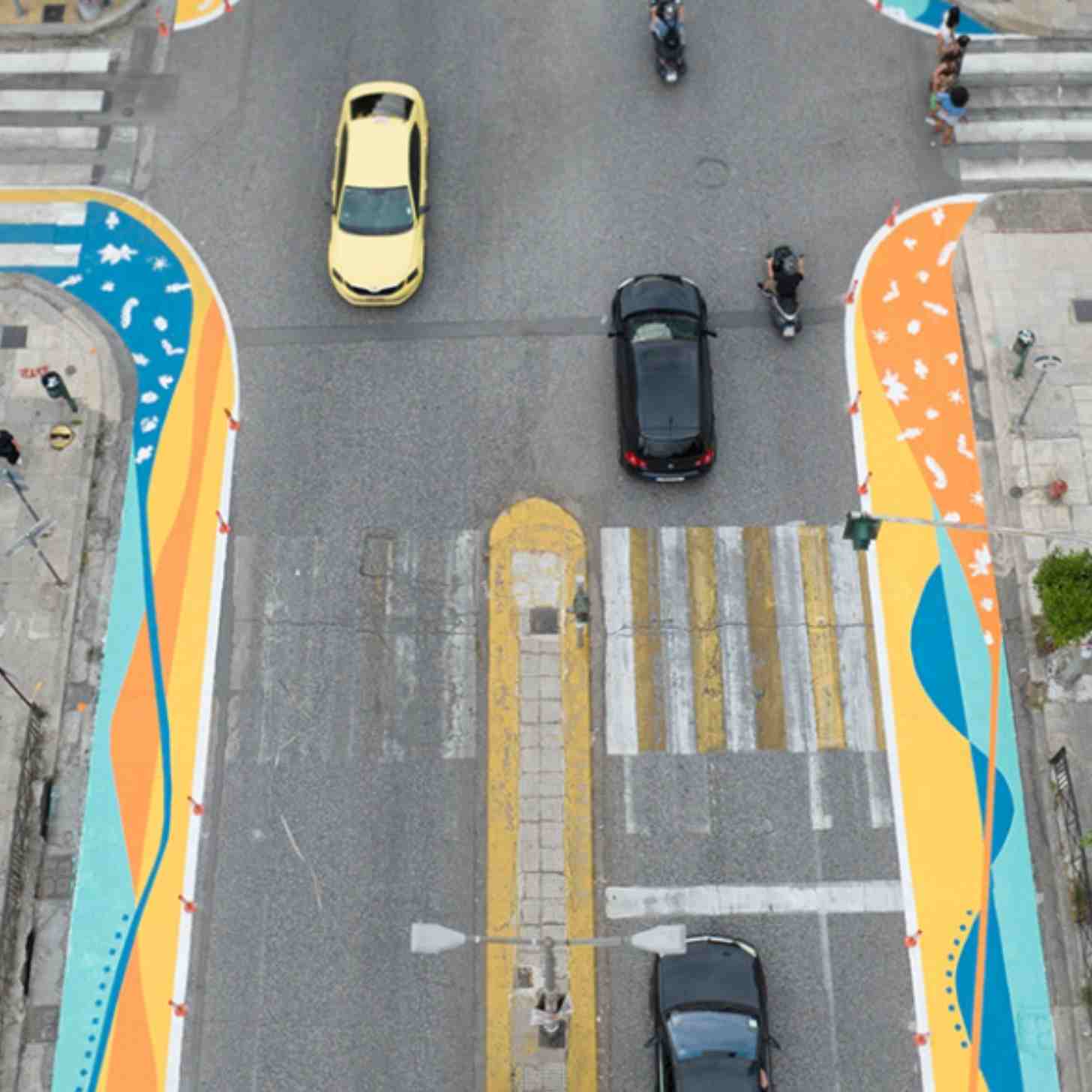
In Kaisariani, the program assembled a team of urban planners, architects, and designers to redesign the intersection with safety in mind. They also included a group of local schoolchildren, who brought their vision of a colorful city to life.
After buckets of paint and freshly installed traffic barriers, the project dramatically reduced the risk of traffic accidents without the cost of upending and rebuilding entire city blocks of concrete sidewalks.
In just a few days, the newly painted intersection boasted wider walking paths and improved the crosswalk visibility for pedestrians and drivers alike.
“We tried to use colors which are bright but not disorienting, because the idea was to bring out the kids’ drawings,” designer Antonia Michalakakou told Bloomberg, in reference to the bright orange, yellow, and blue hues.
On the day of the redesign, local teacher Stella Moisi was happy to roll up her sleeves and help paint the children’s designs of stars, sunbeams, and robots. She was surrounded by her students, who brandished paint rollers and brushes and gasped as their art sprang to life on the pavement.
“It’s a street that students cross often,” Moisi smiled. “Which is why we are delighted to decorate it.”
A version of this article originally appeared in the 2024 Art Edition of the Goodnewspaper.
Header image via Asphalt Arts / Bloomberg Philanthropies
Last summer, inside the yawning halls of the Parthenon Museum in Nashville, Tennessee sat a collection of pre-Columbian artifacts and antiquities.
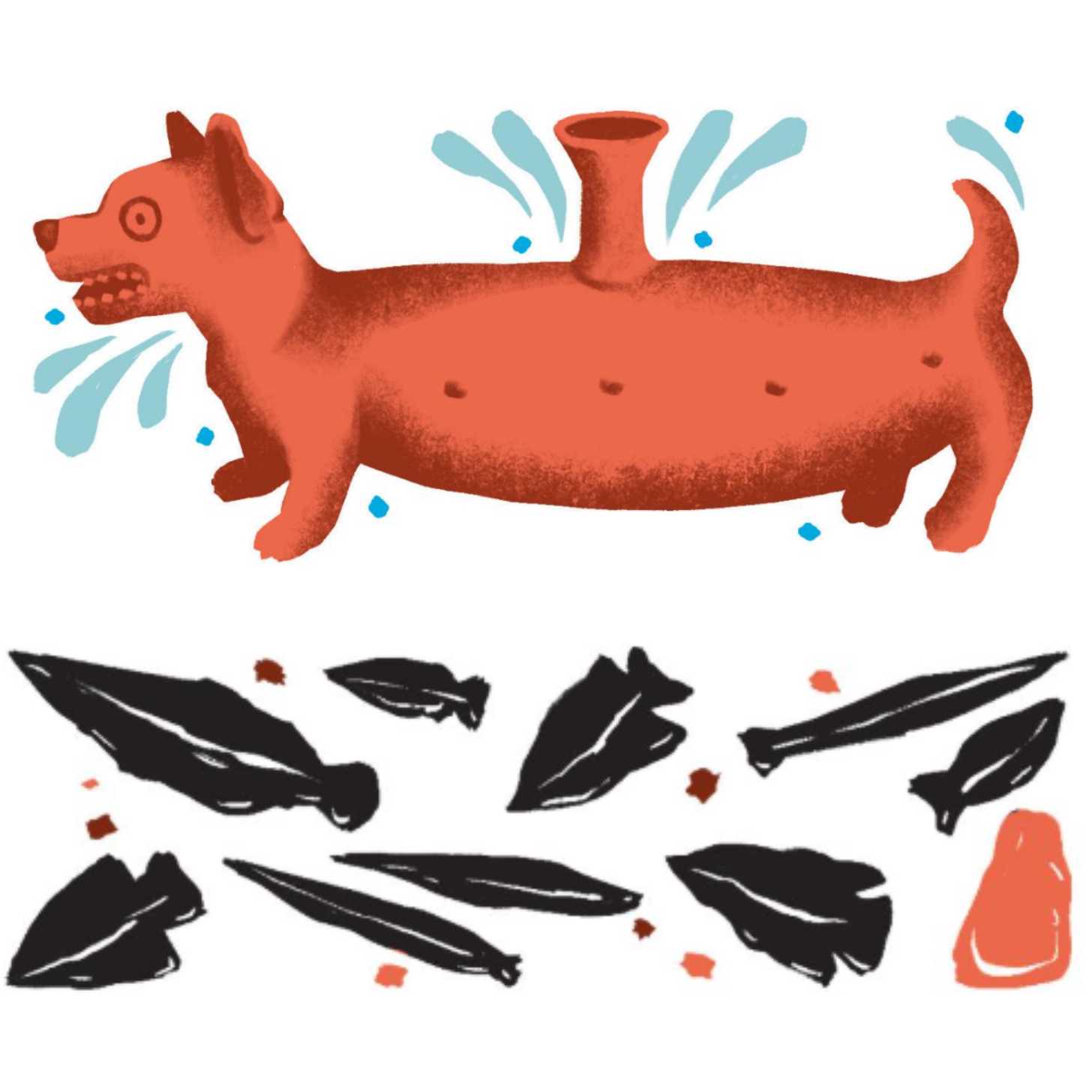
The 250-piece collection — which includes ancient hand tools, obsidian arrowheads, instruments, and clay sculptures — is part of a temporary exhibit titled “Repatriation and Its Impact.” And at the end of the summer, every item was sent back to Mexico.
“I want people to come in and know exactly that this is about not just our collection, but the world,” said Bonnie Seymour, an assistant curator at the museum, in an interview with NPR. “I want to introduce them to the idea of what repatriation is, and that it's not an abstract idea. That it is something that impacts people on a personal level.”
From her very first day at The Parthenon, Seymour was shocked by the sheer number of collectibles on display that were “stolen.”
“They represent someone's ancestors, and we're not them,” Seymour said.
She soon turned to the Mexican Consulate in Atlanta for help with the official repatriation process, which is the act of returning or restoring property to its place of origin. After its “farewell tour” at The Parthenon, the consulate moved the collection to The Mexican National Institute of Anthropology and History in Mexico City.
“By recovering these pieces, we’re recovering a piece of a memory,” Consul General Javier Díaz de León told NBC. “That way, people who live in Mexico have direct contact with pieces that represent how their ancestors live, where they come from and part of our history.”
In turn, the Nashville museum was granted permission to make 3D prints of several key artifacts, including Seymour’s favorite: a sculpture of a Mexican hairless dog. The 3D-printed models will live on in the museum as part of a larger, educational exhibit at the Parthenon.
For young students like Paulina Alvarado, the “Repatriation and Its Impact” exhibit opened their eyes to the impact of colonization on the art world.
“It’s nice to see the culture being shared worldwide,” Alvarado told NBC. “[But] having permission from that culture and from the people to be able to share that culture with others — that’s important to me.”
You may also like: In new heist video game, players return museum artifacts stolen from African countries
A version of this article originally appeared in the 2024 Art Edition of the Goodnewspaper.
Header image via Victoria Metzger / Centennial Park Conservancy
In August of this year, Florida Governor Ron DeSantis ordered the removal of about 400 “non-standard” pieces of street art — most of them rainbow, Pride-themed crosswalks and murals — even though they all received state approval when they were installed.
This began when the DeSantis administration painted over a rainbow-colored crosswalk outside of what used to be Orlando’s Pulse nightclub, where 49 people were killed in a 2016 shooting.
In response, community members repainted the tribute themselves, and many other municipalities attempted to stand their ground and resist the removal of colorful crosswalks and other street installations.
But still, some complied, as the Florida Department of Transportation threatened to withhold state funding for road projects, which could lead to larger financial impacts for communities.
The city of St. Petersburg, for example, publicly shared its disapproval of the removal of its many artistic road-level installations, including a number of Pride-colored murals, and one that read “Black History Matters.”

Despite protests in the area, St. Pete still complied with the DeSantis mandate, promising that it was not a reflection of the city’s commitment to inclusion. (Earlier this year, St. Petersburg was given a perfect score on the 2025 Human Rights Campaign's annual Municipal Equality Index. This is the only nationwide assessment of LGBTQ+ inclusion in municipal law, policy, and services.)
“These murals are more than art — they reflect the soul of our community. That message can't be erased. This is our city, our voice, and our story,” the city shared in a social media post before the murals and crosswalks were removed, urging community members to take photos and share them on social media with the hashtag #CantEraseStPete.
“Together, we’ll continue building a community that is resilient, inclusive, and united.”
Some cities, like Fort Lauderdale, Key West, Orlando, Miami Beach, and West Palm Beach, voted to defy the ban and are challenging the mandate through legal action and ongoing protests.
But St. Pete is still showing up in creative ways for the LGBTQ+ community.
Earlier this week, the city debuted a series of rainbow-colored bike racks in place of a former Pride crosswalk.
“We’ve just installed 11 Pride-inspired bike racks along Central Ave. and 25th St. — a vibrant way to honor the Pride street murals that were removed earlier this year due to state requirements,” a social media post from the city shared.
“These racks were funded through the City’s long-standing public bike rack program.”
In a video, workers in visibility vests are seen securing bike racks into the ground, in colors resembling the order of stripes on the Progress Pride Flag.
Comments flooded in from community members cheering on the new bike racks.
“That’s why I love St. Pete,” one person wrote.
“This is clever,” another added. “Proud of my city!”
Just one example of the strategic efforts to fight back against LGBTQ+ erasure, these bike racks are a signal of resistance, reminiscent of a statement shared by Equality Florida just after the mandate was announced earlier this year.
“DeSantis may paint over rainbows and art, but people are answering with defiance, chalking sidewalks, raising flags, covering cars with stickers, and businesses painting their parking lots with rainbows. These acts declare we are not intimidated and we will not be erased,” Equality Florida Executive Director Nadine Smith said in a statement.
“This isn’t about safety. It’s a cowardly abuse of power and the latest in his campaign to ban books, whitewash history, and attack LGBTQ people. Cities must push back to protect the values that make them welcoming places to live, work, and visit.”
You may also like: A drag queen named Pattie Gonia just raised $1M for charity by hiking 100 miles in full drag
Header image courtesy of Grand Central District/City of St. Petersburg
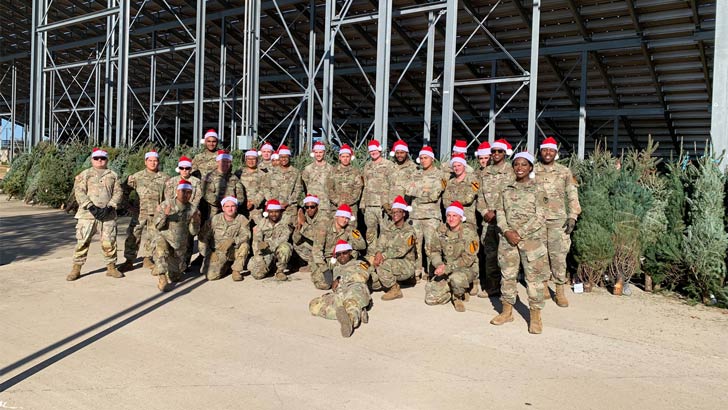
Starting in 2005, a nonprofit called Christmas Spirit Foundation began its “Trees for Troops” program, which distributes free Christmas trees to families and active-duty servicemembers on United States military bases.
Since then, the group’s executive director, Rick Dungey, said over 326,000 farm-fresh Christmas trees have been donated to military families.
“That first year, we were able to do 4,300 trees to five different bases,” Dungey told Fox Weather. “I remember at the time, people thought it was just a crazy idea that wouldn’t catch on, but it did. And now we’re doing our 21st consecutive year.”
While the program brings holiday cheer every December, Dungey said it’s a year-long undertaking to get trees where they need to be.
In 2025, he estimates that the foundation will exceed 19,000 donated trees from more than 340 farms across 28 states.
“Those [trees] have to be gathered together in 56 locations — farms and garden centers — and FedEx picks them up,” he explained. “And they’re going to 94 different bases. And that all has to happen in a 10-day period.”
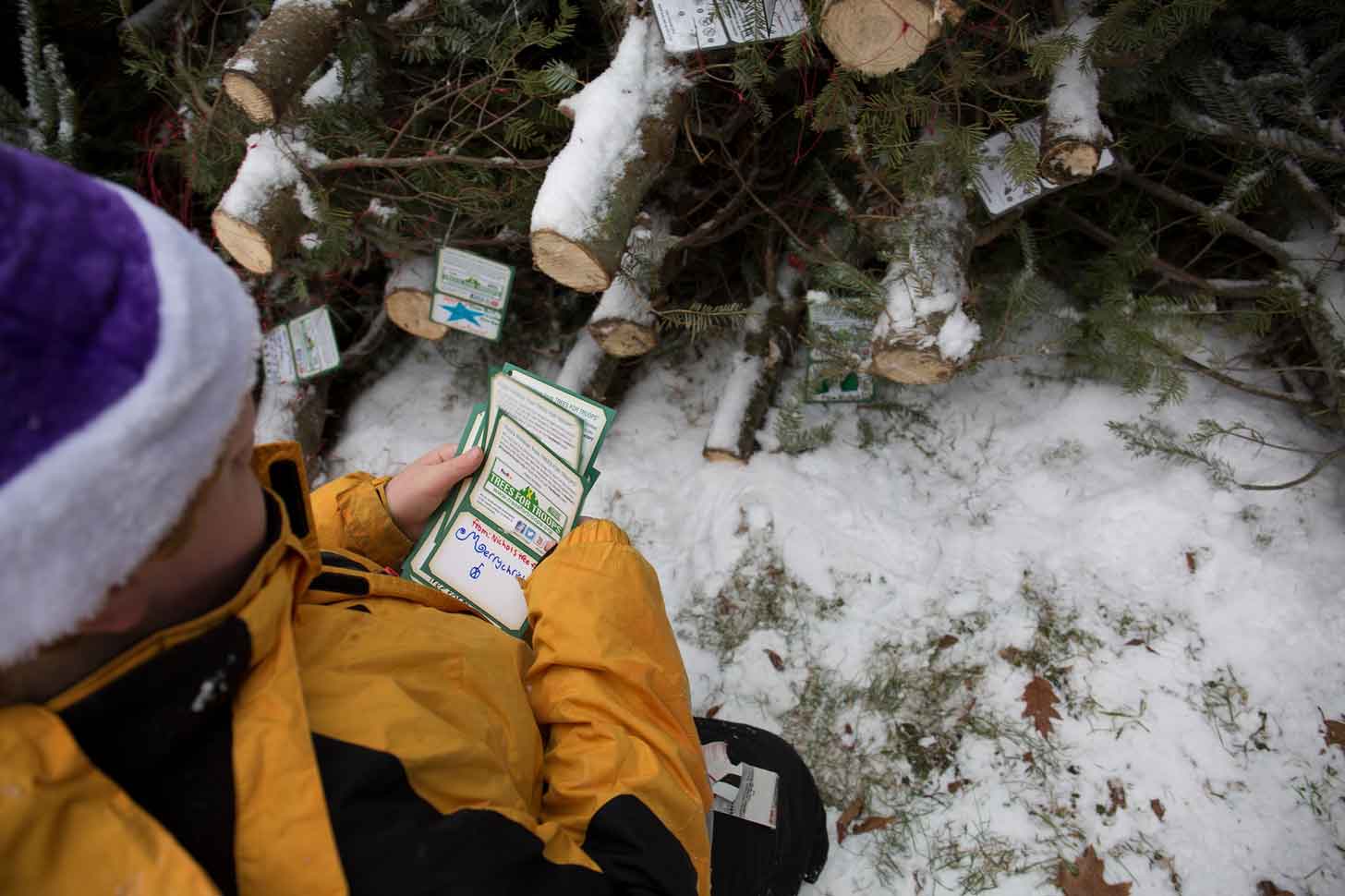
This effort requires all hands on deck, with countless volunteers and community members gathering the trees, hand-writing cards, and even adding handcrafted ornaments made by local children, to be delivered to bases.
At New York’s Ellms Family Farm, state National Guard members joined community members to support the area’s regional pickup for this year’s distribution. The farm has been supporting the program since its inception in 2005.
“Most of them say the same thing, how this reminded them of home and family,” owner Garth Ellms told Military.com, about the troops who benefit from the tree program. “To help our troops enjoy that moment or memory is why we continue to do this.”
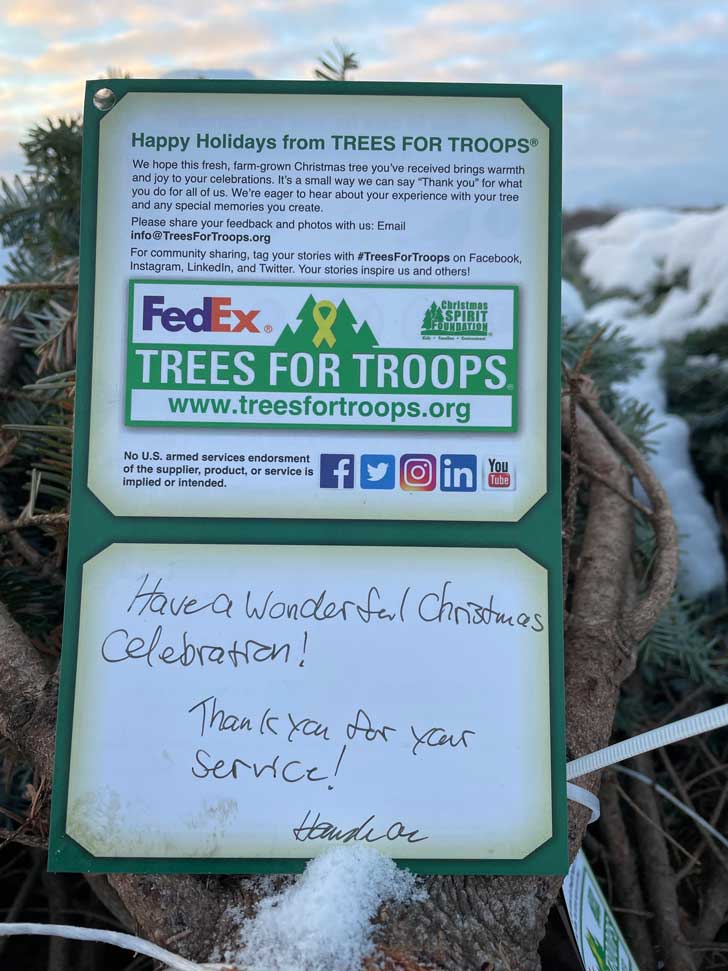
FedEx has also supported the Christmas Spirit Foundation’s mission since the beginning.
“For 21 years, FedEx Freight has been honored to carry more than just cargo alongside the Christmas Spirit Foundation — we carry a piece of home to the doorsteps of our nation’s military families,” Shannon Davis, a spokesperson for FedEx, told Military.com.
“Delivering these trees is our way of saying ‘thank you’ and helping light the holidays for service members and their loved ones.”
The distribution is especially helpful amid increased financial pressure for families across the country, including those serving the military. According to the Military Family Advisory Network, one in four active duty military families experience food insecurity, compared to one in eight U.S. households.
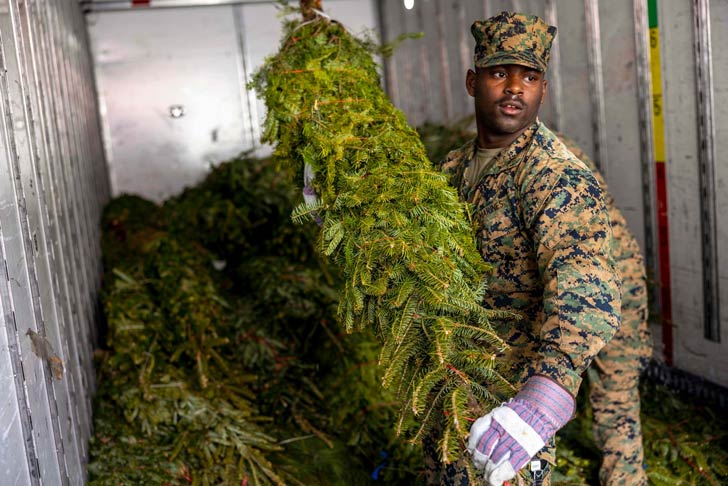
Taking the cost of a Christmas tree out of the budget makes a real difference — and allows service members and their families to truly celebrate the holiday season.
“Nothing says ‘Merry Christmas’ or starts the holidays more than a real tree,” Wendy Richardson of Richardson Farms in Illinois, told Fox Weather. “The smell, the memories of getting a tree — whether it’s at a tree farm or when it’s delivered to the base — it’s a very warm feeling for us to see people appreciating that tree.”
You may also like: School bus driver knits hats for every student on her route: 'I hope they know somebody loves them'
Header image courtesy of Trees for Troops/Facebook
A mini pumpkin toadlet sounds like a confection from the magical world of “Harry Potter,” but it’s actually a miniaturized frog with a bright orange hue that’s roughly the size of a Skittle.
In total, the pumpkin toadlet — formally known as the Brachycephalus — includes 42 recognized species in its genus, 35 of which have only been discovered since 2000.
It’s a type of frog that scientists Marcio R. Pie and Luiz Fernando Ribeiro have become very familiar with in the last several years, as they — and other teams of herpetologists across Brazil — seek to catalog all the Bracycephalus populations in the region.
In 2021, Pie, Ribeiro, and their colleagues discovered a pumpkin toadlet (Brachycephalus rotenbergae) that shines green under UV light.
More recently, on December 10, the researchers published a study in PLOS on a new pumpkin toadlet (Brachycephalus lulai) in the Brazilian cloud forests.
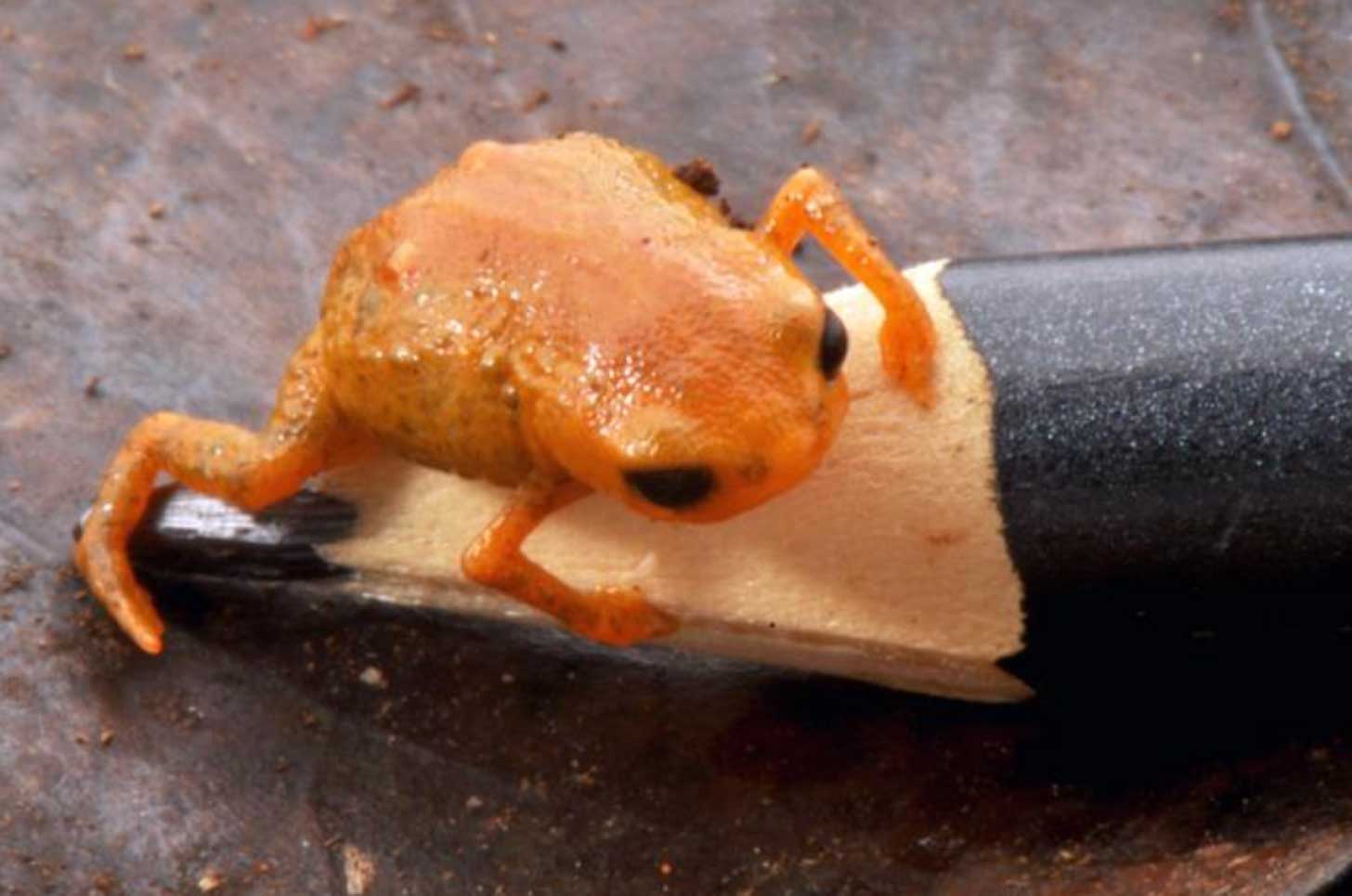
Like other pumpkin toadlets, the B. lulai is so tiny that it can sit on the tip of a pencil (one, in fact, climbed onto Ribeiro’s pencil during their expedition).
Their size makes them hard to spot, but they have a distinctcall that led scientists straight to their hiding spot among the leaf litter in the Serra do Quiriri mountain range.
Typically, pumpkin toadlets are so small that they are exceptionally bad at something most frogs are known for: jumping.
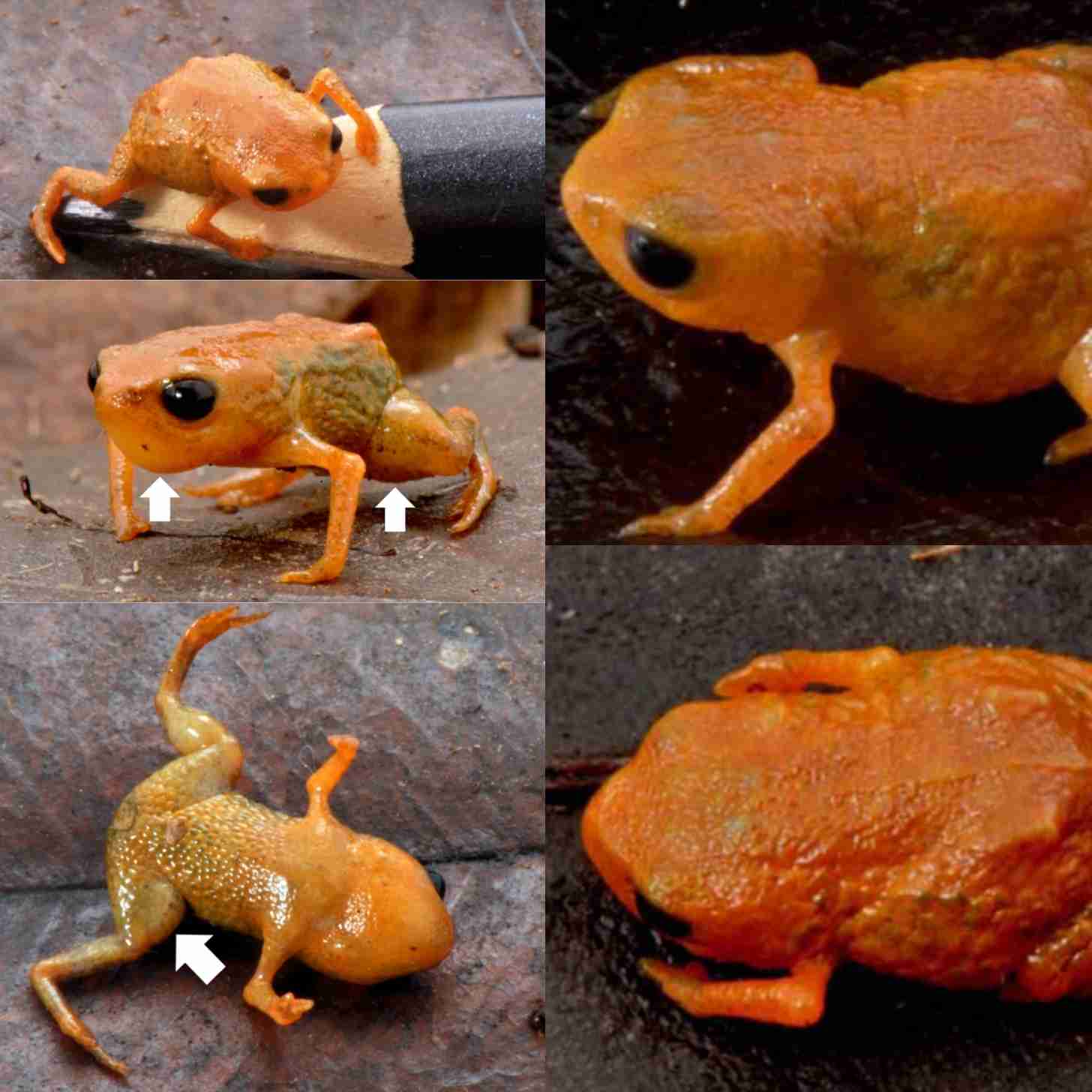
“Without the ability to control [their] posture, these frogs end up flopping backwards and doing backflips quite often,” said Richard L. Essner, a biologist at Southern Illinois University Edwardsville and co-author of the 2021 discovery.
He told CBC that their attempts to jump — and their subsequent tumbles — amount to little more than “uncontrolled landings.”
“They’re actually the worst [at jumping] I’ve ever seen,” he said. “I’ve looked at a lot of frogs jumping and, yeah, they take the prize.”
Despite their uncoordinated way of hopping through the world, pumpkin toadlets are highly poisonous. It’s a strength that allows them to hold a favorable spot in the animal kingdom, with a species designation of Least Concern on the IUCN Red List of Threatened Species.
Essner called it an “evolutionary trade-off.”
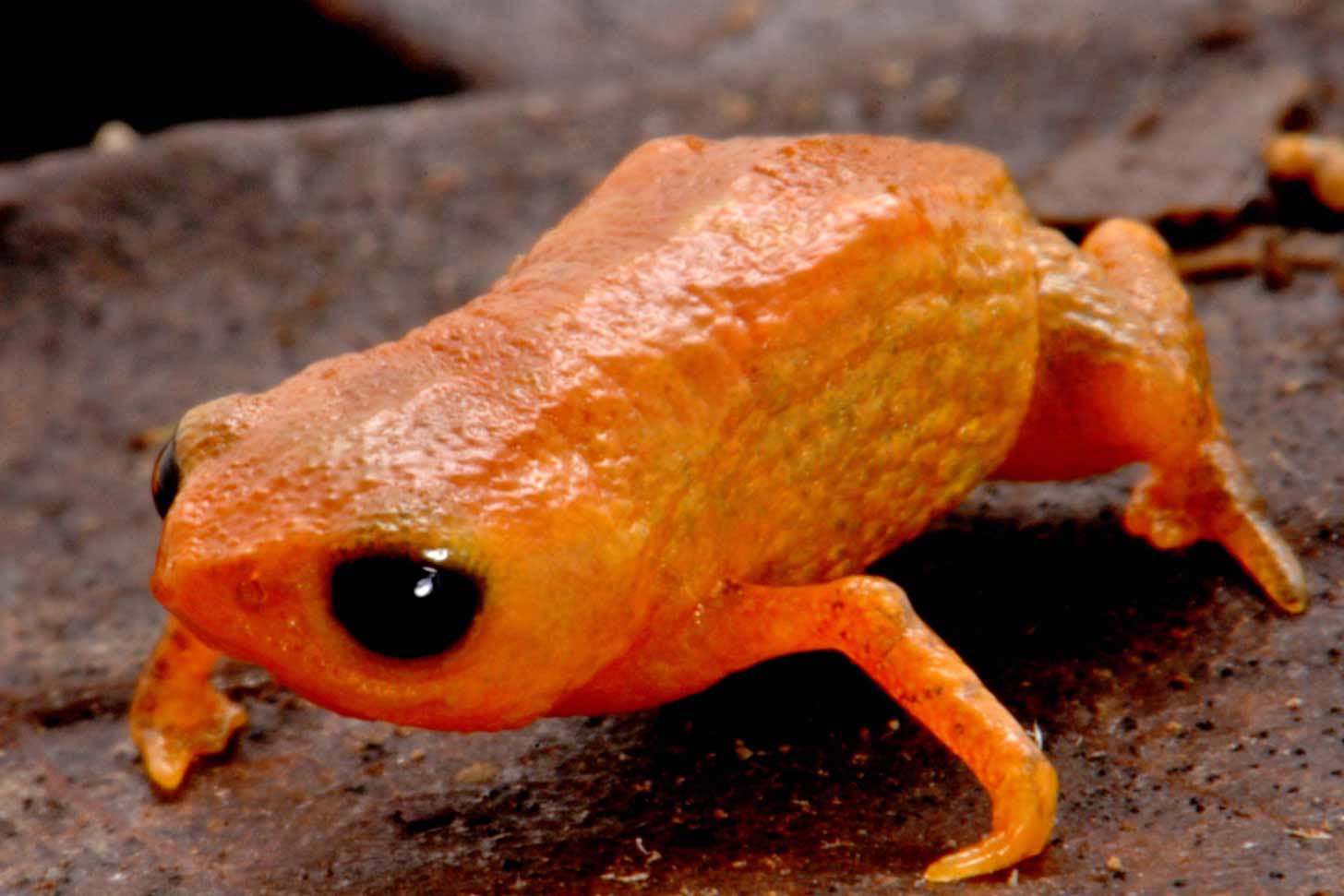
“So maybe the cost is you can’t control your landings very well. But on the other side .... because they’re so small, they probably have access to tiny invertebrates as a food source that other frogs may miss or not be interested in because it’s not worth their effort,” Essner said.
“For a tiny frog like this, even an ant is a really large meal.”
Despite the miniaturized frog’s resilience, Pie, Ribeiro, and their colleagues called for conservation measures to protect all frogs in the region from human disturbance, mining, and deforestation — especially for ones that are critically endangered.
“Possible management actions in the Refúgio de Vida Silvestre Serra do Quiriri could include a diagnosis of the impact of fire, management of grasslands with plots for controlled and rotational burning, establishment of a low-impact cattle stocking rate, reassessment of the impact and mitigation actions for kaolin mining, the cutting of Pinus, and the establishment of a plan to regulate tourism activities,” the researchers wrote.
You may also like: Scientists discover three new species of toad that give birth to tiny 'toadlets,' skipping the tadpole phase altogether
Header image via Luiz F. Ribeiro (CC-BY 4.0) / Chrisporto (CC BY-SA 3.0)
Every day the Good Good Good team collects the best good news in the world and shares it with our community. Here are the highlights for this week!
If you want to get good news in your inbox every day, join the Goodnewsletter — the free daily newsletter designed to leave you feeling hopeful.
The Best Positive News We’re Celebrating This Week —
After the 2026 Winter Games, Milan’s Olympic Village will become subsidized housing for locals
The 2026 Winter Olympic Games take place in Milan, Italy and surrounding areas. With six Olympic Villages planned across Northern Italy, two stand out as uniquely sustainable.
In the heart of Milan, the main Olympic Village is not only being constructed on an abandoned railway yard, once it’s done housing Olympians, it will also be converted into student housing and provide 1,700 beds — including subsidized options — to locals.
And in Cortina, a temporary village will be constructed and then removed post-games to restore the area as an open, natural space.
Why is this good news? While cities where the Olympic Games are hosted see a huge influx of visitors and economic boosts, much of the construction that goes into preparing them to host various sports can be wasteful. It’s exciting to see that the hosts are taking this into consideration when building for the Games!
In New York, researchers are spending $4M to study your garbage. Here’s what they hope to find
→ Read more
A school bus driver knits hats for every student on her route to fight clothing insecurity — and show she cares
Tina Hutcherson has been a school bus driver for the Putnam City School District in Oklahoma for over a decade — and she’s been a knitter and crocheter for over 50 years.
After her daughter gifted her a knitting machine, it has made it easier to keep up with her hobby. So much so, Hutcherson decided to make a hat or scarf for every student on her bus route — using colors they’ve picked themselves.
“I just don’t want nobody to be without, especially when they're riding with me,” Hutcherson said. She drives around 100 students to school every day and has knit and distributed 25 hats to elementary schoolers so far.
→ Read more
Thousands of strangers raised over $1.7 million to help an 88-year-old veteran retire
On December 1, social media influencer Samuel Weidenhofer posted a video interviewing 88-year-old Ed Bambas, who works as a cashier at a Meijer grocery store in Detroit.
Bambas told Weidenhofer he lost his pension and health insurance around the same time his wife was sick, and he sold his home to cover her health care costs. She passed away seven years ago, and he’s working to pay off his debts.
Thousands were moved by Bambas’ story, and the video went viral, gaining 8 million views, and donors gave more than $1.5 million in three days. In total, over $1.7 million was raised to help Bambas retire, in what Weidenhofer said was one of GoFundMe’s largest-ever individual fundraisers.
Why is this good news? While no person, let alone a veteran, should find themselves in this type of situation, it’s an encouraging reminder of the generosity and goodness of human beings — more than 50,000 of them came together to help Bambas.
A couple sheltered 50 people fleeing San Jose mall shooting in their home: ‘They were like angels’
Measles deaths have declined by 88% globally since 2000, saving nearly 59 million lives
Thanks to global vaccination efforts, there’s been an 88% drop in measles deaths between 2000 and 2024. The measles vaccine has saved nearly 59 million lives in that time frame.
An estimated 95,000 people, mostly children under 5 years old, died due to measles in 2024 — among the lowest annual death tolls recorded since 2000. It’s still heartbreakingly high for a preventable disease with an effective, low-cost vaccine available.
While deaths declined, cases have risen. Except, notably, in Africa, which saw a 40% decline in cases from 2019 to 2024, and a 50% drop in deaths over the same time period.
Connecticut pioneered a model to directly develop solar for towns, schools, and low-income housing to lower energy costs
Connecticut Green Bank was the country’s first green bank, and its Solar Marketplace Assistance Program Plus has deployed $145 million on nearly 54 megawatts’ worth of solar projects in sectors that private lenders and developers would typically avoid because of perceived risks or low returns.
The revenues it generates from its projects are used to expand a pool of capital to fund other projects and help the state achieve its clean energy and environmental justice goals.
Despite being the third-smallest state, Connecticut is now ranked fifth in the country for solar capacity installed on K-12 schools. It’s second, behind only Hawaii, in the percentage of K-12 schools with solar.
Why is this good news? With federal clean-energy tax credits disappearing and energy costs on the rise, making the switch to solar — for cities, states, schools, and even individuals — is increasingly challenging. This new approach makes it more accessible and could be a model for other states to follow.
No more ‘heart vs. head:’ New study shows how empathy and reasoning both inspire us to help others
Amid dwindling national investment, Portland is giving out $64 million in clean energy grants
Portland just approved $64.4 million in funding for 60 nonprofit-led projects that will help the city reduce its greenhouse gas emissions and advance the clean energy transition over the next five years.
The projects tackle building more affordable and energy-efficient homes, workforce development, helping residents access electric vehicles, and more.
It’s all being doled out through the Portland Clean Energy Fund, a first-of-its-kind, voter-approved climate action program. The city has so far allocated $1.71 billion in PCEF funding, supporting over 220 nonprofits with 381 total grants awarded.
Billionaire philanthropist MacKenzie Scott donated $7.1 billion to nonprofits in 2025
A significant increase in her annual giving compared to recent years, MacKenzie Scott announced a total $7.1 billion in donations to nonprofits in 2025.
In 2024, Scott donated $2.6 billion total, and in 2023, $2.1 billion. With this year’s donations added in, she’s donated $26.3 billion since 2019. This year, her giving was largely focused on DEI causes.
Notably, Scott’s donations come as no-strings-attached gifts to their recipients. She’s also often quiet about the gifts, and in this announcement wrote that “... any dollar amount is a vanishingly tiny fraction of the personal expressions of care being shared into communities this year.”
Good context: In 2020, Scott signed the Giving Pledge — a promise by the world’s wealthiest philanthropists to give the majority of their wealth to charitable causes — so far, though, her donations have far outpaced many of her peers.
The secret to getting kids off their phones? A homework assignment that sends them into the real world
Just by opening a new browser tab, thousands of people have raised $2 million for nonprofits
Tab for a Cause is a free web browser extension that allows people to raise money for charity simply by opening a new tab on their computer. Its tools have now officially generated more than $2 million for nonprofits.
The browser’s mission of “lowering the barrier to charitable giving so more people can participate” has done just that for its thousands of users.
The money raised has removed 20,000 pounds of ocean plastic, planted 100,000 trees, given 150,000 essential vaccines, and more.
Activists offered $1 million to create the first-ever Climate Nobel Prize, ‘if the Nobel Committee agrees’
A group of climate activists, led by tree-planting search engine Ecosia, launched a campaign pressuring the Nobel Committee to create a Climate and Planetary Health Nobel Prize.
The group argues that Alfred Nobel created the prizes to “serve the greatest benefit to humankind,” and that right now, “this means protecting the planet we all depend on.”
Currently, the Nobel Prize covers six categories with winners, or laureates, receive a €1 million endowment, along with a medal or diploma honoring their achievements. Ecosia has offered to cover the first endowment of €1 million (about $1.17 million USD) and would be “open to extending its support over time.”
Why is this good news? Nobel prizes aren’t just symbolic — they’re precedent-setting. Kroll said, “[It’s] an acknowledgement that inspires courage, creates urgency, and drives momentum for solutions. It would not just be a symbol, but could truly shift how the world values climate action.”
Absenteeism rates plummeted at this middle school after incentivizing students to ‘pie a teacher’
→ Read more
Newly uncovered fossils prove that sea cows have been protecting oceans for ‘tens of millions of years’
As gentle giants who both graze in the tranquil coastal shade of seagrass meadows, manatees and dugongs share the cheeky nickname: “sea cows.” And now a new study is further illuminating their ancestry, thanks to a treasure trove of fossils uncovered in southwestern Qatar.
By eating roughly 10% of their body weight in seagrass each day, the sea cows help maintain the health of sea grass beds — which in turn capture carbon and house vulnerable marine life.
They also help the environment by pooping in these underwater habitats, a natural fertilizer that recycles nutrients back into the ocean. The new fossils reveal that “this has probably been going on for tens of millions of years.”
→ Read more
More good news of the week —
The Institute of Museum and Library Services is reinstating all grants that were previously terminated by the Trump administration. Earlier this year, the IMLS was the target of an executive order that terminated grants that had previously been awarded, which benefit libraries and museums across the country. The cuts particularly hurt small and rural libraries.
A major airline is giving away free gift cards to 100k people who perform an act of kindness. Delta’s Holiday Medallion cards are not connected to a person’s loyalty status or flight activity, but rather are reserved for “customers who truly embody the holiday spirit.”
Mexico announced it was boosting the minimum wage by 13% and plans to limit the work week to 40 hours in 2030. Starting in January, the minimum wage will rise to $17.37 per day, and President Claudia Sheinbaum pushed back against critics who said it would lead to higher inflation, arguing that it actually helps significantly reduce poverty.
U.S. students studying housing, health outcomes, sustainability, and prison reentry programs won 2026 Rhodes scholarships. The students will attend the University of Oxford as part of the Rhodes scholar program, which awards more than 100 scholarships worldwide each year for students to pursue two to three years of graduate studies.
A coalition of more than 230 environmental groups has demanded a national moratorium on new datacenters in the U.S. They’ve urged members of Congress to halt the proliferation of energy-hungry datacenters, accusing them of causing planet-heating emissions, sucking up vast amounts of water, and driving up the cost of electricity for everyday Americans.
Chile became the latest country to outlaw the use of mobile phones and other smart devices in schools. Joining schools in France, Brazil, Hungary, the Netherlands, and China, Chile will restrict smartphone use among elementary and middle school students to reduce its harmful effects and curb classroom distractions.
Through summer camps and scholarships, Girls Who Code is on track to close the tech gender gap by 2030. The nonprofit has served approximately 760,000 young women and nonbinary students in middle and high school, with 50% of them from historically underrepresented groups.
New York City tied its record for the longest stretch without a homicide. During the first 11 months of the year, New York City saw its lowest number of shooting incidents (652) and shooting victims (812) in recorded history, and in November, murders were also at the lowest level ever.
Largely serving southern California, Utah’s largest coal-fired power plant is no longer operating. The Los Angeles Department of Power and Water quietly shut the facility down with no impact on customers. Utah’s legislature blocked the Intermountain Power Agency from fully retiring fossil fuel units this year, but no buyer stepped up to keep it running.
Around 118 million women across India are receiving unconditional cash transfers for unpaid household work. The program makes India the site of one of the world’s largest and least-studied social-policy experiments: paying adult women simply because they keep households running, bear the burden of unpaid care, and form an electorate too large to ignore.
A Colorado city is making its largest one-year investment in affordable housing, distributing $21 million this year. The funds went to two organizations that will add 184 affordable homes to the city’s inventory.
A groundbreaking new therapy has reversed aggressive and incurable blood cancers in some patients. Involving precisely editing the DNA in white blood cells to transform them into a cancer-fighting “living drug,” the first girl to be treated is still free of the disease, and 64% of 10 more patients are also in remission.
Detroit restaurant owners turned their space into an art gallery that supports Black artists. Originally, Detroit Pizza Bar split its food operations and art showcases between the first and second floors, but now, the restaurant and art gallery are one in the same.
A Denver middle school cut chronic absenteeism in mere months using peer accountability and incentives. The school, which serves nearly 300 students, now averages above 92% daily attendance, exceeding its goal of 92%. Before the program, the school averaged about 85% daily attendance.
Chinese researchers developed a breakthrough stem cell therapy that reversed Parkinson’s. One of the six participants part of the study reportedly saw a dramatic decline in symptoms like tremors and rigidity, with their score dropping from 62 to 12, resembling that of a healthy individual.
White storks will make a historic return to London after being extinct in the area since 1419. Following a successful reintroduction nearby, the birds will be brought back to the city as part of an ambitious rewilding effort to bring charismatic nature into busy city communities.
An affordable housing partnership is addressing both housing and skilled trade worker shortages. A Colorado city is partnering with a local school district and Habitat for Humanity to teach kids trades by building homes that working people can afford.
A plant-based, 3D-printed surfboard provides smooth rides and prevents microplastic pollution. Swellcycle is a new line of bespoke, 3D-printed surfboards made from a biodegradable plant material with almost no waste, as opposed to regular surfboards, which are made from petroleum-based foam blocks, much of which is wasted and ends up in a landfill.
An organization is supporting pro-climate candidates in under-the-radar races at the state or city level. Analysts have estimated that 75% of the commitments that the U.S. made at the Paris climate agreement — which President Trump pulled the nation out of as soon as he took office — can be reached entirely without federal support.
Over the course of 16 years, volunteer “citizen scientists” helped red squirrels return to an area of Scotland. It is thought that without the Saving Scotland’s Red Squirrels project, the red squirrel population in Aberdeen could have disappeared, and grey squirrels, which are native to North America, would have expanded in the north east.
One in 10 babies in the U.S. — nearly 374,000 infants — were born preterm in 2023, meaning before 37 weeks of pregnancy. More than 15% were very preterm, meaning they were born before 32 weeks. A full-term pregnancy lasts 40 weeks.
Florida’s rate is slightly higher, at about one in nine babies born preterm. In an average week, 456 of the 4,257 babies born in the state will be preterm, and 75 of those will be very preterm.
According to the March of Dimes, preterm birth and low birthweight-related health complications cause 37.5% of infant deaths nationwide. This makes preterm birth the second-leading cause of infant deaths, after birth defects. Preterm babies who survive infancy are susceptible to health complications later in life, including cerebral palsy and learning disabilities.
Preterm and low-birthweight babies — those weighing less than 5.5 pounds (2,500 grams) — are far more likely to go to the neonatal intensive care unit, or NICU. Very preterm infants tend to have the longest NICU stays, averaging around 43 days.
Beyond the emotional toll this takes on a family, preterm births and their resulting health complications carry substantial financial costs. The average NICU admission in 2021 cost around US$71,000. And economists estimated the lifetime societal cost of all preterm babies born in 2016, from birth to subsequent disability care, at $25.2 billion.
We are a public policy Ph.D. student and public policy researcher focusing on health policy and population health outcomes.
Recently, we were sifting through the data on preterm and low birthweight rates in the U.S., in search of places that are doing better than average at preventing preterm births. And that is what we found in the Central Hillsborough Healthy Start program, which serves a cluster of Tampa ZIP codes with roughly 177,000 residents.
In 2008, this program published records showing 30% lower preterm and low-birthweight rates among families at highest risk. Peer-reviewed evaluations link participation in the program to substantial reductions in preterm and low-birthweight outcomes.
These remarkable improvements remained consistent through 2020.
When we looked at what this program is doing, we found a set of practices that can serve as a model for other counties in Florida and around the U.S. to lower preterm birth rates, saving money and, more importantly, lives.
Screening for risk factors
The program does early screening for risk factors of preterm birth using Florida’s Healthy Start prenatal risk screen at the pregnant person’s first prenatal visit. This screening has been proven to correctly flag a good share of higher-risk pregnancies, while avoiding many false alarms, helping scarce services reach families who need them most.
This is key, because the risk of preterm birth isn’t spread out evenly across all pregnancies. The neighborhoods that Central Hillsborough Healthy Start serves include many young, Black, unmarried, low-income families that are eligible for Medicaid. All of these factors place them at high risk for preterm birth.
Early screening allows the Healthy Start program to identify mothers at highest risk and tailor its resources to assist them.
Measuring against the rest of the state
The Florida Healthy Start prenatal risk screen is available throughout the state. Florida created Healthy Start in 1991 precisely to reduce infant deaths and low birthweight through universal prenatal and infant risk screening, community coalitions, and coordinated services.
While Florida’s preterm birth rate in 2023, the most recent year for which there is data, was 10.7%, Hillsborough County tracked slightly below the U.S. average of 10.4% at about 10.2% of the county’s 16,900 births.
That difference may seem small, but it represents 85 fewer preterm babies in Hillsborough County, and at the average rate of $71,000 per NICU admission, that’s about $6 million in hospital spending avoided in a single year.
In addition, statewide, 14.8% of Black infants were born preterm in 2023, slightly higher than the 14.65% average across the U.S. In Hillsborough County in the same year, it was 13.9%.
Among pregnant women without a partner, participation reduced very preterm births by 52% and halved the rate of very low-birthweight babies — that is, babies weighing less than 3.3 pounds (1,500 grams).
Obese mothers in the program had a 61% lower chance of extremely preterm birth, which means birth before 28 weeks of pregnancy, than comparable women elsewhere in Florida. Even exposure to air pollution, a known risk factor for preterm birth, was less harmful among women in the program.
So what has Central Hillsborough Healthy Start been doing differently?
The Central Hillsborough Healthy Start model
The model used by Central Hillsborough Healthy Start is practical and straightforward.
After early screening, nurses make home visits and help coordinate patient care for mothers in the program.
Central Hillsborough Healthy Start also provides prenatal education, depression screening, and programs to help pregnant mothers improve their health and decrease harmful practices such as smoking or substance abuse. These programs are critical, because obesity, diabetes, hypertension, and smoking during pregnancy are significant risk factors for preterm births.
The program also helps to connect patients to resources they may need during and after pregnancy by making personal introductions to community partners such as women and infant resource specialists in women, infants, and children, or WIC, clinics.
Healthy Start workers also connect patients to interconception care for healthy birth spacing between pregnancies, which can help prevent future preterm births. Studies show that more than 30% of U.S. mothers who give birth preterm conceived their baby less than 18 months after having their previous child.
The Healthy Start staff use Florida’s coordinated intake and referral approach to track referrals and follow up across partners. This is vital to helping the program’s staff see who has been contacted, which services were delivered, and whether referrals took place. They can then follow up if necessary.
Stability and sustainability
Central Hillsborough Healthy Start operates through a local nonprofit, REACHUP Inc., in partnership with the University of South Florida and the Hillsborough Healthy Start Coalition.
Its funding comes primarily from the federal government through the Health Resources and Services Administration’s national Healthy Start program. The program’s current federal funding extends into 2029. But proposed changes to the federal budget threaten to eliminate this funding altogether.
The program’s budget is supplemented by local partners, including Hillsborough County, which helps sustain operations despite federal uncertainty.
Locally, the Hillsborough coalition’s portfolio includes programs that work together like one team, sharing information so families keep getting help even when one grant ends. These partnerships with local community organizations allow the program to remain stable.
A model for others
Looking at the data, we believe Central Hillsborough Healthy Start has succeeded by using the same basic approach for everyone, then customizing. Everyone gets screened early and set up with nurse visits. Then, it adds what each family needs so that support fits real life.
The Central Hillsborough story shows that health disparities are not inevitable. And this model can serve as a feasible blueprint for other communities. With early identification, consistent support, and sustained investment, the outcomes for mothers and babies can improve dramatically.
Read more stories from The Conversation focused on Florida.
This article was written by Loveline Chizobam Phillips and Faye Taxman from George Mason University, and was originally published on The Conversation.
Header Image by Anna Shvets on Pexels

- Trained in air quality mapping, grassroots women leaders monitored air quality across 69 sites in rural areas of Bokaro and Dhanbad in Jharkhand, identifying 26 pollution hotspots.
- Despite the awareness about air pollution’s health impacts, the study found that the public health system is unresponsive and inadequate.
- The research prompted immediate action with the coal company installing water sprinklers, covering coal loads during transport, and setting up air quality monitors in public places.
As coal mine workers begin their day in the village of Jarangdih, the first sound they hear is the whirring of heavy machines. Soon, trucks loaded with coal from the local mines rumble down the roads.
“By afternoon, the air gets bad. Courtyards swept clean in the morning are covered in dust again,” said Rekha Devi, a resident of the village in Jharkhand’s Bokaro district. “And it gets worse in the winter.”
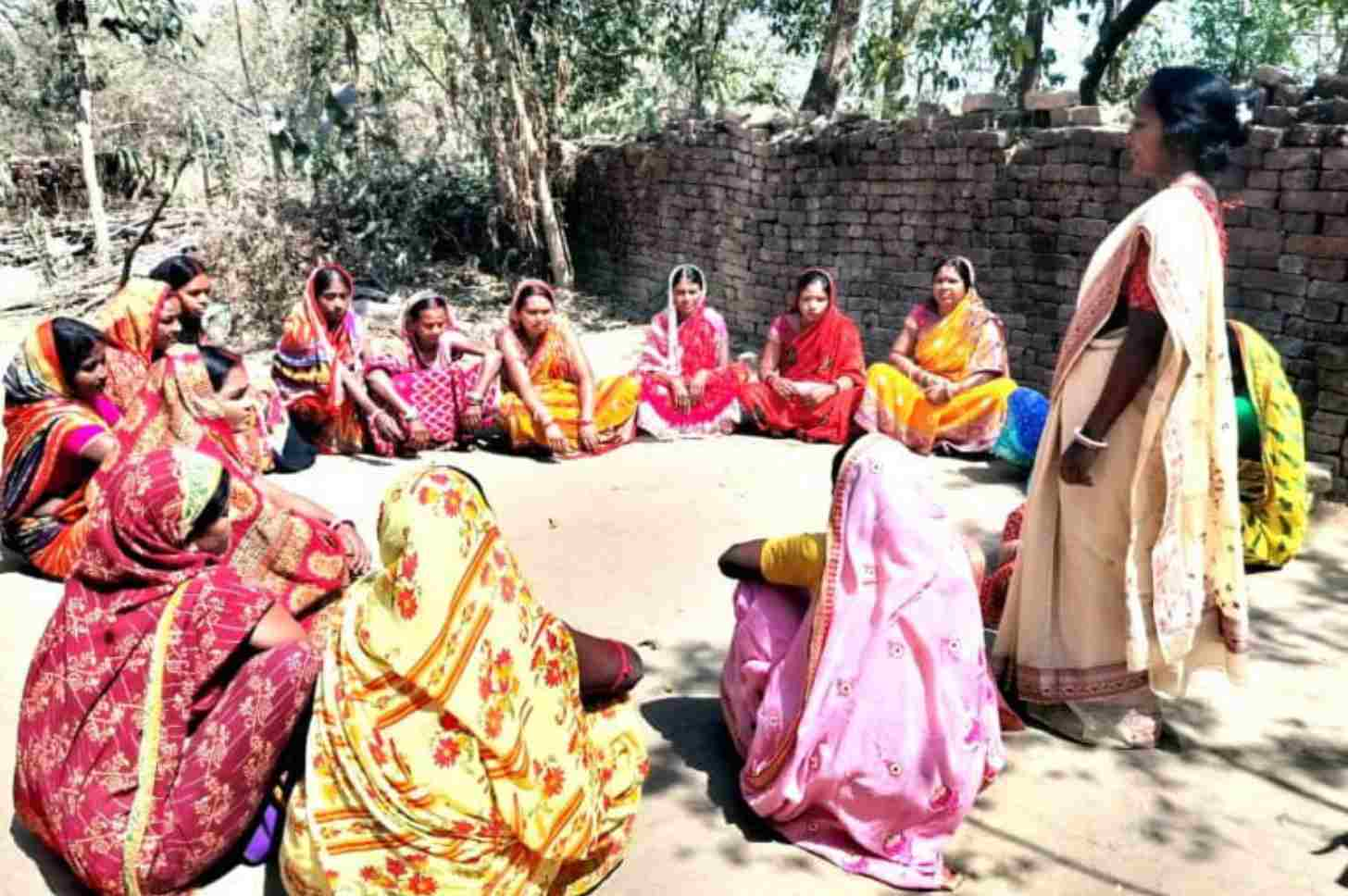
Devi is a paryavaran sakhi (a friend of the environment) and one of the grassroots women leaders, who co-led a recent community-participatory research study published in the Canadian Journal of Action Research in March 2025. The study throws light on the impact of air pollution on public health in rural neighborhoods in Dhanbad and Bokaro, Jharkhand’s two prominent coal-mining districts.
The research was jointly conducted by Neha Saigal and Saumya Shrivastava, who lead the gender and climate change program at Asar Social Impact Advisors and ten paryavaran sakhis, who work with Deshaj Abhikram, a local community organization. Paryavaran sakhi is a model where the women lead environmental efforts in their areas.
The women, trained in air quality mapping, monitored 69 sites for air quality in rural Dhanbad and Bokaro, out of which they identified 26 as air pollution hotspots. Apart from air quality monitoring, the study involved 200 participants in a survey, focus group discussions, and health system mapping, with data collected over nine months in 2022 and 2023.
Today, many states in India are exposed to unhealthy air quality levels. Air pollution causes 2.18 million deaths annually in the country. Jharkhand has a third of India’s coal reserves, with Dhanbad and Bokaro being major mining districts. The level of PM2.5, a type of fine inhalable particles that can only be seen through a microscope, is almost seven to nine times above the WHO limit in Dhanbad and Bokaro.
“This study is very critical because it isn’t a top-down study, which most air pollution studies are. This is a community-led study in places where the government doesn’t even think you need to install air quality monitors,” said Saigal, adding that localized studies can push local governments to find solutions.

The study found air pollution hotspots in unexpected places. Out of 69 sites, 26 emerged as hotspots with PM2.5 levels in poor (91-120 micrograms per cubic meter air or μg/m³), very poor (121-250 μg/m³), or severe (above 250 μg/m³) categories.
Some locations recorded particularly alarming levels, such as a marketplace, which reached 252 μg/m³, and a main road hit 261 μg/m³ (both in Bokaro), more than 50 times the World Health Organization’s recommended limit of 5 μg/m³.
Other air pollution hotspots included not just mining areas but also anganwadis, hospitals, schools, and ponds, frequented by vulnerable populations such as women, children, and the elderly.
“I was surprised to see that places such as the market, which we thought had no pollution, had very high air pollution,” said Devi. This surprised the researchers too, who did not expect such pollution in villages that are more spread out than cities, which tend to be congested, Saigal told Mongabay-India.
Health impacts of toxic air
The study found high awareness of pollution among respondents but also severe health impacts. More than 80% of the participants said they had health ailments associated with air pollution, with all agreeing that their air is polluted.
The local residents reported several short-term health impacts, including cold and cough, breathing difficulties, headaches, and watery eyes. A majority of those with colds and breathlessness were women.
Pregnant women reported feeling sick while cooking on chulhas (stoves that use wood or coal as fuel) or when stepping out in the pollution. According to a study published in July 2025, when pregnant women are exposed to air pollution, they are much more likely to have babies born underweight or premature.
Children and the elderly are disproportionately impacted by air pollution for different reasons, explained Dr. Sumit Ray, who heads critical care medicine at Holy Family Hospital in Delhi. He was not involved in the study.
“The elderly have several years of exposure to air pollution because of their age, and they also have declining organs, which makes them vulnerable to polluted air. Children play and run around a lot, breathing faster and deeper, and air pollution impacts their lung capacity and immunity, which is still developing. If women have added exposure to indoor pollution from cooking on a chulha, it can lead to chronic lung damage,” he told Mongabay-India.

As part of the study by Asar and the paryavaran sakhis, people also reported long-term ailments such as asthma, Chronic Obstructive Pulmonary Disease (COPD), bronchitis, and lung cancer. Community members also reported that children had poorer growth, weakened memory and eyesight, and that life expectancy had reduced among older people.
However, the researchers found that this awareness of air pollution and its health impacts comes with a paradox — the unresponsiveness of the public health system. The study found that the village sub-centers were not equipped for serious ailments, and doctors are frequently absent at health facilities.
It also found that locals often travel up to 45 km to district hospitals for such health issues, which makes treatment expensive. Even at the Community Health Centre (CHC), there aren’t enough people trained to treat serious pulmonary disorders or heart-related issues from air pollution, Saigal told Mongabay-India.
Co-creating research methods with grassroots leaders
The study was conducted in three phases, Shrivastava explained. The first phase was air quality monitoring, where the trained women — paryavaran sakhis — identified sites across neighborhoods and monitored each site three times daily for one month. To conduct this, they received training on using portable AQI monitors. The data they collected was stored on an online dashboard.
“When I went to the open cast mines with the AQI monitor, workers said this would take away their jobs. After I showed them the pollution levels on the monitor, they began to gain awareness about how bad the air is,” said Devi.
The second phase of the study aimed at understanding the community’s perception of air pollution through a survey and focus group discussions around identified hotspots. These discussions involved women and men across castes, occupations, age groups, and economic backgrounds, also ensuring the involvement of marginalized groups.
The third and final phase was health system mapping, in which the women tried to understand whether the public healthcare facilities near the hotspots were accessible. This was achieved through public data, visits to facilities, and interactions with health workers.

On-ground impact of community-led research
Once the study’s results were out, the local women who co-led it took ownership of the data to drive action. They approached stakeholders including the coal company Central Coalfields Limited (CCL), coal unions, district and block officials, and had dialogues with them.
Devi talked about the changes that have happened in her area due to these efforts: The coal company began covering coal with tarpaulin during transportation. They installed water sprinklers at multiple points on roads where coal trucks travel, spraying thrice daily.
They also installed AQI monitors at three public places in Bokaro — at the post office, quarry, and hospital for locals to monitor air quality first-hand. Initially, they installed green netting around mining areas to contain dust. When the netting wore out, they replaced it with a metal sheet on Devi’s insistence. The roads are now swept regularly and the dust collected and removed.
“All this work happened in three to four months because the locals supported us in a big way,” said Devi. She feels now that the dust has visibly reduced.
“These might be very small actions, but they were entirely possible because of the dialogue the sakhis had with different stakeholders. After any research, it’s very difficult and rare to see that kind of impact immediately. This was a win for the study,” said Shrivastava.
According to the researchers, the study’s methodology can be replicated in any part of the country where people want to understand air quality from a hyperlocal perspective and get local decision-makers to take action.
Saumya Singh, who researches urban and rural air quality in India and teaches at the Indian Institute of Forest Management in Bhopal, said in an email interview, “Air pollution is not a big city problem anymore — recent studies, including my work (under publication), show smaller settlements like towns, villages, and neighborhoods experience similar or worse pollution. This study strengthens that evidence from mining belts, which are often overlooked.”
She also praised the study for giving communities evidence to demand changes from coal companies and officials.
However, Singh also noted the study’s limitations: It lacks technical information on the equipment specifications or quality assurance protocols, how a month of monitoring does not capture seasonal variation, and how self-reported health data without medical examinations can’t objectively confirm health impacts.
“The study attributes all health problems to outdoor air pollution, but residents also face indoor smoke from coal cooking, occupational exposure in mines, and pre-existing conditions like anaemia. We can’t separate how much each factor contributes,” said Singh, while adding that the reduction in life expectancy claimed by the respondents needs verification with actual demographic data.
Scaling the model for bigger impact
Going forward, the researchers plan to convert data from the study into action at the state level and test the methodology in other regions where they work on air quality. The local women involved in the research also want to continue using the data to bring more changes on the ground.
Singh said that the next step could be systematically scaling the study’s model to create Paryavaran Vigyan Kendras, district-level centers that train community researchers.
“These centers could provide equipment and technical support whilst local researchers, who understand contexts, do the monitoring. This could train paryavaran sakhis across mining districts, brick kiln zones, and industrial areas, creating district-level environmental health databases linked to government systems.”
Meanwhile, Devi is pleased that her efforts have borne fruit, not just in her neighborhood, but also in people’s homes.
Many families she knows have switched to cooking gas and induction stoves after learning about household air pollution from coal-fuelled chulhas. People have also stopped burning waste in the open and have started taking it to the public bins in the village, she notes.
This article was originally published on Mongabay.
Header Image courtesy of Deshaj Abhikram
Earlier this year, a herd of giant, life-sized animal puppets went on a global journey to sound the alarm on climate change.
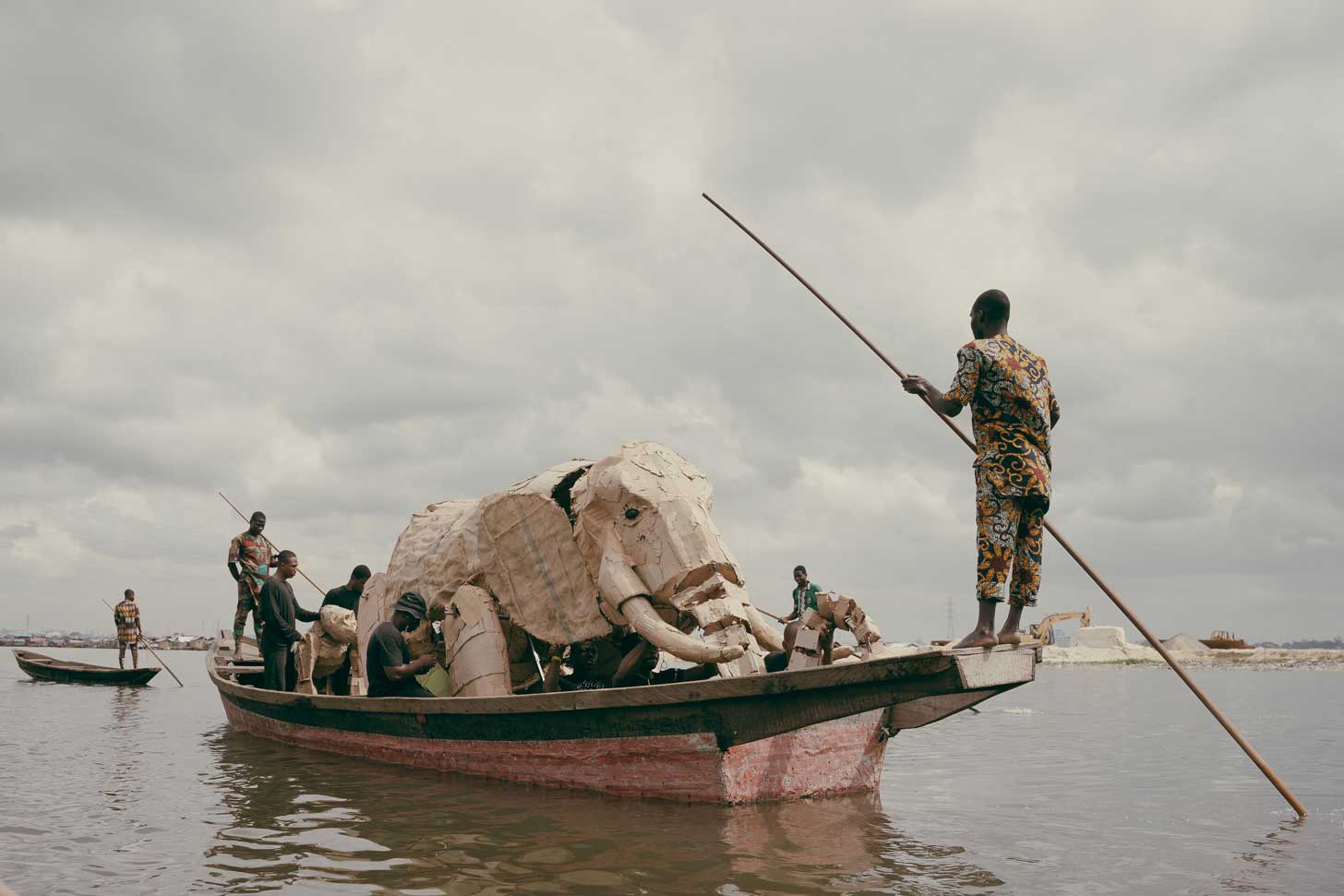
The puppets, made of recycled materials and shepherded by a troupe of about 60 puppeteers, began their journey in the Congo Basin and traveled 20,000 kilometers (or about 15,500 miles) to a melting glacier in the Arctic Circle.
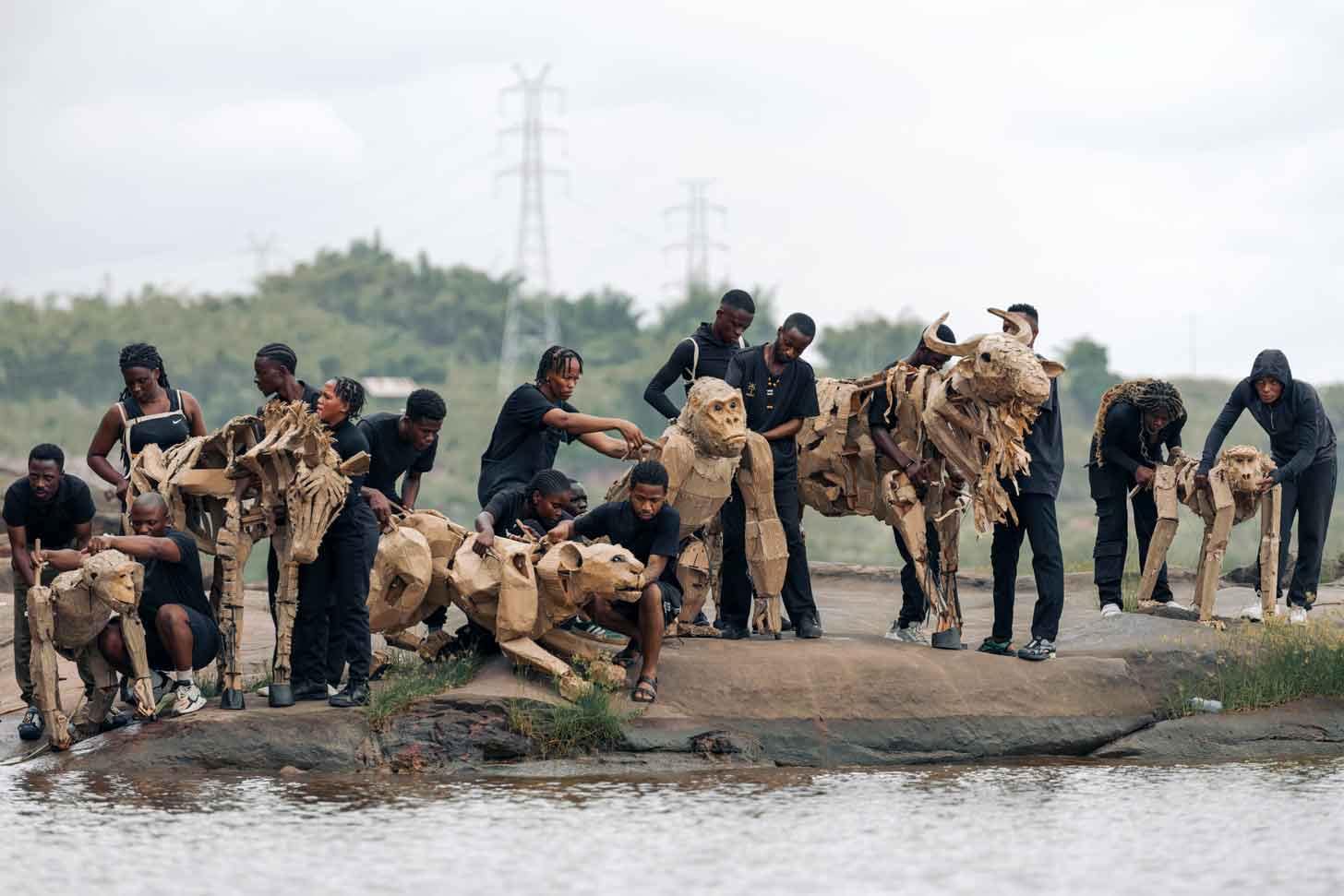
Behind the massive public art activation is The Walk Productions and an international network of producers, artists, and partners.
Together they create large-scale “participatory public art that brings people together in events of artistic excellence, challenging assumptions, rethinking narratives, and provoking change,” according to The Walk Productions website.
Prior to this production — called “The Herds” — the production team was responsible for Little Amal, a 12-foot puppet of a refugee girl who traveled from Turkey to the United Kingdom, interacting with 2 million people in 17 countries along the way.
Artistic director Amir Nizar Zuabi, a Palestinian theater director who has since taken his activism to the world stage, said The Herds came to be as he was touring the world with Little Amal.

“As a young boy, I used to go into the desert in my country, in Palestine, and watch one of nature’s most marvelous phenomenons: the great migration of birds from Africa to Europe and back,” Zuabi said in a 2024 TED Talk, announcing the animal-themed project.
“Twice a year, the sky would darken with millions of birds, herons, buzzards, kites, swifts, storks, all flying in breathtaking formations, all flying home. As I would lay there on the ground, looking up to the sky, these days were defining. They placed me in the world. They were inspiring and humbling. Here I am, one organism, and above me, thousands of other organisms flying for safety.”
He said that as he grew older, the flocks of birds grew smaller, their population dwindling.
“And whilst walking with Amal across Europe, I would often look up to the sky looking for birds. Somehow it felt connected. The migration of people, this misery all around us, felt connected to the migration of birds. Two mirror migrations, now both extremely vulnerable. A sign of a system collapsing,” Zuabi said.
“With that in mind, a nagging question started. Can we create a project that would deal with the climate crisis like Amal dealt with the refugee issue?”
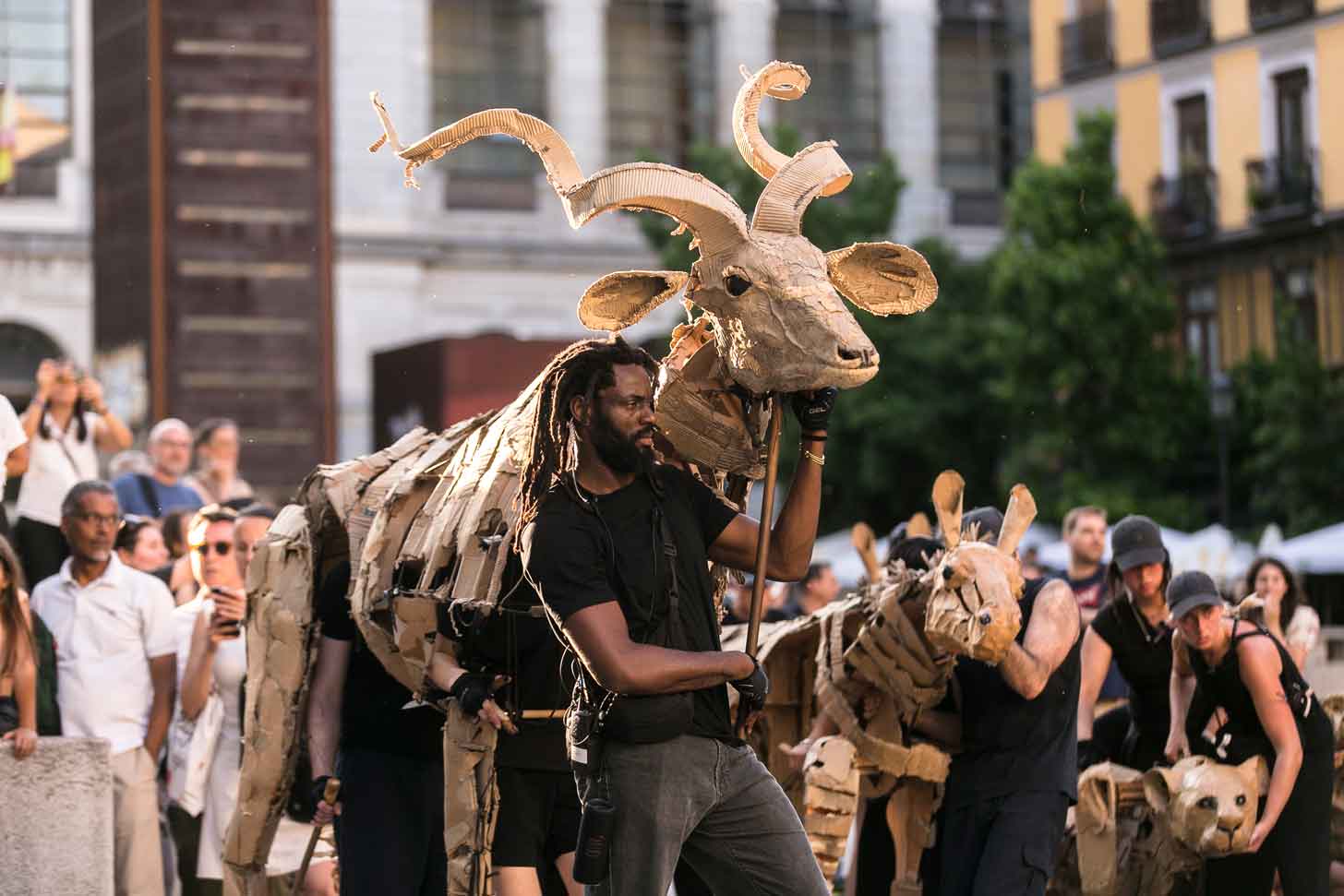
It was then that The Herds was born, designed to tell a story of animals fleeing for safety, only to find themselves at the top of the world, where glaciers melt all around them.

The first set of animal puppets in the troupe was created by Ukwanda Puppetry and Designs Art Collective in Cape Town, South Africa, but as the animals stopped in various locations on their journey, local volunteers were taught how to make their own puppets.
Over the course of the journey, 1,000 people were trained as puppeteers, bringing the creatures to life in 56 public events across 11 countries, according to Euro News.
“The idea is that we’re migrating with an ever-evolving, growing group of animals,” Zuabi told the Guardian.
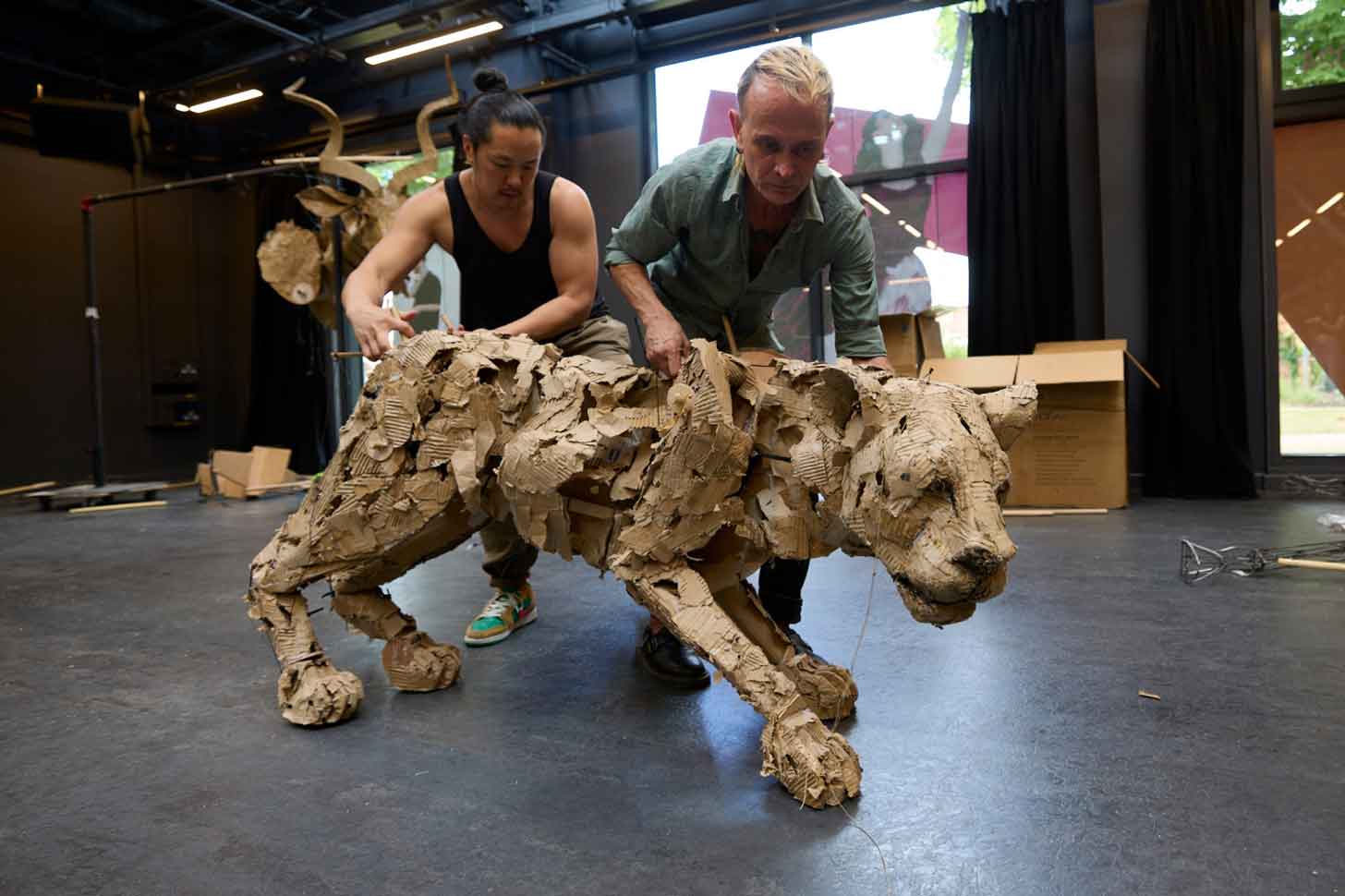
Puppeteers manipulating evocative animals like giraffes, hyenas, gorillas, zebras, and elephants, traveled by foot, by boat, by plane, and more, to reach people in real-life communities.
They began in the Congo Basin Rainforest, making it to the streets of London, and finally, to Jostedalsbreen National Park in Norway.
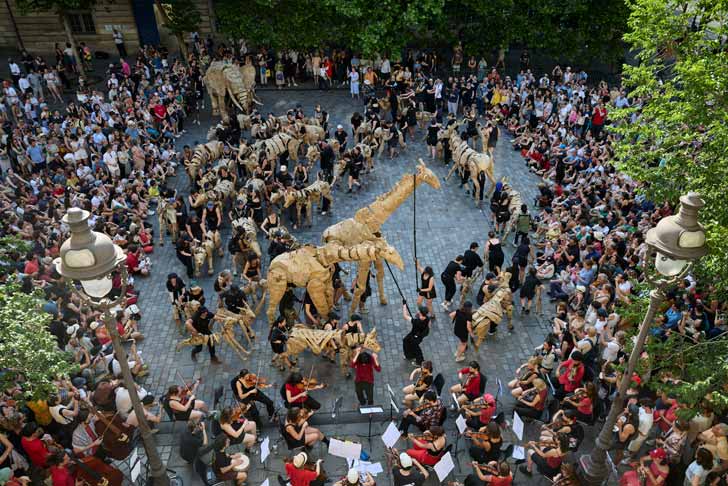
“The Herds will happen in our immediate surroundings, in our familiar. This is important. It needs to happen to us, not to someone else, somewhere far away,” Zuabi told Atmos in July. “It needs to happen where we feel safe, so we understand that we are not safe. They will be an alarm bell, impossible to ignore, a wake-up call, urging us to change our ways.”

This concept mirrors how animals are often the first “early warning system of nature,” as Zuabi described in his TED Talk.
“Birds flocking before volcanic eruptions, herds fleeing before earthquakes. Although we live in a world with constant alarm bells and warnings, the urgency is not registering. We want to disturb this indifference,” he said.
“The Herds will happen to us, around us, on top of us, crashing through our metropolis cities where the effects of climate change are still largely ignored. And they will do that in order to remind us that underneath the layers of asphalt and concrete and vanity, there is nature. And it is wild, vivacious and uncontrollable.”

Ultimately, the goal of the project — which spanned from April to September 2025 — was to use art and emotion to conjure up real concern about the climate crisis.

“I don’t think that we do these projects and the world immediately becomes better, but I want to believe that what we do matters.” Zuabi told Atmos.
“The way we’ve been talking about the climate crisis is through data, through these cold scientific words that don’t really mean a lot to us. That’s not to say they’re not real or important, but they don’t necessarily move us into action. Beauty does. Beauty will make you care.”
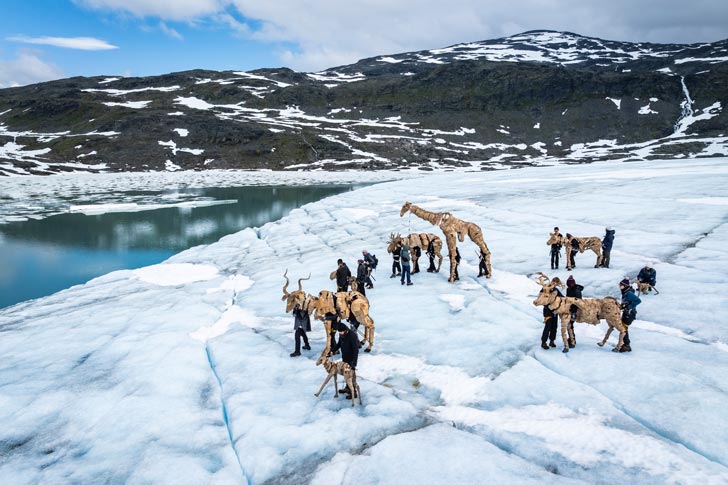
In his TED Talk, he summarized that the project’s intent was also to get people to understand their place in this story — one that, while depicted by fictional puppet characters, is indeed real.
“The minute you add beauty into the equation, it becomes personal, it becomes yours,” Zuabi said.
“And when lions and gazelles … zebras and hyenas … wolves and deer are running together — predator and prey running alongside one another — and they’re running away from us, they’re running away from a disaster that we have created, who are we in that story? What does it say about us?”
You may also like: Activists offer $1M to create first-ever Climate Nobel Prize: 'The funds are ready if the Nobel Committee agrees'
Header image by Vegard Aasen/The Walk Productions
Over the weekend, attackers opened fire at a Jewish celebration at Sydney, Australia’s Bondi Beach, killing 15 people.
The attackers, who police say are a father and son duo, may have caused much more devastation had Ahmed al Ahmed not intervened.
Al Ahmed is a 43-year-old Australian citizen and father of two who immigrated from Syria in 2006. A fruit vendor who was near the scene, el Ahmed had been drinking coffee with a friend near the beach when he heard gunshots, a source close to him told The New York Times.
That’s when he leapt into action. Crouching behind a car in a parking lot just feet away from one of the gunmen, al Ahmed ran toward the assailant and pounced on him to disarm him. The two men wrestled briefly until al Ahmed apprehended a long firearm from the man, who then fell to the ground.

A video circulating online shows al Ahmed pointing the weapon at the assailant, who then got up and stumbled away. Early reports indicate that al Ahmed took four to five gunshot wounds in the process of disarming the attacker and is in stable condition.
On Sunday, Chris Minns, Premier of New South Wales, visited al Ahmed in the hospital and shared a photo on social media site X.
“Ahmed is a real-life hero. Last night, his incredible bravery no doubt saved countless lives when he disarmed a terrorist at enormous personal risk,” Minns wrote. “It was an honour to spend time with him just now and to pass on the thanks of people across NSW.”
Al Ahmed, who is being praised as a hero amid Australia’s worst terrorist attack in decades, is notably a Muslim man who intervened in a coordinated attack on a Jewish Hanukkah celebration.

“He wasn’t thinking about the background of the people he’s saving, the people dying in the street,” al Ahmed’s father, Mohamed Fateh al Ahmed, told ABC. “He doesn’t discriminate between one nationality and another.”
To praise his courage and bravery — and support al Ahmed’s recovery — thousands have donated to a GoFundMe fundraiser. In fact, since the attack, over $1.5 million has been raised by more than 27,000 donors.
While many donations constitute small, individual gifts, one notable contribution comes from Bill Ackman, who gave $99,999 to the fundraiser. He also shared a link to the fundraiser on X and reiterated that “the funds will only be released directly to the hero.”
Messages of gratitude and awe covered the GoFundMe page, with donors from all over the world sharing sentiments with al Ahmed and his family.
“Ahmed, thank you for your extraordinary courage and humanity. Seeing you put your own life at risk to protect others, knowing you have two children at home, was deeply moving,” one person wrote. “You were a light in an unimaginably dark moment. We are deeply grateful that people like you exist. Wishing you a full and speedy recovery.”
“I donated $18 because in Judaism, chai means life. Giving in multiples of 18 is a way of wishing life, strength, and blessing,” another added. “And in this case, it rings very true.”
Editor’s note: An earlier version of this article misspelled Ahmed al Ahmed’s name as Ahmed el Ahmed based on early reporting. The article has been updated with the correct spelling: Ahmed al Ahmed.
You may also like: This couple sheltered 50 people in their home as shoppers fled San Jose mall shooting: 'They were like angels'
In the mobile game “Hay Day,” players can build farms and barns, fish, and raise crops — similar to cozy games like “Stardew Valley” and “Animal Crossing.”
And from December 15 through December 24, users can also find and pet (or rather, tap) virtual huskies and Alaskan Malamutes to support real-world rescue animals.
During the nine-day event, in-game achievements will translate to helping animals at Muddy Paws Rescue in New York City’s Hell’s Kitchen.
“Partnering with Hay Day this holiday season allows us to reach millions of animal lovers in a new and meaningful way,” Rachael Ziering, the founding executive director of Muddy Paws Rescue, said in a press release.
“This ‘Home for the Howlidays’ campaign will not only help us provide vital resources to our pups like food, vet care, and foster kits — it goes one step even further in educating players about the importance of fostering and finding the right homes for pups in need.”
Supercell — which also created the mobile game Clash of Clans — first released Hay Day in 2012.

The farming simulation made headlines in early 2025 when the platform did a crossover event with Gordon Ramsay. But this isn’t their first foray into charitable giving.
In November, Hay Day raised 200,000 meals for families in need through the UN World Food Programme’s ShareTheMeal fundraiser by challenging users to hunt virtual ghosts during their Hay Day Harvest event.
Deborah Mensah-Bonsu, the social impact partner at Supercell, said that the Home for the Howlidays event was the company’s latest way of bringing “Hay Day’s strong sense of community to life.”
“We love our stress-free farming utopia, and together with our players, we get to extend a bit of that harmony and care into the world around us,” Mensah-Bonsu said.
To support Muddy Paws Rescue directly, you can visit their website.
You may also like: This cozy game replaces doom-scrolling with ocean exploring. Every creature you spot trains underwater robots in real time
Header image via Hay Day / Supercell
Seventy miles east of Nassau lies Eleuthera — a skinny, 110-mile-long island that bears an uncanny resemblance to a seahorse when viewed from above.
It’s a fitting shape for the isle, which is now home to the world’s first seahorse national park at Sweetings Pond & Hatchet Bay Caves.
The new park spans 548 acres and protects Sweetings Pond, a landlocked saltwater pond teeming with marine life, and Hatchet Bay Cave, one of the longest dry cave systems in The Bahamas.
“Sweetings Pond is home to the largest known concentration of seahorses in the world and stands as one of the island’s most extraordinary natural treasures,” said The Cove Eleuthera — a local resort that offers guided tours of the pond.
“As we share its magic, we are equally committed to protecting this rare and fragile ecosystem for future generations.”
Through swimming excursions approved through the Bahamas National Trust, Heather Mason teaches guests about the importance of seahorse conservation as they swim in a bioluminescent lagoon.
“Most of the time, you’re going to see just a tiny little piece of the seahorse,” the marine ecologist told AFAR. “You typically look around for tails wrapped around things or sometimes noses. They can change their color to match their background — they are masters of camouflage.”
In June 2026, the lagoon will be open to the public for the first time.
“During this four-day excursion, guests of The Cove will snorkel through serene, protected waters to observe one of nature’s most captivating creatures up close,” The Cove Eleuthera said in a statement.

“Learn about ongoing conservation efforts to preserve this fragile habitat while enjoying guided excursions, educational talks, and the natural beauty of Eleuthera.”
Lined seahorses — which can be found across the Western Atlantic Ocean from Nova Scotia down to Uruguay — are designated as a “vulnerable” species on the International Union for Conservation of Nature Red List of Threatened Species.
Due to their small size and slow movement, seahorses face multiple threats from human disturbances like pollution, construction, trawling, and coastal development. Their unique features and endearing appearance also leave them vulnerable to capture for illegal aquarium trade.
The national park came after more than a decade of research and advocacy from Mason and partners at the Bahamas National Trust.
“I think the fact we are now dedicating this area to a national park is so much in the spirit of what Eleuthera offers, in terms of all that nature brings,” philanthropist Oscar Tang said when the park was first announced. “It’s just wonderful to have this natural gift.”
In an article for AFAR, travel writer Vanita Salisbury described her experience doing an “after-sunset snorkel” with Mason’s research team.
“Everywhere my beam lands, seahorses sit perched upright like tiny sentinels, inch along stems, and sway in slow motion to music only they can hear,” Salisbury wrote.
“And it’s not just them who come alive,” she pointed out. “Maybe darkness emboldens would-be prey, but nighttime turns the pond into an underwater disco: octopuses shuffle between hiding places; crabs scuttle, abandoning meals mid-bite; and bioluminescence glows like submerged stars, reducing grown women to awestruck children — me included.”
You may also like: This 'no-walls, no-doors' rainforest resort in Bali doubles as a firefly conservatory and nursery
Header image via The Cove
In 2012, Brooklyn’s Mike Matthews was at work when one of his coworkers came into the office, lamenting a recent breakup.
As she opened up to him, a singular thought crossed his mind: She needs to talk to Grandma Eileen.
Matthews’ grandma lived in Seattle, and his coworker had never met her, but he gave her Eileen’s phone number anyway.
“She said, ‘Mike, that's so weird. You want me to call your grandma?’” he recalled in a social media post.
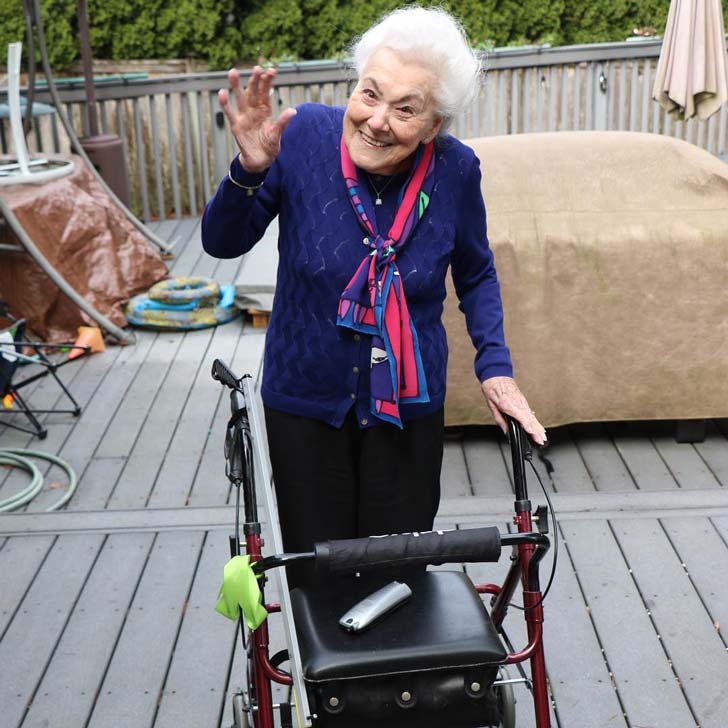
Well, yes.
On Monday, the coworker returned to the office with a spring in her step. Eileen had lifted her spirits, and their first call was the start of a series of regular dispatches.
But it wasn’t just a relationship that blossomed with Matthews’ coworker.
“I set up a little lemonade stand, put a laptop on it, noise-cancelling headphones,” he told ABC 7 last year. “And then I would place it somewhere in the city, and then my grandma could virtually meet anyone in New York City that was walking by.”
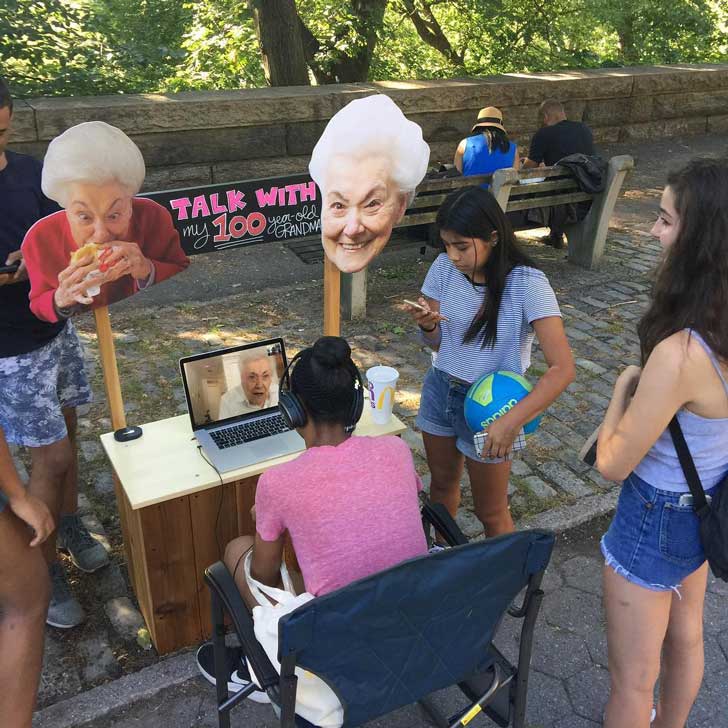
That was the birth of the Grandma Stand.
For six years, Eileen called in and spoke with thousands of complete strangers, until she passed away in 2018 at the age of 102.
“My grandma had so much love to give, and every person who talks to my grandma feels elevated, feels seen, feels heard,” Matthews told ABC 7. “And she also benefited, like she felt like she was valued.”
After her death, Matthews retired the Grandma Stand. But in 2024, he realized the world needed some good, old-fashioned wisdom.
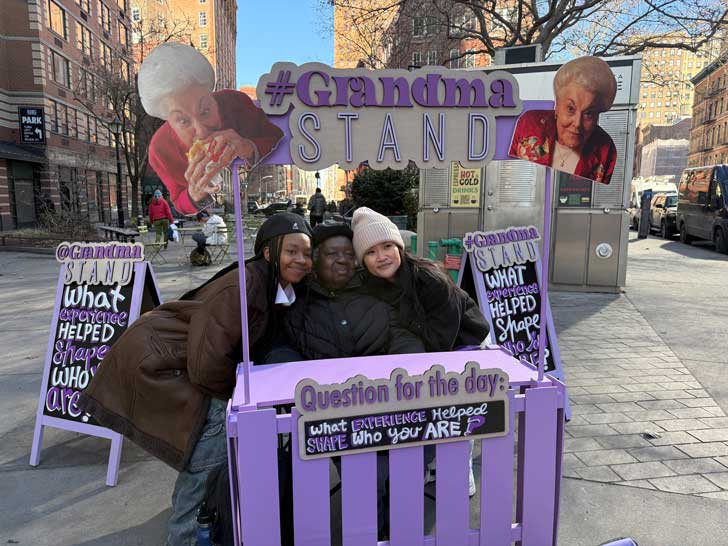
“I was walking in Central Park and was thinking about all my friends who seemed to be drowning in stress because of world events, family rupture, or politics,” Matthews wrote.
“I purchased a new lemonade stand, painted it Grandma Eileen's favorite color — purple — and invited a kind grandma from my building to participate.”
Since then, the Grandma Stand has grown into a nationwide project. In New York, about 15 grandmas staff a rotating pop-up, which can be found in Central Park, on the streets of Manhattan, or really in any nook or cranny in the city.
The volunteer grannies set up their own purple lemonade stand and post a question prompt to get the conversation started, with topics ranging from “What’s made you cry recently?” to “What’s a relationship you need to fix or let go of?”
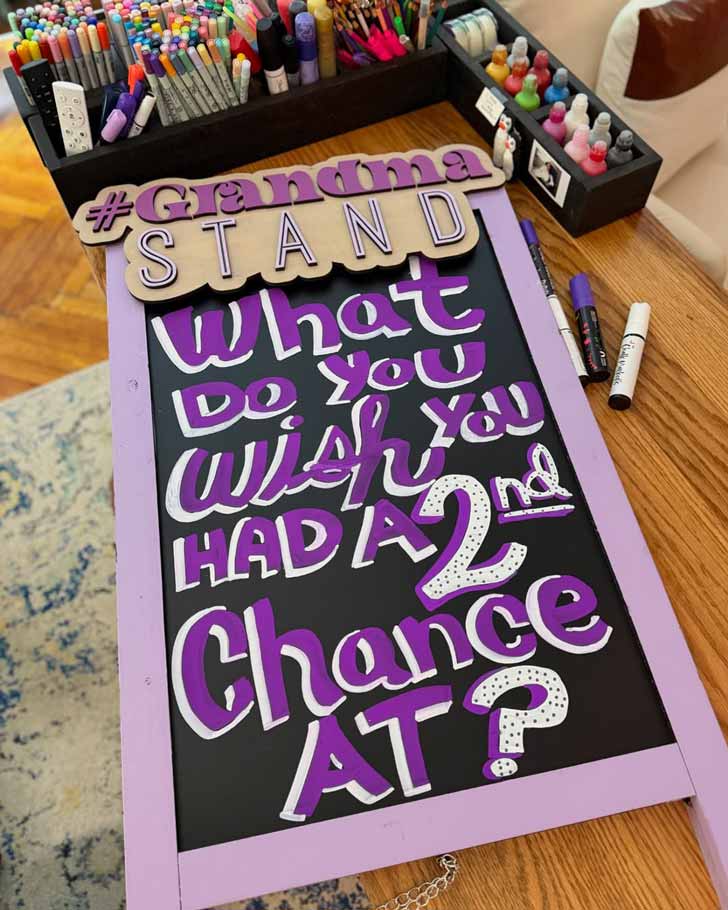
But anyone is welcome to come in with their own baggage.
“We could be experiencing a relationship issue, job loss, financial stress, lack of direction, loneliness, newly married, excited about being a new parent, wrestling with forgiveness, or just feeling apathetic, and a disarming grandma is just what you need,” Matthews continued.
“They’ve lived through world wars, don’t care about social media, and have mastered the art of listening and asking questions. They just care about you and who you really are.”
Grandma Flo, a volunteer in New York, has thoroughly enjoyed serving at the Grandma Stand.
“It’s made my life a lot happier,” she shared in a recent video. “It gives me an outlet … something to do, and I really enjoy talking to people from different parts of the world and different cultures. I learn a lot from them.”
A network of Grandma Stands is slowly budding across the country — and the world. In McKinney, Texas, three grandmas recently set up a stand of their own at a holiday market.
One of them, Nancy, a grandmother of four, was volunteered for the role by her daughter.
“I absolutely love it,” she told CBS News. “Grandmas are nonjudgmental and loving people. Sometimes it's nice to talk to someone who's basically a stranger, but you still feel a connection with.”
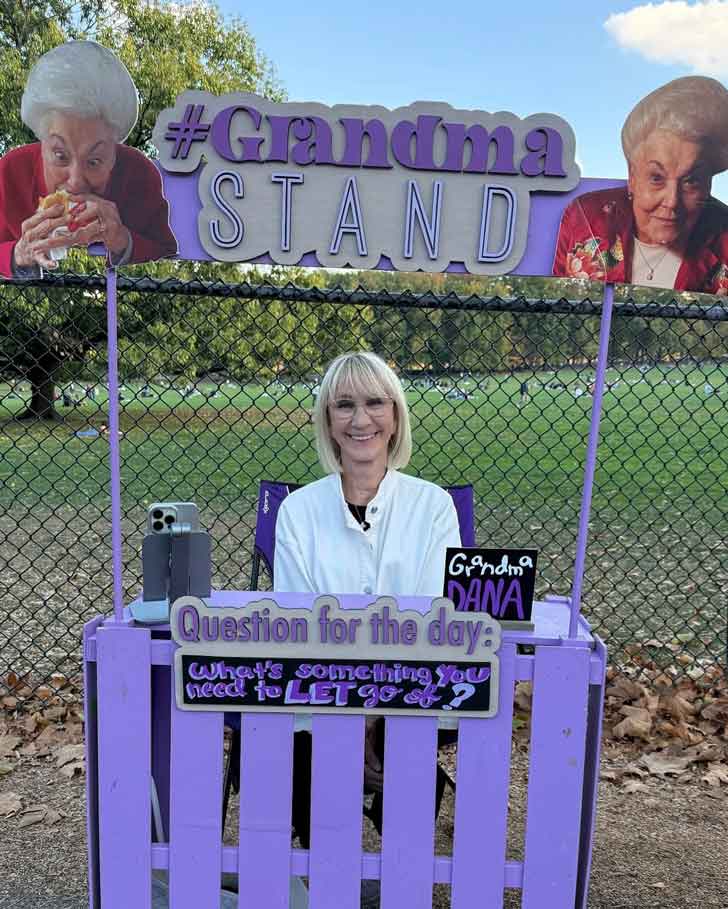
The McKinney stand was a resounding success, and plans to return in the spring for farmers’ markets. Other Grandma Stands have appeared in Omaha and Denver, with other sites planned for Boston, Berlin, Paris, London, Canada, and Mexico.
Those interested in creating one of their own can fill out an interest form, which comes with a commitment of $800 for all of the standard materials to build the stand.
As the movement grows, Matthews is thrilled that more grandmas — and strangers — are taking part. But it all still comes back to Grandma Eileen.
“I think she would be watching this and saying get as many grandmas involved as humanly possible so at least they have a moment to shine and be heard,” Matthews told ABC 7.
“Selfishly, this is for me to honor my grandmother. I feel like this is what she’d want me to do on a weekly basis … She used the term ‘old people.’ She loves saying … just value old people. See the value of them and don’t look past them.”
You may also like: 'Souper Sunday:' This 6,000-person Facebook group gives away free, homemade soup to anyone in need
Header image courtesy of The Grandma Stand/Facebook
When Sonia Vallabh’s mother died as a result of prion disease in 2010, she quickly found out that she, too, had inherited a genetic mutation for the same disease that had claimed her mother’s life.
Prions are abnormally folded proteins that form toxic clumps in the brain and cause rapid neurodegeneration. There is no treatment or cure, and those with the genetic mutation have no idea when the disease might come for them.
About 1 in 50,000 people have the same high-risk genetic marker as Vallabh.
After learning about the mutation, her mortality was quickly brought into question, and Vallabh experienced the same fear and grief any of us would in that situation. But then, this devastating discovery activated her for good.
Though she had already obtained her law degree from Harvard, Vallabh decided to retrain in biomedical engineering and now also holds a Ph.D. from Harvard in biomedical sciences. Her husband, Eric Minikel, a former transportation engineer, did the same.
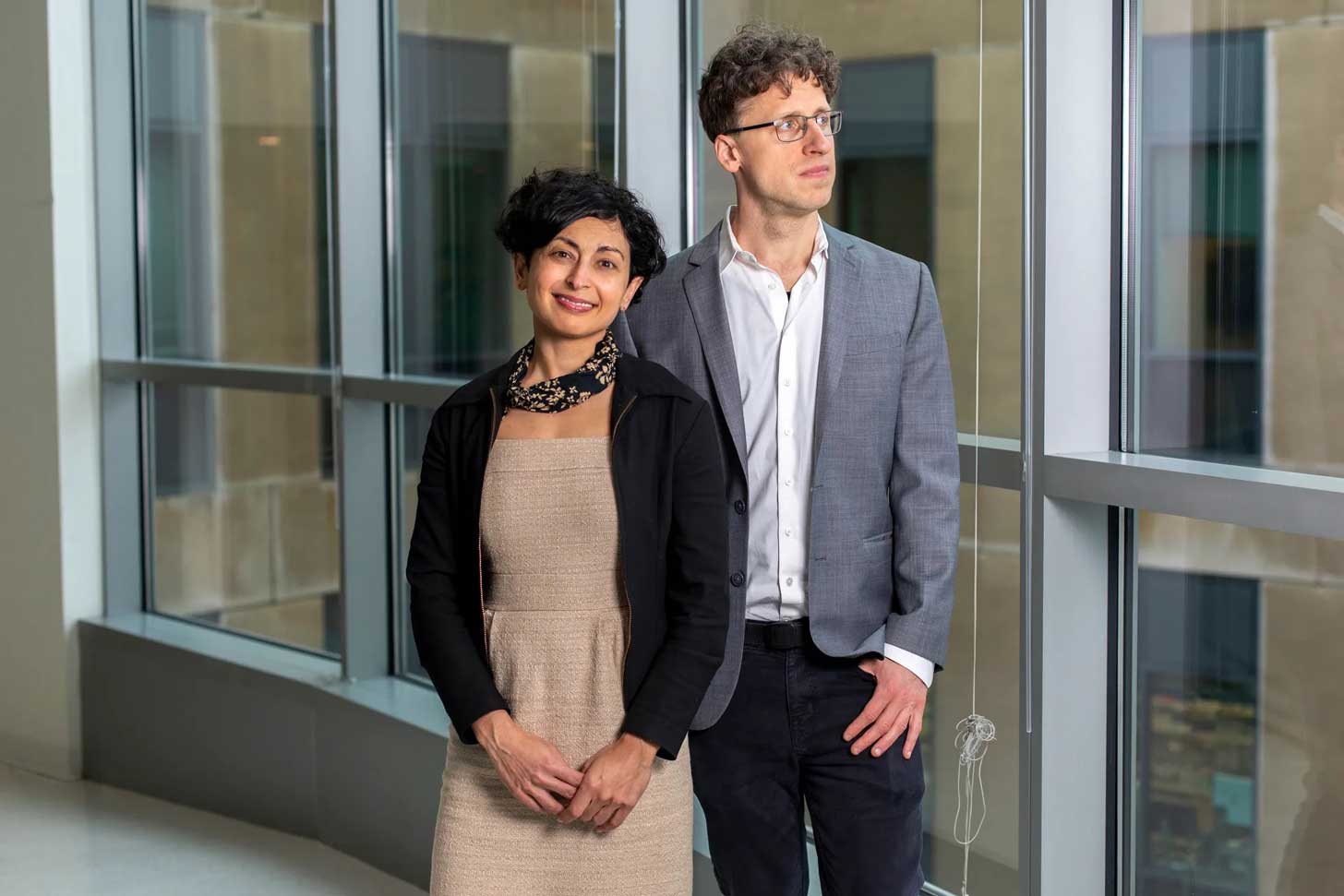
Together, they are now scientists at the Broad Institute in Cambridge, Massachusetts, leading a lab of 12 people, trying to outrun prion disease.
Prion disease is not like a virus or bacterium, but rather appears in a protein called PrP that humans normally have in our bodies. When it “goes rogue,” as Vallabh says in her 2024 TED Talk, it “spreads through your brain and kills your neurons.”
So, Vallabh and her team have focused on developing preventative drugs and gene-editing technology for prion disease. Lowering PrP proteins before the disease process has begun is the ultimate goal — and Vallabh’s lab is onto something.
In 2024, they announced the use of CHARM (Coupled Histone tail Autoinhibition Release of Methyltransferase), a gene-editing technique that could save Vallabh’s life — as well as the lives of those with Parkinson’s, ALS, or even Alzheimer’s.
The technique is different from gene editing processes like CRISPR, which has been compared to an eraser that removes unwanted genetic information.
Instead, scientists describe CHARM more like a volume control, which would allow them to “tune” a gene up or down.
Ideally, they could turn the prion disease gene all the way down — or silence it.
CHARM is also a much smaller technology, making it easier to deliver in small, complicated spaces like the brain. So far, the tech has only been proven in mice. But in those samples, CHARM ‘silenced’ the genetic information up to 90%, seemingly without making unwanted changes.
In 2025, a new paper from the team found that altering the gene that produces the PrP proteins can ultimately reduce the amount of those proteins in lab mice. It extended their lifespans by 52%.
“I think it’s a milestone for sure,” David Liu, senior author of the paper, told the Harvard Gazette. “One has to be careful to recognize that the path to an actual clinical trial has many such milestones that have to be traversed.”
A scientist to her core, Vallabh also isn’t getting ahead of herself. But this breakthrough could be life-saving for her — and millions of other people with fatal genetic conditions.
"The data are good as far as they go," Vallabh told USA Today about the new approach. “There's always, always reason for caution. Sadly, everything is always more likely to fail than succeed. But there is justifiable reason for optimism.”
So, in the meantime, Vallabh, Minikel, Lui, and their scientist cohort, continue the work.
“It’s an incredible privilege to be able to work with them,” Liu continued to the Gazette.
“Their personal connection to the disease provides extraordinary motivation for everybody to try to make as much progress as we can — carefully, but as efficiently as possible.”
You may also like: AI is helping doctors repurpose old drugs for new cures: 'The solution is in your neighborhood pharmacy'
A version of this article was originally published in The 2024 Science Edition of the Goodnewspaper.
Header image courtesy of Cure FFI
Buying clothes secondhand is one of the easiest ways to practice sustainable style and reimagine the way you interact with the fashion industry.
But as cost-prohibitive consumerism catches us even in the Goodwill aisles, or in an online resale age where “flippers” turn thrift finds into a lucrative business, truly sustainable shoppers are antsy for a new era.
Closest Closet might be their answer.
A platform that requires users to clean out their closets before they get something new, here’s how it works: Users can add items they want to get rid of, which earns them “hangers” or points.
From there, they use their hanger currency to “shop” for pieces in other users’ virtual closets. Shoppers can pay an extra fee for shipping or coordinate a local exchange.
Instead of other secondhand marketplaces online, Closest Closet makes it easier to dwindle down your own dresser before you buy another piece.
“The biggest differentiator between Closest Closet and the competitors is that members are using their existing fashion as currency,” founder Danielle Osborne told Good Day Chicago.
“Each item that they post earns them a hanger, and then they can immediately use that hanger to buy other members’ items that have been posted.”
Guests can use the app for free, or committed shoppers can pay a monthly or annual membership, which is still a low cost compared to the cost of buying clothes from traditional retailers.
The goal is to “perpetually recirculate” clothes among consumers instead of the endless cycle of buying and donating.
“I created Closest Closet to extend the life of fashion and reduce the amount of textile waste in landfills,” Osborne said. “Closest Closet empowers an ever-changing wardrobe without expense, waste, or guilt.”
So far, users seem to be enjoying the approach.
“My experience with Closest Closet has been amazing,” one person, Elizabeth, shared in a testimonial.
“Danielle is a visionary and giving members of the community a really fun way to shop that's economic but also ecologically responsible. The inventory is very good quality and are current styles. Plus the unlimited ability to swap clothes is incredible and addicting.”
Closest Closet does have a retail location in La Grange, Illinois, but anyone in the world can become a member on the platform to begin their journey.
“‘If it doesn’t work, I’ll just donate it,’ is so out,” Closest Closet shared in an Instagram post. “Making responsible decisions when shopping is so in.”
You may also like: Survivors of sexual assault are often left with only a hospital gown. This community closet clothes them in dignity
A version of this article was originally published in The 2025 Fashion Edition of the Goodnewspaper.
Header image by Mart Production/Pexels
Once a month at San Francisco’s Muttville Senior Dog Rescue, local senior citizens gather to snuggle up with gray-muzzled pups.
They call themselves the Cuddle Club — or Seniors for Seniors — and they’re a project of Little Brothers Friends of the Elderly, an organization that works to reduce loneliness among seniors in the Bay Area.
“To be able to feel a warm body, a heartbeat, lots of kisses, that's absolutely terrific,” 77-year-old Kay Livingston told CBS News.
The Cuddle Club is open to anyone ages 62 or older — or nine, if you’re a dog.

The goal is simple: To give senior citizens an opportunity to connect with one another, relax a bit with a furry friend, and show these elderly dogs some love while they wait to find their forever homes.
“Our dogs get a whole hour of cuddles,” Angela Di Martino, Muttville’s community engagement manager said, adding that many of the Cuddle Club members are dog lovers, despite not being able to afford to care for one of the adoptable dogs.
But, if seniors are open to adopting, Muttville makes it even easier.
“The adoption process for seniors is very much like our standard adoption process. However, if you are 62+ years of age, we waive our $250 adoption fee,” the senior dog sanctuary shares on its website.
“We also provide a welcome kit that includes your dog’s harness and collar, a leash, dog bowls, a starter supply of food and medication, a doggy bed, and, if needed, home modifications such as a doggy gate and stairs.”

When Sherri Franklin opened Muttville over 18 years ago, senior dogs were being euthanized at shelters regularly. Since then, the rescue has saved an estimated 13,000 senior dogs.
Its newest building is completely cage-free, includes a full vet clinic, and has a cozy living room space where volunteers and visitors of any age are encouraged to enjoy the presence of the dogs — and maybe find one to bring home with them.
“We changed the whole paradigm of what animal sheltering should be,” Franklin recently told the San Francisco Examiner. “Everything here was done with the idea of making this stress-free and feel-good for dogs and for humans.”
You may also like: Dogs offer stress relief, even in tele-therapy settings, according to new study
A version of this article was originally published in The 2025 Dogs Edition of the Goodnewspaper.
Header images courtesy of Muttville Senior Dog Rescue/Facebook
On Black Friday this year, a Virginia liquor store reported a break-in. The culprit? A wild raccoon who ransacked the shelves and was later found passed out in the bathroom.
Animal control officials arrived on the scene and transported the masked mammal to a wildlife shelter. He caught up on some sleep and had no signs of injury, “other than maybe a hangover and poor life choices,” according to a statement from Hanover County Animal Protection and Shelter.
Virginia ABC, which runs the store, issued a statement thanking the animal protection officers for giving the bandit a “sober ride home.”
In the aftermath of the raccoon’s big night out, a photo circulated online, showing him, butt-up, next to a toilet, and oblivious to the world.
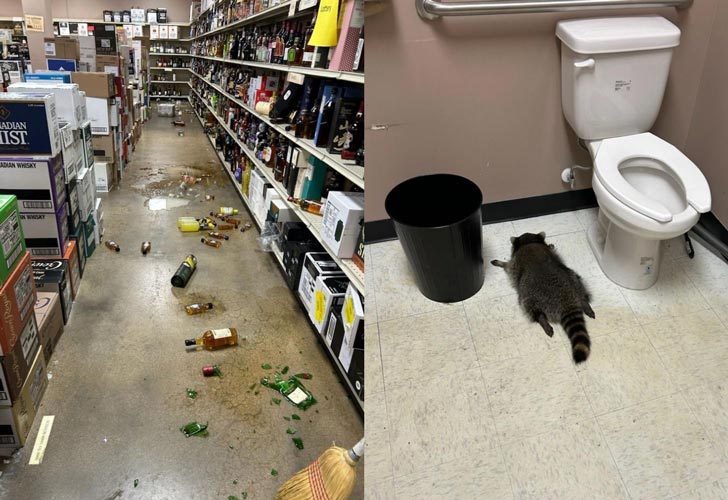
An immediate internet sensation, Hanover County Animal Protection and Shelter did what anyone would do: designed T-shirts.
A merchandise line — featuring an artistic depiction of the raccoon next to a bottle of liquor, and the phrase “trashed panda,” — has now raised over $252,000 for the animal shelter.
Over 19,000 supporters have purchased T-shirts, sweatshirts, stickers, and mugs, according to the campaign.
“We are absolutely blown away,” the Hanover County Animal Protection & Shelter shared in a social media post last week.
“Your support doesn’t just give us a great laugh … it directly helps fund training, equipment, and shelter needs for our animals and the officers who protect them. We couldn’t do this without you.”
Calling the stray animal an “unexpected raccoon celebrity,” the shelter emphasized that its “officers handle hundreds of calls each year involving wildlife, stray animals, and emergencies requiring specialized training and equipment.”
In fact, the officer on the scene of the raccoon’s crime — Samantha Martin — said that this particular critter is a repeat offender and has been at the scene of at least two other break-ins, including a karate studio and a department of motor vehicles on the same block as the liquor store.
“This is not the first time he's been in one of the buildings,” Martin told Hanover County’s Hear In Hanover podcast. “He’s a smart little critter.”
Once he was safe in the care of the shelter, Martin made sure no humans came in contact with him, so he wouldn’t have to undergo any additional veterinary care or rabies testing. Once he was all set to go, Martin released him back into his territory in the woods.
“We need him back into the wild because he didn’t do anything wrong. He was just having a good time,” Martin said. “He just looked back at me and then he just walked off and I was like, ‘See you, fella.’”
While it’s unclear what the raccoon’s future evening escapades might entail, his story will live on through the new merchandise collection — and in the generosity of donors supporting the animal protection agency.
The shelter doesn’t only deal with wild critters, but also houses countless cats and dogs looking for their forever homes.
“We desperately need [the funds] because our shelter is extremely old and the county is growing like wildfire. We can’t keep up,” Martin said on the podcast. “We need more kennel space. We need a bigger well. We just need a bigger shelter for the size of the county.”
“Thank you to everyone who has shared their support, humor, and kindness over the past week,” a social media post from the shelter added. “We’re grateful for a community that can find joy in a unique moment and help turn it into something that benefits animals in need.”
You may also like: When you 'pet' dogs in this mobile game, you provide food and vet care to real-life shelter animals this holiday season
Header image courtesy of Hanover County Animal Protection and Shelter
Every day, more than 100,000 vehicles travel up and down Interstate 25, a freeway that connects major cities in Colorado, Wyoming, and New Mexico.
The six-lane highway is also a crucial crossing point for countless elk, pronghorn, mule deer, mountain lions, and black bears — and now, thanks to the Colorado Department of Transportation, they can travel across 39,000 acres of open habitat in peace.
On December 16, Colorado Governor Jared Polis announced the completion of the I-25 wildlife overpass.
“Colorado is leading the way in reducing wildlife-vehicle collisions, and improving safety for both our motorists and wildlife,” Polis said in a press release.
“The I-25 Greenland wildlife overpass is a momentous feat in our continued work to expand safe transportation options for both humans and wildlife, protecting critical habitat, and our amazing outdoor spaces for generations to come.”
At 200 feet wide and 209 feet long — and encompassing roughly an acre of space — it is now the single largest bridge structure for wildlife in North America and one of the largest in the world.

CDOT Executive Director Shoshana Lew emphasized that the overpass was a protective measure for both local wildlife populations and the tens of thousands of motorists who travel the freeway every day.
“The overpass is an essential component of the wildlife crossing system in this area, which is expected to reduce wildlife-vehicle crashes by 90%,” said CDOT Executive Director Shoshana Lew.
For years, the overpass has been known for its high movement of large mammals. It’s also in good proximity to water sources that have proven vital to the survival of local wildlife.
“After more than nine years of planning and work, Colorado Parks and Wildlife is excited for Colorado’s wildlife to utilize this overpass,” said Matt Martinez, the area wildlife manager of Colorado Parks and Wildlife.
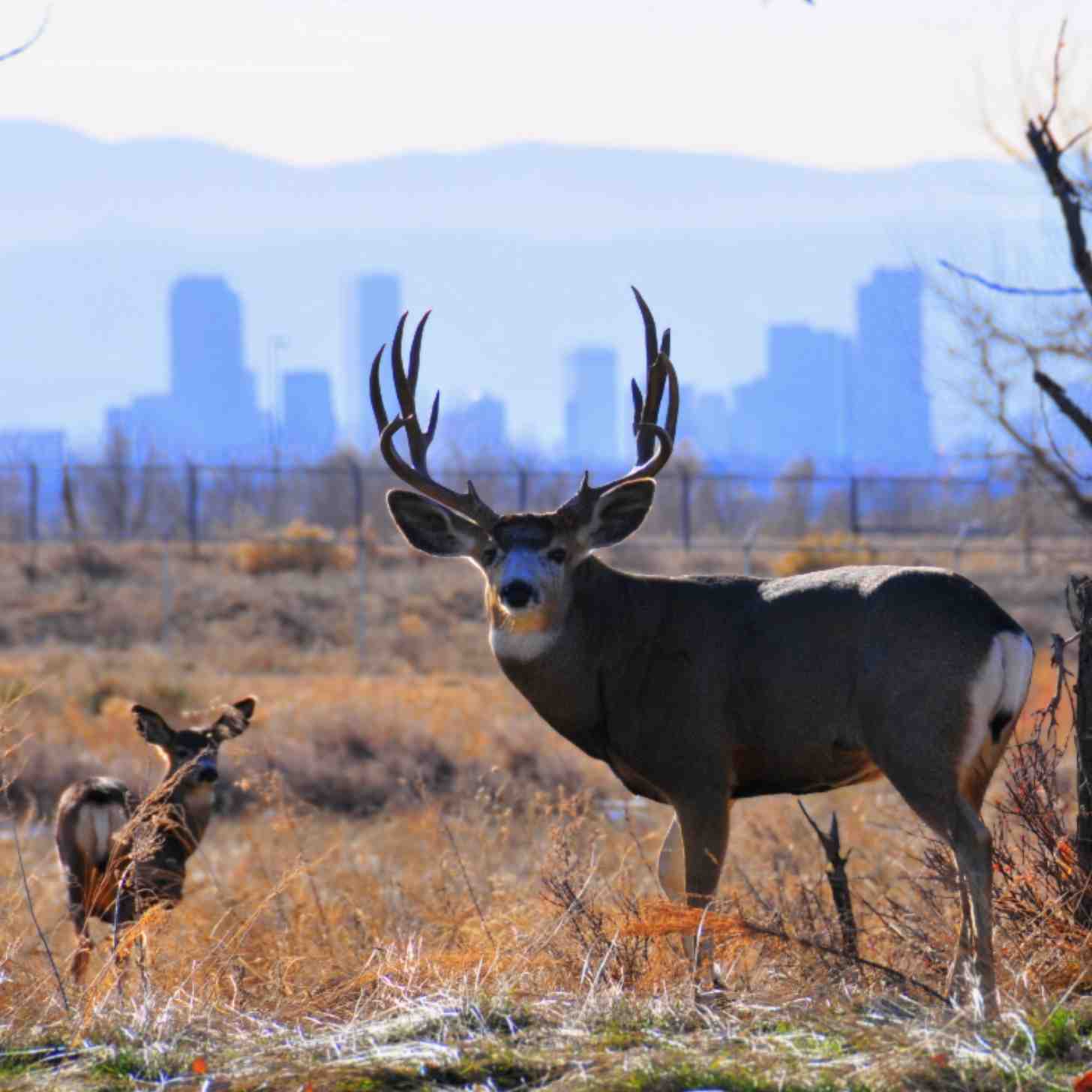
“We look forward to deer, elk, bears, mountain lions and many other species safely crossing I-25, once a major barrier to migration and wildlife movements.”
According to Colorado Commissioner George Teal, the CDOT, Colorado Parks and Wildlife, and Federal Highway Administration have been “safeguarding the wildlife habitat along the I-25 corridor” since 1996.
“In Douglas County, we take great pride in being responsible stewards of our resources — including our natural spaces and wildlife,” Teal said.
“The completion of this wildlife crossing is a tremendous milestone, and we congratulate everyone who has been a part of this effort, which also benefits public safety and transportation.”
You may also like: British neighbors are cutting holes in their backyard fences to create a 'hedgehog highway'
Header image via the Colorado Department of Transportation
From the classic country hit “Jolene,” to Moderna’s COVID-19 vaccine, Dolly Parton has given the world a whole lot to be grateful for.
But if you ask her father, her biggest accomplishment has been the Imagination Library.
“Before he passed away, my Daddy told me the Imagination Library was probably the most important thing I had ever done,” Parton wrote in a letter for the organization, adding that she founded it as a tribute to her father.
“He was the smartest man I have ever known, but I know in my heart his inability to read probably kept him from fulfilling all of his dreams,” she continued.
Now 30 years since its inception, the organization — which is a project of The Dollywood Foundation — has grown enormously, echoing Parton’s desire that “every child, regardless of income, would have access to books.”
Every month, approximately 3 million children across the United States and Canada, Australia, and the United Kingdom receive a free book in the mail. Based on a February 2025 analysis, the project has now delivered over 270 million books.
The Imagination Library also works with local governments, libraries, and schools to implement its programming and reach as many children as possible.
Earlier this year, for instance, New Mexico Governor Michelle Lujan Grisham signed an executive order expanding the program, ensuring that every child in the state from birth to age 5 has access to free monthly books delivered to their homes.
“Today, we’re unlocking the potential of our youngest minds and transforming the future of New Mexico one book at a time,” Grisham said in a statement.
“Every New Mexican child deserves the chance to grow up with books in their home and stories in their hands. Imagination Library proves what’s possible when we invest in our children’s futures.”
New Mexico joins 12 other states that offer the program to every child age 5 or below, with 10 others in progress.
Some programs are implemented with a nonprofit partner, while others rely on state or regional education departments. The Imagination Library handles the rest: managing a central database, book order system, and monthly mailings. An estimated one in seven children under the age of 5 in the U.S. now receives monthly books.
“In the beginning, my hope was simply to inspire the children in my home county, but here we are today with a worldwide program that gives a book a month to well over 3 million children,” Parton shared in her letter.
“The real heroes of our story are the thousands of local organizations who have embraced my dream and made it their own. They raise millions of dollars each year and wake up every day with a passion to make sure their kids have every opportunity to succeed.”
Over the past three decades, The Dollywood Foundation has also conducted research to understand the impact of these donations.
“The findings from the body of Imagination Library research indicate the program is extremely popular in the communities where it is implemented and shows promise in promoting changes in home literacy environments, children’s attitudes toward reading, and early literacy skills,” a statement for the organization shared.
Studies found that having access to books not only supports young minds but also helps parents build confidence in their own reading skills, especially when they read aloud together with their children.
The personalized nature of the donated books also boosts excitement among participating children, who are eager to read their new books when they arrive in the mail addressed specifically to them.
It’s this kind of impact that keeps Parton invested.
“It’s been quite a journey, but we have so much more left to do,” she concludes in her letter. “Let’s share this dream that all children should grow up in a home full of books.”
You may also like: After schools banned phones, students checked out more library books: 'We're reclaiming attention'
A version of this article was originally published in The 2025 Education Edition of the Goodnewspaper.
Header images courtesy of The Dollywood Foundation
When Casey McIntyre was diagnosed with stage four ovarian cancer, her doctors gave her a 10-15% forecast that she’d live longer than five years.
When she died in November of 2023, her husband, Andrew Rose Gregory, posted on social media on her behalf, sharing a letter she had written during her final months in home hospice care. It outlined her story, as well as her memorial wishes.
“To celebrate my life, I’ve arranged to buy up others’ medical debt and then destroy the debt,” her final farewell letter stated. “I am so lucky to have access to the best medical care at [Memorial Sloan Kettering Cancer Center] and am keenly aware that so many in our country don’t have access to good care.”
Setting up a fundraiser with Undue Medical Debt (formerly RIP Medical Debt), Andrew created a fund in Casey’s name: The Casey McIntyre Memorial & Debt Jubilee.
Their goal was to raise $20,000, and about two months after the fundraiser was created, it hit the $1 million milestone. Now two years later, it sits at over $1.1 million.

Thanks to Undue, which buys debt “at cost,” Casey’s fundraiser has erased $120 million of medical debt for 72,320 people in the tri-state area, where Casey, Andrew, and their daughter Grace, called home.
“Casey and I were extremely lucky. Our finances were being impacted by her cancer treatment, but not in a big way. She had extraordinarily good health insurance,” Andrew told Good Good Good in an interview.
“But we had met, through the cancer community at Memorial Sloan Kettering, people who are going into debt for their cancer treatment, people that are being bankrupted by their cancer treatment. You meet people who are deciding not to undergo cancer treatment because they know the cancer treatment would only give them so much time, and then that debt is going to be passed to their kids. That’s a calculation we’re making in our nation.”
The initial dream was to simply ease the burden of those calculations, but the success of the campaign represents something even bigger: both a massive amount of love for Casey, and a similarly universal desire for change.
Andrew said the fundraiser has led him to “a calling of sort” in the work to eradicate medical debt, while also, of course, providing a tether to Casey amid profound loss.
“When I talk to other people who are grieving, there’s a big fear that other people, and even you, are going to forget the person you love. And you are. You’re always forgetting the person you love, little parts about them, big parts about them,” he said. “But in some way, this reassures me that Casey is remembered in a bigger way.”
to celebrate my life, I've arranged to buy up others' medical debt and then destroy the debt. I am so lucky to have had access to the best medical care at @MSKCancerCenter and am keenly aware that so many in our country don't have access to good care. https://t.co/8gAJm5agcp pic.twitter.com/9JOkEoIfsA
— Casey McIntyre (@caseyrmcintyre) November 14, 2023
Their daughter, Grace, was just over one year old when Casey died. Although Andrew said she is “too young to remember her,” the story that came from this loss gives her something special to know about her mom.
“It’ll be a way that she can remember [Casey], not personally, but remember what Casey meant to other people,” Andrew added.
“Casey deeply believed that medical debt and the healthcare system that creates it are immoral, unnecessary blights on American society,” Andrew said in a statement for Undue Medical Debt. “May we live to see an America in which people are treated as patients rather than profit, an America in which healthcare debt no longer exists.”
Andrew told Good Good Good that he has found that the meaning of this accomplishment is not just in the destruction of debt, but in the creation of a better life for others — and the tending of Casey’s enduring legacy.
“It's odd to say, but the success of the campaign and the fact that so much medical debt has been forgiven in Casey's honor has brought me a lot of joy. And that joy is just in a separate place than the grief I feel about Casey. It's not like it's subtracting from the grief,” Andrew said.
“It's not like the deep, deep lake of grief I have about Casey's passing has gotten any shallower because of it. But it's like, at least I have this nice little field of flowers next to that lake.”
It’s a particularly potent metaphor, considering the song Casey chose to be played at her memorial was Stevie Wonder’s “Come Back As A Flower.”
“I wished that I could come back as a flower,” Wonder sings. “To spread the sweetness of love.”
You may also like: Giant holiday 'giving machines' are popping up in cities around the world. They've already generated $50M in donations
A version of this article was originally published in The 2025 Relationships Edition of the Goodnewspaper.
Header image courtesy of Andrew Rose Gregory