


When it comes to picking a major in college, plenty might opt for fine arts, business administration, or even engineering. But for a group of students at the State University of New York’s Stony Brook Waste Data and Analysis Center, it’s all trash, all the time.
In fact, students, professors, and graduate researchers from Stony Brook University have been digging through New Yorkers’ trash since 2024 as part of a five-year, $4 million study to improve recycling rates in New York.
“It looks gross, but we love it. This is what we do,” Stony Brook University graduate student Maeen Akter told CBS News last year.
“We would like to know exactly what’s in garbage, and the only way you can do that is either by theorizing it or getting your elbows into the pile,” Dr. David Tonjes, who researches solid waste management at Stony Brook, added.
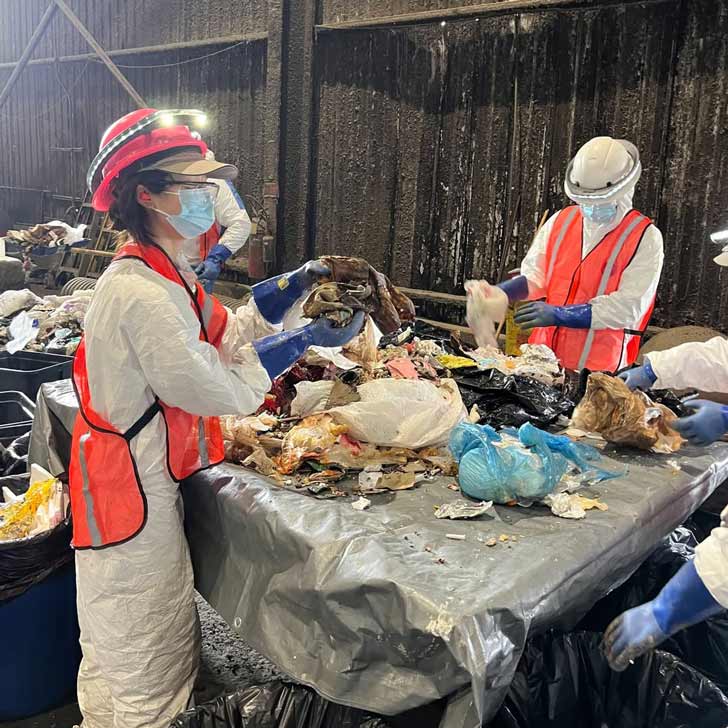
The research team sorts at about 20 locations across the state every year, recently spending a week in Rodman, New York at the Development Authority of the North Country’s Solid Waste Facility.
“We do 13 samples — approximately 3,000 pounds of municipal solid waste. And it’s categorized into 69 different categories,” DANC recycling coordinator John Phelps told 7 News.
“It just gives us an insight into what’s in our local waste stream.”
The group takes in samples, sorts them, bags them up, and weighs them, all culminating in a greater understanding of what most people get wrong about recycling.
In Long Island, the researchers found that roughly a third of glass, metal, and plastic from households should not have made it to the solid waste facility. They were throwing away items that should have been recycled.
Ultimately, the researchers determined that Long Islanders were only recycling about 30-60% of what they could and should be.
“If we did better, if we recycled everything, we would triple our recycling,” Tonjes told CBS News.
The results of this years-long study will be used to shape policy and teach members of the public how to best manage their waste. Stony Brook University is also in the process of innovating new solutions to make sure recyclables don’t end up in waste streams.
A new artificial intelligence-powered project in the university’s civil engineering department aims to combine video footage and AI tech to automate the analysis of waste materials.
“We’re not just building tools in isolation, we’re collecting data at multiple stages of the sorting process, engaging with recycling workers to understand the pain points, and using those insights to help them work faster, safer, and with greater insight,” Ruwen Qin, associate professor in the Department of Civil Engineering, said in a statement.
In addition to the research already taking place at waste facilities, teams are collecting high-resolution video data to inform future solutions.
“We’re not just studying the problem,” Qin added. “We’re building tools that can make a measurable difference.”
And for the students who are out in the field getting their hands dirty? It’s all worth it.
“We love garbage,” graduate student Hailey Lee told CBS News. “And we want [the] world to be a better world, so we are very proud of what we are doing right now.”
You may also like: Portland pays homeless residents to clean up trash: 'This gives people purpose'


