For over a decade, the world has been trying to limit global warming to 1.5°C.
That’s no longer possible, according to a new United Nations report. We will likely pass 1.5°C in 2030. That’s not good news for anyone, least of all Australia’s Pacific Island neighbors who face rapidly rising seas.
In response to the report, Palau’s President Surangel Whipps Jr said:
It is hard to overstate the depth of emotion for those of us living on the frontline after having fought so hard to put the 1.5 degree limit at the heart of the Paris Agreement […] calls for greater ambition are no longer enough — we need to see an urgent and unprecedented increase in political will and investment in a climate safe future.
The small silver lining is that it’s still possible for this to be a temporary overshoot of the target. If nations redouble their efforts to phase out fossil fuels and reduce other sources of emissions, they could limit peak warming to 1.8°C and then use carbon removal methods to bring temperatures back to 1.5°C or below this century.
In 2026, the world is already about 1.4°C warmer than pre-industrial levels, and the damage and death toll from climate-boosted disasters is ramping up. The United Kingdom is warning of possible food shortages amid a historic drought. Wildfires hit new areas in France and Spain, while glaciers are melting rapidly and the oceans are at their hottest level on record. The enormous El Niño event emerging in the Pacific is likely to bring major disruption. Every fraction of a degree makes things worse.
There are no good outcomes if we remain above 1.5°C. Urgent cuts to emissions and efforts to protect the most vulnerable are our best remaining options. Failure to do so risks irreversible harm.
Why does 1.5°C matter so much?
The 2015 Paris Agreement established a shared goal for the world: keep the rise in global average temperatures above pre-industrial levels “well below” 2°C and “pursue efforts” to hold warming to 1.5°C.
This goal was set based on expert scientific assessments that warming of more than 2°C would be dangerous and that limiting warming to 1.5°C was necessary to minimize climate risks.

Pacific nations fought hard to include 1.5°C in the agreement, arguing it was essential for their communities to “stay alive” in the face of rising sea levels and other climate-fueled threats.
Last year, the world’s top court — the International Court of Justice — ruled that 1.5°C is the primary temperature limit nations have committed to work towards.
This ruling means that if governments fail to act as ambitiously as they can, they could be sued in international courts.
In May this year, a majority of nations voted in the U.N. General Assembly to endorse the court’s ruling and urge action to keep to 1.5°C.
It’s not time to give up
Warming of 1.5°C will be bad. But 1.6°C will be worse, and 1.7°C worse again. Every increase will bring more extreme weather, more loss of nature, more loss of land to the sea, and more harm to humans.
If we stay over 1.5°C, we risk triggering climate tipping points — sudden shifts which cannot be undone on human timescales. These include the Greenland and West Antarctic ice sheets melting, the collapse of crucial heat-distributing currents in the Atlantic Ocean, or the Amazon rainforest becoming a source of emissions.
Overshooting 1.5°C doesn’t mean it’s time to throw out the Paris Agreement. It’s not working fast enough, but it is working.
Solar power and electric vehicles have boomed and electrification has accelerated. Nations have cut emissions enough to avoid the worst climate futures of a 3°C rise or even higher. According to the Climate Action Tracker, the Paris Agreement has averted the equivalent of 1°C of warming. Rather than hitting 3.6°C by 2100, the world is on track for 2.6°C.
While this is progress, it is not enough. Global emissions are plateauing, but have still not begun to fall in earnest.
As damage from climate change mounts, leaders must do the work and begin rapidly cutting emissions to keep the goal of net-zero by 2050 alive.
To get temperatures back under 1.5°C, we will also need to pull gigatons of carbon dioxide back out of the atmosphere using tree planting and nature restoration. We may also need technological approaches such as rock weathering or ocean alkalinity enhancement, though these are not proven at scale and can come with other risks.
We are all in this together
It may seem as if climate action faces impossible headwinds, as populism surges and the current United States administration doubles down on fossil fuels.
It’s worth looking beyond these headlines. It took almost 70 years for the world to install a terawatt of solar power, but then just two years for the second and another two for the third terawatt. In ten years, that figure will likely have tripled. Developing nations are moving rapidly to take up non-polluting electric transport.

Climate change can no longer be ignored. As damage mounts, nations will have to cooperate to cut emissions as rapidly as possible and figure out how to safely and equitably pull carbon back out of the atmosphere. Action depends on strong political will, inclusive governance, and finance to help developing countries cut emissions and adapt.
In November, Australia will lead negotiations at the next international climate summit, COP31, in Turkey. Leaders and diplomats will work to keep 1.5°C in reach — even after overshoot.
Australia can point to its own rapid clean energy transition and urge others to set clear pathways to go electric — and wean themselves off the production and use of fossil fuels.
Climate change has been described as a super wicked problem — big, complex, and impossible to solve simply. The solution is to see the urgency of the issue and act cooperatively to tackle it. If we make it a problem for the next generation, there may be no way back to a safe climate.
This article was written by Jacqueline Peel from the University of Melbourne and Wesley Morgan from UNSW Sydney and was originally published on The Conversation.
Featured Image: Ella Ivanescu/Unsplash
Anika Puri, now a graduate of the Massachusetts Institute of Technology, got her start in STEM from an early age.
In fact, when she was 17, she was awarded the Peggy Scripps Award for Science Communication at the Regeneron International Science and Engineering Fair in 2022 for an invention that was inspired by her childhood trips to India.
Growing up, Puri traveled with her family to India, where she saw the ongoing illegal trade of ivory, markets flush with products that came from the trafficking and killing of elephants.
Although the ivory trade has been illegal for decades and elephant hunting has been prohibited in India since the 1970s, the problem has persisted.
“I was quite taken aback,” Puri told Smithsonian Magazine when she was 17. “Because I always thought, ‘well, poaching is illegal, how come it really is still such a big issue?’”

She discovered that drones were used to detect and capture footage of poachers, but that they lacked accuracy and timeliness. But that footage did provide a eureka moment.
After watching videos of elephants and humans, Puri noticed that the two species moved in vastly different ways, with delineations in speed, turning patterns, and other motions.
“I realized that we could use this disparity between these two movement patterns in order to actually increase the detection accuracy of potential poachers,” she told the magazine.
So, she invented EISa (short for elephant savior), a low-cost, artificial intelligence-driven tool that uses thermal and infrared videos to detect movement patterns as a drone captures real-time footage to distinguish more accurately between elephants and potential poachers.
The device uses a $250 low-resolution thermal camera that can plug into an iPhone. Once attached to a drone, the system gives real-time insights as it flies over a park. Field testing showed that Puri’s invention was able to detect humans with over 90% accuracy.

Puri submitted her project to ISEF 2022, the world’s largest international pre-college STEM competition. She won the aforementioned $10,000 prize, as well as a top title in the competition’s earth and environmental sciences category.
“It's really amazing just to see all these kids coming together. And for the same purpose — enjoying science and doing research,” Puri told Smithsonian Magazine. “I was honored just to be on that stage.”
The poacher-tracking invention was not Puri’s first foray into AI and other technological pursuits. She was part of a summer program at Stanford’s AI Lab, and after graduating high school, went on to work as a research assistant at Harvard’s Computational Health Informatics Center.
She just graduated with dual Bachelor’s degrees from MIT in June 2026, one in business management and another in AI and computer science. It’s unclear what the end result of her poacher-detection project was — aside from the ISEF prize — but according to LinkedIn, Puri is still thriving in STEM.

She has held AI research and engineering internships with Goldman Sachs and Nvidia and is currently part of the Bernard M. Gordon MIT Engineering Leadership Program.
“Initially, my enthusiasm for artificial intelligence was based off of this limitless possibility for social good,” Puri told Smithsonian Magazine in 2022.
Once she discovered that AI could contain biases informed by human inventors, she saw another side to her work.
“It really has the capability to reinforce some of the worst aspects of our society,” she said. “What I really realized from this is how important it is that women, people of color, all sorts of minorities in the field of technology are at the forefront of this kind of groundbreaking technology.”
You may also like: Teen scientists invent brain-controlled bionic prosthetic leg for their friend — and win prestigious $50K prize
Featured Image: Courtesy of Society for Science
A federal administrative court has temporarily revoked authorization to build a massive data center near Boulder City, concluding the federal government likely erred when it approved the project construction on public land without a proper environmental analysis.
The Interior Board of Appeals ruled Tuesday that the Bureau of Land Management’s decision to approve the construction of the Townsite Data Center on public land using a prior unrelated environmental analysis likely violated the National Environmental Policy Act.
Townsite Solar 2 LLC — the project developer — originally received federal approval in 2023 to build a solar power generation and battery storage facility on the 88.5-acre parcel, but requested an amended right-of-way grant in 2025 to build a data center instead.
Federal land managers did not study the effects of the data center project in a new environmental analysis, and instead approved the change in July after determining the data center project “is essentially like” the solar plant project and that it would have “similar anticipated impacts.”
The order comes after the Center for Biological Diversity and Boulder City filed an appeal in July against the Townsite data center, which became the first data center approved on BLM land in the United States.
An administrative judge determined there was persuasive evidence that BLM “acted arbitrarily or capriciously when it determined that the data center project is ‘substantially the same’ as the solar plant project for purposes of its NEPA analysis.”
The order prevents the data center project from moving forward while the Interior Board of Appeals considers legal challenges against the proposal.
“We’re thrilled that this data center has been stopped dead in its tracks,” said Patrick Donnelly, Great Basin director at the Center for Biological Diversity in a statement. “The Trump administration is pulling out all the stops to let tech companies build massive data centers on our public lands. This tremendous victory proves communities have the power to fight back and win.”
The federal administrative court found that the appeal was likely to succeed on their claims that the BLM’s analysis of the solar plant project’s environmental effects was insufficient because the projects are not “substantially the same.”
The temporary pause was granted after the Center for Biological Diversity “demonstrated that permanent and irreparable harm is likely to occur” if construction of the data center continued before the appeal is settled, and that those “harms outweigh the temporary financial harm to Townsite from the delay.”
Boulder City also filed an appeal and petitioned for a temporary pause on the project while their appeal makes its way through the federal process. However, the city’s petition was declared moot given the panel granted the Center for Biological Diversity petition seeking a pause.
In the order, the Interior Board of Appeals consolidated both appeals filed by Boulder City and the Center for Biological Diversity and expedited the appeals. The panel ordered BLM to respond by Sept. 21.
Construction of the Townsite Data Center could have major implications for public lands throughout the West, and especially in Nevada where about 80% of the land is managed by the federal government.
In July, the Boulder City Council unanimously voted to appeal the BLM approval for a data center on an 80-acre BLM-owned parcel about three miles west of the city’s borders.
Nevada Rep. Dina Titus, who represents the district where the data center would be located, sent a letter to federal land managers demanding answers about how the agency is reviewing proposals for data centers on public land following the approval of the BLM’s amended plan.
Titus Tuesday applauded the Interior Board of Land Appeals’ decision to halt the development of the Townsite Data Center.
“The judge ruled for transparency and public accountability in granting a stay based on the BLM’s misuse of an environmental impact statement for a solar farm as justification for a data center. The two are vastly different.” Titus said in a statement. “I’ve said since day one that this was not only improper but illegal.”
Gov. Joe Lombardo, to whom Titus had also written seeking clarification about data centers on Nevada public land, and Townsite Solar 2 LLC did not immediately respond to requests of comment about the order. A spokesperson for the Interior said the department does not comment on litigation matters.
This article was originally published by the Nevada Current.
Featured Image: Ken Lund/Flickr (CC BY-SA 2.0)
Most of the world observes International Workers’ Day on May 1, or the first Monday in May each year — but not the United States and Canada.
Instead, Americans and Canadians have celebrated Labor Day as a national holiday on the first Monday in September since 1894, 12 years after the first observance of Labor Day in New York City.
The celebrations aren’t the same.
In much of Europe, Asia, Africa, and Latin America, the event commonly called May Day honors workers’ political and economic power, often with demonstrations by socialist or workers’ parties and tributes to national labor rights.
America’s Labor Day features labor union parades in many places, but for most Americans, it’s less about organized labor and more about barbecues, beach days, and back-to-school sales.
Both holidays, however, arose during the same period, in the U.S. nearly 150 years ago, in the midst of an explosive labor uprising in America’s industrial heartland. Their founding united native-born and immigrant workers in an extraordinary alliance to demand an eight-hour workday at a time when American workers toiled an average of 10 or more hours daily, six days a week.
The call for shorter hours was rooted in a big idea: that workers’ days belonged to them, even if employers owned their workplaces and paid for their work.
That idea inspired the loftiest goals of a growing labor movement that spanned from Chicago and New York to Stockholm and Saint Petersburg. And the labor activism of the late 1800s still casts a distant light on Labor Day today, carrying a vital message about the struggle for control of workers’ daily lives.
I’m a historian at the University of Illinois Chicago, where I study the history of labor. The fight for shorter hours is no longer a top issue for organized labor in the U.S.. But it was a crusade for the eight-hour day that brought together the diverse coalition of labor groups that created Labor Day and May Day in the 1880s.
Labor Day’s radical roots
Led by socialist-leaning trade unions, Labor Day’s founders included skilled, native-born craft workers defending control over their trades, immigrant laborers seeking relief from daylong drudgery, and revolutionary anarchists who saw the quest for control of the workers’ day as a step toward seizing factories and smashing the state.
They originally chose Sept. 5, 1882, for the first Labor Day to coincide with a general assembly in New York City of what was then the largest and broadest association of American workers, the Knights of Labor. Two years later, labor leaders moved the annual event to the first Monday in September, giving the majority of workers a two-day weekend for the first time.
As Labor Day parades and picnics spread, many American cities and states soon made it an official holiday. But since few employers gave workers the day off in its early years, Labor Day likewise became “a virtual one-day general strike in many cities,” according to historians Michael Kazin and Steven Ross.
American roots of May Day
My students come from working-class, mostly immigrant families, and Chicago’s history of labor conflict is all around our downtown campus in the heart of what were once meatpacking plants, stockyards, and crowded immigrant neighborhoods.
My office is about 12 blocks from the spot — surrounded today by upscale office buildings — where the eight-hour movement reached a bloody climax in the battle of Haymarket Square. May Day commemorates that battle.

On May 1, 1886, unions of skilled workers organized by their crafts or trades led a nationwide general strike for the eight-hour day. They were joined by radical socialists, militant anarchists, and many members of the Knights of Labor. More than 100,000 workers took part across the country.
The most dramatic demonstrations happened in Chicago, which had become the second-largest city in the U.S. after years of swift growth. Nearly 40,000 striking Chicago workers shut down much of that burgeoning industrial, agricultural, and commercial hub. Three days later, a bomb thrown at a rally in Haymarket Square killed seven police officers, sparking a sweeping nationwide crackdown on labor activism.
In 1889, socialist trade unions and workers’ parties, meeting in Paris for the first congress of a new Socialist International, proclaimed May 1 an international workers’ holiday. They were partly following the lead of the new American Federation of Labor, which had called for renewed strikes on the anniversary of the 1886 action.
And they were honoring the memory of the eight labor activists who had been tried and convicted for the Haymarket bombing solely on the basis of their speeches and radical politics, in what was widely viewed as a rigged trial. Four “Haymarket martyrs” had been hanged and a fifth died by suicide before he could be executed.
An earlier labor win
Though May 1 had long been associated with European celebrations of springtime, its modern meaning has deeper American roots that precede the Haymarket tragedy. It was on that date in 1867 that workers in Chicago celebrated an earlier victory.
At the end of the Civil War, campaigns for an eight-hour workday arose in cities across the country, championing a common interpretation of the abolition of slavery: for many workers, emancipation meant that employers purchased only their labor, not their lives.
Employers might monopolize workers’ means of making a living, but not their hours and days.
The movement led to laws declaring an eight-hour day in six states, including Illinois, where the new rule went into effect on May 1, 1867. But employers widely disobeyed or circumvented the laws, and states failed to enforce them while they lasted, so workers continued to struggle for a shorter workday.
Seizing the day
In the 19th century, American workers’ labor came to be measured by how long they worked and how much they were paid. While they were divided by their widely different wages, they were united by the generally uniform hours at each workplace.
The demand for a shorter workday without a pay cut was designed to appeal to all wage earners no matter who they were, where they were from, or what they did for a living.
Labor leaders said shorter hours meant employers would have to hire more people, creating jobs, and boosting hourly pay. Spending less time on the job would enable workers to become bigger consumers, spurring economic growth.
Having “eight hours for work, eight hours for rest, and eight hours for what we will,” a popular labor movement refrain, would also leave more time for education, organization, and political action.
Most broadly, the fight for shorter hours encapsulated workers’ struggle to control their own time, both on and off the job. That far-reaching struggle included efforts to limit the number of years people spent earning a living by ending child labor and creating pensions for retired workers — a topic I’m currently researching.
Benjamin Franklin famously said, “Time is money,” meaning that time off costs money that workers could be making on the job. But the message of the movement for a shorter workday was that the worth of workers’ lives could not be calculated in dollars and cents.
Diverging holidays
In the Haymarket battle’s aftermath, the alliance of radicals and reformers, factory operatives and skilled artisans, U.S.-born workers and immigrant laborers began to come apart. And as union leaders in the American Federation of Labor parted ways with socialists and anarchists, each side of the divided workers’ movement claimed one of the two labor days as its own, making the holidays appear increasingly opposed and losing sight of their shared foundation in the campaign for a shorter workday.
Conservative politicians and employers hostile to unions began to equate labor organizing with bomb throwing. In response, trade unions seeking acceptance as part of American industry and democracy displayed their allegiance on Labor Day by waving the American flag, singing patriotic songs, and portraying themselves as proud, native-born Americans, as opposed to foreign workers with subversive ideas.
Many political radicals and the immigrant workers among whom they found much of their following, meanwhile, came to identify more with the international workers’ movement associated with May Day than with American business and politics. They disavowed May Day’s origins among American trade unions, even as many trade unions distanced themselves from the radical roots of Labor Day. By the turn of the century, May Day moved further from the center of American culture, while Labor Day became more mainstream and less militant.
20th-century gains and losses
In the 20th century, labor unions won shorter hours for many of their members across the country. But they detached that demand from the broader agenda of workers’ autonomy and international solidarity.
They gained a landmark achievement with the federal enactment of the eight-hour day and 40-hour workweek for many industries during the 1930s. At that point, economist John Maynard Keynes projected that the rising productivity of labor would enable 21st-century wage earners to work just three hours a day.
Workers’ productivity did keep climbing as Keynes predicted, and their wages rose apace — until the 1970s. But their work hours did not decline, leaving the three-hour day a forgotten vision of what organized labor might achieve.
This article was written by Jeffrey Sklansky from the University of Illinois, Chicago and was originally published on The Conversation.
Featured Image: Anjan Karki/Pexels
In grasslands across the American West, four-legged fire prevention crews are busy at work, helping keep wildfire risk under control. These cattle, goats, and sheep stomp down tall grasses as they munch their way through plants that could otherwise burn, lowering the risk of catastrophic fires in the process.
When livestock are intentionally used for wildfire control like this, the practice is known as targeted grazing. And it’s gaining attention as severe wildfire seasons push firefighters and public land budgets to the brink.
Strategically removing trees, shrubs, and grasses can help alter the trajectory of future wildfires, but it is complex and expensive work that often involves intentional burning, herbicides, and heavy machinery to thin forests or create fuel breaks.
Livestock can do some of this work instead, simply by grazing in the right places.
Current leaders of the U.S. Forest Service and Bureau of Land Management are pushing for more targeted grazing in National Forests and on other public lands as part of the 2025 Grazing Action Plan and its accompanying directives.
As rangeland scientists who study how to effectively use livestock grazing to manage wildfire fuels and invasive plants, we see potential but also limitations to this strategy.
The possibility of pyrograzing
Targeted pyrograzing can help manage wildfire risk well in certain contexts.
Livestock do not eat or trample large, woody trees, but most wildfires burn in grass and shrublands that livestock can help maintain. Beef cattle, for example, consumed around 600 pounds of vegetation per acre across nearly 34 million acres in California alone in 2017.
In places such as Santa Clara County, California, grazing is now a formal part of wildfire management plans.

The goal is not necessarily to prevent wildfire altogether but to reduce flammable vegetation enough to avoid fueling catastrophic wildfires.
Removing hazardous fuels through livestock grazing and trampling can help slow a fire’s spread, so firefighters can stop the fire before it enters communities or reduce its intensity so ecosystems are able to rebound afterward.
Livestock can go where fire crews can’t
In some cases, grazing can be more practical or cost-effective than other fire risk reduction methods.
For example, intentional burning is dangerous where there is so much vegetation that fires would burn too hot and fast to control. In other places, it isn’t feasible to spray herbicides across large areas or bring in heavy equipment to clear vegetation in remote locations.
But goats, sheep, and cattle can eat their way across remote or steep terrain with little trouble.
We’ve spoken with savvy land managers who are also using livestock grazing to remove vegetation before carrying out intentional burns to make conditions safer for those fires. We’ve heard from others who are planning to use grazing before spraying herbicide to treat flammable invasive grasses to make it more effective.
A quarter of the U.S. Forest Service’s ranger districts in the Pacific Northwest, Intermountain, and Pacific Southwest have used some kind of targeted grazing to manage fire risk.
When we surveyed over 1,000 U.S. Forest Service staff, we found a majority think targeted grazing can be at least moderately effective to help with wildfire risk management, and over two-thirds rated past projects as moderately to extremely effective.

Targeted grazing doesn’t work everywhere
Using targeted grazing at the scale needed to address widespread wildfire risk across federal lands would be difficult, and it won’t work everywhere.
To effectively reduce wildfire fuel with grazing, ranchers often need to bring livestock to certain areas at different times of year than usual, haul water so livestock can work in areas without natural water sources, or keep livestock in areas for longer than would be ideal for their weight gain.
Those factors cost ranchers money and can require shifts in their operation that aren’t practical. Or in certain contexts, animals simply may be unable to graze enough to achieve the desired reduction in wildfire risk.
Just 5% of Forest Service staff in the survey we conducted in 2025 reported that they were very likely or extremely likely to use targeted grazing in the next few years. Their answers were driven by how effective they believed targeted grazing could be, but also whether they felt they would have time to plan and manage it.
In particular, we found they were concerned about a lack of monitoring to ensure projects have the intended effect. Their ratings were also strongly connected to whether they felt that ranchers who already graze livestock on public lands could actually implement targeted grazing. And very few staff thought it would be feasible for the agency to pay ranchers to conduct targeted grazing as a vegetation treatment.
What’s needed for targeted grazing to succeed?
As the Grazing Action Plan pushes federal agencies to expand the use of targeted grazing, work is underway to evaluate where it could be effective.
Some uncertainties remain, including around the question of paying ranchers and herders to perform targeted grazing as the practice scales up. Environmental groups have also sued over the plan, arguing that it would put wildlife at risk and is simply an excuse to open more land for ranchers.
While grazing is not appropriate everywhere, our research finds good examples of U.S. Forest Service staff incorporating livestock grazing into fire and fuels planning.

In Idaho, we are working with ranchers to test using sheep to reduce highly flammable and invasive grasses. In some years, the sheep have substantially reduced the amount of flammable invasive grass and even boosted the cover of native wildflowers. They have reduced invasive grass cover by over 20% in some years.
Other times, the invasive grass matures so early that it is difficult to get the sheep to the target areas at the right time.
Overall, we have experienced firsthand the value when ranchers, herders, agency staff, and scientists work together toward shared environmental goals.
We believe the U.S. would benefit from financial and technical investment in both agency staff and ranchers to plan and perform targeted grazing so the practice can become a tried-and-true part of America’s strategy to live with wildfire.
This article was written by Briana Swette and Kelly Hopping from Boise State University and was originally published on The Conversation.
Featured Image: Petra Reid/Unsplash

In a quiet summer garden, a caterpillar perches on a branch, munching serenely on leaves. A moment later it freezes. It senses danger — and just in time. From behind, a wasp approaches, sizing up its prey.
Tobacco hornworm caterpillars don’t look like they have ears, and yet they’re able to sense predators such as wasps. How does the caterpillar know a wasp is approaching?
Scientists do not yet fully understand how this caterpillar’s senses work, but we are part of a team of biologists and engineers who want to figure it out. Our ongoing research suggests the tobacco hornworms can hear using tiny, supersensitive hairs on their body.
Understanding the intricate biological mechanisms that allow this organism to perceive and interact with its environment would help solve a mystery of the natural world. It could also help scientists design new, cheaper microphone technology.
Because the hornworms’ hairs are so sensitive, we have to study them in complete silence. And where better to study hearing than in the complete silence of an anechoic chamber?
What happens in the anechoic chamber
What happens outside the anechoic chamber stays outside the anechoic chamber, because it is meticulously built that way.
Anechoic chambers are some of the quietest places in the world. They are engineered specifically to block the entry of any undesired sounds. Heavy-duty steel springs support the “floating” chamber and keep it from touching the ground. This detachment isolates the space from outside vibrations or noise.
In such a chamber, we studied the caterpillars’ responses to vibrations. Every day for a year, we set up a caterpillar on a platform and sent vibrations toward the platform at a variety of intensities.
To measure the movement and precise vibrations that traveled through the platform the caterpillar sat on, we used a device called an accelerometer. In response to vibrations, we sometimes saw the caterpillars jump; at other times they twitched or even shuddered from the sheer physical force.
Through our observations, we pinned down the specific threshold where the caterpillars stopped reacting to vibrations. Any vibration weaker than that magnitude, and the caterpillar wouldn’t visibly react at all.
After noticing this consistent pattern, we decided to test more caterpillars inside the anechoic chamber, but this time using airborne sound as the stimulus. The idea here was that if the caterpillars are more sensitive to sound than they are to vibrations, they are probably hearing airborne sounds independent of any vibrations.
Sound is broadly defined as a form of vibration or energy that becomes audible, meaning you can hear it with your ears. But here’s the catch: Sound also causes objects to vibrate.
To make sure the caterpillar wasn’t just sensing the sound’s vibrations through the platform, we also used the accelerometer to measure the vibrations that the platform experienced from the sound. Our goal was to compare the platform vibrations produced in two distinct scenarios: when sound through the air was used as the stimulus, versus when just direct vibrations were used as the stimulus.
We noticed that this time the caterpillars continued reacting to the sound even beneath their threshold of response to the direct vibrations. This finding suggested that they were hearing the airborne sounds.
Finding the caterpillars’ ‘ears’
So, where are their “ears”? Or rather, what are their “ears”?
There are two ways of hearing sound: first from the sound waves’ pressure and second from the velocity of the particles making up the sound waves.
For the longest time, scientists have associated hearing with tympanal organs. A tympanal organ in most mammals is a membrane that vibrates in response to pressure from sound waves. Its vibration moves the bone structures adjacent to it as well.
In most insects that respond to sound pressure, the structure analogous to the tympanal organ is a sac filled with air. They perceive any vibrations to this sac as sound.
But caterpillars pose a challenge to this typical hearing system, because they can hear but do not have obvious tympanal membranes. After digging into some past research and examining the caterpillars under the microscope, we spotted the distinctive hairs on their bodies.

Thus, our next project began. We removed their hairs and compared their responses to sound before and after the hair removal. Sometimes we surgically removed all the hairs by plucking them with tweezers under the microscope, and sometimes we strategically targeted a few.
The result was striking: The caterpillars’ defensive reactions decreased dramatically across various sound frequencies depending on which specific hairs were removed.
While our research continues, and we haven’t yet published our results in a journal, this work is allowing us to piece together the caterpillar hearing puzzle and investigate which of these hairs are tuned to register different sound frequencies.
This line of research into how insects hear sounds using specialized, microscopic hairs could inspire a new generation of acoustic tools.
Standard microphones are devices that contain membranes within them that can detect sound pressure levels. By mimicking these biological systems, such as using structures like these hairs in place of membranes, future microphones could be designed to instead measure the air particle velocity caused by sound, alongside the sound pressure levels.
Microphones that can detect air particle velocity would also be able to determine the direction of origin of the sound wave. In the case of microphone designs for hearing aids, a microphone that is able to track both sound pressure and air particle velocity could provide the user with information on both volume and direction of the sound wave. And studying caterpillars’ hearing systems and imitating how their “hearing hairs” work could inspire such directional microphones.
This article was written by Aishwarya Sriram, Carol Miles, Ronald Miles, and Sara Aghazadeh from Binghamton University, State University of New York and was originally published on The Conversation.
Featured Image: Courtesy of Binghamton University, State University of New York

A turtle exclusionary device, or TED, is a specially designed fishing net built on a slanted metal grid. An opening inside the trawl net allows large animals like sea turtles to escape as it catches smaller targets like shrimp.
Fishermen have been using TEDs since 1987, when the National Oceanic and Atmospheric Administration's National Marine Fisheries Service first required TEDs on larger offshore shrimp trawlers.
However, in 1992, exceptions were made for some skimmer-trawl vessels that over forty feet in length.
In lieu of using TEDs, select skimmer-trawl vessels were guided by tow-time restrictions, which limit how long a shrimp trawler can keep its nets submerged in the water during a single fishing cycle.
Under NOAA Fisheries regulations, nets are submerged for a maximum of 55 minutes per tow in the summer, and 75 minutes in the winter. These tow-time restrictions are designed to prevent sea turtles from drowning if they are accidentally caught.
However, conservationists have pointed to widespread noncompliance. Even when restrictions are followed, they still pose a major threat to sea turtles.
Although a resting sea turtle can stay submerged for up to seven hours, an active sea turtle needs to resurface every 40 minutes to catch its breath.
But if a sea turtle is trapped in a net, it could drown in mere minutes.
“When turtles hold their breath, their heart rate slows significantly to conserve oxygen — up to nine minutes may pass between heart beats,” The Olive Ridley Project stated on its website. “Despite this adaptation, a stressed turtle, such as one entangled in ghost net, will deplete oxygen stores rapidly and may drown within minutes if unable to reach the surface.”

On September 1, the 5th U.S. Circuit Court of Appeals — which oversees rulings in Texas, Louisana, and Mississippi — upheld the National Marine Fisheries Service’s 2019 rule requiring select shrimp trawling vessels to use turtle excluder devices, or TEDs.
“As the court recognized, the science has shown for years that tow-time limits simply don’t work and turtle excluder devices do,” Earthjustice attorney Rumela Roy said in a statement.
Jane Davenport, a senior attorney at Defenders of Wildlife, said that the decision is especially vital to protecting Kemp’s ridley sea turtles, the most endangered sea turtle species in the world.
“Louisiana’s waters are key foraging habitat [for them],” said Jane Davenport, senior attorney at Defenders of Wildlife. “Tow-time restrictions just don’t work. TEDs are a coexistence win for sea turtles and fishermen alike.”
Joanie Steinhaus, the Turtle Island Restoration Network’s ocean director, said they were “delighted” that the ruling was upheld, but will continue fighting for strengthened protections across the commercial fishing industry.
“[This] will reduce the number of sea turtles from drowning in large shrimp nets, but we will continue to advocate for TEDs to be required in all skimmer trawls to prevent the continuing cruel and unnecessary drowning of these gentle endangered turtles,” Steinhaus stated.
“It’s a relief that the court didn’t take the bait and dismantle protections that are already far weaker than what’s needed to secure a future for our precious sea turtles,” added Elise Bennett, Florida and Caribbean director at the Center for Biological Diversity.
“We won’t rest easy until these commonsense, lifesaving protections prevent senseless deaths of turtles in all skimmer trawls.”
Watch how TEDs work in real time:
You may also like: This 220-pound sea turtle was tangled in a fishing line. The Coast Guard saved her — and the 100 eggs she was carrying
Featured Image: NOAA Fisheries/Dan Foster
On the banks of the Aguarico River in the Ecuadorian Amazon, a group of Indigenous Siekopai women are combining traditional knowledge and modern technology to help a threatened native turtle recover.
Their efforts center around charapa turtles (Podocnemis unifilis), also known as the yellow-spotted Amazon River turtle, Mongabay Latam’s Astrid Arellano reported. The animal’s populations have declined due to hunting adult turtles, harvesting eggs from nests, and pollution from garbage, oil, and gasoline.
“Sometimes we see plastic, garbage bags,” Janeth Piaguaje, a Siekopai community leader of the project, told Mongabay Latam. “We also see dead animals floating down the river. We can’t control all of that, but we do make a significant effort to clean the beaches where we work.”
Boat traffic is also eroding riverbanks, and climate change has caused water levels to rise, flooding the flats where turtles make their nests. Charapa turtles are listed as vulnerable by the IUCN, the global conservation authority.
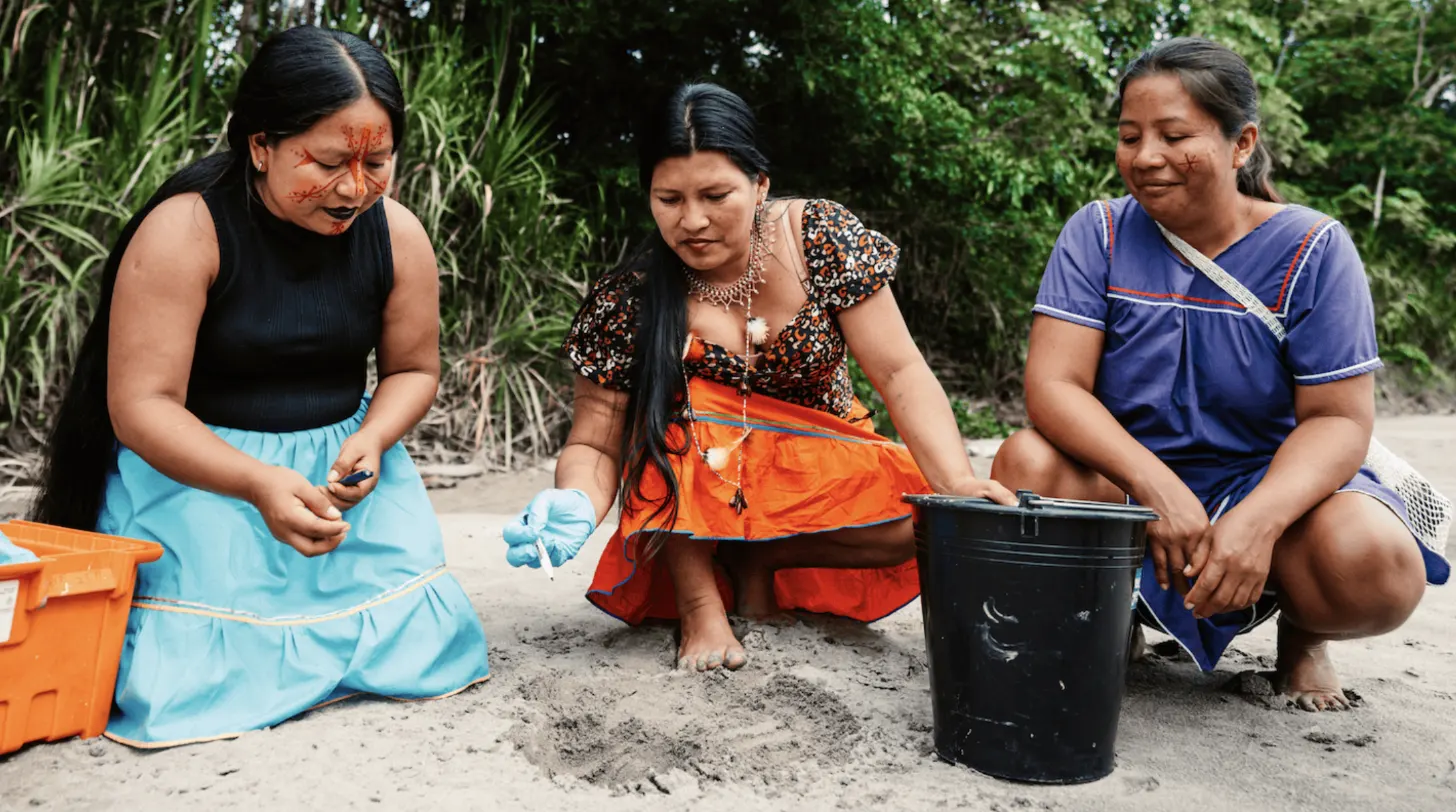
To help the turtles recover, a group of seven Siekopai women, who call themselves Tari Nomiowa’i, or “turtle women,” patrol the riverbanks looking for turtle tracks and nests. When they find nests, the women carefully collect the eggs, a skill Piaguaje said she learned from her father.
“He taught me how to handle the eggs, how to see on what dates and in what months the turtles lay their nests,” she said.
The women document the date, time, location, and number of eggs in each nest using the Epicollect5 app, a field data collection tool.
Then they take the eggs to an incubation facility where they are protected from predators, flooding, and pollution. Once the eggs hatch, the women continue to care for the baby turtles for another month, feeding them cassava, sweet potato, and taro leaves.
Their painstaking work has paid off.

Over the 2025-26 nesting season, the women collected 235 eggs and successfully hatched and released 208 hatchlings into the Aguarico River over March and April this year. The group invited the local community, including schoolchildren, to participate in the turtle release and attend workshops.
“A little girl said, ‘I’m going to take care of them, I’m going to tell them not to touch the eggs,’” Piaguaje recalled.
A driving force behind the work of the Tari Nomiowa’i is their culture and the ancestral belief that the turtles are a link between the visible and spiritual worlds, each swimming with protection from Koouwajëo, the spiritual chief, mother, and ancestral guardian of the turtles.
“I want Koouwajëo to be proud,” said Piaguaje. “When we protect turtles, we don’t just care for a species; we honor the spirits of the river, strengthen our culture, and maintain the sacred pact between our community and nature.”
Read the full story by Astrid Arellano in Spanish here. This article was originally published on Mongabay.
Featured Image: Amalavida.tv/Wikimedia Commons (CC BY-SA 2.0)
A Florida Keys family woke up to find dozens of unexpected guests taking a dip in their backyard pool in late August. Upon inspection, they discovered that it was a flotilla of sea turtle hatchlings.
During turtle nesting season, which takes place between March and October every year, hatchlings typically emerge from their eggs and make their way to the surf using an instinctive “sea finding” behavior.
This internal compass helps them crawl toward the lowest and brightest horizon, which, in successful cases, is the ocean reflecting moon and starlight.
But artificial light sources from development on the beach or flashlights can interrupt this process and lead the turtles hatchlings astray.

This is what experts at the Turtle Hospital in Marathon, Florida believed happened here. The homeowners called in the experts at The Turtle Hospital to help get the babies out of chlorinated water.
A total of 64 hatchlings were counted after being led astray by the home’s bright lights. Once they were all accounted for, the babies were taken to the hospital’s headquarters, where they were cleaned up and given nourishment.
Fortunately, they were all in pretty good shape, and after spending a handful of days recovering at The Turtle Hospital, they were released into the Gulf Stream.
“As hatchling season is still in full effect, this is a good reminder to keep an eye out for these tiny travelers,” The Turtle Hospital emphasized in a social media post.
“Artificial light can disorient hatchlings and lead them away from the ocean, sometimes ending up in some very unexpected places. If you find a disoriented or stranded hatchling, please don’t release it yourself.”
The Turtle Hospital then shared its “stranding hotline,” 305-481-7669. Florida locals can also call the state’s Fish and Wildlife Commission at 888-404-FWCC.
“And remember,” the hospital concluded, “turning off unnecessary lights or switching to red lights near the beach can make a BIG difference for hatchlings making their first journey to the sea.”
You may also like: Firefighters rescue a dozen baby sea turtles that got stuck in a condo's storm drain
Featured Images: The Turtle Hospital/Facebook
On August 30, a Mexican nonprofit dedicated to sea turtle conservation released between 3,200 and 3,500 sea turtles into the Gulf of Mexico from a beach in northern Veracruz.
The nonprofit, Tortugas Fundación Yepez A.C., was founded in 1967 by fisherman Don Marcelino Yepez and his wife Librada Gerón, affectionately known as “Mama Turtle.”
Their legacy lives on as their eldest son, Ricardo Yépez, continues their mission today.
“It’s already August 30, 2026, and well, the moment has arrived — the time has come to see the culmination of sleepless nights, hard work, patrols, [and] all-nighters,” Yépez said in an Instagram Reel.

According to Yépez, tourists were putting nesting sea turtles and their eggs at risk by approaching, touching, and even climbing turtles.
Patrols intensified in August after a pregnant green sea turtle was reported dead on a beach in Nautla, Veracruz. Afterwards, Yépez issued a public warning to tourists to give nesting sea turtles their space, according to reports by La Jornada.
In the weeks since, Yépez and his team of patrollers set up protected sites and moved nests from high-risk areas to small enclosures where they could hatch in peace.
“Today they are being released back into the ocean without any form of harm,” Yépez said, as he crouched on the beach, shoulder to shoulder with his volunteer team. “There aren’t enough words to express our gratitude to all the people who call us, who alert us, and who take responsibility for beach areas.”

“A huge thank you to all these angels whom God has placed in our path so that we can achieve our conservation goals for this endangered little animal,” he continued. “We’re celebrating 59 years of work — it’s easy to say, but it’s 59 years of continuous seasons, of persistence — and thanks be to God, and thanks to all of you, it’s possible for us to continue today. From my parents’ time until today — that’s 59 years now.”

At the end of his speech, Yépez said that there weren’t “enough words” to thank everyone who made the release possible.
“Well, today we’re going to release roughly 3,200 to 3,500 baby turtles,” he said. “Ready, guys? Uno, dos, vámonos!”
In unison, the Tortugas Fundación Yepez A.C. team released the sea turtles onto the sand from their respective buckets. As they raced to the water, the sea turtles tumbled on top of each other and wiggled their flippers, eager to reach the surf.
“Congratulations on your 59 years!” one Instagram user commented. “You say ‘it’s easy,’ but it's a lifetime of dedication and effort that not everyone does.”
Watch the release below:
You may also like: 'Turtle-safe' nets prevent countless sea turtles from drowning. An appeals court just upheld a rule requiring shrimpers to use them
Screenshot via @fundacionyepez/Instagram
Many Americans will pause on the 25th anniversary of the 9/11 attacks to remember the nearly 3,000 people who were killed that day. The attacks became a shared national tragedy, the impact of which reached far beyond those who experienced them firsthand.
The aftermath of such a disaster can place enormous strain on a community. If disruption is prolonged, support is inadequate, and the economic and social structures that hold a community together are damaged, relationships can fracture, trust can erode, and conflict can emerge. Disaster researchers describe this pattern as a “corrosive community.”
As a social work researcher who has studied disaster recovery and worked alongside disaster-affected communities for more than two decades, I have witnessed another side of the human response to catastrophe: Amid tremendous hardship and loss, people reach for connection and find strength in community.
What happens after a disaster
A national survey conducted just after 9/11 found that about half of Americans had responded to the crisis by giving to charity, and nearly a quarter donated or tried to donate blood. Volunteer sign-ups surged.
The research I conducted with colleagues on marriage and divorce following 9/11 offered another window into the disaster’s effects. We examined divorce rates across all 62 New York counties, comparing the four years after the attacks with the decade before them.

Divorce rates were significantly lower than expected in three of those four years. Even by 2005, the statewide divorce rate remained about 8% below what the previous decade’s trend would have predicted.
These patterns point to something I have observed in the decades since: During collective crises, people often turn toward family and social relationships.
I saw that instinct again in 2005, after Hurricane Katrina, which killed nearly 1,400 people and caused more than $125 billion in damage, making it one of the costliest natural disasters in U.S. history.
Amid enormous devastation and displacement, families took in relatives, and volunteers and organizations from across the country stepped forward. In our research on more than 7,200 children and adolescents from Louisiana communities heavily affected by Katrina, we found that two years after the storm, disruptions such as separation from family and community were among the experiences associated with greater post-traumatic stress symptoms.
In our work with crisis counselors in Louisiana, we found that people who had experienced significant losses themselves described finding meaning and healing through helping others recover.
Recovery happens together
The National Oceanic and Atmospheric Administration has documented a sharp rise in billion-dollar disasters in recent decades. In 2024, the last year for which NOAA shared data, the U.S. saw 27 such disasters, compared with an average of about nine a year since 1980.
As these events grow more frequent, understanding what helps communities recover will become more urgent.
For some communities — like those on the Gulf Coast — disasters are not isolated events but repeated experiences. Following the Deepwater Horizon oil spill in 2010 — the largest marine oil spill in U.S. history, which released 134 million gallons of oil into the Gulf — I asked 41 residents what advice they would give others facing similar crises. Many of them had endured multiple disasters, including Hurricanes Katrina, Rita, and Gustav.
Their advice was striking in its simplicity: Lean on your faith and find strength in community.
Years later, I heard the same message thousands of miles away when I visited Hawaii after the 2023 Maui wildfires, which destroyed the town of Lahaina and killed more than 100 people, making it the deadliest U.S. wildfire in more than a century.
During my research for a book about community resilience, residents spoke to me not about individual survival, but about community and a shared commitment to rebuilding.
These were different disasters, places and decades, yet the message was remarkably similar.
Corrosive communities
Recognizing the strength within a community does not diminish its losses or lessen the responsibility to support it. People recovering from catastrophe need housing, economic assistance, mental health services, and sustained investment.
Without adequate resources to rebuild, the connections that help people move forward can themselves become strained, contributing to a corrosive community.
The 1989 Exxon Valdez oil spill was one of the largest environmental disasters in U.S. history. It killed hundreds of thousands of birds and other wildlife and billions of fish eggs, driving families and businesses dependent on fishing into bankruptcy.
In its aftermath, the community of Cordova, Alaska, experienced years of economic loss, prolonged litigation, and uncertainty. Researchers documented declining trust, weakened social connections, conflict, and population decline — effects that, in some cases, persisted for decades.
A corrosive community becomes more likely when recovery is prolonged, resources are inadequate or uneven, and trust erodes. Communities are more likely to cohere when support is adequate, resources are distributed fairly, and institutions are trusted.
In my assessment, recovery is rarely an individual accomplishment; instead, it happens through families, neighbors, community organizations, volunteers, and, sometimes, strangers.
What disasters reveal about us
The American Psychological Association reports that 62% of adults identify divisions in society as a significant source of stress. And despite being more connected than ever through technology and social media, roughly half of Americans show signs of loneliness.
Our differences do not disappear after catastrophes, but people find ways to connect despite them.
Research following Hurricane Maria, a 2017 storm estimated to have killed nearly 3,000 people, found that survivors extended help beyond their social circles, crossing political, socioeconomic, and religious divides — and even past conflicts.
Disaster solidarity may be temporary, but it reveals something enduring: Our capacity for connection does not appear when a hurricane makes landfall, wildfire spreads, or an unimaginable act of violence like 9/11 occurs. It’s already there.
There is something to learn from a disaster that can help in the everyday moments that test us, too.
This article was written by Tonya Cross Hansel from the University of Texas, Arlington and was originally published on The Conversation.
Featured Image: Anthony/Unsplash
On September 2, the City of Kerrville, Texas responded to an unusual call: A local healthcare worker had arrived for work, only to hear a cat crying from inside their engine bay.
On Facebook, the City of Kerrville said the newborn kitten had made the trip “all the way from Rocksprings, Texas,” which meant it had been riding inside the engine for at least 76 miles.
“[Peterson Health] hospital staff removed the vehicle’s front grille to safely reach the kitten, with City of Kerrville Animal Control Officer James Lee on scene to assist with the rescue and hand her off to Kerrville Pets Alive!” The City of Kerrville stated. “The kitten is now in Kerrville Pets Alive!'s care, where she’ll be paired with a nursing mother.”

The city account thanked Peterson Health staff, Kerrville Animal Control and Kerrville Pets Alive! for providing “a safe ending to a very unexpected road trip.”
Kerrville Pets Alive! is a volunteer-run organization dedicated to saving homeless pets in Kerr County, Texas, that acts as a go-between for Kerr County Animal Services, local shelters, and foster networks.
“Since the formation of KPA!, there has been a substantial decrease in the number of pets euthanized in Kerr County,” the nonprofit stated on its website.
On September 3, KPA! shared its own update on “the precious cargo.”
“After one very unexpected road trip, this little one is safe, warm, snuggled up in our care, and has a full belly,” the nonprofit shared.

Within 24 hours, the comment section beneath the video was filled with requests from prospective adopters and praise from well-wishers.
“I just can’t imagine how this little one got into the engine compartment. So glad he is ok,” one person wrote. “Thank you to everyone who helped!”

“Thanks to everyone who helped this tiny one survive,” another Facebook user commented.
KPA! said it truly “took a village” to save their newest foster.
“We’re incredibly thankful for every person who stopped what they were doing to make sure this kitten got a second chance,” KPA! wrote. “[He’s] one very tiny kitten with one very BIG army of advocates behind him!”
You may also like: An environmental restoration company rescued a kitten from an excavator. Now she's their newest 'coworker'
Featured Image: The City of Kerrville, Texas
Sonya Passi founded her nonprofit, FreeFrom, in 2016, with a mission to “end gender-based violence by building economic freedom and safety with survivors.”
One of the main efforts of the organization is to give direct cash transfers to survivors of GBV — often no more than $1,500 — in an effort to prove that economic support could transform the lives of survivors. According to FreeFrom, one in two women and one in two transgender individuals will be subjected to GBV in their lifetimes.
At first, the organization started by helping survivors start their own businesses. While it still offers entrepreneurship support, when COVID-19 hit, the nonprofit answered the call from their community to provide support in cold, hard cash, too.
“I founded FreeFrom on a conviction that felt radical at the time: that gender-based violence is an economic problem, and that survivors — given unrestricted cash — already know how to solve it,” Passi told Good Good Good.
“This type of financial support was once dismissed as impractical. Over the last decade, FreeFrom has built the evidence that it works.”

On August 29, Passi represented the organization at Olivia Rodrigo’s Daisy Chain Fields festival, where FreeFrom was awarded $2 million, along with nine other nonprofits with missions to uplift women and girls.
And FreeFrom is celebrating its tenth anniversary with a major impact report — the evidence, Passi supplied, that these cash transfers are working.
“Since 2016, we've put $10 million directly into survivors' hands,” Passi summarized. “To understand the impact of this work, we surveyed survivors who had participated in our programs.”
According to the 10-year report, all survivors surveyed had participated in at least one FreeFrom cash assistance program, receiving up to $1,500, with many engaged across multiple programs over as many as five years.
The findings showed that 94% of those surveyed strengthened their sense of social well-being, and 93% strengthened their physical and psychological safety after engaging with the organization’s cash assistance program.
More than 90% of survivors also made meaningful progress in securing employment, stable housing, healthcare, and education. And 88% had strengthened their financial security. Among the survey pool, over half of respondents — 56% — improved across all domains measured.
“Gender-based violence is so painful, prevalent, and complex that we make the mistake of thinking we have to solve every single piece of the problem for survivors. We don’t,” Passi said.
“Survivors are incredibly resilient, resourceful, and know what they need. With a little bit of financial support, they are healing and getting to thriving.”
This belief stems from an organizational ethos to “trust survivors.” In the years following the surge of the #MeToo movement, phrases like this, and “believe women,” became a rallying cry to provide more credence to the stories and lived experiences of GBV survivors.
But beyond an “I believe you,” FreeFrom practices trust in a more generous and unrestricted way: Trusting that survivors know what they need to heal.
“Survivors never have to justify their situation to get support from us. No receipts, no explaining themselves,” Passi said. “They just get cash and decide for themselves what happens next. That's how our programs are designed, and it's why they work.”
That trust doesn’t seem to concern itself with how exactly survivors spend their money — rather, it cares about results.
“Before FreeFrom, half the survivors we surveyed were in financial crisis. Today, that's 10%. More than half were in immediate physical danger. Today, that's 13%. But what surprised us most was what survivors accomplished in areas we weren't even targeting,” Passi said.
“95% made progress finding employment and accessing healthcare. 93% pursued education. 91% secured housing. We don't help survivors with job applications or housing searches. We give them cash, trust them to decide what they need, and they do the rest themselves.”

There is programming beyond the initial “Safety Fund.”
FreeFrom also offers a savings matching program that helps survivors match dollar-to-dollar up to $55 per month to build up to $1,440 in emergency savings over the course of a year.
Community financial coaching, webinars, and a “next-step” program are also available.
“The money I'd obtained through the savings match program went directly to me putting a down payment on an apartment when my safety was at the most risk, and my abuser was threatening violence against me and my father,” one survivor shares anonymously in the 10-year report. “It came in handy during an unexpected time when I had to leave my home.”
Beyond those handful of support structures, the power is put directly back into the survivors’ hands.
“You helped me understand that financial instability wasn't a curse or something that just happens like I've been told,” one survivor also shared anonymously.
“I have learned to have my own agency with money, and for the first time in my life, I feel safe and trust myself with financial choices.”
Advancing systemic solutions
While FreeFrom has reached thousands through its programming, Passi knows that the world needs systemic change; one nonprofit can’t reach all the survivors in a given area, let alone the entire country.

“Lasting change means a world where survivor safety is built into the systems survivors depend on, so they can continue to thrive,” Passi said. “FreeFrom has helped introduce more than 1,200 bills and pass over 220 pieces of legislation across the U.S. in support of survivor financial security.”
In 2023, the organization's data helped Chicago build one of the largest municipally-funded cash assistance programs for survivors in the U.S. The hope is to reach more large cities in the coming years.
“FreeFrom’s goals now are about scale. We want cash assistance to become a population-level solution to ending GBV — backed by philanthropic investment and adopted by local, state, and federal governments,” Passi said. “We want survivor-centered policies to be a permanent fixture in political agendas.”
And she makes a compelling case: Cash transfers are more cost-effective than the existing GBV frameworks in most states.
“In New York City, it costs $9,000 for a survivor and one child to stay in a shelter for one month. In North Carolina, every single time the police are called to an incident of domestic violence, it costs the state $5,500,” she said.
“FreeFrom is giving survivors $1,500 or less. Cash is not just what survivors are consistently saying is their number one need. It’s also the most cost-effective and lasting solution there is.”
Other interventions, like providing employees with survivor-supportive protections or giving credit union members access to survivor-informed banking services, have also been rolled out in FreeFrom’s first decade of advocacy.

“Ten years ago, economic security wasn’t seen as a factor in survivor safety,” Passi said. “Today it is — and we're proud of the role FreeFrom played in that shift.”
The economic shift is not just about dollars and cents, but the potential of financial support to set survivors free.
“Every survivor who gets to safety breaks a cycle that would have otherwise repeated. Give a survivor the financial floor, and she builds a safer family and a safer community,” Passi said.
“That's the whole point of this work: Prove, one survivor at a time, that the cycle can break.”
You may also like: These women's health nonprofits lost federal funding. Olivia Rodrigo's $20M donation 'will outlast any news cycle'
Featured Image: Courtesy of FreeFrom
It’s been less than a week since devastating flash floods struck five districts in Nepal.
Since August 26, tens of thousands of people have been reeling from the deadly floods, with homes destroyed, roads and bridges collapsed, and communities cut off from any support.
As of September 3, the death toll has climbed to 1,252, with an additional 4,216 people believed to still be missing, ABC News reported.
The event was initially reported as an earthquake of magnitude 4.4. But then, the United States Geological Survey later determined the tremor was caused by glacial rock and ice collapsing, registering a magnitude of 5.2.

This glacial collapse then triggered a massive release of water, mud, rock, and ice that careened down valleys and overtook four area rivers.
Along with local on-the-ground fundraisers verified by GoFundMe, Nepalese locals have been supported by a swath of international aid organizations. They include: UNICEF USA, All Hands & Hearts, Americares, Binaytara, DirectRelief, Mercy Corps, GEM, Oxfam, Save the Children, One Heart Worldwide, World Central Kitchen, and Wine to Water, among others.
On the morning of September 4, UNICEF USA announced that a flight carrying 84 metric tons of critical humanitarian supplies landed in Kathmandu, coordinated between UNICEF and European Union Humanitarian Aid.

The flight, which departed from Copenhagen, carried emergency supplies to support hundreds of thousands of people, including: acute watery diarrhea kits and diagnostic equipment; water tanks, hygiene kits and water treatment supplies; tents; winter clothing kits for infants and children; and learning materials.
“These supplies are arriving at a critical moment for children and families affected by the floods,” Alice Akunga, UNICEF representative in Nepal, said in a statement.
“Thousands of children have seen their lives turned upside down in a matter of minutes. Many have lost their homes, their classrooms, and their sense of normalcy. This shipment will help us deliver urgently needed support and reach children and families with services that protect their health, wellbeing, and future.”
Since landing, dozens of trucks have mobilized to transport relief items to some of the hardest-hit communities in Rasuwa, Nuwakot, and Dhading districts in Nepal. In the days immediately following the floods, UNICEF has been working with national and local authorities to deliver emergency relief with materials they already had on hand.

Now, they will be able to provide even more support, as the aid aims to help families access safe water, strengthen disease prevention, support children's learning, and give frontline health and nutrition workers the tools they need to care for local mothers and children.
“The generosity of our partners, including the European Union Humanitarian Aid, is helping us move quickly when children need support most,” Akunga added. “Continued support is essential to help children recover, stay healthy, return to learning, and rebuild their lives in the weeks and months ahead. As the scale of the disaster is enormous, and the needs remain significant, every day matters.”
Other organizations have mobilized on the ground quickly.
World Central Kitchen announced on September 1 that it had one operational community kitchen, with two others about to come online.
“Our early focus was Nuwakot Province, where evacuees were being airlifted to a makeshift airfield in Bidur. Families waited at the gates, straining for a familiar face,” an update from WCK reads.
“The moment survivors landed, WCK and our partners were waiting with a hot meal. Through the first few days of the response, WCK has served thousands of meals — including local staples like samosas and momos.”

Traveling to get to people in need proved difficult for WCK teams, as advancing just seven miles took over five hours due to damaged infrastructure. The organization said local knowledge of Nepal Scouts helped them get to where they needed to be.
“As road conditions north of Bidur improve, we are mobilizing more equipment to ensure kitchen teams have everything they need to cook at scale,” WCK concluded.
The humanitarian response to a crisis of this scale requires all hands on deck, with aid organizations from across the world convening to help the people of Nepal.
“The E.U. stands with the people of Nepal in the aftermath of these devastating floods,” Thomas Millar, Chargé d’Affaires a.i. at the EU Delegation to Nepal, said in a statement.
“As climate change increases the risks of floods, landslides, and other disasters, we are supporting communities with essential humanitarian assistance when disaster strikes, while strengthening preparedness, early warning systems, and local response capacities to help save lives and build resilience for the future.”
You may also like: GoFundMe launches hub of verified Nepal flooding relief fundraisers
Featured Image: Laxmi Prasad Ngakhusi/UNICEF
Every day the Good Good Good team collects the best good news in the world and shares it with our community. Here are the highlights for this week!
If you want to get good news in your inbox every day, join the Goodnewsletter — the free daily newsletter designed to leave you feeling hopeful.
The Best Positive News We’re Celebrating This Week —
After Ms. Rachel gave a shout-out to a Black-owned bakery, they earned a month’s rent in just 24 hours
On August 11, Rachel Accurso (better known as beloved children’s entertainer Ms. Rachel) asked Black entrepreneurs to share their craft for Black Business Month.
In the following weeks, Accurso shared five social media posts highlighting the work of Black authors, journalists, and artists — including Ashley La Bomme-Benson, baker and founder of the Los Angeles cookie company The Bomme Sweets.
La Bomme-Benson, who has five children, says the orders received in 24 hours covered her next month’s rent of $3,650. She said, “It gave me a boost of confidence that I can do this.”
Even better: Accurso’s advocacy extends far beyond social media shoutouts. She has also used her massive platform of 11 million followers to demand transparency and justice in the investigation of 18-year-old Nolan Wells, and continues campaigning for peace in Palestine and the safety of children worldwide.
→ Read more
Here’s what Olivia Rodrigo’s $20M ‘Daisy Chain’ donation will actually do for nonprofits
→ Read more
India’s power system just passed a major clean energy tipping point
Long portrayed as one of the greatest growth markets for coal, India’s power system just reached a major milestone. Clean energy sources now account for 331.7 gigawatts of installed capacity, surpassing fossil fuels’ 302.0 gigawatts for the first time.
While coal still accounts for around 70% of India’s electricity system, this shift indicates that the future of the country’s electricity system will likely look a lot different.
In 2010, India had 0.07 gigawatts of solar capacity installed — today, it’s 211 gigawatts and makes up 33% of total installed utility-scale capacity. It’s on pace to overtake coal in the coming years.
→ Read more
A principal in Nepal saved 900 students before the school was washed away by floods
After receiving a phone call warning him that flash floods were headed toward his school, principal Rajendra Dawadi immediately stopped classes to evacuate the 900 students on campus to higher ground.
Around 13 minutes later, water, mud, and debris swept through the area, destroying the school in seconds. Dawadi also called the bus drivers transporting more of his students to tell them to stay away from the area, likely saving even more lives.
The latest reports say the flash floods in Nepal have now killed more than 1,000 people, and thousands more are still missing.
Even better: Dawadi said rescuing his students didn’t make him a hero, it was his responsibility. He’s urging the government to now provide the students with counseling and get them back into school as soon as possible, even if it means relocating temporarily.
→ Read more (Gifted link)
13 young people sued Hawaii over climate change. Here’s what happened next
→ Read more
Nearly 100 students from all 50 states created a national policy framework for AI use in schools
People have varying opinions about what AI use in schools should look like — or if it has a place at all. A group of 98 students hailing from all 50 U.S. states spent three days in Boston creating, debating, and voting on a national policy framework.
Their conclusions: It should emphasize human relationships and judgment, protect the learning process, allow students to build skills for appropriate use, and preserve students’ and educators’ right to refuse to use it.
The student-crafted guidance comes at a time when districts are creating their own policies and guidelines, and the framework will be distributed to a network of over 10,000 school and district leaders. The student creators will also have the opportunity to personally present the group’s findings.
California passed a bill to make plug-in solar easier and cheaper to install
Lawmakers in California passed the Plug and Play Solar Act to legalize balcony solar, which is already abundant in places like Germany. Gov. Gavin Newsom still needs to sign the bill, which had bipartisan support.
Balcony solar, which is sold by a few businesses in the U.S., makes home solar more accessible for renters and homeowners who are unable or can’t afford rooftop panels.
Once it becomes law, it would allow households to install systems up to 1,200 watts without utility approval or interconnection typically required of rooftop systems. A 400-wat system could cover 14% of an apartment’s energy use.
Why is this good news? While so many aspects of the large clean energy transition are out of an individual’s hands, balcony solar gives some (literal) power back to consumers to decide where at least a portion of their electricity comes from. We should be making it easier and more affordable for people to adopt this if they want to.
→ Read more
☀️ You may also like: Over half of US states considering laws allowing balcony solar
A breathtaking new museum dedicated to whales is shaped like a breaching humpback. It will open next year in Norway
A California mom sends $10K a week to a Texas immigration detention center so parents can feed their children
After hearing about the conditions detainees were experiencing in a Texas detention center, including parents finding cockroaches in their food and children vomiting after drinking the tap water, Casey Revkin wanted to do her part to help.
The self-described “California mom” had already been helping immigrant children for around a decade. Now, she sends more than $10,000 a week through her nonprofit to families being detained so they can buy food and other necessities at the commissary.
She’s helped families purchase things like candy bars for a birthday and nasal sprays to help children adjust to the dusty landscape.
→ Read more (Gifted link)
Decades after they were hunted to near extinction, black bears are now rebounding in southern US states
Black bears were once abundant across most of the United States, including the lower Mississippi River basin. But decades of habitat destruction and overhunting in the 1800s and 1900s threatened to wipe out the population altogether.
But local policies and actions have helped the species rebound in the region. Mississippi stopped black bear hunting in 1932 after its populations dropped to an estimated 12 bears; Arkansas banned hunting and seen its population surge from 40 to 50 bears to around 5,000; Louisiana banned bear hunting in the late 1980s; and more.
Even better: Both residents and visitors are learning simple ways to safely coexist with the rising population of black bears, like transitioning to bear-resistant trash cans, and using safe deterrents that don’t “cause long-term harm, but enough that it makes that bear uncomfortable.”
How Gloria Steinem helped shape feminism and gender equality
→ Read more
Indigenous “turtle women” are helping vulnerable reptiles recover in the Ecuadorian Amazon
Seven Indigenous Siekopai women in Ecuador’s Amazon call themselves Tari Nomiowa’i — the “turtle women.”
For years, they have patrolled riverbanks, collected and recorded turtle eggs, and moved them to a protected incubation facility. After they hatch, the baby turtles are hand-raised by the same women.
Without their hands-on intervention tactics, the turtle eggs would be poached by hunters, crushed by boats, or washed away by climate-change-driven flooding.
In the 2025–26 nesting season, the turtle women collected 235 eggs, successfully hatched 208 turtles, and released them into the Aguarico River with the help of local schoolchildren.
More good news of the week —
Thanks to abundant sunshine and smart policy, New Mexico’s electricity prices are some of the lowest in the U.S. The Public Service Company of New Mexico, or PNM, said it delivered 80% carbon-free electricity in 2025 after investing in solar energy, batteries, and wind.
The Coast Guard saved a massive sea turtle — and the 100 eggs she was carrying — from a fishing line. So far this year, Florida has documented tens of thousands of loggerhead sea turtle nests statewide.
New research shows floating wetlands can help decrease wastewater emissions. Treating dirty wastewater solves one environmental problem, but as microorganisms break down sewage, they release carbon dioxide, methane, and nitrous oxide – three potent greenhouse gases.
U.S. troops can get up to $10,000 a year to freeze and store eggs or sperm under a new pilot program. The three-year initiative will test the feasibility of funding cryopreservation for certain service members facing combat deployments, hazardous orders, or long separations that could affect their plans to have children.
A high school student received 40 scholarships to fulfill her dream of attending college. Saying price was her “number one constraint,” Adeola Adeyemo applied for more than 200 scholarships to help make college more affordable.
A new “conservation deed” is protecting tree kangaroos, forests, and people in Papua New Guinea. The deed shields the area’s exceptional biodiversity, including the critically endangered tenkile and weimang tree kangaroos, after a long-stalled effort to secure formal protected status left it exposed to logging pressure.
Amid scrutiny, Texas Gov. Greg Abbott blocked agencies from spending money on Flock. The order came as The Texas Tribune was preparing to publish an investigation detailing how a state agency has devoted at least $30 million to building the state’s Flock surveillance network.
A wildlife crossing in Idaho is almost complete, giving migrating deer a place to walk under a busy highway. The wildlife crossing features three underpasses, as well as extensive fencing on either side of the project to direct animals to the wildlife crossing.
A Washington zoo welcomed a baby porcupine for the first time in 121 years. First-time parents Nigel and Quillow’s porcupette even has its own “emotional support log.”
Beating the entire field, a Colorado mountain marathon had an all-women podium. Brier Youngfleish covered the 26.2-mile course in 4 hours, 8 minutes, and 16 seconds, easily beating the other 55 runners in the race—39 men and 26 women.
A small town in Finland is home to the world’s largest sand battery, addressing clean energy’s core downfall: intermittency. The giant sand battery can cover almost one month of the town’s heating demands in the summer and as much as one week in the winter.
The National Park Foundation is investing nearly $5.5 million to support service corps projects around the U.S. Service corps projects engage youth, young adults, and veterans while advancing critical projects that improve recreation access, protect parks from wildland fires, and maintain and preserve parks.
After months of specialized care, a manatee with a collapsed lung was airlifted back to the sea in Florida. In January, Citron was rescued after she was found swimming on her side following a boat strike injury, and veterinary staff at SeaWorld Orlando quickly assessed that she had a pneumothorax.
Inmates in a UK prison’s carpentry class make and donate “hedgehog boxes” that help save the animals. Other vocational programs at the prison have led to incarcerated individuals refurbishing bikes, restoring memorial benches, and more.
The Spanish Football Federation announced plans to cover the cost of egg freezing for members of its women’s national team. Once finalized, it would be a landmark change and a first for an international football federation.
For the first time ever, a nurse shark filmed a great white shark swimming around a reef. The footage was recorded in 2025 from the dorsal fin of a nurse shark, which repeatedly passed by the great white as the pair hung out around an artificial reef.
“Sweat bees” in Fiji evolved to withstand human environmental changes climate change. (Listen) Extreme weather and habitat changes can spell doom for many native animals including insects but it seems the bees in Fiji are built a little different.
Former NOAA scientists are reviving a critical El Niño blog after the U.S. government took it offline. The ENSO Blog tracked all things El Niño and La Niña, offering newly available data collected by the National Oceanic and Atmospheric Administration to the public in digestible language.
The student team behind the world's first solar-powered ambulance just proved it works. They tested the vehicle in Kenya to see if it could manage long distance travel across tricky terrain, and found that even while stationary, it generated more energy than it consumed while using all its onboard medical equipment simultaneously.
Microphones at 12 ecovoltaic solar farms heard nearly twice as many grassland bird species as the fields beside them. Crews also logged more than 230 active nests on or inside the solar panel infrastructure, and another on bats from the same sites found activity roughly 50% higher over the arrays than over the neighboring fields.
A critically endangered bird in New Zealand just had a record breeding season. The population of the world’s heaviest parrot, the kākāpō, has surpassed 300 birds for the first time in 75 years.
Scientists in London invented the world’s first fully biodegradable party balloon. Standard balloons can take years to break down and can release harmful chemicals, but this one biodegrades within nine months.
A rare butterfly was spotted in Cornwall as warmer weather draws more migrant species to the UK. The Queen of Spain fritillary was spotted at the Eden Project in what was believed to be one of only a handful of sightings recorded in England this year.
The final two beluga whales arrived at the Shedd Aquarium from Marineland in Canada. Ten whales total were brought to Shedd from the closed Canadian park, an alternative to potentially euthanizing the 30 belugas that were left behind when the park closed last year.
The United States Coast Guard is at it again.
First responders from the Coast Guard have supported sea turtle rescues off the coast of Florida multiple times this summer. And last Thursday, they came to the rescue again.
Coast Guard members at the Key West, Florida station received a call about a distressed sea turtle near Sunset Key. The call came from the famous Marathon, Florida-based Turtle Hospital, which first got word from a boat crew about the turtle.
Guard members quickly arrived at the scene and brought the 100+ pound turtle ashore for treatment.

“Every life, every call. We're here for them all,” a Facebook post from the Coast Guard’s page read.
As soon as the turtle was ashore, the veterinary team stepped in, naming their new patient Baby Myrtle.

“Teamwork makes [the] dream work, and we live in an amazing community,” Bette Zirkelbach, general manager of the Turtle Hospital, shared in the caption of an Instagram Reel of the Coast Guard’s rescue.
“We are most grateful for U.S. Coast Guard in the Florida Keys and all of their help with rescuing sea turtles.”

On Tuesday morning, the Turtle Hospital shared an update about Baby Myrtle’s condition.
“When … green sea turtle Baby Myrtle was rescued off Key West with help from the U.S. Coast Guard, she was found floating and unable to dive,” the update read. “X-rays and a CT scan revealed a pneumothorax, meaning air had accumulated in her coelomic cavity, preventing her from diving normally.”
The Turtle Hospital team gave Baby Myrtle a lung tap to remove the trapped air, along with a dose of broad-spectrum antibiotics, fluids, and vitamins, the update shared. Soon, she was transferred to a hospital tank.
The latest update is that the turtle has now been outfitted with a blood patch.
“We cross-matched blood from one of our permanent residents and blood donors, Sam, to help ‘patch’ the suspected tear in Myrtle’s lung,” the Turtle Hospital shared.
“The lung tap helps remove the air, while the blood patch is intended to seal the leak and give her lung a chance to heal.”
After the procedure to implement the blood patch, Baby Myrtle received another round of X-rays before returning to the water.

The Turtle Hospital promised additional updates on their newest patient, and the Coast Guard remains positioned at the ready for any other sea turtle rescue calls that come their way.
“Protecting our waterways means protecting the wildlife that calls them home,” the southeast branch of the Coast Guard concluded on Facebook.
You may also like: Kayak guide interrupts tour in the Florida Keys to paddle out to a sea turtle in distress
Featured Image: U.S. Coast Guard Southeast/Facebook
Squinting through my binoculars, I scanned the dense branches of a black spruce, trying my best to catch a glimpse of the thin legs of a small black, white, and yellow songbird. I was on the hunt for a yellow-rumped warbler — a bird affectionately called “butter-butt” by bird-watchers after the distinctive buttery yellow patch of feathers above its tail.
Once I spotted a flash of red on one of the bird’s legs, I knew that this individual was special — in fact, it was one that I already knew well. That’s because I had placed identifying bands on it the previous year as part of my Ph.D. research, and it was carrying a very important piece of new technology.
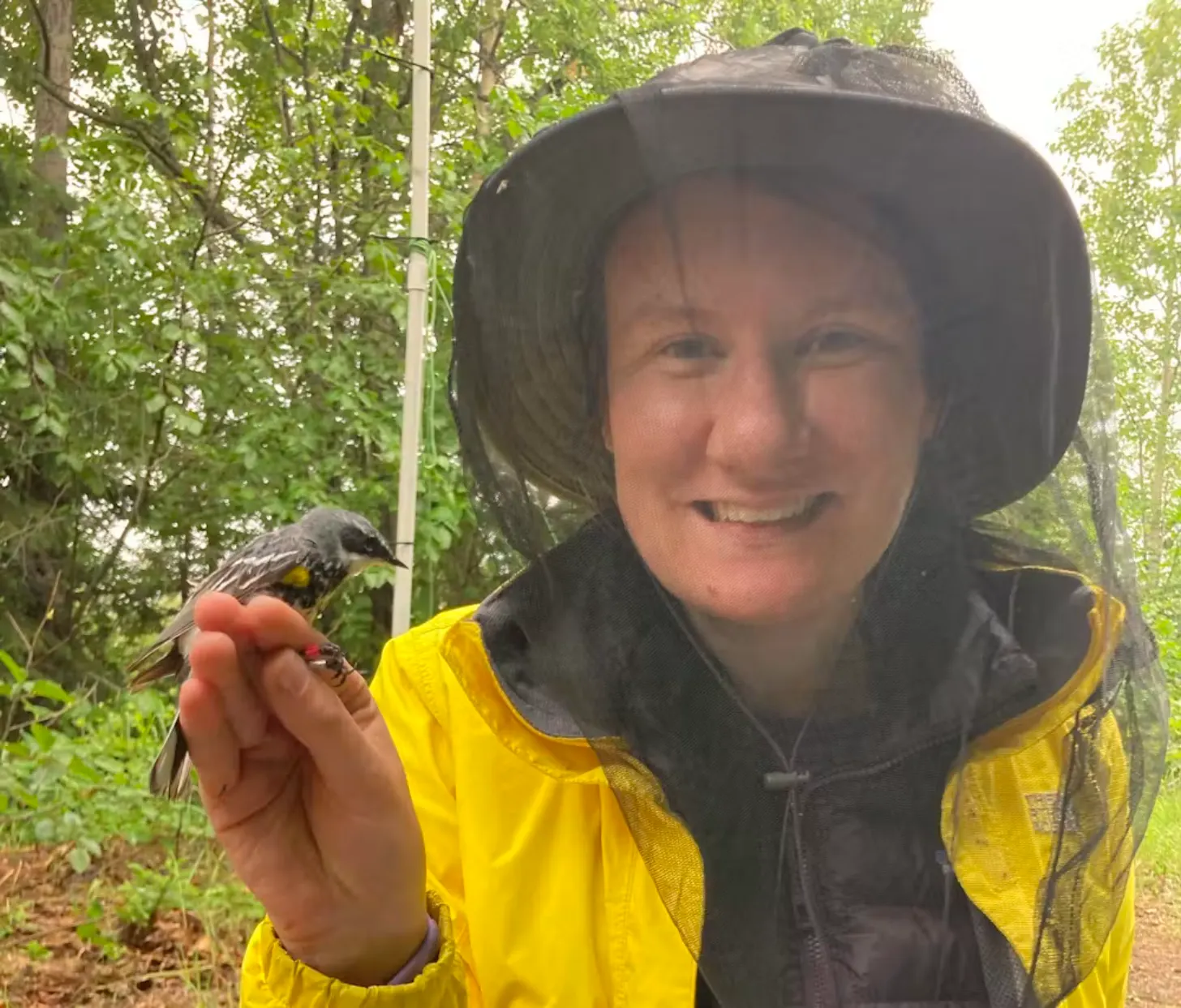
I played the high pitched “warble” of its song through a speaker placed below a mist net of fine, nearly invisible mesh. Thinking another male had intruded on his territory, the bird quickly descended. My tactic worked — he got caught in the net.
As I gently removed him, I breathed a sigh of relief as I saw the Tic Tac-size device sitting on his back.
Over the past year, this warbler carried a multi-sensor geolocator backpack throughout his migratory journey, recording the long trek from his breeding grounds in Anchorage, Alaska, to a yet unknown winter refuge and back again.
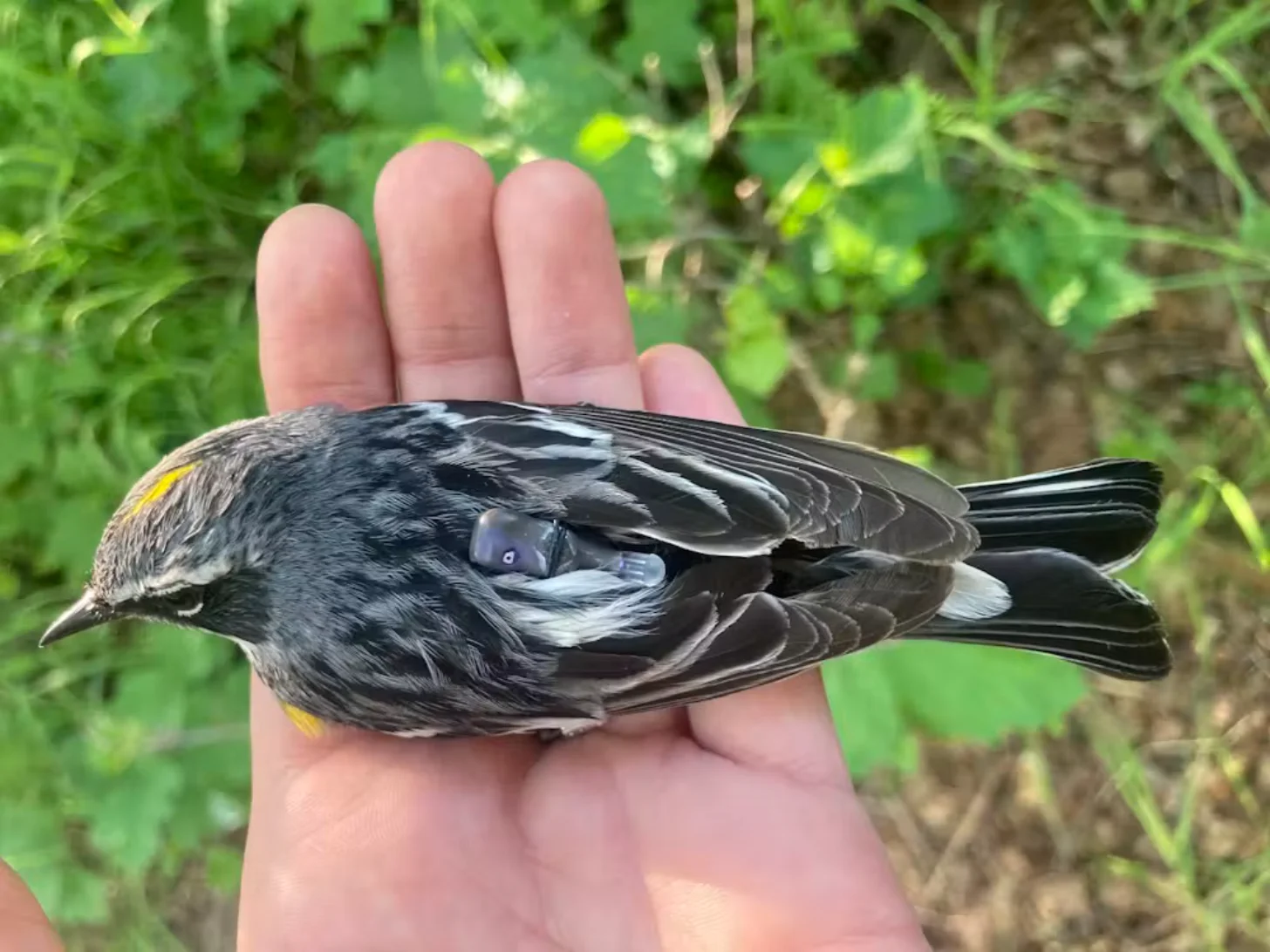
Working with my Ph.D. adviser, evolutionary biologist David Toews, I deployed dozens of these cutting-edge tags to illuminate the migratory journeys of these high-latitude breeding warblers at a scale not previously possible for small birds.
Now, after a year of waiting, I finally had the data in hand.
How can scientists track small birds?
Researchers began tracking the movements of migrating birds in the late 1960s using radio telemetry, a technique that requires tagged birds to be physically followed with receiver equipment, sometimes aided by a small aircraft.
Then, as GPS became more widely available in the early 2000s, satellite tags let researchers accurately track birds remotely. However, GPS transmitters are hefty — even just the battery that powers them is too heavy to be carried by the majority of small migratory songbirds, which often weigh less than a spoonful of sugar.
To address this problem, researchers developed ingenious little light-level geolocators.
These miniature tags minimize weight by containing only a tiny battery, clock, computer chip, and light sensor. They store data internally rather than transmitting it — hence my need to recapture tagged birds a year later. Researchers infer a bird’s locations from the timing of sunrise and sunset, which vary predictably across the globe and throughout the year.
Light-level geolocators have opened new windows into the migrations of small birds, but they also have limitations: Their estimated locations can err by hundreds of miles, and this uncertainty becomes impractically high around the equinoxes, when day length is the same worldwide.
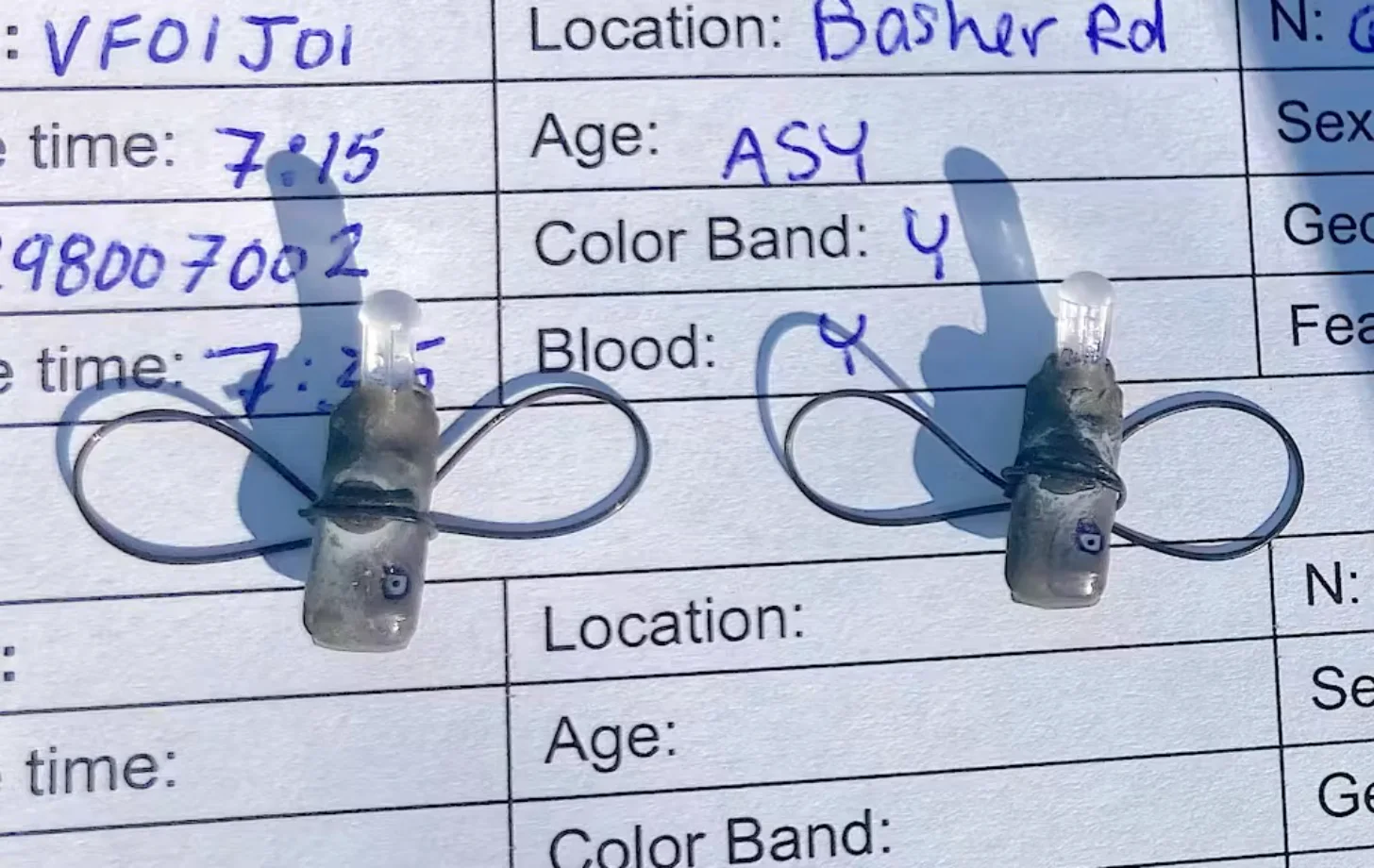
More recently, researchers developed a newer method of geolocation that uses atmospheric pressure to circumvent these limitations. When a bird ascends during a migratory flight, a barometric geolocator records a steep drop in air pressure, capturing the timing of departure and arrival for every stop along a bird’s migration route.
In between flights, the pressure the tag records reflects the elevation at the bird’s position.
Knowing the bird’s elevation helps to narrow down possible locations, which researchers can then refine further by comparing the change in pressure over time recorded by the tag to global weather data using the computer program GeoPressureR. The unique pattern of rises and falls in pressure acts as a kind of pressure fingerprint for a specific location. Including light and wind data in the model of the bird’s movements can increase precision even more.
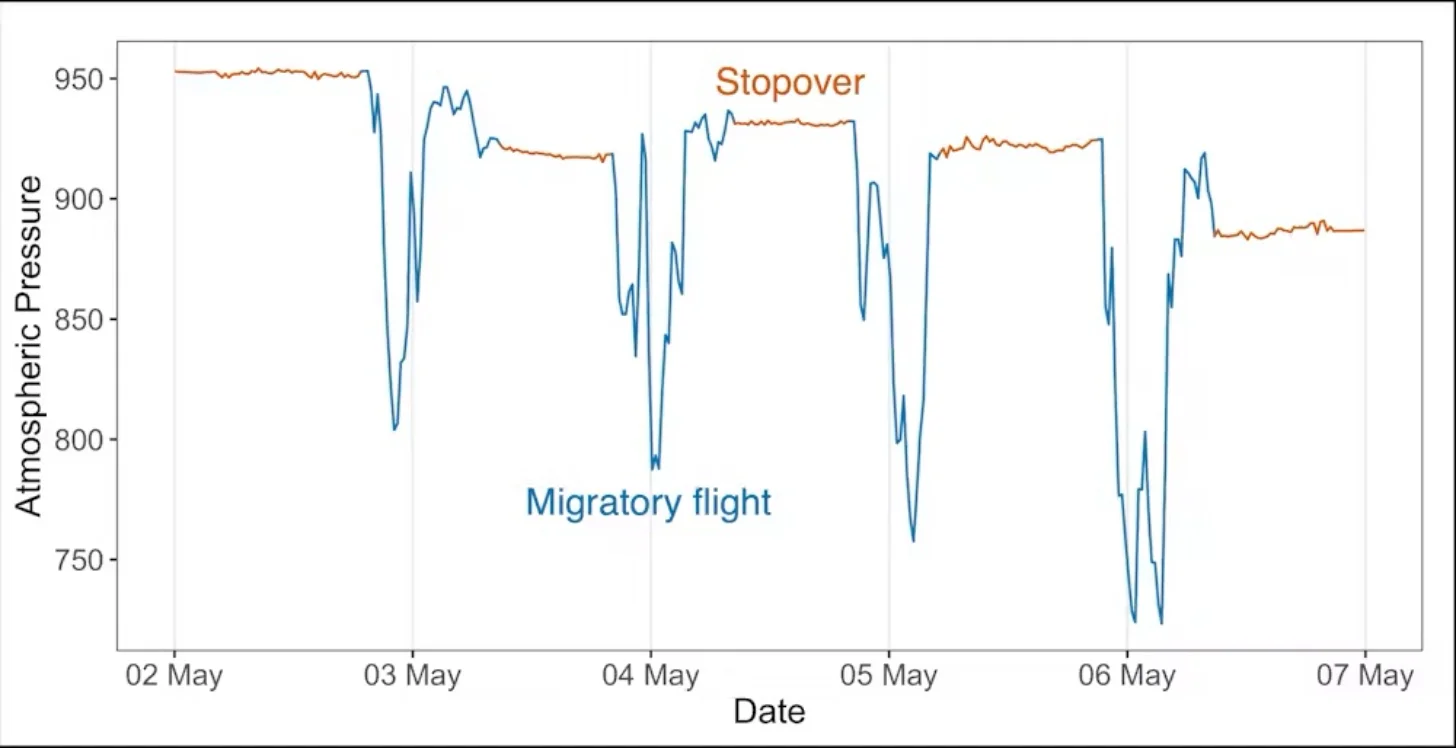
New tech answers an old question
We used these new multi-sensor backpacks to study the migration patterns of myrtle warblers, the northern subspecies of yellow-rumped warbler, which breed across North America’s boreal forest.
Myrtle warblers in the northeast are known to winter along the Atlantic and Gulf coasts, but where northwestern populations migrate has been more of a mystery. In 1899, ornithologist Richard McGregor observed myrtle warblers wintering in coastal California, and hypothesized that these birds might breed in Alaska and British Columbia.
Using these new tags allowed us to test whether warblers breeding in Anchorage, Alaska, actually followed the shortest migration route to winter in California. To our surprise — and probably to McGregor’s as well, if he were still alive — we found that all the birds we tracked traveled east across the boreal forest of Canada before shifting south to the Gulf Coast — certainly not the Pacific Coast route we expected.
All told, this 6,800-mile round-trip journey was much longer than we anticipated for a species commonly considered a short- or medium-distance migrant.
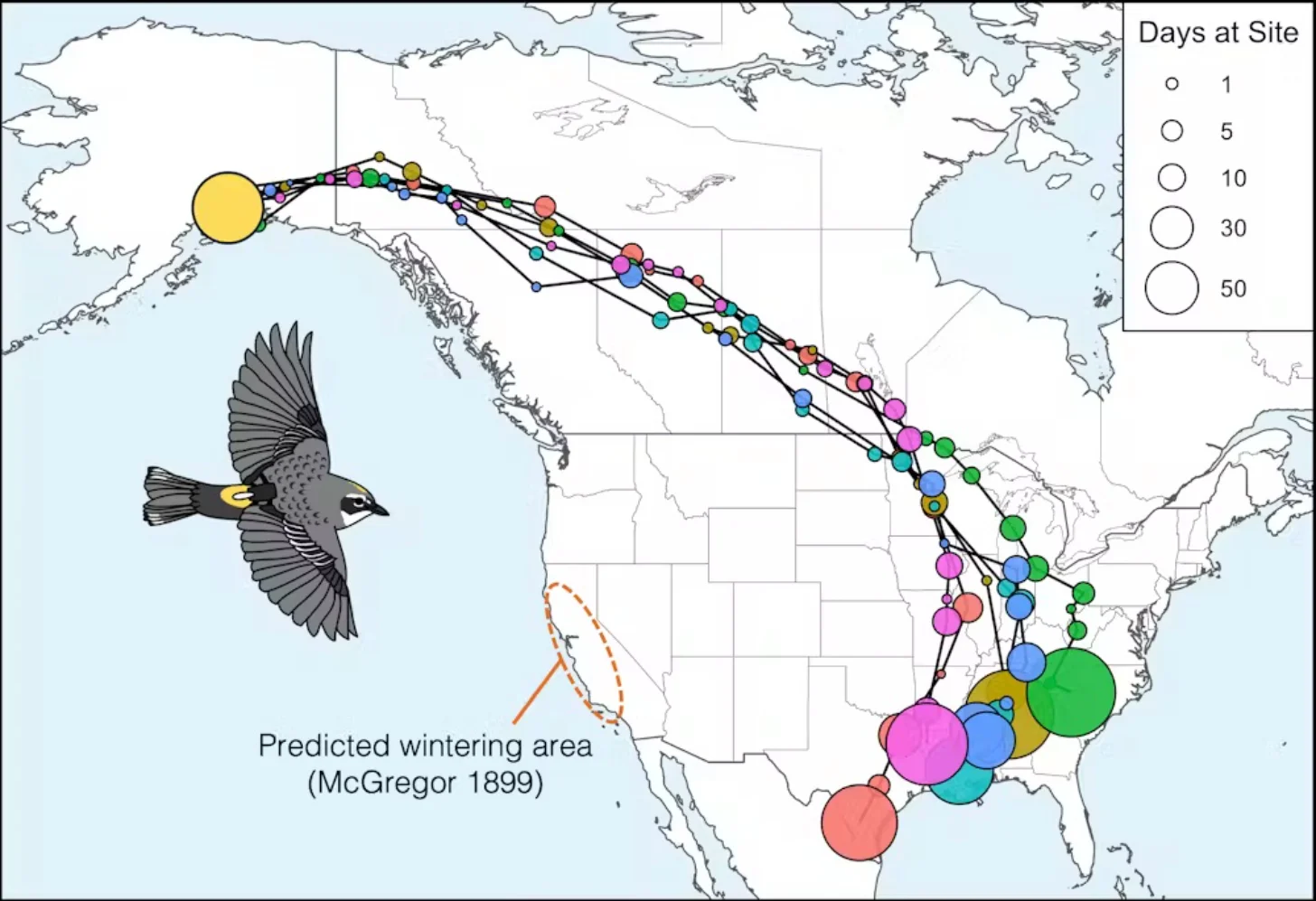
Why take such a circuitous route?
The long, seemingly suboptimal route taken by our Alaskan myrtle warblers is actually mirrored by some other songbird species tracked from northwestern North America, including blackpoll warblers and Swainson’s thrushes.
Part of this pattern may relate back to the glaciations that isolated ancient populations of birds millions of years ago. The thinking goes that as these glaciers spread, they squashed the ranges of formerly northern species into the south. Then, as the glaciers slowly receded, the forests gradually re-expanded.
As more land opened up, birds moved farther north and west into that habitat. Each season, some birds went a little farther as the forest available in their northern breeding grounds expanded.
For migratory species such as myrtle warblers, the farther north and west their breeding range expanded, the longer the migration to their southern wintering ground became.
Scientists think migration routes are genetically encoded. The birds’ genes may have traced this expansion front, like Hansel and Gretel putting down breadcrumbs as they journeyed deeper and deeper into the forest.
Today’s migration routes still trace that incrementally expanded path, even though the glaciers that shaped the original boundaries are long gone.
We’re still not sure exactly where the California-wintering myrtle warblers spotted in the 1800s are breeding. We suspect that a small proportion of the Anchorage-breeding birds may migrate to California, but that most of them travel from more distant, unstudied regions of Alaska or Yukon.
Future research, potentially tagging myrtle warblers directly on the California wintering grounds, will shed more light on this population and why certain individuals follow a different migration route.
Barometric geolocation provides new data
Today, this new geolocation approach improves scientists’ ability to study the migrations of small birds and supports more effective conservation actions across the course of the entire year.
More precise location estimates help researchers identify key stopover and wintering sites in need of protection and better understand the threats birds face throughout their journeys. These geolocators also reveal the altitude of migratory flights, which is important for understanding the risk of birds colliding with buildings or wind turbines.
Because these new tags capture pressure data for every migratory flight, they’re especially valuable for studying migration timing. Researchers have combined data from over 50 bird species to understand at what time of day or night different birds migrate.
Now, as a postdoctoral researcher at the Smithsonian Migratory Bird Center, I am integrating multi-sensor geolocator data with satellite imagery to investigate how arrival and departure decisions throughout a bird’s migratory journey relate to seasonal changes in plant growth.
Scientists have now tracked dozens of bird species with multi-sensor geolocators, and that number increases every year. Each mapped migratory journey improves our understanding of how small birds migrate, what factors shape their movements, and how best to protect them.
This article was written by Stephanie Szarmach from the Smithsonian Institute and was originally published on The Conversation.
Featured Image: Stephanie Szarmach
When Frances Connolly, who hails from the North East region of England, won the National Lottery in 2019, her first instinct was to use the £115 million jackpot — roughly $155 million — to take care of her family.
But after that, she and her husband, Paddy, decided to create a charity trust to give the rest away to charity. Since then, the PFC Trust has shared roughly half of those lottery winnings with a wide range of nonprofit organizations in the United Kingdom.

The group distributes grants to support scholarship funds, emergency food deliveries, projects aimed at combatting loneliness, and adding more defibrillators to local sports clubs, among many others.
Recently, Frances said this drive to give back is as inherent as her love of country music. Her father, specifically, was a big fan of the late Dolly Parton, who Frances described as “an inspiration” for her philanthropy.
“I think it’s in mankind to share when you get to a level where you’ve got enough,” Frances told the BBC.
While she conceded that having “enough” is a different measure for everyone, and that she perhaps would have kept more of the money for herself if she were younger, sharing the winnings was more important to her now.
“As long as the kids are sorted and they had enough to live comfortable, nice lives, I didn't see the point,” she told the BBC about hanging on to more money.
The couple said they have enjoyed “good holidays,” and have a large house, but have still purchased things like luxury watches and cars secondhand.

The BBC reported that Frances worked as a social worker and teacher prior to winning the big prize, and her husband still works for a plastics business. They were originally from Northern Ireland but moved to Hartlepool in England for work in 1990, planning to only stay for a few years. They ended up staying for 25.
“The town opened its doors and its hearts to the couple, and they retain a very strong friendship network among its citizens,” a page on the PFC Trust’s website reads.
“Therefore, when the couple had the good luck to win the lottery … one of their first acts was to set up this charity to give something back.”
The website went on to say that the goals of the trust are to “improve the lives and life chances of people across the North East by highlighting and appreciating the good in the region and helping those who need it.”

In addition to the large sum from the lottery winnings, the PCF Trust still fundraises to expand the capacity for grant funding and the Trust as a whole. A board of trustees also supports Frances and her daughter Fiona’s leadership at the trust.
For Frances’ 60th birthday, seven athletes who appreciate her support for young athletes will run, swim, or cycle a total of 60 miles to raise more funds for the PFC Trust.
“They wanted to put something back into the community,” Frances said about the event. “I’m delighted; I couldn’t have been given a better present.”
Despite all the good the Connelly family has done with their money, Frances knows all of the good fortune comes from doing important work with members of the community.
“I am at pains to explain to people that despite being a millionaire, I can’t cure poverty, and I certainly can’t do everything that’s needed to be done on my own,” she told the BBC.
“We have a lovely life. I always tell people, we have the same life, we just live it bigger.”
You may also like: Over the last 30 years, Dolly Parton has donated more than 270 million books to children in need
Featured Images: @thepfctrust/Instagram and Dolly Parton/Facebook
Most of the countryside around the Holnicote estate in Somerset has been dry and dusty for most of the summer. But one corner remains conspicuously green.
Here in southwest England, an animal that was made extinct in Britain in the 16th century, mostly because of hunting, is making a comeback. Reintroduced just six years ago, beavers have helped turn a small watercourse on the estate into a wet meadow — a true oasis amid the parched landscape.
It is an Instagram-worthy example of why reintroducing beavers to more of Britain could help us prepare for the next drought. It shows how they reshape rivers and the surrounding land to hold water in the landscape for longer, rather than allowing it to drain away rapidly.
Beavers are often called ecosystem engineers. They fell small trees, build dams, and dig channels. Water backs up behind their dams, spills across the valley bottom, and soaks into the surrounding soil. Sediment and woody debris accumulate, while wetland plants establish themselves.
The result can be a mosaic of ponds, channels, marshes, and wet woodland. During dry weather, this stored water can keep soil and vegetation wetter for longer.
This effect was highlighted in a 2008 Canadian study that examined aerial photographs of Elk Island National Park in Alberta over 54 years. Beavers had disappeared from that landscape in the 19th century, but returned in 1954.
The number of active beaver lodges, where beavers live and raise their young, was found to explain more than 80% of the variation in the area of open water. During 2002, the driest year studied, wetlands with beavers on them contained nine times more open water than those without them.
This does not mean releasing beavers in Britain will reproduce the Canadian numbers. It is a different beaver species in a different landscape, and the effects of any beaver colony depend on the shape, soils, and land use of its catchment. But British research points in the same direction.
Researchers studying a beaver enclosure on an intensively managed grassland in Devon in 2011 found that 13 dams stored around 1 million liters of additional water, or about 264,000 gallons. The dam structures built by the beavers held back the stream to create a series of ponds. Because such dams are leaky, this water was released gradually, slowing storm flows while maintaining water downstream during dry periods.
More recent work across four wild beaver territories in Devon estimated that their wetlands held more than 24 million liters of water, or over 6 million gallons.
Why we need wet land
Holding more water in a landscape has another increasingly important benefit: it helps vegetation stay green. Healthy, damp vegetation is harder to burn, so beaver wetlands may provide refuges for wildlife and help interrupt a fire’s progress.
A 2020 study of five wildfires in the western United States found that stream-side vegetation in beaver-dammed areas was three times less affected than comparable areas without beavers.
Again, this does not prove that beavers will always stop British wildfires. Our landscapes, vegetation, and fires differ from those of the western U.S. A wet strip beside a stream is no substitute for proper wildfire prevention and response. But creating wetter, greener corridors through a drying landscape is a useful extra layer of protection.
Beavers are not suitable for every watercourse. Their engineering can flood farmland, block culverts, and damage trees. So, reintroductions need proper assessment, long-term management, and support for affected landowners. England now requires a license and a management plan for any beaver releases into the wild.
A ‘welly belt’ of wetlands?
We also shouldn’t expect beavers to repair the whole landscape. There’s other work to do, including restoring peatlands, ponds, and marshes, reconnecting rivers with their floodplains, and re-establishing vegetated buffer strips along watercourses.
The UK could establish a “welly belt:” a connected network of wetland areas where needing waterproof boots is recognized as a useful feature, rather than an engineering fault to be drained away. Beaver-made wetlands could form an important part of that network, if managed correctly.
The need for careful management has recently been highlighted in Norfolk, where two wild beavers that mysteriously appeared on the River Wensum have produced the county’s first kits for more than 500 years.
Some suspect an illegal release, sometimes called “beaver bombing.” But tempting as it may sound to revive the U.S.’s wonderfully eccentric 1948 experiment, which used surplus wartime parachutes to relocate troublesome beavers into remote parts of Idaho, Britain needs planned releases — not airborne rodents.
We do need far more beavers, though, in the right places. They will not end drought or wildfires. But they can help put water back into a landscape we have spent centuries draining — and keep it there until we need it.
This article was written by Christian Dunn from Bangor University and was originally published on The Conversation.

Featured Image: Katarīna Šterna/Unsplash
The Chester Zoo, which has been operating as a nonprofit since 1934, is world-renowned for its breeding programs and conservation efforts.
Currently, it houses 30,000 animals and more than 500 species — many of which are endangered.
On September 9, the Chester Zoo welcomed three of its newest additions: newborn pups “Spud,” “Russ,” and “Jackie.”
The potato-named pups are rock hyraxes, also known as “rock rabbits” or “rock badgers.” Despite their nicknames, hyraxes belong to the same evolutionary group as elephants, dugongs, and manatees.
“People are always surprised when we tell them that hyraxes are closely related to elephants,” zookeeper Megan Carpenter said in a press release.
“They look completely different, but there are some clues to their unusual family history. Their long front teeth, for example, are a little bit like miniature elephant tusks, and their feet have some resemblance to elephant feet, with flattened hoof-like nails,” she explained.

“It’s incredible to look at one of these tiny pups and know that somewhere in its family tree is an elephant.”
The surprising genetic links between rock hyraxes, manatees, and elephants are not unheard of in the animal kingdom.
In 2024, Karin Akre, a research scientist with Bat Conservation International, explained the unique ties between animal relatives when she pointed out that a bat’s closest living relatives are cows, pumas, and whales.

“Evolutionary relationships are defined by which types of animals share ancestors that lived millions of years ago,” Akre stated.
“Bats, whales, pumas, cows … are all related as placental mammals. The most recent ancestor shared by all placental mammals had hair, produced milk, and gave birth to live young,” she continued. “Scientists suspect it looked like a tiny shrew and lived around the end of the Cretaceous period.”
“Over generations, offspring accumulated changes, leading to populations with differences, then to distinct species. This process repeated over and over, branching into new species and leading to today’s diverse mammals.”
All three hyrax pups were born to parents Maris and Albert in late summer. Recently, Spud, Jackie, and Russ received a clean bill of health from the zoo’s veterinary staff.
Currently, they weigh just 12 ounces, which is roughly the weight of a can of soda. Once they’re older, they’re expected to weigh up to 8 pounds.
In the wild, rock hyraxes live amongst rocky outcrops and cliffs across Africa and the Middle East. According to Carpenter, their rounded shape and russet fur coloring help them blend in with their natural habitat.

“Hyraxes are one of those species that you have to look for, but once you’ve seen them, they are fascinating to watch,” she said.
Carpenter said that zoo staff have been referring to the pups as “little chaos potatoes.”
“They are much more energetic than their parents and sometimes get the zoomies, darting about and testing their climbing and parkour skills,” she joked.

“In contrast, the adults often wedge themselves into corners and grip onto steep rock faces for hours at a time. They’re incredibly well adapted to living among rocks and are much better climbers than you might expect.”
Lyndon Howson, the Chester Zoo’s assistant team manager in visitor engagement, said the surprising connection between hyraxes and elephants is “a brilliant example of how misleading appearances can be when it comes to evolution.”
“It’s incredible to think these little animals are so closely related to elephants and manatees,” Howson said.
“That’s what makes species like hyraxes so interesting — they challenge what we think we know about the natural world and show just how surprising animal evolution can be.”
You may also like: Zoo welcomes baby porcupine for the first time in 121 years. It has its own 'emotional support log'
Featured Image: Chester Zoo