Electric power generation in the U.S. is shifting rapidly away from fossil fuels toward cleaner and lower-carbon sources. State clean energy targets and dramatic declines in the cost of renewable electricity are the most important reasons.
But fossil fuel plants still generate 60% of the U.S. electricity supply, producing air, water and land pollutants and greenhouse gases in the process. To reduce these impacts, the Environmental Protection Agency announced a suite of rules on April 25, 2024.
They focus mainly on coal plants, the nation’s most-polluting electricity source.
As an environmental lawyer who has been in practice since the early 1970s, I believe these curbs on power plant pollution are long overdue.
The new rules close loopholes in existing laws that have allowed coal-fired power plants to pollute the nation’s air and water for decades. And they require utilities to drastically slash these plants’ greenhouse gas emissions or close them down.
Opponents, including industry groups and Republican attorneys general, have raised concerns, and some have vowed to sue. They argue that the EPA has overreached its legal authority and is imposing crippling costs on the coal industry.
While these arguments may resonate with conservative judges, in my view the EPA’s carefully crafted rules are on firm legal ground and have a strong chance of being upheld.

Mercury, wastewater and coal ash
The first rule updates the Clean Air Act’s 2012 Mercury and Air Toxics Standards. Mercury, which is emitted into the air when coal is burned, is a neurotoxin that causes developmental damage in children and has contaminated fisheries throughout the U.S.
The new rule closes the so-called “lignite loophole,” which allows plants burning lignite – the lowest grade of coal – to emit more than three times as much mercury pollution as other coal plants. There are only a handful of lignite plants still operating in the U.S., concentrated in Texas and North Dakota. The new rule lowers the emissions standard for mercury from these plants by 70%.
A second rule tightens standards for wastewater from coal-fired power plants under the Clean Water Act. These plants use a lot of water for cooling, producing steam and industrial processes. The wastewater that they discharge into rivers, lakes and streams contains toxic pollutants such as mercury and arsenic that threaten drinking water supplies and fisheries.
The EPA estimates that the new rule will reduce these pollutants by about 670 million pounds per year. Coal plant owners will have until 2029 to comply, unless they agree to permanently stop burning coal by 2034.
Burning coal also generates millions of tons of ash, which can contain toxic heavy metals such as mercury, arsenic and cadmium. The third new rule deals with “legacy sites” – inactive coal plants – that collectively hold 500 million tons of coal ash in unlined, unmonitored waste pits and holding ponds.
Coal ash spills have contaminated rivers in Tennessee, North Carolina and elsewhere. Over 160 unlined lagoons remain. Most legacy sites are located in low-income communities and communities of color.
A canoe paddle scoops up coal ash from the bank of the Dan River in North Carolina after a spill from a power plant released thousands of tons of ash in February 2014.
The new rule responds to a 2015 ruling by the U.S. Court of Appeals for the D.C. Circuit. The EPA had adopted a rule that regulated coal ash storage at active power plants but not at inactive plants – an approach that the court held was unlawful. The new regulation will require safe management of coal ash at previously unregulated legacy sites.
Carbon pollution standards
The most potentially controversial rule in the new package addresses greenhouse gas emissions from existing coal plants and new gas-fired power plants. Section 111 of the Clean Air Act directs the EPA to define the “best system of emission reduction” for air pollutants, including greenhouse emissions, from power plants.
States must then submit plans to the EPA to adopt these systems. If a state refuses, the agency takes over implementation.
The EPA has determined that carbon capture and sequestration is the best system of emission reduction for both existing coal plants and new gas plants. The agency initially proposed to regulate emissions from existing gas plants but is deferring that step.
The rule adopts a staggered approach to compliance that encourages early retirement of the country’s aging coal fleet. Plants retiring before 2032 would not be subject to the rule. Those scheduled to close by 2039 would have to reduce emissions by 16% by 2030. Plants slated to operate beyond 2039 must reduce their greenhouse emissions by 90% by 2032.
To give utilities some flexibility, the rule allows sources to use “green hydrogen” – produced by splitting water using renewable energy – in their fuel mix, and to participate in emissions trading programs.

Next stop: Court
In my opinion, the regulation that faces the most serious legal challenge is the one addressing greenhouse emissions at coal plants. The mercury and coal ash rules simply plug loopholes in existing regulations, and the wastewater rule is a long overdue update of technology standards to control toxic discharges.
All three rules are squarely within EPA’s regulatory wheelhouse and grounded in explicit statutory authority.
The climate rule may face a harder road because of the Supreme Court’s 2022 West Virginia v. EPA ruling, which invalidated the Obama administration’s Clean Power Plan and applied a new approach to interpreting laws called the “major question doctrine.”
This concept basically says that where a new rule would have “vast economic and political significance,” Congress must explicitly empower the agency with authority over the issue, and the court will not defer to the agency’s interpretation regardless of policy considerations or the agency’s expertise.
The fate of the climate rule may depend on how courts answer these three questions:
Does the major question doctrine apply?
The EPA has gone to great lengths to distinguish this rule from the ill-fated Clean Power Plan and heed the Supreme Court’s directive to stay in its lane. The new rule takes a traditional, time-tested approach to setting emissions limits based on pollution controls that are available to individual plants.
Indeed, carbon capture and sequestration is analogous to scrubbers – devices that the EPA has required for decades to remove pollutants such as fine particulates, sulfur dioxide and mercury from power plant smokestacks. And the new rule does not require utilities to shift from coal or natural gas to renewable fuels, which was what most troubled the court in the West Virginia case.
Is carbon capture and sequestration ready for prime time?
The Clean Air Act requires that a best system of emissions reduction must be “adequately demonstrated.” Courts have interpreted this phrase to include options that are forward-looking and “technology-forcing” – meaning that the standards may not be achievable today, but information available now shows they will be achievable in the future.
The D.C. Circuit Court has repeatedly affirmed that the EPA has the “authority to hold the industry to a standard of improved design and operational advances, so long as there is substantial evidence that such improvements are feasible and will produce the improved performance necessary to meet the standard.”
Will the rule affect power grid reliability?
Shifting too abruptly to new fuels and technologies could make it hard for utilities to generate enough electricity to meet demand. However, the EPA consulted with state and federal agencies and power companies and conducted a detailed analysis, which concluded that the power plant rule would not have a major impact on reliability.
The rule gives owners until 2032 to incorporate carbon capture and sequestration and allows states to keep plants online for an extra year if they can show that retiring them threatens grid reliability. Other provisions give utilities added flexibility.
As of April 2024, there are about 200 coal-burning power plants still operating across the U.S. Plants representing one-fourth of that capacity are projected to close by 2029 for economic reasons unrelated to regulations.
These new rules will certainly make operating coal plants more expensive. This will make the price of electricity generated from coal reflect its true costs to society more accurately. Given coal energy’s impacts on our nation’s air, waters, land and climate, as well as on public health, I see this action as squarely within the EPA’s mission.
This article was written by Patrick Parenteau from Vermont Law & Graduate School, and was originally published on The Conversation.
Banner image by Ella Ivanescu

Starting in July 2024, California will be the first state to charge an excise tax on guns and ammunition. The new tax – an 11% levy on each sale – will come on top of federal excise taxes of 10% or 11% for firearms and California’s 6% sales tax.
The National Rifle Association has characterized California’s Gun Violence Prevention and School Safety Act as an affront to the Constitution. But the reaction from the gun lobby and firearms manufactures may hint at something else: the impact that the measure, which is aimed at reducing gun violence, may have on sales.
As a professor who studies the economics of violence and illicit trades at the University of San Diego’s Kroc School of Peace Studies, I think this law could have important ramifications.
One way to think about it is to compare state tax policies on firearms with those on alcohol and tobacco products. It’s not for nothing that these all appear in the name of the Bureau of Alcohol, Tobacco, Firearms and Explosives, also known as ATF.
What alcohol, tobacco and firearms have in common

That agency, part of the Justice Department, is tasked with making American communities safer.
The ATF focuses on those products because, while legal, they can cause significant harm to society – in the form of drunken driving, for example, or cancer-causing addictions. They also have a common history: All have been associated with criminal organizations seeking to profit from illicit markets.
Alcohol and tobacco products are thus usually subject to state excise taxes. This policy is known as a “Pigouvian tax,” named after 20th-century British economist Arthur Pigou. By making a given product more expensive, such a tax leads people to buy less of it, reducing the harm to society while generating tax revenue that the state can theoretically use to offset those harms that still accrue.
California, for instance, imposes a US$2.87 excise tax on each pack of cigarettes. That tax is higher than the national average but much lower than New York’s $5.35 levy. California also imposed a vaping excise tax of 12.5% in 2021.
Of the three ATF product families, firearms have enjoyed an exemption from California excise taxes. Until now.
The costs of gun violence
Anti-gun advocates have long called for the firearm industry to lose the special treatment it receives, given the harms that firearms cause. The national rate of gun homicides in 2021 was 4.5 per 100,000 people. This is eight times higher than Canada’s rate and 77 times that of Germany. It translates into 13,000 lives lost every year in the U.S.
Additionally, nearly 25,000 Americans die from firearms suicide each year. This implies a rate of 8.1 per 100,000 per year, exceeding Canada’s by more than four times. Moreover, more people suffer nonfatal firearm injuries than die by guns.
Gun deaths and injuries aren’t just tragic – they’re expensive, too. One economist estimated the benefit-cost ratio of the U.S. firearms industry at roughly 0.65 in 2009. That means for every 65 cents it generates for the economy, the industry produces $1 of costs.
And that back-of-the-envelope calculation may be an underestimate. It included the cost of fatal gun violence committed within the U.S. But the estimate didn’t include nonfatal injuries, or the cost of firearm harms occurring outside the U.S. with U.S.-sold weapons.
Mexico pays a steep price for US gun trade
America has been called the world’s gun store. No country knows this better than Mexico. The U.S. endured roughly 45,000 firearms deaths in 2019, while the rest of the world combined saw 200,000. Mexico, which shares a long, permeable border with the U.S., contributed 34,000 to that grisly total.
Mexico’s government estimates that 70% to 90% of traceable guns used in crimes seized in the country come from the United States. Other examples abound. For instance, U.S.-sold guns fuel gang violence in a lawless Haiti.
No investor would back such an industry if they were forced to pay its full cost to society. Yet U.S. gun sales have grown tenfold over the past 20 years to about 20 million guns annually, even though they’re now deadlier and more expensive.
What alcohol, tobacco and firearms don’t have in common
Across the U.S., there’s not a single state where firearms are taxed as much as alcohol and tobacco. I think guns should probably be taxed at a higher level than both of them. That’s because unlike alcohol and tobacco – consumable products that disappear as soon as they’ve been used – firearms stick around. They accumulate and can continue to impose costs long after they’re first sold.
Starting in July, California will tax firearms at about the level of alcohol. But the state would have to apply an excise tax of an additional 26% to equal its effective tax on tobacco.

It’s unclear how the new tax will affect gun violence. In theory, the tax should be highly effective. In 2023, some colleagues and I modeled the U.S. market for firearms and determined that for every 1% increase in price, demand decreases by 2.6%. This means that the market should be very sensitive to tax increases.
Using these estimates, another colleague recently estimated that the California excise tax would reduce gun sales by 30% to 44%. If applied across the country, the tax could generate an additional $1.5 billion to $1.9 billion in government revenue.
One possible problem will come from surrounding states: It’s already easy to illegally transport guns bought in Nevada, where laws are more lax, to the Golden State.
But there’s some evidence that suggests California’s stringent policies won’t be neutralized by its neighbors.
When the federal assault weapons ban expired in 2004, making it much easier to buy AR- and AK-style rifles across much of the U.S., gun murders across the border in Mexico skyrocketed.
Two studies show the exception was the Mexican state of Baja California, right across the border with California, which had kept its state-level assault weapons ban in place.
Gun seizures in Mexico show that all four U.S. states bordering Mexico rank in the top five state sources of U.S.-sold guns in Mexico. But California contributes 75% less than its population and proximity would suggest.
So, California laws seem to already be making a difference in reducing gun violence. I believe the excise tax could accomplish still more. Other states struggling against the rising tide of guns will be watching closely.
This article was written by Topher L. McDougal from University of San Diego, originally published on The Conversation.

Many Americans donate to charities that help military veterans as a way to honor them for their service to the country.
It can, however, be daunting to choose from the more than 8,000 such groups operating nationwide.
Donor trepidation is magnified by the scandals that have embroiled vets’ groups. In fact, more than 10 percent of the charities tagged as “America’s Worst Charities” by the Tampa Bay Times and the Center for Investigative Reporting in 2013 focus on veterans.
As a professor who researches nonprofit organizations and teaches about their finances, I have observed that while some veterans’ charities do squander donors’ dollars, others make the most of donations in meeting their mission.
Fortunately, a little research goes a long way toward spotting the difference between a good cause and a lost cause.
The following tips will help you vet these charities:
How to vet charities that help veterans:
1. Learn what exactly the charities do
Be wary of vague statements about a group’s activities.
While language indicating that a charity “supports” or “honors” veterans does not always signal a problem, it does mean you should seek more specific information.
Many of the veterans’ charities that have faced criticism, such as Paralyzed Veterans of America and National Veterans Services Fund, have had vague mandates to educate the public about what veterans need.

It’s hard but not impossible to decide which veterans’ charities deserve a thumbs-up – and your donation.
A detailed description of a group’s mission and activities can instill confidence that veterans truly benefit from its work.
An exemplary charity is the Honor Flight Network, which flies veterans to Washington, D.C. to visit military monuments and honor fallen colleagues. The benefits are self-evident, as I’ve seen firsthand as a flight volunteer.
Fisher House Foundation, which provides temporary housing to families of veterans receiving treatment at VA facilities, is another good example.
There are many ways that organizations can and do directly serve veterans. To find them, look for clear-cut programs you find meaningful and significant.
2. Find out what share of the money raised for organizations actually supports them
Another common pitfall: for-hire fundraisers that siphon too much of the donated funds.
Michigan’s attorney general determined that only 39 percent of funds raised by professional solicitors for charity in the state in 2016 actually supported those groups.
The fundraising contractors kept the rest of the money. The picture is even more lopsided for veterans’ charities in the state, with only 23 percent of donations making it into their coffers. The track record in Michigan is no anomaly – New York, Massachusetts and other states have found similar patterns.
Operation Homefront, which Consumer Reports has named as one of the best veterans’ charities, clearly states on its website how much it spends supporting its mission.
Professional solicitation is not inherently problematic – but outsourced fundraisers keeping most of the money raised for a charity is a real concern. The federal government does not track this information but most offices of state attorneys general maintain databases that indicate how the organizations raising funds in their states stack up.
Since national campaigns also show up in these databases, even if your own state doesn’t make all the details easily accessible, you can use the online tools other states offer to evaluate different charities. New York’s database is especially user-friendly.
3. Check out IRS 990 forms
OK. I know perusing IRS forms is not everyone’s favorite activity. But it’s the best way to discover how donor dollars are actually spent. Finding a charity’s tax form is easy, even if groups don’t post them on their own websites, thanks to databases like ProPublica’s Nonprofit Explorer and the Foundation Center’s 990 Finder.
The Semper Fi Fund 990 form from its 2016 fiscal year suggests that the group does not spend an excessive amount of money on fundraising and administration.
If you do check out a 990 form, be sure to go to page 10. That’s where nonprofits classify their expenses, both by function and type.
There, you can see where donated money primarily goes. If the organization has a stated focus on providing financial assistance to veterans, for example, you should see lots of grants to individuals on line 2, and not so much in the way of advertising, travel and postage listed on the other lines.
Consider how the Semper Fi Fund, a group that provides financial and other aid to injured and ill post-9/11 veterans and their families, stated its functional expenses for its 2016 fiscal year. The numbers indicate that the group spends over 90 percent of its funds on its mission. Three-fourths of that mission spending is direct grants to individuals – a good sign.
4. Inquire about donor privacy policies
When you make charitable donations, you give away both money and personal information. What charities do with your personal data is part of the picture and how they handle this information varies widely.
Consider how the Wounded Warrior Project, among the nation’s most visible veterans’ organizations, has handled donor data. The group came under fire in 2015 and 2016 for alleged waste, as well as routinely selling personal information culled from its donors to other nonprofits and defending this practice. The controversy resulted in a shakeup at the top.
Other groups do a better job of protecting donor privacy. Fisher House Foundation, which clearly states a policy of not sharing or selling donor lists, offers a good example of how to do this. If an organization doesn’t state its privacy policy on its website, take the time to ask.
When it comes to vetting charities, a little work goes a long way. These four steps should help you find veterans’ charities with goals that match your own and that you can trust to make the most of the money you give away.
This article was written by Brian Mittendorf from Ohio State University and was originally published on The Conversation.

For the last 27 years, GLAAD has tracked the representation of LGBTQ+ characters in television through its annual Where We Are On TV report.
While LGBTQ+ characters are not nearly at the point of ubiquity of their heterosexual counterparts, every year brings new wins for queer representation in media.
In the 2022-2023 report, GLAAD counted 596 LGBTQ+ characters across primetime scripted broadcast and cable and scripted originals on the eight streaming services the organization tracked. While many of those characters are still cisgender, white gay men, a diverse range of LGBTQ+ women characters actually make up a majority of these characters.
According to the report, in 2022-2023, there were 310 LGBTQ+ women (52% of all LGBTQ characters), 261 men (44%), and 25 nonbinary characters (4%) counted.
In 2024, there are over 170 running U.S. television shows that include LGBTQ+ women, but for the WLW (women loving women) crowd, it can still be a challenge to find a show with meaningful representation.
So one TikTok creator, Aria Velz, decided to do something about it.
Velz — whose bio reads “just a woman who loves her wife and lesbian movies” — has created a thorough, color-coded spreadsheet to make finding your next WLW watch easier than ever.
“Hey gays,” Velz starts off a recent video to her over 195,000 followers. “Just a reminder that if you’re looking for a TV show with lesbians and other queer women, you can check out the spreadsheet that I made.”
The spreadsheet — which is formally titled “The Current State of WLW TV” — includes a variety of filters, including:
- Where to watch
- Genre
- Prominence of queer women characters
- Number of seasons
- Whether the show has been renewed or canceled
“Let’s say you want to watch TV shows in which queer women are the main characters or the protagonist,” Velz said. “No problem; you can just filter that out here, and I will show you all of the series where you can watch queer women protagonists and where to find them.”
@ariavelz Reminder to all queer women looking for good movies and TV: I have spreadsheets. #lesbian #wlw #sapphic #lesbiantiktok #gay #queer #wlwtv #sapphictvshows #lgbtq #lgbt #wlwtv ♬ original sound - Aria Velz
Velz’s database also includes a brief description for each title, so viewers can have a taste of what to expect.
Some of these titles include hits like “The Boys,” on Amazon Prime, “Euphoria” or “Hacks” on Max, Paramount+’s “Yellowjackets,” and “Mary & George” on STARZ.
There are also a wide variety of less popular titles, or some in specific genres like anime or soap opera, with the prominence of LGBTQ+ women characters ranging from occasional or ensemble appearances to main characters or protagonists.
The spreadsheet only shows programs that are running in 2024, but users can also toggle to Velz’s spreadsheet from 2023 to find other options that may be available to stream or rent, even if they have not been renewed.
In addition to this regularly updated list of TV shows, Velz has another detailed database of WLW films, complete with a spoiler tab, descriptions, language, release date, and more.
Velz’s spreadsheet is already a great service to the LGBTQ+ and ally communities, but she was sure to throw in a quick plug at the end of the video, considering she reviews and shares in-depth videos about these programs all the time.
She said: “If you follow me, you will never run out of good sapphic TV or movie recommendations.”
Header images courtesy of Eddy Chen/HBO, Liane Hentscher/HBO, and Max
Chappell Roan — rising pop sensation and self-professed “dream girl’s dream girl” — wants to send two lucky fans on a free trip to Bonnaroo Music and Arts Festival this June.
“I’m Chappell Roan, and you can win tickets to Bonnaroo, an all expense paid trip to come see me and other artists,” Roan teased in a recent promotional video.
“All you have to do is donate to the Human Rights Campaign,” Roan said. “I just want my project to mean something — I’m very passionate about that — so I’m partnering with Propeller to make that happen.”
The Human Rights Campaign is an advocacy group that provides resources for the LGBTQ+ community and mobilizes voters in support of anti-discrimination laws.
In addition to the Human Rights Campaign, Roan has led donation campaigns and performed benefits shows for organizations that have been “instrumental” to her journey, like LGBTQ+ youth crisis foundation The Trevor Project, Ozarks-based nonprofit The GLO Center, and the Black, trans-led collective For The Gworls.
“The queer community is my main fanbase, so my responsibility is to pay it forward by donating a portion of ticket sales and sales in general [to LGBTQ+ charities] and show up at Pride events,” she said in an interview with NME this past February. “Really, I’m here to give back all the energy that the queer community has given to me.”
@teampropeller You and your festie bestie could win a trip to meet @chappell roan at Bonnaroo. But a meet & greet with the Midwest Princess won’t be the only way you’ll be experiencing royalty. You’ll also get to experience the fest with the ROO WORKS ROYALTY package - complete with VIP Centeroo tickets, a luxurious Bell tent in the moon colony, your own personal golf cart chauffeur and more. Join us in taking action to support @Human Rights Campaign ♬ original sound - Propeller
At the end of her promotional video, Roan pointed out how timely her latest campaign is.
“Pride Month is coming, right around the corner, and donating to this cause directly supports the queer community,” Roan said, blowing a kiss to the camera. “So you just have to tap the link to donate and enter!”
How do I enter the contest?
Fans have until Wednesday, May 29 to enter the contest, and the winner will be picked on Thursday, May 30.
In addition to winning two four-day VIP tickets to Bonnaroo — which is held in Manchester, TN — the contest package comes with backstage access, a personal “golf cart chauffeur,” a Chappell Roan meet and greet, and complimentary roundtrip travel.
Other artists set to perform at Bonnaroo include Reneé Rapp, Maggie Rogers, Post Malone, Megan Thee Stallion, Red Hot Chili Peppers, Diplo, and more.
Fans can enter the contest in a multitude of ways: donating a dollar or more to the Human Rights Campaign (10 points per dollar), signing a petition against anti-LGBTQ+ legislation (25 points), or buying a Propeller Pride T-Shirt (500 points).
The more points earned, the better chances of getting picked.
After choosing a preferred entry method, users will be prompted to create a Propeller account. Upon returning to Roan’s charity page again, users can then click a “GET ENTRIES” button to turn their accumulated points into entries.
As the Midwest Princess herself sings in her latest hit single: “Good luck, babe!”
Header images courtesy of Team Propeller / TikTok
- Bangladesh has seen the highest number of olive ridley turtle eggs this year, a conservationist group says.
- The olive ridley’s main nesting ground is different islands of the country’s southeastern district, Cox’s Bazar, in the Bay of Bengal.
- The key reasons behind the success are extensive conservation action across beaches and an awareness program among local people.
- Conservationists say they believe success might decline if the current pace of tourism and related infrastructure development is not checked, as they appear to disturb ecosystems.
This year, Bangladesh has seen its highest number of olive ridley turtle eggs, thanks to extensive conservation actions, including building awareness among local people and the vigilance of local conservation groups to ensure favorable conditions for the species.
Nature Conservation Management (NACOM) found 12,425 eggs in five turtle hatcheries — Pachar Island, Shilkali Island, Shahpari Island, Matharbunia, and Shonadia Island in Cox’s Bazar district — through April 17 this year.
The number of eggs has increased by almost 53% compared with the previous year, from 8,096 to 12,425. Those tallies represent a significant jump from the 4,713 eggs recorded in 2020-2021 and 5,763 in 2022-23.
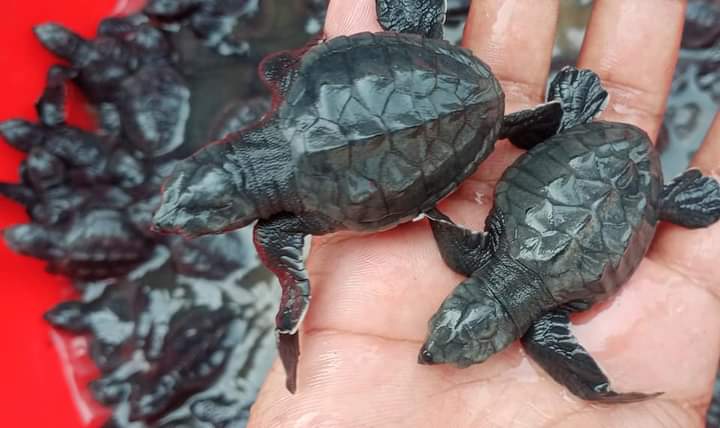
Of the seven turtle species living in seas, five species are found in Bangladesh’s territorial waters: the olive ridley (Lepidochelys olivacea), green (Chelonia mydas), hawksbill (Eretmochelys imbricata), loggerhead (Caretta caretta) and leatherback (Dermochelys imbricata).
Three species of sea turtles — olive ridley, green and hawksbill — come to the coast of Bangladesh to lay their eggs. Green turtles and hawksbills are rare.
The olive ridley is listed as an endangered turtle on the IUCN Red List. Olive ridley turtles usually hatch from November to April. At this time, in the dark of night, the mother turtle comes to the house (nesting ground) made in the sand on the beach and returns to the sea with eggs.
How the development works
Comprehensive conservation action across the beach is a key reason behind the success, among many others. As part of the conservation efforts, several organizations are working with volunteers to care for the hatchery, said Munjurul Hannan Khan, executive director of NACOM.
He added that a second factor in the success is building awareness among local populations on the importance of ensuring a safe environment for the female to lay her eggs.

To explain the process of increasing the turtle population, he added, “We first discovered the problems and found a way out to protect the species.”
“Awareness is the key thing among the local people. We are constantly trying to build awareness among the local people and the fishers. We told them that if they kill turtles, they get fewer fish. Because turtles play a big role in the ecosystem, they clear up the underwater dirt by eating them. Thus, the fish have more chances to breed. So if you kill the turtle, you will get fewer fish.”
“Secondly, we alert them about the existing law about wildlife. Sometimes, smugglers tend to sell them, and also the local people kill them when they come into the seashore. We also alert the fishermen to free the turtles if caught in the net while fishing. Otherwise, they all have to face the fine and other issues by the law enforcement agency.”
Meanwhile, the government has initiated several actions to create a safe environment for turtles, including setting up conservation centers.
The government has set up five conservation centers in Cox’s Bazar for breeding turtles, where hatchlings are artificially hatched. A nesting ground is made on the beach sand to release the eggs, which may cause a rise in the number of turtles coming to the beach and laying eggs safely, said Sarwar Alam, divisional forest officer of Cox’s Bazar South Forest Division.
Rampant development activities appear as threats
According to the 2015 fifth national report on Bangladesh biodiversity, turtle nesting grounds on beaches are destroyed due to development activities and increased tourist traffic. In addition, turtles die after being trapped in commercial fishing nets in the sea. Otherwise, the number of turtles and their eggs would be higher.
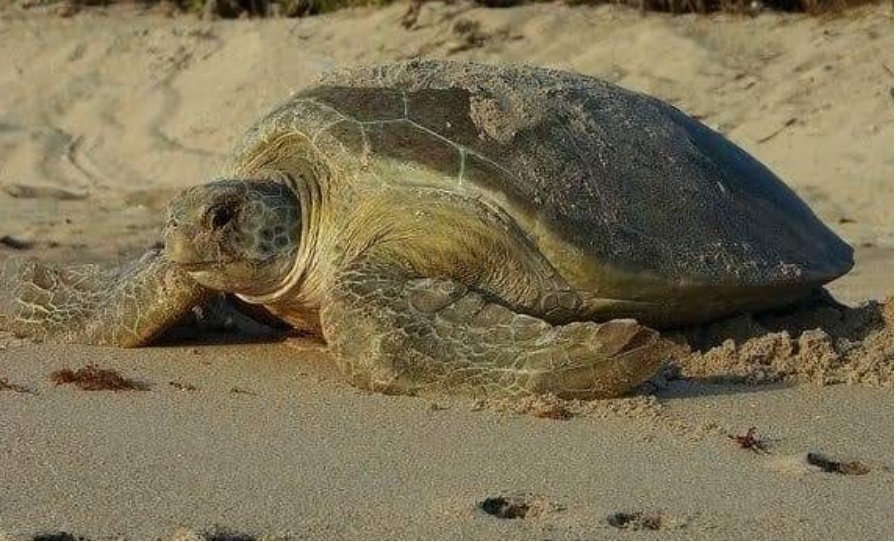
Mohammad Russell, former program officer of Bangladesh Marine Life Alliance, said that fishing with large nets is prohibited within 10 kilometers (6.2 miles) of St. Martin’s Beach during the sea turtle breeding season. However, fishers often do not follow this rule.
“The green turtle can stay under the sea for a maximum of five hours, and the olive ridley is about the same. Then, they have to climb up to breathe. Turtles stay close to the coast when they lay their eggs. But if caught in fishing nets, they die underwater for a long time,” he said.
The conservationist said that due to the lights of hotels and motels built very close to the beach and the noise of tourists, the arrival of turtles on the beach has decreased at night. Some female turtles have come to the beach and returned to the sea without leaving eggs.
Meanwhile, the Bangladesh government signed several international or regional agreements, conventions, treaties and protocols related to the marine environment and biological resources that directly or indirectly affect marine turtles.
In 2016, the Department of Environment took a project called “Environmental Management for the Conservation of Biodiversity of Saint Martin Island” in the country’s only coral island, St. Martin, to preserve sea turtles.
The tourism industry was already intensely pressing beaches for development. Some NGOs and government projects were working on conservation in some areas, but it was not enough, and the government had competing sectors, such as tourism and infrastructure development, that threatened nesting turtle populations.
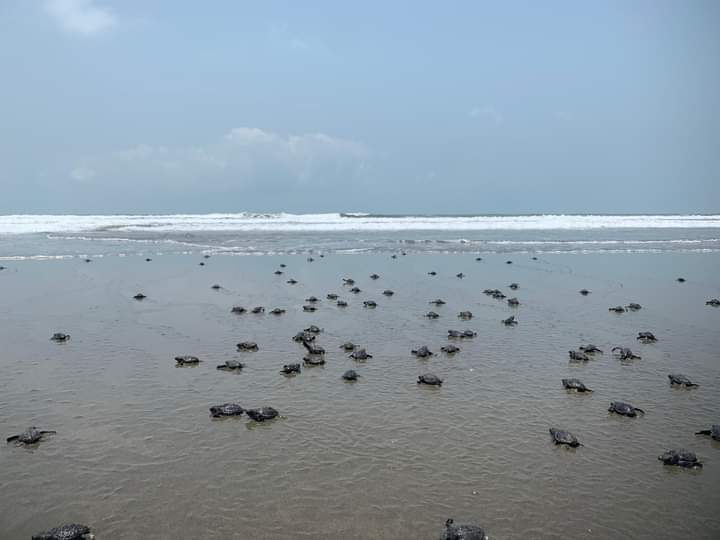
Alam said, “There is no substitute for public awareness to prevent disruption of sea turtle breeding. Besides, everyone should come forward to control the movement of people in the breeding spots and protect them from dogs and foxes.”
He also said, “Bangladesh authority is working on this and planning how to extend the conservation action. Teknaf Beach area is one of them where olive turtles are coming, so we are working on that area.”
This article was originally published by Mongabay.
Header image by Rhett Butler
Seventy-eight per cent of people in England and Wales think that crime has gone up in the last few years, according to the latest survey. But the data on actual crime shows the exact opposite.
As of 2024, violence, burglary and car crime have been declining for 30 years and by close to 90%, according to the Crime Survey for England and Wales (CSEW) – our best indicator of true crime levels.
Unlike police data, the CSEW is not subject to variations in reporting and recording.
The drop in violence includes domestic violence and other violence against women. Anti-social behaviour has similarly declined. While increased fraud and computer misuse now make up half of crime, this mainly reflects how far the rates of other crimes have fallen.
All high-income countries have experienced similar trends, and there is scientific consensus that the decline in crime is a real phenomenon.
There is strong research evidence that security improvements were responsible for the drop.
This is most obvious with vehicle electronic immobilisers and door deadlocks, and better household security – stronger door frames, double glazed windows and security fittings – along with an avalanche of security in shopping centres, sports stadiums, schools, businesses and elsewhere. Quite simply, it became more difficult to commit crimes.
Decreases in crimes often committed by teenagers, such as joyriding or burglary, had a multiplying effect: when teenagers could no longer commit these easy “debut crimes” they did not progress to longer criminal careers.
There are, of course, exceptions. Some places, times and crime types had a less pronounced decline or even an increase. For many years, phone theft was an exception to the general decline in theft. Cybercrime, measured by the CSEW as fraud and computer misuse, has increased and is the most prominent exception.
But this increase was not due to thwarted burglars and car thieves switching targets: the skillset, resources and rewards for cybercrime are very different.
Rather, it reflects new crime opportunities facilitated by the internet.
Preventive policy and practice is slowly getting better at closing off opportunities for computer misuse, but work is needed to accelerate those prevention efforts.
The perception gap
So why is there such a gulf between public perception and the reality of crime trends? A regular YouGov poll asks respondents for their top three concerns from a broad set of issues.
Concern about crime went from a low in 2016 (when people were more concerned with Brexit), quadrupled by 2019 and plummeted during the pandemic when people had other worries. But in the last year, the public’s concern about crime has risen again.
There are many possible explanations for this, of which the first is poor information. A study published in 1998 found that “people who watch a lot of television or who read a lot of newspapers will be exposed to a steady diet of crime stories” that does not reflect official statistics.
The old news media adage “if it bleeds, it leads” reflects how violent news stories, including crime increases and serious crimes, capture public attention. Knife crime grabs headlines in the UK, but our shock at individual incidents is testament to their rarity and our relative success in controlling violence – many gun crimes do not make the news in the US.
Most recent terrorist attacks in the UK have featured knives (plus a thwarted Liverpool bomber), but there is little discussion of how this indicates that measures to restrict guns and bomb-making resources are effective.
Political rhetoric can also skew perceptions, particularly in the run-up to elections. During the recent local elections, the Conservatives were widely criticised for an advert portraying London as “a crime capital of the world” (using a video of New York), while Labour has also made reference to high levels of crime under the current government.
There are also some “crime drop deniers”, who have vested interests in crime not declining due to, for example, fear of budget cuts. One of us (Graham) worked with a former police chief who routinely denied the existence of declining crime.
Despite the evidence of crime rates dropping, some concerns are justified. Victims, along with their families and friends, have legitimate concerns, particularly as crime is more likely to recur against the same people and at the same places.
And, while the trend is clear, there are nevertheless localised increases in some types of offending. When these relate to harmful and emotive issues like knife crime in London, for example, it is natural that this might have a substantial influence.
We are unlikely to be able to change political agendas or journalists’ approach to reporting. But governments should be taking a more rational approach to crime that is based on evidence, not public perception.
Local governments need to keep on top of their local crime hotspots: problem bars and clubs where crime occurs, shops where shoplifting is concentrated, local road traffic offence hotspots and so on. The common theme here is how crime concentrates.
National government, meanwhile, should lead on reducing crime opportunities via national-level levers. Only national government can influence social media platforms and websites that host online crime and encourage larger businesses to improve manufacturing, retailing and service industry practices.
The positive story around crime rarely makes headlines, but this should not put us off from learning the lessons borne out in the data.
We know this can work from past success, but it took decades to get car makers to improve vehicle security and to get secure-by-design ideas in building regulations.
Society needs to move more quickly.
This article by Toby Davies and Graham Farrell from the University of Leeds was originally published by The Conversation.
Header photo courtesy of Benjamin Elliott/Unsplash.

Black-footed ferrets are North America’s only native ferret species and were thought to be extinct in 1979.
When the species was miraculously rediscovered in 1981 in Wyoming, these long, quirky mammals quickly rose to become the center of dedicated conservation efforts.

At that time, the Wyoming Game Department and U.S. Fish and Wildlife Services brought 18 ferrets into human care to begin cooperative breeding programs, like the one at the Smithsonian’s National Zoo and Conservation Biology Institute in Front Royal, Virginia.
Between captive breeding, wildlife reintroductions, habitat restoration, and even genetic cloning, one of the continent's most endangered mammals is now seeing a comeback.
Perhaps the cutest manifestation of this conservation work is a new litter, born at the NZCBI on May 11.
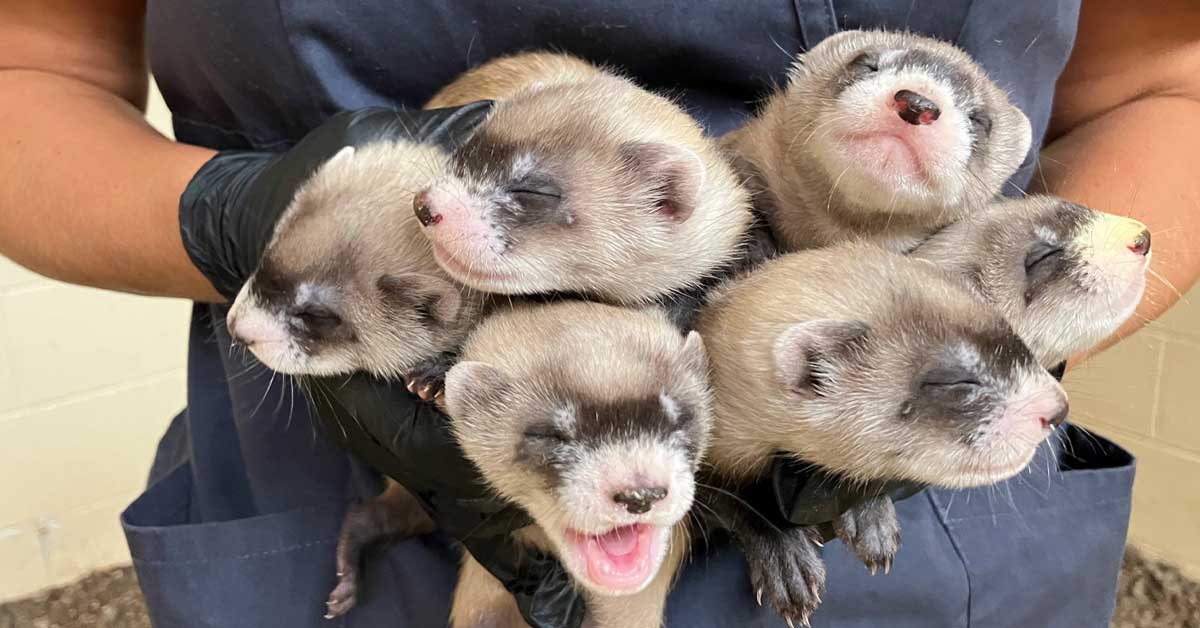
Since 1989, 1,218 black-footed ferret kits have been born at NZCBI, with 750 reintroduced to the wild. Currently, 48 ferrets live at NZCBI, including one-year-old female Aristides, who gave birth to the new litter of six kits last week.
Last breeding season, NZCBI raised 51 ferret kits. Now with 2024’s season underway, animal care staff are closely monitoring the ferrets’ behavior through the institute’s Black-Footed Ferret Cam (a temporary live webcam the public can also view on the NZCBI website).
According to a press release, the kits will nurse for about a month before beginning to sample their mom’s diet and eating meat. A couple months after that, the kits will separate from Aristides to undergo a genetic assessment by the Association of Zoos and Aquariums’ Saving Animals From Extinction (SAFE) program.

“This assessment will determine whether the kits will remain at NZCBI, transfer to another breeding facility, or join the USFWS pre-conditioning program in preparation for their release into the wild,” the press release explained.
“The pre-conditioning program allows ferrets to learn to live in burrows and show they can successfully catch prey before being reintroduced to the wild.”
Right now, the kits are still tiny, weighing less than 10 grams, with a thin layer of white fur covering their bodies. Their well-known mask-like markings and namesake dark feet will appear in the next few weeks. Then, they’ll start venturing out of their den and exploring the burrows of their habitat, akin to the tunnels they’d find in the wild.
The biggest threat for black-footed ferrets, scientists say, is habitat destruction, since much of the shortgrass prairie habitat that ferrets depend on has been plowed for crops across the continent.
Prairie dogs are also important to the survival of these ferrets, since they help create their underground habitats, and are the ferret’s main food source. However, they have also been on the decline because of habitat loss, making it difficult for ferrets to survive on their own in the wild.
“The life of the ferret has a lot of pressures out in the wild,” Adrienne Crosier, who heads the breeding program at the Smithsonian Conservation Biology Institute, told PBS last December.
“They absolutely have a critical role to helping maintain the balance of the ecosystem.”

Paul Marinari, the director of the USFWS’s Black-Footed Ferret Conservation Center in Colorado, told PBS that the wild population of these ferrets is precarious, but that he estimates there are between 300 and 400 black-footed ferrets living in the wild.
“They don’t live that long. They are very quick to produce offspring. They produce a fair number of offspring. That’s the simple version,” Marinari told PBS. “Saving the species is much more complex.”
Without being able to rely on prairie dogs for habitat maintenance and as a food source, breeding programs across the country are the main key to ensuring the future of the species.
The new litter at NZCBI is the second for Aristides, and the third for dad Thanos, a 2-year-old male who came to NZCBI from the Phoenix Zoo. Both parents received a breeding recommendation from the SAFE program.
“SAFE tracks the lineage of individual animals in a record called a ‘studbook.’ When considering which animals to breed, a studbook keeper examines the individuals’ genetic relatedness to one another, overall health and temperament, among other factors, and makes recommendations accordingly,” a press release explained.
“This matchmaking process helps ensure the genetic diversity of a population in human care.”
Additionally, breakthroughs in genetic cloning show a promising future recovery for the species.

In April, the USFWS announced the cloning of two black-footed ferrets from preserved tissue samples, the second and third ferret clones in history, following the birth of the first clone in December 2020.
Cloning is a tactic to preserve the health of species, as all living black-footed ferrets come from just seven wild-caught descendants. This means their genetic diversity is extremely limited and opens them up to greater risks of disease and genetic abnormalities.
One of the new clones, Antonia, was born at the NZCBI, just like this new litter (though, the six new kits came from traditional breeding methods).
While cloning is an exciting innovation, and breeding is vital to ensuring the future of the species, experts suggest that the best way anyone can help black-footed ferrets is by ensuring that they have a place to call home.
“We can save the black-footed ferret,” Marinari told PBS.
“Our thought, and all of our partners’ thought, is that we can save the other 130 unique plants and animals that are native to the North American prairie. It’s a pretty special ecosystem; one that’s often overlooked because of the riches we have in our country.”
Header image courtesy of Smithsonian's National Zoo and Conservation Biology Institute
When we look at the various expressions of injustice in our world, such as brutal wars, fascist regimes, mass poverty, environmental degradation, and animal exploitation, we can see that they all share a common denominator: Relational dysfunction, or dysfunctional ways of relating.
This dysfunction is carried out between social groups and individuals, as well as toward other animals and the environment.
Relational dysfunction reflects and reinforces a particular mentality, which I refer to as the “nonrelational mentality.” This mentality causes us to think — and therefore to feel and act — in ways that violate our integrity and harm the dignity of others.
Integrity is the integration of our core moral values of compassion and justice. When we practice integrity, we treat one another with respect, the way we would want to be treated if we were in their position.
Dignity is our sense of inherent worth. When we honor someone’s dignity, we perceive and treat them as though they are no less worthy of being treated with respect than anyone else.
Violating integrity and harming dignity, on the collective or individual level, leads to unjust power imbalances, as well as to a sense of insecurity and disconnection between all parties.
Think of an abusive relationship. The abusive partner is not acting with integrity, nor are they honoring the dignity of the other partner.
And as the abuse continues, the power imbalance between the partners grows, as does the sense of insecurity and disconnection between them (though the abusive partner may harbor the illusion of being secure and connected).
Or consider patriarchy, which conditions men to wield power and control over women and people of other gender identities. Consider, too, a toxic workplace where staff interact in ways that erode their collective wellbeing.
The nonrelational mentality is based on the belief in a hierarchy of moral worth: that certain individuals are more worthy of moral consideration — of having their interests considered, of being treated with respect — than others.
Unjust or “nonrelational” systems, such as racism, patriarchy, ableism, and speciesism, are all based on this belief.
These systems place, for example, males, able-bodied people, and humans at the top of the hierarchy and encourage these powerholders to act in ways that violate their integrity, harm the dignity of others, and lead to unjust power imbalances, disconnections, and insecurity.
If we hope to end all injustices — and that should be our goal, lofty as it may seem — we need a foundational shift in how we approach achieving justice.
And it’s not enough to look only at who is acting unjustly toward — who is oppressing or abusing — whom.
We need to understand how and why we oppress and abuse in the first place. We need to target the roots of the problem: the mentality at the core of injustice. Otherwise, we’ll trade one form of injustice for another even as we work to create a more just and compassionate world.
For example, if we work toward justice for humans while disregarding and even contributing to animal exploitation, we’re reinforcing the same mentality that’s caused the human exploitation we’re trying to end. The same (nonrelational) mentality that causes us to harm human beings causes us to harm nonhuman beings.
The nonrelational mentality is also causing our work for progressive change to be far less effective than it could be. How can we hope to challenge widespread injustice if our very movements for justice are plagued by the same nonrelational attitudes and behaviors we’re working to transform?
We’ve all witnessed — especially on social media — examples of well-meaning advocates for justice espousing nonrelational, toxic communication that often involves shaming those who disagree with their views and driving away those who might otherwise become supporters of the cause.
And most of us have seen how this same toxicity is a key driver of the epidemic infighting that’s destabilizing our groups working for justice.
Just as relational dysfunction is a common denominator driving all forms of injustice, the common denominator in ending injustice is building relational literacy.
Relational literacy is the understanding of and ability to practice healthy ways of relating. Put simply, healthy relating involves practicing integrity and honoring dignity.
I’m not suggesting that building relational literacy is the solution to ending injustice, but it is foundational to all other solutions.
I believe that building relational literacy among advocates for progressive causes is essential to creating the resilience necessary for our movements for justice to succeed, which includes unifying internally and across causes.
A resilient movement is powerful and impactful; first and foremost, it’s relational.
As such, advocates feel secure and connected with one another, and power is balanced. Consequently, the movement is internally unified.
In a resilient movement, advocates’ communication is respectful, which allows them to express differing opinions without fear of recrimination, such as being called out, shamed, or marginalized.
Advocates are also willing to self-reflect and to assess the validity of their opinions, so they’re better able to develop effective strategies and solutions. And advocates are more likely to stand in solidarity with those from other justice movements.
Ending injustice requires not simply abolishing unjust policies and practices but transforming the way we think and relate. It requires an understanding of the psychology that informs our relationships with others (and ourselves), so we can shift from operating, largely unconsciously, from within a nonrelational framework to living consciously within one that is healthy and empowering.
If we commit to building relational literacy in our work for social transformation, our movements will be strengthened, and we will move closer to our goal of ending injustice everywhere.
Melanie Joy is a Harvard-educated psychologist and the award-winning author of seven books, including bestselling “Why We Love Dogs, Eat Pigs, and Wear Cows” and “How to End Injustice Everywhere.” She is the eighth recipient of the Ahimsa Award (previously given to Nelson Mandela and the Dalai Lama) for her work on global nonviolence.
Many take time on Memorial Day to remember the Americans who have given their lives in service to our country.
For veterans and their families, that sentiment of remembrance is felt year-round. Many veterans suffer lifelong anguish over the loss of their brothers and sisters in arms. For them, Memorial Day is a day like every other day — a day they remember those who died at war.
This shared grief is just one way some veterans are affected by their military service. Veterans are also molded by military culture — a unique set of values, traditions, language and even humor. Military culture has unique subcultures, but it has enough consistency across different branches, ranks and time periods to make most veterans feel a kinship.
Recognizing this kinship has led veteran service and health care organizations to encourage veterans to build trusting relationships and support each other. Researchers have learned that veterans are more likely to share personal information and ask advice about many things, including health care, from fellow veterans. That’s why the VA offers employment to veterans as peer specialists.
I’m a mental health services researcher at the University of Texas at Austin School of Social Work. I focus on increasing the availability of social supports and improving the efficacy of mental health treatment options for veterans and their families.
Last year I had the opportunity to study the Texas-funded Military Veteran Peer Network, a statewide program that provides peer-to-peer support in 37 communities.
My research supports the idea that veterans are an important resource who can be trained to support fellow veterans in need.
What’s more, I’ve learned that civilian care for veterans can be improved when civilians are trained in military culture. The MVPN offers military-informed care training to civilian providers and law enforcement personnel throughout the state.
Understanding the need
The bond that soldiers share can help them stay mentally strong.

Mental health issues are acute for a significant number of veterans.
As many as 25 percent experience some form of mental health concern, such as depression. The VA reports that veterans have a higher risk of suicide compared to the U.S. population.
Post-traumatic stress disorder (PTSD) is another well-known concern. Estimates of the prevalence of PTSD vary widely due to the variety of study samples and assessment tools. A conservative measure suggests PTSD affects eight percent of service members returning from Afghanistan and Iraq.
Veteran peer support shows promise in addressing these common mental health issues. An example is the Vet to Vet program, a VA program developed by Moe Armstrong, a decorated Vietnam War veteran, in 2002.
Research has shown that veterans who receive peer support have greater levels of empowerment and confidence, improved functioning and reduced alcohol use compared to those who didn’t receive peer support.
Researchers are increasingly understanding the value of incorporating veteran peers into health care teams. Given the large numbers of veterans returning from prolonged combat, the documented shortage of trained behavioral health providers to treat mental health problems, overly long wait times for treatment and stigma felt by veterans regarding seeking help, veteran peer support offers great promise in improving treatment outcomes.
While peer counseling is not new — it was formally recognized in the 1970s — its value in treating veterans has gained recognition since President George W. Bush’s New Freedom Commission on Mental Health, which was released in 2003.
President Barack Obama has also seen the value of peer support. His Executive Order 13625 of 2012 sought to improve access to mental health services for veterans, service members and military families by including the hiring of peer specialists.
As of 2015, the hiring of peer specialists has exceeded the goal set in the executive order. In 2015, President Obama renewed his support by calling for more peer support as part of the Clay Hunt Suicide Prevention for American Veterans Act.
Research on the role of veteran peers has shown their positive impact in assisting homeless veterans to transition to housing.
There is early evidence that veterans charged with misdemeanors and arraigned in Veteran Treatment Courts receive invaluable support from veteran peers throughout their probation and treatment for mental health, substance use problems and receive help with housing, transportation and employment.
These are two among many other areas that veteran peers are providing effective supports.
Getting civilians into the act
The mental health care provided by civilians for veterans can also benefit from lessons learned from these veteran-driven programs.
Understanding the unique culture shared by military members and their families can be a daunting task for Americans who have not experienced the military lifestyle.
Given the volunteer nature of our armed services and the historically small size of our current force, this culture is familiar to only a small proportion of American citizens.
Instead of assuming this cultural gap cannot be breached, we are learning the powerful impact that civilian health care professionals can make when they become trained in military culture and practice military-informed care.
Research efforts are underway to understand how to best train practitioners to better understand the clinical impact of this cultural competency. Research can assess, for example, whether this knowledge can help improve veterans’ engagement in care, increase their treatment completion and improve their clinical outcomes.
The VA has hired 800 peers as of 2013 with 100 more planned annually. In addition to Texas, New York, Michigan and California, as well as Canada and the United Kingdom, have veteran peer support programs.
Although most of us can never truly understand what war is like, we can honor all veterans, including those who didn’t make it home, by valuing the special knowledge and connection that veterans bring to bear in therapeutic care settings.
By prioritizing veterans’ experiences and knowledge, we can build a society that promotes real healing and a respectful homecoming.
This article was written by Elisa Borah from the University of Texas at Austin and was originally published on The Conversation.
Header photo courtesy of the United States Department of State

The mental health benefits of being in nature have long been acknowledged, whether through activities like listening to birdsong or taking a walk in the park.
While birdwatchers are often portrayed as boring, it turns out that twitchers have been onto something all along. A study published in 2024 shows that even half an hour of bird watching could make us happier, healthier and help foster a deeper connection with nature.
We already know that listening to birds throughout the day positively impacts our wellbeing. Even hearing birds indoors, through an open window can boost our emotional state, albeit in the short-term.
The study suggests that not only can birdwatching offer even more benefits than just listening to birdsong, it’s more effective at increasing wellbeing and reducing stress than going on a nature walk.
So, why is birdwatching so good for us?

Biophilia could be a big part of it. Biophilia is the belief that humans have an affinity with nature – some would argue that we should see ourselves as part of nature – so being in natural surroundings makes us feel well. But biodiversity could play a role too.
Research suggests that biodiversity is a natural medicine for humans that can help reduce stress and encourage physical activity.
My research, though, focuses on positive psychology and nature. I explore which resources are fundamental to improving wellbeing and help people go beyond feeling “good enough” mentally to flourishing – the highest level of wellbeing. My research, then, could help explain why birdwatching is so beneficial for mental health.
Twitching with happiness
Birdwatching can boost positive emotions – the foundation of wellbeing. Research shows that conscious experiences of emotions affect wellbeing more positively. For example, a study asked participants to either count how many birds they had seen, or rate their joy upon seeing each bird species – both groups reported wellbeing boosts.
However, the joyful group experienced the most remarkable improvement, suggesting that participants’ awareness of positive emotions while birdwatching may have boosted the activity’s benefits.
But birding can be awesome as well as joyful. Research suggests that experiencing awe of nature can be transformational for human wellbeing. “Noticing” is an essential aspect of awe. Noticing means that our full attention is on the birds rather than ourselves. Being in nature and noticing wildlife, then, requires us to immerse ourselves in the activity, which can improve mental and physical health.
The birds and the bees
Unlike the “boring birder” stereotype so popular in TV and film, birdwatching is not a dull, passive activity. It is an engaging pursuit that captivates the mind. Recently, my colleague and I conducted research on the impact of bees on the mental health of beekeepers and their families.
We found parallels between beekeepers and birdwatchers: both experienced a deep engagement and profound sense of tranquillity through hours of observing their subject.
Like birdwatchers, beekeepers can become so absorbed in their observations that they lose track of time and surroundings, enveloped entirely in the hive’s dynamics. This immersion triggers a psychological flow crucial for overall mental wellbeing.
Psychological flow is a state of deep absorption in an activity. It’s characterised by intense concentration, a seamless sense of involvement and a feeling of mastery. This mental state is not only a sign of enhanced performance, but also a key to overall wellbeing. It’s often compared to being “in the zone”, a state where we feel our best and perform at our peak.
One of the reasons that birdwatching is so good for us is that it can produce this experience of psychological flow. Twitchers become fully engrossed in identifying bird species, deciphering their behaviours, and observing their actions. This flow state emerges organically, fuelled by curiosity, heightened concentration and sustained engagement. After being “in the flow” birdwatchers can experience a rush of endorphins and a profound sense of satisfaction and wellbeing.
Get a buzz
Our study found a strong bond between beekeepers and their bees, similar to “positivity resonance” – a deep emotional and physiological connection with another living entity, often resulting in feelings of joy and satisfaction.
This resonance, we found, significantly bolsters beekeepers’ happiness and overall wellbeing, fostering a profound sense of harmony in the beekeeper and a sense of unity with the bees. Observing birds could promote a similar experience for birdwatchers.
Recent research on the beekeepers and birdwatchers, then, confirms the power of nature-centred therapies for improving mental health. So, grab your binoculars and step into nature for a twitching session and a wellbeing boost. Embrace the journey and savour every moment.
This article was written by Jolanta Burke from the RCSI University of Medicine and Health Sciences and was originally published on The Conversation.

Palestinians in Gaza have begun receiving humanitarian aid delivered through a newly completed floating pier off the coast of the besieged territory. Built by the U.S. military and operated in coordination with the United Nations, aid groups and other nations’ militaries, the pier can trace its origins back to a mid-20th century U.S. Navy officer who collected discarded cigar boxes to experiment with a new idea.
Among the artifacts of the military collections of the National Museum of American History, I happened upon these humble cigar boxes and the remarkable story they contain.

In 1939, John Noble Laycock, then a commander in the Navy’s Civil Engineer Corps, was assigned, as the war plans officer for the Navy’s Bureau of Yards and Docks in Washington, D.C., to help prepare for a potential war in the Pacific.
Laycock had to figure out how to construct naval bases on undeveloped islands. The top priority would be what the military called “naval lighterage,” the process of getting cargo and supplies from ships to a shoreline where there were no ports or even piers to dock at.
That’s exactly the problem the relief effort faced in Gaza – and one that military forces and humanitarian groups have faced countless times in the past century.
In the office files of his predecessors, Laycock found plans developed in the 1930s to use small pontoons – essentially floating boxes – that could be easily transported and quickly assembled by hand into larger barges or floating platforms. But Laycock saw problems with the plans’ design and method of connecting the pontoons to each other. And he had an idea.
In my research into his work, I found that around July 1940, Laycock began visiting every concessionaire in the Navy’s headquarters building, which was then located along the National Mall, asking them to save empty cigar boxes for him.
Laycock and a helper lined up the boxes and spaced them evenly. Then they linked them together using wooden strips from children’s kites, which they fastened to the corners of the boxes with small nuts and screws.
The simple model demonstrated that it was possible to connect individual, uniformly sized, small pontoon boxes into a much longer, and much stronger, floating beam. Multiple beams could be combined into the base for a platform of any needed size. A big enough platform could support cargo, military trucks and armored vehicles weighing up to 55 tons.
From cigar boxes to steel pontoons
In August 1940, during his family vacation, Laycock figured out how exactly to connect the individual pontoons, which were made of steel and not wood or cardboard like his cigar-box model.
He designed steel fasteners – scaled-up nuts and bolts nicknamed “jewelry” that could be inserted and tightened by hand – that could handle the stress of the movement of the ocean beneath a floating platform.

Through trial and error, and applying various military requirements such as the width of the steel plates, weight of the empty pontoon, depth needed to float and load-bearing capacity, Laycock designed a basic pontoon 5 feet high by 7 feet long by 5 feet wide.
He also designed a curved section to serve as the bow of a pontoon-based transport vessel. By 1941, testing had proved the design and the system were ready for mass production.

Floating causeways of steel
The pontoon technology first went to war in the South Pacific in February 1942 with the Naval Construction Force, nicknamed the Seabees, who took it to Bora Bora in the Society Islands. The Seabees were pleased with how it worked and helped contribute to the system’s nickname – Laycock’s “magic box.”
The universal nature of the pontoons permitted construction of an array of floating structures, including dredges, barges, floating cranes, workshops, storehouses and gas stations, tug boats, pile drivers and dry docks. These pontoon structures could be found from Guadalcanal to the Marianas, the Aleutians and the Philippines.
The planning for the invasion of Sicily in July 1943 found another use for Laycock’s pontoon system. In late 1942, Royal Navy Capt. Thomas A. Hussey recognized that the Sicilian beaches had gentle slopes.
During an invasion, landing craft, especially those designed for tanks, could be expected to run aground several hundred feet from dry land, in water 6 feet deep. Even waterproofed vehicles would be swamped and could sink.
Aware of Laycock’s pontoons, Hussey inquired whether the units could form a floating road, called a causeway, to bridge the gap between ship and shore. Laycock designed a method to build narrow causeways two pontoons wide and 30 pontoons long – roughly 175 feet.
Setting them side by side would form a 325-foot floating causeway. They could even be towed or carried by landing craft and deployed upon arrival in shallow water.
Tested successfully in mid-March 1943, the causeways proved a success at Sicily. In 23 days of round-the-clock shifts, the Seabees unloaded over 10,000 vehicles, including trucks, jeeps, half-tracks and towed artillery, on the causeways.
Senior American and British leaders said the landings could not have succeeded so rapidly were it not for the pontoon causeways.

Pontoon highways at Normandy
Much like Sicily, the Normandy coast of France also featured beaches with gentle, flat slopes. Floating pontoon causeways were key to the June 6, 1944, D-Day landings for U.S., British and Canadian forces.
Engineers would anchor one end of the causeway on the shore and extend the structure out into the ocean far enough that whether it was low or high tide, cargo-carrying vessels could dock without running aground.
Along the sides, every few hundred feet along the causeway, additional pontoons were attached to form piers, so multiple vessels could dock at the same time, regardless of tidal conditions. They could unload directly onto dry pontoons just as they would at any regular pier or dock.
This system allowed a massive, around-the-clock flow of tanks, trucks, artillery, supplies and personnel to support the fighting as the Allied forces moved inland through Normandy over the coming months.
Uses in war and for humanitarian aid

Over the decades, this concept, with technological advancements in construction and fasteners, evolved into pontoon systems used in the Korean and Vietnam wars. Those have since been improved as well and have helped provide humanitarian aid such as in Haiti after a massive earthquake in 2010.
The pier at Gaza involves both parts of the pontoon system – Laycock’s original floating platform as a cargo transfer site 3 miles offshore, and the British-suggested floating causeway and pier system allowing truck deliveries to get to dry land. All from a humble concept model of cigar boxes.
This article was written by Frank A. Blazich Jr. from the Smithsonian Institution, and was originally published on The Conversation.
Banner image: An aerial view of the floating pier off Gaza shows its basic structure. Image courtesy of U.S. Central Command

It’s a simple idea: Stop mowing your lawn in the month of May to let flowers in the lawn, such as dandelions and clover, grow and support bees and other pollinators.
“No Mow May” was started in 2019 by Plantlife, a conservation charity based in the United Kingdom, in response to a well-documented loss of meadows and an alarming decline of native plants and animals there. Since then, it has been taken up by many gardeners and conservation advocates in North America.
Studies have shown that many flowers that grow in unmown British lawns do support British pollinators. But North America has vastly different ecological communities, composed of unique flora and fauna.
If you are interested in supporting pollinators, it is important to consider the ecological context of your yard – and #NoMowMay may not be an effective strategy. As entomology researchers who run programs on pollinators, we see better ways for people in North America to help pollinators flourish in their yards.
What grows in North American lawns?
Most common lawn flowers in North America are not native to this continent but were brought here from Europe and Asia. Many, such as bull thistle, are noxious weeds that can displace native plants and contribute to problems such as soil erosion. Others, such as ground ivy, are aggressive, invasive weeds in natural areas.
Allowing these weeds to grow can increase their numbers in the landscape and potentially reduce native biodiversity by creating near-monocultures. Not mowing your lawn and allowing these plants to spread can create weed pest problems that people on neighboring properties likely will have to manage with herbicides.
You will find pollinators on lawn flowers, but looks can be deceiving.
Some nonnative lawn plants are very attractive to pollinators. Thistle, crown vetch and, to a lesser degree, dandelion and white clover are commonly visited by bees. This attractiveness helps invasive plants get pollinated, set seed and spread effectively.
But the pollinators you see on these nonnative plants are already the most common in the landscape. Adding these plants to a landscape does not improve North American pollinator communities or support biodiversity.

The dominance of a few pollinator species on these plants may indicate that human influence has reduced the number of species in that ecosystem. Typical human-altered landscapes have a small number of cosmopolitan weedy plants – species found in a broad range of habitats in many parts of the world – and a handful of pollinator species.
For example, a 2014 study that examined urban and suburban lawns in Kentucky found that 90% of spring insects visiting dandelions there belonged to one bee species, the nonnative honeybee; one butterfly species, the common branded skipper; and a few hoverfly species.
Honeybees represented nearly 50% of pollinators visiting white clover in spring, followed by hoverflies and a few bumblebee species.
Surrounding landscapes matter too
Few home gardens are large enough to support pollinator populations. A dandelion meadow in a city neighborhood dominated by steel and concrete would look like a pollinator haven, simply because there would be nothing else nearby for bees to feed on.
But very few bees would visit the dandelions, and they would be species of bee that were common across the whole landscape, just as most birds in the area would be pigeons or house sparrows.
In a nature reserve, that same dandelion meadow would attract a more diverse community of pollinators. But it still would be dominated by the common generalist species that visit many types of flowers and are not very picky. When more specialized pollinators appear in backyards, they are spilling over from adjoining landscapes that don’t include lawn plants.
A 2016 study found this pattern on suburban lawns in Springfield, Massachusetts. Researchers collected 5,331 bees belonging to 111 species flying around small suburban lots over a two-year period. Just 13 species accounted for 4,442 individual bees they collected, while 81 species were each represented by 10 or fewer individual bees.
North America has more than 4,000 species of wild bees. Many have evolved together over millennia with specific native plant species that they pollinate.
Plant diverse native plants
Instead of taking a pause on mowing and letting nonnative plants dominate the spring landscape, we recommend planting a diverse range of native trees, shrubs and herbaceous flowering plants.
Native North American plants and pollinators have evolved together over time. The plants have traits that allow for specific interactions, the right bloom times and the right kind of nectar and pollen for specific native insects.
Researchers at Penn State’s Center for Pollinator Research, where we both work, have examined the pollen that wild bees and managed honeybees collect to see which plants provided the most nutritional resources for bees. They found that in April and May, flowering trees – inclding maple, oak and willow – provided the most pollen for bees.
Other North American native plants that pollinators visit, such as Virginia bluebells, columbine and phlox, have evolved to grow in partial shade as trees leaf out above them.

More reasons to mow
Leaving grass unmowed in May or June is also problematic because it creates a favorable habitat for ticks and for wild animals such as deer and rodents that carry ticks. This can increase local risk of tick infestations and tick-borne diseases.
Maintaining shorter grass provides a drier environment that is unfavorable for ticks. It also limits wildlife habitat and food sources, which reduces tick populations.
Finally, letting weeds grow in unmowed lawns can create conflict with neighbors. Whether the concern is aesthetics, local property values or public health, many cities have ordinances that set limits on lawn height and will fine residents who don’t comply.
While we agree that mowed lawns don’t provide much food or support for native species, skipping mowing for a short period doesn’t do much either. Pollinators need flowering plants for the entire growing season, from early spring to winter.
We recommend converting your yard into a true pollinator haven, adding native plants and flower beds over time and potentially turning your entire lawn into a garden. For lists of North American pollinator plants that are native to your region, visit the Xerces Society and Pollinator Partnership. State Master Gardener groups also have detailed information on developing pollinator gardens for your region, such as the Pollinator Garden Certification Program from the Penn State Master Gardeners.
This article was written by Christina Grozinger and Harland Patch from Penn State and was originally published on The Conversation.
Header image by József Szabó on Unsplash

We already know that Barbie is a doctor, president, author, and astronaut — but ahead of the 2024 Olympics, Mattel is reminding us of her athletic prowess, too.
Today, Mattel announced a series of nine dolls that will honor trailblazing women athletes around the world, with one-of-a-kind Barbies made in their likeness.

So, who are these sports stars?
- Venus Williams, an American tennis player and one of the most decorated Olympic athletes
- Christine Sinclair, a Canadian soccer player who is hailed as soccer’s greatest international scorer (with 190 goals to her name!)
- Mary Fowler, an Australian football player, who became the team’s youngest player to be selected for the FIFA World Cup at 16 years old
- Estelle Mossley, a French boxer who was crowned as an Olympic champion in 2016
- Alexa Moreno, a Mexican gymnast who was Mexico’s first female world medalist in the sport
- Rebeca Andrade, a Brazilian Olympic gold and silver medalist, who has one more than ten medals in World Cups
- Susana Rodriguez, a Spanish paratriathlon star, who has set records in her sport and was also a doctor on the front lines of the COVID-19 pandemic
- Frederica Pellegrini, an Italian swimmer and record-breaking Olympic gold medalist who was elected to the IOC Athletes Commission after her last competition in 2020
- Ewa Swoboda, a Polish track and field springer who is a decorated championship medalist and holds the world lead of 7.01 seconds in the 60-meter race
“Throughout my career, I’ve always been driven by the idea of shattering glass ceilings and staying true to myself, and Barbie’s mission couldn't resonate more deeply with that ethos,” Williams said in a statement.

“I’m honored to be recognized as a sports role model and join forces with Team Barbie to continue empowering the next generation of young girls to never stop believing in their dreams.”
Unfortunately for collectors, these dolls are one-of-a-kind and will not be available for purchase. However, they represent a much larger initiative that will feature the real-life athletes.
As part of the Barbie Dream Gap Project, which fights stereotypes that keep girls from achieving their dreams, Mattel’s flagship brand has partnered with VOICEINSPORT, a digital sport platform dedicated to keeping girls in athletics.

Through this partnership, Barbie will host inspirational virtual venturing sessions with the aforementioned Barbie Role Models on the VOICEINSPORT platform, which are free to attend and will continue into 2025. Girls in sports ages 12 and up are encouraged to sign up to attend these free mentoring sessions.
A press release shared: “Knowing that girls involved in team sports are more likely to believe they are smart enough for their dream career, have high opinions on their abilities and competencies, increased leadership aspirations and enjoy higher levels of self-confidence, Barbie is bringing together these inspiring stories that are shaping the future to show girls that anything is possible if you relentlessly pursue your passions.”
VOICEINSPORT’s founder, Stef Strack said that providing access to these professional athlete mentors is “a dream come true.”
“We built VOICEINSPORT to bring more visibility to women athletes globally so that girls around the world would be inspired to dream big and build confidence to stay in the game,” Strack said in a statement.
This initiative comes as part of an ongoing year-long celebration of Barbie’s 65th anniversary — and comes ahead of the 2024 Summer Olympics in Paris, France, which is the first-ever Olympic Games to achieve gender parity.

While the other Barbie Role Model athlete dolls will not be sold to the masses, a collection of new sports doll lineups and playsets have been announced, aiming to “encourage the next generation of empowered women to explore a future in sports through play.”
They include a 2024 lineup of Barbies that are basketball players, boxers, tennis, and volleyball players; a soccer doll assortment; and a gymnast playset.
Mattel also released a special edition Kristi Yamaguchi doll to its Barbie Inspiring Women line last month, honoring her as the first Asian-American woman to win an Olympic gold medal in figure skating.

The brand’s retail partners are also investing in these empowerment initiatives, with Target contributing a $65,000 donation to The Dream Gap Project, with a portion going directly to Girl Talk, an organization that produces peer-to-peer mentoring programs for girls.
Walmart will also release exclusive content with Barbie Role Models Katya Echazarreta and Venus Williams throughout the year.
“The sports one-of-a-kind role model dolls serve as an embodiment of our shared values of passion, empowerment and individuality,” Krista Berger, Mattel’s senior vice president of Barbie and global head of dolls, said in a statement.
“By shining a light on these inspirational athletes and their stories, we hope to champion the belief that every young girl deserves the opportunity to pursue her passions and turn her dreams into reality.”
Header image courtesy of Mattel/WME Sports Studio
Cargo ships rival the aviation industry in the amount of global greenhouse gas emissions they produce — releasing an average of 140 million metric tons of carbon dioxide annually.
But container ships, and their bulk carrier counterparts, are vital to the transportation of essential goods around the globe. And they’re here to stay.
In recent years, scientists have been working to engineer solutions that cut down on the massive carbon footprint of cargo ships. In 2023, a cargo ship fitted with “WindWings” sails set off on its maiden voyage.
The 123 foot sails opened up once the ship crossed into open waters, allowing the ship to harness the wind for a portion of its journey, instead of solely relying on a fuel-based engine.
Even earlier, in 2021, French company Airseas installed a “parafoil” to the front of one of their cargo ships, a massive kite designed to billow out and carry the vessel forward across the water. It was estimated to cut down on emissions by 20%.
But alterations like these come at a price, making companies reluctant to implement them on a massive scale. Enter the Blue Visby Solution: a proposal dedicated to cutting down on maritime emissions by 15% — no sails or kites required.
Their solution combats a problem common to the shipping industry, called “Sail Fast Then Wait.” The Blue Visby team realized that most cargo ships travel at break-neck speeds, regardless of the docking situation or weather events that await them at their destination.
Often, a cargo ship will reach port before they’re able to unload, leaving them idling for hours — or even days — and burning fuel all the while.

The Blue Visby Solution is simple: slow down and talk to each other. Their plan carefully coordinates vessel positions, port conditions, weather data, and incentivizes participation between companies to help optimize their ships’ passage.
And it’s not just about cutting down on idling. When ships move more slowly, they also reduce hydrodynamic drag, which leads to less fuel burnt on open waters.
“Decarbonization is unattainable without energy efficiency, and energy efficiency is impossible if ships continue to ‘Sail Fast Then Wait,’” Haris Zografakis and Pekka Pakkanen — coordinators of the Blue Visby Consortium — said in a joint statement.
Last week, the Blue Visby Consortium put their solution to the test by studying the effects of their “benefit sharing mechanisms” on the passages of two merchant vessels — Gerdet Oldendorff and Begonia — as they delivered goods to the CBH Group grain terminal in Western Australia.

The Gerdet Oldendorff ship saw a CO2 reduction of 28.2%, and the Begonia ship cut emissions by 12.9% — resulting in an average of 17.3% reduced emissions.
“The operational side of the Blue Visby Solution was rigorously tested in the CBH Prototype Trials, both in its interaction with the software systems as well as with the vessels,” said Risto-Juhani Kariranta, marine operations lead.
Kariranta said that the trials weren’t flawless by any means, but that just means they were able to apply real-world pressures to their system.
“The robustness of our systems was proven when we had to deal with the operational complexities when one of the ships had to deviate,” Kariranta explained. “We have also learned valuable lessons about the outlook of vessels’ crews and how they can provide support.”
Based on the data gathered in hindsight from 284 cargo ships piloted across 2021-2023, the Blue Visby team estimated that their solutions had the potential to reduce CO2 emissions by 25.6% per ship.
“We are very satisfied with all the tests conducted in the course of the CBH Prototype Trials,” said Kimmo Laaksonen, software development lead of the program. “And we will continue to make refinements in upcoming voyages.”
Header image courtesy of Venti Views/Unsplash
Whenever there’s an analysis or discussion about how much people know about the Holocaust, the focus is often on what they don’t know.
For instance, a 2018 survey of 1,350 people age 18 and older found that 11% of U.S. adults and 22% of millennials had not heard of — or were not sure if they had heard of — the Holocaust.
Almost half of U.S. adults — 45% — and millennials — 49% — could not name one concentration camp or ghetto that was established in Europe during the Holocaust, the survey found.
The survey also showed how there’s an overwhelming lack of personal connections to the Holocaust. Most Americans — 80% — had never visited a Holocaust museum and two-thirds — 66% — did not know, or know of, a Holocaust survivor. A significant majority of American adults believed that fewer people care about the Holocaust today than before.
As troublesome as these statistics may be in terms of what they show about how little people know about the Holocaust, there’s another aspect to Holocaust knowledge that often goes overlooked.
And that is, at a time when the Holocaust has “taken on a virtual dimension” and images from the horrific era are prevalent online, there is now a risk of what author Gavriel Rosenberg refers to as the “normalization” of the Nazi past in contemporary culture.
Desensitization
As the number of Holocaust survivors continues to dwindle, today’s students may be more apt to find a Hitler meme online before they discover testimonies of Holocaust survivors.
Rosenberg argues that this normalization of the Holocaust will downplay its horrific nature. In some cases, people have seemingly taken to celebrating the Holocaust. For instance, at the Jan. 6 attack on the U.S. Capitol, one participant wore a “Camp Auschwitz” hoodie — a macabre acknowledgment of the most infamous of the Nazi concentration and death camps.
At at December 2020 protest in Washington, D.C., against the election of then-President-elect Joe Biden, a member of the Proud Boys — a pro-Trump organization designated as a hate group by the Southern Poverty Law Center wore a shirt emblazoned with “6MWE.” The slogan stands for “6 million wasn’t enough,” in reference to the 6 million Jews who were killed in the Holocaust.
Making history accessible
Since the COVID-19 pandemic swept across the globe in early 2020, teachers have adapted instruction to make use of existing and emerging technologies. In line with the purpose of International Holocaust Remembrance Day on Jan. 27, digital tools are offering educators new innovative ways to engage with Holocaust history
The internet has made survivor testimonies easily accessible. Social media platforms have made learning about the Holocaust easier for younger people.
A popular Instagram account appeared in 2019 that features excerpts from from the journal of Eva Heyman, a 14-year old girl from Poland who was murdered in a death camp.
In recent years, virtual reality been used as a tool for Holocaust education and memorialization. For instance, the University of Southern California’s USC Shoah Foundation has launched a project to develop interactive holograms of Holocaust survivors. The first time the exhibit was displayed publicly was at The Illinois Holocaust Museum and Education Center in 2015.
Criticisms from scholars
However, some scholars challenge the use of virtual reality when it comes to the Holocaust. One concern is the risk that people who go through a virtual reality simulation will incorrectly feel that they now know what the historical event itself was like, thereby trivializing it.
I myself am leading an interdisciplinary team at Rowan University in New Jersey to develop a virtual reality teaching tool about the Warsaw Ghetto, the largest ghetto established by the Nazis during the Holocaust — holding more than 400,000 Jews within an area of 1.3 square miles, with an average of 7.2 persons per room.
This project, still in its pilot stage, uses primary-source documents and photographs from the Oneg Shabbat Archive to recreate spaces within the ghetto. Users will be able to explore re-created spaces, examine primary sources, ask questions about photographs and explore a variety of themes.
To better develop The Warsaw Ghetto Teaching and Learning Project, and as author of a chapter in a forthcoming book, “Teaching and Learning Through the Holocaust,” I have examined many digital tools that can be used to teach about the Holocaust, especially in middle and high schools.

Here are five websites that I consider to be the most interesting...
Websites to help educate about the horrors of the Holocaust
1. The Life of Bebe Epstein
This first foray into digital education from YIVO, The Institute for Jewish Research, tells the life story of one young girl, who was born in Vilna, Poland, from before the Holocaust through her immigration to the United States.
A staggering amount of information can be found in this digital tool, which consists of 10 self-guided “chapters” containing the story of Bebe Epstein, artifacts and maps.
2. History Unfolded: US Newspapers and the Holocaust
The United States Holocaust Memorial Museum has a number of excellent online exhibits that can be used for teaching and learning, but “History Unfolded” fills a gap: This website aims to show what Americans knew about the Holocaust, and when they knew it, by using articles from U.S. newspapers published during the 1930s and 1940s. Users can explore by event.
For example, they can search for Kristallnacht, a series of violent massacres carried out against Jews in Germany, often referred to as the “Night of Broken Glass.” Or they can search for information about the USS St. Louis, a ship that brought 900 Jews to Cuba and then the United States, where they were turned away.
Upon being returned to Europe, almost all aboard were murdered in death camps. Visitors can also search their local newspapers from the period.
3. In Mrs. Goldberg’s Kitchen
This augmented reality experience is a part of a larger project about Lodz, Poland, during the period between World War I and World War II, created by Halina Goldberg, a musicology professor at Indiana University Bloomington.
This interactive exhibit allows users to explore space in the Jewish Quarter of prewar Lodz, understanding what daily life was like for so many Jews before they were displaced and murdered during the Holocaust.
4. Anne Frank House: The Secret Annex
Anne Frank’s diary is one of the best-known primary sources to have survived the Holocaust. The annex where Anne and her family hid during the war still exists in the Netherlands and is a popular site for tourists.
For those who are unable to visit the site — and for everyone during the COVID-19 pandemic — the augmented-reality site created by the Anne Frank Museum is an impressive alternative. Users are able to explore the space, examine documents and look at photos.
5. Virtual Tour of the Auschwitz Memorial
Auschwitz is the best-known concentration camp built with the express purpose of murdering Jews and other victims of the Holocaust.
While the memorial and museum remain closed because of COVID-19, the virtual tour presents what the memorial website describes as “authentic sites and buildings of the former German Nazi concentration and extermination camp, complete with historical descriptions, dozens of witness accounts, archival documents and photographs, artworks created by the prisoners, and objects related to the history of the camp.”
Each location allows users to access additional information, view primary sources, and listen to survivor testimony.
This article by Jennifer Rich, from Rowan University, was originally published by The Conversation.

As Australia’s rapid renewable energy rollout continues, so too does debate over land use. Nationals Leader David Littleproud, for example, claimed regional areas had reached “saturation point” and cannot cope with more wind and solar farms and transmission lines.
So how much land is needed to fully decarbonize energy in Australia? When we switch completely to solar and wind, do we have the space for all the panels, turbines and power lines?
I’ve done the sums. All we need is 1,200 square kilometers — or 464 square miles. That’s not much. The area devoted to agriculture is about 3,500 times larger at 4.2 million square kilometers. The area of land that would be taken away from agriculture works out at about 45 square meters per person — about the size of a large living room.
We can ditch fossil fuels and reduce greenhouse emissions with negligible impact on agriculture. And in many cases, farmers can be paid for hosting renewable energy infrastructure while continuing to run sheep and cows or grow crops.
The challenge of the energy transition
Electricity consumption in Australia is currently about 10 megawatt-hours (MWh) per person per year.
Decarbonizing Australia’s economy will require electrifying many technologies that currently derive their power from burning fossil fuels. Then we need to ensure the electricity grid runs entirely on renewables.
When we electrify transport, heating and industry, annual electricity consumption per capita doubles. But we will need even more electricity to decarbonize aviation and shipping. So it’s reasonable to assume electricity consumption must triple if we are to complete decarbonization, to 30MWh per person per year.
This would logically be achieved in three stages, starting with the easiest to achieve:
Stage 1: Solar and wind displace coal and gas from the electricity system. The federal government target of 82% renewable electricity by 2030 puts us firmly on track to decarbonize electricity. This trend is already well underway as shown by the graph below.
Stage 2: Clean electricity is used to electrify transport (electric vehicles), heating (electric heat pumps) and industrial heat (electric furnaces). This off-the-shelf technology could largely replace petrol and gas within a decade with negligible impact on the cost of running vehicles and heating homes.
Stage 3: The chemical industry is decarbonized. Clean electricity is used to make ammonia, iron, steel, plastics, cement, and synthetic aviation and shipping fuel.
Where will this clean power come from?
Virtually all new generation capacity in Australia over the past decade has been in solar and wind. Together, solar and wind have risen from about 6% of electricity generation in 2014 to 33% today. Solar and wind provide the cheapest electricity.
Most solar power in Australia today comes from rooftop solar panels. These panels don’t require any extra land. But the area of rooftop is limited. In coming years, ground-mounted solar farms will become ever more important.
We’ll also need more wind farms. Each wind farm contains dozens of turbines and spans dozens of square kilometers. But only a small fraction of the land is lost to farming.
And it’s best to spread the solar farms and wind farms throughout the settled areas of Australia, to reduce the effect of local cloud and wind lulls.
Most solar and wind farms are located on sheep and cattle farms inland from the Great Dividing Range. Here there is plenty of sun and wind, and it’s not too far away to transmit electricity to the cities via high-voltage power lines.
So how much land do we need?
Typically, only about 1% of land covered by a windfarm is actually lost to farming. In most cases, farmers run livestock or continue cropping around the turbine towers and access roads.
Similarly, because solar panels are spaced apart, the area spanned by a solar farm is often two to three times the actual area of the panels themselves.
The panels are typically spaced to avoid losses from shading. As an added bonus, it means rain and sunlight can fall between them, allowing grass to grow and livestock to graze and shelter.
About 10,000km of new transmission lines will also be required for the energy transition. This sounds like a lot but amounts to just 37 centimeters per person.
Again, the area of land that would be taken away from agriculture for wind turbine towers and access roads is relatively small.
A further small area of land will be dedicated to new storage such as pumped hydro power and batteries.
The total area spanned by the solar farms, wind farms and all the other infrastructure is about 22,000 square km (mostly the land between the turbines in windfarms). But agriculture could continue largely as normal on most of this land.
By my calculations, the total area taken away from agriculture to power a 100% renewable energy (zero fossil fuel) economy is about 45 square meters per person. Considering Australia’s total population of 27 million people, that means the total land area required is 1,200 square km. The area currently devoted to agriculture is about 3,500 times larger than this.

Farmers can earn extra income
Mining companies are often permitted to mine land without the consent of the landowner.
Solar and wind farm developers do not have the same rights. They must agree on lease fees with landowners before gaining access to land. These fees are typically tens of thousands of dollars per year per turbine.
In the case of transmission lines, hosts in Victoria are paid A$200,000 per kilometer over eight years.
The transition to renewable energy has attracted opposition from some residents living near proposed infrastructure. But this can be overcome.
Successful solar and wind farm companies gain community acceptance through genuine transparency, particularly early in the project, to ensure no information vacuum is created and then filled with misinformation.
Paying neighbors as well as the renewable energy host farm, and establishing community funds, is also helpful.
Plenty of land to share
The expansion of renewable energy infrastructure will be concentrated in Australia’s regional areas. But we can also expect new energy capacity from elsewhere, such as expanded rooftop solar and new offshore wind farms, which reduces the amount of land needed for the energy transition.
The location of good areas for solar and wind farms is shown in the Australian National University’s renewable energy heatmaps, which takes account of the solar and wind resources, proximity to transmission lines, and protected land. Farmers in areas colored red can command higher prices for leasing land to solar and wind farm companies.
In short, Australia has far more than enough land to host the solar farms and wind farms required for the renewable energy revolution.
This article by Andrew Blakers, from Australian National University, was originally published by The Conversation.

From 2008 to 2020, the National Library of Medicine reported an increase in heat-related emergency room visits — in every single region of the US.
As the world keeps getting hotter, necessity breeds invention, especially in cities that serve as “urban heat islands:” areas that experience blazing temperatures in relation to outlying regions.
In Tel Aviv, solar-paneled streetlights provide shade on hot days, and new Canadian cooling pavilions provide air conditioning to the pedestrians standing beneath them — by drawing power from their body heat.
But for years, Los Angeles has been adopting an approach that relies on two more simplistic measures: painting rooftops and streets with white, reflective paint and planting more trees and vegetation.
Together, the city’s paint job — and “plant” job — could save lives.
A recent study, published in the International Journal of Biometeorology, estimated that these efforts could significantly reduce ER visits by up to 50% during heatwaves.
“Cooling urban neighborhoods by planting trees and vegetation and increasing the albedo of roofs, pavements, and walls can mitigate urban heat,” wrote Scott Sheridan, Edith B. de Guzman, and their team of researchers.
“Albedo” is the percentage of light reflected by a surface. White paint has a high rate of albedo, which reduces the amount of heat that accumulates in urban areas.
In 2021, street teams in Los Angeles sprayed white “cooling” paint on pavement in ten neighborhoods throughout West Hollywood and South L.A. and the effect was immediate — painted locations were two degrees cooler than their corresponding neighborhoods.
In the years since, L.A. slowly began rolling out more expansive painting projects, as street services coated roofs, walls, and entire blocks of pavement with high-albedo paint.
L.A. has also launched multiple tree-planting initiatives in the last decade. In 2021, University of Southern California scientists developed a tree-planting blueprint that would double shade in L.A.’s Eastside by 2028.
And last year, TreePeople — an environmental justice group based in L.A. — received $8 million in federal funding to funnel toward tree-planting and maintenance projects.

“What we proposed was to be able to plant trees where they’re needed the most, and that was from the northeast Valley all the way to the Inland Empire,” Marcos Trinidad, senior director of forestry with TreePeople, told the LA Times.
“So we’ve expanded our reach, just in being able to identify the areas that need trees the most, but also the communities that are suffering the impacts,” Trinidad continued. “Not just from global warming, but everything that goes into creating a healthy community.”
L.A. is not alone. Cities across America have been adopting similar approaches to beat the heat.
Chicago planted 75,000 trees to create green canopies in urban areas. Cities in Camden, Newark, and Baltimore followed suit with their own tree-planting projects. Tucson even made a pledge to plant 1 million trees to combat climate change and keep temperatures from climbing.
And all of the cities above have prioritized underserved communities on their maps — because heat-related deaths disproportionately impact BIPOC communities living in low-income areas.
“It's not that the heat is seeking out low-income populations,” John Dialesandro, a Ph.D. candidate studying urban climatology at the University of California, Davis, told Environmental Health News. “It’s a lack of greenspace.”
This latest study published in the International Journal of Biometeorology backs up Dialesandro’s assertion.
“Strategic changes in the land cover of urban areas can have significant and measurable positive benefits for public health, particularly for lower-income communities and people of color who suffer disproportionately from heat,” wrote Sheridan, Guzman, et al in their report.
So although futuristic methods are emerging to cool down cities, this latest research posits that most U.S. cities already have the infrastructure at their disposal to combat extreme heat.
“This is a key point,” the research team concluded. “Present strategies exist to greatly improve public health during heat events.”
Every day the Good Good Good team collects the best good news in the world and shares it with our community. Here are the highlights for this week!
If you want to get good news in your inbox every day, join the Goodnewsletter — the free daily newsletter designed to leave you feeling hopeful.
The Best Positive News We’re Celebrating This Week —
Olive ridley turtles just broke a 4-year record thanks to conservation efforts in Bangladesh
Already this year, Bangladesh has seen its highest number of olive ridley turtle eggs, thanks to extensive conservation actions, including building awareness among local people and the vigilance of local conservation groups to ensure favorable conditions for the species.
And their conservation efforts were highly effective. The Nature Conservation Management found 12,425 eggs in five turtle hatcheries through April 17 this year on the country’s coastlines.
That’s an almost 53% increase compared with the previous year, which only saaw 8,096 eggs. And both of those tallies represent a significant jump from the 4,713 eggs recorded in 2020-2021 and 5,763 in 2022-23.
→ Read more
More good news for turtles around the world:
- On an uninhabited island in Africa, researchers and locals work together using technology and tradition to study turtles in order to better protect them.
- A family in Mexico gave up fishing to monitor and rescue sea turtles, and is now training a team of Indigenous Comcáac youth to do the same.
- A community-led conservation program in a small Australia town is helping bring one of the most threatened turtle species back from the brink of extinction.
In line with a larger global trend, crime plummeted by close to 90% over 30 years in England and Wales
As of 2024, violence, burglary and car crime have been declining for 30 years by close to 90%, according to the Crime Survey for England and Wales — the best indicator of true crime levels.
The drop in violence includes domestic violence and other violence against women. While increased fraud and computer misuse now make up half of all crime, it’s primarily a reflection of how far the rates of other crimes have fallen.
All high-income countries have experienced similar trends to England and Wales, and there is scientific consensus that the decline in crime is a real phenomenon.
Still, there’s a perception gap: 78% of people in England and Wales think that crime has gone up in the last few years — but the data on actual crime shows the exact opposite.
The Biden administration just ended all new coal leasing in the largest-producing area of the U.S.
Effectively signaling and end to the coal industry, the Bureau of Land Management just announced it would and all new coal leasing in the Powder River Basin in Wyoming and Montana.
While the decision is expected to face protests from the industry, environmental groups have long been fighting for an end to issuing new leases in the region. The federal agency’s latest study found that new leases would have “significant impacts on human health and the climate.”
While coal companies can still develop on already-issued leases, environmentalists celebrated the decision, saying it would result in six billion tons of “highly polluting coal” staying in the ground.
→ Read more
More good clean energy news:
- A “new era” in manufacturing, Midwestern states have received about $30 billion in clean energy investment since the passage of the Inflation Reduction Act in 2022.
- New biosolar roofs combine solar panels and green infrastructure to generate clean energy, boost panel efficiency, and capture carbon.
- Vermont is about to become the first U.S. state to mandate 100% clean energy by 2035.
- The world’s largest waste-to-energy plant is now operational and providing electricity to over 130,000 homes in Dubai (and there’s one like it in Oregon).
A woman in Edinburgh repairs others’ clothes for free — and has built an army of ‘street stitchers’ across the city
Mary Morton hasn’t purchased any new clothes for five years — a decision she made after learning more about the impact of textiles on the environment.
Beyond making the personal decision to reduce her consumption by wearing and repairing what was already in her coset, Morton decided to make an even bigger impact. She goes out into the parks and streets of Edinburgh to offer free clothing repairs for people passing by.
And her impact is going even further: she’s recruited a team of 49 other “street stitchers” to offer repairs, and each have their own particular mending skills. Morton also teaches others how to sew and mend their own clothes.
[Related: There’s a whole “mending club” movement combatting fast fashion by teaching people the basics of sewing!]
Morton was inspired by another helper, Suzi Warren, who started London’s street stitching movement by sitting outside major retailers and educating folks about repairing, rather than continuing to buy environmentally damaging fast fashion.
→ Read more
Thought to be extinct in 1979, a new litter of endangered black-footed ferrets was just born in DC
Black-footed ferrets are North America’s only native ferret species and were thought to be extinct in 1979. Miraculously rediscovered in 1981 in Wyoming, they quickly became the center of dedicated conservation efforts. (Ferrets were also recently the center of a filibuster in the UK.)
Between captive breeding, wildlife reintroductions, habitat restoration, and even genetic cloning, one of the continent's most endangered mammals is now seeing a comeback.
Perhaps the cutest manifestation of this conservation work is a new litter, born at the Smithsonian’s National Zoo and Conservation Biology Institute earlier this month. (But don’t take our word for it: see for yourself via their live webcam.)
More good endangered animal news:
- Endangered Siberian tigers are making a comeback in China thanks to environmental stewardship policies.
- A rare, nickel-sized, endangered butterfly’s population has quadrupled in Oregon and the species is slated to be downlisted from endangered to threatened.
- The endangered, egg-laying “Attenborough’s long-beaked echidna” was finally spotted on camera by researchers.
- Lawmakers just overwhelmingly approved a bill to return North American wolverines, a threatened species, to Colorado’s high country.
A new study found one simple change can cut carbon emissions from cargo ships by 17%
Cargo ships are vital to the transportation of essential goods around the globe, but they release an average of 140 million metric tons of carbon dioxide annually (rivaling the aviation industry).
In recent years, scientists have been working to engineer solutions to cut down on that massive carbon footprint. Many of the solutions come at a price, so companies are reluctant to implement them at the scale needed to make an impact.
One new solution is cost-effective and incredibly simple: ships coordinate with each other and travel more slowly, reducing both idle time at their destination and hydrodynamic drag — both of which lead to less fuel burnt on open waters.
→ Read more
More good decarbonization news:
- A company is working to electrify the 125 million existing buildings in the U.S. that still run on fossil fuels.
- The Music Decarbonization Project, co-founded by Billie Eilish, is working to advance climate solutions that directly eliminate carbon emissions created by the music industry.
- Researchers designed a new system to capture carbon dioxide from shipping exhaust and store it right back in the ocean.
- Paris is leading the way in creating public housing that’s both less carbon-intensive and healthier for residents.
An international court just delivered a “historic legal victory” for small island nations — ruling carbon emissions are a marine pollutant
A UN court on maritime law found that greenhouse gas emissions can be considered a marine pollutant and that countries have a legal obligation to mitigate their impact on oceans.
The ruling came at the request of a group of nine small island nations in the Pacific and Caribbean that face disproportionate threats from climate change and rising sea levels.
The court’s ruling was called a “historic legal victory” for these nations, who will now be able to hold the countries most responsible for sea level rise due to climate change accountable.
More good news for coastal communities:
- An architecture student is cleaning up pollution in rivers — and her efforts are helping clean up communities and prevent an even bigger pollution problem in the ocean.
- Ten nations in the western Indian Ocean are creating a network of marine conservation areas dubbed the “Great Blue Wall” to help protect 30% of the oceans by 2030.
- Scientists are studying artificial coral reefs that could both restore coastal ecosystems and protect coastal communities.
Thanks to federal regulations and oversight, cancer-causing pollution from oil refineries is falling
Benzene is a particularly “nasty” chemical that can cause leukemia and other blood cancers. For years, oil refineries across the country polluted dangerous levels of it into the air.
Then, in 2015, the EPA implemented a new rule for oil refineries: they had to continually monitor benzene emissions along the boundaries of their facilities and stay under the “action level” of 9 micrograms per cubic meter annually on average.
These regulations and successful oversight have led to significant progress. In 2023, six of the 115 refineries across the country exceeded the “action level” — down from 9 in 2022, 11 in 2021, and 12 in 2020.
This good progress means more communities surrounding these refineries are protected from harmful levels of pollution. And that’s also an environmental justice win since refineries are also often located in underresourced communities.
And while it’s true that we need to phase out refineries overall to stop burning fossil fuels — it’s really good news that more people (and the air we breathe) won’t be exposed to dangerous levels of toxic chemicals while we continue to work toward that goal.
More good news of the week —
A new hand-crank washing machine is helping women around the world reclaim over 15 hours every week. An estimated 60% of the global population relies on hand washing, and 70% of those households place the burden of water collection and household chores on women and young girls.
A Canadian-based organization is helping LGBTQ+ people flee persecution. In 70 countries, it’s illegal to be LGBTQ+, meaning people have zero basic human rights protections, and being outed means you can lose employment or housing.
Solar power output in Germany has jumped to record highs, producing over 60% of electricity for several hours a day. Recently, its solar farms produced 17,531 megawatt hours of electricity, 40% more than the week before and nearly 50% more than the long-term average for that particular week.
Namibia just became the first high-burden country in the world to reach a significant milestone in preventing mother-to-child transmission of HIV and hepatitis B. Access to treatment across the country has led to a 70% reduction in transmission in the last 20 years.
Indigenous groups unveiled plans to protect 80% of the Amazon in Ecuador and Peru. The plan centers Indigenous-led forest management to protect endemic species and prevent approximately 2 billion metric tons of greenhouse gas emissions.
Fossil fuels generated less than one-quarter of the EU’s electricity in April. The drop in fossil fuel generation was driven by wind and solar growth as well as the recovery of hydropower.
Scientists are researching extremophiles in Antarctica, helping us understand more about life on Earth. Their work is also helping us better understand what’s happening with climate change — and all we have to protect.
Achieving an important milestone, 10,000 women were certified to fight malaria in Rwanda. The Certified Care program allows the women to build a career doing the work they’ve spent their lives doing, all while contributing to the efforts to eradicate malaria.
One of the world’s most critical areas for protecting marine biodiversity just received new protections. The creation of the Mar Tropical de Grau National Reserve in Peru is a significant step towards marine conservation.
An upcycling startup in Kenya and Ethiopia is using plastic waste to create building construction materials. By turning hard-to-recycle plastics into affordable and low-carbon building materials, Kubik removes about 45,000 kilograms of plastic waste from landfills every day.
A new first-in-the-world project recycles polyester into yarn for new clothes. Helping cut down on textile waste and reducing the production of new material, Project Re:claim is taking the technology used for recycling plastic bottles and adapting it to polyester textiles.
A study identified blood proteins that could provide an early cancer warning by up to seven years. Scientists identified 618 proteins linked to 19 types of cancer, including colon, lung, non-Hodgkin lymphoma, and liver.
Ten student newsrooms at HBCUs will receive nearly $200,000 for technology, operations, audience engagement, and reporting. The money will also allow the newsrooms to pay stipends for student journalists, who often can’t volunteer because they need to work jobs that pay.
Colorado’s prison system must now provide the same gender-affirming health care covered by state Medicaid. The result of a class action lawsuit, trans women must now also have the option to be housed with other women.
After introducing free public transportation, a French city saw a more than 20% increase in journeys. In Montpellier, there was a notable difference “during traditionally off-peak hours” which could show that people are diversifying what they use public transit for.
[More good public transit news: Solidifying her sustainable-pop-star status, Billie Eilish covered an entire day of LA public transit costs to help fans get to her album listening party.]
Tennessee will become the first state to provide families with baby diapers. New changes to the state’s Medicaid program will start covering 100 diapers a month for newborns, infants, and 1-year-olds.
Mattel just released nine one-of-a-kind Barbie dolls that represent trailblazing women athletes. The release comes ahead of the 2024 Summer Olympics in Paris, France, which is the first-ever Olympic Games to achieve gender parity.
Colorado just became the first U.S. state to pass sweeping artificial intelligence regulations. The new law will take effect in 2026 and sets guardrails for companies that develop and use AI in an attempt to mitigate consumer harm and discrimination.
Researchers developed a new type of “green concrete” that uses half of the amount of cement. The concrete uses coal ash and lasts even longer than traditional Portland cement concrete, which is notoriously carbon-intensive.
Renewable energy has now passed 30% of the world’s electricity supply. A report found that thanks to the rapid rise in wind and solar, the world may be on the brink of driving down fossil fuel generation, even as overall electricity demand continues to rise.
An ER nurse just became the first openly LGBTQ+ person to serve in the upper chamber of the Texas legislature. Molly Cook came out as bisexual in 2021 and supports abortion access, LGBTQ+ rights, and boosting public school funding.
TikTok has now started labeling videos and images shared on the app that are made with artificial intelligence. The move comes after experts have warned about a rise in deepfakes and AI-generated misinformation ahead of the 2024 election.
[Good resource: We’ve got an entire guide to help you avoid spreading misinformation online.]
This story was originally published by The 19th and was republished with permission.
Earlier this month, Rep. Jennifer Wexton made disability history by becoming the first member of Congress to deliver a speech using an assistive and augmentative communication device on the House floor.
Wexton has a rare degenerative condition called progressive supranuclear palsy, or PSP. However, some in the disability community feel that the news coverage has missed the point, focusing on novelty without acknowledging Wexton’s actions in the deeper historical and social context of a world that is not built for people like them.
The speech was in support of a bill Wexton introduced to rename a post office in Purcellville, Virginia, after former Secretary of State Madeleine Albright, the first woman to hold the job.
“The choice to use a text-to-speech device on the floor of the House of Representatives was a no-brainer for me. Despite my PSP condition which has impacted my ability to speak loudly and clearly, I want to keep doing my job and that means relying on this device to have my voice heard in Congress,” Wexton told The 19th.
The 19th spoke with disabled people who use augmentative and alternative communication similar to Wexton’s about how they felt in this historic moment and about the surrounding news coverage. They expressed joy, frustration and hope for a better future.
Assistive and augmentative communication, or AAC, covers a wide range of practices, from temporarily writing out requests while recovering from surgery to long-term use of the type of text-to-speech app Wexton relies on. According to the American Speech-Language-Hearing Association, an estimated 5 million Americans cannot rely on speech alone to communicate and would benefit from AAC.
India Ochs, 48, lives in Annapolis, Maryland. She has a speech disability and is a lifelong AAC user. In 2020, she ran for the Anne Arundel School Board. She didn’t win, but she still broke a barrier and is proud of her foray into local politics.
“I felt that was the right time, the best opportunity, to channel years of public testimony on school issues – and decades of experience in legal and legislative settings, leadership, education and human rights advocacy, and juvenile justice reform, back to the community I grew up in, to support not only my son, but ensuring the best education and safe environment for all the thousands of other students, teachers, and families,” Ochs said.
Ochs was pleased to hear Wexton using her AAC device on the House floor but has been frustrated with how news outlets have covered it.
“After thinking how great it was, my next thought was, why did they only play the segment where she talks about her illness? I want to hear what she actually was testifying on. Then when I went to find other coverage and hear her actual testimony, it got more frustrating with the number of times broadcasters used the word ‘inspiring,’” Ochs said.
The word “inspiring” is complicated or even insulting for many people with disabilities, including Ochs. The late disability activist Stella Young described her frustration with being praised as “inspiring” for doing things as simple as going to the grocery store.
Young coined the term “inspiration porn” to describe how describing disabled people as “inspirational” can be objectifying.
“I use the term porn deliberately, because they objectify one group of people for the benefit of another group of people. So in this case, we’re objectifying disabled people for the benefit of nondisabled people. The purpose of these images is to inspire you, to motivate you, so that we can look at them and think, ‘Well, however bad my life is, it could be worse. I could be that person.’ But what if you are that person?” Young said in a 2014 TEDx Talk.
Ochs also feels that many media outlets failed to understand that methods of communication used by people with disabilities, including text-to-speech software and sign language, should be considered as equal to spoken language.
“Any method a person communicates is their voice. Making the assumption that our natural voice is our only voice is ableist and demoralizing to every person that has spoken by speech app, sign language, pen and paper, etc.,” she said.
She added, “In a perfect world, coverage should have been about renaming the post office after Madeleine Albright.”
Jordyn Zimmerman, 29, lives in Hudson, Ohio. Zimmerman is the board chair for CommunicationFirst, a nonprofit dedicated to protecting and advancing the rights of nonspeakers like Zimmerman, as well as others who cannot rely on speech alone to be understood.
Zimmerman is autistic and uses an iPad app to communicate.
“Watching Rep. Wexton on the floor of Congress was incredible! She leaned into the alternative communication tools available to share on the House floor — normalizing tools and supports that people rely on every single day,” Zimmerman said.
Zimmerman said that she has been denied access to the House viewing gallery because she relies on her iPad to communicate. Electronics are currently banned, and she would have to give up her ability to speak to be allowed in.
The 19th called the House sergeant-at-arms’ office to clarify whether exceptions are made for disabled people like Zimmerman. The office confirmed that normally, electronics are not allowed in the viewing gallery and directed The 19th to the Office of Congressional Accessibility Services about accommodations for people with disabilities.
The Office of Congressional Accessibility Services declined to comment.
We made it our business
…to represent women and LGBTQ+ people during this critical election year. Make it yours. Support to our nonprofit newsroom during our Spring Member Drive, and your gift will help fund the next six months of our politics and policy reporting. Can we count on you?
Zimmerman believes that such rules may discourage people who use AAC from running for office.
“Whether someone has a disability before or acquires one, similar to Rep. Wexton, we must design our spaces and policies to encourage the diverse thoughts that exist in our country,” she said.
endever* corbin, 38, lives in Portland, Oregon. The asterisk is part of their name. They are autistic and work part time peer mentoring in a program focused on health care for people with neurodevelopmental disabilities.
corbin was delighted by Wexton’s speech, describing it as “a little surreal” but “homey” at the same time.
“Hers is a voice I recognize as kin. It was the setting that was surreal. Because normally we would not be allowed there, or at least would not be expected to be there. So there was a sort of happy flapping feeling — wow, someone like me! On TV at all, let alone on C-SPAN!” corbin said.
They are optimistic about how technology and increased acceptance of at least some disabilities will improve.
“I do think there will be more and more assistive technology users who serve as elected officials. For example I remember Senator Fetterman using captioning to support his auditory processing on the floor recently, too. Disabled people make up a huge portion of the population, and the technology available to us only continues to expand in abilities and decrease in expense as time goes on, so it’s entirely reasonable to me that there will be more assistive tech of various kinds in Congress in the future,” corbin said.
However, corbin is less optimistic that this increased acceptance will extend to all people with disabilities – particularly those who use AAC like they do.
“AAC specifically – especially when used by people with intellectual and/or developmental disabilities who haven’t ever spoken with mouthwords enough to gain credence as whole human beings? That feels harder to hope for,” they said.
Wexton is aware that the response to her manner of communicating has been somewhat exceptional and hopes that the same grace will be extended to other Americans who use AAC.
“I’m very grateful that I’ve received nothing but generous accommodations since my diagnosis, but I recognize that is often not the case for too many Americans facing similar challenges in the workplace and in their everyday lives. I hope that seeing AAC being used on the House floor helps more people understand that just because my words may be heard from a device doesn’t mean they’re any less mine or any less important to hear,” she said.