



Electric vehicles are often seen as the panacea to cutting emissions – and air pollution – from transport.

Is this view correct? Yes – but only once uptake accelerates. Despite the recent boom in EV purchases, they’re still a tiny minority of the cars on the road.

We would get more immediate benefit by focusing on electrifying buses, which are a surprisingly large source of air pollution, and finding ways to cut rapidly growing emissions from diesel trucks.

While the electricity sector still produces the largest share of emissions in Australia (32.3%), emissions are falling. But emissions from transport (21.1%) are already the third-largest contributor – and are rising faster and faster.

Critics say EVs just shift the emissions and pollution from tailpipe to power plant smokestack. This is only partly true. A grid powered by brown coal could indeed mean EVs are dirtier than we think.

But as more and more clean energy pours into the grid (or behind the grid, in the form of solar on our rooftops), this becomes less and less of a concern. Charging your EV from rooftop solar is emissions-free, and charging from a high-renewable grid means very low emissions. But even when powered by a coal grid, EVs are still much cleaner than petrol or diesel cars.

EVs are cleaner than internal combustion engines – but the amount differs.

A charger plugged in to an electric car
(Unsplash/CHUTTERSNAP)

‍

Can EVs really improve air quality?

Combustion engines expel smog-causing chemicals that are dangerous to our health, such as carbon monoxide, soot and nitrogen oxides.

Countries such as Norway and China have embraced EVs faster than others. As Chinese researchers have found, air quality in polluted cities begins to improve as EVs arrive in numbers. American researchers have found even small increases in the proportion of EVs improves air quality and reduces the number of people attending hospital with asthma attacks.

What most people think of as EVs are battery electric vehicles made by companies such as Tesla or BYD. While hybrid cars have small batteries, they still have combustion engines. By contrast, battery-electric cars do away with it entirely in favour of much larger lithium-ion battery packs.

If you look at the entire lifecycle of a vehicle, emissions associated with an average EV – including production, shipping, maintenance, recycling, and of course use – are estimated to be just 12% those of a traditional combustion engine vehicle.

‍

Cutting emissions and cleaning air means actually using EVs

The main challenge in cutting transport emissions is no longer technological – it’s uptake.

Last year, more than 8% of new vehicles sold in Australia were EVs. That’s a big jump up from the previous year’s figure of 3.6%.

But the real figure we should focus on is smaller – 1.2%. That’s the proportion of EVs across Australia’s entire passenger vehicle fleet. That is, of the 15.3 million passenger cars, utes and vans on our roads, just 181,000 are EVs as of the beginning of 2023.

So yes, uptake is accelerating. But based on current market trends, it will be at least 15 years before EVs outnumber internal combustion vehicles in Australia, and at least a decade after before these polluting vehicles disappear from our roads. (It’s likely they won’t disappear entirely, due to hobbyists and collectors.)

This is why government initiatives such as the New Vehicle Energy Standards are important – they speed up this transition. Even with this, it will be decades before we actually see falls in transport emissions.

Battery electric vehicles rely on many battery cells linked together.

‍

What if the grid is dirty?

Critics of EVs claim these vehicles are a form of greenwashing. If the power grid runs on dirty coal, the vehicles run on dirty coal.

Is this correct? Yes and no. First, battery electric vehicles have the benefit of zero tailpipe emissions, meaning city air quality will slowly improve.

But do they just push emissions out of the cities and into the hinterland, where the power plants are?

The answer is, it depends. Take the popular Tesla Model 3 as an example. These battery electric sedans are manufactured in both China and the United States. The Teslas we buy here in Australia are typically made in China.

While China is building out its renewable sector at tremendous speed, for now it is is still heavily reliant on black coal. The US, meanwhile, relies much more on gas, which produces fewer emissions when burned. That means a Tesla made in China is estimated to create 154% more emissions than the same vehicle made in the US.

As such, an Australian Tesla driver is (inadvertently) more polluting than their US counterpart – but still much less so than a driver of an equivalent petrol vehicle.

Where the EV is driven also matters. For example, a Tesla Model 3 driven in New South Wales and charged at public chargers will produce nearly 15,500kg of carbon dioxide equivalent over a 16-year timeframe.

That’s because the state still has several coal-fired power stations, though this is changing. By contrast, drive and charge it in hydroelectricity-powered Tasmania and you’ll generate less than 500kg.

‍

Transport emissions are more than just our cars

When we look at how to clean up transport, we have to look at trucks and buses.

Surprisingly, total petrol use has been falling in Australia for almost 20 years. The average car is driven 2,000km less per year than it was ten years ago – a trend that was happening even before COVID.

But demand for diesel has soared, almost doubling over the same period. That’s due to the growth in articulated trucks. While diesel engines produce fewer emissions than petrol, the boom in trucking means emissions keep climbing.

Electric trucks are beginning to appear. These will likely substitute for smaller trucks operating within a city at first, as the weight of batteries makes long-distance trucks less viable.

Electric buses are popping up on the streets of cities such as Melbourne and Perth. But it’s a similar story to cars – while the bus industry is enthusiastic, only around 0.2% of Australia’s buses are electric.

Put this all together, and you have a simple conclusion. Electric cars, trucks and buses can indeed cut transport emissions and clean up air in Australia. But slow adoption rates mean it will be decades before we really see the impact – and we’ll need a much greener grid to charge cleanly.

‍

This article was written by John Rose and Andrea Pelligrini from the University of Sydney, and originally published on The Conversation.

The Conversation

AI models can seemingly do it all: generate songs, photos, stories, and pictures of what your dog would look like as a medieval monarch. 

But all of that data and imagery is pulled from real humans — writers, artists, illustrators, photographers, and more — who have had their work compressed and funneled into the training minds of AI without compensation. 

Kelly McKernan is one of those artists. In 2023, they discovered that Midjourney, an AI image generation tool, had used their unique artistic style to create over twelve thousand images. 

“It was starting to look pretty accurate, a little infringe-y,” they told The New Yorker last year. “I can see my hand in this stuff, see how my work was analyzed and mixed up with some others’ to produce these images.” 

For years, leading AI companies like Midjourney and OpenAI, have enjoyed seemingly unfettered regulation, but a landmark court case could change that. 

On May 9, a California federal judge allowed ten artists to move forward with their allegations against Stability AI, Runway, DeviantArt, and Midjourney. This includes proceeding with discovery, which means the AI companies will be asked to turn over internal documents for review and allow witness examination. 

Lawyer-turned-content-creator Nate Hake took to X, formerly known as Twitter, to celebrate the milestone, saying that “discovery could help open the floodgates.” 

“This is absolutely huge because so far the legal playbook by the GenAI companies has been to hide what their models were trained on,” Hake explained. 

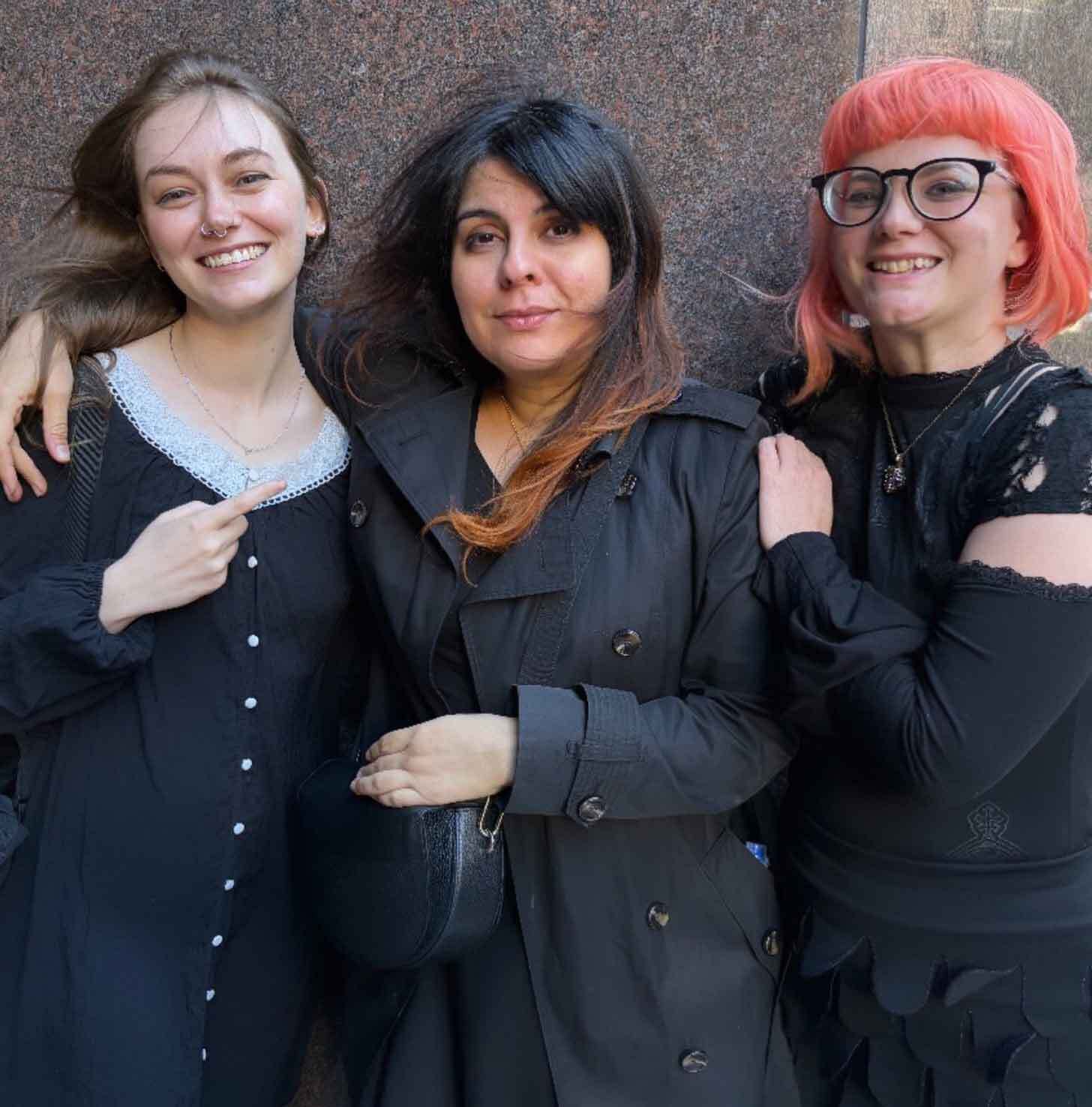
Of the ten artists behind the litigation, three present in court included McKernan, film production artist Karla Ortiz, and cartoonist Sarah Andersen.

Three women stand smiling shoulder to shoulder. From left to right: cartoonist Sarah Andersen, film production artist Karla Ortiz, and illustrator Kelly McKernan.
From left to right: Sarah Andersen, Karla Ortiz, and Kelly McKernan. Photo courtesy of Kelly McKernan/X

“I’m so grateful for these women and our lawyers,” McKernan posted on X, above a picture of them embracing Ortiz and Andersen. “We’re making history together as the largest copyright lawsuit in history moves forward.” 

Ortiz returned the love on X, saying that she was “deeply appreciative” of her fellow artists and plaintiffs. 

“Being there with you all today in the court room really made such a difference for me!” Ortiz wrote. “You are all so inspiring!”

The case is one of many AI copyright theft cases brought forward in the last year, but no other case has gotten this far into litigation. 

“I think having us artist plaintiffs visible in court was important,” McKernan wrote. “We’re the human creators fighting a Goliath of exploitative tech.”

“There are REAL people suffering the consequences of unethically built generative AI. We demand accountability, artist protections, and regulation.” 

If you’ve seen some of your favorite TikTok creators, influencers, and celebrities share a fundraiser in support of a Palestinian family this week, then you’ve seen the work of Erin Hattamer.

Hattamer is an improv and sketch comedian who rose to popularity on TikTok, amassing over 1.5 million followers. But recently, she has transformed her presence on the app from hilarious sketches to grassroots community organizing — while, of course, still sprinkling in some humor.

After using her platform to show support for Palestinians, Hattamer started receiving messages from people on the ground in Gaza and Rafah asking for her help.

“I was getting messages from hundreds of families from Palestine, and I couldn’t keep up,” she told Good Good Good. “There wasn’t enough time or space to talk about everyone. It was heartbreaking every day to have to pick and choose who to talk about.” 

Erin Hattamer
Photo courtesy of Erin Hattamer

So, using “the minimal organizing skills” she had, Hattamer made a form for people to fill out so she could pair these families with other creators who could amplify their stories and donate to their cause.

Then, the pros reached out. 

Operation Olive Branch, a digital volunteer effort organizing and supporting fundraising campaigns that help displaced Palestinians, had been doing this work for months. They offered Hattamer a more standardized method to match families with potential donors.

OOB is led by a coalition of volunteers who collect and verify mutual aid campaigns of hundreds of Palestinian families and share them through a (very thorough and color-coded) spreadsheet. 

These fundraisers, according to an (again, very detailed) FAQ page from OOB, “include campaigns from families regardless of their request, whether it be funds for medical aid, food, supplies of living, evacuation fees, or to rebuild their homes.”

Families are verified through active social media accounts where they document their experiences on the ground in Gaza, or through direct WhatsApp calls with Arabic-speaking volunteers. 

The verification process — combined with GoFundMe’s “Giving Guarantee” policy — allow organizers to mitigate scams and quickly help those in need, expediting funds that often go toward paying exorbitant fees and bribes to evacuate to Egypt. 

While many families desperate to cross the border hope to be verified and added to the list, Hattamer said around 800 pre-verified OOB families still need help to meet their goals.

That’s where she comes in.

@erinhattamer #passthehat ♬ original sound - Erin Hattamer

“They [OOB] have so many hard-working people there that are much more capable than myself,” Hattamer said. “We simply used their list to assign families to creators who were reaching out.”

Hattamer has been the liaison between this grassroots mutual aid effort and big-name creators — like Hank and John Green, Chris Olsen, and Drew Afualo, among many others who have shared and donated to these fundraisers. Even Lizzo has amplified the work of OOB.

“My philosophy is that not one person — me or anyone else — should carry the burden of speaking out,” Hattamer said in a TikTok that explains the project — which she and her followers have aptly named ‘Pass the Hat.’ 

“It’s not just up to me, it’s not just up to you; it’s up to everyone.”

And sharing the load is working.

“We have over 2,000 individuals signed up to symbolically adopt a family and have paired over 600 families. I have been blown away by the reaction,” Hattamer said.

At first, she doubted how many creators she’d be able to get on board. After all, many had seemingly shied away from creating content that could be seen as too political, amid Israel’s bombardment of the occupied area, where an estimated 34,622 Palestinians have been killed in the past 200+ days.

“I thought maybe some mutuals would be interested, but people ran with it. People posted about it without me having to even prompt them, and it’s turned into this,” Hattamer said. “I am just so fucking grateful it worked out that way.”

The caveat to Pass the Hat, she said, is that it shouldn’t have taken her efforts for other creators to get involved.

“I’m so happy Pass the Hat has taken off. I’m so happy we can highlight OOB,” she said in a TikTok. “But did you know that OOB was a bunch of volunteers that are folks of color that have been posting about this for months? And it took me posting about it obsessively for people to start getting on board.”

@operationolivebranch We need to re-center what OOB is! Please watch in full!  Thank you @Erin Hattamer !!!  #operationolivebranch #passthehat #yanatheartist ♬ Free Time - YANAtheartist

OOB organizers have also shared similar sentiments, reminding their new audience that they don’t have to wait to be “assigned” a family to donate to someone in need, and that Black and Brown creators still need support.

“The entire point of Pass the Hat was Erin reaching out to huge influencers who had been ignoring BIPOC creators,” one OOB organizer said in a TikTok, “because Erin understands her visibility, her platform, and her privilege.”

Despite the frustration about the silence of certain creators (until this point), Hattamer does concede that the mainstream attention of Pass the Hat has made talking about Palestine more approachable for many.

I can’t let my own anger get in the way. The people being targeted by Israel don’t care about our squabbles or politics. They want to live. I am happy to come to the table with anyone that wants to help. Sometimes it means swallowing my anger and reaching out a hand.

“There have been some creators that I had low expectations of that have exceeded them,” she said, of folks who have enthusiastically supported the project. “I think it shows that people did want to help but had no way to direct their focus.” 

Ultimately, Hattamer said she hopes to remove her ego from these efforts. In fact, getting swept up in petty disputes about what certain creators have said, or who is doing enough, or who deserves recognition, only fuels her fire to redirect people’s focus to Palestinians on the ground.

“I can’t let my own anger get in the way. The people being targeted by Israel don’t care about our squabbles or politics. They want to live,” she said. “I am happy to come to the table with anyone that wants to help. Sometimes it means swallowing my anger and reaching out a hand.” 

She continues to reach out in every direction, still engaging with a number of Palestinian families herself. After all, that’s how Pass the Hat started.

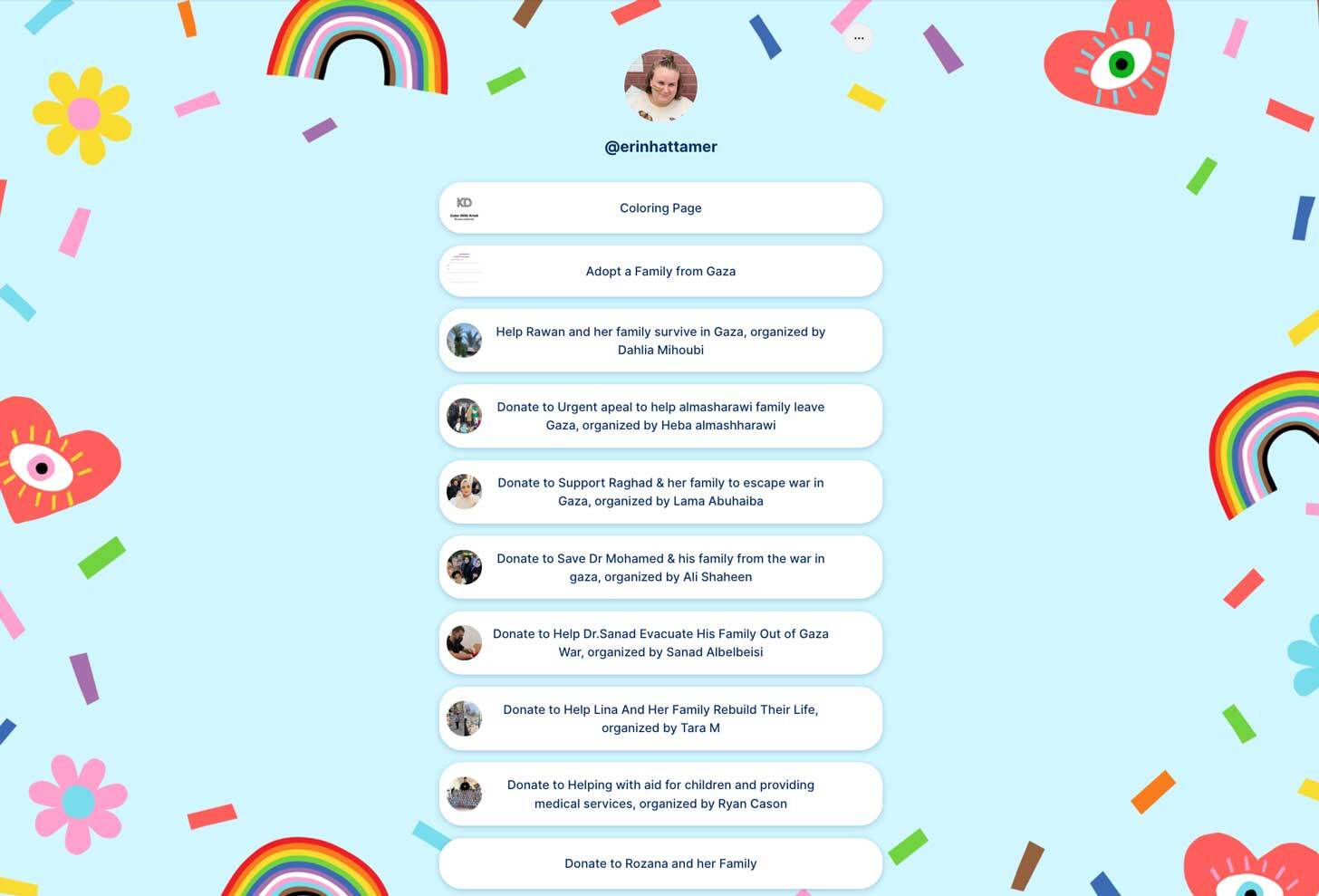
Colorful webpage layout with a light blue background scattered with playful elements like a rainbow, a heart-shaped eye, and confetti. At the center, a list of clickable links for various charitable causes such as "Adopt a Family from Gaza" and "Donate to Urgent appeal to help almasharawi family leave Gaza," each accompanied by the organizer's name. At the top, a profile photo of a woman, labeled "@erinhattamer."
Hattamer's LinkTree includes a number of GoFundMe pages for families in need.

There’s Dana, who Hattamer said has been on the ground helping connect and verify families who are at the heart of this campaign, and continues to seek support herself after her brother and father were hit by shrapnel in Rafah.

Reem and her family also stay in touch with Hattamer regularly and initially reached out because their baby, Laila, bears a resemblance to the comedian.

“They are close to the bombings,” Hattamer said. “But I message them as much as I can to make sure they are safe.”

Rawan and Heba are also new friends of Hattamer’s, who take time to share on-the-ground updates, even as they try to build the resources to flee.

The connections Hattamer shares with these individuals tether her to the situation in the most hands-on way available: Through a screen, sharing dollars and stories, desperate to make an impact.

From the looks of it, she is.

“We have made people’s goals,” she said. “This way is working, and the families send so much love.”

At the end of the day, even as important conversations about privilege and influence continue, Hattamer’s goals are the same as many’s: To help. To encourage people to do what they can with what they have.

“They [the families] often ask me ‘how are you doing?’” she said. “And it breaks my fucking heart that they still, after all of this, have the decency to check on others.”

‍

Header images courtesy of Drew Afualo, Erin Hattamer, and Chris Olsen/TikTok

Every day the Good Good Good team collects the best good news in the world and shares it with our community. Here are the highlights for this week!

If you want to get good news in your inbox every day, join the Goodnewsletter — the free daily newsletter designed to leave you feeling hopeful.

‍

The Best Positive News We’re Celebrating This Week —

Materials used for the 2024 NFL Draft are being repurposed to build a dog rescue shelter in Detroit

Turf, fencing, set pieces, and other materials used for the 2024 NFL Draft, hosted in Detroit, are being donated to local nonprofit organizations — including a local animal shelter, Detroit Dog Rescue.

Stage materials from the draft will be repurposed to help build the dog rescue’s free and low-cost spay and neuter clinic at an existing building, as well as its backyard and “decompression” spaces for dogs.

The city said there was an entire sustainability plan in place between the NFL and the city to reduce waste and repurpose materials from the event, which moves locations each year.

→ Read more​

​
More good news about repurposing and reusing:

‍

If the current rate of clean technology adoption continues, global greenhouse gas emissions will have already peaked in 2023

An analysis of several recent studies looking at clean energy adoption and greenhouse gas emissions shows that if the current, accelerated rates of growth continue — the worst of our impact on the planet could officially be behind us.

Authors of one study wrote that there’s “a 70% chance that emissions start falling in 2024 if current clean technology growth trends continue and some progress is made to cut non-CO2 emissions.”

Their most ambitious projection put emissions peaking in 2023 and then on “a long, sustained decline.” And those findings, while a “rare” piece of good news in the climate space (unless you’re an avid Good Good Good reader), align with similar studies.

The world has also potentially reached a climate “tipping point” — even if the current pace doesn’t continue, emissions are projected to plateau by the end of the decade before eventually beginning to decline.

While we still have work to do to reach key emissions reduction targets by 2030 and 2050 — this news should encourage all of us to continue taking climate action — individually, and collectively. We have what we need to reach those targets.

→ Read more

‍

Great Smoky Mountains National Park just expanded its adaptive excursions, helping disabled visitors bike, camp, and kayak

After launching its free adaptive programming last year with four events, this year, Great Smoky Mountains National Park is offering even more: three hikes, two mountain bike rides, one kayak trip, and one night of camping.

Adaptive excursions like these are made possible by programs with experts who provide equipment and knowledge to park-goers, like Catalyst Sports, whose programs help make the outdoors more accessible.​

The Smokies’ expanded accessible events are part of a larger movement by the National Park Service to make its parks more accessible to people of all abilities.

→ Read more​

​
More good news for accessibility:

‍

The first-ever commercial-scale production of sodium-ion batteries in the U.S. just launched

Renewable energy sources are exceeding production expectations (it’s only continuing to grow and set records!), but that sustainable endeaver comes with a dirty downfall: lithium.

It’s a known issue in the clean energy space, as lithium mining has industry-wide issues of worker negligence, geopolitical disruption, and destructive environmental impacts of its own. And lithium batteries control more than 90% of the global grid battery storage market.

Fortunately, this past week, Natron Energy launched its first-ever commercial-scale production of sodium-ion batteries in the U.S. These kinds of batteries provide more power, recharge faster, last longer, and have a “completely safe and stable chemistry.”

→ Read more

​
​
This tech would make these good headlines even better:

‍

Elmo is “checking in” again as part of a new mental health initiative on “Sesame Street”

Back in January, beloved “Sesame Street” Muppet Elmo logged on to social media platforms to see how folks were faring at the start of 2024: “Elmo is just checking in! How is everybody doing?”

With responses about break-ups, unemployment, rent increases, and more, Elmo’s mental health check-in opened up a national conversation about mental health and how important it is to look out for one another.

For Mental Health Awareness Month, “Sesame Street” and its nonprofit Sesame Workshop want to “check in” on everyone again — this time they’re doing it with mental health-themed episodes and free resources for kids.

→ Read more​

​
More good mental health news:

‍​

Once unhoused himself, a man in England has provided housing for hundreds of others right in his home since 2020

With a long criminal record for “mostly petty stuff,” Stuart Potts spent much of his life up until now in and out of prison — a​​nd for a period, he lived in a tent by a canal in Manchester, England.

That background gives him a uniquely personal understanding of other folks experiencing homelessness — and has led him to do what he can to help make a difference.

Alongside a healthy criticism of systems and cynicism toward authority figures who “lack compassion” — Potts has just as many heartwarming stories to tell about someone helping him out when they didn’t have to. Now, he’s doing the same.​​

From his one-bedroom flat, he’s let “hundreds” of people experiencing homelessness come and stay for free with just a few ground rules: no hard drugs or violence, and everyone helps with housework.

→ Read more

‍

The second-largest in the U.S., a San Francisco-sized piece of land has just been preserved, protecting critical wildlife habitat

On 27,512 acres in San Louis Obispo County, California rests Camatta Ranch, a cattle ranch that just completed the second biggest land conservation easement in the country.

The land, equivalent to the size of San Francisco, is “filled with rolling hills, green grass, oak woodlands and really important wildlife habitat.” While the land is privately owned and open for nature tours, it will also now be protected against any future development.

Owned for six generations by the Morrison family, it was important to them to ensure it stayed protected for the hundreds of animals that call it home: golden eagles, bald eagles, mountain lions, red-tailed hawks, and even bison.

What’s even better: The land is also home to black bears, which were once threatened but have been bouncing back due to conservation efforts like these and were taken off the endangered species list in 2016.

→ ​​Read more

‍

A study found that restoring coastal habitat boosts wildlife numbers by 61%

Pollution, coastal development, climate change, and many other human impacts have degraded or destroyed swathes of mangrove forests, saltmarshes, seagrass meadows, macroalgae (seaweed) forests, and coral and shellfish reefs.

Healthy coastal habitats are the gift that keeps on giving. We need them back, so there’s a lot of enthusiasm for restoring these habitats. But we want to recover more than just the habitats — we want the animals they support too.

In a new analysis of restoration projects, compared to degraded sites, restored habitats have much larger and more diverse animal populations.

And that’s in line with other, similar research on the subject!)

Overall, researchers found animal populations in restored coastal habitats were 61% larger and 35% more diverse than in unrestored, degraded sites.

For example, after oyster reefs were restored in Pumicestone Passage, Queensland, fish numbers increased by more than ten times and the number of fish species increased almost fourfold.

→ Read more

‍

More good news of the week —

​Researchers made the first discovery of endangered blue whales near Seychelles in decades. Whalers illegally killed 500 blue whales in the area between 1963 and 1966, so researchers did not expect to see any during their expedition.

​A city council member was just nominated to be the first Black mayor in Northern Ireland's history. Lilian Seenoi-Barr said she was “deeply honored” to make history for Derry City and Strabane District Council.

​PBS Kids added American Sign Language interpreters to six of its children’s shows. Children who are deaf or hard of hearing can now watch shows like “Daniel Tiger’s Neighborhood” and “Arthur” — which are already available to stream for free.

​A give-back, pajama-party alternative to the Met, the second-annual Debt Gala raised funds to forgive medical debt. The comedy-fashion fundraiser’s ticket sales proceeds go to organizations that relieve medical debt for people across the country.

​In response to a K-pop protest over climate concerns, Hyundai ended its aluminum deal with a major coal supporter. The carmaker will no longer get aluminum from Adaro Minerals, which plans to build 2.2 gigawatts of coal-fired power plants to power its aluminum smelter.

​Setting a “deliberately ambitious” goal, a major European train line is going all-electric by 2030. In the Netherlands, Eurostar’s trains have been running entirely on wind power for years — since 2017.

​A groundbreaking at-home cervical cancer screening test just received ‘breakthrough’ status from the FDA. Self-collect screening methods like the Teal Wand have put Australia on track to completely eliminate cervical cancer as a public health concern by 2035.

​A woman-owned startup just launched a line of sustainable PPE products designed specifically for women in STEM. ArmorSui’s products include gender-inclusive lab coats, reusable isolation gowns, and fire-resistant hijabs.

​A South Korean research team created self-cleaning solar panels that maximize efficiency through wind energy. Solar energy is vital for a sustainable future, but dust and other environmental factors dramatically reduce panel efficiency — this tech could fix that limitation.

​To be more inclusive, Boy Scouts of America announced it is changing its name to Scouting America. The organization’s president said it wants “any youth in America to feel very, very welcome to come into our programs.”

​Setting a new sustainability benchmark in marine logistics, a fully-electric, 10,000-ton container ship just began service in China. The new Green Water 01 vessel can save 8,600 pounds of fuel for every 100 nautical miles traveled, cutting carbon dioxide emissions by 12.4 tons.

[Related: This news aligns with a larger trend toward sustainability in the cargo shipping industry.]

​A new UN-led panel is creating guidelines to prevent environmental damage and human rights abuses with “critical mineral” mining. Used in low-carbon technology, mining for minerals like lithium, copper, and cobalt have led to a susrge in illegal labor and human rights violations.

​Pelicans were just seen nesting on Hat Island in Utah for the first time since 1943. The island is a designated wildlife management area, serving as an important nesting area for American white pelicans due to its isolation and protection for the birds.

​A former animal testing lab was transformed into an animal sanctuary. A lifelong dream of its founder, the 30-acre property will become a rehab center and sanctuary for animals that had spent much of their lives in cages.

​Scientists finally pinpointed a fungal virus that’s been harming frogs and toads. The novel virus has impacted over 500 amphibian species, and the discovery could revolutionize conservation for frogs and toads.

​A “mega-rare” bird was just spotted in Oregon for the first time in U.S. history. A photographer unknowingly captured a photo of the blue rock thrush and shocked the birding world when he posted it on social media.

​A recent Cambodian mangrove expedition uncovered a trove of 700 animal species. The expedition further highlighted mangroves’ crucial role in biodiversity conservation amid widespread loss.

​The hake population in the waters of Northwestern Europe has recovered spectacularly over the past 20 years. In what could signal more good news for overall ocean health, hake fish had nearly disappeared from the area due to overfishing.

​The National Park Service is reintroducing grizzly bears and no longer removing wild horses from parks. The NPS canceled plans to remove 200 historically significant wild horses and will reintroduce threatened grizzly bears to the North Cascades ecosystem.

​In a milestone for the critically endangered species, a California condor recently hatched in San Diego. The new arrival was the 250th hatched at the San Diego Zoo thanks to the conservation efforts of the San Diego Zoo Wildlife Alliance.

Every celebrity has their fan following: Taylor Swift has “Swifties,” Beyoncé’s got a “Beyhive,” and Ms. Rachel has her “little ones.” 

Rachel Accurso — better known to her fans as Ms. Rachel — is the “Bill Nye” and “Mister Rogers” of the next generation. Her online television program — geared towards infants, toddlers, and preschool children — has over 9 million subscribers and her videos have collectively received 6 billion views. 

Her original songs are a huge hit with kids and parents alike, and she prides herself on teaching milestones like pointing, clapping, and sounding out words. 

But children can’t sing and learn if they’re living in dangerous environments. 

On May 12 — Mother’s Day — Accurso pitched a fundraising idea to parents.

“An idea came to me this morning called ‘messages of love: to children, for children’ and I’m wondering if I could get your help with it,” Accurso began. “Please tag Cameo in the comments so we can make this happen together.” 

Cameo — a site that allows users to buy personalized videos from celebrities and influencers — does not currently list Accurso on their roster. But she’s willing to collaborate with them for a good cause. 

“The idea is: I’ll make videos for little ones and all the money raised on my end will go to Save the Children’s Emergency Fund, which will go to children living in conflict,” Accurso explained. 

Save the Children is an international nonprofit that lists Accurso as an ambassador. Through the funds raised from her “to children, for children” campaign, Accurso plans to prioritize supporting children in Gaza, Sudan, the Democratic Republic of Congo, and Ukraine. 

“Hopefully I can make little ones smile by giving them a personal video, and then the money will go to help more children living in unimaginable circumstances,” Accurso said. 

The music education teacher wrapped up her message by expressing that her heart was “completely broken” by the array of violence happening around the globe. 

“Children should never experience the horrors of war, these are grave violations of their human rights,” Accurso pleaded. “Children should be protected, children should have healthy food, clean water, protection from violence, a safe place to live.” 

@msrachelforlittles Tag @Cameo ps of course i have made my own donations and am an ambassador for @Save the Children US #momsoftiktok #toddlermom #toddlers #cameo ♬ original sound - Ms Rachel

Viewers heeded the call from Accurso’s post, tagging Cameo’s account in the comments and adding their own messages of support. 

“Not all heroes wear capes. I’m truly in awe,” wrote one user. 

“I’m crying, thank you Ms. Rachel!” said another. “My son is three and you have been [a part] of our lives [every day].”

“Happy Mother’s Day Ms. Rachel!” said a fellow mom. “You are amazing and we love you so much!” 

Last March, Accurso took a break from social media “for her mental health” teaching her fans — young and old — the importance of self-care. But it wasn’t long before she was back, singing songs, cooing to babies, and checking in with parents to see how she could help them too.

Over the years, Accurso has regularly used her platform for good, by giving out over 3,500 children’s books and supporting the nonprofit Room to Grow, which donates essential items to low-income families in need.

This is also not the first time Accurso has used her TikTok to speak directly to children in crisis. On October 19, she released an original song on her TikTok that evoked the same compassion she’s now echoing 7 months later. 

“Peace, peace, peace, all children deserve to have peace. Safe, safe, safe all children deserve to be safe,” she sang to the camera, sending her voice out to thousands of little ones. “Time to wonder, and time to learn and play. Love, love, love, all children deserve to be loved.” 

Editor's note: Since this article was first published, Ms. Rachel has launched her Cameos — and they’ve already fully sold out. You can learn more about her fundraising success and sign up to be notified of future Cameo drops from Ms. Rachel.

‍

Header image courtesy of Ms. Rachel

In the United States, formal childcare is unaffordable for the majority of parents and 14 million households don’t have internet access. For people positioned smack dab in the Venn diagram of both, public libraries can truly be a life-changing resource. 

But it can be difficult to study for an exam, look up an article, print off a recipe, and more when you have a baby on your hip or a stroller-straddling toddler to tend to. 

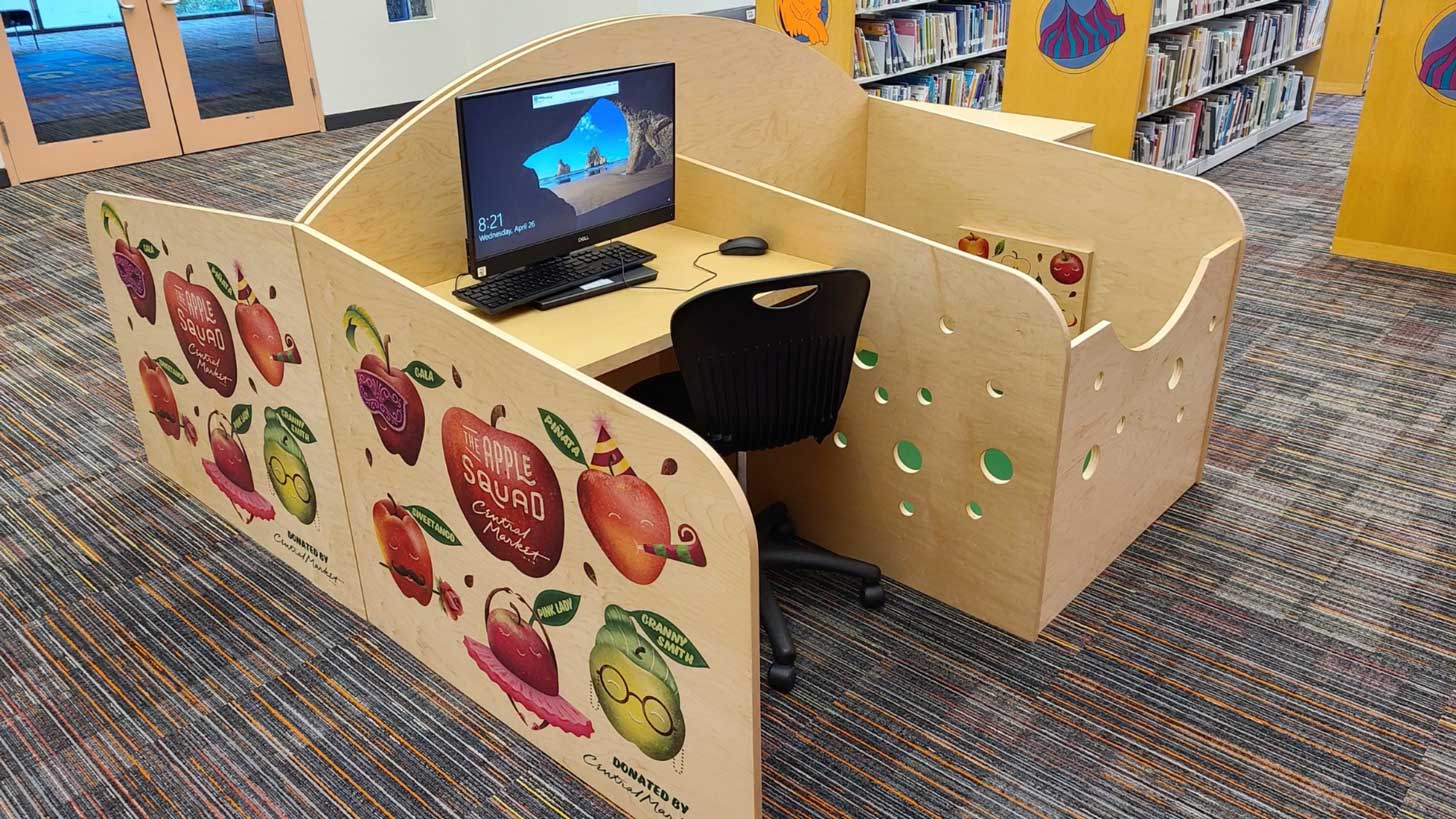
Fortunately, “family workstation” cubicles have been making their way to libraries across the nation. Each desk has a built in play area for an infant or toddler to sit in while their parent works beside them. 

Child-friendly library cubicle decorated with vibrant illustrations of anthropomorphic apples, featuring a desktop computer set on a wooden desk.
Photo courtesy of Plano Public Library/YouTube

One of those libraries includes the Mansfield Richland County Public Library in Ohio. For the librarians, installing the workstations was a no-brainer. 

“Anything that makes life simpler for caregivers is extremely important,” library director Chris May told the Richland Source. “We want them to not only feel welcome at the library, but to be able to use it.”  

“Having that computer access — whether it’s applying for jobs, whether it’s signing up for social services, checking email or even printing off boarding passes – if they can get it done easier than they could get it done before, I think that’s a win.”

Child-friendly library cubicle decorated with vibrant illustrations of anthropomorphic apples, featuring a desktop computer set on a wooden desk.
Photo courtesy of Plano Public Library/YouTube

In most libraries, the family workstation desks are located near the children’s play area, making it convenient for parents to keep an eye on their kids if they have to bring little ones and older kids along on the same library errand.

“The idea was having it near the play area,” said MRCPL children’s librarian Kinsey Landin. “That way if they have different-aged kids, maybe an older kid can be playing in the play area, they have their little one here beside them and then maybe even older kids on the computers.” 

At the MRCPL, the workstation play areas have a padded floor, a mirror, and flowery illustrations. Nearly identical cubicles can be found in four libraries across the country, with slight alterations. 

Child-friendly library cubicle decorated with vibrant illustrations of anthropomorphic apples, featuring a desktop computer set on a wooden desk.
Photo courtesy of Plano Public Library/YouTube

At Haggard Library in Plano, Texas, the workstations swapped flowers for “peek-a-boo walls.” In Washington-Centerville Public Library in Yellow Springs, Ohio, they have learning panels with “pat-a-cake” rhymes and interactive clock games for the kids. 

For WCPL library director Liz Fultz, the workstations were a natural solution to an everyday problem that many public libraries encounter. 

“We frequently see parents and caregivers in the library with small children,” Fultz told WYSO. “They’ll be sitting at a computer with their child in a stroller. Understandably, kids can get a little restless when they're just strapped in a stroller.”

Public libraries remain indispensable solutions for countless parents — especially ones that double as students — who don’t have the luxury of using a computer at home while they bounce a baby on their lap.

For many people, the cubicles are a major source of relief. 

“We want to be supportive of parents and provide things that the community wants and needs,” said Fultz.

The Colorado River supplies water to 40 million people in seven states and parts of Mexico. The only problem? It’s been experiencing a “megadrought” since 2000.

In fact, studies found that 2000 to 2021 marked the driest period in the Colorado River Basin in the last 1,200 years, due to declines in snowfall runoff from Colorado and Wyoming mountains.

But new research out of the University of Colorado Boulder gives reason for hope.

While temperature increases due to climate change are a major factor in decreases in snowfall runoff, they don’t paint the whole picture. 

The Colorado River runs between two large red rock formations
Photo courtesy of U.S. Geological Survey

A climate model analysis from the University of Colorado Boulder’s  Cooperative Institute for Research in Environmental Sciences posits that precipitation is also an important indicator of the river basin’s health.

The good news? Scientists are forecasting a 70% chance of increased precipitation over the next 25 years compared to what they’ve seen over the past two decades.

“It’s sort of a nuanced message,” Balaji Rajagopalan, co-author of the study, said in a statement. “The temperature is warming, but that's not the full story — you add precipitation and you get a fuller picture.”

This full story was published in the Journal of Climate last month, a result of data analysis of flow records at Lee’s Ferry, the dividing point of the river’s upper and lower basins. Rajagopalan and his research partner, Martin Hoerling, looked at records dating back to 1895.

They confirmed that natural changes in participation have fluctuated for much of that time, dictating extreme wet and dry periods for the river.

“We find it is more likely than not that Lee Ferry flows will be greater during 2026-2050 than since 2000 as a consequence of a more favorable precipitation cycle,” Hoerling, the paper’s lead author, said in a statement. 

“This will compensate [for] the negative effects of more warming in the near term.”

During the past two-plus decades, about 12.5 million acre-feet of water per year flowed down the Colorado River, which is significantly short of the 14.5 million acre-feet norm. 

Well, the norm prior to the early aughts.

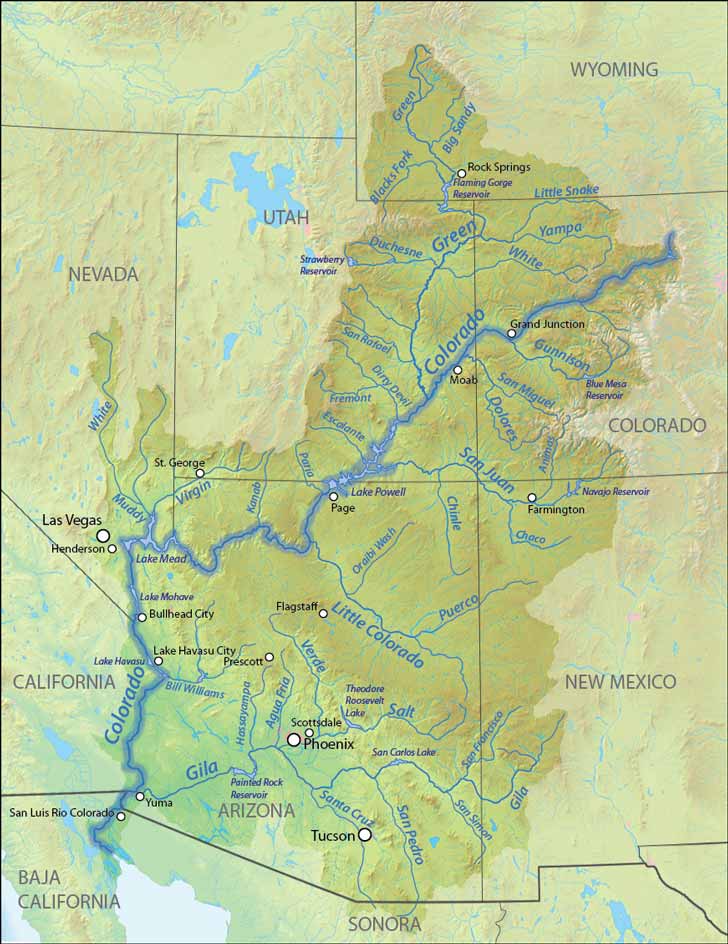
A map of the Western United States, showing where the Colorado River flows
Photo courtesy of Shannon/Wikimedia Commons (CC BY-SA 4.0)

Using climate models, including the latest projections from the IPCC, the study’s researchers predicted the river’s flow 25 years into the future, suggesting that flows could rise to 13.5 million or 14 million acre-feet averages between 2026 and 2050.

“So much of the conversation has been that there’s almost a foregone conclusion that we’re only going to see less water in the Colorado [River],” Nanette Hosenfeld, senior hydrometeorologist at the Colorado Basin River Forecast Center, told the Colorado Sun. 

“I think this [study] just does a good job of raising awareness that that’s not necessarily true.”

Although these predictions are promising, there is still a chance that conditions could get worse. According to Hoerling, there is a roughly 4% chance that Lee Ferry flows could decline another 20% in the next quarter century, yielding only 10 million acre-feet a year. 

That means officials and policymakers must prepare for both outcomes, as they navigate the ebbs and flows of river management for the future.

“Decision makers are confronted with a more optimistic vision of the available supply in coming decades than might have generally been foreseen previously,” Hoerling said in a statement, “but also confronted with a small, but perhaps unacceptable, risk for historically low flows.” 

Tribal nations, environmental groups, and academics are all working to propose guidelines for storing and releasing water from the basin’s reservoirs — and states along the river basin released competing proposals in March after tense negotiations. 

The Upper Basin proposal would require states in the Lower Basin to start conserving water if the reservoir levels fall below certain points, while the Lower Basin proposal would require all seven states to cut water usage.

Ultimately, decision makers have until 2026, when the current rules expire, to finalize the guidelines that will govern the future of the river. Although it’s complicated to approach from a policy perspective, Hoerling hopes the science will provide a fresh lens.

He told the Colorado Sun: “I think what’s important to recognize here is that the future doesn’t have to be seen as a downhill-only prospect.”

‍

Header image courtesy of U.S. Geological Survey

Julia Fox wants to turn your trash into fashion. 

In her new E! competition series “OMG FASHUN,” Fox challenges designers to make outfits out of recycled and repurposed materials. 

But an unconventional fashion show requires unconventional host attire. Ahead of the TV show’s back-to-back premiere episodes, Fox reached out to NYC “trashion” designer Anna Molinari to commission a new dress — entirely made from trash. 

“Julia Fox told me that she woke up craving an outfit made out of plastic, so I just decided to make it for her,” Molinari said in TikTok video posted May 12. 

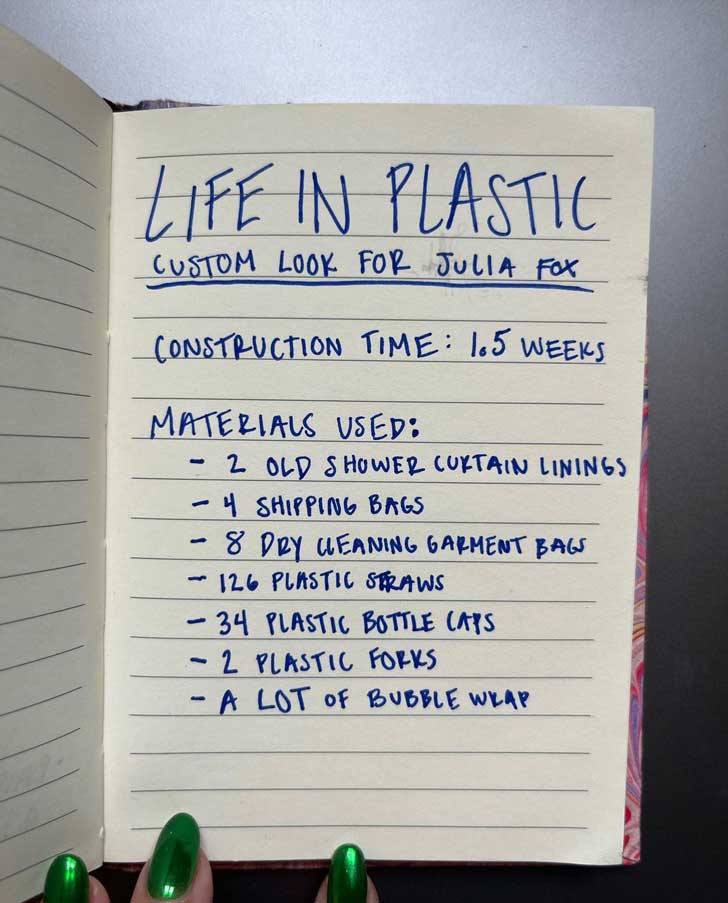
A hand-written creative brief that reads: "Life In Plastic: Custom Look for Julia Fox. Construction time: 1.5 weeks. Materials used: 2 old shower curtain linings, 4 shipping bags, 8 dry cleaning garment bags, 126 plastic straws, 34 plastic bottle caps, 2 plastic forks, a LOT of bubble wrap"
Photo courtesy of Anna Molinari/Instagram

Molinari got to it, diving into dumpsters and taking down her own shower curtain lining, which she used as the base of the dress. 

“I added metal boning to the top part of the outfit, so that it would give Julia her signature snatched look,” Molinari said, as she took viewers behind the scenes. 

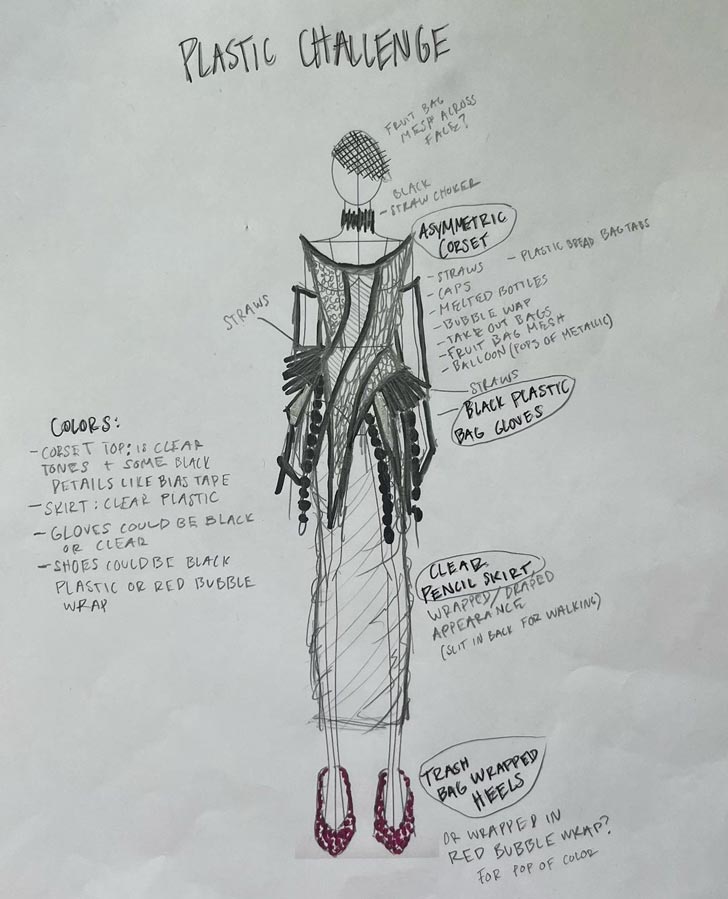
A fashion sketch of Anna Molinari's "Plastic Challenge," showing the blueprints of her dress design in pencil
Photo courtesy of Anna Molinari/Instagram

Molinari took Fox’s “plastic” request to heart, repurposing bubble wrap and dry cleaning bags into the dress, adorning high heels with plastic bottle caps, and melting plastic take-out forks into earrings. 

“I also incorporated a bunch of plastic straws that I’ve collected, because Julia and I want to save the turtles,” Molinari explained. 

The designer topped off the shower curtain corset with additional bottle caps and plastic lining. 

“I wanted to keep the skirt clear, because Julia — as well as the rest of the world — loves her butt,” Molinari joked. 

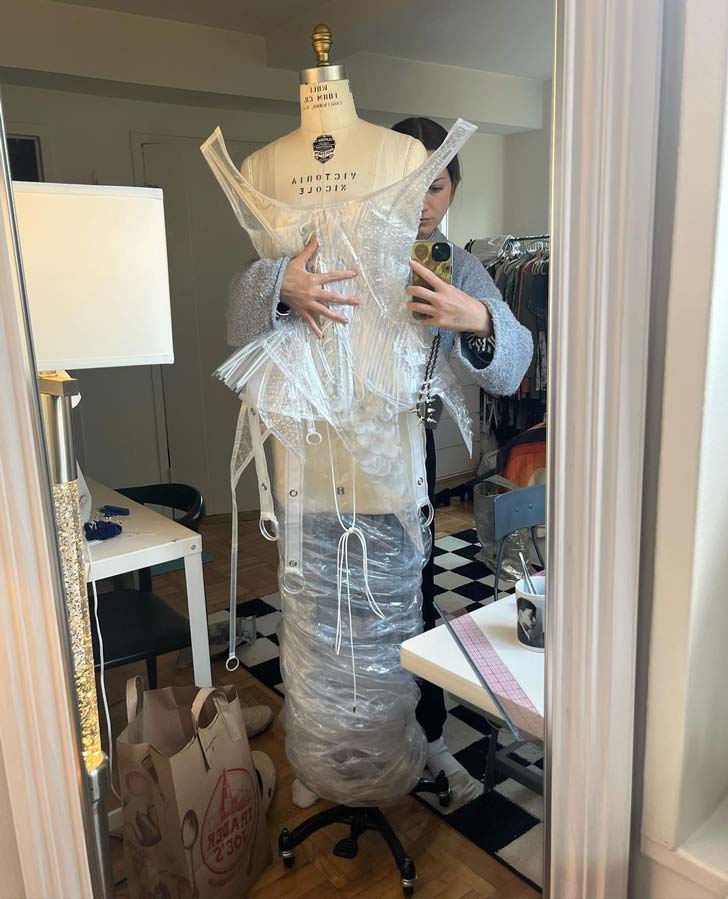
Anna Molinari takes a mirror selfie. She blocks her body with a mannequin covered in a dress made from plastics
Photo courtesy of Anna Molinari/Instagram

Once the outfit was pinned, glued, and sewed to Molinari’s liking, she handed it off to Fox, not knowing that she would wear the very same dress during her television appearance on May 6. 

“She liked it so much she wore it on her new TV show,” Molinari said. “She ate the whole thing up and left no crumbs.”

In each episode of “OMG FASHUN,” three fashion designers — dubbed “disruptors” — are tasked with creating handcrafted outfits from upcycled materials. Every week, Fox, stylist Law Roach, and a rotating guest judge will crown a new winner, who earns a $10,000 cash prize. 

A still from Julia Fox's "OMG FASHUN" in which consestants present their fashion designs to judges.
Photo by Quantrell Colbert/E! Entertainment

Fox has been making headlines lately for her two-year celibacy pact to herself, but she wants to pull focus toward sustainable fashion. Decked out in babydoll heads and deconstructed sneakers, Fox has been on a press tour to promote her new show and talk about the dangers of fast fashion. 

In an interview with the Associated Press, Fox described disruptive fashion as “anything that undermines the current norms.”

“[It means] not wearing mass-produced garbage, supporting local emerging designers in your own community, not falling for clever marketing ploys, [and] not wearing something just because everyone else is,” Fox explained. 

Julia Fox enters the set of her show "OMG FASHUN" wearing an outfit made of pieces of trash. It includes a bikini top and miniskirt, as well as white go-go boots. Atop her head is a dresser drawer headpiece, overflowing with more trash.
Photo by Quantrell Colbert/E! Entertainment

In addition to challenging designers to think outside the box by creating original outfits out of stuffed animals, breast pumps, tampon applicators, and more, Fox wants the disruptors on her show to go above and beyond the weekly prompt. 

“Tell a story through your work,” Fox said. “Don’t just make a pretty outfit. … Anyone can do that. But can you make me feel something? That’s harder to do.”

‍

[Editor's note: As of June 3, all episodes of "OMG Fashun" are now available to stream on Peacock.]

‍

Header image courtesy of Quantrell Colbert/E! Entertainment

Algorithms are a staple of modern life.

People rely on algorithmic recommendations to wade through deep catalogs and find the best movies, routes, information, products, people and investments.

Because people train algorithms on their decisions — for example, algorithms that make recommendations on e-commerce and social media sites — algorithms learn and codify human biases.

Algorithmic recommendations exhibit bias toward popular choices and information that evokes outrage, such as partisan news. At a societal level, algorithmic biases perpetuate and amplify structural racial bias in the judicial system, gender bias in the people companies hire, and wealth inequality in urban development.

Algorithmic bias can also be used to reduce human bias. Algorithms can reveal hidden structural biases in organizations.

In a paper published in the Proceedings of the National Academy of Science, my colleagues and I found that algorithmic bias can help people better recognize and correct biases in themselves.

‍

The bias in the mirror

In nine experiments, Begum Celikitutan, Romain Cadario and I had research participants rate Uber drivers or Airbnb listings on their driving skill, trustworthiness or the likelihood that they would rent the listing.

We gave participants relevant details, like the number of trips they’d driven, a description of the property, or a star rating.

We also included an irrelevant biasing piece of information: a photograph revealed the age, gender and attractiveness of drivers, or a name that implied that listing hosts were white or Black.

After participants made their ratings, we showed them one of two ratings summaries: one showing their own ratings, or one showing the ratings of an algorithm that was trained on their ratings.

We told participants about the biasing feature that might have influenced these ratings; for example, that Airbnb guests are less likely to rent from hosts with distinctly African American names. We then asked them to judge how much influence the bias had on the ratings in the summaries.

The author describes how algorithms can be useful as a mirror of people’s biases.

Two people standing with their reflections on the ground
(Unsplash/Peter Conlan)

Whether participants assessed the biasing influence of race, age, gender or attractiveness, they saw more bias in ratings made by algorithms than themselves. This algorithmic mirror effect held whether participants judged the ratings of real algorithms or we showed participants their own ratings and deceptively told them that an algorithm made those ratings.

Participants saw more bias in the decisions of algorithms than in their own decisions, even when we gave participants a cash bonus if their bias judgments matched the judgments made by a different participant who saw the same decisions.

The algorithmic mirror effect held even if participants were in the marginalized category — for example, by identifying as a woman or as Black.

Research participants were as able to see biases in algorithms trained on their own decisions as they were able to see biases in the decisions of other people.

Also, participants were more likely to see the influence of racial bias in the decisions of algorithms than in their own decisions, but they were equally likely to see the influence of defensible features, like star ratings, on the decisions of algorithms and on their own decisions.

‍

Bias blind spot

People see more of their biases in algorithms because the algorithms remove people’s bias blind spots. It is easier to see biases in others’ decisions than in your own because you use different evidence to evaluate them.

When examining your decisions for bias, you search for evidence of conscious bias — whether you thought about race, gender, age, status or other unwarranted features when deciding.

You overlook and excuse bias in your decisions because you lack access to the associative machinery that drives your intuitive judgments, where bias often plays out. You might think, “I didn’t think of their race or gender when I hired them. I hired them on merit alone.”

The bias blind spot explained.

When examining others’ decisions for bias, you lack access to the processes they used to make the decisions. So you examine their decisions for bias, where bias is evident and harder to excuse. You might see, for example, that they only hired white men.

Algorithms remove the bias blind spot because you see algorithms more like you see other people than yourself. The decision-making processes of algorithms are a black box, similar to how other people’s thoughts are inaccessible to you.

Participants in our study who were most likely to demonstrate the bias blind spot were most likely to see more bias in the decisions of algorithms than in their own decisions.

People also externalize bias in algorithms. Seeing bias in algorithms is less threatening than seeing bias in yourself, even when algorithms are trained on your choices. People put the blame on algorithms. Algorithms are trained on human decisions, yet people call the reflected bias “algorithmic bias.”

‍

Corrective lens

Our experiments show that people are also more likely to correct their biases when they are reflected in algorithms. In a final experiment, we gave participants a chance to correct the ratings they evaluated.

We showed each participant their own ratings, which we attributed either to the participant or to an algorithm trained on their decisions.

Participants were more likely to correct the ratings when they were attributed to an algorithm because they believed the ratings were more biased.

As a result, the final corrected ratings were less biased when they were attributed to an algorithm.

Algorithmic biases that have pernicious effects have been well documented.

Our findings show that algorithmic bias can be leveraged for good.

The first step to correct bias is to recognize its influence and direction. As mirrors revealing our biases, algorithms may improve our decision-making.

‍

This article was written by Carey K. Morewedge from Boston University and was originally published on The Conversation.

The Conversation

Every so often, a cause ignites a sustained fury on college campuses across the nation.

In 2020, it was Black Lives Matter.

In 2011, it was Occupy Wall Street.

In the 1980s, it was apartheid in South Africa.

Right now, it’s the Israeli military campaign in Gaza.

Since college protests tend to draw comparisons to the 1960s, it’s helpful to know more about that heritage.

Here are some of the most helpful and insightful books about the history of campus demonstrations:

‍

Read these books to better understand campus protests:

‘America Divided: The Civil War of the 1960s’

Book cover of America Divided: The Civil War of the 1960s’ by Maurice Isserman and Michael Kazin
Image courtesy of Oxford University Press

This primer on the politics and history of the 1960s recounts the Cuban missile crisis and moves through the many events that led to and fueled student activism, including the Vietnam War and key moments in the Civil Rights Movement.

Published in 1999 and now in its fifth edition, it is co-written by Hamilton College history professor Maurice Isserman, who studies leftist movements, and Michael Kazin, a Georgetown University expert on U.S. politics and social movements in the 19th and 20th centuries.

‍

‘Harlem vs. Columbia University: Black Student Power in the Late 1960s’

Book cover of ‘Harlem vs. Columbia University: Black Student Power in the Late 1960s’ by Stefan M. Bradley
Image courtesy of Oxford University Press

Given how prominent the Columbia demonstrations have been this year, it’s worth delving into the impact of a historically white, male bastion like the Ivy League school that abuts New York’s Harlem.

Stefan M. Bradley’s 2009 history focuses on the intertwined rises of Black and student power in response to Columbia’s attempt to build a largely segregated gymnasium in the small green park that separates it from Harlem.

‍

‘Freedom’s Orator: Mario Savio and the Radical Legacy of the 1960s’

Book cover of ‘Freedom’s Orator: Mario Savio and the Radical Legacy of the 1960s’ by Robert Cohen
Image courtesy of Oxford University Press

It took until 2009 for someone to write a definitive biography of Savio, a visionary who sensed how campus protests could change America.

But New York University historian Robert Cohen’s 544-page tome, based on personal papers, recordings of speeches and countless interviews, brings to life accomplishments of a major leader of the Berkeley Free Speech Movement. His “Bodies Upon the Gears” speech in 1964 could easily be adopted as the mantra of today’s pro-Palestinian movement.

‍

‘The New Student Activists: The Rise of Neoactivism on College Campuses’

Book cover of ‘The New Student Activists: The Rise of Neoactivism on College Campuses’ by Jerusha O. Conner
Image courtesy of Oxford University Press

Months before the murder of George Floyd sparked BLM protests and years before Hamas attacked Israel, Villanova education professor Jerusha O. Conner published her examination of how 1960s-style activism had returned to college campuses.

Still, her examination of the current generation of student activists helps explain why they’ve been so effective at drawing attention and making change. Among other misconceptions, she debunks the myth that student activists today are fragile “snowflakes” operating from a sense of entitlement.

‍

‘The Channels of Student Activism: How the Left and Right Are Winning (and Losing) in Campus Politics Today’

‘The Channels of Student Activism: How the Left and Right Are Winning (and Losing) in Campus Politics Today’ by Amy J. Binder and Jeffrey L. Kidder
Image courtesy of Oxford University Press

For a more contemporary look at student activism, pick up this slim volume by Johns Hopkins sociologist Amy J. Binder and Northern Illinois University sociologist Jeffrey L. Kidder that analyzes how the well-funded national conservative movement is building its own army of campus activists to remarkable effect.

The authors argue that voices from the left and the right are being “channeled into two distinct forms of mobilization and why that has profound consequences for the future of American politics.”

‍

This article was written by Steve Friess from the University of Michigan, and originally published on The Conversation.

The Conversation

In an age where it seems like there are TikTok and YouTube personalities for every kind of viewer, most parents are probably very familiar with the upbeat and cheery voice of the iconic Ms. Rachel.

Rachel Accurso, a children’s entertainment personality, who affectionately refers to her fans as her “little ones,” reaches over 9 million subscribers on YouTube. Here, she shares fun and engaging lessons for infants, toddlers, and preschool-aged viewers to help reach developmental milestones.

One core tenant of Ms. Rachel’s content? That all children deserve access to the resources they need to thrive. 

Ms Rachel in a pink t-shirt and denim overalls speaks directly to the camera in a social media video about fundraising efforts for children in Gaza and Ukraine. She wears a pink headband and her caption text mentions supporting the Children's Emergency Fund.
Photos courtesy of Ms. Rachel/Instagram

This is not the case in places like Gaza, Sudan, and Ukraine, where children face threats of violence, lack access to essentials, and navigate famine, disease, and more.

So, on Mother’s Day this weekend, Accurso announced a fundraising idea to do her part to help: “Messages for Littles to Help Littles.”

She would set up a profile on Cameo, a site that allows users to buy personalized videos from celebrities and influencers. 

“The idea is: I’ll make videos for little ones and all the money raised on my end will go to Save the Children’s Emergency Fund, which will go to children living in conflict,” Accurso explained. 

Working in partnership with Cameo, she launched her account in the afternoon of May 13 — and sold out in just a few hours.

With 500 videos, priced at $100 apiece, Accurso raised $50,000.

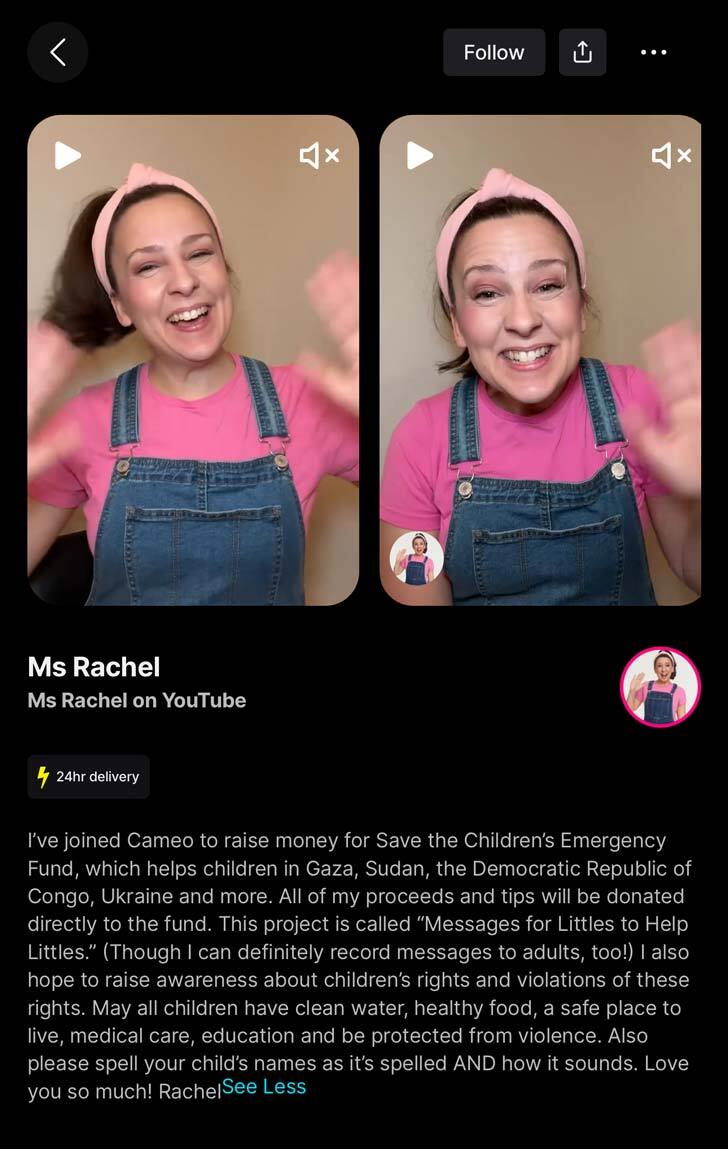
A joyful Ms Rachel in a pink t-shirt and denim overalls waves excitedly in a social media profile for charity efforts. She is collaborating with Cameo to raise money for Save the Children's Emergency Fund, helping children in Gaza, Sudan, the Democratic Republic of Congo, Ukraine, and more. The description under her video highlights that all her proceeds and tips will go directly to the fund, and she is committed to recording messages to raise awareness about children's rights and the violations of these rights, emphasizing the need for clean water, healthy food, safety, medical care, and education for all children.
Photo courtesy of Ms. Rachel/Cameo

“Every penny on my end will go to Save the Children to help children facing unimaginable circumstances,” Accurso shared on Instagram, clarifying that this includes the fee she receives from the videos, plus any tips she receives. 

“I’m so excited to talk to my precious friends!”

Accurso also shared on social media that she would record these 500 videos and would then reopen her Cameo for more requests, continuing to raise funds for children in need.

A notification message stating "Ms Rachel is currently unavailable. Follow Ms Rachel, and we'll let you know as soon as they're back." with a prominent purple "Follow" button against a dark background.
Photo courtesy of Cameo

The Save the Children Emergency Fund helps children in Gaza, Sudan, the Democratic Republic of Congo, Ukraine, and more. Accurso is listed publicly as an ambassador for the international nonprofit, as well.

In her Cameo profile, Accurso said she hopes to “raise awareness about children’s rights and violations of these rights.”

“May all children have clean water, healthy food, a safe place to live, medical care, education and be protected from violence,” she continued.

In a social media post, Accurso also called for an end to the violence around the globe.

“We should be ashamed of how children around the world are suffering,” she said, “when we could wrap each and every one up in love.”

You can “follow” Ms. Rachel on Cameo to be notified when she begins accepting more video requests.

‍

Header images courtesy of Ms. Rachel/Instagram

Earlier this month, a coalition of over 180 international tattoo artists joined together as part of Hibr: A tattoo fundraising campaign led by Palestinian Americans to provide aid to folks in need in Gaza.

(Hibr is an Arabic word that means ‘ink.’)

Led by activists Randa Jarrar and Ariana Bazlamit, the group of independent artists created flash sheets filled with designs related to Palestinian culture or social justice, booking tattoo appointments for those designs all on the same day: May 4.

The profits from these tattoos were then sent to Jarrar and Bazlamit, who shared that they will redistribute funds to Palestinians most in need.

Randa Jarrar and Ariana Bazlamit smile in an Instagram Reel promoting their Hibr tattoo fundraiser
Jarrar (left) and Bazlamit (right) announce the Hibr fundraiser on Instagram.

“We are absolutely blown away to announce that after our first worldwide Hibr event, our community has raised over $74,000,” the organizers shared on Instagram this week.

“This has absolutely surpassed any expectations we could have dreamed of. We couldn’t possibly express how grateful we are to every single one of you who has partnered with us and contributed to our cause with your time, energy, money, and bodies.”

The donations are being split among “vetted mutual aid campaigns for Gazans,” the post said.

Along with committing $10,000 to Ele Elna Elak, a student-led organization that provides essentials to Gazans, the organizers said they are in the process of being connected to evacuated Palestinian families made up of six or more people through the group Egyptians for Palestinians.

“We are committing to sponsor multiple families for a year,” they wrote.

Lastly, they said that they are committing $5,000 to Cairo Mutual Aid, an effort led by Hattie Soykan, to help cover the evacuation costs for families fleeing violence in Palestine.

But this is only the beginning.

The group will continue to hold monthly flash fundraising dates for its global community of tattoo artists, with June 1 and July 16 next up on the calendar. 

Some artists have also committed to offering their designs indefinitely, with all proceeds going back to the aforementioned causes. 

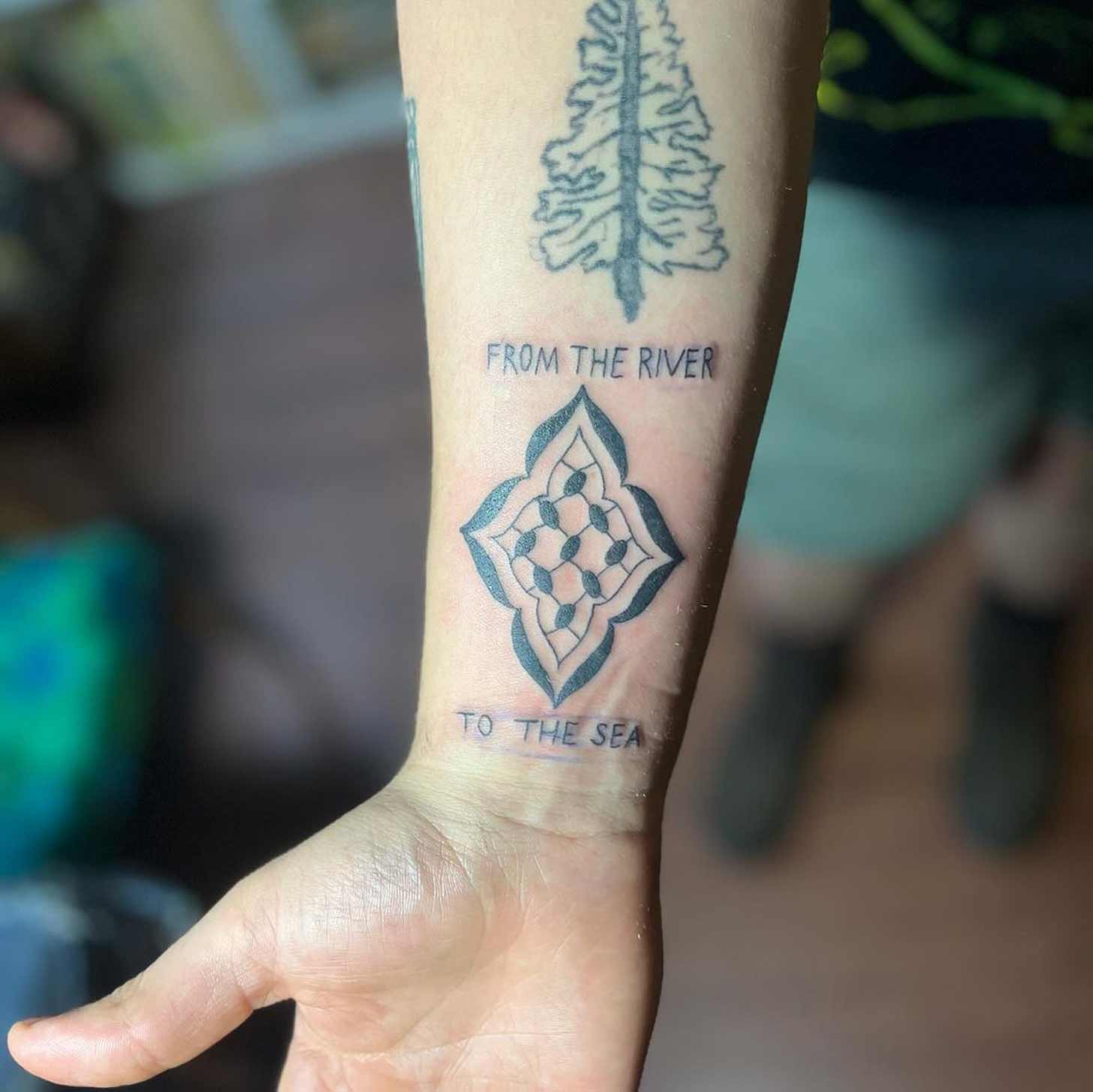
A tattoo that reads "from the river to the sea" with keffiyeh stitching done in support of the Hibr tattoo fundraiser
Photo courtesy of Landon Skelly/Instagram

“Everything counts,” Landon Skelly of Skeleton Inks in Pittsburgh, shared on Instagram after raising $690. 

“I will still be offering this flash, so don’t worry if you were unable to make it to the event. Funds from these designs will still be distributed.” 

Tattoo artists who are interested in participating in the ongoing fundraiser are required to submit a form to be part of the collective. From there, they are free to set their own hours, tattoo sizes, and prices — while committing to donate 100% of profits from these designs to Hibr.

“It’s beautiful to see how much impact we can make when we work together,” Fruit Camp, a Maryland tattoo studio that raised a collective $4,000, shared on Instagram. “Palestine will be free in our lifetimes!”

Participating artists are also featured on Hibr’s Instagram account, so folks interested in getting their own tattoos can find a location near them for future events. Many artists are located in the U.S. and Canada, with a handful working in Europe — and even some in Cairo, Egypt.

As Bazlamit told Good Good Good: their efforts just keep growing; Hibr’s list of participating artists now swells to over 240.

“We’ve been crying since May 4th. The only thing going through our minds is how much we’re going to be able to help our people,” Bazlamit said.

“This won’t undo the horrors they’re experiencing every moment, but we hope it will at least help them feel even the tiniest amount of relief. We love our people beyond measure, and we have an army of tattoo artist partners who are fighting right along with us.”

‍

Header images courtesy of Landon Skelly, Hbir, and Angela Smyth

Once you become attuned to how inaccessible the world is around you, you notice a lot of little things.

Maybe there are no curb cuts in your area, leaving people who use wheelchairs or parents with strollers to take a risky leap into the street, or go out of their way to find a safe way to move around.

Perhaps you notice how the elevator in your office building is always out of order, and those who can’t use the stairs are left to fend for themselves.

The print on a restaurant’s menu is too small, or the bathroom door to the accessible stall doesn’t lock all the way, or American Sign Language interpretation is nowhere to be found.

The developers behind the app Roll Mobility were all too familiar with these everyday concerns.

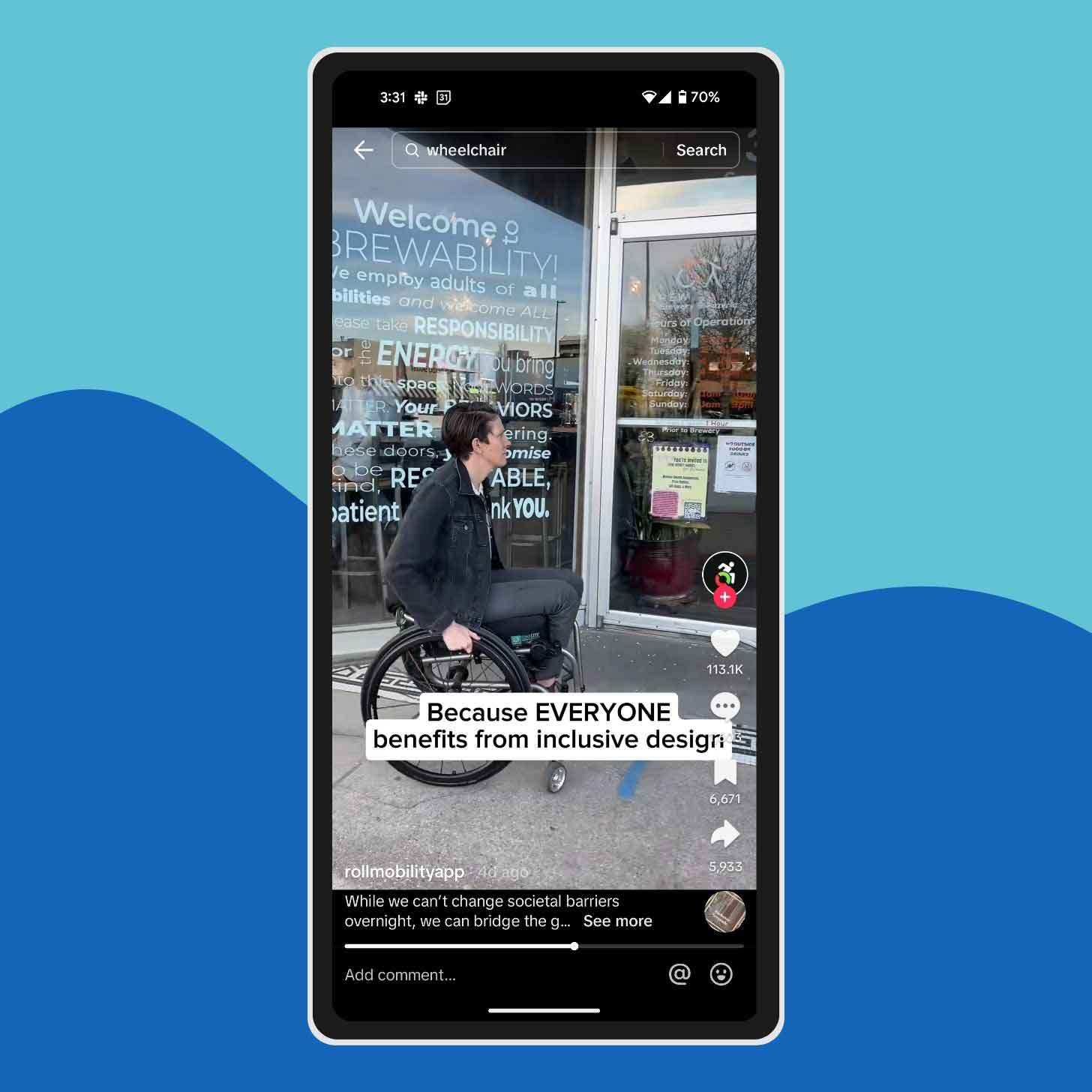
A screenshot of a TikTok video showing a person in a wheelchair outside of a restaurant. The video says "Because EVERYONE benefits from inclusive design"
Photo courtesy of Roll Mobility/TikTok

So, they decided to put the power back in the hands of disabled folks.

“Designed specifically for wheelchair users and individuals with accessibility issues, Roll Mobility takes the guesswork out of venturing into public spaces,” a press release for the app shares.

The app — which is free to download for both Apple and Android devices — launched in February of 2023 and is gaining momentum among people with disabilities.

With a community-based approach, users are able to search for a location, and read crowd-sourced reviews about that place’s accessibility information.

This includes essential information about features like ramps, elevators, accessible restrooms, parking spaces, and more. 

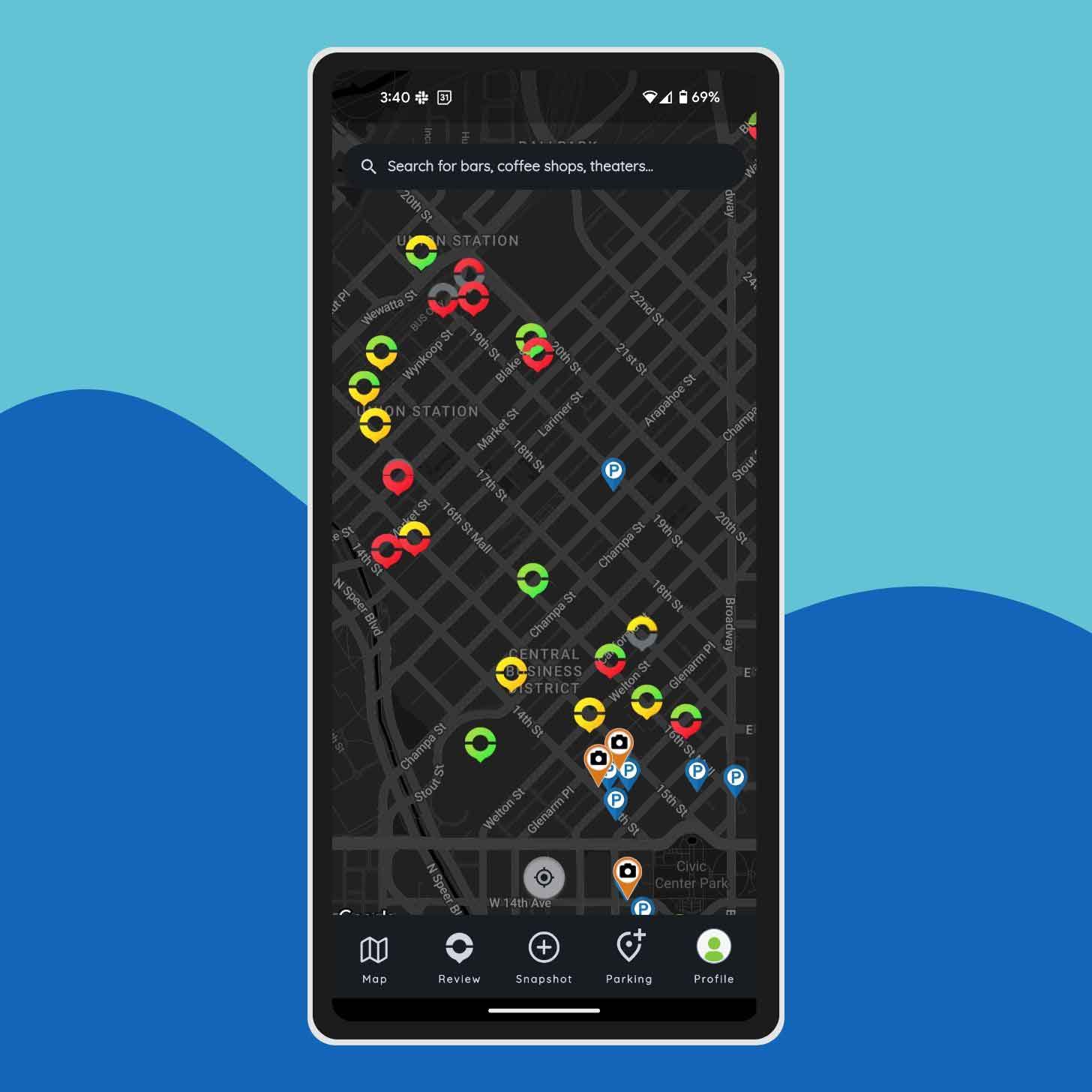
A screenshot of a map in the Wheel Mobility app, which displays locations in the Denver area
Photo courtesy of Roll Mobility

Essentially: It’s Yelp for disabled community members. 

“By leveraging the collective knowledge of its user community, this app creates a reliable and comprehensive database of accessible establishments in the local area, ensuring that individuals can make informed decisions about where to go and what to expect,” Roll Mobility’s website explains.

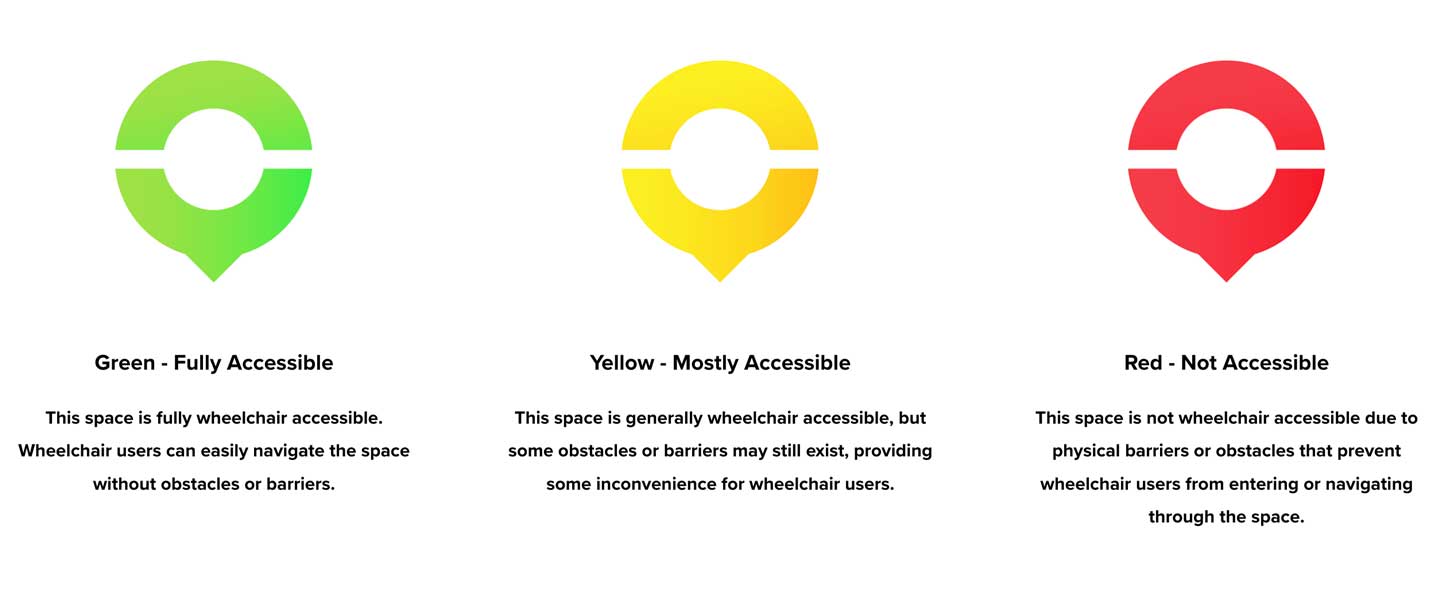
The app has a rating scale that includes data for overall accessibility and bathroom accessibility about a given space. Using a familiar red-yellow-green criteria, users can easily anticipate what kind of accommodations they might have access to — or whether they will be unable to navigate a space.

Roll Mobility's green-yellow-and red rating scale. Green- Fully Accessible. This space is fully wheelchair accessible. Wheelchair users can easily navigate the space without obstacles or barriers. Yellow - mostly accessible. This space is generally wheelchair accessible, but some obstacles or barriers may still exist, providing some invoncenience for wheelchair users. Red- not accessible. This space is not wheelchair accessible due to physical barriers or obstacles that prevent wheelchair users from entering or navigating through the space.
Photo courtesy of Roll Mobility

These scores are generated when users answer a series of questions about a location on the app, noting the absence or presence of key accessibility features. Users can also document additional information, comments, photos, and feedback for every entry.

Although all public places are supposed to meet a certain standard of accessibility under the Americans with Disabilities Act, many establishments either do not prioritize accessibility or are exempt from the ADA due to “grandfathering clauses.” 

“This leaves individuals who utilize wheelchairs uncertain about whether or not they can participate in certain activities, making planning outings a daunting and frustrating task,” Roll Mobility’s press release states.

With an estimated 12% of U.S. adults facing mobility disabilities, this leaves a staggering number of the population struggling to navigate daily life. 

After a little over a year on the market, Roll Mobility serves more than 1,000 users worldwide and highlights over 35 Adaptive Programs across the U.S. 

While the app has become a great resource among disabled individuals, it also aims to raise awareness among able-bodied allies about “what makes a space fully inclusive.” 

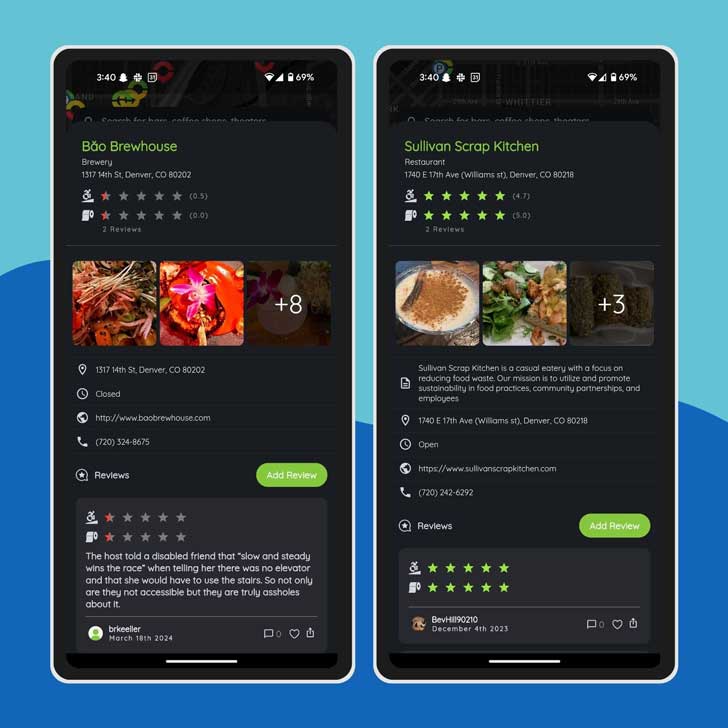
Two screenshots of the Roll Mobility app, displaying a review page for Bao Brewhouse and Sullivan Scrap Kitchen in Denver, Colorado
Two examples of review pages on the Roll Mobility app

App creators even encourage able-bodied people to download the app to help document locations to help bridge the information gap for the users who need it most.

“Roll Mobility is for everyone. All people benefit from accessible design, and our app is designed to teach anyone how to be a reliable accessibility rater,” one team member said in a recent TikTok video. “One of our favorite things about the app is its ability to raise social awareness around disability and accessible design altogether.”

It really is for everyone — the app is available worldwide to serve as a resource for folks no matter where they are.

But it takes time and community to gather the information necessary to make the app the best it can be.

The caption under the same TikTok video sums it up: “While we can’t overcome social barriers overnight, we can at least catalog and share the places where we know we are welcome.”

‍

Header images courtesy of Roll Mobility/TikTok

A carbon sink is anything that absorbs more carbon from the atmosphere than it releases. The world’s soil, oceans, and forests are the biggest known carbon sinks, and scientists have long acknowledged the role that they play in slowing the effects of climate change. 

But a new study shows how instrumental animals could be in tamping down on carbon emissions, too. It found that a single herd of bison has the potential to store 54 thousand tons of carbon a year.

Lead author Oswald Schmitz, Oastler Professor of Population and Community Ecology at the Yale School of Environment, studied a herd of bison in Romania’s Țarcu mountains and explained how this phenomenon occurs. 

“Bison influence grassland and forest ecosystems by grazing grasslands evenly, recycling nutrients to fertilize the soil and all of its life, dispersing seeds to enrich the ecosystem, and compacting the soil to prevent stored carbon from being released,” Schmitz told the Guardian.

“These creatures evolved for millions of years with grassland and forest ecosystems, and their removal, especially where grasslands have been plowed up, has led to the release of vast amounts of carbon. Restoring these ecosystems can bring back balance, and ‘rewilded’ bison are some of the climate heroes that can help achieve this.”

The study, backed by the Global Rewilding Alliance, calculated that a herd of 170 European bison — roaming on 30 square miles of grasslands — captured the yearly equivalent of carbon dioxide emissions from 43,000 US cars. 

Schmitz believes his research, which currently awaits peer review, could be revolutionary for the future of environmentalism and animal conservation alike. 

“Wildlife species, throughout their interaction with the environment, are the missing link between biodiversity and climate,” Schmitz explained in an interview with Yale. “This interaction means rewilding can be among the best nature-based climate solutions available to humankind.”

Dr. Alexander Lees, lecturer and conservation biodiversity reader at Manchester Metropolitan University, welcomes further research on the topic. 

“[Schmitz’s study] makes a convincing case for European bison reintroduction as a nature-based climate solution – one with major biodiversity conservation co-benefits,” he told The Guardian. 

“This study reinforces an emerging consensus that large mammals have very important roles in the carbon cycle,” Lees said. “Rewilding efforts, including, where appropriate, reintroductions, represent key tools in tackling the intertwined biodiversity and climate crises.”

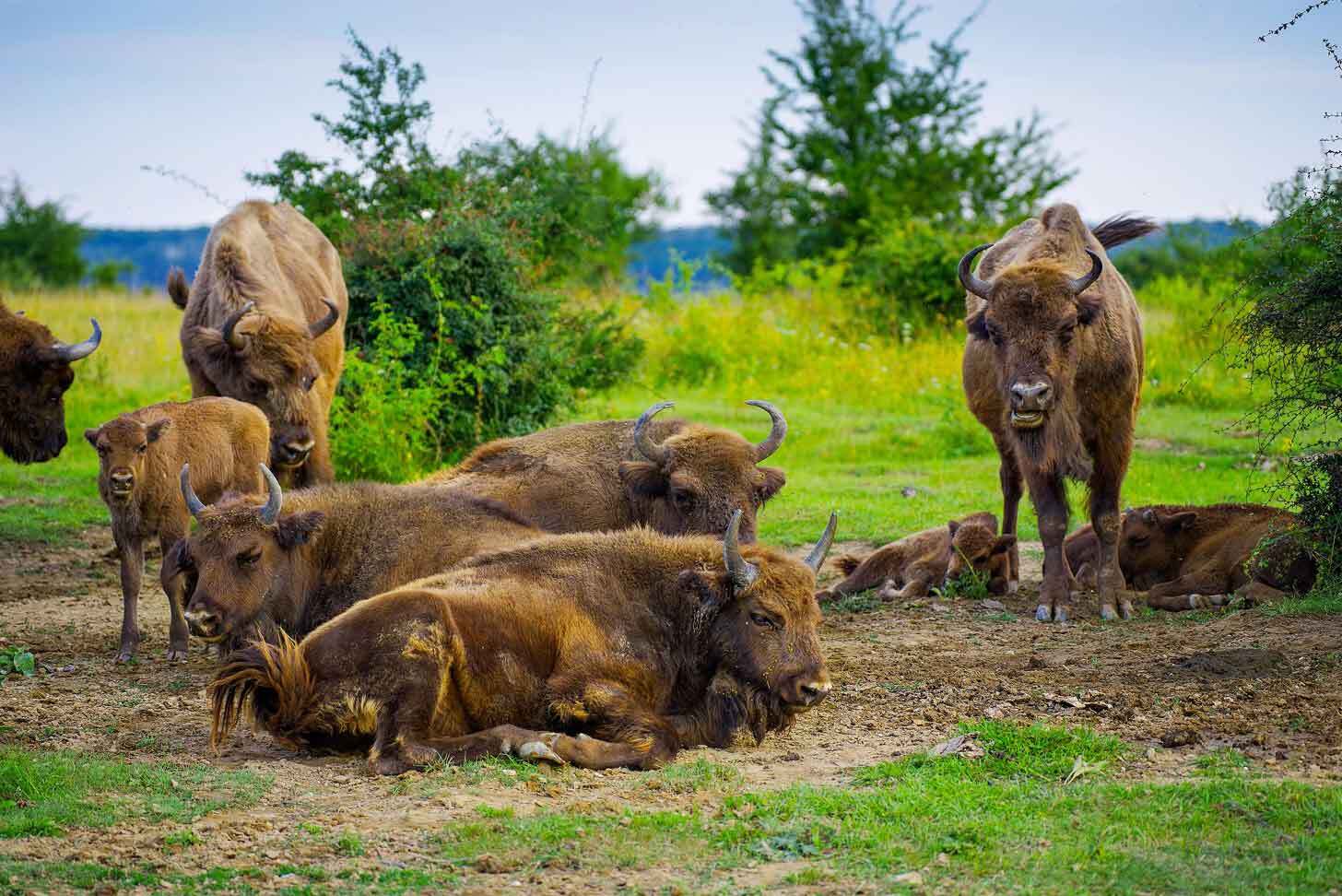
A herd of European bison graze and rest in the grasslands of a wildlife refuge.
A herd of European bison graze and rest in the grasslands of a wildlife refuge. Image via Michal Köpping / Wikimedia Commons (CC BY-SA 4.0 DEED)

Beyond bison, Schmitz and his team studied a total of nine species in relation to how they impact the carbon cycle — including whales, sea otters, musk oxen, tropical forest elephants, and more. Schmitz remarked that they all had “massive potential” to capture carbon. 

“Many of them show similar promise to these bison, often doubling an ecosystem’s capacity to draw down and store carbon, and sometimes much more,” Schmitz said. 

The researchers said that the results of the study invite further research into animals around the world; they hope to carry out additional studies on high-potential species like primates, fruit bats, seals, loggerhead and green turtles, and more. 

Magnus Sylvén, the director of science policy practice at Global Rewilding Alliance, celebrated Scmitz’s research as a milestone in conservation. 

“Until now, nature protection and restoration has largely been treated as another challenge and cost that we need to face alongside the climate emergency,” Sylvén said. 

“This research shows we can address both challenges: we can bring back nature through rewilding and this will draw down vast amounts of carbon, helping to stabilize the global climate.”

[Editor's Note: This article was updated on May 18, 2024 after the researchers of the study reported a coding error in their original metrics. The headline and article have been corrected accordingly.

‍

Header image via Оксана Ващук / Wikimedia Commons (CC BY-SA 4.0 DEED)


         President Jimmy Carter, right, surrounded by journalists after announcing he was lifting the travel ban on Cuba, Vietnam, North Korea and Cambodia, March 9, 1977.          AP Photo/File        
   
 Robert C. Donnelly, Gonzaga University  

Jimmy Carter, who died December 29, 2024 at age 100, was a dark horse Democratic presidential candidate with little national recognition when he beat Republican incumbent Gerald Ford in 1976.

The introspective former peanut farmer pledged a new era of honesty and forthrightness at home and abroad, a promise that resonated with voters eager for change following the Watergate scandal and the Vietnam War.

His presidency, however, lasted only one term before Ronald Reagan defeated him.  Since then, scholars have debated – and often maligned – Carter’s legacy, especially his foreign policy efforts that revolved around human rights.

Critics have described Carter’s foreign policies as “ineffectual” and “hopelessly muddled,” and their formulation demonstrated “weakness and indecision.”

As a historian researching Carter’s foreign policy initiatives, I conclude his overseas policies were far more effective than critics have claimed.

A Soviet strategy

The criticism of Carter’s foreign policies seems particularly mistaken when it comes to the Cold War, a period defined by decades of hostility, mutual distrust and arms buildup after World War II between the U.S. and Russia, then known as the Soviet Union or Union of Soviet Socialist Republics (USSR).

By the late 1970s, the Soviet Union’s economy and global influence were weakening. With the counsel of National Security Advisor Zbigniew Brzezinski, a Soviet expert, Carter exploited these weaknesses.

During his presidency, Carter insisted nations provide basic freedoms for their people – a moral weapon against which repressive leaders could not defend.

Carter soon openly criticized the Soviets for denying Russian Jews their basic civil rights, a violation of human rights protections outlined in the diplomatic agreement called the Helsinki Accords.

Carter’s team underscored these violations in arms control talks. The CIA flooded the USSR with books and articles to incite human rights activism. And Carter publicly supported Russian dissidents – including pro-democracy activist Andrei Sakharov – who were fighting an ideological war against socialist leaders.

                       
             Human rights were a cornerstone of President Jimmy Carter’s foreign policy. Here, a billboard with his picture on it in Liberia.              AP Photo/Michel Lipchitz            
         

Carter adviser Stuart Eizenstat argues that the administration attacked the Soviets “in their most vulnerable spot – mistreatment of their own citizens.”

This proved effective in sparking Soviet leader Mikhail Gorbachev’s social and political reforms of the late 1980s, best known by the Russian word “glasnost,” or “openness.”

The Afghan invasion

In December 1979, the Soviets invaded Afghanistan in response to the assassination of the  Soviet-backed Afghan leader, Nur Mohammad Taraki. The invasion effectively ended an existing détente between the U.S. and USSR.

Beginning in July 1979, the U.S. was providing advice and nonlethal supplies to the mujahideen rebelling against the Soviet-backed regime. After the invasion, National Security Advisor Brzezinski advised Carter to respond aggressively to it. So the CIA and U.S. allies delivered weapons to the mujahideen, a program later expanded under Reagan.
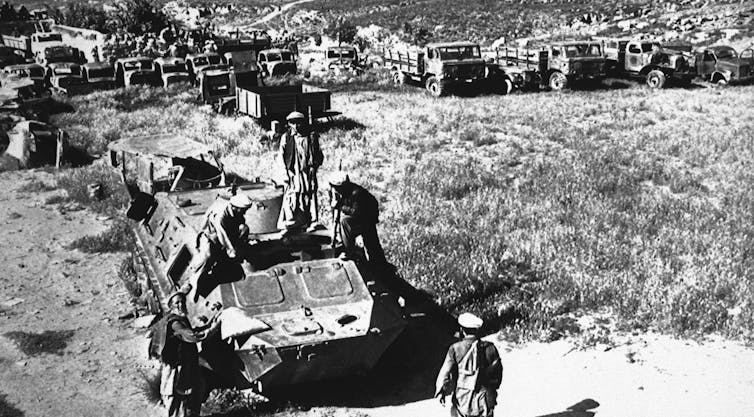
                       
             Afghan rebels examine a Soviet-built armored personnel carrier and scores of other military vehicles left behind when the Mujahedeen fighters overran a Soviet-Afghan garrison.              AP Photo/Joe Gaal            
         

Carter’s move effectively engaged the Soviets in a proxy war that began to bleed the Soviet Union.

By providing the rebels with modern weapons, the U.S. was “giving to the USSR its Vietnam war,” according to Brzezinski: a progressively expensive war, a strain on the socialist economy and an erosion of their authority abroad.

Carter also imposed an embargo on U.S. grain sales to the Soviets in 1980. Agriculture was the USSR’s greatest economic weakness since the 1960s. The country’s unfavorable weather and climate contributed to successive poor growing seasons, and their heavy industrial development left the agricultural sector underfunded.

Economist Elizabeth Clayton concluded in 1985 that Carter’s embargo was effective in exacerbating this weakness.

Census data compiled between 1959 and 1979 show that 54 million people were added to the Soviet population. Clayton estimates that 2 to 3 million more people were added in each subsequent year. The Soviets were overwhelmed by the population boom and struggled to feed their people.

At the same time, Clayton found that monthly wages increased, which led to an increased demand for meat. But by 1985, there was a meat shortage in the USSR. Why? Carter’s grain embargo, although ended by Reagan in 1981, had a lasting impact on livestock feed that resulted in Russian farmers decreasing livestock production.

The embargo also forced the Soviets to pay premium prices for grain from other countries, nearly 25 percent above market prices.

For years, Soviet leaders promised better diets and health, but now their people had less food. The embargo battered a weak socialist economy and created another layer of instability for the growing population.

The Olympic boycott

In 1980, Carter pushed further to punish the Soviets. He convinced the U.S. Olympic Committee to refrain from competing in the upcoming Moscow Olympics while the Soviets repressed their people and occupied Afghanistan.

Carter not only promoted a boycott, but he also embargoed U.S. technology and other goods needed to produce the Olympics. He also stopped NBC from paying the final US$20 million owed to the USSR to broadcast the Olympics. China, Germany, Canada and Japan – superpowers of sport – also participated in the boycott.

Historian Allen Guttmann said, “The USSR lost a significant amount of international legitimacy on the Olympic question.” Dissidents relayed to Carter that the boycott was another jab at Soviet leadership. And in America, public opinion supported Carter’s bold move – 73% of Americans favored the boycott.

The Carter doctrine

In his 1980 State of the Union address, Carter revealed an aggressive Cold War military plan. He declared a “Carter doctrine,” which said that the Soviets’ attempt to gain control of Afghanistan, and possibly the region, was regarded as a threat to U.S. interests. And Carter was prepared to meet the threat with “military force.”

Carter also announced in his speech a five-year spending initiative to modernize and strengthen the military because he  recognized the post-Vietnam military cuts weakened the U.S. against the USSR.

Ronald Reagan argued during the 1980 presidential campaign that, “Jimmy Carter risks our national security – our credibility – and damages American purposes by sending timid and even contradictory signals to the Soviet Union.” Carter’s policy was based on “weakness and illusion” and should be replaced “with one founded on improved military strength,” Reagan criticized.

In 1985, however, President Reagan publicly acknowledged that his predecessor demonstrated great timing in modernizing and strengthening the nation’s forces, which further increased economic and diplomatic pressure on the Soviets.

Reagan admitted that he felt “very bad” for misstating Carter’s policies and record on defense.

Carter is most lauded today for his post-presidency activism, public service and defending human rights. He was awarded the Nobel Peace Prize in 2002 for such efforts.

But that praise leaves out a significant portion of Carter’s presidential accomplishments. As the assessments roll in after his death, those who are evaluating his legacy should consider that Carter’s foreign policy, emphasizing human rights, was a key instrument in dismantling the power of the Soviet Union.

This is an updated version of a story that was originally published on May 2, 2019.The Conversation


Robert C. Donnelly, Associate Professor of History, Gonzaga University


This article is republished from The Conversation under a Creative Commons license. Read the original article.

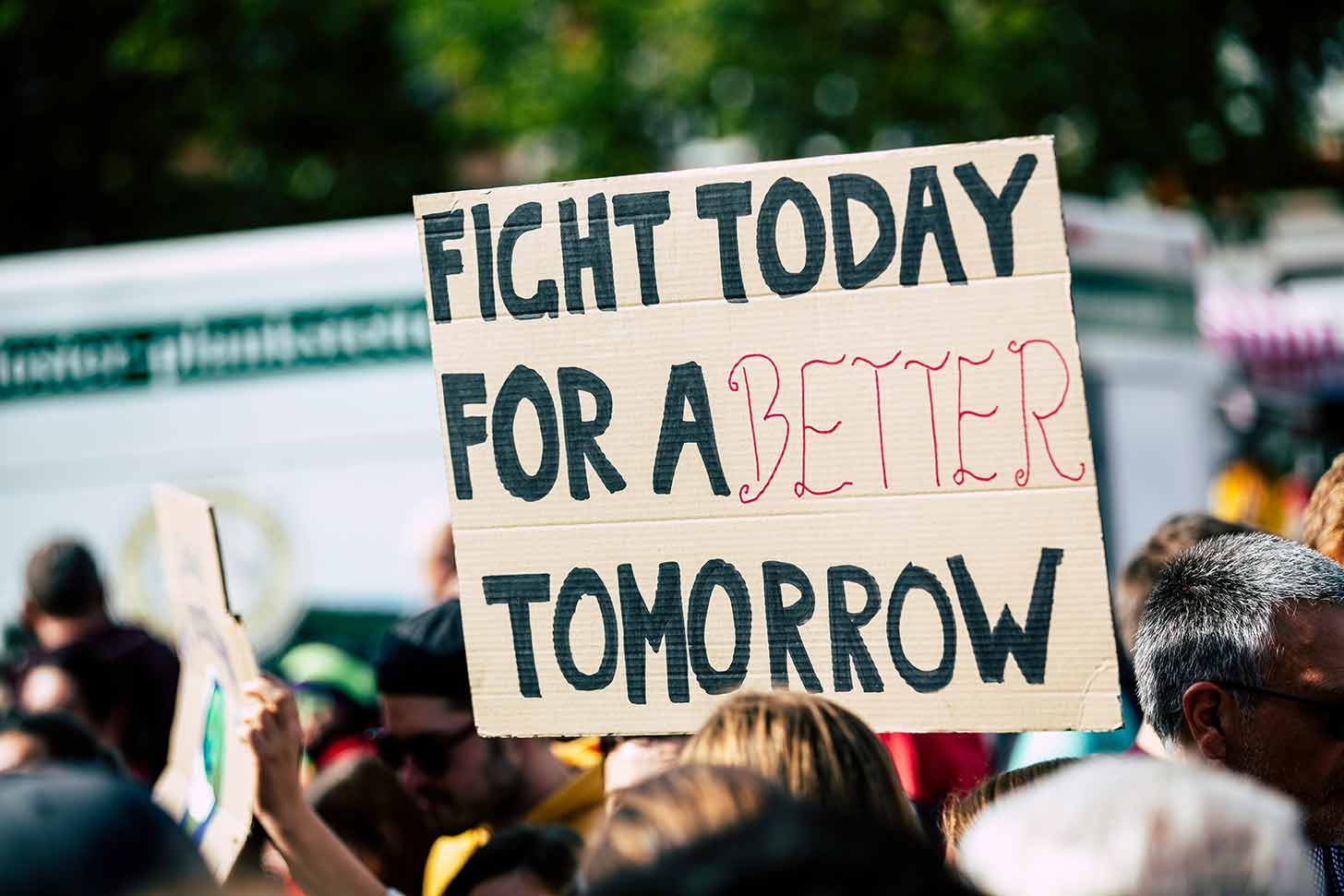
The Conversation

This story was originally published by The 19th and was republished with permission.

‍

Washington, D.C. — Among the protesters in the pro-Palestinian encampment at George Washington University cleared by the police early on Wednesday were students from nearby Gallaudet University, the only college in the United States to have all programs designed for those who are deaf and hard of hearing.

Some of them are founding members of Gallaudet’s Students for Justice in Palestine chapter, which is possibly the organization’s first chapter to conduct all meetings in American Sign Language.

Volunteers, including hearing Gallaudet students and community members, organized to create a more accessible space for Deaf protesters at the encampment. There were American Sign Language interpreters to help Deaf students fully engage in the protest and also communicate necessary information.

The encampment came together on April 25, occupied initially only by George Washington University students. Protesters from several other local campuses soon joined in, including the contingent from Gallaudet.

Student protesters across the country have erected encampments like the one at George Washington University to rally against U.S. support for Israel.

After Hamas led an attack that killed about 1,200 Israelis on October 7, Israeli Prime Minister Benjamin Netanyahu and his government responded by launching a military campaign in Gaza — an offensive going on seven months.

More than 34,000 Palestinians, disproportionately women and children, have been killed, according to local health officials. U.S. student protesters — some with the support of faculty and staff — have been demanding that their universities divest from companies with ties to Israel.

A person holding up a sign that says 'Fight today for a better tomorrow'
(Unsplash/Markus Spiske)

On Wednesday, May 8, in the early hours of the morning, Metropolitan police — some using pepper spray — pushed their way into the George Washington University encampment. In the end, 33 protesters were arrested, including one hearing Gallaudet student who was acting as a volunteer interpreter.

Tents are seen on the George Washington University campus on May 1, 2024. The encampment was cleared by Metropolitan police on May 8, 2024 and 33 protesters were arrested, including one hearing Gallaudet student who was acting as a volunteer interpreter.

Jules, a Gallaudet staff member who was there when the camp was cleared, said on Instagram that when the police came, coordinators were able to signal to her and other Deaf participants to move.

“I’m Deaf and can’t hear anything, but you can see the body language, you can see their anger,” she said of the police.

Earlier on Tuesday evening, Jules had taught a crowd of pro-Palestinian protesters how to sign “free Palestine.” Later, when the police came, she said she witnessed a woman in front of her being “pushed” and “sprayed in the face.”

“The juxtaposition of community joy and devastating violence on the same night was haunting,” she told The 19th in a written statement.

Bobbi-Angelica Morris is working toward a master’s degree in social work. In addition to their involvement with Students for Justice in Palestine, they are the president of Students Against Mass Incarceration at Gallaudet. They felt drawn to the protest and pro-Palestinian activism because of their intersecting identities.

“I’m a Black, DeafDisabled person. I’m nonbinary as well. And I’m also an abolitionist. I believe in a world without state violence. The system that we have now is based on and encourages state violence. And that’s exactly what Palestinians are experiencing right now,” Morris told The 19th last week.

They added: “This is not only about Palestine, this is about collective liberation. None of us are free until all of us are free.”

Morris was the only person interviewed who felt comfortable using their full name. Other students asked to be identified by their first names only because they were concerned about being doxxed or losing access to future employment. Fewer than 40 percent of deaf and hard of hearing Americans work full time, so the Gallaudet students felt particularly vulnerable. However, this fear did not stop them from showing up.

This story alternates using “Deaf,” with a capital “D,” when referring to Deaf culture and community, and the lower-cased “deaf” when talking about audiological status. The choices were based on context and also the identity and preference of the people interviewed.

All interviews in this piece were conducted through volunteer interpreters participating in the protest.

For Elizabeth, an undergraduate studying psychology, staying in the encampment, despite the risk, was about honoring her experience as a Deaf Arab-American.

“I am part Arab. My dad is Arab, from Syria. I know what Israel has done to Palestinians. I’ve been in community with Deaf Palestinians growing up. Deaf people have a duty to each other,” she said.

Morris and Elizabeth are some of the founding members of Gallaudet’s Students for Justice in Palestine chapter. The group was formed in March after Rabbi Yehoshua Soudakoff, Israel’s only Deaf rabbi, came to speak at Hillel, the Jewish organization on campus.

Pro-Palestinian students organized a protest in response, decrying the university’s approval of his visit at a time of inflamed tensions over Israel’s attacks in Gaza. On social media, Gallaudet’s Hillel described the event as “successful” and informative.

Students for Justice in Palestine is a chapter-based organization at campuses in the United States and other countries. While many Jewish organizations, including the Anti-Defamation League, consider Students for Justice in Palestine leadership and some chapters to be antisemitic, tactics and approach have varied from school to school.

A number of Gallaudet Students for Justice in Palestine members were staying at the George Washington University encampment full or part time. Together, they worked to navigate the challenges that came from sharing space with hearing leaders and organizers, most of whom did not know sign language.

Deaf participants were concerned that they may not receive messages or instructions from organizers or police that could help them keep safe.

‍

We made it our business

…to represent women and LGBTQ+ people during this critical election year. Make it yours. Support to our nonprofit newsroom during our Spring Member Drive, and your gift will help fund the next six months of our politics and policy reporting. Can we count on you?

Hearing participants and journalists had, occasionally, been disrespectful, even if unintentionally, the Gallaudet protesters said during interviews before the encampment’s disbandment. Morris recalled a photographer who “took amazing pictures,” they said.

“Then he did a presentation in spoken language. And his comments were like, ‘It doesn’t matter that you’re deaf, it doesn’t mean you can’t hear the cries of Palestinian children.’ He put it on social media and literally said, ‘Gallaudet speaks.’ There are little things like that, where people show ignorance.”

The idea that hearing and speaking are superior forms of communication, called “audism,” is offensive to many in the Deaf community.

“People lack Deaf cultural competency,” Morris continued.

Ave, an undergraduate studying data science, said that there were some structural and logistical issues as well. Many people at the encampment stood in front of the sign language interpreters, blocking them from view of Deaf students, and sometimes needed to be asked to move multiple times.

Volunteer organizers weren’t experienced in respectfully communicating and interacting with the Deaf people in the encampment.

“They don’t need to learn ASL. I mean, yes, they do. But at the same time, they should try to gesture or write with us, or sometimes they’ll just be speaking directly at us. I gesture I can’t hear and then they keep speaking at me anyway,” Elizabeth said.

American Sign Language is a different language from English, with different grammar and vocabulary.

“Some people don’t have very strong English comprehension, and so that literacy isn’t there. They need ASL interpretation. And so sometimes news [about the history of the conflict] is not accessible to them,” said Selena, a Gallaudet staff member who came out to support students at the encampment after work.

“[Gallaudet] has Palestinian students and staff, and they have family who have died,” Selena told The 19th. She added: “There’s no sign of sympathy, understanding or support from [Gallaudet’s leadership], or acknowledgement of the pain and trauma they’re going through.”

Gallaudet has not made a statement specifically on the conflict between Israel and Palestine. They did make a statement about the protest at the Hillel event, noting, “we acknowledge the significant devastation and loss of life that Gazan, Israeli, and Palestinian people are experiencing. So too do we acknowledge the suffering experienced by many other groups and individuals.” Most of the statement focused on campus safety, appropriate places to protest and dispelling social media rumors about the event.

Gallaudet protesters don’t feel this statement is sufficient and one of their specific asks is for an “official university statement condemning the 7 month long genocide of Palestinians in Gaza,” according to a post on their Instagram account. While the Israeli government has objected to the use of the term, many protesters globally have called the conflict in Gaza a genocide because of the number of civilians killed.

Access Palestine and the Olive Guardians were among the groups providing sign language interpretation services for Deaf protesters at the encampment. Ranem, who is Palestinian American and Deaf, founded the organizations to ensure deaf and hard of hearing people were informed about the ongoing Palestine-Israel conflict from a Palestinian perspective. Ranem is not affiliated with Gallaudet, but many of her volunteers are.

“I’ve learned so much from [protesters], and they’ve learned so much from us. It’s such a two-way street. And it sustains us to be able to continue to do more good work. That’s what the community ecosystem feels like. We keep feeding each other. I hope it’ll continue to grow in that way,” she said.

The beginner sign language classes Deaf students and volunteers like Ranem organized, to teach important signs like “help” and basic directions, have been postponed. In the event of a new encampment, those same Deaf students and volunteers hope to continue to protest.

“Despite their efforts to destroy us, our spirits will prevail. Our encampment may be destroyed, but we will rebuild and continue the fight,” Jules told The 19th.

Nearly two years ago, the United States Supreme Court overturned Roe v. Wade, in a controversial decision that gave states the ability to ban or limit access to abortion. 

While many southern and Midwestern state governments continue their crusade to ban reproductive care, the majority of Americans have actually grown more supportive of abortion rights.

According to new polling from the Pew Research Center, more than 60% of Americans now believe abortion should be legal in all or most cases. This is a 4% increase from 2021, the year before SCOTUS overturned Roe. 

A line graph from Pew Research Center shows that a majority of Americans (63%) say that abortion should be legal in all or most cases
Photo courtesy of Pew Research Center

The American majority has long supported legal abortion, especially in recent years, but this April, Pew set out to dive deeper into public sentiment on abortion. 

Pew’s team surveyed 8,709 adults for a week in April of this year. The survey was weighted to be representative of the U.S. adult population by gender, race, ethnicity, partisan affiliation, education, and more.

Although there is a widening gap in opinions between Democrats and Republicans, Pew said that since before Roe was overturned, both parties have seen a modest uptick in the share who say abortion should be legal.

According to the 2024 survey, Democrats and Democratic-leaning independents overwhelming shared that abortion should be legal in all or most cases — with 85% supporting its legality. 

A line graph showing the diverging opinions of democrats and republicans about abortion, which has widened over the past decade. As of 2024, 85% of Democrats say abortion should be legal in all or most cases. On the other hand, 41% of Republicans say the same.t
Photo courtesy of Pew Research Center

The poll’s insights found that Republicans and Republican leaners are far less likely to agree, with 41% saying abortion should be legal in all or most cases. However, two-thirds of moderate and liberal Republicans still say it should be. 

Findings between the two major political parties represent the greatest demographic divide. Support for abortion access transcends most other demographics; the data shows that most men, women, white people, Black people, Hispanic people, and Asian people believe abortion should be legal in all or most cases. 

While all of these groups are part of the majority that supports legal abortion, Black and Asian survey takers were documented as more supportive of legal abortion, with 73% and 76% respondents sharing their support, respectively.

A detailed graph shows that younger Americans are more likely than older adults to say bortion sho
Photo courtesy of Pew Research Center

Majorities of all age groups and education levels also agree that abortion should be legal in all or most cases, though the 18-to-29-year-old age range and highly educated survey takers were more likely than others to support abortion. 

Another insightful data point is that people in states with abortion bans have also become increasingly supportive of abortion access since June 2022, when SCOTUS overturned Roe.

In August 2019, 30% of people living in states where abortion is now outlawed said they believed it should be easier to access abortion.

In 2024, 42% of people in the same states say that.

With that in mind, 71% of those who live in states that prohibit abortion were three times as likely to say it would be difficult to obtain an abortion, which has risen 19% since 2019. 

A graph by Pew Research Center shows that Americans living in states with abortion bans or restrictions are more likely to say it should be easier than it currently is to obtain an abortion.
Photo courtesy of Pew Research Center

This reveals dissonance between the reality of abortion access and the sentiment of most Americans. Overall, a decreasing number of Americans say it should be harder to obtain an abortion: 33% said this in 2019, compared with 25% today.

Pew’s polling on public sentiment builds on bodies of research about the benefits of legal abortion, as well as the harms of abortion bans.

It can be inferred that limiting or banning access to abortion does not make people want abortions any less; nor does it actually reduce abortion, according to a 24-year-long study published in the Lancet.

And the revered Turnaway Study shows that there are little long-term harms seen in women who receive abortions, but rather a significant increase in mental health harm in women who were denied abortions.

“Our research shows it’s completely clear that people know how to judge their own circumstances and make decisions that are right for themselves,” Diana Greene Foster, Ph.D. and author of the Turnaway Study, said.

“They’re not thinking of the politics. They’re not thinking of the law. They’re just trying to make a good decision for themselves and their kids and their family and their future.”

‍

Header image by Charly Louise/Pexels

Billie Eilish debuted her new album “Hit Me Hard And Soft” last night — alongside an unexpected collaboration with the LA Metro.

To celebrate the release of the new album, Eilish is hosting listening events in cities like New York City and Los Angeles, including live performances, as well as gatherings in venues where fans can experience the record for the first time.

A poster for Billie Eilish's "Hit Me Hard and Soft" listening party at the Kia Forum. The singer floats in a dark blue body of water.
Photo courtesy of Billie Eilish/Kia Forum

While her debut performance for the album was held in Brooklyn on Wednesday, thousands of fans flocked to another performance at the Kia Forum in Los Angeles Thursday night, where she encouraged fans to take public transportation or carpool to help reduce greenhouse gas pollution.

To incentivize this, Eilish partnered with LA Metro to make May 16 a “Fee Free Day,” so fans could ride without costs anywhere in the LA area. 

“Billie, a longtime climate activist, has partnered with Metro to provide additional shuttle service just for this event and is personally encouraging her fans to take transit,” an Instagram post from LA Metro shared.

A map of the LA Metro bus and rail system
Photo courtesy of LA Metro

While the Metro offered a number of helpful shuttle buses around the Inglewood area (where the venue is located), fans could take any number of routes from areas like the San Fernando and San Gabriel Valleys, or even San Pedro — all without spending a cent.

“If you’re new to our system or region, please keep in mind that our service area is huge,” a statement from LA Metro said. “Riding to the distant stations from Kia Forum can take 2+ hours. Plan ahead!”

LA Metro planned ahead, too, giving its buses a special makeover for Eilish’s big day. The shuttles that serviced the Inglewood area were adorned with Eilish song titles like “What Was I Made For?” and “Your Power.”

“Each message that appears on the bus headsigns is individually programmed and tested for the various displays on the different bus vehicle models,” LA Metro explained on Instagram.

These sustainable transportation efforts also come on the heels of Eilish’s announcement of eco-friendly vinyls for the new album. Although the singer is still releasing eight variants of the vinyl, they will all be produced more sustainably than traditional methods.

According to Eilish’s website, the standard black vinyl variant is made from 100% recycled black vinyl. The seven other colored variants will be made from ECO-MIX — a 100% recycled compound made of leftovers — or BioVinyl — which is a vinyl that uses non-fossil fuel materials and helps reduce carbon emissions by 90%.

Any packaging materials are made from FSC-certified recycled paper, with plant- and water-based inks.

A product image of Billie Eilish's blue vinyl record for "Hit Me Hard and Soft."
Photo courtesy of Billie Eilish/Interscope Records

Eilish spoke up about the ultra-consumption of vinyl collectors and musicians who release wasteful vinyl variants earlier this year in an interview with her mom, Maggie Baird, for Billboard.

“My parents have always kept me well informed and hyper aware that every choice we make and every action we take has an impact somewhere or on someone, good or bad, and that has always stuck with me,” she said. 

“I can't just ignore what I know and go about my business and career and not do something. That's just not how I was raised, or how I want to live my life.”

Her live events — whether bolstered by free public transit, or run on clean energy — are where this action shines.

In 2022, Elish ensured that there was plant-based food in every arena on her “Happier Than Ever” tour. She then went on to help fund and produce two back-to-back climate summits in London called Overheated. And, in 2023, she ensured that her headlining Lollapalooza set was solar-powered.

“Recognizing sustainable design as an imperfect journey of efforts, Billie is using a range of solutions as she works with her team towards constant improvement,” her website reads.

Billie Eilish smiles while holding up a blue vinyl record. She wears her dark hair down and straight, has on a khaki button-up short sleeve shirt, and blue jeans.
Photo courtesy of Billie Eilish/Interscope Records

Many of these solutions are created in collaboration with nonprofit REVERB, which partners with musicians, festivals, and venues to make concerts more sustainable. Eilish and REVERB are also behind the Music Decarbonization Project, which funds shifts towards clean energy and greenhouse gas reductions in the music industry. 

“I think that the artist’s role is to champion [something] and say that’s what they want, what they believe in, and [that they] want to make it happen,” Baird told Billboard, pointing to the sustainability projects her daughter promotes.

“It’s the power that they have to say, ‘This is important to me, and it has to be a priority.’”

‍

Header images courtesy of Billie Eilish/Interscope Records and LA Metro

Millions of people around the world spend 20 hours a week bent over a bucket of water, handwashing their laundry. 

Divya used to be among them. She’s the woman who inspired the creation of a new, hand-crankable washing machine that works without electricity.  

The story traces back to 2019, when Navjot Sawhney moved from London to South India to make stoves with Engineers Without Borders. 

While living there, he befriended a new neighbor: Divya. Sawhney was blown away by how much time she spent washing and wringing out clothes each week. 

To help, he built Divya a manual washing machine, a prototype that he would later perfect and mass produce through a grassroots movement called The Washing Machine Project, which Sawhney still serves as CEO. 

Every machine that is delivered to a family in need is named Divya, in honor of his neighbor. 

a silver, metal grill-sized washing machine with a crank, a handle, and the label "The Washing Machine Project" on it's front exterior.
A close-up of a Divya washer. Image via The Washing Machine Project.

“The Washing Machine Project has now distributed Divya washing machines to families and communities in India, Iraq, Lebanon, United States, Mexico and Uganda — impacting almost 30,000 people,” reads a mission statement on the organization’s website.  

“Implementation is tailored to meet the partnering regions' specific cultural, economic, and environmental conditions, ensuring the solution is effective and relevant in local contexts.”

Through disaster, displacement, and economic hardship, many households live without electricity and power. 

An estimated 60% of the global population relies on hand washing, and 70% of those households place the burden of water collection and household chores on women and young girls. 

Handwashing steals away precious time that could be spent working, learning in a classroom, tending to family members, or simply taking care of themselves. 

The Divya washers, which require a few minutes of hand cranking for a thirty minute cycle, cut that time down by 76%. 

“When I put clothes into the machine and wash them, it means I can multitask,” said Kyifuko Ramla, a Divya user living in Uganda. “I can leave the clothes in the machine and prepare a meal for my son, or fix him something to drink, and come back to it afterward.” 

Ramla also mentioned the physical relief of using her Divya washer, which eliminates back-bending aches and tired, cracked hands. 

“I no longer bend while washing,” she told The Washing Machine Project. “I don’t strain my body.” 

Not only does the Divya washer save time and physical energy, it also cuts water usage in half — sometimes more — which is vital for families who live in regions where clean water is scarce. 

“With this we can wash our clothes much easier, even if we don’t get ample amount of water. We can wash our clothes in this with minimal water consumption,” said Anjali, who lives in Kuilapalayam, India.

“Maximum, we need 10 buckets of water to wash 10 clothes in hand,” she continued, patting the drum of the washer. “In this washing machine two buckets of water will be more than enough.” 

A woman (Anjali, who is quoted in this article) sits beside her own Divya washer.
Anjali sits beside her Divya washer. Image via The Washing Machine Project.

Recently, The Washing Machine Project partnered with the Whirlpool Foundation, an organization that has been working to provide communities with sustainable washing solutions since 1952. 

The joint organizations have a new goal: impact 150,000 people over the next 5 years.

“We’ve learned together, worked together, listened together, washed together,” the companies said in a joint statement. “Together, we’re engineering solutions to reclaim time and change lives.”

‍

Header image courtesy of The Washing Machine Project

Every day the Good Good Good team collects the best good news in the world and shares it with our community. Here are the highlights for this week!

If you want to get good news in your inbox every day, join the Goodnewsletter — the free daily newsletter designed to leave you feeling hopeful.

‍

The Best Positive News We’re Celebrating This Week —

The European Union just passed “groundbreaking” first-ever legislation to combat violence against women

In a “groundbreaking moment” for women’s rights, the EU’s first law to combat violence against women was just officially adopted by member states. The states now each have three years to add them to national law.

The legislation will help protect women in the EU from gender-based violence, female genital mutilation, forced marriages, and online harassment. Victims of domestic abuse will also be more easily able to report crimes.

While some hoped the law would go further — it notably did not include an agreed-upon definition for rape — they acknowledged it was still “a good starting point.”

→ ​​Read more

​
More good news for women:

‍

A comedian’s calls to action have inspired Lizzo, John and Hank Green, and others to donate in support of Gaza relief

In a recent TikTok video, Lizzo shared about a GoFundMe page for Doctor Ismail, who lives in Gaza and has been helping folks there — and now needs help getting his family safely out.

Lizzo said that she donated — a listing showed an £8,000 (or a little over $10,000) donation on the GoFundMe page — and pled for “fellow rich people with money” to do so, too.

Doctor Ismail’s fundraiser is one of hundreds of campaigns amplified by Operation Olive Branch, a digital volunteer effort organizing and supporting fundraising campaigns that help displaced Palestinians.

Lizzo’s video comes amid an ongoing project on TikTok which aims to get content creators involved in these grassroots fundraising efforts.

Led by comedian Erin Hattamer, the “Pass The Hat” movement matches creators with Palestinian families through Operation Olive Branch, encouraging them to donate or spread the word about people in need.

The fundraiser Lizzo shared has also been supported and shared by popular authors and creators Hank and John Green, who pledged to double their efforts by matching every dollar donated to Ismail’s campaign with donations to Save the Children.

→ Read more

‍

Queensland, Australia was just declared drought-free for the first time in over a decade

For the first time in 11 years, all of Queensland, Australia has officially been declared drought-free, with the last two shires’ drought status revoked.

Recent increases in rainfall and flooding have filled the region’s waterways with more water than usual, and while farmers are apprehensive about a looming dry season — they’re celebrating the (literal) change of scenery.

The land has truly transformed from dry and desolate to bright green grass peppered with wildflowers, shrubs, and weeds next to waterways, creeks, and rivers filled to the brim.

→ Read more​

​
More good news like this:

‍

Global maternal deaths have halved in the last 35 years

In the last 35 years, the estimated annual number of women who died from pregnancy-related causes has been halved. In 1985, there were an estimated 595,000 maternal deaths around the world — ​​in 2020, that number was 301,000.

The world has, and continues to make incredible progress in reducing maternal mortality globally thanks to improvements in maternal health care, safer deliveries, good nutrition, and hygiene and sanitation.

While it’s important that we celebrate and mark this incredible progress — it’s equally important to acknowledge that we could be doing a lot better.

In 2015, the EU had the lowest maternal mortality, with 8 people dying per 100,000 births — if all countries shared this level, only 11,000 people would die annually.

Still, it’s so significantly better from where we’ve been — if conditions were the same as in 1800, around 1.26 million people would die from pregnancy every year.

→ Read more

‍

The biggest changes in over a decade, new electric grid rules could help even further boost wind and solar energy

The U.S. still has an incredibly dated electricity network, and very few high-voltage power lines are currently being installed. This poses major risks for more blackouts during extreme weather and makes the clean energy transition more challenging.

And it happens because grid operators make repairs and upgrades as needed, rather than proactively addressing long-term needs to prepare for the future.

But new rules were just approved by regulators that require operators to look 20 years ahead, accounting for changes in the energy mix, risks of extreme weather, growing wind and solar power, and more.

Why is this good news? Aside from shifting from short-term to long-term thinking in building infrastructure, these changes are desperately needed.

Right now, there are more than 11,000 approved wind, solar, and battery projects (not to mention a whole bunch of existing buildings to be added to the grid) — but there isn’t enough grid capacity for them. And we need them to meet national and global climate goals.

→ Read more

‍

For the first time in five years, overdose deaths dropped in the U.S. in 2023

In 2023, there were an estimated 107,543 drug overdoses, which was down 3% from 2022 with 111,029. While the figures are preliminary, the decline in deaths is expected to hold true. Opioid deaths, particularly fentanyl, fell by 3.7 percent.

And while no specific reasons were given for the drop, one that experts point to is the wider availability of naloxone, a drug that reverses opioid overdoses. There were 22 million doses of Narcan, a naloxone nasal spray, distributed in the U.S. and Canada in 2023.

Additionally, fentanyl test strips grew in popularity, and communities started programs to hand out sterile syringes.

What’s the nuance? Experts are cautiously optimistic about these figures because while there was an encouraging decline in the number of opioid overdoses, there was an increase in overdose deaths from cocaine and meth. Plus, even one overdose death is too many.

Still, this important progress is worth celebrating — ​​and it should fuel our continued work to prevent even more overdose deaths (like this!) and see this decline become an ongoing trend.

→ ​​Read more

‍

A new study found that a single bison herd can help store the CO2 equivalent of 40k cars

The world’s soil, oceans, and forests are the biggest known carbon sinks, and scientists have long acknowledged the role that they play in slowing the effects of climate change.

But a new study shows how instrumental animals could be in tamping down on carbon emissions, too.

The study, backed by the Global Rewilding Alliance, calculated that a herd of 170 European bison — roaming on 30 square miles of grasslands — captured the yearly equivalent of carbon dioxide emissions from 54,000 US cars.

→ Read more

​
​
More good news about carbon sinks:

‍​

A significant milestone in the clean energy transition, the U.S. just surpassed 5 million solar panel installations

According to new data, the U.S. has officially surpassed 5 million solar installations across the country — 4 million of them were installed in the last eight years.

Prior to that, it took four decades for the U.S. to cross the 1 million installation mark in 2016, with the first grid-connected solar project installed in 1973.

More than half of all solar installations in the country have come online since the start of 2020. Even more significantly, one-quarter of them have been installed in the last 20 months since the Inflation Reduction Act (the largest federal climate policy in U.S. history the country has ever seen) became law.

The data accounts for home, business, and utility-scale solar installations, with homes making up 97% of the total installed.

And this good progress is showing no signs of slowing down: the number of installations is projected to double to 10 million by 2030, and triple to 15 million by 2034.

→ Read more

‍

More good news of the week —

​A growing movement of solar cooperatives is helping lower-income households access renewable energy. While prices are declining, rooftop solar still remains out of reach for those who struggle to afford the high up-front costs.

​The first all-electric, zero-emission hospital in the U.S. is now under construction in California. Since hospitals run 24/7, their operations are traditionally very carbon-intensive, but at UCI Health’s new facility, electric boilers and chillers are doing the work.

​A UK company is using AI to help people with physically demanding jobs stay in them for longer. AI already helps workers in other professions like doctors, farmers, software developers, and more.

​Ms. Rachel is making Cameos for “little ones” to raise money for children in Gaza, Congo, Ukraine, and more. The popular children’s educator announced her “to children, for children” campaign to support Save the Children’s work with children living amidst conflict around the world.

[Good update: The Cameos sold out within hours, raising $50,000!]

​Libraries across U.S. are installing “cubicles” for parents who need to study but can't find childcare. Public libraries are introducing desks with built-in play areas for young children, aiming to provide a supportive environment for parents who need to study.

​In a groundbreaking 16-minute surgery, a British toddler just had their hearing restored. Opal Sandy was the first person in the world to take part in a pioneering gene therapy trial, in a development that doctors say marks a new era in treating deafness.

​New wind turbine “tricks” are helping protect threatened bird species from collisions. Wind energy is essential in the clean energy transition, but it poses a legitimate risk for migratory birds especially — but researchers and engineers have created solutions.

​A major battery plant near Los Angeles will be among the largest in the world when it comes online later this year. The storage facility will help protect California’s power grid during the peak summer season and help the state meet its ambitious climate goals.

​A Belgian town takes a centuries-old approach to psychiatric care, hosting folks with mental health illnesses in family homes. Altruistic psychiatric care treats those with mental illness not as patients with a diagnosis to be institutionalized, but as individuals deserving of dignity and inclusion.

New York just became the first state to mandate paid time off for people receiving prenatal care. The new law goes into effect in 2025, giving employees 20 hours of paid prenatal care leave without cutting into their existing 12 weeks of paid family leave.

Thanks to a 2022 reform, unhoused people in Ireland will be able to vote in the upcoming election for the first time. The country is setting a new voting access standard in Europe, where the general rule applies: “no address, no vote.”

After developers offered a Texas family millions for their land, they made it a public park instead. The 1,500-acre RGK Ranch will become a park where hikers can take in Hill Country vistas and explore a tributary of Bee Creek that spills over a series of limestone ledges.

​Illinois just gave $1.6 million to “justice-focused” community solar projects. The funding will benefit three projects in traditionally under-resourced Black, Brown, and Indigenous communities in the greater Chicago area.

​Thanks to heavy rains, Los Angeles captured more than 96 billion gallons of stormwater from October to April. The amount of stormwater captured is enough to meet the water demands of about 2.4 million people, or one-quarter of the county.

​One in three Americans say they’ve reduced how much plastic they’re using. Women, people in households making more than $50,000 annually, and college graduates were more likely to report a decrease in how often they used single-use plastics.