When entire neighborhoods in Palisades, California, burned down in early 2025, artist Ruth Askren felt survivor’s guilt. She had grown up in the Palisades, but her childhood home had emerged unscathed in the wildfires that claimed over 6,000 structures.
That’s when the 72-year-old artist began volunteering with Homes in Memoriam, a collective of artists who paint free home portraits for families displaced by the wildfires.
“For me, it was a matter of feeling really compelled to do something,” Askren told the LA Times. “And this is what I do. I mean, this is it: I’m a painter. This is what I can do to help people cope with their loss in the smallest of ways.”
After being paired with a family, Askren works from a composite of old photographs to recreate their lost home, being sure to add the personal touches, like the way tree branches cast shadows on a façade, or the glow that emits from an upstairs window.
“Painting this special house gave me a sense of how it was like a living thing,” Askren said of one home, a yellow house with a sloping roof, that was gifted to the Vaziri Family.
“I guess that’s a projection, but its personality came through,” she wrote in an Instagram post. “It felt like an entity that could morph according to the needs of its dwellers.”
The project has been emotional for the families who receive them, but Askren said that the process has been therapeutic for her, too.
“The Homes in Memoriam project has helped me process the losses,” Askren said. “These homes and others will live on in the paintings created by loving hands, sharing the joy and the grief.”
A version of this article originally appeared in the 2026 Home Edition of the Goodnewspaper.
Header image via RDNE Stock project
Between 2022 and 2023, the American Time Use Survey found that time spent at home increased by 10%, a trend that started before the COVID-19 pandemic and continues today.
“It’s a dramatic shift in our daily lives,” Patrick Sharkey, a professor of sociology and public affairs at Princeton and the author of the study, told The New York Times. “Almost every part of our lives is more likely to take place at home.”
As people spend more time at home — and work from home in increasing numbers — they’re also looking for ways to make that environment more comfortable.
Here are 10 science-backed ways to feel more at home in your space:
- Safety first: When your brain detects potential threats, it stays in a low-level state of alert. Take care of any chores you’ve been putting off, especially anything that could put you in harm’s way, like dead lightbulbs, jammed locks, and beeping smoke detectors.
- Eliminate clutter: Your brain interprets order as predictability, which lowers stress. Remove items that are broken or unused — as well as anything that doesn’t “spark joy.” Aim for clear surfaces and open pathways rather than perfection.
- Give everything a home: Decision fatigue drains mental energy. Assign a specific, consistent place for everyday items like keys, shoes, bags, paperwork, and chargers so you’re not constantly searching or making decisions.
- Reduce noise and sensory overload: Excess noise keeps the nervous system activated, even if you’re not consciously aware of it. Add soft materials that absorb sound, such as rugs, curtains, fabric furniture, and wall hangings.
- Make room for connection: Knowing your home can welcome others increases a sense of emotional security. Create at least one space in your house where you can easily host guests, even if it’s small, like a couple of chairs, a cleared table, or a couch that invites people to sit and stay.
- Use soft, balanced colors: Calming colors (like greens and blues) reduce cognitive load and help steady emotional regulation. Avoid high-contrast colors and choose neutral or muted tones for large surfaces (walls, bedding, rugs).
- Improve room flow: When movement feels effortless, your brain experiences less stress throughout the day. Keep frequently used items in easy-to-reach places and arrange furniture so you can move freely around your house.
- Bring nature indoors: Our brains are evolutionarily wired to respond positively to nature, even in small doses. Invest in one or two real plants and open blinds and curtains daily to let natural sunlight in.
- Prioritize good sleep: Sleep is foundational to emotional regulation, memory, and immune health. Invest in the basics of rest: a comfortable bed, clean bedding, dim lighting at night, and a sleep area free from work, clutter, and unnecessary noise.
- Add a personal touch: Seeing yourself reflected in your space increases grounding, self-esteem, and the feeling that you truly belong there. Put your favorite objects on display and surround yourself with reminders of your favorite people, memories, and mementos.
Header image via Kaboom
In 1943, psychologist Abraham Maslow released a paper titled “A Theory of Human Motivation.”
In it, he detailed a set of five basic needs that, when met, allow people to function at their highest level: physical survival, physical safety, love and belonging, self-esteem, and self-actualization.
In the decades since, Maslow’s hierarchy of needs has served as a powerful tool in healthcare, counseling, and social work. It maintains that once people are given food, water, clothing, and shelter, there’s still quite a lot of work to do in making sure that they feel safe, loved, and respected, too.
“There's a correlation between the amount of support somebody gets and their ability to stay housed,” said Baron King of the CHATT Foundation, a social services organization in Chattanooga, Tennessee.
In his podcast, Give Me Shelter, King used Maslow’s hierarchy of needs to debunk common myths surrounding homelessness.
“The second level is safety,” he said. “The need for security, stability, and freedom from threats. That includes bodily safety, financial security, and a stable home environment.”
“The third level, moving up the diagram, is love and belonging. We are social beings. We need connection. We need community. Without that, we suffer.”
Across the country, nonprofits are aiming to meet the first three levels of that pyramid, which centers not just on the idea of housing, but housing with dignity.
Since 2015, Georgie Smith and her wife Melissa Goddard have been helping former foster youth find housing — and fully furnish each home.
“A roof over their head is not enough,” Smith told the Imprint.
Their nonprofit, A Sense of Home, started its work over a decade ago, when Smith and Goddard were volunteering with foster youth in Los Angeles and befriended a young man named Barry. After he qualified for an apartment with a Section 8 housing voucher, Barry asked the couple if they could help him move the few belongings he had.
“I saw him living on the floor,” Smith said, noting that Barry didn’t have a bed, fridge, or stove. “I was just like, ‘No, this can’t be.’”
That’s when Smith and Goddard turned to social media, asking for local donations in the form of bedroom furniture, chairs, tables, kitchen supplies, and even art. Overnight, Barry’s apartment transformed into an actual home. His friends from foster care were impressed.
“All of his friends that were coming out of transitional facilities, aging out, reached out to me for help, thinking that this was a service that existed, and it didn’t,” Smith said.
So, she and her wife created one. Since then, A Sense of Home has created 1,500 homes for youth formerly in foster care — many of whom were on the verge of homelessness.
One such person is Regina Brodell, a doctoral student at the University of Southern California. Growing up, her father was frequently hospitalized for cancer treatments, and she and her siblings were often separated from each other.
“When you’re in the system like I was, I got so good at knowing, like, this is not a home, this is not a welcoming space,’’ Brodell said. “You just learn to survive in it, but your compass gets really calibrated to know that’s not home.”
In 2023, A Sense of Home helped Brodell move into an apartment that was designed just for her.
“It’s the first time I’ve ever said, ‘OK, Regina, you can breathe,’” she said. “You can let your soul catch up with itself in this space. And this is where you can be creative and you can heal.”
Another nonprofit providing healing spaces to people in need is Benevolence Farm. In November, they opened North Carolina's first tiny home community for formerly incarcerated women.
“These tiny homes will provide a strong foundation for formerly incarcerated women to begin their reentry journeys, to get back on their feet and to get the resources they need for success,” Anna Harris Stein, a public health official and the First Lady of North Carolina, said at the groundbreaking ceremony.
Many of the people who work for the nonprofit are formerly incarcerated themselves, helping ensure each home was built with trauma-informed design in mind.
“We said no loft with beds, because it reminded us of bunks and jails and prisons,” Mona Evans, the nonprofit’s community advocacy director, told WUNC. “We didn't want to climb up ladders.”
Each home comes outfitted with a full bedroom, bathroom, kitchen, washer, dryer, and living area.
“These individual spaces mean we no longer will be sharing showers with 23 other women,” said Linda Cayton, another formerly incarcerated woman who now works as a peer support professional. “And we don't have to worry about guards walking by and looking at us while we're sitting on our toilets.”
Further north, in Baltimore, Maryland, Godfrey Molen checks in on staff at the ReBorn Store warehouse. Through his nonprofit, Friendly Loving Opportunities, Molen runs a Furniture Assistance Program that delivers free furniture to people in need.
“Furniture is very expensive,” Molen told WBAL 11 News. “When people are thinking about buying furniture, they are only thinking about buying in pieces. We come in and furnish the entire home. So, a lot of times, families are very emotional about it because what they think could take a lifetime or years to be able to accomplish, they were able to do it in a day.”
The program succeeds thanks to dedicated staff members like Brandon Richardson, who works as the warehouse manager.
“It's just a blessing to help people out, and also to help me out,” Richardson said. “And I stay on the straight line, not doing the wrong thing and stuff like that.”
Like many of his coworkers, Richardson struggled to find work before Friendly Loving Opportunities took him on.
“We recruit and provide job opportunities for guys in shelters, recovery and formerly incarcerated individuals in the community,” said Molen. “We teach them how to fix furniture and preserve furniture and repair it, and in return, these individuals give back the furniture to those in need in the community.”
Every day, Molen fields referrals from social workers and case managers who reach out on behalf of families in need — sometimes as many as 100 applications a day. Although it can be overwhelming, he said his nonprofit always rises to the challenge.
“It makes somebody feel comfortable, provides dignity and hope for that person,” Molen said, of making houses into homes. “And it feels like they can accomplish anything they want to do.”
A version of this article originally appeared in the 2026 Home Edition of the Goodnewspaper.
Header image via Alexander F Ungerer
From the emerald waters of the Great Barrier Reef to the vast stretches of the arid outback, Australia hosts over 1,700 threatened species, including koalas, wombats, numbats, tinker frogs, pygmy possums, and many more.
The Wentworth Group of Concerned Scientists has been fighting to stop deforestation, reverse the effects of climate change, and prevent endangered species from dwindling to extinction — a task that seems insurmountable.
However, in July, the group of 60 scientists published a 24-step action plan for what it would take to save the country’s threatened wildlife — and they even put a dollar amount to it: $7.3 billion annually for the next 30 years.
That’s less than two-thirds of the annual funds the federal government funnels toward fossil fuel subsidies.
“The cost is less than 0.3% of our GDP. Given that nearly half of our GDP depends on nature, that’s a pretty sound investment,” Martine Maron, an environmental science professor at The University of Queensland, told the National Press Club.
The plan, “Blueprint to Repair Australian Landscapes,” has been a labor of love for The Wentworth Group of Concerned Scientists for the past six years.
Their plan anticipates that, if followed, the country could repair degraded landscapes, fix fragmented river systems, and “avoid most extinctions and recover almost all threatened species.”
“The key finding of our blueprint is that Australians don’t have to choose,” said Jamie Pittock, a professor of geography at the Australian National University. “We can afford to have both a healthy environment and a productive economy.”
A version of this article originally appeared in the 2025 Animals Edition of the Goodnewspaper.
Header image via Rawpixel (CC0 1.0)
Every day the Good Good Good team collects the best good news in the world and shares it with our community. Here are the highlights for this week!
If you want to get good news in your inbox every day, join the Goodnewsletter — the free daily newsletter designed to leave you feeling hopeful.
The Best Positive News We’re Celebrating This Week —
Thanks to an ambitious ‘refaunation’ project, Brazil’s blue-and-yellow macaws return to Rio after 200 years
Last spotted by Austrian naturalist Johann Natterer in Rio de Janeiro in 1818, experts say after that, blue-and-yellow macaws were almost certainly wiped out by deforestation, along with other species that once roamed forests around the city.
Now, biologists are bringing the macaws, and the forests they inhabit, back to life as part of an ambitious “refaunacation” project from a group called Refauna to restore the rainforest.
So far, four macaws have been dslowly reintroduced, with another six on the way, and longer-term plans to release 50 of them.
Why is this good news? While locals are delighted to see the iconic birds return to the city, the project is more focused on saving the forest and entire ecosystem, “rebuilding ecological relationships and ensuring that these species can once again perform their ecological roles.”
These 5 citizen science projects have actually made a real difference for the environment
→ Read more
The global suicide rate has fallen by 40% since the 1990s
The global suicide rate has fallen significantly over the last three decades. According to new data from the Institute for Health Metrics and Evaluation and Global Burden of Disease, the rates have fallen from 15 to 9 deaths per 100,000 people since the 1990s.
The rates differ widely from country to country, with experts citing bans on highly toxic pesticides as an effective way to reduce a common method of suicide in many low-to middle-income countries.
Sri Lanka has seen the most improvement. In the early 2000s, the South Asian island country had the second-highest suicide rate in the world after Greenland. After banning the most toxic pesticides, the number of Sri Lankans dying from suicide has more than halved, saving thousands of lives every year.
→ Read more
An outdoorsman launched a website to preserve national park history being erased by the Trump administration
For the past year, the Trump administration has removed or altered hundreds of signs and exhibits from national parks across the U.S. that covered topics like climate change, pollution, slavery, and Indigenous history.
Last month, a whistleblower posted a list of all of the signs, exhibits, and more the Trump administration had planned to alter or remove at national parks across the country.
Public lands advocate Mike Beebe said the while the documentation was helpful, it was difficult to sift through — so he created an interactive, searchable website called MissingParkHistory.com to preserve and document every piece of media set to be removed.
Why is this good news? People deserve to have accurate historical information, not history that’s been sanitized or cherry-picked to fit a particular narrative. We deserve to know about how climate change has impacted Glacier National Park, about air pollution in Bryce Canyon, and about slavery and civil rights, LGBTQ history, and internment camps — all histories our national parks and monuments help preserve.
Some polar bears are showing unprecedented resilience to climate change. Scientists think this is why
→ Read more
Britain broke its solar energy generation record two days in a row
Solar farms in England, Wales, and Scotland generated 14.1 gigawatts of electricity at lunchtime on Monday, surpassing the previous record of 14 GW in July last year. One day later, that record was broken again, with 14.4 GW generated on Tuesday.
The back-to-back record-setting days happened as the government also approved plans for the U.K.’s largest solar farm to “bring stability and lower bills in an uncertain world” by increasing homegrown low-carbon energy.
Once complete, the newly approved project is expected to power the equivalent of 180,000 homes a year when generating at its maximum capacity.
A YouTuber and former NASA engineer invested $60M on STEM curriculum — it’s completely free for teachers
A NASA engineer turned YouTube sensation with over 75 million subscribers, Mark Rober makes creative, silly science experiments for an audience of primarily young viewers. It’s part of his mission to “get kids stoked about science.”
While he dreams of being a middle school science teacher himself, in the meantime, Rober just invested $60 million on a STEM curriculum to make it easier for teachers to implement fun, engaging lessons in STEM, without spending their own money on materials.
He just announced the final product at TED2026: Class CrunchLabs, an online STEM curriculum program tailored to grades 3 through 8 that “exceeds” state science standards — and it’s completely free for teachers.
Why is this good news? As Rober said in his TED Talk, “The reason we’re doing this is because it breaks my heart when I see teachers who get paid salaries that as a society we should be ashamed of, spending their own money on resources that totally suck.”
→ Read more
In her first TED Talk, Malala shares 3 steps to keep fighting when hope feels lost
→ Read more (and watch her talk!)
A South African politician went snorkeling in a pothole to highlight her city’s infrastructure issues
Johannesburg mayoral candidate Helen Zille is a 75-year-old politician. And on March 28, she donned a wetsuit and snorkeling gear and leapt into a massive water-filled trench in the middle of a suburb.
The water has been collecting for three years due to a burst water pipe that remains broken, despite the city’s repeated attempts to fix it. It is a symptom of Johannesburg’s larger infrastructure issues, from recent electricity cuts to damaged roads.
Zille was in good spirits as she swam in the pothole to bring attention to the mismanaged policies, saying, “Here we are with a free and wonderful Saturday-afternoon snorkel.”
→ Read more
In a first-of-its-kind effort, Hawaii is turning ocean plastic into roads to reduce pollution
Researchers in Hawaii are covering roads with asphalt mixed with plastic waste and old fishing nets, using marine debris for the first time ever in a plastic paving initiative.
Hawaii has a unique exposure to plastic pollution, a combination of discarded fishing gear, tourist waste, and the Great Pacific Garbage Patch, which engulfs the islands every few years.
About 90 metric tons of plastic trash have been removed from the waters and beaches around Hawaii, and more than a metric ton of fishing nets alone have already been paved into the state’s roads.
What’s the nuance? Researchers shared the public’s concerns about wear and tear on the roads leading to microplastics leaching into the environment. Early test results show that there wasn’t significant microplastic release compared to roads with no plastic mixed in, but this is still an important consideration to monitor.
This state ‘hurricane-prepped’ the roofs of 53,000 homes. Here’s how they held up during an actual hurricane
→ Read more
Teen birth rates hit a historic low in 2025, continuing decades of decline
According to new data from the Centers for Disease Control and Prevention, the birth rate for teens aged 15 to 19 in 2025 dropped 7% from the previous year, continuing a decline that has been underway for decades.
The current rate is about 11.7 births per 1,000 teens, which is five times lower than the same metric in the early 1990s.
Experts attribute the decline to several factors, including broader access to contraception, expanded sex education programs, and larger shifts in social behavior as young women delay relationships to pursue work and academic opportunities.
Forbes announced a new ‘True Net Wealth’ ranking that incorporates how much billionaires give away
Billionaires “all have one thing in common,” Forbes Editor-in-Chief Randall Lane said from the TED2026 stage, “Nobody likes them.” One reason for that, he said, is how little of their wealth they use to make the world a better place.
So, Forbes announced its new “True Net Wealth” list that takes into account money given away by billionaires: “True Net Worth is your regular net worth, combined with the money you’ve donated, that we appreciate like you still own it,” Lane explained.
He showed how the top-five ranking changes when you look at net wealth, and True Net Wealth, which adds Bill Gates and Warren Buffett in the number one and two slots. He also highlighted the list’s “biggest movers,” which includes billionaire philanthropist MacKenzie Scott.
Why is this good news? Lane said the list’s purpose is “to offer role models for billionaires, for millionaires — for thousandaires. Give while you live … [it] supports the system that makes all of us prosperous.”
→ Read more
This 13-year-old serves home-cooked meals to the homeless. He now has nearly half a million followers
→ Read more
Used electric vehicles are cheaper and more available than ever
Used electric vehicles in the U.S. are more affordable than ever, dropping to the point where the average cost of a used EV is now within about $1,300 of a comparable gas vehicle.
The change comes as many EVs are coming off of leases and entering the used car market, pushing prices down across the board. EV batteries are also lasting longer than initially estimated, the cars themselves generally cost less to maintain.
This affordability shift is driving demand, with used EV sales increasing even while new EV sales have declined.
→ Read more
More good news of the week —
A new climate “Solutions Desk” shares good news about what's helping the planet. Mongabay has long stood as a trusted independent media organization reporting on nature and climate change, and now, it’s expanding its good news bureau.
A lifeguard rescued a turtle that had a fishing hook lodged in its throat. Nevaeh Vela found a massive Kemp’s ridley sea turtle buried in the sand — one of the rarest turtles in the world — and quickly called rehabilitation centers to save it.
Analysts estimate that between 30% and 50% of AI data centers planned for the US this year will be delayed or canceled. Many projects cite limits in domestic manufacturing and a lack of electrical components.
Lawmakers in Rhode Island and Virginia are making it easier for victims of gun violence to sue gun companies. A landmark case in New York has inspired other states to hold weapons makers and sellers accountable for dangerous business practices.
Canada aims to double the size of land and water protected from development by 2030. The plan will fund up to 14 marine protected areas, 10 national parks, and 15 national urban parks.
Big Bend National Park staffers photographed and discovered a new plant species while on the job. Further investigations concluded that the plant is so distinctive that it is not just a new species, but is best classified as an entirely new genus within the daisy family.
Billionaire philanthropist MacKenzie Scott gave an unrestricted $70 million donation to Meals on Wheels. The organization said it came “at a time when nearly 14 million seniors worry about having enough food and 56% feel lonely, a declared national epidemic, negatively impacting their health and well-being.”
Colorado just enacted the nation’s first law banning arrests based solely on the results of colorimetric drug tests. Popular because they’re cheap, portable, and can screen for drugs in minutes, the common drug tests also lead to false positives at alarming rates.
Europe’s leading drugstore chain confirmed that it will cease all sales of krill products. Krill are a keystone species in the Southern Ocean, converting energy captured by phytoplankton into a food source that sustains whales, penguins, seals, and countless other species.
Researchers turned recovered car battery acid and hard-to-recycle plastic waste into clean hydrogen. The researchers say that their method, which uses a solar-powered reactor, could help address the global mountain of plastic waste.
Two congressmen resigned from Congress this week following allegations of sexual misconduct. One of them, Eric Swalwell, also ended his campaign for governor of California.
A makeshift university in Gaza is giving students a chance to resume their academic studies. Scholars Without Borders, a U.S. nongovernmental organization, established the solar-powered halls of “University City” to bring students back into lectures.
A new vaccine designed to prevent fentanyl overdoses began human trials after years of research. Similar to the flu shot, the vaccine stimulates the immune system to produce antibodies.
A stem cell transplant led to the seventh documented cure of HIV in history. After the procedure, the patient — a 60-year-old man based in Berlin — has no signs of the virus in his immune system.
The African Road Safety Charter just replaced vague guidelines with new laws that aim to halve road deaths by 2030. The charter marks Africa’s first continental and legally-binding road safety governance.
In response to protests, Etsy will ban animal fur sales starting in August. In addition to prohibiting the sale of products made from animal species that are threatened or endangered, Etsy will also ban all products made from or containing natural fur from animals killed for their pelts, “regardless of age or origin.”
A New Orleans aquarium rescued and rehabilitated 35 of the world’s most endangered sea turtles. Audubon Aquarium Rescue of New Orleans released 29 cold-stunned sea turtles back into the Mississippi Gulf Coast, while the others are continuing their recovery at the aquarium.
Researchers at Johns Hopkins developed a new intranasal vaccine for tuberculosis. The experimental vaccine combines two genes that target tuberculosis’s most stubborn bacterial defenses.
The Netherlands just made it illegal to generate nonconsensual nude images using X platform’s Grok. The new court order imposes hefty fines on those who use Elon Musk’s AI tool to create nude images without consent.
A new portable tool uses smartphones to test for water contamination in under one minute. With the help of a smartphone camera, the test strip emits light when it encounters a compound linked to human and animal waste.
A 72-year-old artist is giving families impacted by the LA wildfires their homes back. Ruth Askren grew up in the Palisades, and began volunteering with Homes in Memoriam, a collective of artists who paint free home portraits for families displaced by the wildfires.
The St. Louis Blues became the first NHL team to broadcast a regional game in American Sign Language. It was part of St. Louis’ ASL Awareness Night, a result of the widespread success the Blues had last season with forward Jake Neighbours designing ASL-themed hats.
Tens of thousands of Brazilian inmates have reduced their prison time by reading books. Through the reading program, detainees can shave off their sentences by up to 48 days per year.
In the Ecuadorian Amazon, scientists teamed up with Indigenous communities to replace traditional boats with solar boats. The innovation greatly reduced noise pollution, leading to ecological recovery.
Fishermen are using temperature sensors to collect climate data as they catch fish. Nearly 150 fishermen from Maine to North Carolina are part of a new nonprofit program that measures the ocean’s ever-changing conditions. (Gifted link)
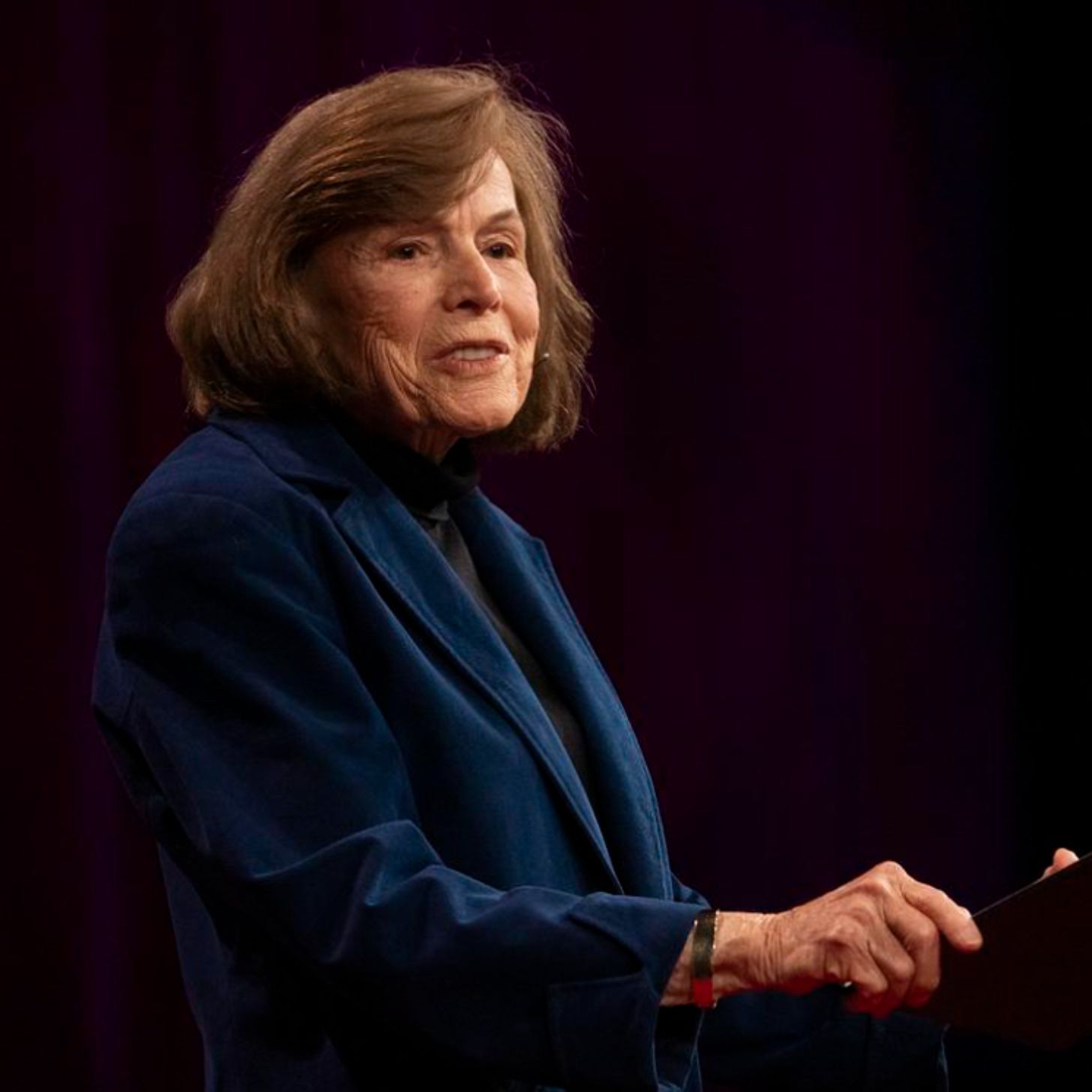
On Friday, April 17, legendary oceanographer and marine biologist Sylvia A. Earle took the TED stage in Vancouver, Canada. In her TED Talk, she explained the importance of “Hope Spots,” or global sites that are scientifically identified as critical to the health of the ocean.
“Today, there are 169 Hope Spots in 116 countries,” Earle said.
“In French Polynesia, at the Tetiaroa Hope Spot, Richard and Mary Bailey are pioneering science-based tourism with a conservation twist,” she said. “They have fiercely protected the sea turtle nests and really taken action to try to restore a place that was losing the wildlife that the ocean needs to have a secure planet.”
Earle explained that for years, the Bailey family has spearheaded conservation efforts at Marlo Brando’s luxury resort in Tetiaroa Atoll, which lies 30 miles north of Tahiti.
By partnering with local nonprofits — Tetiaroa Society and Te mana o te moana (“spirit of the ocean”) — the Brando resort has helped foster the atoll’s long-term sea turtle nesting program, protecting more than 120,000 hatchlings across a decade and rehabilitating over 600 injured and sick adult turtles.
“Just a few years ago, there were only a very few turtles. Now, there are hundreds with protection,” Earle said. “Protection works.”
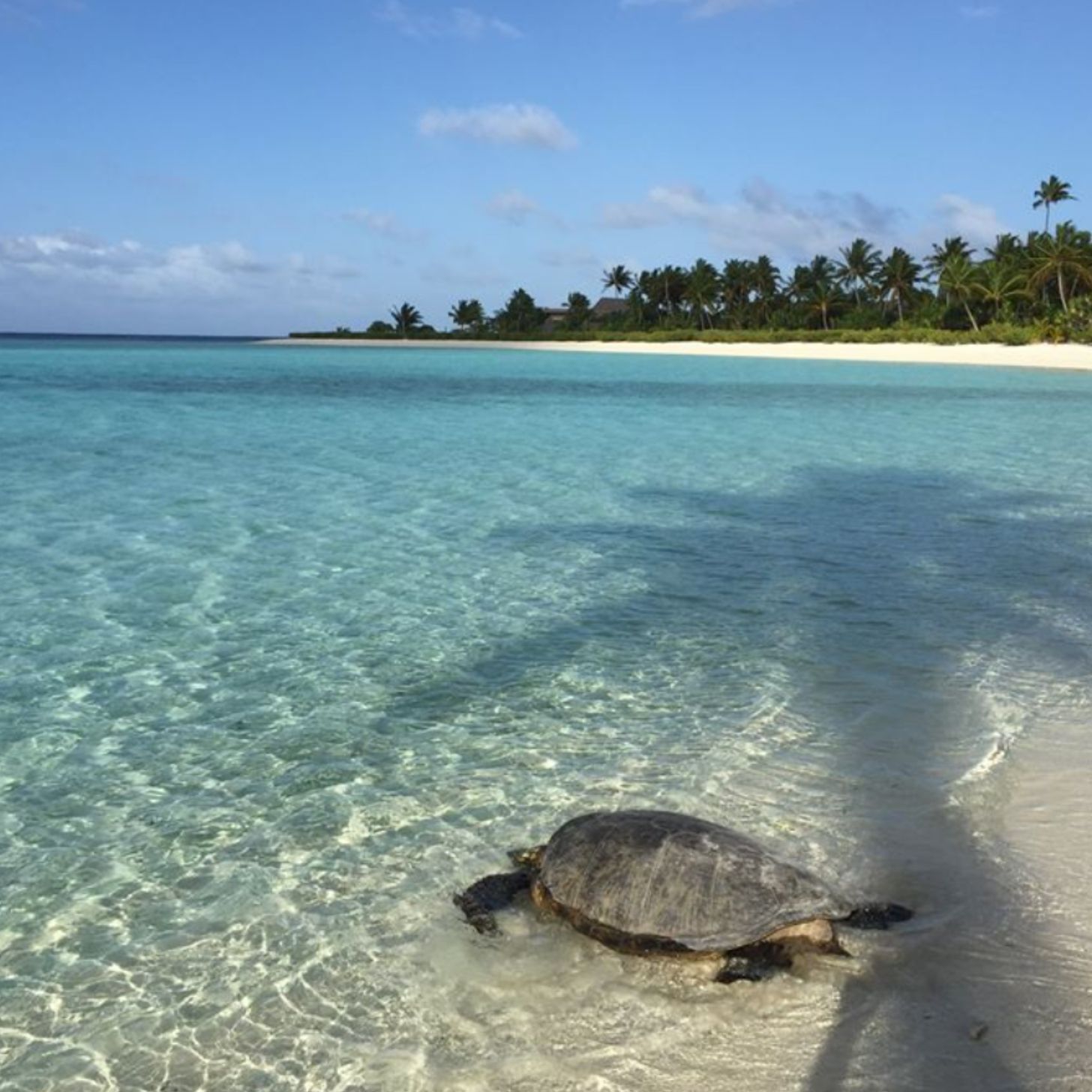
“With the Tetiaroa Society, the Baileys are engaging tourists, scientists, kids, and CEOs in a business plan that couples tourism with revenue that is generated with exploration, research, and conservation,” she continued. “It's a blue-green, nature-positive model that generates income and jobs — and a healthy ocean.”
The Brando itself is a luxury eco-resort that is carbon-neutral, Platinum LEED certified, and uses sustainable energy measures through deep-sea water air conditioning, solar power, and biofuel from local coconut oil.
Years ago, the Brando resort played a key role in the conservation of Tetiaroa by donating a $1 million research station to Tetiaroa Society. Experts from around the world fly into the station to study and discuss habitat restoration, shark ecology, coral reef restoration, and more.
As the Tetiaroa Society runs an education program on the island for local and international students, and — during turtle season - tourists are invited to join night observation treks with Te mana o te moana biologists.
Dr. Cécile Gaspar, the founder and executive director of Te mana o te moana, said that the island is home to four turtle species: the green turtle, hawksbill turtle, olive ridley turtle, and loggerhead turtle, which are all considered endangered or threatened.
“Sea turtles are iconic marine species on the front line of climate change threats,” he said in a press release. “Te mana o te moana’s Green Sea Monitoring Program on Tetiaroa atoll has been an outstanding success.”
“We are proud to be part of Marlon Brando’s vision for a new conservation model where tourists, communities, teachers, students, and researchers all play an important role in protecting our natural resources.”
You may also like: The Kemp's ridley sea turtle is the most endangered sea turtle in the world. This aquarium just saved 35 of them
Header image via Tetiaroa Society
Dr. Katharine K. Wilkinson is a writer, teacher, creator, and climate activist who helps people find their power and joy in the climate movement.
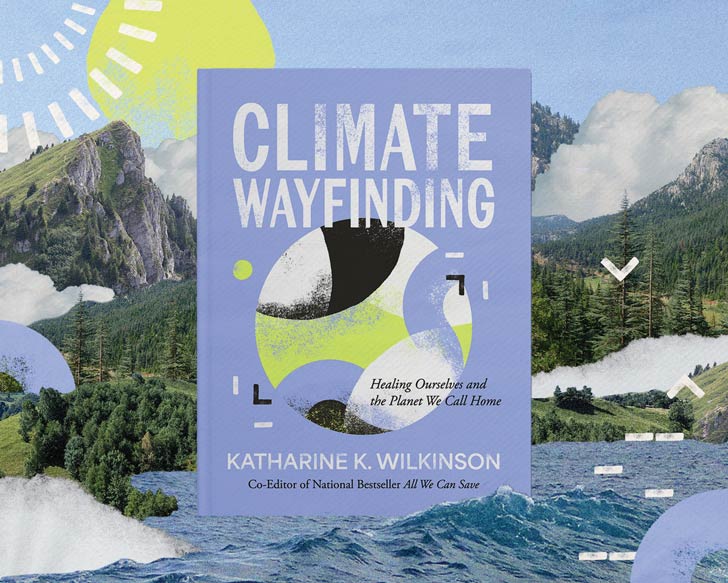
Her newest book, “Climate Wayfinding: Healing Ourselves and the Planet We Call Home,” is an extension of years-long Climate Wayfinding programming, which has given thousands of people the tools they need to find their role in nurturing a climate-forward future.
She co-founded The All We Can Save Project with Dr. Ayana Elizabeth Johnson, hosts the podcast “A Matter of Degrees,” and is the former editor-in-chief of Project Drawdown.
Dr. Wilkinson also holds a Doctor of Philosophy in geography and environment from the University of Oxford and a Bachelor of Arts in religion from Sewanee: The University of the South.
She approaches climate action with a unique blend of spirituality, realism, hope, and genuine delight, and her work has mapped the way for countless others to do the same.
In the following conversation, she gives Good Good Good a look into her newest book, provides some insight into how she navigates the dread and anxiety of our current reality, and invites us all to step into the future together.
Answers have been lightly edited for length and clarity.
A Conversation on Climate Wayfinding with Dr. Katharine K. Wilkinson
Kamrin Baker, Good Good Good: Let’s start with the basics: What is Climate Wayfinding?
Dr. Katharine K. Wilkinson: This is the million-dollar question. Climate Wayfinding is, at its core, a response to the experience that I think a lot of us are having, which is … this world is a lot.
And the ways that we have traditionally had to navigate, to orient, to get our bearings, to figure out how to contribute, how to cope — all of these things are under stress and strain.
And we are so sorely lacking in systems of support and in spaces to grapple with that stuff together, and hopefully work our way out of the mire and into some forward movement.
A lot of times, this shows up in people asking that persistent question: “What can I do?” I really think about that question as almost a Russian doll of other bigger wonderings that are often more existential in nature. “What can I do?” is often also like, “What is the meaning of life in this time?” “Where do I belong?”
So, Climate Wayfinding is my response, The All We Can Save Project’s response, to that need for support and space to hold those big questions and work our way into some answers.
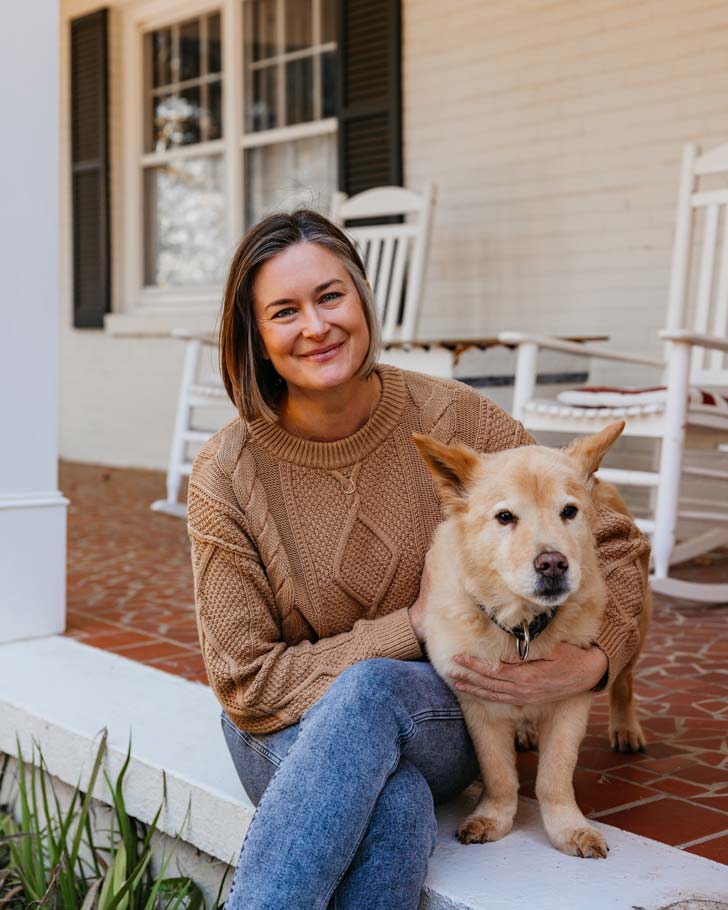
GGG: How has Climate Wayfinding manifested in the world?
Dr. Wilkinson: In many ways, it started out as a piece that I wrote for Time magazine that was asking about that question, “What can I do?” Instead of trying to answer the question, could we help people think about more productive ways to work with the question? And I wrote that piece, and it was like, “Oh actually, this could be a really cool learning journey.”
And so we designed a program, and piloted that in the summer and fall of 2022, and quickly realized that this approach was unique, and it was really working. It was giving people something they really needed.
We started training educators from colleges and universities across the U.S. and Canada to bring the program to their communities, and as we were packaging everything up to give to them, I ended up writing a series of essays that frame the program, and frame the sessions of it. And then I realized, “Oh, there's a book here.”
And if you just want to sit and read the book, “Climate Wayfinding,” it'll be a great reading experience, but it is also a book that you can do, in the sense that there are journal prompts and creative mapping exercises. And it's also a book you can do in community. There are reading group agendas for every chapter. So, it's meant to really make the experience of Climate Wayfinding accessible to anyone who has a library card.
GGG: It sounds like you probably had that experience of asking your own “What can I do?” and you used your strengths in systems-building. Do you have any insights on that experience, or even how you've seen other people have used Climate Wayfinding to find the thing they're good at when it comes to climate action?
Dr. Wilkinson: It's so funny. You hear people say a lot, on climate: “I care about this. I'm worried about this. But I'm a teacher. I'm an investor. I'm not a scientist. I'm not an atmospheric physicist.” It’s this sense that the skills, the talents that we have might not be so relevant.
And the reality is that the climate crisis is everything. So the skills and the talents that we have, whatever they may be, almost certainly can contribute in some way.
That is part of the looking inward piece that we do with Climate Wayfinding, [asking], “What are my superpowers? What am I really good at?” And then we think about the things that give us a sense of authentic power; not hierarchical power over the structures of society, but that feeling of inner heat, that sense of capacity that's welling up within me.
And we also think about the things that give us a sense of deep joy. And oftentimes, there are things that intersect, that give us both a sense of authentic power and capacity and a sense of deep joy.
We do it in a really somatic way, too. What does it feel like to have power in your body? What does it feel like to have joy in your body? And then all of a sudden, your body opens up this exploration. And I think what's so beautiful is that we realize we have any number of things that get us into the sweet spot of power and joy.
And we set aside whether we think those things are relevant to climate. We just do the exploration, and then we connect it back in. And people do then say, “I came here as a theater professor thinking I didn't have any business being here, and now I really see these huge opportunities for the arts and narrative change to play a role,” as just one example.
That, to me, is one of the most beautiful parts of the experience: People really going from, “I guess I'll just sit on the sidelines because I'm not sure I have anything to offer here,” to “Oh, yes, I do.”
GGG: There is so much grief and anxiety surrounding climate. And that doesn't go away with any of this, but, like you said, joy and power are so instrumental. What’s the importance of having that in-person connective experience with others to lean into those varied feelings?
Dr. Wilkinson: The very first deep dive in Climate Wayfinding is into climate emotions. Oftentimes, we say we have to start there because we are starting there, whether or not we're naming it. It's all in the room with us. This is incredibly important information that we are getting from our feelings, and they are often really deep sources of motivation, if we can give them space to breathe.
The pendulum has got to go into the heavy, darker stuff to be able to swing into that lighter, brighter possibility. And it is so good to be together and to do this exploration together.
I think we're often very lonely in these concerns, or we find ourselves in conversations where we're just rattling off all the problems of the world, or we're engaged in really tactical or technical sorts of things.
We're not as much coming at this from like, “This is the experience I'm having of being a human on Earth in this time of trouble and possibility.” Every time we get to run a workshop or run a retreat, I'm just so reminded of how capable we are of giving each other what we need. And that is a really beautiful thing.
There are aspects of addressing the climate crisis that require actual rocket science, and this is not one of them. I think that’s really good news.
GGG: I am naturally someone who comes from a place of optimism. I often feel like progress is inevitable. But, in recent times, that's not as easy to feel. How do you maintain your optimism — or even your groundedness and connection to this work — in the face of this large-scale dismantling of climate action?
Dr. Wilkinson: I think it is a moment that is asking all of us to expand our capacity to hold what is really hard. So to hold the truth of the horror, in many cases, and also to be able to keep tending the flame of possibility.
In the “Climate Wayfinding” book, there are stories in each chapter called “Lighting the Way Stories” that bring to light the wisdom and the journey of a climate leader whose work or perspective echoes key themes of the chapter. And in the one about climate emotions, I interviewed Sister True Dedication, who's a monastic at Plum Village, which is Thích Nhất Hạnh's monastic community of engaged Buddhism. And she says that according to impermanence, everything is possible.
That, for me, is such a grounding concept. That nothing about the future has yet been written because we are still writing it collectively.
And if the future lives anywhere, it is in that space between us as we work to shape it. And so how do we do both of those things? How do we not cop out [on] the really tough shit that is going down? And how do we continue to hold that perspective of possibility?
For me, personally, when I get snarled in the realities of human doings at this time, I often look to the more-than-human world for some inspiration and guidance. This gets a little heady, but I really do remind myself that life is the most powerful dynamic on this planet, and despite all of the odds, has kept on tumbling forward and finding the paths to more life for 3.8 billion years.
We've got something really powerful on our side. I think at the end of the day, the question is, “How do I contribute to that dynamic of life force?” And the feeling of doing that cycles back around and grows my capacity to hold possibility.
GGG: In every Goodnewspaper, we have a centerfold poster with a quote from someone in it. And ours is actually a quote from you: “It is no small thing to be human on Earth.” What does this mean to you? How does it guide your work?
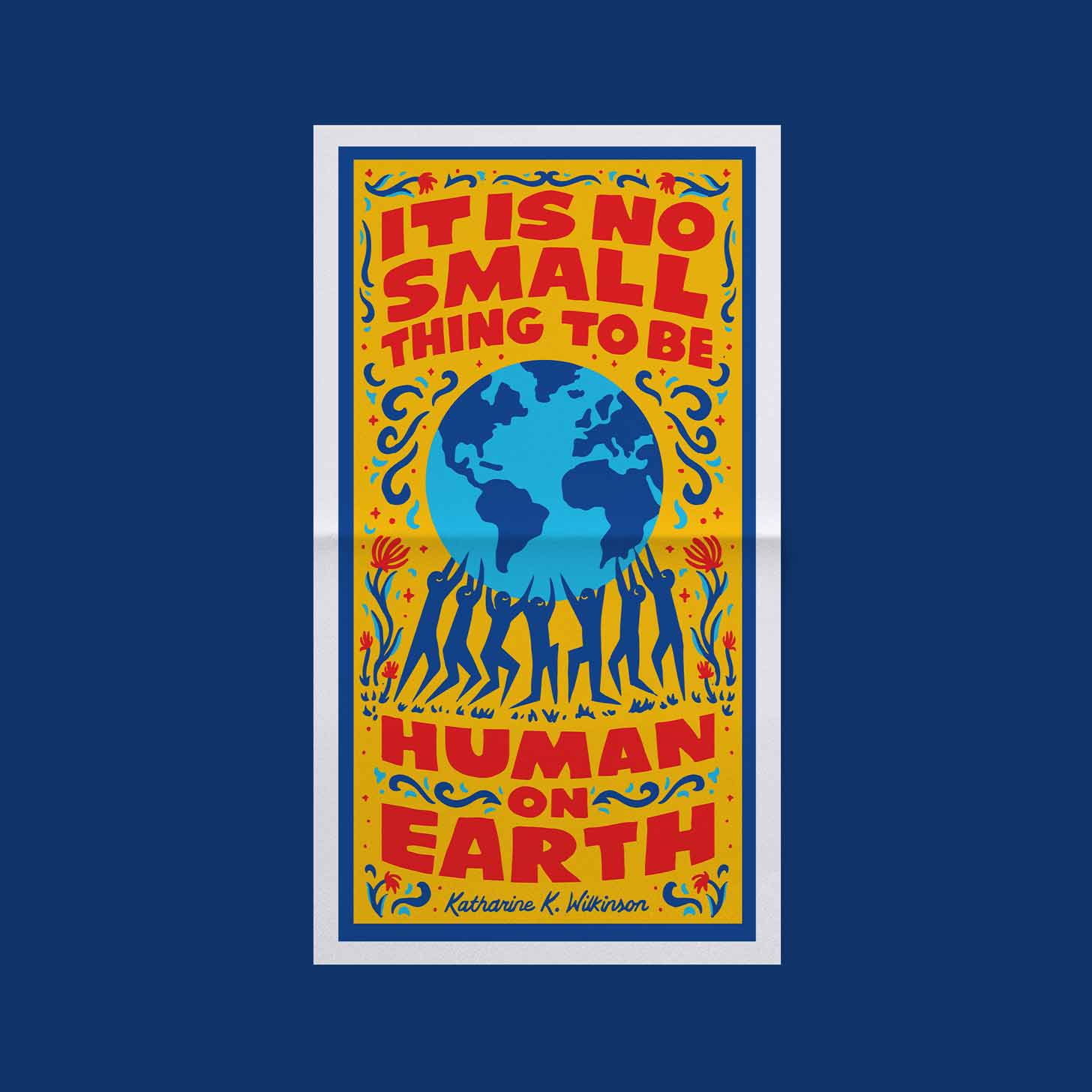
Dr. Wilkinson: So it is actually the opening line of the book. It is no small thing to be human on Earth. And I think, if there was to be a tagline for what I'm up to as a person, as a professional doer and writer, it would be, “It's no small thing.”
It’s no small thing in the sense that it's actually extraordinary that we are here at all. It's no small thing in the sense that the experience of being alive and in a body is a lot, under the best of circumstances. And we have this incredible opportunity, by virtue of being human on Earth, in this moment.
So, it's no small thing in the challenge. But it's also no small thing, in the potential that we each hold, and particularly, the potential that we hold together.
“Climate Wayfinding: Healing Ourselves and the Planet We Call Home” by Dr. Katharine K. Wilkinson is on shelves May 5, 2026. You can pre-order it now.
A version of this article was originally published in The 2026 Environment Edition of the Goodnewspaper.
Header images by Gabriella Valladeres and Ambersand Design
On October 1, 2025, renowned primatologist and conservationist Dr. Jane Goodall passed away at 91 years old — a loss that reverberated around the world.
In July, mere months before Goodall’s passing, she spent three weeks in Tanzania with Dax Dasilva, the founder of the environmental nonprofit Age of Union. Dasilva is also the executive producer of “Jane, Just Jane,” a forthcoming documentary about Goodall’s career, which spanned 27 countries and five continents.
During their trip together, which marked Goodall’s final trip to Africa, the two sat down for a formal 20-minute interview. In it, they looked back on Goodall’s legacy — and forward to the importance of everyone pitching in to safeguard the planet for generations to come.
“In the long run, the bigger change will be from the young people,” Goodall told Dasilva in the interview, which officially aired on Earth Day. “It’s not true that older people can’t change, because they do. You know, I’ve had many, many older people come up after the election and say, ‘Well, Jane, I’d given up, but I promise you now, I’ll do my bit.’”
Circling back to young people, Goodall reflected on the advice that her own mother had given her as a young adult.
“I can’t think of anything better,” she said. “She said, ‘Jane, if you really want to do something like this, you’re going to have to work really hard. Take advantage of every opportunity. And if you don’t give up, I’m sure you’ll find a way.”
“There’s no better advice than that,” she added.
The two also discussed Goodall’s various conservation projects across Tanzania, including her groundbreaking fieldwork studying primates in the Gombe Stream National Park in the 1960s.
Goodall touched on how deforestation had reshaped Gombe when she revisited the area twenty years later.
“By the mid-1980s, when I flew over, I saw to my horror, just a little island of forest that was gone,” Goodall said. “And that’s when it hit me.”
“These people are cutting down the trees to make money from chalk or timber or more land to grow more food because their population is growing,” she explained.
“If we can’t help them find ways of making a living without destroying the environment, we can’t save chimps, forests, or anything else. Including people, actually, in the long run.”
Towards the end of the interview, Dasilva prompted Goodall to offer words of wisdom for people who are feeling overwhelmed and disheartened by the state of the world.
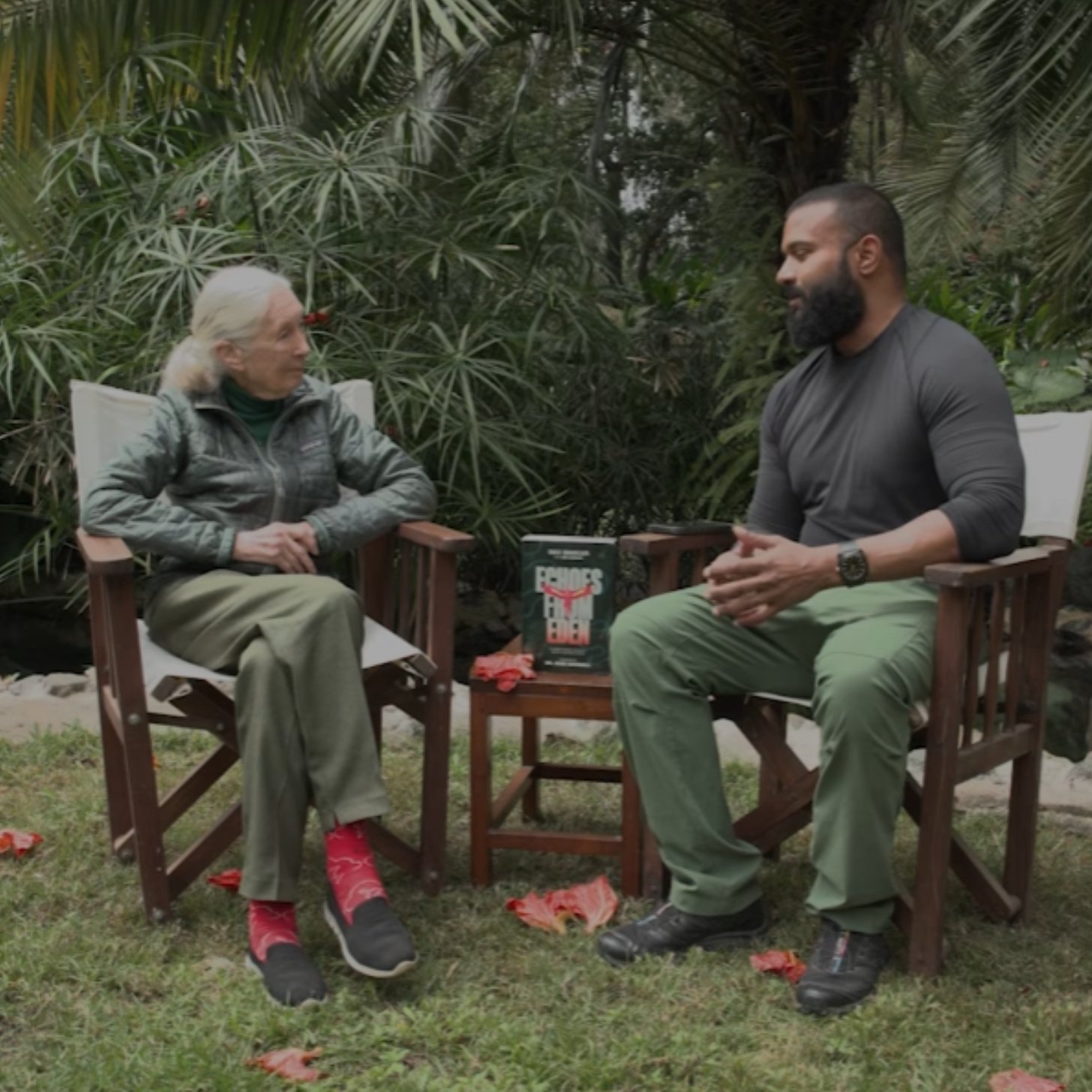
“Tell me more about having hope and how it connects to taking action,” Dasilva said.
“If you don’t have hope that your actions are making a difference, what’s the point of doing them?” she asked in return.
“People come to me and say, ‘Well, look at the world, look at the wars, look at the destruction of the environment, of poverty, the suffering, the destruction of the soil with industrial agriculture. What can I do? I’m just one person. It’s overwhelming. It’s overwhelming.’”
“And we have this stupid saying, think globally, act locally, but no,” she said. “Act locally first and do something.”
“What do you care about in your community?” she continued. “Maybe you don’t like the litter … do something, organize beach cleanups, get a group together to plant trees where there’s a little area from, you know, nothing growing.”
“Just do something that’ll make you feel better,” Goodall emphasized. “And then you want to do more, and then you will inspire others to join in.”
See the full interview below:
You may also like: Because of Jane Goodall, I became a primatologist
Header image via Age of Union
Over the last few weeks, trained personnel and volunteers in Treasure Coast, Florida have been painstakingly moving over 4,100 sea turtle eggs from 45 nests to protect them from upcoming restoration projects.
Since March, beach monitors have moved 3,984 eggs from 44 leatherback nests and 122 eggs from a single loggerhead nest.
Both leatherbacks and loggerheads are endangered and have faced population declines from coastal development, boat strikes, and entanglement from abandoned fishing gear.
However, despite a harrowing 2024 hurricane season that wiped out hundreds of nests, recent conservation efforts have helped sea turtle populations bounce back.
In fact, 2025 was the highest recorded year for leatherback nesting in the state.
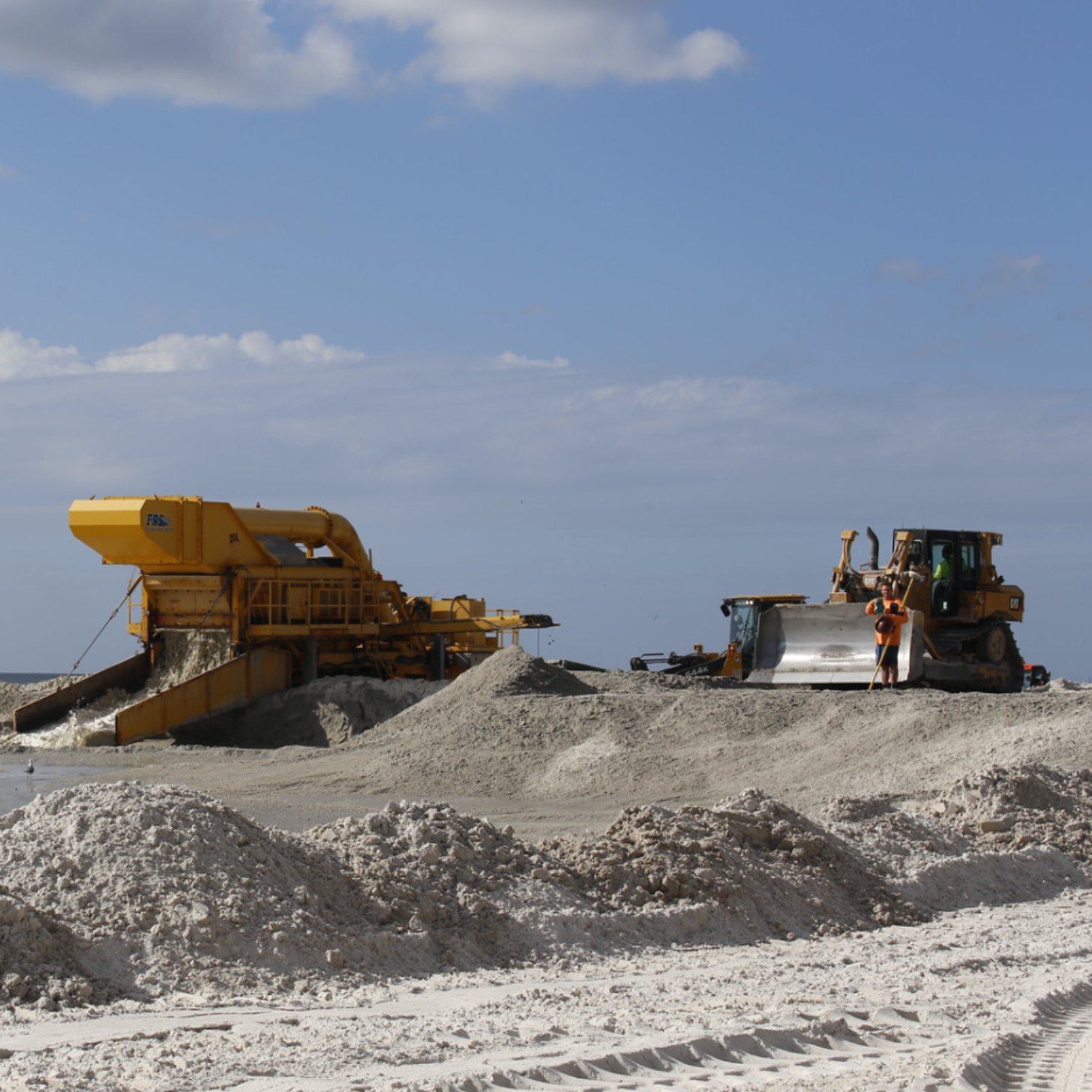
And although upcoming sand restoration projects are necessary to combat coastal erosion — which escalates ecosystem loss and puts sea turtles at risk — it also presents additional challenges.
“[One] way to combat property erosion on beaches is to bring in truckloads of sand,” the The Florida Fish and Wildlife Conservation Commission stated on their website.
“If the sand is of a different consistency or is too compacted, the nesting behaviors of turtles can be drastically altered. If the renourishment is done during nesting season, there is also a possibility nests will be buried too far underground or be run over by trucks.”
To save local sea turtles and their eggs from the forthcoming bulldozers and dump trucks, beach monitors have been hard at work.
According to Joseph Scarola, a senior scientist and sea turtle lighting specialist with Ecological Associates Inc., monitoring crews begin patrols at 9 p.m. each night.
When a turtle is found, beach monitors contact relocation teams and share the exact location.
The relocators carefully place each egg by hand into sand-lined containers without rotating them, then record the nest’s dimensions so they can recreate it at the next site — a location that is kept secret to thwart poachers.
In addition to physically moving sea turtle eggs, local conservationists have also been working to reduce light pollution along the coast.
“Nesting sea turtles look for dark, quiet beaches to lay their eggs. Lights from buildings along the beach distract and confuse the females,” the FWC said. “Any distractions may frighten and disorient her, causing her to return to the ocean before completely covering and camouflaging her nest.”
“The fewer obstacles sea turtles have to overcome,” they stated, “the better their chances of successful nesting.”
You may also like: This French Polynesian paradise combines tourism and sea turtle conservation. They've protected over 120,000 hatchlings
Header image via PICRYL (PDM 1.0)
According to Publishers Weekly, after two years of declines, print sales rose in 2024 with unit sales of print books up 1%.
And in 2025, they rose again — this time 0.5% higher than the previous year — reaching 762.4 million units.
That increase has been a godsend for brick-and-mortar bookstores, even the major chains. After a $1 billion loss and countless store closures, Barnes & Noble has bounced back in a big way, with plans to open 60 new locations across the country in 2026.
For the “why” behind the surge in sales, Publishers Weekly pointed to BookTok, an online community of readers that is predominantly female. And BookTok’s hottest picks from the last year — “Onyx Storm,” “Sunrise At The Reaping,” and “Great Big Beautiful Life” — were all written by women.

“Books have had an interesting ride,” Elizabeth Lafontaine, who tracks consumer foot traffic at the location analytics company Placer.ai, told CO—, a digital platform from the U.S. Chamber of Commerce. “Consumers are not only visiting bookstores, but they’re also spending more time inside the stores once they’re there.”
And for authors like Lisa Jewell, who have been publishing since 1999, BookTok has also helped reintroduce them to younger generations of readers.
“Nobody could have predicted that BookTok was what the publishing industry needed — it was a huge shot of adrenaline,” Jewell said when receiving the TikTok Book of the Year award for her 21st novel, “None of This is True.”
“BookTok has given me readers that I would never have had access to otherwise.”
A version of this article was originally published in The 2026 Feminist Edition of the Goodnewspaper.
Header image via Ian Ramírez
A new study from the University of California, Berkeley, found that people overwhelmingly support a balance of gender representation in government — even when quotas are required to achieve parity.
“In the best-case scenario, citizens would prefer a gender balance achieved without quotas,” said political scientist Amanda Clayton, whose research was published in the American Political Science Review.
“But we know from centuries of male dominance that that either doesn’t happen or happens at a glacial pace,” she continued. “So compared to men’s political dominance, women’s inclusion via quotas is perceived as more democratic and more legitimate than women’s exclusion.”
The study polled 17,000 people in a dozen countries across Europe, the Pacific, and the Americas. Even in the United States and the United Kingdom, where quotas are not mandated, a majority of respondents stated that gender-balanced governments lead to fairer and more democratic policies.

Gender quotas emerged roughly 50 years ago, pioneered by Norway and Sweden. Today, more than 130 countries use quotas to drive gender balance in politics.
And, Clayton pointed out, when countries do adopt quotas for gender equality, those policies tend to last.
“What we’ve found is that, typically, once a party has a mechanism to include women, it doesn’t get rid of it,” she explained. “So the quota just becomes sort of part of the electoral environment. People might not even refer to them as quotas anymore. They just expect that women will be equally represented.”
A version of this article was originally published in The 2026 Feminist Edition of the Goodnewspaper.
Header image via Official White House Photo by Lawrence Jackson (Public Domain)
Imagine you and your partner are sitting in the waiting room of your doctor’s office, waiting for your appointment to get birth control — and instead of calculating how many other people will be called before you, or perusing old magazines, a nurse hands you a digital tablet and encourages you to play a game.
You power it on, and you find yourselves drawn into a story: Can you help Laila and Caleb figure out which contraceptive method will work best for them, given their lifestyles and Laila’s physiology?
Their situation, you realize, is a bit similar to your own. Would helping them choose a form of contraception help you and your partner make an informed decision for yourselves?
As a designer and developer of games that promote positive health behavior change, I work with physicians, public health experts, artists, and programmers to create games just like these. I focus on topics like vaccine hesitancy, sexuality, and reproductive health — sensitive issues that people may have a hard time discussing openly.
Laila and Caleb are characters in a game that my team and I are developing called What’s My Method? We are testing whether playing it helps people choose a birth control method and makes it easier to have a fruitful discussion with their health care provider.
And we are finding that this and other games for health-related education are a powerful but underused way of not just conveying information, but also providing people with an arena to learn from the outcomes of their choices.

The power of play
When I tell people I make health-related video games for a living, they’re often surprised that this is a viable career choice. Many adults still see video games as trivial at best — and destructive at worst. For example, games that involve guns and shootings are widely blamed for gun violence in real life, even though there’s no causal evidence supporting the connection.
Play is how intelligent and curious beings make sense of the constantly changing world and ensure they keep learning. It is an early factor in children’s cognitive development. Peek-a-boo, for example, helps babies learn about object permanence — meaning that even if a person disappears for a short time, they aren’t gone forever.
Digital play can support many types of learning. Games like Minecraft teach resource management, planning, and spatial reasoning, among other skills.
The game industry is also an increasingly large part of the world economy. Given the size and reach of the international video game market — $300 billion in 2025 — games are often the way technological innovations are introduced to a mass audience.
Take motion capture technology, which enables a device to track a person’s movement. Microsoft introduced it to the general public in 2010 through its Kinect console, in which two players can box or play tennis virtually by actually performing the movements with their bodies.
Augmented reality — the ability to use a smartphone to see a virtual world overlaid on the “real” world — entered the mainstream in 2016 when people began playing and watching others play Pokemon Go.
Games are also how many people first experience virtual reality — a full immersion in an entirely virtual world — by wearing headsets like Oculus (now called Meta Quest) and Apple Vision Pro.
Gaming also has a powerful social dimension. Massively multiplayer online games like Animal Crossing, Fortnite, and World of Warcraft provide a means for socialization and togetherness for billions of people worldwide. This became especially powerful during the COVID-19 pandemic when people were social-distancing — people’s use of such games soared during lockdowns, and they helped players maintain social connections.
In my own experience as the director of a university program in game design and development, I find that students who grew up playing complex digital games are better prepared to engage with technology and navigate an increasingly digital world.
Gaming for health
Early in my game design career, I realized that games don’t just provide compelling entertainment, but they can also equip players with the knowledge and the agency to solve hard problems in real life.
That’s especially valuable in health. Information for patients is usually conveyed through pamphlets or links to websites that often provide too much information in formats patients find difficult to decipher. These formats don’t effectively address gaps in health literacy.
Games, on the other hand, provide targeted information in a specific context that players don’t just understand, but also, in some ways, inhabit. Such games allow players to try out different behaviors through avatars to see how they turn out. Conveying information through relatable avatars also triggers empathy, which further cements learning.
Since 2010, my team has been testing how to deploy digital games in the U.S., India, Barbados, and Ghana to communicate complex health-related information through animated graphics, audio, and interactive experiences.
In 2012, we worked with doctors at a hospital on Long Island, New York, to encourage families of critically ill children to get a flu vaccination. We found that family members who played a game we jointly developed called Flu Busters! were 40% more likely to get a flu vaccination than those who didn’t.
In the game, players help an avatar navigate a school filled with children sneezing and blowing their noses in order to enjoy social interactions such as sharing a cookie without getting sick. Rather than telling people how they should behave, the game allows players to experience how difficult it is to avoid being exposed to the flu virus in everyday life and how the vaccine can help children stay healthy, equipping players to make informed decisions about their own health.
In our first international project, we collaborated with public health physicians in India on a game we developed to gather data about how teenagers there make decisions about family planning. In addition to determining that a game was a very effective tool for anonymized data collection, we found that giving young people access to information about reproductive anatomy gave them the vocabulary and tools to understand and discuss their future reproductive choices..

Responding to rising vaccine hesitancy during the COVID-19 epidemic, my team developed Activate My Shield! The game demonstrates how vaccines protect against different diseases using the metaphor of armor that only works against specific types of attacks.
To address misinformation that was widespread at the time — that COVID-19 vaccines contained injectable microchips — the game asks players to try putting a microchip in a vaccine needle and administering it to a person. Experiencing how impossible it is to do this helps players understand that it’s not a legitimate concern.
Reaching digital natives
Our games are available to all for free, but in order to be able to widely distribute them on the app stores, my team and I founded SolitonZ Games.
Several other research groups are developing similar games. They address an enormous range of health issues — for example, encouraging people with HIV to adhere to their treatment, helping teens avoid vaping, and teaching children with asthma to manage their disease.
A video game called EndeavorRx was authorized by the Food and Drug Administration in 2020 as a prescription-based therapy to improve attention in children who have attention-deficit/hyperactivity disorder.
Overall, our research and that of other groups show that digital games can be easily integrated into health care, and that play is an effective way of delivering health information. Simply put, people find the games fun and engaging.
Even as these efforts gain ground, however, health campaigns and patient education efforts have been slow to embrace game-based patient education. That’s perhaps partly because decision-makers such as hospital and clinic administrators are often unfamiliar with gaming and may be slow to buy into the idea of delivering health education through play-based technology. Plus, it’s difficult to make changes in busy environments with a lot of moving parts, like health care.
But I’m optimistic that by working together with public health experts and health care providers, game designers like me can help fit gaming into the industry and culture of health care. After all, it makes sense to try to reach digital natives on the technologies they are already holding in their hands.
This article was written by Elena Bertozzi from Quinnipiac University, and was originally published on The Conversation.
Header Image by Kaboompics via Pexels

Around the world, people plan to plant more than 1 trillion trees this decade in an ambitious effort to slow climate change and reduce biodiversity loss. But if the past is prologue, many of those planted trees won’t survive. And if they do, they could end up as biological deserts that lack the richness and resilience of healthy forests.
It doesn’t have to be this way.
The United Nations declared 2021-2030 the Decade on Ecosystem Restoration to encourage efforts to repair degraded ecosystems. Tree planting has become a centerpiece of that effort, championed by initiatives such as the Bonn Challenge and the Trillion Trees Campaign.
However, many tree-planting commitments have a critical flaw: They rely too heavily on monoculture plantations — vast areas planted with just a single tree species.
Monoculture plantations are generally one-way tickets to producing wood. But these high-yield plantations are high risk and can be surprisingly fragile. When drought, pests, or forest fires strike, entire monoculture plantations can fail at once. In one example, nearly 90% of 11 million saplings planted in Turkey died within three months due to drought and lack of maintenance.
Forests are more than just timber factories. They regulate water, store carbon, provide habitat for wildlife, cool the landscapes around them, and even provide human health benefits.
Rather than gambling on a single species and hoping for the best, science now points to a smarter path that captures both ecological and economic benefits while minimizing risk: mixed-species plantings that mirror the biodiversity of a natural forest, ultimately creating forests that grow faster and are more resilient in the face of constant threats.

We are community and landscape ecologists at the Smithsonian Environmental Research Center. Since 2013, we and our colleagues have been rigorously testing this idea in a large, ecosystem-scale experiment called BiodiversiTREE.
The verdict is striking: Trees in mixed forests don’t just survive — they outgrow their monoculture counterparts and support dramatically more biodiversity.
Trees with diverse neighbors grow larger
Thirteen years ago, we teamed up with volunteers to plant nearly 18,000 tree seedlings on 60 acres of fallow fields on the Smithsonian Environmental Research Center campus near the Chesapeake Bay.
We didn’t plant just a single species. We planted 16 different native species from all walks of tree-life. Some species were fast-growing timber species, some were mid-story species, and some were slow-growing species that might not reach full size for a century or more.
Some plots we planted with just a single species — homogenous rows of the same species over and over again. But others were planted with random allotments of four and 12 species, reflecting the middle and upper ends of tree diversity in similar-sized areas of our local forests.
We asked a simple question: What would happen if we tried to mirror nature and plant a mixture of species instead of a monoculture?

The differences over a decade later are striking.
The monoculture plots — those that survived — resemble traditional plantation forestry that historically has dominated rural lands in the Southeast and Pacific Northwest in the U.S. They contain rows of tall, narrow trees with sparse canopies and little life below.
The mixed-species plots, by contrast, are layered, complex, and dynamic, with foliage filling the canopy and a diversity of plants and animals thriving underneath.
These visual contrasts reflect real ecological gains. Trees grown in mixtures, including important timber species like poplar and red oak, are up to 80% larger than the same species when grown alone. Mixed plots supported fewer leaf pathogens, more abundant caterpillar communities that provide food for birds, and increased phytochemical diversity in their leaves.
We hypothesize that these leaf chemicals, some of which deter animals from eating them, reduced browsing damage from hungry deer, ultimately leading to higher tree growth in the mixed plots.
Plots with several tree species also had much fuller, denser leaf canopies, leading to cooler, shadier conditions that help understory plants flourish and support up to 50% more insects, spiders, and birds.

This pattern isn’t unique to our site. The BiodiversiTREE project is part of TreeDivNet, a global network of large-scale experiments spanning more than 1.2 million trees and hundreds of species. Across continents and climates, the results are consistent: Forests with a mix of species tend to grow larger, store more carbon and better withstand stress from drought, pests, and disease.
So why are monocultures still common?
Despite decades of evidence, mixed-species plantings remain relatively rare in practice. Most commercial forestry operations still rely on monocultures, and these plantations are counted toward international planting campaigns aimed at slowing climate change and reversing biodiversity loss.
The reasons are generally practical: Mixed plantings can be more complex to design, more expensive to establish, and harder to manage. Crucially, until recently, there has been limited evidence that they can match or exceed the economic returns of conventional plantations.
A new experiment at the Smithsonian Environmental Research Center called “Functional Forests” aims to bridge some of the gaps between science and practice. We’re developing intentionally designed combinations of trees to test whether specific mixtures of species can contribute ecological benefits while also providing timber and other services that humans need to support a thriving, sustainable economy.
Each of the 20 tree species in the Functional Forests project was chosen to provide one or more benefits, including timber, wildlife habitat, food for people, resistance to deer, and climate resilience. But no single species provides all of these benefits.
Some of the nearly 200 plots will contain a single species, while others include carefully selected combinations of five species assembled based on the functions they provide. Some plots are protected from deer browsing, while others are left exposed.

By comparing these approaches, we can test how different planting strategies perform across a range of goals, from timber production to food production and from biodiversity to climate resilience.
Landowners and communities have different priorities, whether that’s producing wood, supporting wildlife, or creating forests that can withstand a changing climate. The idea behind Functional Forests is to design plantings that can deliver these multiple benefits all at once, rather than optimizing for just one, essentially leveraging the positive effects of biodiversity to achieve real-world goals.
Planting 1 trillion trees wisely
The stakes are high. Restoration has become a major global investment, with hundreds of billions of dollars already being spent annually. Getting it wrong means wasted resources and missed opportunities to address some of the most pressing environmental challenges of our time.
If the world is going to plant a trillion trees, we believe it needs to do more than just put seedlings in the ground. It needs to rethink what a forest should be.
The goal isn’t just to grow trees. It’s to grow forests that last.
This article was written by John Parker and Justin Nowakowski from the Smithsonian Institution, and was originally published on The Conversation.
Header Image by Clay Elliot on Unsplash

In 2025, New Mexico became the first U.S. state to offer free child care. And a unique provision in the legislation allows grandparents with legal custody or kinship guardianship to qualify for the universal child care program, too.
The provision is especially important in New Mexico, which has the highest rate of grandparents caring for grandchildren in the nation.
“We wanted grandparents to see that we see them and that we recognize they are doing hero’s work by taking care of their grandchildren,” Elizabeth Groginsky, New Mexico’s cabinet secretary for early childhood education, told The 19th.
While 21 other states have exemptions that allow grandparents to access child care assistance, experts say New Mexico’s plan is the most comprehensive measure of its kind yet.
“New Mexico’s approach is simpler and more universally applicable to grandparents, helping reduce confusion and barriers for grandparents seeking child care access for their family,” said Anne Hedgepeth of Child Care Aware of America.
Currently, the program’s biggest obstacle is capacity; the state needs 55 new child care centers to meet demand. So, New Mexico is investing in loans and higher reimbursement rates to address provider shortages.
The new measure is still a major win for “nontraditional” households and the children who grow up in them.
“In New Mexico, grandparents and kin are playing critical roles in improving outcomes for some of our most vulnerable children,” said Kersti Tyson, the director of research and evaluation at Los Alamos National Laboratory Foundation. “Supporting their success with a more comprehensive and coordinated response is a vital necessity for our state.”
A version of this article originally appeared in the 2026 Feminist Edition of the Goodnewspaper.
Header image via cottonbro studio
Women contain multitudes. To see that range in action, look no further than the silver screen, where female directors have been serving up a stunning array of Oscar-nominated films, feminist documentaries, intimate character portraits, and yes, even sequel reboots like “Freakier Friday.”
According to the latest report from the USC Annenberg Inclusion Initiative, women directed only 8.1% of Hollywood's top films in 2025, a sharp drop from recent years.
As they fight for representation in the film industry, women filmmakers need support more than ever.
That’s why we made this primer on some recent releases, from fan favorites like “KPop Demon Hunters” to hidden gems like “Cutting Through Rocks.”
7 recent releases all directed by women
Sara Khaki’s “Cutting Through Rocks”
Genre: Documentary
Where to watch: MUBI
Co-directed with Mohammadreza Eyni, this international documentary introduces viewers to Sara Shahverdi, the first councilwoman to be elected in her Iranian village. Pushing back against generations of sexism, Shahverdi hopes to break cycles of violence and suppression by teaching young girls how to ride motorcycles — and ending child marriages.
Chloe Zhao’s “Hamnet”
Genre: Historical Drama
Where to watch: Peacock
Based on the book by Maggie O'Farrell, this period drama conjures up a fictional retelling of the lives of William Shakespeare (Paul Mescal) and Agnes Hathaway (Jessie Buckley). After a tragedy unravels their lives, Shakespeare turns his heartbreak into inspiration for his play, “Hamlet.”

Eva Victor’s “Sorry, Baby”
Genre: Drama
Where to watch: HBO Max
In this poignant depiction of gender-based violence — and the healing that follows — “Sorry, Baby” centers on Agnes (Eva Victor), a professor of literature at a liberal arts college in rural New England. As a dark memory from her past resurfaces, she finds comfort in unexpected places, whether she’s rescuing a kitten, sharing a sandwich with a stranger, or reuniting with an old friend (Naomi Ackie).
Rachael Holder’s “Love, Brooklyn”
Genre: Romance
Where to watch: Apple TV, Amazon Prime
In an ever-evolving Brooklyn, a love triangle ensues as Roger (André Holland) finds himself holding on to feelings for his ex, Casey (Nicole Beharie), even as he falls for Nicole (DeWanda Wise), a recently widowed single mother navigating heartbreak of her own.
Hikari’s “Rental Family”
Genre: Comedic Drama
Where to watch: Apple TV, Amazon Prime
After one successful toothpaste commercial in Tokyo, American actor Phillip Vanderploeg (Brendan Fraser) is forever chasing acting gigs so he can pay the bills. When he’s given the opportunity to be a stand-in for hire, he finds himself bonding with the people who are “renting” him out for his acting chops.
Nisha Ganatra’s “Freakier Friday”
Genre: Family Comedy
Where to watch: Disney+
Twenty-two years after they first magically switched bodies, Anna (Lindsay Lohan) and her mom Tess (Jamie Lee Curtis) face another body-swapping debacle, this time involving Anna’s teenage daughter, Harper, and her future step-daughter, Lily.
Maggie Kang’s “KPop Demon Hunters”
Genre: Animation
Where to watch: Netflix
Between sold-out concerts on the global stage as the K-pop girl group Huntrix, Rumi (Arden Cho), Mira (May Hong), and Zoey (Ji-young Yoo) lead double lives as highly trained demon hunters. Their two callings converge when a rival boy band full of demons threatens to disrupt the barrier between the human world and the demon realm.

[AUTHOR’S NOTE: Streaming services may change. While seeing films in theaters and through streaming is the most direct way to financially support female-led films, you can always inquire about these selections at your local library.]
A version of this article originally appeared in the 2026 Feminist Edition of the Goodnewspaper.
Header image via Netflix
In 2018, Cara Romero had a vision: reimaging Indigenous women in picture-perfect scenes, framed by a set that resembles a doll box. It was her way of presenting the women she admired in a way that would resonate with her doll-loving daughter.
“The inspiration for the First American Girl series was a lifetime of seeing Native American people represented in a dehumanized way,” Romero told The Museum of Modern Art.
“My daughter was born in 2006, and I really wanted her self-image to be different. But all of the dolls that depict Native American girls were inaccurate. They lacked the detail. They lacked the love. They lacked the historical accuracy.”
So Romero started the photography series with “Wakeah.”
Posed in a doll box, Wakeah Jhane Myers of the Kiowa and Comanche tribes stands tall in a Southern Buckskin dress, surrounded by traditional and contemporary pieces of regalia.
Every year, Romero’s series grows, encapsulating the identities and lived experiences of different Indigenous people each time, like “Naomi” of the YTT Northern Chumash Tribe and “Amber Morningstar” of the Choctaw Tribe.
Romero said that they helped her slowly dismantle the stereotypes she was fed as a young girl — while positively influencing her own daughter.
“I come from a community where women are allowed to have a voice, allowed to be really strong,” she told The 19th. “So [I was] wanting to pass down good self-esteem and a strong sense of self and identity. That’s what we aim to do as moms.”
A version of this article originally appeared in the 2026 Feminist Edition of the Goodnewspaper.
In 2004, a loggerhead sea turtle washed ashore in Castlegregory, Ireland with severely injured flippers.
The sea turtle, dubbed “Molly,” was then taken to Dingle Oceanworld Aquarium, where she spent the next 22 years in recovery.
Oceanworld founder Dr. Kevin Flannery told The Irish Times that they can never be exactly sure what happened to Molly before her rescue, but he believes that her injuries were the result of a shark attack.
Regardless, the team said that the loggerhead turtle was clearly far from home.
Flannery theorized that Molly had been swept up in a storm that carried her from the warm waters of the Gulf of Mexico into the cold waters of the North Atlantic, where she grew cold-stunned and was pulled by the force of a transatlantic current to the shores of Kerry.
Flannery’s theory was confirmed several years ago, when Trinity College Dublin graduate Dr. David Duffy travelled to the Whitney Laboratory for Marine Bioscience in Florida and compared Molly’s DNA samples with samples of Gulf sea turtles.
They matched.
“Like all reptiles, turtles can get too cold and they go into cold shock, and they can’t swim back down to the Gulf, and they get washed all the way up to the Carolinas and beyond into Boston and some get carried across the Atlantic to us,” Flannery explained.
When Molly first came to Dingle Oceanworld Aquarium, she was “quite small” and frail, despite an estimated age of 10. She barely weighed 26 pounds — more than 200 pounds below the species average.
Now, 22 years later, after rehabilitation, swimming exercises, and a steady diet of squid, jellyfish, and mussels, Molly weighs 440 pounds.
That means she’s finally ready to return to the wild.
“We’ve been working closely with Zoomarine in Albufeira in Portugal, and we’ve come to the decision in conjunction with their experts that she is strong enough to go back to sea as she would now be quite capable of making it back to the Gulf,” said Flannery.
In Portugal, Molly will receive one last assessment before she returns to warm Atlantic waters under controlled and monitored conditions.
“This is a very emotional moment for all of us,” a spokesperson for Dingle Oceanworld Aquarium said.
“Molly has been part of our lives for over 20 years,” they continued. “While it is incredibly difficult to say goodbye, our priority has always been her welfare, and we are delighted that she now has the opportunity to return to the ocean.”
You may also like: Over 4,000 sea turtle eggs were at risk of being bulldozed. These volunteers came to their rescue
It doesn’t have to be a holiday like Independent Bookstore Day for people to want to shop at their local indie bookstore. In fact, new data from the American Booksellers Association shows a dramatic growth in independent bookstores across the United States.
Between 2020 and 2025, the number of independent bookstores in the U.S. jumped by 70%. And in 2025 alone, 422 new independently owned shops opened nationwide, up 31% from 2024.
It’s a surprising twist, considering years of Amazon dominance and big bookstore chains consolidating smaller retailers. For years, the data pointed to the demise of locally owned brick-and-mortar bookstores, and by 2009, the number of those shops dropped to an all-time low, according to Fast Company.
But following the COVID-19 lockdown in 2020, indie bookstore growth began trending upward, with many retailers focusing on the in-person communal spaces these stores often provide.
“If you step back and try to understand what really happened from 2010 to today, it is a story of resilience,” Ryan Raffaelli, a professor at Harvard Business School, told Fast Company.
Raffaelli has spent years researching the turnaround of indie bookstores.

“It’s a story of hope. And it’s a story about the power of community.”
Anderson’s Bookshops, an Illinois-based indie bookstore group, recently posted a TikTok video discussing the impact of Amazon on smaller retailers, specifically noting that Amazon often sells books at a loss, in the hopes that shoppers will add more items to their cart online.
But while retail giants can offer slightly lower prices, brick-and-mortar bookstores offer human connection: Events, book signings, book clubs, and more.
“Big business box sellers can’t offer you curated selections chosen by booksellers who actually read them first,” a spokesperson for Anderson’s said on TikTok.
“And there are no opportunities on Amazon to meet your favorite author. But we give you 250 of those opportunities a year here at Anderson’s.”
@andersonsbookshops Supporting each other is what independent bookstores are all about! We support you and you support us. April 25th is Indpendent bookstore day! Come hang out with us or any of the other 1600+ indie bookstores across the country that are participating and help support your community. #booktok #indiebookstoreday ♬ nhạc nền - ɗat"yro💞 - lily
Some stores have events nearly every day, sometimes with multiple signings, story times, and gatherings in a single weekend.
“These are not just author events, but birthday parties, all these other types of things that are inviting people into the actual physical space to engage with other like-minded individuals that are passionate about literary topics,” Raffaeli told Fast Company.
“People start finding their own tribe and they go, ‘I want to be around these people.’”
But even without the physical space bookstores provide, independent book sales are also on the rise.
In 2025, Bookshop.org, an online retailer that supports an indie bookstore of your choice every time you shop, saw sales grow by 55%. Launched in 2020 to help indie shops survive the pandemic, the platform has raised over $40 million for booksellers since, according to Book Riot.
While Bookshop.org has catered to the modern need for convenience, and Amazon still attempts to monopolize the industry, experts like Raffaeli still find the community aspect of these spaces to be the selling feature for most shoppers, who don’t mind paying a suggested retail price on a new title if it means they get to share it with other bibliophiles.
“It begins to shift the value proposition for why you would pay more in the independent bookstore compared to as if you were shopping online at a discount,” Raffaeli said. “Because many consumers will say, ‘I will pay extra because I know that this is actually an investment in my community.’”

There is perhaps no one more aware of this exchange than novelist Ann Patchett, who in 2011, opened her own bookstore in Nashville, Tennessee: Parnassus Books.
“I’ve come to believe that if you’re interested in living in a society where people read, it’s also your responsibility to cultivate readers,” Patchett said in a 2026 TED Talk in Vancouver, which will be released online later this year.
“Whether it’s presidential histories or mysteries, what we see is that books give people the means by which to connect. The conversations may start with books, but they go everywhere,” Patchett concluded. “Reading shines the light that disrupts the dark isolation so many people find themselves in. Go to your local bookstore and see what I’m talking about.”
You may also like: Over the last 30 years, Dolly Parton has donated more than 270 million books to children in need
Header image by Budgeron Bach via Pexels
In December, a small green sea turtle was rescued off the coast of Key Largo.
She was dubbed “Nutella” by the care team, and when she arrived at the Turtle Hospital in Marathon, Florida, she was tangled in an abandoned fishing line and covered in tumors on her body and eyes.
Upon further inspection, the team realized that she had fishing line in her stomach, too.
“Nutella was a long shot,” Bette Zirkelbach, manager of The Turtle Hospital, told the Florida Keys News Bureau. “And she is one that I seriously did not think was going to make it.”
“In addition to having horrific fibropapilloma tumors on her body and her eyes, she was entangled in fishing line to the point that she almost lost the flipper due to lack of circulation and had ingested a lot of fishing line.”
Although she was in dire straits, the team leapt into action. Surgeons removed her tumors in two separate procedures, and her flipper was massaged back to life using laser therapy and — oddly enough — honey.
In her first few weeks at the Turtle Hospital, she also passed the fishing line that she had swallowed.
Green sea turtles, like Nutella, are a leading symbol for conservation success.
In October 2025, after forty years on the endangered species list, they were officially reclassified as “least concern” by the International Union for Conservation of Nature.
“Consistent hard work pays off in conservation,” Bryan Wallace, a sea turtle expert at the IUCN, told NPR. “We went from being pretty worried about green turtle populations to watching their numbers increase over the last few decades.”
“Not entirely out of the woods yet, of course,” he added, “but what the report shows is that, generally speaking, when we do the right things, conservation works.
On Earth Day, April 22, Nutella got to add her own chapter to her species’ success story when she returned to the ocean after four months of recovery.
As she was released from Sombrero Beach into the Florida Keys National Marine Sanctuary, she was cheered on by more than 200 people.
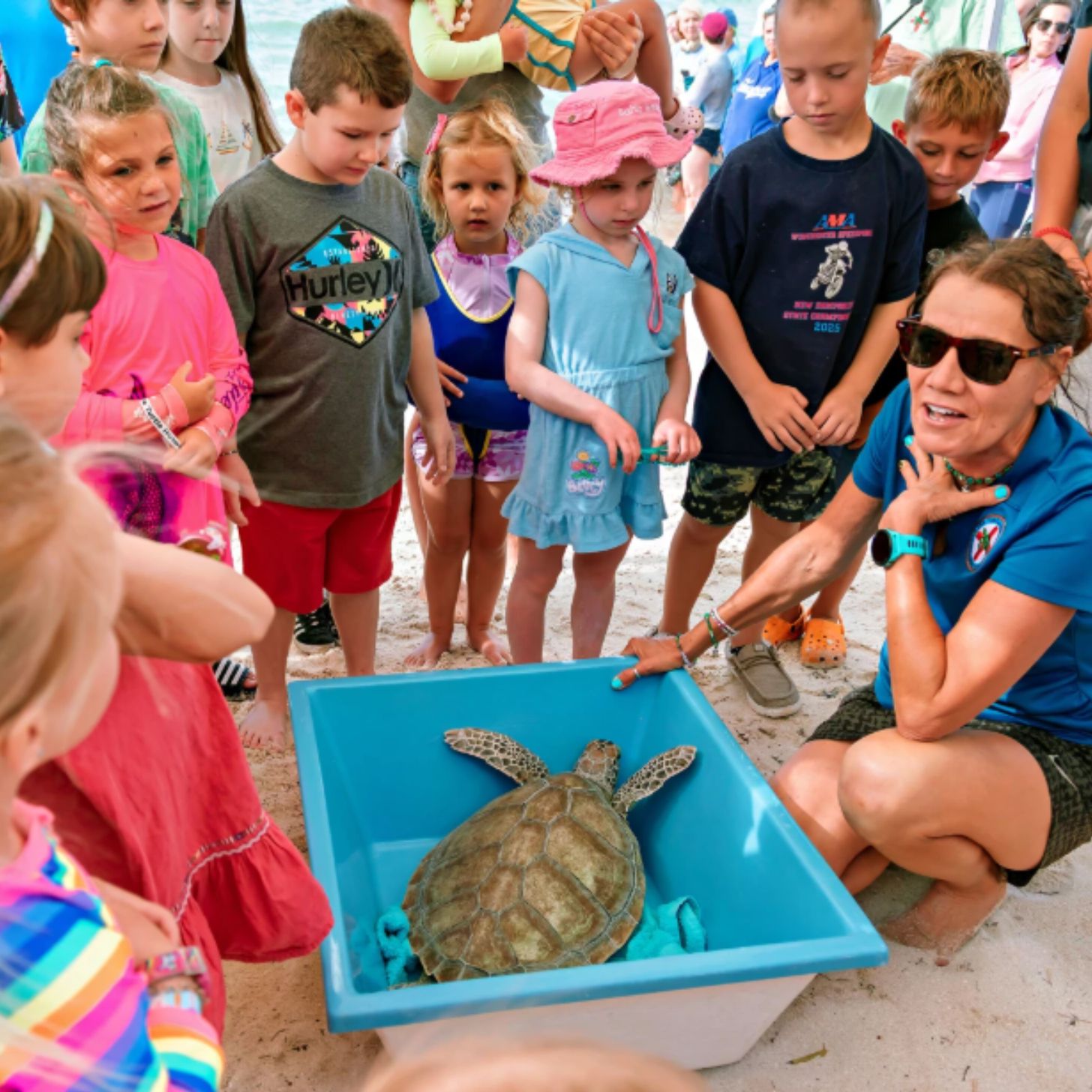
For Zirkelbach, it was an emotional moment that tied back to a recent, more global achievement.
“We recently saw astronauts go to the moon,” Zirkelbach said, in reference to the Artemis II space mission. “And there are amazing pictures. And they look back … and one memorable quote I heard from them is that they saw one planet, one living planet.”
“So, all of us are connected,” she said. “And it’s important to remember that today on Earth Day.”
You may also like: An endangered sea turtle spent 22 years recovering from a shark attack. Now, she's finally returning to the ocean
Header image via Natalie Danko / Photo Design by Natalie (Handout cleared for editorial use)
I used to teach high school science in Oklahoma, and one day I brought in a stalk from a cotton plant with bolls of cotton still attached. Students asked me why I glued cotton balls to a stick.
My students and I lived in a rural town surrounded by pastures of cattle and goats and fields of wheat, soybeans and cotton. I was amazed to learn how little my students understood agriculture. After a few related incidents, I started incorporating agriculture into my science classes.
When the United States was formed, about 80% of the population lived and worked on farms. Within a century the number had fallen to 40%. Today, less than 2% of the population lives on farms.
When most Americans lived on farms, agriculture was part of daily life. Most kids did farm chores, and planting and harvest seasons dictated the schedule of the school year. Today, most Americans are several generations removed from agriculture, and agriculture is seen as a career instead of a part of daily life.
As an agricultural extension specialist focused on horticulture, I’ve found that gardens can be an excellent teaching tool. By integrating gardens into schools, students can grow up learning about agriculture and the food systems that shape their daily lives.
Many researchers have cataloged the benefits of school gardens, and they go far beyond seeing how food grows.
Gardening for education
As people increasingly left the farms in the early 1900s and became disengaged from agriculture, a gap began to emerge between the public's perception of farming and the nuts and bolts of the practice.
In 1981, the U.S. Department of Agriculture created a task force to address agriculture illiteracy. This task force resulted in the formation of the National Agriculture in the Classroom program, which provides educators with lessons and tools to improve students’ understanding of raising farm animals and crops, including gardening.
Gardening also has benefits beyond agricultural literacy. For very young children, gardening increases hand-eye coordination, which is linked to success in handwriting, math, and reading. Gardening, instead of sitting in a classroom, increases students’ physical activity during the school day.

During a typical indoor class, children sit about 84% of the time. While in the garden, children sit only about 15% of the time.
Getting outside and doing hands-on learning is more engaging than sitting in a classroom passively learning by lecture, because active learning engages more regions of the brain, resulting in better understanding and retention of concepts. Active learning also allows students to follow their own curiosity, which motivates them to learn and remember concepts.
A study showed that allowing more individual freedom in gardens led to an increase in positive attitudes toward school. Children involved in school gardening are also more active outside of school hours.
While working in a garden, students are involved with science and nature, and that involvement leads to more science literacy and positive attitudes toward science and the environment.
Gardening is, in essence, a science experiment with variables, such as water, temperature and sun exposure. Each variable has an effect on the success of the garden. Manipulating the variables and seeing the resulting consequences boosts students’ science process skills.
Gardening fosters life skills, such as teamwork, patience, self-confidence, and responsibility.
School gardening also promotes an increase in vegetable consumption. If students grow something, they’re more likely to eat it.
Challenges with school gardens
However, establishing and maintaining a school garden program isn’t easy.
Many teachers feel they don’t have the time or funding to use gardening in their teaching, especially when their districts set goals based on test performance.
Many teachers also report they don’t feel confident enough in their understanding of gardening to teach it effectively.
Gardens don’t have to be flashy or expensive to help students learn, but they still cost some money that schools may not have. Space can also prove an issue, because some school administrators see even tiny gardens in 5-gallon buckets as encroaching on their schools’ playgrounds.
Aesthetics can create another hurdle. Many administrators whom I’ve spoken to think school gardens are messy, and rightfully so. Often they have weeds, they don’t look well manicured like a botanical garden, and a lot are neglected during the summer.
But that messiness is how students learn. Students grow their skills when they have the freedom to experiment with different gardening techniques, see how much room different plants need to grow, and determine what variables they will have to rethink for the next growing season.
If volunteers or teachers visit after the students and clean up or fix their mistakes, the students don’t see the outcomes of their decisions, and they don’t see any reason to change the inputs or growing methods.
Through gardening, students can gain an appreciation for farmers and their food supply. When coupled with lessons about agricultural systems, students learn to make informed food purchases and better understand the economic and political challenges that farmers face.
And nothing beats a garden-grown tomato.

This article by Shelley Mitchell from Oklahoma State University was originally published by The Conversation.
Header image by RDNE Stock project via Pexels