Canada’s Wood Buffalo National Park is the largest in the country, home to species like wood bison, whooping cranes, and wolves. It spans an area the size of Switzerland.
Naturally, there is a lot that has not been explored very much inside a park that size.
One natural marvel that many don’t even know about — despite the fact that it can be seen from space — is the world’s largest beaver dam.

The dam, which spans nearly a half mile (or about 800 meters), is located in the middle of the park. It’s isolated from most human foot traffic; in order to see it, visitors would need to trek for days through wild landscape or pay for a private sightseeing tour via plane.
Before satellite imagery by Jean Thie, a landscape ecologist in the area, was shared with the media in 2007, no one knew the dam existed, including the officials running the park. According to Yale 360, until a reporter called park officials for comment, they had no idea of the dam’s existence. None of the personnel have ever visited it on the ground to this day.
In fact, only one person is recorded to have traveled on foot to see the dam, Rob Mark, who successfully trekked there in July 2014, after three years of planning.
It’s hard to understand the scale of the dam, so Parks Canada has tried to articulate it through comparisons. It’s the length of seven football fields, officials say.

And the surface area of the dam is approximately 8,342 square feet (or 775 square meters). That’s about 1,600 hockey rinks full of water.
While the size of the dam is in fact astonishing, what may be most impressive is beavers’ natural "engineering" skills. This dam in Wood Buffalo National Park holds back runoff water from the Birch Mountains, protecting the lands from extreme flooding.
Beaver dams have long been shown to help the environment by slowing water flow and reducing the severity of both floods and droughts, as well as filtering pollutants in aquatic ecosystems and helping to create rich wetland habitats.

“Beaver dams act as natural filtration systems, trapping sediment and pollutants, thereby improving water quality downstream,” the World Wildlife Fund explains.
“This filtration process helps to remove excess nutrients and contaminants, benefiting both aquatic ecosystems and communities.”
Although North American beavers exceeded 100 million in the 1600s, the population has fallen between 6 million and 12 million today. Seeing signs that beavers in Wood Buffalo National Park are thriving in their habitat is an encouraging sign — at least to Thie, who was the first to document the world’s largest dam.

“Of course, I’m not very positively minded about our own future on the planet. But I am an optimist about beavers,” Thie told Yale 360.
“Their presence improves water management, reduces water flows, reduces the loss of runoff, and creates and improves wetlands. In drier landscapes of the future, all this could be of benefit. I think the worldwide flourishing of beavers is a small step in a good direction.”
You may also like: A real-life 'good news' story inspired Pixar animators to make 'Hoppers'
Featured Image: Deborah Freeman/Wikimedia Commons (CC BY-SA 2.0)
- Scientists have formally described Mus dumbara, a new species of spiny mouse from Sri Lanka’s Dumbara or Knuckles Mountain Range after years of waiting.
- Collected for the first time in 2004, it took more than two decades of morphological and genetic analysis to establish it as a distinct species from the other spiny mouse species found in Sri Lanka.
- Subsequent efforts to find fresh specimens of the elusive mouse proved unsuccessful, despite around 1,900 trap nights in the area, leaving scientists with limited information about its current population and distribution.
- Found only from a small area of the Knuckles Range so far, the discovery highlights the island’s overlooked biodiversity of small mammals and the need for further surveys to understand the species’ ecology and conservation needs.
COLOMBO — As dusk settled over the paddy fields at Puwakpitiya, a village on the northern edge of Knuckles Mountain Range locally known as Dumbara mountains in Central Sri Lanka, researchers began laying traps along the uneasy boundary between farmland and forest.
They were targeting small terrestrial mammals moving through the landscape. On the ground, drift fences were created to lead animals to pitfall traps, while box style Sherman live traps were baited with feed.
But the usual rodent lure — peanut butter — failed to attract the mice in Sri Lanka, so the researchers instead turned to something more familiar to the local mice — pieces of burnt coconut.
On March 11, 2004, one of the pitfall traps caught a small mouse that looked different. Six days later, a second specimen was caught in a baited trap. Both were females, not larger than a child’s palm, with fulvous-gray pelage broken by spiny guard hairs and a slender, naked tail longer than the head and body.
Externally, the animal resembled Mayor’s mouse (Mus mayori), a species endemic to Sri Lanka’s highlands, but differed in tail length and head shape, offering initial clues about a new species.

The two mice remained a scientific mystery for more than two decades, but careful genetic and morphological evidence finally confirmed what researchers had suspected all along, and they soon introduced a species new to science. It’s been named Mus dumbara, commonly known as the Dumbara valley’s spiny mouse, a name that links the rodent to its locality.
Sri Lanka is home to 16 species of rats and mice with six of them endemic. The new discovery adds another endemic mammal to Sri Lanka’s list.
An elusive new rodent
“The Dumbara spiny mouse looks elusive,” said study lead author Suyama Boyagoda, current head of the department of zoology and chairperson of the board of study in zoological sciences at the Postgraduate Institute of Science, University of Peradeniya. At the time of discovering the spiny mouse, Boyagoda was researching shrews in Sri Lanka for her Ph.D.
“In 2014 and 2015, I returned to the same locality and setup a number of traps, but despite the investment of 1,900 trap nights employing the same trapping methods, we failed to find a mouse similar to the first specimen,” Boyagoda told Mongabay.

The new species belongs to the subgenus Pyromys and can be distinguished from its closest Sri Lankan relatives, Mus fernandoni and Mus mayori, by a combination of physical characteristics, she said. Its tail is distinctly longer than its head-and-body length. Its hind feet have pinkish-white toes, while the remaining dorsal surface is covered by a mixture of fulvous-brown, gray, and white hairs.
The skull provided additional clues as M. dumbara has a moderately prominent ridge above the eye socket, known as a supraorbital ridge. The strongest evidence came from the DNA showing more than 11.7% genetic divergence between M. dumbara and the other two species, Boyagoda noted.
Sri Lanka and India’s Western Ghats together form one of the world’s most recognized biodiversity hotspots. Although temporary land connections across the Palk Strait linked the island with southern India during Pleistocene glacial periods, Sri Lanka’s wildlife has remained isolated for long enough to evolve along a distinct path.
This is particularly evident in the island’s wet-zone and montane forests, where exceptional levels of endemism have developed, said Madhava Meegaskumbura, a Sri Lankan evolutionary biologist and researcher at Guangxi University in China.

Meegaskumbura, a co-author of the new study, was among the initial research team and, in fact, collected the first specimen of this elusive mouse along with Sri Lankan biologist Mohammed Bahir.
Less researched small mammals
“In recent decades, scientists have described numerous new species of frogs, lizards, and freshwater crabs. Mammals, however, have produced comparatively few such discoveries, partly because they tend to be larger and more readily detected. The discovery of Mus dumbara adds another species to this relatively short list of recently recognized Sri Lankan mammals,” Meegaskumbura said.
So far, M. dumbara has been recorded from just one valley in the Knuckles Range, leaving considerable uncertainty about its true distribution and population size. The species may occur in other forest fragments that have not been surveyed, or survive at very low densities, or may have experienced a decline since the first specimens were collected, Meegaskumbura noted.
Even though Knuckles Range is a UNESCO World Heritage Site with formal protection, less conspicuous mammals can easily be overlooked in conservation planning. Habitats along the forest margins remain particularly vulnerable to road construction, land clearance, encroachment, and the expansion of plantations.

For a species apparently restricted to a limited elevational range, these pressures could be compounded by climate change, which may reduce the availability of suitable habitat and potential refuges, Boyagoda added. Given the limited information currently available, Meegaskumbura added that M. dumbara should be treated cautiously as a species potentially at risk of extinction until further surveys establish its actual distribution and population status.
“Very little research has been carried out on Sri Lanka’s small mammals, and several important gaps remain, where we need extensive island-wide surveys to understand their distributions and habitat associations and to determine whether undescribed or overlooked species like Mus dumbara remain,” said Sampath Goonatilake, a researcher with IUCN Sri Lanka who studies small mammals.
“One of the biggest needs is a comprehensive taxonomic revision, using both classical taxonomy and modern phylogenetic approaches, to clarify the identity, classification, and evolutionary relationships of the species we currently recognize.”
“The lack of research is partly because studying small mammals is demanding and expensive as researchers may have to spend weeks or even months in forest habitats to obtain enough samples, creating substantial logistical and fieldwork costs, Goonatilake told Mongabay.
There are also relatively few up-to-date identification guides for Sri Lanka’s small mammals, which makes accurate field identification more difficult. At the same time, these animals tend to attract less attention from researchers and students than larger or more charismatic mammals.
Addressing these gaps will require sustained funding, as a comprehensive taxonomic and island-wide research program could cost several million rupees, so collaboration among Sri Lankan universities, government agencies, museums, and international research institutions, supported by external research grants and international funding, will be essential.
This article was originally published on Mongabay.
Featured Image: Suyama Boyagoda/University of Peradeniya
Charles Fain says his three favorite letters in the alphabet are D-N-A.
In 2001, Fain was exonerated and released from an Idaho prison after nearly 20 years on death row for a rape and murder he did not commit, using DNA analysis. After his release, the Idaho Innocence Project helped police identify the true perpetrator and got Fain a certificate of innocence and compensation for wrongful conviction.

The Idaho Innocence Project has been shuttered for more than two years because of a lack of funding. However, on Sept. 17, Fain joined Innocence Project founder Greg Hampikian and fellow exoneree Amanda Knox to usher in a new group continuing the work of overturning wrongful convictions.
Knox sits on the board of The Innocence Center, a nonprofit, free law firm based in San Diego that will take on cases in Idaho to try and free wrongfully convicted inmates.
Hampikian, a forensic DNA expert, also lent his expertise to Knox’s defense team in the highly publicized case and helped free her from an Italian prison after she was wrongfully sentenced for the murder of her roommate while studying abroad.
“It would be a desperate situation if these projects didn’t exist,” Knox said in an interview last week in Boise. “And when I heard that the Idaho Innocence Project was shutting down, I was really, really worried for the state of Idaho, because who else is going to do it?”
The Innocence Center Executive Director Mike Semanchik was admitted to the Idaho bar on Sept. 18 so that he may work as an attorney for these cases in Idaho.
“We’re committed to making this happen and making sure that wherever there are innocent people in prison, there’s an organization to support them,” Semanchik told a small gathering last week to kickoff the new work.
Hampikian said he personally selected The Innocence Center to take up the work.
“My last great act, after 20 years of the Innocence Project, was to choose a successor,” Hampikian said. “… [Semanchik] said, ‘I’ll get barred in Idaho, and I’ll take the cases until we raise the money.’ And I was like, ‘Oh, this guy’s got skin in the game.’”
Edward Stevens, who was sent back to prison after being released, will be first case
Semanchik announced that the center’s first Idaho case to review would be for Edward Stevens — a man convicted of the 1996 killing of an 11-month-old in Ada County, who was released in 2018 and sent back to prison in 2019, the Idaho Statesman reported.
Hampikian, who was not involved in Stevens’ case but knew his mother, walked Stevens back into prison.
“We drive to the prison on a Sunday afternoon, and nobody could face walking back in except me,” Hampikian told the Idaho Capital Sun. “It was just a horrific experience.”
Stevens was caring for his girlfriend’s 11-month-old son in late December of 1996 when the child sustained a serious head injury and died the next day in the hospital, the Associated Press reported.
Prosecutors said Stevens shook the child and hit the child’s head on the bathtub. Stevens has said the child was injured in an accidental fall down the stairs.
Stevens previously appealed his murder conviction and lost, and appealed again to Idaho’s U.S. District Court in 2014. A U.S. magistrate judge later ruled that Stevens had to be released or re-tried because prosecutors failed to disclose some favorable evidence to Stevens’ attorney.
A panel of Ninth Circuit Court of Appeals judges overturned the release in 2019, ordering him back to prison. Stevens is serving a life sentence at a prison in Orofino, according to Idaho Department of Correction records.
Wrongfully convicted individuals can apply for assistance from the Innocence Center by filling out its application form. To qualify, they must have received a conviction and are currently incarcerated, are factually innocent, and have new, strong evidence of innocence.
After review, the firm will decide whether to take on the case.
Semanchik: It ‘takes a village’ to free a wrongfully imprisoned person
Semanchik told the gathering last week that community support would be crucial to continuing where the Idaho Innocence Project left off.
“This work takes a village,” he said.
The Innocence Center has freed 43 people. The average time the center’s clients spend in prison before being released is about 16.5 years, he said. Some are released after more than 30 years, he said.
Hampikian said he ran into problems with funding because a full-time lawyer needs to be on staff. Over the two decades he ran the Idaho organization, he had to pause work a couple times because of funding gaps. In 2024, he had to cease work completely.
The project operated with about $100,000 a year, he said.
“Those were very, very, very difficult times,” Hampikian said. “I am hopeful that I will never run a nonprofit again in my life. I much prefer doing science.”
Knox said that, despite spending four years in prison for a murder she didn’t commit, she had an easier time being released than many of her counterparts in the U.S. She noted that appeals of Italian criminal convictions are easier to obtain, and juries there must provide a “motivation” for the sentence.
That motivation document gave her defense team something to work against.
“You have to get out to make your life back, and it is so hard to get out once you’ve been convicted,” Knox said. “I have to say one thing for the Italian justice system: It’s actually a lot easier to get out once you’ve been convicted.”
Knox noted that the work to free people in the U.S. can take decades, and it’s not easy.
“It is heartbreaking work,” she said. “It will take and take and take from you, but in the end, there is another human being and another life that is saved on the other side.”
This article was originally published by Idaho Capital Sun.
Featured Image: Laura Guido/Idaho Capital Sun
Since 1977, the Sheldrick Wildlife Trust has led one of the biggest rescue and rehabilitation wildlife operations in East Africa. Although they specialize in elephant care, their sanctuaries are home to a variety of animals that arrive orphaned or injured, including giraffes, zebras, and rhinos.
“Rhinos are special animals,” Edwin, a keeper at the Sheldrick Wildlife Trust, said in a video update posted on September 22. “Although the population in our country is steadily increasing. At the moment, Kenya has got more than 2,000 rhinos, which is really good. And we are happy for that.”
To date, the Sheldrick Wildlife Trust has rescued and successfully rehabilitated 20 rhinos. One black rhino currently under their care is Tytan, who was orphaned at an early age.
“[His] mother died after falling down a cliff, and at eight months, he could not have survived,” Edwin explained in the video. “That’s why we had to bring him into the nursery. If he would not have been identified at eight months, the hyenas [and] the lions would have been excited to find him out in the wild.”
One week after Tytan was rescued, a tiny orphaned zebra was found and transported to the same nursery in Nairobi.

“Her mother had succumbed to the same fate, falling off a cliff,” the Sheldrick Wildlife Trust explained on its website. “Tytan and Notty, as we named her, became best buddies and have been inseparable ever since.”
Every day, Tytan, Notty, and the rest of the “herd” are released into the nearby park to explore and graze.

Every night, Tytan returns to the nursery to drink milk, snack on alfalfa, and sleep on a bed of hay as a keeper watches over him.
Eventually, when Tytan reaches five years of age, his keepers will begin leaving his stockade open, so he can have the option to stay out in the park overnight.
Over time, he will return less and less as he naturally becomes more solitary and carves out a territory for himself in the wilds of Nairobi.

“He’s only one and a half years old, and he’s lucky to be with us now — lucky to be alive,” Edwin said. “And expected to go back into the wild after some time.”
But, for right now, Tytan spends his days “grazing happily in the forest.”
“Despite his physical prowess, Tytan remains an immature rhino who enjoys regular naps on the forest floor with Notty and his keepers on sentry duty.”
On September 22, the Sheldrick Wildlife Trust shared a video of Edwin checking in on Tytan and another black rhino, Maxwell, as Notty dutifully followed his friend around the sanctuary.

“Maxwell, who is permanently blind and has a forever home with us, is our beloved nursery patriarch,” the nonprofit explained in the Instagram caption. “Tytan, who was only rescued last year, is just beginning his journey with us and will one day return to the wild.”
In the comments section, one Instagram user asked: “Do any of the other animal orphans ever make their way back to you guys the way ex-orphan elephants sometimes do?”
“Yes,” the Sheldrick Wildlife Trust responded. “Many ex-orphans of all species continue to visit us throughout their wild lives!”
You may also like: After an elephant was killed, Kenyan rangers searched for its baby for three weeks straight: 'He will never be alone again'
Featured Image: Sheldrick Wildlife Trust
On January 4, rangers and wildlife caretakers at the Sheldrick Wildlife Trust woke up to devastating news: Their coworker, Kirsty van Zeller — who had helped care for orphaned elephants for over a decade — had passed away after a three-year battle with cancer.
That same day would soon prove to be life-changing for a baby elephant in grave danger.

Three days prior, the conservation organization had received reports of an elephant calf who was roaming alone, limping from a severe poaching injury.
Footage from the Kenya Wildlife Service confirmed that she had a snare tightly wound around her front left leg. The Sheldrick Wildlife Trust’s helicopter pilots launched into action, leading an aerial-and-ground search effort for the calf, but coming up empty day after day.
After a “fruitless” three-day search, rangers began to grow hopeless.
Coincidentally, the morning after Van Zeller passed away, the elephant was finally spotted and restrained by two rangers, Taru and Roan.
“This was no small feat: She was about two years old, completely wild and propelled by adrenaline,” the Sheldrick Wildlife Trust stated on its website.
As Taru held her, Roan cut the rope snare away.
“This was when the full extent of her injury became clear: The snare had sliced through an artery,” the nonprofit recounted. “It had been acting like a tourniquet, and once removed, the wound started spouting blood.”
As they waited for help to arrive, Roan managed to pinch the artery closed while Taru held her still. Soon, wildlife veterinarian Dr. Lawi arrived on the scene to sedate her.
“First, he had to clamp and fold the affected artery before suturing it firmly closed,” the Sheldrick Wildlife Trust explained. “This effectively stopped the bleeding.”
From there, the calf — who they named Lamuu — was airlifted to a nursery near the Tsavo East National Park in Kenya.

For months, Lamuu’s wound was monitored closely as she settled into her new home with other orphaned animals.
“Given her age and the ordeal she had been through, we expected Lamuu to be very wary of people,” the nonprofit explained. “However, she just seemed relieved to be helped and in safe hands. She took to her keepers right away, accepting a milk bottle and approaching them with a friendly, outstretched trunk.”
Lekoli, a senior keeper at the nursery, was put in charge of Lamuu’s day-to-day care.
“Lamuu soon became extremely attached to him, padding quietly behind him like a shadow. During the initial weeks when she was on ‘bed rest’ in her stockade, she was a model patient, proffering her injured leg to Lekoli for daily cleanings and green clay treatments.”
Shortly after Lamuu was rescued, another orphan arrived at the Sheldrick Wildlife Trust’s Kaluku Unit.

“Like Lamuu, Subi came to us with serious injuries — she had been speared in the shoulder and found abandoned and alone,” the organization stated. “Given their shared experiences and the fact that they were recuperating in stockades close to each other, these girls became instant best friends, supporting each other through their respective healing journeys.”
“As the weeks passed and their wounds improved, their world expanded from bed rest to small jaunts around the compound, before they finally joined the rest of the Kaluku herd out in the bush.”

For the Sheldrick Wildlife Trust, Lamuu’s heart-pounding rescue will always be tied to Van Zeller’s passing — and the caring legacy she left behind.
“Lamuu stands out as one of our most dramatic orphan rescues in recent history. Severely injured by a snare, finding her was an odyssey in itself,” the Sheldrick Wildlife Trust said.
“We feel sure that a guardian angel was watching over this little elephant, making sure she ended up in safe hands — a guardian who has been very present throughout her remarkable recovery, too. In our minds, Lamuu is inextricably linked to Kirsty forever.”
You may also like: A baby rhino and baby zebra bonded after they lost their mothers to the same fate: 'They've been inseparable ever since'
Featured Image: Sheldrick Wildlife Trust
- In June, a team of researchers working in Côte d’Ivoire’s Taï National Park spotted a Ghana cuckooshrike, a bird that hadn’t been seen in 13 years.
- The bird’s home range in West Africa’s Upper Guinean rainforest has been whittled away by logging and agriculture, leaving a patchwork of disconnected forests.
- The ‘rediscovery’ shows the value of conserving places like Taï, where mining and illegal hunting also pose threats.
- The finding relied on close collaboration with West African researchers, the experience and knowledge of the team, and the Ghana cuckooshrike’s listing by the Search for Lost Birds partnership.
When Paulo Ditzel first laid eyes on the bird, he knew he’d seen something special: a vibrant orange body with yellow and black wings and tail feathers, topped by a dark head set off by almost-whimsical splashes of copper on its cheek.
“My brain registered, it’s the Ghana cuckooshrike,” Ditzel, a field research fellow with the International Bird Conservation Partnership (IBCP), tells Mongabay. A surge of excitement rippled through him, he says. Still, the sighting also immediately sparked “the most chaotic calm,” as he stood next to his partner and teammate Stephanie Bartlett on a bridge not far from an ecological research station in Côte d’Ivoire’s Taï National Park.
“OK, what do I do?” he says he remembers thinking. “Priority right now is that Stephanie gets a picture.”
Over the next few moments, Ditzel locked onto the bird with his binoculars and called out its movements to Bartlett, also an IBCP field research fellow. In almost-choreographed coordination, Bartlett trained her camera lens on the branches across the stream and pressed the shutter button.
“I got a photo of the bird before I saw it,” Bartlett says. In six months of bird surveys in West Africa supported by U.S.-based IBCP, she says, she’d come to expect only fleeting glances of the region’s birds. “They’re scared of you. You don’t get to get close to them, and so often you have to use the camera as a tool for identification.”
“If I had seen that bird with anyone else, it wouldn’t have worked out, and we would not have gotten a picture,” Ditzel adds. “We have this perfect little way.”

That afternoon, Bartlett and Ditzel had gone out for a stroll to look for birds in this recess of Taï National Park, as they have in countless other places around the world for years. Nearing the end of their expedition across four West African countries, they entertained only a faint idea that they might catch a glimpse of Lobotos lobatus — the Ghana cuckooshrike, or sometimes the western wattled cuckooshrike.
The bird had turned up in parts of West Africa’s Upper Guinean rainforest as early as the 1970s. Ornithologists figure its range stretches from Sierra Leone and Guinea in the west to Côte d’Ivoire and Ghana in the east, often in the canopy of primary forest but also in logged forests and plantations. The last verified sighting was in Ghana’s Atewa Forest in 2013.
On that day in June, however, there it was, moving through the forest crown with chestnut-capped flycatchers (Erythrocercus mccallii) and a white-breasted nigrita (Nigrita fusconotus) — a “mixed-species flock” in ornithologists’ parlance.
As Bartlett took photos and video, Ditzel ran back to the station to get their colleagues.
By the time they arrived, the cuckooshrike had disappeared. The team scanned the canopy for a few moments, but rain looked imminent, so they left Bartlett and Ditzel on the bridge and headed back to the station.
Not long after, the bird reappeared and snatched a fuzzy white caterpillar. Then, just as quickly as it appeared, it was gone. The team didn’t see the bird again, even on a 15-kilometer (9.3-mile) hike through the forest the next day.
Still, they had snapped “probably the best photos ever taken of this bird,” says John Mittermeier, who is based at the American Bird Conservancy (ABC) and director of the Search for Lost Birds, a global partnership of conservation organizations promoting bird species not recorded in a decade.
Ditzel and Bartlett say luck played a role in their success. But Nico Arcilla, IBCP’s president and research director who’s based in Sweden, says they had “the technical skill” to spot the bird and document it.
Arcilla notes that rarely seen birds are often small and nondescript. But the Ghana cuckooshrike is “super flashy.”
“It’s just such a beautiful bird,” she adds.

But why did such a striking bird drop off scientists’ radar for so long? And perhaps more importantly, how might researchers ensure that the species survives?
Its reappearance after 13 years suggests that ongoing efforts to protect places like Taï National Park are critical, the researchers say. Taï is a stronghold of wildlife habitat in the Upper Guinean rainforest. But logging and agriculture have whittled that expanse down into fragments of standing forests scattered across the once-formidable range. Even places like Taï face ongoing threats: Protectors there struggle to keep artisanal gold mining and illegal hunting out of the park.
The sighting of the cuckooshrike, however, is proof to Yendoubouam Kourdjouak, IBCP West Africa project manager and a member of the expedition team, that protection efforts must be redoubled and populations monitored.
“This rediscovery proves that the bird is not extinct,” says Kourdjouak in a text message to Mongabay. “[I]t’s also a positive sign for local biodiversity and offers hope for conservation efforts within Taï National Park.”

‘Impactful’ fieldwork
By the time Ditzel, Bartlett and the team arrived in Côte d’Ivoire, they had noted the cuckooshrike’s listing by the Search for Lost Birds, and they knew Taï would offer them a chance to see it.
Still, Bartlett says, “I’m like, this is never gonna happen.”
By the time they arrived at the ecological research station on the afternoon of June 19, they had driven along winding and jarring roads — when there were roads to take. The researchers say they would often hope to find a village so they could get directions to the next passable bridge that would get them a little closer to the park.
“It’s the least glamorous fieldwork you could be doing,” Bartlett says, “but the most impactful.”
Working with IBCP has sparked a passion for birds in Kourdjouak, who is from Togo, so much so that he says he plans to pursue a master’s degree related to ornithology to complement his undergraduate studies in zoology. At the research station, however, he stayed behind when Bartlett and Ditzel went birding. On that afternoon, the team’s car needed servicing, and he had clothes to wash.
In six months of traveling through four countries, Bartlett, who is from the U.S., and Ditzel, who is from Brazil, had come to realize the crucial roles that Kourdjouak and their West African teammates play in bringing birds like the Ghana cuckooshrike to the broader attention of the global birding community.
They secured official documents and sorted out the logistical minutiae for road trips that took days to reach research sites. Along the way, they provided critical links to local communities and park guards and helped sort out basic needs.
“To say they were vital for this project is an understatement,” Ditzel says.

Kourdjouak and the rest of the team didn’t catch a glimpse of the cuckooshrike on that June day. Even Bartlett and Ditzel only had a couple of good looks at the bird over the 10 or so minutes they spent with it.
And for now, those observations — of the bird traveling with other species in the canopy or eating that caterpillar — add to the scant observations compiled by earlier researchers. Older reports suggest it makes a soft “tisk, tisk” sound, but recordings of its vocalizations don’t exist.
“Taï is a treasure for biodiversity conservation in Côte d’Ivoire and indeed throughout West Africa,” says Saint Guillaume Odoukpe, an ornithologist and assistant professor at Côte d’Ivoire’s Université Félix Houphouët-Boigny who organized and accompanied the IBCP expedition in the country. “I think there is plenty more to discover in this forest.”
A key goal of the team’s expedition was to scout areas where researchers could return, as well as to develop and strengthen connections with the researchers and communities that make the work possible.
It’s in places like West Africa, with vibrant birdlife but a paucity of recent documentation, that the Search for Lost Birds initiative can be particularly helpful, Mittermeier says.
“We have this sense sometimes [that] there’s nothing left to explore,” he tells Mongabay. “But actually, there’s so many things left to explore, and in a way, these lost birds are a call to exploration.”

‘Lost’ — and found
When the Search for Lost Birds was started in 2021, bringing together ABC, BirdLife International and the U.S.-based conservation NGO Re:wild, the aim was to inspire action to find species that hadn’t been documented by Western science in at least a decade. Understanding where — or in some cases, if — these species persist is a critical first step in protecting them, Mittermeier says.
“You can’t really make an effective conservation plan for a species that nobody’s seen in 10 years,” he adds. “You’re not sure how it’s doing. You’re not sure where it is. So the driving force from our side is saying, let’s collaborate with the global birding community.”
With the advent of apps like eBird and Merlin Bird ID, anyone with a smartphone can now contribute to global ornithological knowledge. The statistics demonstrate the impact that crowdsourcing data can have: Of the more than 11,000 known species of bird, as of September 2026, only 114 of them have escaped documentation in the past decade, Mittermeier explains. And of those, around 70 have never been photographed at all.
“We have all this amazing power as birders and conservationists around the world submitting all these records,” Mittermeier says. Given the tools at the fingertips of birders and ornithologists, he adds, it seems as if there shouldn’t be any of “these question marks on the map.”
And yet, these lost birds exist, so every opportunity to remove one from the list is momentous.
“Anytime one gets found, it’s just such a cool and exciting result,” he says, and the sighting in Taï was particularly so. “The fact that they were aware of this species as a lost bird and thinking of it as something to look out for is wonderful because that’s really what we want — to highlight these gaps to the community and have people be aware of them.”

A variety of factors help explain why birds disappear from the photographic record for years, decades or longer in an age of ubiquitous camera phones and an ever more sophisticated birding community comprising professional ornithologists and sleuthing citizen scientists.
Their populations might be quite low, or they might be extinct altogether. In his own fieldwork, Mittermeier has pursued the Makira moorhen (Gallinula silvestris) for months in the forests of the Solomon Islands in the South Pacific. It’s a species known from only one specimen, and it hasn’t been seen in almost 100 years.
“If there was one species that I wanted a miracle rediscovery for, I’d probably pick that one,” he says.
Still, he acknowledges it might never be found.
“The reality is that some of them are going to be extinct,” Mittermeier adds. “As tragic as that is, that’s also a really important story to tell.”
In other cases, Mittermeier notes, lost birds might be “taxonomic mysteries.”
“We have a few examples of birds that are known from a single specimen, described sometimes over a century ago,” he says. “Is this a species, or is it a hybrid, or is it some form of something else?”
Behavior can also help birds evade binoculars and camera lenses pointed in their direction. In the cuckooshrike’s case, its preference for the canopy means it’s hard to find. “Despite the fact that it’s got these incredible bright colors, it’s a really tricky bird to pin down,” Mittermeier says.
And geography can also play a role, as in the case of West Africa.
“There’s so little actual fieldwork happening [there] with birds,” Ditzel says. “There’s a lot of birds that are completely underrepresented in the science.”

Of course, it’s often a combination of these factors, some of which are outside the control of the ornithology community. Groups like ICBP can help address gaps in understanding, which can start with spotting a bird like the Ghana cuckooshrike. Such exciting findings help make the case for its continued protection — and clarify how little is known about birds in the region.
“It encapsulates just how beautiful and amazing all this life in West Africa is,” IBCP’s Arcilla says. Still, it also underscores the stress the region’s forests face, increasing the urgency to document more species and their behavior. Ditzel and Bartlett say they plan to return to West Africa and to Taï for more fieldwork in the next year. And for Arcilla, the cuckooshrike sighting offers a glimmer of hope mixed with a dose of pragmatism.
“It’s there for the finding. It’s there for the discovery, and it can still be saved,” she says. “But all of these forests, these habitats, this wildlife, all of these birds are very, very threatened.”
Featured Image: A Ghana cuckooshrike in Côte d’Ivoire. Image by Stephanie Bartlett.
Written by John Cannon. John Cannon is a staff features writer with Mongabay. Find him on Bluesky and LinkedIn.
This article was originally published by Mongabay.
Nick Blanchard tumbled out of bed and poured himself a cup of ambition Friday morning, then headed straight to a table in front of the Wake County Express Library in downtown Raleigh, North Carolina.
Blanchard and his friend Kelly Forbes were presiding over a children’s book drive to honor the late music icon and philanthropist Dolly Parton.
Gov. Josh Stein declared September 25th, or 9/25, officially “Dolly Parton’s Imagination Library Day of Reading” across North Carolina in memory of the Tennessee musician, her hit song “9 to 5,” and her philanthropic generosity to Helene victims as well as young readers.
Parton’s Imagination Library, launched in 1995, has delivered more than 300 million free books to children around the globe.
In North Carolina, the initiative has delivered 25 million free books to children in all 100 counties.
“I had an idea of just doing something in Dolly’s honor,” said Blanchard. “She was so entrenched with children’s literacy. And I thought this would be a good opportunity for us to all get together and give books.”

On this day, all the books collected by Blanchard and Forbes will end up in little box libraries in five neighborhoods across the city.
“You can’t get along with this world without reading,” said Blanchard. “Dolly really wanted to get people involved in reading from birth. And that’s why we’re collecting so many different kinds of books.”
Forbes said she welcomed the chance to be a part of the inaugural event, getting her employer Team Triangle Realty to donate books, and even sponsoring one of the little libraries.
“I do absolutely love [Dolly] and everything that she stands for,” said Forbes. “What a good person she was! And we love to honor her memory this way.”

Forbes said a beautifully illustrated, physical book can open the world of reading to a young person at a time when too many people are fixated on screens.
“I think that it’s sad that people use screen time to babysit their children,” said Forbes. “Picking up a book for a kid is fabulous.”
While Parton died at age 80 on Aug. 25, her dream of sending a free book every month to children from birth until they reach 5 years old is still alive through The Dollywood Foundation.
Here’s where parents can subscribe at no cost.
This article was originally published by NC Newsline.
You may also like: 24 Most Inspirational Dolly Parton Quotes About Life & Love
Featured Image: Clayton Henkel/NC Newsline
This story was originally published by The 19th.
These Texas advocates call themselves “lionesses” for a reason: They say backing down is not in their nature.
In 2022, a small group of formerly incarcerated women formed the nonprofit Lioness Justice Impacted Women’s Alliance to empower communities to challenge harmful practices within the criminal legal system. Since that time, they have put a spotlight on what they argue are dangerous conditions caused by extreme heat and cold in Texas prisons.
This week, Lioness, alongside two other organizations, won a major lawsuit against the Texas Department of Criminal Justice (TDCJ) after a federal judge ruled that the state must air-condition all Texas prisons by the end of 2029. This change would fall in line with rules that already require Texas county jails to maintain temperatures between 65 and 85 degrees.
In a 150-page order, U.S. District Court Judge Robert Pitman noted that roughly 88,697 incarcerated people were housed in unairconditioned units heading into summer 2026, meaning TDCJ provides “cool beds” for only about 37 percent of its population.
“It has been said that the degree of civilization in a society can be judged by entering its Prisons,” Pitman wrote. “As described below, the record in this case paints a clear picture: in a state where outdoor heat indexes exceed 130 degrees, inmates in Texas prisons are suffering — and in some cases dying — in extreme heat every summer.”
This, he argued, violates the Eighth Amendment, which prohibits cruel and unusual punishment. For the Lioness staff who spoke with The 19th, the judge’s order was a long time coming.
“We’ve been laughing and crying and celebrating, and also, you know, preparing because we know that this is just one step in the fight,” said Marci Marie Simmons, director of communications for Lioness. Simmons spent a decade incarcerated in a Texas prison and is intimately familiar with summers inside prison walls made of concrete and steel.
“I remember laying in my bunk — we weren’t allowed to lay on the floor in that prison — and I remember thinking, ‘I don’t know if I will survive this,’” Simmons said.
Lioness operates with a core team of one full-time executive director and four part-time employees, including Simmons, and they are all formerly incarcerated. The organization has grown into a network of about 500 members, including 400 who are currently incarcerated. They work to advance the health, safety and well-being of the estimated nearly 20,000 women and transgender people inside Texas prisons and jails, in addition to those navigating life outside.
Fighting to bring radical change to any state institution can be difficult, at best, and at times can feel insurmountable. But everything is bigger in Texas, including its prison system, which has more incarcerated people than many individual countries. That did not deter this group, Simmons said.
“Our organization is named Lioness, and there’s a reason for that. We move like the animal. Lionesses stick together; they stay together,” she said. “It’s that same tenacity and loyalty that a lioness has — that’s what we have that makes us capable of taking on, frankly, the largest prison system in the country.”
For years, letters had poured into Lioness’ mailbox, with incarcerated people sharing details of how the heat affected them. Sometimes, they “just wrote because they were hot, frustrated, sad and exhausted, and they felt forgotten,” Diane Thompson, Lioness’ director of member relations, wrote in an email to The 19th. “They needed somebody on the outside to hear them and to know what they were living through.”
Those stories were at the forefront of the Lioness staff’s minds as they entered the legal fight for air conditioning. In 2024, Lioness joined and expanded on an existing federal lawsuit filed a year prior on behalf of Bernie Tiede, a 65-year-old man with diabetes and high blood pressure whose health, he argued, had been affected by the heat. The Lioness lawsuit was filed jointly with two other organizations, Texas Prisons Community Advocates and Texas Citizens United for Rehabilitation of Errants.
Thompson kept meticulous notes on the heat-related letters. She logged the correspondence in a spreadsheet, listing the incarcerated members’ names and unit, the date they sent the letter, the heat-related issue they reported and any other notable details they might have included. She also saved the physical copies of the letters in a folder for future reference, Thompson said.
Judge Pitman referenced these letters at multiple points in his order.
“We are a membership-based organization. We include our incarcerated members in our decision-making. They lead our advocacy work,” Simmons said. “Because of the structure of our organization, that is what got us to the finish line in this case.”
Carlee Purdum, an associate professor of sociology at the University of Houston, who has researched how natural disasters impact incarcerated people, said she was overwhelmed to hear the news of the victory. “The immense pressure it’s going to relieve off of people’s health and on the entire system. I just can feel that,” she said.
She has studied the physical and mental toll extreme heat has taken on people in Texas prisons. “The most significant impact is just the helplessness and the dehumanization that a person feels,” she said. “It’s not being able to protect yourself and not being able to protect the people around you that you care about, and feeling like nobody else cares.”
In surveys Purdum has conducted, incarcerated people have described myriad health effects from the heat, including heat illness, passing out, and having seizures and rashes.
Wanda Bertram, a spokesperson for the Prison Policy Initiative (PPI), a nonprofit that researches prison conditions, said many people in prison also have physical conditions that make them more susceptible to extreme heat.
“Quite a few of them are taking psychotropic medications, which often are dangerous to be taking if you’re exposed to the heat for a long time. And the same goes for people with high blood pressure who are on hypertension medication,” Bertram said. A big portion of the population has diabetes and heart issues that make people more vulnerable to heat, she said.
A majority of incarcerated women who are in prison or jail have a chronic medical condition. Women are also more likely to report “serious psychological distress,” compared to men, according to the federal Bureau of Justice Statistics (BJS).
Purdum also conducted focus groups that included women from Lioness, who brought up having to deal with pregnancy and menopause in the extreme heat. U.S. prisons and jails see about 58,000 admissions of pregnant women each year, and studies have shown that extreme heat is linked to higher rates of preeclampsia, a potentially fatal blood pressure condition, and is associated with higher rates of premature and low-weight births.
The population of older incarcerated women is also growing, and experiencing perimenopause and menopause symptoms that include hot flashes and night sweats. The percentage of women over the age of 50 held in state and federal prisons grew from 8 percent in 2008 to 18 percent in 2023, according to data from the U.S. Bureau of Prisons.
While this judge’s ruling could lead to change in Texas, at least 13 states do not require universal air conditioning in their prisons, and many of those are located in the South, according to a 2019 report by PPI In 2019.
“A lot of places in the country have extreme heat, even more so now with global warming,” Bertram said. “There aren’t really states in the country where this isn’t an issue.”
Without air conditioning in a majority of Texas’s prisons, Purdum said the options given to people to cool off are limited. If they run out of water, they have to request more from prison officials, and they need permission to access cooled respite areas.
“People in the free world just do not understand what it means to not be able to take the simplest actions to stay comfortable, to stay alive,” she said.
This will likely still be the case for the next few years. Texas has until December 31, 2029, to install air conditioning and is required to submit status reports to the court every six months; the state plans to appeal the court’s decision.
In the meantime, Purdum has seen how the women have taken care of each other. In her focus groups, they described redirecting their own resources to make others more comfortable during extreme heat days.
“They talked about women who were elderly, and women who had health issues that made them more vulnerable to the heat, and talking about, ‘Okay, ‘well, how are we going to make sure that we’re checking on those people?’ And they talked about going and making sure they had water,” she said.
“They were just these kinds of extraordinary examples of care,” she added. “We have a lot to learn from them.”
She credits that kinship and concern for those still incarcerated for the recent victory.
“It was always about the people that they still had on the inside, and they never stopped fighting for them. That was extraordinary to just witness,” she said. “I’m just very proud to have had the opportunity to work with them.”
Written by Candice Norwood
Featured Image: Robert Stringer/Flickr (CC BY 2.0)
Investments in wildlife crossings continue to increase nationwide, and states continue to see success reducing wildlife-vehicle collisions through these projects.
Now, wildlife crossings are coming to Joshua Tree National Park.
In addition to the enormous Wallis Annenberg Wildlife Crossing that will soon open over the 101 Freeway in Agoura Hills, five more wildlife crossings are planned for Southern California.
Two crossings are being planned in the Mojave Desert, and three other structures will span Interstate 15.
Those Mojave Desert crossings — which will pass over State Route 62 — are years in the making, Kelly Herbinson, a wildlife biologist and executive director of the Mojave Desert Land Trust, told KTLA earlier this year.
“This highway runs between two really important protected areas for wildlife, Joshua Tree to the east and Sand to Snow National Monument to the west,” Herbinson told KTLA. “It’s essentially fragmenting the habitat, effectively keeping species like bighorn sheep, deer, black bear, and mountain lions from being able to move from one area to another.”

In late April of this year, a healthy 18-month-old male cougar was struck and killed on State Route 62’s Yucca Grade. A month later, the Mojave Desert Land Trust received the funding it needed to get started.
In February, the group secured a $5.5 million grant from the California Wildlife Conservation Board. And in May, after the mountain lion was killed, a $512,000 grant from the Coachella Valley Mountain Conservancy.
Still, the final vision is years away.
“It’s a three-year project just to do engineering surveys, get through the environmental permitting process, and actually design what the crossings might look like,” Herbinson told KTLA. “After that, we’ll hopefully get funding to do that second phase, which is finalizing the designs and breaking ground.”
So, experts are getting started now.
Wildlife researchers have begun surveying the area to collect information on species like bighorn sheep — and later, mountain lions and bobcats — to guide in the planning of the two new crossings.
They will collect animal droppings for DNA analysis to study wildlife activity like movement and genetic exchange among these key species across the highway.
Detection dogs will soon join researchers to scout for animal scat. This work will give researchers more information to understand mating patterns across the highway, which will establish a baseline dataset to compare wildlife activity after the crossings are finally built.

“Generally, these genetic studies are long-term studies that can be informative for years to come and be used to track changes in genetic health as the crossings are adopted by wildlife,” Geary Hund, senior biologist and wildlife crossing project manager, told the San Bernardino Sun.
This study will run through April 2027. After that, another phase of study would run through December 2029, including roadkill surveys. A third study would then take place after construction.
All of this work is contingent on acquiring more funding.
According to a press release from the Mojave Desert Land Trust, the existing grant funding will bring two proposed crossing projects to 65% design completion, “setting the stage for implementation.”
The large state grant funds the technical studies and engineering work needed to design the structures and develop plans for environmental review. Once this work is complete, the land trust and its partners “will work to secure funding for the implementation and construction phase.”
“Desert communities exist at the intersection of people, wildlife, and wide-open landscapes. The proposed wildlife crossings would re-establish the natural movement of animals across the land, reduce dangerous wildlife-vehicle collisions, and strengthen the health of the ecosystems that sustain us,” Herbinson said in the press release.
“Thanks to the support of the Wildlife Conservation Board and our partners, we can invest in solutions that not just protect wildlife but support safer roads and more resilient communities that exist within, not apart from, nature.”
You may also like: Montana debuts cute new license plate design projected to raise $100K for state wildlife crossings
Featured Image: Hannah Schwalbe/NPS
On May 2, 2026, the Kenya Wildlife Service vet and capture team received reports of an orphaned hippo in Naivasha, which is situated squarely in the Great Rift Valley.
When they arrived on the scene, the days-old hippo was nestled beside his mother’s body. Rangers on the scene surmised that his mother had died the day prior, likely defending her calf with her life.
“After her death, her baby remained by her side, confused and with nowhere else to go,” the Sheldrick Wildlife Trust, a rescue and rehabilitation nonprofit, stated on its website. “He clearly didn't understand the situation; he was calling out to his mother and nudging her with his blunt little nose, desperately hoping for a response.”
After a “logistically challenging water rescue,” the tiny hippo was driven to Nairobi, where he was passed over to the Sheldrick Wildlife Trust for continued care.
“Bumpy spent his first night at the Nairobi nursery, where he was fed a warm bottle of milk and swaddled in a cherry red blanket,” the nonprofit recounted.
“Keeper Simon put his mattress on the ground and the tiny hippo nestled by his side. After his terrible ordeal, he finally felt at peace and slept soundly in the crook of Simon's arm.”

After a short stay in the nursery, Bumpy was transported to the Sheldrick Wildlife Trust’s Kaluku Unit, a sanctuary along the Athi River.
“He was clearly desperate for comfort and connection and remained glued to his keepers from that moment onwards … being such a young baby, he rests plenty and sleeps most soundly when cuddled alongside a keeper.”
Today, Bumpy is 5 months old.
“Given the ordeal he had been through, we wondered if Bumpy would arrive quite wild, but the opposite proved to be true,” recalled Angela Sheldrick, who has led the Sheldrick Wildlife Trust and all its operations in Kenya since 2001.

The conservation organization was established in memory of her father, David Sheldrick, the founder and warden of Tsavo National Park, Kenya’s largest protected wildlife sanctuary.
“He was just happy to be ‘home,’” Sheldrick emphasized, “for he very quickly made us his home.”
According to Sheldrick’s field notes, Bumpy is still “absolutely hooked” on his keepers, Festus and Jackson.
“He follows them like a small, rotund shadow, chattering away in his noisy hippo grunts,” she wrote. “If he's in his pool, he peeks his eyes and ears above the water to closely monitor their movements. If he's outside, he can usually be found nestled between their feet or napping on one of their laps.”

Bumpy isn’t the only hippo at the sanctuary. Musumbi, a rescue 18 months his senior, responded with a polite aloofness to his arrival.
“We have given Bumpy and Musumbi their own personal pools, so as to avoid any territorial tension,” Sheldrick wrote. “While they remain happily separate, they do occasionally boop noses. Unlike elephants, which form multi-generational family herds that raise their young communally, hippo pods are territory-based and can be quite transient.”
Most days, Bumpy can be found hanging out in his respective swimming pool, splashing and performing an “ever-changing dance of porpoise dives, barrel rolls, and ballet across the pool floor.”
Buffaloes Gruff, Bibi, and Moshi often come by the pool to wallow — and have become “thoroughly smitten” with their little hippo friend.

In just a few short months, Bumpy has also formed a fast bond with Wangalla, the youngest elephant resident at the Kaluku Unit. Like Bumpy, Wangalla was orphaned at a young age and was later found hiding among a herd of zebras for protection.
“[Wangalla] usually only has eyes for her keeper, Misheck, but has clearly developed a soft spot for Kaluku’s littlest hippo. They make an absolutely adorable pair,” Sheldrick wrote.

“Wangalla doesn’t quite realise that Bumpy isn’t an elephant. Mimicking how her ‘big sister,’ Korbessa, behaves towards her, she treats Bumpy like a younger sibling to fuss over.”
In May, Bumpy narrowly survived a deadly encounter that left him orphaned. Now, he has a second chance at life — and will eventually return to the wilds of the riverine Tsavo.

“Today, his days are full — splashing in his pool, sleeping by his Keeper’s side, and drawing an ever-growing circle of friends to his little corner of Kaluku,” Sheldrick wrote. “His story with us is just beginning, but already he has made our lives so much fuller.”
You may also like: A baby elephant survived for a month alone after being mauled by a lion. Now he has a family of his own again
Featured Image: Sheldrick Wildlife Trust
- African savanna elephants are using a narrow strip of land across the densely populated Kilombero Valley in southern Tanzania to migrate.
- It’s Tanzania’s first officially designated wildlife corridor, linking Nyerere National Park’s open savanna woodlands with the high-altitude rainforests of the Udzungwa Mountains National Park.
- Local landowners have designated parts of their farms for the corridor and co-manage it with the government.
- Experts note that vigilance is needed to prevent some planned development, which could negatively impact the corridor.
African savanna elephants in southern Tanzania have an unusual habit: They climb mountains. Up to 1,000 of the pachyderms spend part of their time in the Udzungwa Mountains, clambering up and down steep slopes that are clad in lush, closed-canopy rainforest.
“They go everywhere,” said Trevor Jones, director of strategy and development at the Southern Tanzania Elephant Program (STEP), a conservation group. “They can negotiate really quite surprisingly steep gradients that you wouldn’t expect, even to the point [of] occasionally, in the rainy season, sliding down on their bums when a particular slope is too steep.”
But some also migrate from the mountains to more typical savanna elephant (Loxodonta africana) habitat that lies to the east, across the Kilombero Valley, in Nyerere National Park.

Researchers like Jones have been trying to understand why these herds have historically used such different parts of the landscape.
“It’s a very adaptive population that’s using that mosaic of habitats and resources, from montane forest to lowland forest, and then miombo woodland and open bush in Nyerere,” Jones told Mongabay. “I’m sure some of [the habitats] are crucial for different time periods or different circumstances; in drought, for example, they might have to move to the [mountains] where there would be enough food left when other areas get too dry.”
That food includes native bamboo, which grows in stands around 2,000 meters (more than 6,500 feet) above sea level.
Fifty years ago, this land was connected by unbroken lowland rainforest, but since then, the forest has been cut down and the valley converted to farmland. This created conflict between elephants and farmers when the pachyderms crossed the valley along their long-established migration routes.
The answer? Give some of the land back to the elephants. The process took seven years, but in April 2025, after seemingly endless preparatory work by STEP and its partners, and hundreds of meetings with officials and residents, the Tanzanian government designated the Nyerere-Udzungwa Wildlife Corridor (NUWC), the country’s the first wildlife corridor to be given official protection. It’s designed to keep elephants out of people’s crop fields.
Across Africa, both elephant species need protection. Massive poaching for their ivory tusks, combined with shrinking habitat, have decimated populations over the last 50 years, with numbers dropping by at least 60%. The African forest elephant (Loxodonta cyclotis) is critically endangered, according to IUCN, and the savanna elephant is endangered.

Safe passage
Each day, elephants must consume massive amounts of forage — plant materials gathered by browsing and grazing — and water to survive. This requires them to move along ancestral routes to find resources; availability changes with the wet and dry seasons.
In 2006, Jones began studying elephant corridors in southern and central Tanzania and in 2009, he led a nationwide assessment that identified 33 of these pathways across the country. Years later, in 2018, he and colleagues began discussions with villagers and government officials to demarcate the most viable corridor across the Kilombero Valley.
The Nyerere-Udzungwa corridor is particularly important because it connects Tanzania’s southern and western elephant populations.
The corridor is just 200 m (656 ft) wide and extends for about 14 kilometers (around 8.7 miles) across the valley floor, from Nyerere National Park and the adjoining Magombera Nature Forest Reserve in the east to the Udzungwa Mountains National Park in the west.
The corridor’s route was chosen by local communities, and 368 landowners were compensated nearly 2.2 billion Tanzanian shillings ($880,000 at the time) for giving up 1,000-2,000 square meters (approximately 10,700-21,500 square feet) of their land to create it, according to STEP.
Current supporters include Fondazione Capellino, an Italian conservation NGO; the U.S.-based conservation organization Saving Nature; and the Hempel Foundation in Denmark.
Making the corridor viable includes installing fencing to funnel the elephants into it as they move between habitats.
Part of the process is assessing the success of the corridor — and documenting which animals use it. STEP has partnered with organizations including Lion Landscapes, an NGO that fosters coexistence with lions, to install 59 cameras at 500 m (1,640 ft) intervals across the corridor in November 2023. Images captured revealed that in 15 months, at least 1,440 mammals used the corridor, 529 of which were elephants, according to STEP.
Others included bushbuck (Tragelaphus scriptus), buffalo (Syncerus caffer), serval (Leptailurus serval), honey badgers (Mellivora capensis), Sykes’ monkeys (Cercopithecus mitis moloneyi), Harvey’s red duikers (Cephalophus harveyi) and even Cape clawless otters (Aonyx capensis).

“I’ll say that they [elephants] really need these [connected] areas for their survival,” said George Lohay, an ecologist and head scientist at the Grumeti Fund, a conservation nonprofit working along the western edge of Serengeti National Park in northern Tanzania.
“There are some areas that are used during the wet season; there are some which are used during the dry season,”Lohay told Mongabay.“But also, elephants are aware of [the location of] different resources, like salt licks.” These mineral deposits provide needed nutrients, he added.
Elephants can move over vast distances. Lohay, who is not involved with the corridor initiative, recalls that his Ph.D. work was evidence of this. He detected genetic similarities between elephants in the Tarangire National Park in northern Tanzania and those more than 700 km (435 mi) to the south, in Ruaha National Park.
“That was just an indication that these elephant populations were once one big population,” he said.
Rewilding the valley
The corridor linking Nyerere and Udzungwa not only helps to reconnect parts of the elephant’s historical range, but it also gives conservationists an opportunity to rewild the valley floor.
So far, villagers and one of STEP’s partners, Reforest Africa, have planted 100,000 native trees inside the corridor, featuring 30 different species raised in a nursery in Mang’ula village in the valley. Some areas are planted densely to resemble closed-canopy rainforest; others are left more open as woodland habitat. Another 50,000 trees will be planted.
Tree species were chosen to mimic the former landscape and to feed different animals. The fruit of sycamore figs (Ficus sycomorus) and wild mangos (Cordyla africana), for instance, is popular with Sykes’ monkeys and trumpeter hornbills (Bycanistes bucinator). Fruit-eating animals then disperse the seeds and aid natural reforestation, said Robin Loveridge, chief executive of Reforest Africa.
Some sites within the corridor remain unplanted so that the team can watch and learn how restoration unfolds. “These different habitats provide a home for different species,” he said. “The corridor aims to maximize biodiversity.”
Advocates for nature
The project hasn’t been without setbacks. Elephants using the corridor have avoided an underpass built especially for them beneath the main road that hugs the southeastern edge of Udzungwa.
Tarred three years ago, the road is busy. Onlookers sometimes stop their vehicles, and crowds gather when elephants emerge from the forest or come along the corridor, causing the herd to turn back, Jones said.
Screens will need to be placed near the underpass to give the elephants some privacy.
A new petrol station is under construction a few hundred meters from the corridor, being built without an environmental impact assessment, Jones said. A hotel and bus station are also planned for sites alongside, which, if they go ahead, could further undermine its effectiveness.

Strong representation by villagers on the committee that manages the corridor together with the government offers the best hope for ensuring compatible land use near it, Jones said.
Astrid Matejcek, a cultural geographer at the University of Mainz, Germany, carried out research on wildlife corridors in the Kilombero Valley between 2018 and 202. The strongest force for sustainable elephant routes is the residents themselves, she told Mongabay, describing them as “advocates for nature.”
This was seen, for instance, in their demand for native tree species to be planted inside the corridors.
In 2018, she said, another environmental NGO working in Kilombero considered restoring corridors by connecting patches of land that farmers could still derive benefits from, such as timber from plantations of exotic Burmese teak or harvests from groves of cacao.
But many villagers told Matejcek that elephants would avoid teak plantations because they lack the ground covering of small plants and grasses that herbivores need, while both elephants and monkeys eat cacao pods, raising the potential for human-wildlife conflict.
“Entrusting [local people] with responsibility not only for their land but also for [tree] species selection and forest management offers hope for the sustainability of the corridors,” she said.
“The corridors will only have a chance if people, resources, and creativity continue to be mobilized in their support.”
Lohay, the Serengeti scientist, said he’d like to see something similar done to secure connections between major ecosystems in northern Tanzania.
Elephants there use corridors linking Tarangire National Park to the Serengeti ecosystem, and between Tarangire and Ngorongoro Conservation Area. But in some places, corridors are threatened as farmers settle nearby.
“The window of opportunity to officially demarcate them is closing,”Lohay said. “We are not too late, it’s just that if we don’t act within, like, 10 years from now, things will definitely change.”
Meanwhile, back in the Kilombero Valley, Reforest Africa’s Loveridge said trees planted in late 2023 are already above head height. They’re starting to resemble a forest, and the dark green is now visible in space satellite images.
His favorite memory of the reforestation work was planting trees with his young son and imagining how wild the corridor will be once he’s grown up. “That’s what all this is really for,” he said. “Safeguarding the planet for the next generation.”
Featured Image: A tuskless bull elephant inside the Nyerere-Udzungwa Wildlife Corridor. Courtesy of Udzungwa Mountains National Park.
Written by Ryan Truscott. This article was originally published by Mongabay.
Gordon Hempton is an acoustic ecologist, someone who records sounds in the natural world — sometimes to be listened to on your streaming platform of choice, sometimes to help experts learn more about the ecosystems of our planet.
He’s been around the world, recording in the field in the Australian Outback and the Amazon Rainforest.

But his favorite place is right in his backyard in Washington State: Olympic National Park.
In a recent interview with SFGATE, he called the park “the listener’s Yosemite.”
One place inside the park is a hidden gem, a private research project Hempton initiated on Earth Day in 2005.
He called it One Square Inch of Silence, “very possibly the quietest place in the United States.” Located in the Hoh Rainforest in Olympic National Park, the destination is as simple as they come: One small red-colored stone placed atop a moss-covered log in a spot 3.2 miles from the Visitor’s Center on the Hoh River Trail.

It’s about a two-hour hike from the parking lot, along a “gentle path” hugged by ancient trees and ferns.
The project stemmed from Hempton’s pursuit to catalog the quietest spots on the planet in 1984, locating 21 silent spots in Washington State alone. A decade later, only three were left. Road traffic plays a part in the noise, but the biggest problem, Hempton said, is jet aircraft.
“No place near any kind of flight path is reliably quiet anymore,” a Conde Nast Traveler article wrote about Hempton’s findings. “As a result, says Hempton, there’s not a single square inch of silence left anywhere in the continent of Europe: Too many planes.”
The One Square Inch of Silence project aimed to defend one of the last remaining spots of quiet in the U.S.

“The logic is simple; if a loud noise caused by an aircraft could have a noise impact over many square miles, then, would it be true that a single point of quiet, if maintained in a completely noise-free condition, would also have an equally large quiet impact?” Hempton wrote on his website.
“Indeed, this proved to be the case between the years of 2005-2018 when the One Square Inch project [was] active,” he confirmed. “During those 13 years, when noise intrusions were observed, the noise source was identified via internet flight tracking data and the responsible party asked voluntarily to avoid flying over Olympic National Park. Alaska Airlines, American Airlines, and Hawaiian Airlines all cooperated.”
While the One Square Inch project came to an end in 2018 — followed by increases in “electronic warfare exercises” by the U.S. Navy that disrupted this place of peace in Olympic National Park — Hempton is still working towards protecting natural quiet.
In 2019, he launched Quiet Parks International, a nonprofit with a “mission to save quiet for the benefit [of] all life, both human and wildlife, and not just at one place but worldwide.”
The organization awards certifications to truly quiet places across the globe, with a map of quiet parks in Asia, Africa, Europe, and North and South America.

Places in Olympic National Park still qualify as “quiet.”
“It’s the most sonically diverse [national park],” Hempton told SFGATE. “It’s three parks in one: You have the alpine, glacier environment; you have the largest contiguous coniferous forest in the United States, including temperate rainforest; and you have the longest uninterrupted wilderness coastline on the western U.S.”
One of his favorite spots in the park is Rialto Beach.
He describes the Sitka spruce logs on the coast as “nature’s largest violin,” complimenting the rattling pebbles that drum along with the surf.

“Rialto is my personal favorite. It basically has four seasons of sounds, of surf sounds,” Hempton said. “It’s just a concert.”
While the noise of the world continues to get louder, it’s these sounds he hopes people continue to seek out.
In the meantime, Hempton continues his work with Quiet Parks International. Similar to DarkSky International, the organization that maps natural places that aren’t bathed in light pollution, he hopes to bring people closer to nature — and further from all that distracts from the beauty of the planet we call home.
“A world that offers quiet within and without. A world where everyone has daily access to quiet and opportunities to listen to the sounds of nature. A world where the experience of quiet nature is directly linked to inner quiet, peace, and joy of being,” Quiet Parks International describes as its vision.
“When we save quiet, we save everything else.”
You may also like: This 'listening lab' is eavesdropping on national parks to improve your visits
Featured Image: Packbj/Wikimedia Commons (CC BY-SA 4.0)
On September 30, 2025, rangers from the Sheldrick Wildlife Trust and Kenya Wildlife Service were running a training exercise with their canine unit north of the Galana River when they found an 8-month-old elephant wandering alone.
Young elephants typically nurse until they are about three years old, but there were no mothers — or even herds — in the calf’s vicinity.
Rangers from the Sheldrick Wildlife Trust, a conservation organization that specializes in rescue and rehabilitation, surmised that a pack of lions had scared off his herd near a local watering hole.
“We suspect that he was one of the calves from the large Dabaduki herd, which frequent the watering points near Lali,” the Sheldrick Wildlife Trust stated on its website. “Dabaduki in Somali means ‘tail’ or ‘behind,’ so he was named Daba — left behind.”

After the Kenya Wildlife Service had confirmed that the calf had been fully abandoned, the elephant was transferred to the organization’s Voi Reintegration Unit.
“Little Daba spent time at Voi, but his condition wasn’t improving,” the Sheldrick Wildlife Trust recounted. “In mid-October, the decision was made to bring him up to our Nairobi Nursery, where we could ensure a gentler environment and specialist care.”

In Nairobi, Daba quickly adapted to his new family: Muridjo, Wamata, Arthi, and Alia — a herd of other orphaned elephants raised within the sanctuary.
“Wamata and Arthi were a bit disgruntled to meet yet another newbie who threatened to dethrone their ‘spoiled baby’ status, but everyone else was very welcoming,” the nonprofit joked. “Muridjo, the new mini matriarch of the nursery herd, has taken him under her wing and is always looking out for him.”
Today, Daba is 20 months old. The keepers at the sanctuary have noted a few “funny” habits that he’s picked up over time.
“For instance, he has mapped out the times and locations of all the milk feeds and is constantly scheming to get there early,” the Sheldrick Wildlife Trust said. “One memorable morning, he snuck away from the herd and ambled towards the stockades, hoping to circumvent the milk wheelbarrow on its way out.”
“When that plan was foiled, he made a beeline for the mud bath. Finding neither milk bottles nor keepers to feed him, he began trumpeting in protest.”

Daba has also been known to dabble in some “naughty” behavior at night.
“Although he is fed every three hours, day and night, he becomes quite impatient. When he hears milk being prepared outside, he stretches his trunk up to his keeper’s bunk bed and snatches the blanket right off the sleeping man,” the nonprofit wrote.
“If this is not effective, he moves on to Plan B. Somehow — a skill most elephants of his age have not yet mastered — he balances on his hind legs and plonks his front legs on the edge of the bed, waking his keeper with a trunk kiss.”

Between his human keepers and his found family of elephants, Daba has come a long way from his days wandering Galana Ranch alone.
“Daba has already been through a lot in his short life. While we will never know how he came to be orphaned, it clearly affected him deeply,” the Sheldrick Wildlife Trust said.
“But now that he is settling in, growing in strength and confidence, a bright and clever young elephant is emerging. Our little boy who was ‘left behind’ will never be alone again.”
You may also like: Days-old hippo 'Bumpy' given second chance at wildlife sanctuary: 'He sleeps most soundly when cuddled'
Featured Image: Sheldrick Wildlife Trust
This story was originally published by CalMatters. Sign up for their newsletters.
California lawmakers are cracking down on expensive concert experiences by targeting “ghost tickets” — so called because the person selling access to the show doesn’t actually own the ticket yet. It’s an issue that has stumped regulators who are combating deceptive e-commerce fueled by artificial intelligence.
Gov. Gavin Newsom on Sunday signed a bipartisan bill meant to rein in that market by banning the sale of tickets that are not yet owned by the people who advertise them and prohibiting the use of software to manipulate a venue’s purchasing restrictions.
“Buying a ticket shouldn’t come with hidden risks or unfair practices,” he wrote on social media after signing the measure, Assembly Bill 1349.
The bill requires ticket resellers to “implement reasonable measures” to prevent speculative tickets. Sellers found in violation could face misdemeanor charges and penalties.
The bill’s author, Assemblymember Isaac Bryan, cited an incident in which he and his friend searched for tickets for a concert at the Hollywood Bowl. The tickets listed online were expensive and were posted before actual tickets went on sale.
“Many fans buy these tickets not knowing that they are listed at a price greater than they would actually be when they eventually go on sale,” said the Culver City Democrat during a June hearing. “In the worst instances, fans never actually acquire the ticket that they paid for, leaving our small venues in California ultimately on the hook.”
The measure changed dramatically in the final days of the legislative session and Newsom in a signing statement asked lawmakers to revisit it because it may exempt marketplaces that he suggested should be regulated. He did not name them.
Initially, the bill moved forward with support from Live Nation, the entertainment behemoth that owns Ticketmaster. In a January statement, the company argued “no one should be able to scam fans by listing tickets they don’t have.”
Live Nation’s backing of the bill fueled skepticism from critics, who feared it would ultimately help the company squash its competitors.
Ticket reseller StubHub lobbied heavily against the bill, spending $4.4 million in the two-year legislative session to influence the measure and several others.
In a surprise, StubHub supported the final version of the bill, which is less favorable to Live Nation. Live Nation did not respond to a request for comment about the law from CalMatters.
The National Independent Venue Association, which supported the original version of the bill, argues the version Newsom signed creates liabilities for music venues and festivals while exempting StubHub. Its leaders worry that independent venues and event promoters will break the law if they sell presale, VIP, or waitlisted tickets.
It opposed the final version of the bill and urged Newsom to veto it.
AB 1349 “puts the small businesses and nonprofits that put on shows every night at risk,” Stephen Parker, the association’s executive director, said in a written statement after lawmakers passed the bill.
The association also argued that the amendments protects ticket resellers, such as StubHub, by exempting resale marketplaces from being classified as speculative ticket sellers, “even though every speculative sale happens on their platforms.”
The Ticket Policy Forum, an advocacy organization that represents ticket resale marketplaces such as StubHub and SeatGeek, strongly disagrees with the independent venue association’s interpretation of the law.
“AB 1349 bans the sale of speculative tickets, including on resale marketplaces. Any other interpretation is clearly divorced from the text of the law and from reality,” Brian Berry, the executive director of the Ticket Policy Forum said in a written statement.
“We applaud Assemblymember Bryan for enacting these consumer protections, and our members will of course comply with the speculative ticketing ban and the many other new requirements that come with this new law.”
Newsom in his signing statement wrote, “While there may be good reasons for exempting certain sellers from the bill’s provisions, such a carve-out deserves further discussion, and I encourage the author to work with stakeholders to refine this policy.”
The Legislature had also considered another related bill that would have put a 10% markup cap on resale tickets. But it stalled in August in the Senate Appropriations Committee.
CalMatters Deputy Editor Adam Ashton contributed to this story.
This story was updated on Sept. 20 to include comments from the Ticket Policy Forum.
Featured Image: Amhernandez8754/Wikimedia Commons (CC BY-SA 4.0)
About 50 years ago, red-legged frogs completely disappeared from Yosemite National Park.
Native to the Sierra Nevada, conservationists believe the frogs were subject to a number of threats back in the 1970s. Those threats include habitat loss, invasive American bullfrogs, and elevated raccoon populations — which led red-legged frog numbers to vanish.
In the decades since, park staff have worked to remove the invasive bullfrogs and make habitat improvements to restore wetlands, streambanks, and river systems.
But ten years ago, conservationists embarked on their biggest effort yet: A controlled repopulation effort to breed and release red-legged frogs back into the park.
Between the National Park Service, the United States Fish and Wildlife Service, the California Department of Fish and Wildlife, the Yosemite Conservancy, and the San Francisco Zoo & Gardens, conservationists celebrated their 10,000th frog release this spring.
“This milestone reflects years of focused work to restore a species that plays an important role in the park’s ecosystem,” Rob Grasso, aquatic ecologist at Yosemite National Park, said in a statement for the CDFW.
“After invasive bullfrogs eliminated red-legged frogs from the area decades ago, we removed those threats and created conditions for recovery. Today, multiple generations of frogs are established in Yosemite Valley.”
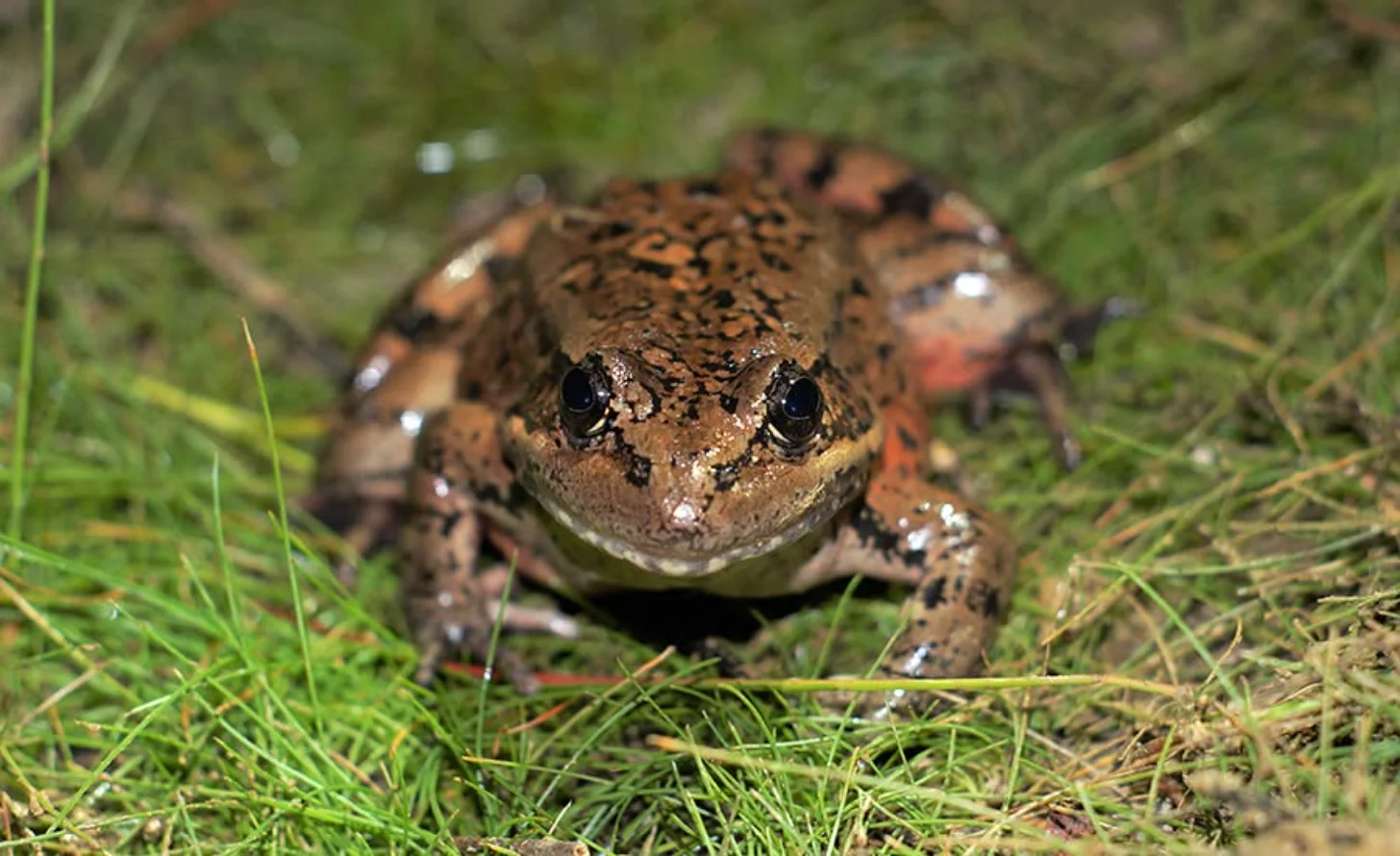
The main component of this repopulation effort is a frog-rearing facility at the San Francisco Zoo, which was established in 2016. Here, experts raise frogs from wild-collected eggs until they are about one or two years old. In this controlled environment, the juvenile frogs have all the support they need to thrive before being released into the park.
“When the program began in 2016, no California red-legged frogs remained in Yosemite Valley,” said Dr. Rochelle Stiles, director of field conservation at the San Francisco Zoo and Gardens.
“Today, every frog in the valley traces back to this effort. Despite drought, severe winters and flooding, the population has proven resilient.”
In 2026 alone, the zoo plans to release about 830 juvenile frogs into Yosemite, with 600 eggs being raised for future release.
When the 10,000th frog was released in May of this year, speakers gathered to commemorate the event, with local elementary schoolers joining in to let the amphibians leap freely.
“I mean, the frog was kind of slimy on the inside, and I basically trained it perfectly,” 9-year-old Lupine told Your Central Valley. “It just jumped right out.”
The 10,000th frog released from the program was symbolically nicknamed “Twain,” after the frog species gained national recognition in Mark Twain’s “The Celebrated Jumping Frog of Calaveras County.”
And it’s clear: The species remains celebrated.
“Protecting vulnerable species helps preserve the park’s natural balance,” Cassius Cash, president of Yosemite Conservancy, said.
“This milestone shows what sustained collaboration can achieve.”
You may also like: National park ranger photographs rare species for the first time while snorkeling on the job
Featured Image: Dietmar Rabich/Wikimedia Commons (CC BY-SA 4.0)
In 1977, the Sheldrick Wildlife Trust was formed in memory of conservationist David Sheldrick, founder and warden of Kenya’s largest protected wildlife sanctuary, Tsavo National Park.
In the nearly 50 years since, the organization has been a pioneer in rescuing and rehabilitating wild animals. Although the nonprofit has a menagerie of giraffes, zebras, water buffalo, and more across its various sanctuaries throughout Kenya, its conservationists specialize in a beloved endangered species: African elephants.
In June of 2023, a local tour guide reported the sighting of a possible orphaned elephant in the Maasai Mara National Reserve. Rangers estimated that she was just seven months old — which is far too young for a calf to be on her own.
“When the report came in, our Sheldrick Wildlife Trust and Kenya Wildlife Service Mara Mobile Veterinary Unit were attending to a speared hippo,” the Sheldrick Wildlife Trust stated on its website. “As soon as that treatment was complete, they turned their attention to the possible orphan.”
But when rangers went looking for her in the bush, she had “evaporated” into the wilderness.
“Everyone hoped that she had reunited with her herd,” the organization recounted. “Sadly, that was not to be.”
On June 26, a few days later, the calf reappeared in the Talek area of the Maasai Mara National Reserve. But this time, she was trailing behind an older male elephant for protection.

It is not uncommon for a young elephant who has been separated from its mother to follow older bulls for safety, lest they be picked off by a pack of hyenas or lions.
“The beginning of Talek’s story remains a mystery, but we know that this resourceful, brave little girl did her very best to fend for herself in the vast Mara landscape before being rescued,” the Sheldrick Wildlife Trust said.
“While the bull could give her companionship and protection, he could not give her the milk a calf of her age requires,” the post continued. “Now, absolutely certain that she was an orphan, the County Warden and Kenya Wildlife Service greenlit a rescue.”

The calf was gently separated from her “adoptive” father and airlifted to the organization’s nursery in Nairobi. There, they named her Talek, after the region where she was discovered.
“Talek settled right into nursery life,” the Sheldrick Wildlife Trust wrote. “After a few days of regular milk feeds, her cheeks filled out, and her belly returned to its round splendor. She quickly became a firm favorite among all the older girls.”

“However, Talek’s keepers remark that she is an ‘independent girl’, with little interest in being cosseted and coddled.”
A few short weeks after Talek settled in at the nursery, another orphaned elephant named Pardamat arrived. Pardamat had been rescued from Mara as well, after a harrowing 3-week search.
“She and her nighttime neighbor, Pardamat … have a classic little sibling relationship,” the organization said. “One minute, they are best friends, the next, they are squabbling over the slightest infraction!”

Today, Talek is three years old. Within the next year, she will begin weaning off her milk and spend more time outside the nursery in the forest, with the other orphans who have “graduated” from the sanctuary and found peace in the surrounding nature reserve — a collective herd that often returns to greet their former keepers.
“We are very grateful for Talek’s ‘guardian bull,’ who looked after her with such gentleness,” the Sheldrick Wildlife Trust said. “Now, her keepers have taken over, giving her round-the-clock care and nurturing for as long as she needs it.”
“Talek is absolutely hooked on her new ‘parents.’ If the keepers are standing in a group, she plants herself right in their midst,” it continued. “This once-lonely little girl will spend the rest of her life surrounded by love.”

You may also like: This herd of rescue elephants 'adopted' a new little brother: 'He will never be alone again'
Featured Image: Sheldrick Wildlife Trust
The students in Danielle Trial Lucini’s concert band class were charging through the White Stripes’ “Seven Nation Army” during first period on a Thursday morning at Mount Pleasant High School in Providence.
Lucini let them finish before offering her review: It was enthusiastic, but too fast.
“I need to hear the space between the notes,” Lucini told them.
For more than an hour, 14 students ran through riffs, motifs, and abbreviated band and pop standards. Their teacher often took up an instrument herself to demonstrate or sometimes ceded conducting duties to one of her students. She also sang and played alongside them.
Students often tell Lucini she’s their “strictest teacher.” But Lucini — who was awarded Providence Teacher of the Year in June — expects them to not only show up to class, but to participate.
“You can come to band class and sit with your instrument in your lap,” she told Rhode Island Current in an interview. “That doesn’t help anybody.”
Continuous high school participation in arts classes — especially music — was associated with better school attendance in a new study conducted by Quadrant Research and commissioned by the Rhode Island State Council on the Arts.
The Sept. 17 report’s primary question: “Do arts students have lower chronic absenteeism rates than non-arts students?”
To answer it, researchers looked at state education department data spanning 2018 through 2025. The arts council believes the report’s findings could have implications for how the state deals with chronic absenteeism, which is defined as missing at least 10% of the days in a school year during which students are enrolled.
Reducing chronic absenteeism has been a signature priority of the Rhode Island Department of Education under Gov. Dan McKee. The governor has promoted the Attendance Matters RI campaign, which uses public dashboards, school-level data tools, and family outreach to track and reduce absences.
In August, McKee celebrated the fourth consecutive year of decline in chronic absenteeism rates, which are now down 14.4 percentage points from a pandemic-era peak.
After accounting for student demographics, year-to-year differences and school district, researchers estimated 25.4% of four-year music students were chronically absent, compared with 37.3% of students without four consecutive years of music.
The gap was not nearly as large, however, when researchers looked at four-year participation across all arts classes — music, visual arts, theater, dance, and media arts — the chronic absenteeism gap between four-year arts students and those who lacked four consecutive years of art was only 1.9 percentage points.
The study shows a correlation, Robert Morrison, a co-author of the report and founder of Quadrant Research, cautioned in an interview.
While data may show a relationship between art classes and better school attendance, it can’t actually prove that art classes are what made students show up, Morrison said. “‘Prove’ is pretty strong language,” he added.
Students who stick with arts classes for multiple, consecutive years may differ in ways the data can’t fully capture, Morrison said. The report notes that individual motivation, academic skill, or family circumstances which encourage better attendance may keep students more engaged in the classroom. In the case of music, previous experience or lessons outside school can also help.
“What this study shined a light on through the data is something that many of our music and arts educators have known all along,” Morrison said.

Sustained engagement matters
Students who took at least one arts course in each of all four high school years had slightly lower chronic absenteeism rates than students who did not sustain arts participation for all four years, the report showed. The difference was much larger among students who took music all four years.
The same attendance-arts correlation was not observed in all students who took art classes. In fact, the data from 2023 through 2025 showed that high school students taking any arts course had chronic absenteeism rates a smidgen higher than students taking none.
“If you’re just taking it one year, if you’re just getting … an exposure course or like a general course that you’re taking to meet a graduation requirement, that’s not the same thing as sustained engagement,” Morrison said.
Lucini described a current junior who, when she taught him as a freshman taking band for an elective, missed 110 days of school and failed multiple classes. The next year, he asked to try band again, saying he hadn’t given it a fair shot.
In his second year with band, he was absent about 15 school days — still around the state’s definition of chronically absent — but he earned an A in band class. He continues to take band and even volunteered to perform with the band in the most recent PVDFest parade, Lucini said.
“For some kids, it’s the thing that draws them in and gives them a reason,” Lucini said.
Nicole Simpson, Providence Public Schools’ director of fine arts, said it’s important that students have a choice in arts education. They get to make decisions and work toward their own desired final product.
“That level of choice and voice is not present in any other content area,” Simpson said. “Especially in urban education, where all of our teachers are given a curriculum that says, ‘You’re on this page this week, this day, doing this lesson, and here’s how you’re teaching it.’”
For Lucini, it’s all about choice — and the punctuality, teamwork, and structure band class requires only serves to reinforce students’ autonomy, rather than weaken it. She doesn’t force beginning band students to play an instrument they don’t like.
“I’m not sticking a trumpet in your hand,” Lucini said. “I want you to pick something that you like the sound of, that you’re drawn to.”
That individual choice ends up affecting the collective responsibility of the band, which Lucini called “the biggest group project you’ll ever have.” Whether practicing or performing for an audience, the players have to listen to themselves and to one another — something they can only do if everyone shows up.
Performance, she said, illustrates well the adage that if you’re on time, you’re late, but if you’re early, you’re on time. A 5:30 p.m. gig means arriving at 5 to assemble instruments and warm up.
“If one person is late, then everyone is late,” Lucini said.
One of Lucini’s senior band students is Sidney Feliz — a drummer and singer who has taken part in band and chorus during all four of her years at Mount Pleasant. She said Mount Pleasant’s music program drew her to the school, and it was her top choice for a high school. (Providence students get some choice in where they go to high school and can shortlist their preferred schools before being assigned.)
“Since I’ve been out the womb, I’ve been totally interested in music,” Feliz said. “I’ve been singing, playing stuff, but once I came here, I started taking drum super serious.”
Feliz credited Lucini with keeping her on beat when her motivation waned during sophomore and junior year.
“She kind of led me back in,” Feliz said of her band teacher. “And I don’t think I would be doing what I do today without her.”
For Feliz, the sense of direction was difficult to find elsewhere in her school day.
“I’m able to push myself to work with other classes, but it’s mainly this class where she gives us the greatest push,” Feliz said of Lucini. “We really give it our all to perform.”
The pushing works even when the students haven’t been playing a dedicated instrument for a long time. Xionangelys Lopez Davila is a sophomore in Lucini’s concert band class who played piano and flute in the past but who only started violin last year.
“It’s very difficult, but at the end, you start to understand it and love it,” she said, adding that she always shows up to Lucini’s class.
The report co-author Morrison — who took music classes himself as a teen, and worked in the music and instrument industries for years before becoming an arts education researcher — offered that the arts are worth more than what they might do for attendance.
“The arts have legitimacy for their intrinsic value in their own right,” Morrison said.
The attendance finding, he added, is a “bonus.”
This article was originally published on Rhode Island Current.
Featured Image: Alexander Castro/Rhode Island Current
Labrador retrievers have seemingly endless energy, a massive capacity for obedience and training, and noses that can find just about any morsel of food in their vicinity.
But what if a dog used those inherent traits to make the world a better place? Conservation detection dogs like Uisge are up for the job.
Uisge (pronounced ‘oosh-ka’ and named after the Gaelic word for water) is a detection dog in Scotland that has been trained to sniff out a very specific invasive species.

Her area of expertise is a species of sea squirt called Didemnum vexillum — more colloquially called “sea vomit.” These aquatic invertebrates are “filter feeders” — and they are not meant to be in Scotland’s waters.
According to Fauna & Flora, the sea vomit species is originally native to Japan but has colonized coastlines across the United Kingdom, often transported on the hulls of ships.

They form large patches and are able to spread rapidly, literally able to clone themselves and blanket entire areas of a coastline. This causes harm to vulnerable native species, like mussels and oysters. In addition to threatening marine biodiversity, this also impacts the local fishing industry.
So, Dr. Texa Sim — Uisge’s handler — has come to the rescue. A marine biologist who worked with the Community Association of Lochs and Sounds on Scotland’s Morvern peninsula, she has worked to restore native European oyster populations and regenerate local marine habitats.
Sim started Conservation Detection Dogs Scotland as a trained dog handler, where she partners with Uisge and her other dog, Sgiath, to help support this coastal restoration work.

“She has extensive experience in training and handling dogs to undertake detection work in high-pressure and time-critical situations,” CDDC’s website describes Sim. “Holding a Doctorate in Marine Ecology, Texa brings the scientific process to dog training and handling, ensuring a thorough approach and requiring high standards from both herself and her dogs.”
Sim converted her home garage into a canine training campus, where she has installed a wall of specialized scent bricks for the dogs to practice.
Inside the bricks, she hides samples of the target invasive species for her dogs to detect. Then, they are rewarded when they find the right smell.

“With their incredible noses, dogs are able to pinpoint targets much more effectively than humans, making them powerful allies in efforts to support species and conserve ecosystems,” Sim writes on an Instagram page for the dogs.
“We have some exciting projects in the works, with some novel target species that are pushing the boundaries of dogs’ scenting abilities,” she continued. “We are developing the world’s first American slipper limpet and carpet sea-squirt detection dogs, showing that dogs can be vital even in the marine environment.”

In addition to sniffing out sea vomit, Uisge is also training to detect slipper limpet, another invasive marine species. She is also learning how to detect dead bats, which may be getting killed in collisions with wind farms.
And when she’s not out in the field, Uisge is still a force to be reckoned with.
“This dog... full labrador but with the brain of a spaniel and the drive of a Malinois,” Sim describes Uisge in a LinkedIn post. “She is the best of both worlds; sweet-natured but with enough drive for three dogs, which makes her excellent to both work and live with.”
You may also like: 'Dog-sniffing dog' helps volunteers rescue lost pets: 'A game-changer'
Featured Image: Conservation Detection Dogs Scotland/LinkedIn
In southwestern Kenya, the Sheldrick Wildlife Trust houses a menagerie of rescued giraffes, hippos, rhinos, and zebras. It’s also home to Korbessa, a 3-year-old African elephant, who the keepers affectionately call “little frog.”
“While she is not green in color, she is such a fan of eating greens that she may as well be!” The Sheldrick Wildlife Trust said on its website. “Like her amphibious cousins, she loves water. Mud, puddles, water troughs — it is all fair game for our little frog. But perhaps her most frog-like quality is the way she plops down on her belly, front legs splayed out.”
“It is not a position usually preferred by elephants,” the conservation organization said, “but Korbessa is no ordinary elephant.”

Korbessa’s rescue was extraordinary in and of itself. On August 23, 2023, rangers from the Kenya Wildlife Service heard the sound of elephants trumpeting near an old well in Meru National Park.
“At first light, they went to investigate. Their patrol ended at the Korbesa well — and much to their surprise, they found a tiny elephant calf staring at them from inside,” the Sheldrick Wildlife Trust recounted.
“Clearly, the calf had fallen in the night prior,” the organization continued. “While many modern wells are built with greater consideration, traditional wells can be a death trap for young elephants. Deep and steep, stout legs are unable to clamber to safety. This calf was young — a few days old, at most — and had no chance of getting out on her own.”
With the clock ticking, the rangers jumped inside the well to heave the calf out. As they waited for a mobile veterinarian to arrive and examine her, the rangers remained close to the well in the hopes that she and her mother could reunite.
Two hours passed, and no elephants returned.
“By the time the vet unit arrived, the little elephant was absolutely spent,” the Sheldrick Wildlife Trust said. “She was suffering from acute exhaustion, but was also so stressed from her ordeal that she could not relax. Dr. Aminga gave her fluids, glucose, and water, which had an immediate effect. Bolstered by fluids, she soon drifted into a deep slumber.”
In total, the team waited four hours to see if any adult elephants would return to the well. It was then that the Kenya Wildlife Service greenlit a rescue, and the Sheldrick Wildlife Trust soon airlifted her to her new home: the Kaluku Neonate Nursery.

“We named the orphan Korbessa to forever connect her to her origins. Korbessa was put into a stable next to Toto,” the organization said. “Although Toto is 18 months her senior — effectively making him her ‘big brother’ — it immediately became clear who the boss was. In fact, we all became Korbessa’s subjects!”
At the sanctuary, Korbessa is known as the “queen of Kaluku.” Because she was so young, she was given around-the-clock care by a team of keepers: Joseph, Jonas, Sammy, and Simon.

“Korbessa is absolutely obsessed with her bedroom,” the Sheldrick Wildlife Trust said. “It is easy to understand why: Her keepers have turned it into a palace fit for a queen. The radio is often playing — Korbessa is a big fan of Kenyan musicians — with fresh greens hanging in place and a soft mattress just waiting to become a little elephant’s throne.”
Elephants are slow-growing. Even now, at three years old, Korbessa is still too young to live freely in the wild. But her keepers believe their “queen” will be a true matriarch of her own herd one day.

“It is a rare privilege to be part of an elephant’s journey from the very beginning,” the Sheldrick Wildlife Trust said. “Korbessa was only a few days old when fate left her orphaned, but now she has her entire life ahead of her.”
“Only time will tell her future — again, we predict she will become a matriarch in the fullness of time — but we will be there to support her, look after her, and love her every step of the way.”
You may also like: A male elephant 'adopted' a calf and kept her alive long enough for rangers to rescue her
Featured Image: Sheldrick Wildlife Trust
A new big cat bombshell has entered the Himalayan Highlands at The Wildlife Conservation Society’s Bronx Zoo: Sarka.
The female snow leopard cub was born on May 31 to parents Dariga and Moutig in the Bronx, New York. After passing her physical exams and routine vaccinations, the new cub is now exploring the zoo’s snow leopard habitat — on display for visitors to see.
“The female cub is doing well and has now reached the age she can venture with her mother into the Himalayan Highlands exhibit,” the zoo wrote in a recent social media post.
“According to her keepers, she is enjoying exploring the habitat as well as seeing snow leopards in the neighboring exhibits. We currently have eight snow leopards here at the zoo.”
Sarka, whose name means “shark” in Nepali, represents an exciting milestone in snow leopard conservation.
The species is known as one of the world’s most elusive big cats, occasionally called “the ghosts of the mountains.” The species is rarely seen in the wild but is well-suited to high-altitude habitats on the Himalaya and Tibetan Plateau in Asia.

“They have a spotted white-gray coat that provides camouflage in their rocky mountainous habitat; large, padded feet that act as natural snowshoes; and long, woolly tails that provide warmth and balance as they navigate steep terrain,” the zoo wrote in a press release about the new cub.
The International Union for Conservation of Nature lists the species as “Vulnerable,” with an estimated 5,000-7,000 remaining in the wild across Asia. The snow leopards are threatened by habitat degradation and decline in prey species, as well as poaching, illegal trade, and retaliatory killing by livestock herders.
The WCS has been a longtime leader in snow leopard conservation, with the Bronx Zoo making history as the first zoo in the United States to exhibit snow leopards in 1903.

The organization’s field biologist George Schaller led pioneering surveys on wild snow leopards in the 1970s and 80s, establishing a scientific foundation for the species’ conservation.
“Building on 55 years of work protecting the species across Asia, WCS today supports these big cats and their mountain ecosystems in Mongolia, home to the world’s second-largest snow leopard population, and in Afghanistan, where WCS is the only international NGO working to conserve the species,” the organization explained.
“These efforts include community outreach and governance building, protected area development and management, ongoing monitoring using camera traps and satellite collars, and anti-poaching and anti-trafficking initiatives.”
Now with this new cub in their midst, the Bronx Zoo has had more than 80 snow leopard births since 1903 and participates in the Association of Zoos and Aquariums Snow Leopard Species Survival Plan. The cooperative breeding program is built on the intention of enhancing the genetic viability of the species.
You may also like: The Bronx Zoo rescues 800 endangered turtles from 'unprecedented surge in trafficking'
Featured Image: Terria Clay/Courtesy of Wildlife Conservation Society