Starfish — or sea stars — have been on earth far longer than humans; 474 million years longer, to be exact.
But even though the earliest traces of starfish stretch all the way back to the Paleozoic era, they’re not a sea creature that we should take for granted.
Due to sea star wasting disease, lower oxygen levels in seawater, and rising temperatures, starfish populations are at risk around the globe.
One species in particular — the sunflower star — was nearly wiped out completely. Across the last decade, the sunflower star population plummeted by over 90%.
Fortunately, in 2019, marine biologist Jason Hodin stepped up to save the sea stars from extinction.
At the University of Washington’s Friday Harbor Labs, Hodin has carefully grown and raised several generations of sunflower starfish in a controlled environment, breeding them from a select sample of starfish he rescued from the harbor five years prior.
And on August 10, Hodin led his research team in a historic release at Friday Harbor.
“We’ve been talking about this for five years now, it’s pretty exciting,” Hodin told KING 5 news network on the day of the release.
This was the first time ever that sea stars grown in a lab were put back into the wild.
“No one’s ever done this before with this age of star or with any captive-bred star before, so we have no idea what to expect,” said Hodin.
In scuba gear, researchers swam down to the ocean floor and deposited a box of ten baby starfish at a marked location. They plan to monitor them as the creatures explore the same harbor where their ancestors were plucked in 2019.
“We’re not going to repopulate the entire ocean with these ten sea stars or even with the hundreds that we have in the lab, but we can show how it’s done,” Hodin explained.
Thanks to Hodin’s breakthroughs in the lab, The Henry Doorly Zoo and Aquarium in Omaha has also started raising starfish in captivity.

“Jason’s success with the captive breeding of the Pycnos really provided the fire that lit the whole Pycnopodia recovery program, because it showed a positive way forward and a real opportunity,” Drew Harvell, a marine ecologist at Cornell University and Friday Harbor Labs, told Vox.
Another key factor in saving the sunflower starfish has been raising awareness of their decline. Thanks to efforts led by ecologist Sarah Gravem, the sunflower starfish became the first-ever marine invertebrate listed as a critically endangered species on the IUCN Red List, back in 2020.
From coral reefs to tidal pools, and seagrass meadows to kelp forests, starfish have proven to be a keystone species in freshwater habitats around the globe.
In fact, the phrase “keystone species” was first coined in relation to starfish when Robert Paine studied them in Washington in 1966.
By munching on sea urchins and mussels, starfish keep overpopulation of both at bay — increasing biodiversity and providing balanced access to resources for all kinds of organisms.
But for right now, Hodin is simply excited for what he and his team will discover from monitoring the starfish babies they just released.
“It’s a million questions that we’ve had about what these stars will do that we’ve been thinking about for years,” Hodin told KING 5. “And [we] will finally get some answers.”
Watch the video below to see how Hodin grew these starfish in the lab:
Header image via Ed Bierman (CC BY 2.0)
Google searches for “teen mental health” have doubled in the last four years, reaching an all-time high in 2023, according to Justin Steele, the America’s director of Google.org.
And the search engine — along with mental health ambassador Selena Gomez — are doing something about it.

Today, Google.org — the philanthropic arm of Google — announced a $10 million Teen Mental Health Initiative, which will support the rollout of mental health resources to one million high school students and 10,000 teachers.
The funds will be distributed among a number of youth mental health and education nonprofits, including Gomez’s Rare Impact Fund, DonorsChoose, The JED Foundation, Child Mind Institute, and The Steve Fund.
It’s a cause close to Gomez’s heart, who founded the Rare Impact Fund to “mobilize $100 million for organizations increasing access to youth mental health services and education” around the globe.
“I know that being a teenager can feel complicated and lonely. When it comes to mental health, knowledge is power,” Gomez said on Monday.
“We have to give teens resources so that they can build strong, positive, and productive mental health habits. That’s why… we want to expand access to mental health services by meeting young people where they are: The classroom.”
As part of the initiative, Google.org has funded all current mental health projects created by high school teachers on the DonorsChoose platform — a website that helps teachers receive funding for supplies, curriculum, and more. This provides more than $1.5 million to over 2,000 classrooms across the country.
“As young people find their way through the world, it’s crucial that they get guidance in building healthy, positive and productive mental health habits,” Gomez wrote in a blog post for Google.org. “Few people are in a better position to help do this than teachers.”
After today, Google.org will continue to provide $500 to all eligible projects posted to DonorsChoose.
“Mental wellbeing and academic achievement are inextricably tied,” said Alix Guerrier, CEO of DonorsChoose in a statement. “Our recent research shows more than 70% of public school teachers are concerned about their students’ mental health.
Guerrier added that this initiative will “give frontline educators critical tools and resources to support the wellbeing of students across the country.”

In addition to these funds, teachers can also receive $200 in DonorsChoose credit when they complete one of nine new Google.org-funded mental health trainings.
These trainings, created to support teachers as they “navigate the ins and outs of teen mental health,” are all 30 minutes in length and were created by Child Mind Institute, JED Foundation, and The Steve Fund.
“It’s so important that teenagers have a safe space to build strong mental health habits. I try to make my classroom the place where they can ask hard questions and navigate tricky topics like personal identity, self-worth, and confidence,” said Dr. Aileen Gendrado Adao, a teacher and wellness leader at Eagle Rock High School in Los Angeles, CA.
Dr. G — as she’s known by her students — also shared that she has used DonorsChoose to fund a variety of mental health projects, including a peer-to-peer counseling program that required extra supplies like posters and paint markers for activities.
“It's great to see Google supporting a platform that allows me and other teachers to ensure our students' wellbeing is a core priority,” she said.

Dr. G was just one leader present at an announcement event at Eagle Rock today, where she was joined by Gomez, as well as Senator Alex Padilla, his wife Angela Padilla, and Jennifer Lynn Siebel Newsom, the First Partner of California.
California Governor Gavin Newsom also praised the initiative, although he was not present at the event.
“The First Partner and I are proud to stand with Selena Gomez, the Rare Impact Fund, and Google to support students in growing strong mental health habits,” Gov. Newsom shared in a statement.
He also mentioned the California Master Plan for Kids’ Mental Health, which works “to ensure that every child has the support they need to thrive.”
Senator Padilla has also been a force for mental health reform in California, co-founding the Bipartisan Senate Mental Health Caucus to “reduce stigma and develop bipartisan mental health solutions.”
“It is up to us to expand the conversation and break down the culture of silence,” Sen. Padilla said in a statement. “I’m proud to see private investments announced today complement our efforts to tackle this crisis head-on.”
This new $10 million investment is only part of Google’s larger mental health initiatives, which focus on youth digital wellbeing and mental health. With this announcement, Google has now invested $25 million in this cause.
And alongside the ambassadorship of one of the most well-known mental health advocates in modern life — Gomez — young people will have a support net in schools they likely have never had before.
“No one should feel isolated in their mental health experiences, especially young people, who can be especially vulnerable to those struggles. Support is out there,” Gomez wrote.
“And by standing together, we can make a real difference in teen mental health.”
Header image courtesy of Google.org
If you’re looking for positive adjectives that start with the letter A, we’re here to help.
As lovers and sharers of positive news (we publish good news online, in our free newsletter, on our positive podcast, and our beautiful monthly Goodnewspaper), we’re always thrilled to help fill the world with more positivity.
We’ve compiled the best nice and kind adjectives that start with A into a simple and easy-to-scroll guide.
Whether you’re trying to describe a person, find positive characteristics or traits, or simply brush up on your English — we hope this list helps you feel more positive.
By the way, looking for more positive words? Check out our guides to positive words (not just adjectives) that start with each letter of the alphabet.
Adjectives, Characteristics, and Words To Describe Someone… That Start With the Letter A —
- Abaxial
- Abdominal
- Abiding
- Abiotic
- Ablaze
- Able
- Able-bodied
- Able-minded
- Abled
- Ablest
- Abloom
- Aboral
- Aboriginal
- Abounding
- Absolute
- Absorbent
- Absorbing
- Abstract
- Abstracted
- Abundant
- Abyssal
- Academic
- Accelerated
- Accelerating
- Accentual
- Acceptable
- Accepted
- Accepting
- Accessible
- Acclaimed
- Accommodating
- Accommodative
- Accomplished
- Accordant
- Accountable
- Accountable
- Accredited
- Accretive
- Accumulative
- Accurate
- Accustomed
- Ace
- Achievable
- Achievement-oriented
- Achromatic
- Aconitic
- Acoustic
- Acoustical
- Acquainted
- Acquiescent
- Acrobatic
- Action-oriented
- Actionable
- Activated
- Active
- Active-minded
- Actual
- Actualistic
- Actuarial
- Acuminate
- Adamantine
- Adaptable
- Adaptive
- Addable
- Additional
- Adept
- Adequate
- Adherent
- Adhesive
- Adiabatic
- Adipose
- Adjustable
- Adjusted
- Administrative
- Admirable
- Admired
- Admiring
- Admissible
- Adolescent
- Adoptable
- Adoptive
- Adorable
- Adored
- Adoring
- Adorned
- Adroit
- Adsorbed
- Adsorbent
- Adsorptive
- Adulatory
- Advance
- Advanced
- Advancing
- Advantaged
- Advantageous
- Adventive
- Adventure-loving
- Adventuresome
- Adventurous
- Advisable
- Aeolian
- Aerated
- Aerial
- Aerobatic
- Aerodynamic
- Aeroelastic
- Aerogenic
- Aeromedical
- Aesthetic
- Aesthetical
- Aestival
- Affable
- Affectionate
- Affective
- Affiliated
- Affirmative
- Affluent
- Affordable
- Aflutter
- African
- Aged
- Ageless
- Agential
- Agglutinative
- Agile
- Agleam
- Aglitter
- Aglow
- Agnostic
- Agreeable
- Agreeing
- Agricultural
- Agronomic
- Ailanthus-like
- Aileron-like
- Airborne
- Airtight
- Airworthy
- Airy
- Ajar
- Akin
- Alacritous
- Alaskan
- Alaskan
- Alchemical
- Aldermanic
- Aleatory
- Alert
- Alexandrian
- Algerian
- Alienable
- Aligned
- Alike
- Alimentary
- Aliphatic
- Alive
- Alkalescent
- Alkaline
- Alkaloidal
- All-embracing
- All-inclusive
- All-knowing
- All-powerful
- All-purpose
- All-round
- All-star
- Alleged
- Allegoric
- Allegorical
- Allied
- Allocable
- Allometric
- Alloyed
- Alluring
- Allusive
- Almighty
- Alphabetic
- Alphabetical
- Alpine
- Altaic
- Alterable
- Alternating
- Altimetric
- Altitudinous
- Altricial
- Altruistic
- Aluminous
- Alveolar
- Amalgamative
- Amaranthine
- Amative
- Amatory
- Amazed
- Amazing
- Ambassadorial
- Amber
- Ambiguous
- Ambitious
- Ambivalent
- Ambrosial
- Ambulant
- Ambulatory
- Ameliorating
- Ameliorative
- Amenable
- American
- Amiable
- Amicable
- Amoral
- Amorous
- Ample
- Amplified
- Amplifying
- Amulet-like
- Amused
- Amusing
- Anabatic
- Anabolic
- Analytic
- Analytical
- Anamnestic
- Anatomical
- Ancestral
- Anchored
- Ancient
- Androgynous
- Anecdotal
- Angelic
- Angelical
- Angular
- Animal
- Animate
- Animated
- Animating
- Anniversary-related
- Annual
- Anodyne
- Anointed
- Anonymous
- Another
- Answerable
- Antenatal
- Anterior
- Anthemic
- Anthophilous
- Anthropocentric
- Anti-aging
- Anti-inflammatory
- Anticancer
- Anticipated
- Anticipative
- Anticorrosive
- Antifragile
- Antifungal
- Antimicrobial
- Antioxidant
- Antioxidative
- Antique
- Antique white
- Antiracist
- Antiseptic
- Antiviral
- Aphrodisiac
- Apical
- Apodictic
- Apollonian
- Apostolic
- Apparent
- Appealing
- Appeasing
- Appetent
- Appetitive
- Appetizing
- Applaudable
- Apple green
- Applicative
- Applied
- Appraising
- Appreciable
- Appreciated
- Appreciative
- Apprentice
- Approachable
- Approaching
- Approbative
- Approbatory
- Appropriate
- Approved
- Approving
- Approximate
- Apt
- Aqua
- Aquamarine
- Aqueous
- Aquiline
- Arbitrary
- Arbor-like
- Arboraceous
- Arborous
- Arcadian
- Archaic
- Arched
- Archetypal
- Archetypical
- Architectural
- Archival
- Arctic
- Arctic
- Ardent
- Argent
- Argentiferous
- Argentinean
- Argonaut-like
- Arguable
- Aristocratic
- Aristocratical
- Armada-like
- Armigerous
- Army green
- Aromatic
- Aroused
- Arousing
- Arranged
- Artful
- Articulate
- Artificial
- Artisan
- Artisanal
- Artistic
- Artsy
- Ascendable
- Ascendant
- Ascending
- Ascensive
- Ash gray
- Aspirational
- Aspiring
- Assertive
- Assessable
- Assessed
- Assiduous
- Assignable
- Assimilable
- Assimilated
- Assimilative
- Assistant
- Assistive
- Associated
- Assorted
- Assumable
- Assumptive
- Assured
- Assuring
- Asteroidal
- Astonished
- Astonishing
- Astounded
- Astounding
- Astral
- Astrological
- Astronomic
- Astrophysical
- Astute
- Asymmetric
- Asymmetrical
- Asymptotic
- At-hand
- Athletic
- Atmospheric
- Atomic
- Attachable
- Attainable
- Attempted
- Attention-getting
- Attentive
- Attracted
- Attracting
- Attractive
- Attributable
- Attributive
- Attuned
- Atypical
- Auburn
- Audacious
- Audible
- Auditory
- Augmentative
- Augmented
- August
- Aural
- Aureate
- Auroral
- Auspicious
- Authentic
- Authenticated
- Authorial
- Authoritative
- Authorized
- Autistic
- Autobiographic
- Autochthonous
- Autodidactic
- Autographed
- Automatic
- Automotive
- Autonomous
- Autotelic
- Available
- Avant-garde
- Avatar-like
- Average
- Avian
- Aviary-like
- Aviator-like
- Avid
- Avowed
- Avuncular
- Awaited
- Awake
- Awakened
- Award-winning
- Aware
- Awash
- Awe-inspiring
- Awe-striking
- Awed
- Awesome
- Awestruck
- Axiological
- Axiomatic
- Axonometric
- Azoic
- Azure
Explore even more positive words that start with…
A | B | C | D | E | F | G | H | I | J | K | L | M | N | O | P | Q | R | S | T | U | V | W | X | Y | Z
Plus, check out more positive lists…
It’s no secret that polyfluoroalkyl substances — colloquially known as PFAS or “forever chemicals” — are cause for concern.
PFAS are a group of more than 10,000 human-made chemicals that often have water, heat, or oil-resistant properties.
Found in plenty of domestic products like fabrics, food wrappers, non-stick pans, fire extinguishers — and even the water in both our natural environment and kitchen taps — PFAS are known for causing a myriad of health problems like cancer and diabetes.
Health officials across the globe have been working to figure out ways to reduce PFAS levels in drinking water, but this often comes at a high cost — both financially and on the planet.
According to Euronews, it could cost up to £21 billion (or about $27 billion) to remove all forever chemicals from the U.K.’s sewage — let alone the rest of the world.
Plus, current methods, like carbon and resin water filters, aren’t always effective. Adsorbents and separation methods can effectively remove PFAS from water, but they don’t eradicate the chemicals in question. And incineration — which was long considered the only way to break down PFAS permanently — likely just disperses the chemicals into the air instead.
However, Swiss startup Oxyle — co-founded by Dr. Fajer Mushtaq, a nanotechnology engineer — has a different approach.

“There are very few methods that we know of that permanently and safely destroy PFAS,” Mushtaq told TNW. “But it can be done.”
The way Oxyle does it? By oxidizing the chemicals, or chipping away at the bonds between molecules.
“We are purely destruction tech; we are oxidizing and reducing these chemicals,” Mushtaq told Euronews.
“Let’s say you have a carbon-hydrogen bond. We break it. You have a carbon-fluorine bond, [we] break it. At the end of the treatment, all you’re left with is CO2, water molecules, some fluorides, sulfates, and minerals — basically, building blocks.”
Building blocks that don’t harm the health of people or the planet.
This chemical process isn’t new. In fact, many other companies do the same, usually by passing electricity through electrodes or applying UV light to the wastewater.
But Oxyle makes things simpler, using mechanical energy like vibrations produced by bubbles or water flow to target the molecules.
It works like this: First, Oxyle applies a nanoporous catalyst material (created during Mushtaq’s doctoral thesis research) to the water. Then, it is activated by water movements (the aforementioned bubbles), to create a chemical reaction. Then, the reaction generates oxidative molecules that break down organic pollutants (PFAS) to harmless materials (like carbon and fluorides).

“It gets activated and starts to split the water and forms different chemical species that are able to break the bonds of these PFAS molecules,” Mushtaq explained.
It works well, too. According to Mushtaq, each Oxyle reactor can treat about 10,000 liters of water an hour.
And it’s a lot less energy-intensive. Using bubbles reduces the company’s energy use by between 15% and 60%.
“Energy is the biggest driver of cost for destruction tech,” Mushtaq told Euronews, meaning her startup can do this vital work for less than its competitors.
Still, in many countries, members of the public pay for the processes that treat their water, and advocates suggest that companies and governments should be footing the bill.
Mushtaq said the clients Oxyle targets are “mostly industrial players,” or “the ones who are either producing these chemicals and have to treat the wastewater or have contaminated the facilities around and need to do remediation.”
Last year, Oxyle completed a pilot with Swiss chemical company CIMO, treating groundwater contaminated by the company’s PFAS. According to a case study from the company, Oxyle removed 99.2% of the contaminated materials every day for six months.
Although this is a promising approach to a major issue, even the scientists most exhilarated by these discoveries know that it can’t solve the root problem, calling for PFAS regulation by government bodies to help end the ongoing pollution.
The European Union does have a proposed ban on PFAS, though many other individual countries — like the U.K. — aren’t as progressive.
But for Oxyle, the treatment of waste and groundwater will remain a priority — whether or not elected leaders feel the same.
“As a company that does remediation of PFAS, we will be existing for decades,” Mushtaq told Euronews.
And the job is just getting started.
“The imperative to eliminate PFAS from our drinking water has never been more critical,” Oxyle’s website reads. “Our mission is clear: restore and protect our waters from micropollutants — down to the very last drop.”
When scrapes and injuries happen, people tend to reach into their medicine cabinet for a pack of standard Band-aids. But for severe and chronic wounds, those don’t always cut it.
Fortunately, scientists have created a new type of bandage — one that uses electricity.

Electrical stimulation for wound healing isn’t new technology — scientists have known that electric pulses are helpful in healing chronic wounds from diabetic skin ulcers, or in reducing chronic pain.
But now, instead of hooking a patient up to an electric machine, scientists have unveiled a flexible — and affordable — electric bandage that can deliver those pulses to the site of the wound with ease. And it’s simply powered by a little H2O.
In fact, researchers from North Carolina State University recently published a study on their invention, which found — through animal testing — that the electric bandages healed wounds 30% faster than wounds treated with conventional bandages.
The study intended to find a more effective way to heal chronic wounds that often impact patients with diabetes who experience sores. These wounds are open and known to heal slowly — if they heal at all. Difficult wounds like these are often recurrent and increase the risk of amputation or death in patients.
“Our goal here was to develop a far less expensive technology that accelerates healing in patients with chronic wounds,” said Amay Bandodkar, co-corresponding author of the work and an assistant professor of electrical and computer engineering at North Carolina State University.
“We also wanted to make sure that the technology is easy enough for people to use at home, rather than something that patients can only receive in clinical settings.”
The result is the WPED — or Water-Powered Electronics-free Dressing. It utilizes electrical currents, which travel through damaged tissue and help accelerate the movement of skin cells to the site of the wound. This leads to a speedier closure to the damaged tissue and can even reduce infection by killing bacteria at the same time.
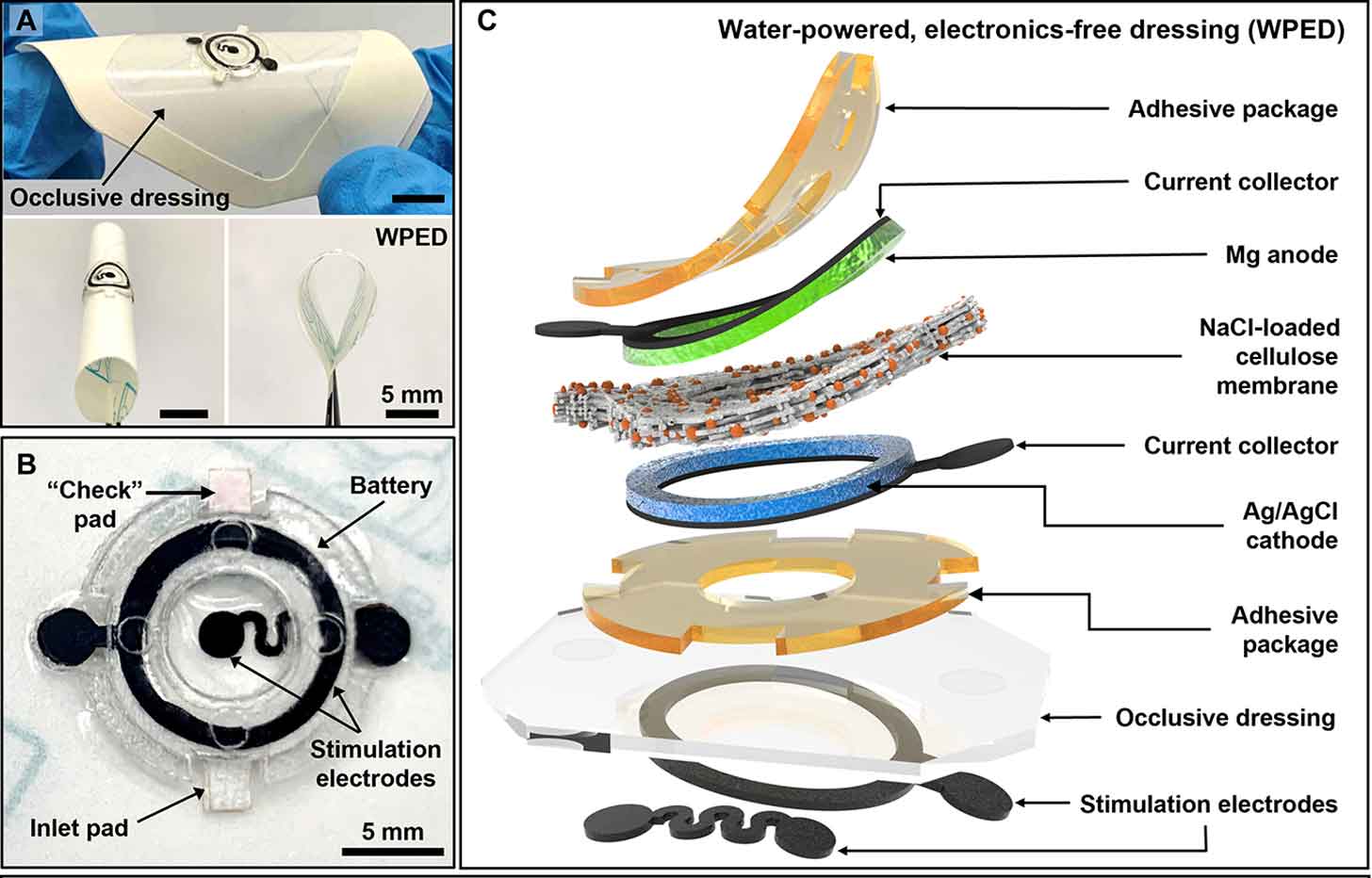
Plenty of bioelectric products exist on the market, but many require thick batteries or other electronic designs that are expensive, awkward to wear, and might reduce a patient’s mobility.
The WPED looks like a standard adhesive bandage, which can stick to someone’s wound and conform to the surface of their body. But instead of a simple gauze patch, these bandages feature a group of small electrodes and a smart water-powered battery.
The dressing simply gets applied to the patient like any other bandage, but in a way in which the electrodes can easily reach the wound.
A drop of water is applied to the battery to activate it, and the electric currents are then able to flow for up to seven hours. The electric field contains a 1.5-volt current and will work until its battery dries out. According to New Atlas, re-wetting the bandage could potentially give it an additional two hours of power.
However, the cost of the bandage is so nominal — a couple dollars each — most patients should be able to apply a fresh WPED when needed.
One of the study’s lead authors — and a postdoctoral researcher at NC State — Rajaram Kaveti, explained how all of these crucial components work together.
“That electric field is critical, because it’s well established that electric fields accelerate healing in chronic wounds,” he said in a statement.
The “ability to conform” to the wound is also critical, “because we want the electric field to be directed from the periphery of the wound toward the wound’s center,” he said.
“In order to focus the electric field effectively, you want electrodes to be in contact with the patient at both the periphery and center of the wound itself,” Kaveti continued. “And since these wounds can be asymmetrical and deep, you need to have electrodes that can conform to a wide variety of surface features.”

The bandages are disposable and can be applied quickly and easily at home. The hope is that patients will be able to move around and take part in daily activities while their wounds are healing. Plus, simple functionality makes it easier for people to adhere to treatment plans, keeping them from visiting clinics or making appointments.
The ease is important, “but it is equally important that these bandages can be produced at relatively low cost,” Bandodkar said. “We’re talking about a couple of dollars per dressing in overhead costs.”
Of course, before these can be stocked in your nearby drug stores, the researchers must test their efficacy.
This most recent study — published in Science Advances, by researchers from NC State, Columbia University, Beth Israel Deaconess Medical Center, the University of North Carolina at Chapel hill, Korea University, Georgia Tech, and the Korea Institute of Science and Technology — tested the dressings on diabetic mice.
Mice are “a commonly used model for human wound healing,” according to Maggie Jakus, a researcher from Columbia University.
“We found that the electrical stimulation from the device sped up the rate of wound closure, promoted new blood vessel formation, and reduced inflammation, all of which point to overall improved wound healing,” Jakus explained.
With this proof of accelerated healing in animal trials, the researchers are optimistic about the future use of these bandages for humans in everyday life.
“Next steps for us include additional work to fine-tune our ability to reduce fluctuations in the electric field and extend the duration of the field,” Bandodkar said.
“We are also moving forward with additional testing that will get us closer to clinical trials and — ultimately — practical use that can help people.”
Header image courtesy of Rajaram Kaveti
Australian meteorologist Nate Byrne was in the middle of a morning weather report on August 13 when his words began to slightly falter.
“We’ve got big falls…right through that part of the country,” Bryne said, pausing and taking a deep breath. “And we’re going to see lots more rain in the days ahead—”
Bryne then cuts himself off mid-sentence.
“I’m actually going to need to stop for a second, some of you may know that I occasionally get affected by some panic attacks and actually that’s happening right now,” Bryne said, speaking quickly. “Uh, Lisa, maybe, I uh, could hand back to you?”

“You certainly can Nate,” ABC News Australia host Lisa Miller replied calmly, without skipping a beat.
“And Nate wrote a great piece on the ABC online website about this, and I reckon we might re-up it, because it’s fantastic that he has been so open and transparent about it.”
Byrne’s article — “Live TV triggered my first panic attack, and I still deal with anxiety” — was first published in February 2022. In his piece, Bryne details a day at the station where he had two panic attacks in the span of 15 minutes.
“All of a sudden, my body started tingling, my heart rate rose and I realized I was drenched in sweat,” Bryne wrote. “As soon as the camera was off me, I dropped my on-air demeanor and doubled over, trying to catch my breath, light headed and confused about what was happening.”
But 15 minutes later, Bryne had a second panic attack. And this one, he wrote, nearly “broke” him.
“This time, it was much worse,” he wrote. “I started shaking, my vision narrowed, my heart was pounding like I'd run a marathon, I couldn't breathe.”
The station slotted in another correspondent so that the broadcast wasn’t interrupted, but the experience left him in tears.
Fortunately, he was given the day off to speak to a doctor, and those heart-pounding, mind-racing, bouts of fear were diagnosed as panic attacks.
Over the next few years, Bryne regularly met with a psychologist and learned how to manage his symptoms with the aid of beta blockers.
But one of the shining lights in his mental health recovery has been the unwavering support from his coworkers, including Miller and their fellow broadcaster, Michael Rowland.
“You might have seen Nate experience a panic attack earlier this morning while presenting the News Breakfast weather,” Rowland wrote in an Instagram post on August 13.
“Nate’s open about his panic attacks — he’s even written about them before — and he’s doing okay!”
In his post, Rowland sings the praises of his coworker, and says he gave him “a bear hug off-camera” after his panic attack subsided.
“As a team, we’ll always have your back, Nate,” he wrote. “Always.”

The clip of Byrne having a panic attack on-air quickly went viral (at the time of publication the video was rapidly approaching 3 million views on TikTok).
But Byrne told BBC that the response from viewers has been “incredible.”
The comments beneath the now viral clip are filled with words of support.
“This is the greatest, seamless, grown-up media handling of simple mental realities I’ve ever seen,” one person wrote.
“Not only did [Lisa] handle it with grace, but she praised him for being vulnerable and credited his piece about it…this is beautiful,” another person added.
“I’m blown away by how graciously this was handled,” a viewer commented. “As someone who personally deals with chronic anxiety, this meant a lot to me.”
In the wake of the viral clip, Byrne has spoken up even further about his mental health.
@abcnewsaus Nate Byrne experienced a panic attack while presenting the weather. He’s open about his panic attacks — he’s even written about them before — and he’s doing okay. Here’s the moment it happened and the team’s response. To personalise your news & stay in the know, download the ABC News app via the link our bio. #ABCNews #PanicAttack #MentalHealth #Anxiety ♬ original sound - ABC News Australia
“So many people have a story about anxiety, or have some experience with it,” Byrne told the BBC.
“After I first spoke about it publicly, a lot of people have come to me and said that they didn’t know what they were having was a panic attack [and] they didn’t know other people have panic attacks.”
For anyone suffering from chronic anxiety and panic attacks, Byrne recommends they do what he did on the very first day it happened: go see a doctor.
He added, “Talking to someone is probably the best thing you can do.”
Header images via ABC News Australia / TikTok
Donning a form-fitting white baby tank top on stage in Los Angeles, megaphone in hand, it was clear that pop star Olivia Rodrigo had one message to get across at the ‘Guts World Tour’ on Tuesday: Vote.
The ‘So American’ singer — who is known for supporting reproductive rights and survivors of gender-based violence — took her activism another step forward with her fashion statement at the Kia Forum, in front of a sold-out crowd of about 17,500 people.
In addition to her wardrobe choices, there were also tables throughout the venue where fans could register to vote, all while seeing their favorite artist live.
Supported by HeadCount, an organization that registers young people to vote at events like concerts and festivals, the singer’s official fan account also shared links encouraging fans to vote across social media.

While it’s not yet clear how many registrations this resulted in, Rodrigo has five more shows in Los Angeles in the coming days, which likely means she will continue these efforts.
In fact, it’s far from the first time she’s subtly swayed fans into voting. In 2022, the singer sported a bedazzled T-shirt reading “vote,” as well, just in time for the last midterm elections.
With a high-stakes election right around the corner, advocacy from stars like Rodrigo makes a real impact.
In 2022, Harry Styles helped HeadCount register a record-breaking 55,000 fans to vote (during a non-presidential election as a British pop star, no less). And in 2023, Vote.org recorded a surge of over 35,000 voter registrations when Taylor Swift encouraged fans to sign up via Instagram.
And if anyone has been following the Kamala Harris campaign, they’ll also likely hear the sweet serenades of artists like Charli XCX and Chappell Roan, whose feminist beats have become the soundtrack of election season.
As it turns out, fans of pop music are fans of democracy, too.
OLIVIA RODRIGO THE FUCKING LEGEND YOU ARE. VOTE!!!!!!!! pic.twitter.com/q58RjjPk5Y
— a (@sourlittleme) August 14, 2024
“I’d wear that tank top to the polls,” one fan wrote in response to a photo of Rodrigo on stage, posted to X (formerly Twitter) last night.
“Love that she uses her concerts to send great messages to fans,” another wrote on a Reddit post about the voter registration initiative. “Reproductive rights, voting rights. Go ahead Olivia!”
Indeed, Rodrigo’s Fund 4 Good was also on full display at the L.A. stop of the ‘Guts World Tour,’ where a portion of proceeds from ticket sales went to support California-based organizations Women’s Reproductive Rights Assistance Project and Access Reproductive Justice.
“We stan,” Access Reproductive Justice shared on its Instagram Stories, while posting about Rodrigo Tuesday night. “Thanks for the shout out… and thanks for supporting access to abortion care.”
While Rodrigo is certainly leading the charge for these issues, it’s her fans who will go on to carry the torch when the final encore ends and the last piece of confetti falls.
“Personally, if I had that kind of influence, I would be using it to talk about the things that are important to me and that are important to the world as a whole,” said 20-year-old San Jose resident — and Rodrigo fan — Ananya Bahugudumbi, in an interview with KQED.
Elected representatives, she went on to say, “should remember that the people who are voting for them are like the people here at this concert.”
Header image courtesy of X
The opioid crisis affects countless lives and kills more than 187 people every day, according to the Centers for Disease Control.
In 2023, more than 100,000 Americans died from opioid overdoses, and while drugs like Narcan — the brand name of a drug called naloxone — slowly become more accessible, this crisis will need further innovation to be defeated.
Researchers at MIT and Brigham and Women’s Hospital (the second-largest teaching hospital of Harvard University) have created a new device they hope will help to save more lives from opioid overdose.

It’s an implantable sensor — about the size of a stick of gum — that is placed under the skin, where it monitors variables like heart rate, breathing rate, and other vital signs of a patient. Researchers have named it the iSOS implant.
When it determines that an overdose has occurred, it rapidly administers a dose of naloxone.
Naloxone is an “opioid antagonist” which means it can bind to opioid receptors and block the effects of other opioids, like heroin and fentanyl.
Up until this point, the most effective way to save a life from an opioid overdose is for a first responder or bystander to immediately deliver naloxone — often in the form of Narcan nasal spray.
That said, responders can’t always reach a person in time. Overdoses can cause permanent brain damage in less than three minutes, and — heartbreakingly — death, within four to six minutes.
Additionally, the effects of naloxone wear off after about 30-45 minutes, so immediate action is vital to get someone the emergency help they need.
The iSOS sensor could close that gap and immediately reverse the effects of an overdose, buying people more time in an emergency.

In fact, in a new study published in the journal Device, the MIT and Harvard researchers found that the device could successfully reverse overdoses in animals.
Here’s how it works: Since vital signs like heart rate, blood pressure, oxygen saturation, and breathing rate all change rapidly in an overdose, the researchers were able to create a unique algorithm that measures these vitals.
This specific algorithm helps distinguish between other conditions, like sleep apnea, where breathing rates are also decreased.
By measuring how exactly these vitals change in an overdose, the researchers increased the sensitivity of the device to accurately detect an overdose and calculated the point at which naloxone should be administered.
The iSOS implant includes a refillable reserve that can pump 10 milligrams of naloxone into the deepest layer of the skin. The device can also buzz or send an alert to a smartphone to alert the patient of an overdose, or send a medical alert to first responders and loved ones.
In the animal trial, 96% of overdoses were successfully reversed using the iSOS.

Giovanni Traverso is an associate professor of mechanical engineering at MIT, a gastroenterologist at Brigham and Women’s Hospital, and the senior author of the new study.
“We created a closed-loop system that can sense the onset of the opiate overdose and then release the antidote, and then you see that recovery,” Traverso said in a statement.
While further testing must be done to reach clinical development, this approach could change the trajectory of the opioid crisis.
“This could really address a significant unmet need in the population that suffers from substance abuse and opiate dependency to help mitigate overdoses,” Traverso said, “with the initial focus on the high-risk population.”
That high-risk population includes folks living with substance use conditions who have already survived an overdose.
That said, the research team also knows that asking a patient to implant a device under their skin is a significant agreement.
“We believe that many patients would be willing to adopt the iSOS implant, especially those who are at high risk of opioid overdose and are seeking reliable, life-saving interventions,” Traverso told Cosmos.
“However, we also recognize that the decision to adopt an implantable device is significant, and acceptance may vary among individuals.”

The device has taken about five years thus far to develop, and, according to Traverso, has a timeline of initiating first-in-human trials within the next three to five years.
In the future, he also said the research team plans to run surveys, focus groups, and pilot programs to better understand patients’ and healthcare providers’ opinions on the iSOS.
Hen-Wei Huang, a former MIT visiting scientist and current engineering professor at Nanyang Technological University in Singapore, agreed that the implementation of this device is not without its hurdles.
“The most challenging aspect of developing an engineering solution to prevent overdose mortality is simultaneously addressing patient adherence and willingness to adopt new technology, combating stigma, minimizing false positive detections, and ensuring the rapid delivery of antidotes,” Huang explained.
But, while other wearable devices have been studied for this same issue, the iSOS is one of the first to show such remarkable promise.
“Our proposed solution tackles these unmet needs by developing a miniaturized robotic implant equipped with multi-sensing modalities, continuous monitoring capabilities, on-board decision making, and an innovative micro-pumping mechanism,” Huang added.
It’s not yet clear when the iSOS will be implemented in a clinical setting, or how exactly it will be administered, but the researchers are eager to see it become part of the tool belt in confronting the opioid epidemic.
“A key pillar of addressing the opioid epidemic is providing naloxone to individuals at key moments of risk,” said Peter Chai, an associate professor of emergency medicine physician at Brigham and Women’s Hospital.
“Our vision for this device is for it to integrate into the cascade of harm-reduction strategies to efficiently and safely deliver naloxone, preventing death from opioid overdose and providing the opportunity to support individuals with opioid use disorder.”
Header image courtesy of MIT
This story was originally published by The 19th and was republished with permission.
Minyon Moore’s name has never been on a ballot. She’s not giving speeches to thousands of adoring voters chanting her name. She’s not running to be the nation’s commander in chief.
But she helped pave a path for Vice President Kamala Harris to do all those things — and accept the Democratic Party’s presidential nomination at next week’s convention. In her 40 years of working in Democratic politics, Moore has become one of the party’s most respected voices.
She was part of a group that advised President Joe Biden on selecting Harris as his running mate and on nominating Justice Ketanji Brown Jackson as the first Black woman on the Supreme Court.
Now, Moore is the chair of the Democratic National Convention, charged with managing more than 150 full-time staffers on the event’s production, from choosing the location to planning the programming.
The role comes during an unusual election year in which Biden, the party’s presumptive nominee, stepped aside four weeks before thousands of Democratic delegates and party leaders were set to gather in Chicago.
After a rapid campaign launch, the convention will go forward with celebrating Harris as the first Black woman and first Asian American to secure a major party nomination for president.
Moore’s background, which includes roles both in and out of the White House, has prepared her to oversee the massive event. She’s a South Side Chicago native who wanted to ensure that local residents and businesses felt included in the convention process.
Known as a “diplomat” among her friends, Moore has maintained relationships with both advocates and people in all levels of government who can shape the convention’s programming.
Her time in the Clinton White House may be an asset as the party aims to solidify voter support by highlighting the Biden-Harris administration’s accomplishments and Harris’ vision for the future.
Moore had no way of predicting the switch up in this year’s nomination process. But Harris — a history-making woman and the daughter of an Indian mother and a Jamaican father — represents the type of leader Moore has helped lay the foundation for throughout her career as a Black woman at the top echelon of American politics.
“I became very familiar with the politics of people of color, the politics of Black people, and then I was able to expand my base,” Moore told The 19th. “When I go into a room, if I don’t see Asian Americans, if I don’t see anyone in the LGBTQ community, if I don’t see Black women — and sometimes if I don’t see White men — I’m like, ‘OK, well, what’s wrong with this table?’ That’s how I was trained. I was trained to see who is not at the table, and that’s been an important benchmark for me in how I like to lead today.”
Moore cut her teeth as an organizer in Chicago and a member of Rev. Jesse Jackson’s 1988 presidential campaign, which sought to build a coalition of people of color, the working class and LGBTQ+ people. Years later, she was part of “Hillaryland,” Hillary Clinton’s inner circle during her 2008 and 2016 bids to become the country’s first woman president.
For Moore, her work to push boundaries on diversity comes down to remaining optimistic about the American people’s values, she said.
“What I bet on is the American people and voters. I can be idealistic about what I want, but in the end, the voters have to make the decision,” Moore said. “What I do know is that America has come a long way. So the truth is, what I remain hopeful about and optimistic about is that America is smarter about inclusion.”
The Chicago political scene in the 1970s and ’80s served as a training ground for Black women in national politics. Moore was in her early 20s when she met Rev. Willie Barrow, a Black woman who, alongside Jackson, co-founded the economic empowerment organization Operation PUSH.
At that time, Moore didn’t have a seat at the table. But she did have a seat in a corner of the room where Chicago’s Black political leaders made decisions about historic moments, including the campaign of Harold Washington, who went on to become the city’s first Black mayor in 1983.
Barrow was tough, but in a loving way, Moore said. Barrow instructed her to never show up to work without a pen and paper, and to always build relationships with the people she meets.
“What it did for me, just going in those rooms with her, I got to listen,” Moore said. “It sharpened my antenna and I got to meet people from all walks of life that I would have never gotten to meet. It was because she gave me the opportunity.”
Working with Barrow, Moore developed the confidence to step into any room without focusing on the disadvantages she could face as a Black woman. She instead took it as an opportunity to demonstrate her preparation and work ethic.
Barrow also taught Moore another career-defining lesson: “When you get to the table, make sure you’re not the only one.”
This is a core value for both Moore and the women she surrounds herself with. Her most well-known group of friends call themselves “The Colored Girls” and have been celebrated as Black women who rose to the highest levels of American politics during a time of limited representation for communities of color. They include Moore, former DNC chairs Donna Brazile and Rev. Leah Daughtry, and political consultant Yolanda Caraway.
Black women have been champions of voting rights, labor rights and other political movements for decades, but The Colored Girls’ ascent represented a new wave of influence from inside the halls of the country’s most powerful institutions. In 1988, 30-year-old Moore was working on presidential campaigns, and by 1999 she had become the White House director of political affairs.
People in these behind-the-scenes positions are “campaign whisperers” who are often unknown to the public, which also means their contributions can be easily overlooked, said Wendy Smooth, a professor of political science at Ohio State University.
That can be a double-edged sword. Black women’s loyalty to the party — as voters, community organizers and inside strategists — can also come with being designated as “saviors” burdened with fixing the party’s problems with little support in return, said Nadia Brown, a professor of government and director of the Women’s and Gender Studies Program at Georgetown University.
For the most part, Brown said, her research finds that Black women are happy to commit to that work. “These women have a really clear understanding that they are fighting for their lives and their livelihood, and whether they get the credit or not, the work has to be done anyway,” Brown said.
The Colored Girls had a range of personal goals and approaches to their work, but they never compromised on their shared values of inclusivity and diversity, said Brazile.
Moore is the glue of the group who keeps an open-door policy. After Brazile completed a Harvard fellowship in 2001, she returned to Washington, D.C., and asked if she could intern for Moore, then the chief executive of the Democratic National Committee.
“On my first day as an intern, Minyon said, ‘Now listen, Donna, I have an open door. People want to come and talk to me. They want to come and sit in my office. You don’t have to bully them about how much time they have,’” Brazile said.
“Minyon has always had that same spirit of congeniality,” she added. “I’m not a closed-door person, but I do like to secure my downtime in the office to think and be creative. But Minyon could do that while seeing four or five people at a time.”
The Colored Girls’ efforts to expand opportunities for women of color can be found around the country: a powerful network of Black women who mobilize behind political issues and candidates.
“I feel like these women who have been behind the scenes have been beating on tables saying, ‘Listen to Black women,’” Smooth said.“I think some of the strategies that they’ve adopted have focused on showing what Black women can do.”
Within hours of Harris’ announcement that she would seek the Democratic presidential nomination, 44,000 Black women gathered on a Zoom call and raised more than $1.6 million for her campaign. It was part of a weekly Sunday night meeting organized by the collective Win With Black Women, whose founder, Jotaka Eaddy, has been inspired by The Colored Girls after learning about them as a political science student at the University of South Carolina.
“I remember reading about The Colored Girls and just being so struck by everything that they stood for, everything that they were about,” Eaddy said. “I thought to myself, ‘My goodness, I want to be more like them.’ And I started studying The Colored Girls with no expectation that I would ever meet them.”
Eaddy went on to work for Barack Obama’s 2008 presidential campaign and as a senior adviser with the NAACP. Through that work, Eaddy met Moore, who has since become her mentor and friend. They talk several times a week, Eaddy said, and she regularly seeks personal and professional advice from Moore.
In recent years, groups like Win With Black Women, She the People and The Collective PAC have shifted conversations about Black women’s organizing around elections. Moore sensed the tides turning after Hillary Clinton lost to Donald Trump in the 2016 presidential election.
“It was devastating for Black women and women of color in particular, because we put our heart and soul behind it, and we didn’t understand why White women didn’t want to vote for her,” Moore said. “So, what we determined after that was: We have enough power to really start electing and making different changes in the political landscape.”
The Win With Black Women’s call for the Harris campaign inspired a series of others, organized by Latina women, South Asian women, White women and White “dudes.”
That excitement is part of what Moore aims to capture with the convention.
In the days following Biden’s decision to exit the race, DNC and convention staff grappled with the uncertainty of how their work and the election would be affected, said Emily Soong, a press secretary for the convention. But Moore never wavered, she added.
“Her steadiness and assurance in that moment was a lighthouse for our team, and it was a testament to how she has led through the ups and downs of the last several months,” Soong said.
Much of the convention team’s responsibility remains the same: tell the story of the Democratic Party and rally enthusiasm for the nominee. Moore said Harris has been baked into the convention agenda from the beginning, so they did not need to start from scratch. But there’s a new lifeline of party enthusiasm about Harris to harness.
When it comes to her role as the convention chair and her years of work for the party, Moore said she remains focused on the positives and the power Black women have to shape the future.
“If you want to be in the game, you’ve got to put your full self in the game, because a lot of people look to us as leaders in this,” she said. “I love this party. I love challenging this party. I love seeing the change of this party. But I also know that this work is very difficult, and change is very hard. It’s probably the hardest thing we’ll ever do in our lives.”
Header image by Chad Stembridge on Unsplash
As modern medicine evolves, the issue of severe bleeding is still enormously life-threatening, leaving first responders to use long-established methods like applying pressure, administering powder, using a tourniquet, or packing wounds with gauze.
It’s clear — especially in severe situations where a patient has suffered a gunshot wound or deep cuts — that innovative alternatives could change the game.
Fortunately, the U.S. Food and Drug Administration has just approved the use of a medical device called Traumagel, which is shown to stop severe bleeding in seconds.
The device is a 30-milliliter syringe filled with an algae- and fungi-based hemostatic gel (which has the color and texture of hummus, according to Fast Company).

Applying the solution directly into a wound, first responders can control bleeding within seconds.
“The ability to rapidly stop bleeding at the point of care and halt a life-threatening hemorrhage can be the difference between life and death for people with traumatic injuries,” said Joe Landolina, CEO and co-founder of the device’s manufacturing company, Cresilon.
According to a press release from Cresilon, 40% of gunshot or massive injury deaths are due to major hemorrhaging or its consequences.
“The FDA clearance for TRAUMAGEL is a monumental milestone for Cresilon and brings us another step forward in our mission to save lives and transform the standard of care in emergency medicine,” Landolina added. “Our proprietary hemostatic gel technology is a game-changer and unlike any other hemostatic agent currently being used.”
Prior to the debut of this 30-milliliter syringe, the company created a similar Hemostatic Gel, which is a 5-ml version of the same product, designed to be used on minor cuts.
And before that, the technology was first employed in veterinary medicine, in a product named Vetigel. Vetigel has been utilized in procedures like spinal surgeries and teeth cleanings in over 10,000 veterinarian clinics, which allowed the company to scale to human-grade use.

“All of the work we’ve done to this point has not only allowed us to save lives in the pet space,” Landolina told Fast Company. “It’s also allowed us to build up the business functions that we need as we launch Traumagel.”
A major rollout of Traumagel is slated for later this year, as Cresilon markets the product for a variety of groups, including government health agencies, emergency medical services, medical professionals who treat traumatic wounds, and even the U.S. military.
Cresilon is currently working on a cooperative research and development agreement with the U.S. Defense Department’s Walter Reed Army Institute of Research to study the mitigation of life-threatening brain hemorrhages, as well.
“91% of battlefield mortality is due to preventable hemorrhage,” Landolina told Fast Company, “Which means if there were only a better product to stop bleeding, lives could be saved.”
Traumagel is a “better product” compared to gauze and tourniquets because it does not require pressure to work, meaning its impact is rendered in seconds, compared to treatment methods that can take several minutes to work.
“While several hemostatic agents and gauze bandages are currently available for applications such as trauma and surgery, many products require preparation and lengthy application time, can be difficult to apply, or are not suited to work across all types of bleeds,” Cresilon’s press release said.
“Cresilon’s plant-based hemostatic gel is supplied in a pre-filled syringe, easy-to-apply, requires no preparation, and designed to stop bleeding quickly across all types of bleeds.”

Moving forward, the company is focused on the launch of Traumagel, as well as training EMTs and physicians in the use of the product.
In a Forbes article about Traumagel, Landolina did not specify the exact price of Traumagel, but said that it would be priced “competitively” to other treatments on the market, adding that it has to be accessible “in order to save lives.”
Header image courtesy of Cresilon
Young pronghorn antelopes are expert hiders, known for tucking themselves into hard-to-see spots and laying motionless beneath tall grasses and foliage to protect themselves from predators like bobcats and coyotes.
Typically, pronghorn antelope young only spend 20 minutes on their own each day, when their mother goes off to find them food.
But in early summer, a fawn in Washington was separated from its herd — and befriended a dog that took the antelope home to its owners.
According to The Lewiston Tribune, the dog’s owners tried to return the antelope to its mother, but she never returned. Seeking help, the locals took the fawn to Washington State University.
“Unfortunately, pronghorn are very flighty,” Marcie Logsdon, WSU veterinarian in the exotic and wildlife department, told the Tribune. “They don’t tend to let people get very close to them, and … the finders did the right thing.”
Logdson, who went on to rehabilitate and bottle-feed the fawn, praised the locals for trying to rewild it as soon as possible.

“I want to compliment the finders on the fact that they first tried to find the family and reunite,” Logsdon continued. “Because if they had managed to, that would have been the best possible outcome for this situation, so we really appreciate that they tried.”
The fawn became the first pronghorn antelope rehabilitated in Washington state.
But when it became clear that it could not survive in the wild on its own, Logsdon and her colleagues began planning for the fawn’s future.
They reached out to the Minnesota Zoo, which has “over four decades of experience and nationally recognized expertise” in caring for pronghorn antelope.
“Dr. Logsdon sought a home with experienced pronghorn caregivers,” the Minnesota Zoo posted on their official Facebook page. “That's where we come in!”
With a home in Minnesota secured, the veterinarians at WSU originally planned to send her there on a plane.
However, the team feared that the trip — by cargo hold — would be too stressful for the young fawn.
So instead, Logsdon decided to drive her there by car, in a cross-country road trip that covered roughly 1,500 miles and took 22 hours.
“We were actually able to get her over there very early on, which was good because they are a somewhat high-stress species and don’t always deal well with changes,” she said.
As the fawn settled into her new home, the Minnesota Zoo asked Logsdon what she’d like to name the fawn. Again and again, the vet told the zookeepers that they could choose whatever they thought fit best.
So they chose to name her Marcie.
“They ended up going ahead and naming her after me, which I thought was very sweet, especially since there were so many people involved in helping get this little friend to her new home,” she said.
“The fact that they chose to name her after me, that was quite the honor.”

As of August, Logsdon told The Lewiston Tribune that she was receiving regular updates on her dainty, big-eared friend, and that Marcie seemed to be settling in nicely.
Diana Weinhardt, curator of the Minnesota Zoo’s Northern Trail habitat, told Washington State University that Marcie was welcomed with open arms.
“North American species, like pronghorn, have vibrant stories that don’t always get the attention they deserve,” Weinhardt explained. “As the fifth largest zoo in the country, the Minnesota Zoo is unique in the number of North American species in our care.”
“To me,” she added, “pronghorn are the forgotten, cool part of our prairies, and this fawn will be a remarkable ambassador for her counterparts in the wild.”
Header images via WSU College of Veterinary Medicine / Ted S. Warren
Louise Butcher was 49 when she first realized that she had lobular cancer — a rare type of breast cancer that starts in the milk-producing glands of the breast. Within a matter of weeks, it spread dramatically.
“The areas that they found were tiny areas, but when I had my breasts removed, it was five centimeters,” Butcher said in an interview with People.
Before her cancer diagnosis, and subsequent mastectomy flap closure surgery without reconstruction, Butcher loved to run. The North Devon, England resident had started running in her forties to alleviate anxiety.
Post-surgery, it became a new way to heal — both mentally and physically.

With a new intensity, Butcher began training and completing marathons for the first time in her life. And she did it while running topless.
Without breasts, she said, she had to evolve “into something else.”
“When I started topless running, that made me accept it even more because of the way that I was empowering and accepting myself and showing other people myself,” Butcher said.
That’s when the Guinness Book of World Records reached out to her.
“What I wanted to do is to normalize mastectomy,” Butcher said “The records are there to be broken, so [Guinness] came up with the record that I would be the fastest woman with a double mastectomy.”
And she can’t wait for someone else to beat her record.
“That's what I wanted — that women might want to beat it,” she said. “It's just part of the normalizing of the mastectomy and not having breasts.”

At first, Butcher was frustrated by the negativity and stigma that seemed to surround mastectomies online, including “the loss of your femininity, the loss of your sense of self, [and] being a woman.”
“It just felt like there was no positive to it,” she said.
That’s when she started posting videos of herself running on her instagram account (@louisebutcher39) and she found an audience of women who had gone through similar experiences.
As she continued running — and went on to run in the London Marathon topless — she soon had over a thousand followers that she could share her journey with. As well as people she could talk to about the unexpected freedoms that came with a mastectomy.
“There were benefits, to be honest: Not wearing bras when it was hot. I wasn't sweating. And I thought, ‘I'd really like to show the positive side of it,’” she recalled.
“Especially the fact that you're living, you know,” she said. “You’re living. You haven't died.”

In July, Butcher looked back on the last two years, and everything that life had thrown her.
“[Cancer] really teaches you...that your body will always try and heal, and will always try and keep you alive,” she said.
“You become more aware of what your body does rather than what it looks like. I've got a better respect for my body now than I used to.”
Every day the Good Good Good team collects the best good news in the world and shares it with our community. Here are the highlights for this week!
If you want to get good news in your inbox every day, join the Goodnewsletter — the free daily newsletter designed to leave you feeling hopeful.
The Best Positive News We’re Celebrating This Week —
After it was damaged in the wildfire, the Lahaina community is celebrating the recovery of a 151-year-old banyan tree
In August 2023, the Maui wildfires devastated the community of Lahaina: 102 people lost their lives, countless homes were destroyed, and wildlife and flora were devastated — including a 151-year-old banyan tree.
Now, one year later, parts of the tree have begun to regrow, with hundreds of new leaves, and even fruit growing on some branches — and the town is celebrating the landmark’s recovery.
Volunteers and arborists have been tending to the tree, which has been a gathering place for generations. It extends 60 feet tall, and its trunks cover almost one full acre of land.
Why is this good news? This same banyan tree was a source of hope for a devastated community after the fire cleared — because while it’s leaves and smaller branches were completely destroyed, the trunk and base of the tree appeared to be unscathed. Now, that image of restoration and rebuilding holds even more promise for Lahaina.
A new, national survey found that key mental health measures for teens have improved since 2021 — especially among girls
A new CDC survey, taken in 2023 by more than 20,000 high school students across the U.S., found that 53% of girls reported extreme depressive symptoms — down from 57% in 2021. The rate for boys remained about the same from 2021 to 2023 — around 28%.
While that might not seem like a big change — it matters, and is important progress to celebrate, as even the smallest improvement in youth mental health is good news, and a sign that efforts to address the teen mental health crisis are working.
For example, one expert said that these improvements could be due to an increased focus on getting teens earlier access to mental health services — like right at pediatricians’ offices.
It’s equally important to note that there is still a lot of progress to be made — because the number of teens reporting persistent sadness in the 2023 survey was still higher than at any other point in the last decade, aside from 2021.
→ Read more
The U.S. FDA just approved the first non-injectable drug for severe allergic reactions
Providing the first-ever needle-free alternative to injectible epinephrine, the U.S. FDA just approved a nasal spray that can stop severe allergic reactions known as anaphylaxis.
Called Neffy, the drug is approved for use in adults and children weighing more than 66 pounds. It’s given as a single dose sprayed into one nostril, a second dose can be given if needed — similar to the injectable drug.
It can be extremely stressful, as one expert put it, “deciding when to inject epinephrine to themselves or a child” — which can cause a dangerous, potentially life-threatening delay. And when it comes to an allergic reaction, “earlier administration is better.”
What’s the nuance? While the shelf-life is significantly longer than injectables (30 months vs. 18 months), and co-pays can help bring the cost down, the cost of a two-pack of Neffy is still prohibitively high. Now that it’s been approved, though, and as more companies start to produce it, it could help lower the cost.
A teen is flying solo to all seven continents to raise money for childhood cancer research
A 19-year-old from Florida is on his way to becoming the youngest person to fly solo to all seven continents — and he’s doing it for a good cause.
Ethan Guo was inspired to make a difference after his cousin was diagnosed with stage-four blood cancer. He’s hoping the attention from his record-breaking feat will help him reach his goal of raising $1 million for childhood cancer research.
Taking off from Memphis, Tennessee in May, so far he’s made stops in Switzerland, and is on his way to Greece.
Guo is looking to cover 50,000 miles over 100 days and stops in 60 countries. So far, he’s raised $20,000 on his journey. And while the risks of the journey are plentiful, he says accepts them because “this is what I believe in.”
Saving the species from extinction, a lab-grown starfish was just released into the wild for the first time
Due to sea star wasting disease, lower oxygen levels in seawater, and rising temperatures, starfish populations — the original keystone species — are at risk around the globe. One species, the sunflower star was nearly wiped out completely, with its numbers plummeting by over 90% in the last decade.
In 2019, marine biologist Jason Hodin stepped up to save the sea stars from extinction, carefully growing and raising several generations of sunflower starfish at the University of Washington’s Friday Harbor Labs from a sample he rescued.
And now, five years in the making, Hodin and his research team just made history by releasing their lab-grown starfish into the wild for the first time. While they can’t “repopulate the entire ocean,” they can help lead the way and show others how it’s done.
More good news for sea creatures:
- Scientists discovered a new, rare coral species off the coast of the Arabian peninsula.
- Breakthrough new research shows that the tiniest ocean creatures play a huge role in carbon removal.
- Scientists discovered a new animal with 200 legs that crawls the deep sea floor cleaning up ocean trash.
- A new method to eliminate harmful “forever chemicals” in water uses “oxidizing bubbles” — and it’s 99.2% effective.
- Revolutionizing treatment for people with type 1 diabetes, a new “smart” insulin responds in real-time to changing blood sugar levels.
- Newly developed water-powered “electric bandages” help heal wounds faster than conventional methods.
The world’s largest 3D-printed neighborhood is almost complete in Texas
In 2022, ICON’s massive 3D printer began “construction” on the Wolf Ranch community outside of Austin, Texas — the final houses are now being printed. Once completed, it will be the world’s largest 3D-printed community.
When compared to traditional construction, 3D printing homes is faster, less costly, and minimizes waste. A single-story three- to four-bedroom home takes about three weeks to finish printing.
The concrete walls are also resistant to water, mold, termites, and extreme weather.
Why is this good news? In addition to the fact that traditional construction contributes 27% of global greenhouse emissions, UN-Habitat also predicts that by 2030, three billion people around the world will require improved housing.
3D-printing homes, especially in disaster-prone areas, offers an efficient, viable alternative — and neighborhoods like this help prove their effectiveness.
→ Read more
The number of children not attending school globally has declined by nearly 40% since 2000
According to the most recent data from UNESCO, 244 million children globally were not in primary or secondary school in 2023 — down from 390 million in 2000, representing nearly a 40% reduction.
Additionally, the global population of children has gone up in that same time period, so this decline is even more encouraging and significant.
While progress has slowed in the last five years, it’s incredibly good news that so many millions more children are getting the opportunity to receive an education than 20 years ago.
Looking even closer, the gap between girls and boys not attending school has nearly closed — historically, many more girls were not attending school than boys.
→ Read more
With a 96% success rate, MIT scientists reversed opioid overdoses using a ‘Narcan sensor’ implant
In 2023, more than 100,000 Americans died from opioid overdoses. Researchers at MIT and Harvard’s Brigham and Women’s Hospital have created a new device they hope will help to save more lives.
The iSOS is an implantable sensor — about the size of a stick of gum — that is placed under the skin, monitors vitals, and when it determines that an overdose has occurred, it rapidly administers a dose of naloxone.
While further testing must be done to reach clinical development, this approach could change the trajectory of the opioid crisis, helping those at the highest risk — like folks living with substance use conditions who have already survived an overdose.
Why is this good news? Up until this point, the most effective way to save a life from an opioid overdose is for a first responder or bystander to immediately deliver naloxone — often in the form of Narcan nasal spray. But responders can’t always reach a person in time, and overdoses can cause permanent brain damage in less than three minutes, and heartbreakingly, death just minutes later.
We can’t be the only ones whose week felt a little emptier without the Olympics on our screens. Here are some more good moments you might have missed as the Paris 2024 Olympics wrapped up:
- We’re still trying to bottle the Olympic spirit to use for the next four years.
- A commentator for the BBC is going viral for all the right reasons.
- An Olympics Refugee Team member showed us all how to speak up for what’s right, no matter the cost.
- 26 of Team USA’s 40 gold medals were won by women, a record-setting accomplishment.
- After enjoying free health care in the Olympic Village, a USA Rugby player is universal health care’s newest (and most passionate?) advocate.
- Lauren Scruggs made history as the first Black American woman and the first Black, out lesbian to win an individual fencing medal.
- We’ve got one more for you at the end of this Goodnewsletter!
By the way... these roundups aren’t ending just because the Olympics did. We’re actually just getting started.
The Olympic high jump gold medalist just donated $24,000 of her prize money to support animal shelters in Ukraine
Ukraine’s Yaroslava Mahuchikh took gold at the Paris 2024 Olympics in the women’s high jump event and announced she’d be donating some of the prize money to help animals.
In announcing the donation, Mahuchikh acknowledged the crisis of homeless animals in Ukraine right now and encouraged people to support shelters caring for these animals — and to adopt an animal if they’re able.
A “cat mom” to her “favorite jumper,” which she adopted from a shelter, Mahuchikh said, “if you have the opportunity to save an animal, save it!”
In addition to supporting UAnimals, an animal rescue and environmental organization along with four animal shelters, the gold medalist also donated some of her winnings to support the needs of the Armed Forces of Ukraine as well as to a psychological support fund.
→ Read more
More good news of the week —
With human-wildlife contact on the rise, Wyoming just introduced a new Instagram filter to keep visitors safe. It’s also safer for the animals, who can be cast out from their herds or may avoid revisiting these areas altogether after a human encounter.
With fewer than 600 in the wild, one of the world’s rarest animals was just born at a UK zoo. Related to domestic donkeys, Persian onagers hail from the semi-desert regions of Iran, and conservationists say this new foal could help safeguard the species.
A Colorado utility company is rolling out a $440 million plan to deploy heat pumps and electrify buildings. In a unique test case, Colorado actually directs utility companies to make energy efficiency upgrades and holds them accountable for helping the state reach its climate goals.
Google and Selena Gomez are partnering on a new $10 million initiative to compensate teachers who take mental health trainings. Google searches for “teen mental health” have doubled in the last four years, reaching an all-time high in 2023.
South Korea’s recycling, trash, and compost system allows residents to recycle 98% of their food waste. Amounting to around 5 million tons annually, the food waste is processed into animal feed and fertilizer for farms across the country.
Related: Part of a groundbreaking zero-waste strategy, Milan became the first major city to enforce a citywide food waste policy in 2015.
Hundreds of extremely rare baby hammerhead sharks were spotted off the coast of Australia. Humans pose the largest threat to the sharks, with Australia allowing several tons to be caught annually, alongside illegal fishing and accidental bycatches.
The world’s first wind-powered electric ship-charging station just debuted in the Belgian North Sea. Alongside innovations like hydrogen ferries and innovative sail systems, bringing clean energy to the seas is no longer a pipe dream, and it comes with seemingly endless benefits.
A grocery store chain in Canada is getting EV chargers at more than 130 locations. With at least 500 charging ports being installed in August alone, the stores will be getting fast chargers, which can get EVs from 10% to 80% in about 15 minutes.
California and Nevada just joined the movement to ban slavery in prisons, adding it to the 2024 ballot. While the 13th Amendment to the U.S. Constitution abolished slavery, a loophole still effectively legalizes involuntary servitude as punishment for convicts.
After a weatherman had an on-air panic attack, his coworkers stepped in to help while he recovered. The now-viral clip illustrates beautifully the difference a supportive work environment can make for those with anxiety — or any kind of mental health struggle.
Philadelphia just rolled out free unlimited transit passes for 25,000 low-income residents. The innovative program is helping remove transportation barriers for residents, a matter of both economic and social justice.
In an effort to restore the country’s tree cover, Kenyans are using an app to help plant 15 million new trees. The Jazamati app helps locals select and plant trees based on their ecological zones, it’s part of a 10-year effort to achieve 30% tree cover by 2032.
The White House announced people will save thousands of dollars on some of Medicare’s most popular and costliest drugs. It’s a landmark deal for the program, which provides health care coverage for more than 67 million older and disabled Americans.
Pakistan’s capital just launched a free bus service to offer reliable, safe transportation to women workers, students, and teachers. The pink bus service project also aims to help connect rural areas with urban centers and schools across Islamabad.
In a “game-changing discovery,” a Colorado biologist just found tadpoles for a dwindling frog species. The result of years of conservation work from wildlife experts, the wild boreal toad tadpoles were discovered in a wetland area at 11,500 feet of elevation.
South of Lake Okeechobee, Florida — at the heart of Everglades National Park — a new freshwater reservoir is underway.
And at a whopping 10,100 acres, it will be larger than Manhattan and Staten Island combined.
The Everglades Foundation, one of the non-profit organizations behind the project, told the BBC that the restoration plan is the “largest environmental restoration project” in the world.
“It is the single most important project to store, clean and send water from Lake Okeechobee to nourish the Everglades and supply clean drinking water to millions in South Florida,” Meenakshi Chabba, an ecosystem scientist at The Everglades Foundation, told BBC Future Planet.
“The freshwater flowing across the Everglades recharges Biscayne Aquifer, which provides drinking water to millions of South Florida residents,” Chabba said.
The man-made lake, officially called the Everglades Agricultural Area (EAA) reservoir, is set to be complete by 2029.
According to Jason Schultz — a spokesperson for the South Florida Water Management District — the reservoir will help to reduce harmful discharges to the St Lucie River, the Caloosahatchee River, and Lake Worth Lagoon.
“The EAA Reservoir and Stormwater Treatment Area is a cornerstone project that reduces damaging discharges that harm our coastal communities while providing fresh, clean water to America's Everglades and Florida Bay,” said Schultz.
“Restoring America's Everglades is one of the most ambitious hydrologic restoration projects ever undertaken and will restore the natural flow of clean water south where it is needed most,” Schultz added.
However, there are a lot of challenges at play in this restoration project, which have been affecting Florida for years.
Obstacles include fighting agricultural runoff from local farming, which continues to impact water quality.
Climate change has additionally ushered along an uptick in extreme weather events and rising sea levels, both of which put a strain on water management and could potentially lead to saltwater mixing with the drinking water supply.
There’s also Florida’s ongoing struggle to keep the water free of pollutants like phosphorous, which can lead to harmful algae blooms, like Tampa Bay’s “red tide” event of 2021, which killed fish and manatees on a devastating scale.
In fact, Lake Okeechobee often plays host to the same algae blooms that discharge to the coast.
“It's complicated. Can you really get the relief you want from a reservoir?” asked Barry Rosen, a professor of ecology and environment at Florida Gulf Coast University, in an interview with the BBC.
“The reservoir is not going to resolve the whole thing. But if it shaves a little bit of the problem, then great. If the system is better restored it will be more resilient.”
Rosen is right to be cautious. Fortunately, the environmentalists and experts helming this project are all too aware of the challenges they face, and they are working overtime to ensure that the restoration project is successful on multiple fronts.
Their plan includes doing stormwater treatments to remove pollutants before they reach the reservoir, implementing advanced filtration techniques, and taking a broader restoration approach to the Everglades by restoring natural barriers like mangroves and wetlands to slow saltwater intrusion.
“The potential benefits for ecosystem restoration, water management and reduction of harmful algae blooms are significant,” Assefa Melesse, professor at the Institute of Environment at Florida International University, told the BBC.
For Floridians, it’s a project worth embarking on.
“The Everglades is a unique and complex ecosystem found nowhere else in the world and it is crucial to life in Florida,” Schultz said.
When it comes to Melesse, the good outweighs the bad.
But she hopes that the attention that comes with this world-first reservoir also leads to larger efforts to protect the “crown jewel” of the Everglades — and the national park at large.
“The reservoir is not a complete solution,” Melesse said. “[But] it is part of a broader, integrated approach to water management and environmental protection in Florida.”
Header image via Joe Shlabotnik / Flickr (CC BY 2.0)
The Benedictine monks at Our Lady of Guadalupe Monastery carry with them a deep reverence for their work: “To love as God loves,” said Brother Santiago, in a video for the U.S. Forest Service.
Yes, the U.S. Forest Service.
For the monks — who reside in a community in western New Mexico right beside the Gila National Forest — that love isn’t just for their fellow man, but for the planet.
This has led them to serve as volunteers in the national forest, where they are behind an effort to bring community members together for one mission: To reduce the risk of wildfires.

The monastery has sat on the forested land near Silver City, New Mexico since the late 1980s — but in the beginning, it needed some restoration.
Due to the impact of both historic mining operations and early settlers, the overgrown conditions of the forest were harming wildlife and presented a fire hazard for the forest — as well as the surrounding community.
“When we first came here, everything was overgrown,” Brother Lawrence, a monk living at the monastery, said in a statement.
“It’s part of the nature of the Benedictine order to restore. We started with 20 acres, and now we have about 600 acres.”
Though attempts have been made to restore the forest by adding new species of trees, these have overtaken the area and become too dense, Brother Santiago said, making it difficult for crews to suppress a fire.

This happened in 2012, when the Whitewater Baldy Fire left fire scars on the forest and impacted the Monastery with long-lasting smoke.
So, outfitted in robes and carrying chainsaws, the monks have taken to tending to the forest with divine care, removing vegetation through controlled burns and fuel reduction efforts, which lessen the threat of wildfires on the property.
“We’re re-managing how we address the forest and its health by using fire as a tool, not just as a destructive element. That’s a very delicate case and it just can’t be done randomly,” Santiago explained.
“It requires that we’re all on the same page working together because it involves everyone.”

Working together requires a myriad of stakeholders. The monks have been champions for the Gila Landscape Collaborative for nearly a decade, bringing the community together to care for the national forest.
They also work alongside Firewise, a program created by the National Fire Protection Association, which provides simple steps for homeowners to make homes safer from fires.
These partnerships are monumental to local and federal forest management agencies.
“The Monastery helped us get ‘buy-in’ from the community to do Firewise work on and adjacent to landowners’ properties,” said Daniel London, the Fuels Planner for the Silver City district of the Gila National Forest.
He added that seeing the monks lead by example helped “teach [the community] the importance of fire hardening around their homes by thinning and clearing brush.”

Essentially, this crew of forest-stewarding monks is a gold standard example to show nearby residents how it’s done.
“The Benedictines have unique perspectives, values, and insights they bring to the table,” London added. “It’s also valuable to have someone outside the government stressing the importance of this work. They live here. They have a special connection to it. They’re some of the best people to share this important message.”
Of course, the Forest Service employs its own expert personnel to manage wildfire prevention on national public lands. But these large-scale communal efforts are vital in protecting the entire landscape of a given area.
“It’s a real crisis. It’s not pretend,” Santiago said, of changing climates and hazardous wildfires.
“In Latin we say, ‘ignis numquam dicit, ‘satis.’ Fire never says ‘enough.’ If it’s got fuel and oxygen, it’s going to keep burning.”
So, the monks use their calling to tamp down the threat.
“Management is something that’s been given to man by God,” Lawrence said. “In Genesis, man is put as a steward over nature. So, we need to go out there and do our part in allowing the ecosystem to grow and flourish.”
In their humble opinion, the best way to do that is by doing it together.
“A society is made up of parts of members. And the parts are not greater than the whole,” Santiago said. “We as Benedictines know we’re part of the greater whole. Our part is primarily spiritual, but that carries on to everything else we do in the material realm.”
Header image courtesy of USDA Forest Service/Preston Keres
Brad Montague is an internet creator (behind hits like “Kid President”), book writer and illustrator (of titles like “The Fantastic Bureau of Imagination” and “The Circles All Around Us”), and public speaker. And despite his impressive resume, he’s also a big ol’ failure like the rest of us.
Well, at least that’s what he reckons with in his latest book — “Fail-A-Bration” — created with his wife, Kristi. The picture book “made for children and former children alike” confronts how failure is just as much a part of trying as succeeding — and is equally worth celebrating.

Good Good Good interviewed Brad about what it means to confront failure with joy, inspiration, and courage.
What inspired you to write a picture book about failure?
Brad: I was writing an entirely different book, but it wasn’t working. Writing can be a very isolating thing at times, so I set out to throw a party. I invited some of my friends to share stories, but only stories of things that went wrong. I told them it needed to be like a TED Talk, except … terrible.
This messy “Fail-A-Bration” turned out to be beautiful! Stories were shared of failed businesses, dented cars, embarrassing auditions, heartbreaks, and more.
We laughed, cringed, and cried. I discovered how good it feels to connect with people around those vulnerable stories we too often hide.
After the big party, people continued throwing parties! Fail-A-Brations started popping up all over. I began receiving emails from groups of friends gathered in apartments and offices all over the world.
This idea just really struck a nerve with people. I was encouraged to discover I wasn’t alone in needing to work through my idea and relationship with failure.
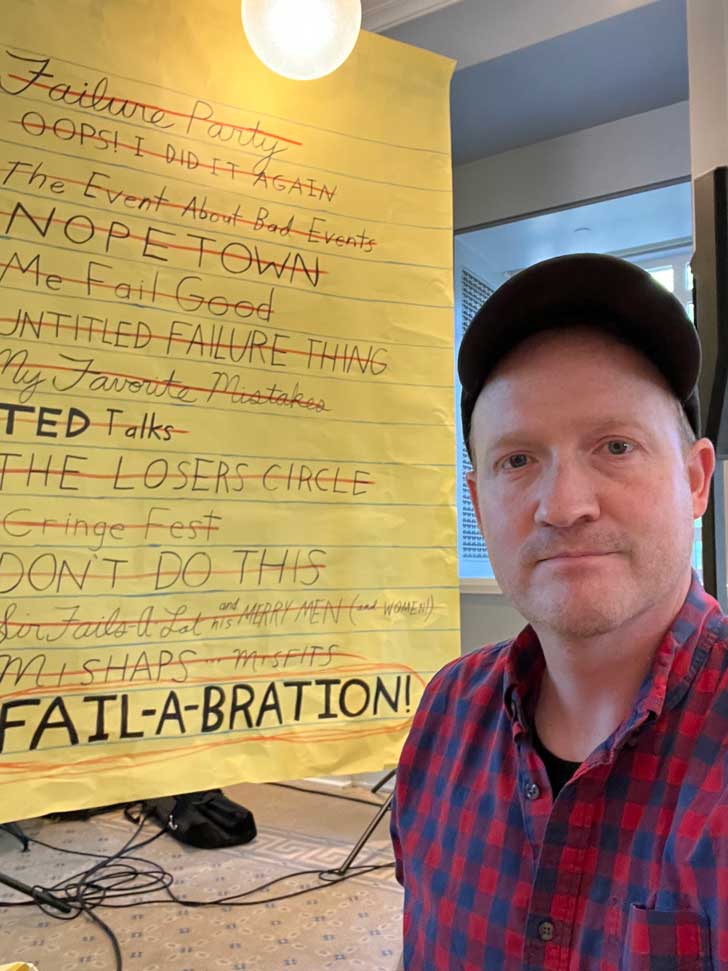
I went all-in on the “Fail-A-Bration” picture book when I learned that one in three young people in America deal with extreme anxiety.
This number tracked with what I was experiencing in classroom visits. It also spoke to what I felt as a student who worried about my grades and being perfect.
I wanted to create a book that repositioned failure not as an end point or a catastrophe, but a normal part of the learning process.
Failure doesn’t have to be catastrophic! Failure can be a catalyst for creativity and new discoveries! It has been for me.
The book is a picture book for all ages — and I mean it. I believe the best picture books work for children and former children. The language might be simple, and the illustrations are childlike, but it really is for humans of any age.
The idea of reimagining failure and working through it with community is something every person needs.
How does failure make us more courageous?
Brad: It’s natural to want to hide our mistakes. We’re taught that failing is shameful. The idea that a failure could be shareable is somewhat radical.
This project has taught me just how contagious vulnerability can be. We’re hungry for it. Seeing someone be real about a setback or disappointment gives us permission to do the same. We begin to see shame transform into shared wisdom. It makes everyone around it stronger, braver, and more resilient.
To get people excited for the book, you’re helping them throw their own Fail-A-Brations. What does that look like?
Brad: It’s very simple to throw a Fail-A-Bration! It can be as big or small as you’d like.
All you do is simply bring people you care about together. This can be family and friends. This can be co-workers. This can be classmates. It’s an invitation to bring people together and celebrate your failed attempts, mishaps, and falls.
We’re seeing everyone from preschoolers to people in prisons taking this idea and making it part of their community. It’s overwhelmingly beautiful to see.

People are providing space for people to share vulnerable stories, which is already a big deal. We’re also seeing that all these vulnerable storytellers are being celebrated. We ask people throwing these parties to be generous with standing ovations, snacks, and surprises!
What would your dream Fail-A-Bration party look like? What failures would you be celebrating?
Brad: One of my dream Fail-A-Brations already took place! We were in an arena with more than 5,000 educators! LeVar Burton was there. It was absolutely incredible.
Best of all, though, each educator shared a story of something embarrassing or painful. I watched as this massive crowd became a family. It was like the arena became a living room. People sharing, laughing, crying, and growing together.

But my big dreamy Fail-A-Bration Of All Fail-A-Brations would be an Academy Awards-style celebration where some of the biggest stars in the world present awards to kids who fell off bicycles, came in last at science fairs, or missed words in spelling bees.
I think it’d also be helpful to have every elected official, entrepreneur, creator, or successful superstar interviewed by children. Every question would be about failures! No story of success from leaders allowed. Just tell us what went wrong! That’s where the good stories are! That’s where the good stuff is!
To be clear, this is not about celebrating mediocrity. This is all an invitation to fail better.
We spend so much time avoiding failures. That’s a life lived from a place of fear. We cannot and must not avoid failure.
“Failing better” means knowing you’re not alone.
Communities of growth and cultures of growth are needed if we’re going to be people who reimagine what our relationships to failure look like.
How do you find the courage to be vulnerable in your work? What is your advice for others looking to do the same?
Brad: I often create the things I myself need. I wrote the Kid President pep talk because I was in need of a pep talk. I share things on Instagram because they’re also things I need. I’ve discovered that when I do that, these creations tend to find the people who also need them, too.
My wife and I have a sign up in our studio. It says “Be Who You Needed When You Were Younger.” That has been a guiding principle. We look deep down for the things we needed as children.
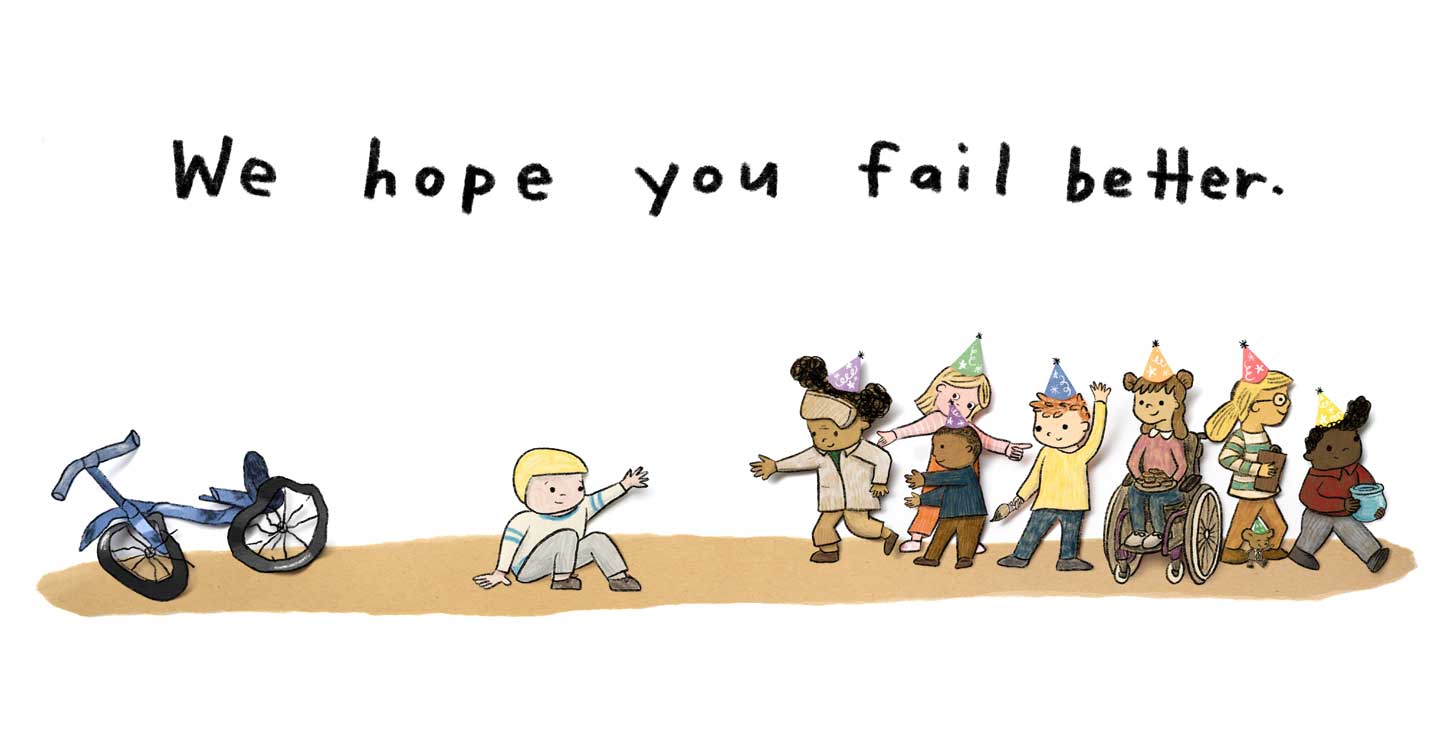
We’re also listening closely to the children in our paths to find out what they need now. It’s led us to places of joy and pain, light and heavy.
What keeps me going is discovering that these things — be they stories or experiences or whatever — these things can be of help to people on their journeys. So, it’s not always easy to dig deep and get vulnerable, but it leads to rewarding places.
“Fail-A-Bration” by Brad and Kristi Montague is available wherever books are sold starting September 10, 2024.
A version of this article was originally published in The Courage Edition of the Goodnewspaper.
Get your own Goodnewspaper by becoming a good news subscriber today.
Biogas is a renewable natural gas, which starts as organic matter like agricultural crops, forestry waste, and animal manure. After being processed to remove impurities, biogas — which is sometimes referred to as biomethane — has the same properties as natural gas and can be used for heating, generating electricity, and even transportation.
In other words, biogas could be another approach to clean energy — and is making strides worldwide.
Six Japanese companies recently announced their efforts to take this manure-fueled technology to the high seas.
Shipping company Mitsui OSK Lines will partner with dairy company Takanashi Milk Products to test the feasibility of using locally sourced biogas, as Japan aims to reach net-zero emissions by 2050.

Their joint study will also include Hamanaka Town, JA Hamanaka, Hokkaido Gas Co, and MOL Sunflower.
A press release from MOL noted that liquified natural gas is already being used as a low-carbon fuel alternative in factories and vessels, reducing CO2 emissions by up to 40%, compared to conventional methods. But biogas is known to emit even less carbon than standard LNG, especially when sourced from organic waste.
That said, biogas is not always a cleaner solution, with its environmental impacts heavily depending on where it is sourced. For instance, biogas from organic waste can be a less carbon-intensive fuel, but some gas companies create biomethane from fossil sources, which is well-documented as harmful to the environment.
It’s also important to note that agribusiness practices have a reputation for creating their own high levels of emissions, or exposing the environment to other air pollutants in the production of biogas.
Thus, testing the feasibility and sustainability of these solutions is a vital first step in potentially implementing them.
“In this study, the six organizations will evaluate the feasibility of using all or part of the biomethane produced in Hamanaka Town to fuel factories and vessels,” the press release continued.

This project will focus on the production of biogas sourced from local dairy farms in Hamanaka Town (yes, using cow dung). From there, experts will examine how well biogas can translate into existing infrastructure and test its ability to reduce greenhouse gas emissions at sea.
Other Japanese companies — Mitsui & Co and Tokyo Gas, have taken similar steps to integrate biogas into their operations, by bringing biomethane from the U.S. to Japanese waters. But this new coalition aims to produce their biogas locally, which could also lead to better management of organic waste in Japan, reducing landfill waste and other environmental hazards.
According to MOL, the transition promises to be a smooth one.
“Biomethane is an effective energy source for the ultimate goal of decarbonization because it can be used in current infrastructure for transport and consumption,” the company’s press release said.

This seems to be true across a number of countries, as the maritime industry slowly but surely makes the switch to clean energy.
In 2021, France emerged as a leader in biomethane shipping when CMA CGM launched a fleet of biogas-powered ships, “aiming to cut CO2 emissions by 67%.”
Earlier this month, the port of Rotterdam also opened a biogas terminal, which will be injected into the Dutch national gas grid or stored for future use.
Beyond meeting global emission-reduction goals, the companies involved in this initial testing also have their own sustainability interests.
For instance, MOL Sunflower will expand its ferry services with two liquified natural gas vessels by 2025, but with expanded knowledge of biomethane production, could be looking at an even better fuel alternative in the future.
“The six organizations participating in the collaboration will bring their respective knowledge and experience to this study,” MOL’s press release said, “... leading to major progress toward the goal of net-zero emissions by 2050.”
Header images courtesy of Carina Chowanek/Pexels and Mitsui O.S.K. Lines
On August 19, Apple announced an initiative to boost support for America’s national parks.
From now until August 25, the tech giant will donate $10 to the National Park Foundation for every purchase made with Apple Pay through its stores.

Essentially, when you shop at the Apple Store, in the App Store, or on apple.com using Apple Pay, a portion of your purchase will go towards stewardship and programming for the country’s national parks — up to a maximum of $1 million.
“For eight years, Apple has engaged customers in support for the NPF as part of the company’s long-standing efforts to protect and connect communities to America’s national parks,” a press release from Apple stated.
This initiative celebrates the 108th birthday of the U.S. National Park Service and comes alongside the rollout of a number of new national park tech features.
Apple has already shared content and resources across its platforms highlighting national parks, including a “Nature Awaits” playlist on Apple Music, which according to the press release, is also now playing in retail stores across the country.

And immediately following this philanthropic project, on August 25, the company will kick off its annual National Parks Apple Watch Activity Challenge, in which users can earn limited-edition awards and stickers to use in Messages by recording any workout that lasts 20 minutes or more.
Perhaps most exciting, however, is that this fall, Apple Maps will roll out new features to browse thousands of hikes and adventures across the country’s 429 national park sites.
Alongside 30 Apple Maps Guides curated by the NPF, the app will soon offer users the ability to filter maps by length, elevation, and route type, all while following “turn-by-turn guidance.”
iPhone users can also explore topographic maps and build custom routes tailored to their own preferences, such as a steep climb or a leisurely walk. According to Apple, all national park hikes and custom routes can be saved in Apple Maps and accessed offline without service or Wi-Fi.
“Every time I visit a national park, I’m struck by their extraordinary beauty and incredibly rich history,” Tim Cook, Apple’s CEO, said in a statement.
“We’re proud to partner with the NPF to help preserve these natural treasures that inspire so many people. Their important work helps ensure that future generations will be able to experience that same sense of awe, wonder, and reverence for the planet we call home.”
Apple’s impact on the future of national parks
Apple’s support for the NPF funds a number of programs that help steward and preserve these treasured landmarks, but they are also vital in STEM programming that helps visitors and students learn and explore.
This includes funding the EcoLogik Institute, which supports youth interested in science, engineering, and innovation as they relate to the NPS.
A recent EcoLogik summer camp offered apprenticeships and on-the-ground work experiences in natural resources and science career fields, especially for young, diverse talent who often face barriers to exploring nature, according to Apple’s press release.
“EcoLogik has given me an amazing community,” 17-year-old EcoLogik camper Addison Shapiro said. “I’ve made so many lifelong friends and met inspiring women in STEM who have not only broadened my perspective, but also motivated me to pursue a career in the life sciences.”

While the preservation of the parks is important, so is nourishing the future generation that will grow to take care of them.
“By investing in the interest and passion of young women and girls who want to explore careers in STEM, we can empower them to become the next generation of environmental stewards,” Will Shafroth, president and CEO of NPF, said.
“The EcoLogik Institute’s project is proof that when we nurture a love of science, provide access to national parks, and equip young women… with the tools to succeed, they will see their potential come to life. With the support of Apple, together we’re creating a future where every girl can see herself as the next scientist, park ranger, and other endless aspirations.”
Header image courtesy of NPS/Damon Joyce and Apple
An international team of researchers — led by University of Utah scientists — has identified a new hope in treating diabetes and hormone disorders: Toxins found in one of the most venomous animals on Earth.
For a study published earlier this week in the journal Nature Communications, researchers examined the venom of a predatory marine cone snail. To hunt their prey, cone snails will “hijack” their prey’s blood sugar regulation using a lethal substance called consomatin.

As it turns out, the scientists noticed that this venom mimics a human hormone called somatostatin, which regulates blood sugar and hormone levels in the body.
Helene Safavi, the senior author of the study, and an associate professor of biochemistry at the University of Utah, explained that, while sourcing venomous sources might sound counterintuitive, these toxins are extremely precise and can be very useful in treating disease.
“Venomous animals have, through evolution, fine-tuned venom components to hit a particular target in the prey and disrupt it,” Safavi said in a statement.
“If you take one individual component out of the venom mixture and look at how it disrupts normal physiology, that pathway is often really relevant in disease.”
For medicinal chemists, she said, “it’s a bit of a shortcut.”

This is because consomatin has specific, long-lasting effects, and appears to be more stable and specific than the human hormone. This makes it a promising “blueprint for drug design.”
Somatostatin acts like a “brake pedal” for a number of processes in the human body, like preventing levels of blood sugar or hormones from rising too high, the university explained.
By isolating the consomatin in a petri dish, the researchers found that it interacts with one of the same proteins that somatostatin does, delivering similar results.
However, somatostatin interacts with several proteins, and consomatin only interacts with one, which means that they could fine-tune hormone and blood sugar levels without tampering with the levels of other molecules.
The researchers even said that the cone snail’s toxins could more precisely target hormone levels compared to most synthetic drugs — drugs that are an important element of care for people with diabetes, or whose bodies overproduce growth hormones.

The cone snail is also theorized to use the consomatin alongside another insulin-like material, just like humans.
“We think the cone snail developed this highly selective toxin to work together with the insulin-like toxin to bring down blood glucose to a really low level,” said Ho Yan Yeung, a postdoctoral researcher in biochemistry and the first author of the study.
“It means that there might not only be insulin and somatostatin-like toxins in the venom,” Yeung said. “There could potentially be other toxins that have glucose-regulating properties too.”
But… how do these highly selective toxins get harvested, and ultimately, help people in need?
The chemistry of cone snails
Researchers traveled to the Philippines, where cone snails reside, to collect samples for their study.
The venom of these snails is not just deadly to their natural prey — like worms, mollusks, and fish — but also to humans.
“Conus geographus can be aggressive and has been reported to have killed people – about 40 human fatalities have been reported,” Safavi told Cosmos, noting that the collection of snails was “potentially dangerous.”
With the expert experience of the research team (the university’s School of Biological Sciences has been a hotspot for cone snail venom research since 1970), they used long tongs to move the snails into large plastic containers.
“When we get back to the boat we transfer the snails to a bucket and take them back to the lab where we continue to handle them with great care,” Safavi told Cosmos.
From there, the team extracted venom from the snails to conduct their testing.

Although the consomatin yielded exciting results, it could still be too dangerous to use as a therapeutic. That said, by studying its structure, researchers can begin to design drugs for endocrine disorders with these key elements in mind.
“The next steps for us are to use this and other cone snail consomatins to make drug analogs that can be used to detect and treat different types of neuroendocrine cancers,” Safavi told Cosmos, “and also make analogs that can be used as new pain therapeutics.”
Although the scientists have this newfound knowledge on their side, they remain humbled by the evolutionary power of their lethal invertebrate colleagues.
“We’ve been trying to do medicinal chemistry and drug development for a few hundred years, sometimes badly,” Savafi said. “Cone snails have had a lot of time to do it really well.”
Yeung chimed in: “Cone snails are just really good chemists.”
Header image courtesy of University of Utah
Every day the Good Good Good team collects the best good news in the world and shares it with our community. Here are the highlights for this week!
If you want to get good news in your inbox every day, join the Goodnewsletter — the free daily newsletter designed to leave you feeling hopeful.
The Best Positive News We’re Celebrating This Week —
A new trail network is the first in Vermont, and possibly the entire U.S., to be fully accessible to adaptive mountain bikes
Situated on 256 acres, a new mountain biking trail network called the Driving Range just opened in Vermont, and it’s the first in the state — and potentially the country — to be fully accessible to adaptive mountain bikes.
The Driving Range is a collaborative effort from nonprofits, a donor who supplied the land, hundreds of volunteers — and it was spearheaded by two mountain bikers, including Greg Durso, who rides an adaptive mountain bike.
The “most critical volunteer” to the project, Durso personally test-rode each of the trails, which are open to all mountain bikers — and are by no means easy.
Why is this good news? As one volunteer said, while there are so many issues in the world we can’t fix, “We can have an impact here.” Their efforts opened up a world of access and opportunity for outdoor enthusiasts of all abilities to experience and enjoy adaptive excursions — and charted a (literal) path for others to do more of the same.
Florida is building a freshwater reservoir that will supply clean drinking water to millions of people
At the heart of Everglades National Park in South Florida, a new, 10,100-acre freshwater reservoir is being built. Once completed, it will be larger than Manhattan and Staten Island combined.
The “largest restoration project in the world,” the Everglades Agricultural Area reservoir will help to reduce harmful discharges to the St Lucie River, the Caloosahatchee River, and Lake Worth Lagoon.
Those discharges harm coastal communities, and cleaning them up will provide fresh, clean water to millions of people who depend on getting clean water from the Biscayne Aquifer, which is supplied by freshwater from the Everglades.
What’s the nuance? Longtime challenges like agricultural runoff, climate change, and pollutants like phosphorus that lead to devastating algae blooms all pose a problem for the reservoir. Still, the environmentalists and experts working on this project are familiar with the challenges and are working overtime to ensure that the restoration project is successful on multiple fronts.
A group of Benedictine monks are helping prevent forest fires to protect the planet and their community
The Benedictine monks at Our Lady of Guadalupe Monastery carry with them a deep reverence for their work: “To love as God loves.” Residing in a community right beside the Gila National Forest in New Mexico — that love isn’t just for their fellow man, but for the planet.
This has led them to serve as volunteers in the national forest, where they are behind an effort to bring community members together for one mission: To reduce the risk of wildfires.
They tend to the forest with divine care, removing vegetation through controlled burns and fuel reduction efforts, which lessen the threat of wildfires on the property.
And their example has been monumental in helping “teach [the community] the importance of fire hardening around their homes by thinning and clearing brush.”
A cutting-edge new community center in Tanzania will be 3D-printed using locally sourced soil
The Hope Village in Tanzania is soon to be home to a brand new, cutting-edge 3D-printed community center. What makes this center unique, though — is it will be created using locally sourced soil rather than layered concrete.
The soil will all be sourced within 25 kilometers (or 15.5 miles) of the build site, reducing the need to transport materials for construction. To account for the climate of the region and flexibility of use, the interior will feature an interior floor plan.
The center is part of a larger plan to provide housing, a school, childcare, and training to young girls in the community.
→ Read more
More good 3D-printing news:
- Faster, cheaper and greener than regular construction, 3D printing schools could help African countries close education gaps.
- A single dad in England creates custom, one-of-a-kind 3D-printed toys for kids with disabilities.
- Saving it from the trash bin, a YouTube creator figured out how to recycle “printer poop” waste from his 3D printer.
- Extending the lifespan of damaged items, a maker, fixer, and content creator provides free, mobile 3D-printed repairs.
This week, Apple is donating $10 to national parks for every qualifying purchase made with Apple Pay
To celebrate the 108th birthday of the U.S. National Park Service, Apple is donating $10 to the National Park Foundation for every purchase made with Apple Pay through its stores until August 25.
When you shop at the Apple Store, in the App Store, or on apple.com using Apple Pay, a portion of your purchase will go towards stewardship and programming for the country’s national parks.
The initiative comes alongside the rollout of a number of new national park tech features, including a “Nature Awaits” playlist on Apple Music, as well as its annual National Parks Apple Watch Activity Challenge.
→ Read more
More good national park news:
- The Inflation Reduction Act gave national parks $700 million in funding to fight climate change.
- New entry permit requirements at six national parks are making them easier to visit and preventing overcrowding.
- The National Forest Foundation has reforested over 21,000 acres of land in the last year and planted over 8 million trees to combat climate change.
- Two of the newest national parks (importantly) celebrate painful, darker times in U.S. history: the Blackwell School and Amache National Historic Site.
To prevent floral waste and brighten others’ days, two Virginia women make bouquets from discarded flowers
Both discouraged by the nationwide problem of floral waste and excited by the idea of being able to use those discarded flowers to brighten someone’s day, Rebecca Shelly and Laura Ruth started a nonprofit called Friendly City Florals.
They reuse arrangements donated from weddings, funerals, floral shops, and even local gardeners to refresh bouquets for senior care homes, hospitals, mental health agencies, schools, and more in the Harrisonburg, Virginia area.
Shelly and Ruth meet at least a few times a week at each others’ homes to collect, refresh, and deliver their repurposed bouquets, which they noted can help alleviate stress and depression.
They even drop off loose stems at one senior care home so that residents can create their own bouquets.
A collaborative initiative between two Oregon counties successfully housed over 5,500 formerly homeless individuals
Two counties in Oregon, Portland and Multnomah, just proved how effective a collaborative effort to address homelessness can be. In the last fiscal year alone, they moved nearly 5,500 individuals out of homelessness and into housing — a 28% increase over the previous year.
Additionally, the Joint Office of Homeless Services said 7,900 people accessed its shelter services, an increase of approximately 35% over the prior year.
The Joint Office was able to serve thousands more individuals thanks to supportive policy programs, which directly helped around half of those it served.
→ Read more
More good news in homelessness and housing:
- A building in Detroit was transformed into permanent housing for veterans experiencing homelessness.
- Instead of an inaccurate, once-a-year federal tally, cities are using real-time data to end homelessness.
- Different from the rest of Europe, Finland has adopted a housing-first model that’s helped solve homelessness in the country.
- A viral TikTok invention is providing a compact, portable, secure option for transitional housing — and aims to end homelessness for good.
If you can’t wait four years for more summer Olympics energy, we have good news for you: we are officially less than one week away from the start of the Paralympics!
It’s the first time that Paris (and all of France!) will host the Summer Paralympic Games, and there’s so much to look forward to:
- Similar to the Olympics, the Paralympics Opening Cermony will make history and will be hosted outside of a traditional stadium setting for the first time ever.
- Thanks to advances in disability awareness and inclusion, the Olympics were already built out with accessibility in mind — there are other reasons why there’s a two-week gap before the Paralympics begin.
- With more coverage than ever before, NBC’s Peacock streaming app will stream a record-breaking over 1,500 hours of live coverage across all 22 Paralympic sports.
- One news channel’s coverage will also feature the first-ever deaf person to host live sports coverage on television.
- If you’re tuning in to the Paralympics for the first time, or are new to adaptive sports: you need to understand classification!
- With eight athletes and two guide runners (representing more than 120 million displaced people around the world), the Refugee Paralympic Team is the largest in history.
- Sarah Adam will make history as the first woman to compete on the USA wheelchair rugby team.
- For one Paralympic sprinter, winning gold medals is great — but what the Paralympics stand for matters way more.
- And Flavor Flav is helping that sprinter’s parents get to Paris to watch him compete.
Banned from attending university in Afghanistan, 19 medical students just arrived in Scotland to complete their studies
Overcoming setbacks and bureaucracy, a charity organization called the Linda Norgrove Foundation just successfully coordinated for 19 women medical students from Afghanistan to complete their studies in Scotland.
The group of women were banned from attending university after the Taliban took over and restricted women’s rights.
Notably, the “incredible women” will be treated as home students in Scotland, meaning they’ll receive free tuition and living costs, too.
The foundation has raised more than £3 million to fund projects for women and girls in Afghanistan over the last 14 years. The foundation’s namesake was a Scottish aid worker who was kidnapped by the Taliban in 2010, and died during a rescue attempt.
→ Read more
More good news of the week —
The Interior Department announced a $46.7 million investment in community-led local park projects in eight U.S. states. The funding will go toward the redevelopment or creation of local parks in cities like Tuscon, Kansas City, Cleveland, and Houston.
An alternative to the pap smear, starting this fall women will be able to use a simple swab to test for cervical cancer. Eliminating the uncomfortable, and for some, painful speculum, doctors hope the new test will improve screening rates and address disparities in who gets the disease.
Shattering the previous high, sockeye salmon are returning to the waters of Washington in record numbers. At a single dam, there were 165,071 sockeye counted through July 31 far surpassing the previous record of 54,000.
Faster and safer than traditional methods, a new gel-filled syringe that stops severe bleeding in seconds just got FDA approval. Especially in severe situations where a patient has suffered a gunshot wound or deep cuts, this innovative alternative will save lives.
A job training and placement program for former coal workers in Kentucky just got $40 million in funding. The Shaping Our Appalachian Region plan will advance local industries, small business support, and job placement for people in recovery, former coal workers, and more.
Britain is experiencing a beaver baby boom in places where the animals had been considered extinct for centuries. Until about 20 years ago, beavers had been extinct from Britain for 400 years, having been hunted for their fur, meat, and scent oil.
Churches across the U.S. are using their land for affordable housing initiatives. The congregations are using their land in new ways that reflect their faith, and to help make a difference for the intensifying housing crisis.
Left out for decades despite their deep connection to the land, Yellowstone is pushing to re-indigenize the park. This year, the park hosted a week-long celebration honoring the ancestral cultures and traditions of Yellowstone’s Indigenous Peoples.
The Tulsa Zoo just welcomed five critically endangered Malayan tiger cubs. The national animal of Malaysia, there are currently fewer than 150 Malayan tigers in the wild due to threats such as habitat loss and poaching.
A simple, new treatment is helping stroke survivors who suffer from an invisible disability known as spacial neglect. More than half of stroke survivors do not receive rehabilitation after the first days of advanced stroke care, but new techniques can help improve their function and freedom.
Critical in fighting malaria in the country, Mozambique just introduced the vaccine into routine immunization. Malaria is endemic in the country, with prevalence in children under 5 years of age at 32% — this is a critical step forward to improve children’s survival using the lifesaving vaccine.
The FCC is launching a new alert system for missing and endangered Indigenous people in the U.S. The alert will help address disparities in searching for and locating thousands of missing Indigenous persons, who are at higher risk of being victims of violence, homicide, and of going missing.
Researchers found that toxins in one of the most venomous animals on Earth could help treat diabetes. The predatory marine cone snail’s venom mimics a human hormone called somatostatin, which regulates blood sugar and hormone levels in the body.
Denver converted all of its school playgrounds to green spaces and reaped incredible economic benefits. In addition to helping meet the developmental, social, and well-being needs of students, a report estimated that communities can see a more than $3 return for every $1 invested in green schoolyards.
Children in the UK will be taught how to spot extremist content and misinformation online. The country’s education secretary is reviewing curriculum in primary and secondary schools to help develop students’ critical thinking skills and to recognize misinformation spread online.