At first glance, the video game “Relooted” may look like a standard side-scroller. But the heist adventure — which is on many lists as the most anticipated game of the year — promises to reward players with a deeper narrative.
Set in the late 21st century, the game follows Nomali, a fast-thinking, acrobatic leader who assembles a crew of ordinary citizens-turned-thieves.
Their mission: to reclaim 70 real-life African artifacts from Western institutions and return them to their rightful homelands.
With each mission, players aren’t just solving spatial puzzles or testing their reflexes — they’re also participating in a modern reclamation story, blending meaningful narrative with satisfying, high-stakes action.
“Relooted” does not yet have a final release date, but its demo was released on September 16 to high praise. It is expected to arrive on PC and Xbox Series consoles before the end of 2025.
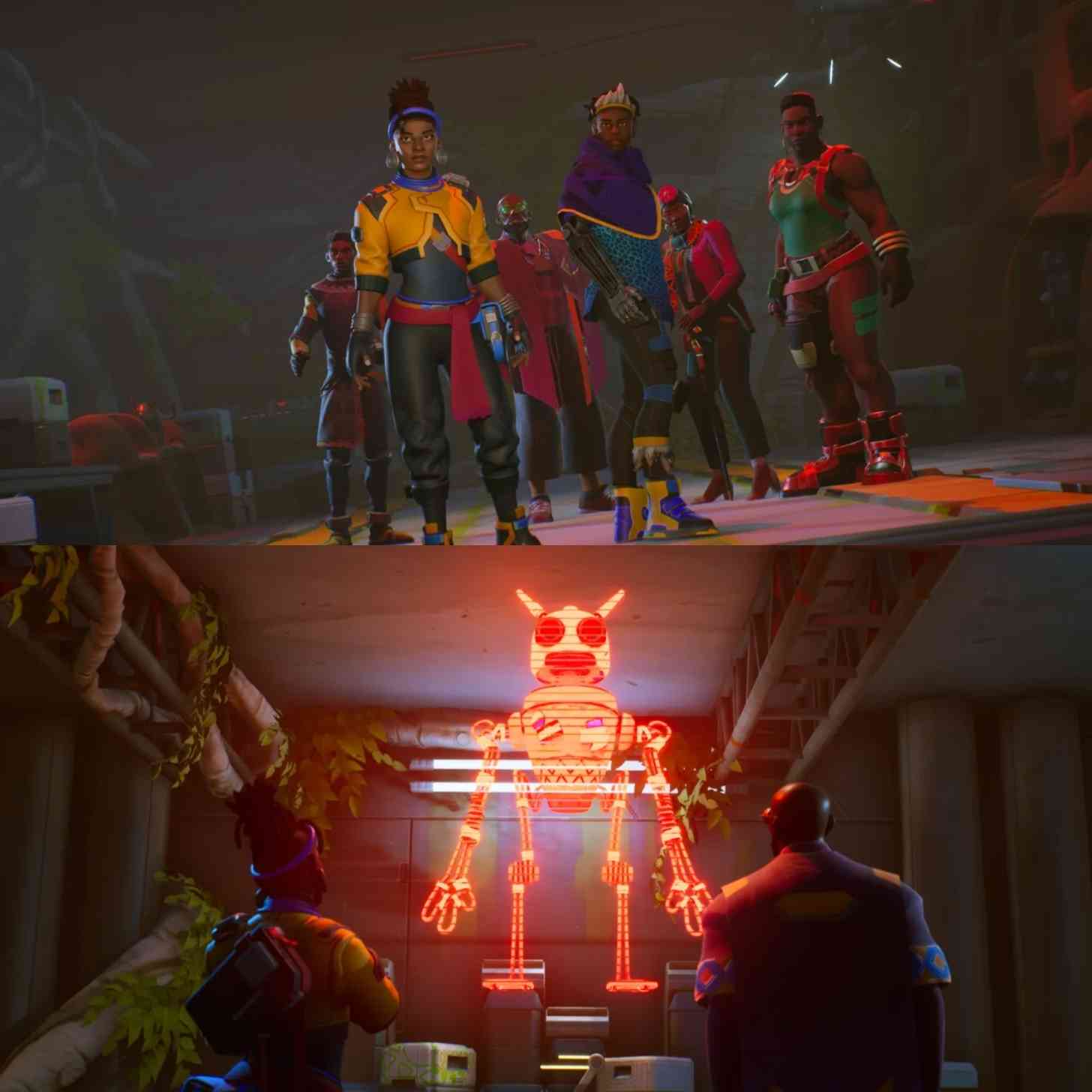
In an interview with Gamespot, “Relooted” producer Sithé Ncube said that the diversity on the development team helped inform representation within the game itself.
“A lot of people are based in Johannesburg,” Ncube said, in reference to the city where “Relooted’s” game studio — Nyamakop — is based. “Some people are based in Cape Town, but we also have people [elsewhere], like a 3D artist in Ethiopia.”
“I'm originally from Zambia,” Ncube continued. “When I started on this, I was living in Port Elizabeth, and now I'm in Johannesburg. We also had people work on the game from Ghana [and] Nigeria. And the voice actors are also from [all over]. They have different backgrounds as well, all of which are pretty close to the backgrounds of the actual characters.”

Ncube said that even before she started working on “Relooted,” she was interested in what game developers across Africa were doing, and how their heritage and background informed the games they were working on.
Ultimately, Ncube said, the diversity of their development team adds to the authenticity of their project.
“Because there are some instances where it's like, maybe we need a pronunciation for this type of thing,” she explained. “And you can ask someone who's very close with someone in the team, or even just someone within the team.”
That authenticity carries over even into the game’s most minute details.
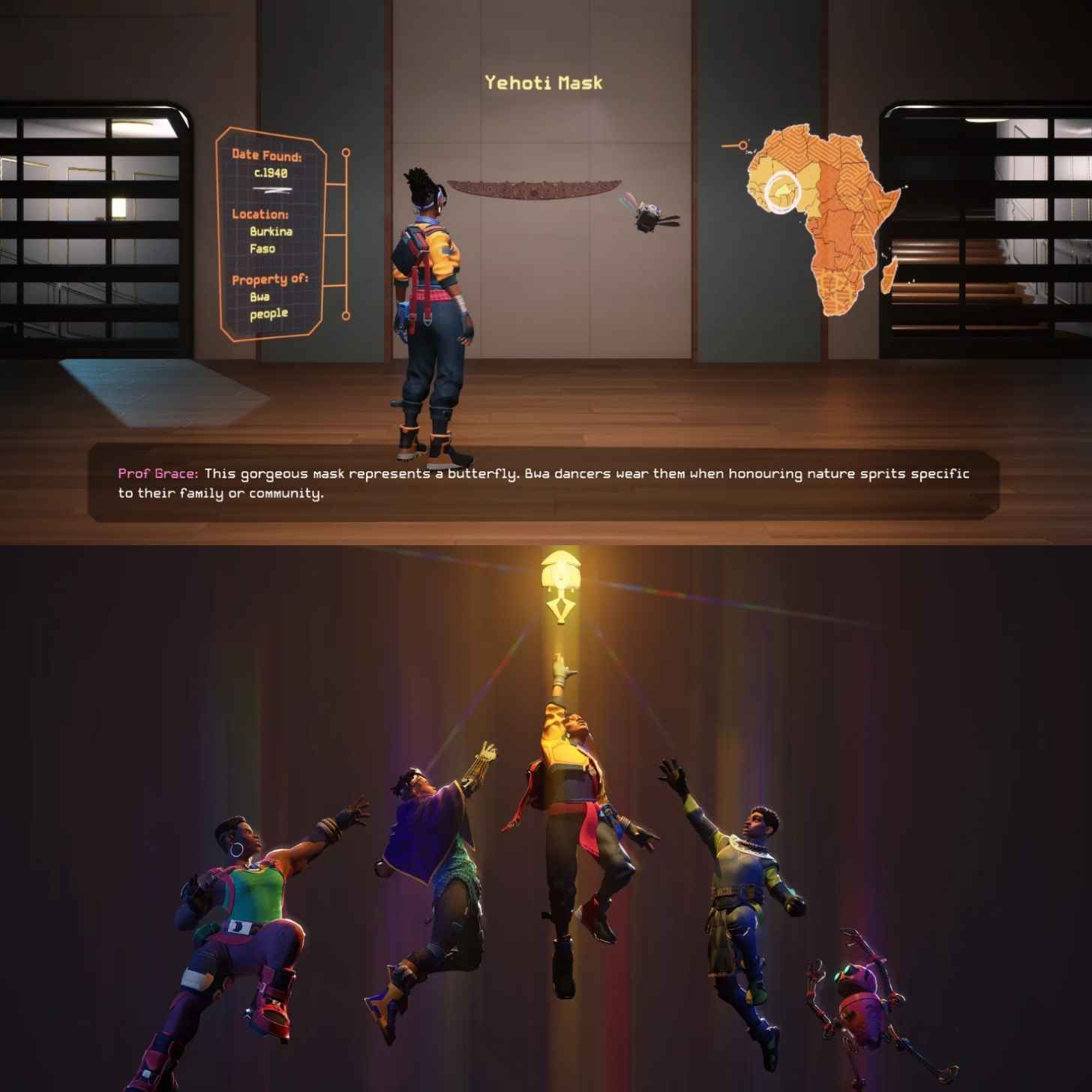
“Even the environment art,” Ncube pointed out. “Someone told me that they really like the rooftops in our game, and I was like, ‘What?’ I've literally never heard anyone comment on rooftops, but they said, ‘Yeah, you can see that it's purposely African. It's good.’”
In addition to producing “Relooted,” Ncube created Prosearium, an initiative designed to help 1,000 African women create and self-publish their own games.
“Sometimes you can see the common thread among communities across the continent, which is usually related to the lack of accessibility of resources when compared to the Western games industry,” Ncube told Forbes Africa after the initiative launched.
“It is difficult to find local game publishers and financing options almost throughout the continent,” Ncube said. “As industries become more visible, we’re bound to see more variety crop up around the continent.”
You may also like: New Roblox game donates a real-life meal to someone in need for each one served in 'virtual community kitchen'
Header image via Nyamakop
Every day the Good Good Good team collects the best good news in the world and shares it with our community. Here are the highlights for this week!
If you want to get good news in your inbox every day, join the Goodnewsletter — the free daily newsletter designed to leave you feeling hopeful.
The Best Positive News We’re Celebrating This Week —
The world’s first ocean reserve to be led and governed through Indigenous knowledge is a step closer to reality
New resources have been committed to continue the development of the Melanesian Ocean Reserve, which will be the world’s first Indigenous-led marine protected area.
Located across the Solomon Islands, Papua New Guinea, Vanuatu, and New Caledonia, it will be the first reserve that utilizes modern science and local governments, but is led and governed completely by Indigenous knowledge.
When it’s complete, it will make up more than 6 million square kilometers of ocean and islands — an area as large as the Amazon rainforest — and will protect some of the most biologically diverse seas on the planet.
Why is this good news? Healthy oceans and marine ecosystems are critical to the health of the planet and the living things that call it home. These areas have historically gone under- or un-protected, but more and more countries and leaders are taking concrete action to do better, while prioritizing the wisdom and insight of Indigenous groups who have long histories and connections with the ocean.
→ Read more
After Global Plastic Treaty fails, cities and states leap into action on microplastics
A woman in Australia has donated thousands of hand-knit baby clothes to the NICU
For some babies born prematurely, hand-knit clothes may be all that fits them as they receive critical treatment in the neonatal intensive care unit.
When the COVID-19 pandemic slowed donations of essential items for these tiny humans in John Hunter Children’s Hospital’s NICU, it made a Facebook post asking for donations of knitted goods.
Kim Franks saw that post and immediately got to work. Franks suffers from the chronic inflammatory skin condition psoriasis, which often leaves her bedbound, so knitting for NICU babies has been a welcome hobby in recent years. With semi-monthly donations, she estimates she’s made thousands of items.
→ Read more
Starting in 2027, a groundbreaking preventative drug for HIV will be rolled out for $40 a year in over 100 countries
Global health agencies announced that generic versions of the groundbreaking, injectable HIV-prevention drug lenacapavir would be available for around $40 a year in more than 100 low- and middle-income countries starting in 2027.
The twice-yearly injection was shown to reduce the risk of HIV transmission by more than 99.9% — a medical breakthrough for bringing better, more effective preventative treatment to people around the world.
Currently, lenacapavir costs around $28,000 a year in the United States. The company behind it signed licensing agreements with six generic drugmakers to help bring it to poorer countries, where treatment is needed by more people, but is also less accessible
Why is this good news? This move is being hailed as a “game-changer” in the fight against the AIDS epidemic — with one expert saying that, with the generic product, “we can end HIV.”
12 popular podcasts unite for ‘Be Hope’ takeover, proving there’s still good news in politics
A Jamaican student just received a major award for his invention that’s revolutionizing disinfection technology
Rayvon Stewart was the first in his family to go to college. There, he discovered his love of inventing, but it wasn’t until he was 23 and volunteering at a hospital that he realized he could solve a real problem with his designs.
It was this time in healthcare facilities that led him to invent a door handle that could disinfect itself after every touch. Xermosol is an ultraviolet self-sanitizing door handle, which Stewart says can kill 99.9% of pathogens, but is safe for people and animals.
The smart door handle has received over $200,000 in initial investments and has been hailed as a game changer for hospitals, hotels, and other businesses to control the spread of disease — and it won Jamaica’s Prime Minister’s National Youth Award.
→ Read more
A new ‘autism-friendly’ restaurant in North Carolina is making sure all its guests feel welcome
Jim Gordon owns the Peninsula Prime restaurant in Cornelius, North Carolina. His daughter also has autism, and he wanted to make sure she and other autistic people feel welcome and supported at the steakhouse.
The restaurant recently announced it would be an “autism-friendly” dining destination by offering sensory kits, a menu with pictures to allow customers with nonspeaking autism to point to their order, and generally providing a welcoming environment.
Gordon emphasized the need for more establishments to move past autism awareness to autism acceptance, and accommodations like these help get us there.
Why is this good news? Families and experts agree that this kind of support makes them feel welcome, considered, and cared for. One family whose son is autistic said they didn’t go out to eat for five years after his diagnosis, but this move communicates, “Please come have dinner at our restaurant because we’re going to meet your needs.”
Two years since Maui fires, 900 Hawaiians move into historic tiny home village: 'Second largest in the nation'
→ Read more
Despite only giving a small share of its income, foreign aid from the US has saved millions of lives each year
In 2023, the U.S. was the largest foreign aid donor, giving $62 billion — about the same as the next three largest donors, Germany, Japan, and the United Kingdom, combined.
This only represented 0.24% of gross national income, the smallest share of any of the ten countries that gave the most, but had a massive impact: saving an estimated 3.3 million people every year.
While it’s difficult to precisely determine the number of lives saved, researchers at Our World In Data’s “best estimate” found that AIDS programs saved the largest number of lives at over 1.5 million per year. Vaccines, tuberculosis, malaria, and humanitarian response saved between a quarter and half a million lives.
Some nuance: This impact was thanks in large part to USAID, which made up about 61% of the country’s foreign assistance. The Trump administration has completely dismantled the program, but people like Jane Goodall are helping ensure its work continues to make an impact.
A network of nearly 900 home bakers in four states makes sure food banks are stocked with fresh bread
The Seattle-based nonprofit Community Loaves started pairing home bakers with food pantries during the COVID-19 pandemic, but their work hasn’t stopped.
The organization, made up of a network of nearly 900 bakers in Washington, Oregon, California, and Idaho, has donated over 200,000 loaves of fresh bread and around 220,000 energy cookies to food banks. It’s one of the largest efforts of its kind in the country.
As opposed to the surplus bread often sent by grocery stores, which is often highly processed white bread or expired sweets, the home bakers’ breads are made with whole grains and minimally processed ingredients.
Why is this good news? Families around the country are increasingly struggling with hunger, food insecurity, and the rising cost of groceries. More than 50 million people a year receive food assistance, and experts say the recent federal cuts to food aid for low-income families will impact around 3 million people, making this work even more essential.
→ Read more
Former ‘garbage island’ transformed into modern cafe: ‘Even the light fixtures are made of plastic waste’
→ Read more
Jane Goodall was a legendary conservationist — and inspired all of us to stay hopeful and fill the world with more good
Dr. Jane Goodall was one of the world’s most celebrated primatologists and conservationists. She began her groundbreaking research on chimpanzees in Tanzania’s Gombe Stream National Park in 1960. Over the course of her six-decade career, Goodall worked tirelessly to protect chimpanzees and their habitats.
In 2002, she founded the Jane Goodall Institute, which supports chimpanzee conservation efforts around the world. Goodall’s work inspired people of all ages to appreciate and respect animals and our natural environment.
Big trees in the Amazon rainforest are more climate resilient and better at storing carbon than previously believed
A study that shows how the rainforest can draw carbon dioxide out of the atmosphere and sequester it in bark, trunk, branch, and root found something else: despite rising temperatures and strong droughts, the biggest trees in the Amazon are growing larger and more numerous.
Nearly 100 researchers from 60 universities looked at changes in the Amazon over the past 30 years. They found the mean cross-section of tree trunks thickened by 3.3% per decade, and the greatest increase was found in larger trees.
This proves the climate resiliency of these types of tropical rainforests and their effectiveness as a carbon sink — but only if they’re left alone.
What’s the nuance? We need to stop deforestation. The vital role these big trees play in fighting the climate crisis is at risk from fires and land clearance from the expansion of roads and farms, so the Amazon’s climate resiliency “may count for little, unless we can stop the deforestation itself.”
→ Read more
After schools banned phones, students checked out more library books: ‘We’re reclaiming attention’
→ Read more
From 2005 to 2023, per capita carbon dioxide emissions from energy consumption decreased in every U.S. state
According to new data from the U.S. Energy Information Administration, from 2005 to 2023, total energy-related carbon dioxide emissions in the country fell 20% while the population grew by 14% — leading to a 30% decrease in per capita carbon emissions.
While that’s the nationwide average, what’s even better is that per capita emissions also decreased in every state over that same time period.
The primary reason for this nationwide decline was less coal being burned in the electric power sector. Increased electricity generation from natural gas — which releases about half as many carbon emissions per unit of energy as coal — and from carbon-free sources made up for the decrease in coal generation.
More good news of the week —
In a new documentary, stand-up comedians open up about anxiety and depression — and streaming profits go to mental health support. “Anxiety Club,” blurs the lines of vulnerability and humor and promises an unflinching look at how deeply rooted anxiety and depression are in the stand-up comedy scene, all while inviting viewers to have “some laughs along the way.”
A California-based nonprofit has saved over 1.5 million acres of island forest and marine ecosystems. Seacology’s latest project is working to protect and restore Greece’s seagrass, a natural resource that protects the country’s coastline from erosion and sequesters ten times more carbon per acre than a rainforest.
A world-first sea turtle tracking project is giving scientists insight into the vulnerable flatback turtle species. The research team used turtle trackers comprising of motion sensors, GPS, and video cameras to monitor the turtles’ movements and feeding habits to help inform behavior-specific conservation efforts.
A nonprofit in Wyoming is launching a three-year initiative to build the state’s first “third space” for teens. A “third space” is anywhere outside of home or school where youth can socialize and hang out without spending any money — at the new space, teens will actually be able to make money in the program.
The first country to commit a contribution, Brazil announced a $1 billion investment in a global forest fund. The Tropical Forests Forever Facility would support the conservation of endangered forests, and has also received initial signs of support from nations such as China, the U.K., France, Germany, Singapore, and the United Arab Emirates.
China is recycling retired wind turbine blades into sand barriers that fight desertification. More durable and stronger than traditional materials, like wood composite boards, the recycled blade barriers both stop sand from spreading in arid regions and offer a new solution for massive amounts of would-be waste.
Bee experts added eight new species to Washington state’s list of native bee pollinators. Researchers discovered them after while collecting pollinators in Chelan County to study how climate and wildfires affect native bee populations, and their findings have important implications for protecting the pollinators.
Researchers developed a solar-powered artificial plant that can purify radioactive soil by 95% in 20 days. This highly effective, groundbreaking solution for cleaning up nuclear accident sites and contaminated agricultural land drastically speeds up a process that would typically take months.
A 9-year-old girl with stage 4 cancer got an early screening of “Wicked: For Good” two months ahead of the movie’s release. Brielle Bird is a “Wicked” superfan, got to share the experience with her family, and received messages from stars Ariana Grande and Cynthia Erivo, who said, “I hope that this film has made you believe you can fly.” (Have tissues ready for this one.)
Scientists invented the world’s first sunscreen made from pollen that’s as effective as traditional options and won’t harm the ocean. In their research, they found that the commercial sunscreen caused coral bleaching in two days and coral death in six days, but the pollen sunscreen gel had no impact on corals, which remained healthy for the duration of the experiment.
Tourism in Uganda is helping turn endangered mountain gorilla poachers into conservationists. Locals have said that fees to see the gorillas that tourists pay have ensured the recovery of the species, with habitat encroachment and poaching in decline as wildlife authorities seek to collaborate more with nearby communities.
Conservationists in Hong Kong are helping protect a critically endangered bird by installing artificial nests. The yellow-crested cockatoo population has stagnated in the city as the birds, which live in tree cavities, are losing natural nesting spaces in old trees due to typhoons and government tree trimming for public safety, on top of threats from the illegal pet trade and climate change.
For the first time, a transgender woman will represent Vietnam at the 2025 Miss Universe beauty pageant. Miss Universe Vietnam confirmed that singer and reality TV star Nguyen Huong Giang would represent the country, saying that “she shines with a strong inner strength, creativity and pride, true to the image of a modern and strong Vietnamese woman.”
More than 1,200 Portland residents and over 110 businesses volunteered in a “We Believe In Portland” city cleanup effort. The civic cleanup initiative happens semi-regularly in the city to help residents get involved in helping keep the city clean — the spring event saw more than 1,800 residents participate.
Volunteers sorted through 50,000 pounds of marine debris in Hawaii to help scientists learn more about the waste stream. Each piece that’s sorted is weighed, recorded, and logged into a global database to help pinpoint sources of marine debris. Initial findings suggest that 60% is coming from commercial fishing vessels.
In prisons across Ohio, inmates are finding purpose in rehabilitating orphaned and injured wildlife. The inmates volunteer as caretakers and learn how to handle, feed, and administer medication to a wide range of species — the program has rehabilitated and released thousands of animals that required extra care after initially being treated at an animal hospital.
After USAID cuts hit Goodall’s reforestation program in Tanzania, a search engine stepped up to keep it funded. Ecosia provided $100,000 to help save the Jane Goodall Institute’s reforestation effort in the Gombe Masito Ugalla biosphere reserve.
Colorado created a brand new holiday to celebrate Goodall’s 91st birthday, naming April 3 “Animals Matter Day.” The Jane Goodall Institute also celebrates #GoodAllDay on her birthday, inviting supporters — especially young people — to take action.
Goodall joined a TikTok creator to encourage young people to vote with nature in mind, saying, “You do care about your future.” On “Subway Takes,” Goodall delivered her hot take: “Young people have such an important role, and they don’t know how to play it.”
As part of its Inspiring Women series, Mattel made a Jane Goodall Barbie out of recycled ocean-bound plastic. It was part of a doll release that included a conservation scientist, a renewable energy engineer, a chief sustainability officer, and an environmental advocate.
In an essay, Jane Goodall acknowledged that humans were destroying the planet — but that hope is not lost. Goodall argued that “it will take hope, inspiration, and action to save the earth” and that “youth are the key to our survival.”
Thousands of activists in New York protested against financial institutions “profiting off the climate crisis.” “Make Billionaires Pay” protests happened in cities around the world ahead of New York Climate Week and the UN General Assembly, as countries have continued to increase their emissions of carbon dioxide, fueling more frequent and intense extreme weather events.
In the past decade, a Baltimore-based nonprofit has provided free sports programming for more than 80,000 children. The Volo Kids Foundation started with fewer than 100 young participants playing flag football at a Baltimore rec center — now it’s in 10 cities, giving thousands of kids access to free sports programming.
Bolivia became the latest country in Latin America and the Caribbean to ban child marriage. Between 2014 and 2023 alone, 5,169 child marriages were registered, of which nearly 93% of them involved girls aged 16 and 17, often with partners two or three times their age.
Researchers in Sweden found that a low daily dose of aspirin can have a “huge effect” in stopping colorectal cancer from returning. They found that people who took a low daily dose of aspirin after having their tumor removed were half as likely to have their cancer return over the next three years as patients who took a placebo.
This Barbie is a rugby player.
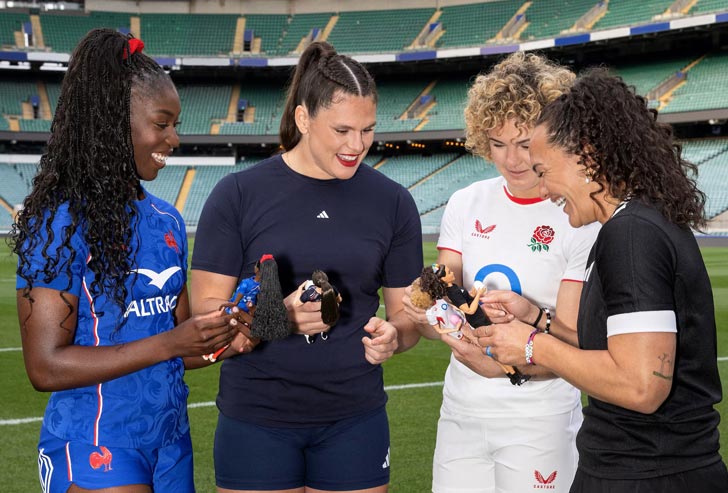
Today, Mattel announced a team of four new Barbie dolls modeled after professional rugby players, just in time for International Day of the Girl.
The four dolls are one-of-a-kind likenesses of four internationally renowned athletes: Ilona Maher, Ellie Kildunne, Portia Woodman-Wickliffe, and Nasirra Konde.
Each of these players has a history of showing their confidence on the playing field and encouraging young girls to do the same.
Ilona Maher in particular skyrocketed to fame as an Olympian rugby player unafraid to show off her broad shoulders and signature red lip — in addition to her medal-winning athletic prowess.
She became a social media star posting behind-the-scenes content as an athlete and continuing to champion body positivity on “Dancing With The Stars.”
“We all doubt ourselves at times, myself included. But I am where I am today, because I kept showing up anyway. Even through tough practice days or days I didn’t feel my best, I continued to put in the work, strengthen my skills, and believe in my ability. Which grew my confidence in myself and my career,” Maher said in a statement.
“I’m proud of how far I’ve come, and I’m not afraid to say it. If sharing my story can inspire other young girls to believe in themselves the way I have, then I’ll have truly made an impact.”
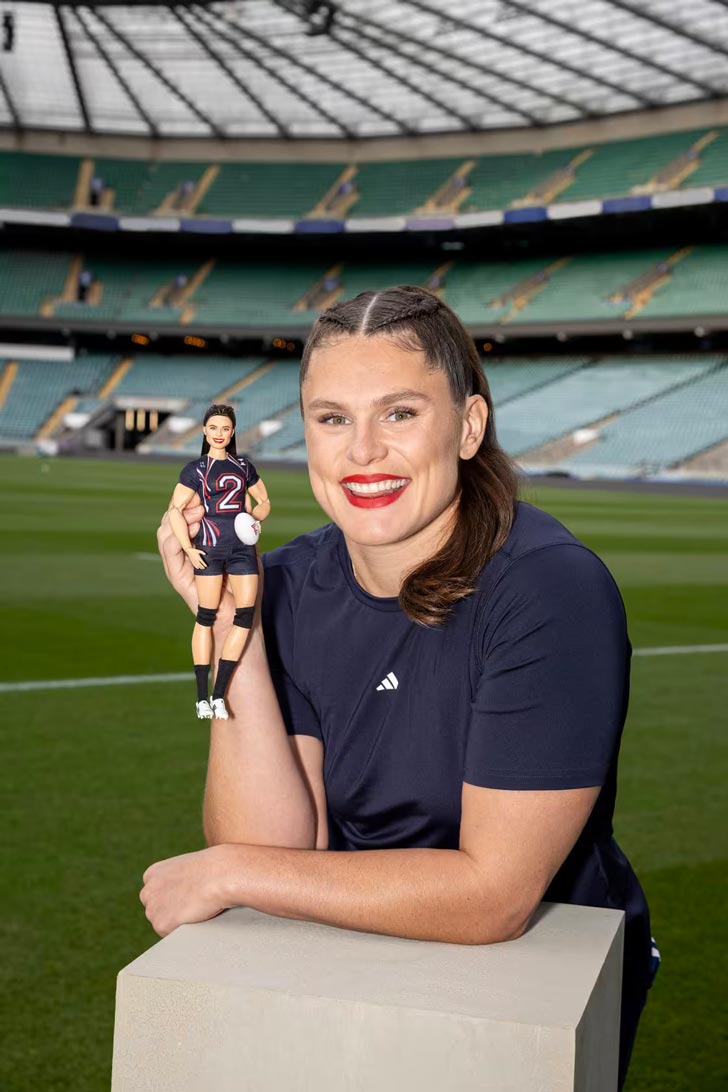
Maher’s Barbie doll won’t just be a one-time model but will actually be on store shelves in 2026. And Mattel is making a first-of-its kind new body build to reflect Maher’s strength and femininity.
The Ilona Maher Barbie doll will feature an all-new body sculpt designed to reflect the build of many female athletes.
“The Muscular sculpt celebrates strength with a straighter, more athletic torso, visibly defined arms, shoulders, and legs, plus sculpted core and back muscles,” a press release from Mattel detailed.
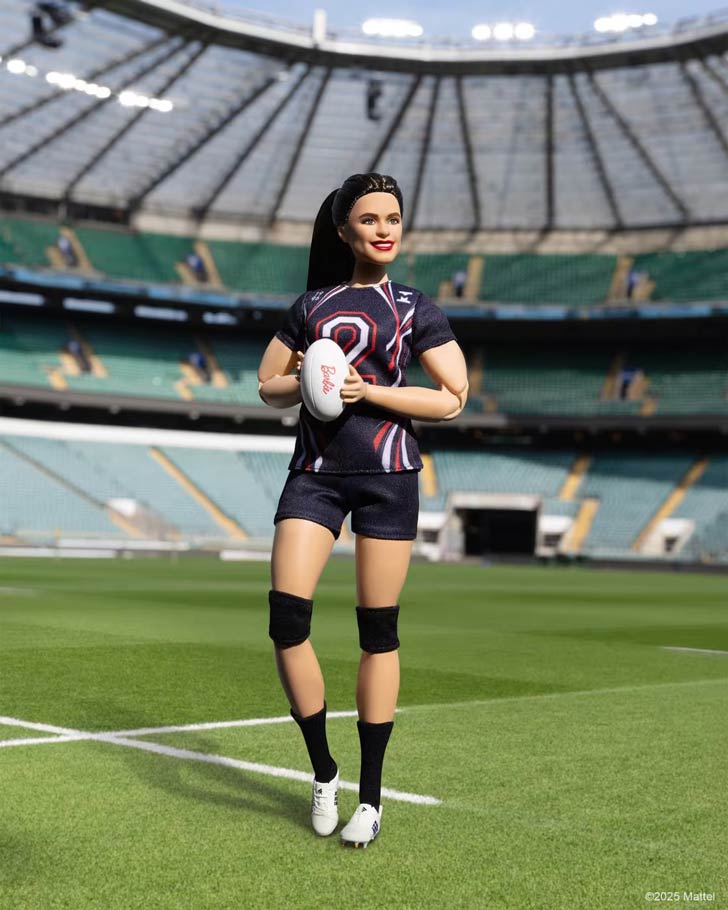
“She's been hitting the gym,” Maher joked to Reuters.
Seeing herself depicted in the iconic Barbie doll form means a lot to Maher.
“Being part of Team Barbie is about showing girls that confidence isn’t something to shy away from, but something to own,” Maher continued in a statement.
“I’m honored to use my platform to empower the next generation to find that spark of confidence within themselves and let it drive them toward unlocking their limitless possibilities.”
In addition to releasing this female athlete Barbie, the company also conducted a study across the United States, United Kingdom, France, and New Zealand – the home countries of the four Team Barbie rugby players — to better understand girls’ confidence and how it relates to athletics.
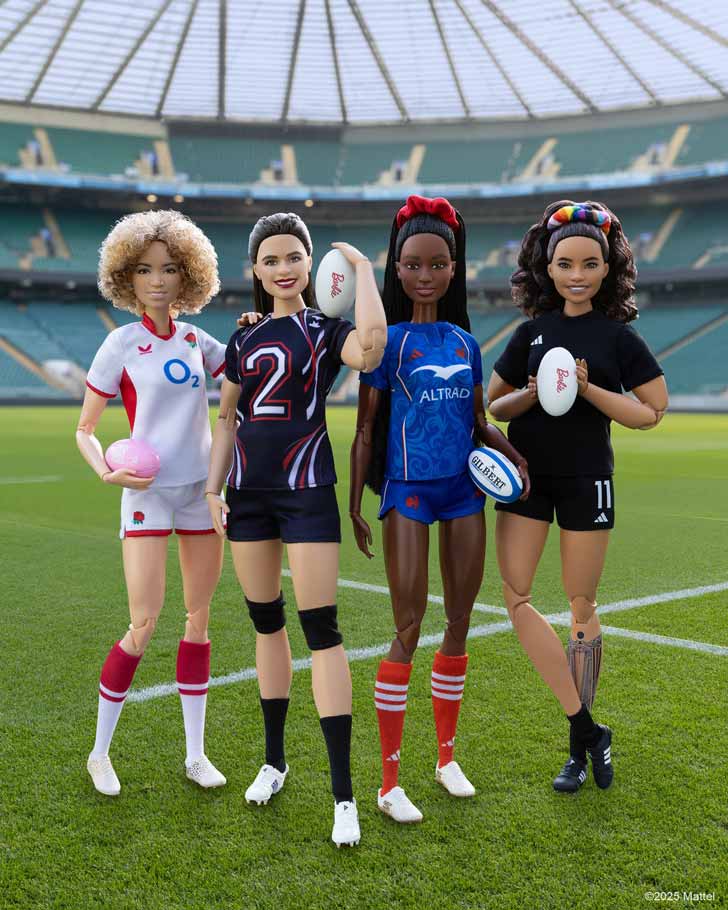
Their research found that one in three girls disengages from sports by age 14, citing body confidence concerns, self-doubt, and a lack of visible female role models.
Well, these dolls hope to play a role in boosting that visibility.
“At Barbie, we believe that girls can be, and do, anything,” Krista Berger, Senior Vice President of Barbie, Mattel, said in a statement.
“We’re committed to breaking down the barriers — from gender stereotypes to self-doubt — that hold girls back from realizing their limitless potential.
Along with the new campaign, Mattel will make a donation to girls’ sports organizations in the four countries of the Team Barbie athletes “to fund programming focused on unlocking girls’ confidence.”
“By showcasing the stories of incredible role models whose confidence has fueled groundbreaking success, we’re showing girls that the future of sports – or wherever their passion takes them – is theirs to claim,” Berger added, “with Team Barbie cheering them on.”
Maher agrees.
“Barbies are the ultimate image of beauty and femininity. And so that's what we grew up seeing every day,” she told Reuters.
“What I want is that when girls play with this and they see my Barbie and the broad shoulders and the big arms, that can kind of shape their views of beauty, as well.”
You may also like: First-ever Blind Barbie creates a 'sense of belonging' for disabled children
Header image courtesy of Mattel
Shipping containers have been retrofitted to become homes, hotels, dorms, and transitional housing for people facing homelessness.
But in the Czech Republic, they are now the foundation of a long-awaited tourist destination.
The architecture studio Atelier-r has just debuted its project Lookout Above Litomyšl, a viewing tower that provides unparalleled views of castles, nature, and sprawling European countryside.

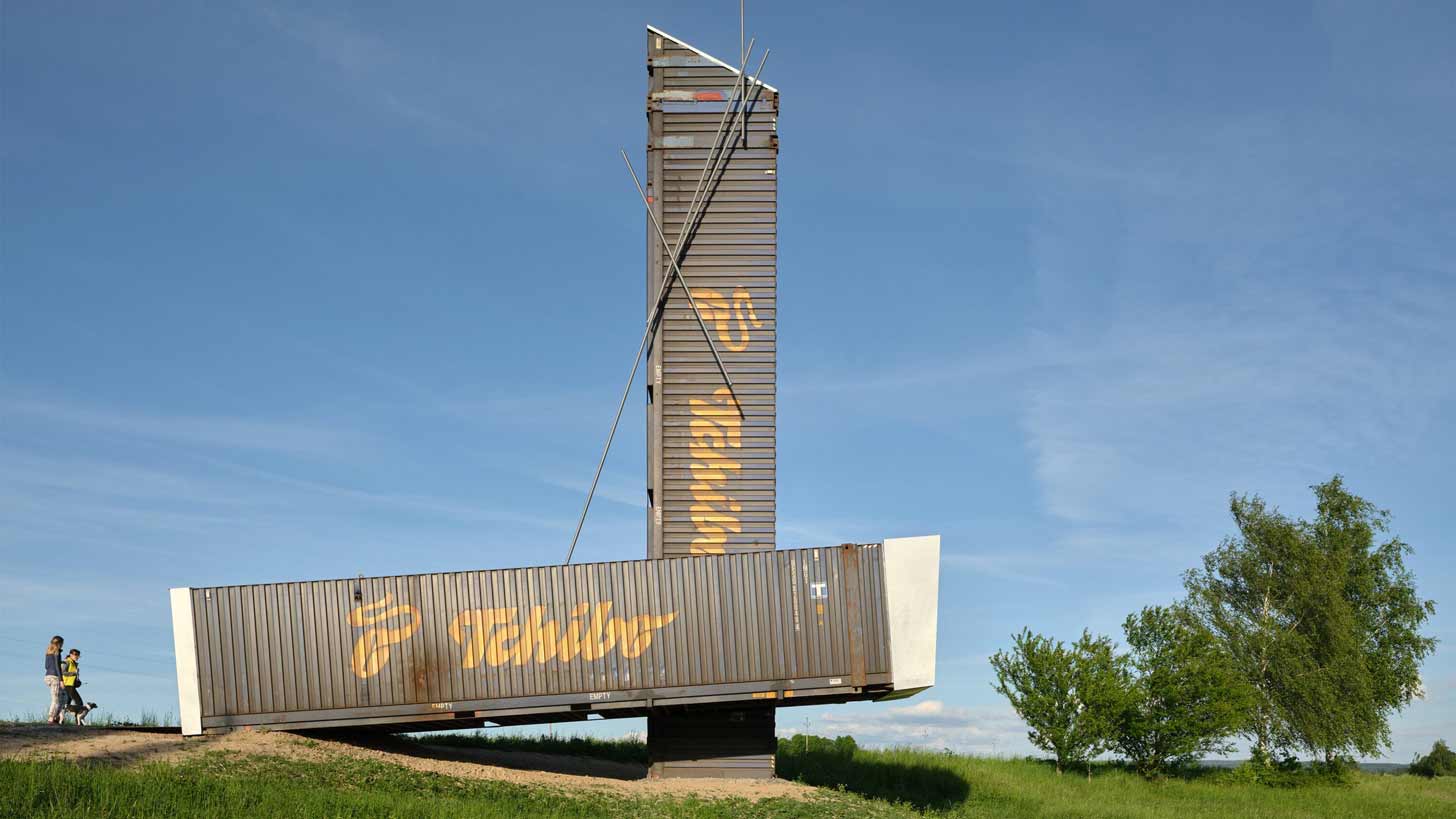
Situated on the outskirts of the town of Litomyšl, two recycled shipping containers make up the watchtower, with one played horizontally as a viewing deck, and the other standing vertically as a tower.
The development is part of the town’s Destinations of Journeys project, which aims to encourage locals and visitors alike to explore the area’s countryside. The tower sits just off a hiking trail and opens to views of the Litomyšl Castle, a UNESCO World Heritage Site, as well as the town center and town hall.
The designers used recycled shipping containers to scale back on cost and make a built structure that could be “reversible” if needed.
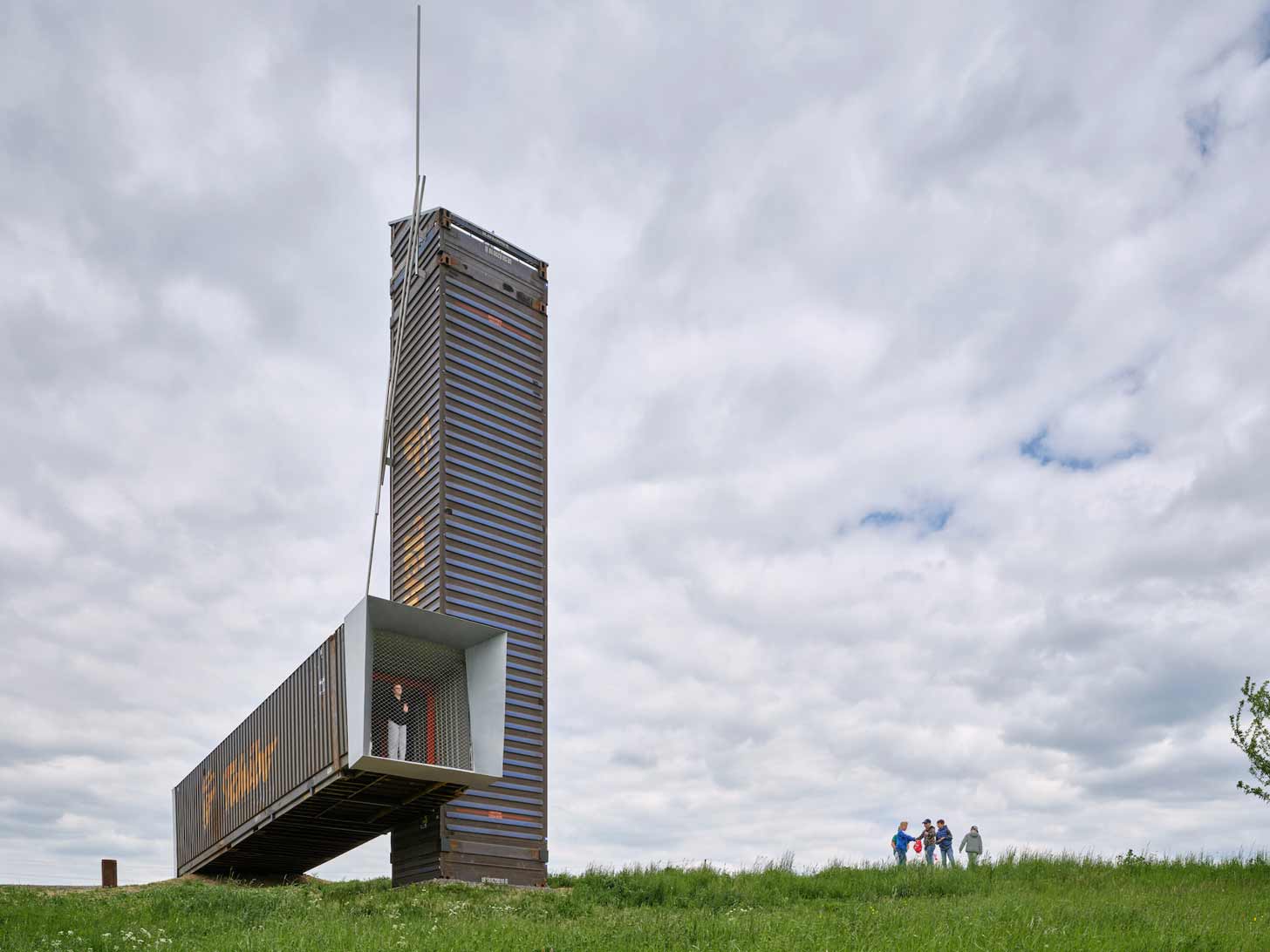
“We were driven to design an iconic object that would act as a visual beacon, drawing people towards it,” the firm’s chief architect Miroslav Pospíšil told Dezeen.
Pospíšil added that the creative process was to “conceive a sculptural object with an engaging function, to offer a new perspective on the city center with minimal investment costs, and to remain respectful of the environment.”
“We agreed that the construction should be environmentally friendly, and the overall solution should be reversible, meaning it should be possible to return the site to its previous state in the future,” the architects shared in a project statement.
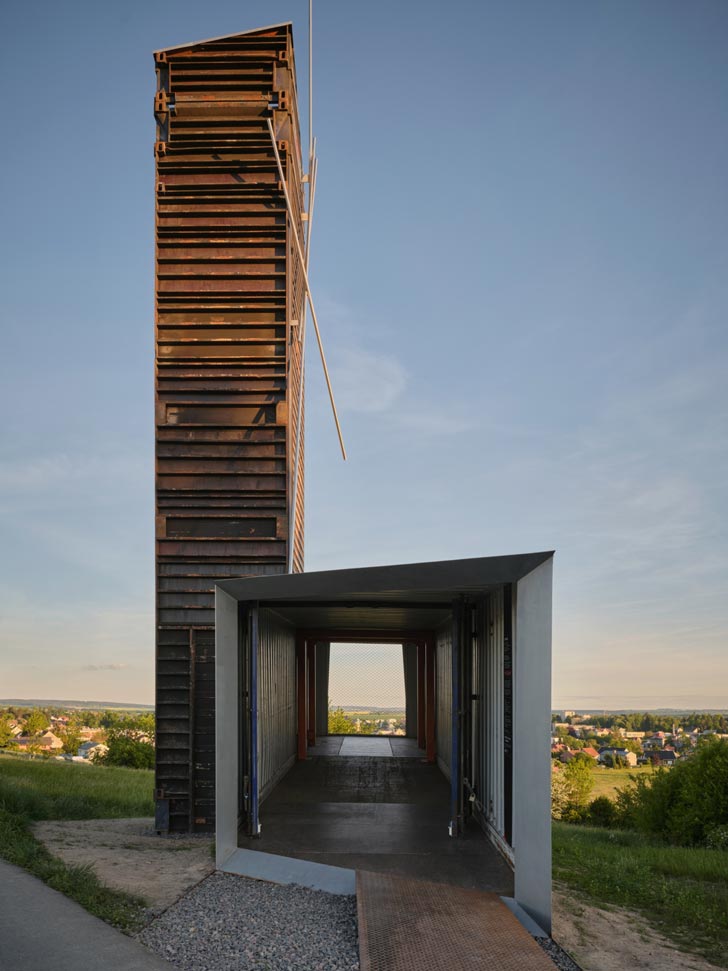
The shipping containers retain their industrial exterior look, a weathering gray metal that stands in stark contrast to the green landscape. They even still display a logo from the German coffee chain Tchibo, displaying a history of use and reuse.
“To preserve authenticity, the containers were left in their original surface finish,” Pospíšil continued to Dezeen. “They were not specially cleaned or painted. Coatings were applied only to the newly added reinforcing structures. Should the lookout one day cease to attract the city’s residents, though we firmly believe it will not, the structure can be easily dismantled, and the containers recycled for future use.”

Some simple changes were made, however.
Architects added support to the shipping containers, a steel structure that allowed for a staircase to be added inside the vertical tower. Both containers were also placed on reinforced concrete.
And on the top of the viewing tower is an artwork by sculptor Jan Dostál. Made from slender metal rods, it adds an additional dimension to the design while also acting as a lightning conductor to protect the structure.
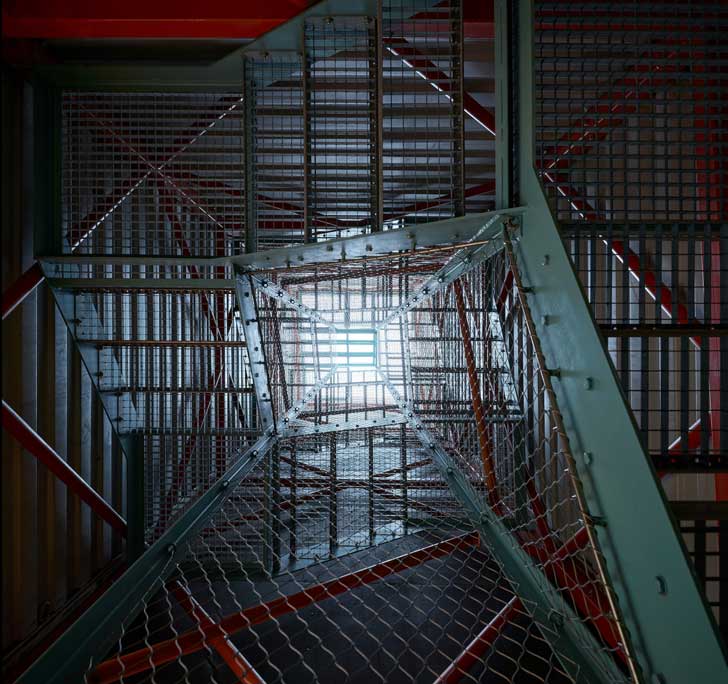
Overall, the unique new spot adapts to the challenges and limitations of creating new structures — with a much smaller environmental footprint than traditional means.
“The idea behind our project is to create an unconventional piece reflecting contemporary phenomena. We consider the influences of globalization, which simplifies many things (at the cost of their uniqueness) such as transportation and ecology,” the architects shared.
“We rely on … transportation in … most areas of human activity. Ecologists strive to balance finding new paths and eco-friendly alternatives. Our studio intends to reuse items and elements in a new context.”
A shipping container, they added, checks all of these boxes.
“A shipping container … travels around the world, from port to port where people of different nationalities, languages, and beliefs live, transporting goods that we all need. After serving its primary purpose, it can be reused, contributing to the ecological challenge,” Atelier-r designers said.
“By reusing old containers, we can save natural resources and energy sources.”
You may also like: Shipping container transformed into indoor farm that feeds immigrants for free: 'Forefront of innovative agriculture'
Header image by Boysplaynice for Atelier-r
Researchers at the Chulalongkorn University Museum of Natural History have identified a new species of spider found in the forests of Kanchanaburi, Thailand.
The specimens they collected included both blue-gray males and orange females, which were morphologically distinct from any other type of burrowing spider.
But one spider in particular was especially notable: It was orange on its left side and blue-gray on its right side, exhibiting a rare condition known as bilateral gynandromorphism.
In an email interview with Forbes, lead researcher and entomologist Chawakorn Kunsete delineated the difference between hermaphrodites and gynandromorphs, which are commonly mistaken for each other.
“Hermaphrodites are organisms that naturally possess both male and female reproductive organs with bilateral symmetry, such as earthworms or certain plants like roses,” Kunsete explained.
“Gynandromorphs, in contrast, occur in species where individuals are normally one sex only; a single organism shows both male and female characteristics, often split asymmetrically across the body.”
Like other arachnids, burrowing spiders play a crucial role in their local food web by controlling pest populations such as flies, mosquitoes, and roaches.

But Kunsete emphasized that the discovery of a gynandromorph in a burrowing spider species is incredibly rare.
“What surprised me most was that this was not only the first record of a gynandromorph in the Bemmeridae family, but also a new species from Thailand,” Kunsete explained
“I feel truly grateful and fulfilled, especially because this discovery was only possible thanks to the support and collaboration of many people.”

In the study, which was published in the scientific journal “Zootaxa” on September 25, Kunsete and his colleagues also explained the inspiration behind the name of the new species: Damarchus inazuma.
“The species is named after Inazuma, a character from the Japanese manga ‘One Piece,’ known for the ability to change sex between male and female,” the researchers wrote, in reference to the popular manga, which has been running since 1997.
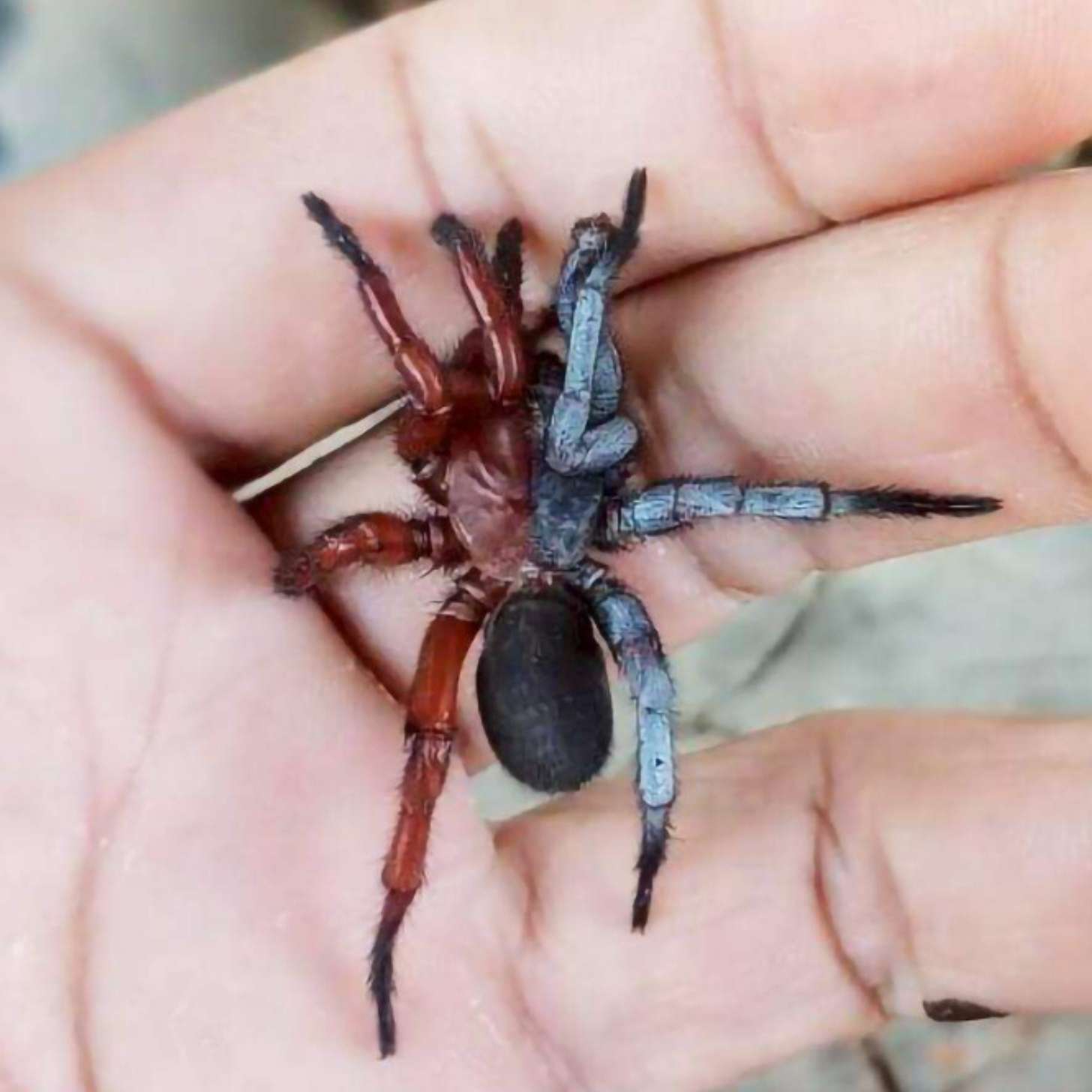
“The Inazuma style is characterized by bilateral asymmetry, presenting distinct coloration with orange on the left side and white on the right side,” they continued.
“This color arrangement closely mirrors the sexual dimorphism observed in this species, with males exhibiting white coloration and females displaying orange.”
Surprisingly, this is not the first time that “One Piece” has inspired researchers in the field.
As recently as August, a small team of researchers from the Japan Agency for Marine-Earth Science and Technology shared the discovery of a new deep-sea limpet, or sea snail, found 5,922 meters below sea level.
Due to its “unusually large” size, researchers named the deep-sea limpet B. Wadatsumi in reference to Large Monk Wadatsumi, a “fish-man” character from the series.
In the study, which was published in the scientific journal “Zoosystematics and Evolution,” lead author Dr. Chong Chen also included a special acknowledgement to the manga artist behind the best-selling series, Eiichiro Oda.
“[We] take this opportunity to salute Eiichiro Oda for continuing to chart the epic voyage of ‘One Piece,’” Chen and his colleagues wrote. “Which reminds us that the greatest voyages are driven by freedom, camaraderie, and an insatiable thirst for discovery.”
You may also like: New creature with 'visible internal organs' discovered by scientists. It looks straight out of a Studio Ghibli movie
Header image via Vyacheslav Argenberg / Wikimedia Commons (CC BY 4.0) and Surin Limrudee, via Natapot Warrit
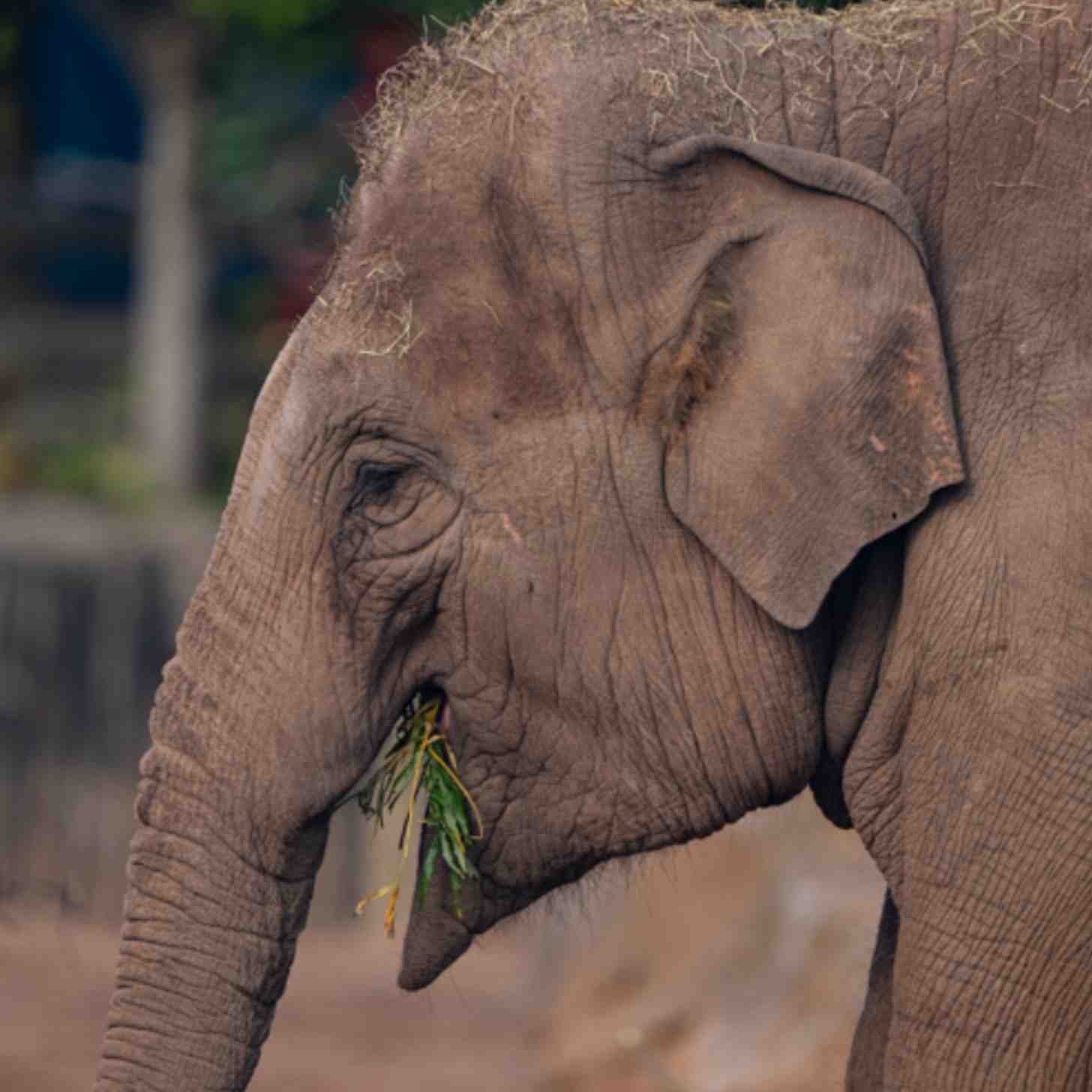
The Chester Zoo in England isn’t new to elephant conservation.
In 1977, they became the first zoo in the United Kingdom to successfully breed Asian elephants in captivity, a practice that they continue today with greater urgency.
According to the World Wide Fund for Nature (formerly known as the World Wildlife Fund), Asian elephant populations have declined by at least 50% in the past three generations.
In addition to threats from habitat loss, deforestation, and poaching, the Asian elephant — which is listed as endangered by the International Union for Conservation of Nature — has also been facing a mounting threat in the form of the Elephant endotheliotropic herpesvirus.
EEHV is a rapid, dangerous disease that causes acute blood loss issues and can lead to an elephant’s death within 24 hours of them first exhibiting symptoms. It is especially fatal to elephants under the age of eight.
In 2009, the Chester Zoo lost an elephant calf to EEHV, a tragedy that would later prompt the “Never Forget Campaign.” The zoo raised £250,000 through the fundraiser, which helped kickstart vital research into developing a vaccine.
“In 2019, our calf Indali Hi-Way became one of only a handful of recorded survivors after intensive treatment,” the zoo said in a press release. “By 2021, the first doses of this vaccine were trialled here at the zoo.”
“And now,” they shared, “in 2025, with trial results published, the vaccine can be rolled out worldwide.”
“This vaccine was first delivered to an elephant here at Chester Zoo in 2021,” said lead conservation scientist and study co-author Katie Edwards. “But this publication marks a watershed moment — it means we can now say the vaccine is ready for wider use.”
“EEHV has taken the lives of so many elephants, but this offers hope and a massive step towards ending those losses.”
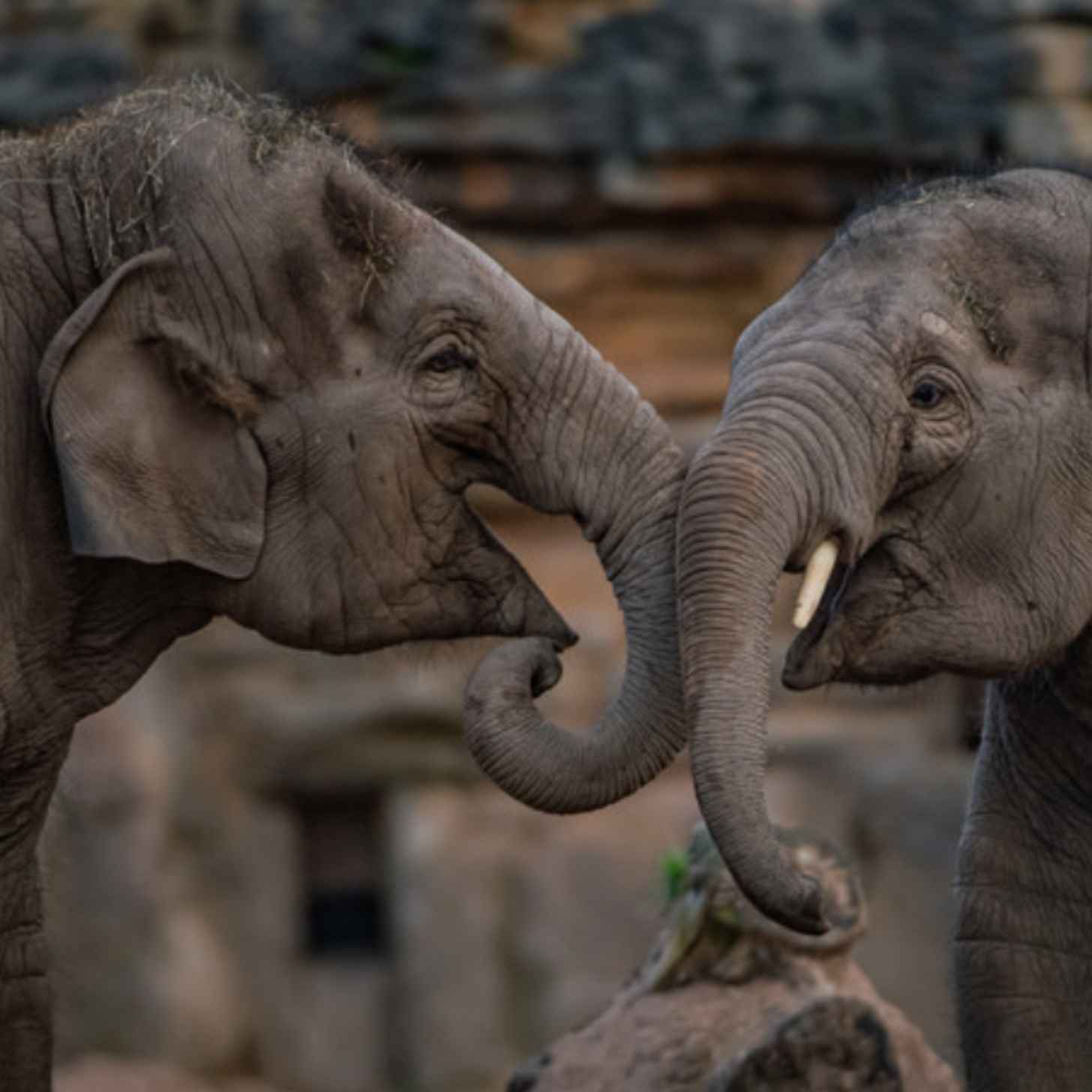
Falko Steinbach, a professor of veterinary immunology at the University of Surrey, called it a “landmark moment” for elephant conservation.
“For the first time, we have shown in elephants that a vaccine can trigger the type of immune response needed to protect them against EEHV,” said Steinbach, who served as a senior author of the study.
Javier Lopez, Chester Zoo’s head of veterinary services, emphasized the importance of making the vaccine as accessible as possible as it rolls out worldwide.
“As a conservation charity, our goal is for the vaccine to be open source and freely available to help save as many elephants as possible,” Lopez said. “Until now, EEHV has been a silent killer — with this vaccine, we finally have a weapon to fight back.”
You may also like: Park rangers in Senegal celebrate as beloved 'Ghost elephant' makes rare appearance
Header image via Ad Meskens / Wikimedia Commons (CC BY-SA 4.0)
Leksi Kostur addressed social media viewers with a bold statement: “I created my own coffin to get over my fear of death.”
While most might have their own existential concerns about the unknown, Kostur wanted to face her feelings head-on — and through her work as a biodesigner.
In a recent TikTok video, Kostur explained that she was in the process of getting her Master’s degree in product design when she lost some people close to her. It inspired her to do her thesis project on green burial.
“I wanted to look at ways of how to actually make death beautiful,” she said. “There’s actually so much beauty in decomposition.”

Kostur said she pored over images of primary decomposers — insects, fungi, and bacteria — and took to the beauty found in things like flies’ wings or the colors and shapes of different kinds of fungi and bacteria.
“From these images, I developed an ethereal aesthetic for my funeral,” she said.
But beauty wasn’t the only thing that inspired her.
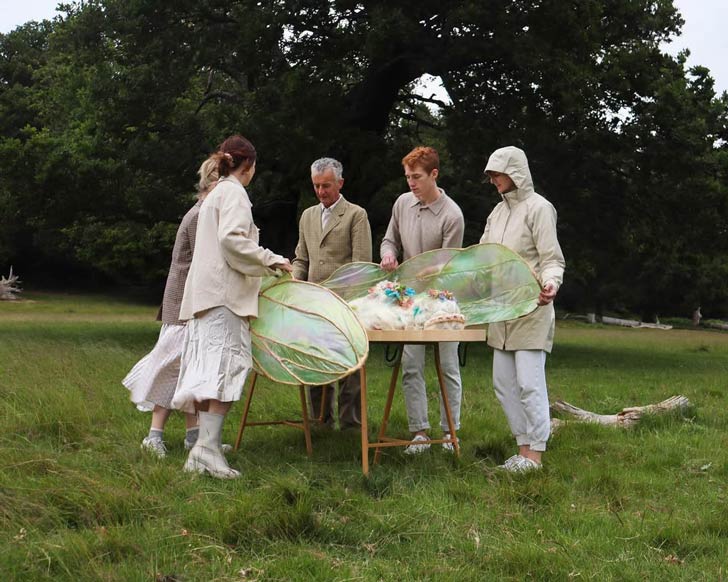
“I needed the whole thing to be biodegradable,” she said.
Conventional burial methods are often harmful to the environment. Resources like lumber, plastic, steel, and other metals are used for caskets or vaults, and embalming fluids contain toxic chemicals like formaldehyde that pollute soil and water as they seep from burial sites. Traditional cemeteries also require a lot of land use without much opportunity for natural degradation.
“Chemicals that we bury leech into the soil and the groundwater, and they end up polluting all the surrounding ecosystems,” Kostur added.
She was determined to find a better way.
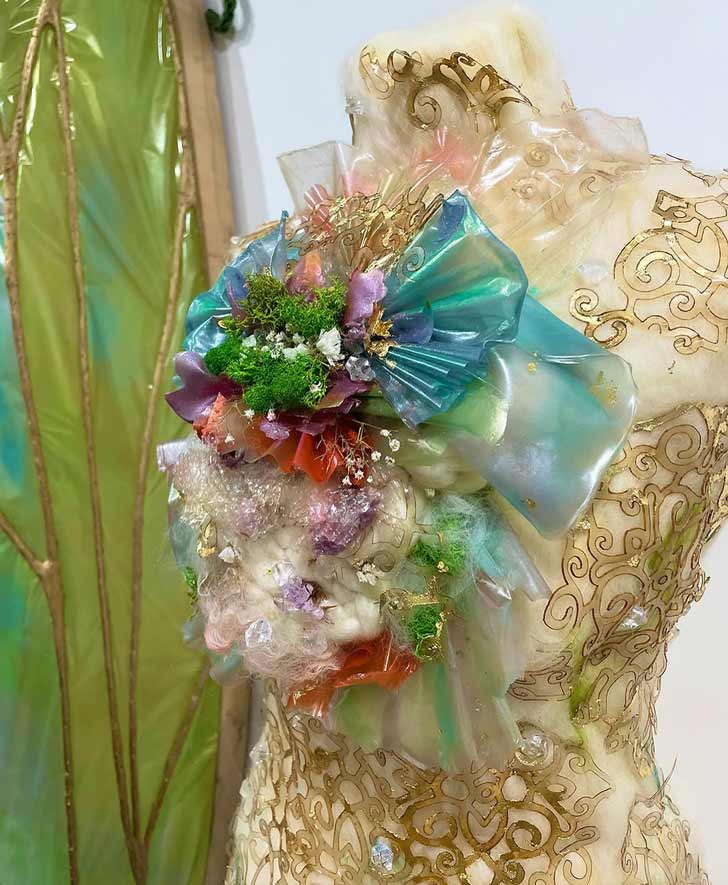
Ultimately, she made her own — a fully compostable, translucent “bioplastic” material made out of seaweed. Creating this material even led Kostur to use it in fashion accessories and wedding floral displays, which is now how she spends most of her time professionally.
But for her coffin, Kostur utilized the material to create something that lent itself to the ritual surrounding death and burial.
“I designed a ritual with these materials where the body is laid on a baseboard and covered with these biomaterial wings. After a procession takes place, the wings are removed and the body is underneath, shrouded in wool and various biodegradable accessories,” Kostur explained.

“The body on the baseboard is then lowered into the ground, and the grave is covered. The biomaterial wings are laid on top of the gravesite,” she continued.
Kostur also created another biomaterial for the golden structure of the wings, which contains native wildflower seeds.
“When it rains, and the biodegradable materials start to dissolve, the seeds sprout, and this creates a natural garden at the gravesite.”
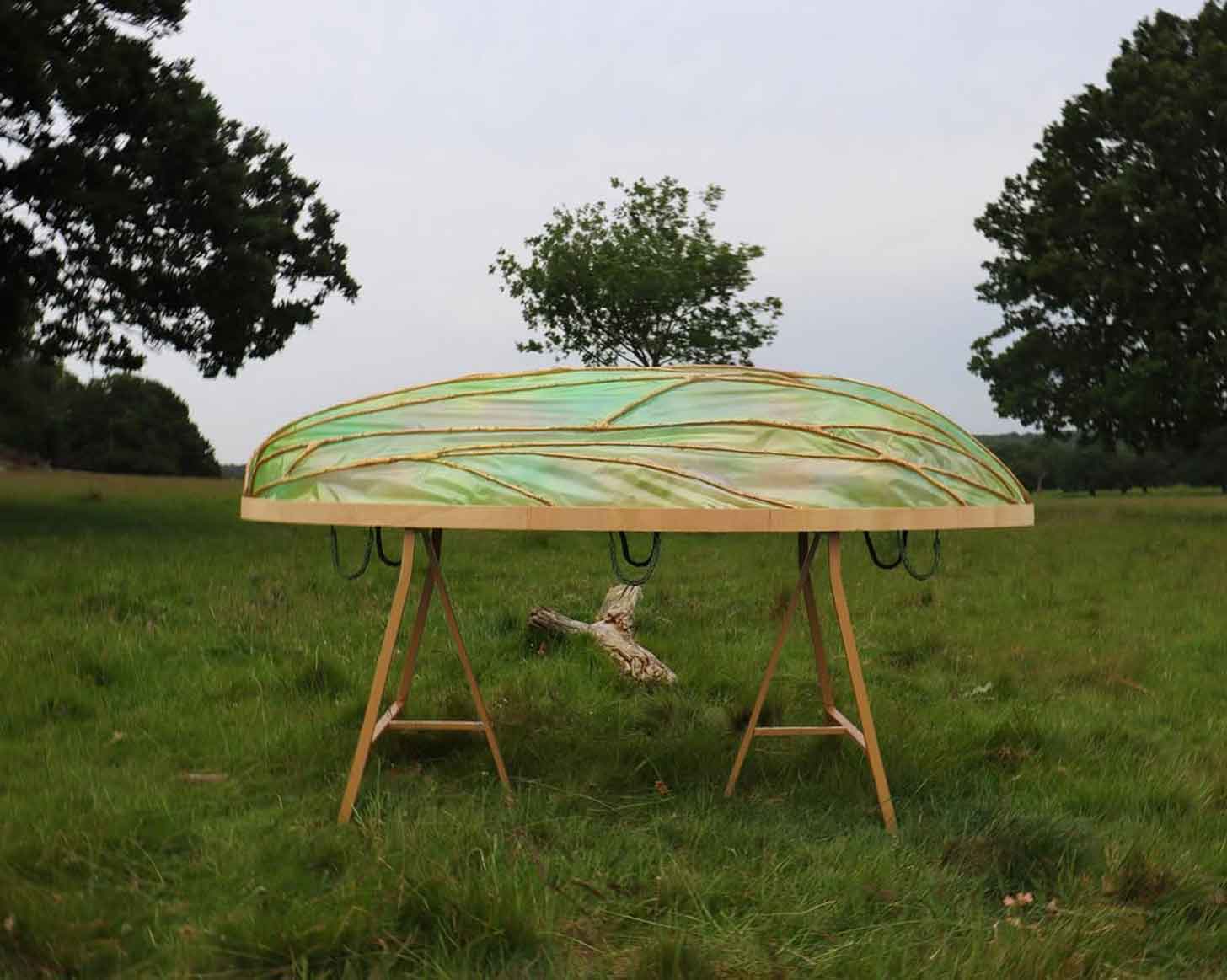
Kostur’s project, titled “Continuum,” was nominated for an international Green Product Award in 2022, and now years later, Kostur still reflects on it as a project that did provide some relief and control over her fear of death.
“Aside from its poetic value, this product contributes to the rewilding of green burial grounds,” a project statement for “Continuum” reads.
“As the gravesite becomes a natural garden, the transition from individual to collective is complete.”
You may also like: This startup recycles pet ashes into artificial reefs to save marine life. Human remains are next
Header image courtesy of Leksi Kostur/Instagram
In 2023, Canan Dagdeviren, who leads the Women’s Health Initiative at the MIT Media Lab, published a study on a groundbreaking invention: An ultrasound device that can be attached to a bra, designed to catch breast cancer early.
The device is a flexible patch that can be attached to the undergarment, allowing the wearer to move an ultrasound tracker along the patch and image the breast tissue from different, more dynamic angles.
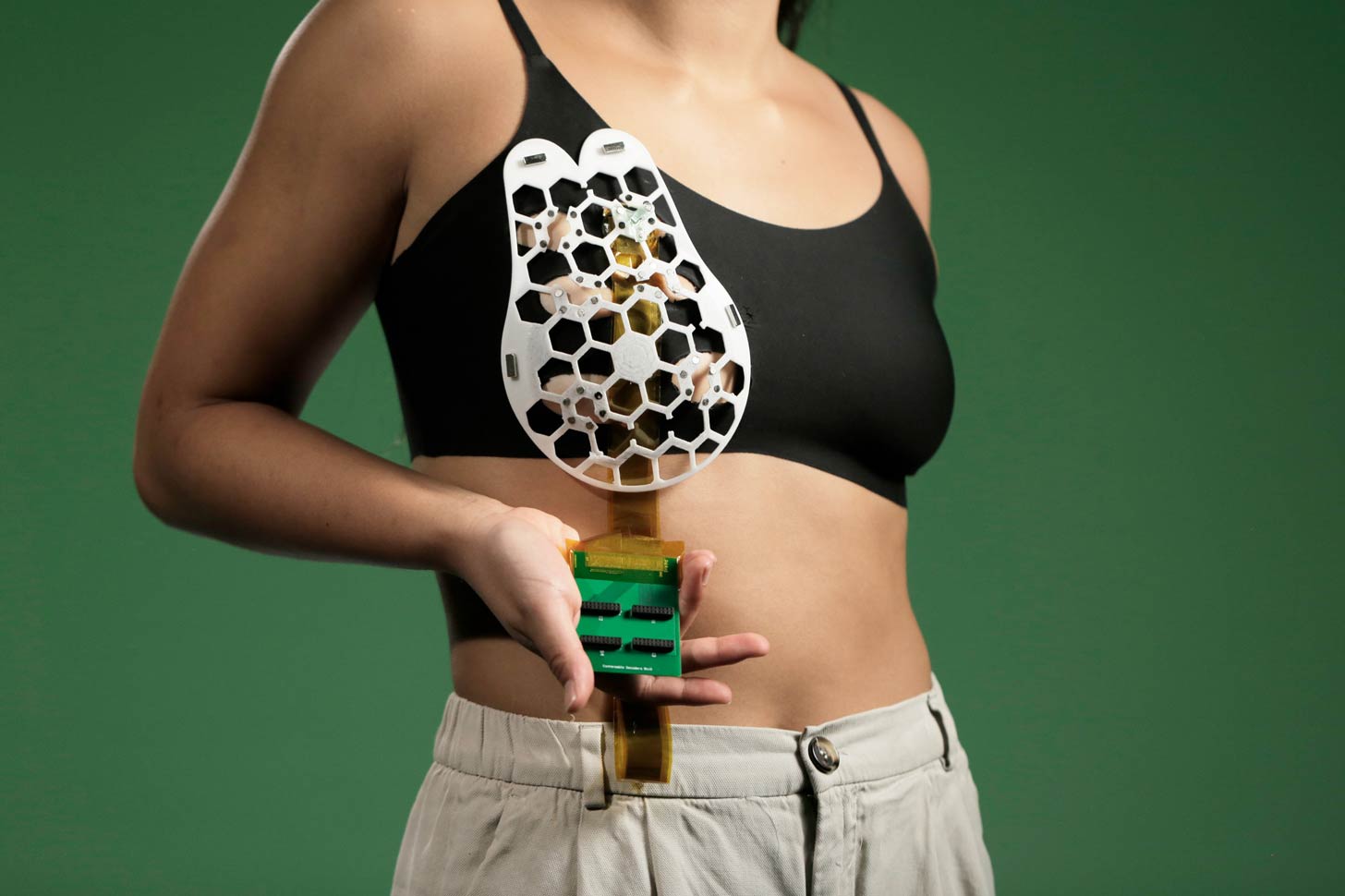
In the 2023 study, Dagdeviren and her team found that they could obtain ultrasound images with resolution as clear as those used in medical imaging centers.
But unlike traditional mammograms, the device offers a safer and more frequent alternative, capturing data from the same spot consistently and even detecting anomalies as small as 0.3 centimeters.
It’s called the Ultrasound Breast Patch, or cUSBr-Patch, and it was inspired by Dagdeviren’s late aunt, Fatma Caliskanoglu. She was diagnosed with late-stage breast cancer at age 49, despite having regular cancer screenings, and passed away six months later.
During that time, Dagdeviren started sketching up her design, allowing for more frequent screening of individuals at a high risk for breast cancer.
“My goal is to target the people who are most likely to develop interval cancer,” Dagdeviren told MIT News in 2023. “With more frequent screening, our goal to increase the survival rate to up to 98%.”

Now, just a couple years later, the cUSBr-Patch has taken the next step in the research journey — or, the next big leap for womankind.
In April, the device was sent to space with a team of six women on the Blue Origin space flight.
“It’s one of three experiments I conducted in space for women’s health,” astronaut Amanda Nguyen shared on Instagram.
She explained why it’s important for research like this to be done in orbit.
“One thing space gives scientists that cannot be replicated on Earth is more time,” Nguyen said. “In microgravity, 10 years of tumor growth can occur in 10 days.”
Researchers can experiment with treatments equally as quickly.
“I teamed up with Dr. Dagdeviren at MIT, the inventor of this ultrasound, to test its hardware durability, both in high G-forces, ascent and descent, and in microgravity,” Ngueyn added.
“Ultrasounds can be bulky, but Canan’s invention makes it possible to conduct more cancer experiments in space, embed ultrasounds into spacesuits, and into bras on Earth.”
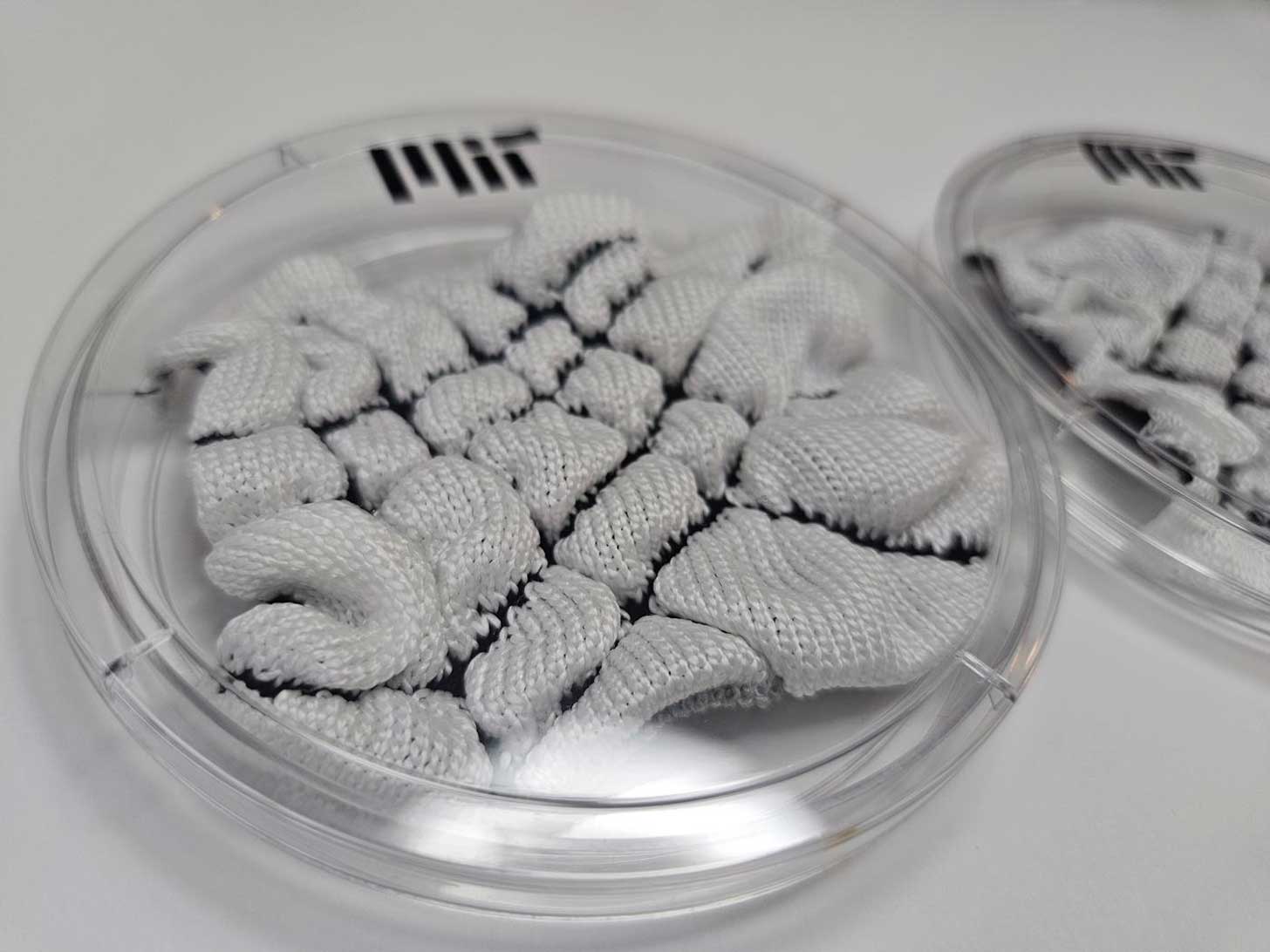
Back on earth, Nguyen is working with MIT Media Lab researchers to analyze the performance of the device’s materials, which include ultra-high molecular weight polyethylene and elastic yarns, designed for high-tensile environments. It was also tested for moisture resistance.
While it’s unclear what their findings will be, or what is next to getting this device on the market, its potential is written in the stars.
“This device has the potential to reshape our approach to imaging breast cancer, saving up to 12 million lives,” Nguyen said. “It’s an honor to be a part of advancing this research.”
You may also like: Scientists invent solar panels that provide wireless energy from space
Header images courtesy of Canan Dagdeviren and NASA
In 2014, British wildlife photographer Margot Raggett was on a safari in Northern Kenya when she came across a poached elephant. The emotional encounter spurred her to action, and she began asking fellow wildlife photographers if they would like to contribute to a photo series in the name of elephant conservation.
“At the time, I was spending a lot of time out in the field in Kenya, so I was meeting a lot of wildlife photographers,” Raggett told Bob Books.
“So I started asking the photographers I knew if they would contribute an image or two towards a book to raise money for elephants. Everyone I asked said yes, and then I would ask them if they knew any other photographers they could introduce me to.”
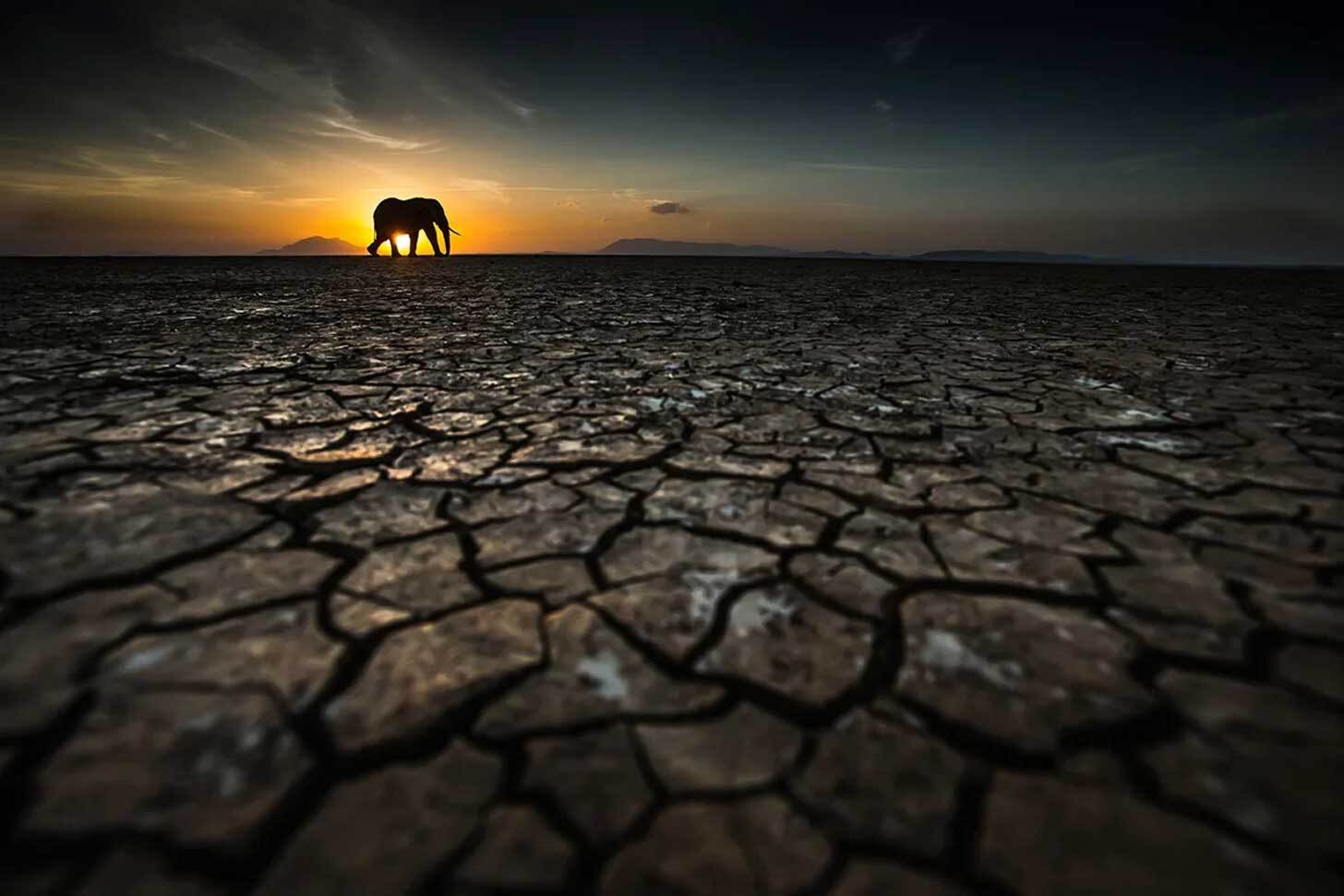
In the end, 65 photographers — including National Geographic collaborators Art Wolfe and Frans Lanting — donated images to the cause, under the name “Wildlife Photographers United.”
The resulting book, “Remembering Elephants,” became a runaway success, and Raggett went on to continue the project with “Remembering Rhinos” and “Remembering Great Apes” — the latter of which included a foreword from the late Jane Goodall.
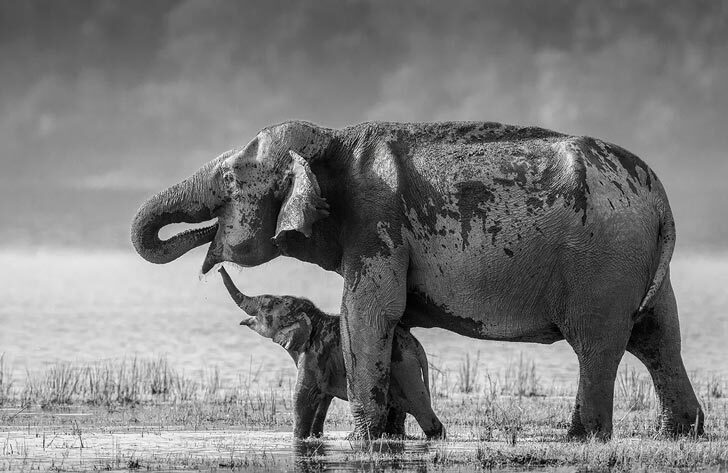
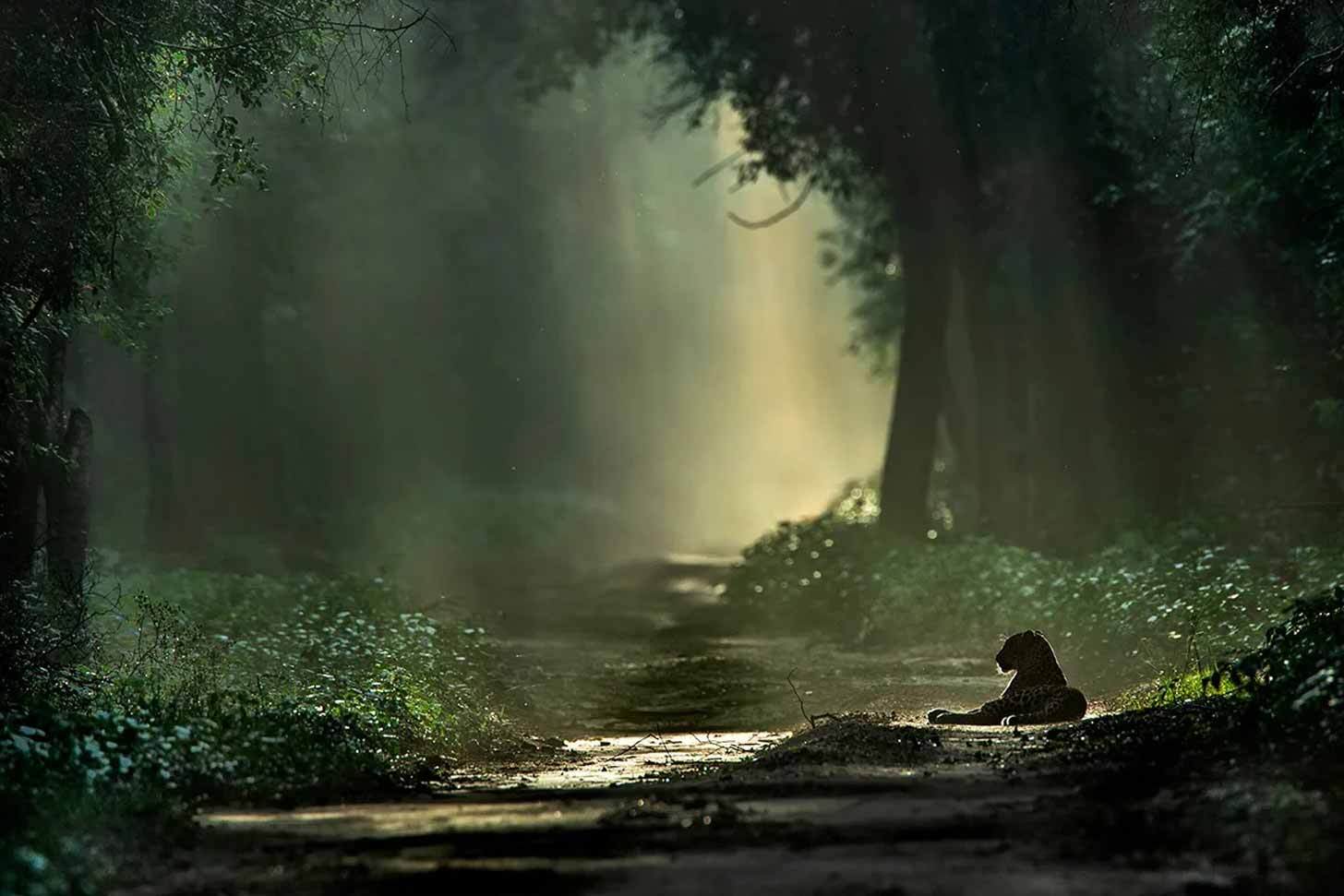
Every year since, Raggett has galvanized a team of photographers to support the conservation efforts in countries around the world, with proceeds going to vulnerable and endangered species like lions, cheetahs, African wild dogs, polar bears, leopards, and tigers.
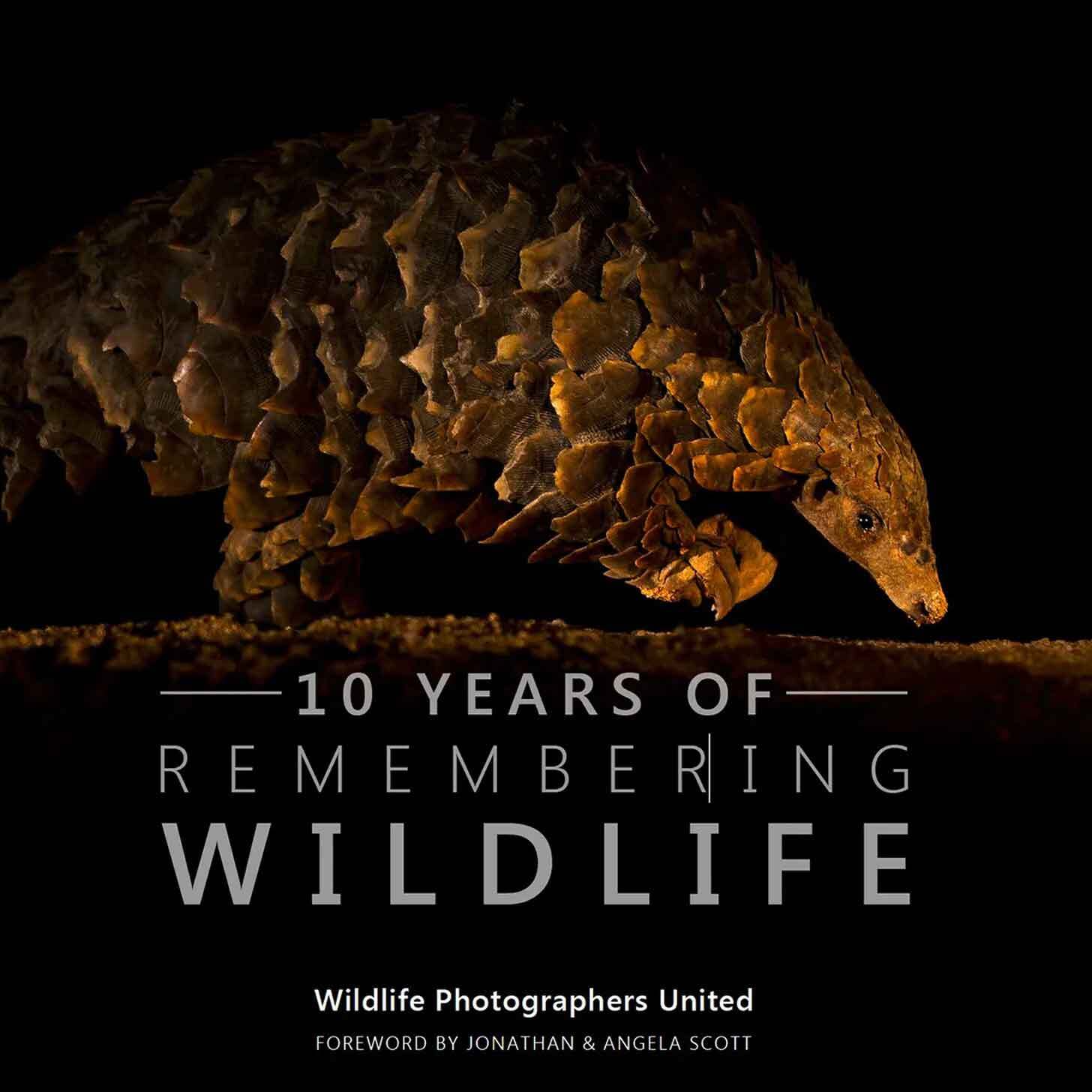
And now, they are celebrating the release of their latest book: “10 Years of Remembering Wildlife.”
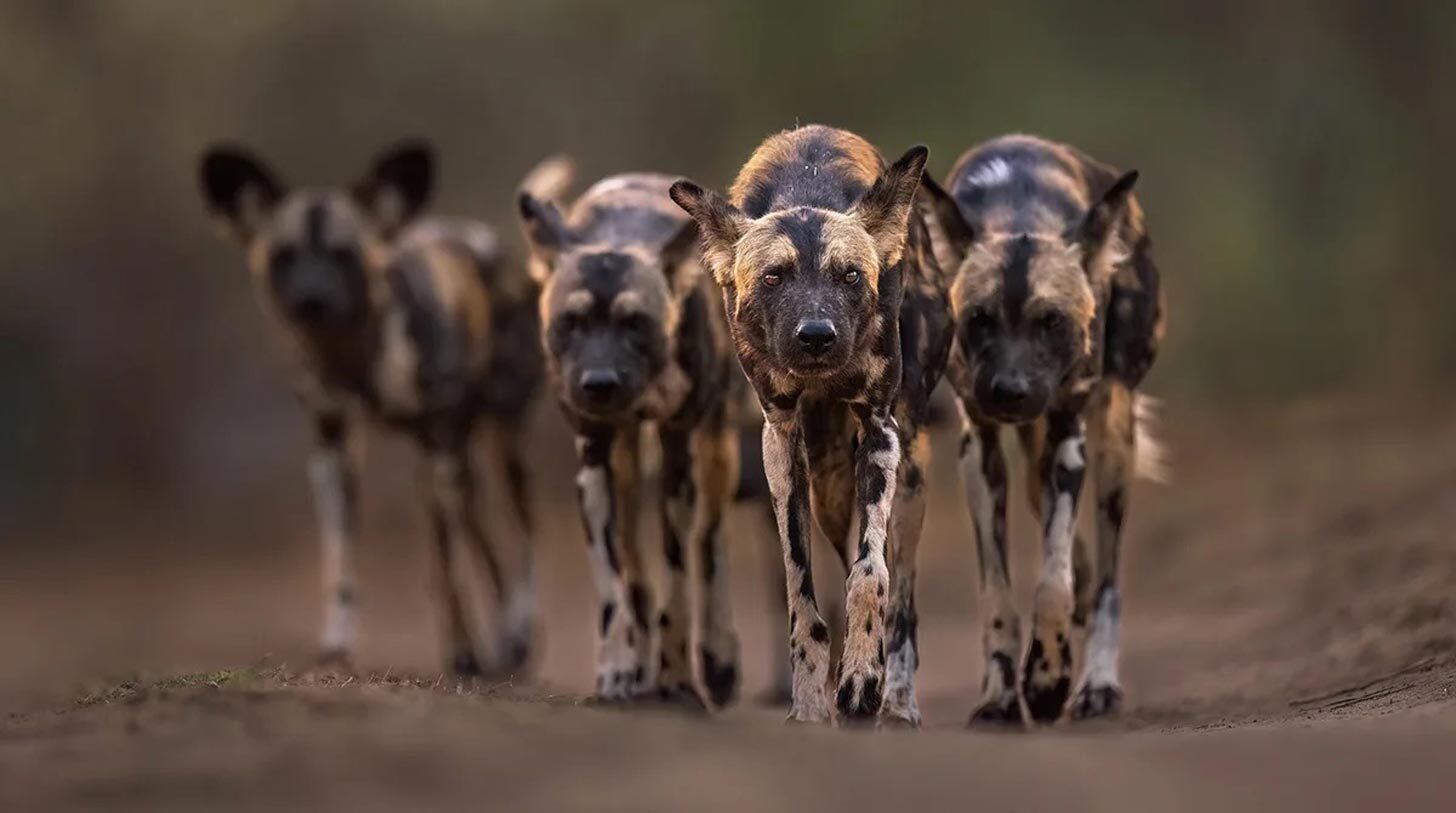
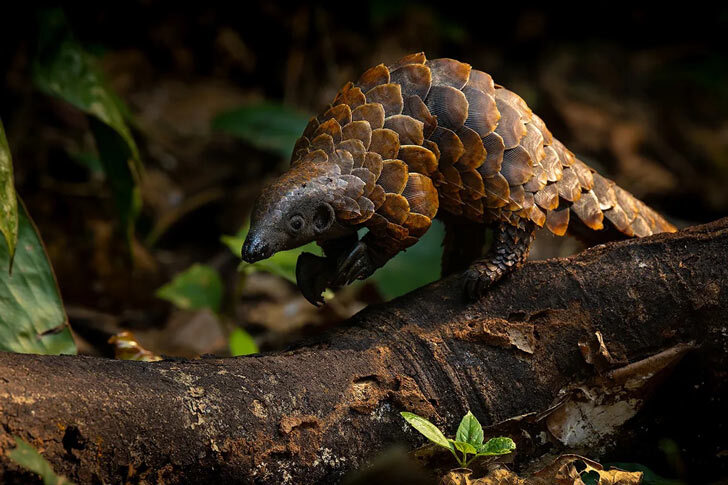
Alongside photos from the previous nine books — that were voted on via a “best of” competition — the book features 20 new photographs and opens with a chapter that highlights the plight of the world’s most trafficked mammal: the pangolin.
Remembering Wildlife is transparent about where its money goes. On the landing page of their website, they break down exactly what happens with every cent.
Every book is prefunded by Kickstarter, supported by the public. And the photos themselves are donated by “300 of the world's best wildlife photographers.”
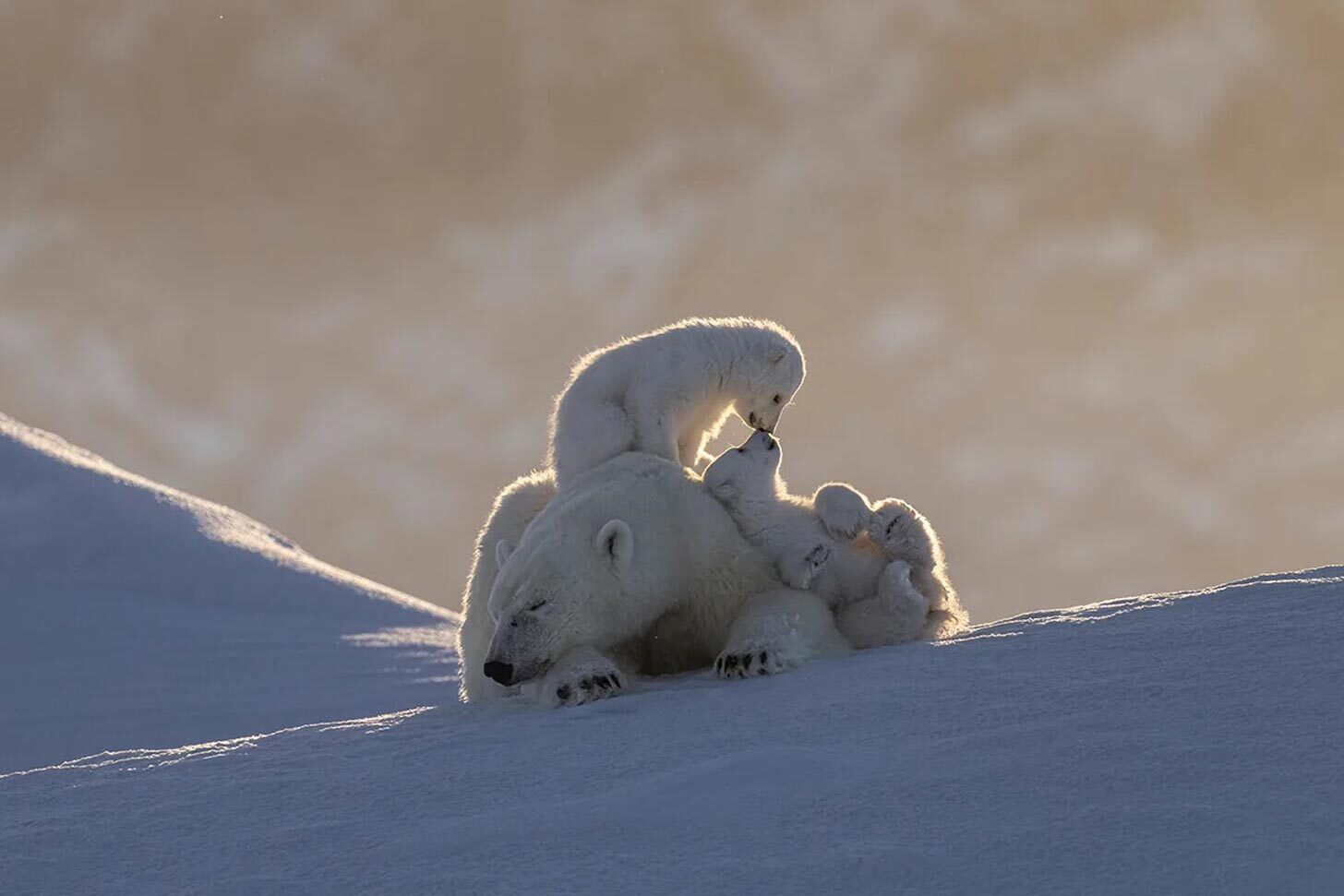
“All of the stunning images we use in our books and exhibitions have been generously donated by our photographers, as their way to give back to the species they make their livings from photographing,” the business writes.
They reference keeping “overheads” as low as possible, all while paying their core team to design, edit, and distribute the books.
Even then, the company emphasizes that everyone is “receiving considerably less than they would in the commercial world” because they believe in the cause.
And it’s working.
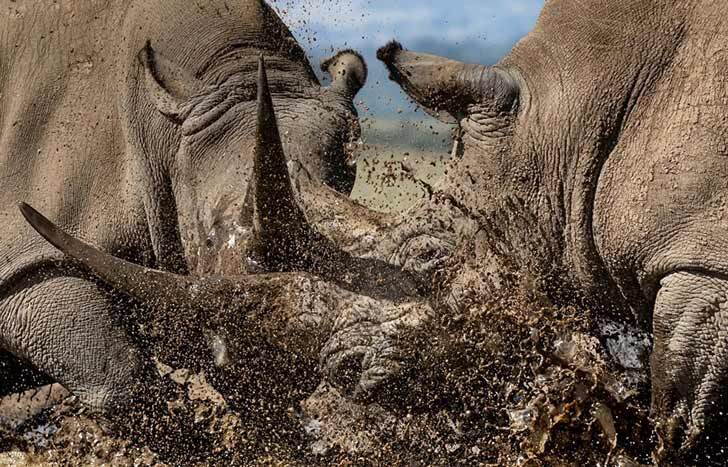
“So far, we’ve distributed more than £1.23m GBP ($1.58 million USD) of ‘profit’ to 80 different conservation projects in 34 countries since we started in September 2015, and we are determined to grow that,” they pledge.
“Time is running out for so many species that we believe being as nimble as we can is critical to getting funds raised out into the field,” they continue.
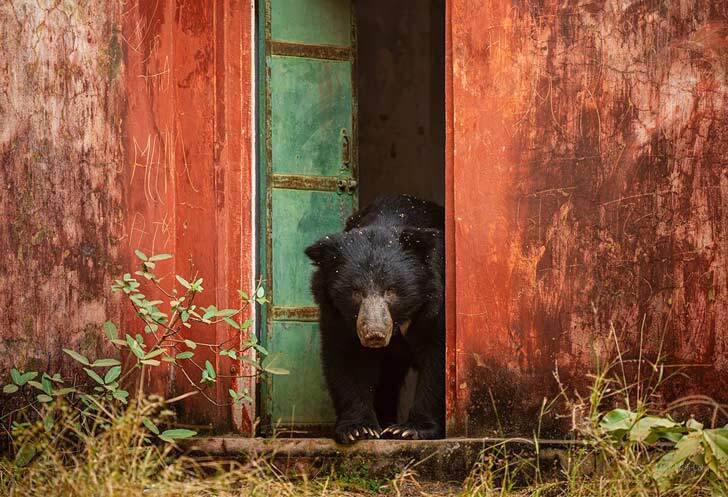
“Unlike the way many charities operate, we don’t sit on big reserves of cash or schedule donations months or even years ahead; we want our cash out with projects doing good as soon as we possibly can get it there.”
In her interview with Bob Books, Raggett talked about the dichotomy of wildlife photography, from the reality of poaching and the decline of endangered species, to the celebration of these magnificent animals.
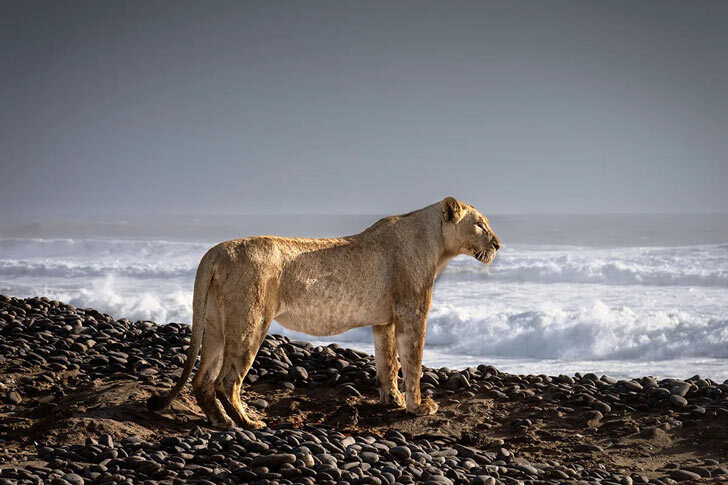
“I think there are two different approaches, and I talk a little bit about it in my introduction to the … book ‘Remembering Great Apes.’” Raggett said.
“First, there are obviously the shocking pictures, which make people turn away in horror. In these books, I’ve been very selective in illustrating the problem and the vast majority of what we have in the books are the beautiful pictures of the animals in the wild, because that’s what I believe people want to buy.”
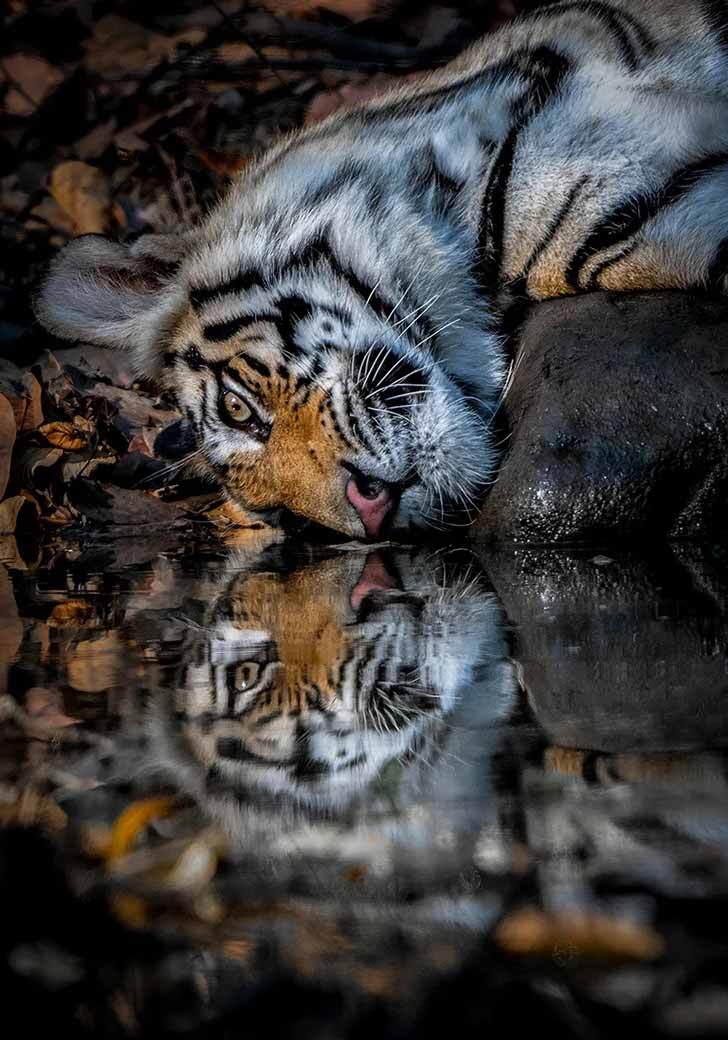
“But,” she said, “I called the books ‘Remembering…’ and there are a couple of reasons for this.”
“Around the time I was thinking about doing the book, I saw an interview with Jane Goodall on the BBC and she was talking about the elephant poaching crisis,” Raggett explained.
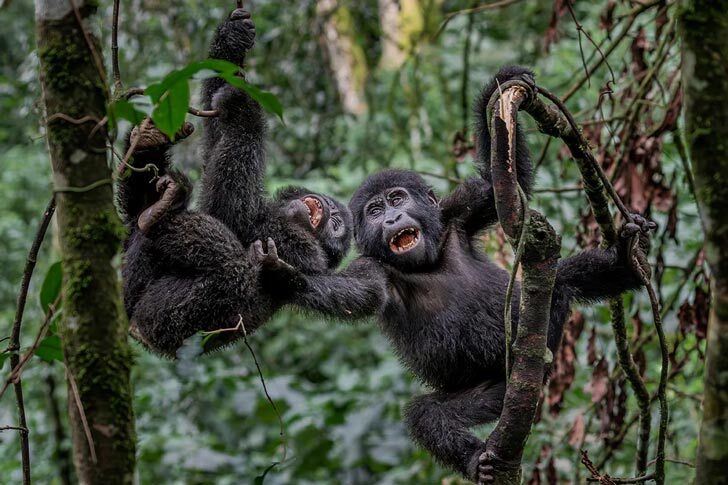
“She was quoting some statistics showing that elephants were being wiped out quicker than they were being born and were on a path to disappearing. I just thought how shocking it was that it could happen on our watch and that our generation could be the last to see elephants in the wild.”
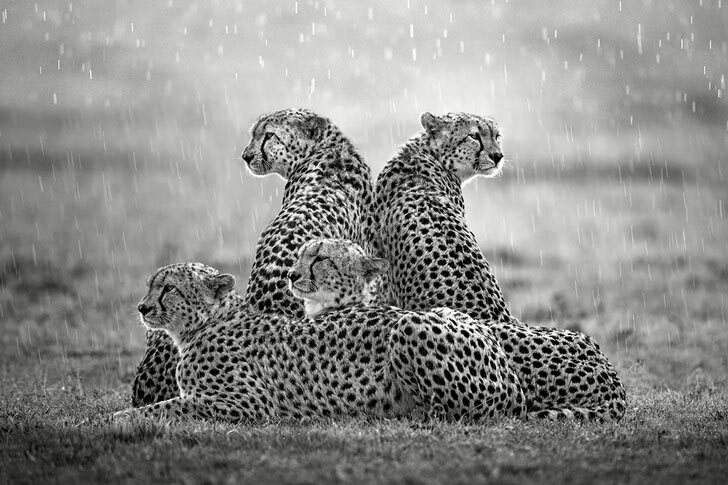
Ultimately, Raggett said, the project is about balancing the reality of the threats facing endangered species — and also capturing their beauty before it’s too late.
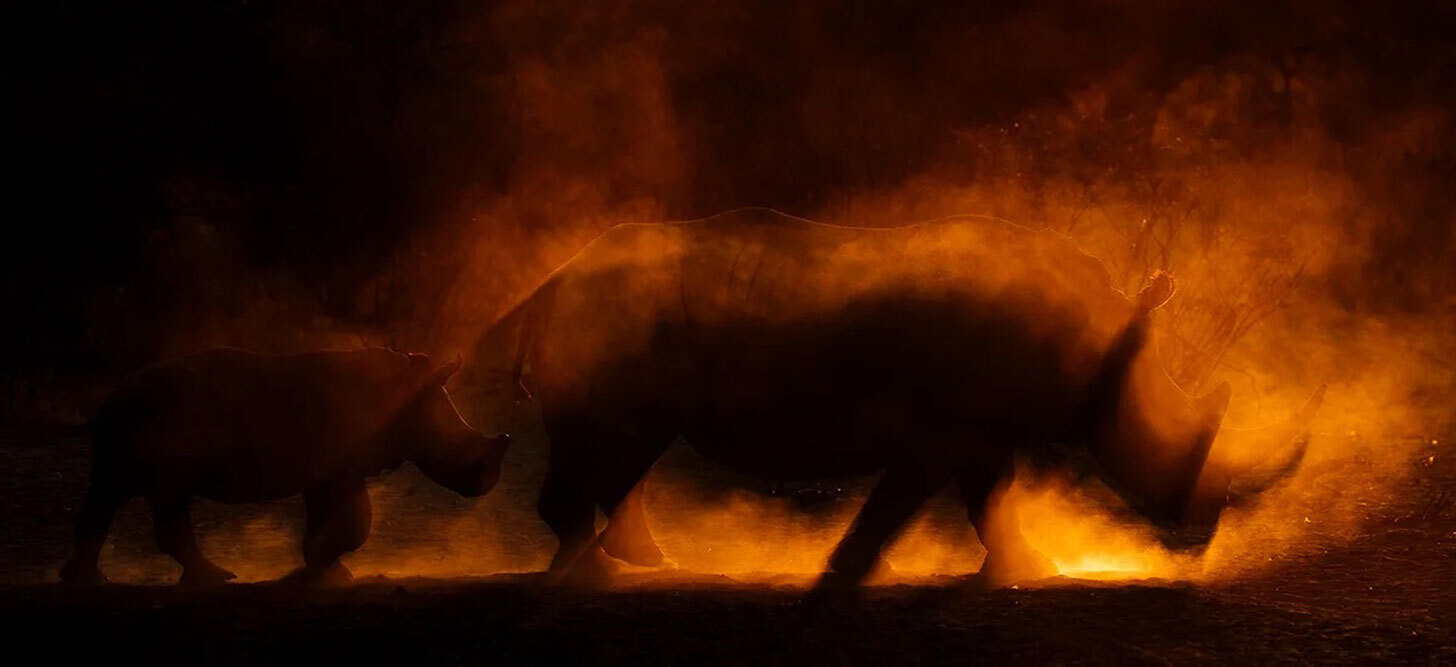
“I also think it’s important to show people the good side, because many people don’t have the opportunity or funds to travel to the places where these animals are still wild,” Raggett said.
“So through wildlife photography, we’re able to show them what we stand to lose if we don’t do something about it.”
You may also like: This deadly virus is the 'silent killer' of young elephants. A new vaccine rolls out to save them worldwide
Header image via Julie Oldroyd/Remembering Wildlife
In August, an international team of scientists from the Schmidt Ocean Institute deployed a remotely operated vehicle to explore deep-sea coral reefs off the coast of Uruguay.
From a nearby research vessel, researchers were able to lead the underwater robot, dubbed SuBastian, to depths of over 300 meters.
They captured the expanse of the coast’s cold-water stony coral reefs — one which covered an area equivalent to “more than 180 FIFA football fields.”
To the scientists’ pleasant surprise, the Desmophyllum pertusum reefs were a lot healthier than they expected, and they were rich with a mix of colorful underwater residents like hummingbird fish, slit shell snails, groupers, and sharks.
Dr. Alvar Carranza of the Universidad de la República and the Centro Universitario Regional del Este first detected the deep-sea coral reefs in 2010 using mapping technology.
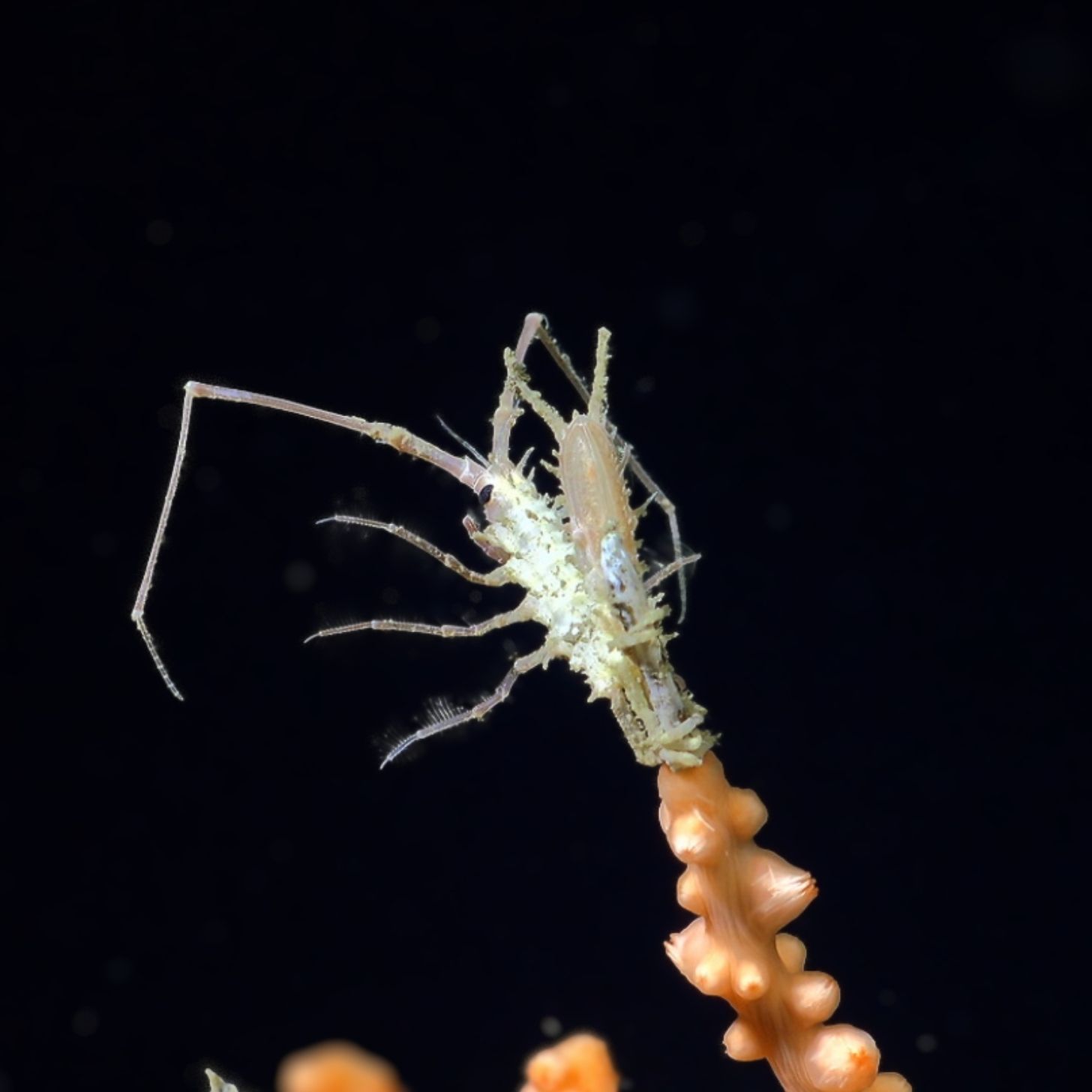
Across the 29-day voyage, the team captured footage of at least 30 potential new species, including sponges, snails, and crustaceans.
“We always expect to find the unexpected, but the diversity and complexity of what we found exceeded all our expectations,” Carranza said in a press release.
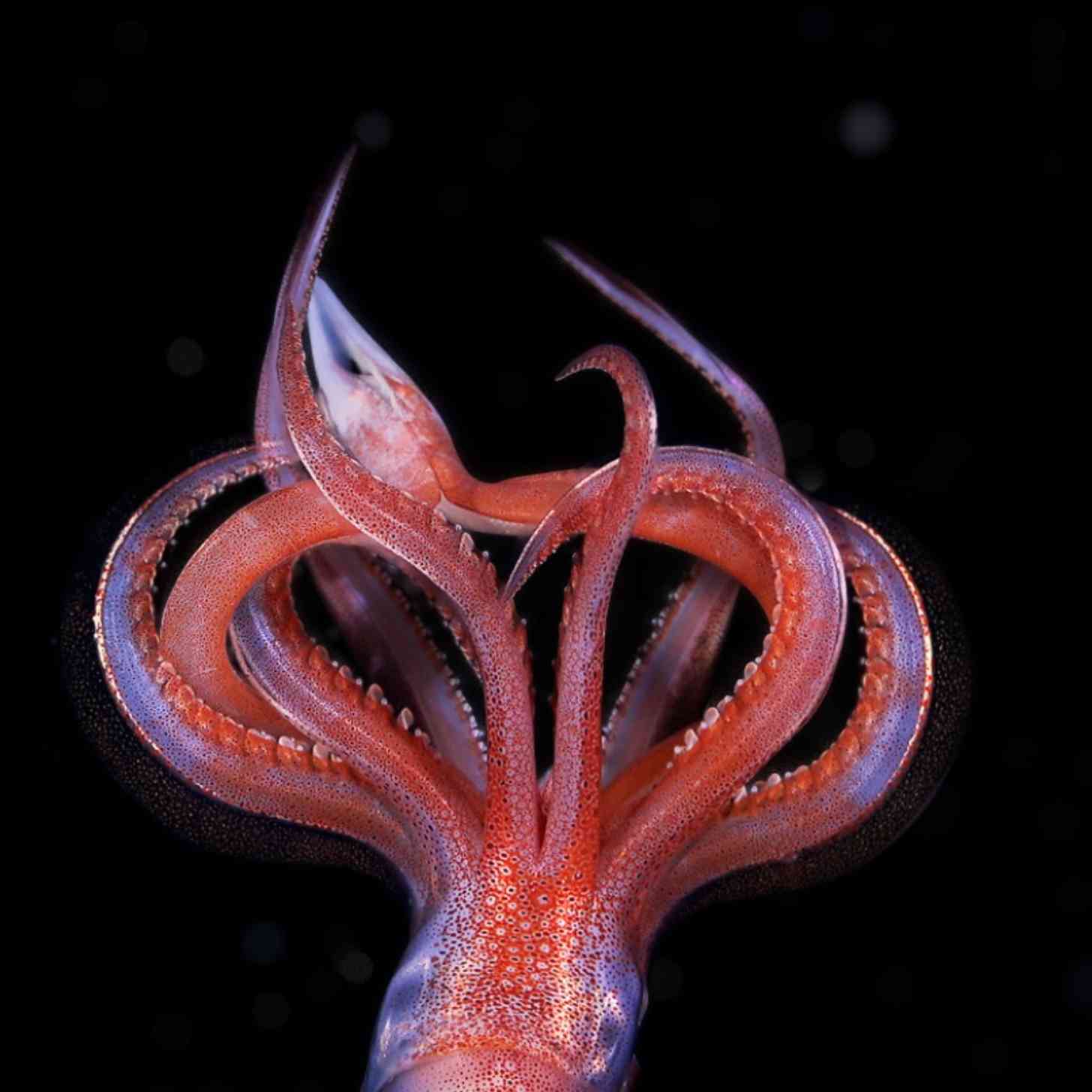
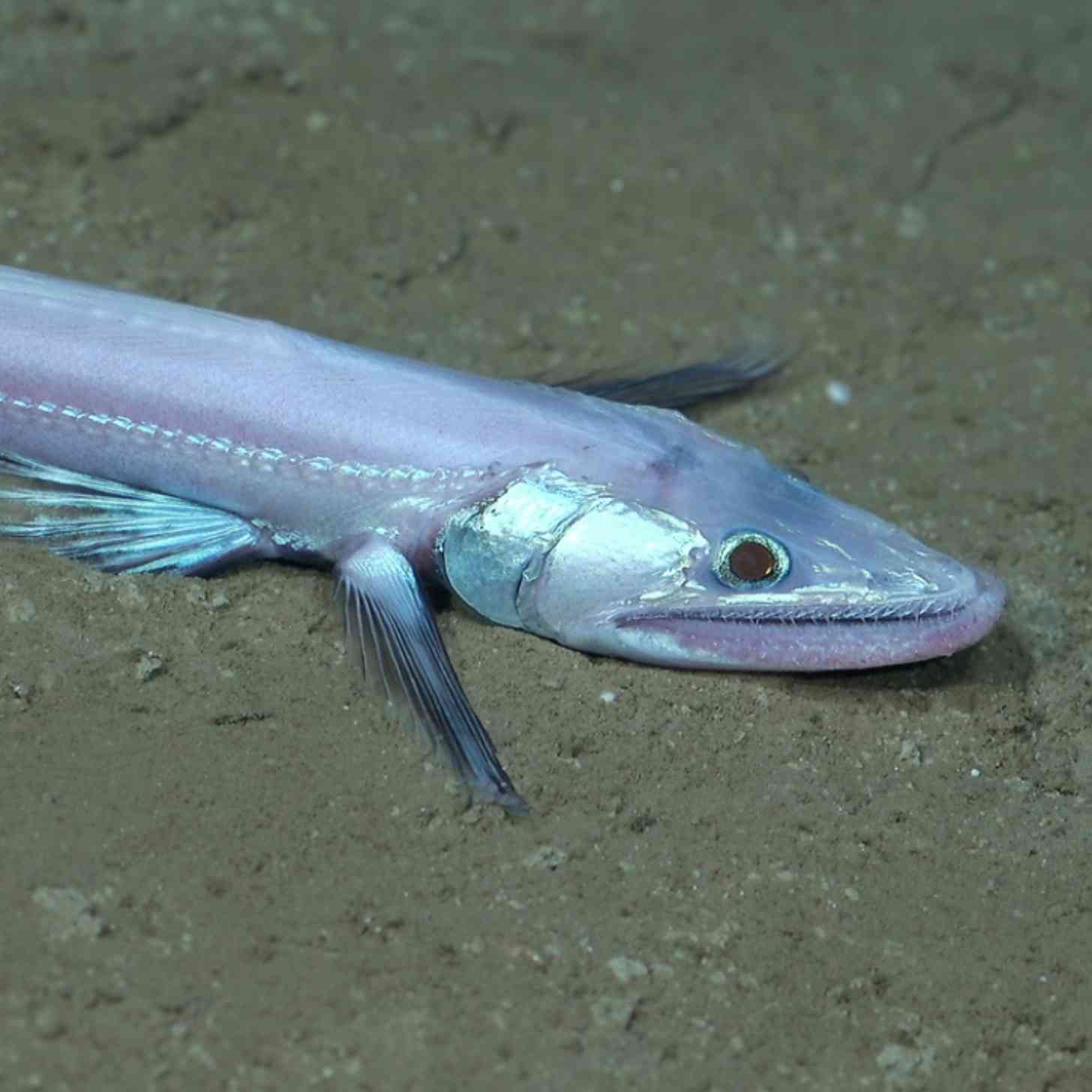
As the suspected new species await further study, the researchers were also shocked to spot hundreds of species that had never been seen in Uruguayan waters before, including crystal squids, the dumbo octopus, and tripod fish.
“This was Schmidt Ocean Institute’s 100th expedition and we are delighted that it took place in the beautiful waters off Uruguay with such an engaging team of scientists,” said Schmidt Ocean Institute’s Executive Director, Dr. Jyotika Virmani.
“We were also honored that Uruguay’s President Yamandú Orsi graciously visited the vessel just before it set sail to wish the scientists and crew a successful voyage as they explored this previously never-before-seen part of the world.”

Schmidt Ocean Institute also made global headlines in August when the livestream of their three-week expedition of Argentina’s Mar del Plata Canyon went viral and garnered over 17.5 million views.
Using SuBastian, the team was able to lead the first high-tech exploration of Mar del Plata, remotely controlling the vehicle at depths of more than 3,500 metres — nearly twice as deep as the Grand Canyon.
In addition to dancing telescope octopuses,“Barbie” pink lobsters, and a star fish that went viral for its likeness to a certain SpongeBob character, researchers estimated that they had uncovered up to 40 potential new species.
The never-before-seen deep-sea creatures included “sea anemones, sea cucumbers, sea urchins, snails, corals, and crinoids, amongst others.”

Researcher Dr. Martín Brogger, who works for the National Scientific and Technical Research Council, said that he was blown away by the attention that their Argentinian expedition accrued.
“It’s been incredible to see how people of all ages have connected with the deep sea,” Brogger said.
“We received hundreds of messages from families, teachers and kids who felt inspired, surprised and even emotional watching the live broadcasts,” he continued.
“Some young students told us they now dream of becoming marine biologists — an impact that goes beyond science by creating a shared sense of wonder and curiosity that can truly last a lifetime.”

You may also like: New creature with 'visible internal organs' discovered by scientists. It looks straight out of a Studio Ghibli movie
Header image: Blackbelly rosefish (Helicolenus dactylopterus) were documented among soft mushroom corals (Heteropolypus sp) at 246 meters deep off the coast of Uruguay. The ROV dive took place at the head of the Montevideo Canyon, on the upper slope, immersed in Antarctic Intermediate Waters. Image via ROV SuBastian / Schmidt Ocean Institute
Jane Fonda is joining forces with more than 500 celebrities and Hollywood heavyweights to defend free speech.
The membership roll already includes scores of famous actors like Jamie Lee Curtis, Viola Davis, Whoopi Goldberg, Pedro Pascal, Natalie Portman and Michael Keaton. Successful directors like Spike Lee and Ben Stiller have signed on, along with singer and actress Barbra Streisand and pop star and songwriter Billie Eilish.
Fonda, a star who has championed progressive causes since the 1970s, explained when she announced the group’s new edition on Oct. 1, 2025, that the effort isn’t really new.
Instead, it marks the relaunch of the Committee for the First Amendment, an organization her father, actor Henry Fonda, had belonged to.
The original Committee for the First Amendment was formed in October 1947 at a time when the U.S. government worried that there were communists in Hollywood who were putting left-wing propaganda into the movies.
Hearings divided Hollywood
The attack on Hollywood started when a bipartisan congressional committee held a series of highly publicized hearings in 1947 on what it said was the “communist infiltration of the motion picture industry.”
The House Un-American Activities Committee, known as HUAC, invited 23 “friendly” anti-communist witnesses to testify.
Ayn Rand, a Russian-born novelist and screenwriter who hated communism, was one of the witnesses. She testified that the 1944 MGM movie “Song of Russia” showed clean, well-dressed, happy peasants, which she said was a sanitized, propagandized version of life in the USSR.
Another movie that came under suspicion was “It’s a Wonderful Life.” The FBI complained that the 1946 blockbuster, which starred Jimmy Stewart as a broken man who learns the true value of his life, “deliberately maligned the upper classes” with its negative portrayal of Mr. Potter, the town’s richest man.
The HUAC hearings continued for a decade and divided Hollywood. The committee’s interrogators demanded that people turn on each other and “name names.”
Due to these hearings, as well as an anti-communist publication called Red Channels, hundreds of screenwriters, directors, producers, actors and musicians were fired or blacklisted for having ties to liberal groups.

Fighting back
The HUAC hearings brought Hollywood stars and the flashbulbs of the nation’s press corps to Capitol Hill. Conservative screen idols like Gary Cooper testified that communism wasn’t “on the level.”
Friendly witnesses, like Rand and Cooper, were allowed to read prepared statements and to speak for as long as they liked. Such courtesies were not granted to the 10 “unfriendly” witnesses — the suspected communists who became known as the “Hollywood 10.”
Screenwriter John Howard Lawson was the first of the Hollywood 10 to testify. Lawson, after refusing to answer if he was a communist or not, was shouted down by Rep. J. Parnell Thomas, a New Jersey Republican who served as HUAC chair.
After Lawson was removed from the courtroom, HUAC’s chief investigator, Robert Stripling, read detailed evidence of Lawson’s communist affiliations.
Prominent Hollywood liberals understood that these hearings were an attack on free speech, free assembly, and other rights guaranteed by the First Amendment.
Ira Gershwin, the lyricist known for his hit show tunes such as “I Got Rhythm” and “They Can’t Take That Away From Me,” hosted the first gathering of the Committee for the First Amendment at his Beverly Hills mansion. Attendees included Judy Garland, Humphrey Bogart, Lauren Bacall, and Gene Kelly.
The committee quickly raised US$13,000 — the equivalent of $188,000 today — and chartered an airplane to Washington.
Upon their arrival in the capital, they marched and spoke out in support of the Hollywood 10. Next, they produced a radio broadcast, “Hollywood Fights Back,” as a defense of the rights of Americans to write, produce, act in, and see whatever movies they pleased.
The committee released an initial statement with 35 signatories. A few months later, it published a pamphlet with more than 300 additional names supporting the effort.
Purging Hollywood
If you’ve never heard of that committee, or if you only learned about it recently when the new version made headlines, you’re not alone. The group fizzled out almost as quickly as it had mobilized.
Bogart, perhaps its most famous member, soon retracted his support for the Hollywood 10, saying in March 1948 that he regretted his trip to Washington.
“I’m no Communist,” the “Casablanca” star declared in a widely circulated statement.
Two crucial developments kneecapped the committee. First, the HUAC cited the Hollywood 10 for contempt of Congress. They were later tried in court and convicted of that crime. They eventually served prison time.
Also, studio executives drafted new hiring policies for the movie industry. Later known as the “Waldorf declaration” because the meeting took place in the Waldorf-Astoria hotel in Manhattan, the studio heads announced that the Hollywood 10 would be fired and banned from any studio, and that all the studios would agree to fire and ban any known communists.
Over the next decade, hundreds more stars and other key players in the entertainment industry were fired, purged, and blacklisted in what became known as the blacklist era.
I’m a professor of English and film studies, and I’m writing a book about progressive films made during those years. The original committee’s members were mainly leftists and liberals whose careers survived the political pressures to root them out of show business.
The Committee for the First Amendment ultimately failed to protect the Hollywood 10 from professional attacks or incarceration, nor did it prevent hundreds of others from being blacklisted.
Bad timing
But I don’t believe that the original Committee for the First Amendment was destined to fail.
The Hollywood 10’s legal strategy, rooted in the First Amendment, reflected the hope that their convictions might be eventually overturned by the Supreme Court.
Unluckily, however, Frank Murphy and Wiley Blount Rutledge, two of the court’s most liberal justices, died before the appeal of the first two Hollywood 10 convictions could reach them.
After President Harry Truman replaced them, the Supreme Court declined to hear the appeals. Most of the Hollywood 10 served prison sentences between 1950 and 1951.
Why bother?
Given that the Committee for the First Amendment failed to protect Hollywood from conservative repression in the 1940s and 1950s, why would anyone revive it?
One reason is that there are parallels between the blacklist era and today.
For example, the Trump administration is trying to get comedians who poke fun at him kicked off the air, as evidenced by talk show host Jimmy Kimmel being temporarily pulled off the air.
Hollywood has also seen a surge in labor organizing. Many members of the new Committee for the First Amendment were on the front lines of the screenwriters and actors strikes of 2023.
Finally, this fight is arguably worth waging. Most Americans see the First Amendment as enshrining valuable rights. An October 2025 Marist poll found that 4 in 5 Americans think the U.S. is restricting First Amendment freedoms too much.
Americans still debate whether or not it was right to fire and blacklist Hollywood’s suspected communists. While many see the HUAC hearings as a travesty, others defend the House committee and the anti-communist fervor that inspired it.
Resilience and silence
Many look at the blacklist era as a time of capitulation by progressives in the face of repression. While there’s some validity to these claims, I’ve found that many progressive filmmakers also banded together, using allegory and other creative techniques to make movies with progressive — sometimes radical — messages.
Take “The Pajama Game,” for example. It’s a musical comedy about labor trouble in a pajama factory. While the film is a sexy, frothy romp, on the one hand, the film also casts Doris Day as Babe, a feisty union steward. In “Racing with the Clock,” workers sing about the pressure they feel to speed up the pace of their labor.
Scenes include workers organizing a slowdown, sabotaging machinery, and going on strike. The last word spoken in the film is “solidarity.”
To me, the revival of the Committee for the First Amendment draws attention to the dangers implicit in efforts to muzzle writers, artists, and filmmakers.
“Silence the artist, and you silence the most articulate voice the people have,” the actress Katharine Hepburn said in May 1947 in a speech written for her by Dalton Trumbo, one of the Hollywood 10. “Destroy culture and you destroy one of the strongest sources of inspiration from which a people can draw strength to fight for a better life.”
This article was written by Kathy M. Newman from Carnegie Mellon University, and was originally published by The Conversation.
Header Image by Ted Eytan (CC BY-SA 2.0)

For decades, animal rights activists, campaigners, and ethical designers have fought to strip fur fashion of its glamour and expose the cruelty behind it.
From bold celebrity-led protests to quiet shifts in consumer values, these efforts have slowly reshaped the fashion landscape.
Now, one of the industry’s most influential gatekeepers, Condé Nast — publisher of Vogue, Vanity Fair, and Glamour — has announced it will no longer feature “new animal fur in editorial content or advertising” across its titles.
The decision, which includes exceptions for what are outlined as “byproducts of subsistence and Indigenous practices,” marks a symbolic turning point within the fashion media landscape due to Condé Nast’s global reach.
It is especially significant given Vogue’s legacy in glamorizing fur and its historically unwavering support under former editor-in-chief Anna Wintour, one of fur’s most powerful advocates in fashion media and a long-time target of the anti-fur movement.
Wintour remains involved at Condé Nast in the role of chief content officer, and as Vogue’s global editorial director.
Anti-fur campaigns
The announcement by Condé Nast follows a nine-month campaign led by the Coalition to Abolish the Fur Trade. This activist group staged more than a hundred protests targeting Condé Nast executives, editors, and affiliated businesses.
Demonstrations ranged from picketing outside the homes of Vogue editors to disruptive actions inside stores linked to Condé Nast through board affiliations.
While this campaign undoubtedly influenced the publisher’s decision, it was likely the culmination of anti-fur advocacy dating back to the early 20th century.
The long tail of the movement
Animal rights activism in fashion can be traced back to the late 19th century, when the feather trade decimated bird populations and led to the extinction of species prized for their plumage.
Anti-fur activism followed. It gained momentum in the 1970s, and with the founding of the People for the Ethical Treatment of Animals, or PETA, in 1980.
Through high-profile campaigns exposing the cruelty of fur farms, PETA enlisted celebrities and models to pose nude in its iconic “I’d rather go naked than wear fur” ads.
These efforts led to tangible change. Calvin Klein dropped fur in 1994, citing animal advocacy. Since then, fur-free policies have become a relatively easy win for brands navigating the increasingly complex ethics of animal materials.
A new standard for luxury fashion
Several U.S. states have banned fur sales, and fur farming is now outlawed in countries including the United Kingdom, Netherlands, Austria, Italy, and Norway.
Condé Nast’s new position places it alongside other media and fashion leaders. Elle magazine went fur-free in 2021. Major luxury brands such as Max Mara, Burberry, Chanel, Prada, Valentino, and Versace have adopted similar policies, as have retailers including David Jones (Australia), Macy’s (U.S.), Nordstrom (U.S.), Saks Fifth Avenue (U.S.), and Hudson’s Bay (Canada).
In 2022, French luxury conglomerate Kering also committed to a fur-free policy across its brand portfolio.
The largest remaining holdout is LVMH (Moët Hennessy Louis Vuitton SE) — the parent company of Dior and Fendi — which faces mounting pressure to follow suit.
The fur paradox
Despite these shifts, fur remains a fascination within fashion, and periodic revivals are still celebrated in the press.
TikTok’s 2024 “mob wives” aesthetic, featuring oversized fur coats and animal prints, sparked a return of fur on winter runways. Singer Sabrina Carpenter even wore a special edition Louis Vuitton fox fur coat on the day of the Met Gala.
This paradox reflects fashion’s cyclical and often contradictory nature. Faux fur and faux shearling are increasingly used to replicate the luxury aesthetic without the ethical baggage. Yet debates about the environmental impact of synthetic fur complicate this narrative.
What’s next?
Condé Nast’s fur-free stance comes at a time when many fashion brands are rethinking or rolling back their sustainability commitments.
Some industry observers worry climate goals are being deprioritized.
Ralph Lauren, for instance, has dropped its net-zero emissions target. Also, the Vestiaire Collective, a platform for pre-loved luxury item resale, has started monetizing its activities by selling carbon credits, demonstrating the difficulty of navigating current market conditions.
Still, there are signs of progress. Stella McCartney’s Summer 2025 Paris Fashion Week show featured feather alternatives made of plant-based materials.
This year also marked the first Australian Fashion Week in which fur, feathers and exotic leathers were banned from catwalks.
Animal rights advocates, such as Collective Fashion Justice founder Emma Hakansson, continue to push for the industry to reduce its use of leather, wool, and other animal-derived material.
This space is dynamic and evolving. Whether Condé Nast’s decision is a tipping point or another fashion fad remains to be seen.
This article was written by Rachel Lamarche-Beauchesne from Torrens University Australia, and originally published on The Conversation.
Header Image by Eugene Chystiakov / Unsplash

Plastic has become such a ubiquitous material in our daily lives because, up until recently, there hasn’t really been anything like it. It’s strong and durable, relatively cheap to make, and easy to shape into almost anything.
The downside? It is wreaking havoc on the planet.
Made with fossil fuels, oil-based plastics not only have a large environmental footprint in their assembly, but also take decades — or even centuries — to decompose once thrown out.
Plus, as they slowly break down, they can release harmful microplastics and toxic chemicals into the air and waterways.
It’s no wonder, then, that researchers around the globe have been working on ways to create “bioplastics,” or plastic-like materials made out of biodegradable components.

Researchers at China’s Northeast Forestry University and Shenyang University of Chemical Technology think they may have cracked the case on bamboo plastic.
A recent study, published in “Nature,” details how researchers have developed a type of strong, biodegradable plastic from bamboo that resembles oil-based plastics in both strength and shapeability.
The material can reportedly biodegrade in soil within just 50 days — which is no time at all compared to traditional plastics.
“Bamboo’s rapid growth makes it a highly renewable resource, providing a sustainable alternative to traditional timber sources,” Dawei Zhao, one of the study’s authors, told New Scientist.
“But its current applications are still largely limited to more traditional woven products.”
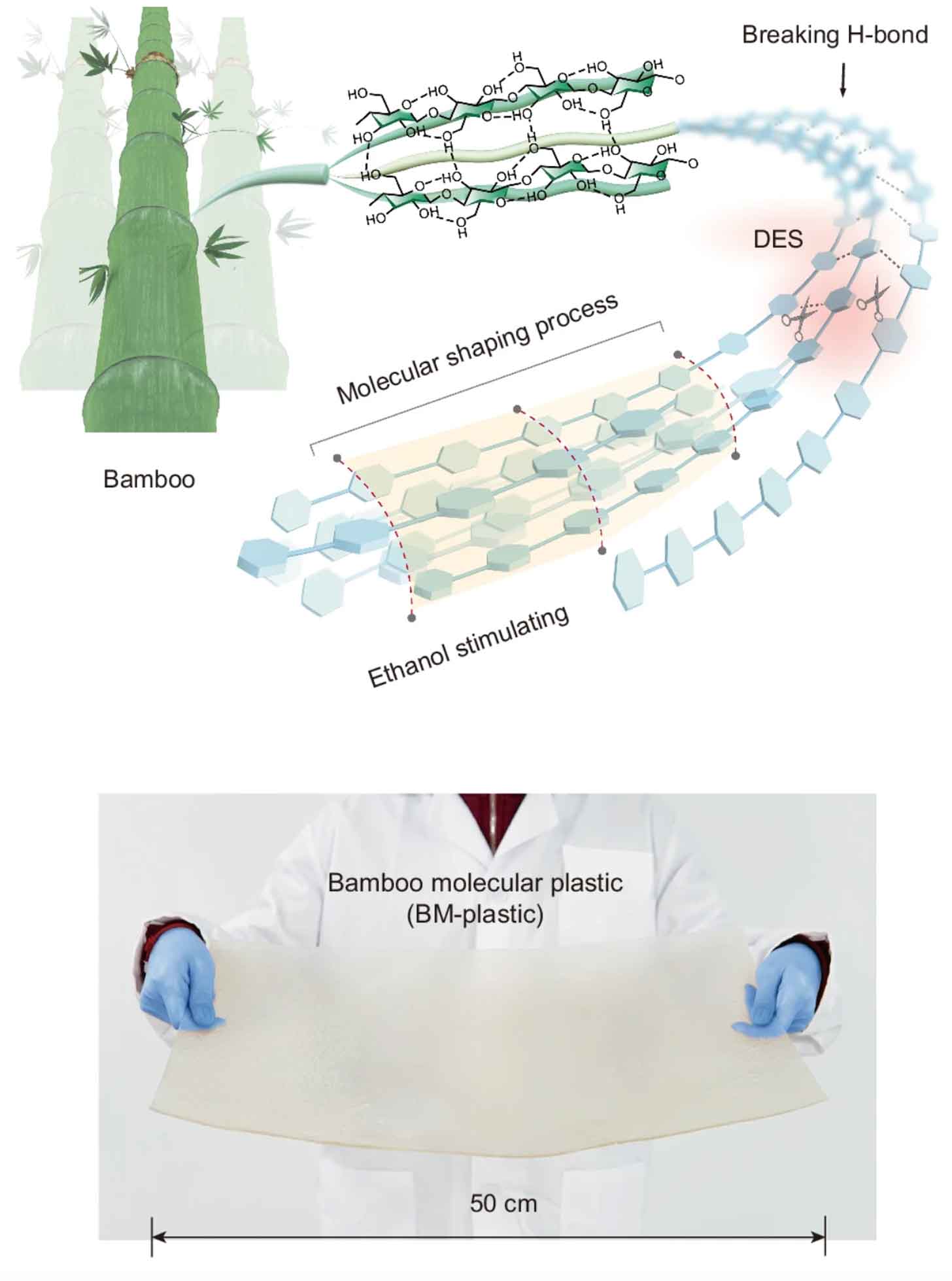
Haipeng Yu, Zhao, and other researchers studied the plastic-like application of bamboo by developing a non-toxic alcohol solvent base to dissolve bamboo cellulose down to a molecular level. From there, they directed those cellulose molecules to reassemble into a tough plastic material.
In this process, the cellulose is chemically modified and forms a strong molecular network, creating the durability traditional plastics are known for.
The bamboo bioplastic was tested against several other types of commercial plastics, and it matched or outperformed them in nearly every way.
The bamboo version displayed a tensile strength of 110 megapascals. That means it could withstand more pressure than traditional plastics and existing bioplastics.
Researchers also found that the bamboo alternative matched or outperformed traditional plastics in tests of mechanical and thermal stability and shapeability, meaning it could even be used in industrial contexts.
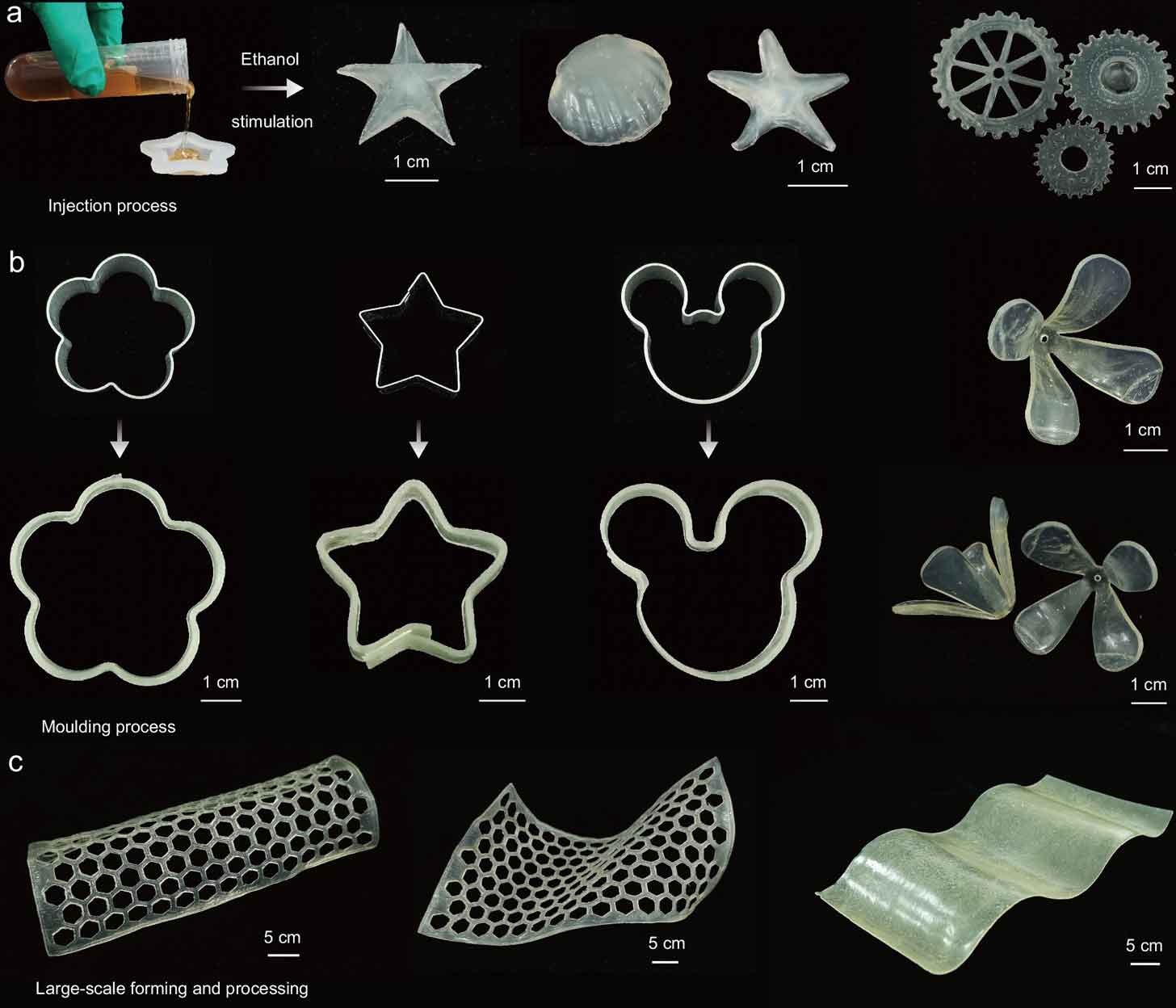
Because of its strength, the bamboo bioplastic does not offer too much flexibility, but it still has potential to be used in engineering plastics or other similar high-pressure applications.
While the bamboo material isn’t as cheap as some of the world’s most commonly used plastics, researchers found that it can be completely recycled while maintaining 90% of its original strength, meaning it can likely be reused repeatedly.
And, when it reaches the end of its life, the “plastic” would take just days to decompose.
“This work establishes a method for transforming abundant bamboo cellulose into high-performance, eco-friendly materials,” they write in their research, “offering a viable pathway to mitigate plastic pollution and fossil resource dependence.”
You may also like: New 'bioplastic' degrades in water faster than paper — and could replace Styrofoam, other single-use plastics
In 2022, architects built what was dubbed the world’s first “upcycled” skyscraper.
The owners of Sydney, Australia’s AMP Centre wanted to replace the original 1970s structure with a bigger, better, and more energy-efficient building.
But instead of demolishing the high-rise, which comes with significant environmental costs, they asked architects to build a new skyscraper without demolishing the old one.

Firm 3XN was the pick for the job, and once completed, the “new” building, renamed the Quay Quarter Tower, now stands 676 feet tall and retains 95% of the original building’s core. The new building also retained 65% of the original building’s structure, including beams and columns.
“The tower was coming to the end of its life, in terms of viability … but the structure and the ‘bones’ can actually last a lot longer,” Fred Holt, a partner at 3XN, told CNN in 2022.
“You can’t always retain everything. But if you can retain the structure — and that’s where the majority of your embodied carbon is — then you’re lowering your footprint.”
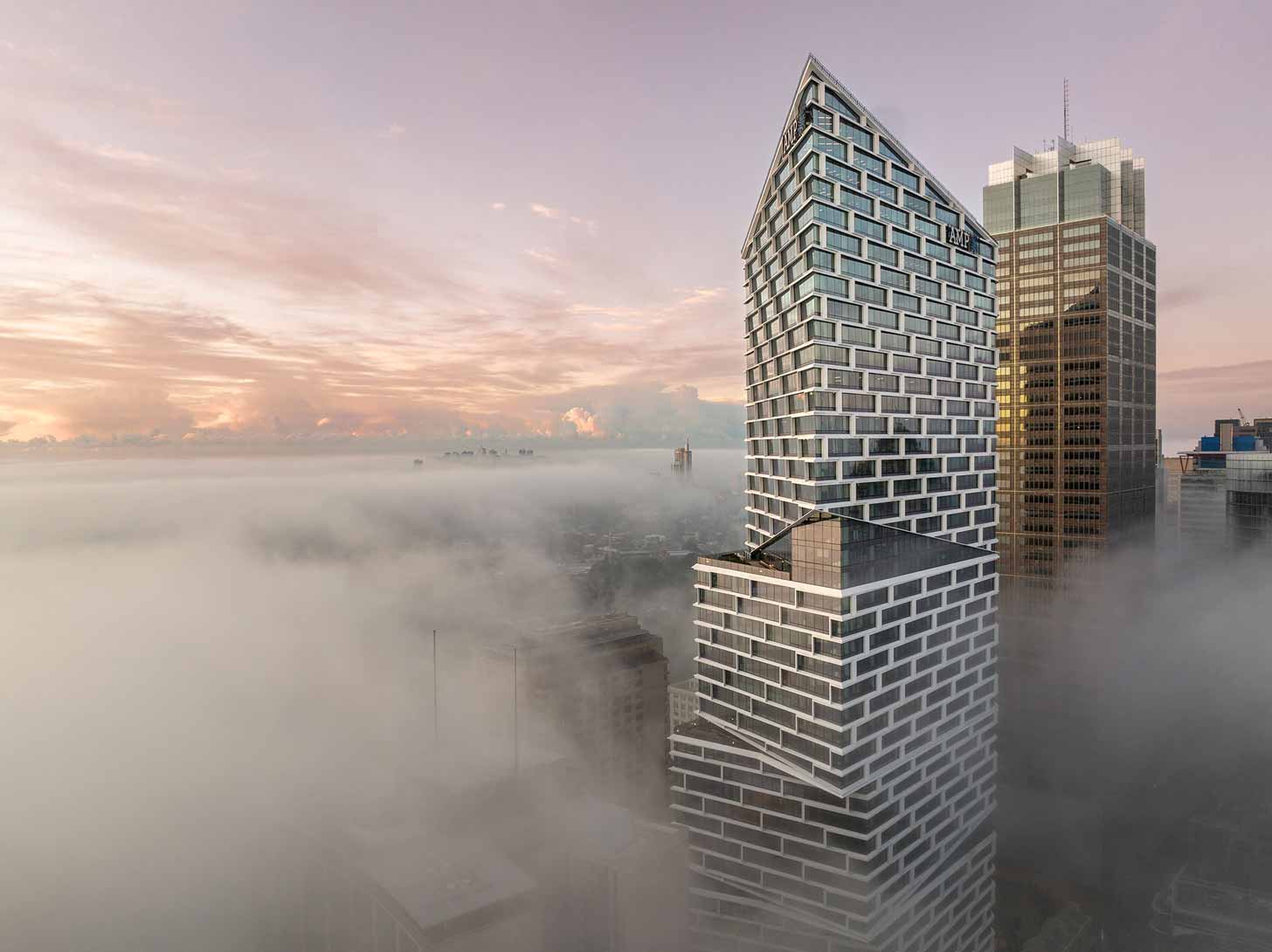
Lauded for the major achievement, the Quay Quarter Tower was named World Building of the Year in 2022. But it’s still receiving accolades today.
In fact, the building itself has been named one of 15 finalists for Prince William’s fifth annual Earthshot Prize, a coveted competition launched in 2020 that celebrates big ideas aimed at tackling climate change.
A 10-year project, Earthshot aims to “ensure, for the first time in human history, the natural world is growing — not shrinking — on our planet” by 2030.
To support and uplift solutions that get closer to this goal, five total finalists from five different categories are each awarded £1 million to further develop their ideas every year.
These are the five categories:
- Protect & Restore Nature
- Clean Our Air
- Revive Our Oceans
- Build A Waste-Free World
- Fix Our Climate

The Quay Quarter Tower is the first-ever building to be nominated for the award and is one of three finalists in the Build a Waste-Free World category this year.
“Quay Quarter Tower is the world’s first fully ‘upcycled skyscraper’ and the most comprehensive building transformation ever attempted at this scale,” the Earthshot Prize described.
“It proves that retrofitting buildings that have stood for decades offers a commercially viable and scalable solution to decarbonizing the built environment.”

According to 3XN, the entire process of building the “upcycled” tower saved more than 12,000 tonnes of embodied carbon, the equivalent of 35,000 flights between Sydney and Melbourne.
They hope it can serve as a blueprint for other ways to navigate a growing world and a changing climate.
“The demolition cycle is one of the greatest threats to our global climate goals. Quay Quarter Tower proves that transformation at significant scale is possible and, critically, commercially viable,” Holt said in a statement for the prize.
“We hope that our approach can help redefine urban development, offering a blueprint to meet low-carbon ambitions as our cities worldwide continue to grow.”
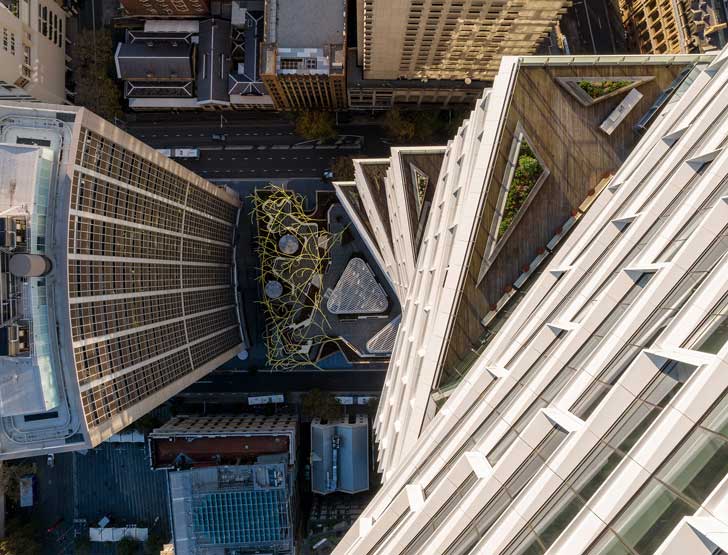
An Earthshot title would undoubtedly help that mission reach new heights.
“We see it as a reflection of both architecture's impact and its potential,” 3XN told Dezeen about being named a finalist for the award.
Prince William, too, seems eager to honor this year’s finalists.

“As we reach the halfway point of the Earthshot decade, I am truly inspired by this year's finalists, which embody the urgent optimism sitting right at the heart of our mission,” he said in an announcement of the 2025 finalists.
“In just five years, The Earthshot Prize has shown that the answers to our planet’s greatest challenges not only already exist, but that they are firmly within our grasp.”
The Quay Quarter Tower was selected among nearly 2,500 nominees to reach the stage of 15 finalists vying for one of five awards. One winner will be selected by Prince William and an award council later this year.
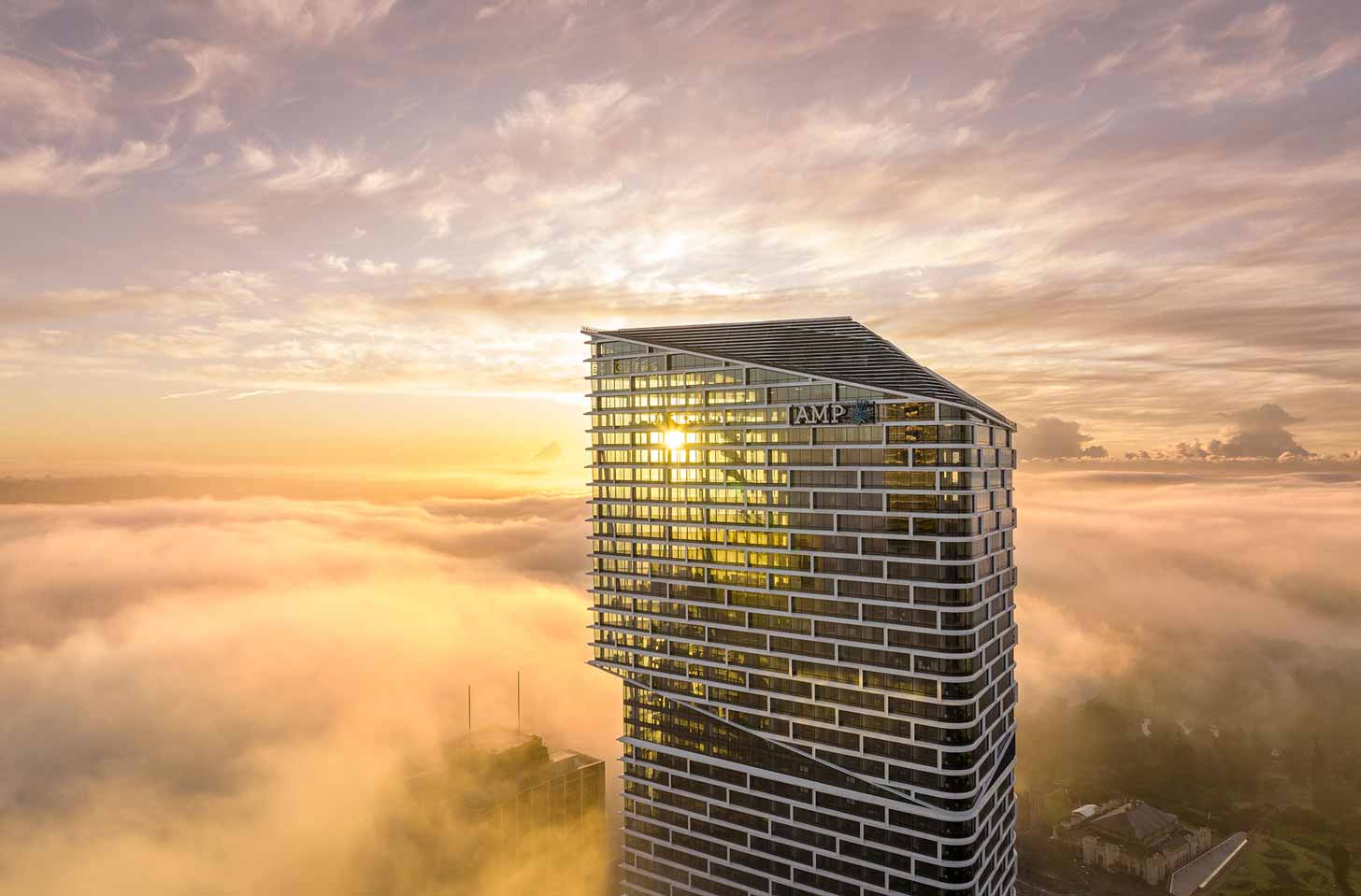
“The people behind these projects are heroes of our time, so let us back them,” the prince concluded.
“Because, if we do, we can make the world cleaner, safer and full of opportunity — not only for future generations, but for the lives we want to lead now.”
You may also like: Woman transforms clothing waste into building materials to solve 'global south housing crisis'
Header image by Adam Mork for 3XM
Picture a button, a pencil eraser, or a dime. Those small-scale objects are the same size as a new species of poison dart frog, the Ranitomeya hwata.
At 15 millimeters, it’s the smallest frog ever found in the Ranitomeya genus.
Despite its minuscule size, scientists were able to spot the new species on an expedition through Alto Purús National Park in the Amazonian lowland forests of western Brazil and southeastern Peru.
By comparing museum records, the researchers confirmed that the new species can also be found in northern Bolivia, which borders Brazil and Peru.
According to a press release from a Peruvian conservation agency, the National Service of Natural Areas Protected by the State, the discovery “highlights the biological richness of protected natural areas and the key role they play in the conservation of species still unknown to science.”
Like other poison dart frogs, the frog boasts distinct patterns and bright coloration.

“[The new species] has bright yellow dorsal stripes, a finely mottled ventral pattern, and a black band that separates the gular region from the belly,” the press release continued.
The Ranitomeya hwata lives exclusively in Guadua, a tropical species of bamboo native to Central and South America.
Inside the bamboo stems, male frogs fertilize the eggs of female frogs as they release them into the collected rainwater.
From there, the frog spawn hatch into tadpoles, which can wiggle onto their parents’ backs for transportation if their water supply begins to dry up.
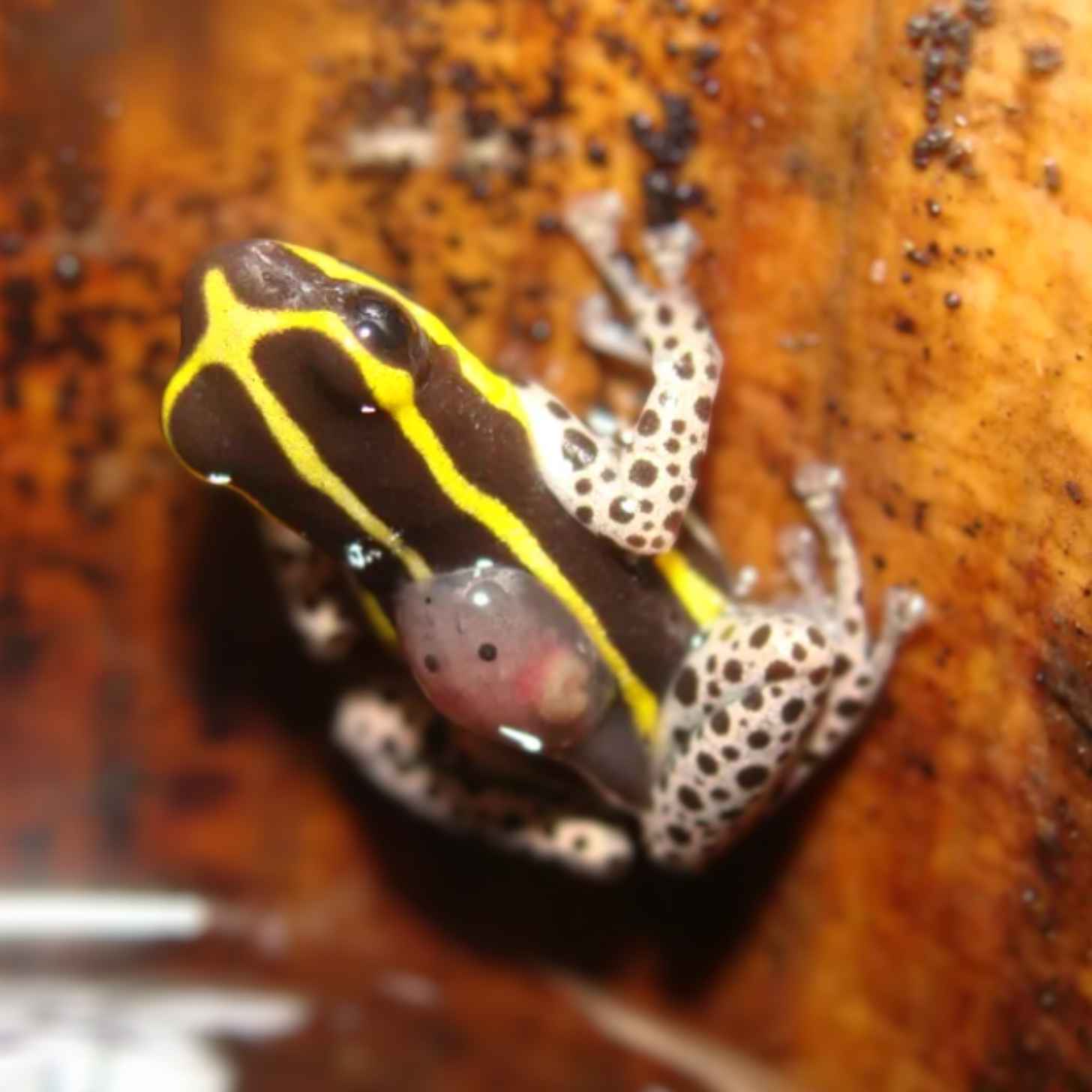
“The most noteworthy thing about this species is how much it really loves living in Guadua bamboo,” Dr Evan Twomey, the study lead author, told IFLScience.
“Certainly, there are a few other species of Ranitomeya that live and breed in bamboo, but usually, it is just certain populations that do this.”
“However,” he continued, “as far as we know, the whole distribution of R. hwata seems to be tied to the presence of this bamboo, and with few exceptions, all individuals of this species have been found in or near bamboo.”
In addition to their love for bamboo, the researchers said that the new species appeared to diverge from its closest relatives by abstaining from cannibalism — a common trait in poison dart frogs.
They also proved to be less monogamous.
“Unlike other close relatives, which are mostly monogamous, males of the new species appear to be polygynous, recruiting multiple females per breeding site,” Twomey and his peers confirmed in the new study, which was published in the scientific journal Zootaxa.

Poison dart frogs are known to help their environment by keeping pest populations in check. They’re also uniquely suited to serve as prey for their only natural predator: the poison-resistant fire-bellied snake.
Additionally, as sensitive creatures with highly permeable skin, their mere presence is a strong indicator of a healthy ecosystem.
“This discovery highlights the great value of protected natural areas as havens for biodiversity and unique species,” emphasized the National Service of Natural Areas Protected by the State.
“It also expands knowledge about the diversity of Amazonian amphibians and reinforces the need to continue conserving habitats like Alto Purús National Park.”
You may also like: New creature with 'visible internal organs' discovered by scientists. It looks straight out of a Studio Ghibli movie
Header image CC0 Public Domain
Every day the Good Good Good team collects the best good news in the world and shares it with our community. Here are the highlights for this week!
If you want to get good news in your inbox every day, join the Goodnewsletter — the free daily newsletter designed to leave you feeling hopeful.
The Best Positive News We’re Celebrating This Week —
Nearly 80 years after it was first introduced, Jane Fonda relaunched the ‘Committee for the First Amendment’
The Committee for the First Amendment was first created in 1947 by Hollywood legends like Henry Fonda, Lucille Ball, Frank Sinatra, and Judy Garland during the McCarthy Era in an effort to defend free speech. Now, Jane Fonda is bringing back the organization in what she calls “the most frightening moment of my life.”
More than 550 Hollywood figures have already joined her in support, including Gracie Abrams, Glenn Close, John Legend, Kerry Washington, Natalie Portman, Pedro Pascal, Quinta Brunson, Spike Lee, Viola Davis, and more.
While specific government leaders were not mentioned, a committee spokesperson said Fonda was inspired to relaunch the initiative due to “the onslaught of attacks on free speech from the current administration” to put on a “united front against government censorship, intimidation, and fear.”
Why is this good news? As the committee said in its announcement, “The ability to criticize, question, protest, and even mock those in power is foundational to what America has always aspired to be.”
In light of recent events, like Jimmy Kimmel being taken off air and President Trump saying networks were “not allowed” to “hit Trump,” and promising to punish his enemies, people are understandably worried about their First Amendment rights. Fonda and others are using their power and influence to fight to protect those rights.
“Because of Jane Goodall, I became a primatologist. Here’s the legacy she leaves behind.”
Scientists are using corals from other countries to save Florida’s dying reefs
Scientists at the University of Miami are testing corals from Florida, Honduras, and the Cayman Islands to find the ones that best survive warming ocean temperatures driven by climate change.
With 80% of the world’s reefs seeing dangerous levels of heat over the past two years, efforts to protect these critical ecosystems have shifted to replanting them, similar to replanting a forest of trees. And the effort in Florida is one of the largest in the world.
So scientists are working to breed corals that can tolerate heat better, speeding up the natural evolution process to keep pace with more rapidly warming waters. For the first time in the U.S., their “Flonduran” corals were planted in the wild.
Why is this good news? The past three summers have been the worst on record for Florida’s coral reefs, where more than 90% of the living coral off the Keys has died. Not only do these reefs preserve biodiversity and the larger state ecosystem, but they also protect its coastline from extreme weather events, hurricanes, storm surge, and more — rebuilding them is critical to saving these communities and marine ecosystems from collapsing.
Ilona Maher gets her own Barbie doll, complete with broad shoulders, to inspire young athletes
→ Read more
Surging wind and solar have given Spain one of the cheapest electricity markets in Europe
Spain has successfully decoupled the influence of fossil fuels on the price of electricity by growing its wind and solar installations, making its wholesale electricity price 32% lower than the European Union average in the first half of the year.
This is despite the country having the third-largest gas power fleet in the EU, which typically drives higher electricity prices. That’s because when lower-cost sources like wind and solar grow enough, they displace gas and coal, leading them to determine prices less often.
That displacement is happening in Spain thanks to strong solar and wind growth. In the first half of 2019, Spain’s power prices reflected the cost of fossil fuels in 75% of hours — it was just 19% in the same time period in 2025.
Solar and wind generated more power than coal for the first time on record — and outpaced growing demand
In the first half of the year, solar and wind generation together grew by 400 terawatt hours — more than the overall global demand increase in the same time period. Solar grew by a record 31% and wind by 7.7%.
Additionally, for the first time on record, renewable energies combined generated more power than coal. Total fossil fuel generation even declined slightly in the first half of the year.
Analysts have often said that growing renewable energy won’t lead to a reduction in fossil fuel use, but this data shows the opposite is true.
Why is this good news? This latest data confirms it’s entirely possible for the world to phase out polluting sources of power, even as demand continues to rise around the world. This latest data further proves renewable energy is a great investment for the planet and for people.
→ Read more
Traditional burials are bad for the planet. So this woman created her own biodegradable ‘cocoon coffin’ instead
→ Read more
The Wolbachia method is helping dramatically reduce dengue fever cases — and could help tackle more neglected tropical diseases
Around 60 million recorded cases of dengue fever occur each year, and around 25,000 people die from it each year. The Wolbachia method is a promising solution that could help reduce the spread of infection and death.
Wolbachia is a bacterium that occurs naturally in around half of all insect species, except for the mosquito that most commonly spreads dengue. Scientists discovered that when these mosquitoes are bred to carry it, they’re less likely to transmit viruses.
In trials in Indonesia, Wolbachia-infected mosquitoes reduced dengue fever infections by 77% and hospitalizations by 86%. It’s been so effective, it could also offer an effective tool against other neglected tropical diseases like yellow fever, Zika, and chikungunya.
New York will become the first state to require private insurance plans to cover ‘scalp cooling’ for chemo patients
Scalp cooling is a treatment that helps preserve hair during chemotherapy — it’s also expensive, with an average cost of between $1,500 and $5,000 per patient, which is often not covered by insurance.
Starting next year, a new law in New York will require private insurance companies to cover scalp cooling for chemotherapy patients, making it the first U.S. state to ease this cost burden.
The lawmaker who first introduced the bill six years ago said cancer patients already go through so much, so making life easier for them “is worth everything.”
Why is this good news? For many cancer patients, the option to preserve their hair helps give them peace of mind and hold on to some sort of normalcy while undergoing a really difficult treatment regimen. As one said, “nothing is the same as looking like yourself.” Finances shouldn’t get in the way of that.
Scientists launch ‘breast-cancer-detecting bra’ into space, study tumor growth in microgravity
One year after Hurricane Helene devastated a national forest in North Carolina, volunteers restored 35 miles of its trails
One year after Hurricane Helene, closures and limited access are still impacting several forest districts in North Carolina’s Pisgah National Forest. And that’s on top of staffing cuts impacting the Forest Service.
To help restore access and take the load off rangers, a group of about 50 volunteers took on several major projects at the Grandfather Ranger District of the forest. They built a retaining wall where there was a landslide, laid rock to increase trail sustainability, cleared trails, and more.
Because of their efforts, which equated to about 400 hours of work in a single day and happened thanks to a $60,000 grant for supplies, around 35 miles of trails are now reopened.
→ Read more
After decades of protests, Vogue publisher Condé Nast will no longer feature animal fur in any editorial content or advertising
Under new guidelines from its parent company, Condé Nast, Vogue will no longer feature “new animal fur in editorial content or advertising.” The guidelines allow for some defined exceptions, like Indigenous practices.
The decision also impacts other publications owned by the media conglomerate, like The New Yorker, Vanity Fair, and GQ. As the leader in fashion publication, though, the change is significant for Vogue, and comes after persistent pressure from anti-fur and animal rights activists.
“Elle” banned fur from its international editions in December 2021. Fur farming is also banned in countries including the U.K., Austria, and Italy.
Why is this good news? While activists wish it had come sooner, the announcement from Condé Nast represents a critical turning point in the fashion media landscape due to its global reach and influence. Vogue, in particular, has historically glamorized fur, so this shift is important.
Wildlife photographers have raised over $1.5M for endangered species. See the stunning photos they ‘donated’ to the cause this year
Federal authorities ordered a Vermont man to an ICE check-in — 200 friends and neighbors joined him in support
When federal authorities ordered Juan De La Cruz to check in with ICE, his family feared the worst. When they arrived at the local field office, they were greeted by about 200 friends and neighbors there to show their support.
De La Cruz applied for asylum in 2017, and said the show of support his family received shows why he wants to remain here: “It’s my community.”
One neighbor expressed alarm that “someone like Juan” that’s been “taking all the right steps and being a member of the community who is giving back and following all the rules and is still being kind of punished by the system he’s trying to work through,”
Immigration officials assured the family that he could stay in the U.S. while his asylum case proceeds, with in-person check-ins every six months.
→ Read more
More good news of the week —
Recently awarded by the EU, a teen invented an autonomous “sea turtle robot” to safely monitor coral reefs. Evan Budz saw potential in the way the turtle moved compared to traditional propeller-based systems of other autonomous robots, which also has less impact on the very environments scientists are trying to protect.
Doctors say that one of the cruellest and most devastating diseases, Huntington’s, has been successfully treated for the first time. The disease runs through families, relentlessly kills brain cells, and resembles a combination of dementia, Parkinson’s, and motor neurone disease, but a new treatment showed the disease was slowed by 75% in patients, giving them decades of “good quality life.”
At Paris Fashion Week, Stella McCartney debuted plant-based feathers in her designs. The “fevvers” are made from a plant-based material and naturally dyed, which has the look of a feather without the bird. McCartney notably hasn’t used leather, fur, or skins in the entirety of its nearly 25-year history.
Since 2018, preschool enrollment in the Kingdom of Morocco rose from 45% to 80% nationally, and 33% to 91% in rural areas. In 2018, the country set a national goal of universal preschool access for children aged 4 to 5 by 2028, with a particular emphasis on reaching rural and disadvantaged communities that have limited access to early learning opportunities.
A world-first vaccine has been rolled out to save young elephants around the world from a deadly virus. Elephant endotheliotropic herpesvirus is a rapid, dangerous disease that causes acute blood loss issues and can lead to an elephant’s death within 24 hours of them first exhibiting symptoms, and it’s especially fatal to elephants under the age of eight.
A new $23 million “homeless resolution center” just broke ground in Fort Collins, Colorado. Offering more than just beds and a kitchen, the new center’s goal is to “resolve homelessness” and is slated to open next fall with a capacity of 250 beds, which are all much needed after a serious fire destroyed 89 beds in the rescue mission’s previous building.
An innovative “sponge” park saved a historic neighborhood in Atlanta from flooding. Funded by the Trust for Public Land, the city, and private donors, Rodney Cook Sr. Park cost $40 million to install, but saved the city about as much when Hurricane Helene rolled past and filled the park with nine million gallons of water — keeping nearby homes completely dry.
Researchers at the University of Arizona developed a solar drying tower to combat food waste. The system can dry fruits and vegetables in hours rather than days, has zero carbon footprint, uses natural heat gradients to preserve produce that might otherwise end up in landfills, can process four tons of produce at a time, and produces clean drinking water in the drying process.
Colorado is training teachers on how to use the state’s new “red flag” gun law to help prevent shootings. Teachers were added to the list of people who can request a person’s guns be temporarily confiscated in 2023, a proven solution in helping prevent school shootings, but few have used it because officials say they “don’t know about it.”
Mackenzie Scott donated $50 million to a nonprofit that offers scholarships to Native students. The Native Forward Scholars Fund is the largest provider of scholarships to Native students, and Scott’s contribution is one of the largest-ever gifts to a Native nonprofit, following a $20 million unrestricted donation to the fund in 2020.
The Church of England named Sarah Mullally as the next Archbishop of Canterbury, the first woman to ever serve in the role. Mullally is a former NHS nurse, became a priest in 2006, was appointed the first female Bishop of London in 2018, and has promised to confront failures which had “left a legacy of deep harm and mistrust” in the Church.
A company in Switzerland created the world’s first two solar-powered furnaces to produce completely recycled steel. The two pilot systems are designed to recycle high-quality steel waste from local watchmakers and medical manufacturers, industries that are both known for their precision engineering and intensive use of stainless steel.
Indigenous nations are planning a tariff-free trade route along the U.S.-Canada border. For generations, Indigenous peoples freely exchanged goods, knowledge, and culture across what is now the Canada–U.S. border, and those networks are now being reimagined as a modern supply chain grounded in Indigenous law and sovereignty.
A mother raised $11,000 for trade school scholarships in her son’s memory. After her son passed away in a car accident, Heather Walters created the Ethan Legrand Helping Hands benefit to raise funds to support a local trade school, which Ethan had graduated from.
After a years-long legal battle, villagers in Kenya saved their ancient, sacred caves from a mining project. (Gifted link) Against the odds, a Kenyan court revoked the licenses for an Emirati-backed company that was looking to bulldoze over 600 acres of land for cement production, thanks to the community members who challenged the project.
Thanks to the recovery of seagrass beds, turtle strandings and soft-shell syndrome cases are declining in Australia. Soft-shell syndrome has been devastating the country’s green turtle population, with a 400% increase in admissions to the Australia Zoo Wildlife Hospital in the past three years, which researchers quickly connected to the turtles’ declining food source.
Scientists developed a new ‘bamboo bioplastic’ that outperforms traditional plastic and breaks down in just 50 days. Made with fossil fuels, oil-based plastics not only have a large environmental footprint in their assembly, but also take decades — or even centuries — to decompose once thrown out.
While the U.S. government aims to weaken protections, Latino communities are stepping up to monitor and improve local air quality. Motivated by rising pollution concerns, a growing number of people have installed air quality sensors outside their homes, businesses, and churches to better understand the air they’re breathing and advocate for change in their communities.
More than 700 faith leaders in Minnesota signed a letter urging the governor and lawmakers to ban assault weapons. The letter was in response to the Annunciation Catholic School shooting that killed and wounded children, and a delegation of 50 clergy members delivered it to the lawmakers and gathered on the state capitol steps to kick off a week of prayer and action.
Scientists developed a novel blood test that can detect and diagnose chronic fatigue syndrome with 96% accuracy. Offering new hope for those living with the debilitating, long-term illness, which impacts millions worldwide but is poorly understood and has long lacked reliable diagnostic tools.
In August 2024, sea turtles were on track to shatter records for nesting season across Florida’s Atlantic and Gulf coasts.
Local experts even expected 2024 to surpass 2023, when 200,000 nests were counted statewide — breaking a previous record that stretched back to 1989.
Then a trio of hurricanes hit in quick succession, as Hurricanes Debby, Helene, and Milton tore through Florida in the span of two months.
The unrelenting disasters caused catastrophic damage and significant flooding, with Helene marking the second-deadliest hurricane in half a century.
When hurricane season finally came to a close in late November, it was evident that Florida’s sea turtles — many of which are endangered — suffered from the storms. Despite a promising hatching season, hundreds of loggerhead, leatherback, and green turtle nests were washed away in the destruction.
Kristen Mazzarella, the turtle watch director of Anna Maria Island, described how drastically the local beaches had been reshaped by 15-foot storm surges.
“It’s a big shock to see a beach go from dunes, with sea oats and sea grapes and other dune plants, to just a flat piece of sand,” Mazzarella told WUFT, a public radio station in North Central Florida.
Fortunately, after a year of rebuilding, local wildlife experts are once again seeing record numbers of sea turtle nests.
“Green turtles had a strong August, bringing the season total to 61,708 nests,” Florida’s Fish and Wildlife Research Institute shared in a Facebook post. “While still behind the record 72,982 nests set in 2023, this is the second-highest green turtle total on record for Florida.”
“Leatherbacks have now reached 2,021 nests statewide, officially extending their record set last month,” the institute continued. “2025 will be remembered as Florida’s top leatherback year to date!”
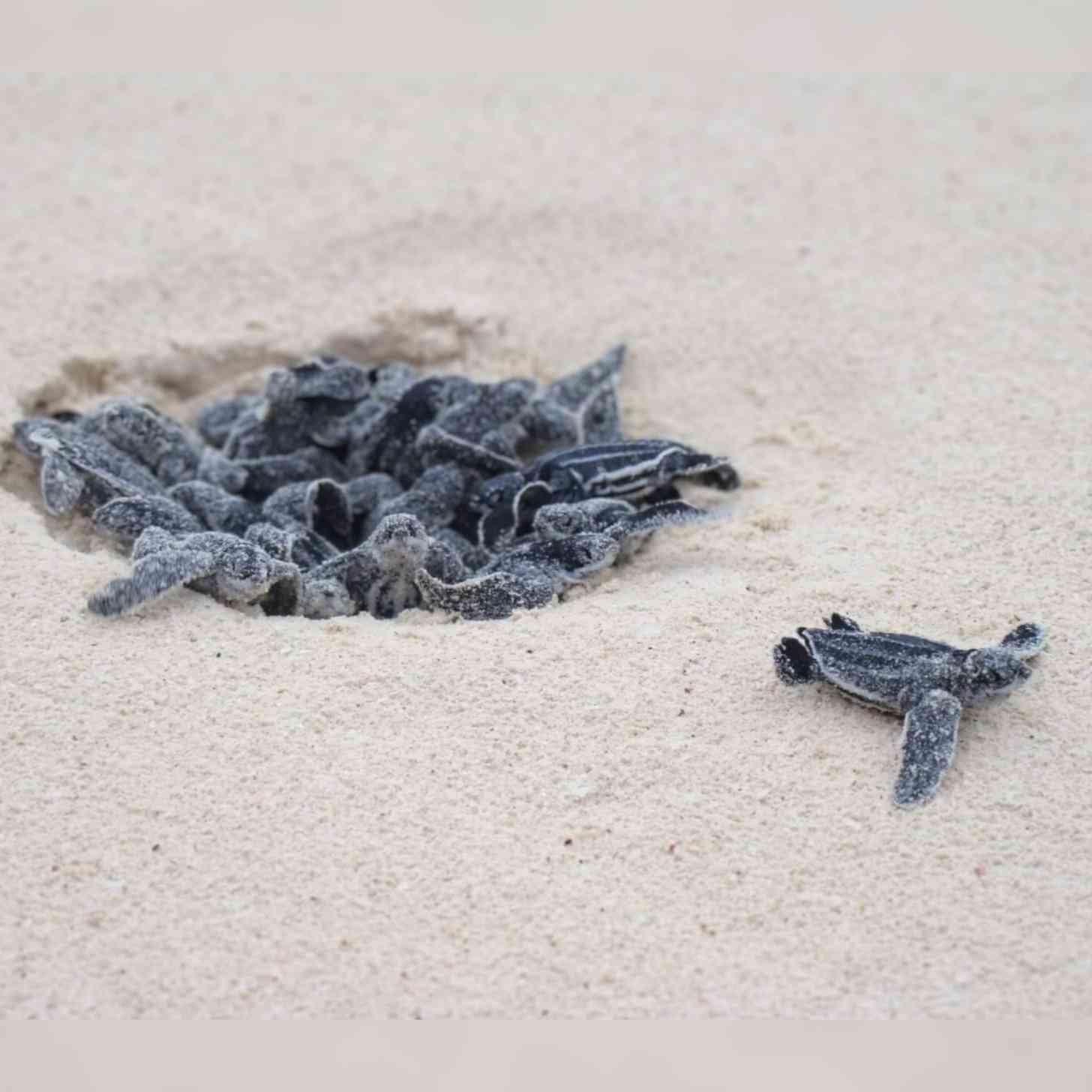
In addition to noting that Florida’s most common nester, the green sea turtle, had nest counts that “remain lower compared to recent years,” the institute also shared the discovery of 10 Kemp’s Ridley turtle nests — a promising sign for the rarest sea turtle in the world.
Jack Brzoza, a sea turtle biologist at Sanibel-Captiva Conservation Foundation, cautioned that “record-high” nest counts are just “one part of the picture.”
“You can have as many nests laid as you want,” Brzoza said, following last year’s hurricane season. “If none of them hatch, that’s really not contributing much.”
Still, positive trends in nest counts are in line with population growth on a larger scale.
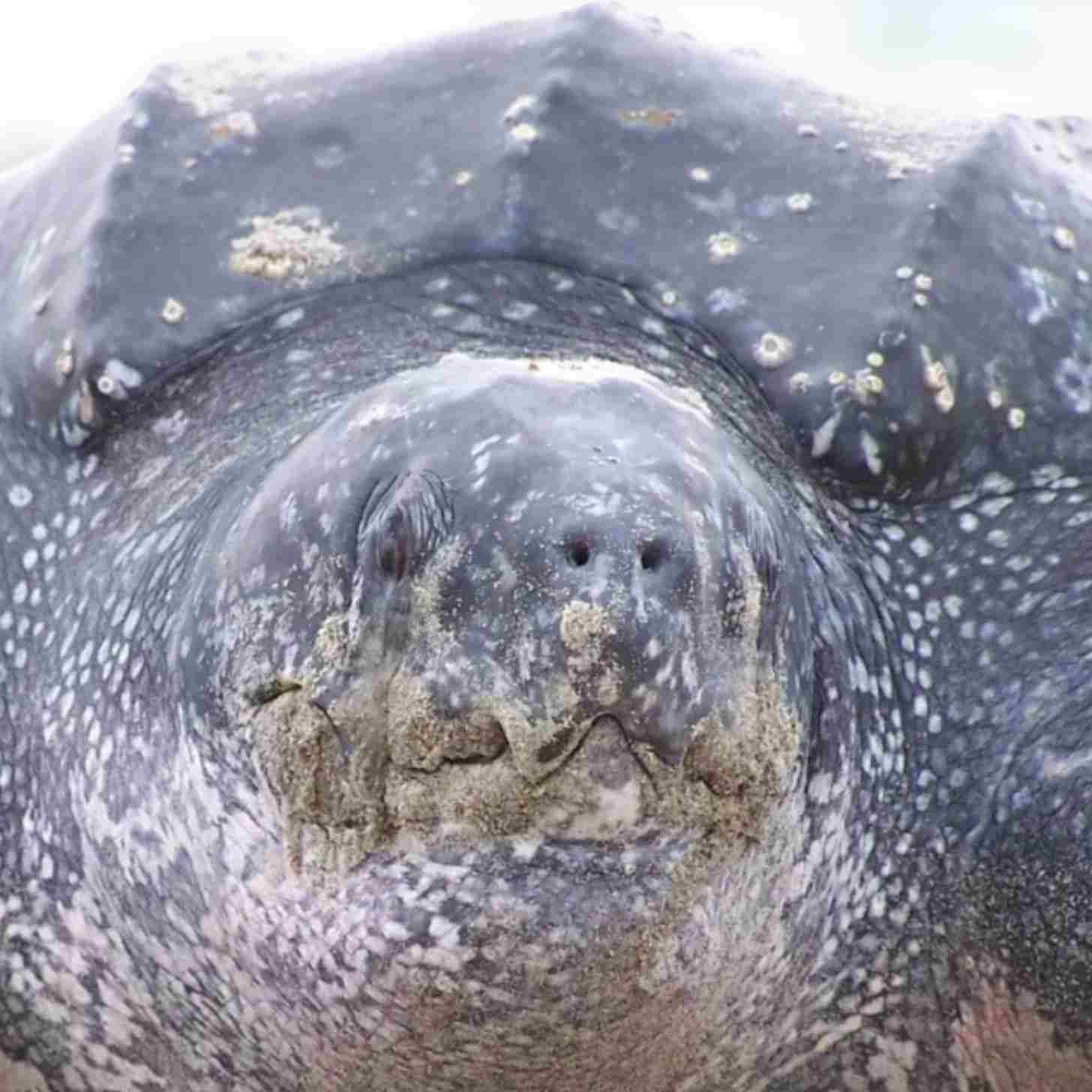
Two months after Florida’s Fish and Wildlife Research Institute shared their data on nest counts in late August, green turtles were downgraded from “endangered” to “least concern” by the IUCN Red List of Threatened Species.
Due to the long lifespan and cyclical nesting habits of sea turtles, Dr. James “Buddy” Powell, the executive director of research at Clearwater Marine Aquarium, said that the milestones we see today are the result of conservation efforts from decades prior.
“[Record sea turtle nesting] is likely a consequence of conservation actions that were put in place 30 years ago,” Powell told WUFT, speaking to the long-term impacts of collective community action.
Powell also noted that when measures are taken to clean up beaches, mitigate light pollution, and protect sea turtles at large, everyone benefits.
“I don’t know of any renourishment projects of beaches that are done just for turtles,” Powell said. “What’s good for the animals, what’s good for the habitat, ends up also being good for us.”
You may also like: Biologists celebrate recovery mission as 31 critically endangered sea turtles return to the Atlantic Ocean
Header image via the National Oceanic and Atmospheric Administration
The whir of an otherworldly machine coupled with the claustrophobic requirement of staying completely still while a doctor peeks at your organs isn’t exactly a recipe for comfort — no matter the age of someone undergoing an MRI.
That’s why Erik Ullerlund Staehr, an employee at LEGO, decided to design a LEGO MRI Scanner set. He hoped to alleviate anxiety for pediatric patients who are anxious about getting their scans.
In 2022, the company rolled out the special LEGO kits and donated them to radiology departments around the world. Since then, over one million children have used the toys, which feature a scanner, patient bed, waiting room, procedure room, staff minifigures, and medical accessories.
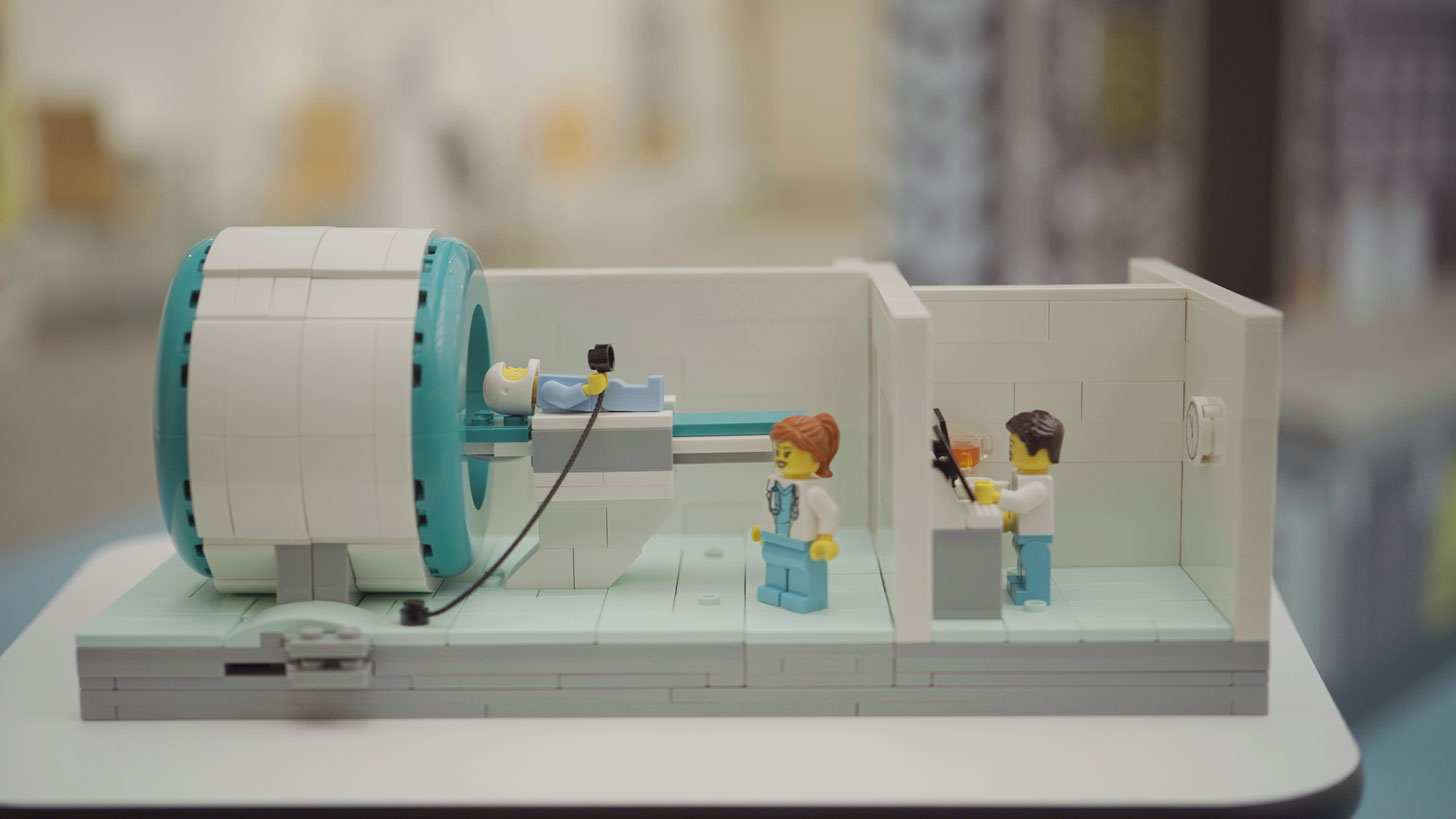
New research conducted by the LEGO Group found that 96% of healthcare professionals who used the LEGO MRI Scanner set say the model helped alleviate children’s anxiety, and 46% reported that it has reduced the need for sedation or anesthesia during MRI procedures.
“Usually, when we walk in with the LEGO MRI Scanner set, the faces on the kids light up,” Traci Aoki-Tan, a child life specialist at Kaiser Permanente Roseville Medical Center, said in a testimonial.
“They can’t wait to touch and play with it. The entire mood in the room gets brighter as soon as we walk in. Even anxious parents — you can see their shoulders drop.”
Over the past couple of years, the company has given 10,000 units of the custom toys to hospitals globally, designed to approach children with a more playful energy as they prepare for a scan.
The research also showed that 95% of healthcare professionals said the set improved the family’s hospital experience, while 94% said it was fun and engaging for children.
One such example is 14-year-old Sam, a teen who was diagnosed with brain and spine cancer at Boston Children’s Hospital. Here, he underwent a year of surgeries, chemotherapy, radiation, and MRI scans. While the LEGO set was not available for his first scan, he has since built it a number of times with a child play specialist at the hospital.
“When he was at one of his lowest moments in hospital, Laura, an amazing child play specialist, invited him to help build the hospital unit's first LEGO MRI scanner model,” Sam’s mom, Christina, said in a statement.
“Sam had already had countless MRI scans by then, but he liked the thought of being able to help other children who would go on to use it. I watched his confidence grow with this sense of purpose as he plugged away building.”
Sam, who is now one-year cancer-free, said building the LEGO model helped him focus on something other than his condition and even planted the seed for a deeper love of LEGO, building even more sets during his time in the hospital.
“I found my first few MRI scans quite scary. I didn’t like the noise and it felt claustrophobic,” he said in a statement.
“Playing with something like this before my scan would definitely have helped me understand more about what was going to happen. It’s cool to think that so many children have been helped by the MRI model I built.”
The reason the LEGO MRI Scanner set works is likely because it taps into an element of play therapy and provides a visual understanding of the medical procedure a patient is about to encounter.
“The LEGO MRI machine is especially unique because it immediately feels familiar to patients. They recognize LEGO bricks from home and associate them with fun and play. When they see a large medical machine represented through something they enjoy, a layer of anxiety is instantly reduced,” Alyssa Sachs and Laura Boegler, two Child Life Specialists at Boston Children’s Hospital, said.
“This sense of comfort makes children more eager to learn, ask questions, and engage with the preparation process,” they continued. “As a result, it allows us as professionals to clear up misconceptions, provide accurate information, and ultimately help patients feel more confident and better able to cope with their healthcare experience.”
The toy also provides a narrative experience for children, allowing them to feel in control of their story and experience, embodying the minifigures in the set.
“Play is so powerful and real for children,” Sam’s mom, Christina, added.
“For them, that little LEGO minifigure in the MRI model is their buddy. That's a friend that's also going through the same thing they are going through. I would love to see this set in every hospital.”
The LEGO MRI sets are not available for purchase and are only created through the LEGO Group’s social responsibility arm. They are donated through nonprofit partners, including Fairy Bricks, Starlight Children’s Foundation, and the United Way.
“Our MRI Scanner set shows how a simple act of play can have a big impact. We know scans can be unfamiliar and even scary for children. By giving children the opportunity to explore, ask questions, and play their way through a medical procedure, we're helping them feel safer and more in control,” Diana Ringe Krogh, vice president and head of social responsibility at LEGO Group, said in a statement.
“It is amazing to see how this set is reducing the number of children who need to be put to sleep for their scans and improving the whole family's experience and wellbeing at what can be a difficult and stressful time.”
You may also like: German grandma builds wheelchair ramps from Legos to make her town more accessible — and colorful
Header image courtesy of LEGO Group
This afternoon, TED, the nonprofit, nonpartisan organization best known for its globally beloved TED Talks, has announced a new era of leadership.
Sal Khan, founder and CEO of Khan Academy, has been named as a board member and “Vision Steward” of the organization, following a nine-month search.
Earlier this year, Chris Anderson, head of TED for 25 years, announced he would be stepping down and set off on a unique and bold journey to find his replacement.
According to a press release from the organization, today’s announcement follows a period of “extensive consultation with close to 100 organizations, investors, and individuals worldwide.”
After receiving numerous proposals, including offers to acquire TED outright, the organization decided to remain a nonprofit, with Khan working with existing leadership to steward the institution into its next era.
“The breadth, ambition, and imagination of what was offered were truly inspiring,” Anderson wrote in a blog post for the organization.
“But for me — and for everyone on TED’s leadership team — the answers weren’t just about capital or scale. They were about stewardship, values, and a shared belief in giving ideas away, trusting community, preserving independence, and amplifying human possibility.”
Anderson added that TED “seriously considered for-profit joint ventures,” but ultimately decided that its nonprofit status “must endure,” to remain independent of “external commercial control.”
“We will proudly continue our transparent mission of providing knowledge, insights and inspiration freely to anyone in the world,” he added.

According to Anderson, Khan embodied that mission.
“From the start, our goal was to find a way for TED to grow its impact while preserving its soul,” Anderson said in a statement.
“Sal Khan embodies the spirit of generosity and curiosity that defines TED. He’s a visionary who has proven that technology and learning can serve humanity at scale — without losing integrity or heart.”
Khan got his start creating math videos and software to help his cousins. With time, Khan Academy grew into a free, trusted learning resource with over 170 million registered users in over 50 languages.
In 2023, he gave a TED Talk about the evolution of artificial intelligence in education. And today, he echoed his enthusiasm for the future of the organization.
“TED has been one of the world’s great amplifiers of ideas,” Khan said in a statement. “I’m honored to help steward its next chapter — one that will further empower people everywhere to learn, connect and collaborate for a better future.”
Under the new leadership structure, Khan will use his role to guide long-term strategy for TED, while still continuing his full-time position leading Khan Academy.
Khan Academy and TED will continue to operate independently of each other, Anderson clarified, but part of Khan’s allure was his ability to craft organizations with goals that are both ambitious and achievable within a nonprofit culture.
With his efforts, a press release said, “he will help shape TED’s evolving mission around lifelong learning, community engagement, and using technology — including AI — to deepen human connection and understanding.”
Additionally, the organization announced that its current CEO, Jay Herratti, would be stepping down and would be replaced by longtime TED team member and TED Fellows co-founder Logan McClure Davda.
“Logan is not an outsider or newcomer — she is a leader forged within our org,” Anderson wrote in a blog post.
“From co-founding our Fellows program to her current role as Head of Impact, she has earned deep respect across the organization and among our community. She knows our culture, our strengths and constraints; she has fought to extend TED’s reach, and she is a believer in Sal’s vision for the future.”
Between Khan and Davda’s two-pronged leadership approach, the duo will fill in where Herratti and Anderson have operated for years.
“Our conviction is that this combination — a visionary steward plus an exceptional, trusted internal leader — gives us the best of both worlds: fresh imagination and operational firepower,” Anderson wrote.
Herratti will join TED’s board, and Anderson will also remain a TED board member for the foreseeable future. At TED2026, he will officially “pass the torch” to Khan and Davda.
“I began at TED in 2008, and have seen ideas travel and change the world — their ripples are real,” Davda said in a statement.
“With Sal shaping the vision ahead, it’s an extraordinary — and humbling — moment to step in as CEO. I’m excited to work with Chris, Jay, Sal, and our leadership team to keep TED focused, imaginative, and impactful.”
Moving forward, Anderson said, the organization will be meeting with its community to discuss feedback, questions, and ideas, and promises to maintain transparency about its governance structure, board composition, and decision-making.

Another new concept will be TED’s new Ideas Council, which a press release calls “a group of visionary thinkers and creators who will bring fresh perspectives and editorial insight.”
The role of this council will be to “champion intellectual curiosity and ensure TED continues to spotlight breakthrough ideas that challenge how we see the world — and our place within it.”
Soon, TED will invite its wider community to contribute by nominating people for the council.
“For decades, TED has been a platform for spreading ideas that change lives,” Anderson said in a statement. “Now, we’re preparing it for the next generation — one that learns, collaborates, and dreams together.”
Anderson signed off his blog post with a word of inspiration to the TED community, filled with speakers, organizers, educators, translators, volunteers, donors, staff, and viewers.
“This moment is for you,” he said. “You have given TED its wings. Now let’s give it a future worthy of that trust.”
You may also like: Iconic TED Talks will now use AI to dub speakers' voices into a dozen languages
Header image by Jasmina Tomic/TED
Good Good Good has been covering TED's annual conference and spinoff events — like TED Women, TED Next, and TED Countdown — as press since 2023. Our journalists watch TED Talks live and interview speakers after they get off stage, giving Good Good Good the opportunity to share stories like this before TED Talks are released online.
A new cozy game, created by the Monterey Bay Aquarium Research Institute, invites people to trade doom-scrolling for mini-games driven by ocean exploration.
Using underwater footage, FathomVerse trains players to spot and classify marine animals through a variety of minigames.
“The images you see in FathomVerse are real photos collected by ocean researchers,” the creators note on the game’s website.
“Scientists, coastal communities, government agencies, and enthusiasts all over the world are deploying all kinds of imaging systems to monitor and explore the depths of the ocean. Every dive in FathomVerse is filled with imagery that researchers have shared with us.”
After honing their skills, the game then invites users to identify real ocean animals — and test their skills against AI-generated estimations.
As they log more animals, players can “unlock missions” and curate a personal gallery of over 50 groups of ocean animals.
In April, the team behind the FathomVerse project debuted the latest installment of the game on the Monterey Bay Aquarium’s YouTube channel.
In the hour-long livestream, the creators investigated footage to identify octopus, squid, sea stars, and crustaceans in real time.
“As we’ve mentioned, the ocean is … huge.” FathomNet content manager Emily Clark noted in the livestream, eliciting laughs from her colleagues.
“There’s just a lot of animals, a lot of habitats, a lot of lighting, a lot of camera differences,” she continued.
“There are so many elements at play, which is why even something really powerful, a process like machine learning, still takes so much training and so much input.”
“And that’s really where the volume of eyes on them — human eyes,” Clark emphasized, “is what makes it a powerful tool.”
Lilli Carlsen, the engagement coordinator for FathomNet, said that gamified citizen science like FathomVerse helps MBARI’s machine learning models improve with every click.
“The thing that gets me really excited with this technology, is if we get an AI model, a machine learning model, to the point where it's able to recognize something that's new,” Carlsen said.

“So we can be sure that we've never encountered this new animal, and that means it's a brand new species that is undiscovered and undescribed.”
At one point, livestream host and MBARI senior content creator Lilianna Watson pointed out that FathomVerse fans — dubbed “Fathomnauts” — were helping the MBARI team identify animals by “playing along in the comments.”
“I can just tell that everybody is so passionate, and it's just really fun to see,” Watson said. “You guys are lucky to have such an engaged community, and it's really, really awesome that so many people care about marine science.”
Kakani Katija, a principal engineer at MBARI, echoed that appreciation as their livestream came to a close.
“I’ve been doing ocean exploration and ocean technology development for a little while now,” Katija said. “And this is one of the most rewarding, exciting projects I’ve ever been on.
“I’m just so grateful to all the Fathomnauts out there that perhaps agree with us and want to continue this journey.”
“And yeah,” Katija added with a grin. “Onwards and downwards.”
“Onwards and downwards, everybody!” Watson cheered, echoing the game’s tagline.
FathomVerse is currently available to download for free on Google Play and the App Store.
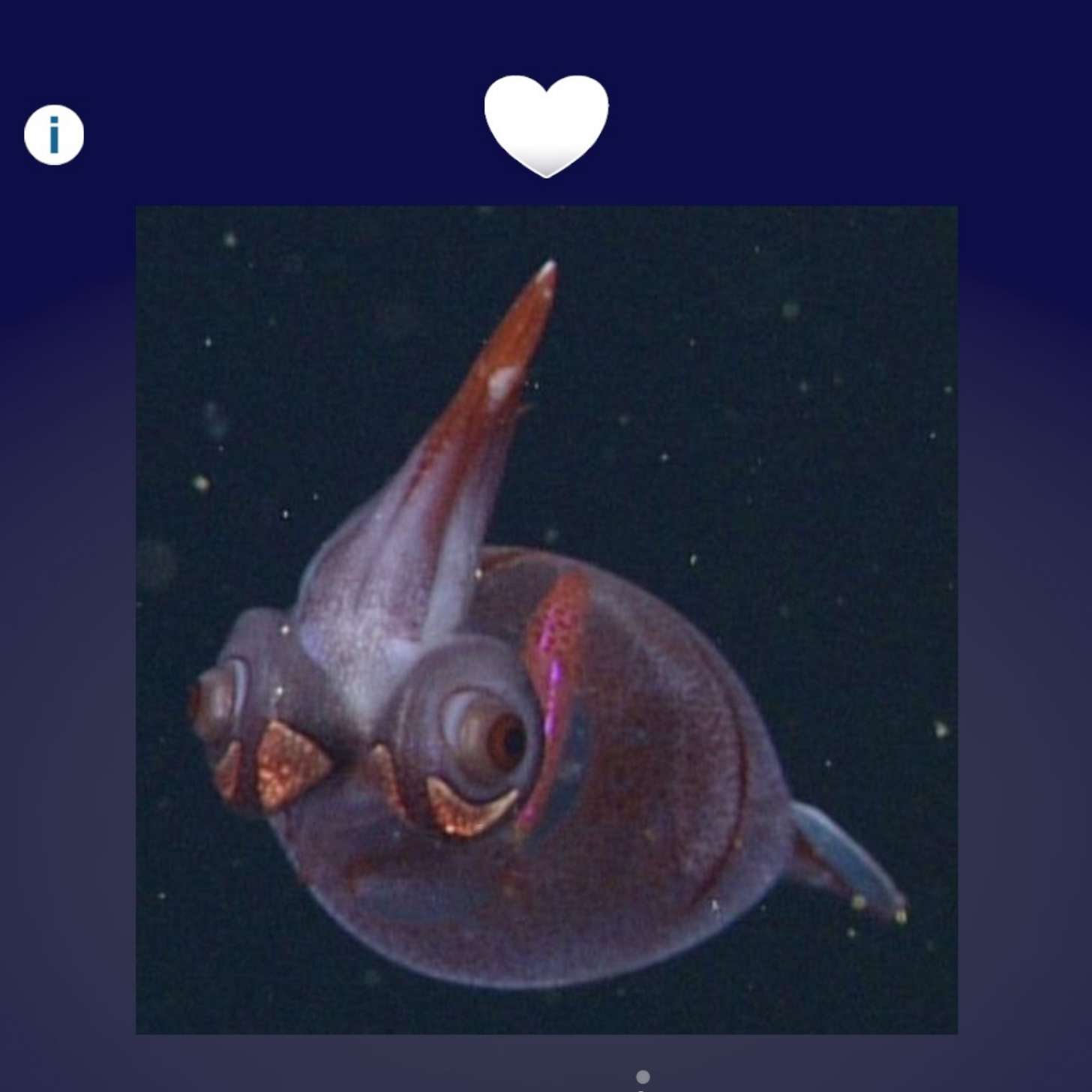
You may also like: In this new heist video game, players return museum artifacts stolen from African countries
Header image via FathomVerse / Monterey Bay Aquarium Research Institute