Between the crisis at the U.S.-Mexico border, and the U.S. withdrawal from Afghanistan, and in addition to ongoing refugee crises globally — there was a lot of heartbreaking news involving refugees and immigrants in 2021.
As global citizens who are aware of how interconnected we all are, it can feel overwhelming to see real people around the world without a safe place to call home, fleeing violence, discrimination, and even death. In the face of these heartbreaking stories, we saw so many people and organizations stepping up and stepping in to help.
The Biden administration began righting the horrifying wrongs of the previous administration in separating migrant children from their parents at the border. And while they did not go far enough to offer aid and assistance, we were glad to see families reunited.
After the U.S. withdrawal from Afghanistan, countries stepped up to welcome refugees fleeing Taliban rule. We also saw communities in the U.S. welcome refugees with open arms, volunteering to set up new homes for them, organizing donation drives for furniture, clothing, and other essentials. And in 2 days, people sent Miles4Migrants over 52 million frequent flyer miles to help fly refugees to safety.
We still have so much work to do to ensure refugees have a safe, clear, and simple way to find not only a safe place to call home and have their basic needs met — but a place to thrive, too. It's also true that we made a lot of progress, especially towards growing empathy for people faced with such a difficult circumstance, in 2021.
Sesame Street debuted its first-ever Rohingya Muppets for Rohingya children living in the world’s largest refugee camp in Bangladesh
Meet Sesame Street's newest characters: Noor Yasmin and Aziz, 6-year old twins and Rohingya refugees living in a refugee camp. Sesame Workshop debuted the two new Muppet characters last month as part of an early education program for children living in the world's largest refugee camp in Cox's Bazaar, Bangladesh.
Rohingya refugees fled conflict in neighboring Myanmar, more than 1 million of them live at Cox's Bazar — more than half of them children.
Thanks to a battery-powered projector, Noor and Aziz will be featured speaking the Rohingya language and engaging with the children in the camp.
“For most Rohingya children, Noor and Aziz will be the very first characters in media who look and sound like them," Sherrie Westin, Sesame Workshop’s president of social impact and philanthropy, said in a press release. “Rooted in the rich Rohingya culture and informed by extensive research and input from Rohingya families, Noor and Aziz will bring the transformative power of playful learning to families at a time when it’s needed more than ever before."
Refugee children fleeing from conflict in their home countries often lack access to early education, a basic human right at a critical stage of development. Research shows how universal access to education opens up opportunities, and is a key component of ending extreme poverty.
And it's so important for children to see themselves represented on-screen. We're celebrating the good work that Sesame Workshop continues to do to make this a reality for children all around the world.
Lawyers found the parents of 105 separated migrant children
Lawyers working to reunite migrant children separated from their parents the U.S.-Mexico border have found the parents of 105 children. They started with 611 children, and now are still working to locate the remaining 506.
Lawyers for the Justice Department said they expect their federal task force to "resolve many — if not all — outstanding issues."
Bottom line: This never should have happened, and we wish we weren't celebrating children being reunited with their parents at all. There’s still much more work to be done by the Biden Administration and it’s important we hold them accountable. This news reminds us to celebrate those working hard to make sure this devastating wrong is made right, and we're hopeful that in the coming days and months every child will be reunited with their parents.
In a reversal after public outcry, the Biden administration said it will increase the refugee cap in May
Our voices matter — Last week, the Biden administration announced it would *not* be increasing the refugee cap set at 15,000 by President Trump, say it “remains justified by humanitarian concerns and is otherwise in the national interest.”
During his campaign and in a plan laid out to Congress a couple months prior, Biden promised to lift that historically low refugee cap, so the announcement that it would stay in place was met with quick public outcry and criticism among lawmakers in Washington, D.C.
In response to the outcry, hours later the White House reversed the announcement, saying it would be increased by May 15 — but no number was set yet.
Local organizations that support refugees are ready to help in all 50 states.
While so much more needs to be done to address the refugee crisis, this is incredibly encouraging news. It can seem like our elected officials don't listen, or aren't representing the desires of their constituents — but our voices do matter, individually and collectively.
We can make a difference.
Canada announced it will resettle 20,000 Afghan refugees, specifically women leaders and human rights workers
Canada announced its plans to resettle more than 20,000 refugees from Afghanistan including women leaders, human rights workers, and journalists.
The effort is in addition to an earlier initiative to welcome thousands of Afghans who worked for the Canadian government, such as interpreters, embassy workers and their families, Immigration Minister Marco Mendicino said in a news conference last week.
According to the UNCHR, an estimated 550,000 Afghans have been newly displaced inside the country since January 2021 — primarily due to insecurity and violence, and 80% of them are women and children.
Related: Read more Canadian good news
In only 2 days, people sent Miles4Migrants over 52 million frequent flyer miles to help fly refugees to safety
Good news from our friends at @miles4migrants — In just 2 days, people donated over 52 million frequent flyer miles and credit card points, $15,000 in travel vouchers, and $100,000 in cash for flights for refugees and asylum-seekers to reach safe homes.
Miles4Migrants is a nonprofit organization that uses donated frequent flyer miles, credit card points, and cash to help people impacted by war, persecution, or disaster reunite with loved ones and start new beginnings in safe homes.
They've flown over 5,000 people from 78 different countries to safety, and redeemed over 85 million total miles.
Amidst all that's happening in Afghanistan — the new donated miles, points, and cash will be put to work getting refugees and asylum-seekers out and to safety, too.
An asylum-seeking athlete from Iran helped from the Paralympic Refugee team
The #ParalympicGames begin today in Tokyo! When Shahrad Nasajpour heard the Olympics was going to have a refugee team at the Rio 2016 Games, he immediately emailed the International Paralympic Committee and asked, “What about the Paralympics?”
The discus athlete, who was born with cerebral palsy and has some mobility impairments on his left side, sought asylum in the U.S. from Iran just before the 2016 Olympic games and was told by the IPC that they had no plans for a refugee team, but perhaps he could try to compete for the U.S. This was impossible, however, because he didn’t have U.S. citizenship.
But he didn’t give up — and his persistence paid off.
In August 2016, the IPC announced it would have the first-ever Independent Paralympic Team (renamed the Refugee Paralympic Team for 2020) with a refugee and asylee Paralympic athlete. Nasajpour was one of the two athletes to compete. He even carried the Paralympic flag in the Closing Ceremony.
Nasajpour is one of six members of the Refugee Paralympic Team for Tokyo 2020 — back on the team that he pioneered.
Nasajpour is also one of 52 Paralympic and Olympic athletes working with Proctor & Gamble’s “Athletes for Good Fund.” Ahead of Tokyo 2020, each athlete gets $10,000 to donate to a charitable organization of their choice. Nasajpour gave his money to Buffalo Peace House, a nonprofit in Buffalo, New York that assists asylum-seekers.
As many as 73% of people in the U.S. said they support resettling Afghan refugees in the country
According to a new poll from NPR, PBS NewsHour, and Marist College, nearly 73% of people in the U.S. support allowing refugees from Afghanistan to resettle in the country.
Another poll from the Washington Post and ABC News found that 68% of people said they support resettling refugees after they go through a security screening.
We're celebrating this news that a vast majority of people support welcoming refugees into the U.S. — it is not only secure, vetted, and safe — it's also good for communities, creating safer towns and more prosperous economies. And many communities have already started welcoming them!
Good Action: Under the Trump Administration, funding was significantly cut for refugee resettlement organizations around the country — so they especially need our help right now.
A Turkish doctor created an app to help meet the healthcare needs of refugees - refugee women in particular
After trading jazz for a Harvard education, Aral Sürmeli chose to support refugees by not only working in a refugee camp in Turkey, but by developing an app that supports refugees’ unique healthcare needs.
One of the major challenges of being a refugee is the lack of access to real healthcare, particularly for refugee women. But through the power of empathy and tech, there are now more avenues for refugees seeking proper care for their basic needs.
Sürmeli is a Harvard-educated refugee healthcare provider who has worked to offer solutions through public advocacy and digital solutions for refugees seeking shelter, pregnancy care, and much more. After starting his Masters in Public Health at Harvard University in the fall of 2018, Sürmeli launched the HERA Digital Health app — a mobile app connecting refugee mothers and children with preventative healthcare.
On the Sounds Good podcast, Aral Sürmeli talked to Branden Harvey about how he became interested in refugee health after a visit to Turkish refugee camps — and how he’s exploring and working to solve the unique complications for refugees accessing healthcare through tech.
Three Afghan women launched a school for 200 refugee children at the Fort McCoy army base in Wisconsin
The hundreds of children living temporarily at the Fort McCoy base in Wisconsin are among 53,000 Afghans who left their country after the Taliban seized power in August and are being housed on military bases across the United States.
"After we arrived in the camp, we saw kids roaming around, doing nothing. That's when we thought of a school ... we went from building to building and on the very first day we got 130 kids," said Nilab Ibrahimy, one of the school's three founders.
Now, 200 refugee children attend classes, learning math, English, and about life in the U.S.
Archbishop Emeritus Desmond Mpilo Tutu has died at the age of 90.
Archbishop Tutu earned the respect and love of millions of South Africans and the world. He carved out a permanent place in their hearts and minds, becoming known affectionately as “The Arch”.
When South Africans woke up on the morning of April 7th, 2017 to protest against then-President Jacob Zuma’s removal of the respected Finance Minister Pravin Gordhan, Archbishop Tutu left his Hermanus retirement home to join the protests.
He was 86 years old at the time, and his health was frail. But protest was in his blood.
In his view, no government was legitimate unless it represented all its people well.
There was still that sharpness in his words when he said that:
We will pray for the downfall of a government that misrepresents us.
These words echoed his stance of ethical and moral integrity as well as human dignity. It is on these principles that he had fought valiantly against the system of apartheid and became, as the Desmond Tutu Foundation rightly affirms,
an outspoken defender of human rights and campaigner for the oppressed.
But Archbishop Tutu didn’t stop his fight for human rights once apartheid came to a formal end in 1994. He continued to speak critically against politicians who abused their power.
He also added his weight to various causes, including HIV/AIDS, poverty, racism, homophobia, and transphobia.
His fight for human rights wasn’t limited to South Africa. Through his peace foundation, which he formed in 2015, he extended his vision for a peaceful world “in which everyone values human dignity and our interconnectedness”.
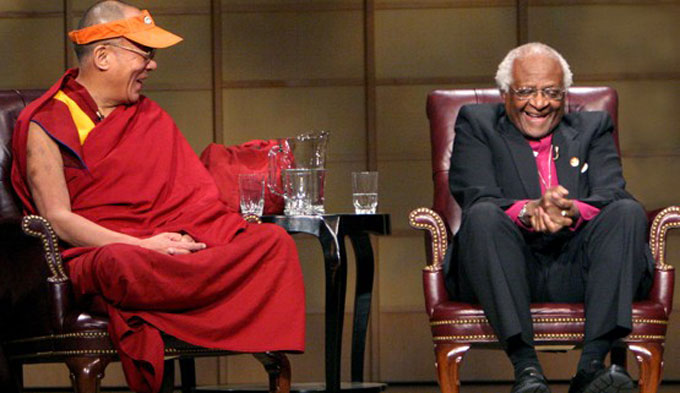
He also became relentless in his support for the Dalai Lama, whom he considered his best friend. He condemned the South African government for refusing the exiled Tibetan spiritual leader a visa to deliver the “Desmond Tutu International Peace Lecture” in 2011.
Desmond Tutu's Early Years
Archbishop Tutu came from humble beginnings. Born on October 7th, 1931 in Klerksdorp, in the North West Province of South Africa where his father, Zachariah was a headmaster of a high school. His mother, Aletha Matlare, was a domestic worker.
One of the most influential figures in his early years was Father Trevor Huddleston, a fierce campaigner against apartheid. Their friendship led to the young Tutu being introduced into the Anglican Church.
After completing his education he had a brief stint teaching English and History at Madibane High School in Soweto; and then at Krugersdorp High School , west of Johannesburg; where his father was a headmaster. It was here that he met his future wife, Nomalizo Leah Shenxane.
It is interesting that he agreed to a Roman Catholic wedding ceremony, although he was Anglican. This ecumenical act at the very early stage in his life gives us a hint of his commitment to ecumenical work in later years.
He quit teaching in the wake of the introduction of the inferior “Bantu education” for black people in 1953. Under the Bantu Education Act, 1953, the education of the native African population was limited to producing an unskilled work force.
In 1955 Tutu entered the service of the church as a sub-deacon. He got married the same year. He enrolled for theological education in 1958 and, after completing his studies, was ordained as a deacon of Saint Mary’s Cathedral in Johannesburg in 1960, and became its first black dean in 1975.
In 1962 he went to London to pursue further theological education with funding from the World Council of Churches. He earned a Master of Theology degree, and after serving in various parishes in London, returned to South Africa in 1966 to teach at the Federal Theological Seminary at Alice, Eastern Cape.
One of the lesser-known facts is that he had a special interest in the study of Islam. He had wanted to pursue this in his doctoral studies, but this was not to be.
The activities he was involved in in the early 1970s were to lay the foundation for his political struggle against apartheid. These included teaching in Botswana, Lesotho and Swaziland and, thereafter, a posting to London as the Associate Director for Africa at the Theological Education Fund, and his exposure to Black Theology. He also visited many African countries in the early 1970s.
He eventually returned to Johannesburg as the dean of Johannesburg and the rector of St. Mary’s Anglican Parish in 1976.
Desmond Tutu's Political Activism
It was at St Mary’s that Tutu first confronted the then apartheid Prime Minister John Vorster, writing him a letter in 1976 decrying the deplorable state in which black people had to live.
On June 16th Soweto went up in flames, when black high school pupils protested against the forced use of Afrikaans as a medium of instruction, and were mowed down by apartheid police.
Bishop Tutu was thrust deeper and deeper into the struggle. He delivered one of his most passionate and fiery orations following the death in detention of the black consciousness leader, Steve Biko in 1977.
His role as the General Secretary of the South African Council of Churches, and later as the rector of St. Augustine’s Church in Orlando West in Soweto, saw him become an ardent critic of the most egregious aspects of apartheid. This included the forced removals of black people from urban areas deemed to be white areas.
He Became a Target
With his growing political activism in the 1980s, the Arch became a target of the apartheid government’s full-scale victimization and faced death threats as well as bomb scares.
In March 1980 his passport was revoked. After much international outcry and intervention, he was given a “limited travel document” two years later to travel overseas.
His work was recognized globally, and he was awarded Nobel Prize for Peace in 1984 for being a unifying leader in the campaign to resolve the problem of apartheid in South Africa.
He went on to receive more distinguished awards. He became the Bishop of Johannesburg in 1984, and the Archbishop of Cape Town in 1986.
In the following four years leading up to the release of Nelson Mandela after 27 years in prison, the Arch had his work cut out for him. This involved campaigning for international pressure to be brought on the apartheid through sanctions.
Democracy Years
After 1994, he headed the Truth and Reconciliation Commission. Its primary goal was to afford those who committed human rights abuses – for or against apartheid – the opportunity to come clean, offer legal amnesty to deserving ones, and to enable the perpetrators to make amends to their victims.
Two of the greatest moments in his personal life took his theological outlook beyond the confines of the Church. One was when his daughter Mpho declared she was gay and the church refused her same-sex marriage. The Arch proclaimed:
If God, as they say, is homophobic, I wouldn’t worship that God.
The second was when he declared his preference for assisted death.
South Africa is blessed to have had such a brave and courageous man as The Arch, who truly symbolized the idea of the country as a “rainbow nation”. South Africa will feel the loss of the moral direction of this "brave soldier of God" for generations to come. Hamba kahle (go well) Arch.
This article was originally published by our partners at The Conversation — and was republished by Good Good Good with permission.
Header photo originally by Kristen Opalinski — taken at the COP17 "We Have Faith: Act Now for Climate Justice" Rally on 27 Nov 2011 in Durban, South Africa. The photo was made available via a (CC BY-SA 3.0) license — and was edited to be wider.
→ Desmond Tutu's best quotes about injustice, hope, joy, and forgiveness

This week, as we mourn the loss of Archbishop Demond Tutu, we're looking back on his quotes, sayings, and words of wisdom.
Desmond Tutu spent his life fighting injustice, maintaining a genuine sense of hope and joy, and inspiring a new generation to do the same.
13 Desmond Tutu Quotes to Leave You Feeling More Hopeful, and Ready To Make a Difference:
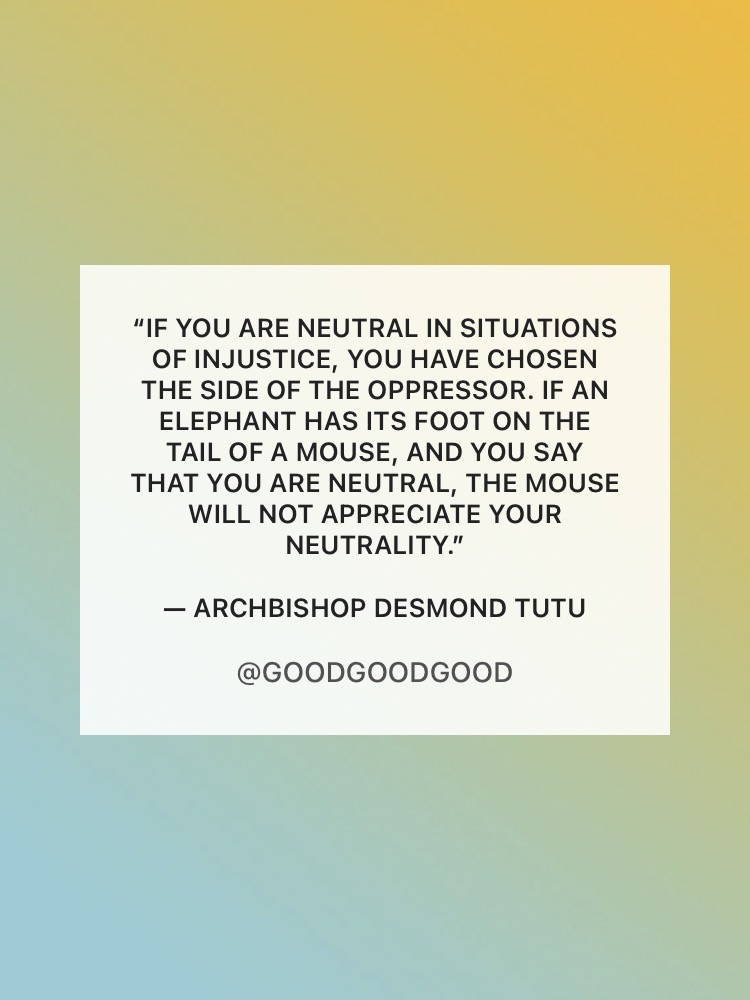
1. “If you are neutral in situations of injustice, you have chosen the side of the oppressor. If an elephant has its foot on the tail of a mouse, and you say that you are neutral, the mouse will not appreciate your neutrality.”
— Archbishop Desmond Tutu
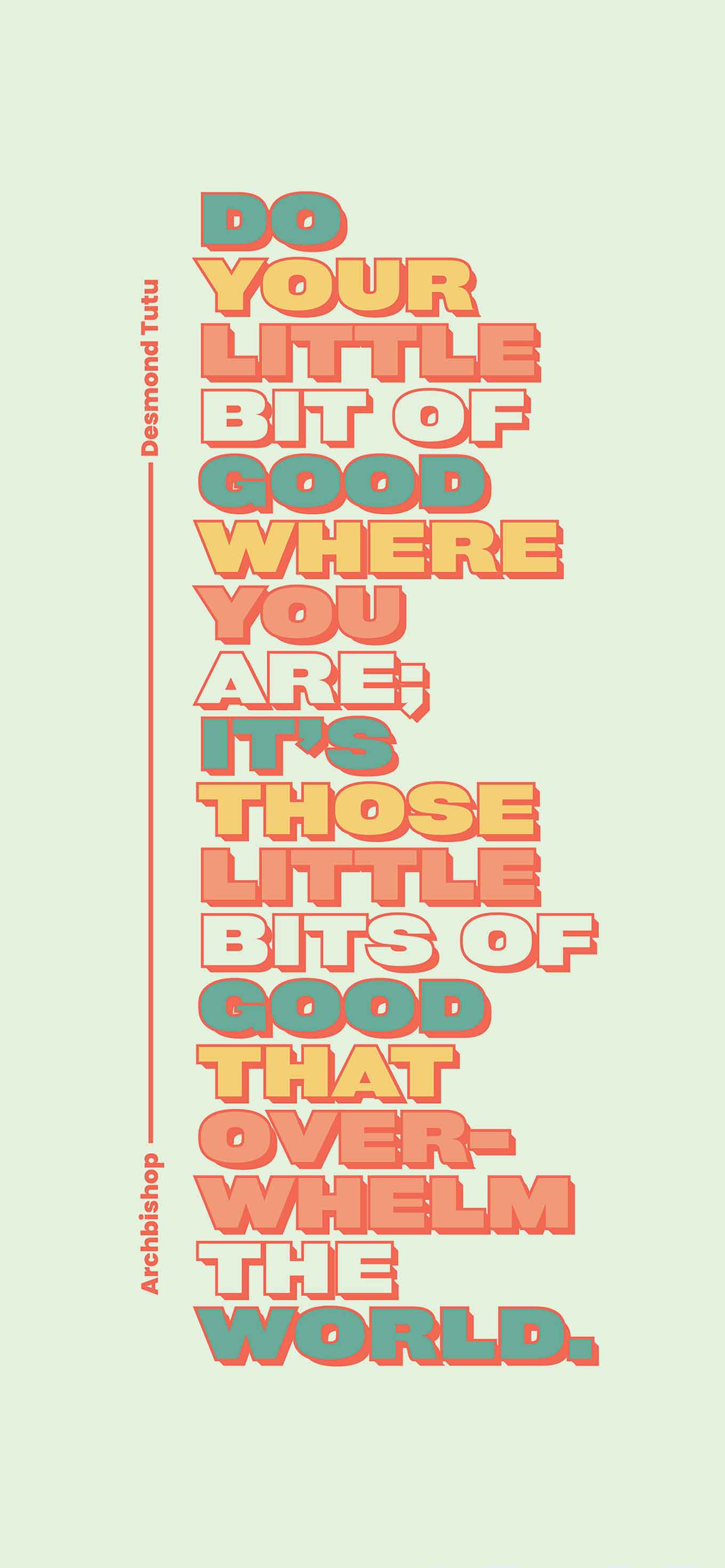
2. “Do your little bit of good where you are; it is those little bits of good put together that overwhelm the world.”
— Archbishop Desmond Tutu
→ Read more quotes about activism
3. “Hope is being able to see that there is light despite all of the darkness.”
— Archbishop Desmond Tutu
→ Read the best quotes about hope and quotes about optimism
4. “If you want peace, you don't talk to your friends. You talk to your enemies.”
— Archbishop Desmond Tutu

5. “Discovering more joy does not save us from the inevitability of hardship and heartbreak. In fact, we may cry more easily, but we will laugh more easily too. Perhaps we are just more alive. Yet as we discover more joy, we can face suffering in a way that ennobles rather than embitters. We have hardship without becoming hard. We have heartbreaks without being broken.”
— Archbishop Desmond Tutu
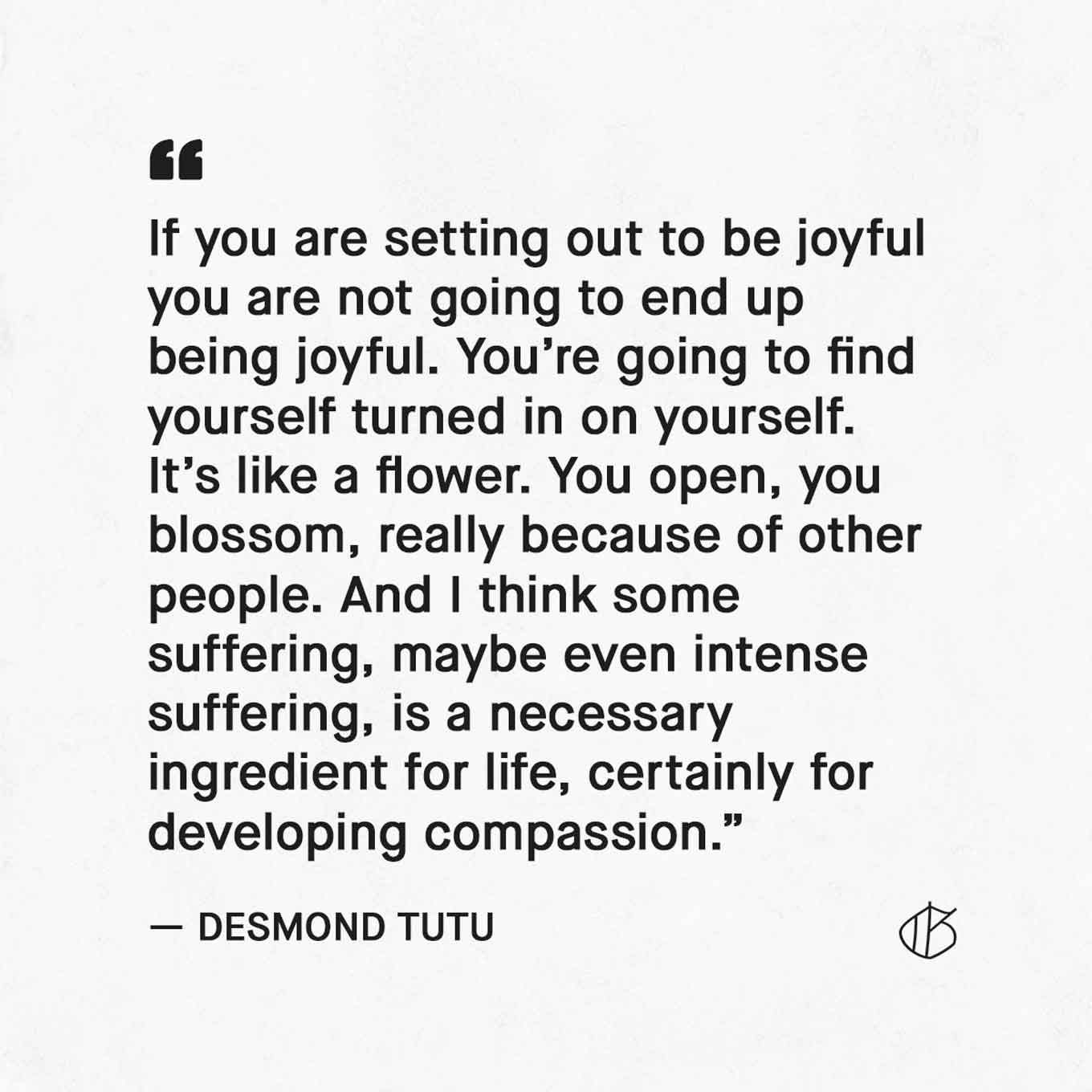
6. “If you are setting out to be joyful you are not going to end up being joyful. You’re going to find yourself turned in on yourself. It’s like a flower. You open, you blossom, really because of other people. And I think some suffering, maybe even intense suffering, is a necessary ingredient for life, certainly for developing compassion.”
— Archbishop Desmond Tutu
7. “Despair can come from deep grief, but it can also be a defense against the risks of bitter disappointment and shattering heartbreak. Resignation and cynicism are easier, more self-soothing postures that do not require raw vulnerability and tragic risk of hope. To choose hope is to step firmly forward into the howling wind, baring one's chest to the elements, knowing that, in time, the storm will pass.”
— Archbishop Desmond Tutu
→ Read the best quotes about hope and optimism
8. “God places us in the world as his fellow workers-agents of transfiguration. We work with God so that injustice is transfigured into justice, so there will be more compassion and caring, that there will be more laughter and joy, that there will be more togetherness in God's world.”
— Archbishop Desmond Tutu
9. “My humanity is bound up in yours, for we can only be human together.”
— Archbishop Desmond Tutu
10. “We are each made for goodness, love, and compassion. Our lives are transformed as much as the world is when we live with these truths.”
— Archbishop Desmond Tutu
11. “I wish I could shut up, but I can't, and I won't.”
— Archbishop Desmond Tutu
12. “I am not interested in picking up crumbs of compassion thrown from the table of someone who considers himself my master. I want the full menu of rights.”
— Archbishop Desmond Tutu
13. “The price of freedom is eternal vigilance.”
— Archbishop Desmond Tutu
As we read, absorb, and take action based on these quotes from Archbishop Desmond Tutu, may we continue his work of filling the world with more peace, justice, and hope.

Tucson, Arizona's ambitious tree-planting goal aims to improve the health of residents, wildlife, and the watershed.
Reflecting on her childhood, Tucson, Arizona Mayor Regina Romero points to her father as the figure who lit an environmentalist fire within her.
Any chance he'd get, Romero's father would take his wife and six kids to an 800-acre ranch in the Sierra Madre mountain range of Sonora, where they learned how to ride horses, direct cattle, and to respect the wildlife, such as bobcats and brown bears.
"We invaded their space," he would tell them.
At the ranch, there was an outhouse instead of running water, rivers instead of showers. It was very rudimentary, Romero described.
But riding through these biodiverse mountains on horseback made it all worth it.
"It was just so liberating," Romero said.
Five years ago, Romero's father passed away. Still his legacy lives on, as Romero, the first-ever Latina mayor of America's 33rd largest city, uses her platform to build an environmentally resilient community.

In Feb., Romero solidified a pledge to plant 1 million trees in the semi-arid desert city by 2030, when she joined the 1t.org US Chapter Stakeholder Council, a group of public, private, and nonprofit leaders committed to the restoration of 1 trillion trees globally.
The U.S. chapter, including REI, National Forest Foundation, Amazon, the City of Dallas, and the City of Tucson, have committed to more than 1 billion trees thus far.
Romero's goal: adapting to a rapidly changing climate in the country's third fastest-warming city.
"Climate change waits for no one," Romero said. "Without a liveable community, we have no Tucson."
Currently, Tucson supports an estimated 1.6 million trees.
Low-income neighborhoods are hit hardest by climate change
Romero, urban forestry manager Nicole Gillet, and local groups such as Tucson Clean and Beautiful, are prioritizing tree planting in low-income communities, which are disproportionately burdened by Tucson's urban heat island effect.
"We have to attack the problem where the problem exists," Romero said.
According to a Climate Central report, Tucson has warmed by 4.48 degrees Fahrenheit since the first Earth Day in 1970, which is more than Phoenix, 110 miles to the north.
Recent research shows that some Tucson neighborhoods are up to 8 degrees F warmer than the city's average. Neighborhoods with the highest Latino populations are 4 to 5 degrees F warmer on average.
"It's not that the heat is seeking out low-income populations," lead author, John Dialesandro, a Ph.D. candidate studying urban climatology at University of California, Davis, told Environmental Health News. "It's a lack of greenspace."
In the desert Southwest, the extra heat that low-income neighborhoods endure often coincides with lack of air conditioning. Many households must choose between air conditioning, healthcare, and food, one University of Arizona paper said.
These communities with less indoor cooling often have fewer trees to provide shade as well.
Some Tucson neighborhoods with high poverty rates are only 1 to 2 percent shaded by tree canopy, according to an American Forests tree equity map.
This is an issue of public health, Adriana Zuniga, an assistant research scientist in the University of Arizona's College of Architecture, Planning and Landscape Architecture, told Environmental Health News.
"It affects quality of life," Zuniga said. "Vegetation is linked to better air, lower temperatures, less stress, studies show less use of antidepressant medication."
Trees help biodiversity
According to Zuniga, urban vegetation can also alleviate issues facing desert biodiversity, especially migratory species.
"Their habitats have been fragmented so much from urbanization that every spot of vegetation counts," Zuniga said.
Migratory pollinators are declining in the Sonoran Desert. More than 10,000 pollinator species are at risk in the Southwest, according to the Desert Botanical Garden in Phoenix.
The monarch butterfly, known for its remarkable blood-orange wings, is a keystone species that relies on nectar resources in southern Arizona during its spring migration.
Over the last two decades, monarch populations have fallen by 80 percent. Some of the causes include climate change, drought, deforestation, and declines in milkweed plants, which female monarchs rely on for laying eggs.
"They desperately, desperately need our help in developing those patches of habitat for them to use while they migrate back and forth from Mexico, all the way to Canada," Zuniga said.
Restoring the watershed during a drought

Trees need water. And the Southwest is in a drought.
2020 was Tucson's driest year on record, at only 4.17 total inches of rainfall.
Thus, planting 1 million trees in the next decade has faced criticism.
But Lisa Shipek, executive director of Watershed Management Group in Tucson, believes that the initiative is realistic if native, drought-tolerant trees are planted.
"Velvet mesquite trees, desert ironwood, blue palo verde—there are a number of trees that are very appropriate to plant in the city, are found at these low elevations, and can be sustained just on rainwater," Shipek told Environmental Health News.
In fact, Shipek said, planting 1 million trees could actually restore parts of the Tucson watershed.
Before the mid-1900s, Tucson had a platter of perennially flowing rivers and creeks, such as the Santa Cruz River, Rillito River, and Sabino Creek. Then came over-pumping and massive urban development.
Now, it is rare to see flowing water.
In urban areas, where much of the surface is paved and impermeable, the million tree initiative could allow more rainfall to reach Tucson's watershed, according to Shipek.
"Putting in a rain basin with every single tree will help restore the watershed and ensure more water is infiltrated where the rain is falling," Shipek said.
A rain basin is a surface that allows rainwater to soak in and feed the trees, and indirectly, Tucson's groundwater. Groundwater contributes to streamflow.
Rainwater will be the primary fuel for the million trees initiative. When Romero entered office, she and her council approved a green stormwater infrastructure fee, which charges the average residential water-user $1 per month. Over the next three years, the fee will generate up to $7 million for sustainable stormwater harvesting in parks, streets, and parking lots, according to Romero.
Relying on rain in a drought is tricky, but according to Katie Gannon, program director at Tucson Clean and Beautiful, rain will reach these trees by way of nature. When more trees are present, the surrounding air becomes cooler, causing more clouds to drift into the low-pressure system, she told Environmental Health News.
"Green attracts rainfall," Gannon said.
This article was originally published by Environmental Health News — and was republished by Good Good Good with permission
When many people think of New Year’s resolutions, they brainstorm ways to improve themselves for the year ahead.
What if we expanded those aspirations to include resolutions that benefit our communities, society, and the planet, too?
It might not be a typical approach, but it can broaden your horizons to show ways you can also be of service to others.
Here are four popular New Year’s resolutions with a twist for improving your relationship with nature in the new year and beyond:
Environmental resolutions to help fight climate change (and inspire others to join in and do the same)
1. Exercise more consideration for how your actions impact the environment
We each have an environmental ethic reflecting how we value, manage and ultimately relate to nature. Balancing the scales of reciprocity between us and nature – how much we give and take – can improve this relationship in many ways. Whether it’s our addiction to one-use plastics that pile up in landfills or fossil fuels that warm the planet, a mishandled relationship with nature is not doing us or the Earth any favors.
In 2022, we can all take more responsibility for how our actions exacerbate environmental problems.
We can also encourage governments and businesses to make it easier for people from diverse socioeconomic backgrounds to protect the environment. This includes making recycled goods affordable and reliable public transportation widely accessible.
Check out the U.S. Environmental Protection Agency’s resources describing some very simple ways to reduce waste at home, work, in our communities, and during the holidays.
Tips from the website include turning off or unplugging lights during the day, reusing packaging materials, and using online billing services instead of paper mail.
2. Lose the weight of social injustice – it harms nature, too
The perils of social injustice stress multiple aspects of society. Racism and inequality can lead to health disparities, and they also have consequences for the natural environment.
A recent study described how practices such as redlining and residential segregation led to unequal access to nature, excess pollution, and biodiversity loss.
These practices brought in highways and industries that harm environmental quality in marginalized communities.
They also left neighborhoods with fewer parks and trees that provide cooling in summer and benefit the planet.
Perpetuating social ills like systemic racism and inequitable resource allocation is detrimental to the environment, marginalized people, and society as a whole.
To help turn this around, you can speak out in your community. Join groups that are trying to promote environmental protection and social justice and are bringing nature back to communities.
Call your city, state, and Congressional leaders to urge them to take action.
Also, refer to the Green 2.0 report’s section on making diversity initiatives successful for concrete ways that you can actualize this in your place of work.
3. Learn something new about nature and how to reduce harm to the environment and yourself
Clean air, water, and soil are fundamental for our survival, but research shows many people lack basic environmental and health literacy to know how to protect themselves.
In 2022, get to know your own impact on the environment. Read more and start exploring ways to preserve the integrity of your area’s natural resources.
For example, find out where you can stay abreast of local land-use decisions that impact the environment and your overall community.
You can also support local educators and encourage them to bring the environment into lessons. Environmental issues overlap many other subjects, from history to health.
This website includes a framework and materials for educators to help students expand their environmental literacy.
Staying plugged in with media that discuss the latest research can enhance awareness. You can also try tying environmental facts and knowledge into your game night and team-building activities.
4. Spend more time with family and friends in nature
Studies show that spending time in nature, including urban green spaces, can improve your relationship with nature and with others.
Time in nature can increase social cohesion. Throughout the pandemic, many people discovered the outdoors as a place to decompress and reduce stress.
Spending more time outdoors can encourage social interactions that benefit health, buffer emotional distress and encourage use of these spaces, which can help protect them for the future.

Here are some tools that outline best practices to enhance parks and recreation near you. Also, here are ways to make outdoor environments more inclusive for families in diverse communities.
Collectively, thinking about our relationship with nature and finding ways to protect the environment can help us be better stewards of the planet.
This article was originally published by The Conversation — and was republished with permission
Edward O. Wilson, a prominent biologist and prolific author who help raise global awareness and understanding about biodiversity and conservation, has died.
— Wilson began his career studying the biology and social structures of ants which led him to develop expansive theories on evolution and humanity’s relationship with the planet.
— While Wilson’s research was highly influential in scientific circles and won numerous recognitions, he was mostly widely known for his accessible writing, including articles and best-selling books which introduced concepts like biodiversity to the masses.
— Wilson was an outspoken advocate for global conservation efforts.
— Wilson advocated for setting aside half of the Earth as wilderness.
Edward O. Wilson, a prominent biologist and prolific author who help raise global awareness and understanding about biodiversity and conservation, has died.
E.O. Wilson, as he was often known, died on Sunday in Burlington, Massachusetts, according to a statement from the E.O. Wilson Biodiversity Foundation. He was 92.
“Ed’s holy grail was the sheer delight of the pursuit of knowledge. A relentless synthesizer of ideas, his courageous scientific focus and poetic voice transformed our way of understanding ourselves and our planet”, said Paula J. Ehrlich, CEO & President of the E.O. Wilson Biodiversity Foundation and co-founder of the Half-Earth Project, in a statement.
“His greatest hope was that students everywhere share his passion for discovery as the ultimate scientific foundation for future stewardship of our planet. His gift was a deep belief in people and our shared human resolve to save the natural world.”
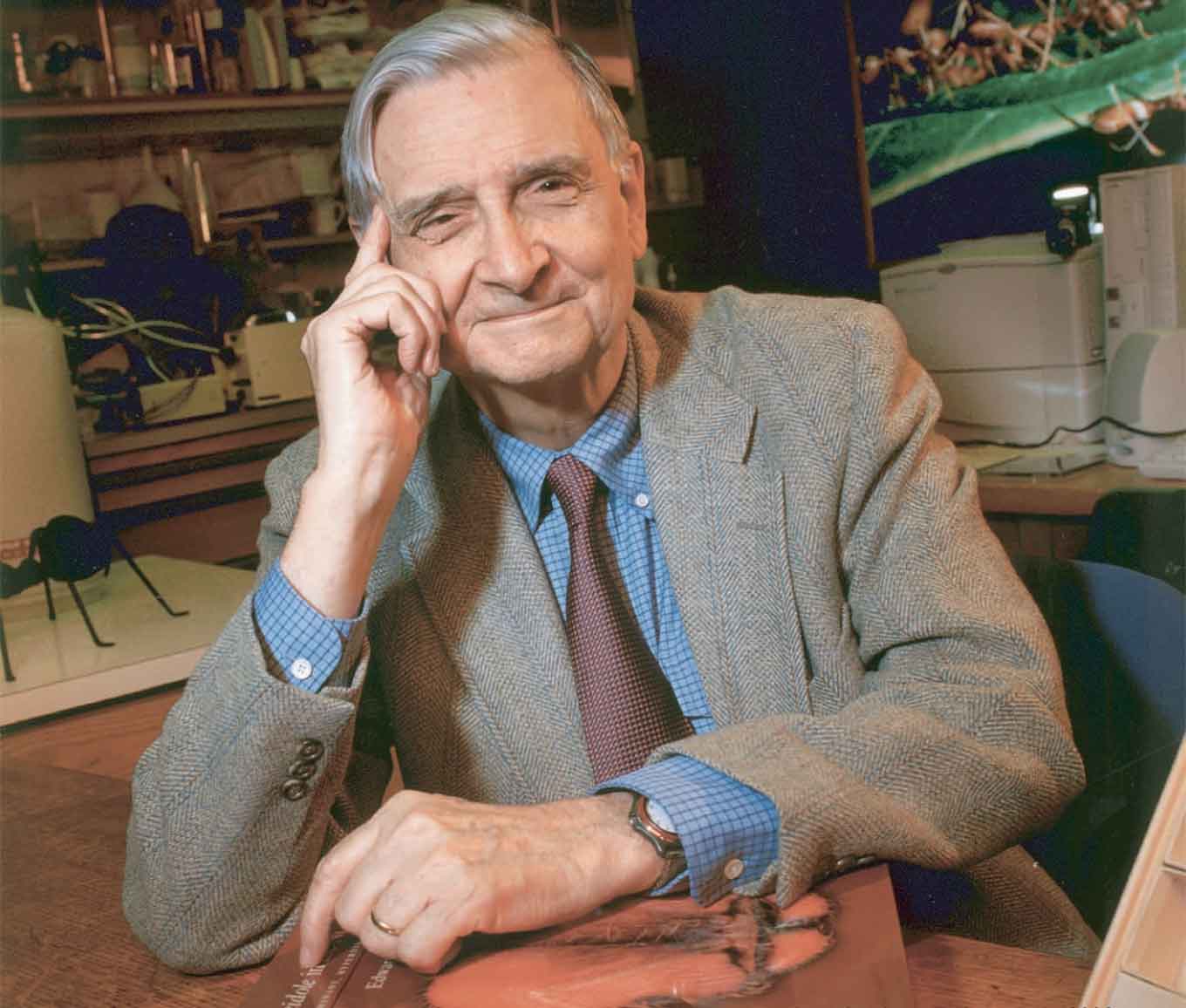
Wilson began his career studying the biology and social structures of ants.
That research led him to develop the concept of sociobiology, which explains social behavior in terms of evolution, and to make major contributions to island biogeography, which became foundational for understanding the effects of habitat size on the diversity of species.
His island biogeography work served as a mathematical basis to forecast species loss resulting from habitat destruction, providing a way to quantify the sixth great extinction currently underway.
But while Wilson’s research was highly influential in scientific circles and won numerous recognitions, he was most widely known for his accessible writing, including articles and best-selling books which introduced concepts like biodiversity to the masses.
He won Pulitzer Prizes for On Human Nature (1978) and The Ants (1990), and received popular acclaim for works like The Diversity of Life (1992), Naturalist (1994), Consilience: The Unity of Knowledge (1998), The Future of Life (2002), The Creation: An Appeal to Save Life on Earth (2006), The Social Conquest of Earth (2012), Letters to a Young Scientist (2014), The Meaning of Human Existence (2014), and Half-Earth: Our Planet’s Fight for Life (2016).

“It would be hard to understate Ed’s scientific achievements, but his impact extends to every facet of society. He was a true visionary with a unique ability to inspire and galvanize,” said David J. Prend, Chairman of the Board of the E.O. Wilson Biodiversity Foundation, in a statement.
“He articulated, perhaps better than anyone, what it means to be human. His infectious curiosity and creativity have shaped the lives of so many, myself included, and I feel lucky to have called him a friend.”
Wilson was also an outspoken advocate for the planet’s non-human inhabitants.
He was a driving force in establishing the Encyclopedia of Life, which aimed to catalog the world’s species, and established an initiative to protect half of Earth’s surface for conservation.
He served as an advisor to presidents, international institutions, and leading figures on how to preserve the planet.
Wilson is survived by his daughter, Catherine, and her husband John. He was preceded in death by his wife Irene K. Wilson.
This article was originally published by Mongabay — and was republished with permission
Related: Read E.O. Wilson's most important quotes about nature and life.
This week, after the loss of E.O. Wilson, we're looking back on some of the most prolific quotes from his work as a biologist — and his musings about life.
Quotes from E. O. Wilson about earth, humans, and making the world a better place:
1. “You are capable of more than you know. Choose a goal that seems right for you and strive to be the best, however hard the path. Aim high. Behave honorably. Prepare to be alone at times, and to endure failure. Persist! The world needs all you can give.” — E.O. Wilson
2. “If all mankind were to disappear, the world would regenerate back to the rich state of equilibrium that existed ten thousand years ago. If insects were to vanish, the environment would collapse into chaos.” — E.O. Wilson
3. “Destroying rainforest for economic gain is like burning a Renaissance painting to cook a meal.” — E.O. Wilson
4. “Nature holds the key to our aesthetic, intellectual, cognitive and even spiritual satisfaction.” — E.O. Wilson
5. “Science and religion are the two most powerful forces in the world. Having them at odds... is not productive.” — E.O. Wilson
6. “Without a trace of irony I can say I have been blessed with brilliant enemies. I owe them a great debt, because they redoubled my energies and drove me in new directions.” — E.O. Wilson
7. “A very Faustian choice is upon us: whether to accept our corrosive and risky behavior as the unavoidable price of population and economic growth, or to take stock of ourselves and search for a new environmental ethic.” — E.O. Wilson
8. “Perhaps the time has come to cease calling it the 'environmentalist' view, as though it were a lobbying effort outside the mainstream of human activity, and to start calling it the real-world view.” — E.O. Wilson
9. “The education of women is the best way to save the environment.” — E.O. Wilson
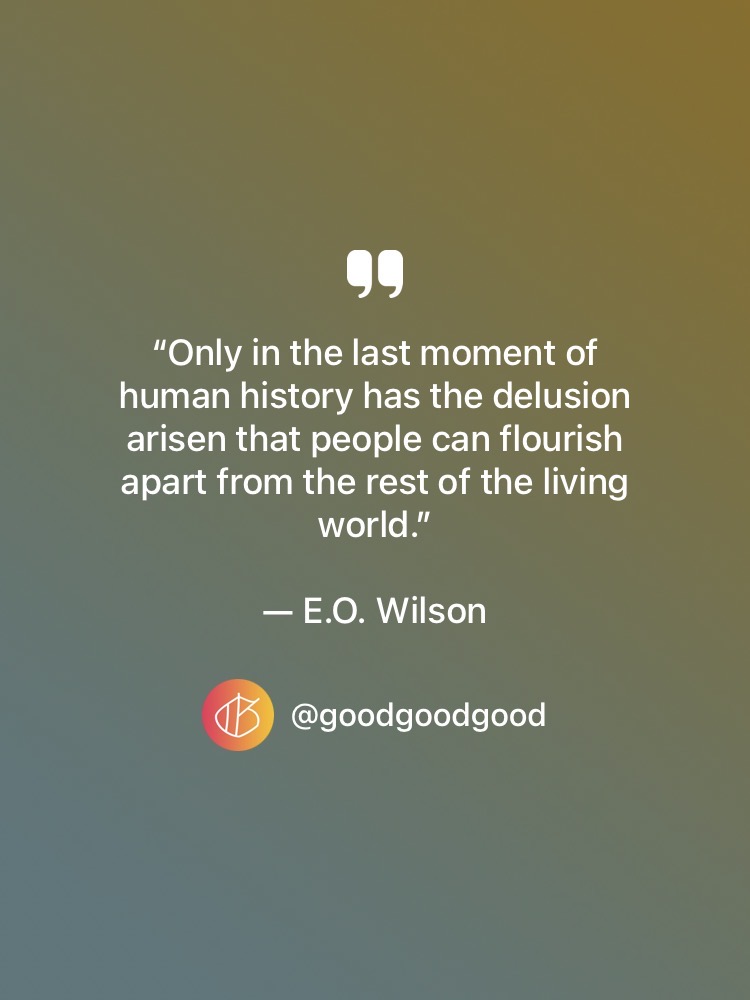
10. “Change will come slowly, across generations, because old beliefs die hard even when demonstrably false.” — E.O. Wilson
→ Read more quotes on activism
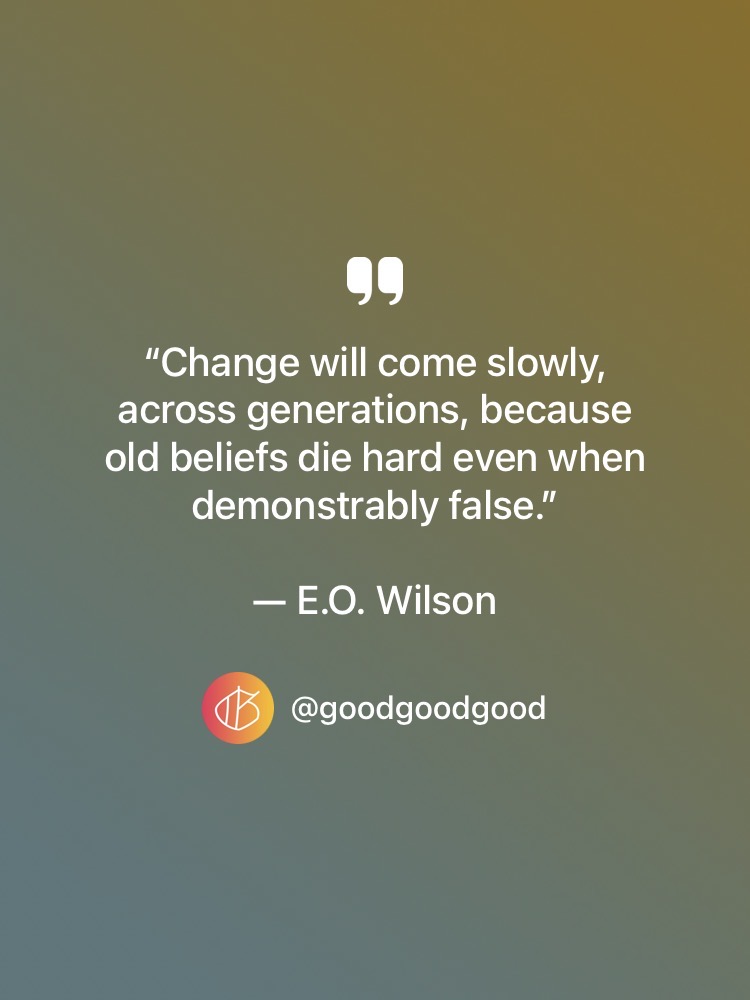
11. “Only in the last moment of human history has the delusion arisen that people can flourish apart from the rest of the living world.” — E.O. Wilson
→ Read the best quotes about hope and optimism
12. “Every kid has a bug period... I never grew out of mine.” — E.O. Wilson

→ Read more quotes about nature
→ Read more quotes about life
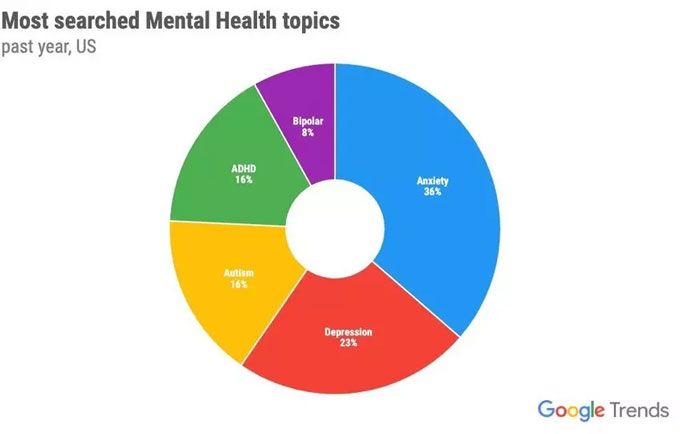
2021’s most-searched included themes of reflection, healing, and pulling together.
— Global searches for mental health reached the highest level ever.
— How to cure burnout was a breakout US search, meaning it increased at least 5,000% compared with the prior time period.
— Several mental health-related queries reached record levels.
— Climate change remained firmly on the agenda while a viral “mittens” wholesome meme almost broke the internet.

Mental health, healing and pulling together were key themes of 2021, according to the world’s most popular search engine.
Google processes billions of requests every day and its Year in Search data reveals some of the top questions, moments and individuals of 2021.
The snapshot illuminates just how the COVID-19 pandemic has infiltrated all aspects of our lives, after "coronavirus" was a top search term in 2020.
Even so, the world remains optimistic with notable searches including: “how to heal”, “how to stay strong”, “how to make a comeback”, “how to be resilient” and “how to be hopeful”.
Related: How to help someone who's thinking about suicide
Related: What actually is OCD — and how can you make a difference?
/ Image: Google Trends
Places We Wanted To Help
In 2021 people wanted to show their compassion towards two war-torn areas as “how to help Palestine” became a breakout search worldwide in May, meaning it increased at least 5,000%.
That was followed by “how to help Afghanistan” in August.
Extreme weather affected the Lone Star State in February, which caused a huge volume of searches for “how to help Texas”.
An earthquake followed by Tropical Storm Grace boosted the search term “how to help Haiti” in August.

Kindness Shines Through
People also found ways to show kindness to others locally. “Vaccination volunteer” was the top trending volunteer opportunity searched worldwide and “how to help your community” grew in popularity, as people looked for ways to offer their help to the global vaccination program.
Furthermore, the search term “when is nurses week” was at an all-time high in 2021, as people showed their appreciation for medical workers.
Mental Health & Self-Healing
The pandemic hasn’t just affected front-line social care and medical staff, but also those who lost loved ones, spent time in hospital, navigated changes in their working lives, or experienced increased unpredictability at home.
"How to maintain mental health" saw more searches this year than ever before, as well as "how to recover from burnout".
Keeping negativity at bay was crucial to many as the term “doomscrolling” became a popular search in January. Doomscrolling is spending excessive time looking at negative news, which can have a harmful effect on mental health.
Recognizing that the face of work has changed, and employee wellbeing and mental health is more critical than ever, the World Economic Forum actively supports international bodies in their efforts to bolster practices in the workplace.
The Forum’s platform aims to promote the work of organizations such as the World Health Organization and the Wellcome Trust through content that highlights best practices for mental health awareness.
Related: Avoid doomscrolling by choosing 'hopescrolling' — or even better, subscribe to the Goodnewspaper and avoid scrolling altogether
Better Lifestyles
The year's biggest search terms not only reveal the effect that COVID-19 has had on our mental health, but also the ripples of change it has sent throughout our lives.
An abrupt shift to people working from home caused city dwellers to start packing up and moving out to fulfill their dreams of rural life in 2020, according to data from Rightmove.
This trend continued into 2021 with the search terms “how to move with kids”, “how to move with pets” and “how to move with plants” reaching record numbers worldwide.
The quest to find the right work-life balance has also caused many people to leave their jobs.
The phenomenon called “The Great Resignation” may prompt companies to re-evaluate how to retain talent, however, the working world has other ideas as the term “how to start a business” saw more searches than “how to get a job” in 2021.
Related: How to support Black-owned small businesses
Related: More women are starting businesses than ever before
Climate Change
The world searched “impact of climate change” more than ever before, along with questions in the UK like “is climate change caused by humans?” and “how does eating less meat help climate change?”
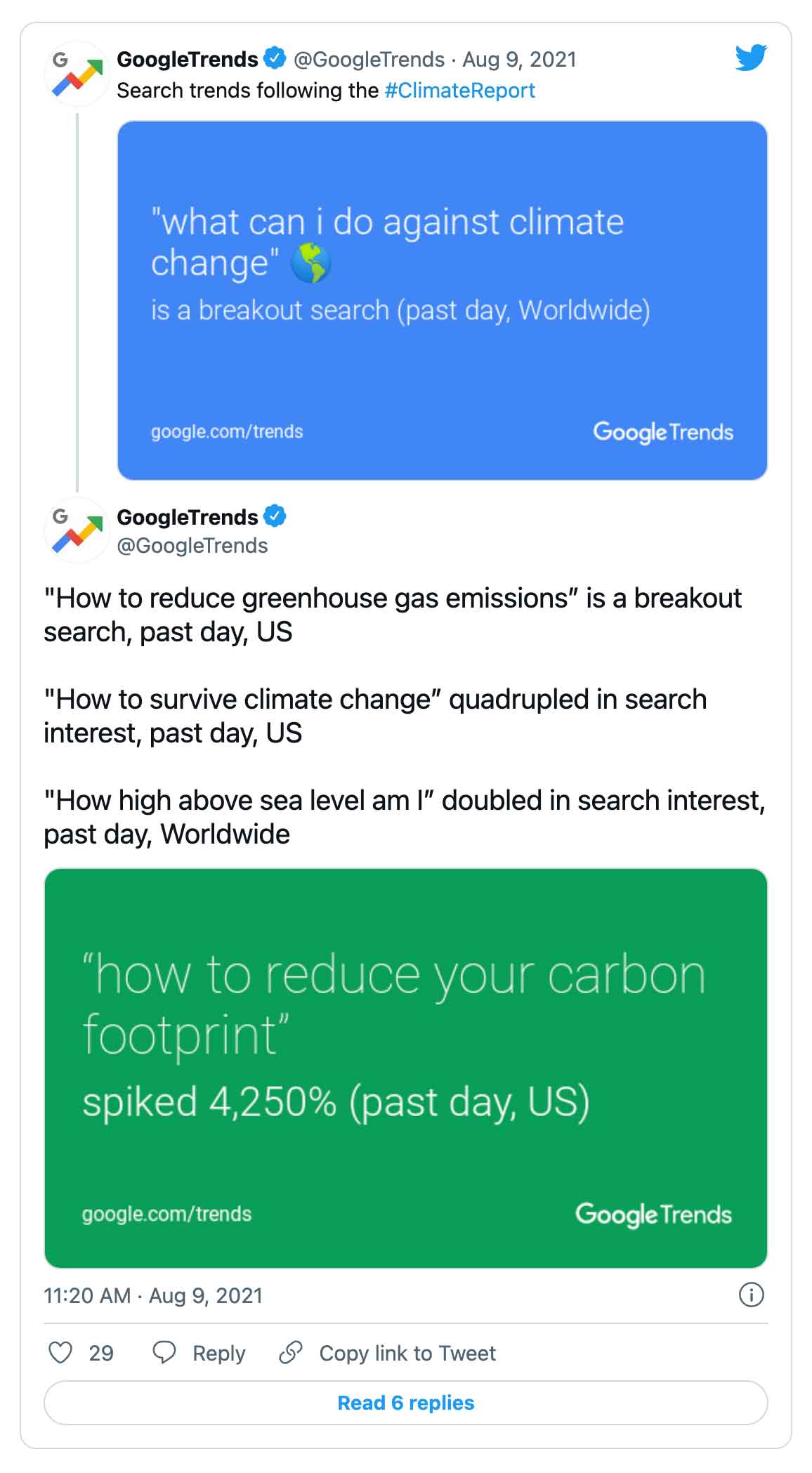
Related: How to demand better climate change coverage from the media
Related: The best good news about climate change from 2021
LGBTQ Positivity
After voting to legalize same-sex marriage in September, Switzerland showed the most interest in the topic worldwide this year.
Worldwide searches for the term “pride events near me” also increased by more than 5000% in 2021.
Related: We asked LGBTQ+ leaders what questions they wish more people understood
Related: 12 LGBTQ+ good news stories from 2021
Light-Hearted Moments
And there were light-hearted moments as well.
Searches for “mittens” reached a global high in January after Senator Bernie Sanders was photographed wearing the knitted gloves at the U.S. 2021 presidential inauguration.
This article was originally published by World Economic Forum.
Stigma toward people with depression has dropped significantly for the first time since national data have been tracked in the United States, a new study shows.
Stigma levels for other mental illnesses, however, have remained stagnant and, in some cases, have increased.
The findings can help shape treatment of those with mental illness and have an impact on anti-stigma programs and policies to help people find support, the researchers say.
“Stigma is broad and pervasive and, up till now, has been notoriously stubborn to change efforts,” says coauthor Bernice Pescosolido, professor of sociology at the Indiana University-Bloomington.
“Stigma translates into so many issues, including people’s reluctance to seek care, our shortage of mental health professionals, and the US’ unwillingness to invest resources into the mental health sector. The good news from this study is stigma can change, and the change we document crosses all sectors of society and individuals.”

For the study in JAMA Network Open, researchers examined how stigma has changed over two decades for mental health disorders such as schizophrenia, major depression, and alcohol dependence.
Researchers used data from the US National Stigma Studies, which are part of the General Social Survey, to examine public stigma over a 22-year period at three key points: in 1996, 2006, and 2018.
The team looked at how the public understands the causes underlying individuals’ problems; whether they can identify psychiatric cases from daily problems; their perceptions of what people with different mental illness are like; and their willingness to interact with individuals with mental illnesses in various social contexts.
The findings show that from 1996 to 2006, Americans reported increasing beliefs that mental health problems are caused by genetics or disruptions in the brain, rather than moral causes including having a bad character or bad upbringing.
While these findings reflected a greater belief in scientific causes, they were not accompanied by any decrease in the public rejection of those with mental illness.
However, data from 2006 to 2018 revealed a statistically significant drop in social rejection for people described as having major depression.
Across a number of social contexts, including the workplace, the family, and the neighborhood, fewer Americans in the 2018 study compared to the 2006 study expressed an unwillingness to interact with the people described as having major depression.
Other disorders did not see a reduction in the public’s desire to distance themselves socially, however.
In fact, public perceptions attributing dangerousness to schizophrenia and lack of morality to alcohol dependence increased.
“It is encouraging to find more progressive attitudes toward mental illness among millennials and to see public stigma around depression significantly decreasing, especially as rates of depression continue to rise in the US among young people,” says coauthor Brea Perry, a professor of sociology.
“However, the increasing stigmatization of schizophrenia and alcohol dependency is concerning. Taken as a whole, our findings support rethinking stigma and retooling stigma reduction strategies to improve public attitudes surrounding mental illness. There is a lot of work left to be done.”
When it comes to stigma, the study finds few differences across subgroups like gender, education, or income.
The authors documented the well-known conservatizing effect of age, i.e., the increased likelihood of holding more stigmatizing attitudes/conservative values as one gets older, and indications that some birth cohorts, including the “greatest generation” and millennials, hold less stigmatizing attitudes and beliefs.
The researchers speculate that different experiences of these groups early in life may be at work.
The researchers recommend several ways to address the importance of mental health, including leveraging the educational system to introduce level-appropriate information on mental health, providing teachers with high-quality materials for health-related courses, and helping philanthropic groups develop interesting and relevant programs.
Additional coauthors are from Penn State and Indiana University.
Source: Indiana University / This piece was originally published by Futurity.
Poet Amanda Gorman captivated the world when she recited her hope-centric poem, The Hill We Climb, at Joe Biden’s presidential inauguration.
On that day she became the youngest inaugural poet in U.S. history — at the age of 22.
She has since gone on to publish several books of poetry, made the cover of Vogue and TIME, and co-hosted the Met Gala. She has long said that she intends to run for president in 2036.
Amanda describes herself as “a wordsmith and a change-maker”. And her poetry speaks to important issues like racism, climate change, feminism, marginalization, and social justice. And throughout her poems are themes of taking action, maintaining hope, and creating the future we wish to inhabit.
She describes what poetry means to her in these two quotes:
“Poetry is the lens we use to interrogate the history we stand on and the future we stand for.”
— Amanda Gorman
“I have to interweave my poetry with purpose. For me, that purpose is to help people, and to shed a light on issues that have far too long been in the darkness.”
—Amanda Gorman
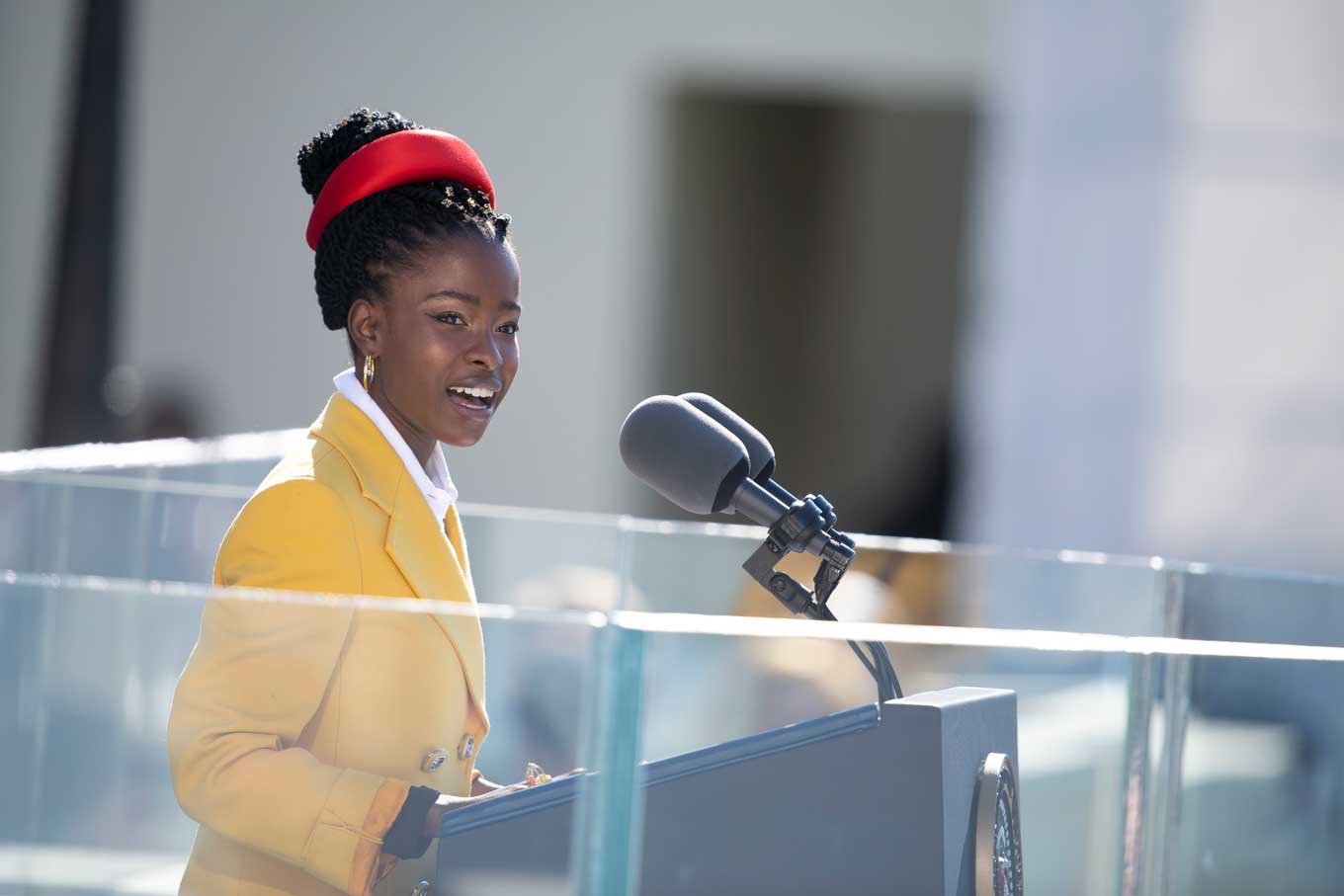
We rounded up Amanda Gorman’s best quotes about Light, Hope, Change, Activism, and more:
On Light
“There is always light. If only we’re brave enough to see it. If only we’re brave enough to be it.”
— Amanda Gorman, inauguration poem, The Hill We Climb
“When day comes, we ask ourselves:
Where can we find light
In this never-ending shade?
The loss we carry, a sea we must wade.
We braved the belly of the beast,
We’ve learned that quiet isn’t always peace,
And the norms and notions of what ‘just is’
Isn’t always justice.
And yet the dawn is ours before we knew it,
Somehow, we do it.
Somehow, we’ve weathered and witnessed
A nation that isn’t broken, but simply unfinished.
We, the successors of a country and a time
where a skinny Black girl, descended from slaves
and raised by a single mother,
can dream of becoming president
only to find herself reciting for one.”
― Amanda Gorman, Call Us What We Carry
“All of us bring light to exciting solutions never tried before
For it is our hope that implores us, at our uncompromising core,
To keep rising up for an earth more than worth fighting for.”
— Amanda Gorman, Earthrise
→ Read the best quotes about light and quotes about light in the darkness
On Hope
“We lay down our arms
so we can reach out our arms
to one another
We seek harm to none and harmony for all
Let the globe, if nothing else, say this is true:
That even as we grieved, we grew
That even as we hurt, we hoped
That even as we tired, we tried”
― Amanda Gorman, Call Us What We Carry

“For it’s our grief that gives us our gratitude,
Shows us how to find hope, if we ever lose it.
So ensure that this ache wasn’t endured in vain:
Do not ignore the pain. Give it purpose. Use it.”
— Amanda Gorman

“We do not hope for no reason.
Hope is the reason for itself.”
― Amanda Gorman, Call Us What We Carry
“The great responsibility I feel is to get people to put that power and that hope in themselves.”
— Amanda Gorman, to TIME

→ Read the best quotes about hope
→ Read the best quotes about optimism
On Change
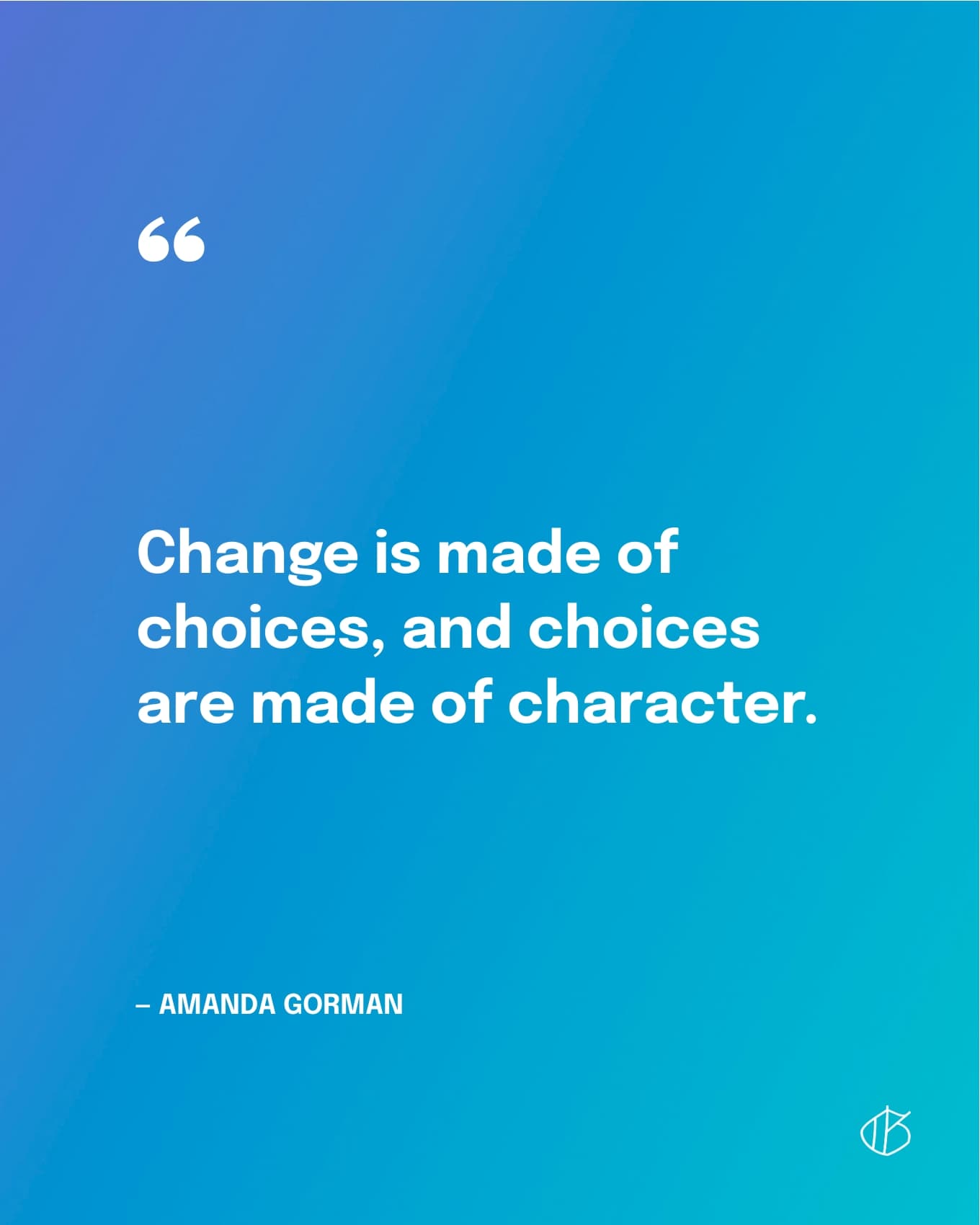
“Change is made of choices,
and choices are made of character.”
— Amanda Gorman, Call Us What We Carry
“I can hear change humming
In its loudest, proudest song.
I don’t fear change coming,
And so I sing along.”
— Amanda Gorman, Change Sings: A Children’s Anthem
“Hear me as a woman
Have me as your sister
On purpled battlefield breaking day,
So I might say our victory is just beginning,
See me as change,
Say I am movement,
That I am the year
And I am the era
Of the women.”
— Amanda Gorman, Won’t You Be My Sister
“You don’t have to be a poet, you don’t have to be a politician or be in the White House to make an impact with your words. We all have this capacity to find solutions for the future.”
— Amanda Gorman
“I think when [children] view themselves represented in stories as agents of hope and light and change, that’s one of the greatest ways we can empower the next generation to take charge.”
— Amanda Gorman, in a 2023 interview
On Activism
“That is the promised glade,
The hill we climb, if only we dare it:
Because being American is more than a pride we inherit —
It’s the past we step into, and how we repair it.”
― Amanda Gorman, The Hill We Climb: An Inaugural Poem for the Country
“We are the good news that we have been looking for,
Demonstrating that every dusk holds a dawn disguised within it.
Today we don’t burst into a new world.
We begin it.”
— Amanda Gorman, in the Some Good News Graduation episode
“The only way to correctly predict
The future is to pave it,
Is to brave it.”
― Amanda Gorman, Call Us What We Carry
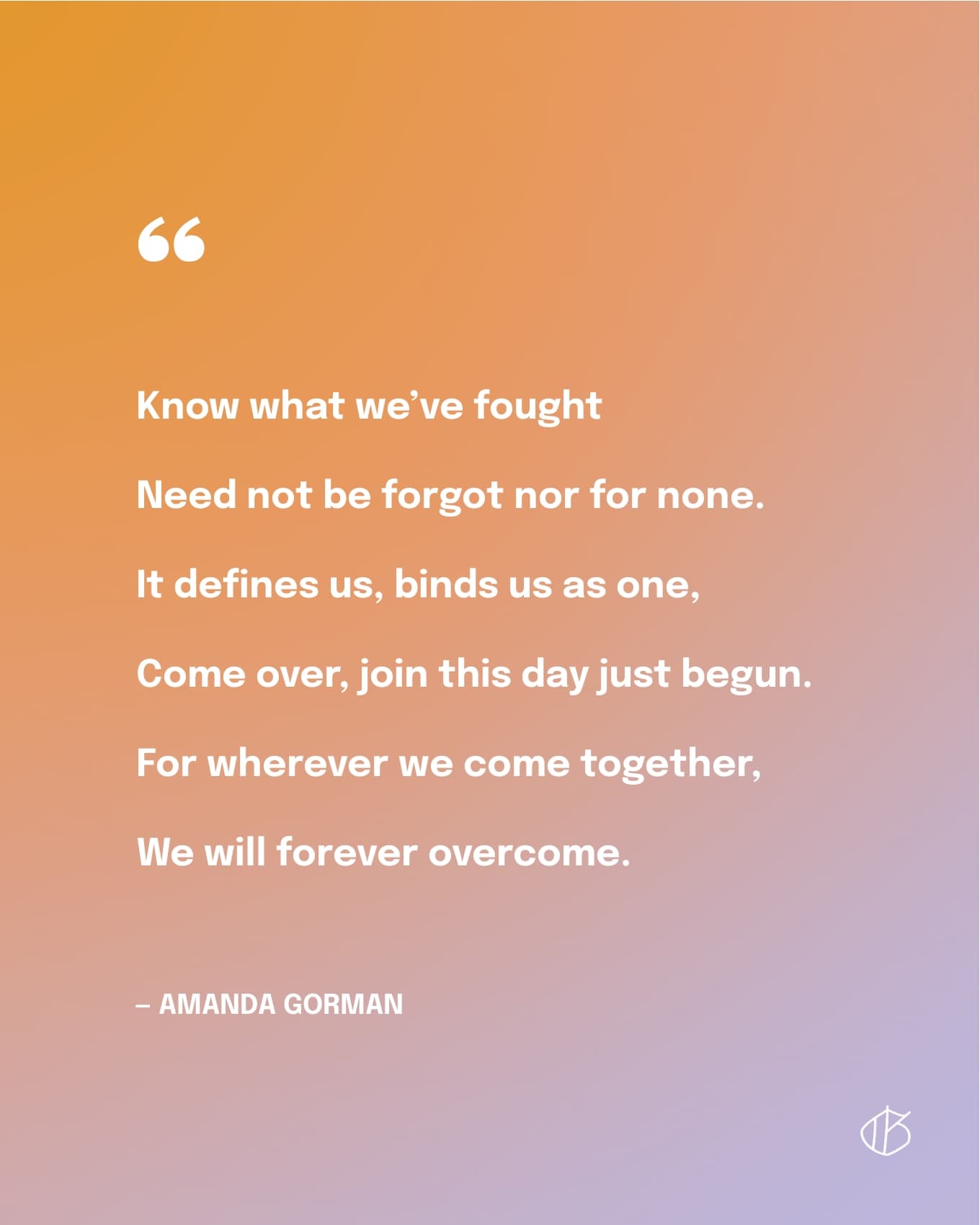
“Know what we’ve fought
Need not be forgot nor for none.
It defines us, binds us as one,
Come over, join this day just begun.
For wherever we come together,
We will forever overcome.”
— Amanda Gorman, New Day’s Lyric
“For while we have our eyes on the future, history has its eyes on us”
— Amanda Gorman
→ Read the best quotes about good news
“Maybe everything hurts,
Our hearts shadowed & strange.
But only when everything hurts
May everything change.”
— Amanda Gorman, Hymn for the Hurting
“May we not just grieve, but give. May we not just ache, but act.”
— Amanda Gorman, Hymn for the Hurting
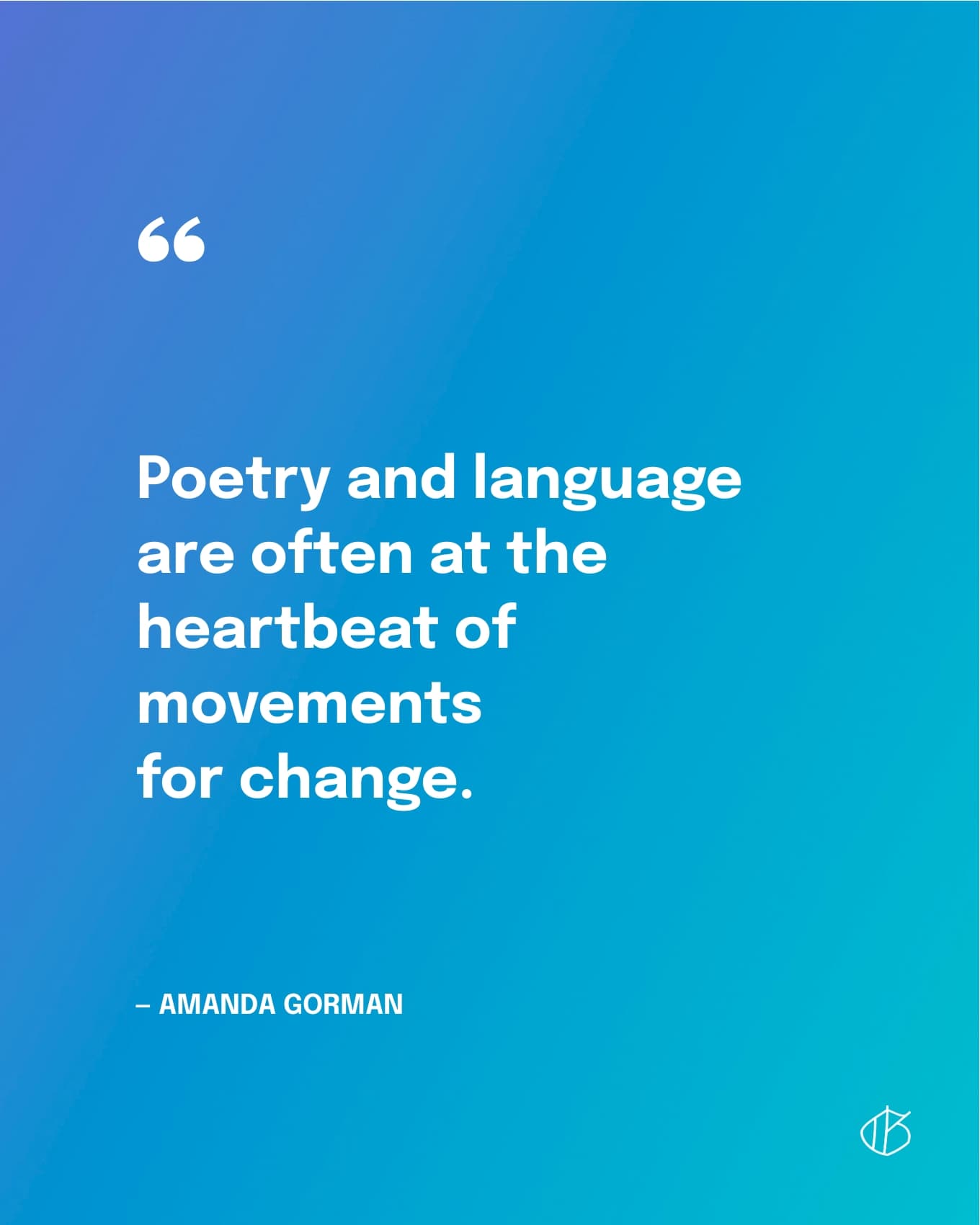
“Poetry and language are often at the heartbeat of movements for change.”
— Amanda Gorman
→ Read more quotes on activism
On Peace
“There is no such thing as gentle war.
There is no peace
That can’t be flung aside.
Our only enemy is that which would
Make us enemies to each other.”
— Amanda Gorman
“The single greatest challenge of our era is to transform without wrath, war, or wariness.”
— Amanda Gorman
“Would we crave peace
If we knew what it was”
— Amanda Gorman
“We lift our gazes not
To what stands between us,
But what stands before us.
We close the divide,
Because we know to put
Our future first, we must first
Put our differences aside.”
— Amanda Gorman, on October 11, 2023
“We lay down our arms
So that we can reach our arms
Out to one another.
We seek harm to none, and harmony for all…
Victorious, not because we will never again know defeat,
But because we will never again sow division.”
— Amanda Gorman, on October 11, 2023
→ Read the best quotes about peace
More Quotes from Poet Amanda Gorman
“While we might feel small, separate, and all alone, our people have never been more tightly tethered.
The question’s not if we will weather this unknown, but how we will weather the unknown together.”
— Amanda Gorman, The Miracle of Morning, Call Us What We Carry
“I think sometimes our terror is a great kind of flag to symbolize a type of love or greatness. The fact that I was so afraid, that I knew there was a reason that I was tapping into every well of courage that I had to show up into that space. Because the space needed to be revisited; that space needed to be revamped and it needed to be reconciled with. And I thought one of the few and also most fervent ways we have to do that is with poems.”
— Amanda Gorman, in conversation with Clint Smith for The Atlantic, about the experience of delivering a poem at the Capitol just weeks after the violent uprising
“The type of leadership that I like to participate in really leans into my femininity. Things like empathy, compassion, listening, tenderness, sharing power — you risk being called ‘too emotional,’ but I like to lean into those characteristics because we need to see more of that in the world.”
— Amanda Gorman, to TIME
“It’s said that ignorance is bliss.
Ignorance is this: a vine that
sneaks up a tree, killing not by
poison, but by blocking out its
light.”
― Amanda Gorman, Call Us What We Carry
“We were told to never use I when writing, because eliminating this voice makes arguments legitimate. But we realize there is nothing that convinces like the self does — our life, our body & its beating, proving its own jagged point. Tell me what is more powerful than the unerased.”
— Amanda Gorman, Call Us What We Carry
“We have so much to learn from children that we don’t always give them credit for. Obviously, we want to protect them, we want to safeguard them, but at the same time, we want to be listening. Because when we give them a mic, it’s magic.”
— Amanda Gorman, in a 2023 interview
“To love one another just may be the fight of our lives.”
— Amanda Gorman
→ Read the best quotes and poems from Maya Angelou
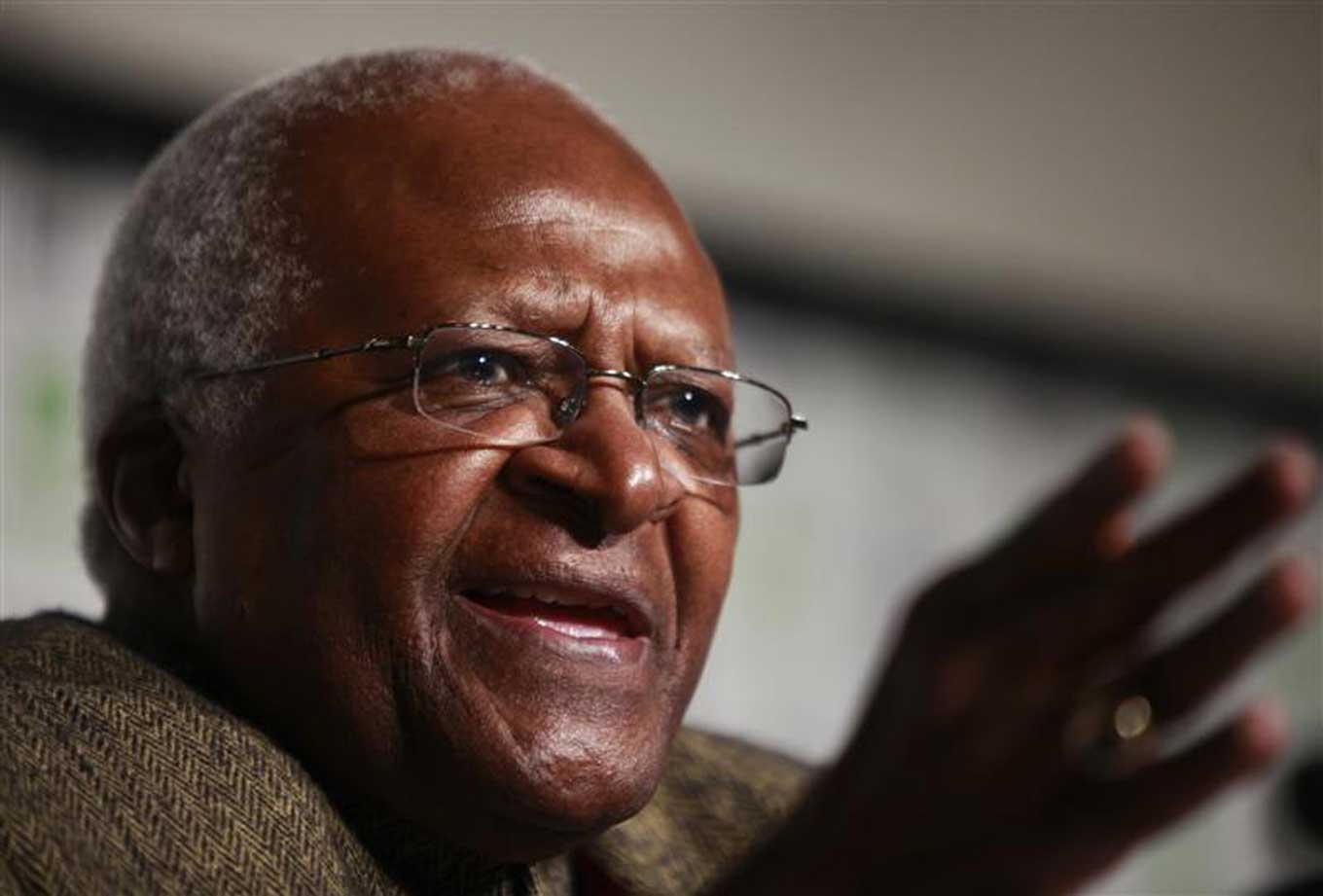
Following the death of South African anti-apartheid and peace icon Archbishop Desmond Tutu, here are some of the ways he also advocated for a healthy planet:
DURBAN, December 30th, 2021 — Following the death of South African anti-apartheid and peace activist Archbishop Desmond Tutu aged 90 last Sunday, world leaders have praised his life-long advocacy on social justice issues from inequality, racism, and homophobia to climate change.
The Nobel Peace Prize laureate became an environmental icon as the effects of global warming became more apparent, using his influence to hold governments and the fossil fuel industry to account while giving African youth climate activists a voice.
Ahead of Tutu's funeral on Saturday, here are some of the ways he put a spotlight on the climate emergency:
Boycotts
Anti-apartheid activists were able to bring down white minority rule by calling for boycotts and sanctions against South Africa's racist regime — a tactic Tutu often said should be deployed to cut the use of planet-heating fossil fuels.
In articles, interviews, and speeches, Tutu encouraged consumers to steer clear of media, sports teams, and events sponsored by fossil-fuel firms and to buy low-carbon products.
He also called for universities, municipalities, foundations, corporations, and cultural institutions to cut ties with big oil companies and to invest in clean energy.
Petitions
In 2015, Tutu used his profile to gather nearly 333,500 signatures for a petition calling on then U.S. President Barack Obama, former U.N. Secretary-General Ban Ki-moon, and other leaders to set a target of 100% renewable energy by 2050.
In the petition, Tutu called climate change one of the "greatest moral challenges of our time".
The effort was part of an international campaign by religious leaders to pressure politicians to deliver ambitious climate action ahead of the 2015 U.N. summit where about 195 countries adopted the Paris Agreement to curb global warming.
Tutu's work also inspired University of Cape Town students to launch their own petition, asking the university to divest from fossil fuels and invest in sustainable energy.
Since the petition handover in 2016 and further years of campaigning, this August the university's responsible investment panel recommended full divestment from fossil fuels by 2030.
The Elders
Tutu was the first chair of The Elders — a global group of senior human rights activists and political leaders advocating for peace — and used this platform to push publicly for urgent measures to tackle climate change.
Under Tutu's guidance, The Elders lobbied world leaders to keep alive a path to the lowest 1.5-degree Celsius limit on global warming in the Paris pact, through conferences, blogs written by youth climate activists, and other advocacy campaigns.
Peace Lecture
As part of the Desmond and Leah Tutu Legacy Foundation — established to promote human rights research and leadership training — an annual Peace Lecture held on Tutu's birthday has brought together various human rights experts over the years.
For the 10th edition in 2020, Ugandan youth activist Vanessa Nakate, among others, was invited to talk about climate justice, highlighting the unfair impacts of a warming planet and how African women and children face both poverty and climate shocks.
Nakate, who has worked to promote youth climate protests alongside Swedish teen Greta Thunberg, has gained international attention for using platforms, such as the Peace Lecture and U.N. climate talks, to spotlight the issues affecting Africa.
South African youth climate activist Ayakha Melithafa was also invited to speak at the Tutu foundation lecture, with other voices from the continent and high-level political figures.
Prayers
As during the apartheid era, Tutu used his position as a religious leader to push inter-faith interventions such as petitions, marches and prayers to end human rights abuses, support marginalized groups, and tackle climate change.
His 2015 Paris petition was part of the "Faiths for Earth" initiative which brought together religious leaders from across the world to pressure governments for stronger climate action.
Tutu also shared an online prayer for the planet ahead of a key climate leaders' summit at the United Nations in 2014.
"We pray for our leaders, custodians of Mother Earth ... may they negotiate with wisdom and fairness ... and lead us in the path of justice for the sake of our children and our children's children," Tutu wrote in the prayer.
Earth Hour
Tutu was also a supporter of the Earth Hour movement, led by global green group WWF, which unites businesses, communities and individuals in turning off electric lights for one hour at the same time each year to save energy and raise awareness.
An event that started in 2007 in Sydney has now become an international campaign involving millions of participants.
"If we all perform this one simple act together, it will send a message to our governments too powerful for them to ignore," said Tutu in a statement.
"They will know the eyes of the world are watching," he added.
Related stories:
13 Best Desmond Tutu Quotes About Hope, Activism, & Optimism
The World Is Celebrating the Life of Archbishop Desmond Tutu
What Is Intersectional Environmentalism?
What Are the Types of Activism?
Reporting by Kim Harrisberg; Editing by Megan Rowling. This article was originally published by the Thomson Reuters Foundation, the charitable arm of Thomson Reuters, that covers the lives of people around the world who struggle to live freely or fairly. Visit news.trust.org.
K-pop fans are a force for good to be reckoned with.
Korean pop fans have always used their voice for good. In recent years, K-pop fans have stood against the rise of authoritarian empires across the world.
They’ve organized anti-authoritarian strikes in Myanmar, purchased tickets to harmful and divisive political rallies to increase the number of no-shows, and raised $1 million for Black Lives Matter support groups.
K-pop fans stand together as a force to be reckoned with — their passion for their idols (what fans call the members of K-pop groups) is just as strong as their desire to protect marginalized communities, and they won’t back down.
The creation of K-pop itself has a political background. According to Sam Nakahira, a Japanese-American illustrator and cartoonist, the occupation of Korea by U.S. armed forces in the mid-20th century caused a Western influence on Korean music.
Nakahira told NPR that “because of the military presence, a lot of the military men kind of wanted to listen to American and Western songs. So a lot of Korean music artists and bands would perform at military bases,” he said.
“And they would often perform, like, Western kind of pop-influenced songs. So there was kind of like westernization coming in through the music industry,” which continues to influence the lyricism and production of Korean music today. Korean entertainment is rooted in politics and history, which is not lost on its fans.
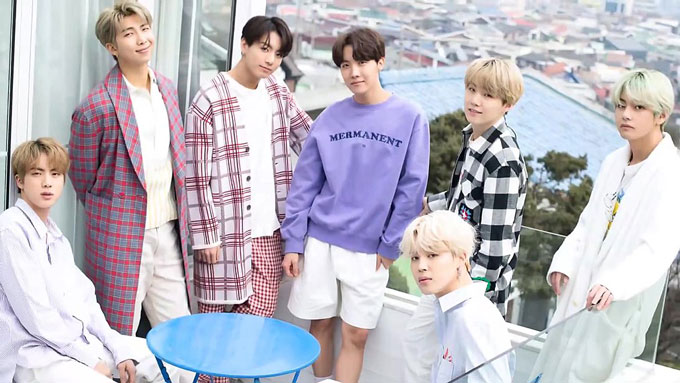
The roots of K-pop fan activism can be seen as early as 2013, when The Korea Herald reported that fans were initiating their own fundraisers to donate money, rice, trees, and wreaths to different charities. These selfless actions were made in the name of fans’ favorite K-pop idols; but what people were really seeing was a desire to help one another.
And that desire has lasted for almost a decade now — in October of this year, K-pop fans organized an anti-authoritarian campaign in Myanmar through the same social media accounts they use to support their idols.
For example, these digital organizers helped Myanmar citizens access free internet services by creating a Facebook account.
Since free speech in Myanmar is stifled and censored, fans introduced the Free Basics in Myanmar initiative. The initiative allowed citizens whose voices were silenced by their government to share their stories and hear from other fans around the world.
For other governments, fans organized similar campaigns and efforts to help its residents.
Earlier this year, during the reign of the Trump administration, fans purchased thousands of tickets to President Trump’s campaign rally in Tulsa, Oklahoma.
The intention behind the idea was to purchase tickets without showing up, leaving speakers with an empty arena. According to The New York Times, the venue, which seats 19,000 people, only had 6,200 attendees that night.
The efforts of K-pop fans have not gone unnoticed by politicians, either. In a quote tweet by Congresswoman Alexandria Ocasio-Cortez, she told off Trump administration advisor Brad Parscale, who shamed fans for their efforts.
“Actually you just got ROCKED by teens on TikTok who flooded the Trump campaign w/ fake ticket reservations & tricked you into believing a million people wanted your white supremacist open mic enough to pack an arena during COVID,” she wrote.
In 2020, K-pop fans in Peru used their networks and platforms to support protesters and push back against propaganda.
K-pop fans’ biggest effort, however, was made in June 2020. Following the murder of George Floyd and its subsequent discourse on police brutality, systematic racism, and the value of Black lives, fans donated and raised $1 million alongside K-pop group BTS.
The money fundraised by these fans, also known as ARMY, was then split evenly between a variety of organizations supporting and advocating for Black lives.
In a statement from the collection of K-Pop fans who fundraised for Black Lives Matter organizations, they explained to BTS fans that they “encourage ARMY to continue educating themselves on the history of anti-black racism in the United States as well as anti-black racism that occurs in your own country.”
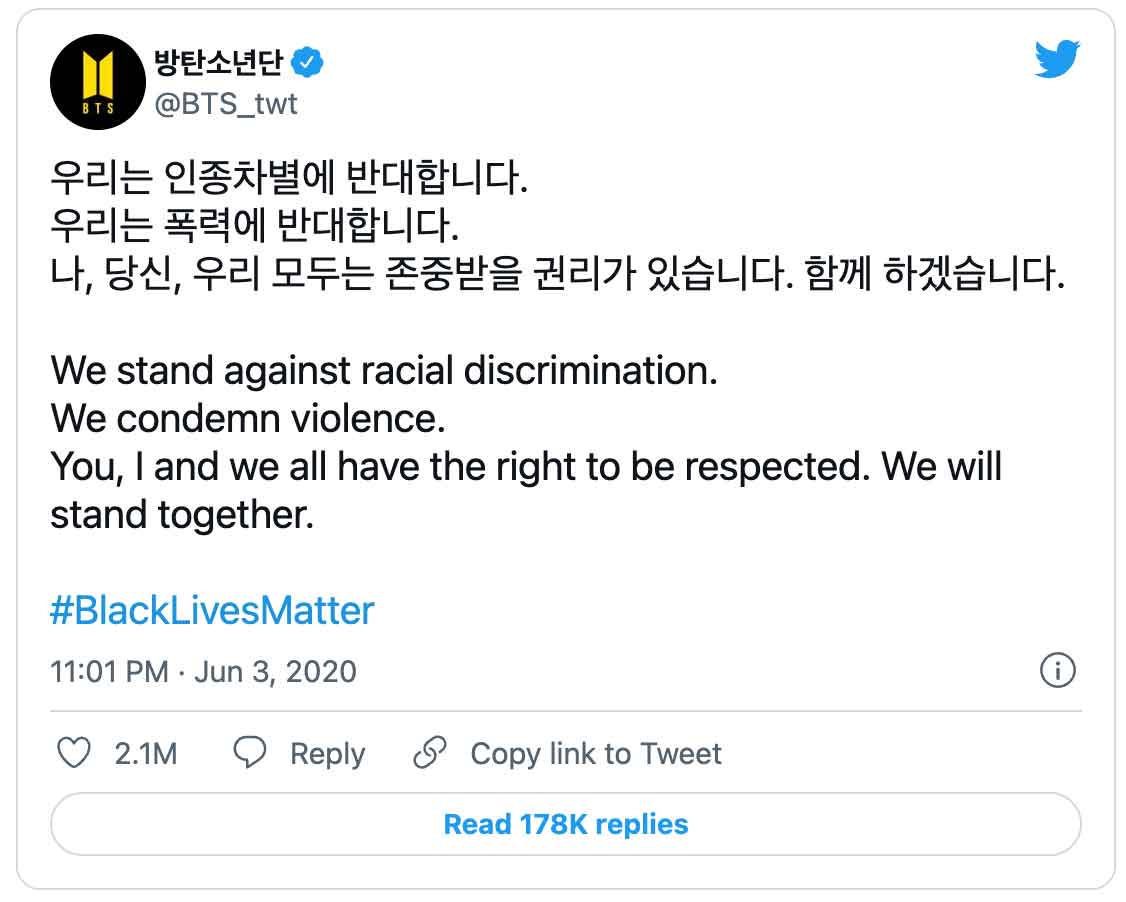
A few days earlier, BTS released their own statement which translated to “We stand against racial discrimination. We condemn violence. You, I and we all have the right to be respected. We will stand together. #BlackLivesMatter.”
K-pop fans continue existing as a force of good — and it looks like their passion for caring for their community, as well as their favorite idols and groups, isn’t going anywhere.
At Good Good Good, we celebrate people who fight to make the world a better place. We believe each of us has the ability to find a way to make a difference — to create a better future.
Through the years, we've collected the best quotes from activists, civil rights leaders, environmentalists, pacifists, grassroots activists, political leaders, and more. And now we're sharing our (growing) list publicly.
As you read through these famous quotes from inspiring leaders, it's important to remember that none of these icons began their activism in the public eye.
Each of these leaders began by identifying a problem or injustice in the world — and deciding to do something about it.
You have the opportunity to find one way to get involved and make a difference in an issue you care about.
Whether it's fighting for racial justice, combatting climate change, standing up for animal rights, or any number of other important topics.
May these inspirational quotes — about social change, political activism, and changing the world — leave you feeling ready to stand up for good.
The most powerful quotes from activists about activism:
“Activism is my rent for living on the planet.”
— Alice Walker, American writer & social activist
“The duty of youth is to challenge corruption.”
― Kurt Cobain, American musician & LGBTQ+ rights activist
“I'm convinced of this: Good done anywhere is good done everywhere. For a change, start by speaking to people rather than walking by them like they're stones that don't matter. As long as you're breathing, it's never too late to do some good.”
— Dr. Maya Angelou, American poet & civil rights activist

“Do it! What are you waiting on? Do it! Stand up for what you believe in. The world needs your voice. Whoever you are, you have something to say. Say it.”
— Kerry Washington, American actress, director, and activist
“I've found the cure for depression is action”
— Yvon Chouinard, founder of Patagonia & climate activist

“I have a little different definition of evil than most people. When you have the opportunity and the ability to do good and you do nothing, that's evil. Evil doesn't always have to be an overt act, it can be merely the absence of good.”
— Yvon Chouinard, founder of Patagonia & climate activist
→ Read more quotes from Yvon Chouinard about sustainability and adventure
“Start where you are. Use what you have. Do what you can.”
— Arthur Ashe, American tennis athlete & civil rights activist
“We can't just hope for a brighter day, we have to work for a brighter day. Love too often gets buried in a world of hurt and fear. And we have to work to dig it out so we can share it with our family, our friends, and our neighbors.”
— Dolly Parton, singer, songwriter, and humanitarian

→ Read more Dolly Parton quotes
“Human progress is neither automatic nor inevitable... Every step toward the goal of justice requires sacrifice, suffering, and struggle; the tireless exertions and passionate concern of dedicated individuals.”
— Martin Luther King Jr., American civil rights leader
→ Read more quotes from Martin Luther King Jr.
“I am no longer accepting the things I cannot change. I am changing the things I cannot accept.”
— Angela Davis, American political activist & academic

“I think the importance of doing activist work is precisely because it allows you to give back and to consider yourself not as a single individual who may have achieved whatever, but to be a part of an ongoing historical movement.”
— Angela Davis, American political activist & academic
“Peace is the opposite of dreaming. It’s built slowly and surely through brutal compromises and tiny victories that you don’t even see. It’s a messy business, bringing peace into the world.”
— Bono, musician & co-founder of Product (RED) and ONE
→ Read more quotes from Bono
“The world is full of what seem like intractable problems. Often we let that paralyze us. Instead, let is spur you to action. There are some people in the world that we can't help, but there are so many more that we can. So when you see a mother and her children suffering in another part of the world, don't look away. Look right at them. Let them break your heart, then let your empathy and your talents help you make a difference in the lives of others. Whether you volunteer every week or just a few times a year, your time and unique skills are invaluable.”
— Melinda Gates, American philanthropist & co-founder of the Bill & Melinda Gates Foundation
→ Read more quotes about good news
“No one has a right to sit down and feel hopeless. There is too much work to do.”
— Dorothy Day, Catholic social activist & journalist

“Those who say it can’t be done are usually interrupted by others doing it.”
— James Baldwin, American writer & social activist
“When you see something that is not just, not fair, or not right, you have to do something. You have to say something. Make a little noise. It's time for us to get into good trouble, necessary trouble.”
— John Lewis, leader within American civil rights movements & former congressman
→ Read more quotes about justice
“Pick up the battle and make it a better world. Just where you are.”
— Dr. Maya Angelou, American poet & civil rights activist
“We live in a world in which we need to share responsibility. It's easy to say 'It's not my child, not my community, not my world, not my problem.' Then there are those who see the need and respond. I consider those people my heroes.”
— Fred Rogers, host of the educational television series Mister Rogers' Neighborhood

“All of us, at some time or other, need help. Whether we're giving or receiving help, each one of us has something valuable to bring to this world. That's one of the things that connects us as neighbors — in our own way, each one of us is a giver and a receiver.”
— Fred Rogers, host of educational television series Mister Rogers' Neighborhood
→ Read more Mister Rogers quotes
“The children almost broken by the world become the adults most likely to change it.”
— Frank Warren, founder of PostSecret and mental health activist
“It isn’t enough to talk about peace. One must believe in it. And it isn’t enough to believe in it. One must work at it.”
— Eleanor Roosevelt
“Do your little bit of good where you are; it is those little bits of good put together that overwhelm the world.”
— Archbishop Desmond Tutu, South African Anglican bishop & human rights and anti-apartheid activist
→ Read more Desmond Tutu quotes
“A joyful rebellion is you living differently not because you’re mad at how things are but because you are swelling with joy at the thought of how things could be.”
— Kid President
“We all are Citizens of the World. What’s good for you, must be good for all. If you are lost, share a plate of food with a stranger... you will find who you are.”
— Chef José Andrés
→ Read more quotes from José Andrés
“Let future generations say we were the ones who stood up. Let them say we were the first to live in a world where all girls can learn and lead without fear.”
— Malala Yousafzai, Pakistani activist for women's education & Nobel Peace Prize laureate
→ Read more quotes from Malala
“As activists trying to dismantle the system and fight against structural inequities, we need to take care of our own health — emotionally, mentally, physically, and spiritually — in order to sustain ourselves and our movements.”
— Gloria Walton, CEO of The Solutions Project
“I cannot prevent anyone from getting angry, or mad, or frustrated. I can only hope that they’ll turn that anger and frustration and madness into something positive”
— Harvey Milk, first openly gay elected official in California
→ Read more Harvey Milk quotes
“Action is the antidote to despair.”
— Joan Baez, American singer-songwriter & activist

“Fight for the things that you care about, but do it in a way that will lead others to join you.”
— Ruth Bader Ginsburg, Former Associate Justice of the Supreme Court of the United States & co-founder of the Women's Rights Project at the ACLU
→ Read more of the best RBG quotes

“Every action, no matter how small, is like drips on a rock—over time, they can carve a canyon through even the thickest, most immovable layer of rock.”
— Shannon Watts, founder of Moms Demand Action
“Gentleness can be a great strength, and quiet action can sometimes speak as powerfully amid the noise as the loudest voice.”
— Sarah Corbett, on craftivism: the art of gentle protest
“People are not sitting down, people are taking action. And women are at the forefront of these actions.”
— Joan Carling, Indigenous human rights activist and environmentalist

“If it doesn't make the world better, don't do it.”
— Brad Montague, New York Times Bestselling author & creator of Kid President
“Sometimes we are blessed with being able to choose the time, and the arena, and the manner of our revolution, but more usually we must do battle where we are standing.”
— Audre Lorde, American writer, feminist, and civil rights activist
“Power concedes nothing without a demand. It never did, and it never will.”
— Frederick Douglass
You might also like: Quotes about doing good | Quotes about making a difference | Quotes about kindness | Quotes about giving back | Quotes about caring
If you love quotes about making a difference — you'll love the Goodnewspaper, our monthly print newspaper filled with good news.
Each issue comes with a centerfold poster with a new inspiring quote. Perfect for framing or hanging on your wall.
At Good Good Good, we help you feel more hopeful and do more good.
For years — since launching our podcast, Sounds Good, and printing the first issue of the Goodnewspaper — we've been slowly collecting quotes about optimism.
There's an interesting nuance to be found in the difference between hope and optimism – and there's power in pushing back against cynicism. (Despite how easy it is to feel cynical these days.)
We wanted to share our favorite short quotes about optimism (and the difference between hope and optimism) — in the hopes they'll leave you feeling more hopeful, and empowered to use that sense of hope as fuel to help you do more good.
The best quotes about optimism:
“To be optimistic is to assume things will work out. To be hopeful is to realize things can work out if you work at them. Hope requires responsibility and agency; optimism relieves us of both. In rooting for your sports team, choose optimism. In rooting for democracy, choose hope.”
— Eric Liu
“Optimism doesn’t mean that you are blind to the reality of the situation. It means that you remain motivated to seek a solution to whatever problems arise.”
— The Dalai Lama
“I can't be a pessimist because I am alive. To be a pessimist means that you have agreed that human life is an academic matter. So, I am forced to be an optimist. I am forced to believe that we can survive, whatever we must survive.”
― James Baldwin
“Does saying “things are improving” imply that everything is fine, and we should all relax and not worry? No, not at all. Is it helpful to have to choose between bad and improving? Definitely not. It's both. It's both bad and better. Better, and bad, at the same time. That is how we must think about the current state of the world.”
— Hans Rosling, Factfulness
“There's no difference between a pessimist who says, 'It's all over, don't bother trying to do anything, forget about voting, it won't make a difference,' and an optimist who says, 'Relax, everything is going to turn out fine.' Either way the results are the same. Nothing gets done.”
— Yvon Chouinard
→ Read the best Yvon Chouinard quotes about adventure, business, and sustainability
→ Read the best quotes about activism

“I am essentially optimistic. Being alive is incredible. Life is extraordinary and beautiful. It can be hard and sad and terrifying, but it’s all we’ve got.”
— James Frey
“I choose to feel optimistic, because I don’t think I could get out of bed if I didn’t.”
— Kerry Washington
“All I ask is one thing, and I’m asking this particularly of young people: please don’t be cynical. I hate cynicism, for the record, it’s my least favorite quality and it doesn’t lead anywhere. Nobody in life gets exactly what they thought they were going to get. But if you work really hard and you’re kind, amazing things will happen.”
― Conan O'Brien
“While skepticism is healthy, cynicism, real cynicism, is toxic.”
― John Oliver
“Youthful cynicism is sad to observe, because it indicates not so much knowledge learned from bitter experiences as insufficient trust even to attempt the future.”
― Maya Angelou
“Optimism isn’t a belief that things will automatically get better; it’s a conviction that we can make things better.”
— Melinda Gates
“I am very optimistic, and I always think positive, but within reason and never getting too far ahead of the game.”
— Luis Fonsi
“Hope confronts. It does not ignore pain, agony, or injustice. It is not a saccharine optimism that refuses to see, face, or grapple with the wretchedness of reality. You can't have hope without despair, because hope is a response. Hope is the active conviction that despair will never have the last word.”
— Cory Booker

“For me, finding hope is not some philosophical exercise or sentimental notion; it is a prerequisite for my survival.”
― John Green
→ Read more John Green quotes about hope
→ Read more quotes about hope
“We need optimism to make progress — yet that alone isn’t enough. To contend with environmental crises and make life better for everyone, we need the right kind of optimists: those who recognize that the world will only improve if we fight for it.”
— Hannah Ritchie, in an article for Vox
“Optimism is a strategy for making a better future. Because unless you believe that the future can be better, it's unlikely you will step up and take responsibility for making it so. If you assume that there's no hope, you guarantee that there will be no hope.”
— Noam Chomsky

“Hope will never be silent.”
— Harvey Milk
→ Read more Harvey Milk quotes about hope
“Hope is contagious!”
— Greta Thunberg
“I’m a bubbling brew of emotions, but mostly, I’m an optimistic person.”
— Carlene Carter
“It is in collectivities that we find reservoirs of hope and optimism.”
— Angela Davis
“Being truthful about the state of our nation and world does not equal losing hope. Hope sees truth and still believes in better. That which dismisses or does not seek truth, but grins, saying "It will be okay," is naïveté, not hope.”
— Bernice King

“Understanding that this is America shouldn’t evoke hopelessness. Hope and truth are connected. Hope is not naïveté. It is bearing witness to truth, still believing in better and yielding the energy to contribute to better.”
— Bernice King
→ Read Bernice King's quotes about hope, love, and her father, Martin Luther King Jr.
“Cynicism masquerades as wisdom, but it is the farthest thing from it. Because cynics don’t learn anything. Because cynicism is a self-imposed blindness, a rejection of the world because we are afraid it will hurt us or disappoint us.”
― Stephen Colbert
“Can we overcome apathy? Yes, but only if we have hope.”
— Jane Goodall
“I do have reasons for hope: our clever brains, the resilience of nature, the indomitable human spirit, and above all, the commitment of young people when they're empowered to take action.”
— Jane Goodall

“No one has a right to sit down and feel hopeless. There is too much work to do.”
— Dorothy Day
“I always like to look on the optimistic side of life, but I am realistic enough to know that life is a complex matter.”
— Walt Disney
“No one wants to follow a pessimist… You can be skeptical, you can be realistic, but you can’t be cynical. If your boss is Eeyore, do you want to work with someone like that? Oh, bother.”
— Bob Iger
“I’m not for delusional optimism, but I’m also not for cynics either. I’m for skeptics, and I also think true optimism is true realism.”
— Matthew McConaughey
“Do not get lost in a sea of despair. Be hopeful, be optimistic. Our struggle is not the struggle of a day, a week, a month, or a year, it is the struggle of a lifetime. Never, ever be afraid to make some noise and get in good trouble, necessary trouble.”
— John Lewis
→ Read the best quotes about good news
“The positive thinker sees the invisible, feels the intangible and achieves the impossible.”
— Winston Churchill
“Hope is an embrace of the unknown and the unknowable, an alternative to the certainty of both optimists and pessimists. Optimists think it will all be fine without our involvement; pessimists adopt the opposite position; both excuse themselves from acting.”
— Rebecca Solnit, Hope in the Dark
“Pessimism: We have a problem, but we can't solve it.
Optimism: We have a problem, and we can solve it.
Responsibility: We have a problem. Can I help solve it?
Initiative: We have a problem. Here's how I'm solving it.”
— Adam Grant
“I don't believe in pessimism. If something doesn't come up the way you want, forge ahead. If you think it's going to rain, it will.”
― Clint Eastwood
“Pessimism becomes a self-fulfilling prophecy; it reproduces itself by crippling our willingness to act.”
― Howard Zinn
“The best way to not feel hopeless is to get up and do something. Don’t wait for good things to happen to you. If you go out and make some good things happen, you will fill the world with hope, you will fill yourself with hope.”
— Barack Obama
→ Read Desmond Tutu's quotes about hope and light
“I guess I do have a childlike sense of fun, and although I still have my dark days, I’m generally an optimistic person. The way things have gone in my life, sure, I could have been a bitter person. But I just find bitter people really un-fun, you know? And who wants to be that person?”
— Drew Barrymore
“What I am trying to cultivate is not blind optimism … but radical hope.”
— Junot Diaz
“A single individual is enough for hope to exist. And that individual can be you.”
— Pope Francis
“To be hopeful in bad times is not just foolishly romantic. It is based on the fact that human history is a history not only of cruelty, but also of compassion, sacrifice, courage, kindness.
What we choose to emphasize in this complex history will determine our lives. If we see only the worst, it destroys our capacity to do something. If we remember those times and places — and there are so many — where people have behaved magnificently, this gives us the energy to act, and at least the possibility of sending this spinning top of a world in a different direction.
And if we do act, in however small a way, we don't have to wait for some grand utopian future. The future is an infinite succession of presents, and to live now as we think human beings should live, in defiance of all that is bad around us, is itself a marvelous victory.”
— Howard Zinn, You Can't Be Neutral on a Moving Train
“When we remember the stories of people power overcoming oppression in the past, it serves as the grounds for hope that it can happen again. For this reason, I define hope not as a feeling but as a conviction, based on the knowledge of all the ordinary people who have won against injustice before.”
— Andre Henry
“History and data have convinced me that change, from the bottom up, is possible. I’m hopeful because I believe history is a story we’re writing together, not something happening to us — which means we all get a say in how the story ends.”
— Andre Henry
“This conviction that we can win isn’t static. It’s a flame that must be fed and tended. We tend our hope by setting boundaries about how we consume news content that makes us feel despair.”
— Andre Henry
“A man may be a pessimistic determinist before lunch and an optimistic believer in the will’s freedom after it.”
— Aldous Huxley
“When I despair, I remember that all through history the way of truth and love have always won. There have been tyrants and murderers, and for a time, they can seem invincible, but in the end, they always fall. Think of it — always.”
— Mahatma Gandhi
“Pessimists are usually right and optimists are usually wrong but all the great changes have been accomplished by optimists.”
― Thomas Friedman
“You'll never find a rainbow if you're looking down.”
― Charlie Chaplin
“But I do think it’s important that we stay hopeful about our capacity to overcome that bigotry. And I am persuaded that hopelessness is the enemy of justice; that if we allow ourselves to become hopeless, we become part of the problem. I think you’re either hopeful, or you’re the problem. There’s no neutral place. Injustice prevails where hopelessness persists. And if I’ve inherited anything from the generation who came before me, I have inherited their wisdom about the necessity of hope.”
― Bryan Stevenson
“When asked if I am pessimistic or optimistic about the future, my answer is always the same: If you look at the science about what is happening on earth and aren’t pessimistic, you don’t understand data. But if you meet the people who are working to restore this earth and the lives of the poor, and you aren’t optimistic, you haven’t got a pulse. What I see everywhere in the world are ordinary people willing to confront despair, power, and incalculable odds in order to restore some semblance of grace, justice, and beauty to this world.”
― Paul Hawken
“If you don’t think you have anything to be grateful for, keep looking. Because you don’t just receive optimism.
You can’t wait for things to be great and the be grateful for that. You’ve got to behave in a way that promotes that.”
— Michael J. Fox
“The pessimist complains about the wind; the optimist expects it to change; the realist adjusts the sails.”
— William Arthur Ward
Cycling reduces greenhouse gas emissions, brings myriad health benefits and reduces traffic. But urban planners and policymakers often struggle to get more people on bikes.
To increase urban cycling, we need more than extra cycling infrastructure; we need a culture change. A worldwide movement of community bike workshops, also known as bike kitchens, can help.
Bike kitchens offer tools, second-hand parts and bikes, and convivial help with repairs. They are also hubs for community development.
Since 2014 we have visited over 50 bike kitchens around the world — in the US, Australia, NZ, UK, France, Germany, Austria, Switzerland, Portugal, Mexico, and Belgium to research how they operate. We have also volunteered and led student projects at several workshops.
Building a Culture of Cycling
Dedicated bike lanes, road treatments, and bike parking are relatively cheap to build and maintain compared to roads, car parks, and major public transport schemes.
There is some correlation between better bike infrastructure and more riders.
But better infrastructure alone does not solve the problem.
In Paris, with its pro-bike mayor and traffic calming initiatives, a recent explosion in bike use has led to accidents and clashes, suggesting other factors like social acceptance and up-skilling need attention.
In lockdown this year, Sydney experienced a 78% increase in cycling injuries when more people took to their bikes.
Cycling in cities is a social practice, and building a culture of cycling is essential – especially where bike use has traditionally been low.
It’s essential to cycling culture that a critical mass of people have riding and bike maintenance skills, and the activity is more socially accepted.
That’s where bike kitchens come in.
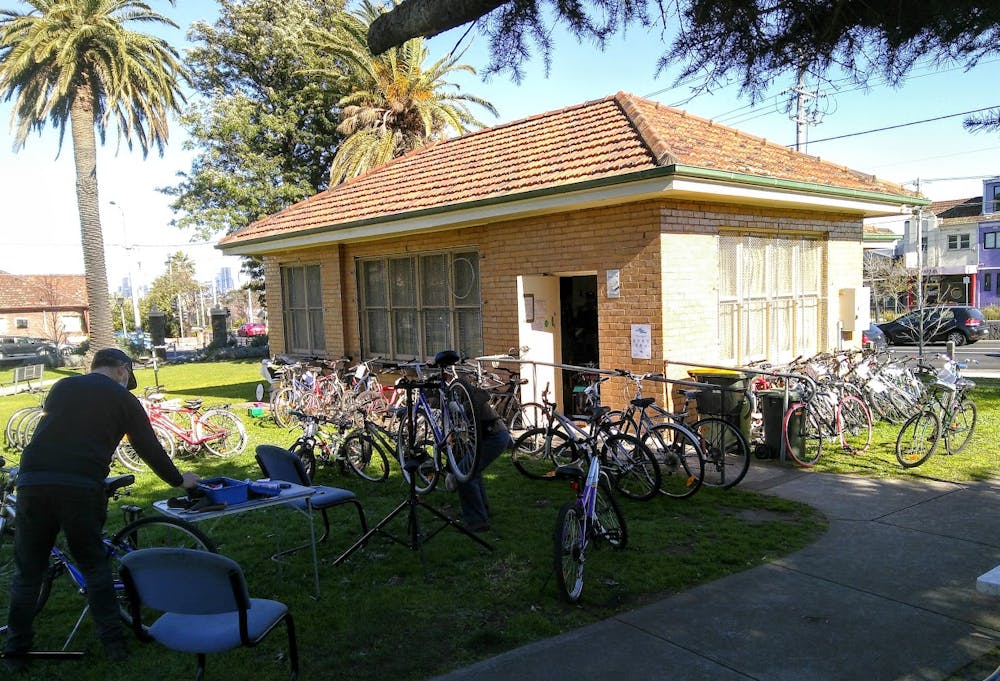
Convivial Places To Build and Repair a Bike
Bike kitchen workshops are initiated and run by activists and socially-minded cyclists. Most teach hands-on self-repair and maintenance skills to people who want to learn. Others give away free bikes to those who need them.
Workshops extend the use life of bicycles and components. They are part of the community economy and interrupt the waste stream; most parts come from donated or scavenged bikes and are re-used creatively and cheaply with a DIY ethos, avoiding new consumption.
Some bikes may be sold to support ongoing workshop costs, but rarely for high prices.
Workshops numbers have grown since the 1990s, and are widespread across Europe, the Americas, Australasia, and the rest of the world.
The largest concentration is in France. Most are networked through l'Heureux Cyclage, which coordinates events, logistics, and learning between 250 workshops, assisting well over 110,000 people yearly.
Brussels has at least 18, like Cycloperativa, spread across the city’s arrondissements.
Ten bike workshops operate in Austria, with at least four in Vienna. They include Flickerei and WUK which, established in 1983, are probably the world’s oldest.
How Bike Kitchens Work
There are two main types of bike kitchens:
- Places where tools, parts, and bike stands are offered for anybody to use, assisted by workshop volunteers and sometimes by paid mechanics.
Most are social enterprises or non-profits, promoting what’s known in French as vélonomie: the ability of a cyclist to maintain a bicycle and ride safely and with confidence.
- Those that fix bikes for others – often for the disadvantaged – such as WeCycle in Melbourne which offers bikes to refugees and asylum seekers. Working Bikes in Chicago sends bikes to the Global South.
There are often fixing sessions and other activities for specific ages, genders and groups. At one of the oldest French bike workshops, Un p'tit vélo dans la tête in Grenoble, one volunteer told us some fixing sessions are women-only.
For members of the public without money, earn-a-bike programs convert volunteer hours into eventual bike ownership.
Workshop rules vary, but almost all forbid racist and sexist behavior and support conviviality, diversity, and respect. The main goal is “integrating a community”, the same volunteer told us.
Over time, a few diversify to become big social enterprises, like Cyclo in Brussels. Fees from memberships or workshop time, bike sales, or government employment schemes allow some workshops to take on paid staff.
Others like Atelier Vélorutionaire in Paris reject commercial or government support entirely, championing a more militant stance against cars and capitalism.
Bike Kitchens in Australia
Australia has had many community bike projects dating back over 30 years, with The Bike Shed in Melbourne being one of the first.
Workshops come and go, but there are at least 18, with seven in Melbourne and four in Sydney.
Many smaller initiatives work in schools, churches, or recycling centers. They are networked through BiCANZ.
WeCycle in Melbourne is a workshop focused on fixing bikes for others. Founders Gayle Potts and Craig Jackson have supplied refurbished bikes to asylum seekers, refugees, and people in need since 2016.
A community approach to sustainable transport
Workshops need volunteers and secure premises with power and light, on or off-grid. Limited budgets make this a challenge.
While workshops can be co-housed, secure premises are the key area where support from government and bike-friendly donors is welcome. Tools, racks, and spares are also needed.
Community bike workshops extend bicycle lifespans and promote a community approach to sustainable transport — all while promoting conviviality and making our cities more livable.
This article was originally published on The Conversation.
For the most part, we tend to think of empathy as a good thing.
The world becomes a more sympathetic place when we intentionally try to understand what another person is feeling. It’s often seen as a bridge to communication and a fundamental pillar in having a moral and just society.
But according to Paul Bloom, a professor of psychology at Yale and author of Against Empathy: The Case for Rational Compassion, the concept of empathy is more complicated than we may assume.
In his book, Bloom argues that empathy itself is not inherently a good tool, only that it has the potential to be.
“I’ve come to realize that people mean different things by empathy. Some people take empathy to mean everything good or moral, or to be kind in some general sense. I’m not against that,” he told Vox.
"I think that understanding people is important, but it’s not necessarily a force for good. It can be a force for evil as well."
“There’s another sense of empathy which is narrower and which has to do with understanding other people. And that’s not exactly what I’m talking about. I think that understanding people is important, but it’s not necessarily a force for good. It can be a force for evil as well.”
To fully understand empathy, in Bloom’s eyes, we also have to consider privilege.
For example, a white woman who has committed a crime is systemically given more empathy than a Black man per our justice system.
Empathy, like other aspects of our culture, is not free from realities like white supremacy.
Bloom argues that empathy can be skewed in favor of an individual while ignoring the suffering of the collective — or to put it frankly, understanding where someone is coming from doesn’t always do good.
In his book, he cites how we tend to have more empathy for those who resemble us — which can definitely have dire consequences for society that already favors white cisgender men.
This isn’t to say that empathy isn’t inherently bad. In order for empathy to be effective and a tool for making positive change in the world, it must be practiced with compassion, which is actually caring about the greater good of a community.
Bloom calls this “rational compassion.”
Writer Sally Vickers writes about this in the Guardian, stating that “a sympathetic understanding is an imaginative attempt to sense another’s otherness without purporting to appropriate or own their existential uniqueness. The belief in a valid empathetic response suggests to me a form of wishful thinking that we are fundamentally knowable to one another – which we are not. Nor should we need to be.”
"Our differences are to be respected and are what make us interesting."
She continues: “Our differences are to be respected and are what make us interesting. Bloom doesn’t go as far as this, but believes that rather than claiming emotional identification we should be cultivating our ability to stand back in order to provide a more rationally effective programme of care.”
In order to practice rational compassion in real life, people have to be conscious of their biases — who exactly are we empathizing with, and for what reasons? — and how they are to be acted out.
In the case of climate change, it may be easy to empathize with why corporations fail to engage in sustainable practices: because it’ll cost them profit. But even understanding that, it’s imperative that we — individuals and governmental entities — hold them accountable for their harm.
In this instance, empathy, the act of understanding another’s position, does little good.
But rational compassion asks the imperative question of “what is the greater good for everyone?”, leading to the answer that corporations must be responsible for the damages they cause to the planet.
"empathy is neither good nor bad. But empathy itself will not make the world a better place until it’s in conjunction with rational compassion."
All this to say, empathy is neither good nor bad. But empathy itself will not make the world a better place until it’s in conjunction with rational compassion.
The next time we find ourselves thinking about how to be a more empathetic person, it’s definitely worthwhile to ask how we can be compassionate as well.
When the two combine, we’ll go a lot further and be able to care for our communities more with that intent in mind.
This article was originally published in the Goodnewspaper — Good Good Good's monthly print newspaper filled with good news.
→ Join thousands of people who get a new Goodnewspaper in the mail every month
In June, with representatives from Montreal to Guadalajara in attendance, the city of San Antonio, Texas officially opened its new North American Friendship Garden.
A thriving green space to celebrate cross-border sustainability efforts, it includes, among other features, a large “bug hotel” to support pollinating insects.
The structure, beautifully designed by a local artist, quickly became one of the most buzzed-about elements of the new space.
So did the cohort that created it: a group of teenagers working with the mayor’s office.
The teens were members of San Antonio’s Youth Engagement Council for Climate Initiatives, a mechanism for incorporating young voices into municipal climate action strategies.
Established last year to help execute the city’s Climate Action and Adaptation Plan, the youth council has already made significant impacts that are visible across the city.
The bug hotel is just one example. Initiated by the youth council’s biodiversity subgroup, the squat, cylindrical, terracotta-esque structure is packed with non-toxic, organic materials that the youth council members helped collect from their backyards.
Bees, butterflies, and other pollinators can enter through a series of large, diamond-shaped holes in the structure’s sides and enjoy dark, cool areas to rest or nurture their young.
The same group made related policy recommendations to the city council that San Antonio’s green spaces include pollinator habitat protection.
Another cohort of the youth council worked with the city’s transit agency on a pilot program to add rooftop gardens to bus shelters.
The low-maintenance rooftop gardens, designed in collaboration with graduate students at the University of Texas at Austin’s School of Architecture, increase habitat for local pollinators and help cool the city by mitigating the urban heat island effect.
Laura Fuller, communications and design manager at EcoRise, an Austin-based nonprofit that has supported the creation of youth climate councils that advise the mayors of San Antonio, Austin, and Houston, says the city is now discussing replicating the pilot, creating more green bus stops across the city “thanks to the ideas and action of a handful of local high school students.”
For what the youth councils contribute to the city’s climate action plans, they get at least as much in return, offering young people the opportunity to influence policy and hold leaders accountable for their action (or inaction) on the climate.
They also teach practical skills and open new career paths for a future generation of climate leaders. “The impact these programs have on students has been amazing,” says Fuller.
Youth councils harness the energy — and anxiety — that make young people particularly inclined to take climate change seriously.
In a recent global survey of people ages 16 to 25, almost 60 percent of respondents said they were very or extremely worried about climate change.
The vast majority believe climate action should be America’s top policy priority, a sense of urgency that has translated into political action, as young people turn out to vote and run for office on climate platforms in ever-growing numbers.
“We inherit the state of the environment from past generations, and will pass on the environment to future generations,” says 23-year-old climate activist Mark Haver.
Haver got involved in climate justice work after seeing the destructive impact of climate change in his hometown of Ellicott City, Maryland, which was struck by record-breaking floods in 2016 and 2018, destroying the city’s downtown.
Now, Haver serves as Chair of the Sustainable Ocean Alliance’s Youth Policy Advisory Council.
Youth council members elsewhere are motivated by similar first-hand experiences.

Texas cities are already bearing the brunt of climate change in sweltering heat waves, deadly cold snaps, and flash flooding — events that are growing more common and severe.
Young people from frontline communities have shown up to serve on local youth councils because the majority believe that it is still possible to prevent the worst long-term effects of climate change if serious action is taken.
In Tempe, Arizona, where extreme heat warnings have become commonplace during the long summer months, two recently launched youth climate councils have created cooling plans and projects for a more heat-resilient city.
“We have high school students, college students … that want Tempe to be a livable and cool place for decades to come,” says Braden Kay, sustainability and resilience director for the City of Tempe and a driving force behind the creation of the new youth climate councils there.
He says youth councils are “about the city coming alongside of those actions.”
While the climate councils in Tempe have just inaugurated their first cohorts, the groups have already held a community tree planting day in cooperation with the City of Tempe’s urban forester.
Youth council members have also pitched installing new shaded bus stops and community gardens, similar to initiatives in San Antonio.
According to EcoRise, results like these are possible when youth councils are given access to sufficient funding and resources.

In Tempe, for instance, youth councils have access to policy experts, city administrators, climate scientists, experts in racial justice, and local Indigenous practitioners.
Funding for the Tempe program is provided by a grant from the Robert Wood Johnson Foundation.
“I think what’s really exciting to me, and what stands out from our work is we are spending these resources and using these assets to provide the youth councils with a menu of options and support structures for how to do the work,” says Kay.
Haver agrees, adding that partnerships with subject matter experts and other youth climate leaders were also vital to his council’s biggest successes.
As global temperatures continue to rise, empowering young people and fostering relationships between the current and the next generation of climate experts, activists, and policymakers are more critical than ever before.
“Being able to bring youth to the decision-making table and have our voices heard in a very legitimate and credible way really does elevate this intergenerational partnership for environmental justice,” says Haver.
This story is part of the SoJo Exchange from the Solutions Journalism Network, a nonprofit organization dedicated to rigorous reporting about responses to social problems. It was originally published by Reasons to be Cheerful.
Ten nations in the western Indian Ocean committed this November to create a network of marine conservation areas to hasten progress toward the goal of protecting 30% of the oceans by 2030.
— Less than 10% of the marine expanse in this region currently enjoys protection, and a recent assessment highlighted the price of failure: all the coral reefs are at high risk of collapse in the next 50 years.
— The focus of these efforts won’t just be coral reefs, but also mangroves and seagrass meadows, a lesser-known underwater ecosystem critical for carbon sequestration and oceanic biodiversity.
— Even as overfishing and warming take a toll on marine health, threats from oil and gas extraction are intensifying in this corner of the Indian Ocean.
Ten countries in the western Indian Ocean are banding together to create a network of marine conservation areas under the banner of the Great Blue Wall.
The idea is to push through conservation areas, including those that straddle national boundaries, to bridge the gap between how much of the ocean is protected and how much needs to be secured.
A recent assessment revealed the cost of failing to do so: coral reefs in the region are at high risk of collapsing in the next 50 years.
“Most of what needs to be done is already happening, governments are creating Marine Protected Areas [MPAs], local communities are setting up locally managed marine areas,” said Thomas Sberna, a regional head for Eastern and Southern Africa at global conservation authority the IUCN. “But is it happening fast enough, is it big enough? No.”
Only around 5-8% of the marine area in the Indian Ocean is under some form of legal protection, a far cry from the goal of protecting 30% of Earth’s land and oceans by 2030. Known as “30 by 30,” this goal has gained traction globally ahead of a landmark biodiversity summit this year.
The Great Blue Wall initiative, launched in November, aims to promote transboundary cooperation between 10 nations: Comoros, Kenya, Madagascar, Mauritius, Mozambique, Seychelles, Somalia, South Africa, Tanzania, and France, whose overseas department of La Réunion is in the Indian Ocean.
The focus of these efforts won’t just be coral reefs, but also mangroves and seagrass meadows, a lesser-known underwater ecosystem critical for carbon sequestration and oceanic biodiversity.
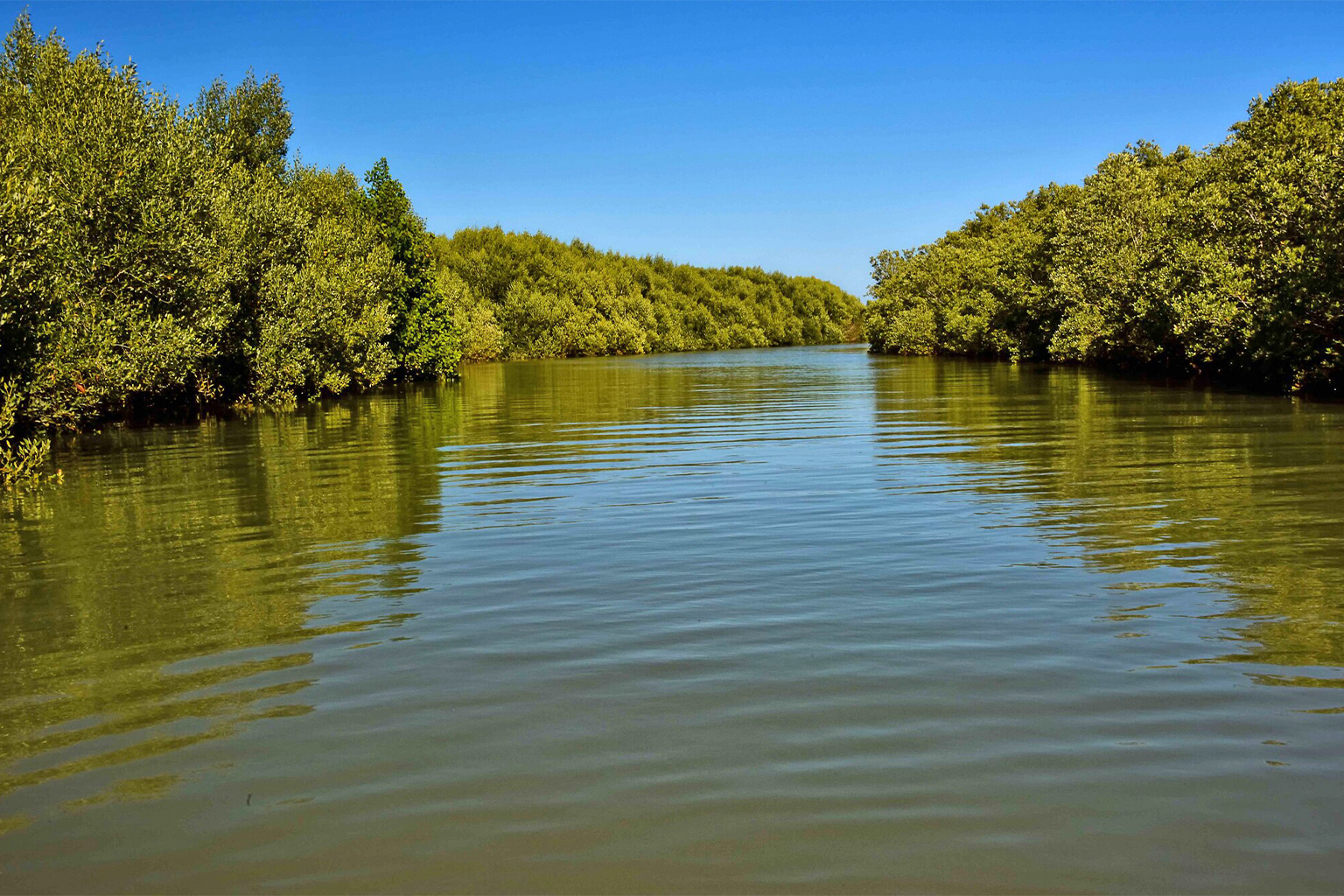
Sberna, who works on marine and coastal resilience, said this network would include sites that are neither conventional MPAs nor locally managed marine areas (LMMAs).
The former employ a top-down, centralized management approach usually led by government, while the latter rely on local management usually by communities, and often in partnership with NGOs and government entities.
These seascapes would enjoy IUCN category VI status, which restricts economic activity to lower-impact activities like artisanal fishing, while excluding industrial activities.
There’s a long history of protected areas associated with exclusionary conservation. In the marine context, for example, no-take zones can impinge on the livelihoods of local fishers.
The Great Blue Wall is modeled on Africa’s Great Green Wall. Last year, the greening initiative, launched in 2007 to curb desertification in the Sahel region bordering the Sahara, secured billions of dollars in funding as the movement to tackle climate change gathered momentum.
“It is an opportunity to try to ride that wave, to adapt it for coastal and marine areas,” Sberna said.
Sberna and others like Aboud S. Jumbe, an environmental scientist with the Tanzanian government, say pressing forward as a group can help attract funding not just from international donors but also private entities.
Tanzania is developing the first block of the Great Blue Wall: the Tanga Pemba seascape. The Pemba Channel runs between the Tanzanian mainland and the Zanzibar archipelago.
This marine corridor is heavily used for marine traffic, hosts a thriving fishery, and supports substantial marine-based tourism.
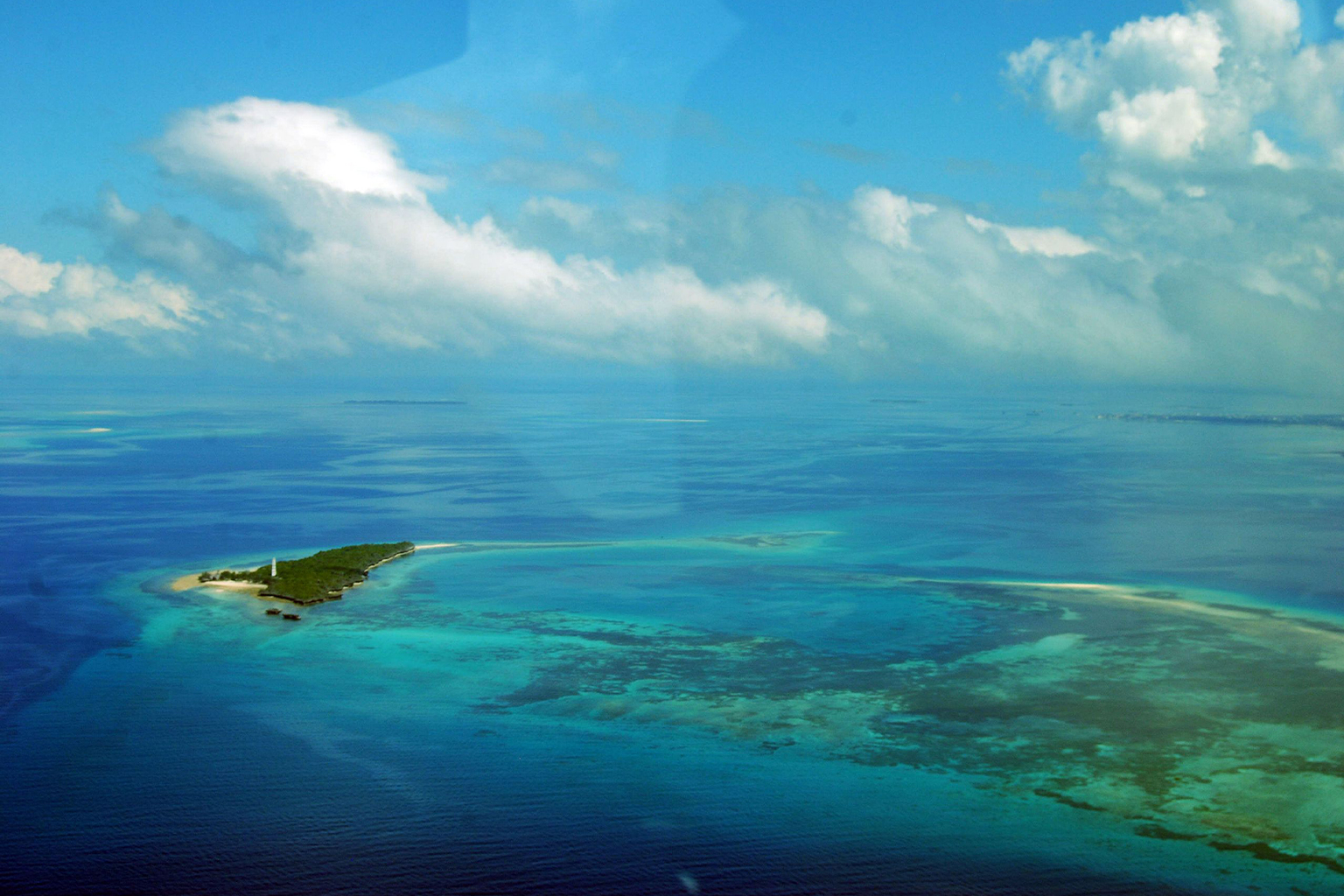
Two marine parks — the Pemba Channel Conservation Area and the Tanga Coelacanth Marine Park — already exist in the vicinity.
The new transboundary marine area will lie north of the Tanga Coelacanth Marine Park along the coasts of Tanzania and Kenya. Ireland is supporting this program with a 400,000 euro ($452,000) one-year grant.
The transboundary area hosts a plethora of unique coastal systems, from mangroves to coral reefs, and intertidal reef flats to seagrass beds.
“Corals, mangroves, and seagrasses are vital organs of the ocean. Like a human body, if you don’t take care of those organs, the rest of the ocean will not survive,” Sberna said.
The latest update on coral reefs is alarming. This region, which hosts 5% of all the world’s coral reefs, is being ravaged by ocean warming and overfishing.
“We detected overfishing of top predators on all the reefs from which we had data,” sad Mishal Gudka, a senior scientist at coastal research institute CORDIO East Africa and co-author of the 2021 study that revealed the risk of coral reef collapse.
“These results highlight the need to improve local fisheries management to ensure the health of reef systems and secure sustainable fish stocks.”
Existing protected areas are also falling short in keeping these dangers at bay, even within their own boundaries.
A report that looked at the expansion of MPAs, notified at the national level, found that legislation governing them is uneven across countries in the western Indian Ocean.
Enforcement is an issue, as are lack of personnel and funds, and policies that don’t always align with the science.
Rapid expansion can often come at the cost of quality protection. The Marine Protection Atlas, an online database of protected areas across the world, found that of the about 8% of marine area under MPAs, only around 3% can be considered “fully or highly” protected from fishing impacts.
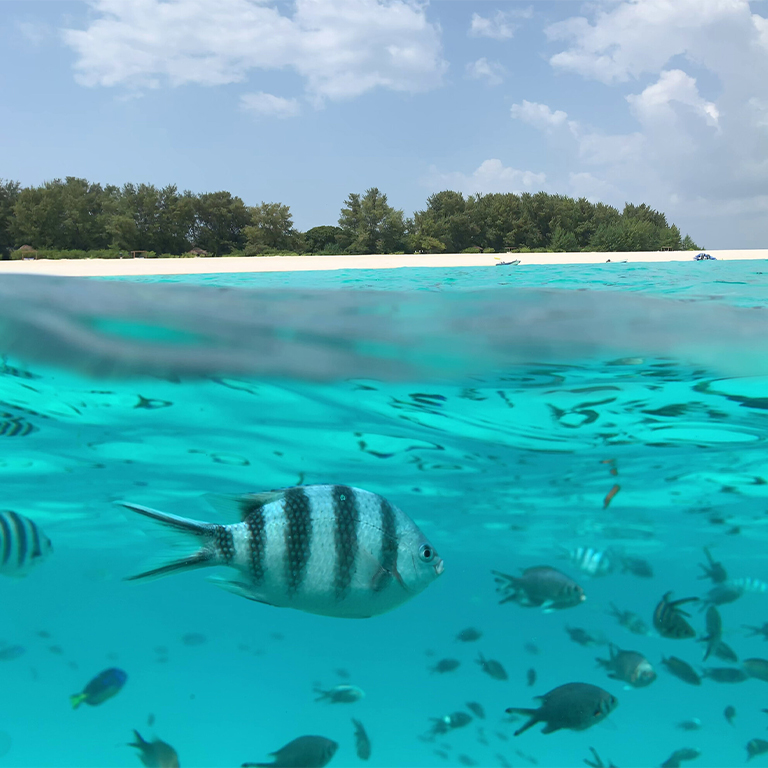
Even as these challenges persist, threats are multiplying in this corner of the Indian Ocean. The discovery of oil and gas deposits off East Africa, particularly in Mozambique, Tanzania, and Kenya, has already skewed marine conservation calculations.
About 50 trillion cubic feet of Tanzania’s proven natural gas reserves of 57 trillion cubic feet are located offshore in the Indian Ocean.
Oil and gas activity could endanger marine biodiversity hotspots, a 2017 WWF report said. The development of IUCN category VI protected areas could block oil and gas extraction in those areas.
Transboundary cooperation exists in various forms in the region. The members of the new initiative are all members of the Nairobi Convention, signed in 1985, that promotes the sustainable management of the region’s marine and coastal environment.
The same countries are also members of a scientific body, WIOMSA.
Nations that ring the Indian Ocean are also part of the Indian Ocean Rim Association, while island territories in the western sector have organized themselves through the Indian Ocean Commission.
The Great Blue Wall platform will complement these, Jumbe said, while taking into account emerging realities of a changing climate and greater understanding of the value of the marine ecosystems.
“Many countries, including Tanzania … do not have adequate financial resources to be able to implement their ocean management planning,” he said. “So, any support or partnership for conserving and protecting the marine environment is appreciated.”
Banner image: A school of sweepers (reef fish), in the south of Pemba. Image by Darwin Initiative via Flickr (CC BY-NC-SA 2.0).
Citation: Obura, D., Gudka, M., Samoilys, M., Osuka, K., Mbugua, J., Keith, D. A., … Zivane, F. (2021).
Vulnerability to collapse of coral reef ecosystems in the western Indian Ocean. Nature Sustainability. doi:10.1038/s41893-021-00817-0
This article was originally published by Mongabay.
The United Nations on December 7th recognized Gladys Kalema-Zikusoka as one of its “champions of the Earth” for promoting the One Health approach to conservation in Africa.
- The Ugandan conservationist, a trained wildlife veterinarian, established the NGO Conservation Through Public Health (CTPH) in 2003 to ensure better health care access for communities living around Bwindi Impenetrable National Park and to lower the risk of human pathogens jumping to mountain gorillas.
- UNEP selected Kalema-Zikusoka for its science and innovation category; the other awardees were Barbados Prime Minister Mia Mottley, Kyrgyz youth activist Maria Kolesnikova, and the nonprofit Sea Women of Melanesia.
- “If you make the community feel that you care about them, then there’s less need to fight them,” Kalema-Zikusoka said.

Years before the obsession with wild-borne pathogens latching onto humans gripped the world, Gladys Kalema-Zikusoka was already dealing with disease spillovers.
Except, she worried about humans infecting gorillas in her native Uganda.
“Disease transmission goes in both directions,” says Kalema-Zikusoka, a trained wildlife veterinarian.
It demonstrates, albeit narrowly, an idea gaining currency in the COVID-19 era: “One Health,” the worldview that human health and the health of the natural world are inextricably linked.
The United Nations on Dec. 7 hailed Kalema-Zikusoka as a “champion of the Earth” for putting the principle into practice in East Africa, where the human imprint on gorilla habitat is growing.
Bwindi Impenetrable Forest National Park, where Kalema-Zikusoka mostly works, is home to one of only two remaining populations of mountain gorillas (Gorilla beringei beringei).
All four gorilla subspecies (scientists are still debating if it should be five) are at risk of dying out.
The seeds for the NGO Conservation Through Public Health (CTPH), which Kalema-Zikusoka co-founded in 2003, were sown during her early years in Bwindi.
In 1996, she helped trace a scabies outbreak among mountain gorillas to people living around the park who themselves had little access to health facilities.
CTPH’s efforts over the years have earned Kalema-Zikusoka many accolades — from being awarded the prestigious Ashoka Fellowship in 2006 to becoming a National Geographic Explorer in 2018.
She is one of four women recognized as Earth champions this year. Tal Harris, a media consultant for the U.N. Environment Programme (UNEP), which administers the prize, said this wasn’t purposeful.
“The choice was based on merit,” he said. “There were many nominees and they stood out as the most impressive and inspiring.”
The other 2021 winners were Barbados Prime Minister Mia Mottley (recognized for her policy leadership), Kyrgyz youth environmental activist Maria Kolesnikova (for her entrepreneurial vision), and the nonprofit Sea Women of Melanesia (for their inspiration and action).
Kalema-Zikusoka won in the science and innovation category.

In a country, where fewer than six out of 10 teenage girls (15-18 years) have finished primary school, Kalema-Zikusoka was fortunate to receive higher education.
A still-untitled autobiography of Kalema-Zikusoka, set to hit bookstands next year, describes her years as a conservationist and also offers glimpses of her early life.
Kalema-Zikusoka was born in an illustrious Ugandan family: her father was a teacher-turned-politician allegedly murdered by then-President Idi Amin’s forces.
Her mother later became one of Uganda’s first woman parliamentarians. Kalema-Zikusoka discovered during her teenage years that her passion wasn’t politics but animals.
She decided to pursue veterinary studies at the Royal Veterinary College in the U.K., and went on to complete a master’s degree at North Carolina State University in the U.S.
“Her impact does not end with her work,” said Brian Atuheire Batenda, a Ugandan conservationist who has worked closely with Kalema-Zikusoka. “She is mentoring the young and inspiring them.”
At 25, Kalema-Zikusoka joined the Uganda Wildlife Authority (UWA), then known as Uganda National Parks, as the agency’s first wildlife vet.
In an interview with Mongabay, the 51-year-old, known to colleagues and friends as Dr. Gladys, described what it was like to work alongside conservation biologists in the mid-1990s.
According to them, “wild animals were supposed to be left on their own,” she said. “Sick animals are the next meal for the lions.”
But as a vet, it was her job to treat sick and injured animals. Moreover, she believed the context had changed.
“It can’t only be natural selection,” Kalema-Zikusoka recounted thinking. “We have already disrupted the natural way of life.”
With tourism growing in Rwanda, and Uganda emerging as a promising destination for great ape tourism, the gorillas would have to live with humans and their germs.
As in most countries, public health initiatives in Uganda are distinct from conservation programs, animated within their own constellation of actors, institutions, and incentives.
Traditionally, the interlinkages are overlooked, Batenda said.
“Their approach works because it takes into account the health of the people and health of the gorillas,” he said.
“It engages the local communities including the Batwa indigenous people into conservation decision-making.”
One of the ways CTPH is bridging the gap is through a disease early-warning system for both the animal and human populations.
It checks the risk of human pathogens escaping into livestock and wildlife or the other way around.
CTPH also works to raise awareness about and improve access to family planning in villages neighboring Bwindi Impenetrable National Park.
Kalema-Zikusoka describes health care as “a very good entry point” to get a foothold within communities. It also allows her team to engage with both men and women.

As a wildlife veterinarian at UWA, a semi-autonomous government body, Kalema-Zikusoka said it was difficult to generate interest and funding for her work.
However, another department, though it had been around longer, seemed to fare even worse: the community conservation unit.
“The wildlife authority was established in an era of fences and fines in the ’50s,” she said. NGOs like hers are trying to push past that.
What helps is that Bwindi is one of Uganda’s top tourist attractions, drawing in a steady stream of revenue.
Under Ugandan law, 20% of the park’s entry fee has to go to the local community.
Kalema-Zikusoka , who served as a UWA board member from 2012 to 2015, said she lobbied to increase the share received by communities from gorilla permits (which allow tourists to track the apes) from $5 to $10.
The NGO also pushed for a greater proportion of rangers to come from the communities.
“If you make the community feel that you care about them, then there’s less need to fight them,” she said.
When local people see tangible benefits from the presence of the gorillas, they are more willing to stop poaching and avoid bushmeat.
Gorillas are usually trapped for bushmeat or accidentally in snares meant for other animals.
CTPH also runs a program to encourage poachers to surrender and supports some reformed poachers by providing livestock and assistance for farming.
“People poach because they’re hungry, they have no other alternative,” Kalema-Zikusoka said. “It’s easier to convince people if you give them an alternative.”
She says it has helped the gorillas too: mountain gorilla numbers have almost doubled from 600 in 1996 to 1,063 today, and about 460 of the apes are found in Bwindi.
A decade ago, the Bwindi population was 400.
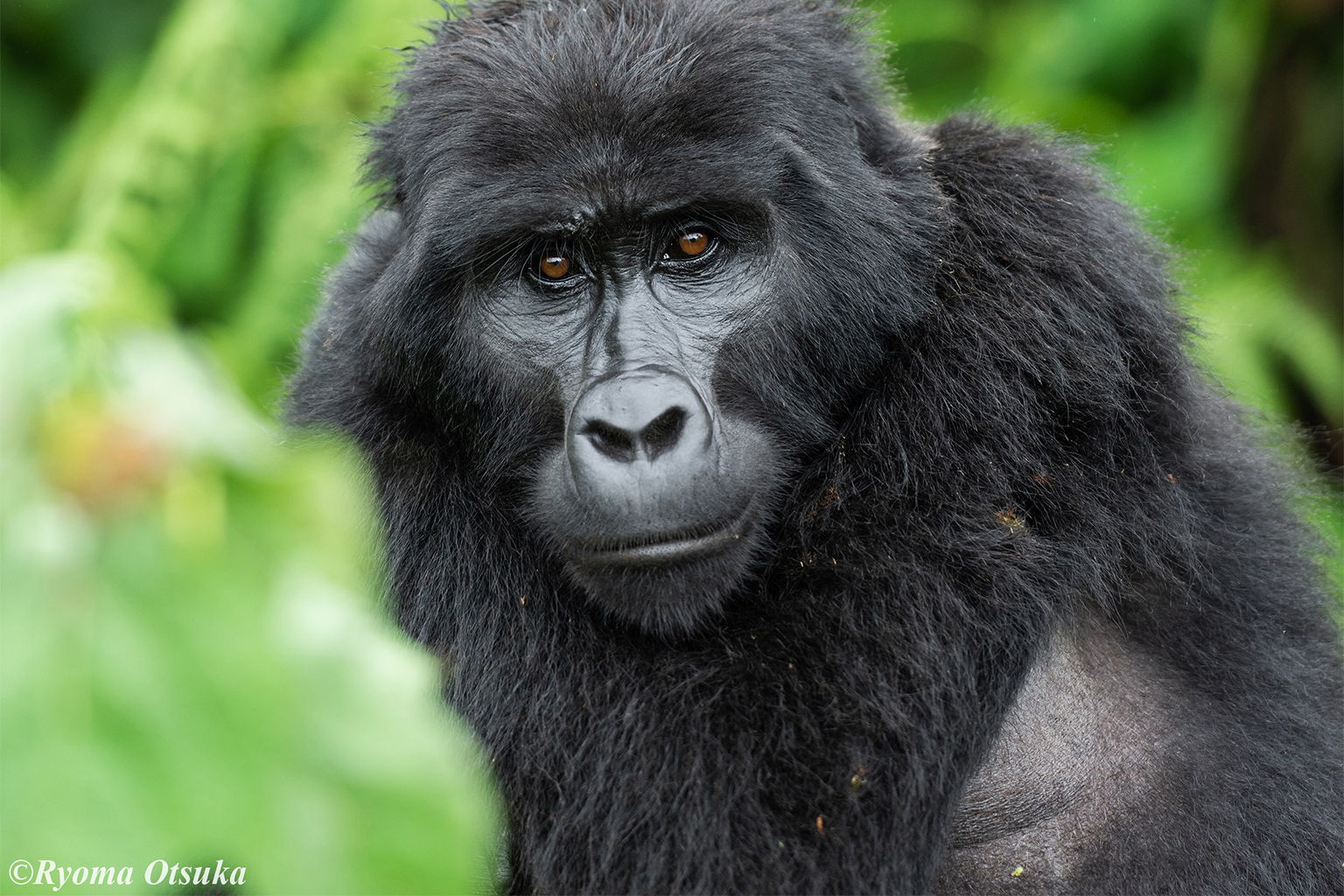
In 2018, global conservation authority the IUCN acknowledged an improvement in the conservation status of mountain gorillas from critically endangered to endangered.
However, as a whole, the eastern gorilla species, which comprises mountain gorillas and eastern lowland or Grauer’s gorillas (Gorilla beringei graueri), remains critically endangered.
The same pandemic that has brought greater attention to the risk of zoonotic diseases has also brought tremendous hardship for the people in Uganda who depend on ecotourism.
From guides to porters to farmers, the local economy around Bwindi suffered during the six months of complete lockdown and border closures last year.
The park reported an increase in poaching during this period.
Tourists are trickling back, but the number is still far from pre-pandemic levels. Local lockdowns and fresh concerns about new variants have dampened hopes for a swift recovery.
COVID-19 has accelerated the search for other ways to sustain conservation that aren’t dependent on tourism.
CTPH started Gorilla Conservation Coffee in 2015, sourcing coffee from small-scale farmers at above-market prices and selling it at a “conservation premium” in Uganda and in countries like the U.S., Canada, and New Zealand.
It’s a $1.50 markup per kilogram of coffee, of which the cultivators receive 50 cents, while the rest supports CTPH.
“I am glad that the One Health approach is being seen as a viable approach to conservation, that’s great,” Kalema-Zikusoka said.
“But there isn’t enough funding for One Health field programs, there’s more funding for higher-level academic programs.”
This article was originally published by Mongabay.