Learning disabilities are the most common type of disability for school-aged children.
According to Pew Research Center, 1 in 3 students receive educational services under the federal Individuals with Disabilities Education Act for learning disabilities; this surpasses support for students with speech impairments and chronic health problems.
Learning disabilities are neurodevelopmental disorders that affect people's ability to read and write, solve math problems, speak, and listen or focus.
According to the National Institute of Neurological Disorders and Stroke, multiple learning disabilities can overlap, or they can be "isolated," having a variable impact on the people living with them.
Dyslexia — trouble with reading, spelling, and writing — is the most common learning disability, affecting approximately one-fifth of the U.S. population.
Dyscalculia is another common diagnosis, causing difficulty comprehending numbers and math calculations.
It's important to remember that not all learning disabilities are the same and that consulting a professional clinical expert can determine an accurate diagnosis and treatment plan.
Learning disabilities can affect anyone, and facing these unique learning struggles does not mean an individual is incapable of achieving great things.
In fact, many of the world's most famous actors, musicians, and athletes — whether diagnosed as a child or as an adult — have lived and thrived while learning differently.
Our partners at Stacker and Marker Learning compiled a list of celebrities you may not realize are affected by learning disabilities, using various news sources. And Good Good Good has published a version of that article with edits from our editorial team.
Keep reading to learn more about famous figures who have overcome struggles with learning to become highly successful in their respective fields.
Celebrities you may not realize have dyslexia, dyscalculia, and other learning disabilities —
Jennifer Aniston
Just a few years before "Friends" turned her into America's television sweetheart at the age of 25, actor Jennifer Aniston was diagnosed with dyslexia.
During a routine eye exam for prescription glasses, a test showed her eyes jumping back and forth between words while reading. The diagnosis came as a relief to Aniston, who reports she struggled in school and thought she just wasn't smart growing up.
Keanu Reeves
Although actor Keanu Reeves struggled with dyslexia growing up, eventually dropping out of high school due to lack of proper support, he has always enjoyed reading.
Reeves paged through volumes of the Encyclopedia Britannica as a child, courtesy of his step-grandfather who worked there, and cited Ernest Hemingway and Jack Kerouac among his literary influences.
The star of "Speed" and the "Matrix" and "John Wick" film franchises draws a connection between his love of books and acting with the common thread of storytelling.
Rob McElhenney
In July 2023, actor Rob McElhenney revealed on Twitter he'd been recently diagnosed with what he called "a host of neurodevelopmental disorders and learning disabilities" and pledged to share more about his journey on his podcast. (His podcast, unfortunately, went on a temporary hiatus before the episode was released.)
Best known for his role as Mac on "It's Always Sunny in Philadelphia" and the co-owner of the Wrexham football club, the star admitted this isn't something he would normally talk about, but it is important to let others know they aren't alone in their struggles.
McElhenney wrote the following encouragement alongside this announcement: "You're not stupid. You're not 'bad.' It might feel that way sometimes. But it's not true."
Salma Hayek
Although Salma Hayek was diagnosed with dyslexia as a teen, it didn't slow her down; she graduated from high school at just 15, then began studying international relations and political science in college at 16.
This difficulty reading has caused her a few minor issues at times — like when she struggled to pronounce the title of her 2021 movie "Hitman's Wife's Bodyguard" — but Hayek has established a long, successful acting career. (In fact, she's the first Mexican woman actor to receive a Best Actress Oscar nomination.)
Hayek even referenced her own diagnosis in a Season 6 episode of Netflix's "Black Mirror," where, playing herself, she exclaims, "I am a dyslexic, talented actress with questionable English!"
Chris Rock
Many fans were unaware that comedian Chris Rock has a learning disability until the infamous events of the 2022 Academy Awards, where Will Smith slapped Rock for joking about the appearance of his wife, Jada Pinkett Smith, who lives with alopecia areata.
This incident generated much public discussion about Rock's diagnosis: nonverbal learning disorder, which can affect social skills, motor skills, and more. Rock reports having specific difficulty with his ability to interpret nonverbal cues.
Maya Hawke
Actor and singer Maya Hawke is perhaps best known for her role as Robin Buckley on the hit Netflix series "Stranger Things" — and for having uber-famous actors Ethan Hawke and Uma Thurman as parents.
Hawke described her childhood as "deeply difficult" due to having dyslexia, which caused her to be bullied, kicked out of school, and sent to a school for children with learning disabilities.
Despite these challenges, she remains passionate about reading, a trait she may have picked up from her father, who has written a number of books himself.
Henry Winkler
Henry Winkler, famed for his role as the Fonz in "Happy Days," struggled with undiagnosed dyslexia throughout his childhood and early adulthood.
Despite significant challenges in reading and memorization, Winkler harnessed his creativity and improvisation skills, which notably aided his acting career. He was accepted into the Yale School of Drama and later achieved immense success on television, particularly through his iconic role.
Winkler's experiences with dyslexia also inspired him to co-author a series of children's books featuring Hank Zipzer, a character with dyslexia. Through these books and his advocacy, Winkler emphasizes that learning challenges can be overcome with determination and resilience, inspiring many with similar struggles.
Channing Tatum
Although Channing Tatum found great success as an actor in films like "Step Up," "White House Down," and the "Magic Mike" franchise, he never considered himself highly intelligent.
This was partly due to Tatum's struggles growing up with dyslexia and ADHD — which made him feel like he didn't fit in anywhere.
It wasn't until discovering the performing arts that Tatum realized his passion would help him find his place in the world.
Jamie Oliver
Jamie Oliver may be a world-renowned celebrity chef today, but he struggled with learning as a child due to having dyslexia.
Cooking helped him overcome these difficulties — once telling the BBC, "The kitchen genuinely did save me" — and because of this, he advocates for kids to take their own approach to tasks they might find difficult.
Despite his troubles with reading and writing, Oliver has published a line of cookbooks throughout his career and released his first children's fiction book, "Billy & The Giant Adventure," in April 2023.
Tommy Hilfiger
In his 2016 memoir, "American Dreamer," Tommy Hilfiger discusses how having dyslexia pushed him toward a career in fashion.
Although the iconic designer wasn't officially diagnosed until he was older, he worried his difficulty reading would limit his options in life.
As a result, he carved out his own career path as an entrepreneur: At just 17, Hilfiger bought 20 pairs of jeans, resold them at school for a profit, and used the money to open his first store.
Whoopi Goldberg
Like many others on this list, actor-comedian Whoopi Goldberg's dyslexia went undiagnosed as a child. While she grew up experiencing bullying at school, she credits her mother with telling her she could do anything.
Fans know Goldberg grew up to star in such classic films as "The Color Purple," "Ghost," and "Sister Act," but many may be surprised to know she also penned an entire series of children's books about the "Sugar Plum Ballerinas."
Brian Grazer
Producer Brian Grazer attributes his success in the entertainment industry to his childhood struggle with dyslexia.
In elementary school, he couldn't read at all, but he learned the valuable skill set of connecting with other people.
Grazer believes this connection — having what he calls "human conversations" — made his career possible, leading him to generate such acclaimed films as "A Beautiful Mind" and "Apollo 13" and popular TV series like "24" and "Arrested Development."
Tom Cruise
Diagnosed with dyslexia at age 7, Tom Cruise has said even by the time he graduated high school he considered himself "a functional illiterate."
The actor compensated for his difficulty reading scripts by asking directors and producers to explain the characters in the films he auditioned for, then managed by ad-libbing.
It wasn't until 1986 — the year his hit film "Top Gun" was released — that Cruise says he was able to understand his dyslexia and, with the help of tutors and learning specialist, learn techniques to problem solve, study, and leverage his creativity to overcome obstacles.
Florence Welch
Music lovers may not be aware that the lead singer of Florence and the Machine was diagnosed with dyscalculia and dyslexia as a child.
Prior to becoming a Grammy- and BRIT Award-nominated musician, Florence Welch recounted to Rolling Stone about a time when she felt judged for being unable to count change at a bar where she worked.
Despite these struggles, she went on to publish the 2018 poetry book "Useless Magic" and contributed to the 2020 book "Creative Differences" in support of neurodiversity in the arts.
Octavia Spencer
As a child, Octavia Spencer learned her dyslexia diagnosis wasn't a weakness or deficiency but rather a different way of learning.
This attitude helped the Oscar-winning star of films like "The Help" and "Hidden Figures" embrace her own unique strengths.
Spencer also benefited from a teacher who introduced her to the "Encyclopedia Brown" books, which not only fostered her love of reading but also inspired her to later write her own series of middle-grade mysteries, "Randi Rhodes, Ninja Detective."
Cher
As a child, Cher struggled in school, eventually dropping out at age 16; it wasn't until she took her own child to be tested for reading difficulties that everything made sense.
The singer and actor was diagnosed with dyslexia at age 30, a revelation that explained her self-reported struggles with reading slowly and feeling as if "my mind raced ahead of my hand."
This diagnosis hasn't limited Cher's six decades in the spotlight, though — a career highlighted by a 1988 Best Actress Oscar win for "Moonstruck" and a 2000 Grammy for Best Dance Recording for her hit song "Believe."
Steven Spielberg
Like many celebrities on this list, Steven Spielberg was not diagnosed with dyslexia until later in life — age 65, to be precise.
Growing up, the future filmmaker was often bullied by peers because of his unexplained difficulty reading and he revealed that "making movies was my great escape."
Spielberg's hobby ultimately turned him into one of Hollywood's most well-known producers and directors, with decades of blockbusters under his belt including "Jaws," "E.T. the Extra-Terrestrial," and "Schindler's List."
Tim Tebow
Former NFL quarterback Tim Tebow discovered he had dyslexia in elementary school, a diagnosis he shares with both his father and older brother.
Tebow didn't let this affect his ability to play the game he loves, though; he adapted by using flashcards to learn plays, as opposed to the more traditional method of studying a playbook.
Mel B
Melanie Brown — aka Mel B, one-fifth of the iconic 1990s pop group the Spice Girls — always struggled with reading, but it wasn't until 2017 that she received a dyslexia diagnosis.
She welcomed the diagnosis as an explanation for her lifelong struggles as a slow reader and having to read scripts repeatedly to memorize them.
Mel B has also spoken openly to normalize the other diagnoses she was given as an adult: ADHD, anxiety, and dyspraxia.
Richard Branson
Richard Branson has said that he believes people with dyslexia, like himself, possess "the skills of the future."
The entrepreneur emphasizes dyslexia's association with beneficial attributes like keen problem-solving skills and an expansive imagination, crediting these qualities in part for the success of his business, the Virgin Group.
Branson has also encouraged more understanding of neurodiversity to support future innovation.
Anderson Cooper
Anderson Cooper, journalist and descendent of 19th-century tycoon Cornelius Vanderbilt, loves books today but struggled with reading as a child. With the support of a teacher who instilled a passion for reading, Cooper learned to work with his mild dyslexia.
In addition to his well-known role as a CNN correspondent, Cooper has also published multiple books, including one he co-authored with Katherine Howe about his own family, "Vanderbilt: The Rise and Fall of an American Dynasty."
Keira Knightley
Raised by an actor and a playwright, Keira Knightley knew at a young age she wanted to act.
Her parents leveraged this desire to help address her childhood dyslexia, allowing her to get an agent if she read every day during summer vacation and then audition for roles as long as she maintained good grades.
Knightley grew up to become a big-screen star in films like "Pride & Prejudice" and "Atonement," both directed by Joe Wright, who was, coincidentally, also diagnosed with dyslexia.
Jay Leno
Jay Leno credits his mother's advice as one of the main reasons he became the well-known comedian he is today.
The former "The Tonight Show" host was diagnosed with dyslexia as a child, and his mother said he'd have to work twice as hard as his peers to succeed.
So that's exactly what he did, patiently waiting hours for auditions and even sleeping in a New York City alley when his early stand-up gigs didn't pay enough.
Jewel
Jewel Kilcher's dyslexia went undiagnosed as a child due to her switching schools often as she moved around a lot while growing up.
Even so, the clever singer-songwriter created her own way to improve her reading: She laid a piece of paper with a small strip cut out over the page she was trying to read to focus and make sense of just one sentence at a time.
Not only has Jewel written multiple Grammy-nominated songs since then, but she also published a book of poetry in 1998, "A Night Without Armor," and a memoir in 2015, "Never Broken: Songs Are Only Half the Story."
Gavin Newsom
Gavin Newsom, the Governor of California, has been open about his struggles with dyslexia.
His learning disability, diagnosed in his childhood, presented significant challenges in reading and writing.
His speeches and debate performances are known for being densely packed with facts and figures — which he painstakingly memorizes so he isn't reliant on reading notes.
Despite these obstacles, Newsom has navigated his political career successfully, showcasing that dyslexia need not be a barrier to achieving high-level success. He's even gone on to write a children's book about dyslexia.
Robbie Williams
British musician Robbie Williams — best known as a member of the boy band Take That who later launched a successful solo career — calls himself "numerically dyslexic" due to his dyscalculia diagnosis.
Even as an adult, Williams struggled adding and subtracting, remembering important dates, and recalling his own house number; yet he has maintained a successful music career for over 25 years.
Sir Anthony Hopkins
Sir Anthony Hopkins, celebrated for his exceptional acting career, attributes his interest in acting to his dyslexia.
He found solace in painting and playing the piano during his school years, which he disliked due to academic struggles.
Hopkins, known for his Oscar-winning portrayal of Hannibal Lecter in "The Silence of the Lambs" and roles in "The Mask of Zorro" and "Amistad," overcame his educational challenges to become one of the greatest living actors
Dax Shepard
Dax Shepard, widely recognized for his work in acting and podcasting, credits his dyslexia for shaping his career path.
Despite the challenges posed by dyslexia in his academic life, Shepard leveraged these experiences to develop a unique approach to acting. He's also gone on to become a prominent podcast, with his podcast Armchair Expert — where he speaks often about how dyslexia affected his childhood and adult life.
His story illustrates the positive impact of embracing and adapting to learning disabilities, leading to success and creativity in his professional endeavors.
Tom Holland
Diagnosed with dyslexia at age 7, Tom Holland was fortunate to have supportive parents who encouraged him to try his best and work hard.
The actor has said his difficulties are mostly spelling-related, which did not hold him back from performing.
Holland got his first break at age 12 in "Billy Elliot: The Musical" and went on to snag the iconic film role of Spider-Man in 2017.
This story was originally published by Stacker and republished with permission, pursuant to a CC BY-NC 4.0 License.
It is an egregious fact that forced labor has long been a practice in human history. Evidence of it has been seen in continents and countries since ancient times.
Slavery based on race, however, is a more recently constructed concept that began sometime in the 15th century with the transatlantic slave trade. Backed by European nation-states, it "introduced a system of slavery that was commercialized, racialized, and inherited," Mary Elliott, curator for the Smithsonian's National Museum of African American History and Culture, and Jazmine Hughes, writer and editor for The New York Times, wrote for the Times' 1619 project.
These efforts were deemed abhorrent to some in the British Empire, and sometime in the 18th century, efforts to abolish forced labor and human trafficking began. Those who saw slavery as a shameful practice and sought to upend this system were called abolitionists.
These ideas eventually spread to North America as well, where the first stirrings of the abolitionist movement began in states like New York and Massachusetts.
The abolitionist movement began in earnest around the 1820s and by 1833, the American Anti-Slavery Society was formed. While names like Frederick Douglass and William Lloyd Garrison, whose newspaper The Liberator regularly exposed the atrocities of slavery, are names that often come to mind, there were also many women who were instrumental in the fight to end slavery such as Harriet Tubman, Sojourner Truth, Sarah Moore Grimké, and Angelina Grimké Weld.
However, the road to freedom was fraught with harsh resistance and opposition—to both the anti-slavery movement itself and the women advocating for it. Many people—even some abolitionists—opposed women's active involvement in the movement.
Nonetheless, women abolitionists carved their way. They formed their own anti-slavery societies.
They organized anti-slavery fairs, signed anti-slavery petitions, and circulated anti-slavery literature. They wrote articles for anti-slavery newspapers, raised funds, and engaged in public speaking against slavery. At a time when women were expected to sit in the background, these heroes shattered those restrictions, bravely and unapologetically standing up for what they believed in.
Along with famous abolitionists, several lesser-known women abolitionists helped in the movement as well, and their impact should not be forgotten. Using multiple sources, such as the National Abolition Hall of Fame and Museum, the National Women's History Museum, and the Archives of Women's Political Communication at Iowa State University, among other sources, Stacker compiled a list of 16 women abolitionists whose names may not be recognized by most.
Keep reading to learn more about how these courageous women activists contributed to the abolition of slavery.
Influential Women Abolitionists To Know
Lydia Maria Child

One of the 19th century's most popular writers, Lydia Maria Child paid the price for her convictions. She was the author of a bestselling book on household advice called "The Frugal Housewife" and the founder of America's first children's magazine, Juvenile Miscellany.
After meeting William Lloyd Garrison, which spurred her activism, she published her anti-slavery book "An Appeal in Favor of That Class of Americans Called Africans" in 1833. The public was so outraged that she lost sales of her books and eventually shut down the magazine.
Despite these hardships, Child continued to advocate for abolition, protesting even through her way of life. In 1838, Child and her husband relocated to a different town to grow sugar beets, an alternative to slave-produced cane sugar, though they left later. The year after, she became part of the American Anti-Slavery Society's executive committee.
From 1841 to 1843, she edited The National Anti-Slavery Standard newspaper. Even after leaving the Standard, Child continued to write and edit. In 1861, she edited and wrote the introduction for Harriet Jacobs' book "Incidents in the Life of a Slave Girl," and she published "The Freedmen's Book" for those emancipated from slavery in 1865.
Lucretia Mott

Lucretia Mott dedicated her life to the twin causes of abolition and women's rights. A charismatic orator, she often blended these two causes together as a Quaker minister. She also advocated for the boycott of products made through the labor of those who were enslaved.
In 1833, she attended the first meeting of the American Anti-Slavery Society and was the only woman to speak. Later, she helped found the Philadelphia Female Anti-Slavery Society, an interracial organization run by women.
She was so prominent in the movement that after the dedication of the Pennsylvania Hall, which was built to be used by abolitionists, her home was targeted by a mob carrying torches. Though she waited in her parlor, the mob was eventually diverted by allies.
In 1840, Mott and her husband attended the World Anti-Slavery Convention in London as delegates, but she was barred from participation because of her sex. Even then, the crowd chanted her name, and she proceeded to give a speech, urging the crowd to purchase goods made without forced labor.
After the Fugitive Slave Act of 1850 was passed, Mott's home became a stop for freedom seekers on the Underground Railroad, and in 1866, she stepped up to become the first president of the American Equal Rights Association. She was also part of the efforts to ensure that Swarthmore College was coeducational. Throughout her life, Mott was dedicated to human liberation in all its forms.
Abby Kelley Foster

A teacher living in Lynn, Massachusetts, Abby Kelley Foster was influenced by The Liberator and William Lloyd Garrison on the matter of slavery. She used her skills as a lecturer and educator to continually advance the causes of women's rights and abolition, giving speeches to mixed-gender crowds and even sharing her platform with those formerly enslaved.
Foster joined the town's Female Anti-Slavery Society, and afterward, was sent by the chapter as a delegate for the first Anti-Slavery Convention of American Women. Foster eventually became the chief fundraiser, general financial agent, and general agent for the American Anti-Slavery Society years later.
Becoming more and more radical as the years progressed, Foster believed in full and legal equality for Black people along with the abolition of slavery. She also encouraged abolitionists to leave churches that did not completely condemn slavery. She left the Quaker church herself in 1841 over a violation of a policy concerning anti-slavery speakers.
Foster married Stephen Symonds Foster and used their property, Liberty Farm, as a stop on the Underground Railroad for freedom seekers. Their home was designated a National Historical Landmark in 1974.
Frances Ellen Watkins Harper

Frances Ellen Watkins Harper was a household name in her day. One of the first Black women to publish a novel and the first to publish a short story, Harper was also an influential abolitionist who helped found the National Association of Colored Women.
Born a free Black woman, Frances Ellen Watkins worked as a teacher and lived in an Underground Railroad station, where she witnessed firsthand the work of abolition. But it was when Maryland passed a law stating free Black people who entered the state could be sold into slavery that marked the start of her activism.
She gave anti-slavery lectures for several years in the U.S. and Canada, which helped sales of books. Harper diverted a large share of those proceeds from book sales to benefit the Underground Railroad.
In 1866, Harper delivered a memorable speech at the National Women's Rights Convention, calling for participants to include Black women in the suffrage movement. Apart from helping found the organization, she would serve as vice president of the National Association of Colored Women in 1897.
Throughout her life, Harper continued to publish books that exposed the racism of 19th-century society and showed the struggles of Black people in the United States. In one moving poem, "Bury Me in a Free Land," she writes, "I ask no monument, proud and high, / To arrest the gaze of the passersby; / All that my yearning spirit craves, / Is bury me not in a land of slaves."
Laura Smith Haviland

Laura Smith Haviland's life does not lack in high-stakes milestones. She helped form the first anti-slavery society in Michigan, established one of the first Underground Railroad stations in Michigan, and co-founded the nondiscriminatory Raisin Institute with her husband.
Born in Ontario, Canada, Haviland devoted herself more fully to anti-slavery work after several of her family members died from an epidemic in 1845. Haviland made many trips through Ohio, Michigan, and Indiana enacting elaborate plans to help fugitives escape slavery by making the journey to Canada. Haviland found such great success that Southern owners of enslaved people set a $3,000 reward for Haviland's capture.
During the Civil War, Haviland helped with relief efforts, and afterward, she continued assisting formerly enslaved people by working with the Freedman's Relief Association and the American Missionary Association. She also founded an orphanage for Black children. Haviland meticulously wrote down her many experiences in a religious autobiography, "A Woman's Life Work: Labors and Experiences of Laura S. Haviland."
Myrtilla Miner

Myrtilla Miner first witnessed the horrific reality of slavery while teaching at Newton Female Institute in Mississippi and requested to teach African American girls but was denied. Because of her beliefs, she was forced to leave the state.
She moved to Friendship, New York, where she developed a project that would help uplift Black communities by training African American girls to be teachers—an effort Frederick Douglass considered to be ambitious and dangerous.
Despite this, in 1851, Miner opened a school in Washington D.C. teaching six students, and after three moves, found a permanent location named the Normal School for Colored Girls. The school faced harassment and enraged mobs who tried to burn it down. The mayor publicly condemned Miner's school in the newspaper, but she persevered and eventually found allies like Johns Hopkins and Henry Ward Beecher, who would serve on the school board.
Though the school had to close in 1860, it opened again as the Institution for the Education of Colored Youth in 1865 and was subsequently assimilated into other institutions that would later form the University of the District of Columbia.
Harriet Forten Purvis

One of the famed "Forten Sisters," Harriet Forten Purvis was the daughter of influential abolitionists Charlotte Vandine Forten and James Forten. Of biracial background, Purvis worked alongside her mother and three sisters to help found the Philadelphia Female Anti-Slavery Society in 1833. Purvis was a co-chair for their anti-slavery fairs, and she also attended the Anti-Slavery Convention of American Women in 1838 and 1839.
Purvis participated in the society's sewing committee, which opened a sewing school in a poverty-stricken region. She also helped launch a boycott of slave labor products, such as vegetables, fruit, and cotton.
She married Robert Purvis, who also came from a prominent abolitionist family, in 1832. Purvis and her husband's Byberry, Pennsylvania, home became a major station on the Underground Railroad for freedom seekers.
During the Civil War, Purvis protested the segregated trolley laws in Philadelphia by sitting in the section reserved for whites. Long before Rosa Parks, Purvis would help overturn inequality in trolleys in the 1860s along with Octavius Catto. Throughout her life, Purvis continued to work on civil rights and segregation issues.
Elizabeth Gloucester
Upon her death, Elizabeth Gloucester was thought to be the richest Black woman in the country. Gloucester ran multiple businesses, including an upscale boarding house, and her fortune was worth about $300,000 (or about $7 million today). But it was what she chose to do with this wealth that is as remarkable.
Born free, Elizabeth Parkhill eventually married James Gloucester, who later founded Siloam Presbyterian Church in Brooklyn. The couple's church supported the cause by donations and support for anti-slavery causes. The church also assured safe passage for runaways and gave a platform to noted figures such as Frederick Douglass and John Brown, a militant abolitionist. Gloucester also raised funds for the Colored Orphan Asylum, which aimed its services toward Black children who were excluded from the efforts of other orphanages at the time.
Harriet Jacobs
Born into slavery in North Carolina, Harriet Jacobs is best remembered for her autobiography, "Incidents in the Life of a Slave Girl," which details the abuses she faced in the household of Dr. James Norcom.
Edited by fellow abolitionist Lydia Maria Child, the book was unheard of at the time. It brought to light the difficult circumstances of a woman who was enslaved, fighting unceasing sexual advances. It also framed the woman as an intelligent hero.
After running away from Norcom, Jacobs lived in a 9-by-7-foot crawlspace for seven years to be close to her children, which she had with a white lawyer. A fugitive and enslaved person, she was constantly on the run, and she eventually moved north to Rochester, New York, and worked with abolitionists. It was Amy Post who urged her to write her autobiography, which has now been translated into multiple languages, including Spanish, French, and Japanese.
Sarah Parker Remond

Sarah Parker Remond was transatlantic abolitionist. Born free in Salem, Massachusetts, Remond was part of a family of successful businesspeople. She began to lecture in opposition to slavery at 16.
In 1853, Remond refused to sit in segregated seats at a theater and was shoved down a flight of stairs and forced to leave, but she sued the theater and won, and the theater was ordered to integrate seating.
From 1856 to 1858, Remond gave anti-slavery lectures in the United States for the American Anti-Slavery Society, and later, she gave anti-slavery speeches in Scotland, England, and Ireland.
She was the first woman to speak against slavery in public in the United Kingdom. During the Civil War, Remond advocated for people in Britain to support the Union, and afterward, she gave lectures to raise funds for those emancipated from slavery. She returned to the United States briefly, joining the American Equal Rights Association, but moved to Italy where she married and practiced medicine for more than 20 years.
Maria Stewart
Maria Stewart was one of the first American women of any race to speak in public. Born free, Stewart also published "Religion and the Pure Principles of Morality" in 1831, and in doing so, became the first Black woman to write and publish a political manifesto. Her manifesto inspired four abolitionist lectures in Boston from 1831 to 1833.
Stewart's speeches used biblical language and even advocated the use of force, if necessary. She encouraged Black audiences to pursue education and fight for political rights. "Sue for your rights and privileges," Stewart wrote.
In 1834, she moved to New York where she joined a Black and female literary society and also taught. She moved to Baltimore and later relocated to Washington D.C., where she became a nurse at the Freedmen's Hospital, now known as Howard University Hospital.
Charlotte Forten Grimké

Born free in Philadelphia to a prominent family of abolitionists, Charlotte Forten moved to Salem, Massachusetts, where her interest in abolition was kindled. In Salem, Grimké attended anti-slavery lectures, wrote poems opposing slavery, and joined the Female Anti-Slavery Society.
In 1862, Forten went to St. Helena Island, South Carolina, to teach formerly enslaved people who were left behind by plantation owners fleeing the Union forces. This was called a "rehearsal for Reconstruction."
Forten kept detailed journals when she taught in South Carolina. Her writings were then published in Atlantic Monthly as a two-part essay entitled "Life on the Sea Islands" in 1864. That same year, she married Francis James Grimké, who was the nephew of Sarah Moore Grimké and Angelina Grimké Weld. Later, in 1896, she helped found the National Association of Colored Women, working to advance civil rights throughout her life.
Mary Ann Shadd Cary
When Frederick Douglass' North Star newspaper asked readers what could be done to improve Black lives, Mary Ann Shadd Cary wrote, "We should do more and talk less."
Shadd Cary was born free and lived in an abolitionist home that frequently saw enslaved people who were on the run. After Congress passed the Fugitive Slave Act, which compelled Americans to help capture those who ran from enslavement, Shadd Cary and some of her family moved to Canada.
In Canada, Shadd Cary published writing that advocated for Blacks to immigrate there, and she also founded the anti-slavery paper The Provincial Freeman, which made her the first Black woman newspaper editor in North America.
When the Civil War began, Shadd Cary came back to the United States to help recruit Black soldiers for the Union Army. She also moved to Washington and founded a school for the children of the formerly enslaved after the war. Later in life, Shadd Cary earned a law degree, becoming one of the first black women lawyers in the U.S.
Prudence Crandall

Prudence Crandall bravely kept to her beliefs and fought against systems of racial discrimination by opening one of the first schools for African American women in Connecticut in 1833.
In 1831, Crandall opened a girls' academy that soon became one of the best in the state. The next year, Crandall admitted a controversial student: a young black woman named Sarah Harris. Harris' admission was met with intense hostility and opposition from the townspeople, but Crandall stayed firm in her decision.
She continued to attract African American students aided by support from Garrison's newspaper, The Liberator. In response, the town continued its vehement opposition, taunting African American students with stones, eggs, or manure. When 1833's Black Law made it illegal to teach African American students from states other than Connecticut, Crandall was arrested. Though her arrest was overturned in higher courts, Crandall finally closed the school to protect her students' safety.
She would eventually leave Connecticut and move to Illinois where she would continue in education. Crandall is now named Connectictut's state heroine.
Lilly Ann Granderson
Education is truly a prize, especially for those who were enslaved. In the South, anti-literacy laws kept much of the enslaved population from working to better their lives. Through her midnight efforts, Lilly Ann Granderson helped uplift her community.
Born into slavery in Virginia, Lilly Ann Granderson was later sent to Kentucky, where the children of her enslaver taught her to read and write. Granderson was eager to learn and to share her newfound knowledge. She would teach others on Sundays, hiding in the woods and drawing letters on the ground.
After the death of that first enslaver, she was sent to Mississippi where she initially worked in the cotton fields, but was transferred to Natchez after suffering from the heat and labor. In the Natchez house, Granderson managed a clandestine school that ran from 11 p.m. to 2 a.m. each day, teaching 12 students at a time. In a time span of seven years, hundreds of enslaved people attended Granderson's school and learned to read and write.
Sarah Mapps Douglass
Granddaughter to Cyrus Bustill, a founder of the Free African Society, Douglass was an educator, artist, and abolitionist. Her works are one of the earliest examples of art signed by an African American woman.
In 1831, Sarah Mapps helped found the Female Literary Association for Black women, which encouraged self-improvement. Societies like these often catalyzed activism in their members.
In 1833, she helped found the Philadelphia Female Anti-Slavery Society led by Lucretia Mott. She would be involved in work for this organization for most of her life, organizing programs that would encourage an end to slavery, including procuring signatures for petitions and boycotts.
Though she originally thought of becoming a doctor, she eventually chose to become a teacher and worked at the Institute for Colored Youth, where she worked for the cause of the formerly enslaved.
This story was originally published by Stacker and republished with permission pursuant to a CC BY-NC 4.0 License.
Rooftop solar has long been the preserve of the affluent. Solar adopters skew white and wealthy compared to the broader public, according to a report from Lawrence Berkeley National Laboratory.
The number of households installing solar across the country could be much higher, but millions of low-income homeowners don’t have enough capital to pay the upfront costs. While the price tag varies depending on location, incentives, and the type of solar panels, a typical 7-kilowatt rooftop solar system can cost between $17,400 and $24,000.
It can take many years to break even on that hefty investment, but since panels typically last for at least two decades and their costs are falling rapidly, homeowners can save thousands of dollars on their energy bills — if they can find that initial capital.
For those who can’t, there are some emerging alternatives. A growing movement of solar cooperatives is helping low-income households access those financial benefits, while decarbonizing the power sector.
Solar co-ops are groups of property owners who band together to build small solar projects for their communities. “It’s like putting panels on your own roof, except you put them somewhere else with a bunch of other people,” Dan Orzech, general manager at the Oregon Clean Power Cooperative, tells The Revelator.
Once installed, the electricity produced by the panels is injected into the grid and utilities pay for that power using a system called “net metering” that allows co-op members to slash their energy bills. Solar co-ops members own the solar arrays and can therefore take full advantage of federal and state incentives.
Building a solar co-op can be a daunting process that is often facilitated by organizations like Orzech’s and others including Co-op Power and the People’s Solar Energy Fund, to name a few.
One of the largest solar co-op organizers is Solar United Neighbors, which has helped 8,400 people across the United States install over 70 megawatts of solar capacity since 2007.
Solar doesn't just come in handy during storms! We've seen how power can go out during extreme heatwaves, which is why a reliable resource like solar is especially important in hotter parts of the country! https://t.co/OMFhZODshK
— Solar United Neighbors (@SolarNeighbors) August 3, 2023
The nonprofit is seeing increased interest in solar co-ops because people want to lower their energy bills and “they’re concerned about the climate and the legacy they’re going to leave to their children and grandchildren,” says communications director Ben Delman.
But that’s not all. “Some people are also worried about the micro impacts of climate change, like what happens when a hurricane hits and the power goes out,” he says. “We’re seeing a lot of interest in Florida, because you can pair solar with batteries and keep the lights going when there is a blackout.”
Different Approaches
Solar co-op organizers follow different models, but they typically get a few dozen families together and help them negotiate a contract with solar installers that often offer bulk discounts. They also advise them on federal tax credits, as well as state and county-level solar incentives, and help them secure loans, grants, and other forms of funding from local governments and investors.
They also try to ensure that low- and middle-income families can gain access to solar energy. To that end, Cooperative Energy Futures in Minnesota doesn’t require credit checks or income verification “because that’s a barrier preventing a lot of low-income households to participate,” says Timothy DenHerder-Thomas, the organization’s general manager.
Their approach seems to be working: Between 38% and 50% of the approximately 700 people who subscribe to their solar projects are economically disadvantaged.
“Paying $25 or $30 less in your energy bill every month may not sound like much, but it’s money that you can use for groceries or medications,” he says. “It helps people who are struggling to make ends meet.”
The benefits spill over to nonmembers, too. For example, Cooperative Energy Futures tries to hire minority-owned companies to install solar panels. “There are also subcontractors and workforce development partners who are providing employment for Black and Brown workers,” DenHerder-Thomas adds.
Oregon Clean Power Cooperative follows a different approach based on community-based stock offerings that typically allow people who “want to see their money do something positive for the community” to invest around $7,000, Orzech says. The organization combines these investments with grants, tax credits, and donations to finance community solar and co-ops. Community solar projects are small solar farms owned by a third party and tend to offer fewer economic benefits but be ideal for renters.
The cooperative is now working on a solar project consisting of a 75 kW solar and battery system that will cut the power costs of low-income groups in the city of Talent, which was partially destroyed by the 2020 Almeda wildfire.
“This will allow them to lower their power bills by between 50% and 75%, but they will also be having some, albeit small, positive impact on the planet as a whole,” says Orzech. “I think it really gives people a new sense of power.”
The organization has also helped churches, libraries, schools, and at least one farm finance and develop solar projects. Its Oregon Shakespeare Festival Community Solar project was selected as a Sunny Awards winner by the U.S. Department of Energy for its efforts to increase access to clean energy among disadvantaged communities.
Ultimately solar co-ops could potentially help lower electricity prices for everyone because they tend to be in urban areas and don’t require expensive transmission infrastructure to distribute their power, says Crystal Huang, the cofounder of Oakland-based People Power Solar Cooperative.
The organization argues that the current system, under which utilities produce power and distribute it to households hundreds of miles away for a fee, is “inefficient, overpriced and unreliable” and has a huge environmental impact.
Instead, the People Power Solar Cooperative envisions using solar co-ops to create a not-for-profit decentralized energy system.
“Our relationship with energy doesn’t have to be just as consumers,” says Huang. “We can be part of cooperatives that own the energy and completely redesign what the energy system looks like.”
Boosting Efforts
Stakeholders say demand for solar co-ops is increasing rapidly, in large part thanks to efforts by the Biden administration to boost community solar generation from 3 gigawatts in 2020 to 20 gigawatts in 2025 and provide clean energy to five million families. This goal is part of the Justice40 Initiative, which seeks to ensure that disadvantaged communities receive 40% of the overall benefits of climate and clean energy investments.

In addition, the Inflation Reduction Act passed last year provides community solar projects with a 30% tax credit and bonus benefits for projects based in low-income communities or Tribal lands.
“The Inflation Reduction Act is a game changer for solar in the United States,” says Orzech. “Before we had to find tax equity investors and sign Power Purchase Agreements. The same model that large solar investors were using but downsized to a community level. It was a lot of work, but this legislation makes it simpler to leverage tax benefits for community solar.”
Growing Threats
States like New York, Massachusetts, Minnesota and Illinois are also helping solar co-ops, thanks to net-metering rules that pay a fair price for surplus power generated by solar projects that gets put back into the grid, stakeholders say.
“You basically get a one-to-one credit. The value of one electron is equal to what utilities compensate producers for,” says Delman. “But some utilities are essentially monopolies. They don’t like competition from rooftop solar.”
That’s what’s happening in California, where investor-owned utilities recently lowered the price they pay for the solar power that residential solar projects inject into the grid by around 75% and introduced a monthly charge for rooftop solar owners. The discounted rate will only apply to future projects.
The changes effectively slash the incentives that drive solar growth and will likely put solar power out of reach for low-income people in the Golden State, Huang says.
“Utilities are stopping community solar, or local solar as a whole, because it threatens their very lucrative business model. It threatens their existence,” she says.
California isn’t alone. Scores of other states are reviewing their net-metering policies or adding charges and fees that effectively undermine the economic benefits of residential solar, and by extension solar co-ops.
The Carolinas, Indiana, Michigan, Arizona, Utah, and Louisiana have implemented these types of policies, while Arkansas, Idaho, Virginia, and Washington state are considering similar measures, says Autumn Proudlove, associate director for policy and markets at the North Carolina Clean Energy Technology Center.
“I think ultimately residential solar isn’t going to stop growing, especially with these incentives from the federal government, but these state policies are eroding the value to customers in the compensation that they receive,” she says. “It makes solar less accessible for low-income communities because it’s not as valuable under these new structures unless you add battery storage to your system.”
Luckily the costs of battery storage are also decreasing, thanks in part to tax benefits in the Inflation Reduction Act, while states such as Illinois, New Hampshire, and Maryland offer additional incentives.
As a result, residents and co-ops are both more likely to install batteries to use all the power produced by their panels, instead of injecting it into the grid at a discount.
“That’s my prediction,” says Orzech. “But let’s see what happens.”
This story was originally published by The Revelator.
As the climate crisis escalates, a huge amount of attention and money is being focused on climate solutions.
These can be divided into two categories: solutions that pursue “mitigation,” which lowers greenhouse gas emissions, and those that pursue methods to adapt to climate impacts to increase human and ecological resiliency.
Dams, of course, create enormous environmental harms, many of which have already been described in scientific literature.
Equally well documented is the fact that removing dams can restore seriously damaged ecosystems. But missing from almost every climate-solution story and study is how dam removal can be key for both mitigation and adaptation.
Here are 10 reasons why dam removal fights climate change:
Why Dam Removal Is a Climate Solution:
1. Greenhouse Gas Emissions
Dam removal reduces greenhouse gas emissions, especially methane. An increasing amount of scientific evidence, including from the U.S. Environmental Protection Agency, indicates that dam/reservoir systems can be a significant methane emitter.
In some cases, hydropower dam projects can emit as much total greenhouse gases as a coal-fired powerplant.
2. Natural Flows
Dam removal allows rivers to meander through their historic valleys, plains and forests. In so doing, rivers transport surrounding organic material, such as decomposed plants and soil, to sea.
Once there, much of the material sinks to the bottom of the ocean, where it’s transformed and locked into rock formations.
These river plumes, which can extend for miles into the ocean, are carbon sinks.
3. Carbon Sinks
Dam removal allows landscapes that have been flooded to regrow their native vegetation: also carbon sinks. In the United States alone, the largest 150 reservoirs submerge over seven million acres of land. In the Canadian province of Quebec, over 6 million acres of previously forested land is covered by reservoirs.
Globally, there are likely over 100 million acres of land flooded by reservoirs.
4. Biodiversity
One of most detrimental ecological impacts of climate change is the diminishment of biodiversity.
The construction of dams and reservoirs exacerbate this loss of biodiversity by flooding riverine ecosystems that are biodiversity hotspots. Dam removal restores native biodiversity, a key climate adaptation strategy.
5. Forests
Healthy forests — especially old-growth forests — are key carbon sinks in many ecosystems of the world including the Pacific Northwest.
Dam removal that restores the migration of anadromous fish, such as wild salmon, are key fertilizers for healthy forests as the fish swim upstream and die, replenishing the soil and ecosystem.
6. Sediment Transport
Climate change is causing rising sea levels that batter coasts and deplete beaches in California and across the planet. Dams block natural sediment from flowing to the sea; dam removal will allow sediment to reach estuaries and coasts where it can help provide the material to rebuild beaches.
Sediment in river deltas can also help protect against salt-water encroachment, worsened by rising seas, in places like the Mississippi River Delta.
7. Fish Populations
In parts of the United States and elsewhere, dams have decimated fish populations that are a principle food source for local and Native peoples. Dam removal allows fish to naturally spawn, reproduce, and migrate along vast stretches of rivers. As climate change intensifies, freshwater river fish are increasingly important as a human food source.
8. Water Supply
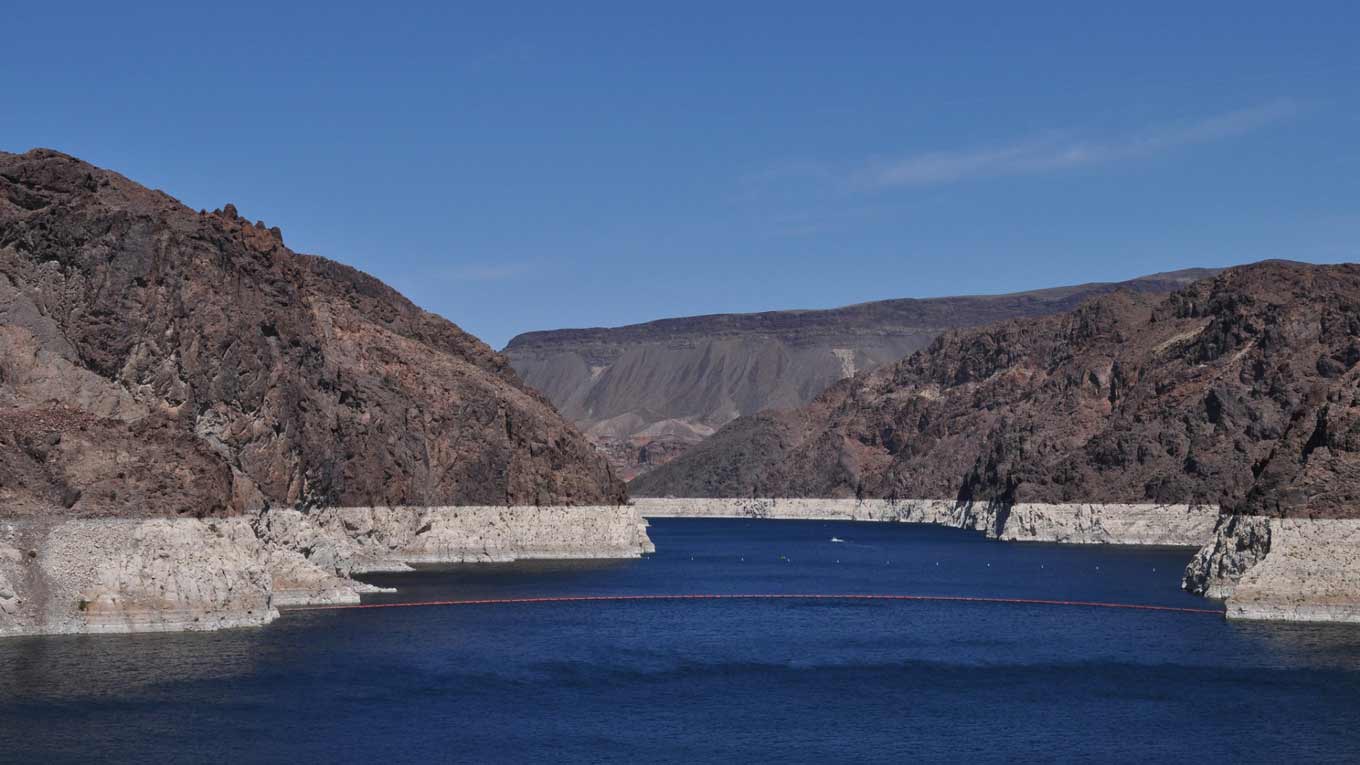
Reservoirs, large and small, allow vast amounts of water to evaporate off their surfaces, and this problem gets worse as temperatures rise.
As just one example, in the drought- and overuse-plagued Colorado River in the southwest, it’s estimated that 10% of the entire flow of the river evaporates every year. Removing dams and storing water in underground aquifers makes water supplies more resilient in a warming world.
9. Climate Resilience
Climate change is intensifying extreme weather including rainfall, floods and melting glaciers. Most dams, large and small, were constructed to withstand a range of weather events that may no longer be the norm. Further, dams need an increasing amount of maintenance and repairs to withstand extreme floods.
Recent massive floods in Libya and India that have caused large-scale dam collapses suggest that dam removal can increase the health and safety of downstream human settlements in the path of climate change.
10. Cooling Effect
As climate change causes the planet to warm, heat waves — especially in urban areas — cause heat stress and deaths. Not only do healthy flowing rivers provide a cooling effect to surrounding urban heat islands, but people increasingly use local rivers to stay cool on hot days. Dam removal ensures that rivers flow and stay cooler, cleaner, and healthier in a climate-changed world.
With more than 91,000 dams in the United States, it’s important to evaluate them all for removal as potential climate solutions. In many cases both mitigation and adaptation can be achieved in one single dam removal event. Few other climate solution projects of this breadth and magnitude exist.
While most other climate solutions involve building some type of structure or facility as a technical solution, dam removal involves tearing a structure down and letting natural ecological processes be restored. Such “nature-based solutions” that decrease the number of dams blocking rivers must be considered in the vast mix responses to the escalating climate crisis.
The opinions expressed above are those of the author and do not necessarily reflect those of The Revelator, the Center for Biological Diversity or their employees.
This story was originally published by The Revelator and reshared with consent.
Tim Robinson, a beloved comedian known for his writing work at “Saturday Night Live” and his oddball Netflix hit “I Think You Should Leave,” is using his distinctive style to take on a topic that doesn’t usually get a lot of laughs: climate change.
In a sketch for Yellow Dot Studios called “You Expect Me To Believe That?” Robinson plays a raucous TV show host “Ted Rack,” who cuts right to the chase.
“I’m sick and tired of scientists telling us mean, bad facts about our world in confusing ways,” he shouts. “So I have folks come on and tell us their terrible message in a way that’s easier to swallow.”
Robinson then proceeds to introduce the audience to his “new show,” which appears to be a parody of “Queer Eye.” He welcomes Henri F. Drake — an ocean and climate scientist at the University of California, Irvine — and gets him some new clothes to make him seem more down-to-earth. Or at least more entertaining.

The whole goal of the humorous PSA is to poke fun at those who continue to ignore the urgent messages scientists share about climate change.
“We helped this scientist make his message easier to swallow for people who don’t want to hear it,” Yellow Dot Studios describes the video. “Like elected leaders.”
Clocking in just over five minutes, the sketch delivers laughs as Robinson embodies his cocky character, filled with side-eyes and aggressive mannerisms.
“So like a normal guy, can you explain to me why I should care about climate change?” Robinson pushes Drake in the clip, crossing his arms confidently.
“The Earth exists in a delicate balance,” Drake begins, with perfectly-timed menacing music.
While the video mocks the idea of “dumbing down” scientific realities, it also does a great job of making the topic more engaging and easier to understand.
That’s exactly the initiative of Yellow Dot Studios, which is a nonprofit production studio founded by Adam McKay. You may know him as the Oscar-winning writer, director, and producer of Netflix’s climate-focused film “Don’t Look Up,” or as a heavy hitter for projects like “The Big Short,” “Anchorman,” “Step Brothers,” and “Succession.”
Using his entertainment savvy to fight back against climate disinformation and inaction, McKay created Yellow Dot to make memorable and entertaining videos about climate change — that are all scientifically accurate.
“By shining a light on the urgency, responsible parties, and scientifically proven solutions, we aim to empower more people to be part of the conversation about what we’re facing and what we can do about it,” the Yellow Dot website explains.
The production studio has also made other videos with actors such as Sarah Hyland and Rainn Wilson and also has a Climate Comedy Cohort who make videos about solutions to cut carbon pollution.
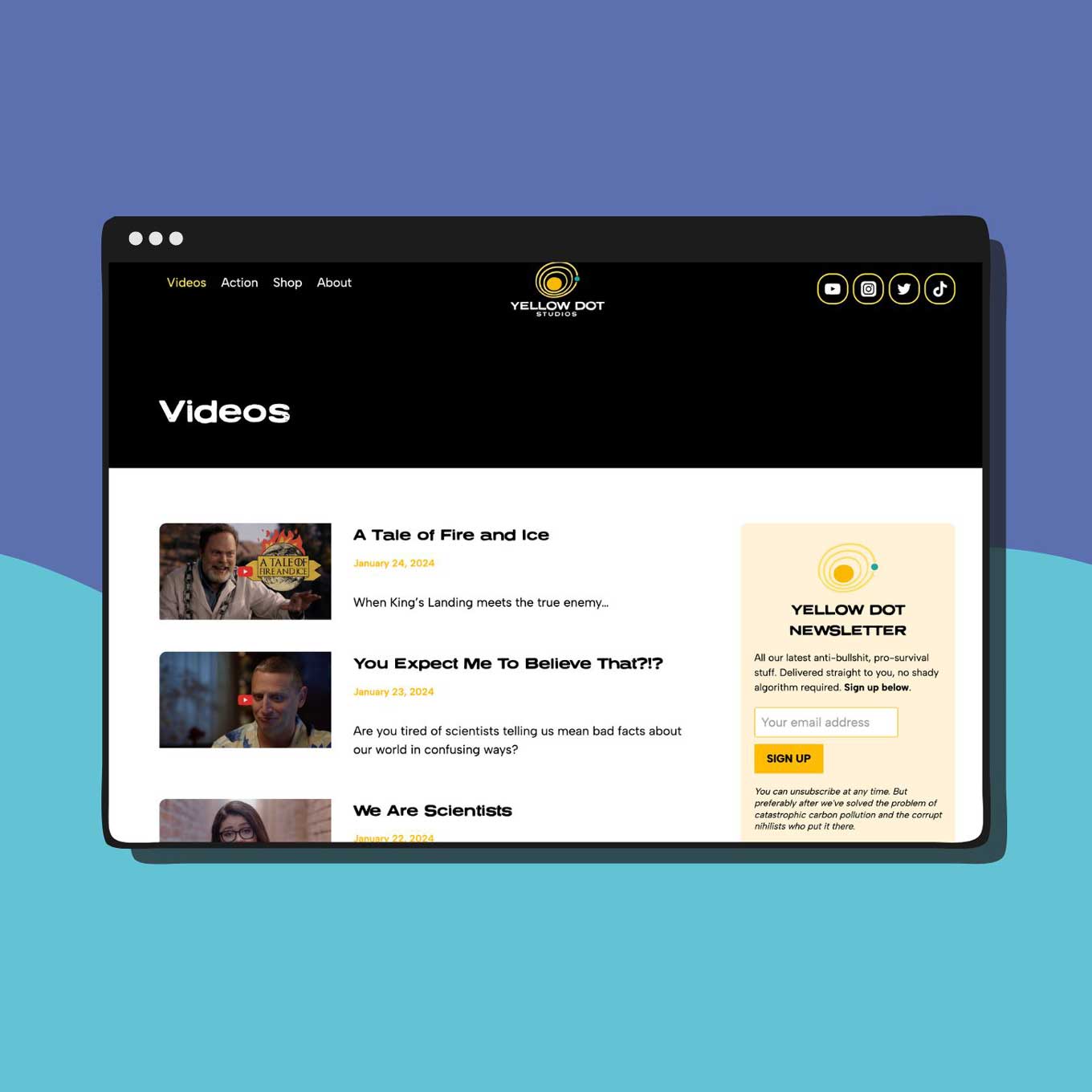
“We aim to support the creatives, organizations, scientists, and individuals who are similarly allied with the cause of continued human existence on Earth,” Yellow Dot’s website continues.
Viewers of Robinson’s video are directed to a hashtag and accompanying webpage: #ImWithScience. This includes resources where people can find climate news, contact their representatives, or join an advocacy group in their communities.
And it already appears to be resonating.
“As much as I am horrified at the prospect of a 1.5 degree increase in global temperatures, this is a remarkably funny Tim Robinson sketch,” one user commented on YouTube.
“This was such a great way to help spread the message,” another chimed in. “Thanks for the creativity!”
“People need to take climate change more seriously, but the messaging we’re getting about it is complicated, confusing, and scary,” another commenter summed up. “Tim’s ability to demonstrate empathy for so many audiences is amazing.”
Header images courtesy of Yellow Dot Studios
Every day the Good Good Good team collects the best good news in the world and shares it with our community. Here are the highlights for this week!
If you want to get good news in your inbox every day, join the Goodnewsletter — the free daily newsletter designed to leave you feeling hopeful.
The Best Positive News We’re Celebrating This Week —
An organization in California is helping immigrant farm workers transition to farm owners
For more than two decades, the Agriculture and Land-Based Training Association (ALBA) in Salinas, California, has been playing a crucial role in empowering farm workers, particularly immigrants from Mexico and Central America, to transition from farm workers to farm owners.
ALBA's comprehensive approach involves offering classes, on-farm training, access to land, equipment, and business support to aspiring organic vegetable farmers. This initiative has received over $15 million in support from federal grants, local and national foundations, and individual donors in the last 20 years, resulting in the launch of more than 220 businesses since 2001.
Participants in the ALBA program initially work part-time on larger farms, gaining essential knowledge and skills through introductory coursework. The program then offers them the opportunity to farm a designated plot of land owned by ALBA, complete with equipment, technical assistance, and a market for their produce through partnerships with local distributors.
This approach has enabled participants to make the challenging transition from farm workers to farm owners, with some even expanding their operations independently.
The group’s impact report indicates that farms nearly triple in acreage on average after leaving ALBA, and most alumni farms exclusively grow organic produce. This shift not only supports sustainable farming practices but also contributes to climate benefits by reducing dependence on fossil fuel-intensive methods.
Why is this good news? Land access is a critical barrier for aspiring farmers, especially young individuals, BIPOC farmers, and immigrants. In this context, ALBA has been a trailblazer in addressing issues of land justice. The program not only imparts education through a year-long course but also facilitates land access and ongoing farm support. Such a comprehensive framework has positioned ALBA as a model for newer farm incubator programs across the country.
California's efforts to address food waste are working
In 2022, consumers and businesses in California generated almost 13 million tons of surplus food, reflecting a 10% decrease from 2016, according to nonprofit ReFED.
The reduction indicates progress in the state's efforts to address food waste, with California implementing regulations requiring residents to sort food scraps into compost-specific bins. State law also mandates recovering 20% of edible food otherwise disposed to landfills for addressing food insecurity, aligning with California's goal of reducing organic waste disposal by 75% by 2025.
Why is this good news? Food waste contributes significantly to landfill input and greenhouse gas emissions — it even has a carbon footprint larger than that of the airline industry. A 10% decrease in surplus food shows that efforts to address food waste, including regulatory measures and public awareness, are working.
A startup is replacing traditional plastic packaging with a seaweed-based alternative
Sway, a California-based startup founded in 2020, is making waves in the sustainability world by addressing the issue of plastic pollution. Recognizing the environmental impact of traditional plastic packaging — particularly the thin, film-like variety that is challenging to replace with eco-friendly alternatives — the company has developed a solution using polymers derived from seaweed.
Co-founded by Julia Marsh, Matt Mayes, and Leland Maschmeyer, the company aims to revolutionize the packaging industry by offering a compostable alternative to thin-film plastic. This innovation comes at a crucial time when plastic pollution has become a global concern, with millions of tons of plastic waste accumulating in landfills and oceans.
According to Plastic Oceans, approximately 180 billion plastic bags are produced annually for storing and protecting clothing, shoes, and accessories. These bags can take up to 1,000 years to decompose. In contrast, Sway's seaweed-based bags biodegrade in just four to six weeks. The seaweed used can also sequester up to 20 times more carbon per acre than trees, according to a Harvard University study.
The company collaborates with ocean farms that cultivate seaweed, ensuring a responsible and sustainable harvesting process. The seaweed, when harvested, is described as being akin to giving the plants a haircut rather than uprooting them, promoting their continued growth.
Importantly, Sway's materials seamlessly integrate into existing supply chains and machinery, eliminating the need for new infrastructure. Marsh emphasizes that the company's focus is on encouraging corporations and brands (the major producers of waste) to adopt their material rather than placing the burden on individual consumers.
Sway is part of a growing trend in the industry, with investments in seaweed-based startups doubling in 2021. Plastic alternatives often face challenges, such as the difficulty of composting corn-based plastic, which requires large amounts of land to grow. Seaweed farms, on the other hand, offer the benefit of creating jobs along coastlines without the need for additional land or fertilizer.
Why is this good news? Sway's commitment to providing a sustainable and functional alternative to traditional plastic packaging demonstrates the potential of seaweed-based materials to address the environmental challenges posed by plastic pollution. As the company continues to gain recognition and pave the way for eco-friendly packaging solutions, it contributes to the broader movement toward a more sustainable and regenerative approach to materials and waste.
A nonprofit is advocating for a holistic approach to combat greenwashing in the fashion industry
Nonprofit organization Collective Fashion Justice is tackling the issue of greenwashing in the fashion industry by advocating for a comprehensive approach known as "total ethics fashion."
With the increasing focus on sustainable fashion, many clothing brands claim to be environmentally friendly, but the reality often falls short. The nonprofit, founded by Emma Håkansson, urges companies to prioritize people, animals, and the planet over profit.
The term "total ethics fashion system," coined by Håkansson, encapsulates the organization's efforts to address the complex challenges posed by harmful practices in the fashion industry. The approach involves considering fair fashion (caring for humans), sustainable fashion (caring for the planet), and vegan fashion (caring for animals).
The nonprofit recognizes that substantial change in the fashion industry requires action at a governmental level. They’ve partnered with the United Nations Environment Programme and participated in creating "The Sustainable Fashion Communication Playbook."
This guide aims to redirect fashion communication toward sustainable and circular solutions, providing a framework for marketers, brand managers, influencers, and media.
While acknowledging the significant impact of large fashion companies, Collective Fashion Justice encourages individuals to take steps toward total ethics fashion.
Education plays a crucial role, and the organization provides resources such as articles and guides on its website, covering the latest news and offering advice on supporting ethical brands.
Why is this good news? Collective Fashion Justice seeks to revolutionize the fashion industry by promoting a total ethics fashion system, encouraging a shift toward a more holistic and ethical approach that considers the interconnected issues of people, the planet, and animals. Through education, awareness, and citizen engagement, the organization aims to combat greenwashing and foster positive change in the fashion industry.
A collective of vegan tech volunteers are utilizing their skills to inspire advocacy within the vegan community
The Vegan Hacktivists, a global collective of volunteers comprising software engineers, designers, data scientists, writers, and strategists, have united with the common goal of leveraging their digital skills for animal protection activism.
Established in 2019, this group collaborates to develop projects and provide guidance to organizations dedicated to the welfare of animals. Their initiatives include Vegan Bootcamp, a website offering free courses to guide users toward adopting a plant-based lifestyle, an interactive Animal Rights Map pinpointing 2,500 local animal rights activist groups globally, and Vegan Linguists, a platform facilitating the translation of vegan content for broader accessibility.
Additionally, they conducted a groundbreaking Tech & Data Study, exploring how the vegan movement employs technology. This comprehensive 50-page report delves into challenges and opportunities while offering recommendations for community members to effectively harness technology in support of their cause.
While the organization initially focused on creating tools and platforms to assist individuals in adopting veganism, it has evolved to provide consulting services for advocates and organizations, aiming to enhance support for the movement. Notably, all services offered by the Vegan Hacktivists are provided free of charge, emphasizing their commitment to ensuring everyone in the movement thrives.
The impact of their work is evident in their accomplishments. In 2022, the organization granted over $56,000 in grant money to individuals and developing organizations, while providing partner organizations with over $620,000 worth of free tech, design, and support services.
Why is this good news? The Vegan Hacktivists not only empower a growing community of individuals concerned about animal welfare and the environment but also strive to simplify the process of taking meaningful action. As they continue to evolve and expand their initiatives, the group envisions a future where their projects contribute significantly to the broader adoption of vegan lifestyles and increased activism for the well-being of animals.
World Central Kitchen reaches milestone of 22 million meals served in Gaza
Amidst the prolonged conflict in Gaza, where violence continues to escalate, World Central Kitchen, led by Chef José Andrés, has achieved a milestone by delivering over 22 million meals.
The dire situation in Gaza has led to over half a million people facing "catastrophic hunger" — equivalent to famine levels — according to the United Nations Relief and Works Agency. Despite the challenges posed by intense fighting and the complexities of aid distribution in the region, WCK has proven resilient in its commitment to providing essential food assistance.
In response to the urgent humanitarian crisis, WCK has undertaken a comprehensive approach, deploying over 800 trucks to the area and establishing 27 kitchens, along with 750 clean cooking stoves. The organization's efforts are concentrated around its Field Kitchen in the city of Rafah, where many Palestinians seek refuge.
Over the course of 100 days, WCK has demonstrated its dedication by serving hot meals and assisting in the construction of kitchens to address the immediate needs of affected families.
Furthermore, WCK has extended its support beyond immediate meal provision by designing ready-to-eat meal kits with ingredients capable of sustaining a family for four days. With an eye on the upcoming Ramadan in March, the culinary team has prepared special boxes, demonstrating foresight and proactive planning to address ongoing and future needs.
Why is this good news? The organization's mission remains steadfast — to reach as many people as possible with nourishment, providing comfort and support in times of crisis. In the midst of violence and escalating tensions, providing essential food assistance to those facing "catastrophic hunger" is a humanitarian effort that addresses an urgent and critical need.
World Central Kitchen's approach to addressing immediate needs, coupled with forward-thinking solutions and global outreach, exemplifies the organization's dedication to making a meaningful impact on the lives of those affected by crises.
An Indian teen invented a device to detect falls and wandering in individuals with Alzheimer's
A 17-year-old Indian teenager named Hemesh Chadalavada has developed an innovative device known as the Alpha Monitor to address the needs of individuals with Alzheimer's disease.
Inspired by his grandmother's experience with Alzheimer's, Chadalavada wanted to create a gadget that could enhance the safety and well-being of those affected by the condition.
The Alpha Monitor is a lightweight and compact device that can be worn as a badge or an armband. It is designed to detect when individuals with Alzheimer's fall or wander, going beyond the capabilities of existing devices.
One notable feature of the Alpha Monitor is its use of long-range technology, which enables it to detect a person over a mile away in cities and three miles in rural areas. This technology surpasses the limitations of devices relying on Wi-Fi or Bluetooth, which lose connection when the person moves out of their limited range.
The device also includes a medication reminder feature, ensuring that individuals take their prescribed medications on time. Chadalavada aims to further enhance his invention by incorporating machine-learning technology to predict a patient's movement patterns.
Chadalavada, a self-proclaimed robotics enthusiast, taught himself about robotics and electronics through YouTube tutorials. To better understand the needs of Alzheimer's patients in India, where an estimated 8.8 million people live with the condition, he spent time at a day center run by the Alzheimer's and Related Disorders Society of India.
In recognition of his groundbreaking work, Chadalavada won a 10 million rupee ($120,000) grant from the Samsung Solve for Tomorrow contest, beating 18,000 entries. Chadalavada hopes to make the device available on the market by this fall.
More good news of the week —
A groundbreaking procedure allows heart repairs to grow with children and holds promise for revolutionizing treatment options. The innovative approach offers a potential long-term solution for children facing heart-related challenges and provides hope to hundreds of pediatric patients with congenital heart disease in the U.S.
A U.S. appeals court has upheld a decision to temporarily block part of a Texas law restricting books in public school libraries. The court's decision was celebrated by bookstores, trade associations, and critics, who argued that the law violates free speech rights, particularly the First Amendment, and imposes onerous conditions on businesses.
A startup is creating customizable dolls specifically designed to represent children with disabilities. The dolls are hand-crafted and assembled in the United States, with a focus on offering more realistic movements and customization options than traditional dolls.
Authors Ann Patchett, Jason Reynolds, and Eric La Salle, in collaboration with audiobook platform Libro.fm, are donating 100% of customer payments for selected audiobooks between January 23 and 25 to Binc. The initiative supports Binc's charitable programs, providing assistance to book and comic sellers facing financial hardships or emergencies.
A Brooklyn-based electric mobility company has celebrated its two-millionth ride in the New York metropolitan area, just six months after reaching its millionth ride milestone. The company operates an all-electric rideshare fleet of over 500 vehicles, offsetting over 9 million pounds of carbon emissions with its two million rides, and employs about 1,500 W2 drivers with guaranteed hourly wages, benefits, and covers vehicle costs.
After a year of the statewide fee on single-use plastic bags in Colorado, the Eco-Cycle recycling center estimates a reduction of up to 1.8 billion plastic bags used in the state in 2023. The collected fees, which are divided between businesses and local governments, fund green initiatives.
During a recent ice storm in Portland, food salvage and redistribution nonprofits stepped in to rescue and repurpose excess food from closed businesses. These organizations, which normally salvage food to prepare free meals, worked through icy conditions to collect larger quantities of food due to restaurant and grocery store closures during the storm; the salvaged food was then distributed to emergency shelters.
After facing decades of criticism, FEMA has announced a major overhaul of its disaster aid system. The changes, set to take effect in late March, include new programs offering rapid cash payments of $750 to victims of federally declared disasters and flexible upfront funding for housing, eliminating red tape such as Small Business Administration loan requirements and pre-existing conditions provisions.
The European Parliament has approved a new law aimed at preventing greenwashing and misleading environmental claims on products. The directive prohibits terms like "environmentally friendly," "biodegradable," and "climate neutral" in advertising or packaging without concrete evidence.
Scientists exploring hydrothermal springs off Costa Rica's Pacific coast have discovered at least four new octopus species. Two octopus nurseries were found during expeditions in 2023, revealing unique biodiversity.
Brian "Head" Welch, guitarist and founding member of Korn, has launched Atlantic Behavioral Health, a mental health treatment center providing intensive outpatient treatment in Massachusetts and New Hampshire. Inspired by his own struggles with depression, Welch aims to create a supportive community through the center, combining individual therapy, group therapy, and medication management to address anxiety, depression, and various mental health disorders.
Canada has granted the Arctic territory of Nunavut control over its mineral resources, including gold, diamonds, iron, cobalt, and rare earth metals. The devolution agreement allows the territory to collect royalties that would otherwise go to the federal government.
A new report suggests that plastic bag bans in the U.S. have been successful in reducing plastic bag use. The study, focusing on five representative policies in New Jersey, Vermont, Philadelphia, Portland, Oregon, and Santa Barbara, California, indicates that plastic bag bans can eliminate nearly 300 single-use plastic bags per person per year.
Miami-Dade County is set to receive nearly $20 million from the EPA to fund the purchase of 50 new electric school buses and 16 fast chargers, bringing the total number of electric buses in the public school district to 100. The funding is part of the EPA's Clean School Bus Program’s Grants Competition, aimed at accelerating the transition to low- and zero-emission vehicles, improving air quality for children, and advancing environmental justice.
New York City Mayor Eric Adams has announced plans to eliminate over $2 billion in medical debt for up to 500,000 residents in partnership with RIP Medical Debt, a nonprofit that buys and forgives medical debt in bulk. The city will allocate $18 million over three years for the debt relief program, which Mayor Adams considers a significant investment in the financial well-being of middle- and working-class New Yorkers.
April is here — signaling the full bloom of spring and bringing a refreshing energy that makes us want to cherish every budding tree and bright, blue sky! It’s a month of Earth’s awakening, new beginnings, and the joyful promise of warmth.
To help you immerse yourself in the beauty of April, we’ve curated a selection of positive and inspiring quotes (and poems) about the fourth month of the year.
And because we’re Good Good Good — we’ve also highlighted the best quotes around April’s awareness holidays and national days — like Earth Day, National Parks Week, Arbor Day, Independent Bookstore Day, and Arab American Heritage Month.
Plus, quotes from influential celebrities and leaders with April birthdays.
Whether you’re reveling in the wonders of nature, celebrating an April birthday, or just seeking a burst of springtime positivity to invigorate your month, these quotes are for you. Scroll all the way through to find some delightful gems.
Here’s to making the most of April!
Explore more monthly quotes: January | February | March | April | May | June | July | August | September | October | November | December
The Best April Quotes
Famous Quotes About April
“No winter lasts forever; no spring skips its turn. April is a promise that May is bound to keep, and we know it.”
— Hal Borland
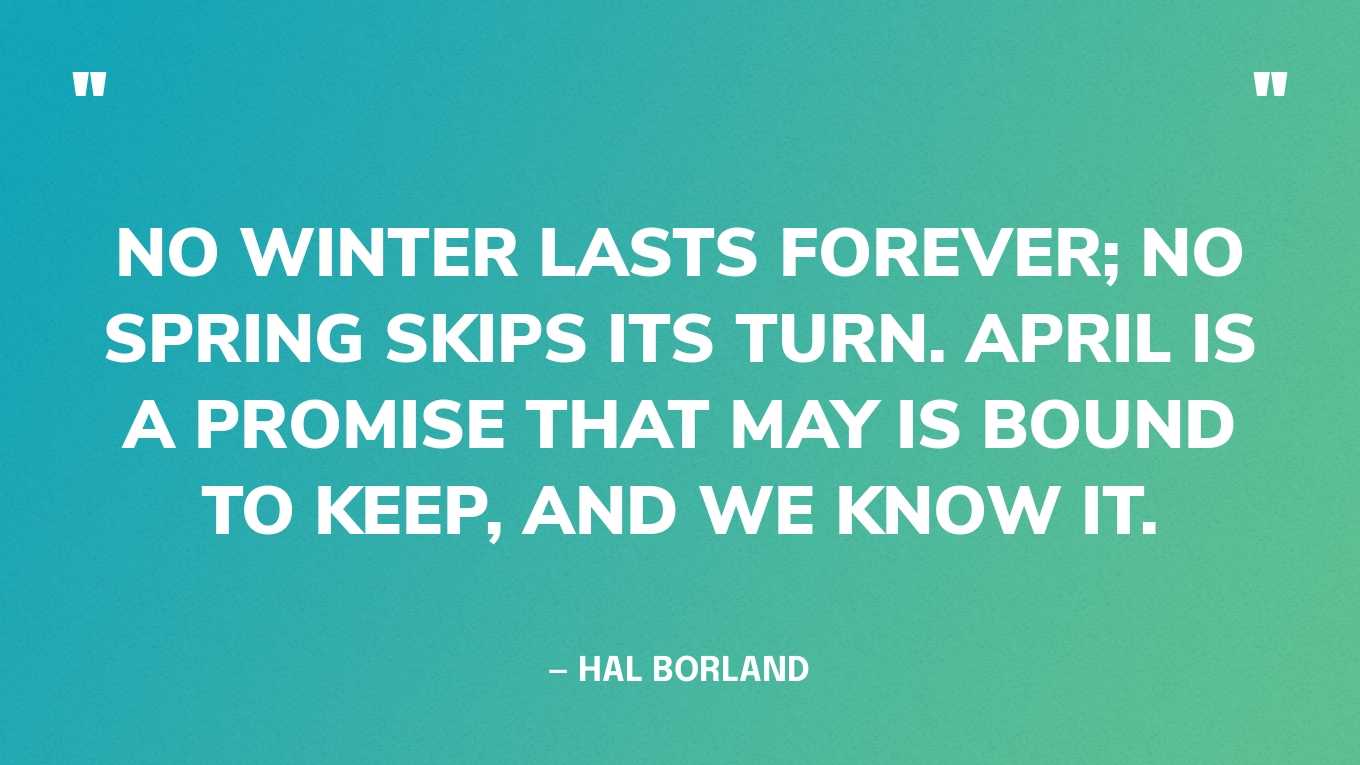
“April is a moment of joy for those who have survived the winter.”
— Samuel Johnson
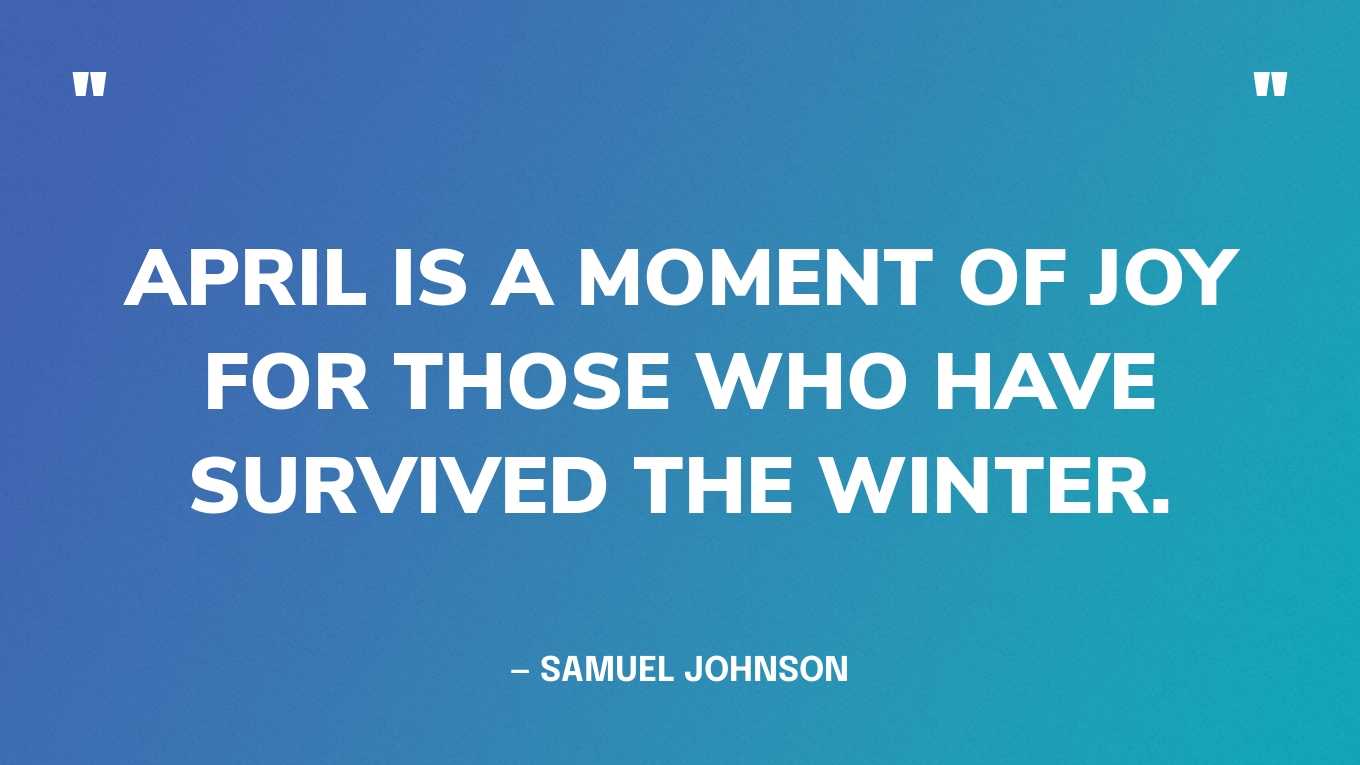
“April is the sweetest month of the year, the mellow season of rebirth and renewal.”
— Mary Sojourner
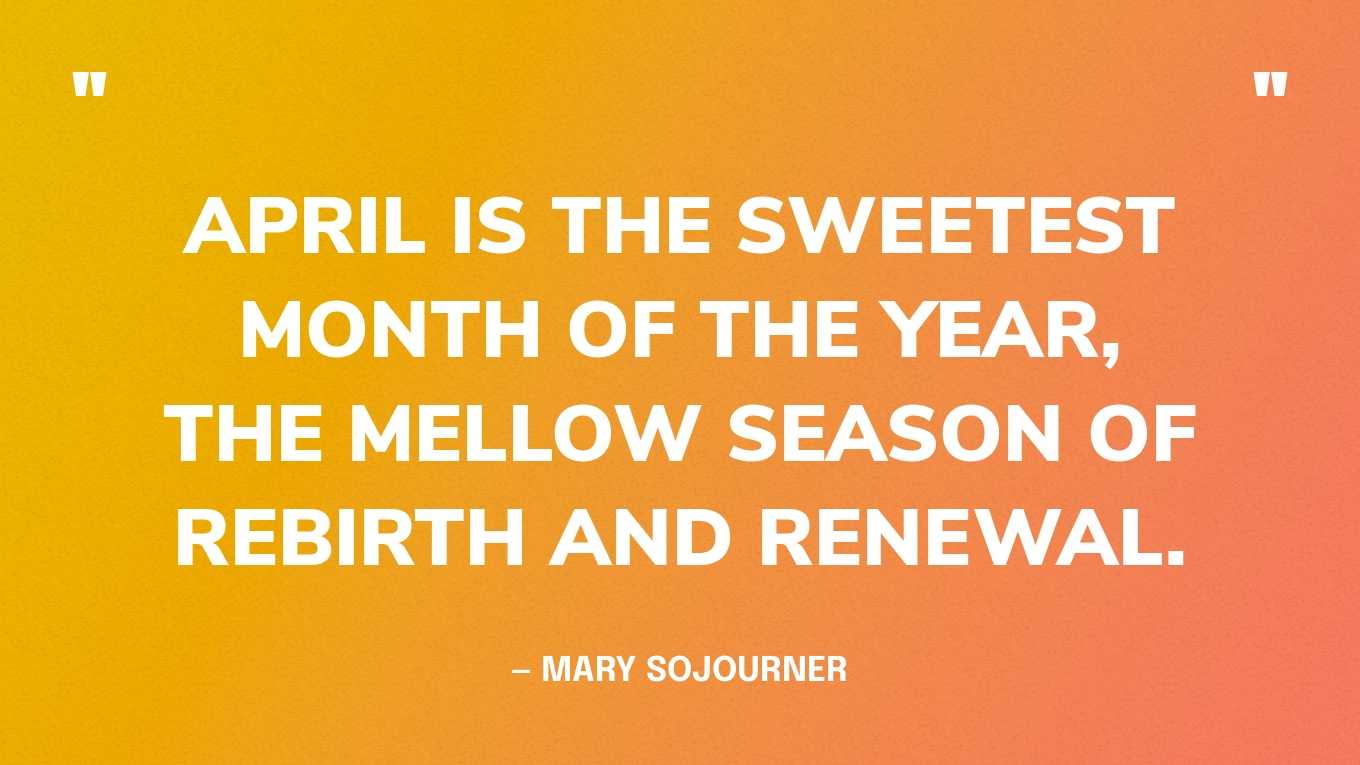
“The first of April is the day we remember what we are the other 364 days of the year.”
— Mark Twain
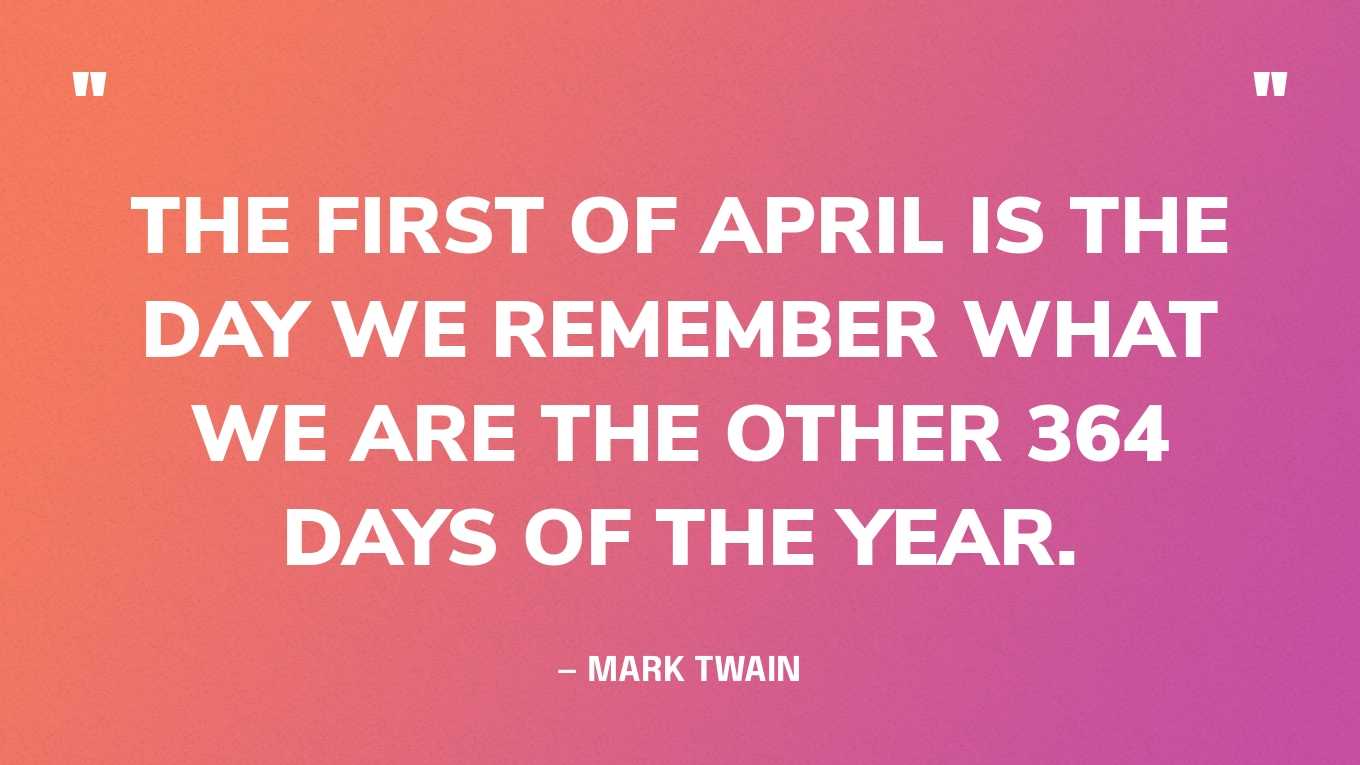
“April is the cruelest month, but also the most necessary for growth.”
— Elizabeth Gray
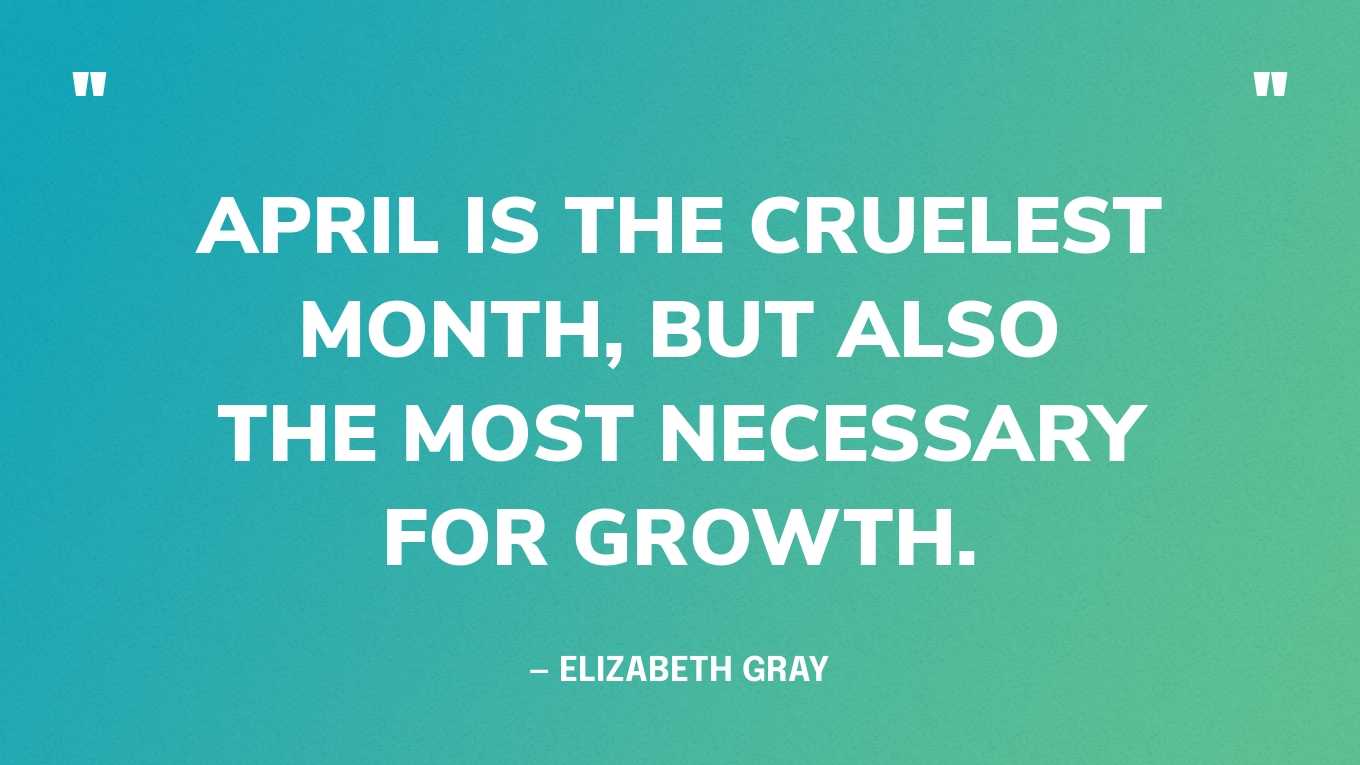
“Winter’s done, and April’s in the skies. Earth, look up with laughter in your eyes!”
— Charles G.D. Roberts
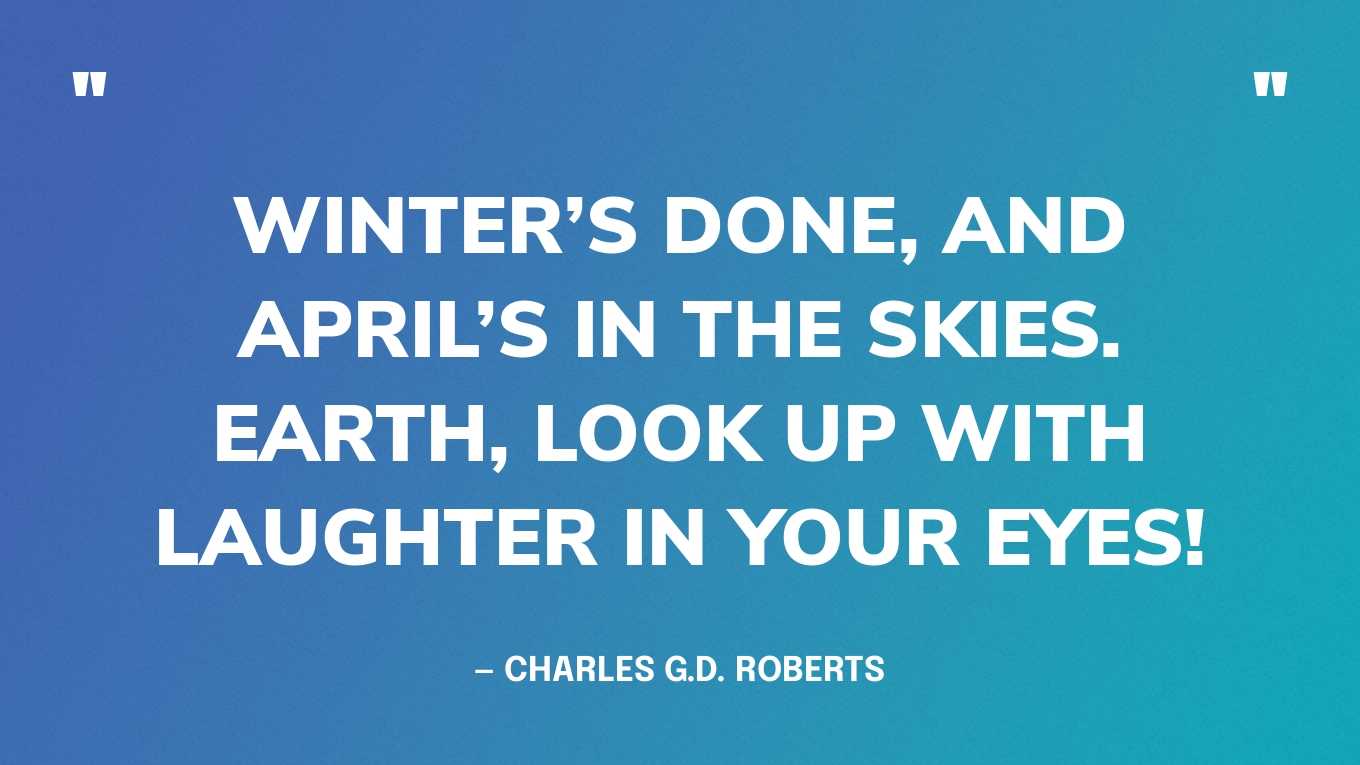
“April hath put a spirit of youth in everything.”
— William Shakespeare, Sonnet XCVIII
Inspirational April Quotes
“April is a reminder that life is a beautiful, ever-renewing cycle.”
— E.E. Cummings
“April is a gentle reminder that life’s transformations are beautiful and inevitable.”
— Ellen Lovell
“April is like a secret whispered in the woods, a hush of green and bustling life.”
— Sarah L. Wildes
“Our spring has come at last with the soft laughter of April suns and shadow of April showers.”
— Byron Caldwell Smith
“April is the month of dreams come true.”
— John Baillie
Quotes for Awareness Holidays in April
A collection of quotes to celebrate April’s awareness months and national days.
→ Explore more of this month’s awareness days in our April calendar
Arab American Heritage Month
April 1 - April 30
“As Arab Americans, we have a responsibility to share our stories, dispel myths, and build bridges of understanding. By doing so, we contribute to a more inclusive and diverse America.”
— Debbie Almontaser
“Arab Americans have a rich heritage, and we have contributed to the cultural and intellectual fabric of the United States. Embracing our heritage and sharing our stories is essential for fostering understanding and breaking down stereotypes.”
— Moustafa Bayoumi
“We celebrate #AAHM by acknowledging monumental contributions Arab Americans have made to this country. Our resilient family values, strong work ethic, dedication to education, & diversity in faith that strengthens America & its democracy.”
— Rashida Tlaib, in a tweet
→ Read about how to celebrate Arab American Heritage Month
National Parks Week
April 20 - April 28
“That is all the National Parks are about. Use, but do no harm.”
— Wallace Stegner
“In a world that is becoming increasingly virtual, the parks remain places of visceral beauty. Places where we can remember that we are but a small part of the life on this planet, and that it is a truly wonderful planet and the only one we’ve got.”
— Nevada Barr
“National parks and reserves are an integral aspect of intelligent use of natural resources. It is the course of wisdom to set aside an ample portion of our natural resources as national parks and reserves, thus ensuring that future generations may know the majesty of the earth as we know it today.”
— John F. Kennedy
→ Explore more National Parks quotes
Earth Day
April 22
“Earth Day should encourage us to reflect on what we are doing to make our planet a more sustainable and livable place.”
— Scott Peters
“Avoiding climate breakdown will require cathedral thinking. We must lay the foundation while we may not know exactly how to build the ceiling.”
— Greta Thunberg
“These young people are saying we all have a right to know what is in the air we breathe, in the water we drink, and the food we eat. It is our responsibility to leave this planet cleaner and greener. That must be our legacy.”
— John Lewis
→ Explore more Earth Day quotes
→ Read about how to celebrate Earth Day
Arbor Day
April 26
“Arbor Day is not like other holidays. Each of those reposes on the past, while Arbor Day proposes for the future.”
— Julius Sterling Morton
“Ancient trees are precious. There is little else on Earth that plays host to such a rich community of life within a single living organism.”
— Sir David Attenborough
“We need to protect our forests to protect all of life.”
— Samantha Lynch
→ Explore more tree quotes
Independent Bookstore Day
Last Saturday in April
“The truly wide taste in reading is that which enables a man to find something for his needs on the sixpenny tray outside any secondhand bookshop.”
— C.S. Lewis, The Four Loves
“But here, none too soon, are the second-hand bookshops. Here we find anchorage in these thwarting currents of being; here we balance ourselves after the splendours and miseries of the streets.”
— Virginia Woolf, Street Haunting: A London Adventure
“You cannot invent an algorithm that is as good at recommending books as a good bookseller, and that’s the secret weapon of the bookstore — is that no algorithm will ever understand readers the way that other readers can understand readers.”
— John Green
→ Read about how to celebrate Independent Bookstore Day
→ Explore more quotes about books and reading
Quotes from Inspiring People with April Birthdays
Jane Goodall
April 3
“To reconnect with nature is key if we want to save the planet.”
— Jane Goodall
“Each one of us must take responsibility for our own lives, and above all, show respect and love for living things around us, especially each other.”
— Jane Goodall
“I do have reasons for hope: our clever brains, the resilience of nature, the indomitable human spirit, and above all, the commitment of young people when they’re empowered to take action.”
— Jane Goodall
→ Read about the new holiday honoring Jane Goodall
→ Explore more Jane Goodall quotes
Maya Angelou
April 4
“No matter what happens, or how bad it seems today, life does go on, and it will be better tomorrow.”
— Maya Angelou
“Love life. Engage in it. Give it all you’ve got. Love it with a passion because life truly does give back, many times over, what you put into it.”
— Maya Angelou
“I believe that the most important single thing, beyond discipline and creativity is daring to dare.”
— Maya Angelou
→ Explore more Maya Angelou quotes
Emma Watson
April 15
“If you truly pour your heart into what you believe in, even if it makes you vulnerable, amazing things can and will happen.”
— Emma Watson
“I’m willing to be seen. I’m willing to speak up. I’m willing to keep going. I’m willing to listen to what others have to say. I’m willing to go to bed each night at peace with myself. I’m willing to be my biggest bestest most powerful self.”
— Emma Watson
“Don’t expect change to happen overnight, even if it’s not always visible it’s making more impact than you think.”
— Emma Watson
→ Explore Emma Watson’s favorite books about climate change
Coretta Scott King
April 27
“Struggle is a never-ending process. Freedom is never really won, you earn it and win it in every generation.”
— Coretta Scott King
“It doesn’t matter how strong your opinions are. If you don’t use your power for positive change, you are, indeed, part of the problem.”
— Coretta Scott King
“When you are willing to make sacrifices for a great cause, you will never be alone.”
— Coretta Scott King
→ Explore more Coretta Scott King quotes
April Poems
“Sweet April showers
Do bring May flowers.”
— Thomas Tusser, Five Hundred Good Points of Husbandry
“A gush of bird-song, a patter of dew
A cloud, and a rainbow’s warning
Suddenly sunshine and perfect blue
An April day in the morning.”
— Harriet Prescott Spofford
“The sun was warm but the wind was chill
You know how it is with an April day
When the sun is out and the wind is still
You’re one month on in the middle of May.”
— Robert Frost
“April is the cruelest month, breeding
lilacs out of the dead land, mixing
memory and desire, stirring
dull roots with spring rain.”
— T.S. Eliot, The Waste Land and Other Poems
“Every tear is answered by a blossom
Every sigh with songs and laughter blent
April-blooms upon the breezes toss them
April knows her own, and is content.”
— Susan Coolidge
“The April winds are magical
And thrill our tuneful frames
The garden-walks are passional
To bachelors and dames.”
— Ralph Waldo Emerson
“I have seen the Lady April bringing
the daffodils,
Bringing the springing grass and the
soft warm April rain.”
— John Masefield
“For April sobs while these are so glad
April weeps while these are so gay
Weeps like a tired child who had
Playing with flowers, lost its way.”
— Helen Hunt Jackson
“There is no glory in star or blossom till looked upon by a loving eye; There is no fragrance in April breezes till breathed with joy as they wander by.”
— William Cullen Bryant
“I smile, of course,
And go on drinking tea,
Yet with these April sunsets, that somehow recall
My buried life, and Paris in the Spring,
I feel immeasurably at peace, and find the world
To be wonderful and youthful, after all.”
— Henry James, The Portrait of a Lady
Funny April Quotes
“April prepares her green traffic light and the world thinks, ‘Go!’”
— Christopher Morley
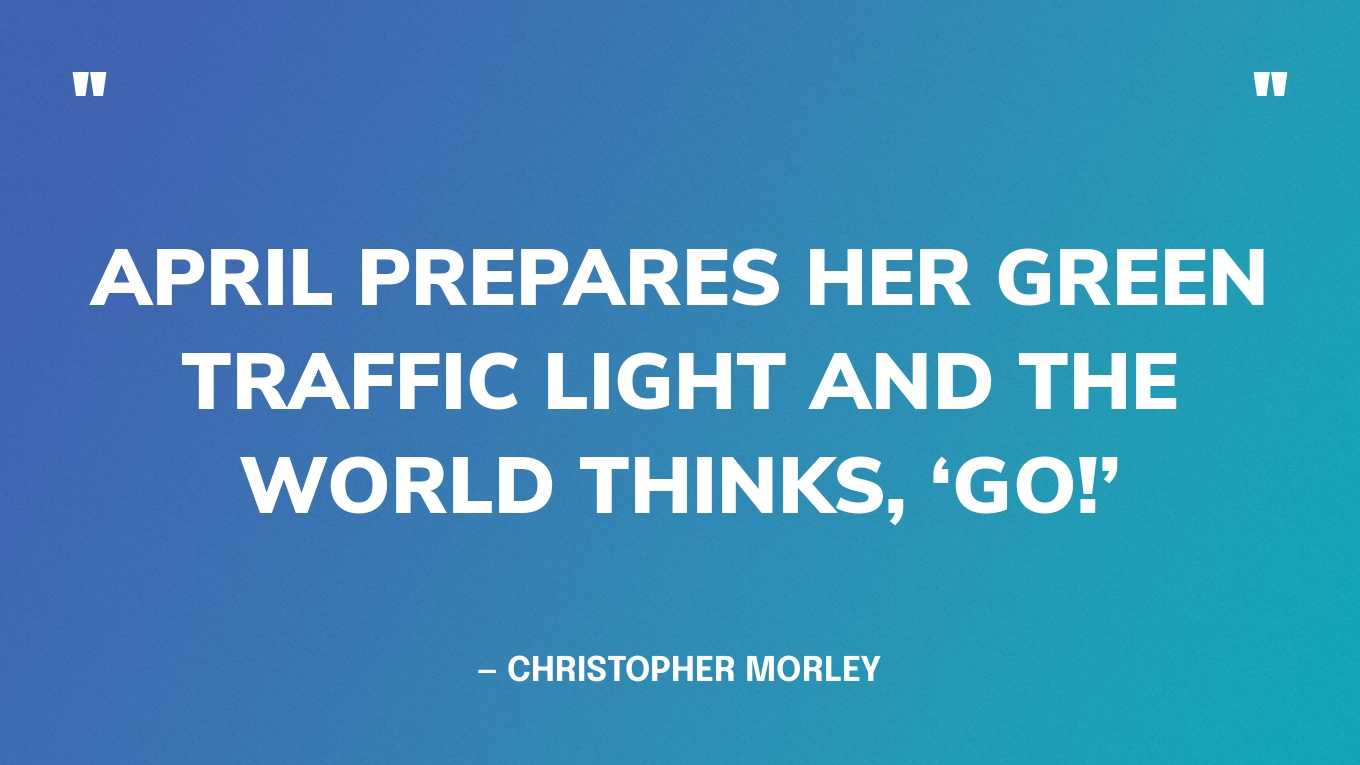
“Men are April when they woo, December when they wed.
Maids are May when they are maids, but the sky changes when they are wives.”
— William Shakespeare
“Here cometh April again, and as far as I can see the world hath more fools in it than ever.”
— Charles Lamb
“April fool (noun): The March fool with another month added to his folly.”
— Ambrose Bierce
“Snow in April is abominable, like a slap in the face when you expected a kiss.”
— L.M. Montgomery, Anne of Ingleside
Short April Quotes
“April, the angel of the months, the young love of the year.”
— Vita Sackville-West
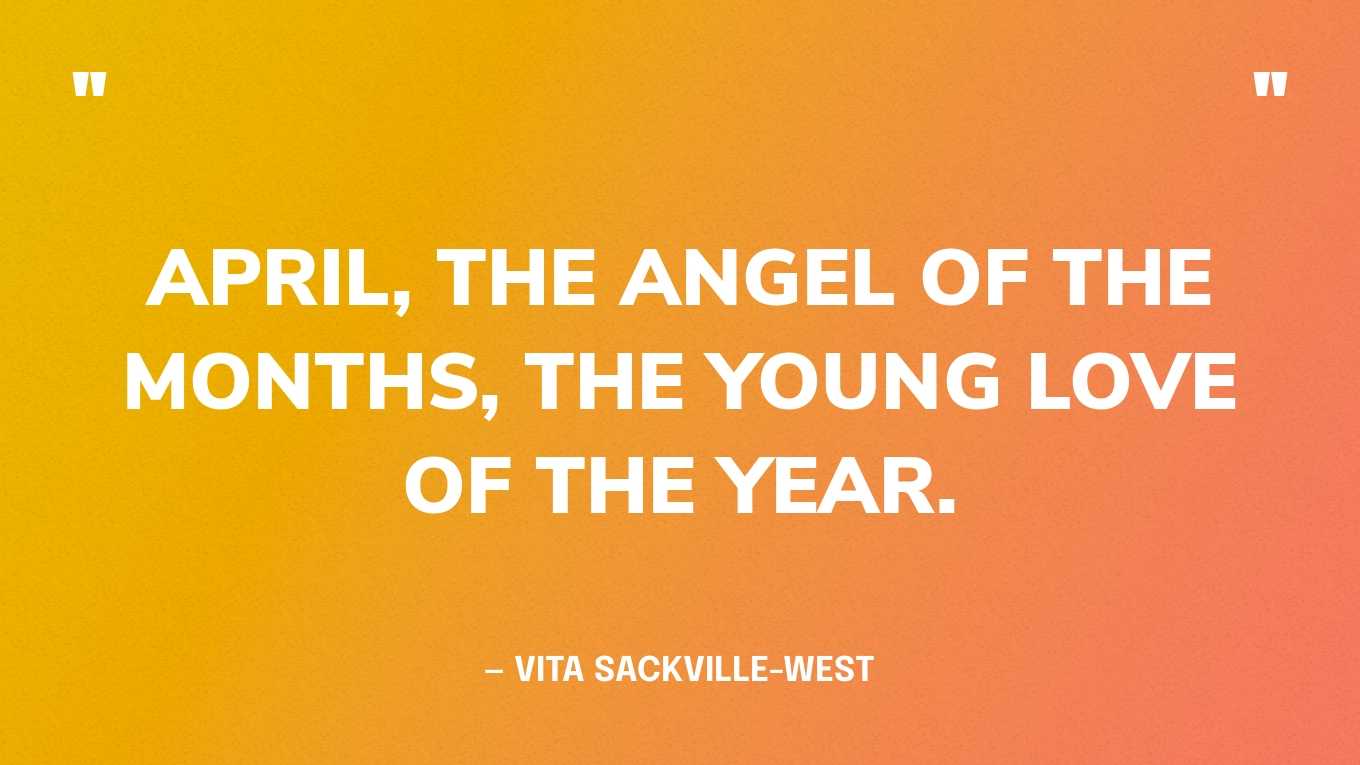
“Shining through tears, like April suns in showers, that labour to overcome the cloud that loads ’em.”
— Thomas Otway
“April splinters like an ice palace.”
― Ruth Stone
“April, come she will.”
— Simon & Garfunkel
“If April showers should come your way, they bring the flowers that bloom in May.”
— Buddy de Sylva
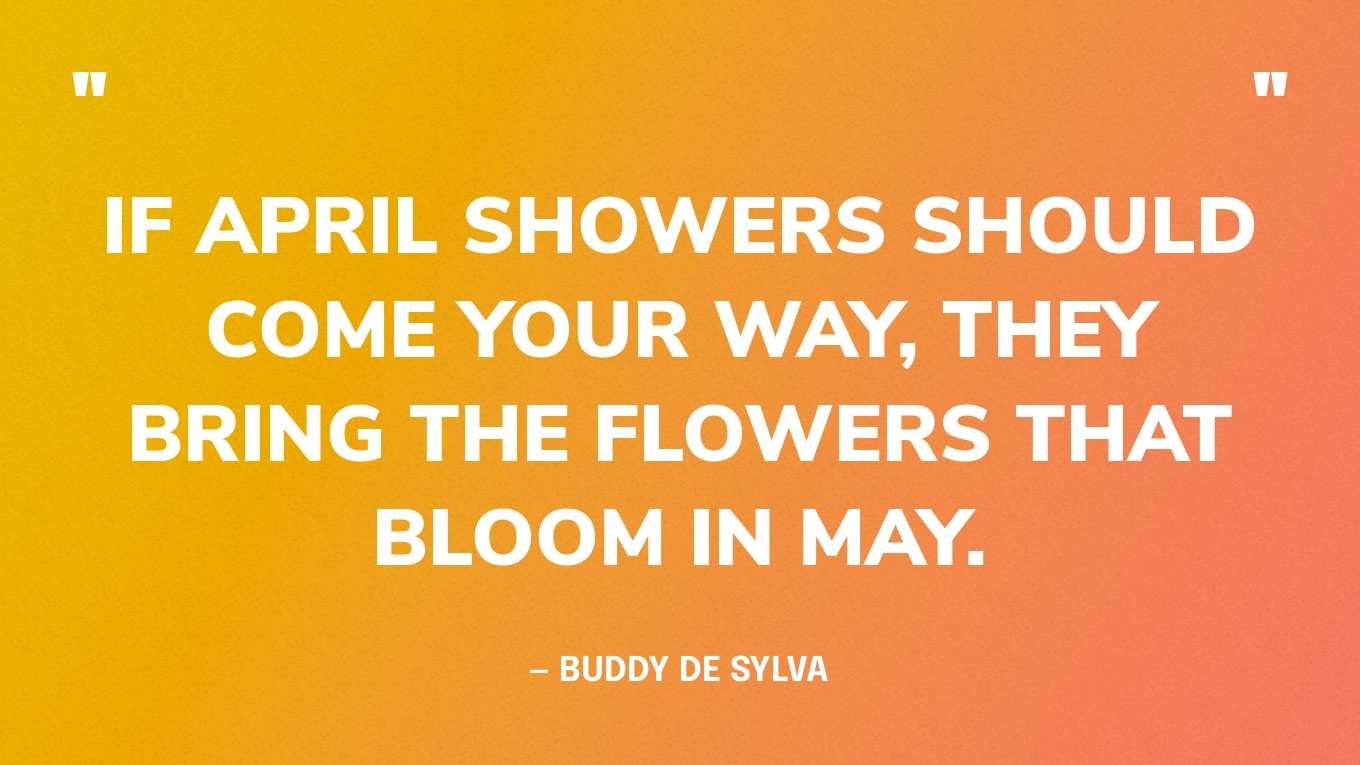
“April is the gateway to the joys of summer.”
— Fennel Hudson
“Today has been a day dropped out of June into April.”
— L.M. Montgomery, Anne of Windy Poplars
“I shine in tears like the sun in April.”
— Cyril Tourneur
“In the April of life, the days are sweet and fragrant.”
— Sarah Dessen
“Calmly we walk through this April’s day”
— Delmore Schwartz
“But it is a sort of April-weather life that we lead in this world. A little sunshine is generally the prelude to a storm.”
— William Cowper
“Oh, the lovely fickleness of an April day!”
— W. H. Gibson
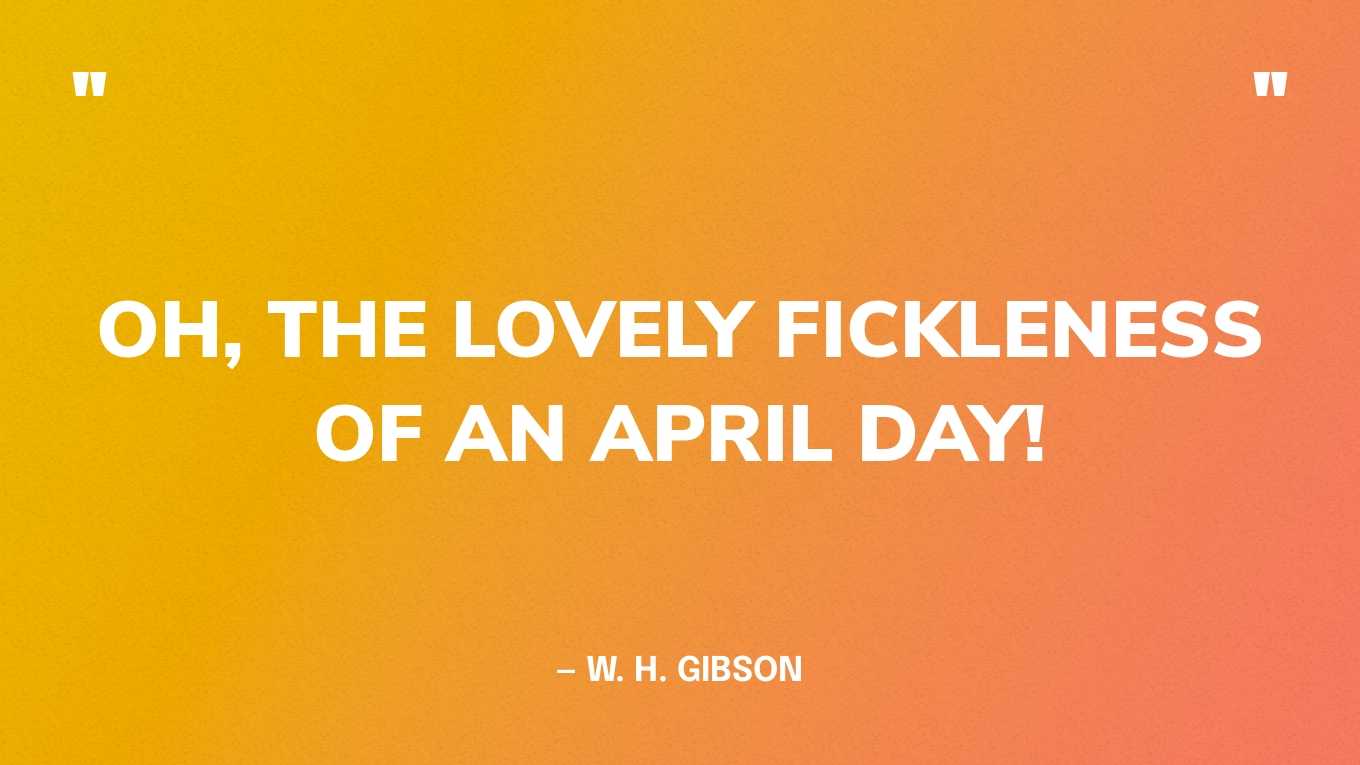
→ Explore more short quotes
More April Quotes
“April was just beginning, and after the warm spring day it turned cooler, slightly frosty, and a breath of spring could be felt in the soft, cold air.”
— Anton Chekov, Short Stories
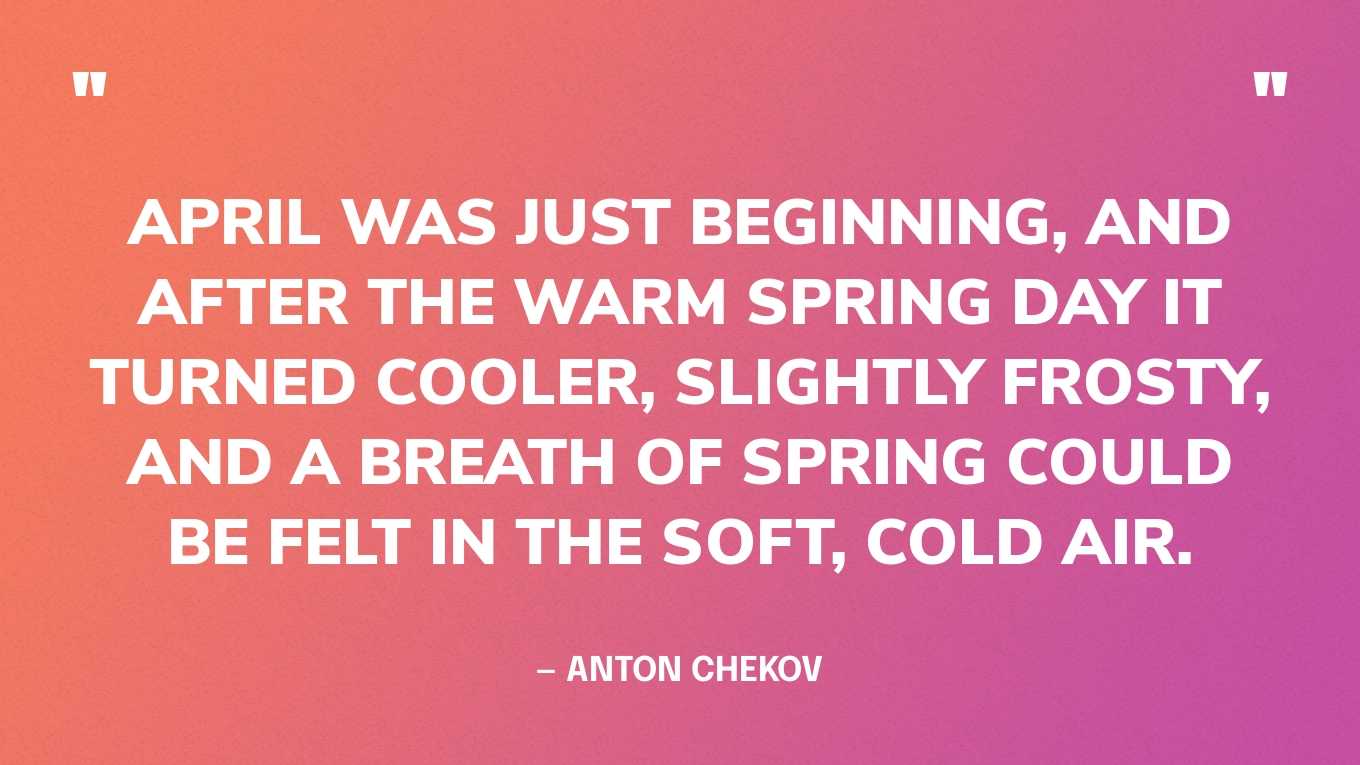
“They came on one of April’s most brilliant days — a day as sparkling as a newly-washed lemon — a day when even the shadows were a melange of blue and orange and jade, like the shadows that poured from the tipsy brush of Monet.”
— Beverley Nichols
“Aprils have never meant much to me, autumns seem that season of beginning, spring.”
— Truman Capote
“One never knows the idyllic charm of our northern woods who has not seen them in April, when it is all a feast of birds and buds and waking life.”
— Fannie Hardy Eckstorm, The Penobscot Man
“Spring is made of solid, fourteen-karat gratitude, the reward for the long wait. Every religious tradition from the northern hemisphere honors some form of April hallelujah, for this is the season of exquisite redemption, a slam-bang return to joy after a season of cold second thoughts.”
— Barbara Kingsolver, Animal, Vegetable, Mineral: Ethics and Objects
“When April came with sunshine. And showers and lilac bloom, my heart with sudden gladness. was like a fragrant room.”
— Bliss Carman
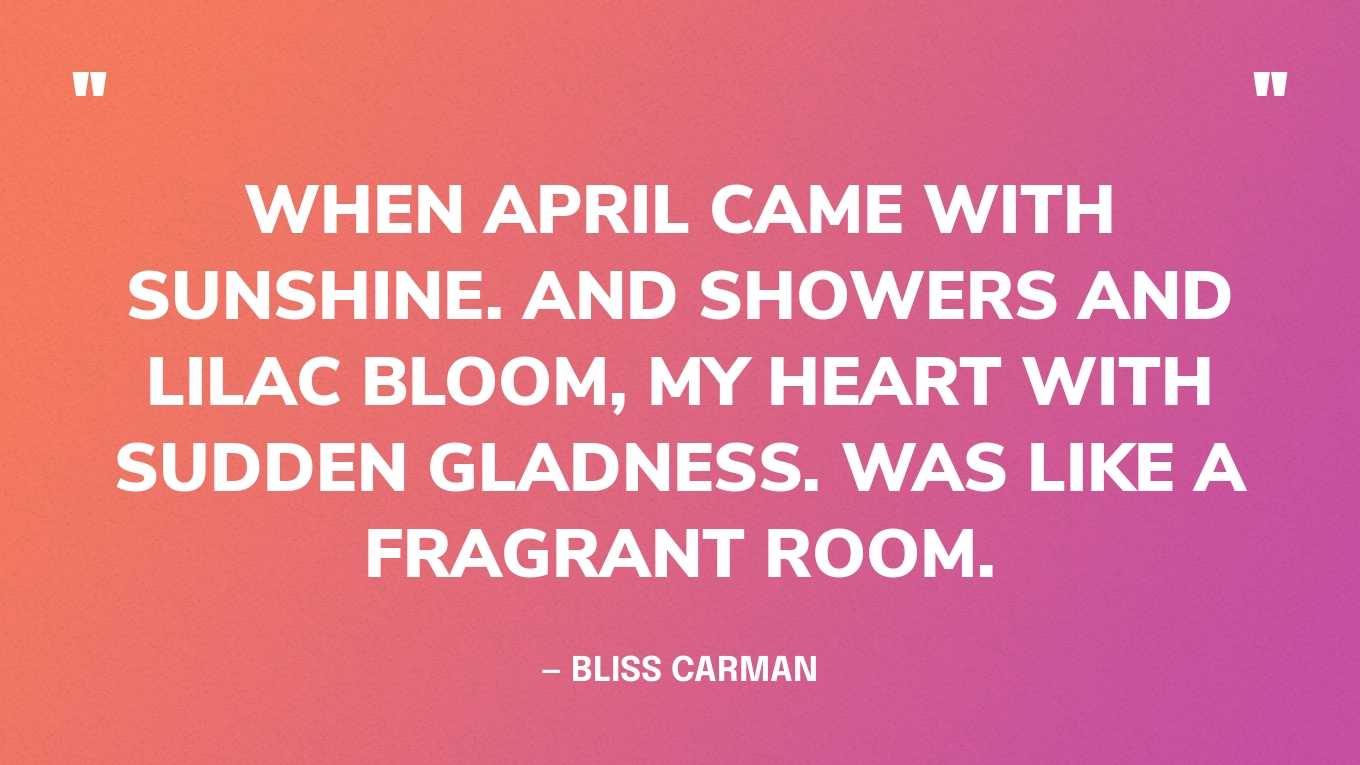
May is here — blooming with the full splendor of spring and radiating an uplifting energy that encourages us to relish every blossoming tree and bright, sunny day! It’s a month of colorful renewal, continued growth, and the heartwarming promise of sunny days ahead.
To help you indulge in the charm of May, we’ve curated a selection of positive and inspiring quotes (and poems) about the fifth month of the year.
And because we’re Good Good Good — we’ve also spotlighted the best quotes around May’s awareness days and national celebrations — like AAPI Heritage Month, Mental Health Awareness Month, Jewish American Heritage Month, Teacher Appreciation Week, 143 Day, and Mother’s Day.
Plus, quotes from inspirational celebrities and leaders with May birthdays.
Whether you’re reveling in the beauty of spring’s peak, celebrating a May birthday, or just seeking a dose of positivity and inspiration to brighten your month, these quotes are for you. Scroll all the way through to find some enchanting gems.
Here’s to making the most of May!
Explore more monthly quotes: January | February | March | April | May | June | July | August | September | October | November | December
The Best May Quotes
Famous Quotes About May
“May is the month of expectation, the month of wishes, the month of hope.”
— Emily Brontë
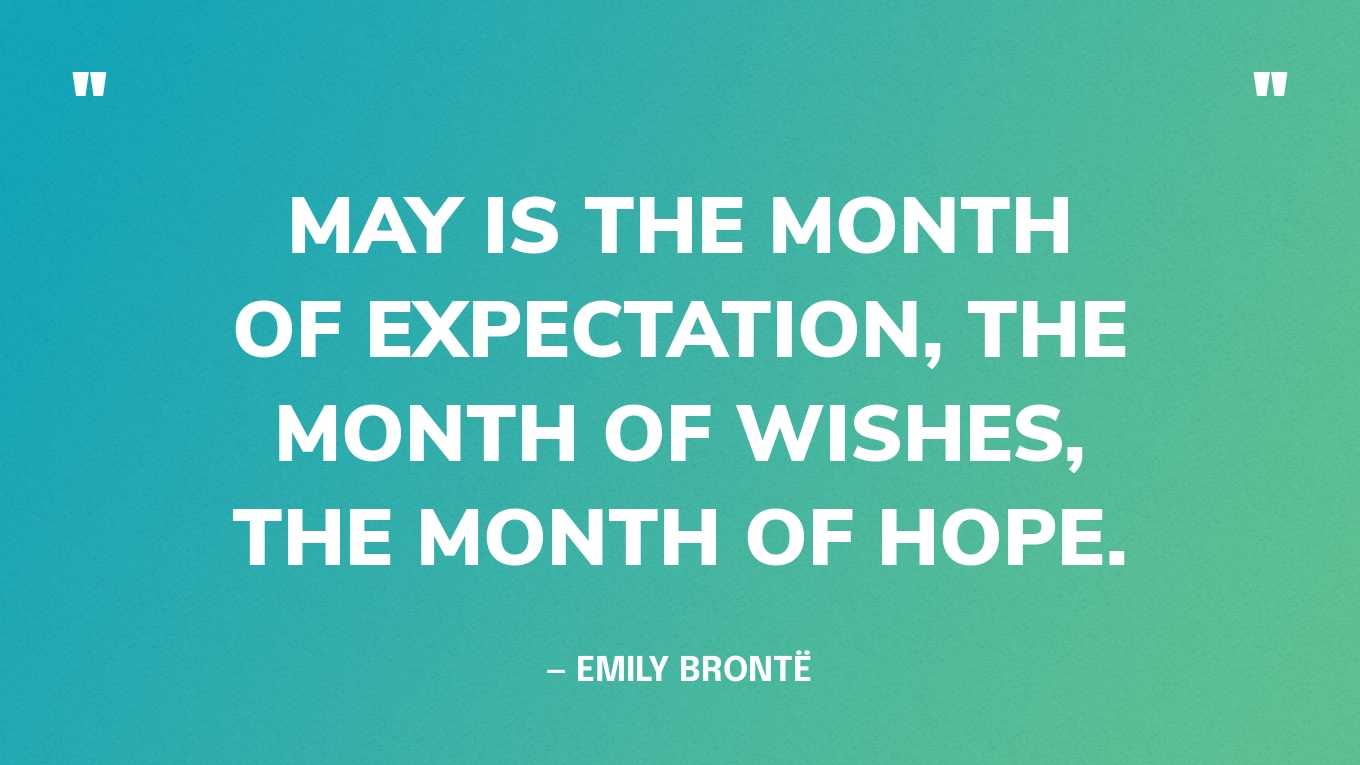
“As full of spirit as the month of May, and as gorgeous as the sun in Midsummer.”
— William Shakespeare
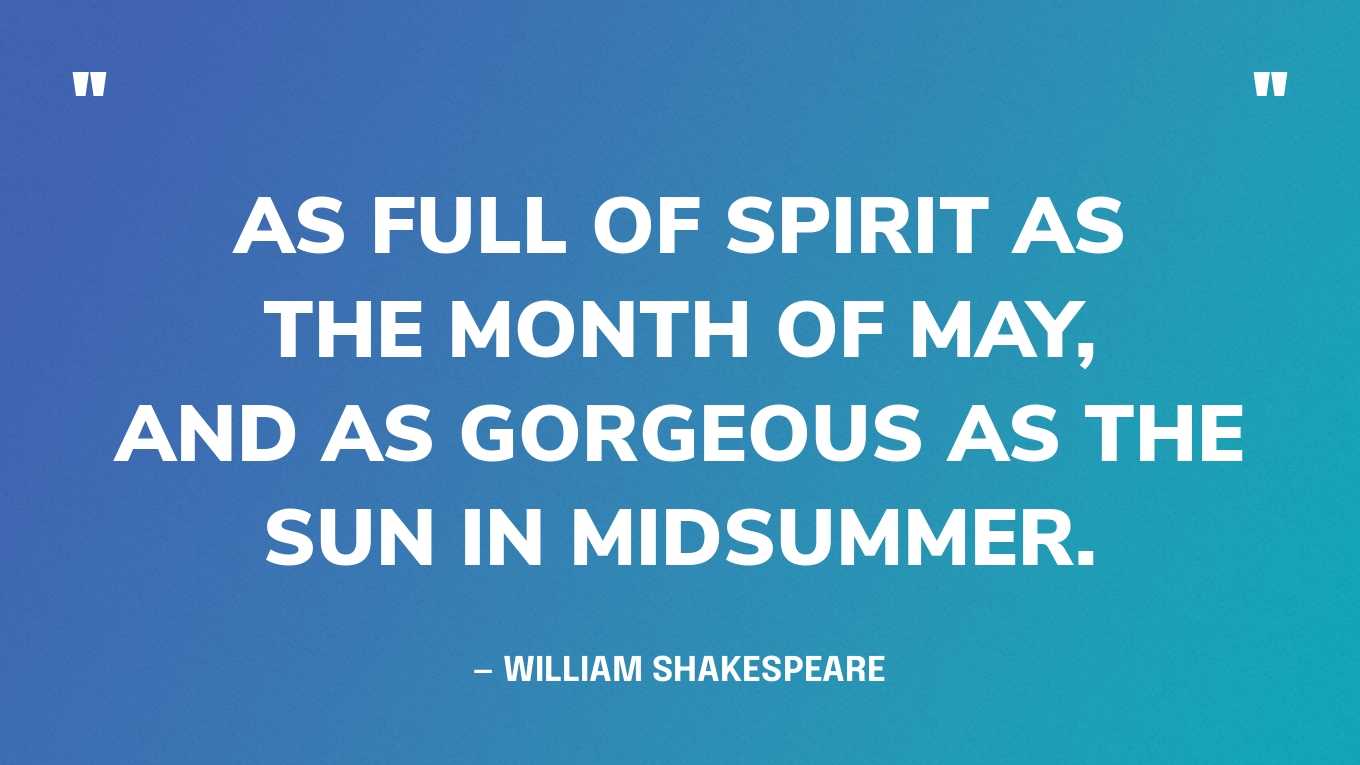
“Another May new buds and flowers shall bring: Ah! why has happiness no second Spring?”
— Charlotte Smith
“The month of May has come, when every lusty heart beginneth to blossom, and to bring forth fruit.”
— Thomas Malory
“My heart is light with May!
The sky is soft; the coming birds
Are silent on their way.”
— Mary Mapes Dodge
“Sweet May hath come to love us. Flowers, trees, their blossoms don.”
— Heinrich Heine
“May is the most beautiful month of the year, a month alive with warm color. The flowers and trees are in full bloom, and even the sun joins this rhapsody be emitting warmer rays.”
— Lillian Berliner, And The Month Was May: A Memoir
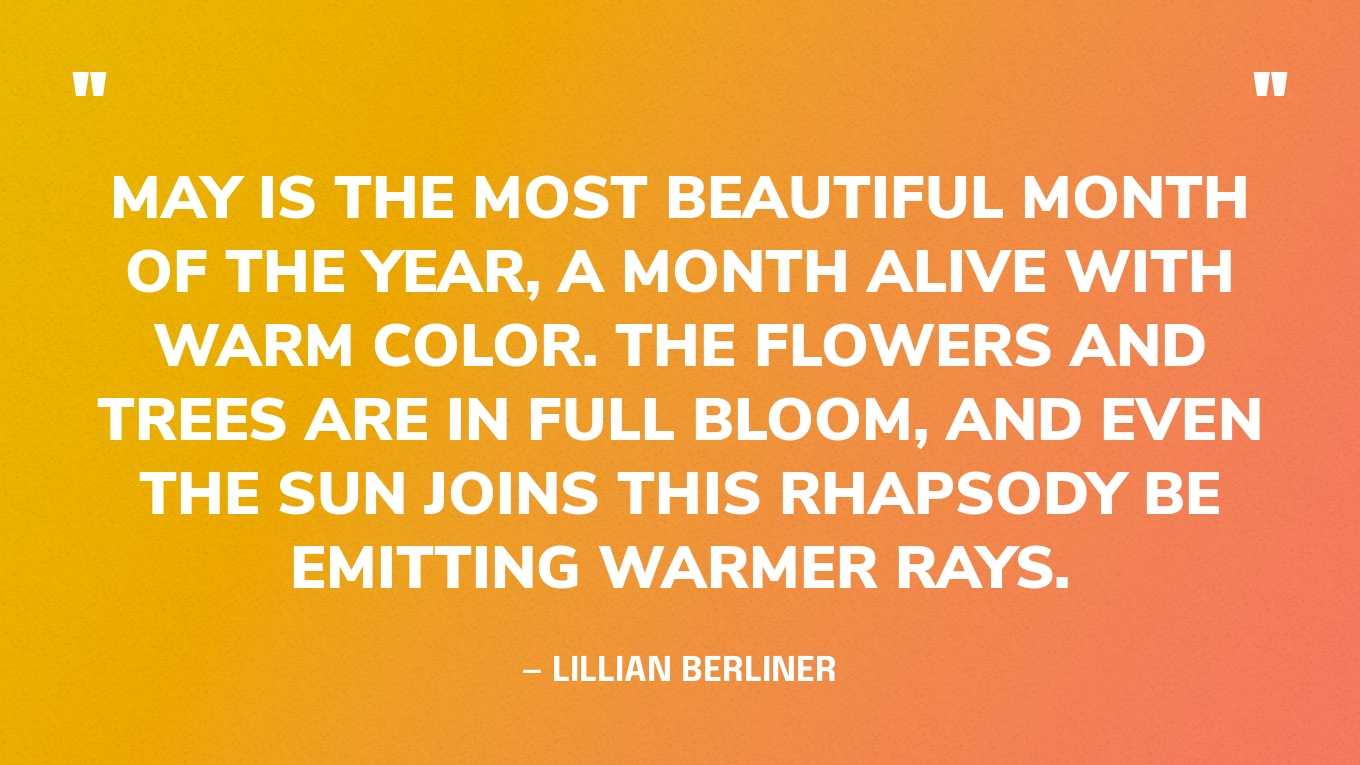
“Among the changing months, May stands confest the sweetest, and in fairest colors dressed.”
— James Thomson
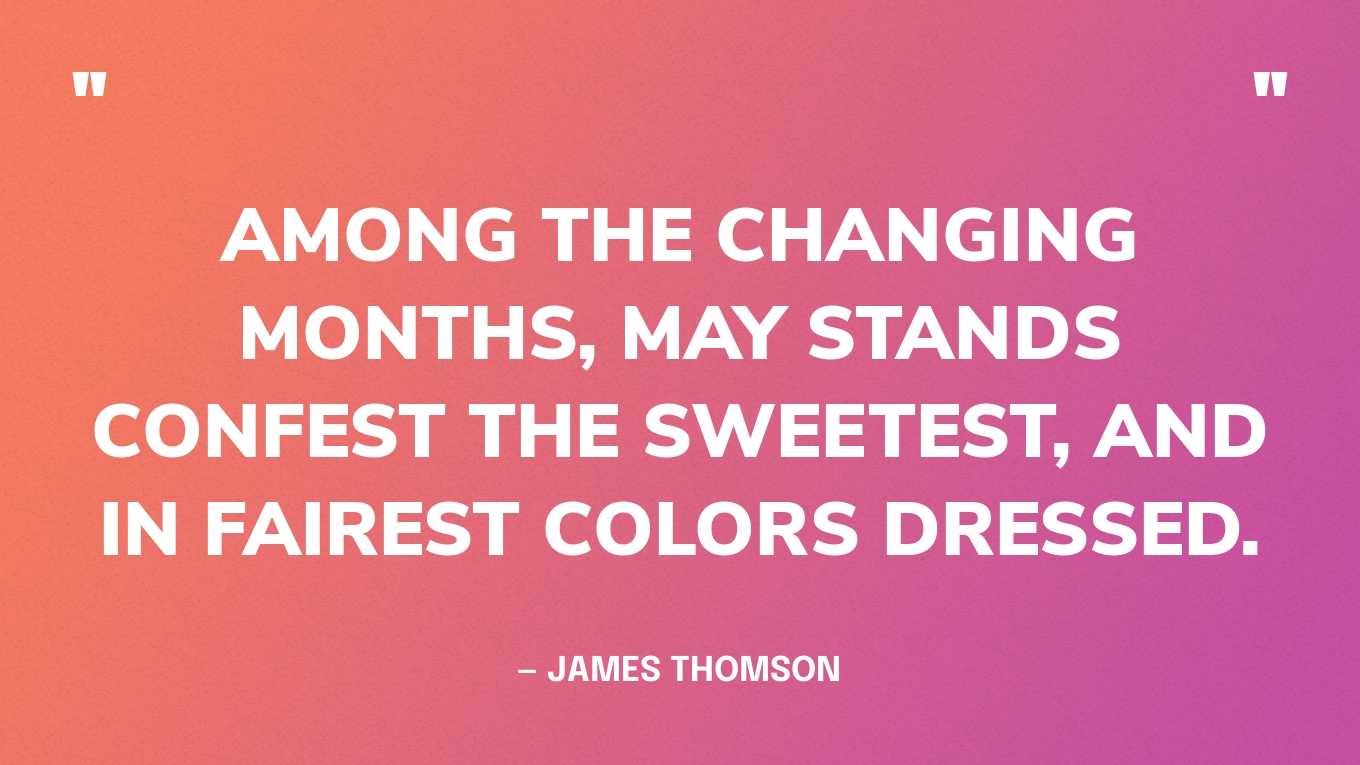
Inspirational May Quotes
“Then you have to remember to be thankful; but in May one simply can’t help being thankful that they are alive, if for nothing else.”
— L. M. Montgomery
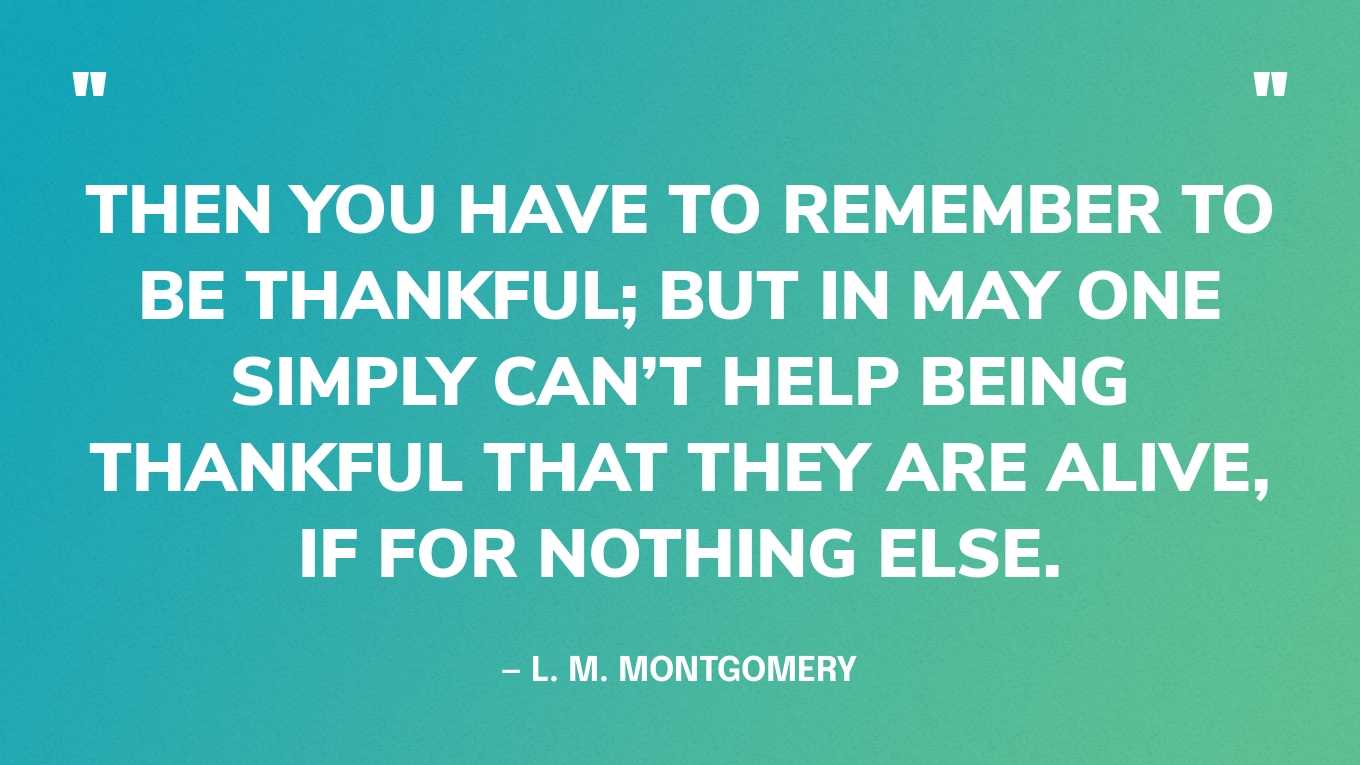
“I thought that spring must last forevermore; For I was young and loved, and it was May.”
— Vera Brittain
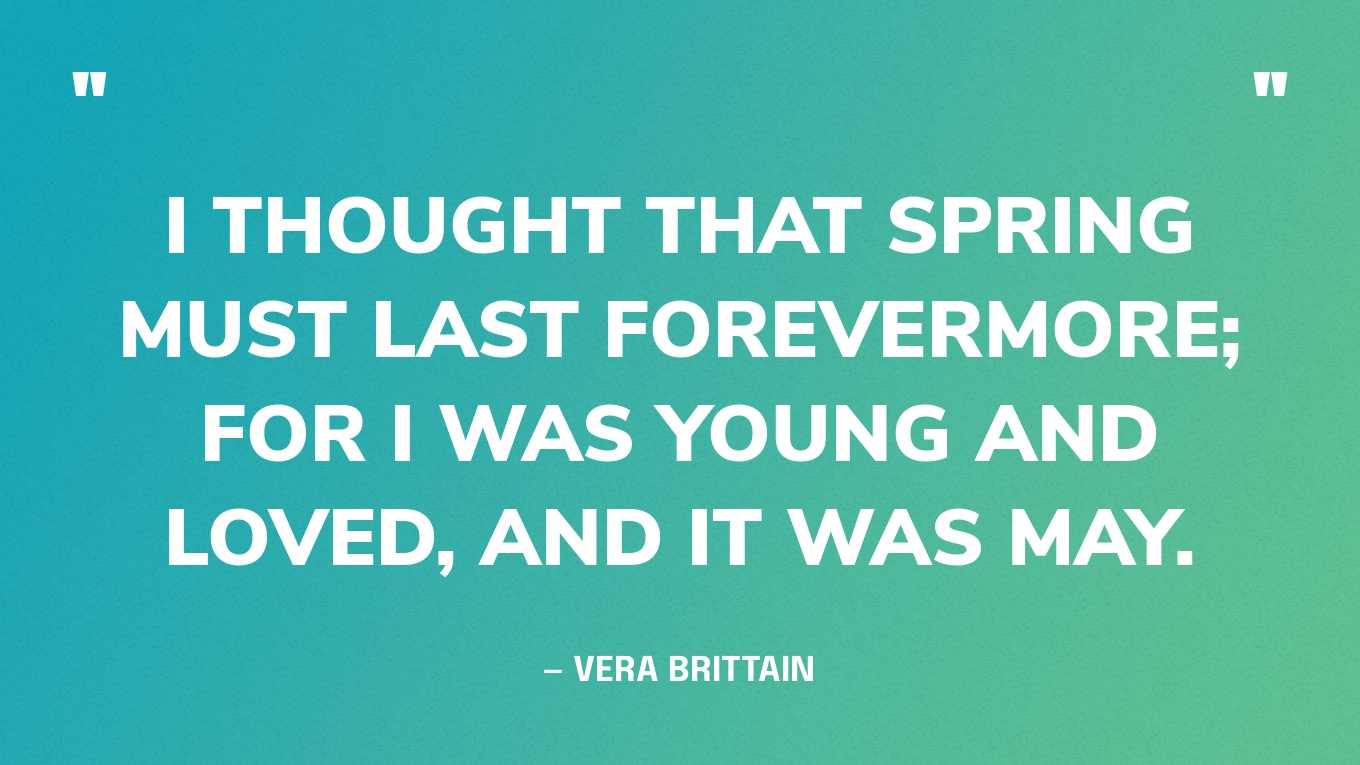
“Ah, in those earliest days of love how naturally the kisses spring into life! So closely, in their profusion, do they crowd together that lovers would find it as hard to count the kisses exchanged in an hour as to count the flowers in a meadow in May.”
— Marcel Proust
“The month of May is the pleasant time; its face is beautiful; the blackbird sings his full song, the living wood is his holding, the cuckoos are singing and ever singing; there is a welcome before the brightness of the summer.”
— Lady Gregory
“May has come in, young May the beautiful, weaving the sweetest chaplet of the year. Along the eastern corridors, she walks. What time the clover rocks the earliest bee. Her feet are flush with sunrise, and her veil floating in breezy odors o’er her hair.”
— Thomas Buchanan Read
“At last came the golden month of the wild folk — honey-sweet May, when the birds come back, and the flowers come out, and the air is full of the sunrise scents and songs of the dawning year.”
— Samuel Scoville Jr.
Quotes for Awareness Holidays in May
A collection of quotes to celebrate March’s awareness months and national days.
→ Explore more of this month’s awareness days in our May calendar
AAPI Heritage Month
May 1 - May 31
“The power of visibility can never be underestimated.”
— Margaret Cho
“[Being raised by Korean immigrants] gave me grit, cultivated independence, and showed me the power of resilience and hard work — but more importantly, [it gave me] the opportunity to redefine the narrative of a first-generation Asian woman.”
— Haejin Chun
“We have to build things that we want to see accomplished, in life and in our country, based on our own personal experiences to make sure that others do not have to suffer the same discrimination.”
— Patsy Takemoto Mink
→ Read about how to celebrate AAPI Heritage Month
Mental Health Awareness Month
May 1 - May 31
“Your mental health is everything — prioritize it. Make the time like your life depends on it, because it does.”
— Mel Robbins
“Vulnerability sounds like truth and feels like courage. Truth and courage aren’t always comfortable, but they’re never weakness.”
— Brené Brown
“Anything that’s human is mentionable, and anything that is mentionable can be more manageable. When we can talk about our feelings, they become less overwhelming, less upsetting, and less scary.”
— Fred Rogers
→ Explore more mental health quotes
→ Read about how to celebrate Mental Health Awareness Month
Jewish American Heritage Month
May 1 - May 31
“Our task is not to erase differences, but to build unity in diversity.”
— Ruth Bader Ginsburg
“I grew up in a tradition where having ideas and contributing to the community and creating art that had an impact on the world mattered. That’s part of the Jewish tradition.”
— Eve Ensler
“This is one of the goals of the Jewish way of living: to experience commonplace deeds as spiritual adventures, to feel the hidden love and wisdom in all things.”
— Abraham Joshua Heschel
→ Read about how to celebrate Jewish American Heritage Month
Teacher Appreciation Week
First full week of May
“Teacher appreciation makes the world of education go around.”
— Helen Peters
“Everyone who remembers his own education remembers teachers, not methods and techniques. The teacher is the heart of the educational system.”
— Sidney Hook
“Teaching is more than imparting knowledge; it is inspiring change. Learning is more than absorbing facts; it is acquiring understanding.”
— William Arthur Ward
→ Explore more teacher appreciation quotes
→ Read about how to celebrate Teacher Appreciation Week
Mother’s Day
Second Sunday of May
“If love is as sweet as a flower, then my mother is that sweet flower of love.”
— Stevie Wonder
“Only mothers can think of the future — because they give birth to it in their children.”
— Maxim Gorky
“My Mother: She is beautiful, softened at the edges and tempered with a spine of steel. I want to grow old and be like her. ”
— Jodi Picoult
143 Day
May 23
“Real strength has to do with helping others.”
— Fred Rogers
“Love isn’t a state of perfect caring. It is an active noun like struggle. To love someone is to strive to accept that person exactly the way he or she is, right here and now.”
— Fred Rogers
“I have tried to encourage children to love and care for themselves and to love the parents who care for them. That’s the way true neighborliness grows — loving others as we first loved ourselves.”
— Fred Rogers
→ Read about how to celebrate 143 Day
→ Explore more Fred Rogers quotes
Quotes from Inspiring People with May Birthdays
Dwayne Johnson
May 2
“The single most powerful thing I can be is to be myself.”
— Dwayne Johnson
All success begins with self-discipline. It starts with you.”
— Dwayne Johnson
“Check your ego at the door. The ego can be the great success inhibitor. It can kill opportunities, and it can kill success.”
— Dwayne Johnson
Hank Green
May 5
“We are the superhero. None of us, individually, but all of us together.”
— Hank Green
“Humanity is good. Some people are terrible and broken, but humanity is good. I believe that.”
— Hank Green
“Worrying isn’t a disease, it’s a symptom of caring.”
— Hank Green
→ Explore more Hank Green quotes
Bono
May 10
“I can’t change the world but I can change the world in me.”
— Bono
“Where you live should not determine whether you live, or whether you die.”
— Bono
“Dream up the kind of world you want to live in. Dream out loud.”
— Bono
→ Explore more Bono quotes
Madeleine Albright
May 15
“What people have the capacity to choose, they have the ability to change.”
— Madeleine Albright
“Our collective experience has shown that when women have the power to make their own choices, good things happen.”
— Madeleine Albright
“You’ve got the guts to find your own purpose.”
— Madeleine Albright
→ Explore more Madeleine Albright quotes
Harvey Milk
May 22
“Hope is being able to see that there is light despite all of the darkness.”
— Harvey Milk
“Rights are won only by those who make their voices heard.”
— Harvey Milk
“All young people, regardless of sexual orientation or identity, deserve a safe and supportive environment in which to achieve their full potential.”
— Harvey Milk
→ Explore more Harvey Milk quotes
Funny May Quotes
“May, more than any other month of the year, wants us to feel most alive.”
— Fennel Hudson
“When the sun is out and the wind is still, You’re one month on in the middle of May.”
— Robert Frost
“May is a pious fraud of the almanac,
A ghastly parody of real spring.”
— James Russell Lowell
“It’s May, the lusty month of May
That darling month when everyone throws self-control away.”
— Alan Jay Lerner
“Horticulturally, the month of May is opening night, Homecoming, and Graduation Day all rolled into one.”
— Tam Mossman
“The last days of May are among the longest of the year.”
— Alice Munro
May Poems
“Oh! gladly do we welcome thee,
Fair pleasant month of May;
Month which we’ve eager longed to see,
Through many a wintry day.”
— Rosana Eleanor Leprohon
“When purple finches sing and soar
when vernal gladness runnin o’er —
when joys like these salute the sense
then waiting long hath recompense
and all the world is glad with May.”
— Jonh Burroughs
“There is but one May in the year,
And sometimes May is wet and cold;
There is but one May in the year
Before the year grows old.”
— Christina Georgina Rossetti
“How tender is the touch of May
While gentle winds are blowing,
And in a sweet yet silent way,
All sylvan things are growing.”
— William Hamilton Hayne
“Winds of May, that dance on the sea,
Dancing a ring-around in glee
From furrow to furrow, while overhead
The foam flies up to be garlanded.”
— James Joyce
“When April steps aside for May,
Like diamonds all the rain drops glisten;
Fresh violets open every day:
To some new bird each hour we listen.”
— Lucy Larcom
“May, queen of blossoms, And fulfilling flowers, With what pretty music Shall we charm the hours?”
— Edward Thurlow
“The flowers that should bloom in the month of May
Every one of them came on an April day!
And they looked for April showers in vain,
But all through May it did nothing but rain!”
— Carolyn Well
“That I may reach that happy time
The kindly gods I pray,
For are not ducks and pease in prime
Upon the last of May?”
— William Makepeace Thackeray
“We roamed the fields and river sides,
when we are young and gay;
we chased the bees and plucked the flowers,
in the merry, merry month of May.”
— Stephen Foster
Short May Quotes
“But winter lingering chills the lap of May.”
— Oliver Goldsmith
“It is the month, the jolly month. It is the jolly month of May.”
— Francis Thompson
“May is a month of rebirth, of renewed vitality and energy.”
— Lailah Gifty Akita
“It was outdoor detail — and May is one fine month to be working outdoors.”
— Stephen King
“What potent blood hath modest May.”
— Ralph Waldo Emerson
“The month of May is the gateway to summer.”
— Jean Hersey
→ Explore more short quotes
More May Quotes
“Prose and drama are well enough for winter, but when nature swells the darling buds of May, my spirit craves three things: poetry, painting, and love.”
— Joan Smith
“Queer things happen in the garden in May. Little faces forgotten appear, and plants thought to be dead suddenly wave a green hand to confound you.”
— W. E. Johns
“The month of May comes differently in cities: not for us white blossom on the hedgerows, bluebells in the woods — instead the sun’s rays burnish bricks and mellow pavements; seeds burst into flower in the cracks between the stones; speedwell and bindweed bloom among the rubble.”
— Heidi Thomas
“May means long walks in the evenings, eating outside in the garden (whenever possible) and lots of healthy, fresh salads to use up all the lovely summer veg that’s available.”
— Sophie Morris
“What is so sweet and dear
As a prosperous morn in May,
The confident prime of the day”
— William Watson
“Step aside to a brand new day, in the month of May I feel, I can start again. Life is feeling new, This is hope, this is love, this is where we all won, if you call, I will hear, I will listen for you.”
— Mychal Simka
Coral reefs support vibrant marine ecosystems, stimulate tourism and fishing industries, and protect shorelines from tropical storms and erosion. But reefs around the globe have been hit hard by pollution, overfishing and climate change, which is causing increasingly frequent and severe coral bleaching.
Scientists predict severe bleaching on 99% of the world’s reefs within this century unless we reduce greenhouse gas emissions. Saving coral reefs requires major systemic changes — dramatic cuts in energy consumption, switching to renewable energy, managing overfishing and pollution, and restoring target reefs.
Restoration efforts have now become a priority for many scientists. This series looks at some of those efforts.
The University of Miami’s Rosenstiel School of Marine, Atmospheric, and Earth Science sits on the shore of Florida’s Virginia Key. Most of its buildings have views of the water. One of them even houses its own ocean.
This boxy wind-wave tank, part of the Alfred C. Glassell, Jr. SUSTAIN Laboratory, is 60 feet long, 7 feet tall, and 23 feet wide. A jet engine creates winds up to 170 mph and mechanical paddles make waves; putting the two together can simulate a Category 5 hurricane. The tank is clear on all sides, high enough to walk under, and strong enough for scientists to sit on top so they can monitor the action inside.
A multidisciplinary team at the university is using this tank to study how artificial reef structures stand up to wind and waves and how well live corals planted on those structures survive and grow.
This work could lead to a unique combination of “grey” or human-built infrastructure, such as concrete seawalls, and “green” or natural systems like coral organisms — resulting in systems that provide both shoreline protection and coral reef habitat. A collaboration between the university and the city of Miami Beach, the project is called Engineering Coastal Resilience Through Hybrid Reef Restoration, or ECoREEF.
Florida is the only state in the continental United States with a shallow coral reef near its coast, extending some 350 miles from the Dry Tortugas at the tip of the Keys in the Gulf of Mexico to north of Palm Beach.
Studies show that shallow coral reefs can buffer up to 97% of the energy from waves, reducing flooding and helping to prevent loss of life, property damage, and erosion from storms. But nearly 90% of corals on this reef have died due to climate change, hurricanes, disease and human development.
Add in South Florida, with its low-lying typography and its location within the tropical storm belt, the result is a heavily populated coastline extremely vulnerable to the effects of climate change.
ECoREEF joins other projects, some decades-long, working to restore Florida coral reefs, which provide habitat for hundreds of marine species — including green sea turtles, parrotfish and stingrays — while supporting the state’s tourism industry and protecting its shorelines and structures from wave energy.
The reef-restoration efforts include studying the idea of moving hardier corals into degraded areas, outplanting hand-raised coral fragments onto existing reefs, coaxing corals to reproduce sexually in laboratories, and boosting natural sexual reproduction of the organisms in the wild.
“The idea behind ECoREEf is installation of structures that can host corals but also provide wave energy dissipation,” says Landolf Rhode-Barbarigos, an associate professor in the College of Engineering.
After testing designs in the tank, in March the team deployed two types of structures in 14 feet of water about 750 feet off the shore at Miami Beach. One design is a hollow trapezoid structure with limestone boulders on its outer surface to mimic the texture of coral reefs and attract marine life.
The other is a configuration of hollow, hexagonal units perforated to let water flow through, called Sustainable Estuarine and Marine Revetments, or Seahives. Both are made of concrete.
It’s less expensive to test and alter a model in the tank than an actual structure out in the ocean, says Brian Haus, chair of the Department of Ocean Sciences at the Rosenstiel School. Post-testing, models can be scaled up.
“The tank testing gives us a model that tells us this structure dissipates this much wave energy,” says Rhode-Barbarigos. “Then we use those findings combined with mathematical models to design structures that can withstand the actual waves.”
There’s increasing recognition that green infrastructure is an effective and cost-efficient alternative to gray infrastructure. But once green systems are lost or degraded, it can take a long time to restore them. The artificial infrastructure can help speed up that restoration.
The physical structures are well-developed at this point, but adding living coral makes the system much more complex — one reason for the multi-disciplinary nature of the project.
“We’ve blurred the lines between ecology and engineering to think of not only optimizing the structures but what types of corals we use,” Rhode-Barbarigos says.
He points out that data from the project can show the value of the combination. “It makes a different type of argument for coral restoration. If we can combine coral restoration and shoreline protection, we have a stronger argument.”
So far, the work clearly supports the argument of combining the two for shoreline protection. One study showed that coral structures — the calcium-based skeletons these organisms create — can significantly enhance the wave-reducing capability of an artificial reef, depending on sea conditions and characteristics of the structure.
A trapezoidal artificial coral reef model was found to reduce up to 98% of the wave energy, with coral contributing an estimated 56% of the total. Additional testing found that adding skeletons of staghorn corals (Acropora cervicornis) mitigated up to an additional 10% of wave height and 14% of wave energy on submerged artificial reef compared to those without corals.
After the structures were placed in the water, marine scientists from the Rosenstiel School added live corals, including great star, mustard hill, knobby brain and symmetrical brain corals. These species all are stony corals, which can create massive reefs over time.
“On July 19, we outplanted about 500 corals, fragments we took from parent colonies and grew out either here at UM or at our offshore nurseries,” says Emily Esplandiu, a research associate in the school’s Coral Reef Restoration Lab.
While many offshore coral nurseries hang staghorn coral fragments from PVC trees using monofilament, this lab uses an adhesive to affix corals to a plug that’s screwed into flat trays. The trays are easier to transport from the nursery to the testbed structure, she adds. Engineers are now incorporating the plug screws into the design of the artificial reef structures, making it easier to attach corals.
The team planned to outplant another 500 corals until extremely high temperatures hit Florida waters in late summer. The scientists instead found themselves bringing corals from their offshore nurseries into land-based facilities.
“At temperatures of about 30.5 degrees Celsius (87 degrees Fahrenheit), we can’t outplant or move corals offshore,” Esplandiu says. The plan is to finish the planting by the end of this year, once temperatures fall below that threshold for at least a week.
Meanwhile, the scientists monitored the corals already on the structures, documenting about 80% survivorship. However, as temperatures continued to rise, on Aug. 17 the monitoring teams observed some paling (a precursor to bleaching), and on Sept. 8, they saw bleaching.
But there was some good news: The scientists observed differences in the amount of bleaching among species and genotypes within species. They plan to take a closer look to identify those least affected and use those hardier genotypes for future fragmenting and outplanting.
For example, the original outplanting included four or more genotypes of star coral, Esplandiu says, and one genotype all bleached while another all remained healthy.
Haus notes that the ultimate goal is to create larger infrastructure to provide more protection. “Beach renourishment and dune reconstruction are no longer enough with sea-level rise,” he says. This effort could put corals in new areas as well as those that historically had reefs — good news for coastal residents and marine life.
“People are realizing it’s a crisis, all of it — coral loss, climate change, sea level rise,” says Haus. “The goal is to develop solutions that are ecosystem friendly and indeed help the ecosystem. Of course, it won’t be enough if we don’t change. We need to stop the source of the problem because emissions are just going to get worse.”
For the Coral Reef Restoration Lab, the next step is to grow out thousands more coral fragments for planting on additional structures. Working with engineers to design structures that work better for the corals has been exciting, Esplandiu says.
“We learned that corals do best with high water flow, because that flow brings nutrients. We know putting a coral on the top versus the side of a structure is different. We can work together to find literally the specific spot on a structure that is best to put corals.”
“Up until now, the only outplanting we had done was on the natural reef, which is mostly degraded in Florida,” Esplandiu says. “We see a lot of restoration sites crashing after three to five years because they’re facing the same stressors the corals were to begin with. The reef framework is the most important part of the reef, and we’ve lost so many corals that they’re no longer able to create that framework.”
Coral restoration efforts are something of a finger in the dike, scientists acknowledge, and ultimately won’t succeed without continued efforts to change the things that are causing coral loss in the first place, such as greenhouse gas emissions, overfishing and pollution.
But the test structures offer a way to replace some of the natural reefs that have been lost, and they provide an alternative to putting corals back onto degraded reefs. The team has already documented a large fish community around the test structures.
The combination of artificial reefs and stress-tolerant corals could contribute to restoring both the coastal protection and marine habitat provided by healthy natural reefs. In other words, work in the university’s indoor ocean is helping to heal the real ocean just outside its windows.
This story was originally published by The Revelator and republished with permission.
Gloria Steinem, a trailblazing feminist, journalist, and social-political activist, has been a leading voice in the women’s liberation movement for decades.
Her work, spanning from the grassroots level to the global stage, has significantly contributed to the discourse on gender equality, women’s rights, and social justice.
Steinem’s insightful commentary and sharp wit have not only challenged societal norms but have also empowered generations to think critically about the structures of power and privilege.
Here, we’ve gathered a selection of Gloria Steinem’s most memorable quotes.
Whether you're a long-time admirer of her work or new to her contributions, Steinem's words continue to inspire and challenge us to envision a world where everyone has the freedom to become the fullest version of themselves.
The Best Quotes from Gloria Steinem
Famous Quotes
“Empathy is the most radical of human emotions.”
— Gloria Steinem
“Revolutions that last don’t happen from the top down. They happen from the bottom up.”
— Gloria Steinem
“The art of life is not controlling what happens to us, but using what happens to us.”
— Gloria Steinem, Revolution from Within: A Book of Self-Esteem
“The future depends entirely on what each of us does every day; a movement is only people moving.”
— Gloria Steinem
“Power can be taken, but not given. The process of the taking is empowerment in itself.”
— Gloria Steinem
“Don’t think about making women fit the world — think about making the world fit women.”
— Gloria Steinem, in a speech
“The art of being helpful is behaving as if everything we do matters — because we never know which things might.”
— Gloria Steinem
“None of us can be liberated if other groups are not.”
— Gloria Steinem, in a speech
“We need to worry less about doing what is most important, and more about doing whatever we can.”
— Gloria Steinem, in an article
“Law and justice are not always the same. When they aren’t, destroying the law may be the first step toward changing it.”
— Gloria Steinem
“Without leaps of imagination or dreaming, we lose the excitement of possibilities. Dreaming, after all, is a form of planning.”
— Gloria Steinem
On Love
“Far too many people are looking for the right person, instead of trying to be the right person.”
— Gloria Steinem
“I wonder: If you think of someone you love, do you become a little more like them? I would like to think so.”
— Gloria Steinem, My Life on the Road
“Love is wanting what’s best for the other person. Romance is wanting the other person.”
— Gloria Steinem
“If you are not a feminist in love, you fail to recognize someone who does not love you. Feminism makes love easier. Otherwise, there is the danger of feeling romantically drawn to someone who does not see you as an equal.”
— Gloria Steinem
“Being able to support oneself allows one to choose a marriage out of love and not just economic dependence. It also allows one to risk that marriage.”
— Gloria Steinem
“As Robin Morgan wrote so wisely, ‘Hate generalizes, love specifies’. That’s what makes going on the road so important. It definitely specifies.”
— Gloria Steinem, My Life on the Road
On Motherhood
“I see mother as a verb — we are all able to mother, whatever our sex or our age or our abilities. Bring one of your mothers to this event.”
— Gloria Steinem, in a tweet

“Childbirth is more admirable than conquest, more amazing than self-defense, and as courageous as either one.”
— Gloria Steinem, In Praise of Women’s Bodies
“Most of us are living out the unlived lives of our mothers, because they were not able to become the unique people they were born to be.”
— Gloria Steinem
“We are all able to mother, whatever our sex or our age or our abilities. To mother is to care about the welfare of another person as much as one’s own. To mother depends on empathy and thoughtfulness, noticing and caring.”
— Gloria Steinem, on Instagram
“In retrospect, perhaps the biggest reason my mother was cared for but not helped for twenty years was the simplest: Her functioning was not that necessary to the world.”
— Gloria Steinem
“We’ve begun to raise daughters more like sons… but few have the courage to raise our sons more like our daughters.”
— Gloria Steinem

On Equality
“When humans are ranked instead of linked, everyone loses.”
— Gloria Steinem, My Life on the Road
“A belief in equality, without division by sex or race, is now held by a huge majority in public-opinion polls. But a stubborn minority of Americans feel deprived of the unearned privilege of that old hierarchy and are in revolt. The time of greatest danger comes after a victory, and that’s where we are now.”
— Gloria Steinem, in an article
“On the fight for equality today: ‘It’s not so good when we say to kids, You can be anything you want,’ because it’s not true. Much better to say, ‘You should be able to be anything you want.’”
— Gloria Steinem
“I’ve been using my torch to light other peoples’ torches. Because the whole idea that there’s only one torch is part of the reason why we’re so f*cked up. Everybody needs a torch.”
— Gloria Steinem, in a speech
On Leadership
“There is no such thing as a perfect leader. We have to learn to lead ourselves.”
— Gloria Steinem

“Also, one of the simplest paths to deep change is for the less powerful to speak as much as they listen, and for the more powerful to listen as much as they speak.”
— Gloria Steinem, My Life on the Road
“Hang out with people who make you feel smart, not dumb. That’s crucial. Because if they make you feel dumb, they’re not supporting you and they’re not helping you. It isn’t that we’re right or wrong. It doesn’t have to do with being right all the time, but if you have consistency of support from people who value your opinion, it will help you to value your opinion. We’re communal people. You can’t do it by yourself.”
— Gloria Steinem, in an interview
“I’ve noticed that great political leaders are energized by conflict. I’m energized by listening to people’s stories and trying to figure out shared solutions. That’s the work of an organizer.”
— Gloria Steinem, My Life on the Road
“Clearly no one knows what leadership has gone undiscovered in women of all races, and in black and other minority men.”
— Gloria Steinem
“If you want people to listen to you, you have to listen to them. If you hope people will change how they live, you have to know how they live. If you want people to see you, you have to sit down with them eye-to-eye.”
— Gloria Steinem, My Life on the Road
On Feminism
“A feminist is someone who believes in the full humanity of all people.”
— Gloria Steinem, in a tweet
“Any woman who chooses to behave like a full human being should be warned that the armies of the status quo will treat her as something of a dirty joke. That’s their natural and first weapon. She will need her sisterhood.”
— Gloria Steinem
“Women have two choices: Either she’s a feminist or a masochist.”
— Gloria Steinem
“We’ll never solve the feminization of power until we solve the masculinity of wealth.”
— Gloria Steinem
“For women… bras, panties, bathing suits, and other stereotypical gear are visual reminders of a commercial, idealized feminine image that our real and diverse female bodies can’t possibly fit. Without these visual references, each individual woman’s body demands to be accepted on its own terms. We stop being comparatives. We begin to be unique.”
— Gloria Steinem, In Praise of Women’s Bodies
“Women are always saying, ‘We can do anything that men can do,’ but men should be saying, ‘We can do anything that women can do.’”
— Gloria Steinem
“Women have a special opportunity to live the revolution. By refusing to play their traditional role, they upset and displace the social structure around them.”
— Gloria Steinem, in a speech
“Every woman remembers the first time we ever stood up for ourselves.”
— Gloria Steinem, in a tweet
“Women may be the one group that grows more radical with age.”
— Gloria Steinem, Outrageous Acts and Everyday Rebellions
“Feminism has never been about getting a job for one woman. It’s about making life more fair for women everywhere. It’s not about a piece of the existing pie; there are too many of us for that. It’s about baking a new pie.”
— Gloria Steinem
“We are the women our parents warned us against, and we are proud.”
— Gloria Steinem
→ Read more feminist quotes
Short Quotes
“Once we give up searching for approval we often find it easier to earn respect.”
— Gloria Steinem
“Laughter is a rescue.”
― Gloria Steinem, My Life on the Road
“Dying seems less sad than having lived too little.”
— Gloria Steinem
“Democracy exists when all people have the fundamental right to make decisions about our own bodies and lives.”
— Gloria Steinem, on Instagram
“Self-esteem isn’t everything; it’s just that there’s nothing without it.”
— Gloria Steinem
“We learn most where we know the least.”
— Gloria Steinem, My Life on the Road
“The truth will set you free, but first it will piss you off.”
— Gloria Steinem
“When unique voices are united in a common cause, they make history.”
— Gloria Steinem
“We are so different, yet so much the same.”
— Gloria Steinem, My Life on the Road
“A good friendship is a conversation that never ends.”
— Gloria Steinem
“Experience is everything. Somebody who has experienced something is more expert at it than the experts.”
— Gloria Steinem, My Life on the Road
“Being married is like having somebody permanently in your corner. It feels limitless, not limited.”
— Gloria Steinem
“The first resistance to social change is to say it’s not necessary.”
— Gloria Steinem
“Decisions are best made by the people affected by them.”
— Gloria Steinem, My Life on the Road
→ Read more short quotes
More Quotes
“So whatever you want to do, just do it… Making a damn fool of yourself is absolutely essential.”
— Gloria Steinem, in a speech
“We need to unlearn our respect for education since it has undermined our respect for ourselves. It’s worth taking time to demystify it… All the things an adolescent can be… are reduced to a three-digit number… We too can decide how to value our education instead of letting them value us.”
— Gloria Steinem, Revolution from Within
“The problem is the feeling that we’re divided from politics, that our vote doesn’t count or what we do doesn’t count. In fact, everything we do counts.”
— Gloria Steinem
“When the past dies, there is mourning, but when the future dies our imaginations are compelled to carry it on.”
— Gloria Steinem
“The first problem for all of us, men and women, is not to learn, but to unlearn. We are filled with popular wisdom of several centuries just past, and we are terrified to give it up.”
— Gloria Steinem, in an article
“Writing is the only thing that when I do it, I don’t feel I should be doing something else.”
— Gloria Steinem
“We tend to forget that every revolution or social change is like a tree — it grows from the bottom up, not the top down. However small it may seem to begin, that does not matter because it will grow.”
— Gloria Steinem, in an interview
“The power to make decisions about our own bodies is the first step towards democracy, so it comes as no surprise that authoritarian regimes resist our right to reproductive freedom.”
— Gloria Steinem, on Instagram
“We need to remember across generations that there is as much to learn as there is to teach.”
— Gloria Steinem
Boston Mayor Michelle Wu started a recent TikTok video bundled in a beanie, bright and early in the morning.
“Today we are going to commute with Becky,” Wu said with a smile. “Becky is a teacher and we have got to get her from Brighton, on the bus, to her school, to get her settled in time before the students arrive.”
It’s part of a new social media campaign in which Wu commutes with Bostonians “to experience all parts of our transportation system and how we can do better,” per her caption.
Wu’s video continued, as she greeted Becky, a ninth grade teacher, at a bus stop. Becky detailed parts of her commute, like tracking the 501 bus on her phone, standing in an unheated bus shelter, and even how she gets to watch the sunrise on the bus every morning.
Wu asked her how many of her students get to school, as well.
“The vast majority of my students commute via public transit,” Becky explained. “They are susceptible to the same shuttles and bus woes.”
She shared that some students are late to school for the same reasons she might run late, like missing a bus or waiting in the cold.
Before Wu and Becky parted ways, the Mayor asked what kinds of improvements the teacher would like to see in regard to the city’s public transportation system, if she could wave a magic wand.
“I would do more buses, more express buses, more buses all around,” Becky said. “I would do more well-functioning trains that don’t need to be shut down all the time. And I would do heated bus stops because it’s really cold.”
@officeofmayorwu Commute with us! I’m joining Bostonians on their daily commutes to experience all parts of our transportation system & how we can do better. This week I commuted with Brighton resident and BPS teacher Becky on the 501 Bus (it goes on the Pike!) as she headed to school. #MBTA #Boston #Brighton #OakSquare #BayVillage #BostonCommute #transit ♬ original sound - officeofmayorwu
Wu’s enthusiasm to hear Becky’s feedback seems genuine, and according to her official city biography, the Mayor is an “MBTA rider.”
Other videos on her TikTok page include information about speed humps in streets, how to make the most out of a Boston Bike Pass, and quick video reminders about closures along MBTA routes (in both English and Spanish).
Wu, who is Boston’s first woman and first person of color Mayor, has a long history aiming to improve transportation in her beloved city.
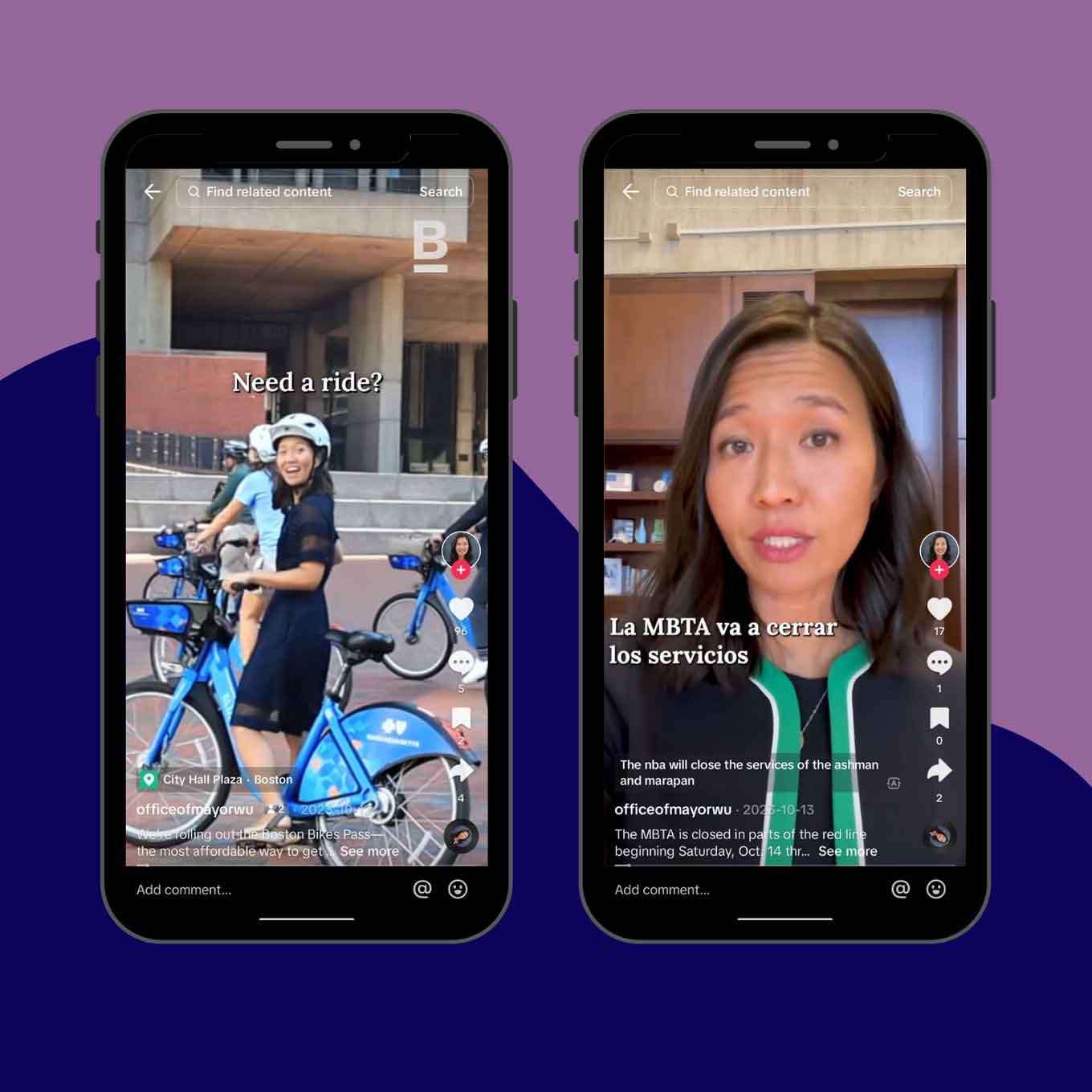
She served on Boston’s City Council from 2014 to 2021, until she was elected as Mayor. In her first week, Mayor Wu worked with the city council to make three Boston bus lines, which serve predominantly Black and brown neighborhoods, fare-free for two years.
Another first act in her role as Mayor, Wu signed an ordinance divesting City funds from fossil fuels, private prisons, and the tobacco industry.
Wu has also launched a Green New Deal for Boston Public Schools, creating a district-wide effort to reduce building emissions, renovate old facilities, and modernize the city’s education system. She also expanded the city’s early childhood services and created an Office of Early Childhood to oversee the changes.
Additionally, Wu has established Boston’s first-ever Offices of Food Justice, Black Male Advancement, LGBTQ+ Advancement, and Worker Empowerment.
“Together, these achievements align Boston’s climate, infrastructure, education, and investment strategies with Boston’s values, laying the foundation for a greener, more efficient, more equitable city for generations to come,” Boston’s city website reads.
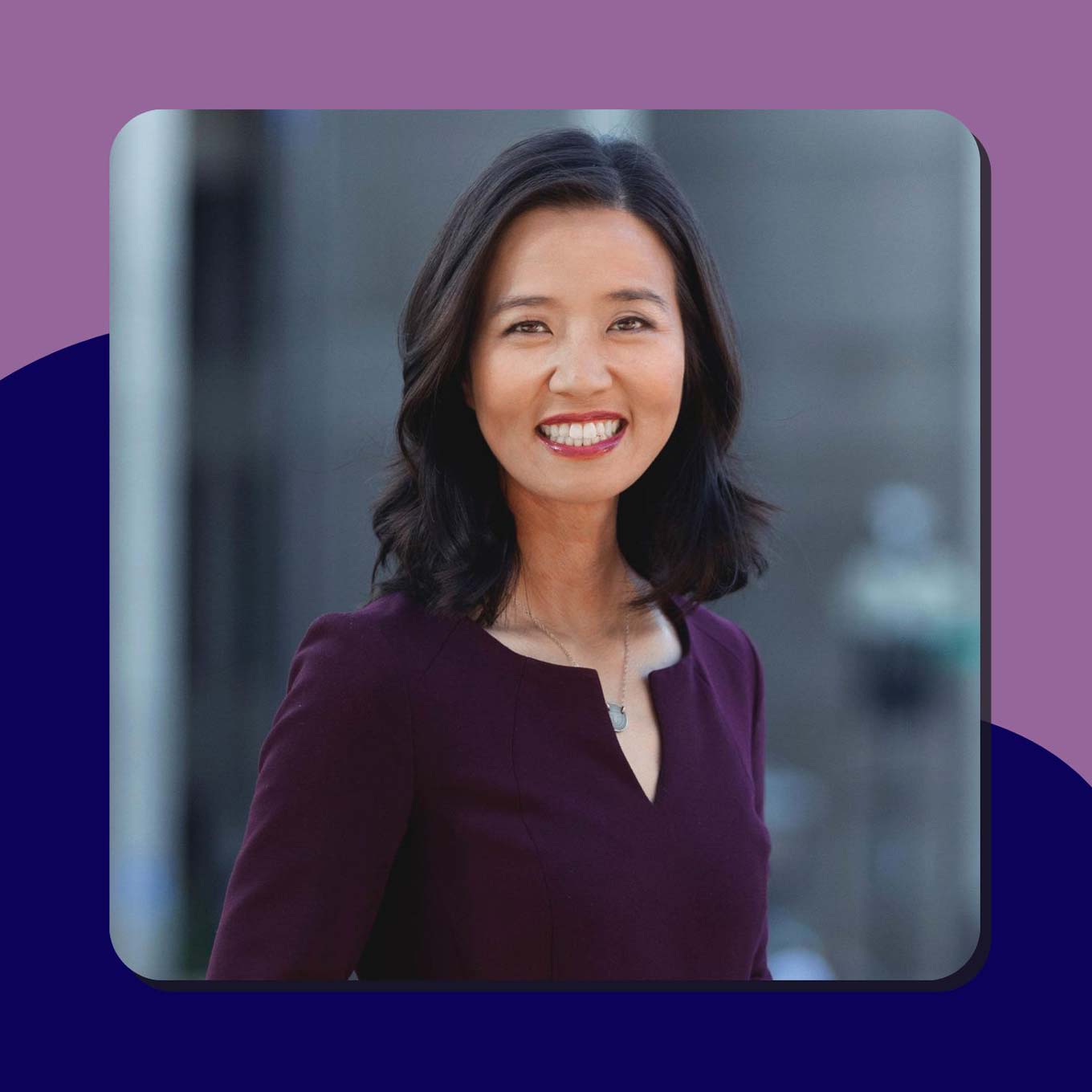
And her efforts seem to be earning her supporters.
Comments on her video with Becky show how eager constituents are to see their elected officials in action.
“Great job on getting proximate and not hearing about it and going out and experiencing it,” one user wrote. “Real change can be made when all people truly walk in someone else’s shoes.
“Yes please keep doing this!” another person added. “Love the awareness surrounding commuting issues.”
“Wait, this is the Mayor!” one user said, suddenly realizing whose profile the video came from. “We need more empathetic representatives like this.”
Header images courtesy of the Office of Mayor Wu/TikTok
Life is an intricate mix of experiences and emotions — a journey that constantly evolves and surprises us.
It’s filled with challenges that test our resilience, moments that take our breath away, and opportunities that push us toward growth.
Philosophers, writers, and thinkers throughout history have tried to capture the essence of this journey. Their quotes about life shed light on the complexities, joys, and inevitable struggles we all face — providing wisdom that can guide us, comfort us, or simply make us think.
In this article, we’ve curated a selection of life quotes that reflect the human experience. Whether you’re seeking guidance, inspiration, or a moment of reflection — may these quotes remind you of the shared human condition.
The Best Quotes About Life
Famous Life Quotes
“Life is very short and what we have to do must be done in the now.”
— Audre Lorde
“Nothing in life is to be feared, it is only to be understood. Now is the time to understand more, so that we may fear less.”
— Marie Curie
“What counts in life is not the mere fact that we have lived. It is what difference we have made to the lives of others.”
— Nelson Mandela
“Life is like a bicycle. To keep your balance, you must keep moving.”
— Albert Einstein
“No matter what happens in life, be good to people. Being good to people is a wonderful legacy to leave behind.”
— Taylor Swift
“When I hear somebody sigh, ‘Life is hard,’ I am always tempted to ask, ‘Compared to what?’”
— Sydney J. Harris
“Life is what happens to you while you’re busy making other plans.”
— John Lennon
“For the great doesn’t happen through impulse alone, and is a succession of little things that are brought together.”
— Vincent van Gogh
“Your vocation in life is where your greatest joy meets the world’s greatest need.”
— Frederick Buechner
“Find ecstasy in life; the mere sense of living is joy enough.”
— Emily Dickinson
“Our prime purpose in this life is to help others. And if you can’t help them, at least don’t hurt them.”
— Dalai Lama
“Life is in ourselves and not in the external.”
— Fyodor Dostoevsky
“Change your life today. Don’t gamble on the future, act now, without delay.”
— Simone de Beauvoir
“Life isn’t about finding yourself. Life is about creating yourself.”
— George Bernard Shaw
“You get in life what you have the courage to ask for.”
— Oprah Winfrey
“Life is really simple, but we insist on making it complicated.”
— Confucius
“Life shrinks or expands in proportion to one’s courage.”
— Anaïs Nin
“The good life is inspired by love and guided by knowledge.”
— Bertrand Russell
“Life has got all those twists and turns. You’ve got to hold on tight and off you go.”
— Nicole Kidman
Positive Quotes
“I believe we are here on the planet Earth to live, grow up and do what we can to make this world a better place for all people to enjoy freedom.”
— Rosa Parks
“Nothing is impossible, the word itself says ‘I’m possible.’”
— Audrey Hepburn
“Live life to the fullest, and focus on the positive.”
— Matt Cameron
“I don’t think of all the misery but of the beauty that still remains.”
— Anne Frank
“Keep your face always toward the sunshine and shadows will fall behind you.”
— Walt Whitman
“My purpose: to lift your spirit and to motivate you.”
— Mavis Staples
“Once you replace negative thoughts with positive ones, you’ll start having positive results.”
— Willie Nelson
“There’s always something we can do. Whatever you did, your life is still meaningful.”
— Bryan Stevenson
“Life is full of beauty. Notice it. Notice the bumble bee, the small child, and the smiling faces. Smell the rain, and feel the wind. Live your life to the fullest potential, and fight for your dreams.”
— Ashley Smith
“Today is life-the only life you are sure of. Make the most of today. Get interested in something. Shake yourself awake. Develop a hobby. Let the winds of enthusiasm sweep through you. Live today with gusto.”
— Dale Carnegie
“Positive anything is better than negative nothing.”
— Elbert Hubbard
“You can, you should, and if you’re brave enough to start, you will.”
— Stephen King
“If you don’t like the road you’re walking, start paving another one.”
— Dolly Parton
“Smile in the mirror. Do that every morning and you’ll start to see a big difference in your life.”
— Yoko Ono
Deep Quotes
“Fight for the things that you care about, but do it in a way that will lead others to join you.”
— Ruth Bader Ginsburg
“Humankind has not woven the web of life. We are but one thread within it. Whatever we do to the web, we do to ourselves. All things are bound together. All things connect.”
— Chief Seattle
“Lead from the heart, not the head.”
— Diana, Princess of Wales
“It’s your outlook on life that counts. If you take yourself lightly and don’t take yourself too seriously, pretty soon you can find the humor in our everyday lives. And sometimes it can be a lifesaver.”
— Betty White
“You will encounter misguided people from time to time. That’s part of life. The challenge is to educate them when you can, but always to keep your dignity and self-respect and persevere in your personal growth and development.”
— Bernice King
“One of the things I learned the hard way was that it doesn’t pay to get discouraged. Keeping busy and making optimism a way of life can restore your faith in yourself.”
— Lucille Ball
“A life spent making mistakes is not only more honorable, but more useful than a life spent doing nothing.”
— George Bernard Shaw
“Nobody realizes that some people expend tremendous energy merely to be normal.”
— Albert Camus
“Life can only be understood backwards; but it must be lived forwards.”
— Soren Kierkegaard
“Maybe that’s what life is… a wink of the eye and winking stars.”
— Jack Kerouac
“Life is a mirror and will reflect back to the thinker what he thinks into it.”
— Ernest Holmes
“He who has a why to live can bear almost any how.”
— Friedrich Nietzsche
“You may not always have a comfortable life and you will not always be able to solve all of the world's problems at once but don't ever underestimate the importance you can have because history has shown us that courage can be contagious and hope can take on a life of its own.”
— Michelle Obama
“Life is a series of natural and spontaneous changes. Don’t resist them — that only creates sorrow. Let reality be reality. Let things flow naturally forward in whatever way they like.”
— Lao Tzu
“We make a living by what we get, but we make a life by what we give.”
— Winston Churchill
“I don’t want to get to the end of my life and find that I have lived just the length of it. I want to have lived the width of it as well.”
— Diane Ackerman
“Let life happen to you. Believe me: life is in the right, always.”
— Rainer Maria Rilke
“The events in our lives happen in a sequence in time, but in their significance to ourselves they find their own order the continuous thread of revelation.”
— Eudora Welty
“Life is a tide; float on it. Go down with it and go up with it, but be detached. Then it is not difficult.”
— Prem Rawat
“The most common way people give up their power is by thinking they don’t have any.”
— Alice Walker
“We don’t stop playing because we grow old; we grow old because we stop playing.”
— George Bernard Shaw
“Don’t let life discourage you; everyone who got where he is had to begin where he was.”
— Richard L. Evans
“As a single footstep will not make a path on the earth, so a single thought will not make a pathway in the mind. To make a deep physical path, we walk again and again. To make a deep mental path, we must think over and over the kind of thoughts we wish to dominate our lives.”
— Henry David Thoreau
“Life is not easy for any of us. But what of that? We must have perseverance and, above all, confidence in ourselves. We must believe we are gifted for something and that this thing must be attained.”
— Marie Curie
“We do not remember days, we remember moments.”
— Cesare Pavese
“Love life. Engage in it. Give it all you’ve got. Love it with a passion because life truly does give back, many times over, what you put into it.”
— Maya Angelou
On a Happy Life
“Don’t waste a minute not being happy. If one window closes, run to the next window — or break down a door.”
— Brooke Shields
“The most important thing is to enjoy your life — to be happy — it’s all that matters.”
— Audrey Hepburn
“Even a happy life cannot be without a measure of darkness, and the word happy would lose its meaning if it were not balanced by sadness. It is far better take things as they come along with patience and equanimity.”
— Carl Jung
“Folks are usually about as happy as they make up their minds to be.”
— Abraham Lincoln
“The present moment is filled with joy and happiness. If you are attentive, you will see it.”
— Thich Nhat Hanh
“Happiness is holding someone in your arms and knowing you hold the whole world.”
— Orhan Parnuk
“The most important thing is to enjoy your life — to be happy — it’s all that matters.”
— Audrey Hepburn
“The happiness of your life depends on the quality of your thoughts.”
— Marcus Aurelius
“Let us be grateful to the people who make us happy; they are the charming gardeners who make our souls blossom.”
— Marcel Proust
“Be happy for this moment. This moment is your life.”
— Omar Khayyam
Funny Quotes
“You know the trouble with real life? There’s no danger music.”
— Jim Carrey
“Be who you are and say what you feel, because those who mind don’t matter and those who matter don’t mind.”
— Bernard Baruch
“You only live once, but if you do it right, once is enough.”
— Mae West
“It is often said that before you die your life passes before your eyes. It is in fact true. It’s called living.”
— Terry Pratchett
“If my life wasn’t funny, it would just be true, and that’s unacceptable.”
— Carrie Fisher
“Life is pleasant. Death is peaceful. It’s the transition that’s troublesome.”
— Isaac Asimov
“People say nothing is impossible, but I do nothing every day.”
— A. A. Milne
“If I’d have done all the things I was supposed to have done, I’d be really tired.”
— Willie Nelson
“Do not take life too seriously. You will never get out of it alive.”
— Elbert Hubbard
“Fantasy is a necessary ingredient in living, it’s a way of looking at life through the wrong end of a telescope.”
— Dr. Seuss
“Don’t waste so much time thinking about how much you weigh. There is no more mind-numbing, boring, idiotic, self-destructive diversion from the fun of living.”
— Meryl Streep
“Life would be tragic if it weren’t funny.”
— Stephen Hawking
“Life is like a box of chocolates. You never know what you’re gonna get.”
— Forrest Gump
“I always wanted to be somebody, but now I realize I should have been more specific.”
— Lily Tomlin
“Life is like an onion; you peel off a layer at a time and sometimes you weep.”
— Carl Sandburg
“I’d like to live like a poor man — only with lots of money.”
— Pablo Picasso
“The hardest years in life are those between ten and seventy.”
— Helen Hayes
“Love is being stupid together.”
— Paul Valery
“To succeed in life, you need three things: a wishbone, a backbone and a funny bone.”
— Reba McEntire
Life is Too Short
“Life is too short to work so hard.”
— Vivien Leigh
“Don’t ever doubt yourselves or waste a second of your life. It’s too short, and you’re too special.”
— Ariana Grande
“Life is too short to worry about anything. You had better enjoy it because the next day promises nothing.”
— Eric Davis
“That’s the funny thing about life. We’re rarely aware of the bullets we dodge. The just-misses. The almost-never-happeneds. We spend so much time worrying about how the future is going to play out and not nearly enough time admiring the precious perfection of the present.”
— Lauren Miller
“Be patient and understanding. Life is too short to be vengeful or malicious.”
— Phillips Brooks
“Life is too short not to enjoy it.”
— Glen Campbell
“It’s only when we truly know and understand that we have a limited time on earth — and that we have no way of knowing when our time is up, we will then begin to live each day to the fullest, as if it was the only one we had.”
— Elisabeth Kübler-Ross
“Everyone should be able to express themselves in the way that best suits them — life is too short to spend it unhappy.”
— Jinkx Monsoon
Love Quotes
“The greatest pleasure of life is love.”
— Euripides
“Believing you are unworthy of love and belonging — that who you are authentically is a sin or is wrong — is deadly. Who you are is beautiful and amazing.”
— Laverne Cox
“The heart has its reasons, of which reason knows nothing.”
— Blaise Pascal
“We’re all a little weird. And life is a little weird. And when we find someone whose weirdness is compatible with ours, we join up with them and fall into mutually satisfying weirdness — and call it love — true love.”
— Robert Fulghum
“So long as the memory of certain beloved friends lives in my heart, I shall say that life is good.”
— Helen Keller
“To live is like to love — all reason is against it, and all healthy instinct for it.”
— Samuel Butler
“It is a curious thought, but it is only when you see people looking ridiculous that you realize just how much you love them.”
— Agatha Christie
“To love one another just may be the fight of our lives.”
— Amanda Gorman
“Love can change a person the way a parent can change a baby — awkwardly, and often with a great deal of mess.”
— Lemony Snicket
“Of all forms of caution, caution in love is perhaps the most fatal to true happiness.”
— Bertrand Russell
“The story of life is quicker than the blink of an eye, the story of love is hello, goodbye.”
— Jimi Hendrix
Short Quotes
“Live a life full of humility, gratitude, intellectual curiosity, and never stop learning.”
— GZA
“A dead end is just a good place to turn around.”
— Naomi Judd
“All of us have to be committed to a life beyond our own aspirations.”
— Bernice King
“Remember when life’s path is steep to keep your mind even.”
— Horace
“Do one thing every day that scares you.”
— Eleanor Roosevelt
“Life is the art of drawing without an eraser.”
— John W. Gardner
“Life is not a problem to be solved, but a reality to be experienced.”
— Soren Kierkegaard
“The most exhausting thing in life is being insincere.”
— Anne Morrow Lindbergh
“To me, if life boils down to one thing, it’s movement. To live is to keep moving.”
— Jerry Seinfeld
“You cannot find peace by avoiding life.”
— Virginia Woolf
“The most wasted of all days is one without laughter.”
— E. E. Cummings
“The world is what it is. But the world is also what you bring to it, and who you share it with.”
— John Green
“Mistakes are part of the dues that one pays for a full life.”
— Sophia Loren
“Open your eyes, look within. Are you satisfied with the life you’re living?”
— Bob Marley
“Life is a shipwreck, but we must not forget to sing in the lifeboats.”
— Voltaire
“Success is falling nine times and getting up ten.”
— Jon Bon Jovi
“To know nothing is the happiest life.”
— Desiderius Erasmus
“One way to get the most out of life is to look upon it as an adventure.”
— William Feather
“Life itself is the proper binge.”
— Julia Child
“No one changes the world alone and no one doesn’t change it at all. We are all exceptional, and none of us are.”
— Hank Green
“I have not failed. I’ve just found 10,000 ways that won’t work.”
— Thomas A. Edison
“There is no way to be perfect and no fun in being perfect.”
— Alicia Keys
“Life is a work in progress.”
— Jeff Rich
“You can’t achieve anything in life without a small amount of sacrifice.”
— Shakira
“A little credulity helps one on through life very smoothly.”
— Elizabeth Gaskell
“People are like music. Some speak the truth, and others are just noise.”
— Bill Murray
“I am an artist… I am here to live out loud.”
— Emile Zola
“A mind is like a parachute. It doesn’t work if it is not open.”
— Frank Zappa
“Life is not a matter of holding good cards, but sometimes, playing a poor hand well.”
— Jack London
“We can’t plan life. All we can do is be available for it.”
— Lauryn Hill
“Everything has been figured out, except how to live.”
— Jean-Paul Sartre
“The whole point is to live life and be — to use all the colors in the crayon box.”
— RuPaul
→ Read more short quotes
Advice on Life
“Here’s my advice: Study broadly and without fear. Learn a language if you can, because that will make your life more interesting. Read a little bit every day. But more importantly, surround yourself with people who you like and make cool stuff with them. In the end, what you do isn’t going to be nearly as interesting or important as who you do it with.”
— John Green
“Each morning when I open my eyes I say to myself: I, not events, have the power to make me happy or unhappy today. I can choose which it shall be. Yesterday is dead, tomorrow hasn’t arrived yet. I have just one day, today, and I’m going to be happy in it.”
— Groucho Marx
“My only advice is to stay aware, listen carefully, and yell for help if you need it.”
— Judy Blume
“Life is so fresh, life is every day so new if we are fighting, only for the best. Sometimes I think the only real satisfaction in life is failure, failure in your endeavor to do your best.”
— Maude Adams
“The truth is you don’t know what is going to happen tomorrow. Life is a crazy ride, and nothing is guaranteed.”
— Eminem
“Figure out who are you separate from your family, and the man or woman you’re in a relationship with. Find who you are in this world and what you need to feel good alone. I think that’s the most important thing in life. Find a sense of self. With that, you can do anything else.”
— Angelina Jolie
“My formula for living is quite simple. I get up in the morning and I go to bed at night. In between, I occupy myself as best I can.”
— Cary Grant
“I have a simple philosophy: Fill what’s empty. Empty what’s full. Scratch where it itches.”
— Alice Roosevelt Longworth
“I used to think that the worst thing in life was to end up alone. It’s not. The worst thing in life is to end up with people who make you feel alone.”
— Robin Williams
More Life Quotes & Captions
“Life is a series of collisions with the future; it is not the sum of what we have been, but what we yearn to be.”
— Jose Ortega y Gasset
“Ah, how mysteriously the everyday things of life brush by us! On the surface, touched by light, of this complex human life, Time, a hesitant smile, blooms on the lips of the Mystery! How modern all this sounds, yet deep down it is so ancient, so hidden, so different from the meaning that shines out from all of this.”
— Fernando Pessoa, The Book of Disquiet
“Children — and adults — who have a growth mindset are much more successful than those who have a fixed mindset about themselves and the world.”
— Jane Goodall, The Book of Hope: A Survival Guide for Trying Times
“You have enemies? Good. That means you’ve stood up for something, sometime in your life.”
— Winston Churchill
“If you live long enough, you’ll make mistakes. But if you learn from them, you’ll be a better person. It’s how you handle adversity, not how it affects you. The main thing is never quit, never quit, never quit.”
— Bill Clinton
“I’ve learned that you shouldn’t go through life with a catcher’s mitt on both hands; you need to be able to throw some things back.”
— Maya Angelou
“When life hands you a difficult situation where you feel undervalued and disrespected, be bold and brave enough to know your worth.”
— Yai Vargas
“Life ought to be a struggle of desire toward adventures whose nobility will fertilize the soul.”
— Rebecca West
“The boundaries which divide Life from Death are at best shadowy and vague. Who shall say where the one ends, and where the other begins?”
— Edgar Allan Poe
“Empathy begins with understanding life from another person’s perspective. Nobody has an objective experience of reality. It’s all through our own individual prisms.”
— Sterling K. Brown
“When you have balance in your life, work becomes an entirely different experience. There is a passion that moves you to a whole new level of fulfillment and gratitude, and that’s when you can do your best… for yourself and for others.”
— Cara Delevingne
“Throughout life people will make you mad, disrespect you and treat you bad. Let God deal with the things they do, cause hate in your heart will consume you too.”
— Will Smith
“The golden moments in the stream of life rush past us, and we see nothing but sand; the angels come to visit us, and we only know them when they are gone.”
— George Eliot
“We must be willing to let go of the life we have planned, so as to have the life that is waiting for us.”
— E. M. Forster
Many of us have found ourselves in a position where someone we care about is having a hard time, and in turn, we have a hard time finding encouraging or supportive words beyond a measly “there, there” or “it’s going to be okay.”
It makes sense that this is a challenge; we care about the people in our lives and want to say the right thing. After all, connecting with other humans relies a lot on being able to communicate effectively.
Fortunately, new survey results from the language tutoring platform Preply might give us some helpful insights about what to say next time the people we love need some support.
Nearly half of Americans share encouraging words daily
Preply surveyed nearly 1,000 Americans (997, to be specific) about the supportive words they share and receive to get a better idea of what language has the most impact. Respondents ranged in age from 18 to 76 years old, and were 49% female, 50% male and 1% nonbinary.
The major findings are enlightening. According to this sample size, 42% of Americans share words of support with others at least daily. Additionally, many of these people exchange those positive words most with their partners and spouses.
This makes sense, considering relationship experts like those at the Gottman Institute consider “sharing fondness and admiration” to be a core tenant of a “sound relationship.”
“Sharing fondness and admiration in intentional, consistent, faithful ways is the antidote to contempt and, more importantly, it increases the amount of affection and respect in a relationship,” Zach Brittle, a licensed mental health counselor, wrote for the Gottman Institute.
These behaviors of sharing support and affection aren’t just for romantic partners — in fact, many of the encouraging words survey respondents shared can be used in many different contexts.
According to the study, respondents cited words like “love,” “trust,” and “strong,” to be some of the most powerful words in their arsenal, while phrases like “I’m proud of you,” “You’ve got this,” and “I believe in you,” rank highly, as well.
Offering support can be tricky
Of course, everyone is different, and communicating authentically — and within contexts like the workplace — can help us identify the best supportive language to uplift the people closest to us.
This is especially important, as 60% of people said that the words of support they have received felt cliche or insincere — especially phrases like “You’re an inspiration” or “you’re stronger than you think.”
Navigating all of these social norms and emotional complexities, it makes sense that Americans might find it difficult to share words of support.
“Sharing words of support can be complex due to a variety of factors like intense emotions, vulnerability, socio-cultural norms, language proficiency, and the potential for misinterpretation,” Preply language expert and Head of Methodology Sylvia Johnson said.
“The risk of miscommunication can also be a concern, as good intentions behind phrases like ‘You’ve got this’ might be misunderstood as pressure,” she continued. “It’s essential to understand these nuances and employ empathetic communication to share supportive words effectively and authentically.”
That being said, the survey found one piece of information that is nearly universal: We could all use more words of encouragement, even if they might be imperfect.
About 52% of respondents said they hear words of support weekly or less, and 40% said they hadn’t heard words of support from their parents in six months or longer.
So — what other words and phrases have the most positive impact?
Here are the best words of encouragement to share
The best words of support to hear
According to Preply’s findings, these 20 positive affirmations were clear favorites in the study.
- I’m proud of you.
- You’ve got this.
- I believe in you.
- You’re doing great.
- I’m here for you.
- You can do it.
- I’ve got your back.
- I’m here to help.
- I’m here to support you in any way I can.
- You’re amazing.
- You’re not alone.
- I’m on your side.
- I’m here to listen.
- I’ve got faith in you.
- You’re making progress.
- You’re capable of great things.
- You’re stronger than you think.
- You’re an inspiration.
- Keep going — don’t give up.
- You’re a fighter.
The best encouraging words to hear at home
While there are some phrases and words that might be evergreen across social contexts, it’s important to know what words are most appropriate between parents or partners, rather than coworkers or teammates.
These are the top 10 words of support respondents shared for their home lives.
- I love you.
- I appreciate everything you do.
- I’m proud of you.
- I’m grateful to have you in my life.
- I’m here for you, no matter what.
- You mean the world to me.
- You’re the best thing that ever happened to me.
- You bring so much joy into our lives.
- You’re a great parent.
- You’re a wonderful friend.
- Your happiness matters to me.
The best supportive phrases to hear at work
Receiving praise from a manager or coworker can be a huge self-esteem boost — especially when they are said thoughtfully. Preply found the following phrases to be the most impactful.
- Great job!
- You’re doing a fantastic job.
- Keep up the good work.
- You’re an asset to the team.
- Your effort is appreciated.
- You’re a key part of our team’s success.
- Your contributions make a difference.
- Your input is valuable.
- You’re a problem solver.
- Your dedication is impressive.
- You’re an inspiration to your colleagues.
These are the phases you should avoid
The most cliché words of encouragement
Although some encouraging words might be helpful to some people, others might find them cliché or insincere. Here are 20 phrases Preply’s respondents perceived to be hollow and unhelpful.
- You’re stronger than you think.
- You’re a fighter.
- You’ve got this.
- You’re not defined by this moment.
- You’re an inspiration.
- You’re capable of great things.
- I’m here for you.
- You’re not alone.
- Keep going, don’t give up.
- I’ve got your back.
- You can do it.
- I’m rooting for you.
- I’ve got faith in you.
- I believe in you.
- You’re amazing.
- I’m here to lend an ear.
- You’re doing great.
- I’m proud of you.
- I’m here to listen.
- I’m here to support in any way I can.
The Behren’s silverspot butterfly, a rare, bright orange species, is finally making a return to Northern California.
Along the coast, conservationists from multiple agencies will work together to execute a four-year plan to restore the butterfly’s population in the region.
The species was listed as federally endangered in 1997, but numbers continued to decline. Over the past 15 years, only 92 sightings of the Behren’s have been documented.
Part of this is due to large butterfly poaching schemes in the region, as a handful of people have dwindled wild populations down to dire straits.
Additionally, a U.S. Fish and Wildlife recovery plan from 2016 named “the degradation and loss of habitat as a result of developmental and agricultural practices” as a main cause of this population strain. Invasive species have also taken over the butterfly’s habitat in the region.
So bringing back early blue violets — which are the only plant that Behren’s larvae and caterpillars can eat — is a first major step in reintroducing the population back to the coast.

Supported by a $1.5 million grant from the State of California Wildlife Conservation Board, the Mendocino Land Trust will plant 35,000 early blue violets in the area, spanning 53 acres.
The new funding also ramps up conservation efforts led by the Sequoia Park Zoo, California State Parks, the Bureau of Land Management, the Laguna Foundation, and Wynn Coastal Planning & Biology.
For the past three years, scientists at Sequoia Park Zoo have been doing their part to breed caterpillars in captivity.
These caterpillars, which have been raised from eggs laid at the zoo by female butterflies captured in the wild, are currently in a state of ‘diapause,’ in which they do not need to eat or drink.
“They’re not actually asleep but still dormant and not growing,” Christine Damiani, the director of Sequoia Park Zoo’s butterfly conservation project, told the North Coast Journal.
As winter thaws into spring, Damiani and her team of volunteers will help raise the caterpillars into their final stages of development to be released into the wild and feast on the newly planted violets.

The females who laid these eggs also received a nectar solution with extra nutrients and vitamins to help boost egg production to keep this cycle alive and well.
“Those are going to hopefully result in a few butterflies existing on the landscape that went through all of those natural selection pressures and are strong butterflies,” USFW biologist Clint Pogue told the North Coast Journal.
“Our main concern is first preventing extinction, but we want to make sure that we're preventing extinction with a healthy population, and that's good genetics and good adaptability.”
According to Speyeria Conservation and Research, there are 1,412 captive caterpillars currently in diapause at the zoo. This will help contribute to the joint four-year plan to release 600 specimens in the region.

Between these intense population growth efforts, and the support of the State of California Wildlife Conservation Board’s latest grant, specialists are aflutter with hope.
“Members of our diverse working group all specialize in supporting each part of these insects' complex life cycles,” Mendocino Land Trust stewardship project manager Anna Bride said in an announcement.
“From captive rearing and release efforts of the BSB to early blue violet restoration, we’re all passionate about these little organisms and their place in the greater ecosystems of our region.”
“I’m really excited to see how this group is going to advance recovery,” Damiani continued in her conversation with North Coast Journal. “It’s so rewarding to think we may be able to save this one.”
Header images courtesy of Speyeria Conservation and Research
Dan Howell and Phil Lester have been YouTube content creators for nearly two decades, building a dedicated fanbase of both their individual videos and their joint gaming channel, DanAndPhilGAMES.
While the duo’s gaming channel was on hiatus for about five years, it was reborn in the fall of 2023, and they’re back with gusto, mobilizing their 2.8+ million subscribers for good.
For Lester’s birthday on January 30, the pair hosted a livestream on their shared channel, with the intention of raising funds for the Palestinian Children’s Relief Fund.
“Obviously this is Phil’s birthday, and we want the vibes to be high; this is about all of you guys and us having a nice time, and we’re going to do a variety of shenanigans, but this is [also] about something that’s more important,” Howell started at the top of the two-hour stream.
“The situation in Gaza is terrible. There have been over 26,000 people who have died, and 10,000 of them are children. … The Palestinian Children’s Relief Fund, they provide the most essential services, humanitarian aid, blankets, medical supplies, and it really makes a difference.”
By this point, the livestream had been available for under three minutes, and the donation total had reached $9,000.

“We’re here to entertain you, and hopefully in the form of entertaining you, we’ll raise some money,” Lester chimed in.
The two-hour stream did indeed consist of a variety of shenanigans, which included some incentives to increase donation totals.
The first incentive, which was a birthday cake “reveal,” happened immediately, since Dan and Phil had aimed to begin their incentives after raising $1,000, which was surpassed tenfold before they even began.
“I’m so shocked by all of you,” Howell said, as donations came pouring in.

The stream continued, with Lester showing off some of his birthday gifts, answering some audience questions, and of course, some gaming.
With their controllers out, the donations continued, with some big figures, but mostly small $5 increments from a large audience of fans.
“Everyone who donates generously, you’re showing where your heart lies and what your priorities are, and it’s a very beautiful gesture,” Howell said, mid game-play. “But to the people donating just $5 at a time, that’s what is driving us all as a community. Thank you so much.”
“I wish we could read them all out,” Lester said. “They’re just coming in so fast.”
Ultimately, at the end of the two-hour livestream, Phil blew out the candles on his cake, and the pair had raised a total of $83,000 for the PCRF.
“Guys, I could cry,” Lester said. “That’s so incredible.”

Just 19 hours after the livestream, Dan and Phil’s channel showed a total of over $100,000 raised for the humanitarian organization.
While the YouTubers led this altruistic endeavor, it was their community of fans who rallied to make it a success.
“From a Palestinian, thank you so much Phil,” one person tweeted after the livestream. “After watching your videos for 13 years now, i know that my time was not wasted and my love was not for nothing, what you and Dan did today was monumental, thank you.”
“The stream was so fun, and I’m so proud of our community for raising so much money for the PCRF,” another fan wrote.
“Congratulations on an incredible birthday stream,” someone else chimed in. “Your kindness and the support of your audience make a meaningful impact. Here’s to making a difference together!”
Header image courtesy of Phil Lester/X
In 2021, Instagram joined Facebook in adding an optional space for pronouns on user profiles.
This inclusive feature makes it easier for users to share their pronouns in a public space, which helps eliminate assumptions based on appearance — and normalizes pronouns — making the social media platform safer for people who are nonbinary, genderfluid, intersex, transitioning, or gender questioning.
You can learn more about gender pronouns in these guides: she/her | he/him | they/them | he/they | she/they
Everybody has pronouns — and displaying them on your Instagram profile brings clarity and allyship to the social network. Here is a guide on how you can add your pronouns to your Instagram account in a few simple steps!
How to add your pronouns to your Instagram profile:
1. Open the Instagram app and tap the profile icon, located on the far right of the bar on the bottom of the screen.
2. On your profile page, tap “Edit Profile.”
3. Tap the “Pronouns” field.
4. In the “Add your pronouns” field, begin typing in your pronouns. Options will appear below as your type. You can add up to four to your Instagram profile.
5. After you’ve selected your pronouns, you can toggle the option to “Show to Followers Only” or allow your pronouns to be visible to anyone who visits your profile.
6. Tap the “Done” button. Your pronouns should now appear in your Instagram bio beside your name.
List of Instagram’s pronoun options:
Here is a comprehensive list of the English pronoun options currently available on the social media platform:
- Co
- Cos
- E
- Ey
- Em
- Eir
- Fae
- Faer
- Faers
- He
- Him
- His
- Her
- Hers
- It
- Its
- Mer
- Mers
- Ne
- Nir
- Nirs
- Nee
- Ner
- Per
- Pers
- She
- They
- Them
- Theirs
- Thon
- Thons
- Ve
- Vers
- Vis
- Vi
- Vir
- Xe
- Xem
- Xyr
- Ze
- Zir
- Zie
Additional pronoun options are available in non-English languages, including Spanish, Portuguese, French, German, Indonesian, Turkish, Arabic, Farsi, Norwegian, Finnish, Danish, Dutch, and Swedish.

If you would like to request additional pronouns that are not currently available, you can visit this Instagram Help page to submit an inquiry.
It’s become common practice for Instagram users to display their pronouns.
Jonathan Van Ness (one of our 2023 Helpers of the Year!) has “they/he/she” pronouns in their Instagram bio. The “Queer Eye” star and “Getting Curious” podcast host identifies as nonbinary and has spoken publicly about their pronoun journey.
“Some days I feel like a man, but then other days I feel like a woman,” Van Ness told OUT Magazine. “I think my energies are really all over the place. Any opportunity I have to break down stereotypes of the binary, I am down for it, I'm here for it.”
Emma Watson displays “she/her” pronouns on her Instagram profile. The “Harry Potter” alum has long been vocal about gender equality and inclusivity. In 2017, Watson spoke about the significance of winning “Best Actor” for “Beauty and the Beast” at the first-ever gender-neutral MTV Movie Awards.
“MTV’s move to create a genderless award for acting will mean something different for everyone, but to me it indicates that acting is about the ability to put yourself in someone else’s shoes and that doesn’t need to be separated into two different categories,” Watson said in her acceptance speech. “Empathy and the ability to use your imagination should have no limits.”

Alok Vaid-Menon — also known as ALOK — is a transgender artist who uses “they/them” pronouns in their Instagram profile. Through poetry, film, and performance art, Vaid-Menon uses their platform to advocate for transgender rights and visibility. In January 2024, Vaid-Menon attended Sundance to promote their short documentary film “ALOK.”
“Something I really appreciated about the final cut is that much of representation of my community dwells on our tragedy and violence,” Vaid-Menon said in an interview with Deadline about the film. “But what you really see in this film is a kind of vibrancy and aliveness that actually redefines transness not as something tragic or sad, but actually something really beautiful and ebullient for the entire world.”
An ice storm swept through Portland, Oregon last week, with temperatures plunging below freezing. Local residents contended with downed power lines, unheated houses, and dangerous roads, but the severe weather event also placed those experiencing homelessness in critical conditions.
As the frost thaws, Mental Health Association of Portland and the Congregation of Shir Tikvah have partnered up to donate and disperse 1,500 tents to locals who are currently unhoused, many of whom have been sleeping on sheets of ice in the streets.
The tents will likely be removed in coming weeks due to the county’s policy against unsanctioned encampments, but the organizations will count the operation as successful if even a single life is saved.
“All we're trying to do is help our neighbors survive one more day until they get swept again,” Rabbi Ariel Stone told KATU ABC 2.
During the worst of the storm, emergency warming shelters temporarily housed 1,200 people, but as soon as temperatures slipped above 25 degrees Fahrenheit, the shelters closed their doors.
County offices and libraries — the latter of which is a safe haven for many unhoused residents — also remained closed at a critical time.
“County leadership is not being internally consistent when you’re saying our staff can’t come to work because it’s too cold, but it’s not cold enough for us to bring people inside who are living on the streets,” county commissioner Dr. Sharon Meieran said in a press statement.
Winter is a busy time for Portland shelters, and the ice storm has shone a brighter spotlight on the city’s ongoing homelessness crisis. Fortunately, the community has repeatedly come together to support their unhoused neighbors.
Mental Health Association of Portland and Congregation of Shir Tikvah’s donation efforts follow a record-breaking auction held at a Portland Rescue Mission shelter in late December.
The PRM shelter in Burnside, OR raised $50,000 for a pair of golden Air Jordans donated by a mysterious benefactor. All proceeds went directly to those in need, expanding resources for hot meals, overnight shelter space, and medical care.
“We could not keep our doors open without so many people who give in smaller but critical ways to allow us to continue to serve people here,” PRM director Erin Holcomb told KSBW. “These shoes contribute to that, but the bigger story, in my mind, is truly the generosity of our community.”
Header image courtesy of Elvert Barnes (CC BY 2.0)
It all started with a bag of dead batteries.
Ryan Metzger, along with his then six-year-old son Owen, were trying to responsibly dispose of their hard-to-recycle waste that gathered around the house in 2018.
The quest to recycle batteries turned into adventures of disposing of styrofoam, plastic clothing hangers, light bulbs, and more. Metzger had a light-bulb moment himself, realizing that his neighbors were probably in the same conundrum, unsure of how to actually dispose of these everyday items at the end of their lifespans.
He started a recycling carpool in his Seattle neighborhood, collecting items in his community that would otherwise be on their way to a landfill.
And then demand grew.
Metzger then created his startup, Ridwell, which has one simple mission: “Make it simple to get rid of your stuff responsibly.”
Now, the company operates in dozens of cities across seven states: California, Colorado, Georgia, Minnesota, Oregon, Texas, and Washington. The service now reaches over 90,000 users.
It makes sense, as the mounting issue of “wishcycling” sullies communal recycling bins with trash that doesn’t belong. And with reducing, reusing, and recycling a more dire responsibility, consumers are itching for a simpler solution.
For a fee of $14, $18, or $24 a month, depending on a user’s needs, Ridwell members get reusable canvas bags, a special Ridwell bin, and the knowledge that their recyclables will be picked up from their doorstep every two weeks.
“People are wanting to do something positive to help create a better future,” Metzger told GeekWire in 2021, as the business took off. “People see climate change around them. Keeping things from landfills is something they can do.”
Categories include things like plastic film (you know, those pesky Amazon bubble mailers and Ziploc bags), multi-layer plastic (like what your potato chips come in), clothes and textiles, household light bulbs, and more.
Users can also choose from a list of “extra” categories for each of their pickups, like electronics, bottle caps, corks, and batteries.
From there, Ridwell drivers take this waste to speciality recyclers or donate them to vetted partners.
The transparency of where this waste goes is a key element of the business.
“You deserve to know where your stuff goes,” Ridwell’s website reads. “Ridwell is redefining transparency for the waste industry by giving you a detailed look at where your materials end up — and just how much stuff we’re keeping out of the landfill.”
The brand’s website offers its community regular updates in local and regional audits, and highlights partner organizations who do the hard work of repurposing much of Ridwell’s collections.
In fact, 97% of material collected gets reused or recycled. As of January 2024, Ridwell has saved 15 million total pounds of waste from landfills, according to its transparency web page.
Across the country, Ridwell sends plastic film along to Trex to help create composite deck materials that can last up to 25 years.
In Austin, the brand sends light bulbs to Lighting Resources, LLC, to recycle light bulbs and divert mercury from landfills.
In Atlanta, Ridwell shares art supplies with Scraplanta Creative Reuse, fostering creativity and environmental education across the city.
And in Portland, PET plastic clamshell containers (you know them from your to-go orders) are given to Green Impact. From there, they are washed, reprocessed, and turned into FDA Food Grade materials to be used again in new products.
“We love partnering with Ridwell to keep thermoforms out of landfills and instead get them recycled back into new thermoforms,” Octavio Victal, Green Impact’s founder and president, shared in a testimonial. “Ridwell is a partner that’s changing the plastic waste industry by making post-consumer diversion possible.”
These are just a few examples of the ways waste can be made anew through the participation of individual consumers. And with Ridwell’s success, it seems like those consumers are quick to get on board.
“It’s such an easy thing to do,” LA resident Dashiel St. Damien told the LA Times. “There are so many big problems that I feel so helpless about, but this is just one small thing.”
Still, most Ridwell users admit that they come to the subscription out of a need to ease their climate anxiety.
“I think we just owe it to our children’s future to just keep as much out of the landfills as possible,” Bonnie Zucker, another LA resident, told the LA Times. “In some ways, it’s unfortunate that companies like Ridwell have to exist, because we do have so much waste.”
And that’s something Metzger seems to agree with.
“If we could solve climate change and our business would go out of business,” Metzger told GeekWire back in 2021, “I would take that in a heartbeat.”
Header images courtesy of Ridwell
Today marks the official launch of new, collectible bobblehead bundles honoring Black baseball legends.
"We’re excited to be releasing these special Negro Leagues Mystery Bobblehead Boxes in conjunction with Black History Month,” announced Phil Sklar, National Bobblehead Hall of Fame and Museum co-founder and CEO, in a press statement.
The “Negro Leagues Mystery Bobblehead Boxes” are available with one ($20), three ($50), or five ($75) bobbleheads per box, from a lineup of fifty unique players.
Sklar said that some of the most noteworthy bobbleheads include five-decade career legend Leroy Robert “Satchel” Paige and James Thomas “Cool Papa” Bell, who is widely regarded as one of the fastest athletes in baseball history.

The bobbleheads were all produced by the National Bobblehead Hall of Fame and Museum in conjunction with the Negro Leagues Baseball Museum and the manufacturing team at Dreams Fulfilled.
For every bobblehead produced, the NLBM — and the descendants of the baseball players — will receive royalties ranging from 10% to 15% of the item’s selling price.
“The Negro Leagues Baseball Museum can help people identify, understand, embrace, and I hope appreciate the Black experience,” sad Bob Kendrick, the president of the NLBM, in an interview with the Ewing Marion Kauffman Foundation. “This museum is a social justice museum. It is a civil rights museum.”
What were the Negro Leagues?
2020 marked the 100th Anniversary of the first Negro Leagues World Series. The Leagues were formed out of racial segregation and operated on a major competitive scale for three decades in the 20th century.
Historically, the original title was influenced by the NAACP’s petition in the 1920s to recognize the uppercase use of “Negro” as a term of respect. According to the Jim Crow Museum, the etymology for “Negro” changed and fell out of favor with the majority of Black Americans in the 1960s.
Though language evolves, the legacy of the Negro Leagues is a meaningful and important part of Black history.
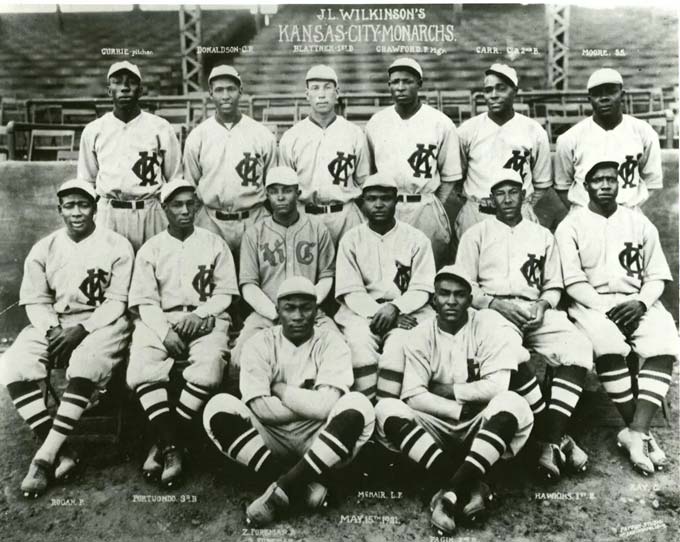
When Jackie Robinson broke the “color line” by starting first base for the Brooklyn Dodgers in 1947, it marked the beginning of a new chapter in major league baseball.
The Civil Rights Era paved the way for desegregation across national leagues, but the 1920s through the 1950s remains a landmark time for all-time athletes like Buck Leonard, John Henry “Pop” Lloyd, Oscar Charleston, and many more.
In 1990, the NLBM was founded in Kansas City to honor Negro League baseball in America.
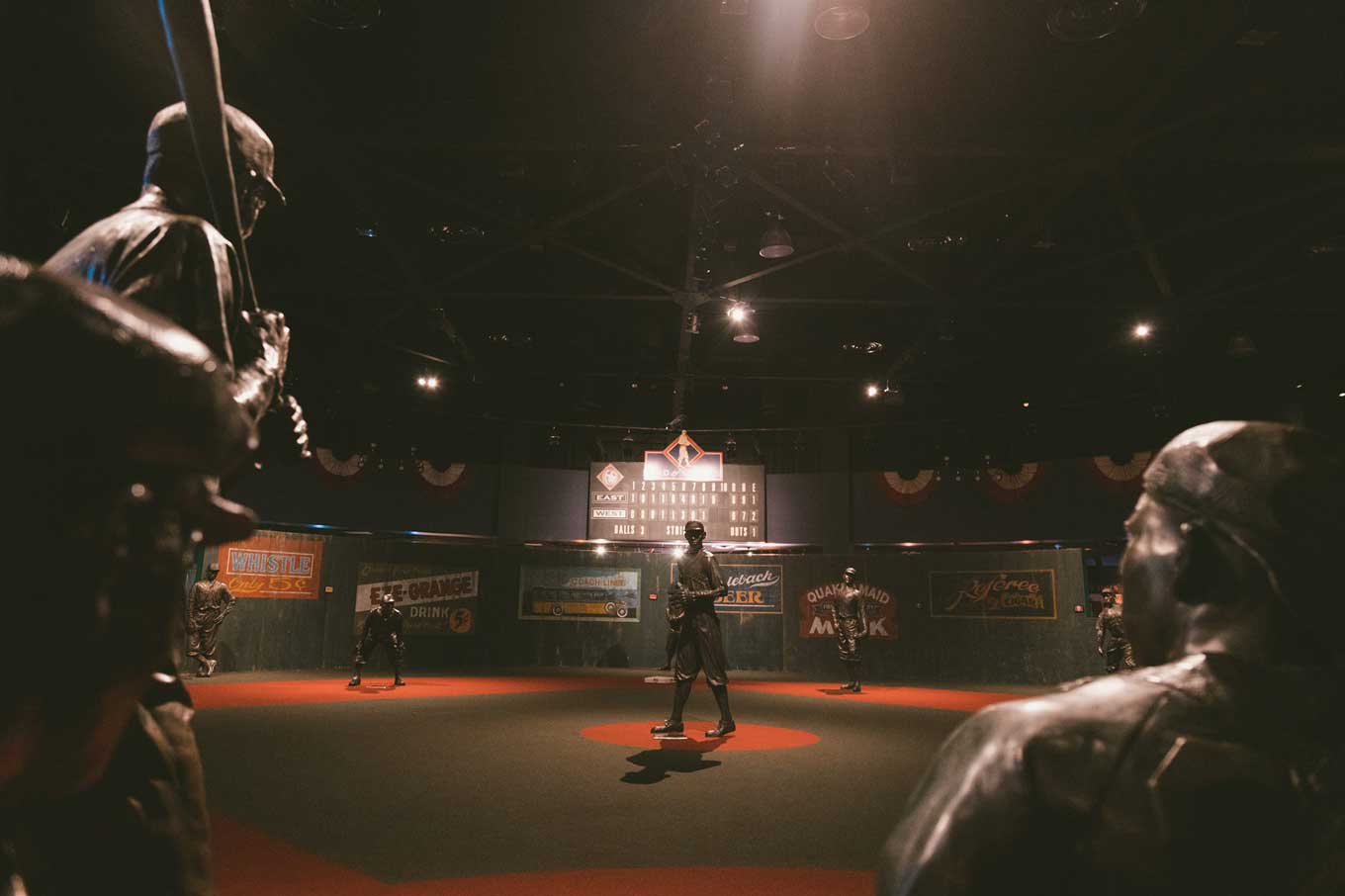
The museum moved into a 10,000 square-foot home in 1997 and has since welcomed more than two million visitors, becoming “one of the most important cultural institutions in the world for its work to give voice to a once forgotten chapter of baseball and American history,” according to Sklar.
This May, the NLBM is set to open a new exhibit titled “The Souls of the Game: Voices of Black Baseball” in its ongoing mission of preserving Black stories and culture, both during and beyond Black History Month.
Header image courtesy of the National Bobble Head Hall of Fame and Museum
While actress Jennifer Garner likely stands out in our collective memories as the lead of classic rom-com “13 Going on 30,” she has also been a vocal partner of Save the Children for over a decade.
As an Artist Ambassador for the NGO, this work has taken Garner across the country to bring the organization’s early childhood education programs to West Virginia and advocate to lawmakers in Arkansas, California, Kentucky, Mississippi, South Carolina, Tennessee, and Washington.
Most recently, she made a trip to Bloomfield, New Mexico, to meet with members of the Navajo Nation and the state legislature to drum up support for Save the Children programs.
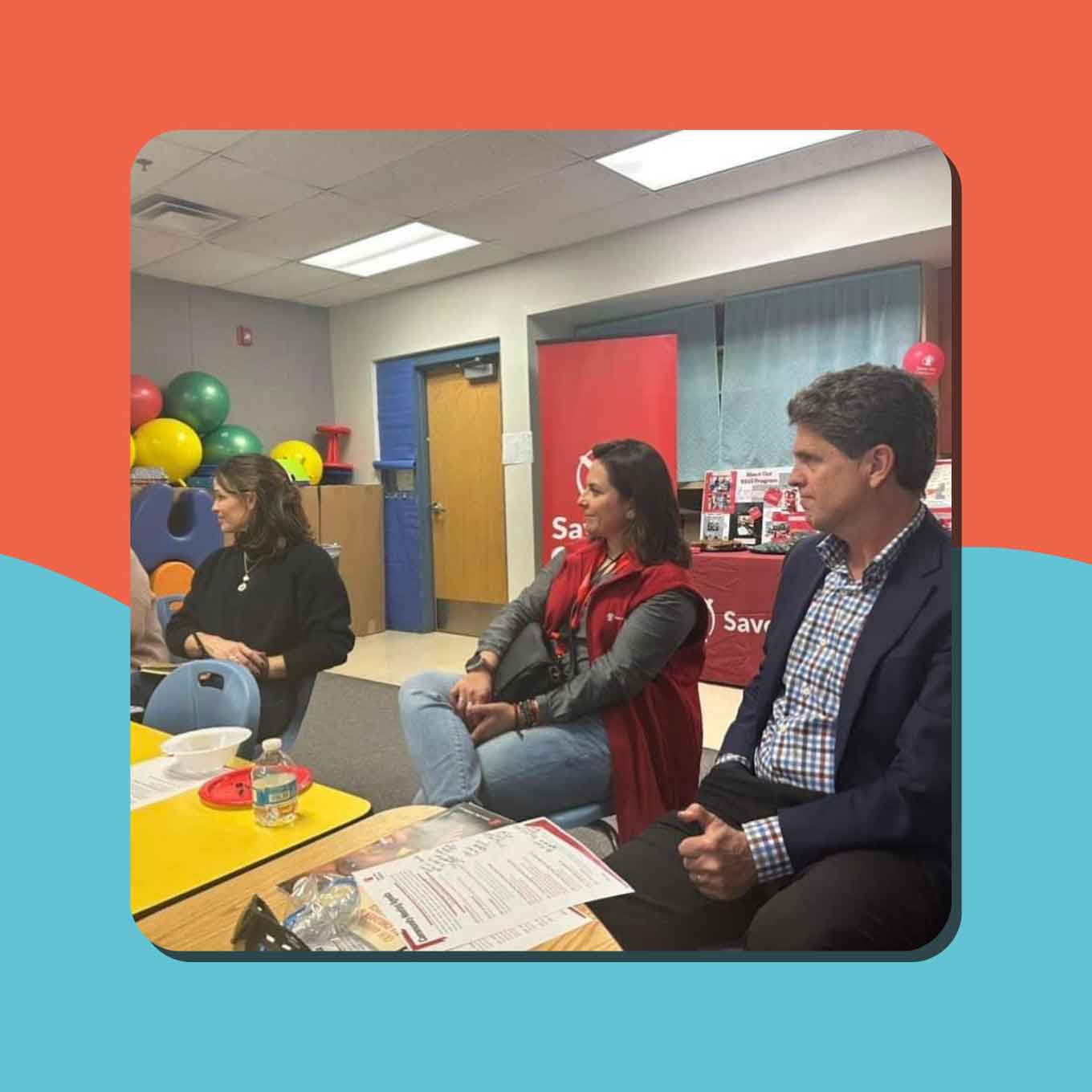
First, she made a visit to Central Primary Schools in Bloomfield and was greeted by swaths of excited students and teachers. Third grade teacher Adele Gutierrez shared a video of Garner walking the halls on her Facebook page.
“My 3rd grade class was excited,” Gutierrez wrote.
In a quieter part of the school, Garner also joined Navajo leaders for a meal.
“She had some traditional Diné foods for lunch! Naashjizhii (Steamed Corn) Mutton Stew w/frybread, Chííł Chin (Sumac) pudding, Tąą’niil (Blue Corn Mush) & Navajo Tea,” Indigenous community member Graham Tome Biyáál tweeted.
“She was in town with Mark Kennedy Shriver,” Biyáál continued. “They are working with schools and families in rural areas to increase student access to books, literacy programs, and developing educational support programs. So so so cool.”
Jennifer Garner was in Bloomfield, NM for a school visit yesterday. Just a couple of miles down the road from us.
— Graham Tome Biyáál (@gbeyale) February 1, 2024
She had some traditional Diné foods for lunch! Naashjizhii (Steamed Corn) Mutton Stew w/frybread, Chííł Chin (Sumac) pudding, Tąą'niil (Blue Corn Mush) & Navajo Tea. pic.twitter.com/qcEcrWqw9A
Garner was later joined by Mark Kennedy Shriver on the floor of the New Mexico state house, transparently noting that “we are here trying to shore up some state funding.”
“We were told that Save the Children has been changing the community in the short time that it’s been there,” she told lawmakers, following her visit to school programs in the community.
“It makes the kids and teachers and families feel like they matter, like somebody sees them, that somebody cares for them.”
This is not the first time Garner has been vocal in her support of Indigenous communities. In 2020, she worked with Save the Children to visit Mono Tribal land in California, supporting families who were most impacted by the COVID-19 pandemic, as well as destructive wildfires in the region.
“On this trip, I saw capable and loving leadership from Big Sandy Rancheria’s Tribal Chairperson Liz Kipp, I helped deliver a celebrated truckload of necessities … and I participated in a prayer and offering to the burned tribal land,” Garner shared in a Facebook post.
“All of this sent me home feeling extra grateful and certain of the good in our beautiful country.”
Garner’s organic food company, Once Upon A Farm, also helps provide support to impoverished Americans through a partnership with Save the Children. The company has donated nearly 500,000 meals to food-insecure communities and has a goal of delivering a million nutritious meals by 2025.

“Our efforts support Save the Children’s early education and nutrition programs that help kids reach their full potential for a happier, healthier tomorrow,” the brand’s website shares.
Between personal philanthropy, community engagement, and outspoken political support, Garner’s work in Bloomfield appeared to be celebrated and appreciated by locals.
New Mexico Senate President Pro Tem Mimi Stewart introduced Shriver and Garner upon their visit to the state house earlier this week.
“Garner has been a champion for Save the Children for nearly 15 years,” Stewart said. “She’s a true advocate for children experiencing poverty in rural America and promotes the importance of literacy, nutrition, and early education efforts as platforms for children to thrive as learners and in life.”
Header images courtesy of El Harvey and Sia Correa Hemphill