Florida Aquarium’s staff veterinarian Dr. Lindsey Waxman took it as an encouraging sign when one of her sea turtle patients grew feisty with her.
“If you're working with wildlife and the animal is trying to kill you, you've done a good job because now it has the energy to fight and to survive in the wild, and that's what we want to see,” Waxman told Florida news outlet WFLA.
The wriggling patient in question was Dark-Blue Yellow, a green sea turtle that came under the Florida Aquarium’s care in late March.
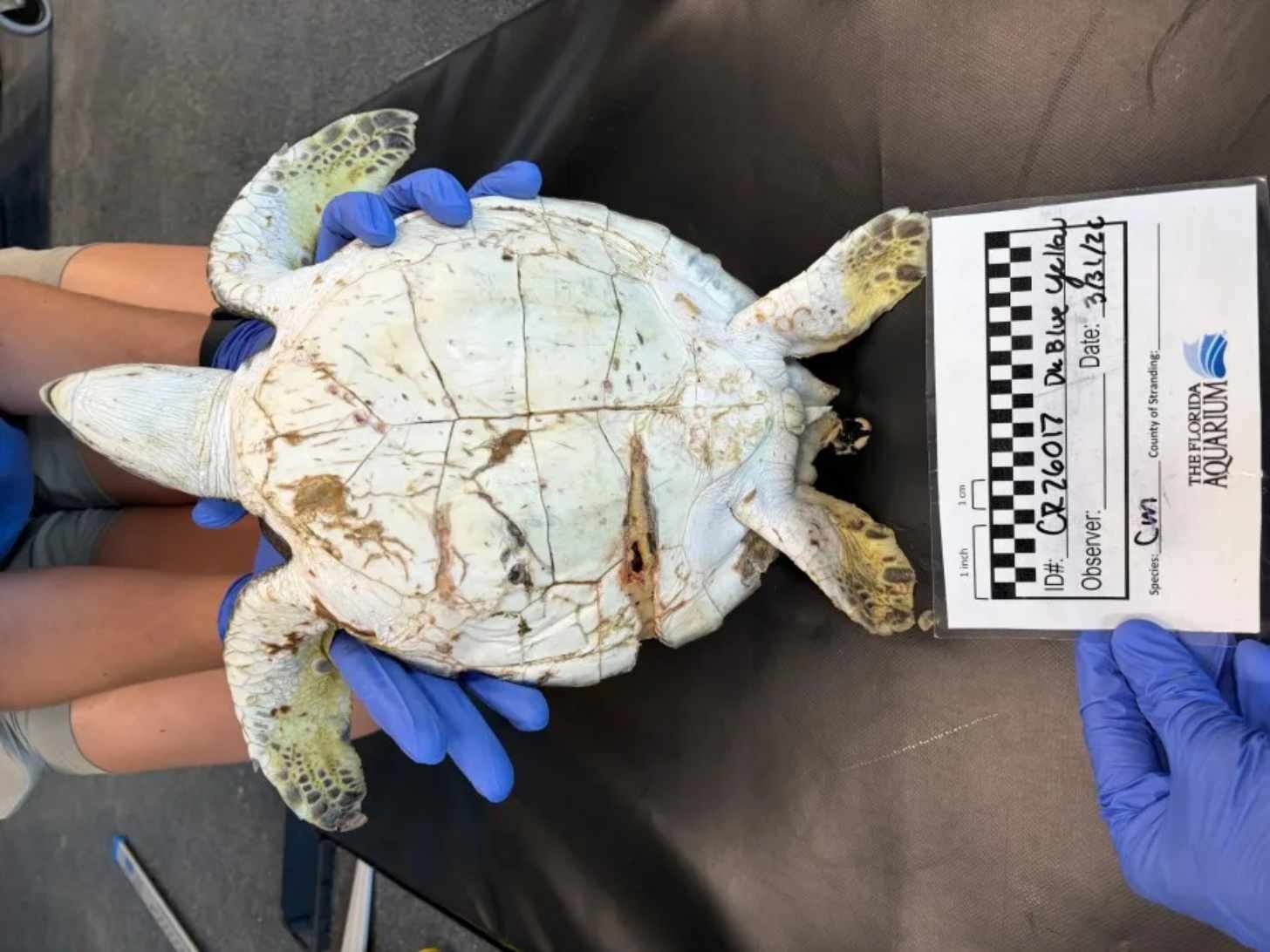
As soon as he arrived at the rescue center, it was clear that he had extensive injuries, chief among them being a cut on his underbelly that was deep enough to go through his plastron — the flat, bottom portion of a sea turtle’s shell that protects its belly and internal organs.
Although they couldn’t be fully certain, the staff believed that his wound was likely from a boat strike.
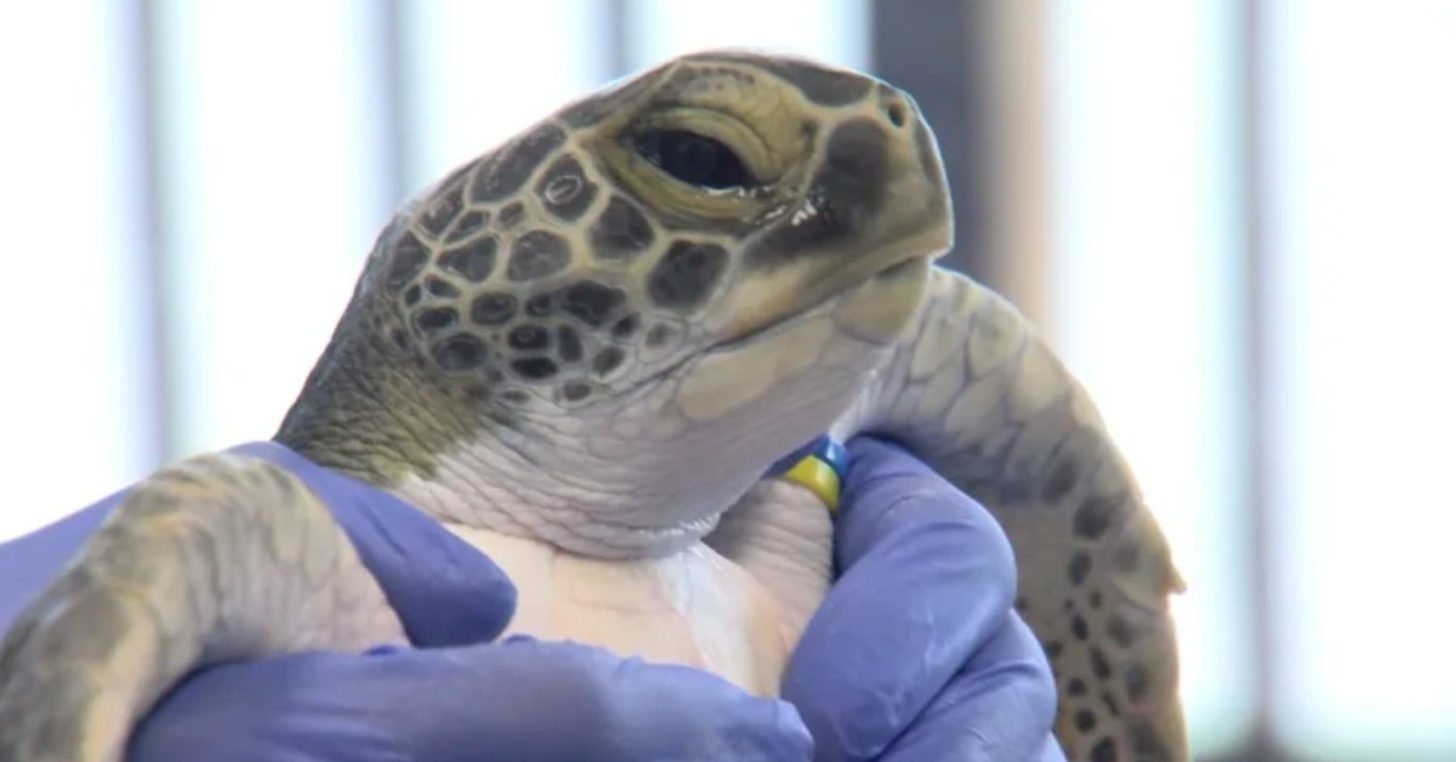
“It very well still could be associated with a boat strike because there’s really not that many things outside of human interaction that could cause wounds through the bone of a sea turtle,” Waxman explained.
Dark-Blue Yellow is among 21 other rescues picked up along the East Coast this season, but the severity of his injuries required around-the-clock care.
“It was unique and the most severe case that we’ve ever seen at the Florida Aquarium,” said Waxman.
Marine life boat strikes are far too common, especially in the summertime.
In early June, four friends were boating near Jupiter, Florida, when they spotted a large sea turtle struggling to keep her head above water.
The turtle, which they later named Zoey, weighed more than 300 pounds and required all four of the men to work together to guide her to the marina’s pier with a rope-pulley system.
Once out of the water, they noticed deep wounds on her shell consistent with a boat strike, which experts from the Loggerhead Marinelife Center later confirmed.
Despite their determination and the rapid response from wildlife specialists, Zoey died a few hours later from her injuries.
However, the four Florida locals said they would help again in a heartbeat.
“I think [sea turtles] are a staple of our waters,” one of the rescuers, Will Savery, told West Palm Beach news outlet WPTV. “When there’s an accident that happens with one, we’ve got to do what we can to save them.”
Fortunately, Dark-Blue Yellow has a different ending to his story. The Florida Aquarium staff said that he has made a promising recovery and is on track to return to the ocean in less than two months.
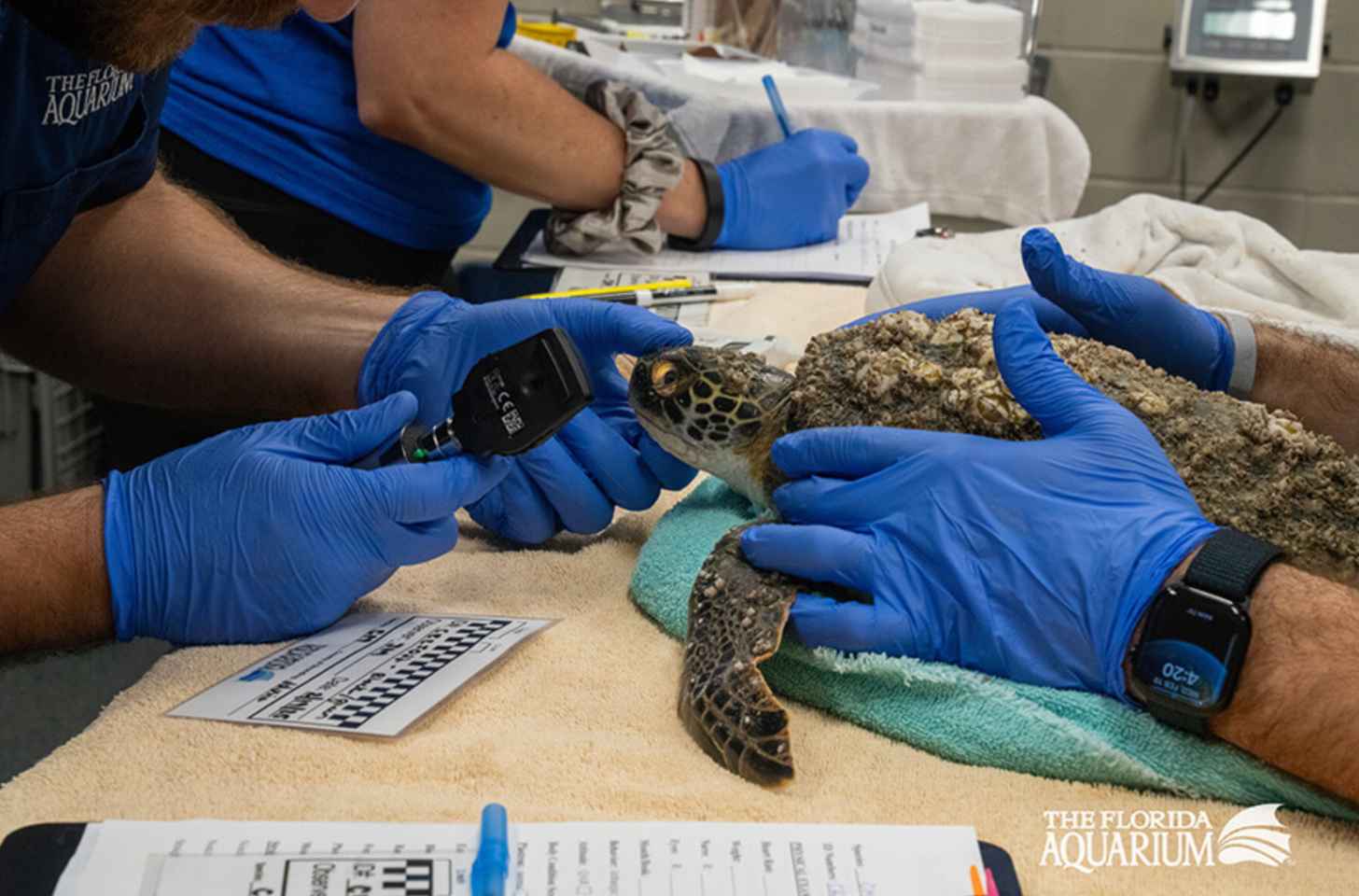
Still, Waxman stressed that sea turtles like Dark-Blue Yellow need all the help they can get.
“Sea turtles are just coming off of their endangered levels, but they still need help out there,” Waxman said. “These turtles would not be able to recover without human intervention.”
You may also like: This rescued sea turtle shocked scientists with its DNA results. After a 7-month recovery, he's returning to the ocean
Header image via The Florida Aquarium Turtle Rehabilitation Center
Rescuers scooped up a 3-pound coyote pup — estimated to be about 4 weeks old — from a homeowner’s yard in Surprise, Arizona after the baby animal fell into a cholla cactus.
After discovering the pup — barbed in the plant’s spines — the homeowner called Southwest Wildlife Conservation Center in Scottsdale, and a volunteer was dispatched to help.
Once at the clinic, Berk Martineau, a veterinary technician at the center, vlogged the whole event and posted a video on YouTube.

“It is considered baby season right now, which means we are getting a lot of orphaned baby animals. Of course, our goal is to always rehabilitate and release these animals. And today is a very interesting day,” Martineau said to the camera.
He then showed a photo of the baby coyote, with spines poking out of his face, paws, legs, and stomach.
“ These cactuses are super gnarly, and they have barbed spines, and they stick to your skin like crazy,” Martineau said. “So, this guy definitely needs some help.”
Once the coyote arrived at the clinic (via a volunteer transporter), he was given some sedatives to undergo the spine extraction as painlessly as possible.
“The hard part about cactus spines is that they aren't like any thorn like you'd be used to; they are barbed. So when they go in, they don't come out as easily,” Martineau narrated, as he attempted to pull a spine out of the small critters’ stomach.

According to the Washington Post, the pup was lethargic when he arrived at the clinic, in a way that suggested he was in shock. Martineau said it’s not uncommon to see animals with a few spines in their skin, but “this was a pretty extreme case,” he told the Post.
After about 45 minutes of using metal clamps to gently pull the spines from the sedated coyote — including some that went all the way through the pup’s ear — Martineau started seeing some progress.
“I'd say this guy has had a pretty rough start to life, but we're going to take good care of him,” he said in the video.
Martineau said the pup would have struggled on its own, even without the cactus spikes. As an orphaned animal, he would not have been prepared to live in the wild yet, as evidenced by this incident.
“They’re learning to become animals, they’re exploring, they’re running around,” Martineau told the Post about orphaned wildlife. “And unfortunately, a bunch get injured or separated from their mom.”
Overall, it took about two and a half hours for all the spines to be removed by Martineau and his colleague.
After they were done, they set up the baby animal in a warmed incubator to rest. He was given some fluids to get rehydrated, and once he was ready, it was time for his first meal.

“He's still got some time to go. We’ve got to get him all raised up to a big adult coyote and get him prepped to go back out into the wild,” Martineau concluded in his video. “So, that could take some time, but we are one step closer.”
Now spine-free, the pup was ready to finally begin healing.
“Hopefully, this was his hardest obstacle that he's going to have while he's here,” Martineau said, “and the rest is smooth sailing.”
You may also like: Harbor seals abandon their pups when beach-goers get too close. These mom-shaped pillows help save the babies' lives
Header image courtesy of Southwest Wildlife Conservation Center
When fishing gear and netting become lost underwater, they turn into “ghost gear” — marine litter that doubles as a deadly trap for marine life through ingestion and entanglement.
And according to the United Nations Environment Programme, a staggering 640,000 tons of fishing gear are abandoned in the ocean each year.
Fortunately, foundations like Healthy Seas have made it their mission to remove ghost gear in oceans around the world.
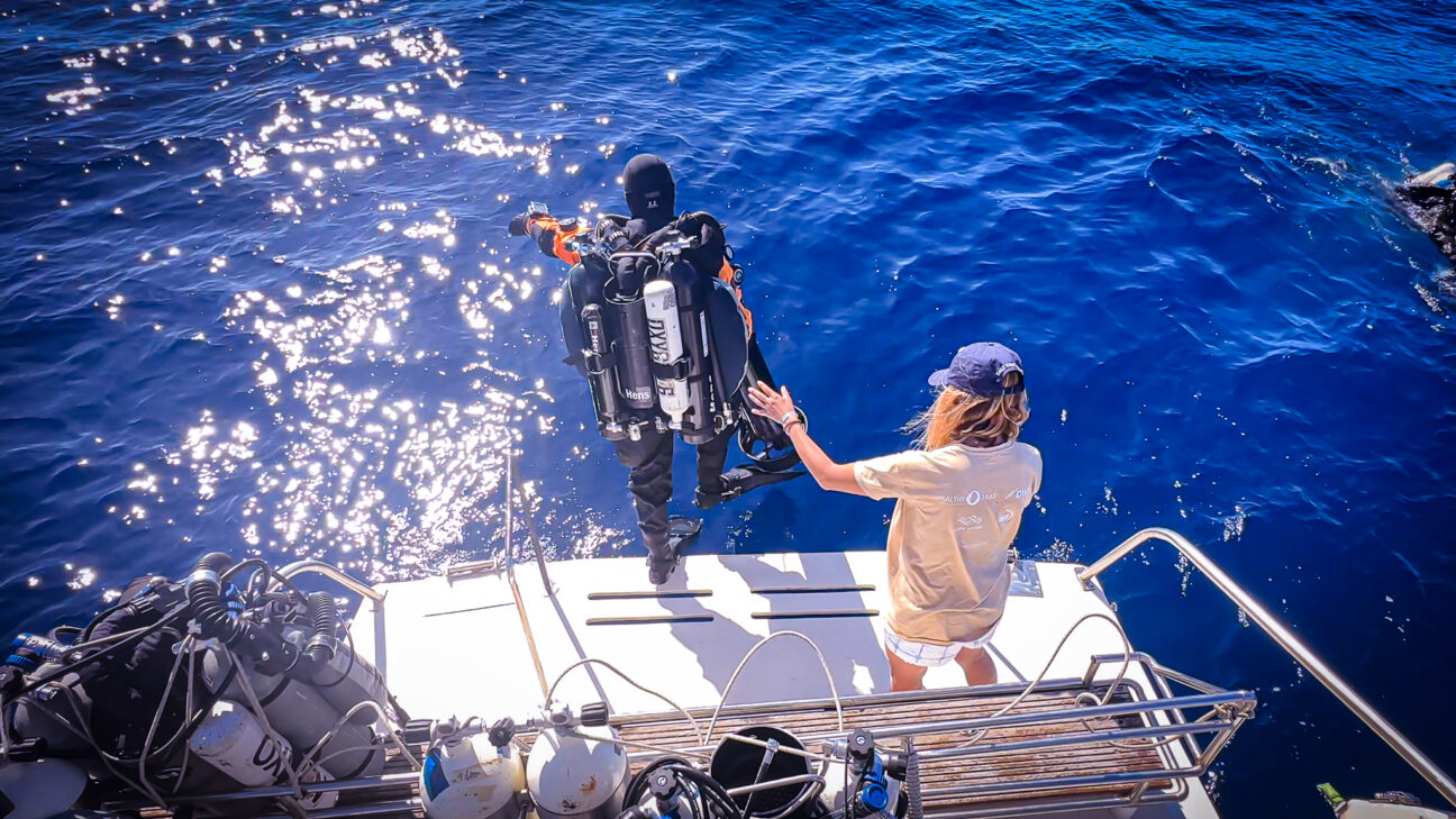
“In 2025 alone, our dedicated team of 550 Ghost Diving volunteer divers contributed a total of 140 diving days, conducting both survey dives and active clean-ups,” Healthy Seas wrote on its website.
“Together with Ghost Diving, we continue to tackle marine litter and remove ghost fishing gear, embodying our dedication to preserving marine ecosystems for future generations.”
On June 8, Healthy Seas revealed that a recent clean-up resulted in a once-in-a-lifetime encounter.
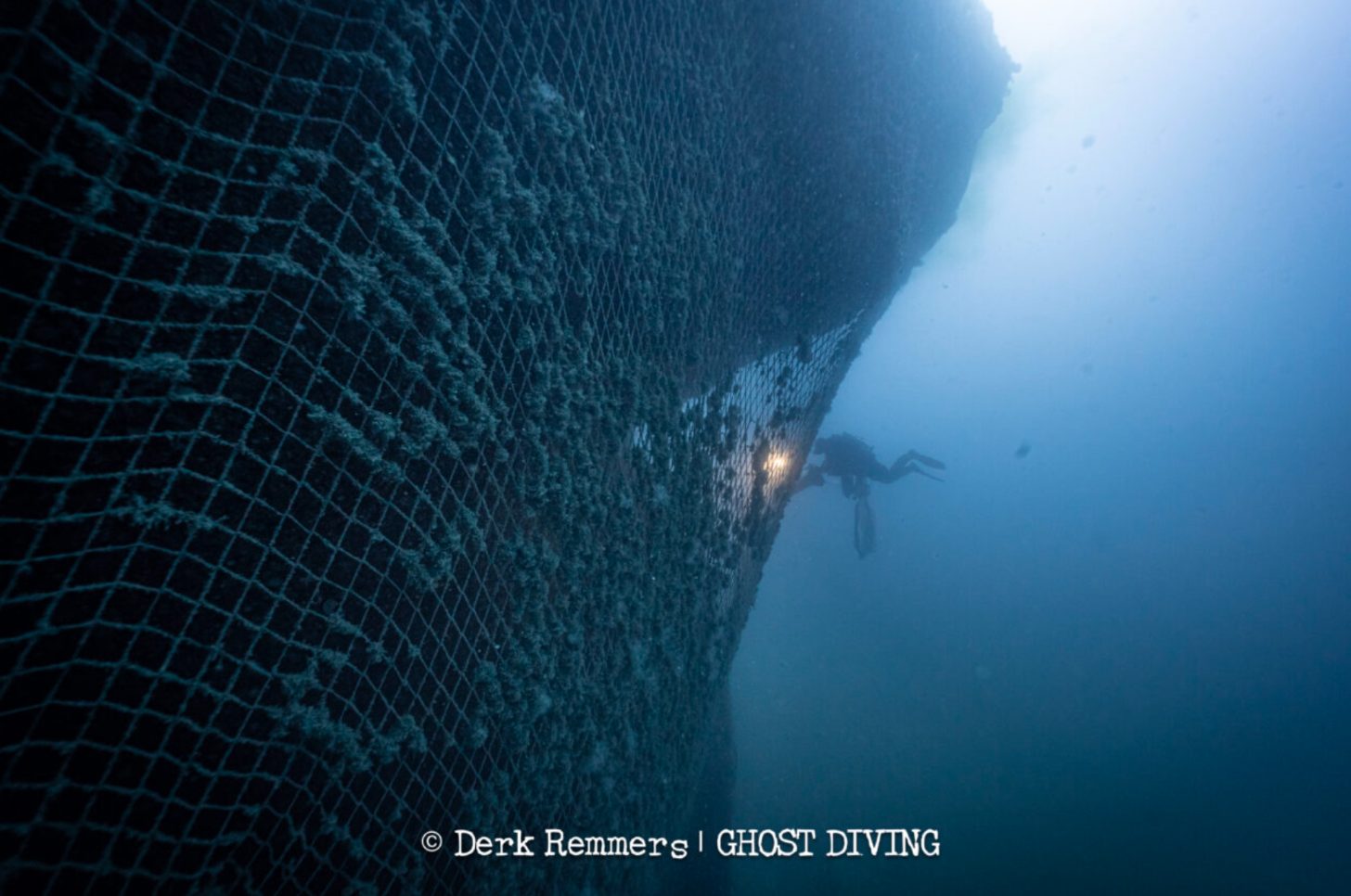
Ghost Diving volunteer Derk Remmers was helping his team remove netting from a shipwreck in the Strait of Sicily when a massive great white shark swam into view.
His immediate concern was not the shark itself, but whether he could take a picture of it in time.
“The shark was pretty close to us,” Remmers told the BBC. “And in fact, my fingers were trembling when I was trying to get the camera operating.”
While great white sharks have long been known to swim in the Mediterranean Sea, live sightings of them are incredibly rare. To date, regional knowledge of great white sharks has been severely limited to deceased specimens that are victims of commercial fishing.
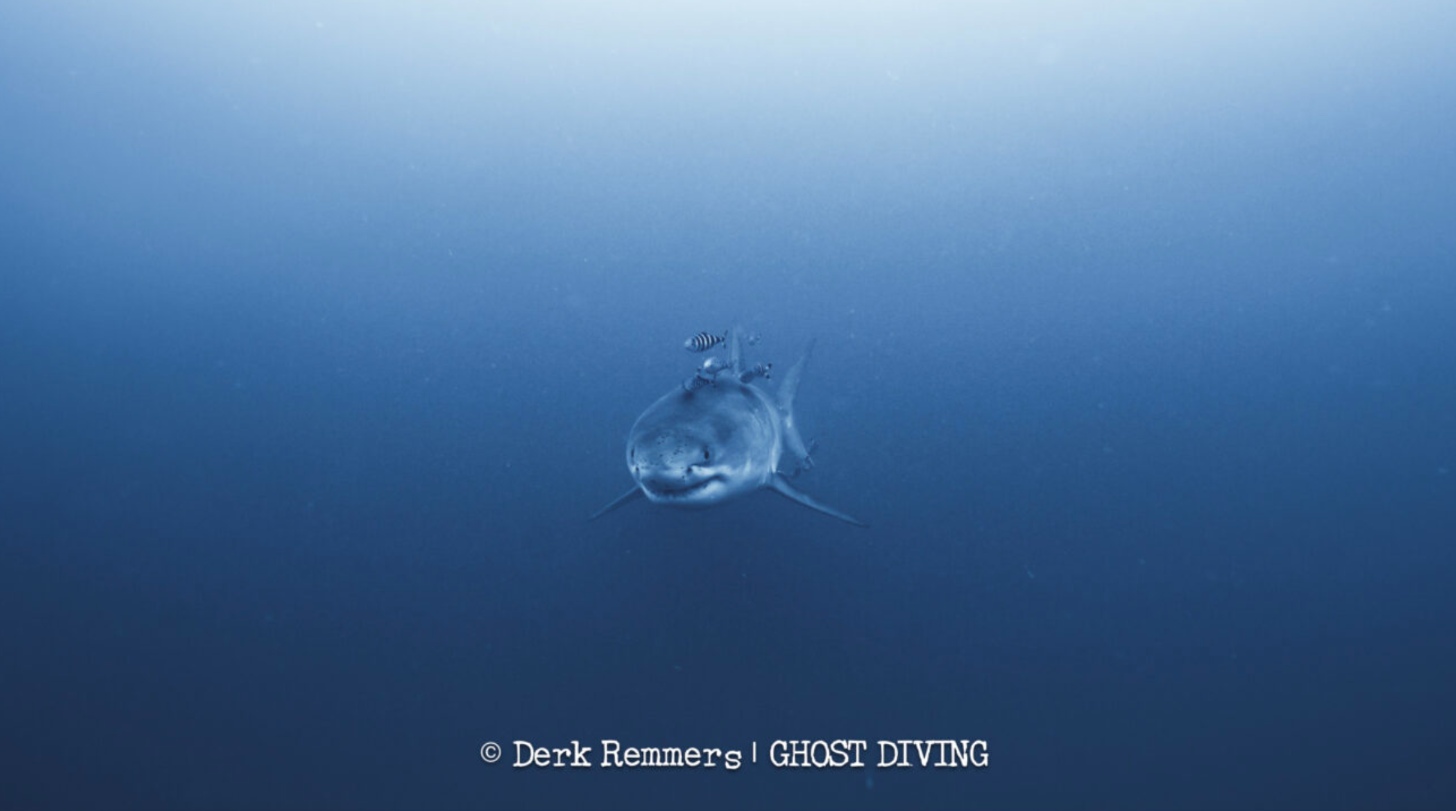
“What makes this encounter so powerful is not only the shark itself, but the context in which it happened. We were there to remove ghost nets trapping marine life on a shipwreck ecosystem that is a hotspot for biodiversity,” Veronika Mikos, the director of Healthy Seas, said in a press release.
“Moments like this remind us how much life can still exist in offshore Mediterranean waters and how important it is to protect it from preventable threats like abandoned fishing gear or overfishing.”
Dr. Carlo Cattano, a researcher at the Sicily Marine Centre of the Stazione Zoologica Anton Dohrn, highlighted the importance of the encounter and the data that awaits them.
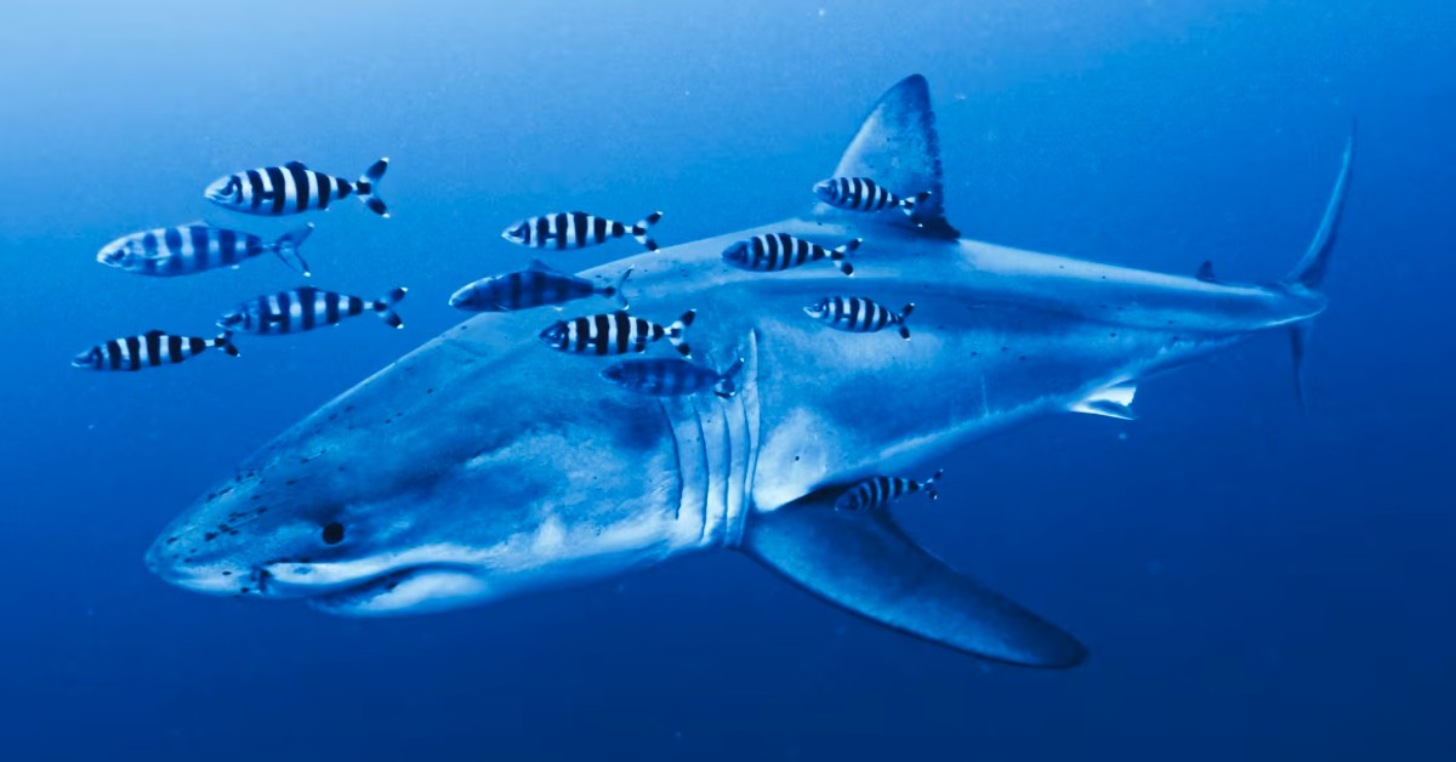
“Observations like this are extremely valuable for improving our understanding of the distribution, habits, and behaviour of this critically endangered species, whose survival is threatened by human activities,” Cattano explained.
“Our research on sharks has, over time, allowed us to identify several key hotspots for threatened species, and this sighting is particularly significant in validating the conservation value of this area.”
Remmers was extraordinarily grateful for the experience, saying it felt “pretty special.” He emphasized that a diver is statistically more likely to “win the lotto jackpot” than to meet a great white shark underwater — especially in the Mediterranean Sea.
“You spend decades diving wrecks and removing ghost nets, but nothing prepares you for a moment like this,” Remmers said. “An offshore underwater shark encounter in the Mediterranean is insane, yet we also went on with our diving plan to remove nets from the wreck, as this moment showed the importance of our work very clearly.”
You may also like: Bull sharks are big, aggressive predators — but they can still make friends, according to new research
Header image via Derk Remmers / Ghost Diving / Healthy Seas
Readers of South African newspapers The Star, The Mercury, and Cape Times may have thought their regular issue of the paper was misprinted — or maybe even soiled in delivery — when they saw bright red blood stains leaking from the front to back covers.
But it was a targeted campaign by the MENstruation Foundation to shine a light on period poverty.
The blood isn’t real, but the printing job is accurate: It looks like someone had used the newspapers as sanitary napkins.
And the reality is, some women and girls do.
“This is not a pad,” South African influencer and “menstruation minister” Candice Chiwra wrote in an Instagram post about the newspapers. “But for millions of girls, women and people who menstruate every month in South Africa, it is.”
So for World Menstrual Hygiene Day on May 28, the nonprofit teamed up with advertising agency Joe Public to ensure nobody turns away.

“Four million South African schoolgirls still can’t afford period products,” the nonprofit wrote on its Instagram. “How is this not front-page news?”
The ad bleeds through multiple pages of the various independent newspapers, landing on an ad that has one large red stain in the middle, with the simple text: “A newspaper can absorb the blood, but not the shame.”
The MENstruation Foundation was founded in 2018 — by two men: Siv Ngesi and Marius Basson — when Basson’s daughter turned 8, and he called up his friend and realized they needed to do something about period poverty.
They learned that around 8 million South African women can’t afford sanitary products — half of them girls in school. And because of this, an estimated 240 million education days are lost every year because they don’t have access to the products they need to go about life in a safe and dignified way.

From there, the foundation designed the Sanitary Pad Dispensing Machine Project, installing units in girls’ bathrooms across the country to provide a free pack of high-quality pads every month.
By August 2025, their website claims, the organization has saved over 500,000 education days through the machine.
Now, the foundation has also opened its own pad factory and continues to advocate for an end to period poverty through campaigns like this.
“I’m always, always on a mission to end period poverty,” Ngesi said in an Instagram video about the newspaper campaign. “I believe that if men bled once a month, sanitary products would be free.”
He went on to show an example of a newspaper with a large blood stain on its front page and reminded people to follow an accompanying QR code to donate to the MENstruation Foundation.
“I am honestly so proud of this,” he said. “We really are making period poverty front-page news.”
You may also like: The world's largest women's prison is now home to an independent newspaper — written by and for inmates
Header image courtesy of MENstruation Foundation
In May, a man named Loz Denis set off to run the entirety of the United Kingdom — a journey often called the “End to End.” He would cover 850 miles (or 1,380 kilometers) in under 17 days.
“That’s two marathons a day, every day… apart from the final day, where I’ll be finishing with a half marathon into Land’s End,” Denis wrote on a crowdfunding page for the run.
But in his eyes, it would all be worth it if he could honor his late parents. In 2020, his mother died after a 10-year battle with neuroendocrine cancer. And in 2023, his father died suddenly after living with heart disease for most of his life. Both of his parents died when he was in his 20s.
“Running became my lifeline through grief. I turned to it searching for a way to cope,” Denis wrote. “What began as a way to manage panic attacks and sleepless nights quickly turned into something much more: a path forward. Running gave me structure, purpose, and a deep sense of connection to both my parents. It’s been a source of healing through some of the darkest days, and this challenge is the next step on that journey.”

His goal was to raise a total of £8,000, to be split among four charities: NET Cancer UK, Birmingham Children’s Hospital, The British Heart Foundation, and Mind, saying that all four organizations played a “significant role in our family’s story.”
With his eyes on the prize, Denis was off, posting daily updates of his journey across the country.
Every so often, he would post a video dedicated to a certain someone: pop sensation — and marathon runner himself — Harry Styles.
“Harry Styles, this message is for you,” a sweaty Denis in a high-visibility vest would speak to the camera enthusiastically.
“I’m running the length of the U.K., and I need your help. I need you to comment … or even, come f—cking run with me! We’re doing it for mental health and everyone going through it. And not only that, we’re doing it for my mum and dad up there, and everyone we’ve lost.”

While he didn’t immediately get Styles’ attention, fans of the singer found the call to action endearing, as the former boyband sensation began his residency at Wembley Stadium over the weekend.
“SIR do not invite him on a run,” one fan jokingly commented on Denis’ video, “because he WILL cancel his tour to join you.”
Styles did not cancel his shows. But he did lend a helping hand to Denis.
Two days after his original video to the singer, Denis got a direct message from HSHQ, the official Styles “headquarters” on Instagram.
“We saw your videos and love what you’ve been doing,” the message reads. “We’d love to invite you to a Together, Together Wembley Stadium show of your choosing. Let us know when works best, and we’ll get it sorted.”
Denis was overjoyed. And he was even more excited to share that after 43 hours of running, he learned Styles had also donated to his fundraiser.
Under the name “Together Together,” a £2,000 donation was left for Denis.

A video of Denis learning about this generous gift has since gone viral, the runner bent over crying with Styles’ “Sign of the Times” playing quietly in the background.
“It means so much,” Denis said through tears. I set myself at £8,000 because I thought it was a bit unrealistic for me to get that. Thank you Harry — and Harry’s team.”
“I’m a bit speechless,” he went on. “I can’t wait to go see him now. Hopefully we’re gonna go for a run together.”
After Styles donated, Denis’ fundraiser saw a major boost, beating his original goal. As of the writing of this article, he has raised over £12,000.
“They really didn’t have to do this,” he said of Styles’ and his team. “It literally means the world. Running the length of the U.K. and asking Harry to comment … is all about making as much noise and awareness as possible, so no one has to go through what I went through.”
And after 215 hours and 33 minutes, according to Denis’ Strava stats, he completed the run, crying as he reached Land’s End.
“Running can be a force for good — not just personally, but in service of something greater,” Denis wrote on his crowdfunding page.
“Your donation — big or small — will mean so much. It will go directly towards supporting vital research, care, and support services provided by these organizations. This run is for my mum, for my dad, and for everyone who’s ever needed to keep moving forward, one step at a time.”
You may also like: After Harry Styles was photographed with this tote bag, he unknowingly paid for hundreds of people's therapy
Header images by Anthony Pham and courtesy of Loz Denis/Instagram
The National Aquarium in Abu Dhabi is home to the Middle East's longest walking underwater tunnel. Through it, visitors can walk 35 feet below the surface, surrounded by a massive 5,000,000-liter ocean tank glittering with thousands of sea creatures.
But The National Aquarium is more than a tourist attraction. It’s one of the world’s leading centers in marine life rehabilitation — particularly when it comes to its sea turtle conservancy.
To date, the aquarium has saved the lives of over 1,300 sea turtles, and its latest patient is one of its most harrowing cases yet.
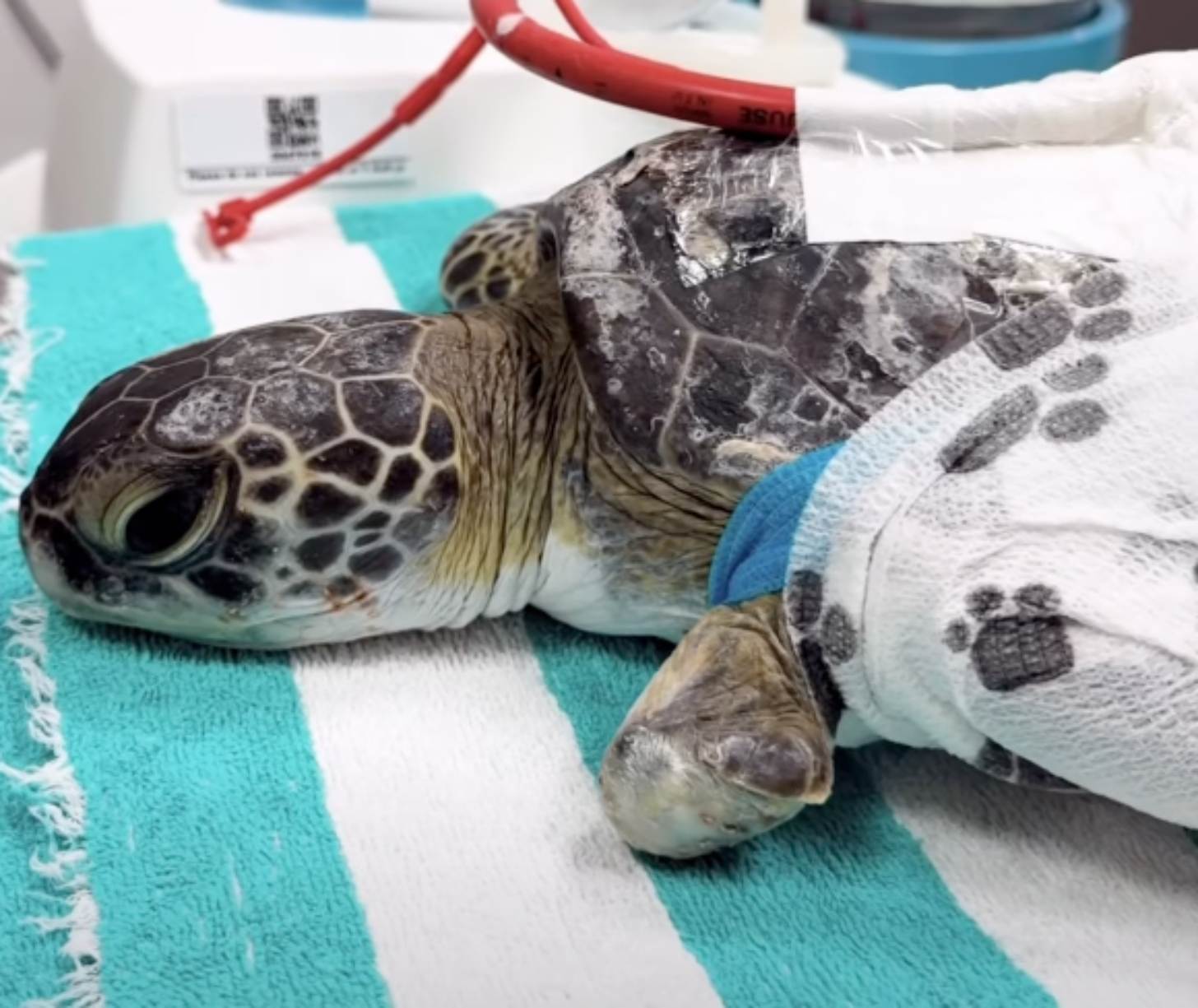
“Today, we have Kraken,” Aisha, a turtle team care member, said in an Instagram Reel that The National Aquarium shared on April 27. “He is a green sea turtle [who] came with a huge crack along its carapace, as well as under here on the plastron.”
A sea turtle’s carapace is the top of its shell, while its plastron is the shell underbelly that protects its vital organs. For an injury to cut through both, Aisha explained that it would have had to have come from a boat strike, “probably from a propeller.”
“Kraken also has a missing front flipper,” she added. “So when we looked at him when he first came in, we were just worried if the boat hit any of the important organs or the spine as well.”
Fortunately, after X-ray imaging, the veterinary staff was able to breathe a sigh of relief.
“Nothing seems to be damaged,” Aisha assured.
But Kraken wasn’t out of the woods yet. If a crushed and cracked shell is left untreated, bacteria and debris can enter the wound, leading to fatal infections or blood poisoning. It can also lead to long-term problems with swimming, buoyancy, and everyday survival if a sea turtle’s shell isn’t reformed properly.
That’s why The National Aquarium called him one of their “most special rescue cases” yet.
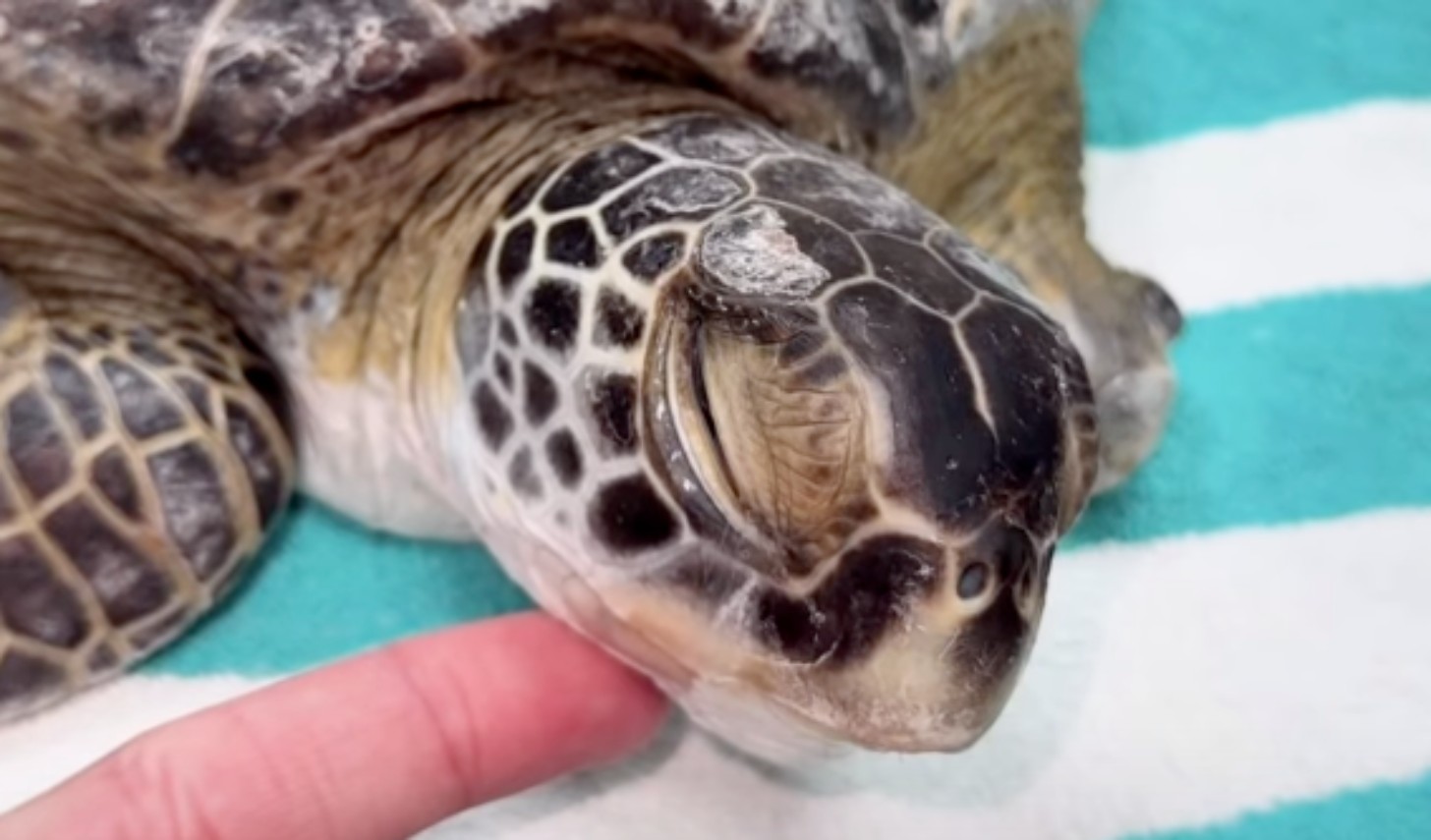
“What we’re doing here is negative pressure therapy,” Aisha explained. “How that works is we create this suction or vacuum, so everything can come together, expel any of the extra fluids, and help with the healing process.”
Negative pressure wound therapy was first pioneered for humans in the 1990s. In the last decade, wildlife veterinarians have adapted the technique to treat severe injuries in sea turtles — in a process that’s sometimes called “Turtle VAC” therapy.
In the procedure, a wound is sealed with an airtight, adhesive drape, while a suction tube connects the dressing to a mechanical vacuum pump, which applies gentle, continuous negative pressure.
Over time, the suction draws out infectious fluids, stimulates blood flow, and reduces swelling. It also accelerates tissue regeneration, cutting down on a sea turtle’s recovery time in the process.
Because sea turtles are, by nature, marine animals, waterproof bandaging and “marine-grade” sealants are used to protect the vacuum seal and ensure that seawater is unable to reach the wound.
“This is one of the first times we've ever done it here in the aquarium, especially with it fractured this way,” Aisha said.
Although Kraken’s injury was extraordinarily severe, it is by no means uncommon. Unfortunately, marine life boat strikes are one of the prevailing threats to endangered sea turtles, alongside entanglement in fishing gear, plastic ingestion, environmental pollution, and poaching.
A few weeks after Kraken was saved in Abu Dhabi, another green sea turtle was rescued 7,800 miles away in Juno Beach, Florida.
On May 21, the Loggerhead Marinelife Center shared the story of its patient, Aelin.
“This juvenile green turtle came to us with brutal injuries from an accidental boat strike in the intracoastal waterway in late March,” the rescue center posted on Instagram.
Like Kraken, Aelin required negative pressure wound therapy.
“Aelin is battling her way through recovery and making great progress thanks to customized care by our team,” they said. “After being dry-docked with a wound vac to stabilize her shell, followed by surgery to remove dead bone and more wound vac time, Aelin is on the mend and out in one of our larger hospital pools. She is getting regular exams and wound cleaning as she continues to heal.”
Today, both sea turtles are recovering from the same surgery, half a world apart.
“We really hope Kraken has a fast recovery,” Aisha said in The National Aquarium video. “Everything is looking well so far, and we’re just really hoping that, from now on, things go forward and the healing process goes well.”
You may also like: See these ‘crusty green’ sea turtles after two months of rehabilitation: ‘The difference is remarkable’
Header image via The National Aquarium, Abu Dhabi / Instagram
On March 8, podcast hosts Matt Carter and Lawrence Price posted a video to TikTok captioned: “35 dads in a pub, learning to braid their daughters’ hair.”
Since 2024, Price and Carter have been exploring the nuances of modern fatherhood on their show, The Secret Life of Dads. This year, they started holding in-person gatherings to help other fathers trade tips and tricks.
The first event, titled “Pints & Ponytails,” was held in early February, when roughly three dozen fathers squeezed around at a long table covered in mannequin heads and learned new hairstyles as they drank beers at the Lucky Saints Pub in London, England.
The events soon went viral, gaining global attention as viewers praised the dads for learning and growing together. On March 16, the news outlet NEXTA praised the hosts for reinventing a “boys’ night out” in a positive way.
“How adorable! In London, dozens of men gather in a pub to learn how to braid their daughters’ hair,” the Eastern European media company shared on X, formerly known as Twitter.
“The meetings last about two and a half hours — they drink beer and, together with stylists, learn how to make ponytails and braids.”
They praised The Secret Life of Dads for creating a space where parents could “discuss the challenges of raising children and support each other without judgment.”

The next day, Andrew Tate, a controversial influencer and self-proclaimed “king of toxic masculinity,” quote-reposted the media company and belittled the “Pints & Ponytails” events, invoking racial supremacy and using a derogatory slur.
In return, Price and Carter took to Instagram to poke fun at Tate’s remark.
“If being a more present dad and a better partner is your insult, we'll take it every time!” The pair shared on April 29. “Dads, we’ve got so many events coming up over the summer … we’ll see you at one very soon!”

After Tate’s ugly remarks went viral, Price and Carter’s events only gained more popularity.
On June 7, the hosts partnered with Fluxxbox, a menstrual health company that makes “first-period kits” for young girls and their parents. Together, they held their first “Periods & Ponytails” event at The Prince pub in West London.
“Periods shouldn't be a mum topic; they’re a parenting topic,” The Secret Life of Dads posted on Instagram. “A daughter who knows her dad won’t flinch or hand the conversation over to mum is a daughter who hopefully grows up with a positive outlook on men.”
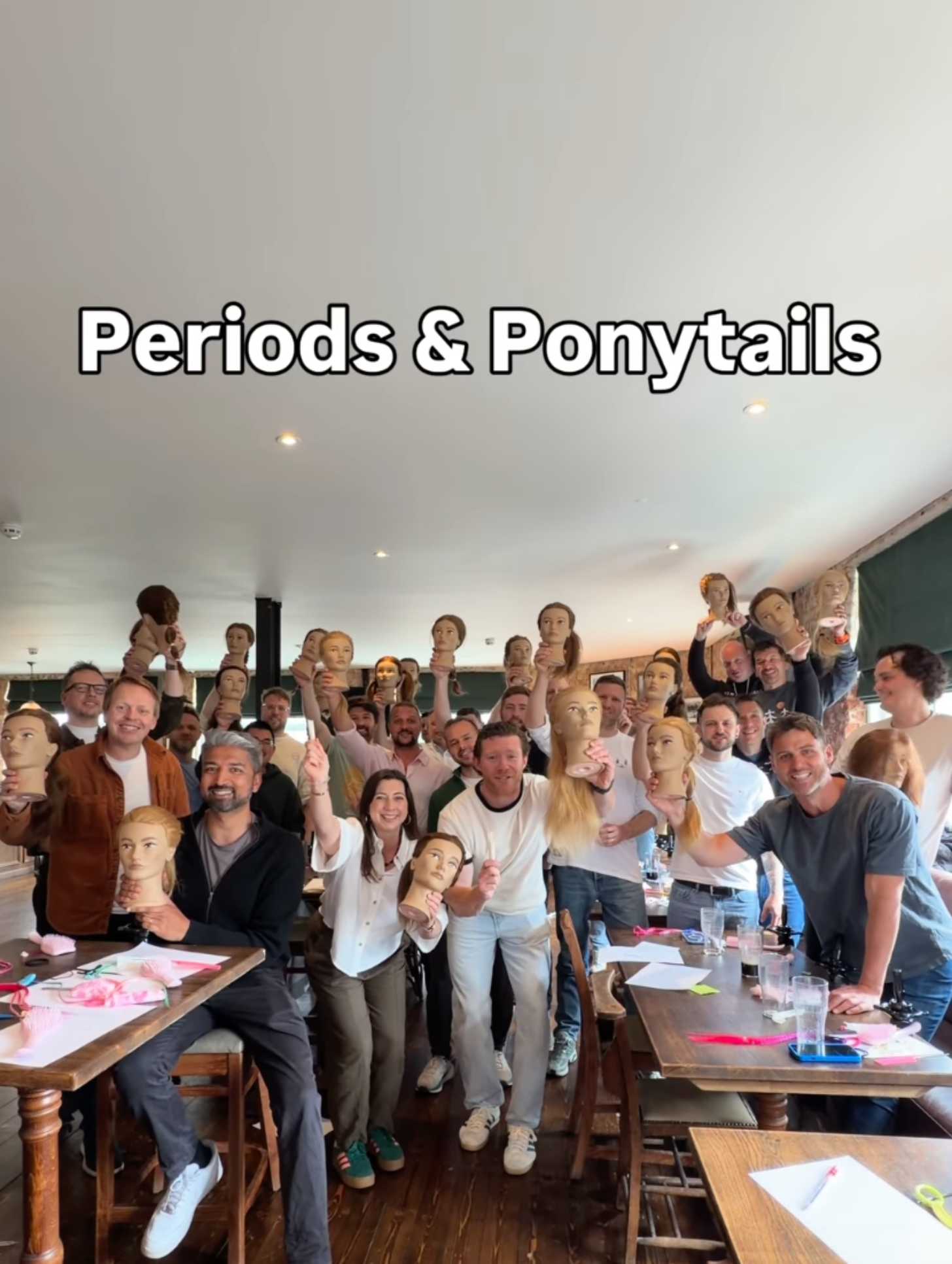
At the event, a representative from Fluxxbox led a PowerPoint presentation on period basics, from the menstrual cycle to diva cups.
Pads and tampons were passed around so the dads could take a closer look, as the instructor led a “pub quiz” on everything they’d learned.
The class ended with another hairstyling lesson, as the dads practiced “high ponies” and braids and cheered each other on.
“This is the kind of parenting we need,” an Instagram user wrote, “a great program, bringing a bunch of dads together that all want to be there for their daughters and giving them the information and hands-on practice to do so with confidence.”
In their post, Price and Carter emphasized that a dad serves as the “first example” of how a man can show up for their daughters.
“The big takeaway (there were many!) was that as a dad, you don’t need all the answers, just to be willing to sit through the moments that make you feel uncomfortable and stay anyway,” they wrote. “She’ll never forget it!”
You may also like: At Pride, supportive dads play catch with strangers
Header image via The Secret Life of Dads Instagram
Across New York City, the average cost of rent is $4,175 per month, about 154% higher than the national average. To live comfortably at this rate, renters would have to make an estimated $166,992 per year.
In the Bronx, however, rent averages at about $1,636 per month.
While this number is drastically lower than N.Y.C.’s total average, the median household income in the Bronx is approximately $46,000 to $48,700 — not even close to the estimated $65,436 per year needed to pay rent in the area.
So, it’s safe to say that people across the city are looking for affordable places to live.
For many young women, Centro Maria Residence in the Bronx has become a guiding light.
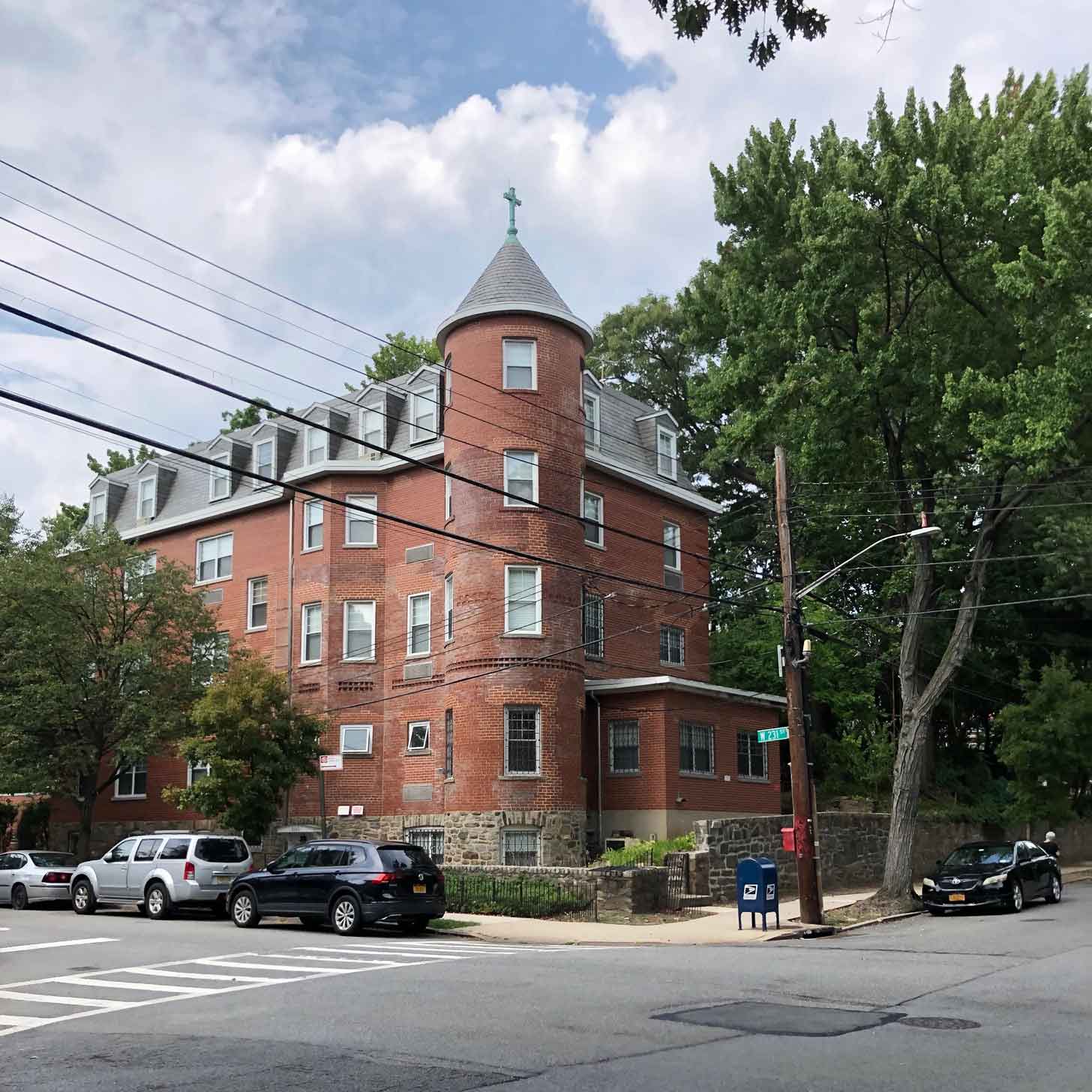
Centro Maria is a boarding house run by a group of Catholic nuns. They host 22 women at the building in the Bronx’s Spuyten Duyvil neighborhood, and the women staying there pay $210 per week for a single bedroom — or $190 for a shared room, according to Brick Underground.
That makes it one of the cheapest places to live in the entire city.
There are some rules, however.
Residents must follow a strict curfew: home by 11:30 p.m. on weeknights and midnight on the weekends. No alcohol is allowed in the bedrooms, and no boys are allowed above the first main floor.
And while residents are allowed to have boyfriends, Sister Rita does not withhold her judgment.
But if those stipulations aren’t a deal-breaker, there are plenty of amenities for residents.
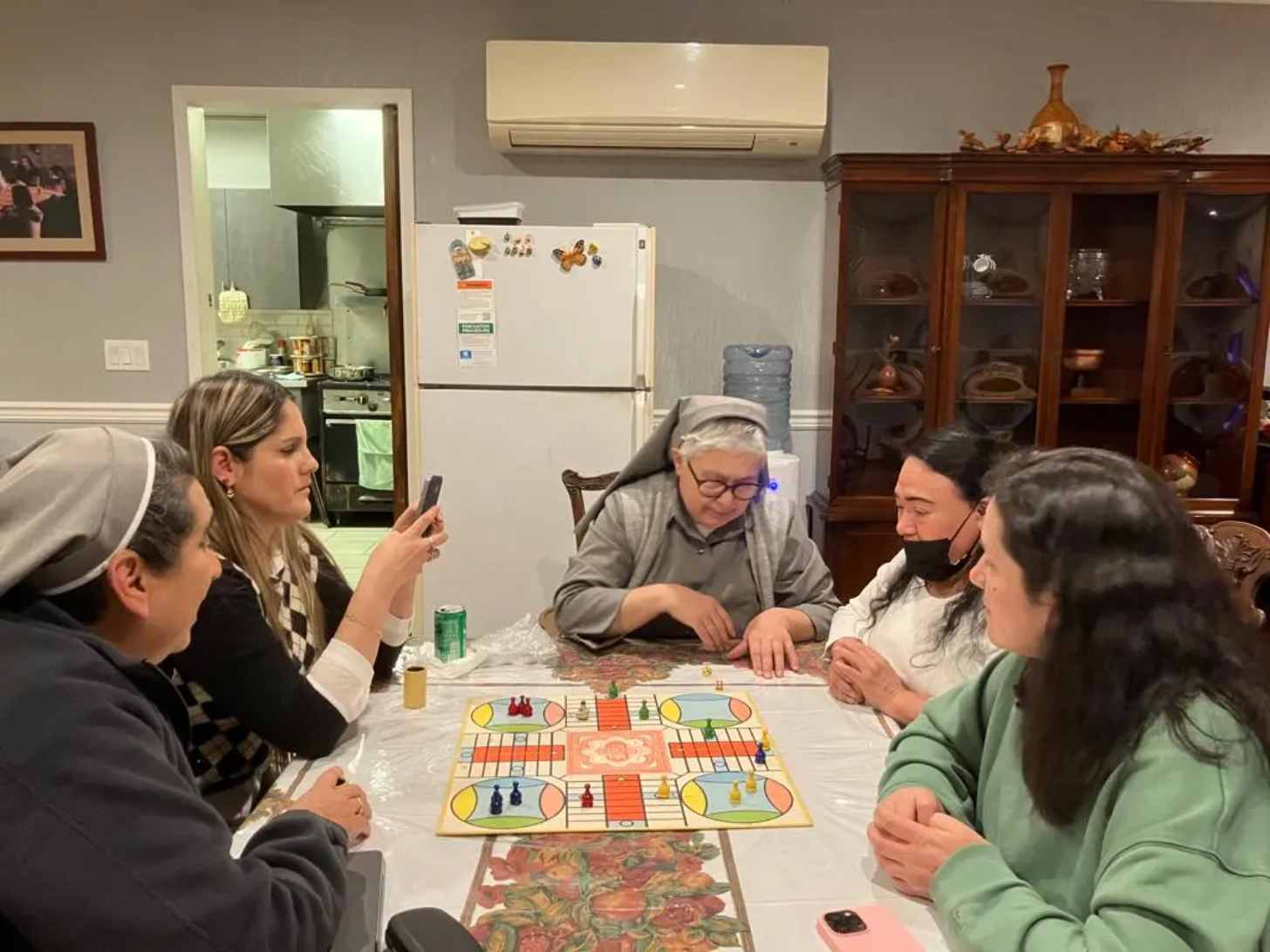
Each morning, the nuns cook breakfast for residents, they offer free Wi-Fi, a fitness center, private bathrooms, on-site laundry facilities, a communal kitchen, 24-hour security, and a parking lot. They also provide basic furniture in each room, and the building has central air conditioning, according to the residence’s website.
The nuns also clean regularly and host parties and social events for the community to get to know each other.
“We are privileged to be here,” Jeralene Maria, a student from India, who lives at Centro Maria, told Brick Underground.
Centro Maria is a unique concept for most modern women, but convents and boarding houses like this were very popular in N.Y.C. after the 1860s, when a group of wealthy Christian women retrofitted homes for factory workers, seamstresses, shop girls, and other working women for a low cost.

Back then, the boarding houses came with strict rules for unmarried women, according to the New York Historical Society.
But these days, with approximately five total boarding houses left in the city, the rules are a lot more relaxed than they were over a century ago. Some places even allow co-ed housing.
“Nuns are awesome,” Katie Rettig, a resident of another boarding house in the city, St. Mary’s Residence, told The Wall Street Journal. “They be chilling.”
“I trust nuns more than I trust random people on Facebook Marketplace,” she added.

Diana Janna Reyes Núñez, a 26-year-old resident at Centro Maria, found the house to be a refuge after her mother died.
“Finances have been such a struggle for me,” she told The Journal.
Having utilities, Wi-Fi, and breakfast included in the rent made everything a lot more manageable. And the nuns walked with her through the grief.
“It’s like a family connection. The sisters are always there to check on you,” Maria, the resident from India, told Brick Underground. “You’re not lost, because New York is kind of a lost place.”

On Centro Maria’s website, the space is described as “a home away from home” for young women who move to the United States from other countries to pursue work or education.
Most boarding houses in the city accept non-Christian residents and don’t require a religious practice. In fact, it seems like the biggest barrier to entry for most is the months-long waitlist to secure a spot.
“I love living with the girls,” Sister Rita, one of the five nuns at Centro Maria, told The Journal. “They keep me young.”
You may also like: They turned an old convent into an all-women apartment complex: 'It's about taking control of our lives'
Header image courtesy of Centro Maria Residence
People who rent their homes, or don’t have enough money to make major upgrades to their homes, have for many years been left out of a major shift in heating and cooling technology that can improve efficiency, save money and be better for the global climate: heat pumps.
Heating and cooling buildings consumes 35% of all the energy used in the United States each year. Many homes and businesses are converting their fossil fuel-powered heating and cooling systems to electric-powered heat pumps, which use electricity not to generate hot or cold air but to move heat into spaces needing warmth and out of spaces needing cooling.
Until recently, that process has required a significant amount of sizable and expensive equipment to be permanently installed in a building, which needs a professional contractor and can cost as much as $10,000 just for the installation — in addition to the actual equipment.
Often called mini-splits, these systems usually have a condenser outside the building that exchanges heat with the outdoor air and an evaporator inside that exchanges heat with the indoor air.
But now window heat pumps are becoming available in the U.S. Much like a window air conditioner, these self-contained devices can be installed without professional help and plugged into a wall outlet. Unlike window air conditioners, though, they can provide heat as well as cooling.
They cost much less than a permanent system — between $3,000 and $4,000 — and can be moved to a new property if the owner relocates.
There aren’t many options commercially available yet, and those on the market can’t heat or cool very large spaces on their own. And they work less efficiently when heating homes in places with extremely cold outdoor temperatures. A few models are available on the market that are even cheaper, but they don’t have efficiency ratings, don’t work when outdoor temperatures are very cold, and are louder when running.
I have designed and evaluated a wide range of building energy efficiency technologies; here’s how these window heat pumps work, and why they may allow apartment dwellers and residents of older houses to easily and relatively inexpensively make significant improvements to their homes’ heating and cooling systems.
Federal subsidies for this type of equipment expired in 2025, but some utility companies, states, and local governments may still offer money to help pay the costs.

Moving heat from one place to another
Heat pumps use a reversible refrigeration cycle and can provide similar heating and cooling as electric-powered space heaters, furnaces, and baseboard heaters, while using less than half the electricity.
The most common heat pumps transfer heat between air indoors and outdoors, but other systems can exchange heat with the ground or with bodies of water, such as lakes.
Heat pumps’ capacities are defined by the amount of heat they can transfer in a particular period of time. A heat pump serving an entire home may need a capacity of 12,000 to 60,000 British thermal units (about 12,660 to 63,300 kilojoules) — but the window units’ capacities are much lower, getting up to only about 9,000 Btu (9,500 kJ).
Performance varies based on the conditions outdoors, where the unit is either sending excess heat to cool the indoors or gathering heat to warm the indoors. In cooling mode, heat pumps are rated by their seasonal energy efficiency ratio, a figure that indicates how much cooling is achieved per unit of electricity used.
The corresponding measurement for heating is called heating seasonal performance factor. In general, the larger these numbers are, the better they will perform. The U.S. Department of Energy has established minimum standards for those figures.
While these units operate even when outdoor temperatures are -13 degrees Fahrenheit, their heating output is reduced to almost half of its rated capacity, and their energy efficiency falls to one-third of its rated performance at that temperature.

In addition to their low cost compared to conventional split heat pumps, packaged window heat pumps meet heating and cooling needs with lower energy demands and costs. But each window unit serves just one room, while a more common split unit can serve multiple rooms.
Packaged window heat pumps are easy and inexpensive to install and offer all-in-one heating and cooling options for apartments and older homes, with higher energy efficiency performance than traditional systems. Their main limitations include their low capacities and reduced energy efficiency in extremely cold climates or conditions.
This article was written by Moncef Krarti from the University of Colorado Boulder, and was originally published on The Conversation.
Header Image by Mike van Schoonderwalt via Pexels

The abolitionist and writer Frederick Douglass is known for many things, but perhaps among the most significant is his views on education’s relationship to slavery. Douglass himself was born into slavery in Maryland in 1818.
Douglass described in his 1845 autobiography how one of his enslavers, Mrs. Auld, began teaching him to read when he was a child. Mrs. Auld’s husband ordered her to stop giving Douglass lessons.
“Just at this point of my progress, Mr. Auld found out what was going on, and at once forbade Mrs. Auld to instruct me further, telling her, among other things, that it was unlawful, as well as unsafe, to teach a slave to read,” Douglass writes. “To use his own words, further, he said, ‘If you give a n—r an inch, he will take an ell. A n—r should know nothing but to obey his master.’”
Congress enacted the 13th Amendment on Jan. 31, 1865, abolishing slavery. It was not until June 19, 1865, that word of the amendment reached enslaved people in Galveston, Texas, marking the origin of the Juneteenth holiday.
The Biden administration declared Juneteenth a federal holiday in 2021. Today, Juneteenth commemorates the end of slavery in the U.S. But the story for formerly enslaved people continued to unfold in complex ways well after Juneteenth, including when it came to their educational journeys.
Juneteenth made clear that freedom was not just confined to someone’s physical enslavement, but mental enslavement as well, bound in the laws that barred enslaved people from receiving an education in Southern states.
Making learning illegal
In 1739, the Stono slave rebellion took place in South Carolina. Fearing that educated slaves would go on to plot future rebellions, South Carolina passed an anti-literacy law in 1740, banning slaves from being taught how to read.
Most Southern states soon followed with anti-literacy laws of their own between 1740 and 1834, in the hopes of preventing any further slave rebellions. These laws applied to both enslaved and free Black people.
Despite these laws, thousands of enslaved people still learned to read and write in the antebellum South. Literacy was a means of freedom.
Meanwhile, the first African Free School for Black children was established in New York City in 1787. The one-room schoolhouse began with 40 students, the majority of whom had parents who were formerly enslaved. Six additional, similar schools were created with public funding by 1824.
Juneteenth and the path to freedom
Juneteenth is a complicated story of formerly enslaved people’s faith and resilience, as well as white supremacists’ hate and resistance to formerly enslaved people experiencing liberation.
It also offers an important reminder that true freedom must also include the right to an education.
Formerly enslaved individuals had various responses to their newfound freedom in 1865, ranging from gratitude and joy to despair and loss.
Many formerly enslaved people decided to leave plantations and Southern states to reunite with family members and communities separated by slavery.
Others opted to remain where they had been enslaved, seeking to experience freedom in familiar surroundings. In fact, the vast majority of freed people remained in the South.
Regardless of their choices, the approximately 4 million formerly enslaved people challenged the U.S. to acknowledge their liberation and welcome them as equals.
Relentlessly, they endeavored to establish themselves as free citizens within the nation. One of these newly freed people’s primary goals was to receive an education.
Learning to read, write and more
After the Civil War, newly freed people gathered in churches, homes, cellars, sheds, meetinghouses, and even under shade trees in the fields where they worked the crops to learn how to read and write. They also learned basic job skills, such as the ability to read and understand labor contracts.
Many of the teachers had no formal training, and some of them were local Black people who were self-taught.
Other educators included white teachers from the South and the North, sent by churches and aid societies.
White aid societies and religious organizations from the North, including the American Missionary Association and the National Freedman’s Relief Association, sometimes funded these free schools for formerly enslaved Black people.
However, most of the money to fund these schools came from the newly freed Americans, who privately paid for their schools.
While about 90% of the Black population in Southern states were illiterate in 1865, this percentage dropped to 70% by 1880.
A journey into higher education
Newly freed Black people also began to have more options for higher education.
The first historically Black college and university, Cheyney University, was established in Pennsylvania in 1837, well before the Civil War. A total of four HBCUs were established by the end of the Civil War in 1865.
At this point, true liberation began, as a growing number of HBCUs offered academic freedom to Black Americans, who otherwise would have been prohibited from attending most colleges and universities.
In the 15 years following the Civil War, a total of 59 HBCUs had opened their doors to Black students.
In 1867, by act of Congress, Howard University was established in Washington, D.C. It provided not only basic college courses but also programs in law, medicine, education, and pharmaceuticals.
A promise that requires education
A whole new set of challenges and opportunities greeted the formerly enslaved Black Americans who sought freedom in the North. Most arrived in cities such as Chicago and New York, where they found some humanitarian support but also racial discrimination and poverty.
Their lives were constantly filled with both legal and racial hostility.
Education ranked high among the free people as a priority, as they looked to gain new skills and advance in life. They learned not only the basics in reading and math, but also job skills, citizenship, and advanced learning in professional careers, such as law, medicine, pharmacy, and teaching.
Ultimately, Juneteenth offered a promise of freedom — but education was necessary to make it happen.
This article was written by Rodney Coates from Miami University, and was originally published on The Conversation.
Header Image by Heather Mount on Unsplash

Every year between May and September, hundreds of sea turtles make their way to the shores of North Carolina’s Cape Hatteras National Seashore. Here, under the cover of dark, endangered turtles lay eggs.
Endangered species, including green, leatherback, and Kemp’s ridley turtles, crawl onto the beaches, digging large pits, and laying hundreds of eggs that incubate for about 60 days.
But those 60 days are crucial.
The national seashore’s beaches have been monitored since 1987 to help ensure the best success rates for these nests, which could otherwise be subject to attacks from beach predators, natural disasters, or human activity.

The goal in monitoring is to collect data about these nests and the species at large, and to ensure no unwelcome visitors come knocking.
But to do this, National Park Service rangers and specialists need help from locals. While one option is to “adopt a sea turtle nest,” locals can also volunteer to join the national seashore’s sea turtle nest watch program.
“Volunteers are assigned to monitor sea turtle nests during the evening hours, helping protect nesting areas from vehicle intrusion, sharing information with visitors, and contacting National Park Service staff if hatchlings begin emerging from a nest,” Island Free Press reports.
Anyone interested in becoming a volunteer must be an Ocracoke resident or long-term visitor who will be available throughout nesting season.

Volunteers must also attend an orientation scheduled for Tuesday, June 23 at the Ocracoke Community Center. During this training, volunteers will learn safety procedures and information about sea turtles and their nesting habits. They’ll also be invited to fill out paperwork to become certified NPS volunteers.
This year, Cape Hatteras National Seashore has recorded 83 sea turtle nests on Hatteras and Ocracoke islands as of June 14. Those nests include 79 loggerhead nests and three leatherback nests, according to Island Free Press.
“Like all national parks, the seashore is a special place that was established to help uphold the National Park Service's mission ‘to preserve unimpaired the natural and cultural resources and values of the National Park System for the enjoyment, education, and inspiration of this and future generations,’” the Cape Hatteras webpage reads.
“Conserving endangered species is an important part of this mission and a responsibility of all those who would be stewards of Cape Hatteras National Seashore.”
You may also like: Researchers celebrate record leatherback sea turtle hatchling season
Header image courtesy of NPS
This article originally appeared on Inside Climate News, a nonprofit, non-partisan news organization that covers climate, energy and the environment. Sign up for their newsletter here.
“Pull! Pull!” shouts Scott Dexter, chanting the cadence for eight men gripping a rope. “Pull!”
With each pull, a 172-pound male loggerhead sea turtle is hoisted higher into the air. It takes several hoists to lift the turtle about 35 feet above the Gulf of Mexico, where Dexter and others are able to lift the netted animal over the railings of the Navarre Beach Fishing Pier.
The turtle, later named Bowser by medical staff, had gotten hooked by a fisherman near its front left flipper just after 6 p.m. Sunday, and Dexter and other volunteers from the Navarre Beach Sea Turtle Conservation Center sprang into action.
Scott Dexter and his wife Cheri Dexter were already on the pier as part of a rotation of volunteers that staff the pier during the morning and evening hours, when sea turtles are most active.
Multiple species of sea turtles frequent the waters around the pier. Some get hooked in the mouth or digestive tract after eating a piece of fish bait, and some are “foul-hooked” or snagged on fish hooks as they swim past. Bowser was foul-hooked in his left front flipper.
The Dexters worked with the angler who inadvertently hooked the turtle to keep the line tight and then guide the turtle into a round turtle net, five feet in diameter. From there, the volunteers recruited fishermen and nearby observers to pull the turtle up over the railing using a specialized hoist that Scott Dexter designed and had built for turtle rescues.
Bowser fought them all the way, trying to wriggle out of the net in the water, and thrashing about on the pier as crowds of onlookers pressed in.
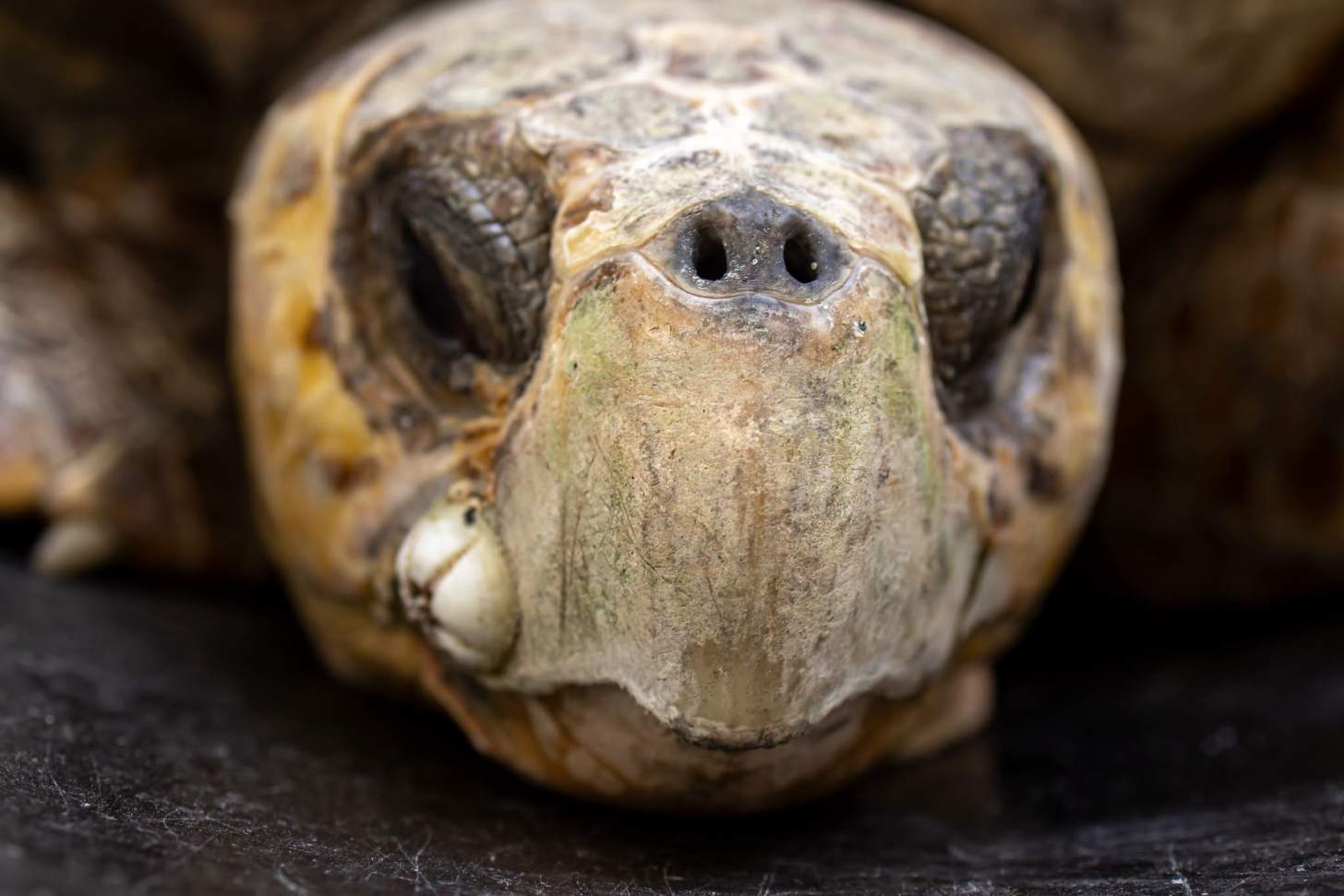
“That’s a good sign,” Cheri Dexter said after the rescue. “If they’re lethargic or just laying there, that’s a bad sign.”
Within 25 minutes, the crew had hauled the turtle onto the pier, cut the fishing line close to the point where the hook was embedded, and loaded Bowser onto a Kawasaki UTV to take him off the pier, despite Bowser’s best efforts to escape.
The operation ran like clockwork, because the volunteer team has had plenty of opportunities to practice.
Bowser was the 26th turtle rescue of 2026 from the pier; the 27th occurred two days later. Last year the center rescued 59 turtles from the pier, mainly loggerheads or green sea turtles. Entanglements are most common during sea turtle nesting season, which runs from May to October.
The Dexters lead a team of 26 volunteers in Navarre Beach who are certified by the Florida Fish and Wildlife Conservation Commission to conduct turtle rescues and transport the animals to an approved rehab facility.
Navarre Beach is a relatively small beachfront community in the Florida Panhandle, between Pensacola Beach and Fort Walton Beach on the Gulf Coast, but it boasts the longest fishing pier in the state, extending 1,545 feet into the Gulf.
That also makes it prime territory for turtle entanglements. From 2000 to 2022, Santa Rosa County — where Navarre Beach is located — accounted for 56% (254 of 452) fishing pier entanglements reported on Florida’s Gulf Coast, according to a study published last year by researchers at the Florida Fish and Wildlife Conservation Commission.
Navarre Beach has the only large pier in that county and the researchers said every turtle incident between 2014 and 2022 occurred at that pier. The researchers also said 85% of turtles Gulf-wide that were rescued during that period were successfully rehabilitated and released, while around 6% died during or after their rescue.
Loggerheads were the most commonly hooked species, followed closely by green sea turtles.
Statewide, the federal Sea Turtle Stranding and Salvage Network reported 503 strandings last year in Florida due to incidental capture, which includes fishing entanglements. Across all Atlantic and Gulf Coast states, there were 954 such strandings.
Those figures also only include turtles that are successfully rescued. A far greater number are hooked and escape, or become hooked or entangled in discarded fishing gear.
Scott Dexter said about 38% of turtles hooked at the Navarre Beach pier are able to be rescued and transported before breaking the line and swimming off with potentially dangerous fishing gear attached.
Sea Turtles Fighting Back, But Still Threatened
Loggerheads like Bowser are one of five sea turtle species found in the Gulf. Loggerheads and green sea turtles are the most common in Navarre Beach, along with the Kemp’s ridley, a smaller turtle that is the most imperiled of all sea turtle species. Scientists estimate fewer than 1,000 breeding females exist in the world.
The massive leatherback turtle, reaching up to 2,000 pounds and capable of diving 3,000 feet below the surface, mainly nests on Florida’s Atlantic coast but is sometimes seen nesting on Gulf beaches. The fifth species, the hawksbill turtle, is generally found in south Florida or the Caribbean.
All five species were pushed to the brink of extinction due to human activity and have been listed as endangered or threatened under the Endangered Species Act. The turtles were hunted for their meat or shells for centuries, and many fell victim to other fishing operations, being caught in trawl nets hunting for other species.
The development of turtle excluder devices from fishing nets — which have been required by law in the United States since 1987 — have greatly reduced turtle mortality.
Sea turtles nest on sandy beaches, where they can be disturbed by development or beach-goers. Bright lights on the beach can confuse turtle hatchlings, who emerge at night, and look for the reflection of the moon on the water to know which way to crawl. Sometimes the turtles instead crawl toward lights on land, giving them long odds for survival.
Valerie Nicole Tovar, conservation manager for the Loggerhead Marinelife Center, a nonprofit turtle rescue and rehabilitation center on Florida’s Atlantic coast, said fishing entanglements are one of several human threats to sea turtles.
“We have always looked to our hospital to see what are the most commonly found injuries, and many of them are things like pollution, things like boat strikes and also fishing line and entanglements,” Tovar said.
“The issue is that sometimes we might not always get these reports, because not everyone always knows what to do when there is an entanglement or an injury of a sea turtle on a pier.”
The Loggerhead center administers a program called the Responsible Pier Initiative, a group of 76 organizations in Florida and other states to respond to sea turtle entanglements. RPI groups have reported 2,230 turtle interactions and 1,181 rescues since it was founded in 2013.
“Essentially what we do is we make sure that first responders, whoever that might be, have all the tools that they need to be able to respond effectively to sea turtle stranding, injury, on or around a fishing pier,” Tovar said.
In Florida, groups like the Navarre Beach Sea Turtle Conservation Center are permitted by state wildlife authorities to rescue sea turtles and transport them to approved rehab facilities where veterinarians can evaluate, treat, and hopefully release the turtles back into the wild.
For Navarre Beach and most of the Panhandle, that facility is the Gulfarium CARE Center, a nonprofit turtle rehab facility created at the Gulfarium Marine Adventure Park, an animal theme park in Fort Walton Beach that features dolphin shows, manatee displays, and penguin exhibits.
Bowser’s Wild Ride
Bowser got his name from Gulfarium staff after his arrival Sunday night. Turtles rescued that week were given names with a Super Mario Brothers theme. The week prior, rescues were named after famous artists: Da Vinci, Raphael, Degas and Frida.
Once at the Gulfarium, staff removed the J-style fishing hook from Bowser’s left front flipper that had entangled him off the pier, and another external hook that he’d been carrying around for an undetermined amount of time.
X-rays showed Bowser also had a hook lodged in his esophagus from a previous encounter with fishing gear.
Mary Fomby, marketing manager for the Gulfarium, said Bowser will undergo a procedure in which he is sedated while vets try to remove the hook manually. For animals where the hook is deeper in the digestive tract, Fomby said the team will often try to help the animal pass the hook naturally.
“We’ll actually do something where we feed them, along with their normal fish, cotton balls that have mineral oil on them,” Fomby said.
Fomby said the cotton ball is a less invasive way than endoscopy or surgery to remove dangerous hooks.
“They don’t digest [the cotton ball], it will just go straight through them,” Fomby said. “So, ideally what happens is it gets caught on the hook and kind of creates a barrier around the tip of the hook to keep it from latching on to any other parts of their intestines.”
The Gulfarium team receives stranded turtles from across the Florida Panhandle, and sometimes from Alabama beaches, as well. Fosby said Tuesday the Gulfarium currently has 31 turtle patients, with seven turtles planned to be released this week.

The center recently celebrated its 1,000th successfully released turtle. Fomby said the center releases more than 100 turtles every year, with most rescues happening between May and October, which coincides with sea turtle nesting season.
State and federal wildlife agencies provide oversight and supervision for the volunteer rescue groups, but usually don’t provide direct funding.
“We’re not state-funded, other than if we win grants,” said Alex Fox, chief operating officer of the Navarre Beach Sea Turtle Conservation Center.
The Navarre Beach center, the Gulfarium CARE Center, and the Loggerhead Marinelife Center are all nonprofit organizations and largely dependent on donations, grants, and their own operations to cover expenses.
The Navarre Beach Center has a visitor exhibit with animals on display, including Sweet Pea, a green sea turtle rescue with injuries too severe to be released back into the wild. Most of the rescue teams consist of trained volunteers, rather than full-time employees of the centers.
Climate Change Threatens Sea Turtles
Sea turtle species, especially the green sea turtle, have shown strong population rebounds after the development of turtle excluder devices in commercial fishing gear and stronger conservation laws worldwide.
But the animals still face significant threats from fishing gear entanglement, boat strikes, and climate change.
The U.S. Fish and Wildlife Service divides loggerhead sea turtles into nine separate population groups. Five of those groups are listed as endangered under the Endangered Species Act. The Northwest Atlantic population group — which includes turtles in Florida and other mainland U.S. states — is listed as threatened, along with three others.
Climate change is of particular concern because the sex of newly hatched sea turtles is determined by the temperature of the sand around the nest. Warmer nests produce more females, while cooler nests produce males.
“Especially here in Florida, the concern is that our beaches are so hot that we might be producing more females than we are males, and that could affect the population overall,” Tovar said, adding that if the nest gets too hot, the turtles may not hatch at all.
Published research on sea turtle sex ratios cites a lack of “population-wide, data-driven studies of primary sex ratios for any marine turtle species,” but localized studies have shown populations that are estimated to be more than 80% female.
Female sea turtles generally mate with multiple males before laying eggs, resulting in “multiple paternity” nests, with eggs from multiple fathers. A 2023 study published in the journal Current Biology found evidence of multiple paternity dropped significantly where populations were 90% or more female.
“On its own, a decrease in the incidence of multiple paternity may not be harmful to sea turtle populations,” the authors conclude.
“However, a reduction in the incidence of multiple paternity to zero should be viewed as a clear warning signal that there is a shortage of males and is likely a precursor for subsequent reductions in egg fertility, which may threaten population viability.”

Tovar said the Loggerhead Marinelife Center has also observed the sea turtle nesting season starting earlier in the year, a possible response to rising temperatures.
Kate Mansfield, an associate professor at the University of Central Florida, directs the Marine Turtle Research Group, which has conducted research on sea turtles for more than 40 years. Mansfield told Inside Climate News last year that green sea turtles in Florida experience significant nesting site disruption due to storms, which are expected to increase in intensity as global temperatures rise.
“We also are experiencing storm events that are just the worst ever, historic levels of winds and tides and storm overwash,” Mansfield said.
“Each year, we kind of brace for what the hurricane season is going to look like. Disproportionately, green turtles, at least in Florida, on our nesting beaches, are the ones that are hit the hardest by these storm events.”
How to Avoid Turtle Entanglement
For anglers who inadvertently hook a turtle, rescuers say it is crucial to call for assistance immediately and not cut the line or try to remove a hook themselves. Public fishing piers should have displays showing a number to call.
“The most important thing is really just trying to make sure anglers know that they can give us a call,” Tovar said. “They can call [Florida Fish and Wildlife] if they’ve hooked a sea turtle; they’re not going to get in trouble, and they will be able to go through the steps to get the turtle rescued.”
Tovar said generally on a pier, the angler should gently reel the turtle toward the surface, keep tension on the line and wait for a team to arrive.
Cheri Dexter said many turtles will naturally want to swim under the pier, but the angler should try to prevent that, as the line will usually break with hooks still lodged in the turtle.
Scott Dexter said inexperience is a big factor in sea turtle entanglements.
“Most of the fishermen that hook turtles are not from here,” Scott Dexter said. “They come down here on vacation, and they either rent fishing equipment or they go to Walmart and buy a cheap rod. They don’t understand what’s out in that water.”
Header Image courtesy of Gulfarium CARE Center
For almost a decade, the nonprofit PeopleForBikes has been evaluating cities and communities across the United States based on their bikability.
To qualify as a “great place to bike,” a community must score 50 or higher on a scale from zero to 100.
This year, 555 U.S. cities scored 50 or higher, a massive leap from 2025, when only 234 met the benchmark, and from 2024, when it was just 183.
Bikeability scores are based on how easily cyclists can access connected, low-stress infrastructure such as bike paths, lanes, and safe streets.
But it goes deeper than that: cities are also evaluated on factors like traffic speeds, protected bike lane coverage, connectivity to key destinations, reallocated street space, and intersection safety treatments.
“Communities across the country are proving that investments in safe, connected bike infrastructure deliver real results,” Jenn Dice, president and CEO of PeopleForBikes, said in a press release. “More cities are reaching the point where biking becomes an easy choice to get where you need to go.”
“When we make biking safe, accessible, and fun, more people ride,” she continued. “One of the best parts? People also arrive happier. These results show that communities of all sizes can make meaningful progress when they prioritize connected networks that work for everyone — making biking not just a practical way to get around, but also a great way to enjoy everyday life.”
But PeopleForBikes is more than a ratings system. It’s a nonprofit whose work is rooted in accelerating the infrastructure of bikeways, keeping local legislation accountable for its proposals and promises, and reducing barriers to access through community outreach.
PeopleForBikes is also set to release International City Ratings in late 2026, broadening the scope of its bikability metrics to thousands of cities around the world.
“City Ratings is more than a ranking. It’s a roadmap,” said Dice. “By helping communities understand where they are today and where opportunities exist for improvement, we’re giving local leaders and advocates a powerful tool and action plan to build safer, more connected places to ride.”
Top U.S. Cities for Bicycling in 2026
Small Cities (<50,000 population)
1. Mackinac Island, Michigan: 100
2. Old Orchard, Pennsylvania: 100
3. Crested Butte, Colorado: 100
4. Washburn, Wisconsin: 98
5. Kent Narrows, Maryland: 97
6. Earlysville, Virginia: 97
7. Isla Vista, California: 95
8. Berkley, Michigan: 93
9. Sunset, Utah: 93
10. Springdale, Utah: 92

Medium Cities (50,000–300,000 population)
1. Hoboken, New Jersey: 83
2. Rochester Hills, Michigan: 80
3. Anchorage, Alaska: 72
4. Ames, Iowa: 68
5. Grand Forks, North Dakota: 67
6. Fargo, North Dakota: 67
7. West Bloomfield, Michigan: 67
8. Ankeny, Iowa: 66
9. La Crosse, Wisconsin: 66
10. Boulder, Colorado: 66

Large Cities (>300,000 population)
1. Brooklyn, New York: 70
2. Minneapolis, Minnesota: 68
3. Seattle, Washington: 66
4. Queens, New York: 63
5. San Francisco, California: 61
6. Milwaukee, Wisconsin: 57
7. St. Paul, Minnesota: 56
8. Portland, Oregon: 55
9. Detroit, Michigan: 55
10. Philadelphia, Pennsylvania: 54
Didn’t see your city listed above? You can visit the PeopleForBikes website to see how your community compares.
You may also like: These 'bicycle mayors' are chosen with one task in mind: Make cities safer for cycling
Header image via Robert So
Conservationists at Jimmy’s Farm & Wildlife Park in Suffolk, United Kingdom, are celebrating the arrival of a very special new baby.
The wildlife facility has just announced the hatching of a critically endangered pancake tortoise as a result of its monitored incubation program.
The new baby, a female, is being called a “rare and welcome boost” for the species, whose population has declined by around 80% over the past 30 years.

Jimmy’s Farm and Wildlife cites habitat loss and the illegal pet trade as key factors in the species' decline, and The International Union for Conservation of Nature notes others, including climate change, residential and commercial development, and changes to their natural environment. The IUCN lists the pancake tortoise as critically endangered.
Named for the flat shape of its shell, the pancake tortoise adapted to successfully hide and build habitats in rocky hills and outcrops across East Africa, especially in countries like Kenya, Tanzania, and northern Zambia.
According to a social media video from the wildlife center, illegal mining is also a large threat to the species in their native countries.
“People come and blow up these huge areas of land that these tortoises will live in because they kind of burrow themselves in between rocks,” Kyle Thomas, a wildlife content creator, said in a video for Jimmy’s.
“So, to have her here,” referring to the new baby, “and that she might produce her own offspring one day is very, very exciting.”
The offspring of parent tortoises Waffle and Maple, the new baby at Jimmy’s marks an exciting conservation milestone for the wildlife center’s incubation program.
“We’re delighted to welcome this tiny new arrival,” a spokesperson for Jimmy’s Farm & Wildlife Park said in a statement.
“The egg was carefully incubated by our team and seeing a healthy female hatchling emerge is a fantastic moment. With Pancake Tortoise populations having fallen dramatically in the wild, every successful hatch is incredibly important.”
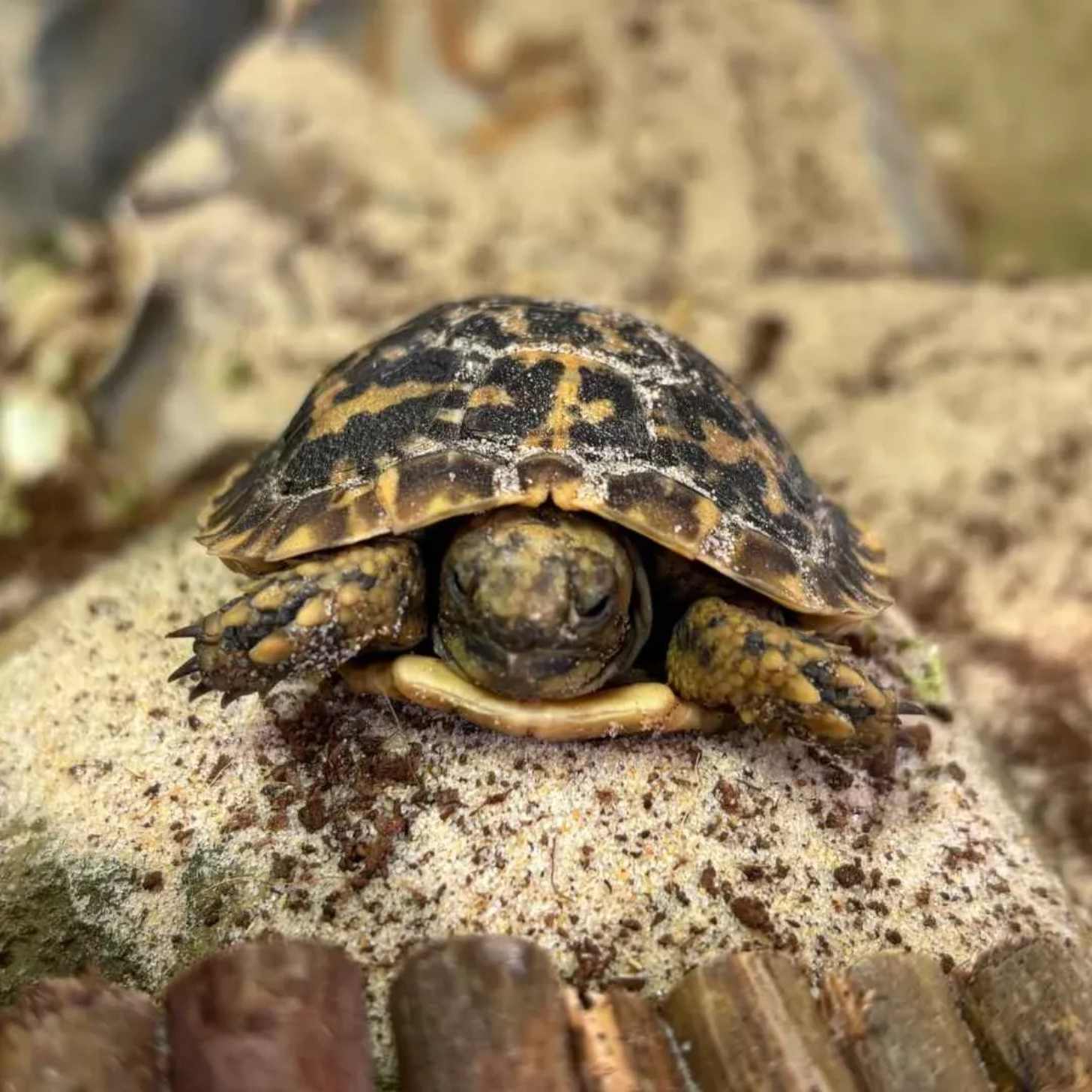
According to the wildlife center, the hatchling is “thriving” behind the scenes and has invited members of the public to submit name suggestions via social media.
“This little tortoise is a symbol of hope for the future of the species and highlights the vital work being done to protect some of the world’s most threatened animals,” the statement from the nature center concluded. “We can’t wait to see what name the public chooses for her.”
You may also like: Vet constructs custom contraption to save tortoise run over by a car
Header image courtesy of Jimmy’s Farm & Wildlife Park
Sea Turtle Week runs from June 8 to June 16, starting with World Ocean Day and ending on World Sea Turtle Day.
And this year, the Loggerhead Marinelife Center of Juno Beach, Florida celebrated the week-long holiday with an incredible milestone.
“A few weeks ago, an unexpected visitor named ‘Tini’ made history as the first-ever suspected olive ridley sea turtle documented on our beach,” the conservation center shared on Facebook on June 12.
“To confirm her species, blood samples were sent to The Warnell School of Forestry and Natural Resources at the University of Georgia for genetic analysis, and the results are officially in: Tini is 100% olive ridley!”
According to the Loggerhead Marinelife Center, olive ridleys are among the most abundant sea turtle species in the world. However, the sea turtle — also known as the Pacific ridley sea turtle — is primarily found in India, Mexico, and Costa Rica.
Substantial nesting populations can also be found in Suriname, French Guiana, Brazil, and the West African country of Gabon — but it is virtually unheard of for an olive ridley to nest along Florida beaches.
“Sightings along Florida’s east coast are incredibly rare, making Tini’s appearance all the more remarkable,” the Loggerhead Marinelife Center said.
In fact, Tini’s nest marks the first documented case of an olive ridley sea turtle nesting in Florida — ever.
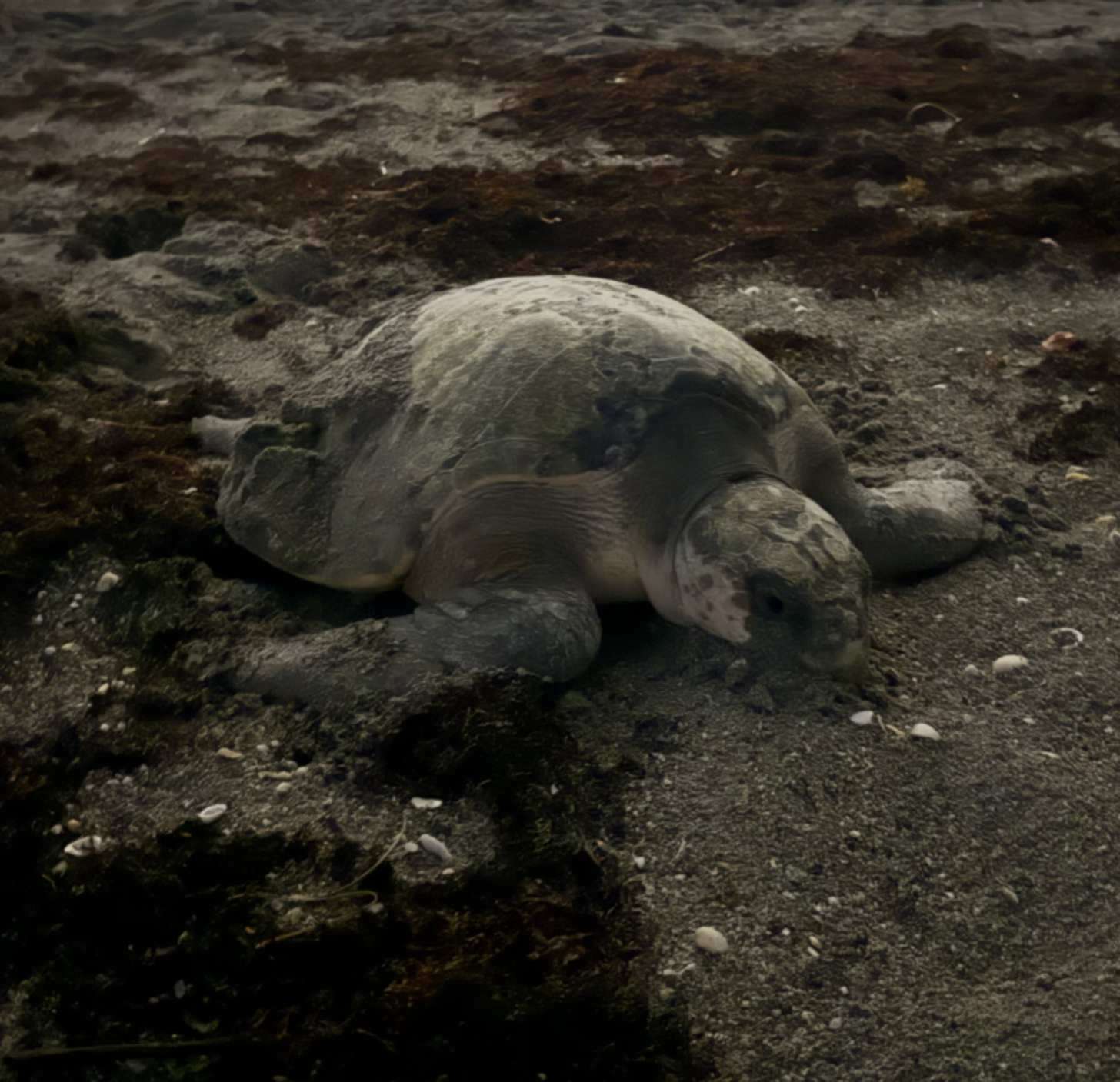
“A huge thank you to our partners at the Florida Fish and Wildlife Conservation Commission and the University of Georgia for helping document and confirm this extraordinary sea turtle,” they added.
The olive ridley is one of the world’s smallest sea turtles, with an adult’s shell measuring up to 2 to 2.5 feet in length. On average, they weigh between 80 and 110 pounds — much smaller than their largest relative, the leatherback sea turtle, which can weigh up to 2,000 pounds.
The olive ridley is known for its distinct heart-shaped, olive-green shell. Unlike other sea turtles, olive ridley sea turtles have two nesting strategies — solitary, like Tini — and en masse by the thousands.
In Mexico, this synchronized mass nesting event is known as an arribada. The natural phenomenon results in simultaneous nesting of thousands, and sometimes tens of thousands, of olive ridleys. Experts believe the technique is used to overwhelm potential predators and keep hatchlings safe.
To underscore how rare it is for olive ridley sea turtles to be found in Florida, one should consider the travels of Nicole Milson — a woman who made it her life’s goal to encounter all seven species of sea turtle.
Ironically, an early destination in her journey was the Loggerhead Marinelife Center in Florida, where she saw her first loggerhead. But there was no Tini to see at that time — the American had to fly all the way to Costa Rica to meet her first olive ridley, while volunteering through Working Abroad.
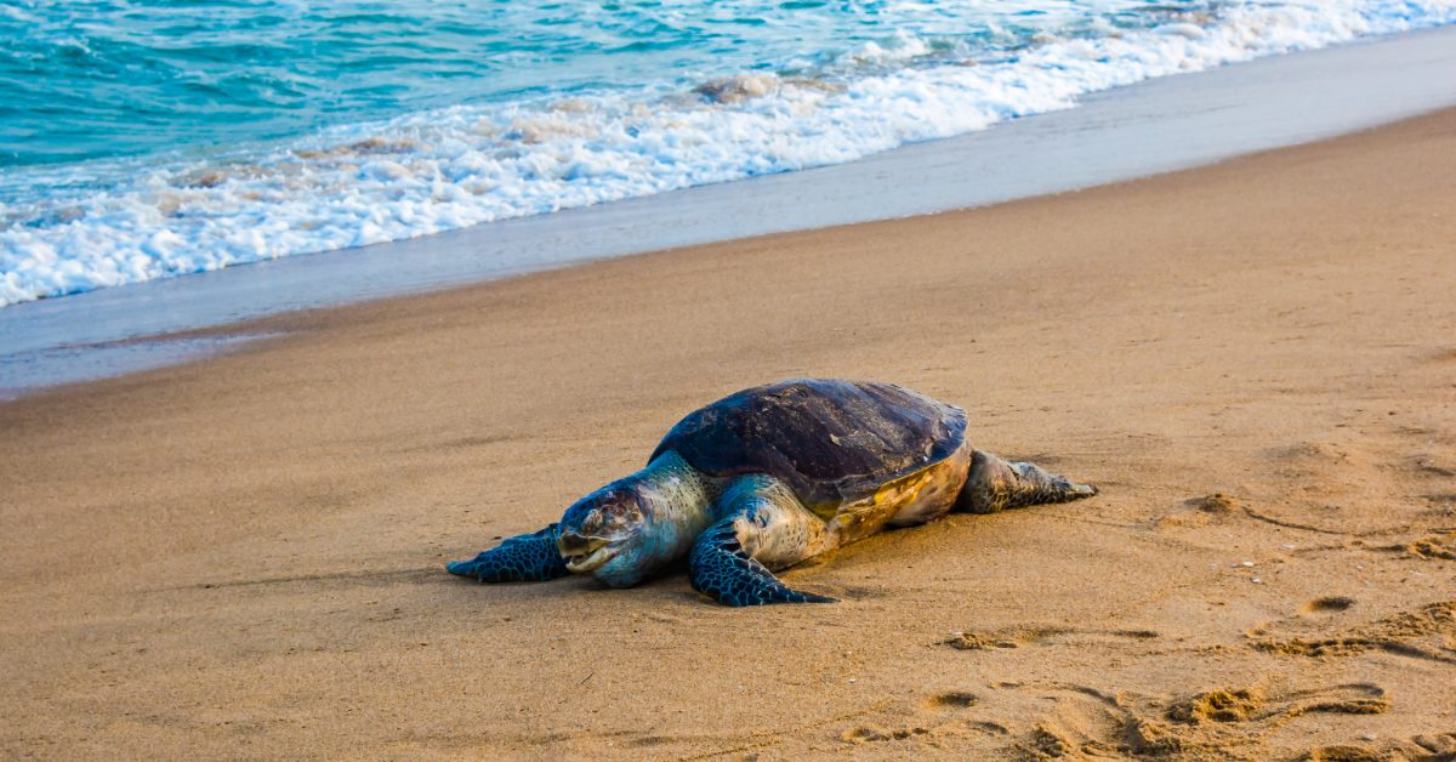
“I got to see and work with 53 Olives,” Milson told Good Good Good, adding that her volunteer experience was the hardest she’s worked in her “whole life.”
“You would go out and do an all-night walk on the beach, and during the day, we had cleaning duties and [built] a new hatchery for their eggs,” she said.
But Milson — who would go on to fulfill her dreams of meeting all seven types of sea turtles — has no regrets.
“I can’t believe something I’ve been a part of will be around for years to come,” she said.
You may also like: This sea turtle was rescued with a missing flipper and a crushed shell. A special procedure saved his life
Header image via The Loggerhead Marinelife Center
In Manhattan, New York, the average cost of rent is approximately $4,173 per month, 154% higher than the national average.
For newcomers or people struggling to make ends meet, affordable housing options can be few and far between. Many have turned to boarding houses, like an all-women home run by nuns, or Kolping House, a Catholic co-ed boarding house.
But another surprising option is Menno House, a 10-person residence in Gramercy, a short walk away from the Union Square train station.
Here, the Manhattan Mennonite Fellowship welcomes long-term residents to stay for three months to a year — with the option to reapply for additional lease terms.
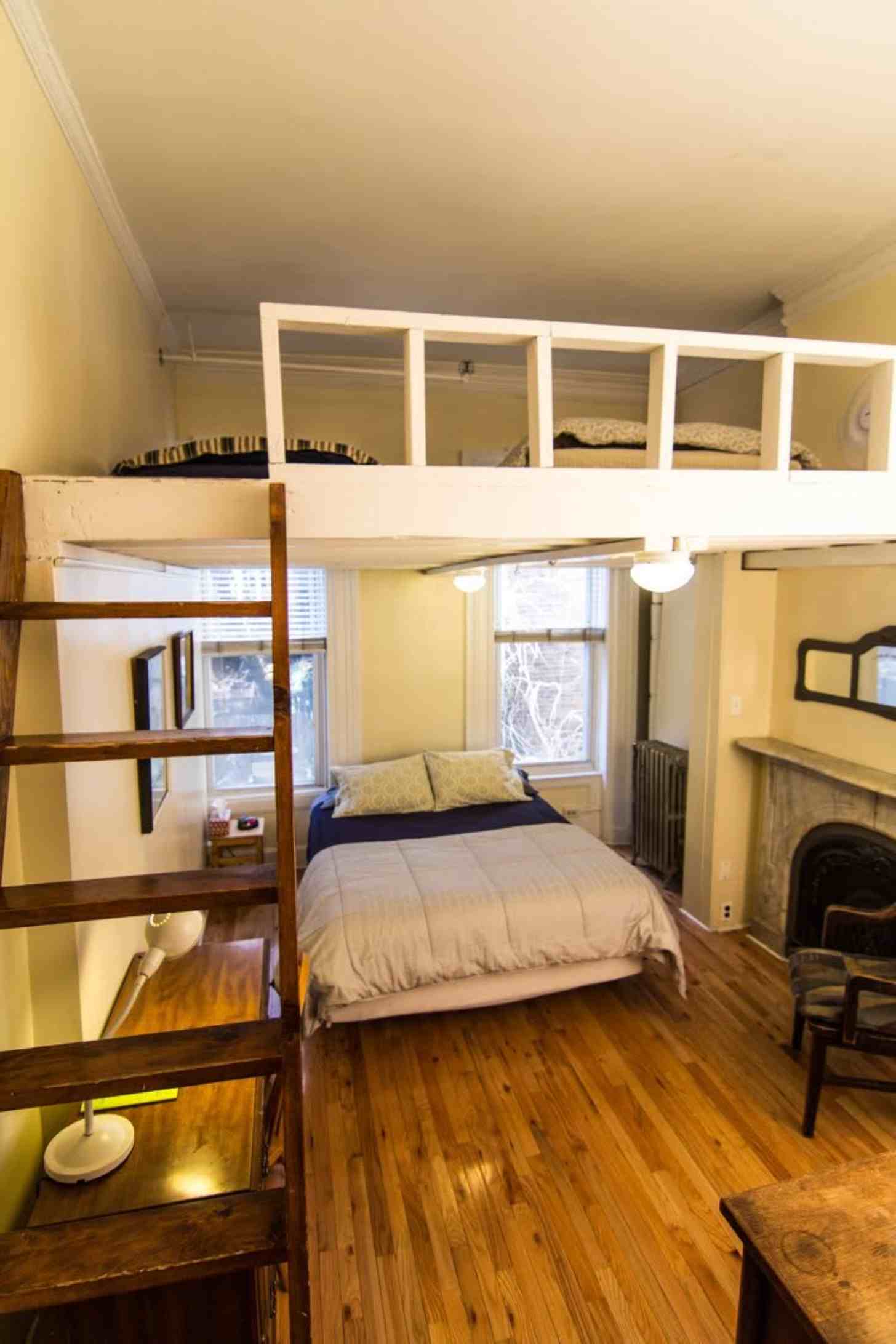
The smallest room costs $582 a month, and the largest is $881 per month, a drastic difference from average rent costs across the borough.
Hannah Keziah Austin, a 24-year-old graduate from New York University moved into the Menno House after graduating, she told The Wall Street Journal.
“It was the cheapest place I found in Manhattan,” she said.
Unlike Centro Maria Residence, which is strictly limited to female residents and has rules like a curfew and no boyfriends above the first floor, Menno House is co-ed and vocally LGBTQ+ inclusive.
“As a ministry of Manhattan Mennonite Fellowship, Menno House celebrates that we are a community with diversity of sexual orientation and gender identity,” the residence’s website reads.
“We are enriched by diversity in race, ethnicity, age, sexual orientation, gender identity, ability, physical and mental health, education, economic standing, and relationship status.”
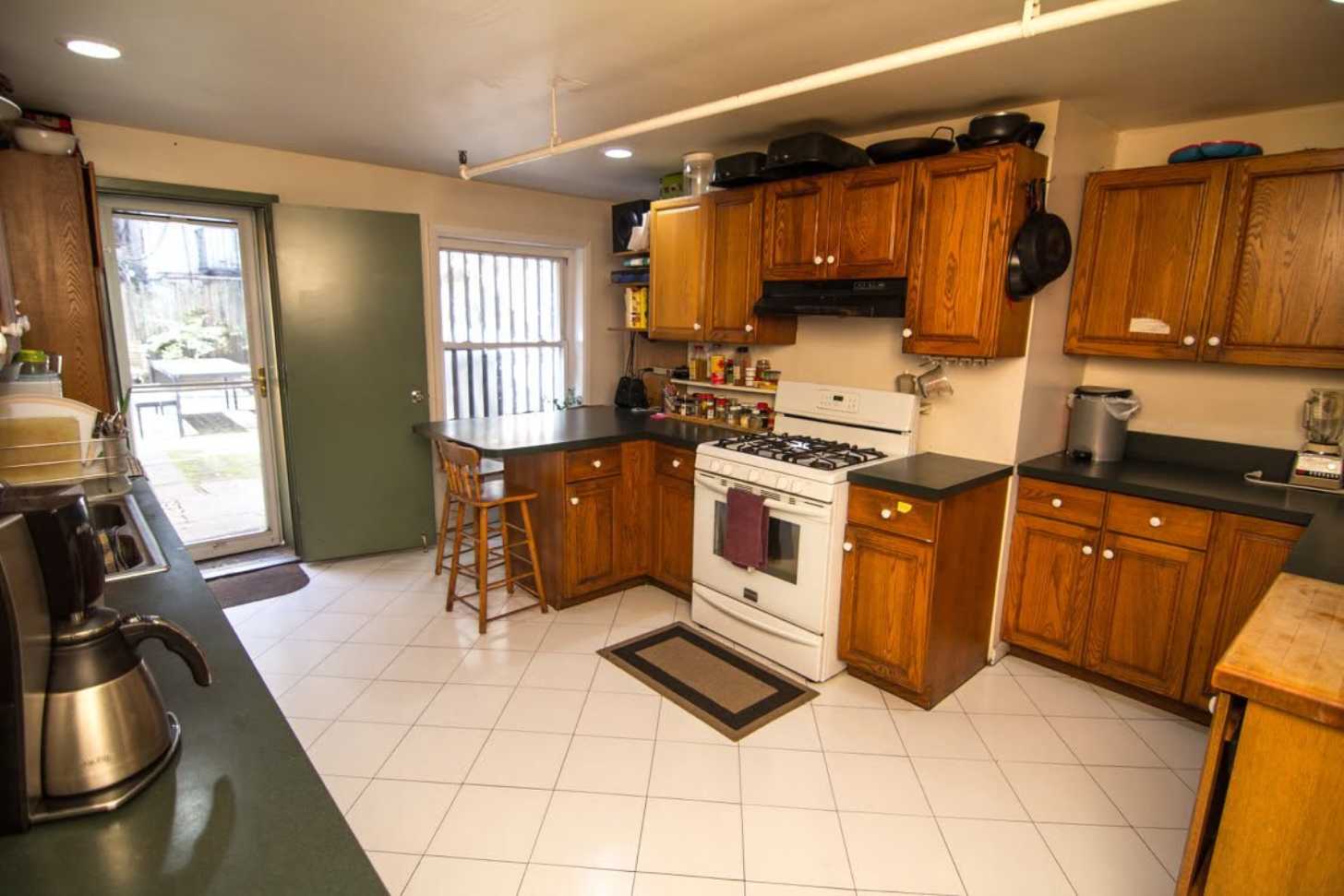
It doesn’t matter who you are; if you live at Menno House, you take part in kitchen duties and bathroom assignments, as well as a rotating deep-cleaning job every six weeks.
“The resident manager helps to maintain the property, coordinate use of the guest rooms and handle finances,” the Menno House website explains. “However, house residents are expected to take turns cleaning their bathroom and the kitchen, to be generous with guests, and to build relationships with their housemates and MMF.”
Each floor in the house has a single shared bathroom, and some rooms are set aside for temporary visitors, while long-term residents have access to a common kitchen (with a cupboard for each resident), a small dining room, living room, and a closet with laundry facilities. There is also a small garden behind the house for herbs and flowers — and hosting cookouts.

Mennonites purchased the building in 1957 as members of a Historic Peace Church to house conscientious objectors to war while they completed their alternative government service.
In the 1980s, the house residents formed the MMF and purchased Menno House in 1997, when it began operating as a guest house.
While MMF members and other fellowship volunteers are often given preference in housing, it doesn’t seem that Menno House requires a specific religious practice for people to find a home there.
“Guests arrive from all over the world, including New Zealand, Canada, Germany, Italy, England, Romania, Slovakia, Colombia, Argentina, Indonesia, Korea, Nigeria, South Africa, Japan, and many more,” the website reads. “We are never quite sure how people learn about Menno House as there is no self-promotion, but word gets around."
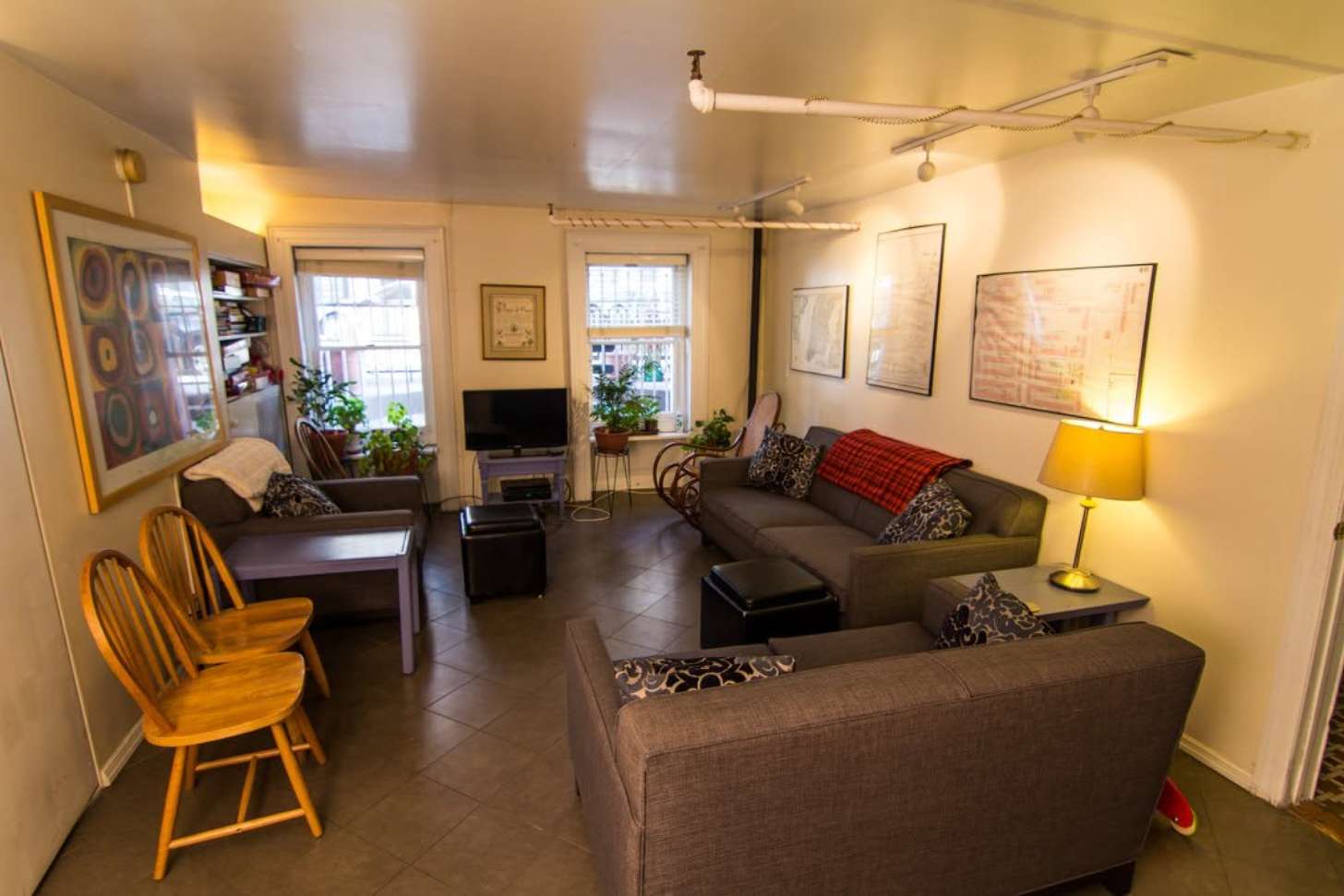
The website also shares that residents vary in their professions and trades: Nurse practitioners, theology students, artists, opera singers, musicians, United Nations workers, actors, cartoonists, and people from International Volunteer Exchange programs.
“Some are Mennonite, but they also come from a wide range of faith backgrounds,” the website adds.
The MMF touts widespread tolerance in its formal confession of faith, as well.

“We affirm all people as created in the image of God. We wish for our congregation to be a community where people can ask questions, offer creativity, and extend compassion and forgiveness to each other as we journey together,” the MMF website reads.
“We seek to create a place together where we each can feel safe enough to be authentic and share our gifts. Services are open to all who are curious and desiring to participate in the life of the church. A person will be accepted as a member through a personal choice to be involved and to contribute to the work of Manhattan Mennonite Fellowship.”
According to the Menno House website, housing availability remains competitive, with expected availability in June and August of 2027.
You may also like: They turned an old convent into an all-women apartment complex: 'It's about taking control of our lives'
Header image via Google Maps
In 2025, researchers from the University of the Sunshine Coast in Queensland, Australia, set off to study the “walking sharks,” or epaulette sharks, at the southeastern tip of Papua New Guinea.
In their mission to better understand the threatened sharks, one sea creature caught the eye of student Jess Blakeway. She immediately brought it to her supervisor, senior research fellow Chris Dudgeon, Ph.D.
It ended up being a new species.
“Straight away I recognized that the color pattern was different from any of the other species I had worked with before,” Blakeway recalled in a press release from the University of Sunshine Coast.
“The first thing that stood out was the white dashes along its brown body,” she explained. “These dashes were quite different to the leopard-like spots we were expecting.”
Immediately after pulling the walking shark from the water, Blakeway and her peers put it in a tub with fresh seawater to measure its blood and obtain tissue samples. Then they continued exploring Papua New Guinea’s Milne Bay.
“Over the next two nights [we] found another 11 individuals with the same patterning,” Blakeway said.
As the importance of their discovery became clear, the research team ramped up their work and completed more than 70 diving, snorkeling, and reef walking surveys at 35 sites.
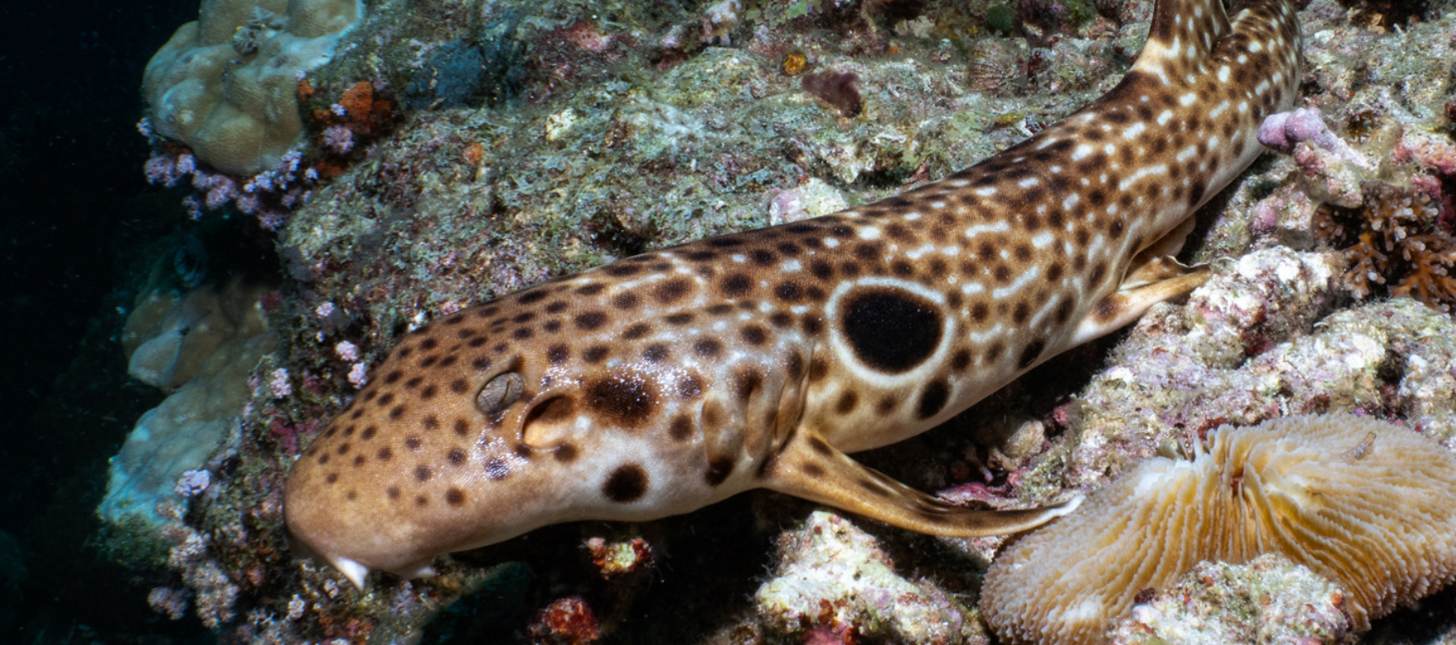
After months of careful research and taxonomic comparison, the new species was officially recognized on June 15, in a study published in the Journal of the Ocean Science Foundation.
“It wasn’t until genetic analysis of the samples back in Australia that we could confirm a new species,” Blakeway explained. “It’s exciting because this is the first new species described for the genus since 2013.”
The researchers agreed to call the new species the Dudgeon’s walking shark — or Hemiscyllium dudgeonae — after their colleague and teacher, who has been studying the genus for over two decades.
“New shark species don’t come along that often, and it’s most definitely the first one named after me,” Dudgeon said with surprise.
Walking sharks are largely found in the Coral Triangle, also known as the “Amazon of the Seas.” The massive triangular marine area is 2.3 million square miles — roughly half the size of the United States — and encompasses the waters of six countries: Indonesia, Malaysia, the Philippines, Papua New Guinea, the Solomon Islands, and Timor-Leste.
Walking sharks, which are regionally referred to as longtail carpet sharks and bamboo sharks, are much smaller than their great white and hammerhead shark relatives, often stretching just 2.5 to 3.5 feet from nose to tail.
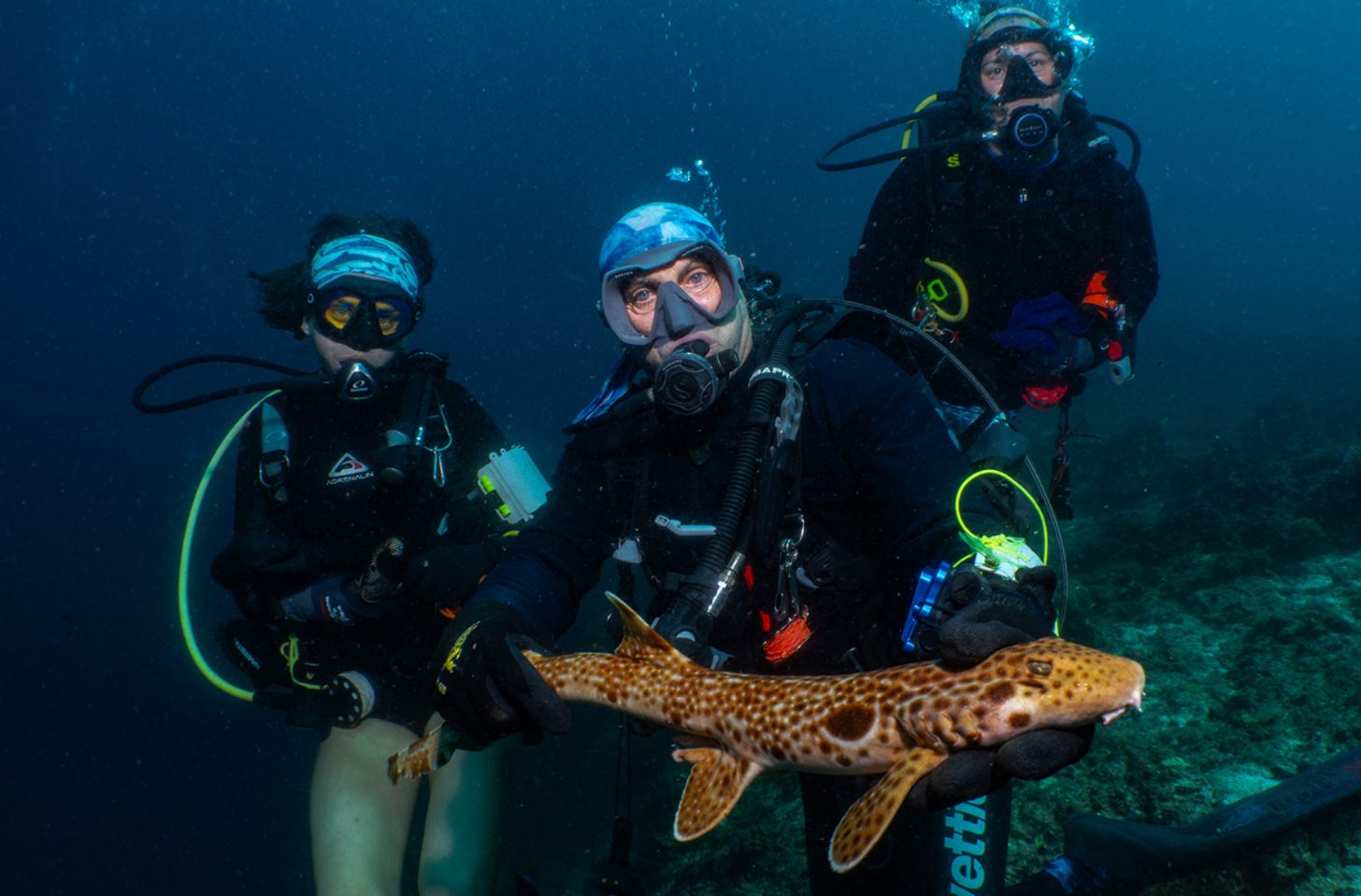
Their nickname comes from the four paddle-shaped fins that they use to navigate the bottom of the seafloor.
The nocturnal sharks play an important part in the marine ecosystem by feeding on bottom dwellers like crabs and shrimp, bristle worms, and small bony fish as they “walk,” and using their snout to dig prey out of hiding places amongst the reef and sand.
Back in Queensland, as researchers at the University of Sunshine Coast celebrated their findings, they knew their work was far from over.
Due to its restricted home range and concerns of habitat degradation and climate change, the researchers are eager to dive back in and better understand the Dudgeon’s walking shark.
“We hope to collect more data on our next research trip in October to help the International Union for Conservation of Nature Red List assess the species as vulnerable or endangered with extinction,” Blakeway explained.
You may also like: New golf-ball sized blue octopus discovered
Header image via Mark Erdmann
It’s a good day Down Under.
Australian conservationists in Queensland are celebrating after discovering a new addition to the country’s population of critically endangered northern hairy-nosed wombats.
In March, a female wombat was spotted on a motion sensor camera deployed by the Australian Wildlife Conservancy at the Richard Underwood Nature Refuge.
The female was seen waddling around southwest Queensland — and when conservationists took a closer look, they noticed a “mini bulge” in the photo.
They realized the wombat was a mother carrying her young, and according to a press release from AWC, the conservationists “turned to mush upon seeing the images.” When the mother was first photographed in March, the baby was believed to be around two or three months old.

“There are only around 450 Northern Hairy-nosed Wombats left in the world – but you can now make that 451,” an “ecstatic” Ben Stepkovitch, AWC Wildlife Ecologist, said in a statement.
“We’re all very excited about the images because every new joey adds to the overall population of the species, giving us hope that they’ll persist well beyond the near future.”
Conservationists say the offspring offers a unique glimpse into the reproductive cycle of one of the “world’s rarest mammals.”
According to the AWC, the northern hairy-nosed wombat is the world’s largest burrowing marsupial, a nocturnal mammal with a distinct appearance, including a broad nose, pointy ears, and faint black eye patches.
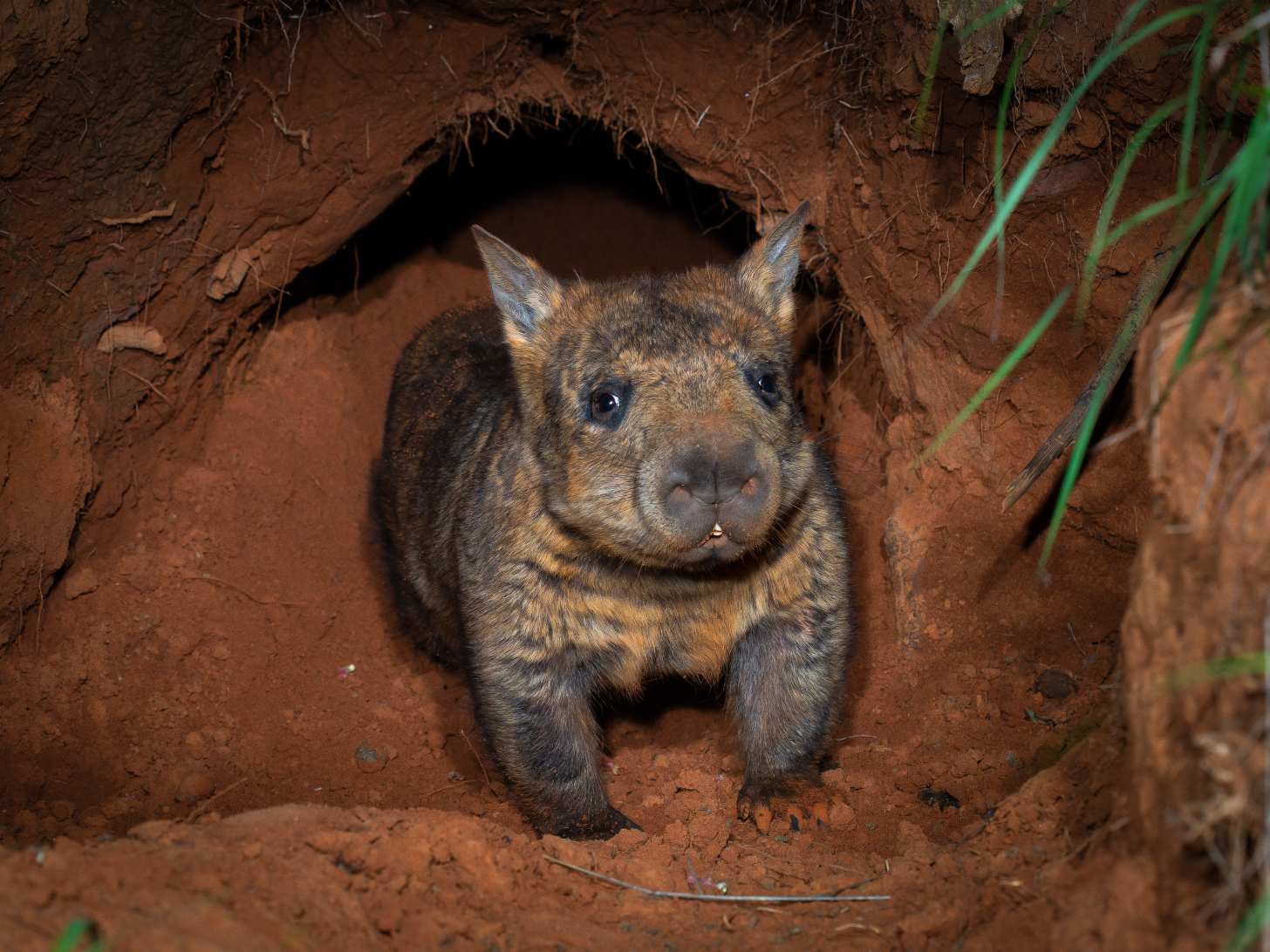
The species historically lived in open eucalypt woodlands, which were vastly cleared in the 19th and 20th centuries. Due to habitat destruction, and even direct killings by European colonizers, the species fell to just 35 individuals in the 1980s.
At this time, the Queensland Parks and Wildlife Service established a dedicated program to protect the remaining wombats, including fences to keep out predators like wild dogs and dingoes, and the population of wild wombats has steadily increased.
That said, the species is still critically endangered, and those working to protect them were overjoyed to see a new arrival.
The first people to identify the new mom were caretaker volunteers Anne and Corinne at Richard Underwood Nature Refuge.
Sifting through pictures from the motion sensor camera, they saw the female with a “slightly slumping belly.”

“When we saw the little bulge on the belly, we got very excited and wondered if this could be a little baby pouch, so we passed the photos immediately onto AWC’s science team to be sure,” Anne and Corinne said in a statement.
“They ran it by the wombat gurus at the Queensland government, and confirmed it was indeed a newly born wombat.”
Now, the team is monitoring the mom’s movements and condition from afar, checking new data from the motion sensor camera on a regular basis.
“We are making an effort to download the images more regularly,” Stepkovitch added.
“Over the last three months, we’ve seen the pouch grow and mum seems to be doing well and holding up against the weight of her joey well. We anticipate that the joey will emerge from the pouch by October when it’s about nine months old. Everyone at AWC is very excited.”
You may also like: Conservationists celebrate birth of baby pancake tortoise, hope for one of the world's most endangered reptiles
Header image courtesy of Australian Wildlife Conservancy
There are an average of 1,270 reported wildlife-vehicle collisions every year in the state of Arizona.
But a growing investment in wildlife crossings aims to change that.
Earlier this year, the state government passed a 2027 fiscal state budget, including dedicated funding for planning and construction of wildlife crossings, with a recurring annual appropriation of $700,000.
This update occurs while the state’s Department of Transportation is at work constructing Arizona’s 27th highway wildlife crossing. The Willard Springs Wildlife Overpass will be a 100-foot-wide overpass above Interstate 17, 12 miles south of Flagstaff.
The concrete bridge will span all four lanes of the highway from east to west. It will have tall parapets on the sides, along with eight miles of new fencing, native vegetation plantings, escape ramps, and adjoining structures to guide the animals onto the path.

“Crews are right now installing miles of tall fencing on either side of the overpass,” a video shared by the Arizona DOT in September 2025 explained. “This will act as a funnel to guide [animals] through the crossing.”
After a pause in construction for a winter shutdown, the state anticipates the overpass to be completed by fall 2026.
The project cost $15.8 million, funded by the state’s DOT and the Arizona Game and Fish Department. The goal is to reduce collisions involving large animals like elk, deer, and other wildlife.
The Game and Fish Department chose this location based on detailed research, following the movements of radio-collared elk as they migrated, searched for food and water, and found mates, according to Arizona Public Radio.

More than half of the collisions on this particular stretch of road over the last four years have involved wildlife, so the state turned to a solution they knew worked.
Arizona currently has 26 dedicated highway wildlife crossings, as well as a large network of underpasses and a robust canal network for wildlife.
The existing highway structures include:
- 13 underpasses built for elk and deer along State Route 260
- 3 overpasses and 2 underpasses built for Desert Bighorn Sheep along U.S. Highway 93
- 1 overpass and 5 underpasses along Interstate 11
- 1 overpass and 1 underpass built for the Sonoran desert ecosystem along State Route 77
The Willard Springs Wildlife Overpass is part of a wave of three new structures, which will add three new overpasses in total. This includes the I-17 location at Willard Springs, along with another I-17 crossing at Kachina Village, and an I-40 crossing west of Parks.
According to Arizona Public Media, the state’s growing collection of wildlife corridors has been credited with an average 90% drop in wildlife-related accidents.
“By investing in dedicated funding for wildlife crossings, the state can help reduce dangerous and costly collisions while reconnecting animal habitat across the landscape,” Pew’s Andres Esparza, who supports conservation efforts in Arizona, praised the state’s updates.
“These projects are proven to deliver lasting benefits for drivers, wildlife, and local communities.”
While experts are hopeful to see success in reducing collisions at Willard Springs, they will back up the project by re-collaring elk and using cameras to monitor the success of the crossing once it’s finally complete.
You may also like: California is building a new overpass to reduce crashes and protect wildlife. It's already working
Header image courtesy of Arizona Department of Transportation
“Visiting Comanche Crossing on Juneteenth felt like freedom,” my father said as we pulled into Booker T. Washington Park, the site near what used to be known as the historic Comanche Crossing on Lake Mexia in Texas. “Listen, Bobby, this place would be full of Black folks cooking, dancing, and playing music. It was a big festival with fireworks and a party.”
It had been more than six decades since my father had visited the park in the summer of 1965. But he sounded like a little kid again as he breathlessly recounted all the food: “We would have barbecue ribs, chicken, brisket, blood sausage, raccoon, armadillo, fried chicken, potato salad, beans, and yellow meat watermelon, and we had to have that Big Red Soda — you know it was created in Waco, right? — banana pudding, peach cobbler, pecan pie, white coconut cake, German chocolate cake, berry cobblers, pies, and homemade ice cream.”
Long before Juneteenth became a national holiday in 2021 and Texas commemorated it as a state holiday in 1980, the park was where generations of my family would join thousands of Black Texans every June to celebrate June 19, 1865.

That was the day Union troops informed enslaved Africans in Texas that they were free, two-and-a-half years after the Emancipation Proclamation and six months before the ratification of the 13th Amendment, which officially abolished slavery in the U.S.
Comanche Crossing lies less than 3 miles north of the site where the region’s enslaved people first learned of their freedom, and it’s where they decided to celebrate with a feast from their harvest.
Yet the story of Black Texans — and how they shepherded the traditions of Juneteenth celebrations through food for over a century — is a central part of this history that receives scant attention.
I’m a native Black Texan, so Juneteenth is personal. And I thought I fully understood its significance while I devoured smoked pork ribs, summer sausage, and brisket, year after year, at my paternal grandmother’s house in my hometown of Fort Worth.
But now, as a scholar of Black food culture, I see these celebrations differently. The mouthwatering spreads that were laid out each year did more than nourish Black Texans. They celebrated the way food was wielded as a tool of resistance and a symbol of freedom during and after slavery.
The freedom feast
As we continued walking through Comanche Crossing, I asked my father what he remembered about preparing food for Juneteenth.
By summer 1965, he recalled, they were living in Fort Worth but traveled back to his hometown of Waco the night before Juneteenth to help his family cook for their annual Comanche Crossing trip. He recalled that the cooking lasted all night, with the meat smoked to perfection over the pit, while other family members, including my grandmother, assembled dishes for the next day, using mostly fresh ingredients and farm-raised livestock. The food was packed up on the morning of June 19, and then the whole family headed for Comanche Crossing.
“And that’s when we would really have a time,” he said.
As my father excitedly described all the food and its preparation, I thought of culinary historian Jessica B. Harris, who, in her 2011 book, “High on the Hog, wrote, "The backbone of Juneteenth festivities has always been the table.”
Each family that came to Comanche Crossing prepared their own unique dishes for the Juneteenth spread.
“You can’t pinpoint how each family would prepare the foods,” my father said, “but you know you would see smoked meat for sure because that was our main tradition.”
For my family, smoked meat and potato salad were nonnegotiable.
The smoked meat echoes the ritual of hog killing that has long been part of the rural Black experience. The practice was one of the few moments when enslaved people exercised a measure of control over their food. Potato salad symbolized the abundance of the harvest of the land, putting on full display the agricultural knowledge and labor of the enslaved.
After emancipation, these traditions symbolized more than just celebration for Black Texans. They reflected what I called “emancipatory food power” in my first book, “Food Power Politics” — the ability of Black communities to use food as a resource for survival, self-determination, and freedom.
A portal into the past
When we approached the large, elevated dance pavilion, the park’s largest structure, my father remarked, “It seemed much bigger to me as a kid.”
He wasn’t wrong. The current structure isn’t the original, which was destroyed by a fire in the 1990s. But for my father, it nonetheless conjured memories of him and his cousins “running around it and watching the adults dance and just be free.”
He said it reminded him “of that Sugar Shack picture.” He was referring to the iconic 1970s painting by Black artist Ernie Barnes depicting a group of exhilarated Black men and women enthusiastically dancing, arms and legs splayed every which way, to live music at a juke joint — a type of informal gathering place that emerged in rural Black communities in the American South after emancipation.
I watched as my father walked under the pavilion and around the park and thought about his recollections: a portal into those earlier Juneteenth celebrations in Texas, when those who attended were just one or two generations removed from enslavement. It was a brief glimpse into how deeply they treasured that day.
Black Texan and historian Amilcar Shabazz picks up on that thread in his 2004 book, “Advancing Democracy”:
“Before Black Texans had their own history, schools, churches … they had Juneteenth. It may not have looked like much in the eyes of an arrogant world, but it was everything Black Texans had, and they each loved and cherished that day with all their heart … and most important of all, they remembered.”
A homecoming 60 years in the making
As my father and I walked back to the car to get back on the road, I could tell that he could have stayed there, reminiscing, for hours.
He kept glancing around, as if his cousins, aunts, uncles, mother, grandmother, and great-grandparents were right there with him in spirit, in their own little corner of Comanche Crossing, passing around dishes, filling plates, and toasting to freedom.
But once we were in the car, his tone changed. He began talking about the 1981 tragedy at the park, which rocked the Mexia community to the core. Three Black boys, known as the “Comanche Three,” were being transported by three police officers across Lake Mexia in a small aluminum boat.
Some type of accident occurred on the water, and all three boys drowned. The three police officers survived. To this day, the circumstances of what happened that night remain unclear.
While the tragedy disrupted the future of Juneteenth celebrations in Comanche Crossing, the events continued, though the number of visitors declined dramatically. But it didn’t erase the past from the minds of Black Texans like my father.
Clearly, the smell of barbecue, the sound of music, and the love of community and family lingered in him.
In many ways, returning to Comanche Crossing after more than 60 years was a homecoming for my father. It was one for me, too. Through his memories, I came to see myself in the Juneteenth story — both personally and intellectually.
“I’m glad that I got the chance to see this place again in my lifetime,” my father said, holding back tears as Comanche Crossing disappeared in the rearview mirror.
This article was written by Bobby J. Smith the University of Illinois Urbana-Champaign, and was originally published on The Conversation.

Header image by Samuel Peter via Pexels