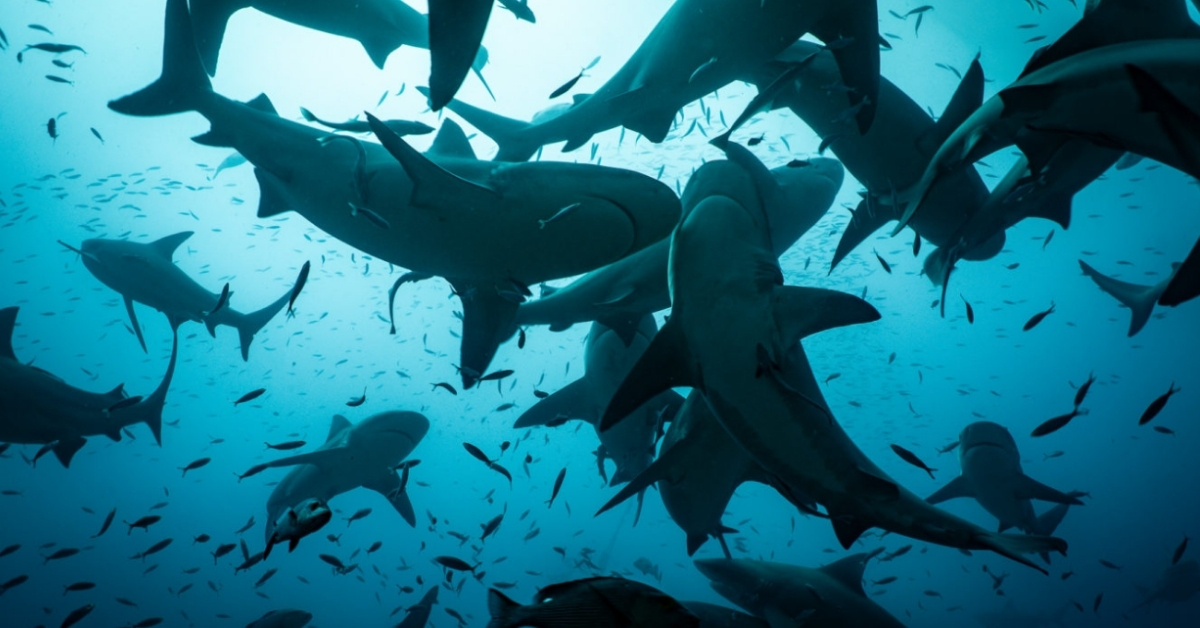
Sharks have long held a bad reputation — not just in the media but in the general public as well. According to a recent survey, 51% of Americans are terrified of sharks.
But real-world facts paint a different picture of the ocean predator.
First, sharks are much less dangerous than movies like “Jaws” and “Open Water” would have you believe. In 2024, just 47 people were hurt in unprovoked shark attacks — the lowest level in almost 30 years.
At roughly 450 million years old, sharks are also one of Earth’s oldest surviving species, pre-dating dinosaurs, trees, and five mass extinctions.
Not only are they enduring, but they are also integral to marine life in oceans around the world. Many sharks migrate thousands of miles in their lifetimes, eating and recycling nutrients as they go.
As they swim, sharks move up and down the ocean, mixing deep, nutrient-rich water with surface layers and boosting productivity where life needs it most. This fuels phytoplankton, which in turn absorb carbon dioxide and release oxygen.
Even shark poop is good for the ocean. Like whale poop, their waste delivers vital nitrogen to ecosystems and carries carbon that can sink and be stored on the ocean floor.
And now, new data has revealed that scientists have been underestimating sharks’ social intelligence.
For a long time, scientists have thought bull sharks to be solitary beings, but new evidence shows that they actually have complex social relationships with other sharks — and congregate in familiar spots with their “friends.”
For a new study published March 17 in the journal Animal Behaviour, Natasha Marosi and her colleagues spent six years observing 184 bull sharks — 33 males and 151 females — and analyzing their interactions.

“As humans, we cultivate a range of social relationships — from casual acquaintances to our best friends, but we also actively avoid certain people — and these bull sharks are doing similar things,” Marosi, a shark behavior researcher at the University of Exeter in England, explained in an interview with the university.
The study was conducted at the Shark Reef Marine Reserve, a protected area off the southern coast of Viti Levu, an island of Fiji.
Dr. David Jacoby, a lecturer in zoology at Lancaster University’s Lancaster Environment Centre, said the study — and its remarkable findings — would not have been possible without the long-term observation that Shark Reef Marine Reserve offers.
“This study capitalizes on data and knowledge from one of the longest-running shark ecotourism dive sites in the world,” Jacoby said. “This offered a unique opportunity to observe the detailed behavior of these individuals over many years, as they grow, develop, and manage their social relationships.”
And friendship has its benefits for survival, too.
“Male bull sharks are physically smaller than females, thus one potential benefit they may gain is by being more socially integrated; they are buffered from aggressive confrontations with larger individuals,” Marosi explained.
The study has been groundbreaking for marine biologists and shark conservationists.
“Contrary to commonly held perceptions of sharks, our study shows they have relatively rich and complex social lives,” said Professor Darren Croft, from Exeter’s Centre for Research in Animal Behaviour.
“We are only just beginning to really understand the social lives of many shark species,” he added. “Just like other animals, they likely gain benefits from being social — this may include learning new skills, finding food and potential mates while avoiding confrontations.”
You may also like: Bonobos, which are highly endangered, just wowed scientists with a talent that has never been seen in primates before
Header image via Natasha D. Marosi