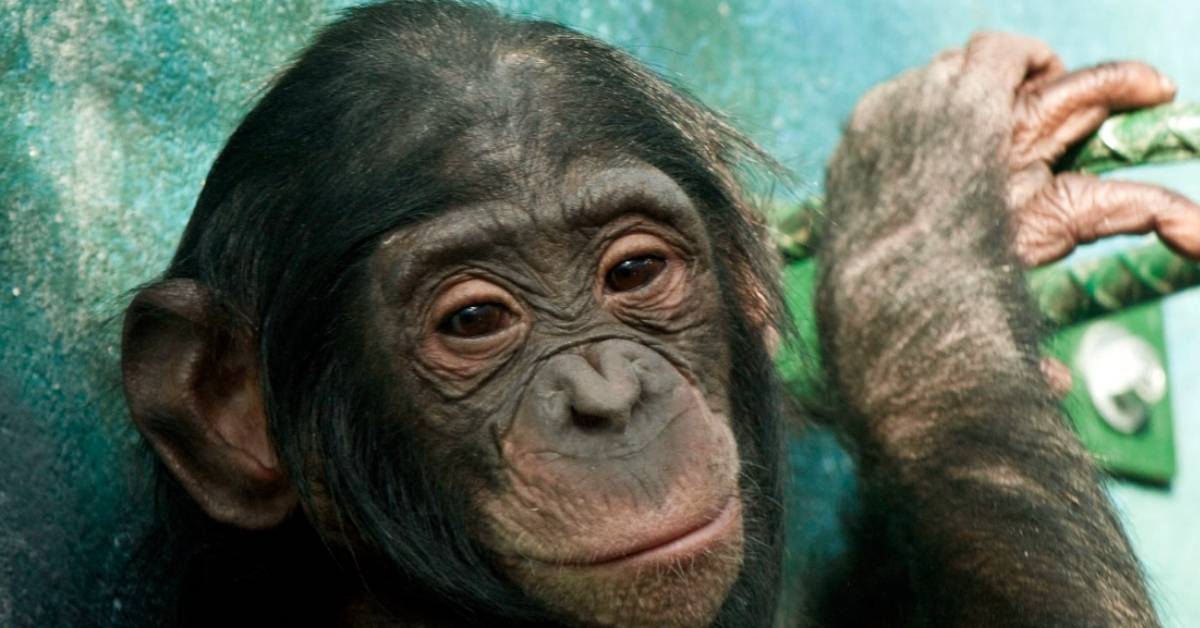
Two researchers at Johns Hopkins University recently invited a special guest to a pretend tea party: a 43-year-old bonobo named Kanzi.
Bonobos are close relatives of humans, similar to chimpanzees, but with slender, longer limbs. For decades, their population in the Democratic Republic of Congo — the only place they are found in the wild — has been on the decline due to habitat loss and poaching.
Like other primates, bonobos are also highly intelligent. At times, they have been seen engaging in various levels of play, moving “imaginary” blocks after playing with wooden blocks, or carrying sticks as though a mother would hold their infant.
To test the capacity of their ability to “play pretend,” two researchers at Johns Hopkins University developed a controlled experiment in which they tested Kanzi’s ability to play “make believe.”
In each test, Kanzi sat across from an experimenter at a table arranged like a child’s tea party, with empty pitchers and cups or bowls and jars.
At first, the experimenter pretended to pour juice into two transparent cups, then acted out dumping the juice from one of them before asking, “Where’s the juice?”
Kanzi usually pointed to the correct cup that still supposedly held juice, even when the experimenter switched its position.
In another experiment, the experimenter pretended to take a grape from an empty container, put it into one of two jars, then acted as if one container were emptied and asked, “Where’s the grape?”
Although he didn’t answer “perfectly” every time, Kanzi was consistently correct.
“As such, our findings suggest that the capacity for representing pretend objects is not uniquely human,” they wrote in their study, which was published in Science on February 5.
“It’s extremely striking and very exciting that the data seem to suggest that apes, in their minds, can conceive of things that are not there,” Dr. Amalia Bastos, first author of the research from the University of St. Andrews, said in a press release. “Kanzi is able to generate an idea of this pretend object and at the same time know it’s not real.”
Her co-author, Christopher Krupenye, a Johns Hopkins assistant professor in the Department of Psychological and Brain Sciences, agreed.
“Before this, there had been no experimental studies of pretend play in animals, and so our biggest challenge was thinking about how best to study this capacity in an animal,” Krupenye told ZME Science.
“What kind of controlled experiment could show that animals can follow along [with] a pretend scenario and track objects that are not actually in front of them?”
“It really is game-changing that their mental lives go beyond the here and now,” Krupenye said. “Imagination has long been seen as a critical element of what it is to be human, but the idea that it may not be exclusive to our species is really transformative.”
Bastos said that because we share this ability with bonobos, they could reasonably expect that this behavior dates back to a shared ancestor “somewhere between 6 to 9 million years ago.”
Both researchers called the study a monumental discovery in the field of animal behavior.
“Jane Goodall discovered that chimps make tools, and that led to a change in the definition of what it means to be human,” Krupenye noted. “And this, too, really invites us to reconsider what makes us special and what mental life is out there among other creatures.”
You may also like: A baby tree kangaroo was just born — and its 'pouch cam' gives rare insight into one of the world's most endangered species
Header image via Becker1999 / Flickr (CC BY 2.0)