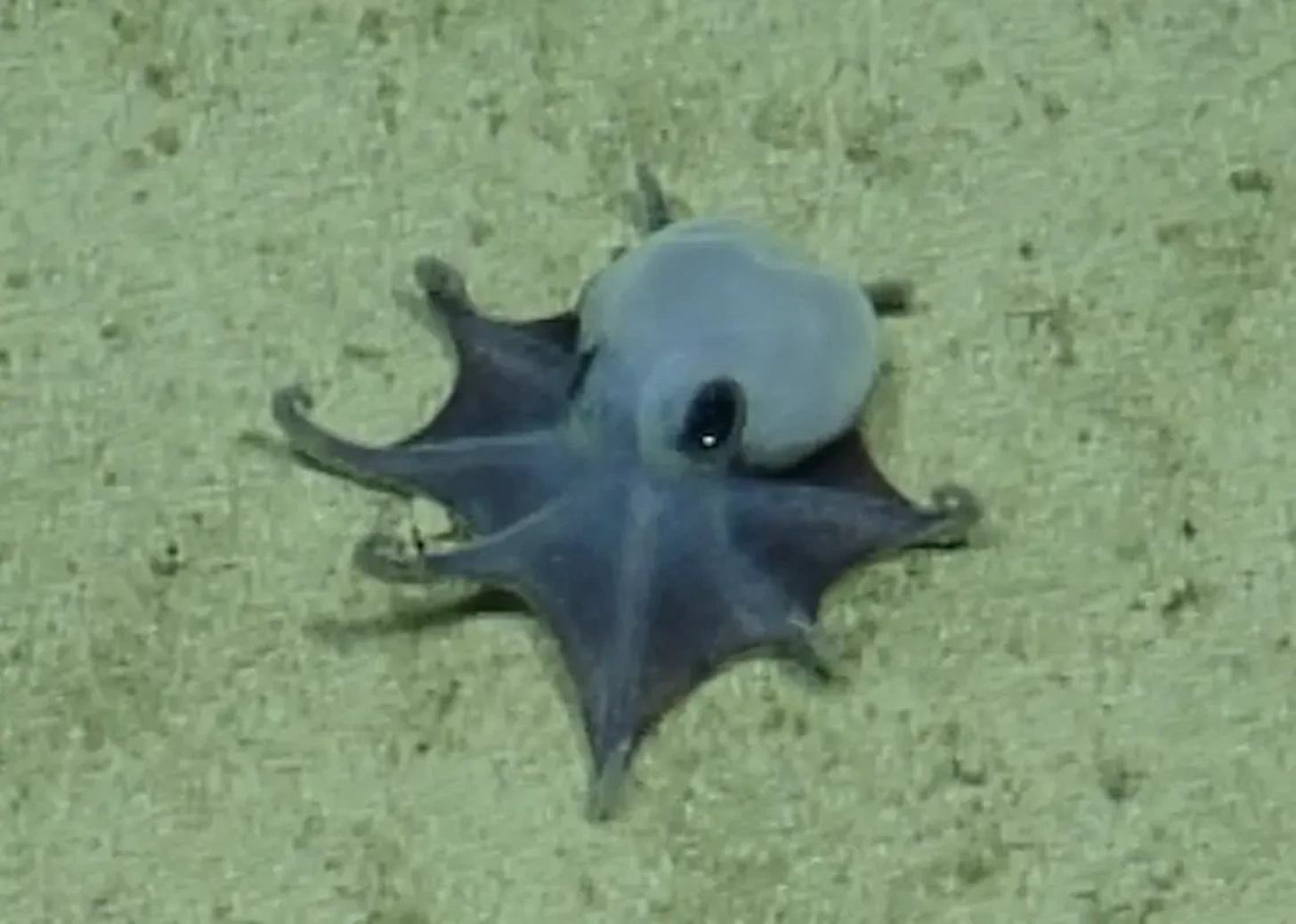
While on a deep-sea expedition in the Galapagos in 2015, scientists found a golf-ball sized, short-armed blue octopus. In a recent study, they confirmed that it’s new to science.
The newly described octopus, named Microeledone galapagensis, was first sighted with a remotely operated vehicle near an underwater mountain, roughly 5,800 feet below the Pacific Ocean surface, close to Darwin Island.
Expedition researchers from the Charles Darwin Foundation and the Galápagos National Park Directorate collected it with their ROV. They saw two more octopus individuals on video. The body of the collected specimen was preserved and sent to octopus expert Janet Voight at the Field Museum in Chicago, Illinois, U.S.
Voight and colleagues at the museum scanned the octopus using computed tomography to create a 3D model of the individual. The researchers then used the CT model to examine its internal organs and mouth parts.
“When you describe a new species of octopus, you have to look at all the parts, including the mouth, the beak, and the teeth. And to see those things, you have to cut the specimen open. We only had the one specimen, so I didn’t want to take it apart,” Voight said in a press release.
A comparison of the blue octopus’ parts with those from other octopus species revealed that it was a new-to-science species.
Unlike many octopuses, Microeledone galapagensis is small, squat, and has short, stubby arms with few arm suckers.
“One of the interesting questions about this and related octopus species is how they survive in the deep sea, which we consider to be resource limited, with such short arms,” Voight told Mongabay by email.
“If you gather prey by moving your arms through the sediment (as we think they do), wouldn’t it be better to have longer arms with more suckers than short little arms?”
Voight said finding a new octopus species in the deep sea isn’t unusual since few people have looked in those places — there may be other deep-sea octopuses waiting to be discovered.
“Given the little we know about the deep sea, how large an area it is (the Pacific Ocean alone is larger than all land masses on the planet combined) and what seems to be limited dispersal of the very large young of deep-sea octopus, we definitely will be discovering new deep-sea octopuses for a long time to come,” Voight said.
Jim Barry, a senior scientist at Monterey Bay Aquarium Research Institute in California, U.S., who was not involved with the study, told CNN: “We just don’t know enough about the biodiversity of the deep sea in general, so as discoveries like this keep coming up every dive, you may see something new that’s never been seen before.”
Header image courtesy of the Charles Darwin Foundation
This article was originally published on Mongabay.