The film “Kneecap” is a “mostly true” retelling of how three musicians — Liam Óg Ó Hannaidh, Naoise Ó Cairealláin, and JJ Ó Dochartaigh — formed the hip-hop group Kneecap in Belfast, Northern Ireland under the stage names Mo Chara, Móglaí Bap, and DJ Próvaí.
The trio plays themselves in the movie, rapping against governmental tyranny and oppression. But it’s not just the content of their songs that’s radical.
It’s their decision to sing in their native Irish language.
In 1737, during British rule in Ireland, the government passed a law that required all court proceedings to be conducted in English. Until 2025, it was considered a criminal offense to speak in any language other than English in court or government.
The impacts of the law were far-reaching and severe, and by the 1990s, English had become the de facto language of Ireland. A decade later, UNESCO officially declared Irish as a “definitely endangered” language.
But Kneecap’s songs have had an undeniable influence on the Irish language. And so has their movie, which became the first Irish-language film to premiere at the Sundance Film Festival.
“Hip-hop draws much of its power from the self-mythologizing impulses of its artists, and ‘Kneecap’ most definitely heeds this call,” Beatrice Loayza wrote for The New York Times. “In this gleefully chaotic quasi-biopic, the members of the hip-hop group of the film’s title are tall-tale heroes, the children of I.R.A. freedom fighters continuing the battle for Irish independence by other means: the reclamation of the Irish language, once actively suppressed, and only recently recognized by the United Kingdom as an official language in Northern Ireland.”

“That might not sound like a very punk endeavor, but the film — based on the pioneers of Irish-language rap who broke out in 2017, and written and directed by Rich Peppiatt — makes a solid case, connecting the struggles of Irish speakers to American civil rights and Palestinian resistance movements.”
Calling it the “Kneecap effect,” scholars credit the trio with driving younger generations’ interest in the language, both in Ireland and abroad.
“If you lose the language of a place, you lose everything that goes with that,” Ó Dochartaigh, or DJ Próvaí, told The New Yorker. Before he became a musician, he worked as an Irish language teacher at a Catholic secondary school. Now, he raps about police corruption and unifying Ireland in the same language he used to teach.
“Basically, we’re just trying to give the diaspora something besides leprechauns to think about,” he joked.

A version of this article originally appeared in The 2026 Storytelling Edition of the Goodnewspaper.
You may also like: Two musicians are paving the way for queer representation in Portuguese Fado music
Featured Image: Helen Sloan/Sony Pictures Classics
In late September, two young customers posted a TikTok review of Oddly Correct, a local coffee shop in Kansas City, Missouri.
“It was a little scary driving here,” one girl said in the video, which has since been deleted. “It felt demonic in there. Everything about it just felt demonic.”
“And weird paintings all over the walls,” the other girl added.
Before they had even tasted their coffee, they said that they “will not be back!”
The video eventually made its way to Oddly Correct co-owner Mike Schroeder, after an employee added it to a work group chat.
“We just were like, ‘Oh my gosh, what a wild take!’” Schroeder told TODAY.com.
Oddly Correct’s walls are filled with colorful and surreal paintings, all made by friends and local artists.

“We just kind of joked around, like, ‘Oh man, October’s coming up. We should just really lean into being demonic,’” he said. “Obviously, it upsets me just because of where those assumptions are coming from, but like in general, we didn’t really think much of it.”
CJ The Alchemist, a Kansas City-based influencer with 70,000 followers, shared his two cents in a TikTok video posted on September 26.
“Anytime somebody says that Troost Avenue is scary, it probably just means that they’re not used to seeing Black folks walking up and down the sidewalks, taking public transportation,” the content creator said.
The neighborhoods along Troost Avenue — now widely known as one of the city’s most prominent racial and economic dividing lines — have historically been subject to segregation.
Before desegregation, Lincoln High School and its feeder junior high schools east of Troost were the only post-elementary schools for Black students.
To this day, neighborhoods to the east of Troost Avenue are still largely made up of Black households, and neighborhoods to the west are predominantly white — and more affluent.
“Troost Avenue is not that scary,” CJ said in the video, which has garnered over 1.2 million views. “This is your sign to go take a trip to Oddly Correct.”

After the influencer’s video, Schroeder said the shop’s sales increased by nearly 200%.
Jackie Nguyen, owner of the nearby Vietnamese restaurant Cafe Cà Phê, came out to show her support — and to film the experience for her Instagram followers.
“We obviously are here because we saw a little video online that we wanted to address,” Nguyen said, noting there was a line out the door.
“Those girls are obviously very young,” Nguyen’s employee, Lex, added. “I feel like maybe they don’t live in Kansas City, maybe they’re on the outskirts, maybe in Johnson County or something. And maybe they just don’t have much exposure to diverse areas … which is almost kind of sad.”
In the video, Nguyen and Lex sipped their respective coffee orders — a bourbon vanilla iced latte and a sweet potato latte with macadamia milk — and offered some advice.
“Troost is an amazing street, and Oddly is an amazing business,” Nguyen said. “I really wanted to show two young girls what you could have done instead and also give you an opportunity to take a breath before you post something. Also, maybe think a little bit.”
“I wanted to welcome you both to show that there are places on Troost, not just Oddly, that are amazing,” she continued.
“They’re amazing places on Troost that not only feel amazing to us, but provide a sense of belonging, a sense of safety, a sense of diversity. We are poking fun,” she emphasized. “We are not trying to bully. We just wanted to take an opportunity to give a little bit of grace and kindness in this, mainly because it shows to me, you just don’t have exposure to a lot of it.”
Schroeder echoed Nguyen’s sentiments.
“When someone says that Troost is scary, we have an idea of why they’re saying that,” Schroeder said.

“We have a lot of people who do, like, spend their lives in this area and love it and felt a need to stand up and say, ‘This is where I live. This is my home, and it’s not scary.’”
Schroeder said one of the young girls in the video reached out to him to apologize. Still, he’s looking forward, not back.
“We’re sort of steeling ourselves to be ready for another big bump this weekend, but it’s tapered off a little bit, you know,” Schroeder said. “Our team is so talented and experienced, and even our younger staff are mature for their age, so they’re all handling it so well, jumping in to help out.”
You may also like: A homeless mom gave away $2 to help a parent in need. Then the internet stepped in to help
Featured Image: Courtesy of Mike Shroeder
In June, trail cameras captured rare footage of a male jaguar moving through the lush foliage of the Guatemala forests near the Honduran border.
Panthera, the global wild cat conservation organization, celebrated the once-in-a-decade snapshot as a huge milestone for the species, which is endangered in Guatemala. It also served as a reminder of how the corridor between Guatemala and Honduras serves as a vital corridor for wildlife on either side of the border.
Allison Devlin, director of Panthera’s jaguar program, and Barbara Escobar-Anleu, Panthera Guatemala’s country coordinator, elaborated on the discovery in a recent interview with Good Good Good.
“In our most recent camera trap records, we have recorded male jaguars in both Guatemala and in Honduras in this specific region,” Devlin and Escobar-Anleu said in a joint statement.
“We need to work with teams to ensure that connectivity is functional, including continued monitoring to hopefully detect female jaguars and indicate if they are reproducing – especially ensuring functional connectivity between the core JCUs. That means making sure that physical and genetic connectivity persists.”

They explained that the Bi-National Corridor between Guatemala and Honduras is a “key bottleneck in connectivity” for jaguars.
“Genetic analyses consistently indicate a lack of genetic exchange between core jaguar populations in the Selva Maya JCU, which covers Mexico, Belize, and portions of Guatemala, and core populations in central Honduras.”
They cited a recent study, published by researcher Claudia Wultsch and her colleagues in 2024, that indicated a lack of “genetic connectivity” between jaguar populations.
“This is likely due to deforestation and threats including direct mortality due to conflict with humans,” Devlin and Escobar-Anleu explained.

Fortunately, Panthera is hard at work to create better solutions for local people — and jaguars.
“Our teams work with local communities to reduce threats to jaguars, including mitigating human-wildlife conflict and illegal wildlife trade,” they said. “We need to ensure that jaguars have a healthy natural prey base and that the habitat is intact.”
“For example,” they said, “in Jeanette Kawas National Park, our team with Panthera Honduras worked together with the Honduran government and local communities to successfully reintroduce collared peccaries, an important prey species for jaguars.”
The pig-like omnivores, which were once thought extinct in the park altogether, are now rebounding with a population that is 80 individuals strong.
That, coupled with the new trail camera footage of a jaguar navigating the corridor, is giving the experts at Panthera hope.
Devlin and Escobar-Anleu said: “We are still studying the status of jaguars and their prey in the Bi-National Corridor, and are already seeing positive momentum from cooperation between our government colleagues and local communities in both Honduras and in Guatemala, working together to ensure safe passage for jaguars throughout Mesoamerica and their range.”
You may also like: Trail camera in Idaho backcountry captures footage of bears, elk, mountain lion cubs using the same spring
Featured Image: Christopher Crouzet/Wikimedia Commons (CC BY-SA 3.0)
In the outdoor section of April Stewart’s rural southeast Mississippi property sits a large enclosure full of 22 rescued monkeys.
This is the Gulf Coast Primate Sanctuary.
Opened in October of 2024 by Stewart and her husband, both military veterans, the 15-acre property takes in primates that were mostly once part of the illegal pet trade: Spider monkeys, squirrel monkeys, kinkajous, and more.

“Many of the primates who arrive at our sanctuary have endured instability: Ex-pets, individuals from the entertainment industry, zoos, laboratories, breeding facilities, or monkeys confiscated by authorities,” the sanctuary’s website reads.
“They come to us with different background stories. Some have [a] history of trauma and need to rebuild trust. They cannot return to the wild. They deserve safety, dignity, and lifelong protection.”
Stewart works with a specialized team of primate-focused veterinarians, experienced caregivers, and trained volunteers, all in accordance with U.S. Department of Agriculture regulations and the Animal Welfare Act, according to the organization’s website.
She’ll host educational tours for the general public, but the biggest crowd she caters to is other veterans, especially those navigating PTSD.
“Through our Unplugged program, we extend our mission to veterans and first responders navigating PTSD and stress-related challenges,” the website reads.
“In a structured, supervised, USDA-compliant environment, participants assist with sanctuary operations and learn the same principles that help our primates recover: Consistency, patience, boundaries, and earned trust.”

It all stemmed from Stewart’s own connection to animals, one that helped her manage her own PTSD.
“It was destroying my life. It was like a cancer,” she told the Associated Press last year. “It was a trauma that was never properly healed.”
“By helping the primates learn to trust, we’re also re-teaching ourselves how to trust, and we’re giving ourselves grace with people,” she added.
By bringing the monkeys into a social environment with other primates — and doing the same for veterans in similar situations — Gulf Coast Primate Sanctuary gives both populations the space to heal.
“Most of our monkeys are former exotic pets who were heavily human-bonded and later surrendered when owners could no longer provide appropriate care. Many struggle with anxiety, hyper-vigilance, insecurity, and difficulty forming stable bonds,” the sanctuary’s website reads.
“Our primates need safety, structure, and steady human interaction within appropriate boundaries. So do many who have served.”

For John Richard, a veteran who has volunteered with Stewart since the start of the sanctuary, holding a chittering monkey named Louie has provided a peace he never knew before.
“Being out here has brought a lot of faith back to me,” Richard told AP. “There’s no feeling like it.”
The Unplugged program is not meant to replace professional treatment for PTSD or other related mental health conditions; rather, it is designed to “complement” people already in the care of licensed mental health professionals, the organization’s website reads.
For those who have monkeys as pets, the sanctuary outlines a process for surrendering them to the refuge.
“We’re not here to judge people. Our main goal is to help the monkeys,” Stewart recently told WLOX News. “If there’s any monkey owners out there who maybe have some questions, we’re always open to conversation.”
And for those who want to volunteer — through Unplugged or otherwise — a robust training process comes first. Then, the healing can begin.
“The Unplugged Program reflects our broader mission,” the sanctuary states. “When we help traumatized animals regain stability, we create space for people to do the same.”
You may also like: 'Wolfdog' sanctuary helps veterans with PTSD heal in 'non-traditional therapy' program
Featured Image: Gulf Coast Primate Sanctuary/Facebook
Every day the Good Good Good team collects the best good news in the world and shares it with our community. Here are the highlights for this week!
If you want to get good news in your inbox every day, join the Goodnewsletter — the free daily newsletter designed to leave you feeling hopeful.
The Best Positive News We’re Celebrating This Week —
The United Nations passed the first declaration on sea level rise to protect island nations’ sovereignty
Since the start of his second term, President Trump has set global climate cooperation back by yanking the United States from the Paris climate agreement, attacking a global agreement on a carbon tax for cargo ships, and threatening countries with tariffs if they get too vocal about climate.
This week brought a notable exception. World leaders at the United Nations General Assembly on Thursday approved a unanimous resolution on how to handle sea level rise, and the U.S. did not block it from moving forward.
The passage of the accord represents a rare win for multilateralism, made all the more notable by the fact that the agreement includes references to climate change and climate aid for developing countries.
Why is this good news? For many low-lying countries, the implications of this agreement could be profound. Some island nations face almost total inundation over the next century as rising temperatures melt the world’s ice sheets and glaciers, and under the agreement, those states will continue to exist as political actors even if their landmass disappears.
→ Read more
A baby rhino and baby zebra bonded after they lost their mothers to the same fate: ‘They've been inseparable ever since’
EV sales in Turkey have skyrocketed over the last three years
Since 2022, the share of electric models among new car sales has increased from 1 in 100 to 1 in 5.
In 2023, the Turkish government introduced tax relief for electric cars, making registration significantly lower compared to petrol and diesel cars.
This coincided with the launch of Turkey’s first domestic electric car manufacturer, Togg, which has since become the market leader. Imports of cheaper electric car models also made the market more cost-competitive.
Planning is now underway for two new wildlife crossings for mountain lions in Joshua Tree, California
Earlier this year, a healthy 18-month-old male mountain lion was struck and killed on a California state road in the Mojave Desert. Shortly after, the Mojave Desert Land Trust was awarded the funding it needed to plan and build two crossings to protect the animals.
While the construction phase is still years away, wildlife researchers have officially begun surveying the area to collect information on all the species in the area to guide the planning of the two new crossings.
The planning and data collection process alone takes years, but it will ensure the best possible protection for wildlife in the area.
Why is this good news? The best time to consider and protect wildlife impacted by a roadway was when it was first built; the next best time is now. It’s never too late to fix poor human planning to better protect and care for our animal neighbors in the future.
Wildlife researchers attempted to trap mice with peanut butter and burnt coconut. They discovered a new species instead
→ Read more
Deaths from drowning have declined significantly among children globally
In 1980, almost 30 in every 100,000 children under five years old died from drowning. By 2023, that rate had fallen significantly to 7.4 in every 100,000 children under five.
Death rates among older children also declined, from 21 in every 100,000 children between the ages of 5 and 14, to 4 in every 100,000.
The vast majority of all deaths from drowning happen in low- and middle-income countries, where the risk is heightened due to everyday exposure to ponds, rivers, and lakes for bathing and washing clothes, or water collection wells. Thankfully, we have safety solutions to continue to improve and prevent more deaths in the future.
Broadway fans raised over $1.4M to support those affected by HIV and AIDS
On September 27, the Broadway Flea Market & Grand Auction returned for its 40th year, raising money for Broadway Cares/Equity Fights AIDS, one of the nation’s leading nonprofits supporting people affected by HIV and AIDS.
As a Nor’easter raged outside, Broadway fans flocked to the Hammerstein Ballroom in Manhattan to bid on auction items from over 18 Broadway and Off-Broadway productions, including “Oh, Mary!,” “Hadestown,” “Little Shop of Horrors,” “The Lost Boys,” and many more.
The packed event ultimately brought in $1,487,927 to help those with HIV and AIDS receive lifesaving medications, health care, meals, and emergency financial assistance.
Even better: The Broadway Flea Market & Grand Auction had humble origins in 1987, when the original cast of “A Chorus Line” set up two tables by their stage door to fundraise for Broadway Cares. Since 1987, the 40 editions of the event have raised more than $22 million for people affected by HIV and AIDS.
This national park is home to the quietest spot in the continental US: ‘Listen to a concert by the natural world’
Electric vehicles are now nine times cheaper to drive than petrol or diesel cars in the UK
As a result of the latest surge in fossil fuel prices, a new analysis found it is up to nine times cheaper to drive an electric vehicle than a petrol or diesel car in the United Kingdom.
The United States’ war in Iran, a recent attack on a Russian oil refinery, and other factors have led to dramatic increases in the price of both diesel and petrol. It now costs an estimated 21 pence per mile to drive a diesel car, and 20.1 pence per mile for petrol.
Electric vehicles, however, charged during off-peak times, cost around 2.3 pence per mile. Even when charged during peak pricing times, it still only costs around 7 pence per mile to drive an EV, three times cheaper than diesel or petrol.
Dolly Parton’s ‘Cup of Ambition’ coffee will go towards providing free books for children
In July, a month before she passed at age 80, country music legend Dolly Parton filmed three commercial spots for her new coffee line, Cup of Ambition.
The brand, which Parton said was “40 years in the making,” was made in partnership with Community Coffee, one of the largest family-owned coffee brands in the United States.
A percentage of proceeds from Cup of Ambition coffee sales will go towards supporting Parton’s Imagination Library, which provides free books to children every month, from birth to 5 years old.
Even better: In addition to its central mission, Parton’s Imagination Library, Community Coffee donates thousands of dollars every year to Louisiana public schools through Community Cash For Schools, with funds going towards new textbooks, computers, and playground equipment.
→ Read more
This dog is trained to sniff out invasive ‘sea vomit’ and protect oyster reefs: ‘She has enough drive for 3 dogs’
→ Read more
A new analysis found that global carbon emissions are set to fall in 2026
Fossil fuel emissions are on track to fall by around 0.5% in 2026 globally as a result of the Hormuz crisis, where the U.S.-Iran war has disrupted trade and caused spikes in oil and gas prices.
Additionally, for every new month the disruption continues, countries are growing more incentivized to switch to alternatives. While forecasts also point to a 1.2% rise in coal demand in 2026 — that rise will still be more than offset by oil and gas declines.
While the IEA forecast a rise in demand of 930,000 barrels of oil per day in January of this year, by September, that had fallen to a 2.5 million barrels per day drop in demand — a 2.4% reduction from 2025.
The producers of ‘Heated Rivalry’ just launched a real-life foundation inspired by the one in the book series
“Heated Rivalry” executive producers Jacob Tierney and Brendan Brady just launched the Irina Foundation, which will “champion LGBTQIA2S+ and underserved communities through participation in sports and the arts.”
In Rachel Ried’s “Game Changers” book series universe, characters Shane Hollander and Ilya Rozanov start a charity by the same name, in honor of Ilya’s mother.
Kate Spade New York is the foundation’s inaugural donor with a founding contribution, and it already has support from men’s grooming brand Harry’s.
Why is this good news? While the arts world has always traditionally been very welcoming and accepting of the LGBTQ+ community, sports are a different story. Women’s sports, despite underinvestment, have historically been inclusive — though efforts to roll back that inclusivity have hit the mainstream in recent years.
This is important work to ensure people can have a safe space to do what they love, be who they are, and have a place to truly belong.
→ Read more
A turtle with a bright blue shell was found in a Kentucky backyard. Rescuers are rushing to restore her natural color
→ Read more
Solar power prices are now ‘offensively cheap’
The price to install solar panels has been declining for a while, disrupting traditional energy supply chains with near-infinite supply that’s driving low prices.
Twenty-six years ago, solar panels ran between $5 and $6 per watt of generation capacity — now, it’s 12 cents per watt, which one researcher called “offensively cheap” compared to alternatives.
The global leader in renewable energy, China has “installed too much green energy” that people can’t use it as fast as it’s produced. Even in the U.S. where efforts to revive the coal industry are underway, solar produced more electricity than coal in June.
More good news of the week —
Dolly Parton fans celebrated the first official “9 to 5” day by donating children’s books to little libraries in their communities. Parton’s Imagination Library, launched in 1995, has delivered more than 300 million free books to children around the globe.
After 20 years on death row for a crime he didn’t commit, a former inmate is helping others find freedom. To date, the Innocence Center has freed 43 people who were jailed for crimes they did not commit.
Nearly 100 U.S. cities now dispatch unarmed responders and mental health clinicians to 911 calls instead of armed officers. A Duke University case study found that one such program led to an increase in 911 call volume, suggesting growing public trust in the alternative response model.
A “lost” bird reappeared in West Africa’s forests after more than a decade. In June, a team of researchers working in Côte d’Ivoire’s Taï National Park spotted a Ghana cuckooshrike, a bird that hadn’t been seen in 13 years.
A group of formerly incarcerated women sued to get air conditioning in every Texas prison — and won. The group spent years advocating for those trapped inside prison walls during Texas’ hot summers.
Scientists in China developed solar panels that work underwater. Designed to capture the wavelengths of sunlight that can pass through seawater, the panels could eventually keep underwater equipment running for longer without relying just on batteries, they argue.
Comedian Nathan Fielder’s “The Rehearsal” just helped get a mental health bill for pilots passed. The second season of the HBO series focused on airline safety, specifically communication between pilots and co-pilots, with Fielder spotlighting the issue in a series of rehearsed situations.
Oslo installed a statue in a “defiant tribute” to people living with incurable cancer. (May require login) The statue is dedicated to Cecilie Flatval, a mother of three young children who died in April 2023 at just 42 years old from incurable breast cancer.
Hungary announced it will start imposing a wealth tax starting in 2027. The tax will primarily target oligarchs who have amassed wealth over the past sixteen years thanks to their ties to former Prime Minister Viktor Orbán’s government.
Philadelphia-area schools are installing solar energy systems to save on energy bills. It’s part of a state grant program that has awarded grants to 85 schools across the state, including 10 in Philadelphia, covering up to 75% of the solar project costs, or up to $900,000.
A new California law prohibits people from selling “ghost tickets” to concerts and sporting events. The bill’s author cited an incident in which he and his friend searched for tickets online that were expensive and posted before actual tickets went on sale.
Trail cameras caught 529 elephants using Tanzania’s first protected wildlife corridor. The nearly 9-mile corridor links Tanzania’s savanna to the Udzungwa Mountains, where up to 1,000 elephants climb steep rainforest slopes.
A major new report found that Alzheimer’s is starting to be considered a treatable and preventable condition. The World Alzheimer Report 2026 from Alzheimer’s Disease International says that despite years of slow progress, clinical trials are now on the brink of diagnostic and medical breakthroughs.
A Massachusetts school district debuted its electric bus fleet beneath a solar canopy. A 625-kilowatt DC solar canopy is now fully operating above the parking area where the buses will be stored, and the school estimates it will deliver about $2.33 million in savings over 25 years.
Kentucky is clearing $250 million in medical debt for thousands of residents. The first 46,000 Kentuckians will have up to $100 million in debt erased, and the governor said the debts erased in that first round range from $1 to $600,000.
The political media outlet The Bulwark raised over $400K for Haitians targeted by ICE. The political commentary outlet hosted a live show in Springfield, Ohio, which acted as a benefit event to support Haitian immigrants.
A small-town library is going viral for its ‘Bye Bye AI’ class to help people take AI off their phones. A North Chatham Free Library event offering to remove the AI features from your phone or laptop went viral on Facebook, getting over 200 comments and 8,000 likes.
After Utah brought in beavers to save a dying river, locals said they “helped save” the whole town. As a keystone species, beavers can shape entire ecosystems, and along the Price River, their dams created places for fish to persist, improved overall river health, and helped the landscape better handle drought.
Philadelphia’s first mobile methadone van expanded its addiction treatment. The goal is to stabilize people by offering a low-barrier form of treatment while addressing their other needs, including housing, food, and wound care, before transitioning them into long-term outpatient counseling and treatment programs.
Students across 11 African countries can now enroll in a new class on drone technology and its role in wildlife conservation. The Connected Conservation Foundation designed the 10-session course with the hope of inspiring the next generation of park rangers.
A veteran-run animal sanctuary in Mississippi is rescuing monkeys from the illegal pet trade. The Gulf Coast Primate Sanctuary rehabilitates spider monkeys, squirrel monkeys, kinkajous, and more.
California became the latest state to allow renters and homeowners to install balcony solar panel systems. Gov. Gavin Newsom signed the Plug and Play Solar Act into law, which lets people set small panels on their patios or fences and plug them directly into wall outlets without having to navigate any utility permissions.
16 years ago, a city in India made rainwater harvesting mandatory for every resident — and they haven’t had a water shortage since. Residents of Visakhapatnam say they haven’t needed private water tankers, even as groundwater levels have declined elsewhere.
Endangered gray wolves are making a comeback in Colorado, after a baby boom this spring. Colorado Parks and Wildlife said six packs have been spotted in the state — a major milestone for its gray wolf reintroduction program.
A cash-for-photos program in Indonesia is encouraging poachers to take on new roles as wildlife photographers. The KehatiKu project aims to reduce poaching by paying individuals in nine participating villages in West Kalimantan province for animal photos and recordings.
Every day the Good Good Good team collects the best good news in the world and shares it with our community. Here are the highlights for this week!
If you want to get good news in your inbox every day, join the Goodnewsletter — the free daily newsletter designed to leave you feeling hopeful.
The Best Positive News We’re Celebrating This Week —
WHO estimates that male contraceptives could hit pharmacies in three to five years
According to the World Health Organization, male contraceptives could hit pharmacy shelves as soon as 2029.
The pill, called YCT-539, is the first non-hormonal, daily male birth control measure. It is currently in its first two phases of clinical trials at the UN agency’s contraception and fertility care unit.
If the trials prove successful, men may soon have a reversible way to take a more active role in family planning. Experts say male contraceptives could give couples another way to share the responsibility of preventing pregnancy, rather than contraception falling primarily on women.
Even better: For decades, hormonal methods for birth control have come with negative side effects, emotional changes, and health risks. Research into non-hormonal male birth control could benefit women, too, by uncovering new ways to prevent pregnancy that may eventually lead to safer, more convenient, and more diverse contraceptive options for everyone.
→ Read more
Cornell’s Jane Doe dropped out of school. A student government member has a plan to keep others from the same fate
→ Read more
The CDC found teenagers’ mental health is improving from its worst levels during the pandemic
Teenage mental health hit its lowest levels in a decade in 2021 amid the COVID-19 pandemic. Now, new data released by the CDC is showing significant improvements.
Teenagers surveyed at high schools across the country last year reported improvements. Now, 33% of students reported persistent feelings of sadness or hopelessness in the last 12 months, down from its peak at 42% in 2021, and 14% reported seriously considering attempting suicide, down from 22%.
These numbers are still devastatingly high — and girls and teens who identify as LGBTQ+ in particular are still struggling — the progress is important to reflect on in continuing to provide adequate support for young people.
→ Read more (Gifted link)
A new pilot program in New York City is helping food carts swap dirty, loud generators for batteries
Street vendors all over the world use generators powered by fossil fuels to keep their carts running. Those generators not only contribute to climate change, but they contribute to local air pollution that can make workers sick — plus, they’re loud and can make doing business challenging.
Batteries are silent and come with no emissions, and a Brooklyn-based startup is helping food carts make the swap.
Thanks to a grant from the City Parks Foundation, 10 vendors in a Queens neighborhood are trialing a six-month pilot program where they’ll use the batteries for free, swapping them as needed throughout the day at nearby charging cabinets.
Why is this good news? Batteries have a lot of perks, but they come with a high startup cost and present charging logistics challenges. PopWheels addresses both drawbacks: renting out the batteries (in this case, offering it for free for a limited time!) and maintaining the charging infrastructure in convenient locations itself.
Formerly incarcerated men try new approach to prison reform: ‘We saw changes in guys in just nine weeks’
→ Read more
The WHO says global life expectancy has returned to pre-pandemic levels
According to the World Health Organization’s latest estimates, in 2023, global life expectancy reached 73.3 years — in 2019, it was 73.4 years.
The new data also show a long-term shift in causes of death, and in 2023, for the first time, communicable diseases accounted for less than half of all deaths in low-income countries, important progress for the “global epidemiological transition.”
It’s also important to note that healthy life expectancy, or the years lived in good health, is recovering more slowly, reaching 62.8 years in 2023 — in 2019, it was 63.2 years.
Six Flags just installed California’s largest solar carport
Six Flags Magic Mountain just finished installing a new 12.37-megawatt solar installation above its parking lot, officially California’s largest solar carport.
It’s expected to generate enough electricity each year to offset both the amusement park and neighboring Hurricane Harbor Los Angeles. It notably utilizes bifacial panels, which also collect sunlight reflected off the ground.
Also one of the largest solar carport projects in the country, the installation spans around 637,000 square feet and shades more than 4,000 parking spaces, including for employees.
Even better: The panels also provide shade for the cars parked below them, giving guests and employees some much-needed relief after a day in the sun at the amusement park.
Scientists unearthed 57 new species from waters in Argentina nearly twice as deep as the Grand Canyon
→ Read more
Two teens create cancer-fighting card game to help children understand what their loved ones are experiencing
When Daniel Zhang was nine, his grandmother was diagnosed with stage 3 pancreatic cancer. During hospital visits, Zhang struggled to understand the treatments she was receiving. Now 17, he has teamed up with his friend Zachary Tou to create Tumor Tactics, a card game designed to teach players about cancer treatment.
Tested by researchers at the University of California, Davis, the game turns treatments such as chemotherapy into engaging game mechanics, including dice rolls and card draws. Over the past year, Zhang and Tou have taught Tumor Tactics to public school students across San Diego.
“I was really surprised by how many students wanted to share their own experiences with cancer in their families,” Zhang told Good Good Good. “That’s honestly been one of the most meaningful parts of this entire project for me.”
→ Read more
Solar and wind generation just met a record 80% of national power demand in Australia
Solar and wind power met a record 80.4% of demand in Australia over the weekend, with rooftop solar alone providing more than half of the power used on the national grid for around 30 minutes.
Australia’s energy minister said the milestone demonstrated that there was “more clean, cheap, sovereign energy powering our homes and businesses than ever before.” And while the country has a long way to go to reach it’s energy targets, it’s notable progress.
On average, renewable energy is providing 44% of Australia’s energy demand, and more than 4.3 million Australian households now have rooftop solar.
Why is this good news? Solar power in particular continues to prove its worth as an energy source, and milestones like these only reinforce the reality that these technologies are here and available to us as we rapidly shift from a fossil fuel-based to a renewable energy system all over the world.
→ Read more
Strangers raised $18,000 to help a North Carolina woman find housing for her and her dog
For the first time, more electric vehicles were sold in Europe than diesel and gas cars combined
In August, fully electric vehicles outsold gasoline and diesel vehicles combined in Europe for the first time ever. The milestone is attributed to rising fuel costs, aggressive pricing strategies by Chinese EV manufacturers, and government subsidies.
More than 243,000 electric vehicles were registered in August across 31 European countries, a 52.2% increase year-on-year — internal combustion engine vehicle sales dropped 23.4% to just under 203,000 vehicles registered.
Additionally, the share of EVs in total new car sales rose to 29.2%, surpassing internal combustion engine vehicles, which makes up 24.4%.
Tesco is now the first supermarket to offer paid ‘safe leave’ for victims of domestic abuse
Supermarket chain Tesco is not only Britain’s largest private-sector employer, it’s also now the first to offer paid “safe leave” for domestic abuse victims.
It has also trained managers to spot signs of domestic abuse and help direct people to the appropriate support services. And importantly, Tesco will not require people to provide formal evidence to access safe leave.
The policy gives employees up to three days of flexible paid leave for things like attending court hearings, arranging emergency housing, changing locks, separating finances, and more.
Why is this good news? Domestic violence and abuse impact the lives of an estimated one in five women. People who need support and safety should be able to access it — from their employers, too. Tesco is not only providing that support tangibly, but in introducing and offering it in the first place.
→ Read more
A baby swan got hooked by a fishing rod. Watch a man calmly untangle the chick while keeping its parents at bay
→ Read more (and watch!)
Child mortality has declined in every region in the world
In 1950, globally nearly one in every four children died before their fifth birthday — in Africa, it was one in three. Since then, child mortality rates have declined in every part of the world.
In Africa and Oceania, child mortality rates declined 5-fold, in Asia 10-fold, and in Europe about 27-fold.
Globally, child mortality has declined to 3.5% on average, meaning about 4.7 million children under five years old died in 2025, or 13,000 every day — far, far too many. This chart proves progress is possible, and we can continue making it.
→ Read more
More good news of the week —
A giraffe that was rescued and rehabilitated by Kenyan park rangers returned to her old sanctuary for a surprise visit. Twiggy was one week old when she was found hiding among a herd of zebras for protection — now the 5-year-old giraffe roams free in Tsavo National Park.
A secretive network is finding new climate jobs for people who were fired by the Trump administration. Climate Reserve is quietly building a lifeline for America’s lost climate workforce, one job at a time.
A retired FBI agent has dedicated more than 20 years to tracking down apple trees before they go extinct. In 2012, Dave Benscoter was trimming trees in a friend’s backyard when he came across an apple he had never encountered before.
At the United Nations, Panama announced it would lead an international effort to recognize the universal rights of nature. Panama is one of more than a dozen countries that have national laws or court rulings recognizing the legal rights of nature as a whole, or specific ecosystems or species.
Researchers discovered a common fungus in Kentucky woodland grass that could provide a sustainable alternative to pesticides. The fungus has a symbiotic relationship with native grasses and naturally deters insects as it grows.
Colorado wildlife officials were granted $1 million to reduce human-bear conflicts through science-backed strategies. By adding bear-resistant dumpsters and food lockers to local campgrounds, wildlife officials hope to protect local bears — and people.
After a TikTok review called a Kansas City coffee shop ‘demonic,’ locals rallied in support. Oddly Correct relocated to Troost Avenue in 2021, and has been a staple in the neighborhood ever since.
Michael J. Fox received the highest civilian honor awarded to Canadians for his Parkinson’s advocacy. Fox was promoted to the companion level of the Order of Canada for his work through his foundation, which has funded more than $3 billion in research for Parkinson’s disease.
Activists in Poland launched an abortion pill locker to bypass a near-total ban. “AbortOmat” in Warsaw is offering a new way to challenge the country’s restrictions and allow women swift, anonymous access to reproductive health care.
Scientists are joining with Indigenous communities in Cambodia to save the critically endangered Siamese crocodile. The “genetic bank” they’ve discovered on a 778-acre wetland could support species recovery across Malaysia, Myanmar, and Indonesia.
A 13-year-old in New Jersey created a new app that helps people track their household water waste. Neha Blunt’s web-based application has been used by over 1 million people worldwide.
Fashion designer Stella McCartney spotlighted overfishing and climate change with an ocean-inspired Paris runway show. McCartney’s brand is known for using no leather and for investing in sustainable alternatives like cotton, wool, mushrooms, and grape byproducts.
Columbus, Ohio, became the first city to provide free period products in restrooms across all of its major sports venues. There are now 165 free period product dispensers in restrooms across the city’s seven venues.
With a major interstate closed, Portland organized “bike buses” for adults to commute safely with others. The Portland Bureau of Transportation is running special bike buses as part of the city’s effort to give people alternatives during the closure and to encourage biking as a transportation option.
A Dutch team created high-protein, plant-based hospital meals in a new seven-day menu template. It includes hazelnut pancakes, a paprika-chickpea sandwich, spinach and soy mince pie, and more designed to work for real patients, real budgets, and real hospital kitchens.
After a series of killings, South Africa announced new measures to combat gender-based violence. The measures include an audit of women’s safety to be completed within 60 days, requiring local authorities across the country to identify dangerous and high-risk areas.
Carey Mulligan and Marcus Mumford raised a record $7.65 million for children living in war zones. The total came from the couple’s annual Wassail benefit in support of Children in Conflict, for which they are founding ambassadors.
New York City is investing $8.9 million to fill gaps in trans youth healthcare. The funding will support healthcare nonprofits delivering gender-affirming care, and comes after several major hospital systems ended their trans youth healthcare programs in the last year.
Harvard students created a low-cost headset that only needs a minute to screen for concussions. Radhika Saran, Cleo Pontone, and Sophia DeVito won the James Dyson Award in the U.S. for their invention, which uses infrared cameras and hot mirrors to track eye movements.
Switzerland just made history, becoming the first country to ban both imports and sales of fur. Last year, it banned fur imports, but just went a step further to also ban the sale of fur products within its borders, setting a precedent for other countries to follow.
The U.K. is banning airlines from charging parents extra to sit with their children on airplanes. To crack down on “little charges that add up” for families, passengers will also no longer need to pay to tweak the name on their flight booking if they need to correct a mistake.
A Native tribe in Arizona enacted a data center moratorium on its nearly 1 million-acre reservation. They said the facilities pose “a direct and severe threat to the tribe’s sacred water, lands, environment, and way of life.”
Trail cameras captured once-in-a-decade footage of a jaguar nearing the Guatemala-Honduras border. Wildlife conservation experts said the moment signals real signs of progress in jaguar recovery for the region.
Virginia officially started automatically sealing old criminal records. Once it’s fully rolled out, an estimated 415,000 residents are expected to qualify for full or partial sealing once the framework is fully rolled out, impacting certain misdemeanor convictions, deferred dispositions, and non-convictions.
The world’s first enhanced geothermal power plant was just completed in under two years. The first third of what will soon become a 100-megawatt power plant just came online, providing a viable option where quick, clean new energy sources are needed.
A university in Canada removed all tuition fees for Indigenous language courses. The waiver, approved unanimously by Brandon University’s board of governors, covers courses in any of the seven Indigenous languages recognized under Manitoba’s Aboriginal Languages Recognition Act.
In 2012, Washington native Dave Benscoter was finding ways to fill his hours after retiring from the FBI.
One day, he was doing yard work for a fellow parishioner from his church. As he pruned her apple trees, he realized they looked completely different than any kind he had seen before.
“So I gave her a call, and I said, ‘Do you know what kind of apple trees are in your orchard?’” Benscoter recalled on the Evergreen Thumb podcast last November.
“And she said, ‘Well, I know the very top ones were named Yellow Transparent. They’re the very first apple that ripens in the year, in July.”
The next row was an older breed called Wealthy, notable as the first apple ever bred in the United States.
“But she didn’t know the rest of the apples,” Benscoter said. “So I jumped online, and I just basically started going down rabbit holes.”
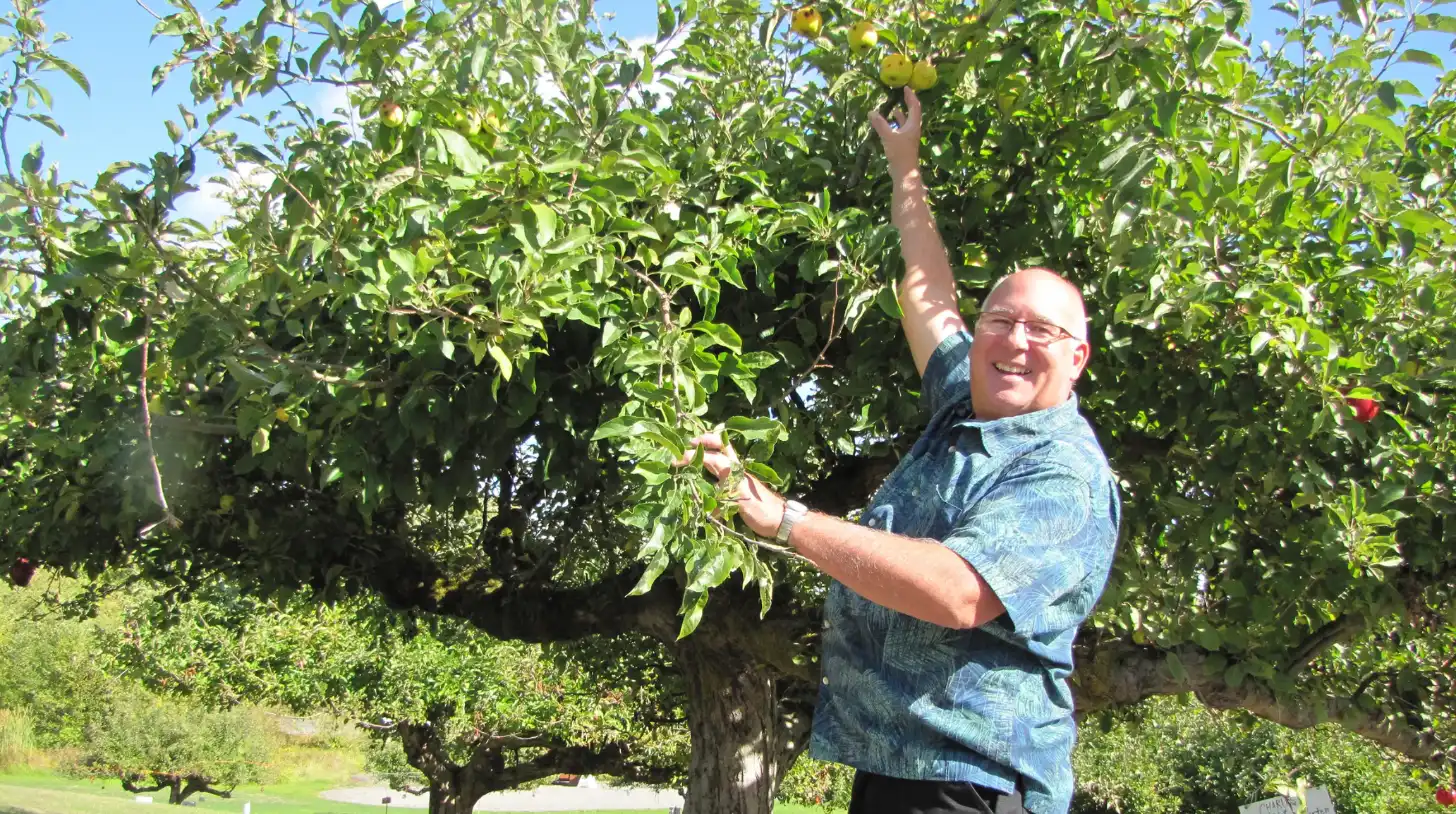
That day, Benscoter became obsessed with apple trees on the verge of extinction in the Pacific Northwest. He scoured nature studies, family recipes, and county fair newspapers to track down “lost apples.”
Then, he teamed up with Joanie Cooper and Sean Shepherd of the Temperate Orchard Conservancy in Oregon — two old friends with unique careers as “apple identification experts,” so that they could analyze their DNA.
“The first year we found one — it was the Fall Jenneting,” Benscoter said. “Now we have found 30 once-lost varieties.”
Together with his friend, E.J. Brandt, Benscoter created the Lost Apple Project. Since 2012, the two have spent their would-be retirements locating historic, pre-1920 apple trees in eastern Washington, western Idaho, and northern Oregon.
Through their nonprofit, Brandt and Benscoter hunt down rare apple varieties, collect apple specimens in the fall for identification, and then return to the same orchards in the winter to graft branches and grow “heritage” varieties.

Over the years, they’ve come across curiously named apples like the Streaked Pippin, the Sary Sinap, and the Nero. Benscoter recalled one farmer in Arkansas who long wished to pluck a Kittageskee apple — but they had vanished from his state years prior.
“10 years ago, he was going to be retiring soon, and his one regret was that he had spent his whole life hoping to come across the Kittageskee [apple] that was grown in Arkansas, and unfortunately, he’d never found it.”
Roughly two years later, Benscoter and his team found the Kittageskee in southern Idaho.
“The Lost Apple Project has members down in the Boise area, and somebody picked those apples and sent them in. I know it made him incredibly happy,” Benscoter said. “It was an apple that he thought he’d never be able to taste, and so that kind of stands out for me.”
You may also like: Thousands of books were destined for the landfill. These Turkish garbage collectors rescued them and built a public library instead
Featured Image: Courtesy of Dave Benscoter
Literary experts widely believe that Baloo from Rudyard Kipling’s “The Jungle Book” was inspired by the sloth bear, a curious-looking bear from South Asia with long claws, a disheleved coat, and a suction-like nose.
Unfortunately, the sloth bears of India face numerous threats — including poaching. In 2019, a young bear named Vasikaran, nicknamed Vasi by his caregivers, was rescued by the nonprofit Wildlife SOS after his left hind paw was caught in a wire snare trap.
When local veterinarians realized that his paw was beyond saving, Vasi had to undergo an amputation.
That was when he garnered the attention of Derrick Campana, an animal orthotist better known as the “Wizard of Paws.” For years, Campana has traveled around the globe, affixing custom-made prosthetics for animals of all shapes and sizes, from horses to birds.
“He came out and worked with [Vasi],” Nikki Sharp, the executive director of Wildlife SOS USA, told Good Good Good. “He’s remarkable. Absolutely remarkable.”
In September 2025, thanks to Campana, Vasi became the first bear in the world to receive a prosthetic limb.
“To our immense joy, Vasi accepted it, and could comfortably place his left hind leg on the ground for the first time in years!” Wildlife SOS stated in a press release.
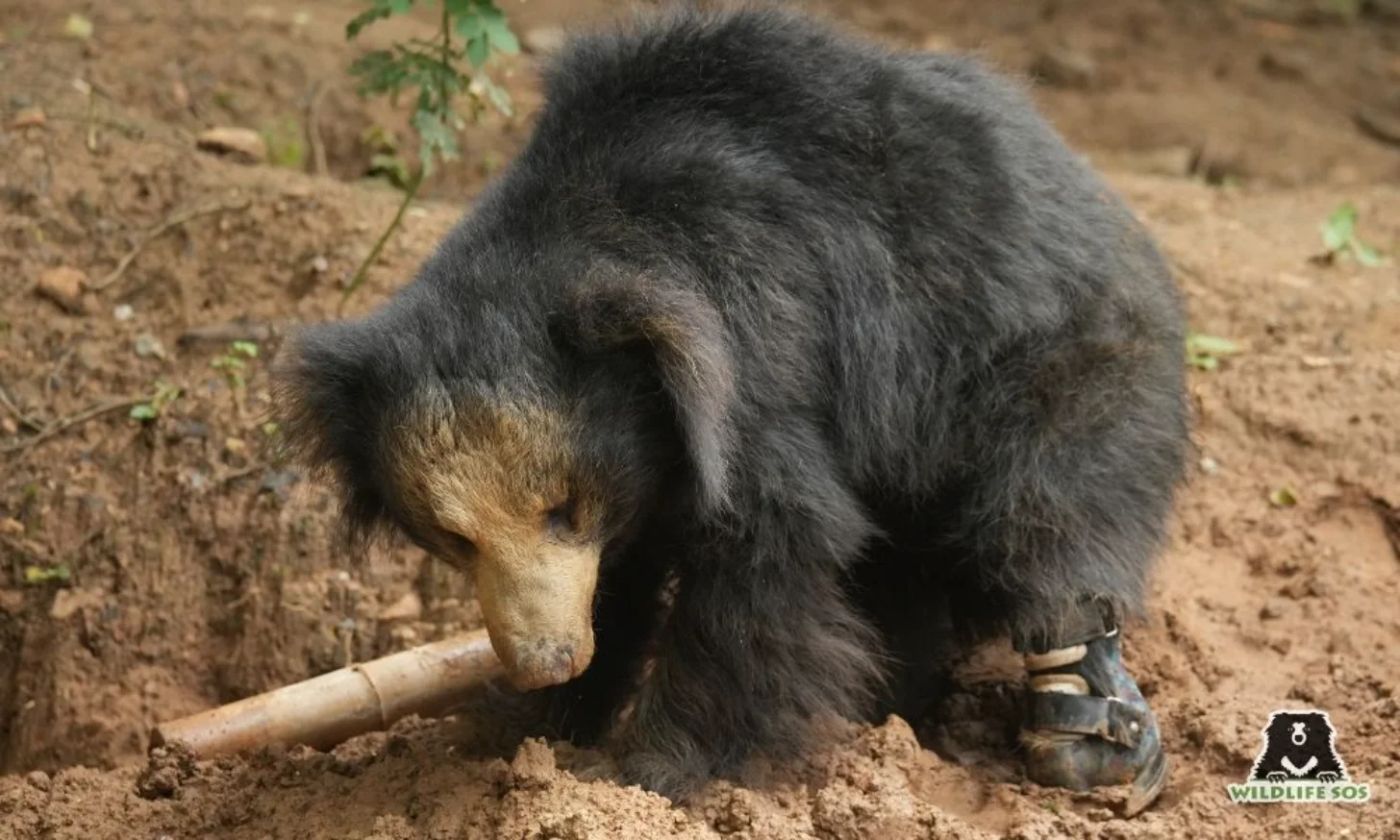
Specialized care is par for the course at Wildlife SOS, which operates four primary sloth bear sanctuaries in India. Its central location, the Agra Bear Rescue Facility, is the largest sloth bear rescue facility in the world.
“If a bear needs some special attention in some way, we are definitely doing everything in our power to make the quality of their life as good as possible,” Sharp said.
Sloth bears come to them in all kinds of conditions — orphaned, injured, or rescued from dancing bear trades — and Sharp said caretakers adapt to fit each bear’s needs.
“A lot of the bears that we have that are receiving lifetime care at our center are rescued from all sorts of different types of scenarios,” Sharp explained. “We have bears that have gotten their legs caught in snares. We have bears that have been electrocuted. There are different ways that animals can end up seriously injured that would require them to have an amputation.”
“But I would say that snares are probably the most common reason why we have bears that are missing a limb or part of a limb,” she added.
Despite their varying conditions, Sharp noted that the bears are remarkably resilient.
“Although they’re not naturally the best climbers, we have bears that have lost legs, and they can still climb trees,” Sharp said.
“We do have a lot of blind bears, and the fact is that they have different needs than bears that don’t have visual impairment. We have a special setup for our blind bear area, and part of that is they just know where everything is, and everything’s a lot more routine.”
For Sharp, there is a lot to love.
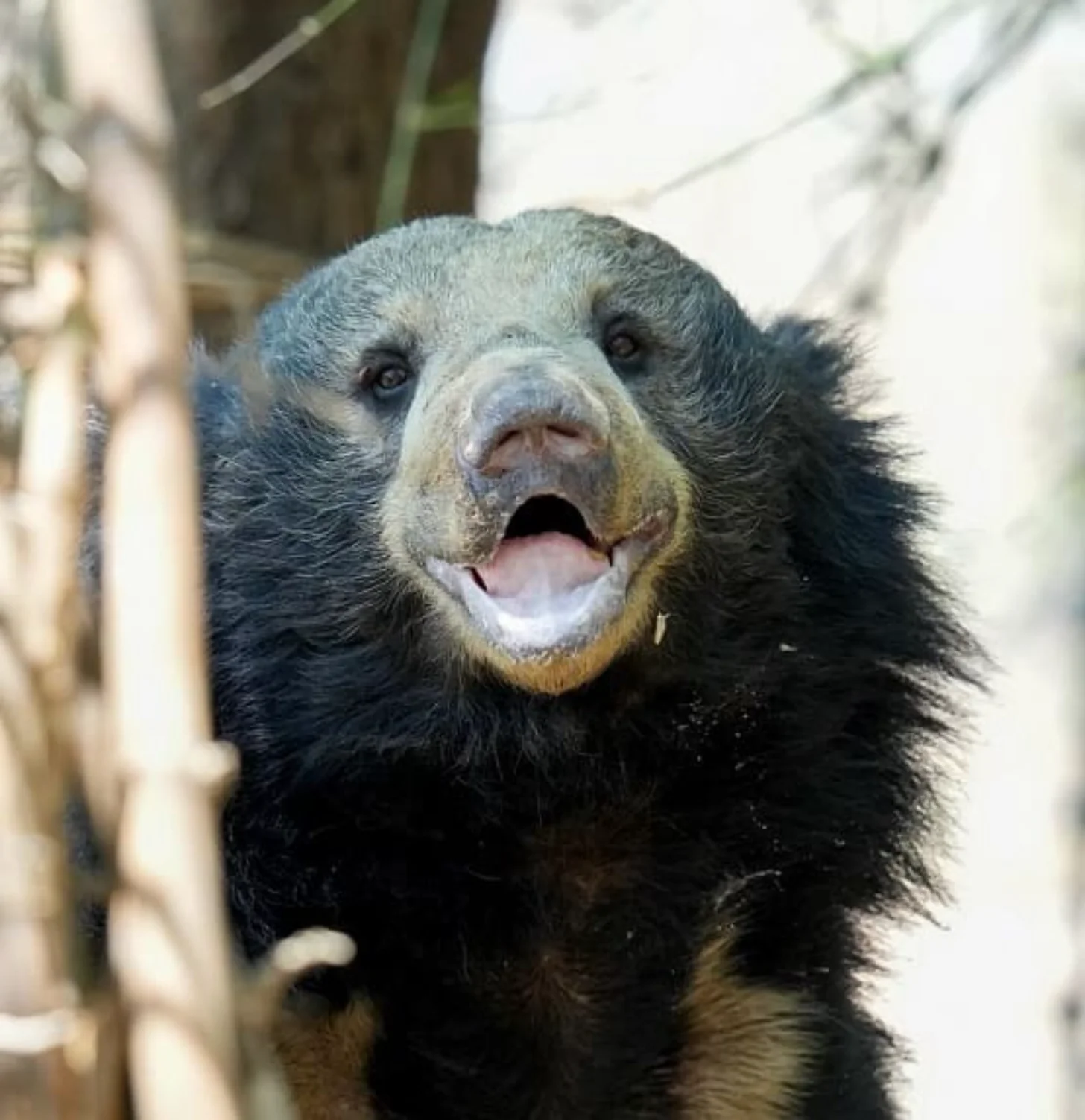
“They have this unique anatomy in their face that allows them to suck like no other bears can — they love to stick their nose into termite mounds,” Sharp said.
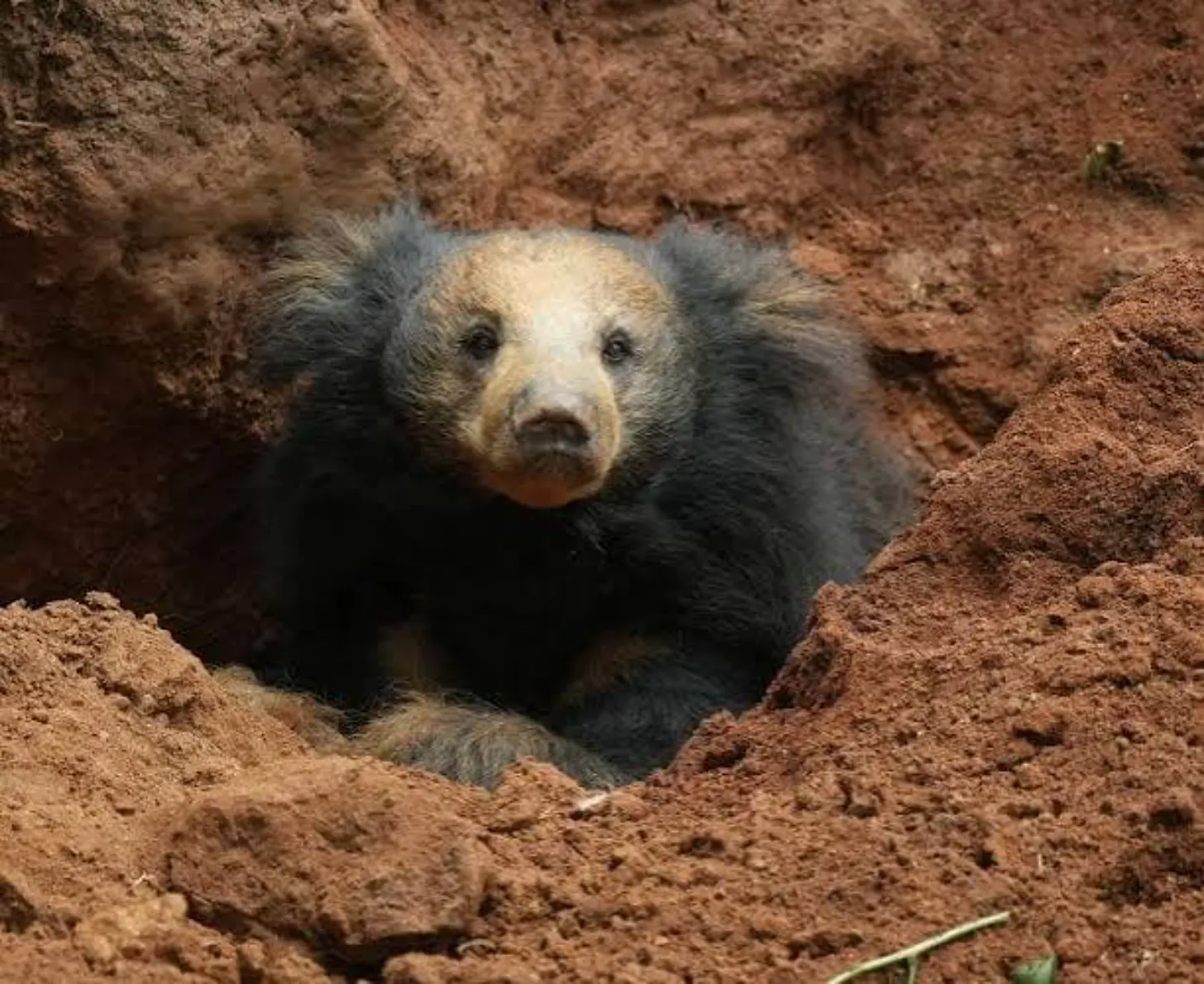
“They also have a very, very shaggy coat,” she added.
In fact, she said, they’re so “disheveled” that their silhouettes are easy to spot on trail cameras.
“I feel like everything kind of sticks to their coat, versus an Asiatic black bear, where it’s always a nice, smooth coat,” Sharp said. “You can often tell, even in the dark, that it’s a sloth bear just by looking at their coats.”
Sharp said one of her favorite fun facts is that sloth bears are the only bear species in the world that regularly carry their cubs on their back.
“And not just that,” she said. “They’ll often have two babies that they’re carrying around, but they can fight off tigers with their babies on their backs.”
“You’ll see these babies hanging on, and it’s just really remarkable how the babies are able to hold on. And how the mom is able to scare off a tiger with the babies on their back.”
According to Sharp, cubs cling to their mother’s backs for up to a year.
“And sometimes you’ll have three cubs that are all riding on them,” she said.
In India and Nepal, sloth bears are listed as vulnerable; in Sri Lanka, they are officially classified as an endangered species.
“I think the biggest threat for sloth bears is probably what you’re looking at for most species around the world, which is that they're losing their habitat,” Sharp explained. “Bears need a certain amount of range in order to survive. And that range area is getting smaller and smaller, and they’re becoming more [akin to] island areas, so they’re not connected. That’s probably one of the biggest problems.”
As they lose their land, human-wildlife conflict has increased.
“There’s always going to be places where bears and people come into contact with one another,” Sharp explained. “We don’t want that to have a negative outcome for the bear or the people … that education is part of our continued effort of where we’d like to spend more energy in the next five to 10 years.”
Another serious threat to sloth bears is poaching. For centuries, poachers would take cubs from the wild and use them for entertainment purposes, forcing them to “dance” on the streets for tourists.
“They put a rope through their nose, and they pull on that rope, and the bear stands on their hind legs because of the pain that it’s going through,” Sharp said. “That side-to-side motion, standing and moving, they would call dancing. So it has a nice name, like ‘Oh, the bears are dancing,’ but they’re in a lot of pain, and they're suffering.”
In 2009, Wildlife SOS helped usher an end to the dancing bear practice in India.
“One of the reasons why Wildlife SOS became an organization 30-plus years ago was really to focus on that problem in India and bring an end to it,” she explained. In 2010, the organization rescued over 600 sloth bears.
“But you can’t just rescue all the bears and be like, problem solved, let’s go on to the next thing,” she emphasized. “You’ve got to really stay on top of it so it doesn’t come back.”
For Wildlife SOS, that entails making sure that locals have access to vocational opportunities and job training so that they aren’t forced to rely on outdated practices like the dancing bear trade.
“Part of that is working with the children so that they grow up with education and they grow up with dreams,” Sharp said. “And a lot of them are now going to college, so they’re not growing up around people who are [profiting off of] dancing bears. [We’re] continuing to ensure that their needs are being met is helping to ensure that this problem does not come back.”
For Sharp, the sloth bear is an underrated animal that deserves a bigger spotlight — and world-breaking news like Vasi’s prosthetic limb helps bring added attention to a species in need.
“I hope if people read this story, they’ll be more curious to know more about sloth bears,” Sharp said. “We have a lot of knowledge that we’d like to share with people.”
To learn more about the rescue and rehabilitation of sloth bears in South Asia, visit the Wildlife SOS website.
You may also like: This rhino was orphaned when he was just one day old. Now he lives in an oasis with other rescued animals
Featured Image: Wildlife SOS
To study the secret life of marine animals, National Geographic scientists regularly deploy Baited Remote Underwater Video, or BRUVs.
Simply put, a BRUV is like a GoPro with fish food attached to it.
“The systems are left on the seabed to record marine wildlife for an hour at a time to capture footage of marine wildlife without the presence of divers,” Jett Walker, a scientist with National Geographic Pristine Seas, told Discover Wildlife.
On August 11, National Geographic Pristine Seas took to Instagram to share its latest BRUV footage.
“In this #POVBRUV series, we leave the humans behind and watch what happens,” the research team posted.
The video, which marked the first BRUV deployment in Samoa, included a shocking spectacle: a “beautiful” leopard shark, also known as a zebra shark.
“These carpet sharks are slow-swimming predators that eat gastropods and bivalve mollusks,” National Geographic Pristine Seas wrote. “They frequent sandy bottoms but can also be found on coral reefs, as we observed here.”
“What a great way to start our time in Samoa!” It added.

In his interview with Discover Wildlife, Walker underscored just how incredible that moment was.
“Leopard sharks are globally endangered and are rarely documented in this part of the Pacific,” Walker explained. “Although older checklists and databases have suggested that the species occurs in Samoa, those reports lacked independently verifiable evidence such as photographs, video, or a specimen.”
This means that the National Geographic Pristine Seas had just captured the first on-camera sighting of a leopard shark in Samoan waters.

“A single camera deployment can reveal something entirely unexpected and add an important piece to our understanding of a species’ distribution,” Walker said.
National Geographic Pristine Seas was founded in 2008 by Enric Sala, a famed marine ecologist and conservationist. The initiative, which blends wildlife conservation and filmmaking, has led 45 scientific expeditions.
The evidence unearthed across nearly three decades of underwater explorations has sparked the creation of 28 marine reserves around the globe.
“When we take government leaders down hundreds of meters underwater in our submersible, for example, we can open a window to their world that they’ve never seen before,” Sala told National Geographic. “You can see the awe and pride on their faces.”
Altogether, the initiative has led to the protection of more than 2.5 million square miles of ocean.
Sala said: “The ocean provides us with the oxygen we breathe, moments of wonder, jobs, and food for people around the globe — making it essential to protect.”
You may also like: Endangered 'walking pinecone' mammal spotted after 24-year absence
Featured Image: National Marine Sanctuaries (CC BY 2.0)
After seeing the number of students identified with autism spectrum disorder nearly double since the pandemic, Detroit Public Schools Community District Superintendent Nikolai Vitti knew he had to think outside the box to address the shortage of teachers certified to serve them.
Vitti believes he’s found a solution with DPSCD partnering with Michigan State University to expand the pipeline of highly trained special education teachers.
Through the partnership, eligible teachers can pursue MSU’s fully online master’s degree in special education with an autism spectrum disorder (ASD) endorsement while receiving tuition support from the district.
With the number of students identified with autism spectrum disorder increasing from 1,035 in 2019-20 to 1,957 in the 2026-27 school year, Vitti said the district continues to identify more students in need of special supports after a couple of years of online schooling and a general lack of social interactions during that time.
“Basically, what happened during the pandemic is a lot of kids didn’t go to school, or kids were learning online, and those disabilities were not identified, and in some ways, I think we’re playing catch up,” Vitti said.
“A lot of students also didn’t interact like they normally would in the earlier child development years because of the pandemic, and I think that’s led to not diagnosing as much as we normally would and other challenges with social interactions.”

For DPSCD, the partnership addresses a growing need by helping more teachers earn specialized credentials and develop strategies to support students with autism. The school district will pay teachers to earn their ASD endorsement, while teachers will pay to earn their master’s degree.
Vitti said the district has worked tirelessly to fill teaching vacancies more broadly during his nine years as superintendent, decreasing the number of vacancies from about 400 at the beginning of his tenure to about a dozen currently.
DPSCD has around 120 teachers who work with students with autism spectrum disorder currently, with 25 teachers participating in the first cohort of the partnership with MSU, which takes about two years to complete, Vitti said.
Michigan differs from other states by requiring an endorsement certification for the specific area of disability they are teaching in, he said.
The pipeline of ASD-certified teachers the district is attempting to create with MSU will allow it to recruit its own teachers to complete the program.
“It’s a win for our students because they get certified teachers,” he said. “It’s a win for our teachers because we’re paying for them to get additional credentials, which just strengthens their portfolio. Hopefully they stay in our district, but it also gives them greater opportunities in the future moving forward.”
Coursework prepares teachers to implement evidence-based programming for students with autism; assess academic and behavioral needs; design instructional and behavioral interventions; collaborate with families and school teams; and create structured, predictable learning environments.
Teachers also learn to use supports like visual cues, augmentative and alternative communication, peer involvement, social skills instruction, and transition strategies to promote student access and independence.
By connecting district educators with MSU faculty and research-based training, the partnership will help strengthen instruction and support for students across Detroit classrooms.
“One of the things I appreciate most about this partnership is that it helps build expertise from within the district,” said Erin Hamilton, MSU College of Education senior academic specialist and special education master’s program coordinator.
“Teachers are able to strengthen their knowledge and skills and immediately apply what they’re learning in their classrooms. That benefits not only the educators participating in the program but also the students and families they support every day.”
MSU’s master’s degree in special education requires 30 to 36 credits, depending on an educator’s previous preparation and teaching certification. The program combines graduate coursework, clinical projects, and supervised practicum experiences that teachers can complete in their own classrooms or schools.

Hamilton said there are several contributing factors to the increase in the number of students identified with autism spectrum disorder — both in Detroit and across the country — including greater awareness of autism, improved screening and evaluation practices, earlier identification and a broader understanding of how autism can present across individuals.
“This is not just a need in Detroit,” Hamilton said. “Schools across Michigan and the country are seeing growing numbers of students identified with autism, and educators want the knowledge and tools to provide effective support. Specialized training helps build confidence and equips teachers to create learning environments where students can be successful academically, socially, and emotionally.
“Ultimately, the goal is to ensure that educators feel prepared to support students with autism and that students have access to learning environments where they can thrive.”
Having an early diagnostic center and process within DPSCD has given the district greater capability of identifying students with autism spectrum disorder, Vitti said, allowing families to detect special needs for their children before they start kindergarten.
“Some of our parents are able to do that; many aren’t because they maybe aren’t comfortable with diagnosing the disability,” Vitti said. “Sometimes parents are even in denial about the disability. But early detection and intervention is key.”
This article was originally published by the Michigan Advance.
Featured Image: Detroit Public Schools Community District
On September 18, The Cornell Daily Sun — the independent, student-run newspaper at Cornell University in Ithaca, New York — published a story that would rock the nation.
A woman, anonymized with the name Jane Doe, had just filed a lawsuit, “alleging that she was gang raped after being coerced into consuming drugs by several men at the Chi Phi fraternity house at Cornell in 2024,” the Sun reported.
Jane Doe is suing Cornell University, several Chi Phi fraternity organizations, seven current and former students, several sorority organizations, the former president of Cornell’s Chi Phi chapter, a local bar, and several unnamed individuals.
Three days after the Sun broke the story, its editorial board published a scathing editorial about how the university failed the plaintiff, titled “Cornell Won’t, We Will.” At the top of the article, the paper listed the seven names of the Chi Phi members accused of gang raping Jane Doe.
In the days that followed, more details emerged about the case, and numerous public figures and local officials have spoken out about the mishandling of the student’s initial Title IX report. New York investigators also reopened a criminal investigation.
This week, Jane Doe’s attorney, Thomas Giuffra, gave a brief interview to CNN’s Jake Tapper.
“I think she wants accountability,” Giuffra told Tapper after being asked what his plaintiff wanted out of the lawsuit.
“Her life has been destroyed. She’s a woman who comes from a small town. She was not somebody who was a legacy or somebody who was from a wealthy family. This was her dream,” the attorney said about Jane Doe’s academic enrollment at Cornell. “And it was taken away from her at a young age and in just a horrific fashion. She’s not even in college anymore. She is barely hanging on.”
“One of the things that I think hasn’t come out is she wanted to leave the university and go home and heal,” Giuffra continued. “And her parents, who had paid thousands and thousands of dollars for her to attend Cornell, tried to get their money back. And Cornell said, no, you have to stay in school. So she spent an entire semester in the campus where she saw these guys on a fairly regular basis, and that is just horrifying to me.”
This detail has stood out to thousands — including Cornell’s Student Assembly Representative at Large Myshay Causey.
“What bothers me the most about this situation is how often victims end up losing out on their education in search of justice,” Causey said in a recent social media video.
“Reporting often comes with the risk of being socially ostracized, targeted, academically falling behind, and being stuck at the same university reliving your trauma. This is a systemic issue that we see happening time and time again in cases like this.”

Causey’s solution? Creating an “inter-Ivy League guaranteed transfer” program for victims of sexual assault, which she calls “similar to witness protection programs and military expedited transfers.”
“We have a systemic issue in the way that we handle sexual assaults. And that’s more than just us failing to punish abusers. That’s also the way that we fail to properly support victims,” Causey continued in her video. “I want to create a system where never again are victims the ones risking their own education by speaking up.”
She calls the plan #WelcomingJaneDoe.
Causey understands that this is a complex system that cannot be built overnight, though with a position on the student assembly representing Cornell’s approximately 16,000 undergraduate students, she hopes to affect change.
“My position gives me the ability to introduce and help pass legislation, advocate directly with administrators, and meet with Cornell staff about student concerns,” she told Good Good Good in an email.
“It also gives me the institutional legitimacy to represent Cornell students in conversations beyond campus, including the national conversations I am now having with representatives and supporters at universities across the country.”
So far, she has a six-page plan drafted with five phases that would eventually result in the transfer program’s implementation.
Those phases include, as quoted from a PDF Causey shared with Good Good Good:
- Reaching out to and organizing student representatives, student governments, alumni organizations, survivor advocacy groups, administrators, staff, legal professionals, survivors, and other stakeholders from Ivy League universities and institutions across the country to build a national coalition focused on educational continuity for survivors of sexual assault
- Hosting meetings with participating institutions and stakeholders to understand differences in admissions, credit transfer, financial aid, housing, academic programs, survivor support, and other institutional processes, and use this information to develop a practical framework for supporting survivors who choose to transfer
- Organizing petitions, surveys, and other forms of student engagement under #WelcomingJaneDoe to demonstrate support across participating universities and create awareness and institutional pressure around the need for educational continuity
- Working with participating student representatives and institutions to develop and pursue coordinated policies that establish meaningful transfer pathways for survivors of sexual assault, allowing survivors to continue their education at participating institutions without being forced to sacrifice their academic progress or opportunities
- Reassessing the effectiveness of institutional action based on the response and implementation of participating universities and determining whether additional measures, including broader state or federal legislation establishing baseline protections for educational continuity, are necessary
Causey said the idea has not yet formally been introduced as a resolution for Cornell to pass, as she first wants to build relationships across universities and develop a feasible plan that works before bringing it under formal consideration.
But her idea is not the only way members of Cornell’s student government have responded to the Jane Doe story.
On October 1, the student assembly held a public hearing for students to speak directly to their representatives about the issue. The New York Times called it a “fiery public meeting.”
“We also unanimously passed Resolution 15, ‘Institutional Transparency and Accountability in the University’s Response to Sexual Assault,’ which calls for greater accountability and transparency from Cornell, the release of information related to sexual assault and this case, and a task force to reassess Cornell’s sexual assault response processes and fraternity and sorority life,” Causey told Good Good Good.
“The Assembly has also passed resolutions addressing consent training on campus and providing free counseling for survivors of sexual assault. These resolutions are currently pending confirmation from the administration.”
Eeshaan Chaudhuri, the student body president, echoed the organization’s support for students like Jane Doe.
“We’re absolutely ashamed of the events that happened on campus,” Chaudhuri said, according to The New York Times. “I think we’ve made it abundantly clear for the past couple of days that we as a campus community stand with victims of sexual violence.”
Causey — who went viral for inviting Kamala Harris to her high school graduation last year — has her sights set on change far beyond her own campus.
“I’m proud of the work the student assembly is doing to push Cornell toward meaningful change,” she told Good Good Good.
“My hope is that #WelcomingJaneDoe can take that work one step further by changing the system beyond Cornell. Since this issue gained national attention … I think it’s fitting that a nationwide solution could also begin here.”
If you or someone you know has experienced sexual assault, you can reach the free and confidential National Sexual Assault Hotline, RAINN, by calling 1-800-656-4673 or using its online chat feature.
Featured Image: Claude-Étienne Armingaud/Wikimedia Commons (CC BY-SA 3.0)
Over the last two years, the Virginia Institute of Marine Science’s TRAP program — Fishing Trap, Removal, Assessment and Prevention — has recovered more than 24,000 abandoned fishing traps.
The retrieval of the underwater garbage, which weighed a collective 600,000 pounds, has supported more than 135 jobs and documented nearly 36,000 trapped marine animals.
In their latest round of funding from the National Oceanic and Atmospheric Administration, the Virginia Institute of Marine Science allocated $225,000 to local watermen to aid in the removal of abandoned fishing gear in the Chesapeake Bay, which stretches 200 miles from Maryland to Virginia.
The Chesapeake Bay, which is the largest estuary in the United States, produces one-third of the nation’s total blue crab supply — and the bay waters are littered with abandoned crab pots.

“These crab pots [are] also known as ghost traps,” environmental reporter Lauren Hines-Acosta explained to the Bay Journal Delmarva Pubic Media. “Sometimes they’re just lost or they’re not checked anymore, abandoned, and critters can still get in there and they can't escape and they don't get harvest. So they just die really for no reason.”
“So cleaning up the crab traps can help with the local populations that there’s not any bycatch that wouldn’t be going towards a harvest. They can also disrupt habitats and they can be navigational hazards too for both.”
The funds will go to two TRAP program projects that center on the retrieval of blue crab pots from two arms of the bay, the Herring Bay and the Eastern Bay.
“There’s two companies, the Oyster Recovery Partnership and Raunch Inc.,” Hines-Acosta said. “They’re going to be working with the local watermen in their area to identify and remove the blue crab traps since they would know what they look like best.”
“And they’re likely on the water more often to know where some of these traps might be,” she reasoned.

The Virginia Institute of Marine Science led similar efforts from 2008 to 2014, where they removed roughly 34,000 ghost traps.
“That’s how the institute became leader of the nationwide project,” Hines-Acosta said.
Since 2019, Ocean Aid 360 has hosted an annual “ghost trap” rodeo, where locals compete in a tournament-style event to fish abandoned gear out of Gulf waters.
“It’s just like your favorite inshore fishing tourney, but instead of redfish and trout, we’ll be weighing in collected plastics, derelict crab traps, and other forms of marine debris after your four-hour search,” Ocean Aid 360 posted to Facebook ahead of their latest rodeo event in August.
According to the organization, the event was open to “anglers, boaters, paddlers, and shoreline walkers.”
“To date, OA360 has organized 18 cleanups around Florida and has weighed in close to 150,000 pounds of marine debris,” Ocean Aid 260 said.
You may also like: Climate activists launch floating gardens in British harbor: 'We built a wildlife corridor in a city'
Featured Image: Richard REVEL/Pexels
On October 13, the tabletop game company Cards Against Humanity — named for its popular flagship game of “fill in the blank” prompts and chaotic answers — took to the social media site X to share a post aimed at librarians.
“Brainrot and AI slop are taking over the world,” the game company wrote. “One lone bastion of critical thinking remains — a land of air conditioning, white noise, and free WiFi.”
“What is that shining light of civilization amongst the tung tung tung sahur wasteland of our times?” The account asked, referring to an AI-generated figure who serves as the peculiar mascot of what’s come to be known as “Italian brainrot.”
It answered: “Your local library.”

“For the last six years, we’ve been sending free copies of Cards Against Humanity: Family Edition to libraries across the country, to fend off the evil forces that threaten to steal the minds of our nation’s youth,” the post continued. “We’ve equipped almost 5,000 libraries so far, and don’t have plans to stop any time soon.”
“Know a library that needs our help?” The account asked. “Tag them below so we can send them our finest front cortex-flexing products, including Cards Against Humanity: Family Edition and Contact, for free.”
The account signed off by saying, “Let’s get real people to play real games together, in person.”

Within a day, the post had almost 1,000 comments from X users tagging their local library branches, from the Kannapolis Library in Kannapolis, North Carolina, to the Pima County Public Library in Tucson, Arizona.
Cards Against Humanity has a long history of supporting public libraries.
In October 2025, the tabletop game company offered presales for their latest game, Cards Against Humanity Explains the Joke, and donated 100% of the presales’ net proceeds to the American Library Association.
“We are exceptionally grateful to CAH for their longstanding support of libraries and thankful for this recent donation, which will help ALA continue its work to protect the right to read freely,” Sam Helmick, the president of the ALA, said in a statement.
The donation corresponded with Banned Books Week. According to PEN America’s Index of School Book Bans, nearly 12,000 books were banned in public schools during the 2025-2026 school year.
It marked the highest number of recorded bans since the nonprofit began tracking the metrics in 2021.
The donation also came seven months after the Trump administration attempted to dismantle the Institute of Museum and Library Services, a federal agency that oversees 125,000 public, school, academic, and special libraries across the country.
A federal judge later reversed the order in April 2026, but not after it triggered grant cancellations and staffing cuts on a national level.
“This fight isn’t free,” Lisa Varga, the associate executive director of public policy and advocacy, added. “The CAH donation allows us to continue supporting librarians and library workers under attack.”
From 2025 through 2029, Cards Against Humanity also pledged an $1,000 donation match in partnership with the American Library Association’s Games & Gaming Round Table.

“Unfortunately, the idea of libraries as a place of intellectual growth, the safety and livelihood of librarians, and the freedom to read itself are all currently under attack in many parts of our country,” Eliot Weinstein, the co-creator of Cards Against Humanity, told the association last year. “There’s no better time to send a message to librarians (and the organizations that support them) that we’ve got your back.”
“To date, we’ve donated over 5,000 games to public libraries around the world, and we have no plans to stop,” Weinstein said. “It’s our goal to get our games played as much as we possibly can, by offering them to libraries free of charge.”
You may also like: At 17, this student is helping children understand cancer through a Pokémon-inspired card game
Featured Image: Cards Against Humanity
“What if we can make our towns resilient against floods, heat waves, and droughts, whilst boosting biodiversity and mental health?” asks documentary filmmaker Cameron in a YouTube video. “Right now, all around the world, people are finding incredible ways to bring nature back into our cities. And we’re here in Bristol to do exactly that.
Nicoll is the creative director at Planet Wild, a nature protection organization. It regularly releases YouTube videos about new environmental projects, and their short doc on “floating wetlands” currently has over 1.5 million views.
“Turns out wetlands aren’t just incredibly important for wildlife,” Nicoll explained. “They also keep temperature and water level stable. You know, the kind of thing we humans really need to survive. And this is why all over the world, people are bringing wetlands back into our cities.”
Julia Newth is a volunteer for WWT, the wetland charity. Over the next few years, the WWT is set to complete 200 new wetland projects to “bring nature back.”
“When you start to install wetlands across the city, whether that’s a small rain garden, a drain pipe wetland … to a lake in your local park, it’s really sort of magical, and everyone in the city benefits from wetlands,” Newth said.
By building and planting “floating wetlands” along the concrete embankments of Bristol Harbour, WWT is building a wildlife corridor through the city center — and creating habitats, absorbing floodwaters, and cooling the city down all the while.
In the video, Nicoll joined climate activist and good news correspondent Sam Bentley in building two floating platforms, 100 square meters and 16 square meters, respectively.

First, they constructed the modular structures. Every element of the platform was recycled, recyclable, and biodegradable, from old drinking water pipes to coconut husks.
Next, they dropped buoyant clay pellets atop the structure to create a stable plant bed that wouldn’t wash away. They then topped the plant beds with more than 20 native plants.
“So above water, we have this land planting system that creates an oasis for pollinators and a safe haven for nesting birds. But the real magic happens underneath,” Bentley said.
“As these plants grow, their roots go super deep into the water, creating a refuge for marine life, cleaning the water, taking all of those pollutants out, and also regulating the water temperature too.”

After creating the platforms, Nicoll immediately saw a real-world impact.
“So we literally just installed the floating wetland, and we’ve seen a baby seagull, who was stuck in the water, use the ramp, and climb up onto the platform, and that’s just saved its life,” Nicoll said. “It’s just unbelievable to witness.”
“And that is the beauty of this project,” he continued. “Nature is just waiting beneath the concrete and the asphalt. And once you give it a chance, it’s immediately making our cities more biodiverse, safer and simply nicer places to live. And because it’s such a simple solution, it can easily be copied around the world.”

“So our funding here is not only transforming Bristol, but it’s also creating a blueprint for future wetland cities everywhere.”
Nicoll pointed out how a floating wetland constructed in 2024 had blossomed in the last two years.
“You can see the difference,” he said. “It’s just full of life. There are families of birds in there. It’s full of insects. I’ve seen loads of fish swimming underneath. Just incredible what can happen in such a short space of time.”
Watch the full video below:
You may also like: 1,000 people buried their underwear across Switzerland. The unusual study helped researchers gauge soil health
Featured Image: Screenshot via @planet-wild/YouTube
When our second child was born, my spouse had several weeks of paternity leave under his parental leave policy at work.
I’m a certified family life educator, and parental leave comes up regularly in my teaching and community work. So I was aware of the benefits his leave could have for our family — in theory.
Still, I could not have imagined how significantly his leave would end up affecting our family and our connections with community.
During his leave time, my spouse took our oldest child to playdates and birthday parties. He quickly became connected with our small-town network of families with kids close in age. I witnessed my spouse becoming more comfortable being the “main” parent in public, going to kid-centered community events, and connecting with other parents.
Our family is still seeing the benefits of those few weeks 10 years later.
Leave for supporting parents after the birth of a child is isn’t standardized or required by law in most places in the United States. Even countries with generous paid time off for the birthing parent don’t always offer similarly generous time for the non-birthing parent.
This diversity in leave policies can make it hard to assess the impact of leave for the non-birthing parent. But existing research suggests that extended leave for birthing parents and moderate leave for non-birthing partners positively impact infant well-being and reduce postpartum mental health challenges.
Maternal and newborn health
Leave for both parents with the birth of a child can significantly benefit parental mental health overall and maternal mental health specifically. Paternity leave assists in the mother’s recovery and contributes to less of an increase in stress and depression than for mothers whose partners didn’t take leave.
One Swedish study showed that flexibility within paternal leave policies, such as allowing new dads to take intermittent time off after the birth of a child, helped reduce the incidence of maternal postpartum health complications.
Children also benefit from paternity leave. When a father takes significant leave — meaning at least two weeks — children report experiencing more father-child closeness and better communication in the relationship up to nine years later. And overall child health tends to improve when fathers take paternity leave.
When paid leave policies are available for both mothers and fathers, breastfeeding is more likely to last longer. Longer breastfeeding is strongly linked to overall infant health and decreased infant mortality.

Family balance
Allowing both parents to have sufficient time off to bond and adjust to their new roles can also have longer-term benefits within the family unit and contribute toward more equity in child rearing. Even in 2026, mothers are often considered the “default” parent, with fathers taking a more secondary role.
While fathers are more involved now than in previous generations, mothers are still more likely to be the first call from school. And even with an involved father, mothers continue to carry the invisible mental load of the family, an unseen burden of data, obligations, and preemptive planning tasks.
This over-reliance on mothers comes with a price: Mothers report being more stressed and tired than fathers do.
As I experienced in my own family, when fathers have ample time off, it sets up the dynamic to be more balanced between parents. This helps reduce the strain on recovering mothers and redistributes some of the care work that goes into raising children.
Home economics
What’s more, paid leave policies have been shown to help families’ financial health. Pay rates during leave can vary widely depending on your company, organization, or country. Without full or close to full pay, many families cannot afford to take leave.
In the U.S., for example, the Family and Medical Leave Act allows time off, but not in all circumstances, nor is that time required to be paid. Many families cannot afford to take the full allowable time off, using up sick or vacation time if available. Many parents in the U.S. end up going back to work sooner than seems healthy.
New parents in the U.S. often find themselves in an economic bind — they can’t afford to take leave, nor can they afford to rely on a single income to have a parent stay home. But many also can’t afford the childcare rates for newborns, which tend to be particularly high.
National averages for infant care at childcare centers are nearly $200 more per month than toddler care. While rates vary significantly depending on where you live and what type of care you choose, infant care remains the most expensive.
Despite the lack of a paid U.S. federal leave policy for parents, both domestic and multinational companies have noticed that their workers care about parental leave policies. Some have begun to offer leave for supporting parents in order to recruit and retain workers.
Outside the US
U.S. leave policies consistently rank at or near the bottom when compared with other similarly developed countries, like the 38 members of the Organization for Economic Cooperation and Development, or OECD.
Some countries follow a “use-it-or-lose-it” model of parental leave, where fathers in particular are encouraged to take a more substantial role in childcare. Sweden and Norway, for example, earmark 90 days of leave for each parent, and it cannot be transferred to or split with the other parent. This encourages both parents to take time off.
There are many options across countries with parental leave policies. Flexibility and defined expectations seem to be key contributors to getting the most out of the parental leave that is offered.
Cultural adoption
When non-birthing parents are men, another barrier to taking leave is the perceived social acceptability within their communities. Even when paid paternity leave is available, many men struggle to take it because of how traditional gender roles and expectations of masculinity frame childcare as women’s work.
To offset these kinds of social pressures, countries like Japan and Austria offer incentives such as bonus leave time for families when fathers actually take their available leave. Germany offers a similar bonus, and it has found improved couple relationship satisfaction when fathers take more of their leave time.
Beyond improvements in maternal and infant health, both parents taking leave can create a more equitable workplace environment. Disparities and discrimination that come when only women take leave after birth can lessen when fathers and other supporting parents also take leave. Childbearing women are then less likely to be penalized, formally or informally, for taking parental leave.
Paid parental leave policies that provide leave for all parents, regardless of gender, also can help reduce structural inequality in the workplace across race and class. In the U.S., Hispanic and Black workers often have less access to paid leave policies and may experience increased pressure to return to work earlier than their white counterparts.
As more states, countries, and corporations adopt more flexible and inclusive leave policies, researchers will continue to learn how parental leave benefits both parents and children.
What they’ve found so far leads me to believe that, just like we’ve seen with prenatal care and early education programs, parental leave will prove to be an early investment in healthy children and families that pays dividends in the long term.
This article was written by Megan Kuykendoll from Miami University and was originally published on The Conversation.
Featured Image: Nappy/Pexels
In 2015, Jennifer Cabral and Deb Mathews founded the Helping Animals Rescue Team, or HART Rescue, in Crossville, Tennessee. To date, they’ve helped adopt out 634 cats to local farmers.
“Our program has ended euthanasia for feral and semi-feral cats at our local shelter entirely,” Cabral told Good Good Good, referring to the Cumberland County animal shelter — which is run by director Andrea Henshaw.
HART Rescue is one of many nonprofits across the United States that rehome feral cats through barn cat programs.
It’s a win-win: Cats slated for euthanasia get a second chance, and farmers get help reducing rodent populations on their land.
“These cats are considered not adoptable to domestic homes,” Cabral explained. “Either they are feral, semi-feral, or completely antisocial. Some of the antisocial cats come around to be at least pet-able after settling into their barn placements.”
“Once we get the call, we set up with our vet to spay or neuter and vaccinate the cats, and they go back to the shelter if we don't have immediate barns for them.”
Then, HART Rescue takes photos of the cats, gets a general idea of the cats’ personalities, and posts their listings on Facebook and PetFinder.
“When someone contacts us looking for barn cats, we give them a list of what kind of cats we have available,” Cabral said. “Some barns want cats to just be feral, and some want them to be more on the antisocial side. We try to match barns with what they are looking for.”
Evidence shows that cats do have a measurable impact on rodents and pests.
From December 2017 to May 2018, researchers tracked a rat colony and five feral cats over 79 days. They recorded over 306 videos and documented 20 stalking events and three “predation” attempts. Two were successful.
Even when the cats didn’t outright eliminate rats, they did affect their behavior. The same study found rats shifted their movement and spent more time in burrows when cats were present, so the cats acted as a deterrent.

Experts held the study up as an example to farmers and factory owners — indicating that cats are just one of many tools that should be used for clearing out active nesting sites.
Still, Cabral said she’s heard anecdotal evidence of positive results.
“We don’t always get updates from the barns, but we do get barns that come back for more cats, and when we do get updates, we have a lot of positive feedback that the cats are working well,” Cabral said.
“We advise the barns that cats who are well fed hunt for fun and they are better hunters when they aren’t just starving,” she continued. “We have had barns tell us that they've had rats clear out shortly after placing cats in the barn situation without the cats having to catch a single rat. We have had cats placed at a rock quarry where rats were so bold that they stole workers’ lunches, and cats placed there immediately went to work hunting.”

From time to time, Cabral has encountered a common misconception about the barn cat program.
“Often, people think the barn cat program is a way to get a free adoption or that we will adopt out little kittens to them as barn cats,” Cabral said. “These cats are always teenagers to adults and must be unadoptable as a domestic cat.”
“This is why we started the program,” she emphasized. “To give these cats a chance to live their lives, and to keep the shelter staff from having to euthanize cats just because they wouldn’t make a good couch ornament. The local shelter has found the program extremely helpful to their numbers, and their hearts.”

Cabral noted one farmer who had set up a “buddy system” for her barn cats.
“We have another barn that likes to have their barn cats in pairs so each one has a buddy,” Cabral told Good Good Good. “So she has gotten four so far, and each one has a friend, so we made sure to give her cats that already knew each other. She sends pictures of them in the barn with the goats supervising all the work.”
When asked if there were any rescue stories that stood out to Cabral, one immediately came to mind.

“We had a somewhat sad experience where a 12-year-old cat came into the shelter with kittens. This means this poor cat had been having several litters a year for 12 years,” Cabral recalled. “Because of this, she lost some control of her bathroom abilities and would pee or poop wherever she was because she couldn’t even tell she was doing it anymore.”
“She was somewhat antisocial but not entirely to the point where we would think of a barn,” she continued. “However, a cat who won't be able to use the bathroom wouldn't be easily adoptable. So we found a barn that stepped up to take her.”

At her new home, the cat had the lay of the land. The owner simply sprayed down the yard or porch with a hose if an accident occurred.
“The cat was not required to hunt in this place; they had other hunters,” Cabral said. “Her only job was to lie in the sunshine and get fed. She grew back her patchy hair and got nice and chunky. She lived there for another three years and passed in her sleep.”
“Barn life is a good life,” she said, “and better than euthanasia.”
You may also like: This dog is trained to sniff out invasive 'sea vomit' and protect oyster reefs: 'She has enough drive for 3 dogs'
Featured Image: Alexandre Delbos (CC BY 2.0)
On September 6, 2023, park rangers from the Tsavo Trust and Kenya Wildlife Service came across a newborn rhino calf in Tsavo West National Park.
Estimating that he was only a day old — and likely born prematurely — rangers were stunned that his mother was nowhere in sight.
“It was a miracle that hyenas, jackals, or other predators hadn’t already snatched him,” wrote the Sheldrick Wildlife Trust, a leading conservation organization in Kenya.
“He had obviously been on his own for a significant time, as he had started to become hypoglycemic and shaky. It was clear — without sustenance and rapid attention, he would die.”
The rangers greenlit a rescue from the Sheldrick Wildlife Trust, which specializes in the rescue and rehabilitation of orphaned animals.
They transported him to the Kaluku Neonate Nursery, which sits in the heart of the Tsavo ecosystem, the same habitat where he was born.
“He was just a day old when he was rescued, so for all intents and purposes, we are the only family he has ever known,” the Sheldrick Wildlife Trust said.

Angela Sheldrick, the CEO of Sheldrick Wildlife Trust, touched on the baby rhino — named Chamboi — and his early rehabilitation journey in 2024.
“Chamboi’s favorite place to sleep is by his keepers’ sides, his eyes closed in bliss as they rub his tummy,” Sheldrick wrote in her field notes.
Although he was in safe hands, Chamboi’s early days were a challenge. He was separated from his mother so quickly that he wasn’t able to get the nutrient-rich colostrum that a nursing mother can provide.
For a long time, he struggled with a laundry list of stomach issues. After his molars came in, he was able to eat leafy greens, which helped him pack on some much-needed weight.

As he slowly grew, Chamboi gained new footing. Sheldrick described him as “animated and flighty” as he toddled around the sanctuary.
“His preferred gait is a skip — he seems to levitate as he races his keepers through the bush.”
According to Sheldrick, rhinos have a penchant for routines and habits.

“Chamboi embodies this trait with particular fervor,” she wrote. “He is obsessed with one particular blanket — a woollen, cherry red number — and flatly refuses to wear anything else. Tsavo can get very hot, but infant rhinos are fragile, much like elephants, and need to be shielded from even the slightest chill in the air.”
In his first year, Chamboi also befriended two birds of a different feather: orphaned ostrich chicks named Bam and Boozle.

“Bam and Boozle immediately took a shine to Chamboi. He had very little say in the matter; they simply started following him from sunup to sundown!” Sheldrick said. “They make an unlikely troupe, the stout rhino and the gangly birds … they go everywhere together — from the airstrip to the mud bath, to the bush and back home again.”
In addition to his ostrich friends, Chamboi is being raised alongside Raha, another black rhino that was orphaned at an early age.
Currently, they are still too young to live in the wild. When they both reach 5 years of age, they will both slowly begin their transition to a protected nature reserve.

But for now, Chamboi is just 3 years old. And he is still enjoying the comforts of his “adoptive” family: the keepers who raised him and the menagerie of animals that mill around him in peace.
“To know a baby rhino is to fall in love with them,” Sheldrick wrote in her field notes. “My mother, Daphne Sheldrick, used to refer to black rhinos as ‘the last living dinosaurs’ — and the epithet rings true, even when it comes to the youngest generation.”
You may also like: This baby elephant fell into a well just a few days after she was born: 'Now she has her entire life ahead of her'
Featured Image: Sheldrick Wildlife Trust
Frank Davis and Aaron Hicks, creators of ECHO: Every Choice Holds an Opportunity, contend that very little programming for people in prison is led by people of color or by those who have been incarcerated themselves.
Both Davis and Hicks have been to prison, served their time, and are now reaching out to work with others who are still incarcerated and/or have been recently released.
Davis and Hicks say they see a recognition that they have something to offer from men who have spent years behind bars and are struggling to make the best of a situation they don’t want to be in.
Voices of Power is the organization Davis and Hicks created to offer their services. They are also founding members of EXPO (Ex-incarcerated People Organizing).
The two were asked to consult with Marquette University and the University of Wisconsin-Madison and to meet with staff at the Racine Correctional Institution: the warden, deputy warden, security director, a correctional officer with the rank of captain, and community members.
“Aaron and I were talking about different things we were doing out in the community, and how we feel that change, or we have seen how change happens,” said Davis, “and it happens when people who are impacted by the system come back to create programming for people in the system.”
At that initial meeting, the men were asked by Warden Robert Miller and Education Director Dan Durler to create programming to decrease the population in solitary confinement, also known as restrictive housing.
“There’s just certain kinds of messages you need the right messenger,” said Darren Wheelock, a professor at Marquette University and director of the prison education program, “and it doesn’t matter how many times someone like me may talk about, you know, the importance of having a reentry plan – ‘start thinking about how what you do affects your future chances’. I can say that until I’m blue in the face, but It’s not going to resonate in the same way that someone who spent years incarcerated, who spent a number of years of that time in the restricted housing unit. They bring all that lived experience with them.”
Wheelock was talking about the ECHO pilot program Davis and Hicks offered last spring at Racine Correctional, which he said amounted to much more than the content on accountability and being proactive.
“The goal of ECHO is to create a space where participants can discover their own strength, connect through shared experiences, and start building a path forward,” the ECHO curriculum states. “It’s about recognizing how many will define and limit them – and choosing instead to define themselves on their own terms.”
Davis said he and Hicks created a curriculum based on their years of experience of working in reentry and recovery.
After seeing the program, Warden Miller asked that in addition to those in restrictive housing, another session be offered for those in the general population who had just recently left restrictive housing
Marquette University funded the pilot project that ran from February to April.
“The guys loved it,” said Davis. “The warden loved how it impacted the guys and how they interacted with staff. The staff inside was able to see changes in guys in just the short nine weeks that we were working with.”
Those who participated in ECHO had to volunteer.
“Normally, what happens is when individuals are offered groups inside, there’s a little apprehension when it comes because it’s like okay, this is another group that’s created by DOC or somebody that doesn’t really understand us, and now suddenly we got to go in here, we got to act like we like it or act like we’re learning something, and there’s really no connection,” said Davis. “When we went up there in the listening session, it was an opportunity for them to see us and they wanted to hear that we’ve been impacted by the system. And once they heard that, their whole demeanor changed. They start listening. They start leaning in.”
After the first listening session, where participants asked questions, the second session addressed the history of incarceration in the United States; an open discussion followed about challenges, especially solitary confinement, along with a conversation about how those challenges do not define the people who endure them.
The third session focused on identity and how people in prison perceive themselves.
“All of the men have been labeled through the system, you know, as a convict, offender, all of those different things,” said Hicks, “and so we pose a question that’s a little bit different, and that question is, ‘who do you say that you are?’ Giving them the space and place to be able to define themselves, and how do you walk in that? And even if you don’t know who you are, we can also just talk about who you don’t want to be.”
There’s a session on mental health and what incarcerated people can do to take care of their mental and emotional lives, what healthy relationships look like, including the one they have with themselves and how they talk about themselves.
Hicks said many reoffend and go back to prison because of unhealthy relationships that should be avoided.
“Once we get out of prison, the first thing we want to do is jump right into a relationship,” said Hicks. “So we talk about toxic relationships, and from that we build. We start talking about healthy relationships. We pose questions to them about what a healthy relationship looks like. We start to dissect it, talk about it.”
The ECHO curriculum asks the men to consider whether they are fostering healthy or unhealthy relationships in prison, even before they step outside into freedom.
Then there is dialogue on post-release employability and housing. The program focuses on real-life skills, work and creating a resume, preparing for job interviews, and understanding workplace culture.
Davis said a lot of people getting out want to live with someone they know, but some of those people may be unhealthy, and Davis and Hicks challenge participants to not connect housing with toxic people.
One of the last sessions is on vision, legacy, and personal accountability. Questions explored, said Davis, include: What is your vision, what is your legacy, what is your plan, and how are you going to implement the plan?
The participants go through a graduation ceremony and receive a certificate of completion and are encouraged to practice what they learned in prison and start creating a healthy community in prison and make decisions that reflect their goals.
Davis said participants will be challenged and there may be justification for their outrage, for how the justice system may have meted out punishment disproportionate to their offenses. But that has to be tempered by the longer-term goal of getting out and creating the life they desire, keeping the long game in mind.
“This is really about two men on a journey to really pay it forward and to open up eyes the way our eyes were opened,” said Hicks.
Some of the men who participated in the program at RCI offered their feedback.
“They came at a time where I was going through a rough patch,” said Davonta Ballard. “They opened my eyes to living and making decisions; every decision you make should be beneficial to you, your goals, and your growth. It came from two individuals who’ve been in my shoes so it meant much more and they were a good example to how you can do your time and come back and be better for the world, your family, and community.”
James Allen has been in and out of incarceration since 2006 and is just months away from release. He said the program made a big difference in his life.
“It was somewhat the way the guys can relate because they have been incarcerated,” said Allen. “They just didn’t talk, but also asked questions. They were different and straightforward.“
He said the session helped him think about the direction he wanted for his life and what he could do to make a difference.
“The thing that stuck with me the most is the question of what did I care about the most,” he said. “I care most about my family.”
He added, “It was the only class I wanted to take to be a better person in life.”

David Greeno said what he learned the most is to pay attention to what he was thinking.
“I’m mostly controlling my bad ways of thinking and I am working on starting my own business when I get released from here in 11 months,” he said. “I am mostly grateful that I took the program. I am very appreciative of what Frank and Aaron are doing by coming into prison and teaching the younger generation.”
Kemondray Johnson said that because both Davis and Hicks had been incarcerated Black men, it gave him comfort with “opening up and being real.”
“They gave me pointers on how to be a survivor, survivor of the criminal system,” said Johnson. “Coming where I come from, there aren’t many positive Black role models and sadly most men have to get incarcerated to learn to be a better man. Those two men are role models to me. They are people I look up to and look forward to meeting outside of these walls.”
He added, “Those guys are free Black men and make time to come here and help us and stepping into an environment they swore to never come to again! I commend them and have the utmost respect for them.”
Davis said during the sessions there was a new guard in one of the wings who reportedly was disrespectful to one of the participants, and another participant reminded the man being yelled at that, “Man, you better know your identity,” and both of the men laughed and walked away from the guard.
Warden Miller chose not to be interviewed for this article, but he did describe the pilot ECHO offering as an “awesome program we have worked hard on collaboratively.”
Wheelock said he heard glowing reports from the participants himself.
“That trial run is what has everyone really excited,” he said. “That worked way better than we had imagined. We had students that they worked with that gave glowing feedback. A number of them then transitioned from the restricted housing unit. Right, they wanted to then kind of expand their educational opportunities and start taking classes. So it was all these downstream really positive benefits from having guys that have lived experience go back inside and help guys.”
The goal now for Davis and Hicks is to provide a year of ECHO programming at RCI over five, nine-week sessions. They are looking at raising $75,000 to fund the programming. The DOC may find the funds in its budget, but the men are also holding an online fundraiser, which started Sept. 1 and will end Nov. 12.
“This campaign is about more than sustaining a program,” the fundraising page states. “It is about closing the gap between what people inside need and what is often available to them. Many people are expected to heal, change, and prepare for reentry without consistent support. ECHO is working to change that.”
To learn more or donate, visit ECHO: Bridging the Gap.
This article was originally published by the Wisconsin Examiner.
Featured Image: Courtesy of Frank Davis
Twiggy the giraffe was just one week old when she was rescued from the Tsavo East National Park in Kenya.
On November 29, 2021, rangers for the Sheldrick Wildlife Trust, a Kenyan conservation organization, paused their anti-poaching patrol to track a baby giraffe through the bush.
“Earlier that day, we had received reports of a tiny giraffe who was — rather unsuccessfully — trying to pass herself off as a zebra,” the Sheldrick Wildlife Trust recounted on its website. “There were no other giraffes in the area, and as her survival instincts kicked in, she latched onto a passing herd of zebras.”
They waited hours to see if the giraffe had a mother nearby, but no adults approached.
“While the zebras gracefully accepted her presence, she made an easy target for predators, particularly Tsavo’s infamous lions, who were as it turns out not terribly far from her location,” the organization said. “Dusk was fast approaching, and if she was to survive the night she’d need help, so the Kenya Wildlife Service requested a rescue take place.”
It wasn’t an easy task. Even at just a week old, giraffes have a lot of kicking power.
“The undertaking took plenty of mettle on the part of our team,” the post continued. “While they drove slowly alongside the orphan, our field works manager leapt out of the vehicle and, with one decisive action, successfully restrained her.”

As the sun dipped on the horizon, the team sought shelter across the Voi River at Sheldrick Wildlife Trust’s closest sanctuary.
“[We] immediately plied her with a bottle of milk, which she drank without hesitation,” the organization said. “Given her eagerness, we can only imagine how long it had been since her last meal.”
Tucked away from predators with a belly full of milk, Twiggy was in safe hands. With immediate care out of the way, the Sheldrick Wildlife Trust needed to choose her next home.
“We wanted Twiggy to grow up with plenty of friends, in an area also frequented by her own kind,” the Sheldrick Wildlife Trust reported. “This led us to our Kaluku Neonate Nursery, located in the heart of the Tsavo Conservation Area.”

“Twiggy would be surrounded by a menagerie of fellow orphans, and when the time was right, could join the thriving population of Maasai giraffes who call that area of Tsavo East home.”
For the next four years, Twiggy grew up in a peaceful oasis, protected from poachers and predators and raised among a colorful array of characters, including Mkubwa the buffalo, Susu the eland, Kwale the hartebeest, and Scooter the warthog.
In the stockade, her “next door neighbor” was an orphaned elephant named Little Rokka.

“From the outset, they spent most evenings chatting in the wonderful way of animals,” the organization recounted. “Of course, being such a fiery elephant, Rokka couldn’t resist a few naughty antics. She became convinced that Twiggy had a better stash of greens and made several attempts to sneak into her stockade.”
Fortunately, Twiggy didn’t seem to mind.
“On the rare occasion that she was successful, Twiggy just stood by as Rokka tucked into her branches.”
Every day, Twiggy would walk around the nature reserve, plucking leaves from native trees and exploring the land with her menagerie of companions.
“After a day of adventures, she eagerly returns to her bedroom,” the Sheldrick Wildlife Trust said in 2022. “Her keeper sleeps in a raised bunk in her stockade, and Twiggy likes to check on him at night by poking her delicate head through the mosquito net. We are all enchanted by this brave, unflappable little giraffe.”

After four years at the Kaluku sanctuary, Twiggy was finally old enough to rejoin the Kenyan wilderness. In November 2025, she was “whiskyed away” by a male giraffe and joined her own herd.
“We have seen her from a distance in the months since, but she has resolutely decided to remain in the wild,” the Sheldrick Wildlife Trust shared in a 2026 update.
Then eight months later, on July 5, 2026, Twiggy “strolled up to Kaluku as if she had never left.”
“She was especially eager to catch up with her former keepers and spent the day reacquainting herself with everything that has unfolded since she's been gone,” the Sheldrick Wildlife Trust said.

“Even after all the time that has passed, Twiggy clearly knows that she always has a home at Kaluku. We’re not sure how long she will stay this time, but we are delighted to have her back in the fold.”
The Sheldrick Wildlife Trust shared video footage of Twiggy’s return on YouTube.

“The level of trust this giraffe shows is a reflection of the kind and gentle ways you show her,” one YouTuber user commented.
“Lovely that she will always have a home where she is treasured,” wrote another.
“I adopted Twiggy last year,” another user wrote, referring to the Sheldrick Wildlife Trust’s virtual adoption program for orphaned animals. “I am thrilled to see my darling again.”
Watch Twiggy's return in the video below:
You may also like: This rhino was orphaned when he was just one day old. Now he lives in an oasis with other rescued animals
Featured Image: Sheldrick Wildlife Trust
This story was originally published by Grist. Sign up for Grist's weekly newsletter here.
Last year was a tough time for anyone who studies climate change for a living. The United States, once respected around the world for its sprawling investments in science, suddenly reversed course.
Shortly after President Donald Trump began his second term in office, his administration set to work slashing funds for America’s scientific institutions, scrapping billions of dollars in research grants and firing thousands of federal employees at agencies ranging from the Environmental Protection Agency to the National Oceanic and Atmospheric Administration.
People were “in shock,” said Aparna Shrivastava, who was a senior climate official in the Biden administration. In private chats, she found herself in conversation with dozens of experts who had recently lost their jobs or funding, but who wanted to continue studying the rapidly warming planet or trying to prevent its worst effects. But the sudden cuts left many with few options.
All of them were trying to figure out, “What could we possibly do to address this?” Shrivastava said. Eventually, the conversations started happening in person. At a workshop convened by the Aspen Global Change Institute in Colorado last July, a group of more than 30 climate experts landed on a possible solution — one that would help fund new jobs for laid-off colleagues across the country.
Today that idea is a full-fledged initiative, backed by tens of millions of dollars, with Shrivastava at the helm. They call themselves the Climate Reserve, and they’re just now taking their operation public.
Climate Reserve functions through a network of experts with a mission to identify the most critical climate work left in limbo and find a place where it can continue, even without federal support. Sometimes that means placing a climate researcher with an organization focused on the environment or climate; other times that means finding a new home for projects that the government cut from its budget, Shrivastava said.
So far, Climate Reserve has funded more than two dozen new positions for climate experts. These people, known as their fellows, are now working across the U.S. at nonprofits such as the Environmental Protection Network and institutions like the University of Minnesota.
The group has also resuscitated a number of federal projects, such as EJScreen, an online map that shows which American communities experience the worst pollution. There’s international work happening too, such as a project mapping sea level rise on islands in Panama, and another measuring greenhouse gas emissions in five African countries.
And there’s more that the group isn’t willing to share publicly. The hope is that a measure of secrecy will keep some of its fellows and projects out of the crosshairs of the Trump administration — which has been notably punitive with some of its funding cuts. After all, many of those working within the network still rely on federal funding in some capacity, or plan to apply for federal funding in the future.
Now that Climate Reserve is making progress, its leaders are willing to take the risk of being more open about their efforts to attract more funding for fellows. So many people are still out of work, Shrivastava said. Even the Lyft driver in Washington, D.C., who drove her to the airport to meet potential funders this spring happened to be a laid-off climate and energy expert.
The name “Climate Reserve” is meant to evoke a nature reserve as well as the Army Reserve — “the emergency group that you can call up to bring people together,” said Brittany Janis, executive director at the nonprofit Open Environmental Data Project, who was involved in the group’s discussions from the start.
Her organization recently partnered with Climate Reserve to hire a former senior advisor for environmental justice programs in the Biden administration to keep the now-independent EJScreen tool up to date.
Funding these positions is meant to provide a kind of “parachute” that can help former federal workers, along with all their specialized knowledge and the relationships they’ve built, land in a safe place, Janis said. “How can we be really thoughtful about parachuting people to the right places so we aren’t losing all that institutional knowledge and that really critical basis for climate action in the U.S.?”
Unlike a traditional hiring or grant-funding system, the group wants to emphasize collaboration rather than competition, according to Ben Poulter, who leads an emissions-monitoring program at Spark, a climate solutions nonprofit that is in the process of hiring two Climate Reserve fellows.
“We realized early on that the changes that were happening could fragment the community even further as resources became scarcer,” he said. “The whole point of Climate Reserve is that we’re all in the same boat and we need to work together.”
This philosophy — dubbed “movement generosity” by several of the group’s founders — means focusing on the broader goals of the climate movement and trying to share resources and expertise across organizations to achieve them. For instance, a single expert funded by Climate Reserve could split their time between two organizations, allowing them to coordinate on similar projects and reduce redundancy.
Poulter, who previously coordinated greenhouse gas monitoring efforts between federal agencies, now leads a program tracking how ecosystems that are especially sensitive to warming, like wetlands, will release more planet-warming emissions as temperatures rise — a feedback loop that is often overlooked by climate models. One of the fellows working at Spark will coordinate these measurements across five African countries, while another will translate that science into policy recommendations for those countries, Poulter said.
There’s also a lot of vitally important but “unsexy” data-crunching projects being saved by Climate Reserve, said Sonia Wang, who leads the Center for Climate and Environmental Data at the Data Foundation, a nonprofit think tank. It’s an important, and often invisible, part of understanding the realities of climate change. For example, two groups using satellites to detect methane emissions might end up with different estimates if they aren’t using the same wind speed models.
Sorting out these discrepancies is “not the flashiest thing, but when you look under the hood, this is really what’s necessary,” Wang said.
Her organization has taken on four Climate Reserve-funded experts to help with these kinds of projects that make it easier for decision-makers and scientists to trust climate data, she said.
By the end of September, Climate Reserve have placed 50 climate experts in new roles, and it plans to triple its funding by the end of next year, Shrivastava said. And if federal support for climate research eventually returns, its organizers hope the network they are building can make the entire field more collaborative and resilient to political shifts in the future.
“We are not at all looking to replace the government. We’re just stepping up to try and meet some of the needs here,” Shrivastava said.
Climate change may be politicized in the United States, but its impacts “affect us all,” said John Balbus, a Climate Reserve fellow who spent 15 years in the federal government. Most recently, he was a senior official in the Department of Health and Human Services coordinating projects to address the health effects of climate change, such as seasonal forecasts for extreme heat and wildfire smoke. He is now continuing that work at the Federation of American Scientists and as an independent consultant.
The climate and health experts that Balbus once worked with would “do anything in their human power” to continue living a life of public service, even without a government job, he said. And the need for this kind of work, he added, isn’t going away. “The need is only going to get stronger every year.”
This article originally appeared in Grist. Grist is a nonprofit, independent media organization dedicated to reporting on climate change.
Featured Image: Sikwe Scarter/Unsplash