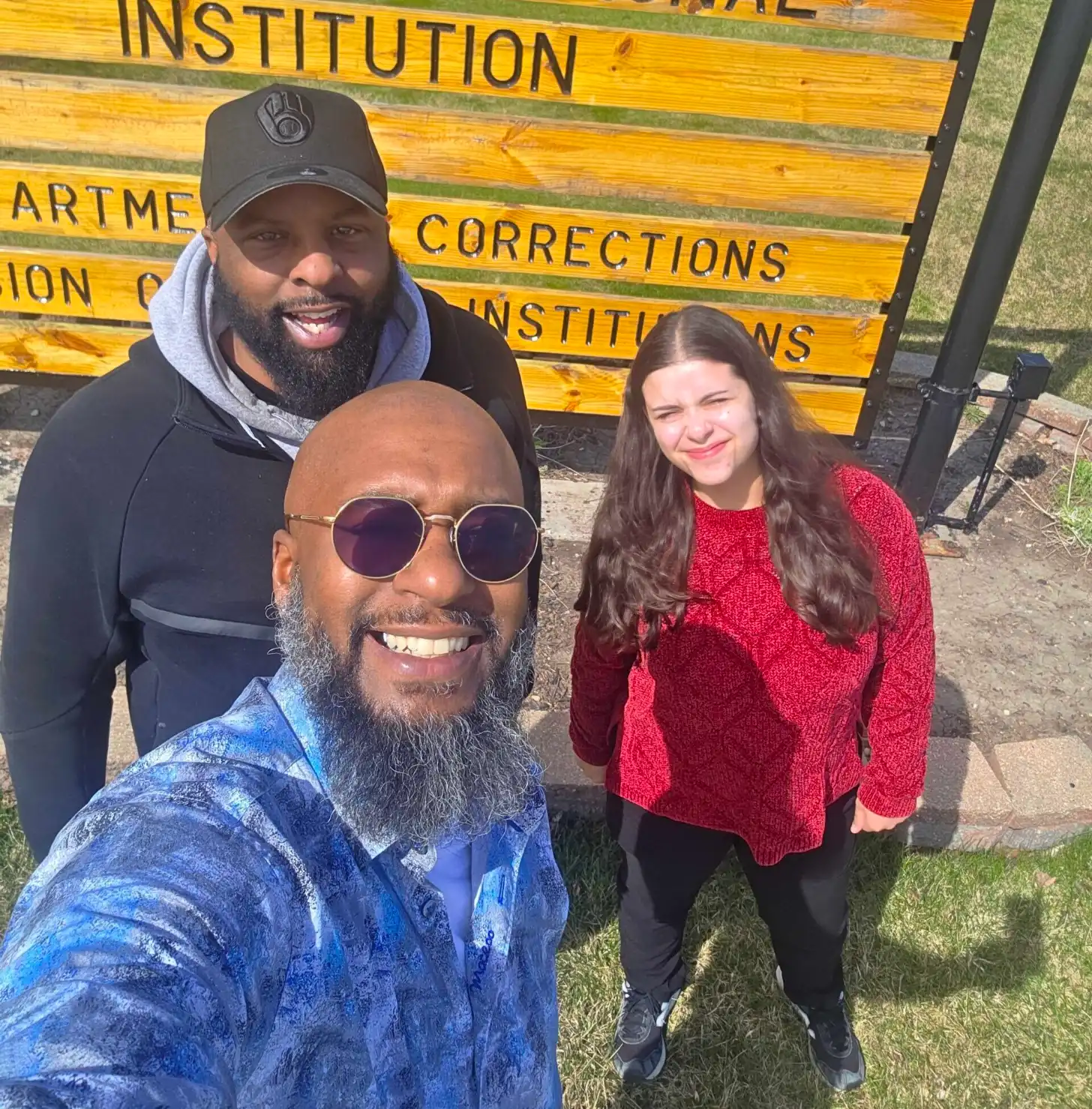
Frank Davis and Aaron Hicks, creators of ECHO: Every Choice Holds an Opportunity, contend that very little programming for people in prison is led by people of color or by those who have been incarcerated themselves.
Both Davis and Hicks have been to prison, served their time, and are now reaching out to work with others who are still incarcerated and/or have been recently released.
Davis and Hicks say they see a recognition that they have something to offer from men who have spent years behind bars and are struggling to make the best of a situation they don’t want to be in.
Voices of Power is the organization Davis and Hicks created to offer their services. They are also founding members of EXPO (Ex-incarcerated People Organizing).
The two were asked to consult with Marquette University and the University of Wisconsin-Madison and to meet with staff at the Racine Correctional Institution: the warden, deputy warden, security director, a correctional officer with the rank of captain, and community members.
“Aaron and I were talking about different things we were doing out in the community, and how we feel that change, or we have seen how change happens,” said Davis, “and it happens when people who are impacted by the system come back to create programming for people in the system.”
At that initial meeting, the men were asked by Warden Robert Miller and Education Director Dan Durler to create programming to decrease the population in solitary confinement, also known as restrictive housing.
“There’s just certain kinds of messages you need the right messenger,” said Darren Wheelock, a professor at Marquette University and director of the prison education program, “and it doesn’t matter how many times someone like me may talk about, you know, the importance of having a reentry plan – ‘start thinking about how what you do affects your future chances’. I can say that until I’m blue in the face, but It’s not going to resonate in the same way that someone who spent years incarcerated, who spent a number of years of that time in the restricted housing unit. They bring all that lived experience with them.”
Wheelock was talking about the ECHO pilot program Davis and Hicks offered last spring at Racine Correctional, which he said amounted to much more than the content on accountability and being proactive.
“The goal of ECHO is to create a space where participants can discover their own strength, connect through shared experiences, and start building a path forward,” the ECHO curriculum states. “It’s about recognizing how many will define and limit them – and choosing instead to define themselves on their own terms.”
Davis said he and Hicks created a curriculum based on their years of experience of working in reentry and recovery.
After seeing the program, Warden Miller asked that in addition to those in restrictive housing, another session be offered for those in the general population who had just recently left restrictive housing
Marquette University funded the pilot project that ran from February to April.
“The guys loved it,” said Davis. “The warden loved how it impacted the guys and how they interacted with staff. The staff inside was able to see changes in guys in just the short nine weeks that we were working with.”
Those who participated in ECHO had to volunteer.
“Normally, what happens is when individuals are offered groups inside, there’s a little apprehension when it comes because it’s like okay, this is another group that’s created by DOC or somebody that doesn’t really understand us, and now suddenly we got to go in here, we got to act like we like it or act like we’re learning something, and there’s really no connection,” said Davis. “When we went up there in the listening session, it was an opportunity for them to see us and they wanted to hear that we’ve been impacted by the system. And once they heard that, their whole demeanor changed. They start listening. They start leaning in.”
After the first listening session, where participants asked questions, the second session addressed the history of incarceration in the United States; an open discussion followed about challenges, especially solitary confinement, along with a conversation about how those challenges do not define the people who endure them.
The third session focused on identity and how people in prison perceive themselves.
“All of the men have been labeled through the system, you know, as a convict, offender, all of those different things,” said Hicks, “and so we pose a question that’s a little bit different, and that question is, ‘who do you say that you are?’ Giving them the space and place to be able to define themselves, and how do you walk in that? And even if you don’t know who you are, we can also just talk about who you don’t want to be.”
There’s a session on mental health and what incarcerated people can do to take care of their mental and emotional lives, what healthy relationships look like, including the one they have with themselves and how they talk about themselves.
Hicks said many reoffend and go back to prison because of unhealthy relationships that should be avoided.
“Once we get out of prison, the first thing we want to do is jump right into a relationship,” said Hicks. “So we talk about toxic relationships, and from that we build. We start talking about healthy relationships. We pose questions to them about what a healthy relationship looks like. We start to dissect it, talk about it.”
The ECHO curriculum asks the men to consider whether they are fostering healthy or unhealthy relationships in prison, even before they step outside into freedom.
Then there is dialogue on post-release employability and housing. The program focuses on real-life skills, work and creating a resume, preparing for job interviews, and understanding workplace culture.
Davis said a lot of people getting out want to live with someone they know, but some of those people may be unhealthy, and Davis and Hicks challenge participants to not connect housing with toxic people.
One of the last sessions is on vision, legacy, and personal accountability. Questions explored, said Davis, include: What is your vision, what is your legacy, what is your plan, and how are you going to implement the plan?
The participants go through a graduation ceremony and receive a certificate of completion and are encouraged to practice what they learned in prison and start creating a healthy community in prison and make decisions that reflect their goals.
Davis said participants will be challenged and there may be justification for their outrage, for how the justice system may have meted out punishment disproportionate to their offenses. But that has to be tempered by the longer-term goal of getting out and creating the life they desire, keeping the long game in mind.
“This is really about two men on a journey to really pay it forward and to open up eyes the way our eyes were opened,” said Hicks.
Some of the men who participated in the program at RCI offered their feedback.
“They came at a time where I was going through a rough patch,” said Davonta Ballard. “They opened my eyes to living and making decisions; every decision you make should be beneficial to you, your goals, and your growth. It came from two individuals who’ve been in my shoes so it meant much more and they were a good example to how you can do your time and come back and be better for the world, your family, and community.”
James Allen has been in and out of incarceration since 2006 and is just months away from release. He said the program made a big difference in his life.
“It was somewhat the way the guys can relate because they have been incarcerated,” said Allen. “They just didn’t talk, but also asked questions. They were different and straightforward.“
He said the session helped him think about the direction he wanted for his life and what he could do to make a difference.
“The thing that stuck with me the most is the question of what did I care about the most,” he said. “I care most about my family.”
He added, “It was the only class I wanted to take to be a better person in life.”
David Greeno said what he learned the most is to pay attention to what he was thinking.
“I’m mostly controlling my bad ways of thinking and I am working on starting my own business when I get released from here in 11 months,” he said. “I am mostly grateful that I took the program. I am very appreciative of what Frank and Aaron are doing by coming into prison and teaching the younger generation.”
Kemondray Johnson said that because both Davis and Hicks had been incarcerated Black men, it gave him comfort with “opening up and being real.”
“They gave me pointers on how to be a survivor, survivor of the criminal system,” said Johnson. “Coming where I come from, there aren’t many positive Black role models and sadly most men have to get incarcerated to learn to be a better man. Those two men are role models to me. They are people I look up to and look forward to meeting outside of these walls.”
He added, “Those guys are free Black men and make time to come here and help us and stepping into an environment they swore to never come to again! I commend them and have the utmost respect for them.”
Davis said during the sessions there was a new guard in one of the wings who reportedly was disrespectful to one of the participants, and another participant reminded the man being yelled at that, “Man, you better know your identity,” and both of the men laughed and walked away from the guard.
Warden Miller chose not to be interviewed for this article, but he did describe the pilot ECHO offering as an “awesome program we have worked hard on collaboratively.”
Wheelock said he heard glowing reports from the participants himself.
“That trial run is what has everyone really excited,” he said. “That worked way better than we had imagined. We had students that they worked with that gave glowing feedback. A number of them then transitioned from the restricted housing unit. Right, they wanted to then kind of expand their educational opportunities and start taking classes. So it was all these downstream really positive benefits from having guys that have lived experience go back inside and help guys.”
The goal now for Davis and Hicks is to provide a year of ECHO programming at RCI over five, nine-week sessions. They are looking at raising $75,000 to fund the programming. The DOC may find the funds in its budget, but the men are also holding an online fundraiser, which started Sept. 1 and will end Nov. 12.
“This campaign is about more than sustaining a program,” the fundraising page states. “It is about closing the gap between what people inside need and what is often available to them. Many people are expected to heal, change, and prepare for reentry without consistent support. ECHO is working to change that.”
To learn more or donate, visit ECHO: Bridging the Gap.
This article was originally published by the Wisconsin Examiner.
Featured Image: Courtesy of Frank Davis