Every day the Good Good Good team collects the best good news in the world and shares it with our community. Here are the highlights for this week!
If you want to get good news in your inbox every day, join the Goodnewsletter — the free daily newsletter designed to leave you feeling hopeful.
The Best Positive News We’re Celebrating This Week —
The UK is planting half a million trees in the next three years
In late September, the United Kingdom’s Secretary of State for Environment, Angela Eagle, pledged that half a million trees will be planted in the next three years as part of efforts to protect against extreme weather.
As part of the new initiative, mayors, local officials, charities, and community groups will receive funding and newfound authority to restore natural landscapes, including wetlands, riverbanks, and meadows.
Craig Bennett, the chief executive of The Wildlife Trusts, said, “We need to make Britain wet again. … We could have tens of thousands of new wetlands.”
Why is this good news? Wetlands, riverbanks, and meadows reduce flooding by acting as a natural barrier to heavy rainfall, snowfall, snowmelt, and storm runoff. By acting as natural sponges, the natural flora and fauna hold onto absorbed water and slowly feed it back into streams and rivers days or weeks later.
Meet the first bear to ever receive a prosthetic paw: ‘We do whatever it takes to help’
Under President Lula’s administration, 20K square kilometers of Amazon have been protected from deforestation
A new analysis found that, under the leadership of Brazilian President Luiz Inácio Lula da Silva, at least 20,000 square kilometers of deforestation have been prevented in the Amazon.
That’s an area the size of New Jersey, and is especially notable coming from the country that is home to 60% of the Amazon rainforest.
It is also a reversal from Lula’s predecessor, whose administration oversaw a surge in deforestation as a result of anti-environmental policies.
In Maine, about 11,000 acres of ancestral homeland were returned to a Native tribe
In the first phase of what will be one of the largest land returns between a U.S. nonprofit and tribal nation, about 11,000 acres of ancestral homeland was just returned to the Penobscot Nation.
In total, the tribe will eventually be given back around 30,000 acres south of the Katahdin Woods and Waters National Monument. The rest of the land will be returned after another $12 million is raised.
When the swath of land initially came up for sale, it was purchased from timber harvesters by the Trust for Public Land, which is now working to raise enough money to return it to the tribe.
Why is this good news? For too long, Indigenous wisdom has been overlooked in land conservation. Not only does this land hold cultural significance to the tribe, but now it will be able to directly steward how it is conserved and used into the future.
National Geographic dropped a camera underwater for an hour. They accidentally captured a first-of-its-kind animal sighting
→ Read more
An Arizona middle schooler spent her summer break delivering 30,000 diapers to families in need
A middle school student in Arizona spent her summer collecting nearly 30,000 diapers to donate to Nourish Phoenix, which helps families with food, clothing, job assistance, and more.
The nonprofit said diapers are their most requested item — and 12-year-old Sloan’s donation was one of the largest they’d ever received.
Even more impressively, Sloan has been volunteering with Nourish Phoenix since she was seven years old — and in her first diaper drive five years ago, she collected around 7,000 diapers.
A new program is helping incarcerated firefighters in California transition into jobs with Cal Fire
California Gov. Gavin Newsom just signed a bill to give formerly incarcerated firefighters in the state credentials that match the requirements for entry-level jobs at Cal Fire.
The bill standardizes the credentials they receive upon release from prison, and gives them priority for certain positions. The career pathway provides a critical opportunity for a six-figure income, state pension, and meaningful, essential work.
Prior to this bill being signed into law, the paperwork was reportedly more cumbersome and less official for accessing job opportunities.
Why is this good news? After leaving prison, incarcerated people in general often struggle to find work, a contributing factor to recidivism. Incarcerated firefighters get real, quality, on-the-job experience that can and should easily translate to a viable career upon release, without being needlessly prohibitive. This bill helps clear the way.
→ Read more
Cards Against Humanity is donating free games to public libraries to fight ‘brainrot and AI slop’
→ Read more
The number of people living in extreme poverty has declined dramatically over the last 200 years
Sometimes the very best progress in the world happens slowly and steadily. That’s the case for people living in extreme poverty. Just 200 years ago, more than 80% of the world lived in extreme poverty — today, it’s under 9%.
As late as 1820, nearly 84% of people in the world lived in extreme poverty. In 1981, it was still 42% — it took 160 years for extreme poverty rates to fall by half. Since, it’s dramatically sped up, with the latest assessment putting the figure at 8.6%, and it continues to decline.
While that still represents millions of people around the world, it’s proof that progress is not only possible; we can continually, exponentially improve.
→ Read more
A Chicago woman transformed her yard into an oasis for migrating monarch butterflies
Claudia Galeno-Sánchez has spent the past two years transforming her Chicago home into a sanctuary and educational space for monarch butterflies.
With native milkweed and wildflowers in her back and front yards, Galeno-Sánchez, her husband, and her two children spend the fall admiring the monarchs that visit as they make a nearly 3,000-mile migration journey to Mexico until late October.
An immigrant herself, she’s found a kinship with the migratory butterflies and has even expanded her efforts throughout her community to nearby schools — she now has eight native plant projects and distributes milkweed plants to a community garden.
Why is this good news? Over the past 20 years, monarch butterflies have been severely declining due to habitat loss from deforestation, extreme weather from the climate crisis, and pesticides harming the plants critical to their survival. Along with regulatory protections, grassroots efforts like this have helped make a huge difference for their survival.
1,000 people buried their underwear across Switzerland. The unusual study helped researchers gauge soil health
Gas cars fell below 50% of new car sales globally for the first time
In the first half of 2026, gasoline-only vehicles made up 49% of global new-vehicle sales, down from 73% in 2021 — marking the first time on record they’ve fallen below half of sales. In a single year, gas-only car sales fell from 52% to 49% globally.
More hybrid-electric vehicles are still being sold than battery-electric vehicles — though the latter showed faster growth. BEVs grew 12%, making up 17% of new car sales, while hybrids grew 10%, representing 18% of sales.
China leads the way, but even in the U.S., where gas cars still dominate, hybrid sales volume was up 23%, reaching a record 16.3% of new car sales.
→ Read more
One year in, New York City’s congestion pricing policy has led to cleaner air
New York City implemented its congestion pricing structure, the first in the country, in parts of Manhattan in January 2025, and now, the latest data shows that fine particulate matter, or PM2.5, one year later, was 13% lower.
That estimate tracks with the around 11% drop in the number of vehicles entering the congestion pricing zone, providing a clear connection between reduced vehicle activity and air quality improvements.
The researchers also factored in weather and seasonal impacts on air quality to get to an even more accurate estimate of the benefits of the zone on air quality.
Why is this good news? People deserve to breathe clean air. Fossil fuel-powered cars still make up the vast majority of vehicles on roads in the U.S. and — beyond their contributions to the climate crisis — have a devastating impact on local air quality. Congestion pricing is one policy that can improve air quality — and human health.
→ Read more
Experts say the national decline in homicide is largely tied to three things
→ Read more
The first-ever ‘Global Girls’ Index’ found health outcomes have improved for girls in 178 countries since 2000
The first-ever Weltmädchenindex, or Global Girls’ Index, found that health outcomes improved for girls in 178 of the 192 countries examined between 2000 and 2023.
The index compared health outcomes for more than 971 million girls and teens between 5 and 19 years old, examining five key categories, including mortality rates and birth rates.
One of the most significant findings was that mortality among girls more than halved. Additionally, birth rates among those between the ages of 10 and 19 fell by around one-third. More progress needs to be made, though, as 290 million girls still live in countries with low or very low scores on the index.
More good news of the week —
The Spix’s macaw rebounded in the wild for the first time in two decades after conservationists released captive-bred birds into Brazil. The striking blue bird was believed to have disappeared from the wild in 2000, but the Spix’s macaws are flying in the natural habitat once more.
Researchers at William Marsh Rice University developed a new material that destroys “forever chemicals” 100 times faster than average waste facilities. In their new study, scientists found that layered double hydroxide material works more effectively than traditional filtration systems.
Savannah, Georgia turned 160,000 cubic yards of mud into a rare bird habitat. Shorebird populations have experienced shrinking habitats due to sea levels, storm surge, and coastal erosion.
A Michigan man is creating prosthetic legs from repurposed bike parts and giving away the revolutionary design plans for free. Hogan recently trained people in Ghana to build the prosthetics and is sharing free instructions online so others can make them locally.
A skateboarder completed a 3,000-mile journey across America for charity. Chad Caruso completed the journey to raise funds for Natural High, which helps young people pursue their passions and avoid drugs and alcohol.
Detroit is building a stronger pipeline of teachers equipped to support a rising number of students with autism. Through a partnership with Michigan State University, teachers can pursue a fully online master’s degree in special education with an autism spectrum disorder endorsement while receiving tuition support from the school district.
Located in Germany, the world’s tallest wind turbine just reached its full height. Winds at higher altitudes are stronger and more consistent, giving the turbine more opportunities to generate electricity, and it could produce approximately twice as much energy as a conventional turbine.
Over half a million voters registered on National Voter Registration Day. It was National Voter Registration Day’s second-most-successful midterm effort since the group began its annual nationwide registration drive in 2012 to encourage turnout.
A southeast London initiative is giving free land to people who will use it to build social housing. It’s the most radical suite of solutions to the housing crisis any local authority is currently putting forward, and could lead to nationwide change.
A study found that a conditional cash transfer program in Brazil drove the most formal job creation. Recipients of Bolsa Família, the federal government’s cash-transfer program, accounted for 85% of the net gain in formal jobs in the labor market between January 2023 and July 2026.
A technology that allows a shared rooftop solar system to be split among several apartments won a top design award in Australia. SolShare works like a “traffic controller for solar” and took home the 2026 Australian Good Design award for sustainability.
Game 3 and 4 of the WNBA Finals were moved to a much larger arena in Atlanta to accommodate more fans. The location of the Atlanta Dream home games had been up in the air because the team wanted to play at State Farm Arena, but initially faced scheduling conflicts with Atlanta’s NBA team and a concert.
After three years of research, replanting, and growth monitoring, the Samish Indian Nation has successfully restored bull kelp beds in the San Juan Islands. Bull kelp has long been used by coastal tribes in Washington as food, tools, and toys, among other creative practices.
A father and mother in Texas were able to hold their premature twins skin-to-skin using breakthrough technology known as the “Skincubator.” The wearable device allows critically fragile newborns to experience skin-to-skin contact while remaining connected to essential medical equipment.
Michelle Obama pledged more than $1 million to organizations that support girls around the world. In honor of International Day of the Girl, her Girls Opportunity Alliance announced that it will support 25 different organizations in 15 countries.
A record number of Native Americans are running in the 2026 midterm elections. (Gifted link) At least 355 Native American and Indigenous candidates ran or are running in local, state, and federal primary and general elections this year.
A Maryland family turned a 116-acre hunting farm into a protected wildlife haven. Over the course of two decades, they planted thousands of trees, including river birches, tulip poplars, sycamores, white oaks, loblolly pines, black walnuts, and pawpaws, alongside grasses, shrubs, and wildflowers.
Robots are cleaning the dust off solar panels, saving billions of gallons of water. Where the sun is the strongest, the desert, the dust is also at its worst, and annual energy losses from panels covered in dust, called soiling, range from about 7% in parts of the United States to as much as 50% in the Middle East.
The NAACP recruited more than 50,000 volunteers to help protect voters’ rights during the midterms. The effort is part of NAACP’s aggressive Election Protection program taking place across the country, with concentrated operations in 16 priority states.
Researchers shared that gene therapy can partly restore sight in blind people. Optogenetic therapy is based on Nobel Prize-winning science and involves turning nerve cells on and off using light.
Climate activists launched floating gardens in a British harbor, creating “a wildlife corridor in a city.” Beyond bringing green space to an urban center, the floating gardens create wildlife habitats, absorb floodwaters, and cool down the city amid record-high temperatures.
China has connected its first 1-gigawatt clean energy project that combines solar panels with solar thermal. The project is expected to generate an average of 2.2 billion kWh of electricity annually, save about 690,000 tonnes of standard coal, and reduce carbon dioxide emissions by approximately 2.07 million tonnes a year.
Two veterans with prosthetic legs summited a mountain in a tribute to Ukrainian soldiers. The two veterans each lost a lower leg while defending Ukraine and summited Mera Peak in Nepal, reaching an altitude of 6,476 meters.
A 15-month operation removed nearly 40,000 tonnes of illegally dumped waste from an ancient woodland in the UK. Recognised as a “site of special scientific interest,” the protected area provides a habitat for rare plants and wildlife, but organised criminals targeted the site in 2023, piling garbage up to 15 feet high.
Nintendo confirmed it has no plans to abandon physical games for its Switch 2 consoles. That stance is in stark contrast to Sony, which announced it would stop making physical games for its PlayStation console starting in January 2028.
Amsterdam’s ARTIS Zoo was founded in 1838 — making it the oldest zoo in the Netherlands and one of the five oldest zoos in the world.
When it first opened, it had just a few monkeys, an otter, and a “Surinamese forest cat.” Today, the 35-acre zoo is home to over 6,000 species, many of which are endangered. Its menagerie of animals includes Asian elephants, reticulated giraffes, red pandas, and southern ground hornbills.
The hornbills are large, turkey-sized birds native to sub-Saharan Africa. Male southern ground hornbills have black plumage, red faces, a fleshy wattle, and a long, curved beak roughly 19 to 22 centimeters long.
Recently, the veterinary team at ARTIS had an unusual case on their hands: A southern male hornbill had broken both the upper and lower parts of its beak. The severe injury had left him with two misshapen “stumps.”
“He managed reasonably well with them, but he could no longer do everything a hornbill naturally does,” ARTIS veterinarian Martine van Zijll Langhout said in a press release.
Like all birds, hornbills need their beaks to pick up food, preen their plumage, and tend to their young.
“Especially with a young bird that can still live to a very old age, we felt it was important to see if we could improve its quality of life,” van Zijll Langhout explained.

“We could have chosen to do nothing. But together with the Faculty of Veterinary Medicine at Utrecht University, we saw an opportunity to repair his beak with two 3D-printed prostheses.”
There are several famous cases of birds being fitted with prosthetic beaks.
In 2019, Max, a 20-year-old blue-and-gold macaw living at South Africa’s Hyacinth Haven Bird Sanctuary, lost his entire upper beak in a territorial fight.
Two years later, after two 3D scans and a CT scan, Max the macaw received a custom 3D-printed titanium beak in a groundbreaking procedure never performed in South Africa before.

Then, in late 2025, a green aracari bird named Beauregard at the Birmingham Zoo in Alabama damaged his upper mandible when he was just three months old.
Within months, experts from the University of Alabama at Birmingham School of Dentistry created a custom mold for Beauregard that mirrored his specific beak pattern and color.

“There are known cases where birds have been fitted with a prosthesis for either their upper or lower beak,” van Zijll Langhout said. “However, as far as we have been able to find in the scientific literature, it has never before been possible to replace both parts in a bird in this way.”
“That makes this treatment special,” she continued. “Not only because it is technically complex, but primarily because we may have found a new way to improve the well-being of birds.”
If the prosthetic wasn’t shaped perfectly, the southern ground hornbill could reject it. To ensure their measurements were as precise as possible, the veterinarians did CT scans of his head, the remaining stumps, and the broken beak parts at Utrecht University’s Faculty of Veterinary Medicine.

“Based on this, the specialists were able to reconstruct the original shape and design two prostheses,” van Zijll Langhout said. “The beak parts were printed from plastic and attached using titanium components and screws.”
In the end, the custom prosthetic was “virtually identical” in shape to his original beak.
“That is important, because ultimately it is not just about what the beak looks like, but above all about what he can do with it,” she said.

Fortunately, just hours after his operation, the bird was already using his new beak and “smiling.”
“Of course, he had to get used to the shape and the extra weight, but he actually looked comfortable right away,” van Zijll Langhout said. “The next morning, he was already picking up a mouse from the ground again. That same day, he ate independently with his new beak.”
“That was an incredibly important moment for us,” she continued. “He understood that he could use his beak and began to discover for himself what was possible with it … the more often he uses his beak, the more skillful he will become with it.”
The next measure of success? If their hornbill patient will father chicks with his mate — and continue safeguarding the future of their vulnerable species.

“We hope that the pair will have offspring in the future,” van Zijll Langhout said. “A well-functioning beak can also be important for mutual interaction and for caring for the young.”
“The hope is that the prostheses will also function well in the long term — but the first results give reason for optimism,” she said. “[It’s] a remarkable medical development, with one goal at the forefront: To give a bird the opportunity to be itself as much as possible again.”
You may also like: Meet the first bear to ever receive a prosthetic paw: 'We do whatever it takes to help'
Featured Image: ARTIS/Facebook
Policy matters because policy affects people in very real ways. Civil engagement, activism, and voting all play a role in helping policy better serve people. Here are five good news stories about new policy changes around the world:
1. The House of Representatives voted to federally decriminalize marijuana. The bill, which will almost definitely not be approved by the Senate, would also mandate a reassessment of prior marijuana convictions, invest in services for people caught up in the war on drugs, and open Small Business Administration funding for legitimate cannabis-related businesses. Despite the likelihood that we won’t see this bill become law, it paves the way for the future.
2. A local government in Japan will become the first city in the country to introduce a partnership system that treats the children of same-sex couples as family. While not legally binding at the national level, the new system will allow same-sex couples in the city to change their relationships from “roommates” to “relatives” in their residence certificates, recognizing them and their children as equivalent to a family.
3. The Bhutan parliament decriminalized homosexuality. (Yes, there are still places where homosexuality is against the law.) The new legislation, pending the king’s approval, will be a human rights victory in the country.
4. On his first day in office, the newly sworn-in Los Angeles County district attorney eliminated cash bail for many offenses and resentenced death row inmates to life in prison. He announced that county prosecutors will no longer seek cash bail for any misdemeanor or non-violent, non-serious felony offenses. Read more about how cash bail disproportionately affects Black and Latinx people here.
5. A new law in the Netherlands automatically gives equal parenting rights to unmarried couples. Previously, a co-parenting partner would have no legal status if, for example, the mother dies. Now unmarried couples have the same legal rights as married couples.
All of these stories are reminders that government matters. Your activism, advocacy, and civil engagement matter — not just during big political elections, but the smaller ones, too, and in the ways we show up every day in our communities to make them better.
It’s the most wonderful time of year! And with it comes the season of giving. If you are looking for the perfect gift for the perfect someone, we suggest shopping some of our hand-curated and giftable picks so you can give well and do good.
You’re sure to find something for everyone — from your parents to your partner to your friends, including gifts for the foodie, the fashionista, the reader, the work-from-homer (so, everyone, right?), the kiddo, and more.
And remember this giving season: By shopping from small businesses and do-good companies, you have the opportunity to make a difference.
Welcome to Good Good Good’s 2020 Gifts That Do Good Guide.
We’ve curated Good Good Good’s best recommendations for the following themes:
Warm & Cozy Gifts
Food & Drink Gifts
BIPOC Owned Gifts
Jewelry & Fashion Gifts
Home Goods Gifts
Books Gifts
Stocking Stuffers
Kids Gifts
And More…
All of the products and brands featured in this gift guide are independently selected by the Good Good Good team. Some of the links in this gift guide are affiliate links — which means that when you click them, we may earn a commission — which supports our ability to continue sharing good news. Thank you!
P.S. We linked to Amazon for some of these for convenience and accessibility — but please consider Amazon alternatives as you do your shopping.
Warm & Cozy Gifts:
These loungers from Allbirds come in a variety of colors and have a flexible sole, so you can technically wear them inside OR outside — no one will notice you’re wearing slippers out and about! | $95
→ Shop Allbirds
This rechargeable lighter from The USB Lighter Company gives you up to 300 uses on a single charge from your USB port, and it’s completely butane-free. It’s slim, elegant, and fits almost anywhere. You'll never need to throw away an empty lighter again. | $32
→ Shop The USB Lighter Company on Food52
Depending on your needs, you may also want to check out our list of the best electric lighters.
Thistle Farms is a nonprofit social enterprise that helps women survivors recover and heal from prostitution, trafficking, and addiction by providing a safe place to live, a meaningful job, and lifelong support. Their Three Trees candle smells of spruce, cedar, and fir balsam with a hint of lavender. | $32
→ Shop Thistle Farms
Check out our other recommendations for top eco-friendly candles
Anyone else living in their pajamas 24/7? If we’re speaking to you, then this lyocell waffle bathrobe is just what you need. It’s made sustainably from organic bamboo and is luxuriously soft. You’ll want to cancel your plans and stay in! | $80
→ Shop Ettitude
Food & Drink Gifts:
Give the gift of learning a new skill by ordering a food subscription box for your loved ones. Purple Carrot is a plant-based meal company — choose from meal kits to cook at home, or buy pre-made meals for on-the-go! | $9.99 per serving
→ Shop Purple Carrot
Use the code GGG30 for $30 off your first box
The Tria serving board from Newly comes in a unique triangle shape and is made from 100 percent repurposed hardwood. It’s perfect for cheese, crackers, and charcuterie. You can even use it as a trivet, which would pair well with the next gift on our list. | $38
→ Shop Newly
We love the Our Place Always Pan because it’s ethically and sustainably made and is a stylish addition to any kitchen. It’s available in six colors and comes with a steamer basket, colander, and spatula, too. | $145
→ Shop Our Place
Currently only $95 — while supplies last
For the coffee lover in your life, Atlas Coffee Club offers a Coffee of the Month Club. You can purchase a subscription just once, and your recipient will get a new kind of coffee from around the world on their doorstep every month. | $14
→ Shop Atlas Coffee Club
Use the code GOOD10 for $10 off
Don't Forget: Buy Gift Cards to Local Restaurants & Businesses
It's always important to support small businesses — but this year they need our support more than ever. They're going to be depending on high year-end spending to help them survive until COVID and the recession are over. If they don't get the funds they need, many businesses will likely be forced to close.
Consider giving gift cards to local restaurants and small business in your (or your recipient's) community. Many businesses now offer physical or digital gift cards on their websites.
Think of this as an opportunity to vote with your dollar. Vote for the businesses you want to stay in business in 2021 — and treat your loved ones to delicious food or local treasures while you do it.
BIPOC Owned Businesses to Shop:
Many people are choosing to shop this year from companies owned by BIPOC — Black, Indigenous, and people of color.
Why? Well, it’s a way to make our world more equitable. By shopping from these businesses, we have the chance to redistribute wealth and move it into the hands of people who historically haven’t had a fair share of the pot.
Think of your support as a way to “spend” your privilege. Your dollar is your vote — and we believe in voting for a world full of more justice and equality. Plus, all of these products are great.
OUI the People is a beauty company you’ll be proud to have on your shelf. We love their calming bath soak — and the fact that they use reusable, refillable, and recyclable packaging. | $28
→ Shop OUI the People
The greeting cards from paper goods company CheerNotes are beautifully designed and of the highest quality. The founder created the company after feeling left out of the greeting card aisle. Now, the company is here to celebrate diversity in representation. Our favorite is this Blessed Angels card. | $6.50
→ Shop CheerNotes
Diverse and nontoxic with shades for every body: Range Beauty supports, uplifts, and includes all people of all genders to be confident in their skin. We love their foundation, available in 21 shades. Plus, it’s cruelty-free and vegan. | $21
→ Shop Range Beauty
Rayo & Honey makes “goods with positive intent.” This “Joy Is An Act of Resistance” tote is both functional and an hopeful message to share with all you see. FYI: It’s listed on Oprah’s Favorite Things list this year! | $65
→ Shop Rayo & Honey
You might have seen these spices on Instagram — and for good reason! Diaspora Co. exists to build a more equitable spice trade that champions Indian farmers leading the way on sustainable agriculture. Their Trio Spice Pack is perfect as a gift and allows you to build your own creative combo of their iconic spices. | $54
→ Shop Diaspora Co.
Each stunning piece by Middle Kingdom is thoughtfully handmade by artisans in China. This 5-inch-tall vase is made of Chinese clay porcelain and comes in five pastel colors. (It comes in other shapes, too!) | $21
→ Shop Middle Kingdom
Jewelry & Fashion Gifts:
Dear Survivor creates stunning jewelry from upcycled materials. Better yet, a portion of every sale goes to supporting survivors of human trafficking. We love these bold leopard print earrings. | $48
→ Shop Dear Survivor
Hands-free and chic? You have our attention. This stylish leather purse from ABLE works as both a belt bag and a crossbody bag — all you have to do is convert the strap. We love ABLE for their radical wage transparency, combatting sweatshops, and sustainability initiatives. | $128
→ Shop ABLE
Work from home uniform or workout attire? No one has to know. Girlfriend Collective’s high-rise leggings are made from recycled water bottles, they’re recyclable, and — this is huge — they have POCKETS! | $68
→ Shop Girlfriend Collective
You can’t go wrong with sunglasses that give back. The tortoise Kaia sunglasses from DIFF Eyewear are scratch-resistant, go with everything, and better yet, for every pair sold, DIFF helps to provide the gift of sight to someone in need through eye exams, surgeries, glasses, and medicine. | $89
→ Shop DIFF Eyewear
From Our Partner: Nisolo
Nisolo is the maker of intentionally designed, ethically made, and fairly priced shoes and accessories. They're a B Corporation and Climate Neutral Certified brand committed to living wages, supporting garment workers, and reversing climate change.
This year, Nisolo recommends the Dari Boot in black, the Amalia All Weather Boot in brandy, and the Lori Tote in rosewood and bone.
→ Shop this weekend to take advantage of their holiday discounts
Home Goods to Gift:
Perfect for the hostess or homebody, these geometric granite candle holders are guaranteed to please even the pickiest recipient. They’re from Parachute, a company that sends life-saving malaria-prevention bed nets to those in need through a partnership with the United Nation’s Nothing But Nets campaign. | $68
→ Shop Parachute
Currently on-sale!
This hand-woven basket from Ten Thousand Villages is the perfect way to hide clutter without compromising on style. It’s made with Fair Trade practices by artisans in Bangladesh. | $60
→ Shop Ten Thousand Villages
How can a pillow be both neutral AND fun? This handwoven patterned throw pillow from Novica was made in Peru on a traditional artisan loom. Novica supports local artisans all around the world. | $68
→ Shop Novica
No, thank you, water rings. These beaded coasters by Kazi are made with glass beads and natural fibers by artisans in Rwanda. They’re equal parts beautiful and functional. | $98
→ Shop Kazi
From Our Partner: Made Trade
Ethical and sustainable online store, Made Trade, is offering you the choice to give or get this year for their Black Friday Fund! Now through November 30th, you can either get 10% off your order, or donate 10% of your entire purchase to provide meals to food-insecure children, families and individuals in Portland, OR through their non-profit partner, Urban Gleaners. Each purchase on Made Trade directly supports multiple small businesses, independent makers and artisans in the U.S. and around the world.
→ Start shopping with Made Trade
Books to Gift:
“The Future Earth” by Eric Holthaus — Finally, a book that's hopeful about climate change. Climate change activist and weather journalist Eric Holthaus presents a compelling vision for reversing the short- and long-term effects of climate change and tells us just how it’s possible through radical solutions. This is the book for anyone who feels overwhelmed by the current state of our environment and hopes to play a part in creating a better future.
→ Shop on Bookshop
“While the Earth Sleeps We Travel” by Ahmed M. Badr — The debut book from social entrepreneur, speaker, and former Iraqi refugee Ahmed M. Badr is a diverse and moving collection of poetry, personal narratives, and art from refugee youth around the world. The book centers on the perspective of those navigating the complexities of displacement and came together through Badr’s storytelling workshops with displaced youth.
→ Shop on Bookshop
“Our Time Is Now: Power, Purpose, and the Fight for a Fair America” by Stacey Abrams — This New York Times bestseller is a blueprint for ending voter suppression, empowering citizens, and protecting civic engagement and fair voting. If you’re interested in integrity in elections and politics, this book is for you.
→ Shop on Bookshop
“There I Am: The Journey from Hopelessness to Healing” by Ruthie Lindsey — Ruthie Lindsey’s memoir tells the story of defying medical odds, living with chronic pain, facing heartbreak, and finding joy, redemption, and healing. It’s a raw and moving account of Lindsey’s resilience in cultivating optimism and hopefulness.
→ Shop on Bookshop
Explore more of our good book recommendations.
Pro-tip: Get Two Audiobooks For the Price of One From Libro.fm & Support Local Bookstores.
Libro.fm is an Amazon-free alternative to Audible, making it possible to buy your favorite audiobooks and simultaneously support your local bookstore. It's only $15/month (the same price as Audible) and has all the same books.
You can even gift a membership to the bibliophile in your life at libro.fm/goodgoodgood.
And if you're signing up for yourself, you can get two audiobooks for the price of one with promo code GOOD.
Stocking Stuffers:
Give the gift of good in a fun and unique way with Lotto Love, a scratch-off “lottery” card that benefits someone in need. Instead of winning a monetary prize, a charitable prize is donated to causes related to literacy, clean energy, food, or solar energy. Here’s how it works: You buy a Lotto Love card as a gift for someone else, the recipient scratches off the card and discovers what they won for someone in need, and the money used to purchase the card is donated to one of the company’s charitable partners. | $8.50
→ Shop Lotto Love
From the company that made the Final Straw, the Final Spork is meant to be just that — the final spork you ever use. FinalCutlery creates reusable cutlery that reduce the need for plastics, empower people to change their buying habits, and raise awareness of the impacts of our everyday decisions on the environment. The Final Spork is foldable, portable, and can be used to eat anything you’d need a fork OR spoon for — and is the perfect addition to any eco-friendly kitchen. | $35
→ Shop Final
The holidays can be a stressful time for anyone, especially with the unique challenges 2020 has brought us. This stress relief essential oil roller from True Botanicals is tried and true. Its blend of Tarragon and Frankincense promote calm and have a powerful grounding effect. | $36
→ Shop True Botanicals
For the sentimental one in your life, a mini photo book from Artifact Uprising might get the happy tears flowing. This 5x5” book is easily customizable and made from recycled paper. Small book, big impact. | $15
→ Shop Artifact Uprising
From Our Partner: Tonico
Tonico is a CBD tincture using only two ingredients: organic coconut oil and organic, full-spectrum, thrice-filtered cannabis oil.
Why is it good?
Tonico is just CBD in Coconut Oil. That’s all.
Tonico believes in compassionate pricing — their CBD is far less expensive than what’s out there.
Tonico donates 12% of all profit to holistic rehabilitation for veterans and research on the medical uses of CBD
→ Learn more about CBD and shop Tonico
Use the code GOOD to save 25%
Explore more sustainable stocking stuffers
Gifts for Kids:
A Kids Book About creates books that help kids and their grownups have honest conversations about challenging, empowering, and important topics. You may have heard about their children's books about antiracism. Impressively, 10 of their books were selected this year for Oprah’s Favorite Things list. Titles include A Kids Book About Optimism, A Kids Book About Empathy, A Kids Book About Feminism, and A Kids Book About Creativity. | $20
→ Shop A Kids Book About
Save an extra $5 with the code GOODGOODGOOD
Crafts with no trash to throw away? Count us in! Green Kid Crafts creates kid subscription boxes that help kids exercise creativity, develop a love for discovery, and learn about the world around them without contributing to our world’s massive waste problem. It was founded by an environmental scientist who wanted her kids to engage in creative learning but was dismayed by the amount of waste generated by traditional crafts. Some of their best-selling sustainable subscription boxes include a volcano-making kit, slime-making kit, and a weather science box. | $30
→ Shop Green Kid Crafts
With every purchase of a Sackcloth & Ashes kids blanket, a cozy blanket made from recycled materials, you get a free copy of the book “Everyone Is Someone,” a children’s book that we are all more similar than we are different — that everyone, everywhere, is someone. For every blanket you buy, one blanket and one book are donated to a child in foster care. | $89
→ Shop Sackcloth & Ashes
Use the code GOODGOODGOOD for 30% all purchases
Tired of having plastic toys strewn all across your home? Look no further than Tegu for beautifully designed toys that inspire creativity. Their magnetic wooden toys are made for a variety of ages — and with their minimal design and muted colors, they would look great on your shelf, too. | $20
→ Shop Tegu
Shameless Plug: Give the Gift of Good News
The Goodnewspaper is the print newspaper filled with good news. This year it was highlighted by Miley Cyrus, Ben Higgins, and thousands of happy subscribers. Pick up a subscription for yourself and for all your friends.
So you want to be an environmentalist! Welcome to the party.
There’s no shortage of ways to begin, but the most important thing is that you do. Whether you’re new to the movement, are ready to take on a bigger commitment, or are a full-fledged tree hugger, check out our 10 tips to incorporate into your journey to help the Earth.
For Beginners

Turn off the tap when you’re brushing your teeth:
It’s a small action you can take that can save gallons and gallons of water over time. Reducing water diverts less water from waterways, reduces wastewater treatment, and cuts back on energy used to heat your water.
P.S. The same goes for when you're singing your ABCs while washing your hands.
Swap out paper towels for cleaning rags:
Use old rags or T-shirts to clean your home. You can throw them in with your next load of laundry and reuse them again and again. You’ll save so much paper.
Reduce your purchases:
In general, think before you buy. Consider the impact of the product on the environment: production, shipping, packaging, and more. Every time you choose not to buy something, you're helping the Earth. And you'll feel better knowing you only own what you need.
For The Experienced
Buy secondhand:
Books, clothes, furniture, you name it. You can save money and support the environment by buying used. Try ThriftBooks, OfferUp, eBay, Poshmark, or just swapping
with friends.
Compost food scraps:
Composting reduces waste that would otherwise go to a landfill and can provide a nutrient boost for your garden.
Make your own cleaning products:
Many products contain harsh chemicals, so try making your own — bonus points if the bottles are reusable. Plus, it's a surprisingly fun experience.
Ditch disposables:
Use reusable water bottles, razors, food storage, batteries, coffee cups, shopping bags, coffee filters, utensils, and other eco-friendly products. Commit to using what you already have, and then buy reusables over time.
For The Pro
Minimize driving and flying whenever possible:
In your community, commit to walking, riding a bike, or using public transportation. When traveling, plan more vacations that are driving-distance instead of flying. When you have to fly, choosing direct flights reduces C02.
Switch your home to solar energy:
It can take an investment upfront (though prices have come down a lot), but solar energy will likely save you money over the long-term, and it’s so much better for the Earth than other energy sources.
Go zero waste:
Ever seen stories about people who can fit their entire year’s waste into a jar? That gesture may be a bit bold, but it's a visual reminder that intentionality can significantly reduce the amount of waste we produce. If everyone lived this way, we’d have dramatically less waste in the world. Start reducing waste one choice at a time.
Understatement of the year: 2020 was one for the history books. In a year full of surprises, it’s easy to feel overwhelmed by the challenges 2020 brought. It’s for good reason, too: At the time of printing, COVID-19 has claimed the lives of more than 1.3 million people worldwide, shutdowns have cause financial ruin for businesses, families, and individuals, and the United States is facing what some call the most divisive political landscape we’ve had since the Civil War.
It’s been rough for so many people. And it’s OK if you haven’t loved this year. At Good Good Good, we never want to avoid the reality of the world’s greatest pains. Instead, we look for hopeful stories happening right within them. In seeking good news, we’ve been able to see that no matter how bad the world may seem, there is still reason to hope. Here’s the good we found out of 2020 →

Good News from January 2020:
Gestures of Goodwill to Support Australia’s Bushfire Crisis
It might feel like a lifetime ago, but remember the bushfires that ravaged Australia? They burned millions of acres of land, destroyed thousands of homes, displacing thousands and killing wildlife.
Australians banded together by offering accommodation, food, medicine, and funds for the heroic firefighters fighting the blaze.
Doctoral student Erin Riley founded an impromptu organization in just four days’ time. The organization, FindABed, is a database of volunteers offering a place to stay for evacuees and animals.
Riley is just one example of Australians stepping up to support one another amid the devastation of the bushfires.
A pharmacist named Raj Gupta kept his pharmacy open despite the area having no power and no cellular service — and despite the fact that his home had burned down from the fires that week.
The loss of power meant he couldn’t take payment for the medications.
“People will come back and pay,” he told the Guardian. “They are very honorable people.”
The rest of the world rallied by donating to the cause and spreading the word on social media. Celebrities and public figures appealed to their followers on Instagram, and musicians held fundraising gigs.
Good News from February 2020:
A Glimmer of Hope in Syria
The conflict in Syria has caused hundreds of thousands of deaths, internal displacement of more than 7 million people, and more than 5 million refugees.
The conflict is complex and ongoing. There’s been little, if any, progress toward peace in the country since it started. There have been peace talks several times since 2011, but there isn’t an end in sight
for the war.
One small glimmer of hope is that Syria resumed commercial flights in February this year. A Syrian Air flight took off from Damascus and landed in Aleppo, a first since 2011, when the airport in Aleppo closed because of the crisis. The flight was a symbolic win amid a war that has torn the country apart and led to a global
refugee crisis.
(Note: This story is nuanced because of all the parties who were involved to make this happen. The conflict is obviously complex, but we think it’s good news because it’s a sign of greater stability in the region.)
Good News from March 2020:
The World Stepped Up to Fight COVID-19
March marked a month when the World Health Organization declared COVID-19 a pandemic. It was also the month that the whole world stepped up to fight the virus. In many ways, this was the most uniting month of the year. People committed to staying home and social distancing, retired health care workers stepped back into their previous roles, and the world rallied around putting an end to the disease. March was a beautiful reminder that we can come together to make a difference.
— In the UK, 4,000 nurses and 500 doctors signed up within 48 hours of the National Health Service’s call for help from retired medical professionals. (The London Economic)
— The City of Detroit restored water service to homes with unpaid bills so people could wash their hands. (The Seattle Times)
— Utah prepared to keep providing meals to students who rely on getting them at school. (The Salt Lake Tribune)
— China sent a team of medical experts and gear to help Italy fight COVID-19. (The South China Morning Post)
— Soccer fans in Italy donated their ticket refunds to hospitals in need. (Bild)
— Liquor and perfume companies began making hand sanitizer in their factories. (CNN)
— A landlord in Maine paused rent for his tenants because of the COVID-19 outbreak, anticipating economic hardship. (Newsweek)
— Grocery stores introduced special shopping hours for elderly people. (NBC)
— New Orleans Pelicans player Zion Williamson pledged to cover the salary of New Orleans arena workers for 30
days. (NBC)
— In a show of unity, people in Italy leaned out their windows to sing together during the lockdown. (The Independent)
— Animal shelters cleared out as people chose to adopt and foster pets during stay-at-home orders. (NBC)
— The City of Toronto acquired hotels and rental buildings to provide shelter for people experiencing homelessness during the coronavirus outbreak. (CityNews Toronto)
Good News from April 2020:
Tiger King Animals Are Now Living in Sanctuaries
The last episode of Netflix’s Tiger King came out on April 12. For some reason, everyone watched this bizarre show about big cat breeding and the eccentric culture surrounding it.
One piece of good news you should know is that 39 tigers (plus three black bears) from Joe Exotic’s zoo are living in a Colorado animal sanctuary, the Wild Animal Sanctuary.
"We try and give them large open spaces, plenty of places to run, decide what they do throughout the day, if they want to lay in the sun, play in the water, scratch on a log," Becca Miceli, chief science and animal welfare officer at the sanctuary, told ABC.
She said many of Joe’s tigers had health problems and still have ongoing physical problems and mental trauma. She said she hopes the series will raise awareness of the exploitation of exotic animals and inspire people to protect big cats.
"Those are all living beings to us, and we want to see them flourish,” Miceli said.
Also in April, Joe Exotic was convicted for several wildlife violations. He’s currently serving a 22-year prison sentence for those charges, in addition to charges related to an alleged attempt to hire hitmen to kill Carole Baskin, the owner of Big Cat Rescue.

Good News from May 2020:
Lockdown Showed Us That Nature Can Heal
At this point in the pandemic, lockdowns in many countries had been in effect in some capacity for at least a month. While many of us began to fear that this would last forever, the environment began to thrive. While at first we were skeptical whether it would make any lasting impact, we can think of these effects as experiments in ways we can create changes that last. We can see how these actions, when done by the masses, can actually make a difference.
Firstly, carbon emissions and air pollution went down. According to reporting from the Guardian in May, lockdowns caused a 17 percent drop in global carbon emissions. It makes sense: People stayed home and businesses were closed, so everyone was using less energy.
Air pollution in large cities also dropped dramatically between March and May of this year. According to the Centre for Research on Energy and Clean Air, levels of nitrogen dioxide — a key ingredient in smog — declined by an average of 27 percent in 12 major global cities 10 days after lockdowns were initiated, compared to the same period during 2017–2019.
Additionally, some wildlife began returning to places it hadn’t been seen in some time. With beaches free of tourists, rare giant turtles called leatherbacks returned to beaches in places like Florida and Thailand. They were seen in numbers not seen in decades.
Good News from June 2020:
People Took A Stand for Racial Justice
The month after a Minneapolis police officer killed George Floyd, protests of police brutality, police racism, and lack of police accountability erupted in more than 2,000 U.S. cities and 60 countries. Violence against Black people and protests against it aren’t new, but in June the movement gained new steam and caught fire. It was clear that there was new energy and enthusiasm in these protests not seen before.
People used their voice to demand justice for Floyd and for racial justice generally — many speaking out for the first time. It made a difference.
According to the New York Times, net support (respondents who support the movement minus those who do not support it) for the Black Lives Matter movement increased in the two weeks after Floyd’s death by nearly as much as it had over the previous two years. (Sadly, others intensified in their opposition to BLM because of rioting and looting, which were largely unrelated to activist activity).
This global movement also brought about some policy changes — all of the following happened in less than a month following Floyd’s death:
Minneapolis lawmakers vowed to disband the city's police department. Mayor Bill de Blasio of New York City pledged to move funding from the city's police department toward youth and social services. Washington, DC, and states including California, Nevada, and Texas, banned chokeholds. These are just a few examples, but there are more.
To be clear: It shouldn’t take a tragedy to create change, and there are more systemic issues to tackle, but we celebrate that more people engaged this year because it moved the needle, even if just a little.
Good News from July 2020:
Sports Returned, with a Sign of Gender Equality Progress
By this point in 2020, sports started returning. MLB had their Opening Day on July 23, the NBA and WNBA both resumed in late July, and golf and soccer were already underway in many places.
Notably, Alyssa Nakken made MLB history in July as the first woman to coach on the field during a major league game. She coached first base for the San Francisco Giants during an exhibition game against the Oakland A’s.
The Giants announced her hiring as an assistant coach in January. CNN reports that she joined the organization in 2014 as an intern in the baseball operations department, where she worked on a variety of special projects related to the amateur draft, international operations, and
player development.
Nakken’s coaching on the field became big news in the baseball world. We think it’s big news everywhere because it shows progress for gender equality, and it’s even better because the response was overwhelmingly positive. Women have value to offer in every industry, and it’s about time we see that value in action.
Good News from August 2020:
New Zealand Gave Us Hope For COVID-19
In August, New Zealand announced they had gone 100 days without a new COVID-19 infection. For a country with nearly 5 million residents, this is a remarkable feat. At the same time, the country reported it had just 23 active cases, all in isolation. The country has fared far better than others, with just over 1,200 recorded cases as of August and 22 deaths.
The country has been praised for its handling of the virus and as of August had eased most of its lockdown restrictions. To thank are the country’s early lockdown restrictions, tough border restrictions, effective health messaging, and test-and-trace programs, BBC reports. What we find most compelling is the empathetic leadership style of the country’s prime minister, Jacinda Ardern. She framed combating the pandemic as the work of a unified “team of 5 million” — which resulted in high public confidence and adherence to pandemic-control measures.
What we can learn from New Zealand is that it’s possible to control the spread of coronavirus. With quick, science-based assessments, early, decisive government action, and dedicated cooperation from the public, we can fight this thing.
Of note: The country did see new cases after August, but by implementing these effective measures again, they have seen about 700 additional cases and three additional deaths since August.
Good News from September 2020:
California Made it Easier for Inmate Firefighters to go Pro After Release
In September, California governor Gavin Newsom signed into law a bill that makes it easier for formerly incarcerated volunteer firefighters to go pro. The new law will streamline the process to expunge their felony records, which clears the path to pursue careers as firefighters.
For decades, inmate firefighters have battled wildfires across the state, working alongside professional firefighters in the heat and smoke for little to no pay. Yet after being released from prison, these men and women who put their lives on the line to save lives and property often find it impossible to put their skills to use professionally because of their records.
Many activists argue that the state’s reliance on incarcerated labor is unfair — prisoners receive about $1 per hour while working active fires, compared to the average firefighter salary in California starting at $40,000 per year, according to CareerExplorer.
The new law makes it easier to earn an emergency medical technician certification, the first step in becoming a professional firefighter in most places. With their felony record eliminated, these heroes could be considered for employment like any other applicant. (Some former inmates convicted of violent offenses, including arson, kidnapping, and rape would be barred from having their records expunged.)
“After seeing all these young men and women stand side by side with our other fire crews and knowing that they had no hope of entering that profession, I knew that it was wrong and that we needed to do something about it,” Assemblymember Eloise Reyes, the bill’s author, told NBC.
Good News from October 2020:
Thousands of Nigerians Protested Against SARS
You may have seen the hashtag #EndSARS going around social media back in October. No, no one was talking about the disease. They were talking about the notoriously violent and corrupt Nigerian police unit, SARS (Special Anti-Robbery Squad).
Since the beginning of October, tens of thousands of young Nigerians have protested a long history of brutality and corruption in the agency, which has largely gone unchecked by the Nigerian government. Despite promises from the government to disband it at the demand of its citizens, it has yet to do so.
A video showing the unprovoked shooting and killing of a man by uniformed SARS officers was a catalyst for the movement's largest protests yet — and they're happening throughout
the country.
On October 12, the Nigerian president responded to the protests by announcing that he would disband SARS as a first step in “extensive police reform.” But many from his staff said officers would simply be relocated to other units. Peaceful protests continued, but on October 20, police shot into crowds of unarmed protestors. At least a dozen people were killed that evening.
This is still unfolding, but the good news is that this has turned into a global movement, which can put pressure on the government to swiftly take action. Protests have spread to cities around the world and have attracted mainstream media attention. Nigerians continue to demand total disengagement of the unit and wide-ranging police reform. Demonstrators have pledged to continue until demands are met.
Good News from November 2020:
Americans Voted in Record Numbers in This Year’s Election
More than 159 million Americans voted in this year’s presidential election — a record high in a presidential election and the highest voter turnout rate among eligible citizens since 1900. More than 100 million of these votes were cast during the early voting period.
According to the U.S. Elections Project, almost 240 million people were eligible to vote in 2020, making this election’s turnout rate about 66 percent, which is the highest voter turnout rate since 1900.
The number of ballots cast in 2020 by mail or in person before Election Day more than doubled that of earling voting in 2016. This year saw about 23 million additional votes than in 2016, too: About 136 million people voted in the 2016 presidential election, compared to about 159 million this year.
The additional turnout can partly be attributed to the expansion of absentee voting this year because of the pandemic-related safety concerns. Many states expanded mail-in and in-person early voting. Texas led early voting with at least 9.6 million votes cast before Election Day, according to NBC News.
Higher turnout rates show that the American public is more willing to engage with the country’s democratic process. And when more people participate, our government can better reflect the people it serves. That’s a win for all.
Good News from December 2020:
To a Better Future...
This issue was printed on November 20th, 2020, and sadly technology hasn’t yet made it so we can predict the future. But here’s what the Good Good Good team is manifesting for the month that will round out the roller coaster that was 2020:
In December, we see record spending on small businesses, helping support them through the end of the year. People won’t buy everything on Amazon but instead will choose to shop local (safely, through online shopping, pick-up, or in-store while following guidance).
We see people signing up to volunteer — not just during the holidays, but at regular intervals so nonprofits can depend
on consistency.
We see people taking the pandemic seriously. As the scientific and medical communities work tirelessly to learn more about the virus, the public will do their part to take care of one another by wearing masks, washing their hands, socially distancing, minimizing time outside their homes, and being kind to essential workers.
We see people making sustainable choices. People will opt to drive instead of fly, which reduces greenhouse gas emissions. People will minimize waste when wrapping gifts — or better yet, won’t wrap their gifts at all and will choose gifts with little to no packaging to throw away.
This is the world as it could be. It’s what we hope for — and it’s a world that we can make a reality through our choices. It starts with you.
It feels overwhelming to think about the weight of climate change and its impact on our lives and ecosystem. Feeling that weight is okay and normal. But it's also important that the heartbreak of what we've done to the earth doesn't overshadow the good that's being done as well.
Mister Rogers always said to "look for the helpers" because we "will always find people who are helping." This is absolutely true when it comes to the environment.
Here are 14 good news stories about the environment and the fight against climate change to celebrate this week. All of these stories are from The Sustainability Edition of the Goodnewspaper. You can also find more good news stories about the environment from Good Good Good on our site.

Paris is Turning Champs-Élysées into a Massive Garden:
The Mayor of Paris, Anne Hidalgo, has given the green light to transform the iconic Parisian avenue Champs-Élysées into a green space.
A committee has been campaigning to redesign the avenue since 2018.
“It’s often called the world’s most beautiful avenue, but those of us who work here every day are not at all sure about that,” the committee president, Jean-Noël Reinhardt, said in 2019. “To French people it’s looking worn out.”
The plans include reducing space for vehicles by half, turning roads into pedestrian and green areas, and creating tunnels of trees to improve air quality. Of its 3,000 vehicles that pass each hour, most are just passing through, causing pollution and traffic, according
to the Guardian.
What’s now the face of pollution, cars, tourism, and consumerism, makeover architect Philippe Chiambaretta told the Guardian, needs to be redeveloped to be “ecological, desirable, and inclusive.”
A “Great Green Wall” is Containing Desertification in Africa:
Development banks have pledged more than $14 billion to continue building a "Great Green Wall" across the entire width of Africa to help contain desertification in a northern region of the continent.
French President Emmanuel Macron announced the pledge at an international biodiversity summit in Paris in January, adding that the pledges had exceeded the initial target of $10 billion.
Desertification is moving out of the Sahara into neighboring areas, driving some people into poverty or forcing them to migrate.
Once completed, the “Great Green Wall” will be a 5,000-mile stretch of green space of trees and grassland across the entire continent — from the Atlantic to the
Red Sea. Construction is already 15 percent underway.
"That's 100 million hectares restored, 10 million jobs created, 250 million tonnes of carbon captured," Macron said at the biodiversity summit.
The project promises to bring life back to Africa’s degraded landscapes and provide food security, jobs, and a reason to stay for the millions of people who live along its path.
COVID-19 Led to the Largest Drop in U.S. Emissions Since World War II:
Last year, U.S. greenhouse gas emissions fell 10.3 percent, the largest drop in emissions since World War II, according to a new report from the Rhodium Group. The massive drop is because of declines in the transportation and power industries following the spread of COVID-19.
The drop means that the United States outperformed its pledge made under the Copenhagen Accord to reduce greenhouse gas emissions 17 percent below 2005 levels by 2020. Emissions actually dropped by 21.5 percent.
“With coronavirus vaccines now in distribution, we expect economic activity to pick up again in 2021, but without meaningful structural changes in the carbon intensity of the U.S. economy, emissions will likely rise again as well,” the report by the research group said.
While we know emissions will rise again once pandemic restrictions ease, we can think of these effects as experiments in ways we can create changes that last. We can see 2020 as a sign that change is possible. Actions in reducing our environmental impact, when done by the masses, can actually make a difference.
Saudi Arabia is Building a High-Tech Zero-Carbon City of the Future:
Saudi officials announced they’re building a zero-carbon city where 1 million residents will live among nature — with no cars, no streets, and no carbon emissions.
Construction for the brand-new city, called The Line, starts early this year along the Red Sea coast. Construction will preserve 95 percent of nature in the region where it’s being built.
The city will have three layers: The surface layer is for pedestrians, where residents will have access to all their daily needs within a five-minute walking radius. The second layer is underground and exists for infrastructure. The lowest layer, also underground, contains ultra-high speed transit, which will connect residents with other communities.
“It is a new era of civilization, a new model for a city which is clean, proper, and with zero carbon,” Saudi economist Mazen Al-Sudairi told Arab News. “This will improve the efficiency of humankind.”
The innovative venture offers inspiration to think outside the box and push the limits of what’s been possible in city planning. The green, technology-driven infrastructure plan offers a new vision for the future.
This Sustainable Alternative to Leather is Made Out of Cactus:
A duo based in Mexico discovered how to create leather out of cactus — and it offers a unique, sustainable, plant-based vegan alternative to leather, an industry that produces significant waste, including environmentally toxic chemicals, pollutants, and heavy metals.
According to a 2019 study in “Energy from Toxic Organic Waste for Heat and Power Generation,” one metric ton of raw leather material yields only 20 percent as finished leather product and more than 60 percent as solid and liquid waste including the highly carcinogenic heavy metal “chromium.”
After years of researching ways to reduce environmental impact, Adrián López Velarde and Marte Cázarez launched their luxury creation, called Desserto, in 2019 in Milan. Their creations are partially biodegradable and are useful for clothing and accessories, furniture, packaging, and even vehicle interiors. The “leather” can be made in a variety of thicknesses, colors,
and textures.
The material is made of the Nopal cactus, which is better-known as the prickly pear cactus. Only mature leaves are cut from the plant — without damaging the plant itself so it grows new leaves every six to eight months. The cactus also requires very little water and absorbs far more carbon dioxide than it generates, making the plant a practical and sustainable choice.
Most Europeans Plan to Fly Less Often and Eat Less Meat for the Climate:
According to a new survey from the European Investment Bank, a majority of European citizens intend to fly less and already eat less meat to help fight climate change.
Of 27,700 survey respondents in the EU’s 27 countries, 74 percent said they intended to fly less frequently for environmental reasons — even once COVID-19 restrictions are lifted. 71 percent of respondents said they plan to choose trains over planes for short-haul trips.
In the poll, conducted in fall 2020, 66 percent of Europeans said they already eat less meat to fight climate change, and another 13 percent said they plan to do so soon.
These small changes — when done en masse — really do add up, and we need all the help we can get as we approach a point of no return in the climate crisis.
“Citizens feel the impacts of climate change, and they want the climate crisis to be addressed with unprecedented action,” EIB vice president Ambroise Fayolle told Reuters.
He said the EIB — the EU’s lending arm — could help people adopt environmentally-friendly habits by financing clean energy and low-carbon transport.
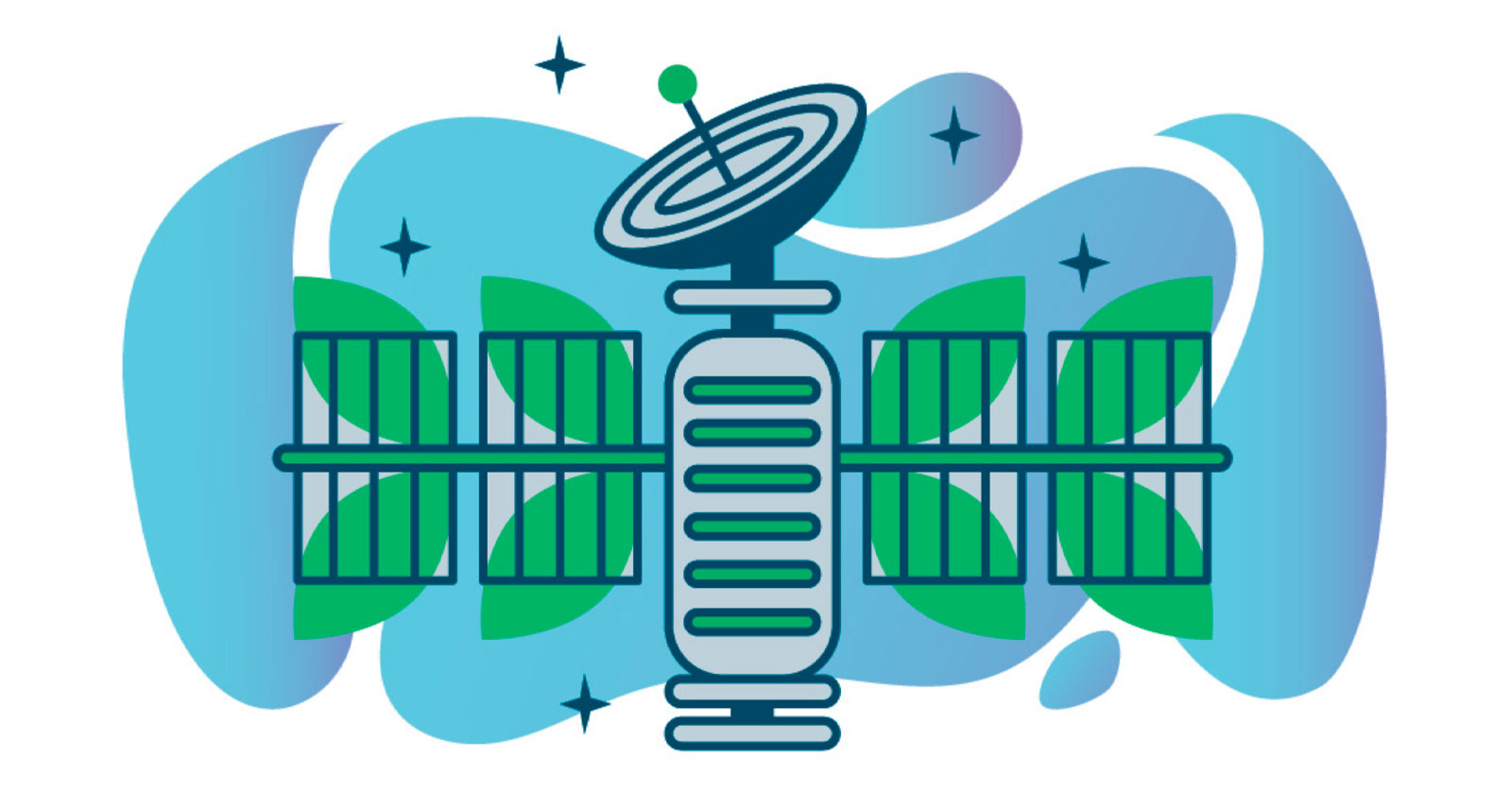
Satellites are Partly to Thank for Reducing Deforestation in Several African Countries:
In just two years, deforestation dropped by 18 percent in several African countries where organizations subscribed to warnings from a new service using satellites to detect decreases in forest cover.
The Global Land Analysis and Discovery system is available on the free and interactive interface Global Forest Watch. GLAD was launched in 2016 and provides frequent, high-resolution alerts when it detects a drop in forest cover.
Governments and others interested in halting deforestation can subscribe to the alerts and then intervene to limit forest loss.
Researchers set out to understand whether these kinds of alerts could achieve their goal of reducing forest loss, which has global climate implications. According to the research team at the University of Wisconsin-Madison, land-use changes like deforestation account for 6 to 17 percent of global carbon emissions, and preventing deforestation is several times more effective at reducing carbon emissions than regrowing forests.
“Now that we know subscribers of alerts can have an effect on deforestation, there’s potential ways in which our work can improve the training they receive and support their efforts,” lead researcher Fanny Moffette told UW-Madison News.
These Women in the Climate Movement Will Give You Hope:
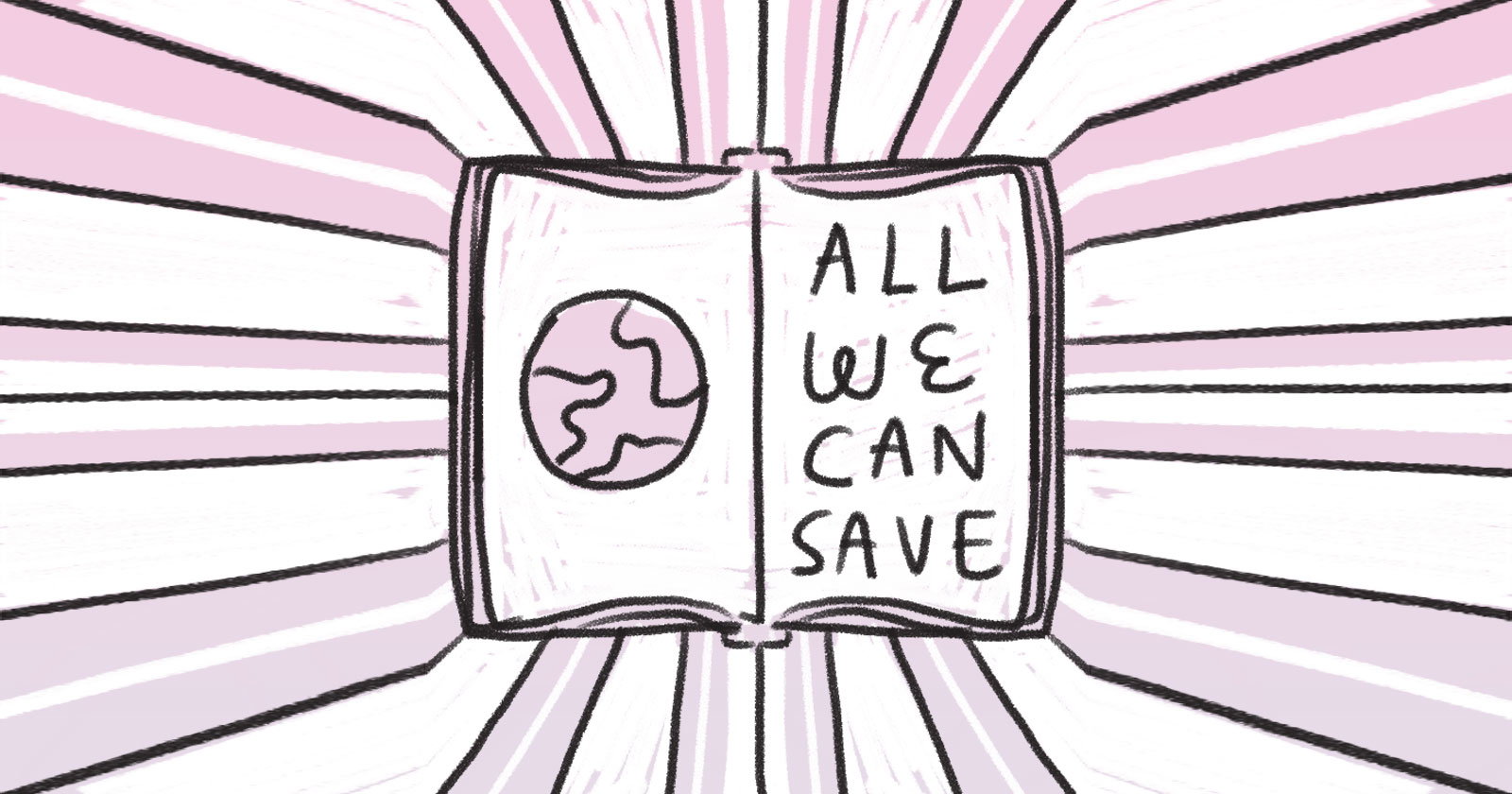
A new book by prominent women in the environmental movement will give you hope for a better future. The book “All We Can Save” is a collection of essays and poetry featuring nearly 60 women representing a range of perspectives, including women involved in climate change activism, science, and policy.
The book focuses on adding a feminine and feminist voice to the climate movement and reminds us that while climate change is a matter of business, policy, technology, and science, it’s also about building empathy and remembering that it’s our connectedness that makes the world worth saving.
The book’s title comes from a line by the late poet Adrienne Rich: “My heart is moved by all I cannot save” — a reminder that our hearts can also be moved by all we can save.
The book’s editors, marine biologist, policy expert, and conservationist Ayana Elizabeth Johnson and writer and climate change activist Katharine Wilkinson, have extended their book into a newsletter so they can include a wider breadth of voices.
For the First Time in 130 Years, U.S. Renewable Energy Consumption Surpassed Coal:
A new report from the U.S. Energy Information Administration reveals that in 2019 U.S. annual energy consumption from renewable sources exceeded coal consumption for the first time since before 1885.
This finding is explained by a continuing decline in coal paired with growth in renewables, mostly wind and solar energy. Compared with 2018, 2019 coal consumption in the United States decreased nearly 15 percent. It was decreased for the sixth-consecutive year, and renewable energy grew for the fourth-consecutive year.
Coal’s dominance rose in the 1800s as fuel for steam-powered vessels and trains, plus steel production, before powering the electric industry. Although coal was once commonly used in the industrial, transportation, residential, and commercial sectors, 90 percent of it is now used by the electric power sector, with most of the remainder used by the industrial sector.
Today, wind and hydroelectric power dominate every energy sector, representing 56 percent of commercially delivered renewable energy for the electric power sector in the United States.
Solar Power is Changing Lives in Remote Villages:
For remote villages in Laos, reliable access to electricity is a monumental milestone. The fact that it’s renewable is just a bonus.
The villages of Ko Bong and Tha Phai Bai are sites for a major hydropower project that feeds renewable electricity to the national grid. But the communities are too remote to be connected to the grid themselves and haven’t been able to benefit from it. They’ve had to resort to diesel generators, which can be expensive, polluting, unreliable, and don’t provide enough electricity for everyone.
But now a community-run solar installation called a mini-grid offers the communities clean, reliable, affordable electricity apart from the main grid.
“Now, the darkness at night will disappear from our villages,” Seng Sommala, Ko Bong village chief, told the United Nations Development Programme.
Now the communities have the ability to turn on lights at night — children will be able to do schoolwork after dark, plus health centers will have access to reliable electricity, improving health care and saving lives. Life-threatening power cuts used to occur during operations, while giving birth, or tending to newborns. And now vaccines and medications that need to be refrigerated can stay cold.
“Light is not only light,” Teung, the chief of Thai Phai Bai village, told UNDP. “It is life, and a better life for us here.”
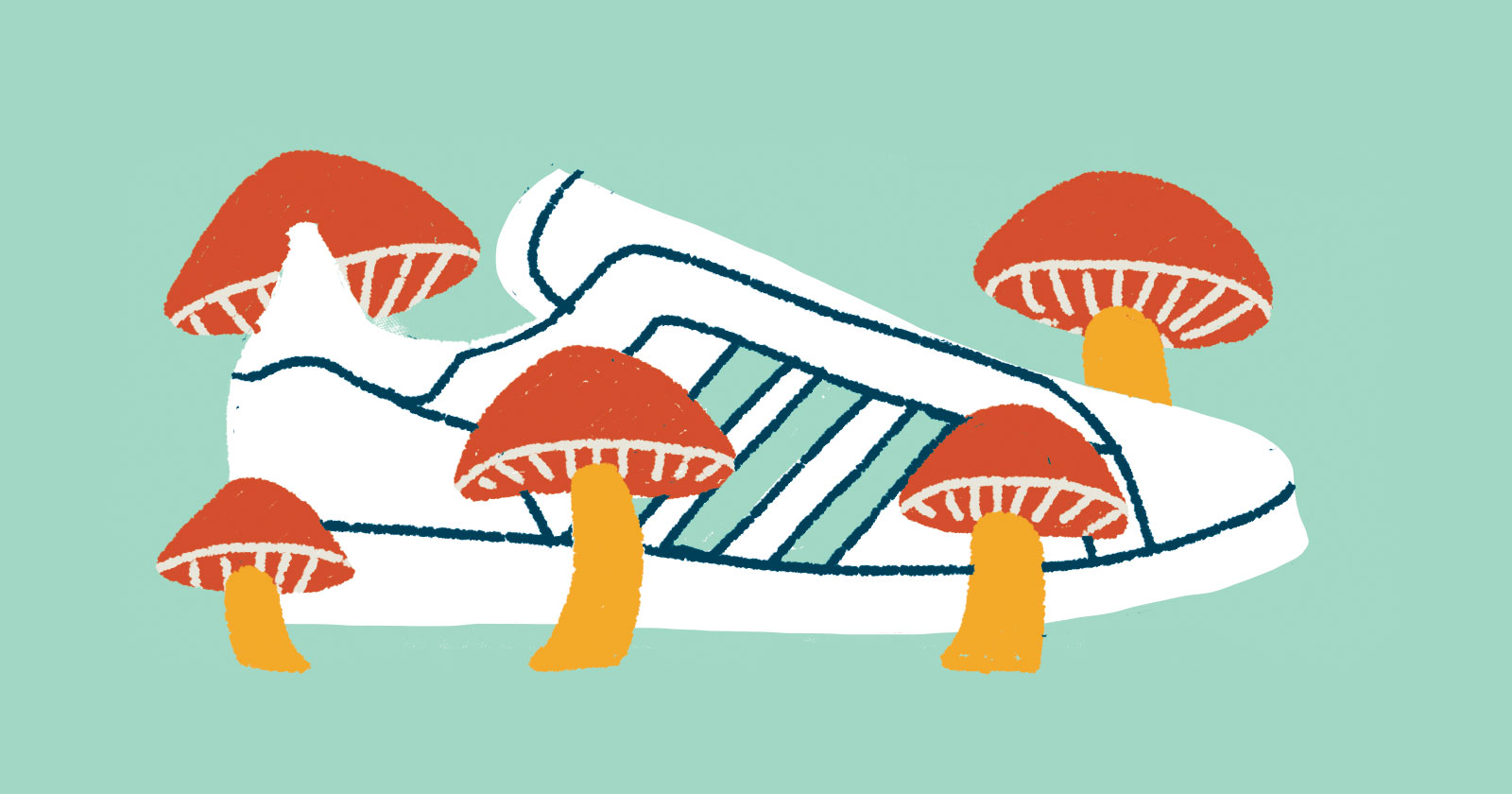
Adidas is Launching Shoes Made Out Of Mushrooms:
Adidas just announced they’re making shoes out of mushroom “leather.” The material will join the brand’s line of animal-free versions of its iconic shoes, launched as part of the company’s
sustainability initiative.
“Adidas is developing a new material, a purely biological leather alternative made from mycelium, and will use it for the very first time in the creation of footwear,” the company announced.
Sustainable leather alternatives are only getting more and more popular, with celebrities such as Natalie Portman and John Legend investing. Stella McCartney, Lululemon, and other massive brands have also partnered with Bolt Threads, the company making the mushroom leather.
Adidas is also ramping up its use of recycled ocean plastic in place of environmentally damaging materials. Last year, the company produced 15 million pairs of shoes made from recycled plastic waste and aims to increase that number to 17 million in 2021. The company also aims for 60 percent of its product line to use recycled polyester and is currently developing recycled cotton.
A Startup is Turning Carbon into Gravel:
A startup in California is capturing carbon dioxide from factories and converting the greenhouse gas into gravel and other building materials.
The startup, Blue Planet Systems, is collaborating with Chevron, Chevron said in a statement in January. Blue Planet specializes in manufacturing and developing carbon capture technology to reduce carbon footprints.
Carbons emissions pose a threat to our planet because when carbon gets into the atmosphere, it damages the environment and contributes to global warming. Carbon capture is one of the most promising strategies for reducing the amount of carbon that gets into the atmosphere. So turning carbon into gravel is useful in two ways — reducing carbon emissions and creating building supplies.
It’s encouraging to see something positive coming from Chevron, a company that has grossly contributed to the climate crisis. According to the 2017 Carbon Majors Report, Chevron is one of 100 companies responsible for more than 70 percent of the world’s greenhouse gas emissions since 1988.
While Chevron’s damage can’t be undone, massive corporations have to get on board with changes before we can begin to see significant healing on our planet. We’re eager to see more corporations support and fund innovative efforts like this one from Blue Planet.
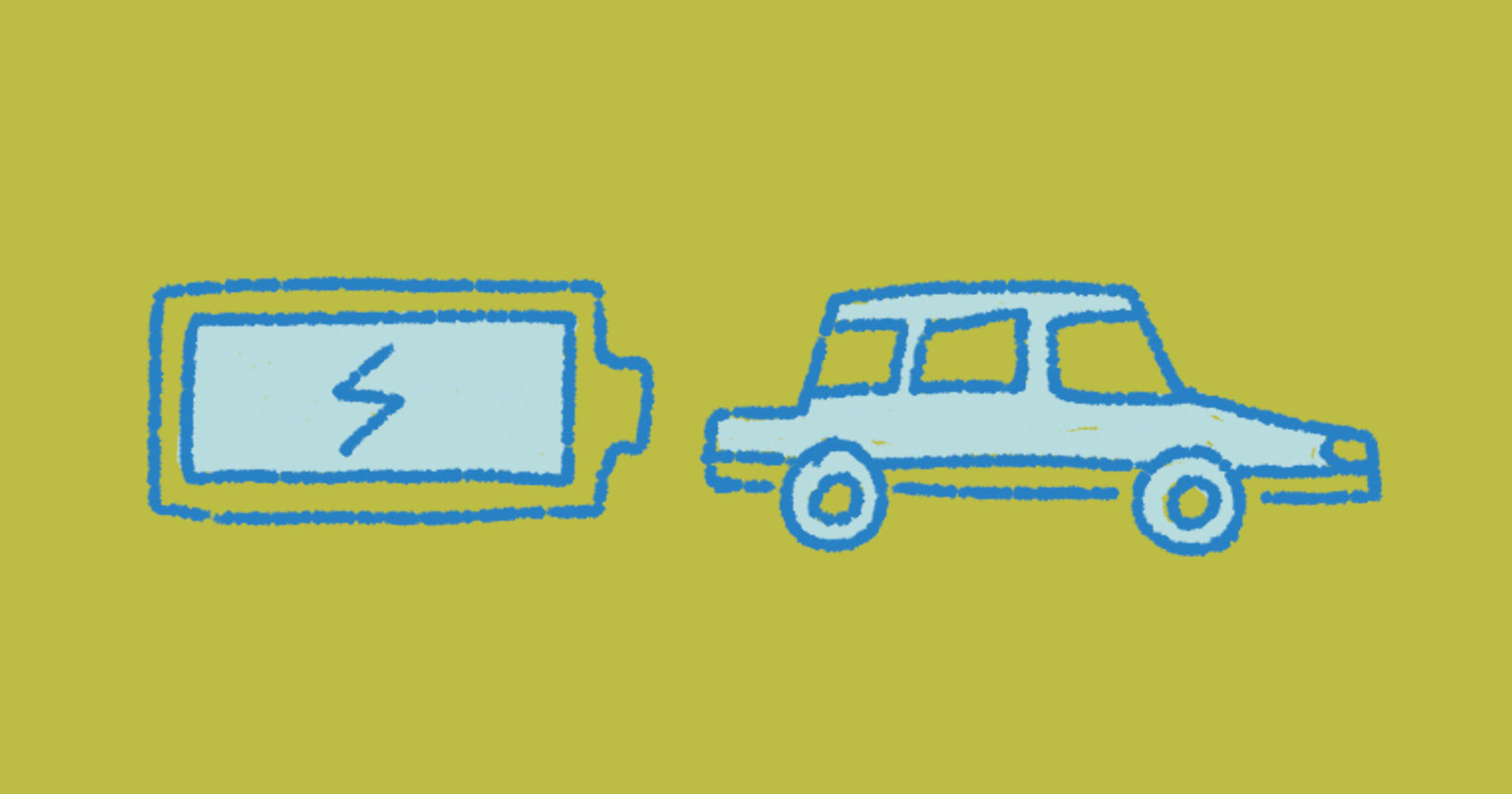
Norway Became the First Country to Sell More Electric Cars Than Gas-Powered Cars:
According to figures published by the Norwegian Road Federation last month, battery electric vehicles made up 54.3 percent of new car sales in Norway last year, making the country the first to have sold more electric cars than gas, hybrid, and diesel engines in a year.
The Norwegian government plans to ban the sale of gas and diesel cars by 2025 and is offering tax breaks and financial incentives to encourage the purchasing of more sustainable vehicles.
In 2011, cars with diesel-only engines took up 75.7 percent of the Norweigen vehicle market but fell to 8.6 percent
in 2020.
“We’re definitely on track to reach the 2025 target,” Øyvind Thorsen, the chief executive of the Norwegian Road Federation, told the Independent.
If the trend continues — which it likely will — then Norway should reach their goal.
“Our preliminary forecast is for electric cars to surpass 65 percent of the market in 2021,” Christina Bu, who heads the Norwegian EV Association, told the Independent. “If we manage that, the goal of selling only zero-emission cars in 2025 will be within reach.”
A business owner who was once down on his luck decided to pay it forward.
Last year, Michael Esmond paid the utility bills for 36 households in his Gulf Breeze, Florida community. This year he turned it up a notch because of Hurricane Sally and the pandemic.
"This year to me probably is more meaningful that last year with the pandemic and all the people out of work having to stay home," Esmond said. "We've had a good year, and that's why I want to share what I have with the people who need it.”
Esmond owns a pool and spa supply business that has done well this year, but he knows what it’s like to not be able to pay the bills. In the 1980s, his utilities were shut off and he struggled to raise his three daughters.
He paid more than $7,600 to pay past-due bills for 114 households, according to the city’s utility billing supervisor. Residents will receive a holiday card notifying them that their bills were paid.
"I can relate to people suffering and not being able to pay bills," Esmond said. "That's probably one of the biggest motivators for me, because I've been there. People can't afford to pay their bills and put food on the table, so I hope doing my part and paying some bills for these folks takes a little bit of stress off of them around Christmas time.”
In an essay for the New York Times, acclaimed professor, award-winning author, and director of the Antiracist Research & Policy Center, Dr. Ibram X. Kendi dove into the topic of how to combat racism:
“No one becomes “not racist,” despite a tendency by Americans to identify themselves that way.
We can only strive to be “anti-racist” on a daily basis, to continually rededicate ourselves to the lifelong task of overcoming our country’s racist heritage.”
“No one becomes “not racist,” despite a tendency by Americans to identify themselves that way. We can only strive to be “anti-racist” on a daily basis, to continually rededicate ourselves to the lifelong task of overcoming our country’s racist heritage.
We learn early the racist notion that white people have more because they are more; that people of color have less because they are less. I had internalized this worldview by my high school graduation, seeing myself and my race as less than other people and blaming other blacks for racial inequities.
To build a nation of equal opportunity for everyone, we need to dismantle this spurious legacy of our common upbringing.”
In order to do this, we have to educate ourselves. We can learn about covert white supremacy, follow organizations leading the way for racial equity and justice, watch films, listen to podcasts, and read books.
This doesn’t need to be seen as a chore, but can instead be seen as an opportunity — an opportunity to better understand ourselves, love our neighbors, and become the change we wish to see.
This list was adapted from the Anti-racism Resources for White People Google Doc compiled by Sarah Sophie Flicker & Alyssa Klein. Because the document was being shared by so many people so quickly, the link to the document from our viral post kept breaking. For those having problems accessing the document, we’ve pasted here.
Any resource additions made based on community feedback are indicated with a *. We’ve linked to Amazon for maximum accessibility, but if you’re able, please support local (Black-owned) bookshops by using Bookshop.org. Some links are affiliate links — 100% of commissions from this page during the month of June will be donated directly to organizations doing important work for racial justice and equality. (Here are the receipts) Leave a comment on Instagram if you have more recommendations.
Antiracism articles to read:
- “America’s Racial Contract Is Killing Us” by Adam Serwer | Atlantic (May 8, 2020)
- Ella Baker and the Black Freedom Movement (Mentoring a New Generation of Activists)
- ”My Life as an Undocumented Immigrant” by Jose Antonio Vargas | NYT Mag (June 22, 2011)
- The 1619 Project (all the articles) | The New York Times Magazine
- The Combahee River Collective Statement
- “The Intersectionality Wars” by Jane Coaston | Vox (May 28, 2019)
- Tips for Creating Effective White Caucus Groups developed by Craig Elliott PhD
- “Where do I donate? Why is the uprising violent? Should I go protest?” by Courtney Martin (June 1, 2020)
- ”White Privilege: Unpacking the Invisible Knapsack” by Knapsack Peggy McIntosh
- “Who Gets to Be Afraid in America?” by Dr. Ibram X. Kendi | Atlantic (May 12, 2020)
Anti-racist podcasts for learning about racial justice & equality:
- 1619 (New York Times)
- About Race
- Code Switch (NPR)
- Intersectionality Matters! hosted by Kimberlé Crenshaw
- Momentum: A Race Forward Podcast
- Pod For The Cause from The Leadership Conference on Civil & Human Rights
- Pod Save the People (Crooked Media)
- Seeing White
Best anti-racist books to read to learn about antiracism:
1. Anti-racist books for beginners:
- Me and White Supremacy by Layla F. Saad (Bookshop.org)
- How To Be An Antiracist by Dr. Ibram X. Kendi (Bookshop.org)
- I Know Why the Caged Bird Sings by Maya Angelou (Bookshop.org)
- Just Mercy by Bryan Stevenson (Bookshop.org)
- So You Want to Talk About Race by Ijeoma Oluo (Bookshop.org)
- The New Jim Crow: Mass Incarceration in the Age of Colorblindness by Michelle Alexander (Bookshop.org)
- White Fragility: Why It's So Hard for White People to Talk About Racism by Robin DiAngelo, PhD (Bookshop.org)
- I'm Still Here: Black Dignity in a World Made for Whiteness by Austin Channing Brown* (Bookshop.org)
- Why Are All the Black Kids Sitting Together in the Cafeteria?: And Other Conversations About Race by Beverly Daniel Tatum, PhD* (Bookshop.org)
- The Hate U Give by Angie Thomas* (Bookshop.org)
- A Kids Book About Racism*
- Call Us What We Carry by Amanda Gorman (Bookshop.org)
2. Next level anti-racist books
- Black Feminist Thought by Patricia Hill Collins (Bookshop.org)
- Eloquent Rage: A Black Feminist Discovers Her Superpower by Dr. Brittney Cooper (Bookshop.org)
- Heavy: An American Memoir by Kiese Laymon (Bookshop.org)
- Raising Our Hands by Jenna Arnold (Bookshop.org)
- Redefining Realness by Janet Mock (Bookshop.org)
- Sister Outsider by Audre Lorde (Bookshop.org)
- The Bluest Eye by Toni Morrison (Bookshop.org)
- The Fire Next Time by James Baldwin (Bookshop.org)
- The Next American Revolution: Sustainable Activism for the Twenty-First Century by Grace Lee Boggs (Bookshop.org)
- The Warmth of Other Suns by Isabel Wilkerson (Bookshop.org)
- Their Eyes Were Watching God by Zora Neale Hurston (Bookshop.org)
- This Bridge Called My Back: Writings by Radical Women of Color by Cherríe Moraga (Bookshop.org)
- When Affirmative Action Was White: An Untold History of Racial Inequality in Twentieth-Century America by Ira Katznelson (Bookshop.org)
Resources for white parents to raise antiracist children:
Books for Teaching Kids Antiracism:
- Coretta Scott King Book Award Winners: books for children and young adults
- @booksfordiversity on Instagram*
- A Kids Book About Racism*
- Stamped (For Kids): Racism, Antiracism, and You by Ibram X. Kendi and Jason Reynolds* (Bookshop.org)
Anti-racist Podcasts for Parents to Learn About Antiracism:
- Parenting Forward podcast episode ‘Five Pandemic Parenting Lessons with Cindy Wang Brandt’
- Fare of the Free Child podcast
- Integrated Schools podcast episode “Raising White Kids with Jennifer Harvey”
Articles for Parents to Learn About Antiracism
- PBS’s Teaching Your Child About Black History Month
- Your Kids Aren't Too Young to Talk About Race: Resource Roundup from Pretty Good
- The Conscious Kid: follow them on Instagram and consider signing up for their Patreon
Best films & TV series about the history of racial justice and equality:
- 13th (Ava DuVernay)
- American Son (Kenny Leon)
- Dear White People (Justin Simien)
- See You Yesterday (Stefon Bristol)
- Selma (Ava DuVernay)
- When They See Us (Ava DuVernay)
- Blindspotting (Carlos López Estrada)
- If Beale Street Could Talk (Barry Jenkins)
- The Hate U Give (George Tillman Jr.)
- King In The Wilderness
- True Justice: Bryan Stevenson’s Fight for Equality
- Black Power Mixtape: 1967-1975
- The Black Panthers: Vanguard of the Revolution
- Just Mercy (Destin Daniel Cretton)
- I Am Not Your Negro (James Baldwin doc)
- Fruitvale Station (Ryan Coogler)
- Clemency (Chinonye Chukwu)
Racial justice organizations to follow on social media & donate to:
- Antiracism Center: Twitter
- Audre Lorde Project: Twitter | Instagram | Facebook
- Black Women’s Blueprint: Twitter | Instagram | Facebook
- Color Of Change: Twitter | Instagram | Facebook
- Colorlines: Twitter | Instagram | Facebook
- The Conscious Kid: Twitter | Instagram | Facebook
- Equal Justice Initiative (EJI): Twitter | Instagram | Facebook
- Families Belong Together: Twitter | Instagram | Facebook
- The Leadership Conference on Civil & Human Rights: Twitter | Instagram | Facebook
- MPowerChange: Twitter | Instagram | Facebook
- Muslim ARC*: Twitter | Instagram | Facebook
- NAACP: Twitter | Instagram | Facebook
- National Domestic Workers Alliance: Twitter | Instagram | Facebook
- RAICES: Twitter | Instagram | Facebook
- Showing Up for Racial Justice (SURJ): Twitter | Instagram | Facebook
- SisterSong: Twitter | Instagram | Facebook
- United We Dream: Twitter | Instagram | Facebook
Anti-racism videos to watch:
Watch: Black Feminism & the Movement for Black Lives: Barbara Smith, Reina Gossett, Charlene Carruthers (50:48)
Watch: "How Studying Privilege Systems Can Strengthen Compassion" | Peggy McIntosh at TEDxTimberlane Schools (18:26)
Quotes to read:
- Martin Luther King Jr quotes that go beyond “I have a dream”
- Bernice King quotes about hope, love, The Beloved Community, and MLK
- Coretta Scott King quotes about justice, the LGBTQ+ community, and her husband's legacy
- Rosa Parks quotes about activism and justice
- Bryan Stevenson quotes about justice and mercy
- The best quotes about activism
- The best quotes about justice
More antiracism resources to check out:
- 75 Things White People Can Do for Racial Justice
- Anti-Racism Project
- Jenna Arnold’s resources (books and people to follow)
- Rachel Ricketts’ anti-racism resources
- Resources for White People to Learn and Talk About Race and Racism
- Save the Tears: White Woman’s Guide by Tatiana Mac
- Showing Up For Racial Justice’s educational toolkits
- The [White] Shift on Instagram
- “Why is this happening?” — an introduction to police brutality from 100 Year Hoodie
Related Articles
— Where to Find Diverse Stock Photos — Free & Paid
— Where to Find Free Black Lives Matter Posters
— 12 Places to Find Black-Owned Businesses to Support
— How to Support Creators of Color with Aundre Larrow
— How to (Actually) Celebrate Martin Luther King Jr. Day
— What Is Intersectional Environmentalism?
— 8 Mental Health Apps & Resources Supporting Black Americans
— This Organization Equips Frontline Communities Fighting for Environmental & Racial Justice
A version of this story originally ran in The Unconventional Activism edition of the Goodnewspaper in May 2020. We're republishing it this week in light of the ongoing protests in Iran.
Firuzeh Mahmoudi’s memories of her childhood in Iran are very fond. She was born in San Francisco, but her parents moved back to their home country when she was just a toddler, and she remembers parties.
She remembers staying in a single bedroom with her mother and sister. “It was perfectly fine,” she says wistfully. “I was happy and life seemed full.”
And then her voice changes just a bit. “It was a bit hard,” she admits. “As the revolution approached.”
The Iranian Revolution changed Mahmoudi’s life, just like it changed the lives of everyone in Iran, just like it changed the fortunes of a nation.
But while many millions of people were caught up in a swirl of oppression, destruction and heartache, Mahmoudi had the opportunity, vision and courage to make a difference for her country.
It’s a difference she’s still making today, attempting to start her own revolution, fueled by activism, volunteers, and an indomitable hope for and belief in Iran.
“I have a lot of energy and stamina and persistence,” she says. “So even if things are going hard, I’ll just keep at it.”

The revolution:
A little bit of background. The Iranian Revolution took place in 1979, when the US-supported Pahlavi dynasty was overthrown by a broad coalition of revolutionaries, mostly consisting of various Islamist groups and student organizations.
Mohammad Reza Shah Pahlavi was replaced by the Grand Ayatollah Ruhollah Khomeini, and the country voted to become an Islamic Republic, reversing its recent, general trend towards pro-Western values.
The reasons for the unrest and revolution remain the subject of a lot study even today. Usually when countries like Iran have a huge, paradigm-changing revolution, it’s the result of a huge financial crisis or a humiliating defeat at war.
But at the time of the revolution, Iran was a relatively prosperous nation. The revolution caught much of the world — and even any people living in Iran itself — by surprise.
“I definitely have a distinct memory of being in our family room and there were these old box TVs that had a wooden veneer on them,” Mahmoudi says. “And I remember the Shah was on TV and he was apologizing. He was the last king of Iran. And a lot of people thought that was the beginning of the end.”
Life began to change for Mahmoudi, from one of relative peace and contentment to one of unrest even, soon, activism. Her school got shut down (“that was the best!” she laughs), but slowly, more insidious changes started to take place.
“Things little by little changed for the worse,” she remembers. “Promises were not kept. Human rights violations and civil liberties were taken away little by little.”
Mahmoudi had to start wearing a head covering or risk arrest. People who spoke out against the new regime started to disappear. A neighbor who passed out flyers was deported.
One night, in fear, Mahmoudi, her mother and some friends dumped all their political books into the full bathtub and tore them to shreds, lest the government find out what they’d been reading.
It was a dangerous situation for a young girl, but it’s also where Mahmoudi started to uncover her activist streak.
“I remember late elementary school, I went to my mom and said that I no longer wanted to go to school at the school I was at because that’s where all the affluent kids went,” she remembers.
“I wanted to go to a school where everyone was welcome. And my mom, to her credit, let me do that. I had those values all along.”
Eventually Mahmoudi’s mother was persuaded that it would be safest for her daughters to go back to the United States, where they’d been born.
So at 12 years old, Mahmoudi and her sister, crisp, blue passports in hand, boarded a plane for San Francisco. Her mother, Mahmoudi said, cried so hard she had scabs on her cheeks.
“I was like, ‘Mom, we’ll be back. We’ll just be gone for the summer,’” she recalls. “I was telling myself that story.”
To America:
High school was difficult for a young Iranian immigrant who, initially, didn’t speak a lick of English. “I didn’t really feel like I fit in,” she says. “I would just read at the library during lunch so that people wouldn’t know I had no friends.”
But by the time she hit college at UC Berkeley, Mahmoudi was starting to come out of her shell. She met people, started hanging out and adjusted to her new country.
After she graduated and earned her master’s degree, she eventually got involved in environmental advocacy, working in India, the Philippines and some parts of Latin America. And she might have continued doing just that for the rest of her life, until something happened back in her home in Iran.
The Iranian uprising of 2009 was a watershed moment in many ways. It began when the Iranian government held a presidential election that was called for the conservative incumbent in a suspiciously short amount of time, which sparked vast protests in the streets of Tehran.
Just like they had 30 years before, the people of Iran demanded that their government be held accountable. The government responded with violence, arresting and even killing protesters — much of it happening on live video and being documented on a then-fledgling social media service called Twitter.
One infamous and shocking video showed a young Iranian protester named Neda Agha-Soltan getting out of her car only to be shot and killed. She died staring into the camera, her lifeless gaze frozen on screen.
“I was heartbroken,” says Mahmoudi. “And so was literally any Iranian. They were heartbroken.”
“There was one day that three to four million Iranians throughout the country protested in complete silence,” she says. “Not a word. To this day — right now — I got chills thinking about it. It was such a powerful day. And it was heartbreaking to think that all Iranians want and this is the most universal experience.
All people want is to be left alone to live their lives to their fullest potential; to be happy. And for their kids to be happy and have good lives. That’s simple, right? And it was taken away from them. It was pulled away from them.”
Mahmoudi wanted to help. She wanted to do something to support her people, but she didn’t know what to do.
“One thing I knew how to do,” she says “was organize.
Organizing:
“I literally googled ‘Iran human rights’ to figure out who to call,” Mahmoudi says. Her plan was to organize a global day of activism to raise awareness for what had happened in Iran and show support for the people being oppressed there.
She didn’t know how to do any of it but, she says, “I’m one of those people who just thinks, ‘I’ll do it. I’ll figure it out.’”
And maybe this is what separates Mahmoudi from so many other people who want to get involved but don’t know how — that little extra bit of motivation and effort that convinces her to find a way to make a difference.
“Moving to a new country and starting over on my own, I learned to be resourceful and resilient,” she says. “I think those are the shining sides of the hardship I felt through my teenage years.”
She had three weeks to get her global day of activism together, and she poured her heart and soul to it. One phone call led to another. This email got her connected to that person. And three weeks after she’d first googled “Iran human rights,” 110 cities participated in Mahmoudi’s day of activism.
“U2’s band organizer called me and to ask for pictures to project on the wall during ‘Sunday Bloody Sunday’ that day,” she says. “I was so mad crazy busy that when the phone rang, my friend was picking it up. My house was kind of like the campaign center for the Bay Area. We had eighteen Nobel Peace Laureates lend their voice, including Archbishop Desmond Tutu. Amnesty International was involved, many different groups were involved — Reporters Without Borders, Human Rights Watch. We became the biggest day of solidarity for the people of Iran in history. And it still is.”

Learning curve:
Mahmoudi’s success with organizing for Iran and her heart for her home country led her to transition away from environmental activism to create United for Iran, an independent nonprofit focused civil liberties in Iran.
“I was new to human rights work,” Mahmoudi says. “I’d done environmental health and justice work which, of course, has human rights’ components to it, but not human rights work. I’d started projects but I’d never started an entire nonprofit on my own. I had never been an executive director. So everything was new. We had a sharp learning curve for the first few years.”
Fortunately, Mahmoudi is a fast learner, and the team she started building around her was eager to figure out the best way to leverage their passion to make a real impact.
The first few years, they advocated for political prisoners and worked to make connections inside Iran for people who were already involved in activism from the inside.
“Ideally you want to create space for those inside Iran to continue the activism,” she says. “So we did what we could, but it took us a little while to figure out the best ways to have traction.”
“We wanted to become more systematic in what we did,” she explains. “So often times in this line of work, one is responding to what’s happening. And if you want to make deep, lasting change in any type of organizing effort, you want to be systematic and think long term, not always be on the defensive. That’s really critical.”
For United for Iran, being systemic has looked like a few different things. They’ve created a new project called the “Irancubator,” which uses technology to support communities in Iran.
They’ve created the Iran Prison Atlas: a massive, interactive database of all the political prisoners in Iran, where they’re being held, and the judges who sentenced them.
They’ve created an app that serves as a period tracker for women in Iran so that they can keep track of their menstrual cycles, and have an understanding of what their legal rights as a woman are in their country.
"These are things," Mahmoudi says, "that are important to the people of Iran, and these projects are empowering citizens to make their own changes."
“It wasn’t easy,” she says. “I felt like it was so important. People were giving up literally their lives. People were giving up years of their lives — years away from their children. This is what I could do.”
The beginning:
Thanks to her work, Mahmoudi’s been blacklisted from Iran, meaning she can’t go back and visit. “I do hope in my lifetime I can go back,” she says. “I have no idea how quickly things can change.”
In the meantime, Mahmoudi is fighting for a home she’s no longer allowed to visit, doing what she can from a distance to make her country a better place. And even if she’s not really able to go to Iran, she’s taking part in her home through her activism.
“I very much believe that if I have a vision of the world it’s up to me to create it,” she says.
“The government’s there for us, so we are there to shape it, and if it’s not doing what we want it to then we need to get involved. Activism is essentially the same as breathing and paying taxes. One of the things we have to do every day, every individual, every generation. It’s something we have to do to do make sure that our lives are moving forward and progressing and not backsliding. We have to use that right to exercise as we can.”
Listen to our podcast interview with Firuzeh Mahmoudi on Sounds Good.
A VERSION OF THIS STORY ORIGINALLY RAN IN THE UNCONVENTIONAL ACTIVISM EDITION OF THE GOODNEWSPAPER IN MAY 2020. THE GOODNEWSPAPER IS OUR MONTHLY PRINT NEWSPAPER FILLED WITH GOOD NEWS.
YOU CAN JOIN THOUSANDS OF SUBSCRIBERS WHO GET ACCESS TO MORE EXCLUSIVE STORIES LIKE THESE, OUR PRIVATE COMMUNITY SPACE, A FREE INSPIRING POSTER, AND SO MUCH MORE. BECOME A SUBSCRIBER TODAY.
The waters off the Antarctic Peninsula are home to diverse and abundant marine life, including iconic species such as orcas, humpback whales, crabeater, and fur seals, and around 1.5 million breeding pairs of penguins. But the region is also home to far lesser-known species that underpin the food web, including the tiny shrimplike crustacean, Antarctic krill.
All of this life faces a variety of threats, but today krill gained a reprieve from one of those perils when the Association of Responsible Krill Harvesting Companies (ARK) said it would cease krill fishing in a 40-kilometer buffer zone around the Hope Bay, Sheppard Point, and Sheppard Nunatak penguin colonies off the northernmost tip of the Antarctic Peninsula. The area totals nearly 4,500 square kilometers—twice the size of Tokyo—and lies within a region of the Antarctic Peninsula that has been proposed as a marine protected area (MPA). That proposal has been under consideration by the Commission for the Conservation of Antarctic Marine Living Resources (CCAMLR), the body that oversees fishing and other activity in the Southern Ocean, since 2017.
Krill are the primary food source for a range of wildlife, including the 1.5 million pairs of Adélie, chinstrap, and Gentoo penguins that live there. But krill have faced threats from the warming of the Southern Ocean and concentrated fishing in coastal areas throughout the peninsula. A significant drop in krill populations would have a devastating effect on the rest of the region’s food web. For these reasons, CCAMLR members Chile and Argentina have been working to get the full commission to approve the proposed MPA to protect many of the region’s critical areas and alleviate some of the strains on marine life posed by a changing climate and fishing.
The new year-round closure follows a seasonal closure of more than 70,000 square kilometers around the Antarctic Peninsula, implemented two years ago by ARK, and reconfirms industry leaders’ willingness to work toward permanently protecting this spectacular region with an Antarctic Peninsula MPA.
“We are extremely proud that ARK has been able to take such an important step,” said Javier Arata, executive officer of ARK. “We want to show that industry can be a positive force for ecosystem conservation in Antarctica.” The companies making the commitment represent 85% of the krill fishing industry in the Antarctic. They are Aker BioMarine, CNFC, Dongwon Industries Co., Fujian Zhengguan Fishery Development Co., Jeong-IL Corp., Liaoning Pelagic Fisheries Co., PescaChile, and Rimfrost.
It’s fitting that ARK’s voluntary fishing closure includes Hope Bay because it represents new hope for Adélie penguins. Several of the world’s largest mega-colonies of these penguins live in this part of the Antarctic Peninsula, relying on krill as a prime source of forage food, and some Adélie populations have experienced a 38% decline in the past 18 years.
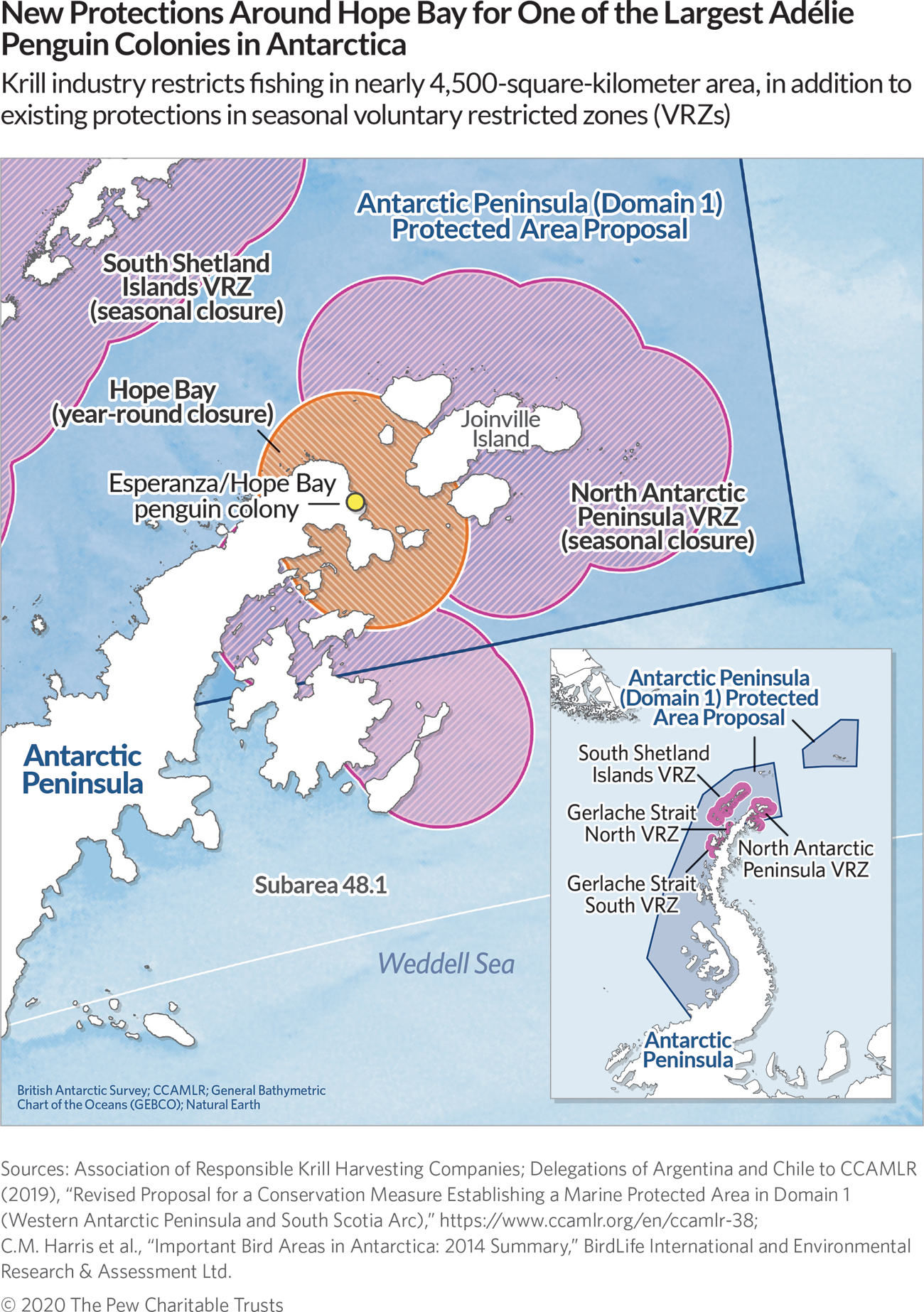
The Antarctic Peninsula is the part of the continent most heavily visited by tourists, and one of the fastest warming places on Earth. As temperatures continue to rise, sea ice—critical habitat for penguins, seals, and other Antarctic species—is shrinking. Krill also rely on sea ice: They use it to breed, and juveniles feed off dense seasonal algae that grow beneath it.
The Antarctic Peninsula MPA proposal calls for prohibiting krill fishing in a zone that covers the coastal foraging ranges of penguins and other krill predators in two of the peninsula’s most biologically important areas: the Bransfield and Gerlache straits. The proposal also includes a permanent, large no-fishing zone in the Bellingshausen Sea along the western Antarctic Peninsula that is known to be an important spawning and nursery area for krill. And it calls for fully protecting vital spawning and nursery habitats for commercially and ecologically valuable fish species, including toothfish, icefish, and silverfish.
“Nature is changing fast in Antarctica, faster than policy and regulation is able to understand and keep up with,” said Pål Skogrand, director of Antarctic affairs at the krill harvesting company Aker BioMarine. “When the krill industry moves to an all-year closure ahead of its time, this is a necessary precautionary action that we take because we can. To get things right in Antarctica, we need to move outside of our comfort zones and develop shared ownership of crucial conservation concepts across industry, governments, and NGOs.”
Today’s announcement by ARK is a big and laudable step. But to fully safeguard the Antarctic Peninsula and its resident wildlife far into the future, CCAMLR should approve the larger MPA as soon as possible.
This article was republished with permission from The Pew Charitable Trusts — and was originally written by Andrea Kavanagh, who directs The Pew Charitable Trusts’ protecting Antarctica’s Southern Ocean campaign.
A devastating smallpox outbreak killed an estimated 400,000 people across Europe in the 18th century, including several reigning monarchs.
Of those who contracted the disease at the time, about 30 percent died and one-third went blind.
Before he became the Russian Emperor, Peter III caught the airborne virus and was left scarred and disfigured. His wife, Catherine the Great, managed to dodge the disease but was deeply affected by the toll it took on her husband.
Catherine became Empress of Russia after her husband was overthrown and took action because she feared for the safety of her son and her subjects.
The earliest method to prevent smallpox was inoculation (also known as variolation), which worked by provoking a mild form of the disease in a healthy person.
Catherine invited Dr. Thomas Dimsdale from Scotland to perform inoculation on herself, her son, and her court to set an example to the Russian people that the procedure was safe.
The doctor was unsure whether smallpox would behave the same in Russia as it did in Western Europe, so he encouraged the Empress to allow commoners to try the procedure first, but she insisted.
Her decision to be inoculated was controversial, but it was a success. She developed a mild case that lasted just over two weeks and then was healthy.
She sought to have her entire empire inoculated.
Catherine is quoted as saying, “My objective was, through my example, to save from death the multitude of my subjects who, not knowing the value of this technique, and frightened of it, were left in danger.”
By 1800, about 2 million inoculations were administered in the Russian Empire.
Thanks to Catherine’s willingness to demonstrate the safety and effectiveness of inoculation, millions of lives were saved.
In the same period, a doctor named Edward Jenner discovered a safer and more reliable technique than inoculation, which led to the first modern vaccine.
He induced immunity into patients by exposing them to smallpox’s related but harmless disease, cowpox.
His findings on vaccinations were initially met with opposition, but Jenner’s vaccination technique gradually replaced inoculation, which was later prohibited in Europe.
Smallpox vaccinations were made compulsory in England and Wales 30 years after he died.
Because of Jenner’s innovation and commitment to scientific breakthrough, we now have the many vaccines that stemmed from his initial work in the second half of the 18th century.
Together, Russia’s longest-ruling female leader and Jenner helped kickstart a method that created smallpox immunity.
The last naturally occurring case was diagnosed more than 40 years ago, and the World Health Organization certified that the disease was globally eradicated in 1980.
We have Jenner — and those who came after him — to thank for the accessibility to life-saving vaccines available today.
This story was originally featured in Issue 06 of the Goodnewspaper.
To get each issue of the Goodnewspaper delivered to your mailbox, join thousands of people by subscribing today.
You can also get good news delivered to your inbox every week by subscribing to the Goodnewsletter.
Along temperate coasts, the effects of climate change—including sea-level rise, erosion, and more frequent and stronger storms—are threatening a vital habitat that offers one of the best natural defenses against those perils.
Salt marshes are low-lying ecosystems characterized by salt-tolerant shrubs, herbs, and grasses that not only protect coastal communities but also provide vital habitat for fish, birds, invertebrates, bivalves, and other wildlife. In the United States alone, up to 75% of commercially important marine species, including shrimp, crabs, and finfish, rely on this ecosystem. That rich biodiversity supports coastal communities and their businesses, from commercial and recreational fishing fleets to seafood markets and tourism outfitters.
Along with other coastal wetlands—namely mangroves and seagrass—salt marshes play a significant role in helping communities adapt to and mitigate the impacts of climate change. This habitat provides flood protection and shoreline stabilization by buffering coastal communities from the full impact of storms, which in many areas have become more frequent and intense. In the U.S., coastal wetlands are estimated to provide the equivalent of $23.2 billion in storm damage protection per year.
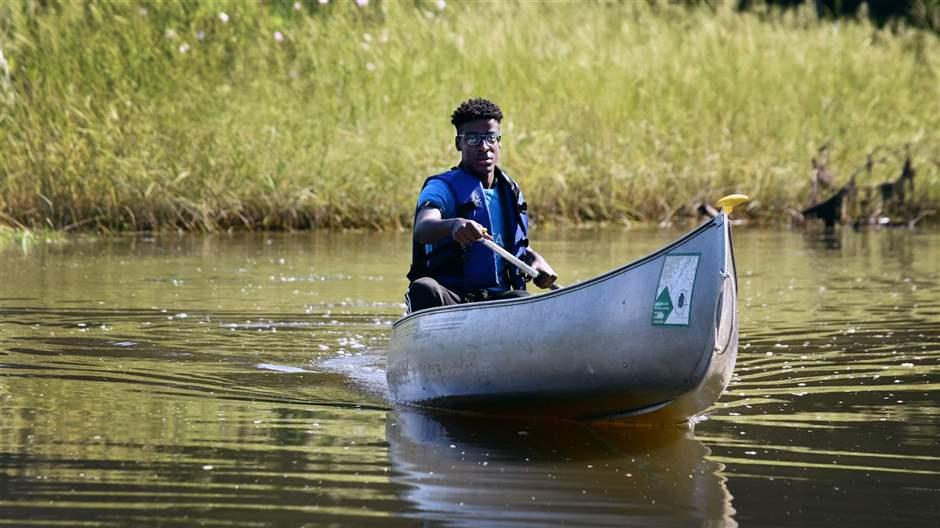
Another major benefit: blue carbon
Marshes also have extraordinary capacity to sequester carbon in their underlying soil, and this carbon can remain stored for decades if it is undisturbed. In fact, the saturated soil found in marsh ecosystems can retain more carbon per acre than some terrestrial forests and is often referred to as blue carbon—that is, carbon captured and retained by ocean and coastal ecosystems.
Salt marshes are one of only three marine ecosystems—along with mangroves and seagrass—currently recognized by the Intergovernmental Panel on Climate Change for their measurable carbon benefits. And scientists and stakeholders alike note the “triple-win” effect that healthy, intact salt marshes convey by helping governments address climate change through mitigation, adaption, and resilience.
Salt marshes are threatened, however, by the very phenomena that they can help to alleviate. Experts estimate that 50% of salt marshes have been lost globally, with declines continuing because of climate change, coastal development, industrialization, and pollution.
But there is hope to reverse this trend. Governments and international bodies are pursuing concrete ways to protect and restore salt marshes and the benefits they provide, such as climate policy instruments like the Paris Agreement. Parties to the agreement may include efforts to protect and restore salt marshes in their domestic climate action plans, called nationally determined contributions (NDCs). Every party to the Paris Agreement was due to enhance its NDC in 2020 and will submit further revisions—each with increasing ambition—every five years.
In the U.S., salt marsh and other blue carbon habitats can be incorporated into state plans for using nature-based solutions to reduce greenhouse gas emissions, known as natural and working lands strategies. By quantifying the amount of carbon stored in these habitats and then setting goals to protect and expand that storage through conservation and restoration, states can help to support broader efforts to mitigate climate impacts. In addition, states, in partnership with federal agencies, should advance regional, landscape-level strategies to help salt marshes better adapt to climate impacts.
Salt marshes are an important nature-based solution in the fight against climate change, with far-reaching benefits for communities, wildlife, and coastal economies. Protecting these vital habitats must be a policy priority—globally and at all levels of government—moving forward.
This article was originally run on The Pew Charitable Trusts’ website and was generously made available to Good Good Good. This article was written by Stacy Baez — who works on The Pew Charitable Trusts’ coastal wetlands and coral reefs project, and edited by Sylvia Troost — who works on Pew’s conserving marine life in the United States project.
As we face the reality of the impact of shopping on the environment, companies are catching on to the fact that consumers are willing to make changes to their spending habits if it means helping the planet.
A company will do almost anything to convince you that they will most responsibility steward your hard-earned dollars — that you can trust that you are supporting a company that is doing its part in helping the environment, or at the very least not hurting it.
You’d be wise to raise an eyebrow at claims of sustainability and eco-friendliness.
The sad reality is that many companies will spend far more time and money on marketing their company as “green” rather than actually doing the work of making their products and practices sustainable.

This is called “greenwashing,” and it’s a dishonest practice that dupes consumers into thinking they are supporting an eco-conscious brand, when really they’re just putting money into the hands of companies with clever PR and marketing teams who may or may not actually care about environmental impact.
Supporting sustainable companies really does make a difference because it puts pressure on other brands to adopt eco-friendly practices.
After all, money rules the world, right? But we as consumers have to be privy to which companies are actually walking the walk and which are using clever language to trick and distract us.
The Six Sins of Greenwashing To Avoid At All Costs:
TerraChoice Environmental Marketing published the “six sins of greenwashing,” which you can use to spot the practice in marketing materials.
1. The Hidden Trade-off:
Suggesting a product is “green” based on a single attribute, such as marketing the recycled content of paper without paying attention to manufacturing impacts such as air emissions, water emissions, and global warming impacts or marketing office technology (such as printers, copiers, and fax machines) that promote energy efficiency without attention to hazardous material content, indoor air quality, or compatibility with recycled paper or remanufactured toner cartridges.
Look for other information that gives a more complete picture of the environmental impact of the product. “Okay, this product comes from a sustainably harvested forest, but what are the impacts of its milling and transportation? Is the manufacturer also trying to reduce those impacts?”
2. No Proof:
Any environmental claim that cannot be substantiated by easily accessible supporting information, or by a reliable third-party certification.
An example is personal care products (such as shampoos and conditioners) that claim not to have been tested on animals but offer no evidence or certification of this claim.
It may not be reasonable to expect a product label or a point-of-purchase brochure to provide detailed scientific explanations of a green claim.
It is, however, reasonable to expect a product label or brochure to direct you to where you can find further evidence. Good green marketing helps the consumer find the evidence and learn more.
Company websites, third-party certifiers, and toll-free phone numbers are easy and effective means of delivering proof.
3. Vagueness:
A claim that is so poorly defined or broad that its real meaning is likely to be misunderstood by the intended consumer.
Look out for words such as:
“Non-toxic” — Everything is toxic in sufficient dosage. Even water, oxygen, and salt are all potentially hazardous.
“All-natural” — Arsenic is natural. So are uranium, mercury, and formaldehyde. All are poisonous.
“Green,” “environmentally-friendly,” and “eco-conscious” — These are all meaningless without elaboration.
4. Irrelevance:
Making an environmental claim that may be truthful but is unimportant and unhelpful for consumers seeking environmentally preferable products. It is irrelevant and distracts the consumer from finding a truly greener option.
For example, chlorofluorocarbons (CFCs) — a contributor to ozone depletion — have been legally banned for almost 30 years, but that doesn’t stop marketers from touting “CFC-free” on products, as if that somehow poses a unique environmental advantage despite the fact that all products have been CFC-free for decades.
Ask yourself if the claim is important and relevant to the product. (If a light bulb claimed water efficiency benefits, you should be suspicious.)
Comparison-shop (and ask the competitive vendors). If the claim seems illogical and disconnected from the product, it may very well be irrelevant.
5. Lesser of Two Evils:
These are “green” claims that may be true within the product category but that risk distracting the consumer from the greater environmental impacts of the category as a whole.
Examples include organic cigarettes or “green” insecticides and herbicides.
(Commercial insecticides and herbicides are essential to some agricultural applications. In those circumstances, choosing the greenest option is essential. However, insecticides and pesticides may be unnecessary for many cosmetic applications, such
as lawns.)
Another example is a single-use water bottle brand promoting its sustainability initiatives. The reality is that it's almost always better to wait until you can access tap water. Even boxed or canned water brands, while more sustainable than plastic water bottles, negatively affect the environment through sourcing, bottling, and transporting their product.
6. Fibbing:
Environmental claims that are simply false. This is rare, but when it does happen, it often includes misusing or misrepresenting a certification. Stay away from this kind of brand at all costs.
The pressure of having to live the “perfect” environmentalist lifestyle is overwhelming and, frankly, turns off a lot of people from even trying.
Truth be told, nailing every marker of sustainable or otherwise green living is unattainable for most people.
For a multitude of reasons, the reality for most people is that it’s just not possible to live in a zero-waste, self-sustaining home, stop driving altogether, or compost every food scrap.
But the inability to do everything shouldn’t stop you from doing something.
Your personal habits do matter. The little things add up — because individual action leads to collective action. There will always be someone greener than you, but don’t let that stop you from making changes to your lifestyle that will help the Earth heal in your own small way, too.
If environmentalism is new to you, that probably means that you’ve recently had a moment of reckoning with the current state of our planet. You may have had a moment of realizing just how dire the situation is, and you want to step up to the plate and solve the world’s problems.
Don’t feel like you need to go big right away. We want you to join us for the long haul. You need to make changes that will be sustainable over a long period of time, not necessarily radical changes that might lead you to burnout quickly (although a radical change is great, too, if you’re ready!)
It’s tempting to want to sell all your possessions, move into a tiny home, and start farming all your own food. While that sounds awesome, you can also try incorporating small changes into your routine, maybe one or two a month. And intentionally seek to combat sustainability guilt.
The goal here is to change your habits that make the biggest impact.
There are many, many small changes you can make to help the environment, such as adopting a minimalist mindset, recycling, and investing in reusable products.
When you’re ready, take on some bigger changes, but don’t forget that everyone starts small.
Skow was diagnosed with end stage liver disease in 2008. He needed a liver transplant but had no way to get one without six months of sobriety. And without a transplant, he would die. He was given just 90 days to live.
He came home from the hospital under hospice care, and was very, very sick: He had problems with his kidneys, pancreas, gallbladder, he looked yellow in the face, plus he was going through opiate withdrawal and had intense and confusing brain fog and hallucinations. He didn’t recognize himself when he looked in the mirror.
“All I wanted to do was kill myself,” Skow said. “I was highly focused on taking my own life. I just couldn't figure out how to live. I had not been without drugs and alcohol my whole life. I just didn't know how to do anything. I was scared of people, places, and things. And worse than that, I wasn't going to survive anyway. I was hopeless.”
His only goal became surviving six months sober to become eligible for the transplant. He said his Rottweiler-pitbull, Marley, was the “catalyzing force” behind his recovery, and Skow even credits Marley with saving his life. In the middle of the night, he would hold Marley to distract himself from the pain and discomfort, feeling the dog’s grounding, solid strength. He started building kennels in his dad’s garage, and started bringing in more foster dogs.]
→ Related: Good Dog News Stories
He had been rescuing and fostering dogs all his life — he rescued his first dog, Specker, when he was nine years old and found him in a storm drain on his way home from school. Going through this healing process with the dogs was “transformative,” he said, and he began “bringing more dogs into the pack.”
Every two days he drove two-and-a-half hours each way from Tehachapi, California to Cedars-Sinai Medical Center in Los Angeles for blood work and imaging. He started journaling, and every day for months he watched the sunrise with the dogs. They went on walks, each day going a little bit farther as Skow’s body grew stronger.
“[The dogs] saw who I was, and they saw what was inside me,” Skow said.
This is how his nonprofit, Marley’s Mutts, was born. Instead of “feeling all the sorry and pity” for himself, he started making adoption flyers.
“If I couldn't like myself, I wasn't gonna live,” Skow said. “And the dogs just distracted me long enough to get good at that.”
At the end of the six-month waiting period, he didn’t need the transplant after all. His doctor was shocked and told him that whatever he was doing to heal was working. In May 2009, he turned Marley’s Mutts into a nonprofit organization, making it an official rescue of shelter mutts, which at the time was far less popular than it is now. They rescue dogs from shelters in Kern County, a county with one of the highest euthanasia rates in the country.
He funded the new organization by selling T-shirts, staying up until 3 or 4 a.m. ironing on the organization’s logo to shirts he bought at K-Mart. He panhandled the shirts at Alcoholics Anonymous meetings and asked around for support.
At the heart of the Marley's Mutt's mission is second chances:
When a buddy of his got out of prison, Skow connected him with a dog, and he saw how their relationship “changed the whole trajectory of his life.” He felt he was onto something and spent nearly five years trying to set up a dog program in prisons. They finally were accepted into the California City Correctional Facility, and since then it’s been Skow’s mission to get into every prison in America.
“We have done our nation and ourselves a tremendous disservice by assuming that the two-and-a-half million incarcerated men and women in this country can't be productive, incredible, wonderful sources of light for this world”
Here’s how the prison program, called Pawsitive Change, works: Marley’s Mutts partners with California state prisons and pairs incarcerated men with a rescue dog for three months, with the goal of “mutual rehabilitation.” The inmates have weekly tasks to complete and are set up to build compassion, develop skills, combat recidivism, and prepare for healthy and productive lives after incarceration. Every year the program trains more than 150 dogs with 400 inmates.
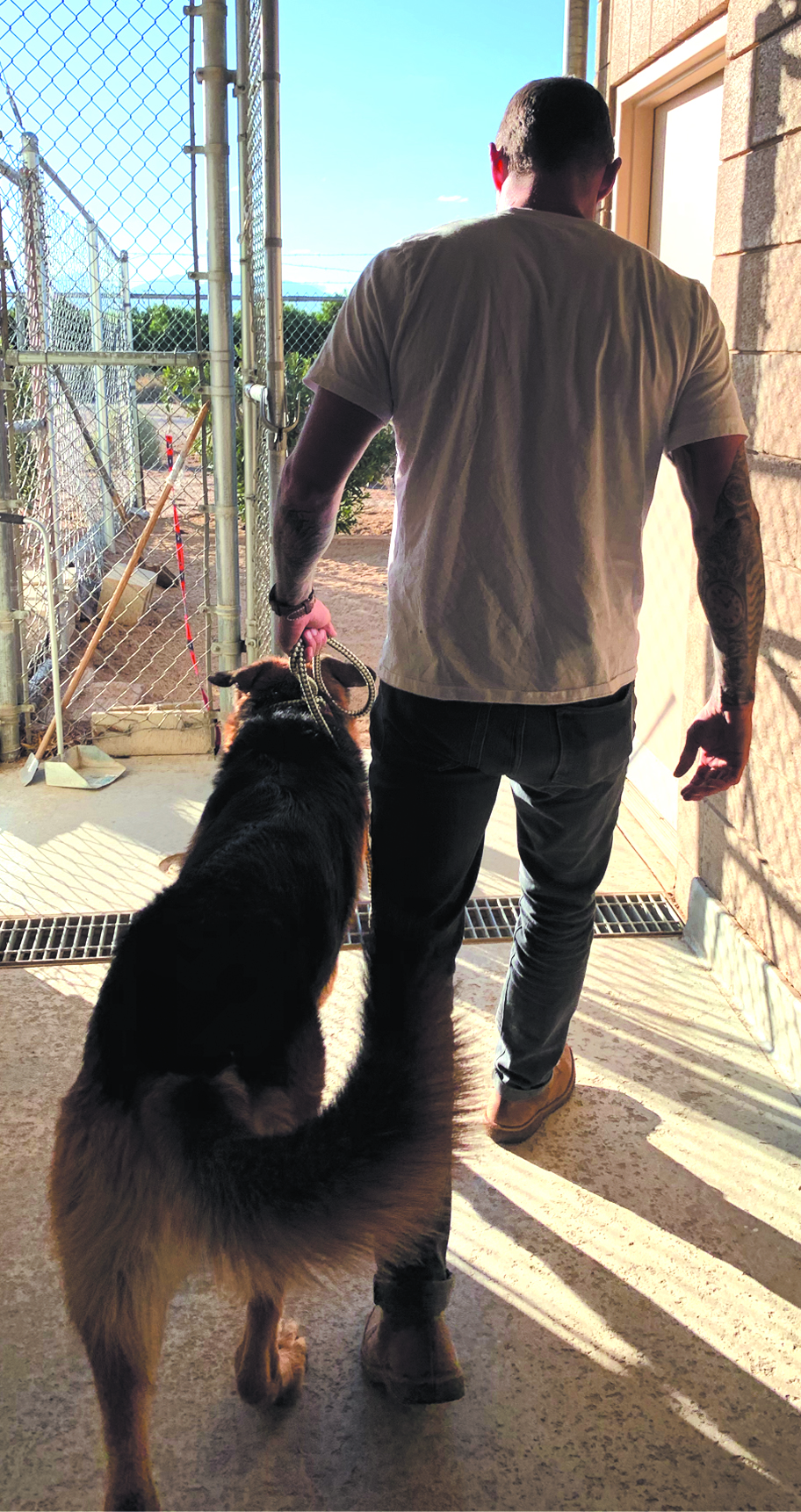
Marley’s Mutts chooses dogs based on the dog’s compatibility with the program: their breed and their personality, for example. Dogs that need structure, training, and routine thrive in the program. Dogs that don’t have a strong connection with people benefit, too, because they develop trust with people during the program. Surprisingly, the most insecure, reserved dogs generally end up doing well because they get so much time with the program participants.
Though he’s passionate about animals, Skow said he’s even more connected to the work he does to help people. He laments the fact that the U.S. spends $182 billion per year locking up more than 2 million people — numbers that come from a study by the Prison Policy Initiative.
California spends more to keep one person in prison every year than Skow makes as the director of his nonprofit. He bemoans the way the U.S. prison system affects families, especially the children, of incarcerated people. He wants to play a part in creating opportunities for these people who have the odds stacked against them.
“We have done our nation and ourselves a tremendous disservice by assuming that the two-and-a-half million incarcerated men and women in this country can't be productive, incredible, wonderful sources of light for this world,” he said.
”We all have something to offer this world, and we are all deserving of a second chance.”
He’s designed the prison program to work as a pathway for people to redeem their lives, to progress society, and to break the prison cycle. Many of the Pawsitive Change program participants end up working for rescues or as trainers once they leave prison, a development that makes Skow proud.
“What it’s really helping people do is understand that returning citizens — formerly incarcerated people — are human beings,” Skow said. “[They have] enormous potential and maybe even more perspective on life than a lot of us do because of what they've been through. ... We all have something to offer this world, and we are all deserving of a second chance.”
Some good news came out of the 2020 general election, and it's all about representation, representation, representation. We saw big wins for women, BIPOC, the LGBTQ+ community, and more.
Better representation among our elected officials matters because it means the makeup of those key decision-makers more closely resembles the varying and diverse perspectives of the people they represent. More representation in government means better representation of what America actually looks like.
Come January 2021, the 117th U.S. Congress will have the most women legislators ever: 134, including 48 women of color, according to the Center for American Women and Politics. That breaks the previous record set in January 2019 of 127 women.
Notably, these numbers are far from where we need to be: Women make up more than half the U.S. population but will now still only make up 25 percent of Congress. We celebrate progress over perfection, though, and these numbers definitely have us on the right track.
Check out these representation wins from the 2020 election:
Kamala Harris will be the first woman in one of the top two U.S. executive offices and the first Black and Indian American vice president.
Washington elected the first Korean-American woman to Congress. Marilyn Strickland is also the first Black representative from the state.
Oklahoma voters elected the first non-binary and Muslim state House representative. Mauree Turner is one of the first non-binary lawmakers in the country.
Delaware voters elected the first transgender state senator in U.S. history. Sarah McBride won 86 percent of the vote in Delaware. “I hope tonight shows an LGBTQ kid that our democracy is big enough for them, too,” she said.
New York voters elected the first two openly gay black men to Congress. They made history (times two!) by electing Ritchie Torres and Mondaire Jones.
Maryville, Tennessee elected a woman to City Council for the first time ever. Sarah Herron is the first woman to ever be elected to serve on the city’s Council.
Miami-Dade voters elected the first woman to serve as the county’s mayor, Daniella Levine Cava.
Missouri voters elected the state’s first Black Congresswoman. Cori Bush is Missouri’s first Black woman to be elected to the U.S. House of Representatives.
Rhode Island voters elected their first Native American woman to the state House. A former teacher, Brianna Henries is the first Native American woman elected to the Rhode Island House.
Wyoming voters elected their first woman Senator. Cynthia Lummis will be the first woman to represent Wyoming in the U.S. Senate.
Swiss lawmakers voted on Friday to legalize same-sex marriage and allow transgender people to change their legal gender by making a declaration, marking a major step forward for LGBT+ rights in the country, campaigners said.
The gay marriage law is likely to be tested in a nationwide referendum next year before it takes effect, but rights activists said they expected it to secure popular support.
"This is not only a milestone in the fight for the rights of the Swiss LGBT population, but also an important victory for their dignity, their acceptance and their inclusion in society," Marriage For All, a campaign group, said on its website.
Switzerland had lagged behind other parts of western Europe on LGBT+ rights, with political institutions tending to be more conservative than the public.
A law protecting lesbian, gay and bisexual people from discrimination was only passed earlier this year.
Under the legislation approved by parliament on Friday, trans people will be able to change their gender on identity documents by making a declaration at civil registry offices.
That would make Switzerland the eighth European country to allow trans people to legally change gender without the involvement of a doctor or a court, in what is known as "self-ID", according to advocacy group Transgender Europe.
The minimum age for changing gender legally without parental consent was set at 16, drawing criticism from trans rights advocates.
They noted that at present name changes and medical treatments related to transitioning gender do not require parental consent for the under-16s.
"On the one hand, we're super happy there will be this legal gender recognition based on self-determination, in a very quick and simple procedure," said Alecs Recher, the head of legal services at Transgender Network Switzerland, an advocacy group.
"But, on the other hand, it's a major step back for those under 16," he told the Thomson Reuters Foundation,
Under current rules, both children and adults have to apply to a court to change gender, said Recher, whose organization supports trans people through the legal procedure, which can cost up to 1,000 Swiss Francs ($1,130).
Switzerland will become the 29th country to allow same-sex marriage, if the law - which will also let lesbian couples conceive using sperm donation - comes into force.
Opponents have 100 days to collect the 50,000 signatures needed to trigger a referendum.
A survey commissioned by a gay advocacy group Pink Cross in February showed more than 80% of Swiss support same-sex marriage, suggesting the law would take effect even if opponents garner enough signatures to force a referendum.
(Reporting by Rachel Savage @rachelmsavage; Editing by Helen Popper. Republished with permission from the Thomson Reuters Foundation, the charitable arm of Thomson Reuters, that covers the lives of people around the world who struggle to live freely or fairly. Visit news.trust.org)
For veterans of combat diving, life after the military can lack a sense of purpose. Now a nonprofit called Force Blue is giving these military veterans a new mission by employing their unique underwater skills to restore ocean health.
Veterans of combat diving are used to mission-focused work, so transitioning back to civilian life and working at a desk can be a difficult adjustment for many veterans.
Enter Force Blue, a nonprofit that unites military veterans with the world of coral reef conservation for the betterment of both.
A big challenge these combat divers face, according to the team’s executive director Jim Ritterhoff, is a sense of not having a mission anymore.
“We’re not a dive therapy program,” Ritterhoff told the news program Living on Earth.
“Our guys are already the best divers in the world. We’re a mission therapy program. We’re all about giving them back that sense [that] your skillset can still be utilized. We can take the training that you already have and the qualities that made you so successful in the military and now use those for the greater good for a cause larger than themselves.”
These veterans come from backgrounds of highly specialized work: special operations teams with extensive government training in SCUBA diving.
These combat divers come from all branches of the military, and millions of dollars have been invested in them throughout their military careers to turn them into specialized underwater operators. It’s a rigorous program to become a combat diver and one of the more difficult schools in the U.S. military.
The Force Blue team consists of 12 combat divers who can be deployed to restore coral reefs, remove invasive species, and remove marine debris.
At the start of the program in 2017, the team went through a two-week training led by marine scientists and environmentalists followed by five days of individual therapy with Dr. Carrie Elk, who specializes in post-traumatic stress in the special operations community.

Right after training, Hurricanes Irma and Maria hit, and the ocean floors in the Florida Keys and Puerto Rico suffered extensive damage. The team deployed and — working with other conservation groups — worked to bring the floors back to their former glory.
Their uniquely specialized training allows Force Blue to work on operations that other groups don’t have the capability to tackle. For example, an impressively massive 900-pound, 500-year-old coral pillar had been ripped from the floor by Hurricane Irma in the Florida Keys.
One of the groups Force Blue worked with, the government agency National Oceanic and Atmospheric Administration, does not lift anything over 100 pounds. But the Force Blue divers — who had lifted predator drones off the ocean floor in the past — took care of it no problem. It was a significant win for conservation because only four of these pillars exist in the Keys.
But it’s not all about conservation. For many of the group’s members, it’s healing to repurpose their skills and continue their service in a new context.
The group is centered around working with veterans who specifically need the sense of having a mission, not just a hobby.
Ritterhoff recalled the story to Living on Earth of his co-founder, Rudy Reyes, who struggled to assimilate to civilian life after six combat deployments in Iraq and Afghanistan.
After a recreational dive in the Cayman Islands in 2015, Reyes looked at Ritterhoff and asked, “Did you see that fish?” Ritterhoff, who is an experienced diver but not a veteran, was shocked. “What are you talking about? There’s a million fish. That’s the whole point of it.”
But these divers had never seen a fish on their dives. They are used to diving in the middle of the night to destroy a target or rescue someone while hauling hundreds of pounds of gear.
Now they get to see the ocean environments in the light of day and see it from the lens of preserving and restoring the ecosystems that live there.
“You get these guys down there, and it’s like opening a whole new world to them, and the sense of wonder and awe that they had — they were just like little kids experiencing something they’d never had before,” Ritterhoff said. “You just see these guys get back to who they were.”
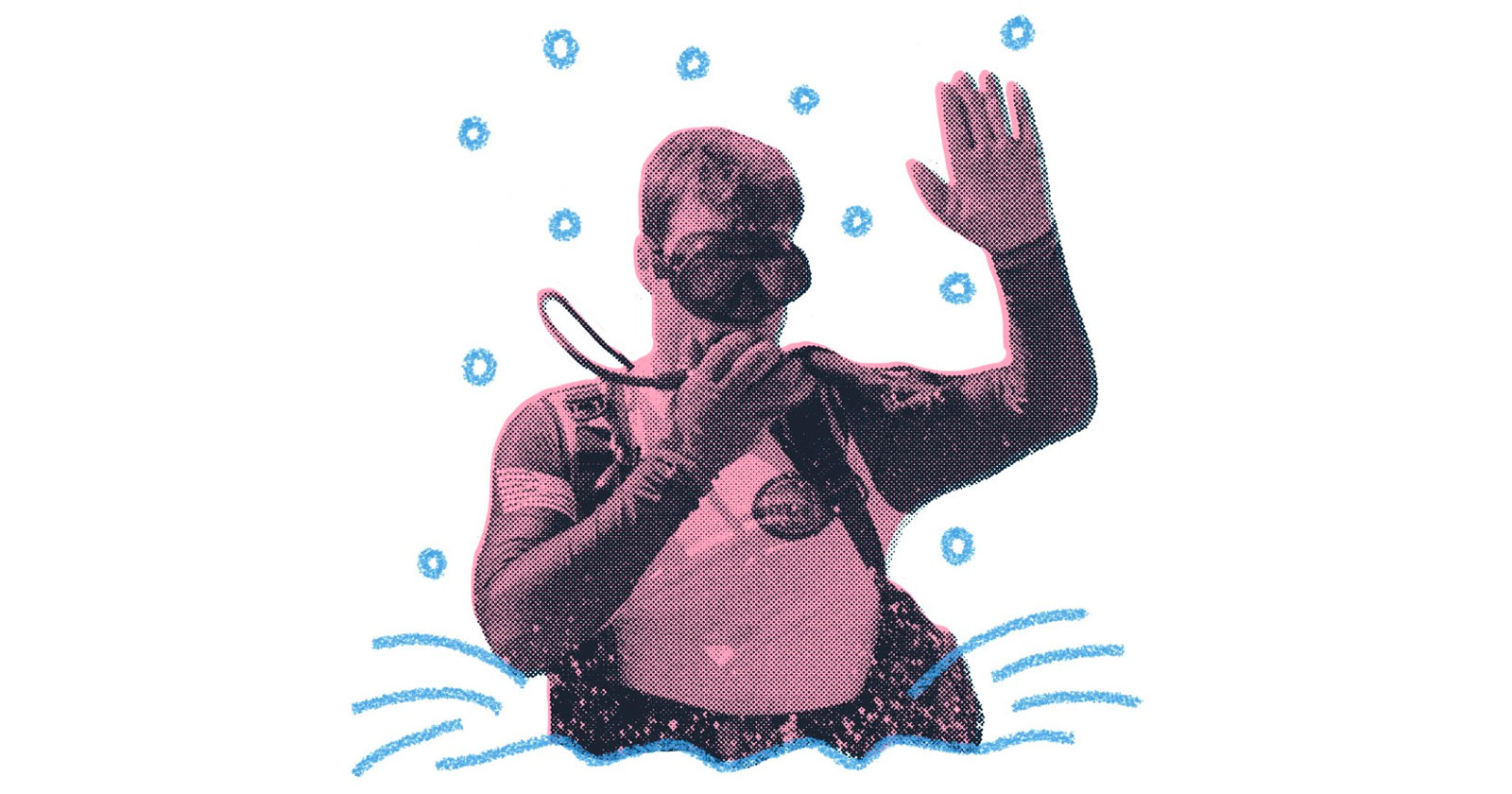
And these divers have a unique position to bring the message of ocean conservation back to their communities.
“Our guys aren’t going to stop ocean acidification or rising temperatures or some of the real underlying causes of what’s happening to our oceans,” Ritterhoff said.
“But what they can do is be a megaphone to reach people who otherwise aren’t getting the message about what’s happening to our planet. People who are not going to listen to another climate change scientist talk about global warming will go, oh, Navy SEALs, recon Marines, these guys are my heroes, right?”
“We hope that that’s a way to get a whole other section of the population engaged in at least understanding. We always say, hey, we don’t care if you get on the boat from the left side or the right side, we’re all in the same boat.”
This article was written Kailey Thompson and originally ran in The Veterans Edition of the Goodnewspaper.
The Veterans Edition of the Goodnewspaper is a special edition of Good Good Good’s newspaper. It’s focused on celebrating veterans doing good and people doing good for veterans.
You can order The Veterans Edition of the Goodnewspaper here or subscribe to future Goodnewspapers here.
"I have eco-anxiety," environmental activist and innovator Binish Desai told The Washington Post. When he sees waste, he said, he begins thinking about ways to use it.
To fight the pandemic, countries increased production of personal protective equipment, or PPE, which is often made of polypropylene plastic, which can take hundreds of years to degrade. After use, single-use masks and other protective gear are thrown away, destined for landfills or bodies of water, where they could break into microplastics that ultimately end up in food streams and come back to us.
One study from the American Chemical Society last June estimated that the world could be using up to 129 billion face masks a month — many of which are disposable.
But Desai, who lives in western India and has an impressive list of environmental innovations already under his belt, came up with the idea to turn protective gear into bricks. As of the end of November of last year, he had made more than 40,000 bricks for projects including homes, factories, and roads.
Here’s how it works: 52 percent of the bricks are made from biomedical waste. To obtain the PPE, he partnered with hospitals, clinics, and nonprofit organizations, and installed bins in grocery stores, restaurants, and apartment buildings in which people could discard their used items.