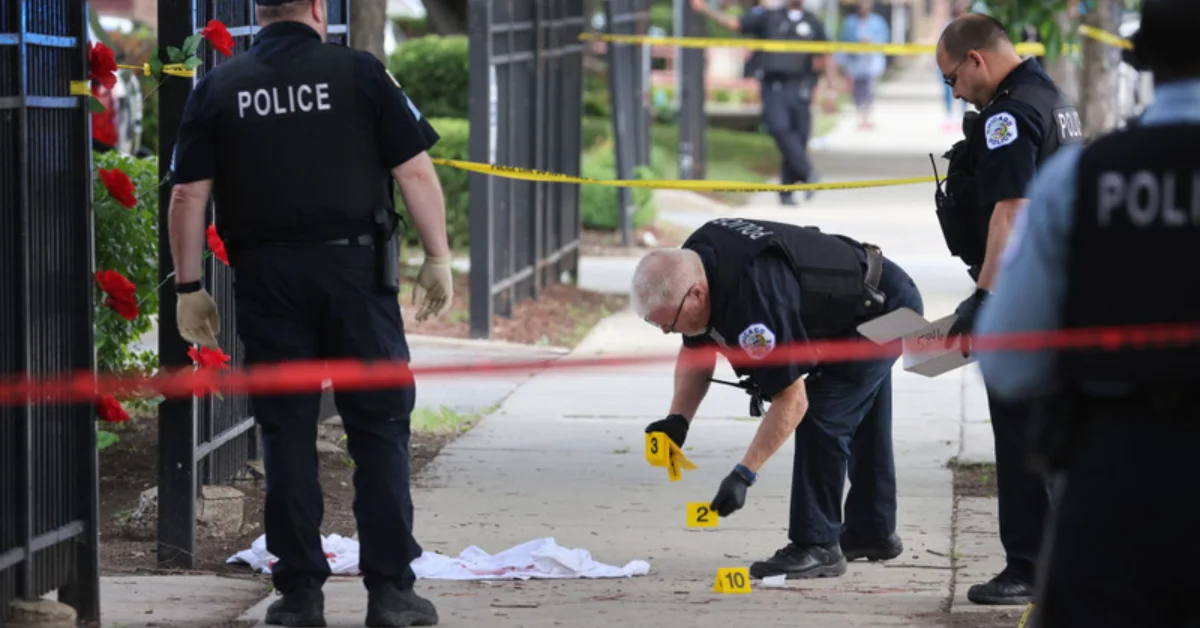
Violent crime in the US fell at record pace in 2025.
As candidates debate public safety ahead of the midterm elections, a new assessment of the nation’s historic homicide decline suggests there is no single explanation for the drop — and that some widely discussed enforcement strategies may have played little role.
A survey of nearly 50 crime scholars convened by the nonpartisan Council on Criminal Justice found the strongest support that the top contributing factors to the drop in homicide rates have been community violence intervention programs, the easing of pandemic-related disruptions, and focused deterrence strategies that pair law enforcement with social services.
The findings come amid a historic national decline in homicide. In 2025, the estimated U.S. murder and nonnegligent manslaughter rate fell 18.1% compared with 2024, which equates to about four killings per 100,000 people.
It tied the lowest rate recorded since national estimates began. The FBI recorded the same rate in 1955 and 1956.
But a national decline does not mean every community has experienced the same drop.
The decline has unfolded in cities with different public safety strategies, economic conditions and political leadership, complicating efforts to credit any one approach, according to the council’s report.
The researchers rated 48 potential explanations for the decline between 2022 and 2026.
Six factors received support from more than two-thirds of respondents as contributing either substantially or to a limited degree:
- Expanded community violence intervention programs, which work directly with people at highest risk of violence, were rated as either a major or a limited contributor contributing by 91% of researchers.
- The pandemic recovery was rated as a major or a limited contributor by 83% of respondents. It was the only factor that a majority of respondents, 57%, rated as a major contributor.
- Eighty-three percent of the crime scholars gave credit to the increased use of focused deterrence, an approach that targets high-risk individuals and groups directly with a carrot-and-stick approach through social support and law enforcement.
- Researchers also pointed to increased local government capacity to provide social services, with 75% rating it either a major or limited contributor.
- Greater public safety and support resources relative to demand earned a rating of 68%.
- And more proactive policing was likewise named as a major or limited factor by 68% of the scholars.
Researchers largely dismissed more than half of the potential explanations, including National Guard deployments, increased immigration enforcement, and increased pretrial detention.
Other factors thought to have contributed little included homeless encampment removals, improved housing stability, electronic monitoring, GLP-1 medications, declining cash use, presidential public safety signals, DNA databases, neighborhood crime alerts, and increased incarceration.
The findings do not establish that any one strategy caused homicide to fall.
The ratings reflect researchers’ professional judgments, not definitive findings, and multiple factors may have overlapped or reinforced one another, according to the council’s report.
The council also cautioned that a factor judged to have contributed little to the recent decline could still help reduce violence in the future.
But understanding what drove the decline could help policymakers determine how to sustain the progress, according to the council’s report.
“Theories and claims abound, and sorting among them is essential if we’re going to sustain the progress. This diverse array of researchers took the challenge seriously, testing competing explanations, debating the evidence, and making tough judgments,” Adam Gelb, the president and CEO of the council, said in a news release.
“Their effort leaves the country with a much clearer picture of what likely contributed, what probably did not, and what we still need to learn.”
This article was originally published by Stateline
Featured Image: Scott Olson/Getty Images