In July 2025, Razia Jan passed away at the age of 81. But she is forever memorialized in the PBS documentary “What Tomorrow Brings.”
As the principal and founder of Zabuli Education Center — the first school for girls in Deh’Subz, Afghanistan — Jan made sure that her girls were safe from the threat of the Taliban. Which meant testing the water from the drinking fountain every morning for potential poison.
“Every day I pray that nothing goes wrong and that they can go forth,” Jan told PBS filmmaker Beth Murphy. “I can’t really be sure what tomorrow brings, but at least they are in school this year. If the water is poisoned, I’m just one person.”
The documentary was filmed over the course of eight years and helped Jan raise awareness and funds for her next dream: a free women’s college with a midwifery program. In a country with high infant and maternal mortality rates, it was one of many ways that the educator hoped to improve the lives of women and girls in Afghanistan.

When the Taliban returned to power in 2021, Jan’s education center and college program were shut down indefinitely.
But until she died in July 2025 at the age of 81, she continued working with her nonprofit, Razia’s Ray of Hope Foundation, to ensure that girls across the country had access to early education, good nutrition, and essential health services.
“Razia was totally undeterred by rejection,” Andrea Alberto, the executive director of Razia’s Ray of Hope Foundation, told the New York Times. “She said, ‘We’ll teach as many of them as we possibly can.’”
A version of this article originally appeared in the 2026 Feminist Edition of the Goodnewspaper.
In 2021, the Taliban returned to power in Afghanistan, barring young girls from schooling beyond sixth grade.
It was a devastating blow for Roya Mahboob, a tech entrepreneur who has dedicated her life to expanding girls’ access to education. She was the first female CEO of an Afghan technology company, but was forced to leave her country and resettle in New Jersey due to death threats.
In her absence, her nonprofit, the Digital Citizen Fund, closed all 13 of its technology centers.
Where others may have lost hope, Mahboob doubled down on her efforts.
She reassembled the Afghan Dreamers, the all-girls robotics team that now spans multiple countries and inspired the 2025 film “Rule Breakers.” She also launched Inoura Academy, a STEAM program for 11- to 18-year-olds with a global impact.
“Our robot, Ruby, is a conversational, AI-powered girl who teaches children to code and financial literacy through play, movement, and empathy,” Mahboob told The New York Times. “We combine robotics with art, storytelling, and comics to make learning fun.”

And she’s continuing her work back home in Afghanistan. In place of technology centers, Mahboob now relies on encrypted channels, underground classrooms, and a free offline app called Edy to continue teaching young girls in her home country.
“Based on my conversations with them, I estimate that we have reached 500 students this year,” she said. “And we have our app, Edy. My goal is to reach thousands of students when it officially launches. It’s dangerous work, but the courage of our students keeps us going.”
A version of this article originally appeared in the 2026 Feminist Edition of the Goodnewspaper.
Header image via Rule Breakers film
Caring about future generations means believing that people who will live decades or centuries from now deserve ethical consideration.
In practice, that means taking their interests into account when making all kinds of decisions across a range of issues — from aggressively cutting carbon emissions to investing in pandemic preparedness initiatives and regulating powerful emerging technologies, such as artificial intelligence.
While it may sound like a niche moral view to care about future generations in this way, our new research, published in the academic journal Futures, suggests otherwise.
In fact, Americans appear to care substantially about future generations. Nevertheless, they also systematically underestimate how much other Americans care.
To study this, we conducted two online surveys of U.S. adults, totaling 1,000 respondents. The samples were built to roughly match the U.S. population in age, gender, race or ethnicity, and political affiliation. In one survey, people told us their own views about future generations. In the other, a different group told us what they thought the average American believes.
We examined this in three ways. First, we asked how many future generations people think society should keep in mind when making collective decisions. For example, when setting climate targets or designing pandemic response systems, how many future generations should count as stakeholders in that decision?
Second, we asked how many future generations elected officials should keep in mind when making decisions about laws and public policy. Third, we asked how far into the future people still deserve “moral concern.”
For the third question, participants were shown a list of the present generation and the next 50 generations, with each generation defined as a 25-year period. They then indicated how many of those generations still belonged inside their “moral circle.”
In plain terms: If someone will live 100, 200, or even 1,000 years from now, does their suffering matter — and do we have some responsibility to help make their lives go better?
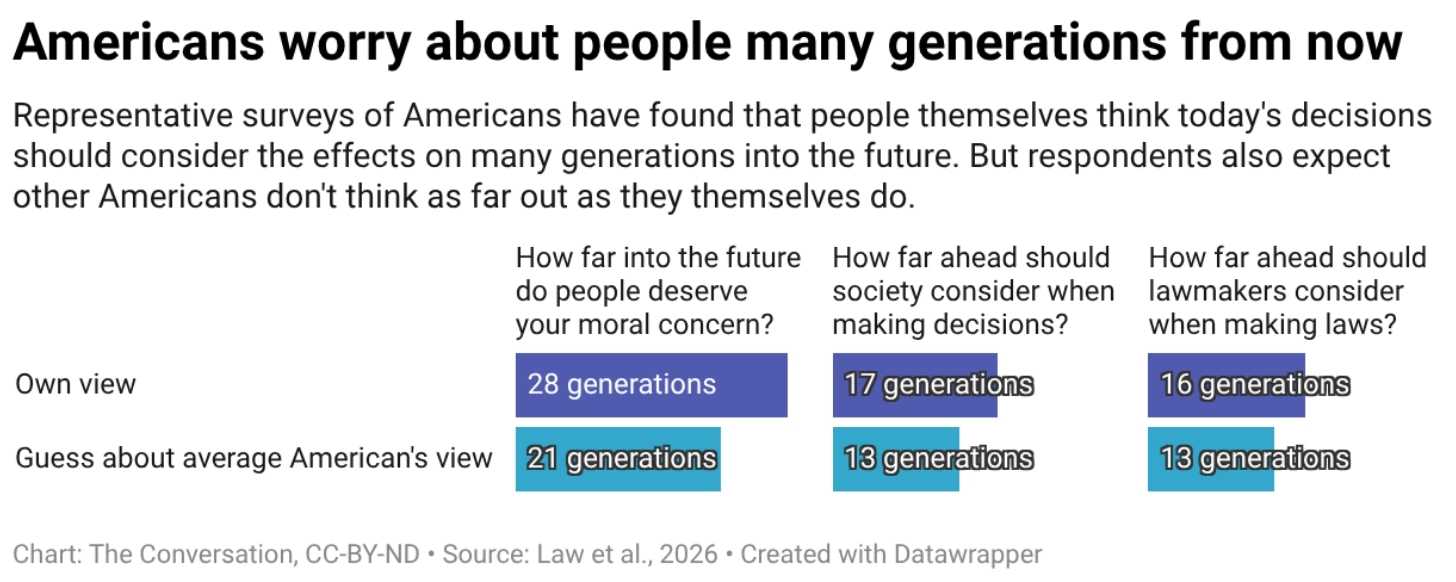
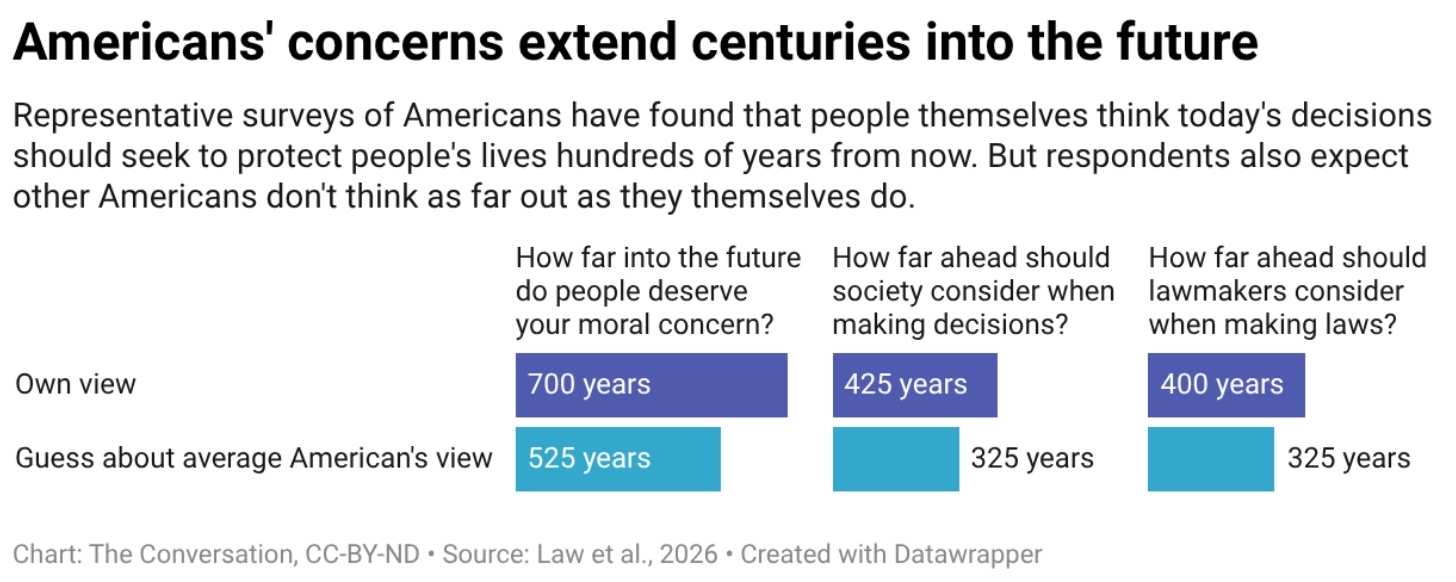
We found that Americans, on average, extended at least some moral concern about 28 generations into the future, or roughly 700 years. But there was a mismatch about when other people’s concern faded — respondents guessed that it happened around 21 generations out, about 175 years sooner.
A similar pattern appeared on the policy questions.
Americans said society and government should take into account people living roughly 16 to 17 generations ahead, respectively — around 400 to 425 years into the future. But they assumed other Americans would endorse a shorter horizon of only about 13 generations, or roughly 325 years. In other words, Americans are more future-oriented than they think their fellow citizens are.
Why it matters
Public support for long-term policies depends partly on what people think other people value. Research on climate policy, for example, shows that Americans often underestimate how much support already exists for major mitigation measures. When people wrongly think their view is unusual, they can become less likely to speak up, join with others, or pressure leaders to act.
Our findings suggest a similar dynamic may shape support for future-oriented policies more broadly. For issues such as pandemic preparedness, nuclear risk, and emerging technologies, decisions made now can affect people far into the future.
It’s possible that a person might support stronger emissions cuts, better disease-prevention systems, or safeguards on high-risk technologies, but stay quiet if they assume most other Americans do not care about those kinds of long-term consequences.
What’s next
For climate change, misperceptions are partly driven by partisan polarization, visible disagreement among leaders and vocal opposition from skeptics. Together, they can make public support appear weaker than it is.
Concern for future generations, by contrast, is much less overtly politicized — meaning it does not divide along party lines the way climate policy does.
Most Americans, regardless of political affiliation, say they care about people living centuries from now. Yet this concern is rarely voiced in everyday conversation, in media coverage or in political debate.
Future research needs to examine why concern for future generations isn’t more visible in public life, such as in the media or voiced in everyday conversations. As a result, people might assume that others do not care as much as they actually do.
This article was written by Kyle Fiore Law and Stylianos Syropoulos from Arizona State University, and was originally published on The Conversation.
Header Image by Pramod Kumar Sharma on Unsplash

This story was originally published by Grist. Sign up for Grist’s weekly newsletter here.
On a Tuesday night in April, beneath a sky mottled with clouds, a slick stretch of road in Cumberland, Maine, erupted in sound. It started with a few high-pitched chirps, like the coos of chicks. Within minutes, dozens, then hundreds more joined a chorus punctuated by low clucks.
By the time the sun dipped below the horizon and rain began to splatter the pavement, the sound had risen to a din. Cars stopped on the shoulder and people spilled onto the road wearing neon vests and waving bright flashlights. They fanned out, and raised their voices as they spoke, like guests at a bustling cocktail party.
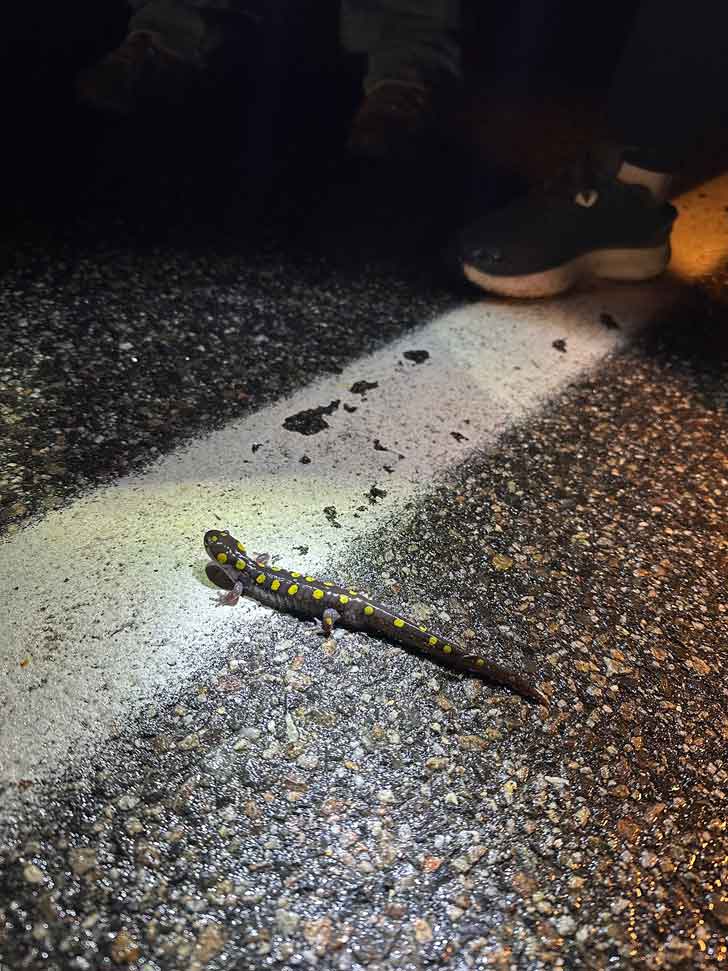
“I got a big one!” called a youngster in a yellow raincoat. She held out her hand for other volunteers who crowded around her. A yellow-spotted salamander about 9 inches long stretched across her gloved palm, its slick tail draped between her fingers.
Each year in New England, on the first warm, wet night of spring, when the ground has thawed, and the temperature is just right, armies of frogs and maelstroms of salamanders emerge from the woods. They hop and undulate through the night, following the same routes their ancestors traveled to the vernal pools of their birth, where they lay their eggs, chirping and clucking all the while.
“They’re calling to the ones that are still in the woods, telling them to come,” said Penny Asherman, who leads the Chebeague and Cumberland Land Trust.
For the past decade, “Big Night” has drawn dozens of people who drop everything at a moment’s notice to help the amphibians migrate safely. But climate change is scrambling that ancient trek. The journey begins less predictably, has grown deadlier, and become more tenuous as the seasonal wetlands they depend on are transformed by climate change.
That has prompted the volunteers to become citizen scientists, tracking when the animals emerge and how many survive. Coordinated by Maine Big Night, the effort, which came on April 14 this year, is generating data that is reshaping how communities think about culverts, road maintenance, and other infrastructure.
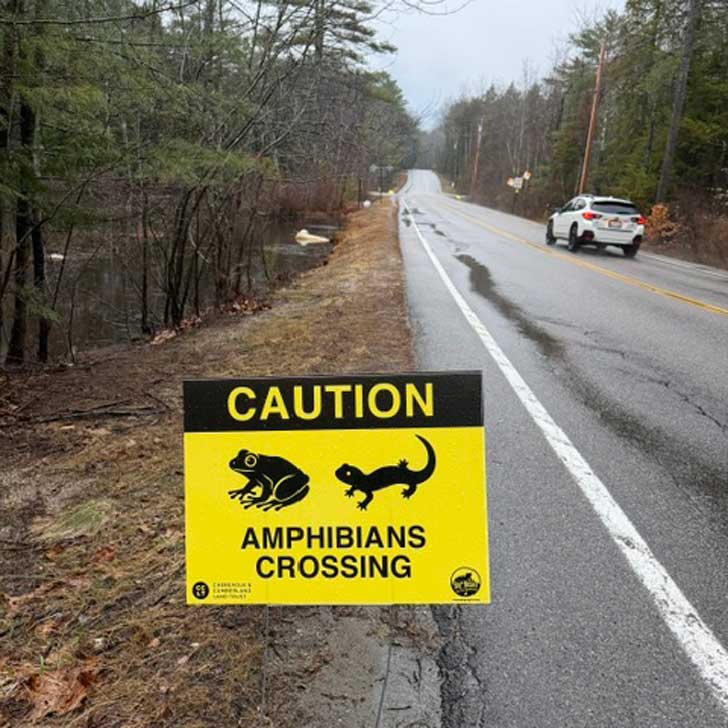
In the past, these amphibian protectors were little more than crossing guards, shepherding the tiny creatures to safety. But a nonprofit formed in 2018, Maine Big Night, has asked them to meticulously document what happens along these migration paths. This year, more than 1,200 observers at 650 migration sites statewide submitted observations.
Tim Kaijala has been a regular for seven years along with his children, Theo, 10, and Kai, 8.
“The data side is pretty cool,” he said. “When we first came, it was just bringing frogs and salamanders over, but the last couple years it’s been more about counting and keeping track.”
As he spoke, Theo and Kai peered into a pool, watching a wood frog they’d helped across the road kick through the clear water. “Remember that one time, Theo,” Kai said, looking at her brother.
“Oh yeah,” he said.
“Tell it,” she urged.
“One time there was a car coming down, and I ran out and saved the peeper,” he paused, solemnly. “I do not want any peepers to die. If I stepped on one, I would never forgive myself.”
When data last year showed that eight out of 10 amphibians were hit by motorists in Orono, at the state’s most ecologically diverse migration site, Big Night worked with city officials to secure a grant for cameras and fencing that guide the animals toward an existing culvert beneath the road.
When the group also saw rising numbers with edema linked to road salt runoff, it pushed for alternative deicing methods, including pickle juice.
Greg LeClair founded Maine Big Night. By day, he’s a municipal planning biologist for the Maine Department of Inland Fisheries and Wildlife. He started the organization because he knew data collection would be essential for protecting the amphibians he’s adored since childhood.
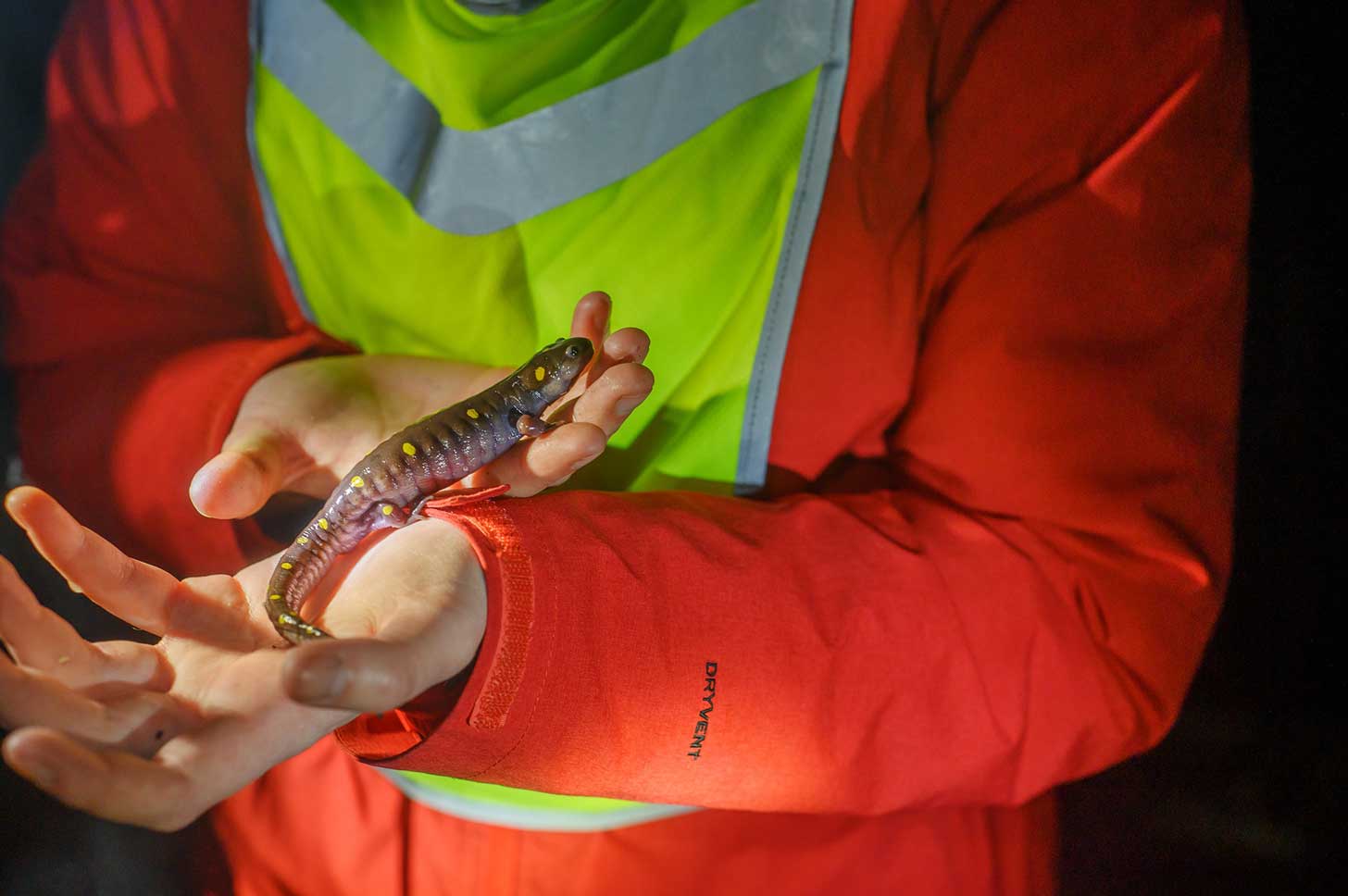
It’s easy to see why. Wood frogs are palm-sized, dappled brown creatures with dark markings smattering the skin around their wide eyes. Spring peepers are the size of a thumb and camouflage so well with the leaf litter of the forest floor that they’re nearly invisible until they unleash calls that echo through the night.
But loving them and saving them are two different things.
“I knew that in order to make change, you needed data, especially when we’re talking about critters folks aren’t as keen on,” LeClair said.
Conserving land and installing culverts, two effective ways to protect the amphibians, aren’t cheap.
“Nobody will give you the money unless you have data,” he said. “That money for infrastructure and conservation is not just floating around.”
Trouble is, little data exists on amphibian migration patterns. They’re small, spend most of the year burrowed in the woods, and are hard to track.
“Any time anyone has a collision with a deer or moose and an insurance claim is filed, a data point is collected, but nobody files an insurance claim when they hit a frog.”

Good data does more than help amphibian advocates win protections. It ensures conservationists spend limited resources where they’ll do the most good.
The fencing project in Orono is one example. For years, scientists thought specialized culverts were the only reliable way to get the hoppers and creepers off roads. But cameras there have already captured frogs and salamanders using an existing crossing. If the new fencing the town recently installed proves nearly as effective, it could save tens of thousands of dollars.
Protecting amphibians matters far beyond frogs and salamanders themselves. They are foundational to New England’s food web. Eggs, larvae, and adults all sustain a surprising range of animals from owls and herons to foxes and even moose.
“If you remove one piece of the puzzle or two, you don’t know which piece could kick the whole system out of whack,” said Sally Stockwell of Maine Audubon. “But there are huge trickle-down impacts when you lose the base of the food chain.”
Amphibians are also particularly vulnerable to climate change. They can’t regulate their body temperature, and they need moisture to move. In the winter, when they burrow into the soil to stay warm, dwindling snowpack can leave them without enough insulation, and they freeze to death. Unusually warm winter days can draw them out of their hiding places, and the return of freezing temperatures kills them. A dry spring or sudden heatwave can dry out the vernal pools where they lay their eggs, killing the next generation.
As the climate warms, fungi adapted to warmer, drier conditions are becoming a greater threat. Among them is the deadly chytrid fungus, which grows on amphibians’ skin, impairs their ability to breathe, and has been seen more frequently in recent years.
Yet we remain their greatest threat. Development eliminates their habitat, and cars kill untold numbers of them.
That is why data is so important: It reveals what would otherwise go unseen. In Cumberland this year, volunteers counted 10 species crossing, including more than 100 spring peepers, 34 wood frogs, and 18 spotted salamanders. Just nine amphibians were found dead.
“Anything we can do to reduce mortality is a benefit,” said Stockwell.
And on that rainy night in April, volunteers did all they could.
Until nearly midnight, children and parents, college kids, and retirees patrolled the road and forest beyond, jotting notes on clipboards and ferrying frogs to safety in Tupperware. They paused only to watch as the tiny cold-blooded critters stretched their limbs and swam, sometimes bobbing at the surface to call — at shocking volume — to the ones still in the woods.
Header Image courtesy of Chebeague and Cumberland Land Trust/Facebook
Allegheny County, Pennsylvania, is experimenting with a policy that has drawn national attention and local skepticism: providing cash compensation to people confined in the Allegheny County Jail in the city of Pittsburgh.
The funds include monthly disbursements to all those incarcerated and additional pay tied to work assignments and participation in educational programming.
At first glance, the policy may sound counterintuitive. Why pay people who are in jail, especially when many law‑abiding residents are struggling to afford housing, food and transportation? That reaction is understandable. But it often reflects a misunderstanding about who is held in the Allegheny County Jail, the amount of the disbursements, and what the county is trying to accomplish.
Over the course of two decades, I have partnered with Allegheny County on policy relevant to justice research and served on the advisory board of the Allegheny County Jail Collaborative, a nationally recognized initiative launched in 2000 to better coordinate jail, health, and community-based services.
Long before many places began using data to rethink criminal justice, Allegheny County was already analyzing data from multiple sources to develop and test new approaches. With that history in mind, this policy may come as less of a surprise — though it still deserves scrutiny.
Most people in jail haven’t been convicted
Understanding the county’s rationale for compensating people in jail begins with understanding the jail population itself. Jail confinement is primarily about custody and court processing, not punishment after being convicted of wrongdoing.
According to county data, only about 8% of people housed in the jail have been convicted and sentenced to jail time. These individuals are serving a maximum incarceration term of less than two years for misdemeanor or lower-level felony convictions.

Roughly half of those incarcerated at the Allegheny County Jail, or 46%, are awaiting trial and have not been convicted of a crime. Another 36% are detained based on an alleged probation violation. The remaining 10% are either on a legal hold placed by an outside agency — such as federal authorities or a correctional facility in another state — are awaiting transfer to a different facility or are ordered to be incarcerated for allegedly violating family court orders.
While jails provide food, clothing, and basic hygiene items, those provisions often fall short of what people actually need. Commissary purchases make up the gap, yet many people in jail have little to no money. When even basic necessities, such as ramen noodles, toothpaste, and tampons, become scarce, bartering can take place.
Commissary items become currency. Debt, theft, intimidation, and power imbalances emerge, leading to conflicts that can cause serious or fatal injury. Staff must manage these threats, sometimes at risk to their personal safety.
The county’s compensation policy addresses this reality in concrete ways.
Since 2022, the Allegheny County Jail Oversight Board has approved monthly payments of about $100 to every person housed in the jail through the Incarcerated Individuals Welfare Fund. The fund is financed by proceeds from jail commissary, phone, and tablet contracts. These funds can be used for commissary items, phone access, fees, or to accrue savings for post-release needs.
$5 a day — and the research behind it
In addition, in March 2026 the county began compensating people confined in jail approximately $5 per day for voluntary work assignments, as well as for participation in some types of vocational and educational programming. Some of this compensated work is labor that keeps the jail running — including cooking, cleaning, and maintenance — and benefits the institution directly. Some of it includes education and vocational training.
Paying for it signals some level of fairness and respect. It is also pragmatic: When people perceive systems as legitimate, they are more likely to follow rules and less likely to engage in misconduct.
Offering compensation for education may also boost enrollment, much like how earned credits toward early release encourage participation in federal programs through the First Step Act. This may better prepare them for reentry into society while also reducing idle time, which is linked to misconduct.
Another reason for compensation comes at the point of release. People often leave jail with no cash and limited access to transportation. Providing even limited financial resources can help people make better choices during a well-documented critical transition period that can make or break successful reentry intro society.
Still experimenting
None of this means the policy will work as intended. Increased access to resources could shift, rather than eliminate, forms of conflict among those incarcerated. And the financial incentives may not meaningfully change behavior for everyone.
This makes rigorous, transparent evaluation essential. Research should measure both intended and unintended effects of this policy, including on institutional safety, program participation, reentry outcomes, and overall cost effectiveness.
Paying people in jail is not about rewarding crime.
In Allegheny County, it is a pragmatic experiment grounded in local data, institutional realities and a clear-eyed commitment to public safety. Whether it ultimately improves safety inside the jail or stability after release remains to be seen. But asking the question and measuring the answer is exactly what evidence-based justice policy should look like.
This article was written by Nancy La Vigne from Rutgers University - Newark, and was originally published on The Conversation.
Header Image by Maria Oswalt on Unsplash

Somewhere between 5% and 7% of U.S. households have rooftop solar panels. Many more Americans want them, but high costs, building locations, and landlord restrictions are key obstacles.
As someone who has designed and evaluated a wide range of building energy efficiency technologies, including integrated photovoltaic systems, I know that other options are available elsewhere in the world — and are becoming available in the U.S.
Plug-in solar systems, also referred to as balcony solar systems, are alternatives to rooftop panels that still generate electricity from sunlight, but without complex and expensive installations.
Plug-in solar systems are designed to be used without requiring specialized technicians, construction permits, or permission from electricity utility companies. A typical system consists of small photovoltaic panels that can be placed on a balcony, in a backyard, or on a deck or roof area. They are connected to the home’s electrical system by simply plugging them into a regular power outlet.
European popularity
In Europe, systems like this have been legal for more than a decade. They are wildly popular, especially for renters who do not have permission to install permanent solar panels on their buildings.
In Germany, the introduction of balcony solar raised the share of households with solar panels to about 10%.
Germans can buy plug-in solar kits in local retail stores and set them up quickly at home, with no help or oversight from technicians or utility companies. Estimates find that with current electricity prices in Germany, the systems generate enough power to pay for themselves in less than three years.

Legal changes afoot in the US
In the U.S., the main barrier to widespread availability and adoption of plug-in solar systems is that current laws and regulations do not distinguish them from larger rooftop panel systems.
In most cases, solar panels on buildings that are connected to the power grid must be installed by professionals, because they typically require additional equipment that prevents too much of the home-generated power from entering the grid. This process also requires a permit from a state or local government.
For balcony solar systems, the grid-protection equipment is built in to what consumers buy at the store. But in most states, the laws don’t recognize a difference and still require permits and professional installation for any solar panels at all.
However, in 2025, Utah passed a law that removes those requirements for plug-in solar panel systems that generate less than 1,200 watts of power. Maine has enacted a similar law, and one in Colorado awaits the governor’s signature. Both are slated to take effect at different points in 2026. The Vermont Senate passed one too, and the state’s General Assembly is considering it now. And lawmakers in 25 other states are considering similar legislation.
In addition, in early 2026, UL Solutions, an independent safety certification company, announced a new standard for plug-in solar systems in the U.S., which can help consumers feel confident they are buying something that is safe for them to use in their homes.

Costs and benefits
The potential benefits of balcony solar systems vary primarily with the local cost of electricity. Buying these systems can cost between $1,200 and $2,000, but they can generate enough power to save several hundred dollars in electric bills each year.
They can’t power a whole home, but they can power relatively low loads, like refrigerators, LED lights, laptop computers, phone chargers, televisions, and fans, even when a grid power outage occurs.

Depending on their configurations, balcony solar systems can offer additional benefits. Mounting them to movable bases that track the Sun’s path through the sky can boost power generation. Mounting the panels on overhangs can create shade, reducing the need for air conditioning, especially in hot climates.
Adding battery storage to balcony solar systems can also help households store extra energy from the daytime and use it at night, further lowering their utility bills, though buying batteries would raise the costs.
I expect U.S. demand for balcony solar systems to be significant, especially in places with lots of sunlight and high electricity prices. Householders will still need to select their equipment and its location carefully to maximize their power generation and cost savings.
This article was written by Moncef Krarti from University of Colorado Boulder, and was originally published on The Conversation.
Header Image by Yuma Solar on Unsplash

When a female polar bear located near Western Hudson Bay in Churchill, Manitoba emerged from her den last spring, researchers documented that she had one young cub by her side. The baby was tagged to be tracked by researchers, along with its mother.
Months later, she was spotted again — denoted as polar bear X33991 — along with her baby. But this time, she also had another cub in tow.
The polar bears of this region are some of the best studied in the world, Polar Bears International said in a statement, but these bears still surprise experts, and X33991 did just that when she adopted a cub that is not her own.
Researchers have confirmed the phenomenon, taking genetic samples from the new cub and analyzing them against what they know about X33991 — and in hopes of finding the cub’s biological mother.

“Polar bear cubs will stay with their moms for between two and two and a half years,” Alysa McCall, Polar Bears International’s director of conservation outreach and staff scientist, said in a statement.
“It's not a lot of time to learn how to be a polar bear. But they do soak up a lot of lessons in that short period of time.”
As of December 2025, researchers believed the cubs to be about 10 or 11 months old, and the mother, X33991, was about 5 years old.
Polar bear adoptions are considered incredibly rare. The subpopulation in the Western Hudson Bay has been studied for over 45 years, and in that time, researchers have tracked more than 4,600 individual bears. This new observation marks only the 13th known case of adoption in this subgroup.
It’s unclear what happened to the adopted bear’s birth mom and whether she is still alive, but it’s also not uncommon for polar bears to pick up extra cubs or switch litters. So, there’s a real possibility that the cub is not an orphan, but rather just a mix-up.

“There must be some sort of confusion going on,” Evan Richardson, a scientist with Canada’s environment and climate change department, said in a video statement shared by Smithsonian Magazine.
“But we really think it’s just because they’re so maternally charged and such good mothers, and they can’t leave a cub crying on the tundra, so they pick them up and take them along with them.”
Now, X33991 and her two cubs have moved out onto the sea ice, where she will hunt seals and teach both babies essential survival skills, according to Polar Bears International.
The bear and her babies can even be tracked online, as they journey across the bay.
Only about half of all polar bear cubs will survive past their first year of life, experts say, and having the help of X33991 will significantly improve the adopted cub’s chances.
“The fact that this cub got adopted and has a chance to learn lessons about being a bear and to be taken care of for a couple years really does give it a shot at making it to adulthood,” McCall said in a statement.
“It's just another reason why the species is so incredible, why they're so fascinating and interesting. It gives you a lot of hope when you realize that polar bears maybe are looking out for each other out there.”
You may also like: Some polar bears are showing unprecedented resilience to climate change
Header image by Dave Sandford / Discover Churchill
On Mother’s Day, Americans go all out with gift-buying and dining out to honor the women in their lives. In fact, according to some estimates, consumer spending in the United States on this day is around $34 billion.
This consumerist emphasis has long been criticized — including by the holiday’s founder, Anna Jarvis. She started the celebration in 1908 to honor her own mother, Civil War-era activist Ann Jarvis, who founded Mothers’ Day Work Clubs in her native West Virginia.
These clubs were associations of local mothers who came together for collective workdays during which they provided education and assistance to families. When the Civil War broke out, the clubs pivoted to promoting peace and reconciliation and offered food and medical assistance to both Union and Confederate soldiers. These mothers viewed peace as the only way to preserve their communities and to ensure the health and well-being of all.
As a scholar of Greek and Roman antiquity, I’m aware that honoring motherhood goes far beyond women’s work in the domestic sphere. In fact, for millennia the role of mothers has included not only childbearing and education but also protection over the community as a whole, especially through advocacy for peace.
Texts dating as far back as the fifth century B.C.E. show mothers promoting peace. In Aristophanes’ comedy “Lysistrata,” the women of Athens unite to end the Peloponnesian War. The leader of the peace movement argues that women suffer twice as much as men in war — bearing children only to send them off to die as soldiers.
Mothers and ancient goddesses
In the ancient world, motherhood itself guaranteed a woman’s power within her family and community, especially if the baby was male. The birth provided an heir for the family and ensured that the woman was not going to be rejected by her husband for childlessness.
In fact, as classical scholar Florencia Foxley explains, motherhood elevated a woman to the rank of protectress and sustainer of the city because she provided a new generation of citizens and soldiers for the community.

The birth of children also gave the woman unofficial power and influence over the political decisions made by her husband and sons, as dramatized in the play “Lysistrata.”
The cult of the Greek goddess Hera, the wife of Zeus and queen of the gods, reflects this dual function of mothers as protectors of children and of communities in the ancient world.
Hera was worshipped in wedding rituals, and she presided over childbirth in the figure of her daughter Eileithyia, the midwife goddess. Beyond the domestic sphere, Hera was also the divine protectress of the ancient city of Argos.
In Rome, under her Latin name Juno, she was worshipped with the epithets of Pronuba as the goddess of marriage, and Lucina as the goddess of childbirth. Nonetheless, Juno was also an integral part of the Capitoline Triad with Jupiter and Minerva, the trio of deities that protected the city. In fact, Juno was credited with saving Rome from an attack by the Gauls in 390 B.C.E. when her sacred geese warned the Romans of the approaching enemy army.

Contemporary practices
The tremendous power of women as peace advocates and protectors of communities continues today.
As journalist Margot Adler has shown, some neo-pagans believe that ancient societies that worshipped mother deities were more peaceful than cultures with patriarchal religious traditions. Today, these worshippers seek to revive the cults of mother deities in order to return to this harmonious way of life. They invoke mother goddesses to promote the political power of women, demilitarization, and harmony with the natural world, as well as world peace.

Similarly, “Lysistrata” continues to inspire women’s advocacy for peace worldwide. In 2003, for instance, peace activists Kathryn Blume and Sharron Bower advocated against the Iraq War by coordinating over 1,000 readings of “Lysistrata” worldwide in a single day.
Admittedly, the play presents female characters in ridiculous ways and, as classical scholar Mary Beard has pointed out, the ending of the play makes it clear that women’s political power is only a fantasy. Yet the play acknowledges that women suffered disproportionately from the consequences of war in ancient times, just as they do today.
The play also acknowledges, albeit in a humorous way, that women wield tremendous power for peace, which is borne out today as well. In fact, according to a study by King’s College London, “states where women hold more political power are less likely to go to war and less likely to commit human rights abuses.”
In a different context, Catholics around the world honor Mary as a mother figure associated with peace and justice. One of her manifestations, Our Lady of Guadalupe, is a popular figure of veneration in Mexico and Latin America, particularly among people of Indigenous descent.

Our Lady of Guadalupe is represented pregnant and venerated by devotees seeking protection and peace. Pope John Paul II, in a public prayer to Our Lady of Guadalupe in 1979, asked her to “grant peace, justice, and prosperity to our peoples.”
The way Mother’s Day is celebrated in the U.S. today conspicuously omits the tremendous power that women wield beyond the domestic sphere.
While women’s work raising children and supporting their families is important and should always be honored, Anna Jarvis envisioned this day as more expansive — a day that honors women as political and moral actors, especially as agents of peace globally.
This article was written by Marie-Claire Beaulieu from Tufts University and was originally published on The Conversation.
Header image by Anastasia Shuraeva via Pexels
Nicole Milson may live in London Ontario, Canada, but right now she’s in Panama on an island, relaxing in an overwater bungalow.
“It's my ‘reward’ trip for all my hard work accomplishing my goal,” Milson told Good Good Good.
For the past five years, Milson has been pursuing a unique dream: to see all seven species of sea turtle.It’s a goal that took her around the world on various volunteer trips.
And in December 2025, she finally fulfilled that goal.
It should be noted that Milson is not a marine biologist or a scientist. She does office administration at McCormick, Canada — a spice factory.
But the 42-year-old mother of two is a self-professed “crazy turtle lady.” It’s a title she’s worn with pride since a life-changing trip to Hawaii in 2020.
“I had never seen any sea turtles at this point, and I spent a couple of days basically manifesting all of them to come to me,” Milson shared. “It was near the end of my trip, and I saw a sea turtle poking its head out of the water coming up for air. This was beyond exciting for me.”
“Little did I know though,” she added. “That night would change my life and switch me from a normal turtle lover to the crazy kind.”
That night, Milson and her friends took a walk along a beach.
“When I arrived, I saw a rock that looked odd, so I went to check it out,” she said. “And there she was – a green sea turtle. As if that wasn’t spectacular enough, there were about 30 of them all lined up next to her, just sleeping peacefully on the beach.”
That moonlit moment sparked a fire within Milson.
“I’m not sure how to describe the feeling I had when I first laid eyes on these giant reptiles,” she recalled. “I suppose at first, I felt this rush of adrenaline that transformed into awe, and then came emotional tears. It’s like stepping into a different world, and you get a sense of serenity.”

Shortly after she returned home to Canada, Milson couldn’t shake that feeling. She plunged into sea turtle research online, and the more she learned about the animals — all of which are endangered or vulnerable — the more her passion grew.
“This is when I found a volunteer website where you can work with nesting sea turtles in Grenada, among many other places in the world,” she said. “This was it, I knew this was what I needed to do, and I had the epiphany: To see all the species.”
That’s when Milson set off for the Caribbean to volunteer as a research assistant through Working Abroad, taking part in leatherback sea turtle monitoring, research, and community outreach programs on the island of Grenada.
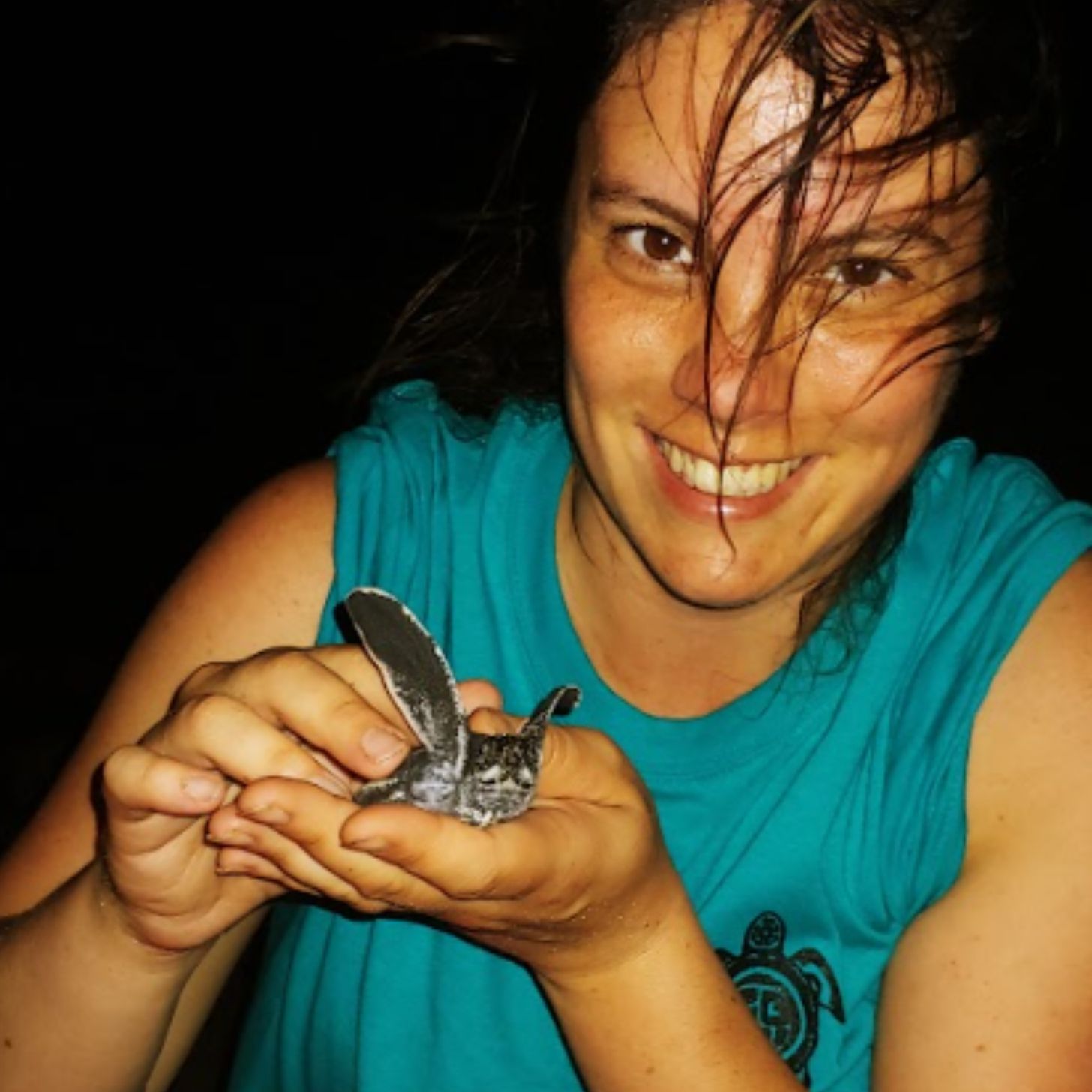
“That experience was incredible. Not only do you get to be up close to them, but you’re working in and around them and helping the species with data collection to save their future,” Milson explained. “I ended up seeing nine leatherbacks and a baby hatchling while there.”
While she was there, Milson was able to check another sea turtle off her list.
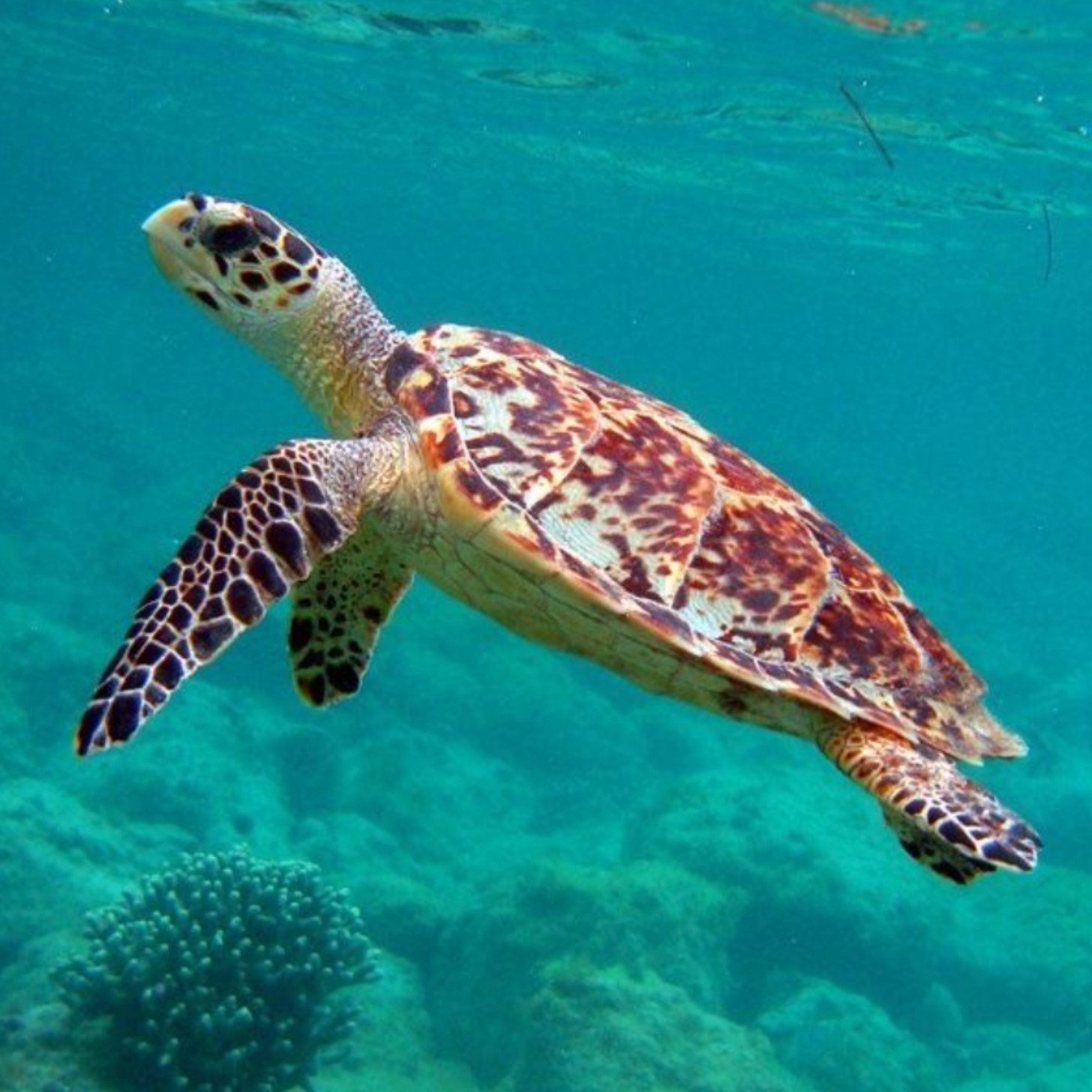
“[I] got really lucky and swam with a hawksbill turtle while snorkeling!” she said. “That amazing feeling you get when you see them for the first time doesn’t fade; it’s like seeing them for the first time all over again.”
The next sea turtle on her list? Loggerheads.
Fortunately, she didn’t have to start from scratch.
Milson had been following the Sea Turtle Conservancy on Facebook for years and knew they were experts in sea turtle conservation. So she reached out to the international organization for help.

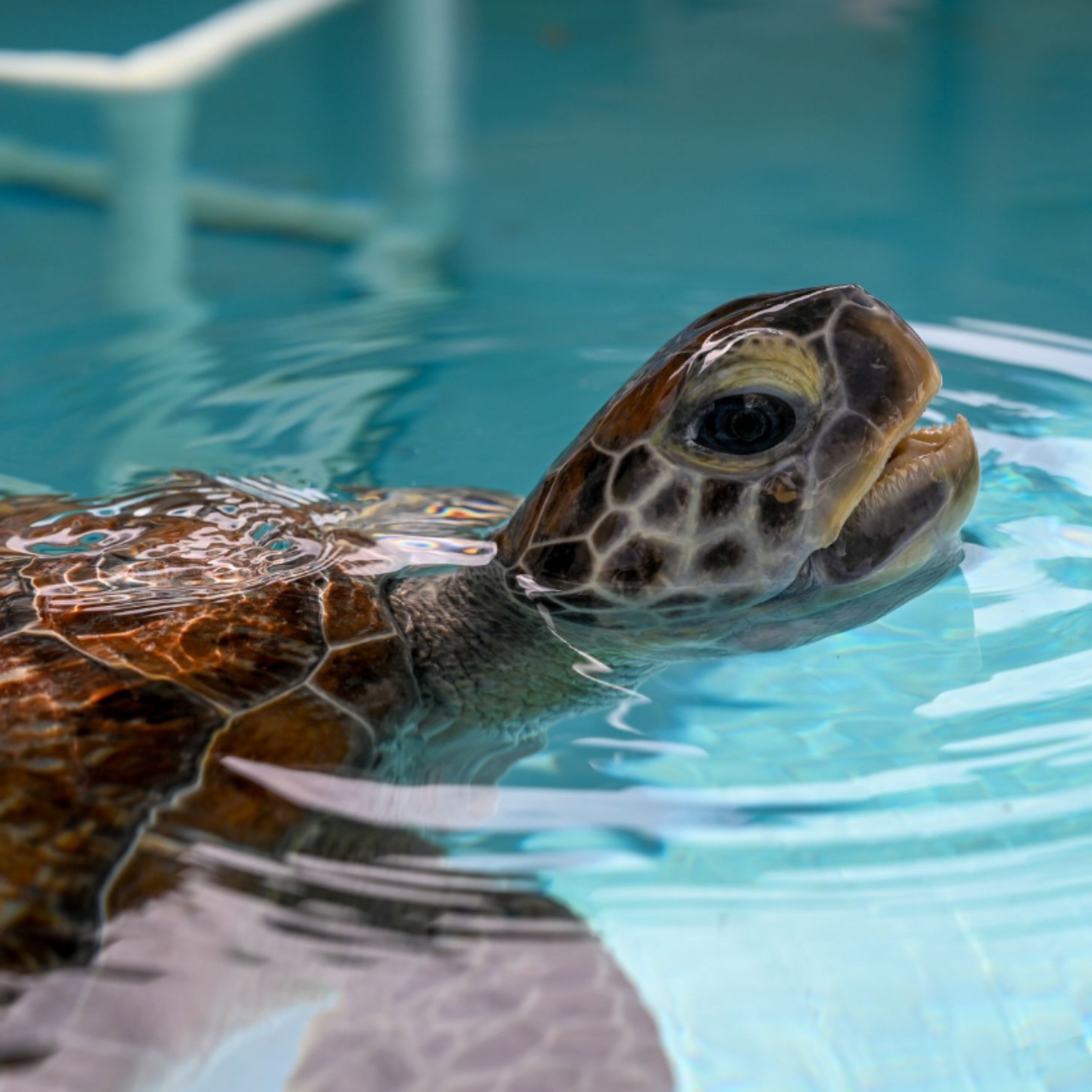
They pointed her to the Loggerhead Marinelife Center in Juno Beach, Florida — a nonprofit that specializes in sea turtle research, rehabilitation, and education.
“I planned my entire trip around that and made sure I visited all the most popular nesting beaches around,” she said. “No luck seeing a loggerhead out in the wild, but I did see many at the center, and that place was so inspiring.”
After Florida, Milson still had three sea turtles left. She set her eyes on finding the Olive ridley sea turtle and signed up for another volunteer program through Working Abroad — this time in Costa Rica.
“If I thought I was lucky before, in this experience, I got to see and work with 53 Olives,” Milson said, going on to describe the volunteer experience as the hardest she’s worked in her “whole life.”

“You would go out and do an all-night walk on the beach, and during the day, we had cleaning duties and [built] a new hatchery for their eggs,” she said.
But Milson said it was time and effort well spent.
“I can’t believe something I’ve been a part of will be around for years to come,” she marvelled.
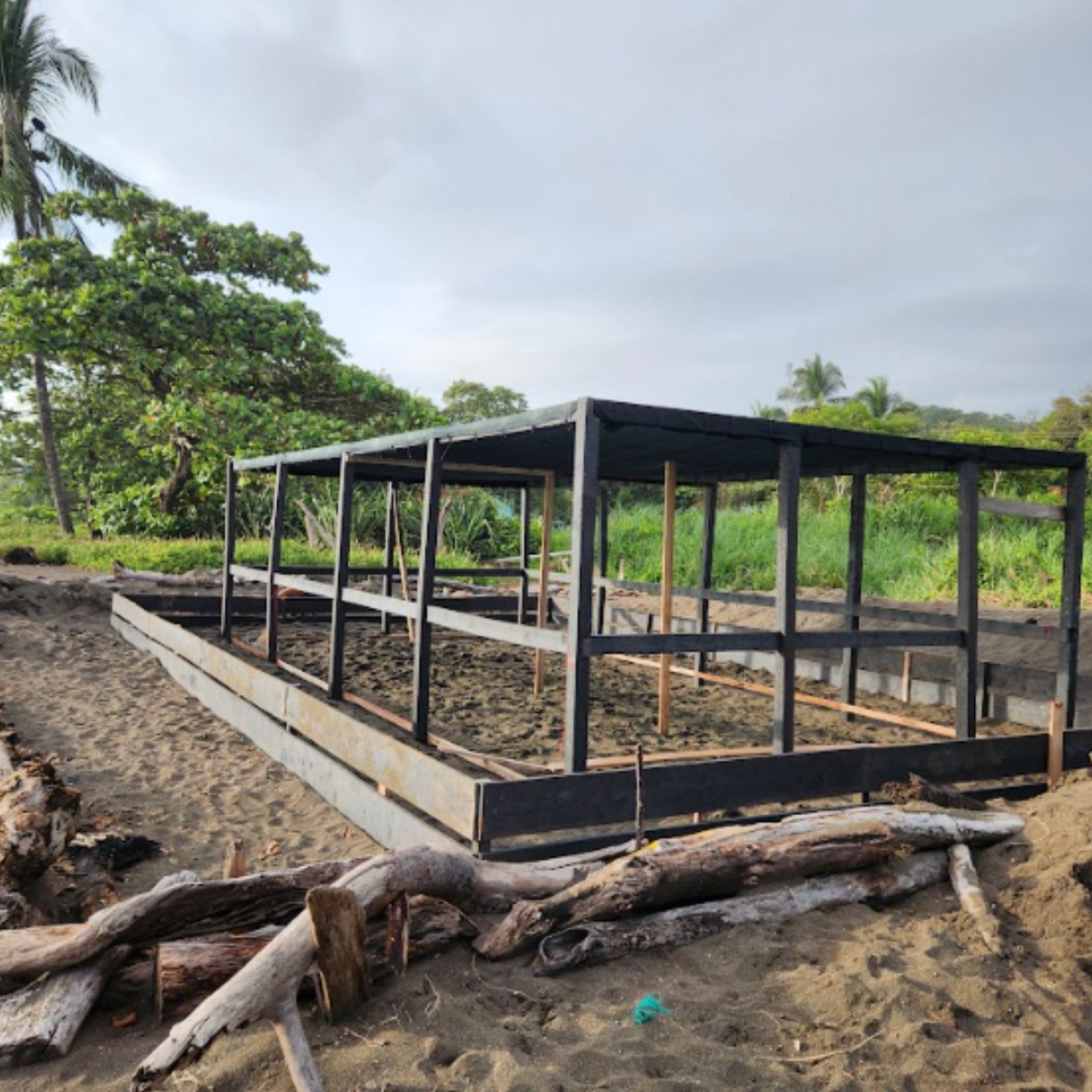
Five down and two to go. According to Milson, this is where things got complicated.
“Kemp’s ridleys are only found in one spot in the world and are the most endangered,” she said. “I spent a week in Texas on Padre Island just driving the beaches and camping on them, just hoping for the best.”
In the end, Milson turned to South Padre Island’s local rehabilitation center, Sea Turtle, Inc., for help. They arranged a meeting so that Milson could meet Hang Ten, a Kemp’s ridley sea turtle with a rare condition.
“Hang Ten hatched from Nest #23 during our 2009 nesting season with a unique birth defect,” Sea Turtle, Inc. explained on its website. “Her front flipper was forked and curled underneath her body. She was released on the beach with the rest of the hatchlings from her nest, but washed up several hours later.”
Although the hospital initially planned to release her when she grew to a larger size, they ultimately realized that she could never survive in the wild.
“When she was smaller, she traveled to local events and schools to educate the public,” Sea Turtle, Inc. shared, adding that she’s too big to travel now, but visitors can find her “happily eating shrimp on any given day.”

And that’s how Milson found her on the day she came to Padre Island.
“Hang Ten and I had a pretty special bonding moment while there,” Milson said. “This was my favorite moment with a turtle yet.”
After that, Milson only had one sea turtle on her list: the flatback. But she had her work cut out for her, as flatbacks are only endemic to Western and Northern Australia.
Through her research, she found the West Pilbara Turtle Program, a program that tasks community volunteers with monitoring turtle nesting beaches and counting turtle tracks and nests. Through the program, Milson volunteered in the small coastal town of Point Samson.
“I was nervous about accomplishing my goal, but stayed positive and spent my free time relaxing by the water,” she said. “If I have had this much success so far with this journey and it’s all I’ve been thinking about, then surely the universe knows it, and I don’t need to get all worked up about it.”
Four days into her seven-day volunteer trip, Milson began to worry.
“It wasn’t easy, but the coordinator gave me even more shifts so I could have more chances,” she said.
That very day, Milson returned to the beach to find her fellow volunteers gathered around a sand dune, greeting her with huge smiles.
“Everyone was aware of why I was there and everyone was cheering for me,” she said. “I asked why they wouldn’t stop looking at me, and everyone at the same time pointed to the water.”
It was a massive flatback, over 150 pounds in size.
“What a sight it was, seeing that turtle coming out of the water and crawling up the sand,” she said. “All of my experiences had been in the dark with red flashlights. But this one, and on my last adventure, she decided to come out during the day for me to catch it all.”
Milson's eyes flooded with tears.
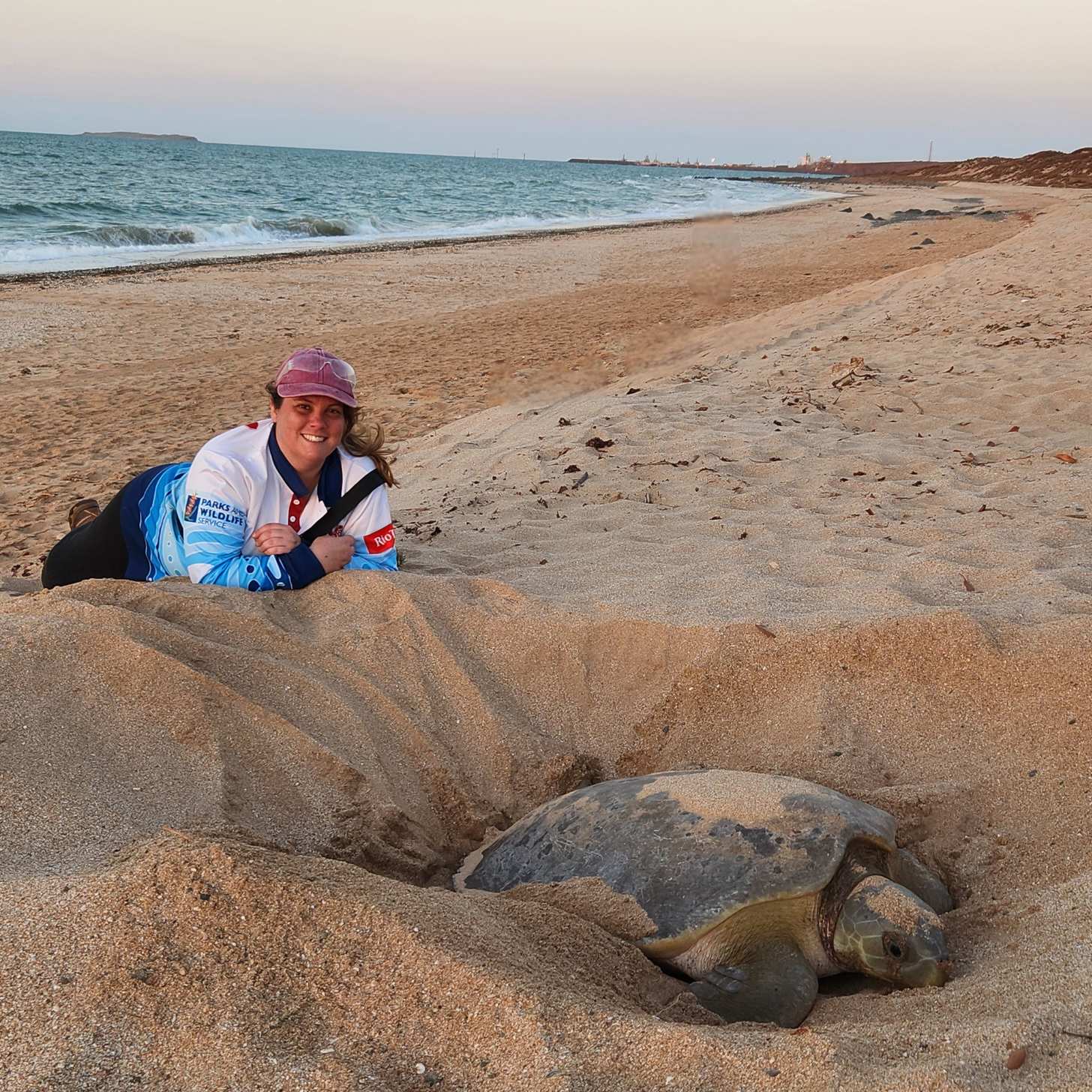
“I just stood there and soaked it all in,” she added. “[It] ended up being a really busy night, and I saw 14 turtles total while there.”
In fulfilling her dream of seeing all seven species of sea turtles, Milson helped protect them along the way.
By conducting research in Grenada, building egg hatcheries in Costa Rica, and monitoring nests in Western Australia, Milson’s everyday actions on nesting beaches around the world put protective measures in place to help generations of future sea turtles.
It’s the kind of grassroots work that is reminiscent of Jane Goodall’s advice in one of her last interviews.
“We have this stupid saying, think globally, act locally, but no,” she told Dax Dasilva, the founder of the environmental nonprofit Age of Union, in July. “Act locally first and do something.”
“What do you care about in your community?” she asked. “Maybe you don’t like the litter … do something, organize beach cleanups, get a group together to plant trees where there’s a little area from, you know, nothing growing.”
“Just do something that’ll make you feel better,” Goodall emphasized. “And then you want to do more, and then you will inspire others to join in.”
On May 4, Working Abroad celebrated Milson’s accomplishment.
“Huge congratulations on achieving your turtley dream, Nicole,” the organization shared on Instagram. “We wonder: What animal will Nicole have to find all of next?!”
You may also like: Scientists were delighted by the appearance of a rare rescued sea turtle. Then they ran a DNA test
Header image via Nicole Milson
The Imperial Lakes Nature Park of the Australian Outback is not known for its turtles.
But in January, a group of students from La Trobe University — a research university in Melbourne — discovered a staggering number of freshwater turtles living in its lakes.
Over 500, in fact.
“What makes these turtles unique is that they are out in very high numbers in a very arid part of Australia,” Ph.D. candidate Wesley Smith told the Australian Broadcasting Corporation.
“To get out here [to the lakes] they would need either outside assistance or a very large flood to move out here,” Smith said.
“Or,” he added, “they just had to have been out here for thousands of years.”
Among the more than 500 turtles, the researchers identified the eastern long-necked turtle, eastern short-neck turtle, and broad-shelled turtle species
Emma Kynaston, a Master’s student on the research team, was shocked by the discovery, saying that broad-shelled and long-necked freshwater turtles were much more suited to “overland movement” than staying in one habitat for long periods of time.
In recent decades, both species have faced population declines due to habitat loss and water quality issues related to climate change.
The eastern long-necked turtle is particularly vulnerable in southern Australia, and the broad-shelled turtle is listed as endangered in Victoria.
“I was just surprised they were out here in general,” she said. “I was expecting 100 or so … we got five times that.”
More shocking than the turtles themselves were the conditions in which they were found. When the researchers found them, they were in dire straits, with the lakes on the verge of drying up for the first time in their 130-year history.

“[The turtles] must have been stacked up as though they were in an elevator…there was so little water there,” said Simon Molesworth.
Simon Molesworth is the president of Landcare Broken Hill, a grassroots network that partners with communities, government, and organizations to promote sustainable land management.
In January, after the research students raised the alarm, they put out an urgent call for emergency funds to collect enough water to save the lakes — and the turtles who lived there.
Ultimately, the nation-wide crowdfunding campaign raised more than $100,000 AUD (roughly $72,406 USD).
“It bought us seven weeks of time before the rain came on the very last day of February,” Molesworth said.
After record-breaking rains hit in late February and early March, the two park lakes were full again. And Molesworth said they had enough funds leftover from the campaign to survive Outback’s next dry period.
“We’ve basically set up a strategy whereby we can keep water in the lakes,” he said.
Before the turtles were discovered and saved, Smith said there was very little data available on turtle populations in arid areas. But after months of research, he and his peers have a much better grasp on the turtles living in the Darling and Lachlan river systems.
“This population seems to be thriving,” said Smith, who hopes to return next year for more research. “Which certainly is a good thing, but we’ll have to dig into it a bit more.”
You may also like: Luxury resort saves over 600 injured sea turtles and helps hatch 120,000 more
Header image via Iulian Florentin Stefancu
While many of us might imagine death as our final mark on the earth, the environmental impacts of conventional burial methods leave behind a legacy most of us wouldn’t be too proud of.
For instance, non-renewable resources like lumber, plastic, steel, and other metals are used for caskets or vaults. Plus, embalming fluids contain toxic chemicals like formaldehyde that pollute soil and water as they seep from burial sites.
Traditional cemeteries also require a lot of land use without much opportunity for natural degradation.
Additionally, cremation has a precarious environmental impact, releasing anywhere from 400 to 535 pounds of carbon dioxide per body, along with other air pollutants like mercury, nitrogen oxides, and particulates.
So, when it comes to end-of-life options, people are considering what it looks like to leave the earth with more care and intentionality. And it’s taking off.
The green burial industry is expected to surpass $1 billion by the end of 2030, and a consumer survey by the National Funeral Directors Association found that more than 60% of people would be interested in exploring green alternatives to traditional burials.
The following three concepts are among many “green burials” that people are using to make their peace with the planet we call home.
Making new life through artificial reefs
United Kingdom-based startup Resting Reef turns the ashes of a loved one into an artificial reef that improves marine biodiversity and restores coral reefs.
Using any cremated remains, the startup combines remains with crushed oyster shells and concrete, and then molds it into reef structures, which are placed underwater for fish species to thrive.

They can now do this with both human and pet remains. They are also now offering a new service called the 'Plan Ahead Club,' which allows people to choose in advance to become a Memorial Reef as their end-of-life wish while they are still alive.
Those who express interest in planning ahead in this way can then formally sign a letter of wishes to become a reef, and can also visit existing Resting Reef sites at a discounted rate. They can also help make decisions about where future reefs will be developed.
Resting Reef has placed 24 memorial reefs in a site in Bali, Indonesia thus far. After tracking its progress, it found that the reefs attracted 84 fish species and achieved fish diversity “14 times greater than nearby degraded areas.”
“Cemeteries should be places that reconnect us with nature and remind us that we’re part of a larger ecosystem,” Resting Reef co-founder Aura Murillo Pérez told The Guardian.
“It’s time for the death industry to change: we want to shift the industry from focusing on death to life and regenerate growth.”

Renewing rest in a mushroom casket
Based in the Netherlands, startup Loop Biotech is transforming fungi into a final resting place. Its mushroom caskets are made from mycelium, or living fungal fibers, that grow in the shape of a pod in just seven days.
Then, a person is placed on a bed of green moss inside the pod and buried. While it’s unclear how long it takes for the body to decompose in this vessel, the mushroom coffin itself decomposes in just 45 days. The pod and human remains also enrich the surrounding soil as they decompose.
Since 2021, Loop Biotech has facilitated more than 2,500 burials using mushroom caskets all over Europe, and recently had its first service in North America.

“I wanted to create a product that would enrich our planet instead of polluting it,” CEO and founder of Loop Biotech, Bob Hendrikx, told Maine Public Radio.
“I don’t understand how we can put all these chemicals in the soil, the same soil we hopefully someday have our grandchildren feed themselves from.”
Returning to earth through human composting
In 2017, Katrina Spade founded Recompose, which calls itself the world’s first human composting company.
Human composting is a process in which human remains are turned into soil through a process that uses organic material like wood chips, alfalfa, and straw to break down the body over several weeks. Nitrogen, oxygen, and carbon decompose the remains like food composting might, and the process can be sped up with moisture, heat, and vessel rotation.
From there, contents are left to cure for several weeks until all that’s left is nutrient-rich soil. There is no need for toxic embalming chemicals, so the soil can be used like any other soil.
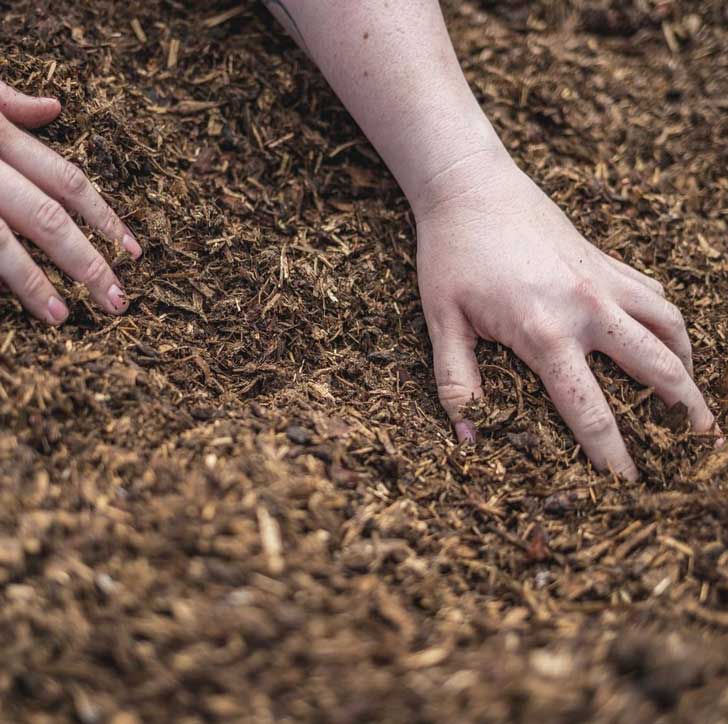
Some families may choose to use it to plant flowers or trees in honor of their lost loved one. About 14 states across the country have legalized human composting, with regulations and resources allocated to local mortuaries.
Spade said she is “thrilled to see so many states legalizing the process, and so many people embracing the process.”
“There’s this interest in choosing something that feels more meaningful, and so it’s not only folks who are concerned about the environment,” she told State House News. “It’s also people who love the idea of returning to nature in some way.”
A version of this article was originally published in The 2026 Environment Edition of the Goodnewspaper.
You may also like: What can you, as an individual, actually do about climate change? Meet the woman who will help you figure it out
Header image courtesy of Loop Biotech
“Venba” is a video game that takes players on a journey, following an Indian mother’s story of immigrating to Canada, through food.
Unlike other cooking games that have more of an “arcade” approach, in “Venba,” players cook South Indian cuisine through puzzle mechanics, which creator Abhijeeth (Abhi) Swaminathan says puts a focus on the recipe themselves.
The cozy gameplay features a “90s cartoon aesthetic” and incorporates a Tamil soundtrack, while players connect through family storylines, as a mother and son work to restore age-old recipes with their own unique flair.
Developed by Toronto-based Visai Games, the premise of the game follows a couple who moves to Canada from India, highlighting the main character — and mother — Venba. She and her husband have a son named Kavin, and although she wants to teach her son to cook, pages from her recipe book have been ripped up, instructions lost to the passage of time.

Players then must learn to recreate the recipes through puzzles, while Kavin grows up and works to reconnect with his South Asian heritage.
“Especially in immigrant families, I find food becomes the bridge between first-generation immigrants and their assimilated children,” Swaminathan told gaming outlet Game Developer.
“I thought it would be interesting to explore this story through the lens of food. I wanted to explore how the family grows and changes in their time in Canada. To measure if something is changing, you need something that stays constant, and to me, food seemed like the perfect fit.”

Something that stands out is also that Kavin speaks English, while his mother, the titular Venba, speaks Tamil. The choice to lead with a maternal character was intentional, as well as capturing the divide between immigrant parents and their children.
“A lot of the [existing] media … focuses on immigrant pain or parents really pushing for their culture, and they want you to speak the language,” Swaminathan told NPR.
“I wanted to hone in on that. Why, though? Why is it important to them? What have they given up? What have they sacrificed? I thought that was left untold, and that's what always bothered me … That's where I think the effort to capture that came from.”

The game is now available for purchase on Steam and has a slew of “very positive” reviews from players — many of which affirm Swaminathan’s efforts to make it with love.
“My producer said this is the kind of game that would make people call their moms,” Swaminathan said. “I remember thinking that if that happened, I would be really happy with it. Since the game released, there’s been an outpour of accounts of people contacting me to say that they called their mom as soon as they finished the game.”
A version of this article was originally published in The 2025 Food Edition of the Goodnewspaper.
You may also like: While this restaurant was being renovated, workers learned Spanish to support Hispanic cooks
Header image courtesy of Visai Games/Steam
In his first year back in office, President Donald Trump made it clear that rolling back environmental protections was a priority, freezing funds, cutting extreme weather preparedness, and weakening pollution protections.
However, despite the administration’s ongoing opposition to environmental laws, Americans are largely united when it comes to reinstating or strengthening ecological standards.
A new study from the Pew Research Center, a nonpartisan advocacy organization, found that six-in-ten Americans believe stricter environmental laws and regulations are “worth the cost.”
The survey, which polled 36,908 U.S. adults across all 50 states, showed a national majority of support. Opinions did vary from state to state, with residents from D.C. and Minnesota having the strongest support for tougher environmental regulations at 71%.

This latest research followed a 2024 Pew Research poll that found that the public’s trust in scientists was on the rise, with three-quarters of Americans saying they had a great deal or a fair amount of confidence in scientists to act in the best interests of the public.
In a panel discussion with the American Association for the Advancement of Science, Alec Tyson, the former associate director of research at Pew Research Center, emphasized that the public’s rising confidence was most marked among Republicans.
“Confidence in scientists to act in the best interest of the public [among Republicans] is up five points in the last year,” Tyson said. “That's a statistically significant uptick and the first increase we've seen among Republicans since the pandemic.”
A version of this article originally appeared in the Environment Edition of the Goodnewspaper
Header image via NPS / Jacob W. Frank (Public Domain)
Back in January 2025, a good Samaritan walking along Lennox Head Beach in New South Wales, Australia, called in a sighting of a stranded sea turtle.
Marine biologists at Australian Seabird & Turtle Rescue quickly made their way to the scene, where they found an adult green sea turtle in dire straits.
“She was lethargic, underweight, and covered in a heavy epibiota load, a clear sign she’d been unwell for some time,” ASTR shared on Facebook.
They named the female turtle Kalani, and after a quick examination, relocated her to their partners at Byron Bay Wildlife Hospital.

In addition to identifying epibiota — organisms including algae, barnacles, and leeches that live on the surface of a marine animal — veterinarians noticed she had a laceration on her left hind flipper and showed signs of possible renal failure.
Sea turtles don’t always face health concerns when they have epibiota on their bodies. In fact, healthy reptiles can scrape them off with their flippers.
Kalani was sick and injured, however, meaning she didn’t have the energy to control the epibiota, making it increasingly harder to swim because she was weighed down by the organisms on her exterior.
And she certainly isn’t the only sea turtle facing these challenges; As climate change and other human threats like fishing and pollution impact these animals’ homes, they are more at risk of injury and illness, making it harder to survive.

“But Kalani is a little fighter,” ASTR said.
Over the course of six months, veterinarians and conservationists took care of the turtle, as they do with the many they see every year.
They scraped off the epibiota from Kalani’s body, gave her medication, and monitored her during months of rehabilitation. Her recovery was slow, but after a few weeks, she began gaining weight and strength once again.
“Over the past six months, she’s continued to improve and is now thriving in our pre-release tank, strong, spirited, and very much the boss of the space,” rescuers at ASTR shared on social media in July 2025. “While she’s still under our care for a while longer, we’re thrilled with her progress so far.”

At this time, the rescue also shared “after” photos, featuring a shiny and healthy-looking green sea turtle.
“As turtles get healthier, their personalities really start to shine,” ASTR assistant general manager Amanda Philp told The Dodo. “Kalani is now … the first to appear at feeding time. We all love her.”
By September, it was time for Kalani to go back home into the ocean.
“It's been amazing to watch her defy the odds,” Philp told The Dodo. “She’s now healthy and truly flourishing.”

On a sandy beach, Kalani flapped her flippers alongside four other green sea turtles who were rehabilitated through ASTR: Bumble Bee, Vegas, Ugg, and India.
“Every release is a true celebration,” the ASTR team shared on Facebook.
“We are so grateful to our team, volunteers, and supporters who make moments like this possible. A heartfelt thank you to everyone involved in their rescue, rehabilitation, and release, we couldn’t do it without you.”
You may also like: 500 turtles saved from dying lake: 'There was so little water. They were stacked up as if they were on an elevator'
Header image courtesy of Australian Seabird & Turtle Rescue
According to the United Nations Human Rights Office of the High Commissioner, Israel has destroyed 90% of Gaza’s schools, all of its universities, numerous archives, museums, and historical sites, and at least 13 libraries since October 2023.
While violence has not entirely stopped, ceasefires have allowed some Palestinians to begin to rebuild — even without the guarantee that it will last.
One such example is the Phoenix Library, a project of Omar Hamad and his friend, Ibrahim Massri. Together, the pair has raised over $100,000 and secured a location to rebuild Gaza’s first new public library.

“There are moments in history when the creation of a library becomes an act of freedom itself,” the duo shared on a fundraising page.
“Here in Gaza, after the genocide, Omar and Ibrahim understood that dreams protected by books do not yield — that knowledge has the strength to pull a city back from ruin.”
Hamad has always been a devoted reader. As a child, when he first learned that Israel monitored curriculum in Palestinian schools, he would hide pocket money until he could buy a few books at the end of each month, which he describes as “the first seed of rebellion.”

Later, when he received an evacuation order on October 8, 2023, he packed up the books he collected over the years — as many as he could carry as he fled his home. His collection dwindled as he was forced to evacuate numerous times.
When a hospital he was sheltering in was attacked, he left his books behind with a note: “Whoever finds these books, please take care of them.”
Miraculously, the books survived and became the foundation of the Phoenix Library, which is growing every day with new books donated from around the world, along with 1,000 collected from rubble throughout Gaza.

And as of April 21, 2026, the library is now open to the public.
In addition to being home to a dedicated collection of books, the founders say the library is there to be a haven for Palestinian writers and poets, as well as children and students whose education has been stalled amid what human rights experts assert is a genocide.
For Massri, who studied English Language Teaching at Al-Aqsa University and later became a teacher, freelance translator, and writer, the Phoenix Library is a return home.

“Through it all, I never let go of the belief that we would rise again. I wrote my story and the stories around me, hoping the world would finally see the truth of our stolen homeland — a truth the occupation has tried to silence for decades,” Massri shared in a written fundraising statement.
“I believed, and still believe, that every destroyed home carries the seed of a new library, and that the word itself is a form of resistance.”
A version of this article was originally published in The 2026 Storytelling Edition of the Goodnewspaper.
You may also like: She was the first female CEO of an Afghan tech company. Now she teaches girls under Taliban rule in secret classrooms
Header image courtesy of Phoenix Library/Instagram
Thanks to early projection models, climate scientists have long suspected that electric vehicles lead to an undeniable reduction in air pollution. But a new study from the Lancet Planetary Health journal used satellites to measure just how big that impact is.
From 2019 to 2023, a national team of scientists measured nitrogen levels across nearly 1,700 ZIP codes in California, the state with the highest rates of EV use in the country. They found that for every increase of 200 electric vehicles, nitrogen dioxide emissions decreased by 1.1%.
Sandrah Eckel, a public health professor at the University of Southern California’s Keck School of Medicine and lead author of the study, said the results were “remarkable.”
“We’re not even fully there in terms of electrifying, but our research shows that California’s transition to electric vehicles is already making measurable differences in the air we breathe,” Eckel said in a university press release.
“These findings show that cleaner air isn’t just a theory — it’s already happening in communities across California,” she added.
Eckel and her peers said that their “revolutionary approach” to studying emissions could be replicated anywhere in the world, inviting other researchers to take part.
“Satellite-measured NO2 could be used across the globe to assess changes in NO2 from ongoing climate mitigation efforts to reduce fossil-fuel combustion, with these data informing policy decisions to protect public health today and in the future,” the authors noted.
A version of this article originally appeared in the 2026 Environment Edition of the Goodnewspaper
You may also like: New study: Most Americans, Republicans included, believe that saving the environment is 'worth the cost'
Globally, it’s estimated that over 500 billion disposable coffee cups are used every year.
Traditional “paper” cups contain plastic linings that make them hard to recycle and that can release microplastic particles into hot drinks.
It’s not only bad for people’s health — it’s bad for the planet.
Notpla, a play on “not plastic,” wants to make trips to the coffee shop less wasteful. So it trialed the first-ever sustainable espresso cups coated with seaweed during the Earthshot Prize in Rio in 2025.
Now, Notpla has secured a €4 million Horizon Europe grant (about $5.4 million USD) to develop a market-ready coffee cup that is fully home-compostable.
“Notpla uses seaweed, one of nature’s most abundant and fastest growing resources, to replicate the qualities of plastics, replacing millions of items of single-use plastic packaging,” said Pierre-Yves Paslier, co-founder of Notpla, in a press release.

“Other benefits of using seaweed include: It doesn’t compete for crops on land, actively sequesters CO2 and de-acidifies the ocean, boosts ocean diversity, and uplifts coastal communities, as well as being biodegradable.”
“The disposable coffee cup looks like a simple invention, but it hides a complex problem,” Paslier said. “This project gives us the chance to tackle that issue at its source.”
Karlijn Sibbel, the Chief Innovation Officer of Notpla, told Good Good Good that nature has already spent “billions of years perfecting packaging that doesn’t outlive its contents: Fruit.”
“That's the blueprint we follow at Notpla,” she said. “With our uncompromisingly natural solution, European funding, and a consortium covering raw materials all the way to real-world end-of-life testing, we're ready to solve one of the most complex packaging challenges: replacing the plastic-coated coffee cup.”

A version of this article originally appeared in the 2026 Environment Edition of the Goodnewspaper
Header image via Notpla
Every day the Good Good Good team collects the best good news in the world and shares it with our community. Here are the highlights for this week!
If you want to get good news in your inbox every day, join the Goodnewsletter — the free daily newsletter designed to leave you feeling hopeful.
The Best Positive News We’re Celebrating This Week —
In a ‘historic breakthrough,’ 59 countries backed voluntary roadmaps to wean the world off of fossil fuels
At the first “Transitioning Away from Fossil Fuels” conference held in and hosted by Colombia, governments were asked to develop “roadmaps” for ending the production and use of fossil fuels, which will serve as the foundation for a new initiative to wean the world off coal, oil, and gas.
The roadmaps also go further than the climate plans published under the Paris agreement, which only address domestic greenhouse gas emissions and don’t account for the impacts of fossil fuel exports.
Almost half of the countries that attended produce fossil fuels, and will provide plans for winding down their output. All participants agreed to support poorer countries in developing their roadmaps, reassess fossil fuel subsidies, and more.
Why is this good news? For years, the marquee UN climate conference failed to produce clearly defined goals and action steps to phase out fossil fuels. In just its first year, this new conference achieved historic agreements and breakthroughs to hold countries accountable.
Two college students led a crusade to end herbicide use on their campus. Now they’re doing the same at schools nationwide
Polish fundraiser for childhood cancer patients breaks records with nine-day livestream
On April 17, Polish influencer Piotr Hancke started a livestream to raise money for the Cancer Fighters Foundation, a nonprofit that supports children with cancer.
The stream then stretched into a nine-day event, as Hancke was joined by athletes, musicians, and celebrities from across Poland, with many shaving their heads with Hancke in solidarity.
According to the Guinness World Records, the event more than tripled the previous livestream fundraiser record, raising over $76 million.
A spokesperson for the Cancer Fighters Foundation said, “We're reaching for the stars, reaching for space, to help those who need it most, the innocent children who fight the hardest battles every day.”
→ Read more
‘Law & Order: SVU’ star Mariska Hargitay has now helped pass laws to end rape kit backlogs in all 50 U.S. states
On the set of “Law & Order: Special Victims Unit,” Mariska Hargitay’s eyes were opened to the pressing realities of sexual assault, domestic violence, and child abuse in the United States.
She started the Joyful Heart Foundation in 2004 to help make a difference, most notably through its “End The Backlog” campaign. After 16 years of the program, Hargitay announced that Maine became the final state to have enacted at least one pillar of rape kit reform in “a watershed moment.”
Now, all 50 states, Washington, D.C., and Puerto Rico have some form of rape kit reform in place, to which Hargitay told survivors, “This milestone belongs to you.”
Why is this good news? Rape kits consist of the evidence collected by a professional after the examination of someone who has survived sexual assault, but they often end up in long queues for processing. Hargitay’s foundation estimates there are still 100,000 untested rape kits yet to be discovered across the country — these laws will help change that.
This teacher in Afghanistan tested water fountains every day to protect her girls from poison
→ Read more
Solar and wind outpace fossil fuels as ‘coal comeback’ is debunked
Although some industry professionals predicted that the ongoing energy crisis would lead to a potential “coal comeback,” a new report from the Center for Research on Energy and Clean Air found the opposite.
In fact, CREA shared that coal-fired generation was flat in March on a global scale, with seaborne coal transport volumes falling 3% globally — a new low since 2021, during the height of the COVID-19 pandemic.
As fossil fuel power generation continues to falter, renewables are helping buffer the energy crisis caused by the Strait of Hormuz blockade. Before its closure, the Strait was used for nearly a fifth of global Liquefied Natural Gas transports. But according to the CREA, the solar and wind capacity added in 2025 is enough to offset that loss twice over.
Scientists are testing which tree species combinations best support flourishing, biodiverse forests
Countries around the world have committed to massive tree-planting initiatives, but some of them have been poorly designed and managed. A new research project hopes to make them as effective as possible.
Ecologists at the Smithsonian Environmental Research Center in Maryland are building a 22-acre forest of carefully planned plots of varying tree species combinations to test how it affects their growth and the surrounding environmental benefits.
It’s part of the Functional Forests project, which will plant 33,518 saplings from 20 different species in 200 different sections to study various reforestation goals like fire resistance, climate resiliency, attracting wildlife, supporting pollinators, producing food, and more.
Why is this good news? Large forests support biodiversity, prevent erosion, protect water quality, absorb massive amounts of carbon, cool the surrounding environment, and may even boost mental and physical health.
Humans deforest about 25 million acres every year, a pace that isn’t sustainable. To save time, money, and resources, we need to reforest in a way that best supports their flourishing.
→ Read more
Scientists filmed a whale birth. The surprise: Mom had many helpers.
→ Read more (Gifted link)
The WHO global alliance has delivered 100 million childhood vaccine doses since 2023
In 2023, the World Health Organization and Gavi, the vaccine alliance, launched “The Big Catch-Up” during World Immunization Week. The initiative, which concluded this March, was geared towards vaccinating children aged 1 to 5 years across 36 countries.
The project was largely focused on the world’s poorest countries, with nations in active conflict needing the most urgent care.
Although the final data is still being compiled, “The Big Catch-Up” initiative vaccinated at least 18.3 million children worldwide and protected them against diseases such as diphtheria, polio, and measles. About 12.3 million of those children had never had access to a vaccine before.
→ Read more
A solar ranch in Tennessee is aiming to prove that grazing cattle under panels is a win-win for the land, farmers, and animals
On a 40-acre farm near Nashville, a pilot project is aiming to prove that cattle-grazing is the next frontier in agrivoltaics, which has so far mostly only involved growing crops or grazing sheep beneath solar panels.
The site has addressed challenges that past solar installations have faced on cattle grazing land. With software upgrades that allow farmers more manual control, the panels shade for the cows, keeping them cooler and requiring less water to drink, and help the soil below retain moisture, too.
If it’s successful, it could help jump-start new projects to meet the rapidly rising energy demands, without adding more carbon emissions, and help ranchers maintain their land and earn a significant amount of money for leasing the land to solar companies.
Why is this good news? The U.S. and the world need to rapidly expand clean energy sources to speed up the clean energy transition. The U.S. has significantly more cows than sheep, and farmland is often ideal for solar farm installation, but it can’t come at the expense of farmers’ livelihoods. This project could be a solution to both.
You may also like: Farms in central Washington boost their yield with solar energy
Mama polar bear adopted a cub in the wild, shocking scientists. Now you can track their journey
→ Read more
In the last 20 years, poverty in Paraguay has plummeted from over 50% to just 16% in 2025
In just two decades, a third of Paraguay’s population escaped poverty, 300,000 in the last two years alone. In the last 20 years, poverty in the country declined from over 50% to just 16% last year.
Experts credit the government’s focus on productivity and jobs, and labor income growth was the primary driver of poverty reduction in 2025. And while some areas still need more improvement, it’s a notable improvement.
Additionally, social programs in the country have supported human well-being. Paraguay’s “Hambre Cero” (or Zero Hunger) program now feeds over one million children across its public school system, sourcing food from family farmers and small businesses within communities.
→ Read more
Australian research students came together to save 500 turtles found in a dying lake
A group of students from La Trobe University — a research university in Melbourne — discovered 500 freshwater turtles living in the Imperial Lakes Nature Park.
Two of the species discovered have faced population declines due to habitat loss and water quality issues related to climate change. And these turtles were facing the same: the lakes were on the verge of drying up for the first time in their 130-year history.
The research students put out a nationwide call for emergency funds to save the lakes and turtles, and ultimately, it raised more than $100,000 AUD (roughly $72,406 USD) — enough to help keep the lakes full through the next dry period.
Even better: Before these turtles were discovered and saved, there was very little data available on turtle populations in arid areas. Now, researchers have a much better grasp on the turtles living in the river systems and how to protect and save them.
Consumerism on Mother’s Day has long been criticized, even by its founder. This is the real reason we should be celebrating
→ Read more
Coffee companies make headway on ‘deforestation-free coffee’ with satellite technology
According to a study in Nature Food, coffee production is responsible for approximately 1% of global agriculture-driven deforestation. To improve sustainability efforts, leading coffee companies are partnering to create the world’s first comprehensive map of global coffee production — completely open to the public.
Using satellite technology, the new initiative will map 1.2 million square kilometers of coffee landscapes across Ethiopia, Tanzania, Kenya, Uganda, Burundi, and Rwanda.
Once the data is used to identify areas of forest loss, the companies have pledged to work with local governments to restore natural landscapes and prevent future deforestation.
More good news of the week —
Kacey Musgraves partnered with Depop to sell items from her wardrobe, and all proceeds will support immigrant children. All proceeds from sales will be donated to the Young Center for Immigrant Children’s Rights, which protects and advances the rights and best interests of immigrant children according to the Convention on the Rights of the Child and state and federal law.
Technology used in a “de-extinction” project will be shared to help with conservation efforts for threatened species. Critics say the “de-extinction” effort is still a huge distraction from “one of the gravest crises on the planet: the accelerating decline and extinction of nature.”
Illinois unveiled a first-in-the-country “green tax credit” for television and film productions that prioritize sustainability. The state saw record-high production spend in 2025 introduced the measure to encourage sustainable filmmaking practices.
Defying the Taliban, FIFA made a landmark amendment to allow the Afghan women’s team to officially play for their country. For nearly five years, Afghanistan’s women soccer players have lived in exile, unable to represent their country’s national team under the Taliban’s ban on women’s sports.
A Toronto man’s HIV was no longer detectable after a bone marrow transplant. He had been living with HIV for 27 years, and if he remains in remission for about two and a half years, he will join 10 people in the world currently considered cured of HIV.
A grassroots initiative is bringing New Zealand’s rare kiwi bird back to the country. Critical ecosystem engineers, before humans arrived in New Zealand, an estimated 12 million kiwi birds roamed the Oceaniac island country — now, only about 70,000 remain.
A U.K. soccer club is building Europe’s first stadium dedicated to women's soccer. The third of its kind in the world, the stadium will bring Brighton & Hove Albion’s Women’s Super League team back to the city, rather than playing about 20 miles away.
A new affordable housing program in Colorado is helping blue-collar workers live closer to where they work. For decades, 75% of the local workforce in Idaho Springs has been forced to commute from out of town.
An anonymous hotline created by Sandy Hook parents has fielded 395,000 tips since first launched in 2014. Early responses to reports of bullying and violent threats have successfully thwarted countless school shootings.
Vietnam removed fences around parks in its capital city, making green spaces more accessible than ever. The move is part of the country’s larger goal to significantly increase park usage in 2026 — and it’s working.
A Canadian First Nation was awarded a huge stake in a planned solar farm in Ontario. Garden River First Nation received a 50% stake in what will be Ontario’s largest solar farm project, making them equal partners and co-owners with Neoen, an international renewable energy company.
England’s new Renters’ Rights Act is now in effect, giving 11 million people more rights. It’s described as the biggest shake-up to renting in the country in more than 30 years and gives more stability and security to those who rent from private landlords.
A Massachusetts farmer converted her cranberry bog into “a living laboratory” for wetland conservation science. The new observatory borders the Tidmarsh Wildlife Sanctuary, which is full of streams, wildlife, and native forests.
A rural town in North Carolina won seed funding for a new neighborhood powered by geothermal energy. The pilot project will heat and cool homes without fossil fuels, while drastically lowering residents’ energy costs.
On the 40th anniversary of the Chernobyl disaster, wildlife has fully reclaimed the nuclear wasteland. Although it remains uninhabitable for humans, local populations of wolves, brown bears, lynx, moose, and d
A Texas job training program is giving formerly incarcerated people a fresh start as solar installers. In the inaugural 22-week training, called “Vulnerable to Vibrant,” 50 participants left with an $18/hour paycheck and a certification in solar installation.
After ICE bought a warehouse in their small, conservative town, locals fought back. Roxbury’s Township Council, an elected body of seven people, all Republicans, passed a resolution affirming that it “unequivocally opposes” modifying town warehouses for ICE use.
San Francisco launched a $300,000 pilot program to help home child care centers switch from gas to electric heat-pump water heaters. The initiative could be a model for other communities around the country looking to decarbonize their buildings and provide cleaner, safer air for children.
Experimental therapies are giving scientists hope that survival rates for pancreatic cancer could substantially improve. (Gifted link) The therapies have radically different approaches to treat pancreatic cancer, one of the most stubbornly deadly forms of cancer.
A species thought to have been extinct for thousands of years was “rediscovered” thanks to Indigenous knowledge. Tambrauw elders described a forest glider they had known for generations, and when combined with earlier photographs, led researchers to verify the continued existence of the ring-tailed glider.
Over half of U.S. states are now considering laws allowing balcony solar, which could save residents hundreds annually. In Europe, plug-in solar installations have been legal for more than a decade.
A decades-long fight to shut down the Line 5 pipeline in Michigan won a key legal battle. The U.S. Supreme Court ruled unanimously that the dispute over the aging oil pipeline belongs there, which is seen as a win for tribes, environmentalists, and the state’s attorney general.
A group of bowel cancer patients is still cancer-free nearly three years after a breakthrough medical trial. The novel approach involved giving patients a short course of immunotherapy before surgery, rather than chemotherapy afterward.
To crack down on puppy mills, Colorado passed a new law that banned the sale of cats and dogs in pet stores. The new bill encourages pet stores to host adoptable animals from local animal shelters.
Iceland, Portugal, and Norway all met their 2024 goal to vaccinate 90% of girls under 15 for HPV. Additionally, every country in the EU now has HPV recommendations in place for adolescent girls and boys.
Cigarette butts are the most common form of litter in the world, with over 6 trillion tossed each year. And because they’re made of plastic, nicotine, tar, and heavy metals, they’re not just a public health risk — they’re an environmental hazard.
Fortunately, researchers have developed a way to recycle discarded cigarette butts — while diverting heavy metals away from soil and water. And they’re doing it by adding discarded butts to clay-fired bricks.
By adding roughly 1% cigarette butt material to the brick mixture, the bricks maintain structural integrity while using less energy during production, and repurposing would-be waste.
“Firing butts into bricks is a reliable and practical way to deal with this terrible environmental problem, while at the same time cutting brickmaking production costs,” said Abbas Mohajerani, lead researcher and associate professor at the Royal Melbourne Institute of Technology.
Not only does the lower energy use reduce energy consumption in brick kilns by 10%, but the lighter bricks also provide better insulation, resulting in lower energy costs for the home.

The researchers believe that if their methods were widely adopted, recycling cigarette butts into building materials could significantly reduce global pollution and help make construction more sustainable.
“My dream is a dedicated brickmaking recycling facility in every country that can recycle butts and solve this pollution problem for good,” Mohajerani said.
A version of this article originally appeared in the 2026 Environment Edition of the Goodnewspaper
You may also like: New study confirms that electric vehicles are already making the air cleaner
Header image via Fatih KÖRKÜ
Many know Erin Brockovich through Julia Roberts’ portrayal of her in the 2000 biopic of the same name, but her legacy as an environmental and human rights activist extends far beyond that.
Following a historic $333 million settlement in 1996 against PG&E for toxic levels of the carcinogen chromium-6 in the groundwater of Hinkley, California, Brockovich continued forging a path as an environmental activist.
In the three decades since, she has spearheaded multiple anti-pollution lawsuits across Missouri, Texas, and New York.
Her most recent advocacy work brought her to Wayne County, West Virginia, where thousands of gallons of oil spilled into a waterway, contaminating a massive source of drinking water.
“I want you to know that I am seeing your messages and hearing your concerns,” she posted online in early 2026. “I didn’t want anyone to think they were being ignored. What you’re dealing with is serious, and your voices matter.”
Throughout her career, Brockovich has amplified the voices of working-class heroes and low-income families. In 2010, she took a no-nonsense approach to corporate scandal in her novel, “Superman’s Not Coming: Our National Water Crisis and What We the People Can Do About It.”
“I want us to understand the importance of water,” Brockovich told People after the book’s release. “I don’t know that we understand the tipping point that we’re at, and what we can do in our own towns to empower ourselves so we have safer water.”
She added, “The hope is when people know better, they do better and they rise up. We can turn that tide. I'm going to believe that until the day I die.”
A version of this article originally appeared in the 2026 Environment Edition of the Goodnewspaper
You may also like: Woman travels the world to see all 7 species of sea turtle — and help save them along the way
Header image via Jim Wallace / Smithsonian Institution and Erin Brockovich film