For some combat veterans, the Fourth of July is not a time to celebrate the independence of the country they love. Instead, the holiday is a terrifying ordeal.
That’s because the noise of fireworks — loud, sudden, and reminiscent of war — rocks their nervous system. Daily fireworks in many U.S. cities in recent weeks have no doubt been interfering with the sleep and peace of mind of thousands of veterans.
This reaction is not unique to veterans with post-traumatic stress disorder, or PTSD. Also affected are millions of others, including civilians, refugees, and first responders.
As a psychiatrist who specializes in trauma and PTSD, I urge you not to overdo an act which causes so much suffering for so many of your fellow Americans.
What is PTSD?
PTSD can occur when someone is exposed to extreme exposure traumatic experience. Typically, the trauma involves a threat of death, serious injury, or sexual violence. Along with war veterans, it happens to refugees; to victims of gun violence, rape and other physical assaults; and to survivors of car accidents and natural disasters like earthquakes or tornadoes.
PTSD can also happen by witnessing trauma or its aftermath, often the case with first responders and front-line workers.
All this adds up to tens of millions of Americans. Up to 30% of combat veterans and first responders, and 8% of civilians, fulfill the diagnostic criteria for PTSD.
And that criteria is not easily met: symptoms of PTSD include nightmares, flashbacks, intrusive trauma memories, difficulty sleeping, avoidance of reminders of trauma, negative emotions, and what we call “hyperarousal symptoms.”

Fireworks can trigger flashbacks
Hyperarousal, a core component of PTSD, occurs when a person is hyper-alert to any sign of threat — constantly on edge, easily startled and continuously screening the environment.
Imagine, for instance, stepping down the stairs in the dark after hearing a noise; you’re worried an intruder might be downstairs. Then a totally unpredictable loud sound explodes right outside your window.
For people with PTSD, that sound — reminiscent of gunfire, a thunderstorm, or a car crash — can cause a panic attack or trigger flashbacks, a sensory experience that makes it seem as if the old trauma is happening here and now.
Flashbacks can be so severe that combat veterans may suddenly drop to the ground, the same way they would when an explosion took place in combat. Later, the experience can trigger nightmares, insomnia, or worsening of other PTSD symptoms.
Those of us who set off fireworks need to ask ourselves: Are those few minutes of fun worth the hours, days, or weeks of torment that will begin for some of our friends and neighbors — including many who put their lives on the line to protect us?

Who else is affected?
Millions of others, though not diagnosed with PTSD, may similarly be affected by fireworks. One in five Americans have an anxiety disorder, many with symptoms of hyperarousal.
Also impacted are those with autism or developmental disabilities; they find it difficult to cope with the noise, or just the drastic change from life routines. Then there are people who have to work, holiday or not: nurses, physicians and first responders, who have to be up at 4 a.m. for a 30-hour shift.
How to reduce the negative impact
There are ways to reduce how fireworks affect others:
- For those with PTSD, the unexpected nature of fireworks is probably the worst part. So at least make it as predictable as possible. Do it in designated areas during designated times. Don’t explode one, for instance, two hours after the designated time window. And avoid setting them off on July 3rd. People are less prepared then.
- If you’re aware that a veteran or trauma survivor lives in the neighborhood, move the noise as far as possible from their home, and give them prior warning. Consider putting a sign in your front yard noting the time you’ll set the fireworks.
- Remember, it doesn’t have to be super loud to make it fun. Consider using silent fireworks. And you don’t have to be the one who lights the fireworks. Simply enjoy watching while your city or township does it safely.
Coping with the stress
If you can’t stand fireworks, there are ways to reduce the stress:
- If the fireworks are a scheduled event, know the time they start and end.
- Use earplugs or background sounds or music to reduce the intensity of the noise.
- Be with loved ones who will support and help distract you.
- Talk to your therapist, psychiatrist or primary care doctor for help in managing PTSD and anxiety symptoms. Effective treatments are available. Your doctor may provide medication that helps during those difficult hours. But definitely do not get medications from others, as some may have serious consequences if not used properly.
And finally, don’t be shy. You can kindly talk with your fireworks-happy neighbors in advance.
This article was written by Arash Javanbakht from Wayne State University, and was originally published on The Conversation.

Header image by Sam Fire via Pexels
The government of French Polynesia announced it is expanding the extent of ocean where extractive industries like seabed mining and industrial fishing will not be allowed. With this move, 30% of French Polynesia’s waters will now be fully protected.
Last year on June 8, French Polynesia, a French overseas territory, established the Tainui Atea marine protected area. It spans nearly 5 million square kilometers (2 million square miles) of its exclusive economic zone, the area of ocean that French Polynesia has exclusive rights to conserve and manage. Some 900,000 km2 of this (about 350,000 mi2), located near the Society Islands and the Gambier Islands, are fully protected waters where no extractive fishing or mining is allowed.
On June 7, 2026, French Polynesia President Moetai Brotherson announced that French Polynesia would expand its fully protected waters by another 520,000 km2 (200,000 mi2) near the Austral, Marquesas and Western Society islands. This brings about 1.4 million km2 (540,500 mi2) or 30% of French Polynesia’s waters under full protection from extractive industries.
“French Polynesia has maintained a moratorium on seabed mining in its waters since 2022, reaffirmed by the Presidency in 2025, and banning it was part of the 2025 protection commitments,” Donatien Tanret, principal officer of the Pew Bertarelli Ocean Legacy, which helped develop the conservation plan, told Mongabay by email.
The protected area has artisanal fishing zones where local people are allowed to continue fishing and sustain their local communities, but industrial fishing in prohibited, Tanret said.
In 2025, artisanal fishing zones collectively covering 190,000 km2 (73,000 mi2) were created. Meanwhile, more than 8,000 km2 (3,088 mi2) of artisanal fishing zones will be added in 2026, Tanret said. Fishing is limited to single pole-and-line catch from boats less than 12 meters (39 feet) in length.
The protected area was established by consensus of the communities within French Polynesia, and more than a decade of advocacy from local mayors, Tanret said.
He added that France helps enforce the protections by conducting surveillance, including satellite vessel-tracking and operational support on the ground.
The new protected zone will help conserve 20 species of sharks including the critically endangered scalloped hammerhead (Sphyrna lewini) and oceanic whitetip (Carcharhinus longimanus). The protected zone is also one of the few known breeding sites for 22 bird species, including the endangered Polynesian storm-petrel (Nesofregetta fuliginosa), the vulnerable Phoenix petrel (Pterodroma alba), as well as Murphy’s petrel (Pterodroma ultima), which flies thousands of kilometers across the Pacific between feeding trips.
The protections will also support swordfish, bigeye tuna and opah that live in the Austral and Marquesas, as well as 455 mollusk species, 60 pelagic (or open-ocean) fish species, three sea turtle species and 10 marine mammal species.
“This is our mission as Oceanians,” President Brotherson told AFP. “We also hope that it can inspire other countries, especially the larger ones, in the way they manage their relationship with the ocean.”
Header image: Sharks in French Polynesia. Image courtesy of Hannes Klostermann, Ocean Image Bank. Written by Maxwell Radwin. This article was originally published by Mongabay.
DJOUROUTOU, Côte d’Ivoire — After a night of heavy rain, the chimpanzees of Taï Forest, in southwestern Côte d’Ivoire, like to sleep in.
Early on a late May morning, chimpanzee guide Evariste Tere led a group of scientists and conservationists to a chimp group’s nesting site that he had marked with his GPS the previous evening.
The humans set off at 4:30 a.m., then spent an hour and a half waiting for the chimpanzees (Pan troglodytes ssp. verus) to wake up.
Eventually, one of them did. Moisture gathered in her nest from the night’s rain gushed down, and then the other trees began to bend and creak as their occupants — one male, four females and a baby — stirred.
One of the females, with the baby clinging to her belly, moved through the treetops to a bigger tree, then used the handholds and footholds of a strangler fig snaking its way up the trunk to reach the canopy. This didn’t seem to impress the male, who was already on the ground and, noticing the humans, wanted to get his group moving.
He screamed angrily and beat his hands on the buttress root of a large tree so that the sound echoed through the forest like a drum.
“He’s angry that they didn’t follow,” Tere said, adding that while Taï’s chimpanzees are used to seeing tourists, a group of five was bigger than normal, and the male did not want to linger. Instead, he would keep his charges moving until they reached the safety of a much bigger chimpanzee group that had spent the night several kilometers away.
Taï’s chimpanzees, which have been studied by primatologists for decades, may be the forest’s most iconic animals, and the most likely to attract visitors, but there is much more to see.
Recent camera trap images obtained by the Ivorian Office of Parks and Reserves (OIPR in French) and its partners as part of a program to monitor mammals, revealed, among others: leopards, forest buffalo, pygmy hippos, giant pangolins, large elusive antelopes known as bongos, golden cats and water chevrotains — the latter an antelope-like animal that hides from predators by diving into water and holding its breath beneath the surface until danger has passed.
Beyond these mammals, Taï’s rainforest has a host of unique amphibians, birds, reptiles and invertebrates that could prove equally big draws for adventurous nature lovers. Leadership for Conservation in Africa (LCA), a South African NGO, is working with OIPR and Eburny Biodiversity Conservation (EBURCO), an Ivorian conservation NGO, to develop specialized rainforest tourism on the back of this diversity.
“There’s a growing market for people who want to see specific reptiles and amphibians,” said Michele Menegon, a herpetologist and director of biodiversity conservation with LCA. “It’s basically [driven by] a combination of [fascination for] rare animals, photography and Instagram.”

Two notable photogenic frogs found in this 5,000-square-kilometer (1,930-square-mile) national park include the giant West African horned toad (Sclerophrys chevalieri), whose back resembles a dried leaf, and the Ivory Coast wart frog (Acanthixalus sonjae), a lumpy-skinned frog barred with green and black stripes that lays its eggs in small rain-filled tree cavities.
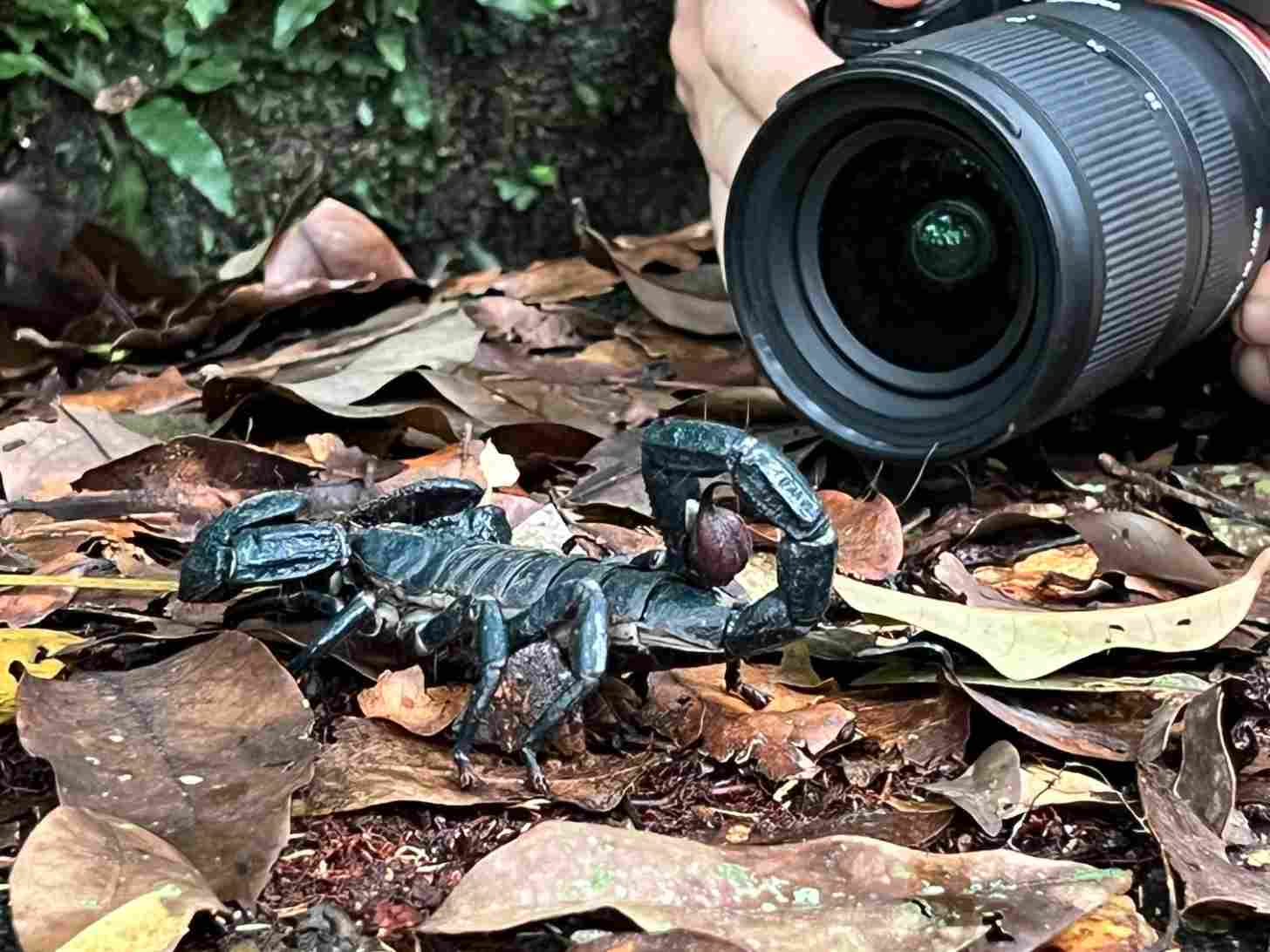
Invertebrates are equally intriguing. A Mongabay correspondent saw a West African tailless whipscorpion (Damon medius), a harmless species of arachnid, scuttling across the path at one point during a five-hour hike through the night to reach a campsite near the Hana River, in the south of the park. The correspondent also photographed one of the world’s largest scorpions — the emperor scorpion (Pandinus imperator) — sheltering beneath a pile of firewood near the campsite kitchen. Taï also has two resident species of Goliath beetles (Goliathus genus), palm-sized arthropods patterned like jewels that are attracted by the smell of fermenting bananas.
Critters like these are targets for the international pet trade, but Menegon said he believes that collectors’ curiosity will be satisfied by instead seeing them in their native habitat — in places like Taï.
Locals can reap dividends from such specialized tours, Menegon suggested, by gaining employment as cooks, guides, porters and assistants. “For communities that are subsistence-based, any extra income is welcome, so even though the park might be sustained by donors and the government, resources flow outwards.”
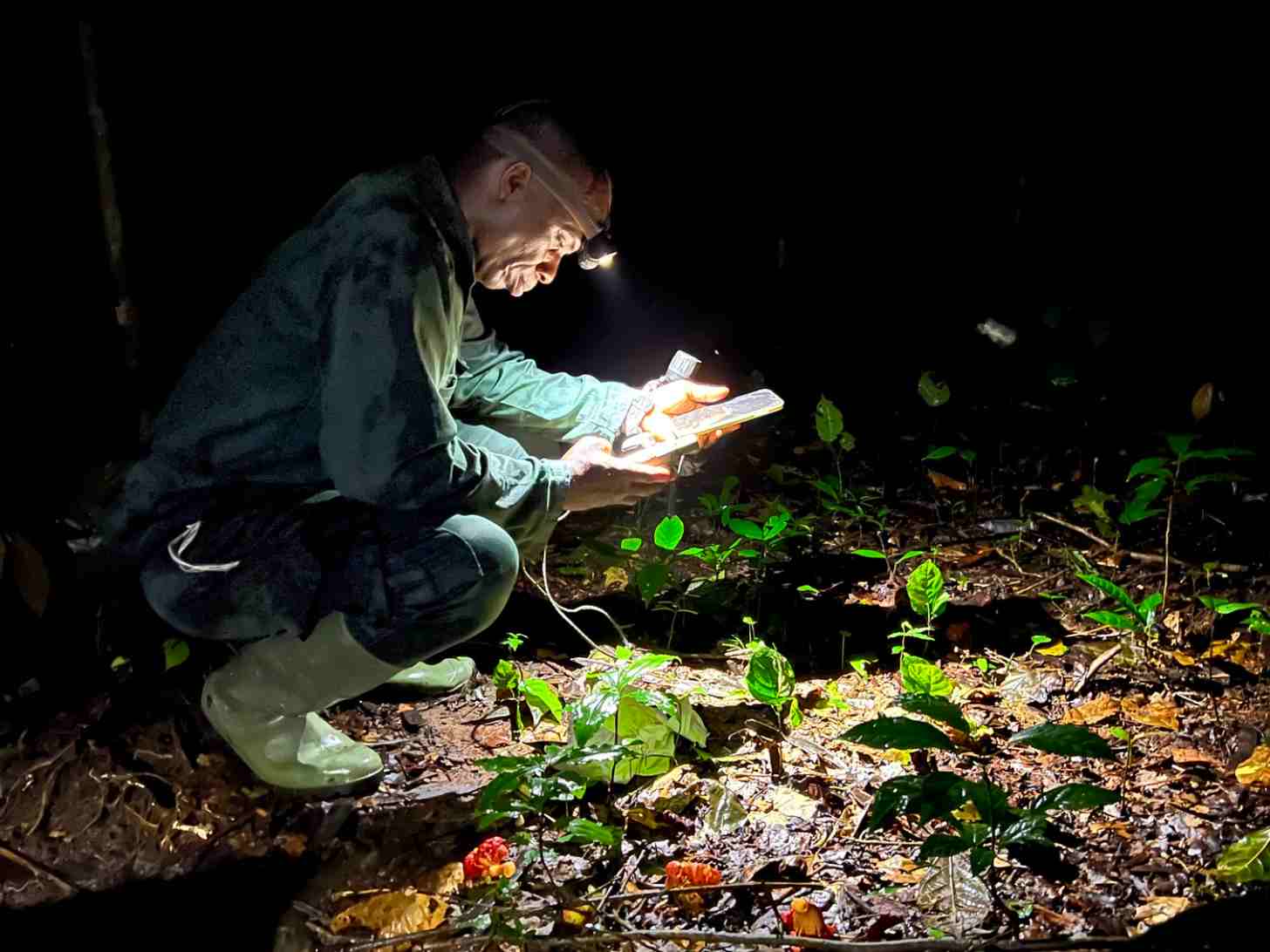
The conservation partners said they hope to identify individuals within local communities who can become knowledgeable guides — people like Tere, the chimpanzee guide, and Kevin Hino, a bird guide who works at the ecolodge near the village of Djouroutou, in the south of the park.
A few years ago, Hino led a U.S. wildlife photographer to capture images of a Shelley’s eagle-owl (Ketupa shelleyi), widely regarded as Africa’s largest owl and possibly its rarest. It was apparently only the second time in history the eagle-owl had been photographed.
“We looked for the bird many times before we saw it,” Hino told Mongabay. After the photos were published on the photographer’s website, Hino was contacted by bird guides from neighboring Ghana who came to Taï to try to see the owl for themselves.
On the first night that the Mongabay correspondent stepped into Taï, a male Shelley’s eagle-owl’s banshee-like call provided a dramatic introduction to the rainforest, along with the sight of lianas as thick as tree trunks, the sound of forest elephants splashing in a stream, and the feel of occasional swarms of driver ants, nipping ankles and crawling up shins.
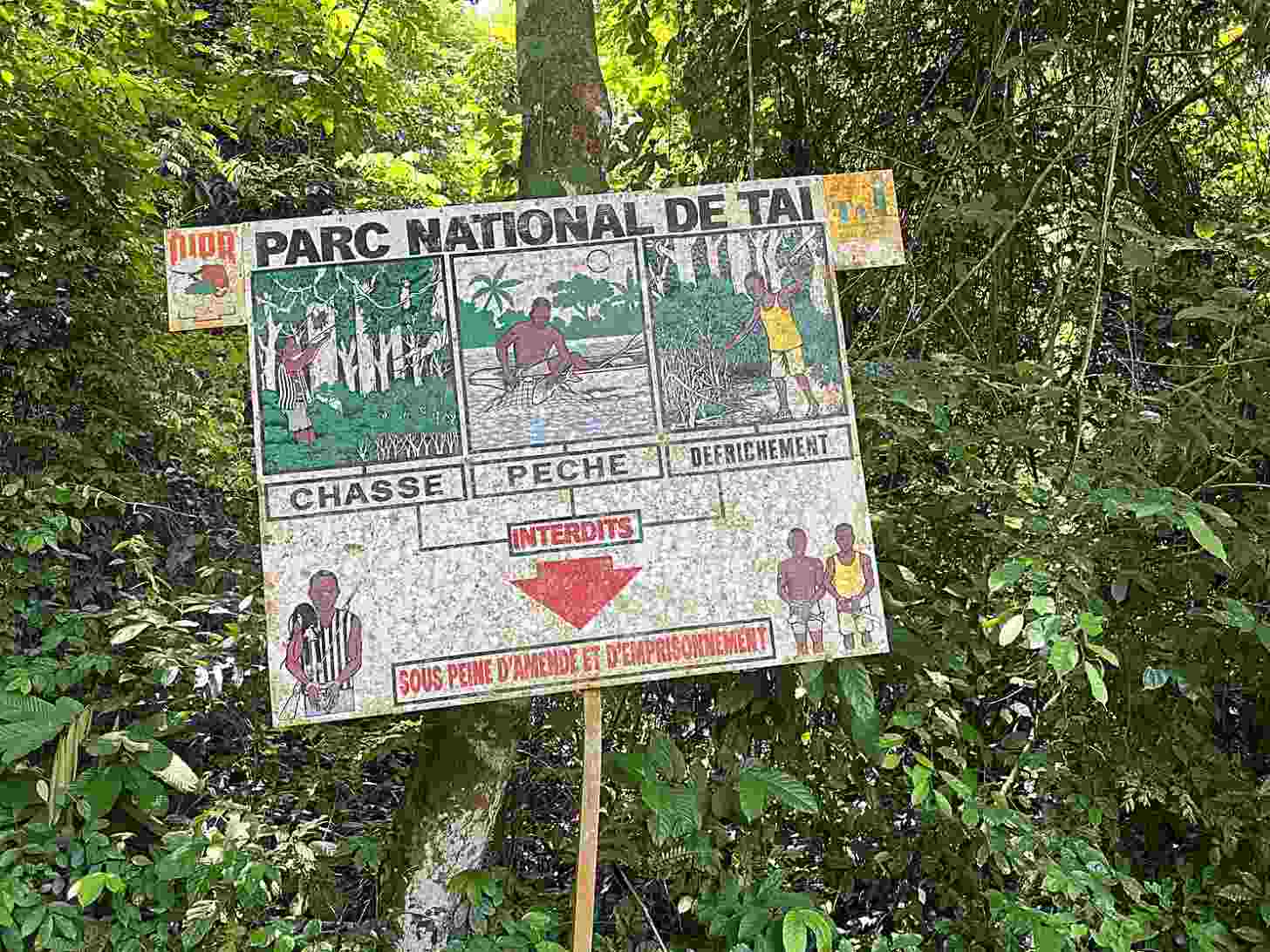
The main entrance to the northern section of Taï National Park, reached via several hours on a rough dirt road north of Djouroutou, is marked only by a forest path and a signpost warning visitors not to hunt, cut wood or fish.
Mongabay accompanied Menegon and a research team on a 10-kilometer (6-mile) hike from here to a forest campsite. Initially, the path meandered through secondary forest, dotted here and there with remnant oil palm trees, a crop responsible for the loss of much of Côte d’Ivoire’s rainforest, but around the campsite stood the tree giants of old growth primary forest, as tall and wide as cathedral columns.
Around 40-50 meters (130-165 feet) above, hornbills wailed and churned the air with heavy wingbeats, and lithe-limbed Diana monkeys (Cercopithecus diana), striking in their pelts of chestnut, black and white, capered along high branches. They are just one of nine species of monkey native to Taï.
In a damp spot, surrounded by Uapaca trees on their stilt-like roots, elephant footprints were visible in the soil and numerous middens of tiny duiker droppings showed that these small antelope were still abundant.
An adventurous spirit and a tolerance of minor discomforts may be prerequisites for any visitor to Taï, but a gradual increase in visitor numbers — including from English-speaking countries — would provide more income for the park and more eyes and ears along its forest trails, supporting the work of the park’s 100 rangers, who are already thinly-stretched across the rainforest’s 5,000 square-kilometer expanse.
Lorenzo Prendini, curator of arachnids and myriapods at the American Museum of Natural History in New York, said he doubts many of the hobbyists who collect live amphibians, reptiles and invertebrates could afford a trip to a place like Côte d’Ivoire, or would even consider going there. “The hobbyist who purchases live animals from a dealer is very different from the hobbyist — or professional — who collects dead critters for a scientific study,” Prendini told Mongabay.
But neither would they pose any direct threat to forest fauna. “Most of these hobbyists do not collect their own critters and wouldn’t know how.”
Menegon said he was heartened by a pilot safari he conducted in Tanzania earlier this year. A clutch of overseas visitors, many of them gecko and reptile keepers, were content to pay to travel from Europe all the way to East Africa to see the animals in their natural habitat. A similar pilot is planned for Taï later this year.
“I think the market [for specialist safaris] is there,” Menegon said.
At the heart of all these efforts is the need to protect Taï — the largest intact stand of Upper Guinean rainforest remaining in West Africa.
During Mongabay’s visit, gunshots echoed through the forest in the southern section of the park on at least two successive nights. They were likely fired by hunters illegally targeting animals to feed a market for bush meat.
Part of LCA’s agreement with OIPR includes paying rangers per diem, on top of their regular salaries, for each day that they’re out on patrol.
Menegon said he is confident that with more trained local guides, possibly including biologists from Ivorian universities working in the rainforest on a seasonal basis, Taï could attract several hundred visitors each year. He said he envisages an investor providing light-touch facilities — wooden decking above the forest floor to keep tourists’ feet dry at well-equipped campsites reached by foot via well-marked forest trails — as opposed to major infrastructure developments like lodges.
A trip to Taï could combine the chimpanzee experience with observing its reptiles, amphibians and numerous special bird species, like the Shelley’s eagle-owl and others unique to the Upper Guinean forest.
“Taï is super rich, super interesting,” Menegon said, “and filling the gap in terms of [providing] facilities and local knowledge could make it work.”
Banner image: A yellow-bellied wattle-eye (Platysteira concreta), a bird of the rainforest understorey, sits on its nest in the Tai National Park. Image courtesy of Michele Menegon. Written by Ryan Truscott. This article was originally published by Mongabay.
This story was originally published by Grist. Sign up for Grist's weekly newsletter here.
Serap Erdal stopped at a light pole in Chicago’s Grant Park, pulled out her phone, and began pinching at the screen. Behind her, towering skyscrapers cut into a sunny blue sky as she scanned her palm-sized map of the city.
The researcher barely noticed the hum of city buses, cars, and cyclists buzzing around her in the city’s busy downtown. She was working out what was in the cool summer air.
Fixed to the pole above her was one of the city’s new solar-powered air quality monitors. The tracker, encased in a metallic silver shell about the size of a tissue box, is part of the nation’s largest community air quality monitoring network.
Today, the network has 277 air monitors across Chicago collecting air pollution data from every ward and community area, with an increased concentration in already-overburdened neighborhoods.
A bright green dot flashed on Erdal’s phone. She smiled.
“Currently, the air quality index at this location is 31,” said Erdal, a professor of environment and occupational health sciences at the University of Illinois Chicago.
The reading puts the air quality in the city’s public park in the Environmental Protection Agency’s safest category, meaning it poses little to no risk to public health.
“Because we have a clear day and it’s breezy, concentrations across the city are quite uniform,” she added.
On that day in June, almost all of the city’s monitors were green, except for one on the far South Side, where legacy industrial facilities and freight traffic pump emissions into nearby Black and Latino neighborhoods. In the coming years, the monitoring system is expected to elucidate the dramatically uneven air quality in different neighborhoods, even on clear and breezy days.
The project, called Open Air Chicago, went live last fall and is part of a five-year project to collect hyperlocal air quality data and provide Chicagoans with real-time pollution information. The data is also intended to help officials develop guidance for permitting, urban planning, and air quality control.
The network is about to face its first Chicago summer, when air pollution typically worsens.
Pollution from cars, heavy vehicles, and industry reacts with sunlight and heat, forming ground-level ozone, a harmful pollutant and the key ingredient in smog, in the summer. As climate change makes summers longer and hotter, the conditions for smog formation are also becoming more common.
The monitoring effort originated as a result of a fight over the city’s decision to relocate General Iron’s scrap-metal shredding operation from the mostly white Lincoln Park neighborhood to the predominantly Latino and Black Southeast Side.
In 2021, local environmental activists filed a civil rights complaint with the federal Department of Housing and Urban Development, arguing that the move discriminated against low-income communities of color and harmed their health.
The city and the community groups reached a settlement in 2023, which included launching the community air monitoring network. Chicago officials partnered with the University of Illinois Chicago to launch it last fall at a combined cost of over $4 million to cover operations through the beginning of 2030.
“This air monitoring system is creating an ongoing record of what the air quality is in Chicago,” said Oscar Sanchez, the director of the Southeast Environmental Task Force, one of the groups that successfully filed the civil rights complaint.
South and West Side residents have so far had limited ways to corroborate that their air is unsafe. Although they tend to have higher rates of respiratory issues, they lacked time-stamped data to establish connections between their poor health and the region’s air quality. Sanchez said the monitoring system changes that.
“This is Chicago working in good faith,” he said. “We’re here to ensure that there’s publicly available information so people are not gaslit about their experience.”
Each air monitor is less than a mile from the next.
The low-cost equipment measures ground concentrations of two airborne pollutants: nitrogen dioxide, typically formed by the combustion of fossil fuels, and PM2.5, which are small particles just one-twentieth the width of a single human hair and capable of passing through a person’s respiratory system and entering the bloodstream.
Exposure to both pollutants is linked to childhood asthma and cardiovascular issues.
PM2.5 is increasingly being singled out as the world’s leading environmental health-determining factor — associated with acute mortality and morbidity for respiratory and cardiovascular health outcomes.
Even as air quality has improved in recent decades, it can still reach unhealthy levels during the summer when sunlight and warm temperatures react with pollutants in the air to form ground-level ozone. That seasonal smog can further degrade air quality when it mixes with smoke from increasingly frequent wildfires.
Climate change is exacerbating these conditions in the Midwest, according to Daniel Horton, an assistant professor of Earth and planetary sciences at Northwestern University.
“We also have to deal with the consequences of increased frequency and intensity of wildfires,” Horton said. “That’s a problem that doesn’t necessarily occur in our backyards, but when the wind blows in the right direction, we suffer the consequences in the Midwest.”
Wildfire smoke now dependably turns Chicago’s summer skies into a hazy orange. In 2023, smoke from the record-setting Canadian wildfires reached the Windy City and raised ground-level ozone levels by nearly 10 percent of the federal pollution limit, according to a study published earlier this year. The study also found that central, western, and southeastern neighborhoods in Chicago were most impacted by ozone.
So far, wildfires have already burned through 2.5 million acres nationwide. That’s nearly double the 10-year average for this time of year. The recent surge in wildfires, tied in part to climate change, is reversing the country’s steady progress toward improving air quality, according to a recent study published earlier this month in Science.
Between 2003 and 2015, the study found that stricter federal air quality rules successfully cut down on the toxic gases that form ozone, or smog, by approximately 11 percent.
Since 2015, however, rising ozone levels have undone about a third of the nation’s headway toward cleaner air — translating to an increase of 318 premature deaths per year from wildfire-related ozone since 2013.

Kamil Krzaczynski / AFP via Getty Images, courtesy of Grist
As extreme heat reshapes air pollution in the Midwest and across the country, Horton said the Open Air Chicago network will be able to identify localized pollution hot spots, offering an “unprecedented look at the air quality landscape across the city.”
The local network is expected to build on top of existing data collected by NASA satellites and the EPA’s limited number of regulatory-grade air monitoring sensors, which Horton called the “gold standard.”
While the EPA’s more sophisticated monitoring devices provide precise measurements of pollutants like PM2.5 and nitrogen dioxide, they are also more expensive to maintain.
Chicago’s low-cost sensors, although less precise, capture over 20,000 data points per day. The sheer volume of data is expected to yield major findings about how air quality changes across the city.
Carl Malings, an assistant research scientist at Morgan State University and NASA Goddard Space Flight Center, said the local data is especially important because, in many cases, satellites are capturing an aerial view that combines the messy interplay of particles and gases throughout the atmosphere’s layers, making it difficult to untangle what’s in the air people breathe near the surface of the Earth.
“If you see a smoke plume from satellite data in the absence of other information, it could be hard to say, Is that smoke actually reaching down to the surface, where it’s impacting air quality and people’s health, or is it rising a little bit above the surface and passing overhead?” Malings said.
Back in downtown Chicago, Erdal said the program is expected to run through 2029. City officials hope to keep the network online even longer.
Over the noisy downtown traffic, she said the network is the culmination of two decades of citizen-based research with communities across the city’s West Side and Southeast Side.
Previously, she worked on a project to monitor vehicle emissions in several of the city’s majority-Latino neighborhoods, which included helping local environmental justice activists install low-cost PurpleAir sensors.
Now her big goal is that the data collected over the next five years can help craft a roadmap for city officials and community leaders to cut down Chicagoans’ exposure to unsafe air.
“We hope we’ll strengthen the network in the future,” Erdal said. “Measuring more pollutants and providing more data to the public.”
Header photo via Open Air Chicago. Written by Juanpablo Ramirez-Franco.
This story was originally published by Grist. Sign up for Grist's weekly newsletter here.
As the impacts of climate change continue to escalate, a growing number of climate scientists and policymakers cite Indigenous lands as a model for their rich biodiversity and effective carbon storage. But that recognition has not always translated into space for Indigenous leaders in climate negotiations, access to climate resilience funding, or enforcement of human rights standards.
That has been the case for decades. But the problems do not stop there. New research shows that approach overlooks the key role that Indigenous knowledge and culture can play in mitigating climate change. It also reveals a dangerous misconception that has taken hold in global climate discussions: the idea that Indigenous lands are so rich because they are remote or sparsely populated.
Nothing could be further from the truth. The health of Indigenous lands and their ability to store vast quantities of carbon stem from the stewardship of the people who inhabit them.
That’s the finding of research from Conservation International, which shows that traditional knowledge, community protocol, and Indigenous culture play a direct role in protecting forests, wildlife, and the environment. Sushma Shrestha, who is Indigenous Newar from Nepal and the study’s lead author, said the research comes at a critical time.
“All of humanity relies on everything that Indigenous peoples have to contribute and offer in terms of their lands, in terms of carbon storage, in terms of biodiversity conservation,” she said.
The study, released as a narrative report and a peer-reviewed study, explores how Indigenous knowledge and practices benefit the planet. It also found that all 43 of the surveyed communities are experiencing drought, extreme weather, and other adverse impacts from climate change. More than half are affected by extractive industries like mining and logging.
Researchers interviewed 49 Indigenous leaders from six continents about how they steward their land, which ranged from the Amazon rainforest to East African savannas and Pacific Islands. They found that traditional management practices like avoiding overfishing, maintaining sacred spaces, watching for fires and other threats, and direct resistance against extraction contribute to the remarkable health of Indigenous territory. Ninety-six percent of respondents said they had land set aside for special uses, like spiritual practices, that also benefit the environment by protecting those spaces and ecosystems. Shrestha stressed that although each Indigenous community is distinct, there are shared lessons the entire world can learn from.
“It’s a time where all hands need to be on deck,” Shrestha said. “And collectively, actions need to be taken, and indigenous peoples have been doing this on their own for a very long time.”
The study builds on years of research that shows, among other things, that the world’s healthiest forests are on Indigenous lands and conservation efforts are more effective when they incorporate Indigenous autonomy and decision-making at every step.
Drought and extreme weather were the top climate impacts cited, but 61 percent of those interviewed also called mining, commercial agriculture, logging, and other incursions serious concerns. These issues threaten to disrupt land stewardship practices that have endured for millennia. To help mitigate these challenges, Indigenous peoples are asking for mitigation and resilience funding, legal advice for protecting their territories, and recognition of national and international land rights.
“Indigenous Peoples’ Knowledge cannot exist without Indigenous Peoples or without the ecosystems where we live,” Hindou Oumarou Ibrahim, who is Indigenous Mbororo from Chad and a former chair of the United Nations Permanent Forum on Indigenous Issues, wrote in a forward to the report. “To protect our knowledge, there is an urgent need to recognize us, and our rights and lands must be secured.”
Respondents from a wide range of countries, including Bolivia, Mexico, and the Philippines, mentioned using community monitoring or patrols to protect their land from outsiders and violations of traditional protocol. Several also called for stronger legal protections to protect their lands from being sold or developed.
Shrestha, Ibrahim, and other Indigenous experts said that as much as Indigenous peoples are asking for help, they are also urging the world to learn from them. The Kichwa people in Ecuador, for example, restrict hunting of female tapirs and other animals to help slow population decline. The Tacana people in Bolivia, among others, do not permit tree clearing along rivers, which helps maintain water quality and prevent erosion. The list goes on, and could help the rest of the world mitigate climate change and protect the environment.
“It is my hope the voices of the sisters and brothers from all over the world reflected in this report trigger the action we need for the planet we all want, the action we need for Indigenous Peoples Knowledge to flourish, and honor our grandparents and our children that are yet to come,” Ibrahim said.
Given the scale of the threats facing the world and the urgency with which they must be addressed, Shrestha said that policy changes and enforcement of Indigenous land rights is more important than ever. She also stressed that these actions will benefit the entire world. “One thing that everybody can do, whether that is at the national level, or at the global level, is to really secure indigenous peoples’ rights to lands,” she said.
Header photo: Juan Carlos Cisneros / AFP via Getty Images, courtesy of Grist
Written by Joseph Lee
Serena Neel, an influencer with millions of followers across YouTube, Instagram, and TikTok, has developed a reputation for being a little absurd. But her antics are always for a good cause.
Whether it’s shopping for 45 Angel Tree recipients around the holidays, giving her delivery drivers thousands of free drinks and snacks, or getting a job cleaning porta-potties, she knows how to capture viewers’ attention.
Her most recent escapade? Filling a pool with 50,000 pickles.
Before you worry about how wasteful that is, Neel is already ten steps ahead of you.
The pickles were purchased from Josh’s Pickles, an independently-owned business that found itself with 10,000 jars of pickles that were inedible and not safe to donate.
“We had 10,000 jars freeze. And when pickles freeze, they change cellular structure. They get soft and mushy,” Josh said in a YouTube video with Neel. “So, these aren't edible. They're not sellable. They're not even donatable. We tried.”

So, Neel took them off the company’s hands for another whimsical project, all before the pickles would be recycled and composted.
It was a whole process.
Neel and a whole team of volunteers built an assembly line with a station to break down jars and clean off the pickles in a contraption they called the “Dilliminator.”
People poured jars of pickles down a ramp, where a wire fence and some water separated the dill and garlic from the pickled cucumbers, so as not to clog the pool with extra ingredients.
Once cleaned, the pickles were transferred to a wheelbarrow, which Neel would dump into the pool.
In between wheelbarrow batches, the pool would be sealed to keep things fresh.
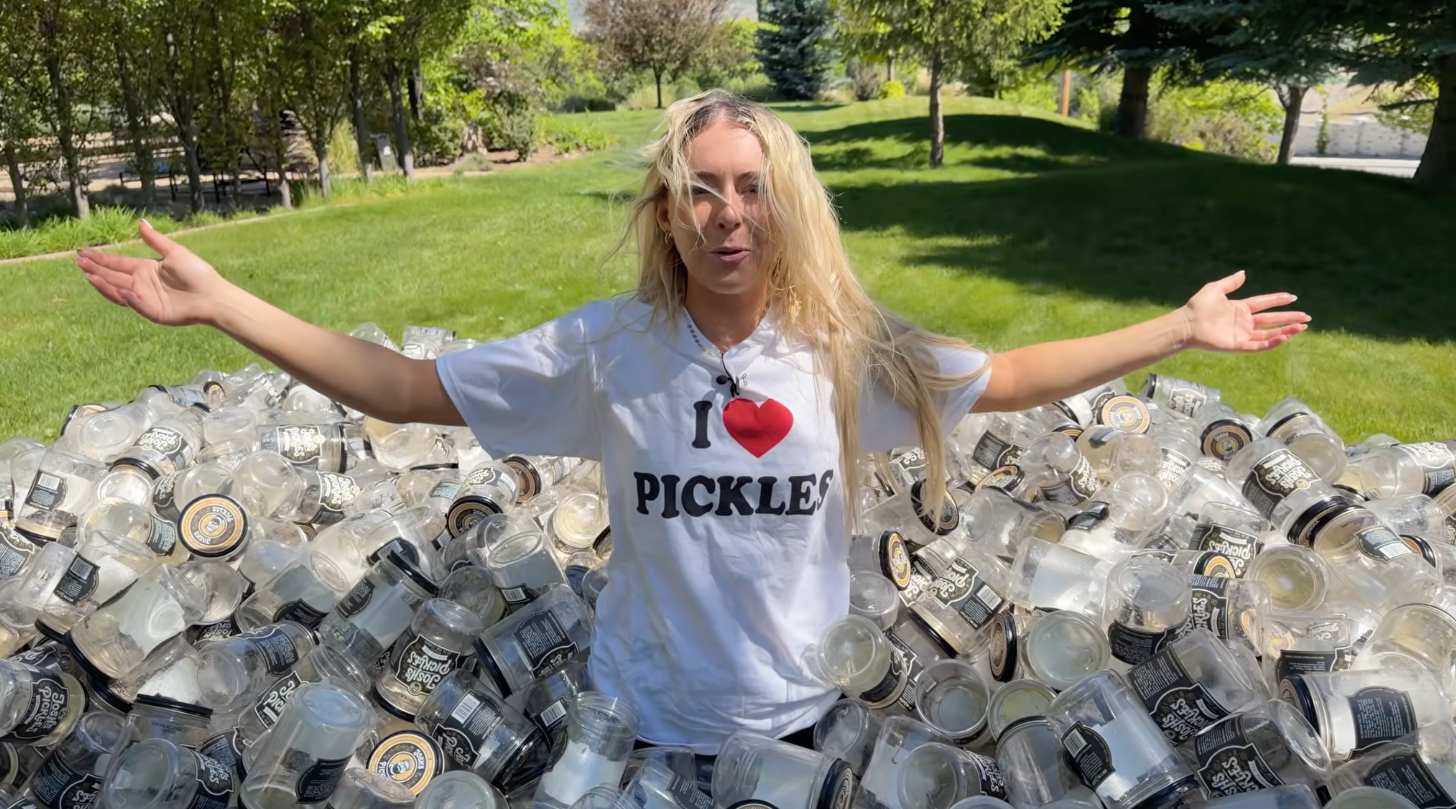
“We do need to keep the pool cover closed because apparently if these were just sitting here, they would turn white in like an hour. That's so weird,” Neel said. “So, let's close it. Gotta protect my pickles. It'll be kind of fun, ‘cause then it'll be like a big pickle reveal … when we’re ready to swim in it.”
The garlic and dill remains were dumped into a compost heap, but the pool still smelled a little, well, pickley.
“Anyone that swims in his pool is just going to smell a little garlicky,” Neel said.
As for the jars, Neel decided to use them to build “the world’s tallest pickle sculpture,” too, before they were recycled.
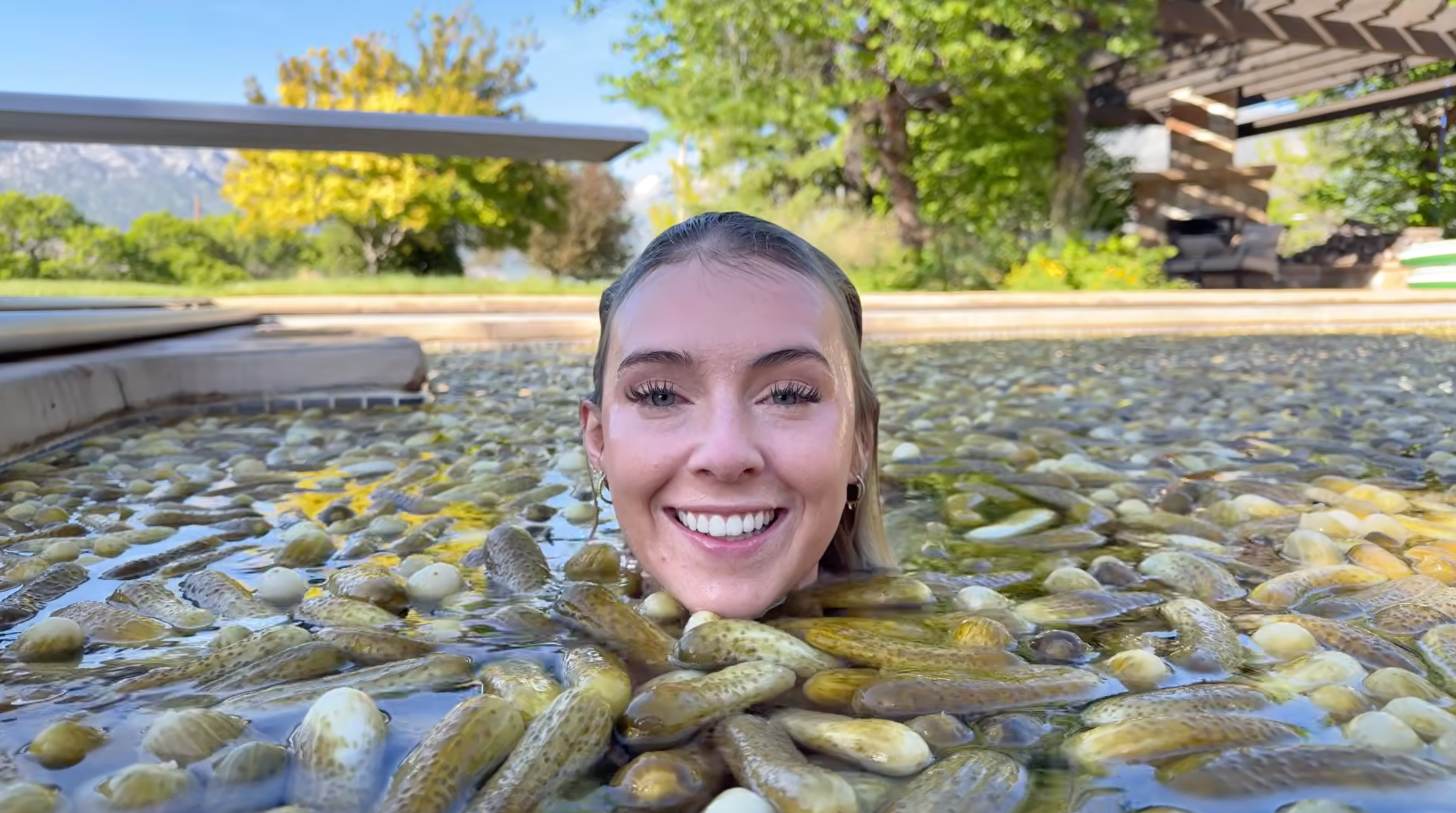
Once it was all done, Neel had the honor of taking the first dip in the pool. She put on a scuba mask and swimsuit and took the plunge.
“Whoa, I feel like an alligator,” she said, adding, “They kind of tickle.”
Josh was the next one to dive in, giggling in disbelief.
Once they tested the waters, Neel and Josh invited the neighborhood over for a pool party, complete with pickle-shaped inflatables and inner tubes.

“A majestic and pickleastic view was before my eyes,” Neel said in her YouTube video. “In this moment, the long hours of Dilliminating, the countless wheelbarrows full of pickles, and my garlic-reeking hair was all worth it. We achieved our dream of building the world's largest pickle pool and breaking my first-ever world record.”
“Seeing Josh's neighbors come together to not only build but enjoy the pool party was just the icing on the cake,” she added.

And of course, once it was all complete, the pickles were picked up for recycling.
“Josh's friends at Recyclops took the truckload of pickles and turned them into renewable energy,” Neel narrated the process at the recycling center.
“They removed all the oxygen, captured the released methane, and fed it straight into the natural gas pipeline, powering homes across Utah with pickles.”
Watch the whole pickle process below:
You may also like: 800-pound butter sculpture from state fair recycled into electricity: 'Enough to power 600 homes for a year'
Header images courtesy of Serena Neel/Instagram
A group of jet skiers was enjoying a day on the water just off the coast of Magnetic Island in Australia’s West Point when they stumbled across a green sea turtle in dire straits.
Andrew Eslick of Magnetic Island Jetskis was leading the tour and initially thought the sea creature was just enjoying the sun. But as he got closer, worry crept in.
“We get closer to it and I think, ‘Oh no, this turtle’s not moving. I think I'm about to show everyone a dead turtle,’” he told the Australian Broadcasting Corporation.
Fortunately, when Eslick reached out to pat the turtle on its head, it opened its eyes. But it was clear the animal was “unhealthy and weak.”
“Her shell started having little bloody patches all over it where her shell had become soft and started to peel off like wet paper,” he described to the ABC.

The tour group insisted on helping, cutting their tour short to save the turtle.
“The tour collectively made the decision that we’d rather help than continue on,” Eslick wrote on Facebook.
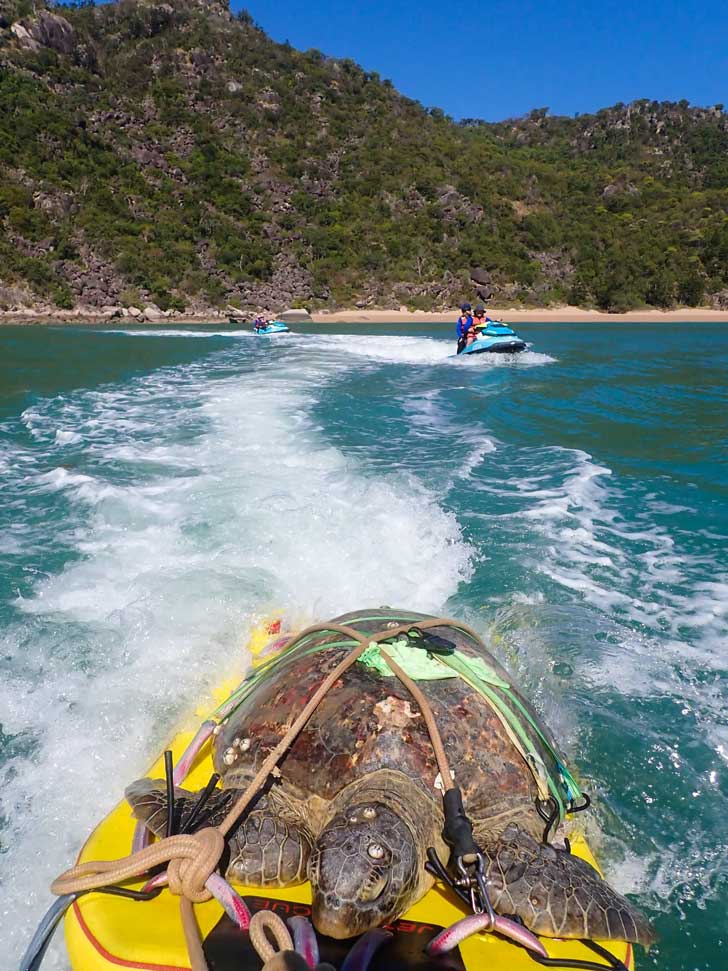
With the help of a nearby lifeguard, the turtle, which was estimated to be over 220 pounds (or 100 kilograms), was strapped to a board and brought back to Horseshoe Bay.
Once they got back to the island, experts at the Magnetic Island Network for Turtles rehabilitation center were standing by, ready to intervene.
“She was whisked off to the vets,” Eslick concluded on Facebook, “and hopefully she makes a full recovery.”
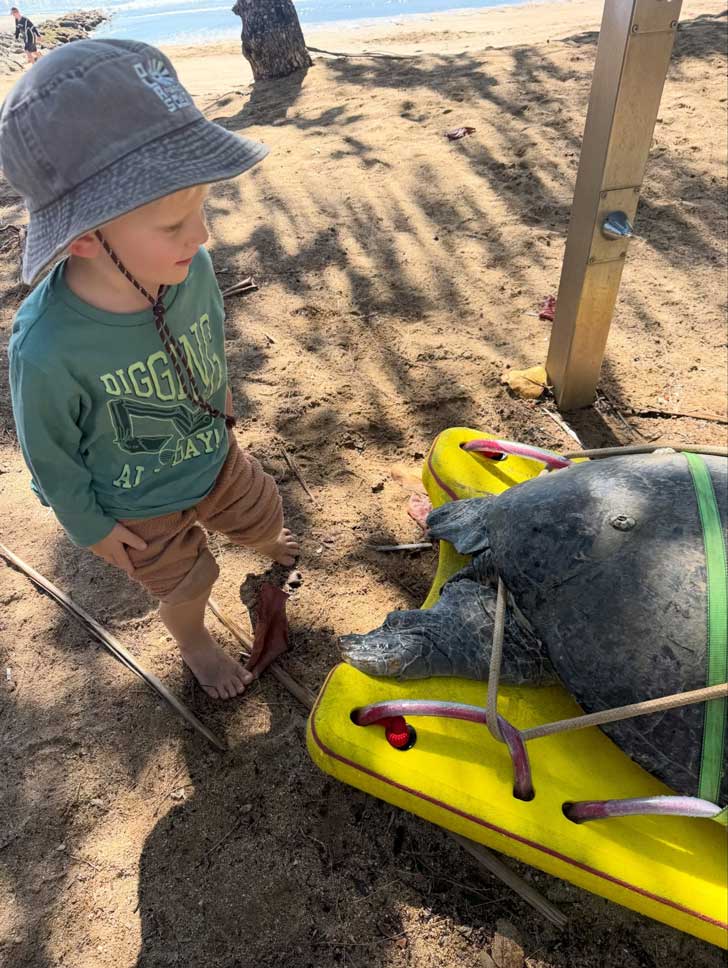
Eslick’s three-year-old son dubbed the turtle “Princess Peach,” and MINT kept the name. Now, she’s in the care of veterinarians, who estimate she is anywhere between 50 and 80 years old.
Aside from her infectious lesions, Princess Peach is deemed to be a healthy turtle.
“We’re actually still trying to find out what the causative agent of her infection is, but she is healing well in care,” Lily Donnelly, the rehabilitation clinic coordinator at MINT, told the ABC.
MINT has created a GoFundMe to help subsidize her care.
“Being such a big turtle … her food costs will match, plus her ongoing medical costs,” the fundraiser reads. “Your donation will go directly to helping get Peach back in the ocean where she belongs.”
Donnelly said it could be less than 12 weeks before Peach returns to the ocean, but that once she is healed, she’ll be tagged for future monitoring.
“All turtles under Queensland government regulations are tagged,” she told the ABC. “If you’re ever out snorkelling and you see a turtle with a tag, take a photo, and it might come from one of our rehab groups.”
Green sea turtles, like Peach, were listed as endangered on the International Union for Conservation of Nature Red List from 1982 until 2025 and are now hailed as a conservation success story. But keeping the population protected requires the work of expert veterinarians — and everyday people like Eslick’s jet ski tour group.
“That’s what we're all about on the island,” Eslick told the ABC of his customers, “making sure we look after the water and look after our animals in this area.”
You may also like: Four friends rescued a 324-pound sea turtle after it was struck by a boat: 'She'd been fighting for hours out there'
Header image courtesy of Magnetic Island Jetskis
If you’ve read any commentary about younger people, none of the following statistics will surprise you.
Approximately 19% of Americans who are 12 to 19 years old are depressed — higher than any adult age group. Only about 58.5% of teens who are 12 to 17, meanwhile, say they consistently receive the emotional and social support they need. They often have little faith in institutions — be it the government or schools, or one another. And the average American child age 8 to 18 spends 7.5 hours a day watching or using screens.
On the one hand, these statistics are understandable: Young people are facing a future shaped by climate anxiety, political extremism, economic instability, and chronic loneliness.
But those numbers may only be telling part of the story.
I have spent the past six months reading hundreds of poems submitted by young writers age 10 to 21. In June 2026, we will publish an anthology of writing from 177 of these young people in the “1455 Young Poets Anthology.”
More than 300 young people submitted their poems to a nonprofit I run, called 1455 Storytelling Arts. The poets mostly come from the U.S., but nine other countries are represented.
I continually found myself surprised, encouraged and inspired while reading their poetry. In a world that sometimes seems to reward the noisiest and the most aggressive, the wealthiest and the most selfish, these young poets understand something at once simple and profound that I think many adults have forgotten: Hope is not optimism. It’s endurance.

‘The only way through is through’
For the young writers whose work crossed my desk, hoping for a better future seems to be both a personal and collective act of accountability. It’s a refusal to accept a status quo in politics and other ways of life that might not work for some people.
Again and again, young people submitted poems that wrestled with loneliness, fractured families, violence, identity, anxiety, grief, and uncertainty.
Layla Dwelle, age 15, confronts this tense atmosphere of information overload and anxiety, writing, “I’m tired of the cycle / I’m tired of evil / I’m tired of what is done / I’m tired of what isn’t.”
Yet many also revealed an unwillingness to surrender entirely to despair. Alicia Chow, age 14, writes, “I realize the only way through is through / So I keep moving as defiance of loss.”
These poems acknowledge pain, but identify tenderness in the darker corners of life. They describe a world that has a soundtrack set on two extremes: chaos and silence. They grapple with real fear and insist that bearing witness to the world gives purpose and meaning to people’s lives.
These writers, in short, are not giving up — they are looking to create a future that revises the dysfunctional present, which they see as a work in progress.
The titles of some poems speak volumes about the worlds and feelings these poems explore: “Self-Portrait as a Firefly,” “The Cost of Rain,” “The Ones Who Run,” “Prayer for a New Season,” “The Grass That Grows in the Cracks,” and “Scars on Soul.”
Where reality meets urgency
What struck me most while editing this anthology was not the poets’ honesty or vulnerability, though both of those qualities were present.
Instead, it was their maturity that really stood out. There’s a focused seriousness present in their writing that combines political reality with a sense of urgency.
Here’s Emily Bennett, age 18, from her poem, “For the Love of the Sunk Cost Fallacy”:
Because,
nothing true aches forever.
And sometimes the bravest thing
you can do is simply open your hands.
Many of these young writers are trying to answer questions that adults themselves struggle with or avoid, including how to remain human in a culture that monetizes distraction.
This is an issue the American writer Jenny Odell compellingly addresses in her 2019 book, “How to Do Nothing: Resisting the Attention Economy.” Her thesis, simple yet radical, is that attention is people’s most vital resource, and all people are being bombarded, 24/7, with algorithmic strategies looking to distract and divide them.
She astutely describes “the mindless traffic of information,” which, not so coincidentally, is something poetry has always stood in quiet defiance of.
The poems raise other questions. How do people care for one another without becoming uncomfortably numb to others’ pain and suffering? How do people imagine and create a future while they are constantly reminded of growing inequality within many countries, and with the world’s wealthiest people quickly growing richer?
The fact that so many young people are still turning to poetry feels, to me, significant, if not momentous.
Poetry is typically not a commercially rewarded art form. It obliges readers to slow down, sit with ambiguity, and experience language in ways that plumb interior life.
If today’s algorithms reward speed, branding and certainty, poetry rewards reflection. This is the thesis of professor and Atlantic editor Walt Hunter’s illuminating — and quite encouraging — recent article, “Stop Meeting Students Where They Are,” which we recently discussed in detail on my podcast, “Some Things Considered.”
Young Americans may not have given up after all
Younger people are not oblivious about the world’s problems. The young poets I’ve been reading see empathy not as weakness, but as a bold imperative to help make the world a kinder, more just place.
I can hardly think of a better example than 16-year-old poet Dave Thompson’s provocatively titled “What if Jesus Was a Little Brown Boy in the USA”:
But you are here.
A little God walking to school,
still foolish enough
still holy enough
to believe love might mean
what it says.
As a podcaster and professor of storytelling, I can’t count how many times I’ve heard people my age or older lament that today’s generation doesn’t read or doesn’t care. This issue comes up at almost every panel discussion I’ve recently participated in.
I think these kinds of assertions about young people are both simplistic and unhelpful. In some ways, while mental health is a real concern for young people, they are doing better than their predecessors in other ways. Youth arrest rates have been declining since the 1990s in the U.S., for example, and American high school students are more likely than ever to graduate.
I think we should pay attention to some of the messages that these young poets are sending. We might even seek to emulate them.
This article was written by Sean Murphy from Shenandoah University and was originally published on The Conversation.
Header Image by Pavel Mudarra via Pexels

Students who study forestry will read about trees, but they do not often get the chance to climb up into a tree, feel its branches, and see its leaves up close.
After observing how many forestry courses gave students limited chances to learn through hands-on experiences, I attended a workshop to gain tree-climbing skills and brought some of these lessons back to my own university’s new urban forestry program.
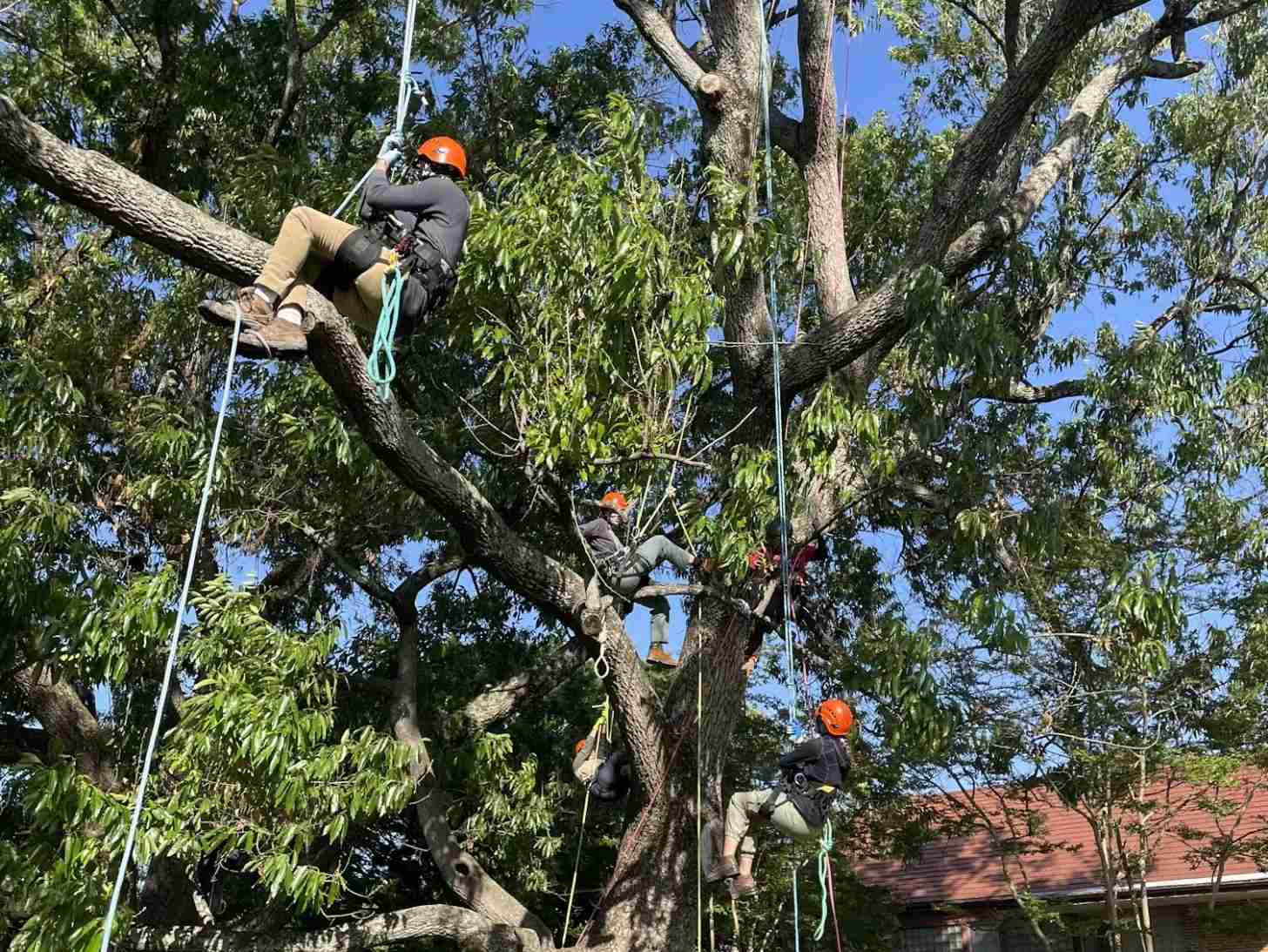
Forestry students at the University of Tennessee, Knoxville, now learn about trees in the classroom and on laptops, but also from 50 feet above the ground. In the process, they gain practical tree-climbing skills, including knot-tying, how to set a climbing line, and basic techniques that help them go up, down, and across trees.
Cities and trees
I designed the course Principles of Urban Forestry to teach students about the history, benefits, and costs of growing and maintaining trees in cities.
Many trees grow near homes, sidewalks, roads, buildings, and utility lines in cities. Climbing is one way tree-care professionals can safely reach these trees to prune branches, look for signs of disease, and assess possible risks.
During the first 10 weeks of the course, students learn how people, trees and cities changed as communities across the country urbanized. They also begin building basic tree-climbing skills by using 6-foot ropes to learn safety techniques, such as tying climbing knots.
For the last five weeks of the course, students climb trees on the University of Tennessee’s Institute of Agriculture campus in Knoxville. Most students climb to heights of about 50 feet. But some students ascend sawtooth oaks, which can stretch up to 69 feet tall.
These trees have strong branching structures and enough space for students to safely learn different climbing techniques. Students first learn how to move up and down the tree, using a technique called body or hip thrusting. They then practice moving through the tree canopy and learn to limb walk, an advanced practice of traversing thinner branches.
The exercise helps them understand tree structure, movement, and care from inside the tree’s canopy.
A focus on trees
Over the past 30 years, the U.S. Forest Service and other organizations have encouraged city dwellers to think differently about trees and greenery, and to promote planting and protecting trees along streets and in parks and other public spaces.
This work has involved planting the right trees in the right places, regularly pruning branches, and monitoring tree health.
The care and management of city trees directly affects most Americans. Approximately 80% of the U.S. population lived in urban areas in 2020.
The shade from trees can cool neighborhoods that would otherwise bake in the sun. Trees also improve air quality by absorbing carbon dioxide and pollutants through their leaves and releasing oxygen.
Even though many students in this course may not choose careers in tree care, the course helps them understand why trees are important to communities.
Climbing isn’t just a physical skill
Through tree climbing, students begin to understand the unique challenges of caring for trees in cities in a practical way.
Students learn that they, too, can help communities care for trees safely and responsibly. City residents, politicians, planners, scientists, and tree-care professionals ideally need to all work together to decide specifics, such as where trees should be planted and how all neighborhoods can benefit from healthy trees.
Ultimately, this course encourages students to look up, be more observant, and better understand the places where they study, work, and live. By paying closer attention to trees in their neighborhoods, students begin to see how trees affect shade, safety, comfort, beauty, and the overall quality of daily life.
This article was written by Sharon Jean-Philippe from University of Tennessee and was originally published on The Conversation.
Header Image by Sharon Jean-Philippe

Every day the Good Good Good team collects the best good news in the world and shares it with our community. Here are the highlights for this week!
If you want to get good news in your inbox every day, join the Goodnewsletter — the free daily newsletter designed to leave you feeling hopeful.
The Best Positive News We’re Celebrating This Week —
A new Etsy anti-Amazon campaign encourages shoppers to support ‘non-billionaire Jeffs’
Ahead of Amazon’s Prime Days this week, a new campaign from Etsy is spotlighting thousands of Jeffs — who aren’t the billionaire founder of Amazon — who sell things online, encouraging customers to shop from them instead.
From Jeff Brown, who makes pottery in North Carolina, to Jeff Risinger, co-founder of a Michigan-based lighting shop, Etsy says it has more than 5,000 sellers named Jeff.
The company’s campaign uses language like, “One Jeff should not rule commerce,” and “Shop non-billionaire Jeffs.” It also released a collection of items made by its sellers that say “Shop Other Jeffs.”
Why is this good news? More and more Americans, including about half of 18- to 29-year-olds, think billionaires are “a bad thing” for the country. And people are increasingly pushing back against the not just the overconsumption Amazon seems to encourage, but its impact on the environment and lives of its workers.
You may also like: 23 best Amazon alternatives for ethical online shopping
Arizona is building its 27th wildlife crossing. Altogether, they’ve reduced collisions by 90%
Young women now have a ‘close to zero’ risk of cervical cancer death thanks to the HPV vaccine
In a landmark, first-of-its-kind study, researchers found that children vaccinated at age 12 to 13 against human papillomavirus, or HPV, have close to a zero risk of dying from cervical cancer before age 30.
The study showed that deaths have dramatically declined since school-age girls started being offered the vaccine in 2008, with around 200 lives being saved in England so far.
Between 2000 and 2024, for the first time ever over a five-year period, there were no recorded cervical cancer deaths among women between the ages of 20 and 24. Without vaccination, there would have been an estimated 23 deaths.
Scientists have identified 64,000 square miles of coral reef capable of surviving the climate crisis
According to a new analysis of 45,000 coral surveys alongside decades of climate and ocean data, scientists identified nearly 64,000 square miles of coral reef capable of both surviving and recovering from climate change — three times more than previous estimates.
The climate-resilient reefs were identified across 71 countries and 100 territories, including in previously unrecognized parts of the Caribbean and Pacific and Atlantic oceans.
One of the report’s authors said people tend to see coral reefs as “beyond saving,” but that the research “proves otherwise,” and now we need the “political will” to save them.
Why is this good news? Coral reefs sustain a quarter of all marine life, but have come under immense stress from increasingly devastating tropical storms, pollution, and “bleaching” events caused by rising ocean temperatures. This new analysis will help governments identify areas to prioritize giving formal protections in reaching the global “30 by 30” goal.
→ Read more
Zohran Mamdani revealed his favorite children’s book. It says a lot about how he leads NYC
→ Read more (Good Good Good exclusive)
State laws banning ‘forever chemicals’ in clothing and textiles have significantly reduced their use in products
In a major public health win that experts say proves the value of preventative policies, state laws that ban the use of PFAS, or “forever chemicals,” have significantly reduced their use in products.
Around 80% of the approximately 115 products purchased from brick-and-mortar retailers in New York and California, and then tested for the chemicals — which have demonstrated a negative impact on human and environmental health — showed levels that comply with the new state laws.
The findings show that enacting strong laws “is making a difference,” and that a “drastic change” happened in a very “short amount of time,” and nobody had to close their businesses to do so.
The largest clean energy infrastructure project in the US is now complete
After nearly two decades of permitting and construction, an $11 billion wind farm and transmission line in New Mexico is now fully operational. It’s the largest-ever clean energy infrastructure project in the U.S., and is three times larger than the next two biggest wind farms.
SunZia can power around 1 million homes annually, and about two-thirds of its power will be sent to customers in California.
Construction on the project started in 2023, after years of permitting hurdles that started in 2008. Its completion comes as the U.S. federal government has been delaying permitting on clean energy projects, especially wind.
What’s the nuance? The U.S. power industry is seeing soaring demand that not only requires new sources of power, but the infrastructure to deliver it where it needs to go — and the country can’t wait two decades for large-scale projects like this to meet that demand. Advocates say the project demonstrates the urgent need for federal permitting reform.
Endangered orangutan caught on camera using canopy bridge in world-first: ‘We have watched and waited for this moment’
→ Read more (and watch it cross!)
A Colorado mayor has been sleeping in his city’s homeless shelters to learn first-hand how to make them better
Aurora, Colorado Mayor Mike Coffman wants to make sure the Aurora Regional Navigation Center is “a model program for serving the needs of the area’s homeless.”
He’s so committed, he’s been sleeping at the ARNC every Friday night since February to understand how it works, where there might be snags, and how he can leverage opportunities to improve the city’s housing services.
While he’s not undercover, he’s also not trying to draw attention to himself, meeting residents in the men’s entry-level dorm and helping to serve breakfast on Saturday mornings.
→ Read more
The world’s largest wildlife overpass just got its first elk visitors
Colorado is home to more than 100 wildlife overpass structures, and its newest one, which opened in December, is currently the largest in the world. It was completed in less than a year, “ahead of schedule and on budget.”
The Greenland Wildlife Overpass was designed specifically for elk, mule deer, and pronghorn, who are both abundant in the area and are notoriously distrustful of underpasses and enclosed tunnels.
Six months after it officially opened, the first three elk were recorded using the crossing, safely crossing six lanes of highway. Officials celebrated the historic crossing, saying it’s proof “the new structure is working!”
Why is this good news? The Pew Research Center estimates that 1 million to 2 million wildlife-vehicle collisions occur each year in the United States, leading to about 200 deaths, 26,000 injuries, and more than $8 billion in associated costs. These solutions protect both animals and humans in their travels — whether on four legs or in a vehicle.
→ Read more
In the 1970s, there were no workplace protections for LGBTQ+ people. This company paved the way
A new report showed people gave US charities $617 billion in 2025
Despite economic uncertainty and volatility in the U.S., donations to charity rose by an inflation-adjusted 3% in 2025 — the third time in the last four years that came in with double-digit increases in giving.
Donors gave $617 billion to charities across the U.S. last year, and giving increased in all categories, from corporations and living individuals to bequests and foundations.
Bequests alone jumped by nearly 17%, the third time in the last four years that form of giving came in at a double-digit increase, which analysts say could signal the start of the “Great Wealth Transfer” of baby boomers passing along their enormous wealth.
Snapchat CEO Evan Spiegel and his wife, Australian model Miranda Kerr just erased $550 million in medical debt
Evan Speigel, co-founder and CEO of Snap, Inc., which owns Snapchat, along with his wife, Australian model Miranda Kerr, announced a partnership with Undue Medical Debt to relieve $550 million in medical debt for an estimated 261,000 Californians.
Undue Medical Debt is a nonprofit that buys debt “in bulk,” — for every $10 donated to the organization, $1,000 of medical debt is relieved for families in need. In total, the organization has relieved over $40 billion in debt in all 50 states.
And those offered debt relief don’t have to do anything. The gift reaches people directly through qualifying debt acquired and canceled by Undue Medical Debt. California families benefiting from this relief can expect envelopes to start arriving in the mail in mid-July.
What’s the nuance? Spiegel has a personal net worth of $2.1 billion, highlighting growing wealth disparities in the U.S. at a time when people are forced into debt to access essential medical care. Additionally, while there are more systemic solutions to confront the healthcare crisis, these efforts provide much-needed relief for people in the here and now.
Critics doubted a $1.46B wildlife crossing. Trail cameras tell a success story: ‘75 recorded uses each night’
→ Read more
A study estimates that deaths linked to air pollution in London have declined by 40%
According to a new analysis, deaths linked to air pollution fell by around 40% in London over a five-year period starting in 2019.
The analysis found that nitrogen dioxide levels were down 41% and fine particulate pollution was down 28% across the city, and that new evidence showed air pollution was more harmful than previously understood.
The report did not single out the city’s ultra-low emission zone, but the mayor said the analysis provided “overwhelming evidence” that it was saving lives.
→ Read more
More good news of the week —
Three referees made history as the first all-American, all-women officiating crew at the men’s World Cup. (Gifted link) Referees Tori Penso, Brooke Mayo and Kathryn Nesbitt officiated the group-stage match between Czech Republic and South Africa.
A new species of “walking shark” was discovered in Papua New Guinea. Researchers from the University of Sunshine Coast in Queensland, Australia confirmed the species after 70 survey dives.
The Netherlands is banning conversion therapy for young people and vulnerable adults. The parties who spearheaded the bill, which passed 75 to 57, said that “years of commitment to freedom, equality, and human dignity have been rewarded.”
At a co-ed Mennonite house in New York City, rent is less than $900 a month — and surprisingly LGBTQ+ inclusive. In Manhattan, the average cost of rent is approximately 154% higher than the national average.
Conservationists were ecstatic after trail cameras captured footage of one of the world’s rarest mammals — with a baby in its pouch. The marsupial is one of only 450 northern hairy-nosed wombats left in the wild.
The last outstanding proposal for a new coal mining project in the UK has been rejected. A council refused a coal company’s plans to dig for 85,000 tonnes of coal, citing impacts on the local environment — the second time the company’s plans have been rejected since the mine closed in 2019.
Scottish World Cup fans donated nearly $30k to charities in Providence, Rhode Island. The fans felt so welcomed by the city and the Providence Tartan Army, a local fan group that helped with their accommodations, they’re repaying their gratitude with donations to local charities, including a children’s hospital.
Olivia Rodrigo announced she’s spearheading a new, all-women music festival, and 100% of the proceeds will go to charity. Daisy Chain Fields will feature performances from Rodrigo alongside Chappell Roan, Doechii, Katseye, with special guests like Stevie Nicks and Sarah McLachlan.
San Francisco unveiled a 49-beam light display that will light up rainbows for the city’s Pride weekend. A reference to San Francisco’s long-standing nickname as the “7-by-7 city,” each of the display’s 49 beams symbolizes one square mile of the city.
A new D.C. “museum” raises awareness about the impacts of extreme weather events caused by climate change. Called the “Museum of Unnatural Disasters,” the pop-up exhibit features roundtable discussions with climate experts, members of Congress, and disaster survivors to talk about economic impacts and how to protect people.
A Cabo Verde island saw an 80-fold increase in nesting loggerhead sea turtles. Globally, the loggerhead population has decreased by 47% over the past three generations, largely due to habitat loss, marine pollution, fishing bycatch, poaching, and multiple climate change-driven impacts.
An experimental drug for hepatitis B could offer a “functional cure” for a subset of patients. In two international studies, about 1 in 5 patients given the first-of-its-kind drug were able to stop treatment without showing dangerous signs of the liver virus, reducing it to levels low enough for the immune system to keep in check.
Zohran Mamdani just appointed a lifelong vegan to lead New York City’s food policy efforts. Siddhartha Sanchez will be tasked with helping expand access to healthy, affordable food across the city.
An endangered sea turtle just laid the 300th leatherback nest of the season — breaking a long-held record from 2009. The nest was laid by Juno, who has been visiting Florida beaches for 25 years.
A landmark study by Latin American researchers revealed that the endangered short-eared dog is actually thriving. The mammal is so rare to spot in the wild that locals have dubbed it the “ghost dog” of the Amazon Basin.
Dr. Suzanne Huurman makes history as the only woman team doctor at the 2026 World Cup. Huurman is the third-ever woman to lead a team’s medical staff for Curacao’s national men’s team, which is also the smallest country to ever reach the World Cup.
Making ultramarathon history, Rachel Entrekin became the first woman to beat the entire field at the Cocodona 250, men and women. Entrekin had already been the top women’s finisher twice, but beat the entire field this time to win the grueling ultramarathon in record time.
A Black-owned bank launched a debit card to help single mothers break the poverty cycle. Redemption Bank introduced the “Bank King Card” for Juneteenth, as a “new regenerative banking model that starts with investing in mothers who are a few hopeful dollars away from breaking out of poverty.”
A new tiny home village in Iowa will house chronically homeless individuals for $300 a month, plus free healthcare. It’s a proud replication of the Community First! Village in Austin, Texas, which is home to nearly 400 formerly homeless community members and is the blueprint for tiny home solutions across the country.
Music streaming platform Tidal launched a new direct-to-fan sales feature, and artists keep 90% of sales revenue. Fans can also purchase and download tracks even without a paid Tidal subscription.
After a successful rewilding effort, trail cameras captured the return of one of the Pacific Northwest’s most elusive mammals. A rare ringtail was seen passing through a 405-acre property in Ashland, Oregon that a family had spent decades diligently rewilding, primarily to prevent a massive forest fire.
The manufacturer of firefighting foam agreed to a $10 million settlement with Wisconsin over PFAS pollution. Tyco’s products contaminated the water supply in northeast Wisconsin with PFAS chemicals for decades.
A Louisiana man officially became the first person in the region to be functionally cured of sickle cell disease. Predominantly affecting African American people, the genetic blood disorder can cause chronic pain, frequent hospitalizations, and shortened life spans.
Maine’s first “turtle tunnels” have successfully saved endangered reptiles from a “highway of death.” Installed in 2021, local officials now say that there has been a “substantial reduction” in casualties for the endangered species.
The Dodgers fulfilled its pledge to donate $1.1 million to two foundations supporting those impacted by immigration raids. The team also denied U.S. Customs and Border Protection agents access to Dodger Stadium last year.
Colombia passed the first legislation in Latin America to outlaw female genital mutilation. Despite it being considered a human rights violation by the World Health Organization, the practice is still widespread globally.
An analysis found that electric vehicle drivers in the U.K. save more than £1,100 each every year in fuel costs. That figure could be even higher, given that the war in Iran has caused a spike in fossil fuel prices.
Four leatherback sea turtle nests have been identified within the Cape Hatteras National Seashore during the 2026 nesting season. It’s the highest annual total for the endangered species since sea turtle monitoring began on its beaches in the 1980s.
A Canadian town officially recognized trees as living beings with rights, dubbing them “our biggest ally.” Under the new resolution, which passed unanimously, the town of Terrasse-Vaudreuil will review its existing rules and bylaws to ensure that trees are protected or replaced if they are cut down.
Sister Stephanie Baliga, a nun living and working at Chicago’s Mission of Our Lady of the Angels, was almost an Olympian.
“I started running when I was 9, and running became my life,” Baliga told WTTW, a local PBS station. “It was how I defined myself and who I was.”
Baliga was the sixth-fastest freshman runner in the nation when she was a student athlete at the University of Illinois, training hours a day, and preparing for a professional career.

As a sophomore, however, she fractured her foot. She traded her hours on the track for prayer, which resulted in the realization that she wanted to devote her life to God.
“Jesus saw me for who I was,” Baliga told WGN 9 News. “He was not looking for my straight A’s or my fast running times; he was just seeking to love me wherever I was at.”
Now, she uses her passion for running to fuel her faith. For the last 15 years, she has run the Chicago Marathon, raising funds to support the MOLA food pantry.
“Right now, this area has many, many non-Catholics living in it, and yet there are still people that have great need,” Father Bob Lombardo, who opened MOLA, told WTTW. “As we like to say, we do what we do because we’re Catholic, not because the people we serve are Catholic.”
That unwavering mission is what has inspired Baliga to lace up her shoes, even encouraging other young people to join her on the Team OLA marathon team every year in Chicago.

According to the MOLA website, this team has “sacrificed thousands of hours training” between 2011 and 2025, and has raised over $2.6 million in the process.
“We serve about 400 to 500 families in person every Tuesday and we send about 300 deliveries to senior citizens between Monday and Tuesday each week,” Baliga said about the food pantry. “It totally changed the way I live my life.”
And her running has been integral to ensuring the people in need in her community have a meal on the table.
“The marathon funding was key to expanding the pantry in 2018, 2019, and 2020,” she told WGN 9 News, “and was very key to us sustaining an extremely large pantry during the pandemic.”
She isn’t slowing down any time soon.

This fall, Baliga and nearly 200 members of the Team OLA charity team will run the Chicago Marathon for the 16th consecutive year, with a goal of raising $500,000 this year alone.
Baliga and team just ran the city’s half marathon on June 10 to prepare — and brought in $16,000 in the practice round. The full marathon team has raised over $184,000 so far.
On the sidelines, other nuns and supporters came in droves, carrying a Pope Leo cardboard cutout and signs with phrases like, “You vati-CAN do it,” and “May God have mercy on your soles.”

On the MOLA website, the marathon team’s mission is described as follows: “Raise awareness of Mission of Our Lady of the Angels; offer up sacrifices of time, energy, and physical discomfort for the Mission and those it serves; raise funds for the Mission of Our Lady of the Angels; and have fun.”
For Baliga, it’s the faith that carries her.
“You’re like, ‘Woah, look at all those zeros! That’s a lot of zeros,’” she said about the 15-year fundraising total.
“The Lord provides,” she added to WGN 9 News. “God’s will is whatever is in front of you right now.”
You may also like: Young women move in with NYC nuns to save money. Rent is $200 a week, and no boys are allowed after curfew
Header image courtesy of Mission of Our Lady of Angels/Facebook
Since 1989, the Knowles-Nelson Stewardship Program has protected more than 750,000 acres of land in Wisconsin, which is home to over 400 endangered and threatened animals.
Through the program, the Wisconsin Department of Natural Resources has maintained public parks and trails, safeguarded its forests from development, and protected its shorelines.
In 2015, the state’s DNR started Snapshot Wisconsin, a wildlife monitoring project that encourages volunteers to identify animals on trail cameras. Thanks to over 30,000 volunteers, the citizen science project has catalogued more than 100 million wildlife photos in the last decade.
“Ten years ago, we were accepting our very first volunteers into the Snapshot Wisconsin program,” Snapshot's lead scientists, Dr. Christine Anhalt-Depies and Dr. Jennifer Stenglein, said in a joint statement in 2025.
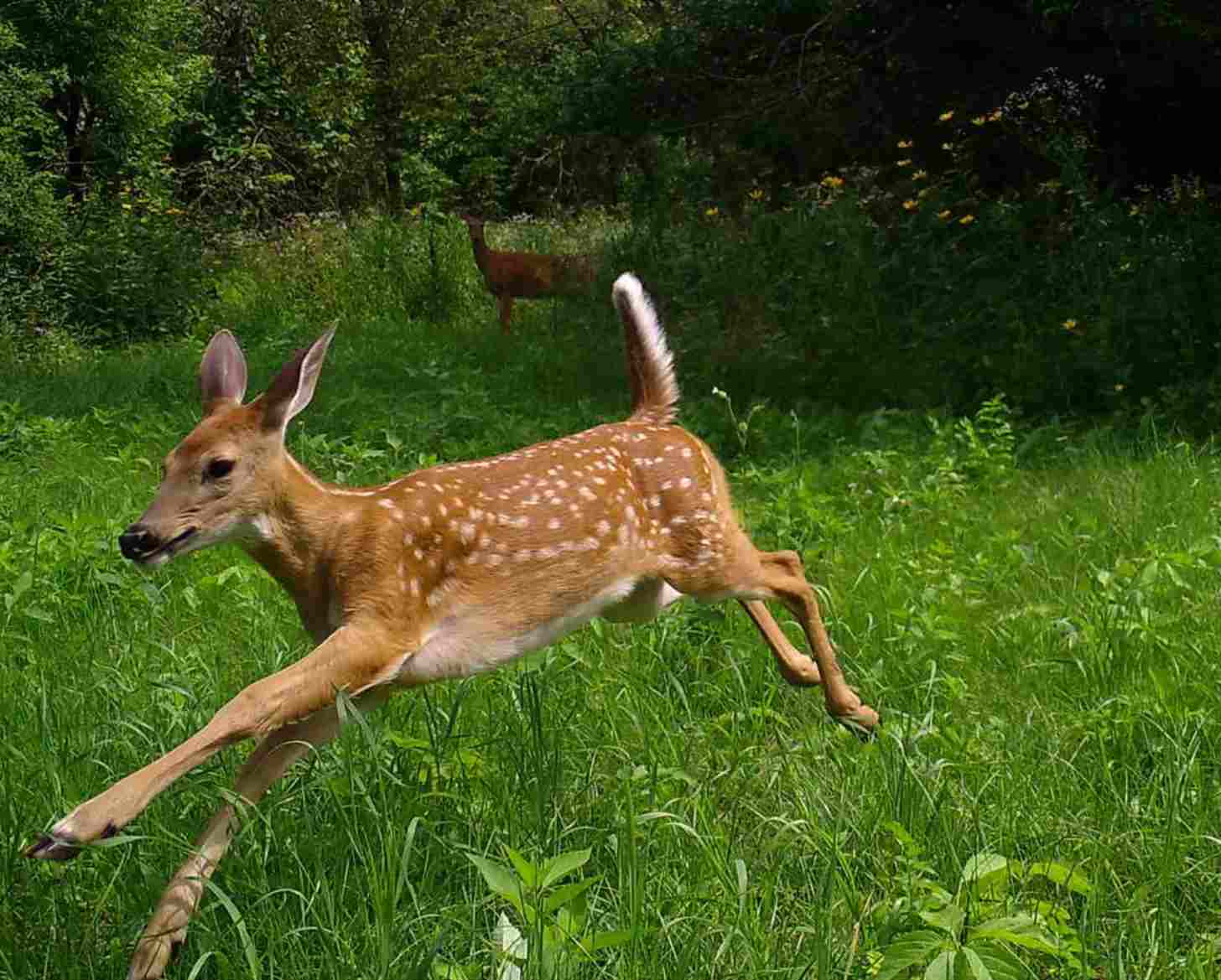
“The reality is that your enthusiasm and dedication to the project has exceeded our expectations. Snapshot Wisconsin has grown into more than we could have imagined,” they continued. “With multiple years of data, this project is useful for tracking Wisconsin’s wildlife populations through time and across the state.”
Although it started in just two counties, Snapshot Wisconsin has become the largest trail camera project of its kind in the country.
“Data from Snapshot Wisconsin supports decision making for 14 different species, with more products in development,” the scientists said.
The program has led to a wealth of information, including fawn-to-doe ratios for white-tailed deer, decision support data for elk and wolves, and trending reports for furbearers like beavers, bobcats, and coyotes.
“Snapshot Wisconsin is used in classrooms and nature programs in support of science and environmental education, and this project has impacts far beyond Wisconsin,” Stenglein and Anhalt-Depies wrote. “Research based on Snapshot Wisconsin has resulted in 21 scientific publications. Snapshot Wisconsin data are requested and used by high school students, university researchers, and Wisconsinites for their own curiosity and research questions.”
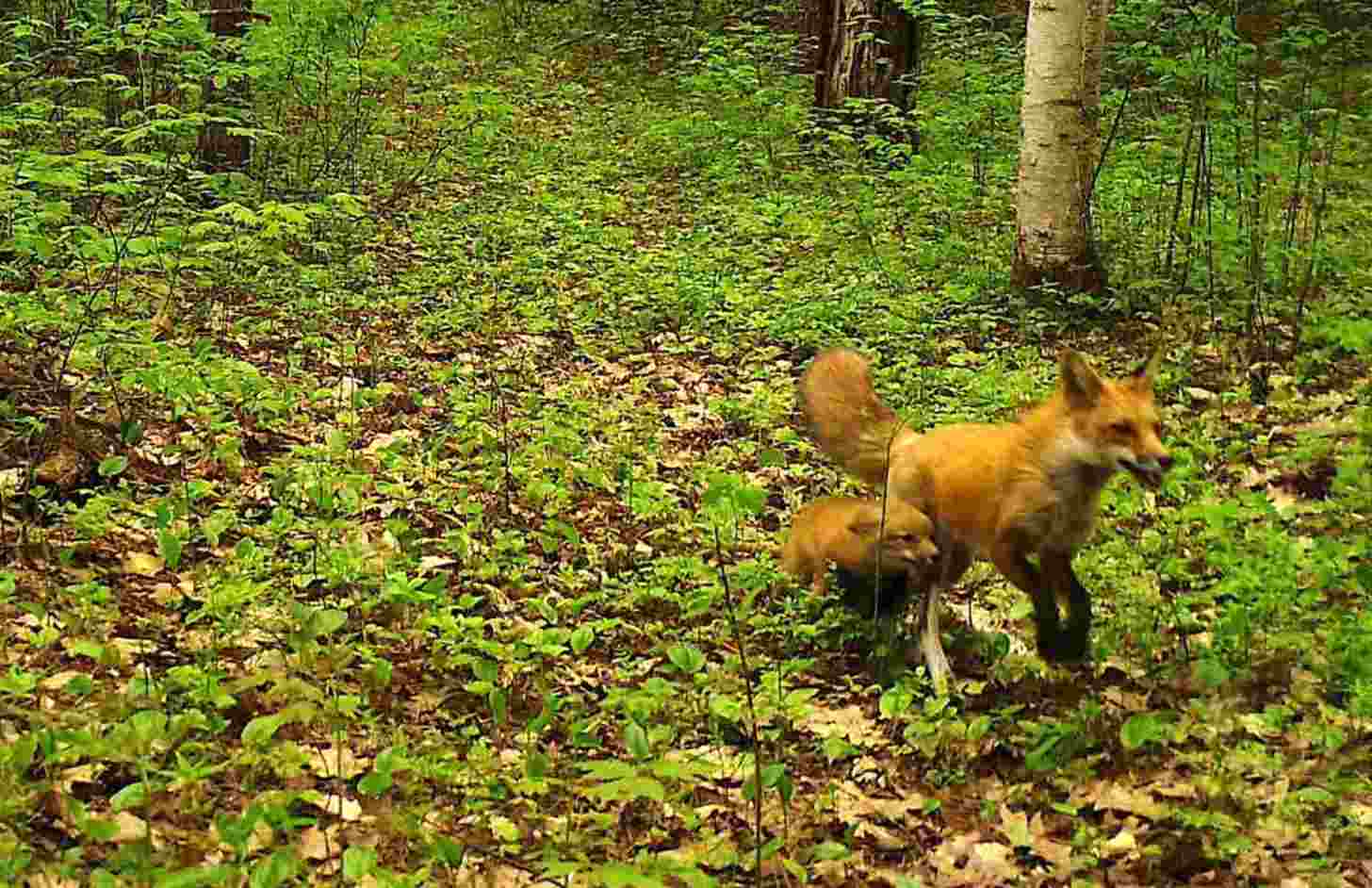
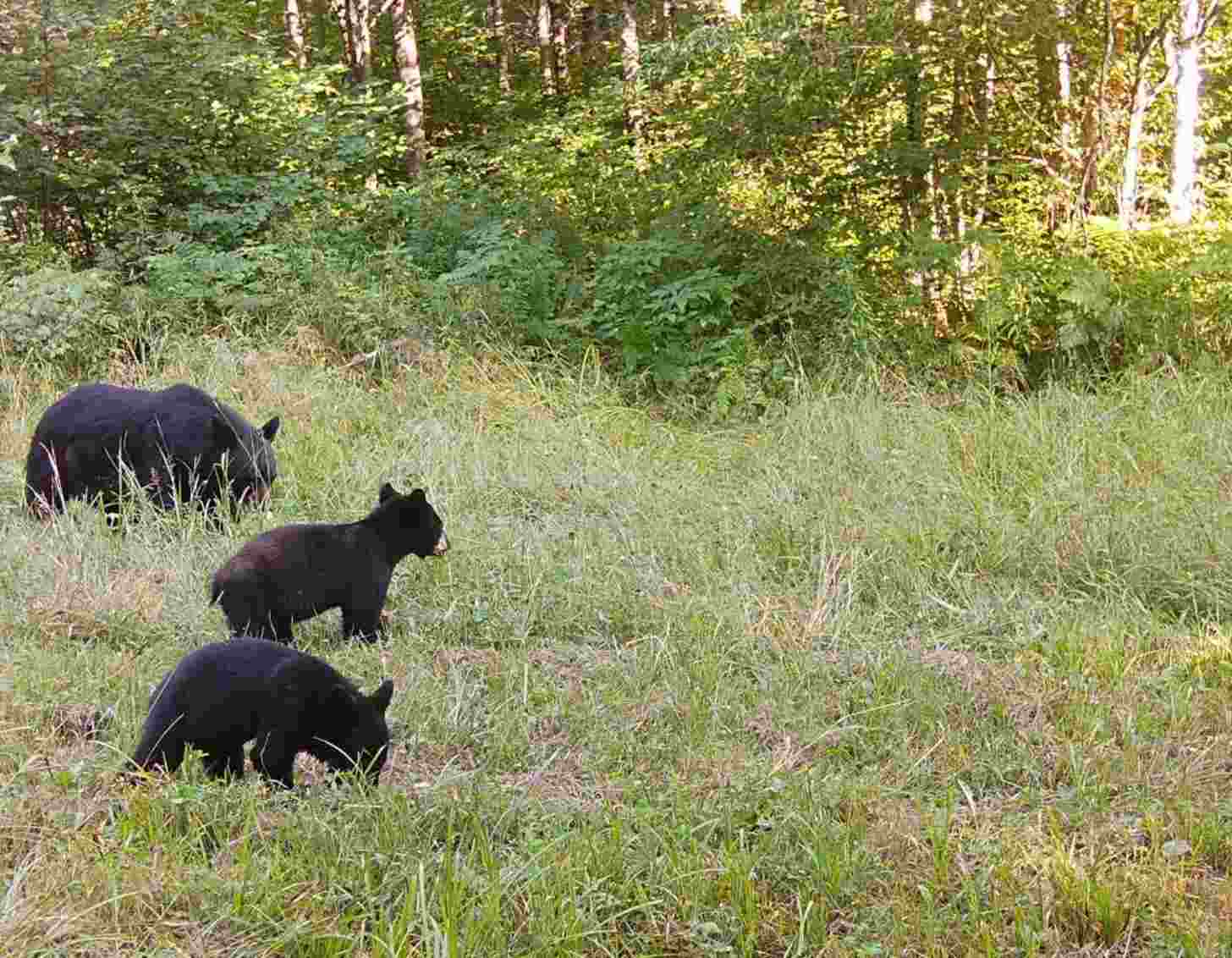
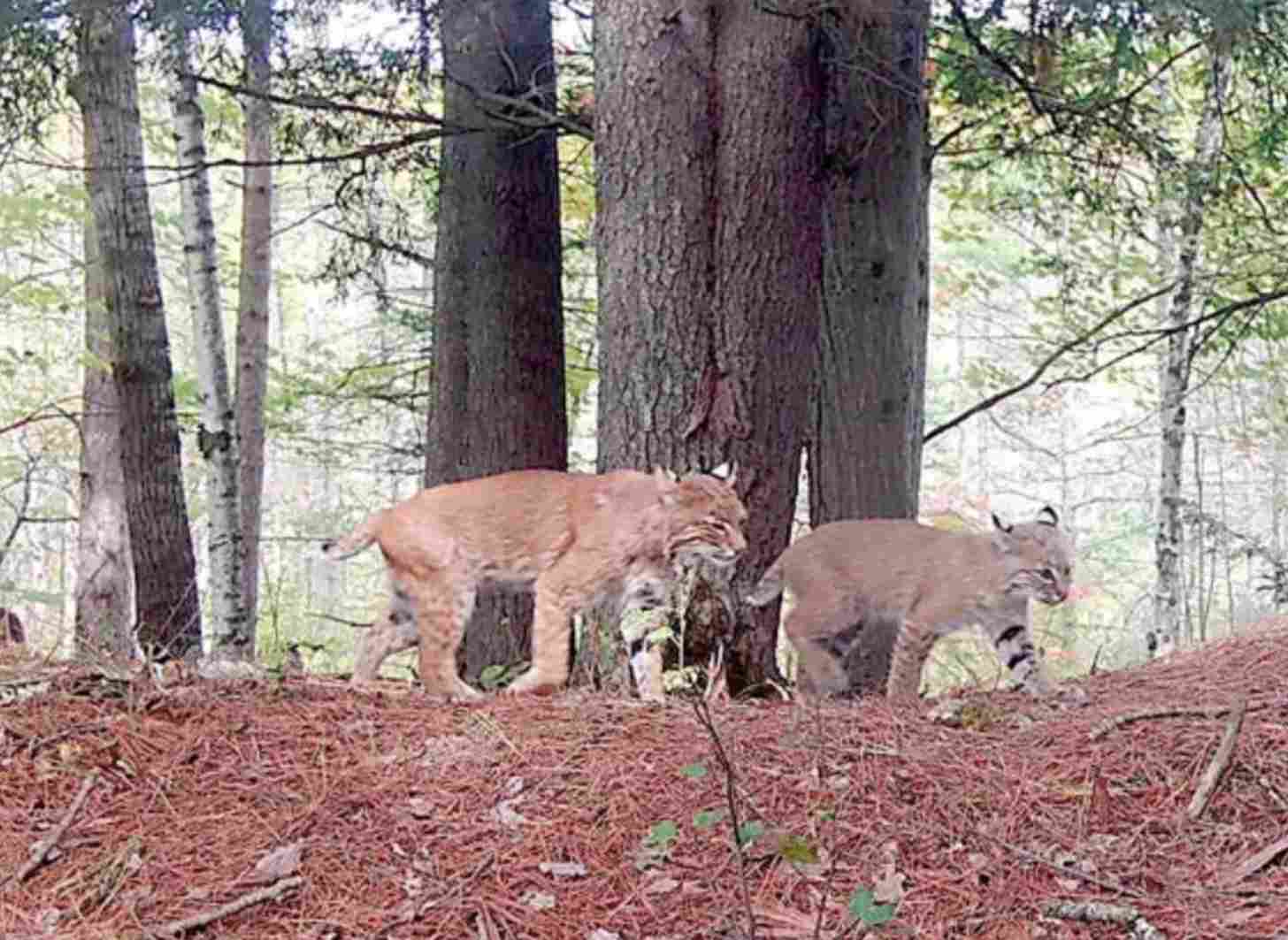
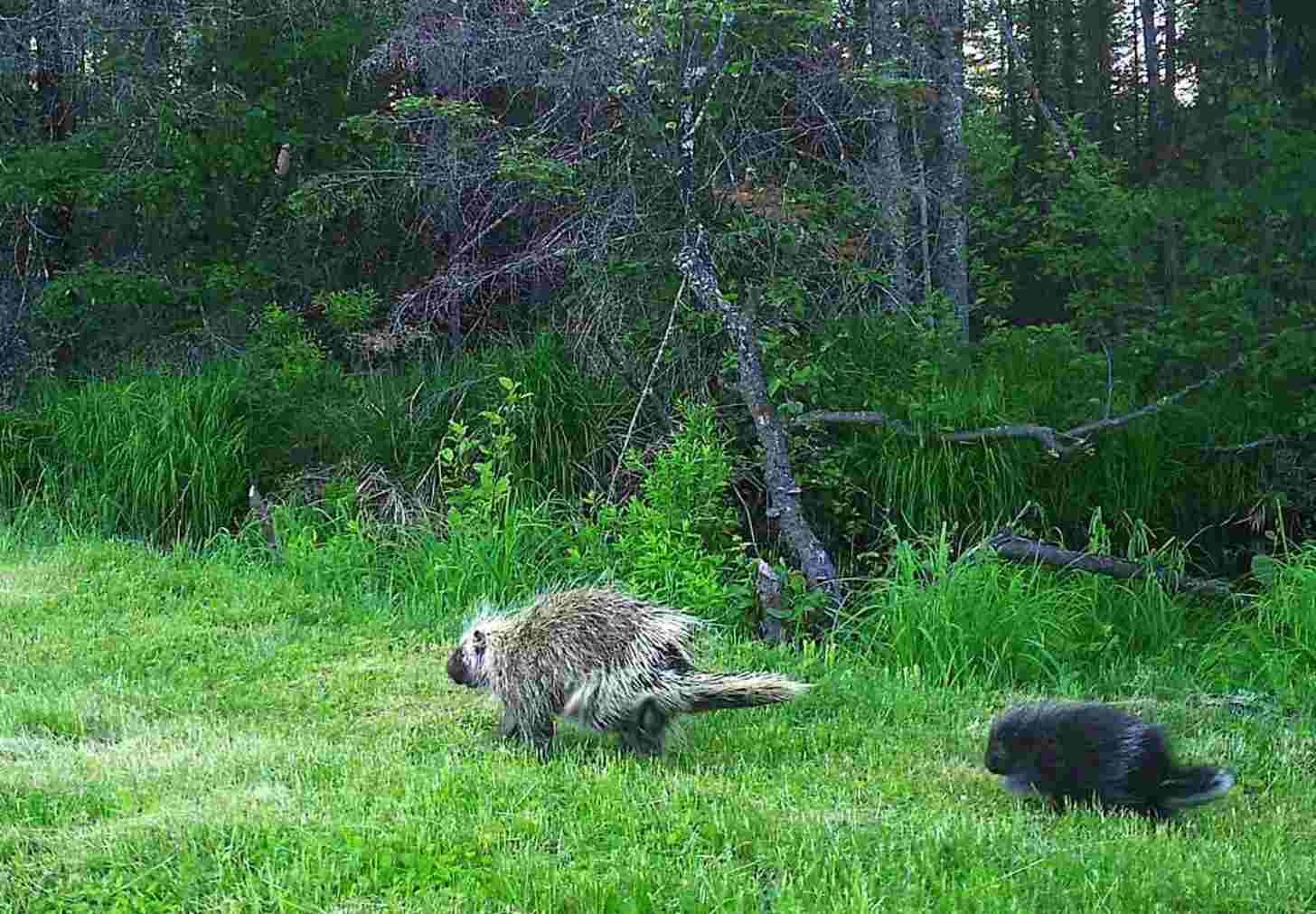
Wild animals spotted on the 2,000-plus trail cameras include black bear cubs, a family of bobcats, fox kits, an adult porcupine and her porcupette, and many, many more.
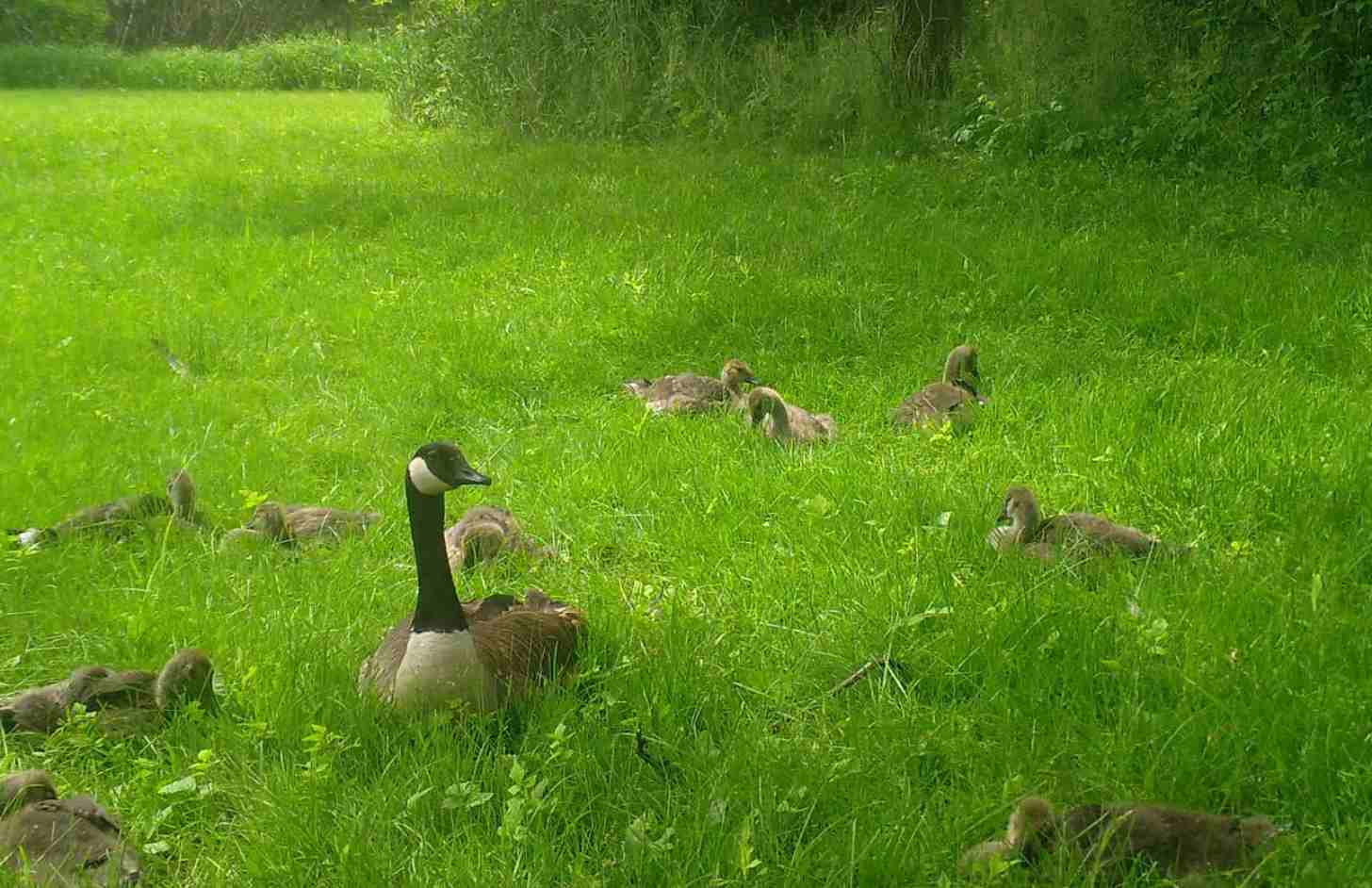
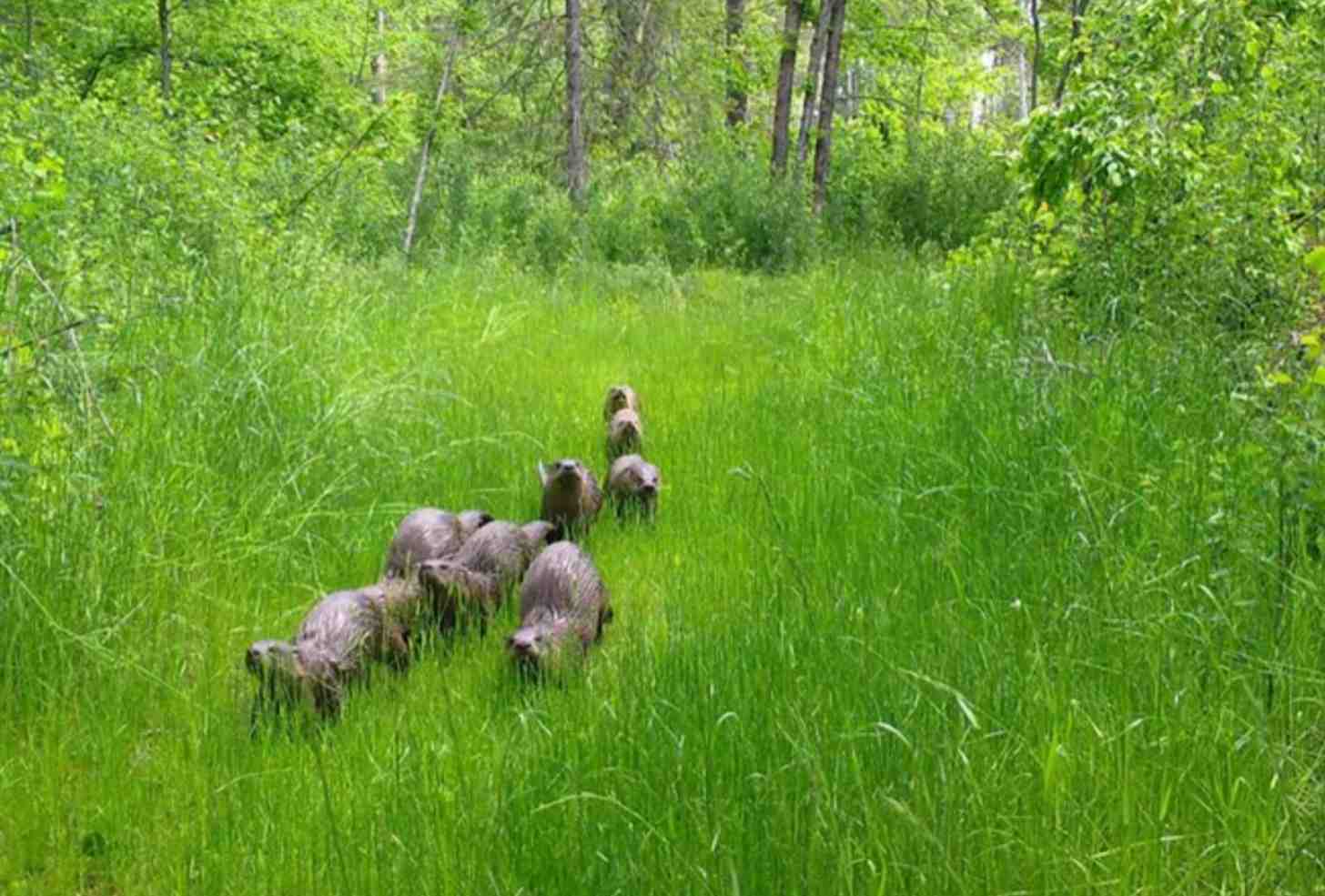
“The 100,000,000 photos that you all have helped collect are beautiful, wild, and surprising,” the scientists said. “We all have our favorites. One of ours comes from the first year of Snapshot Wisconsin. A romp of eight otters running down a grassy path in Sawyer County. Who even knew otters traveled together over land like this? A volunteer brought it to our attention and commented on how they were surprised.”
“This was the first of so many moments like this,” they continued, “sharing awe and delight around Wisconsin’s incredible natural resources.”
Unfortunately, the Knowles-Nelson Stewardship Program, in its current form, is set to expire on June 30, after Wisconsin lawmakers were unable to meet an agreement on its reauthorization.
Generally, the political divide was less about whether the program should exist and more about its size, funding, and oversight, with Republican leaders calling for a more limited version of the plan.
However, as Republicans and Democrats campaign for the governorship, all candidates have promised to uphold some version of the Knowles-Nelson Stewardship Program in the future.
“We absolutely need it,” Senate Democratic Leader Dianne Hesselbein said in a press release. “Knowles-Nelson has been around for so long, and it’s worked so well making sure we have green spaces in the state of Wisconsin to enjoy.”
You may also like: After rewilding success, trail cameras captured the return of one of the Pacific Northwest’s most elusive mammals
Header image via Snapshot Wisconsin, Department Of Natural Resources
On April 14, the National Highways Authority of India officially opened the Delhi-Dehradun Expressway, a six-lane highway connecting the national capital of India to Dehradun, near the Himalayan foothills.
The expressway was designed so that wildlife could cross beneath it by way of a 6.8-mile corridor underneath the overpass.
“The corridor marks a significant milestone in the development of sustainable infrastructure, demonstrating that National Highway development can coexist with the preservation of ecologically sensitive areas,” the Wildlife Institute of India and the National Highways Authority of India said in a joint press release.
According to the agencies, the neighboring forest regions of Asharodi and Ganeshpur are home to some of the world’s most endangered species, including tigers, elephants, greater hornbills, and king cobras.
“The 20 kilometer-long stretch between Ganeshpur and Asharodi features a total of 10.97-kilometer long animal underpass designed specifically to facilitate unobstructed animal movement,” the agencies explained. “This engineering milestone includes one of Asia’s largest wildlife elevated corridors, standing at an average height of 6 to 7 meters to accommodate even the largest mammal.”
Although the roadway was officially completed in mid-April, local animals didn’t wait for permission to cross.
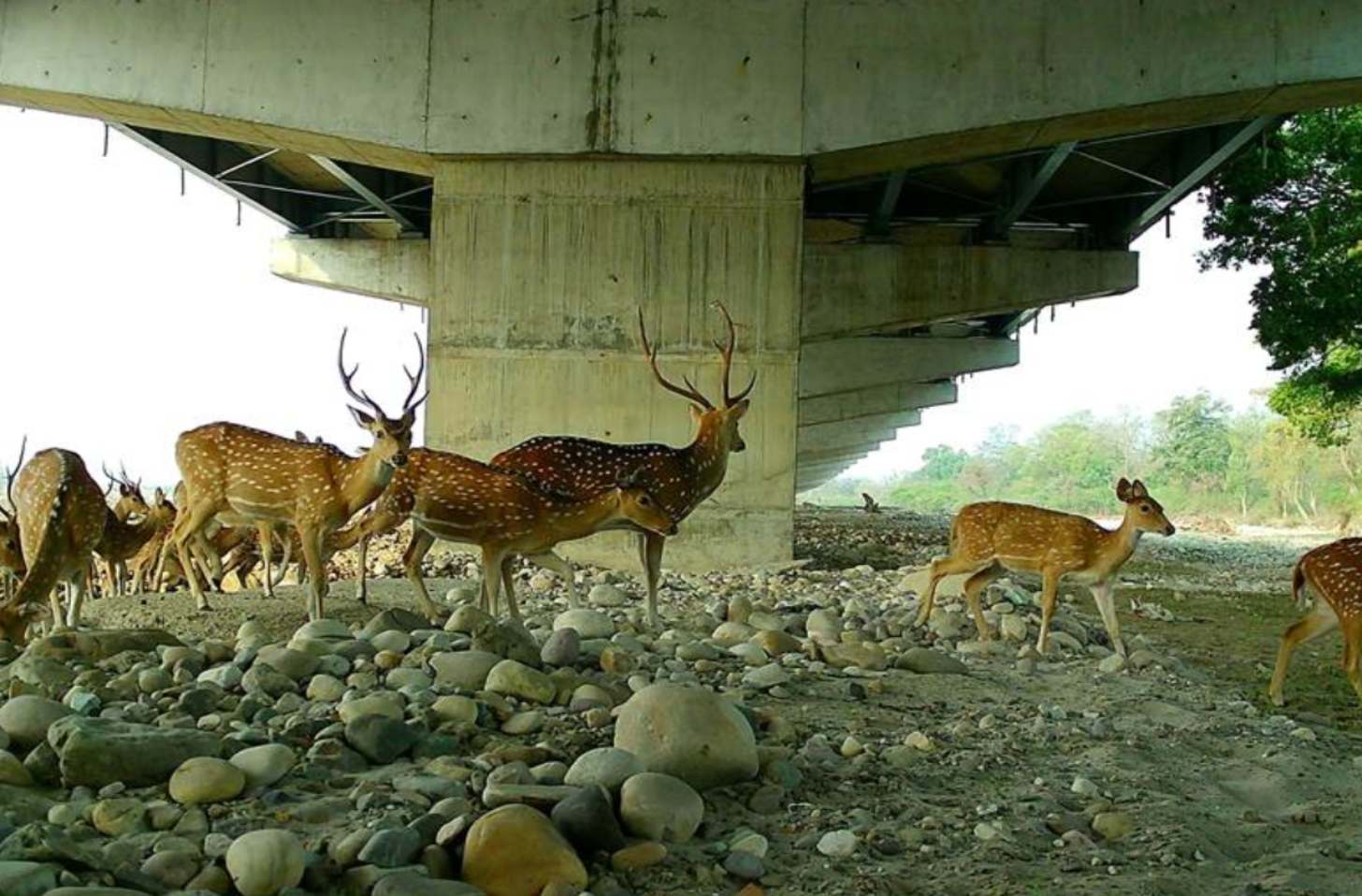
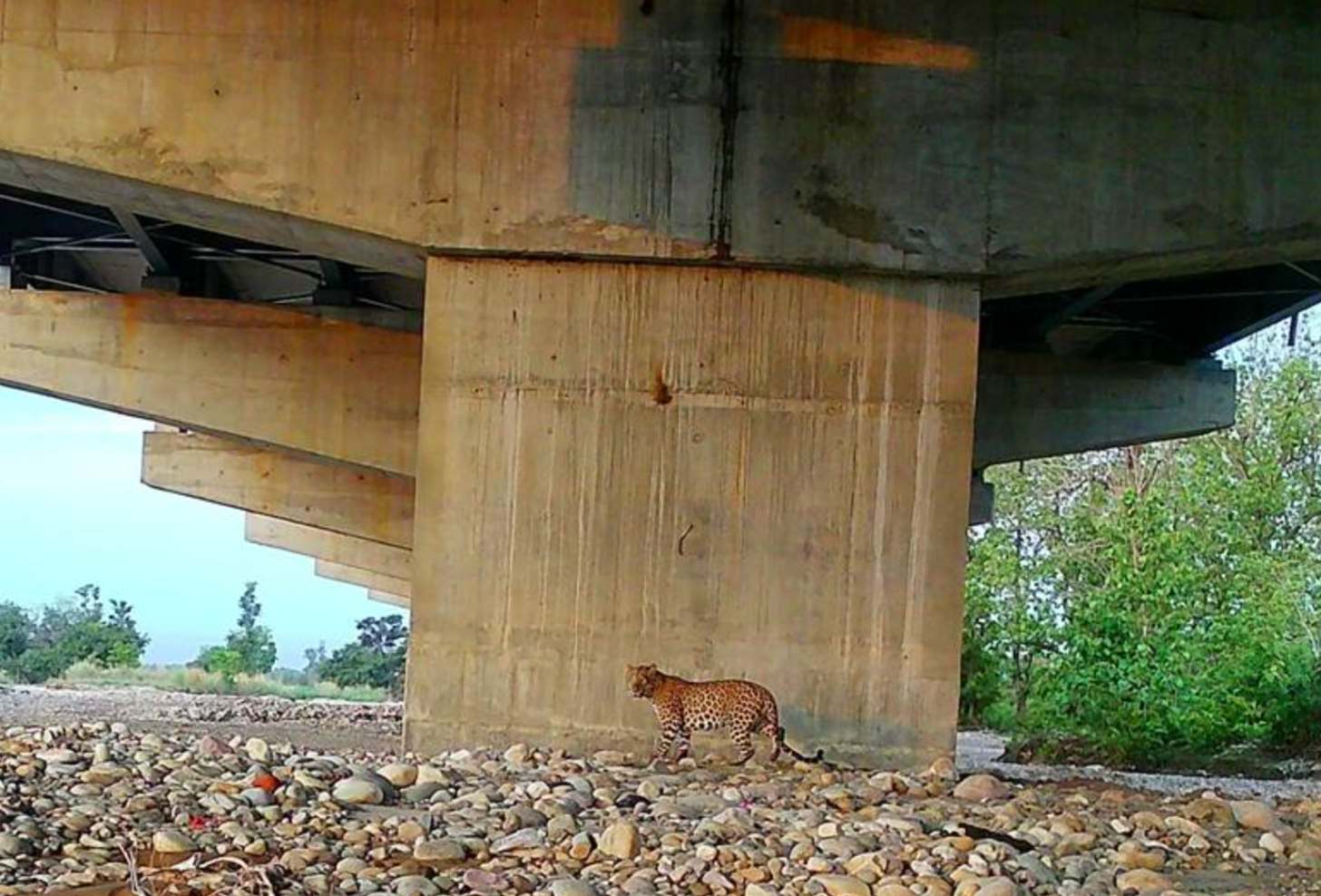
In fact, in a new study from the Wildlife Institute of India and the National Highways Authority of India on the effectiveness of wildlife corridors, researchers recorded over 40,000 images of animals using the crossing in the 40-day window before construction was completed.
“40,444 were attributed to 18 unique wild species utilising the underpass, including various carnivores, herbivores, ungulates, pheasants, and primates,” the agencies stated. “The golden jackal was the most frequently captured, followed closely by Nilgai, Sambar, and spotted deer. Smaller mammals, including the Indian hare, also showed consistent movement through the structures.”
“Notably,” they added, “the study also recorded 60 instances of the elephants safely utilising the corridors, establishing that even the largest wild animals can navigate the new infrastructure to maintain their natural migration patterns.”
India is home to approximately 22,446 wild elephants — roughly 60% of the world’s remaining Asian elephants.
Although Asian elephants are listed as endangered on the International Union for Conservation of Nature’s Red List, nonprofit groups like Wildlife SOS have achieved major conservation milestones in the region over the last decade.
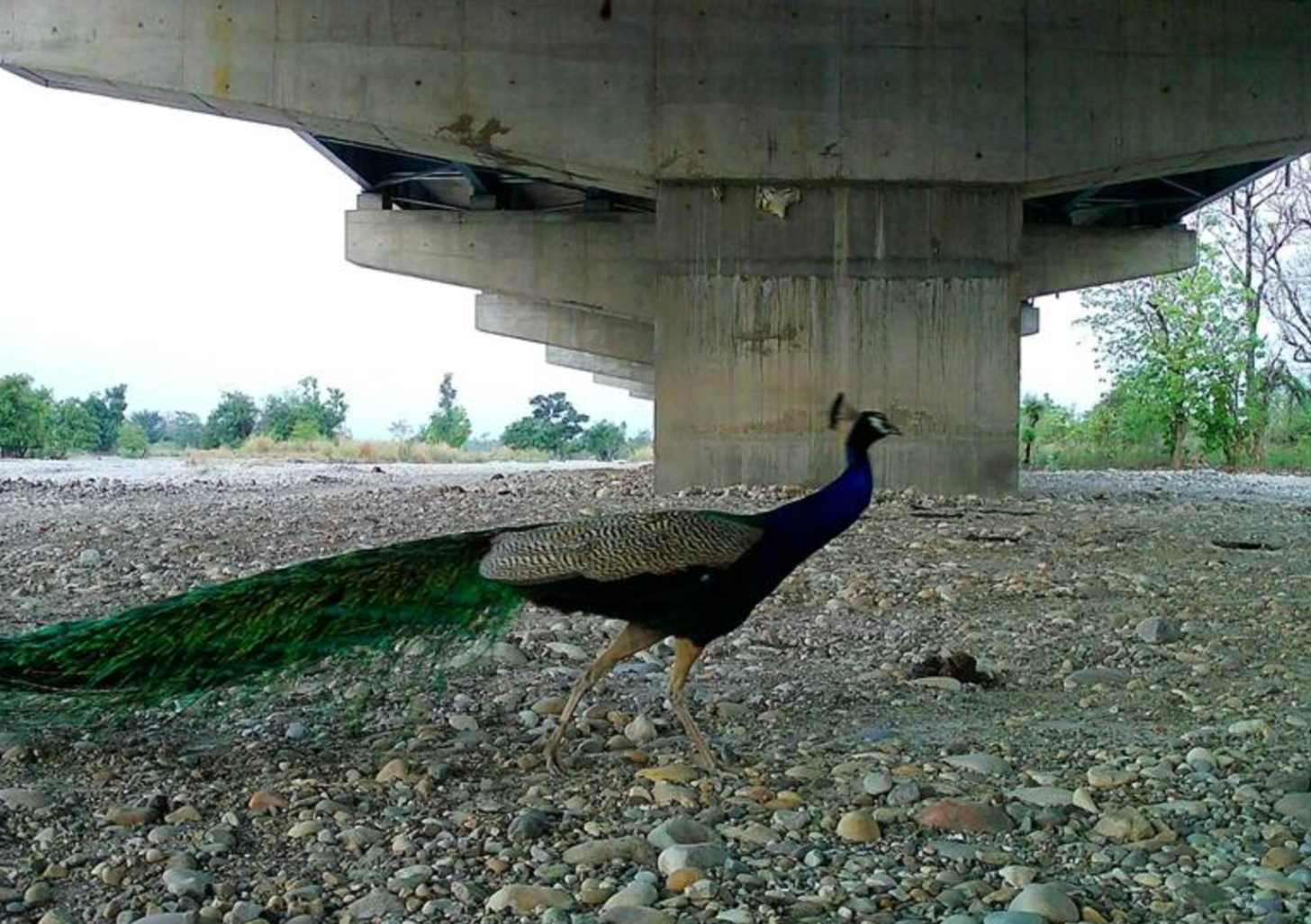
Recent efforts include India’s first Humane Elephant Rescue Center, India’s first elephant hospital, and the implementation of an “elephant” ambulance custom-designed to save elephants in distress.
And now, the Delhi-Dehradun Economic Corridor is one more defense for elephants and other vulnerable species against the preventable violence of traffic collisions.
The agencies concluded their press release by stating: “NHAI remains committed to integrating environmental sustainability into National Highway development and will continue to adopt innovative mitigation strategies and measures, including data-driven approaches to balance infrastructure growth with ecological and biodiversity conservation.”
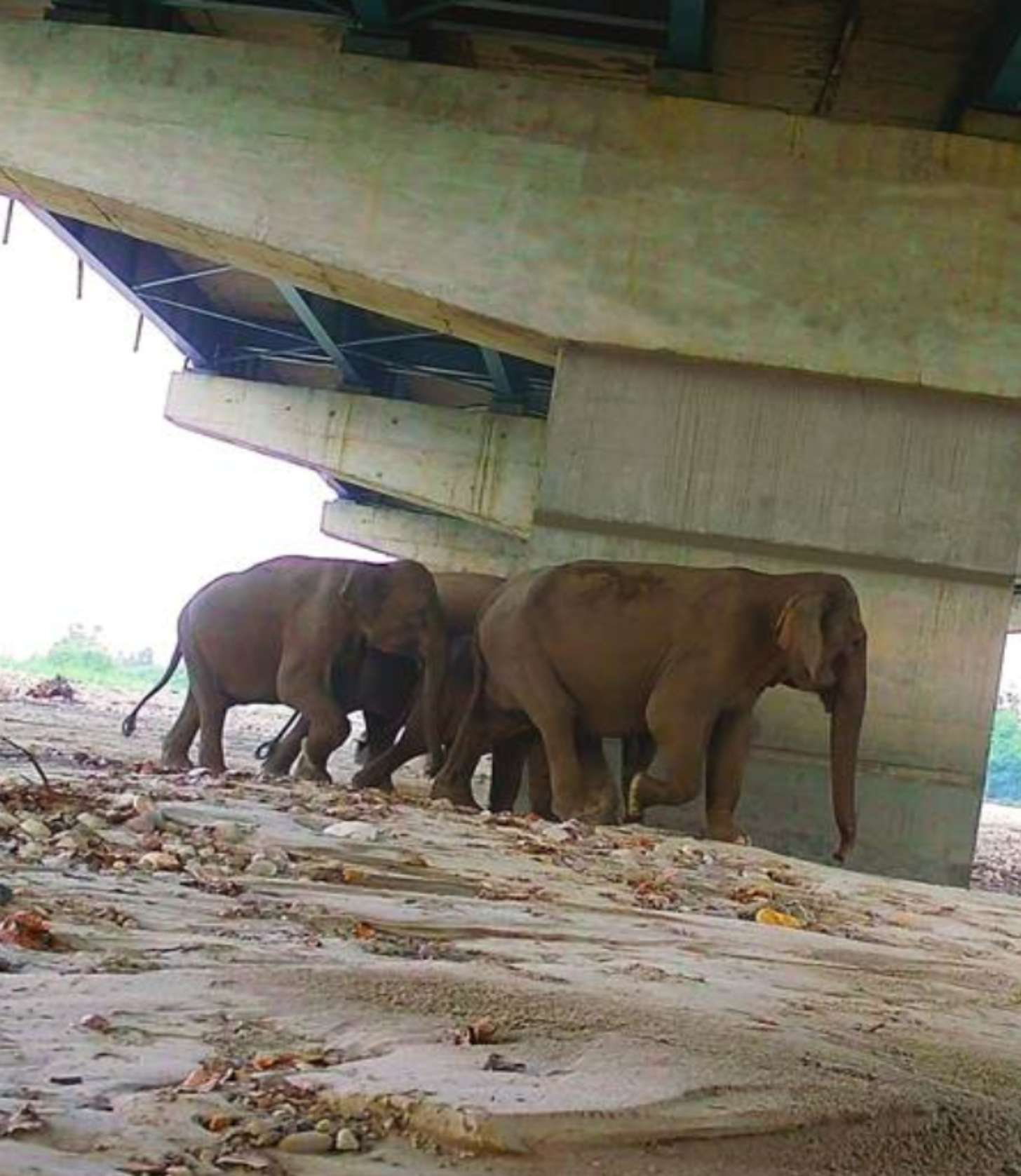
You may also like: The world’s largest wildlife overpass was specifically designed to help elk. Three finally braved the six-lane crossing
Header image Wildlife Institute of India, National Highways Authority of India
Last week, a curious 250-pound Loggerhead turtle on Tybee Island found herself stuck in a marshy mud pit right off of Highway 80.
A long way from home, she was fortunately spotted by Tybee Island Marine Science Center volunteer Tammy Smith, who called into the marine center to get rescuers on the scene.
Then, TIMSC curator Sarah Alley was there, confirming that the female adult Loggerhead had indeed crawled a very long way from home, about 0.8 miles down the trail from the entrance of Fort Pulaski.
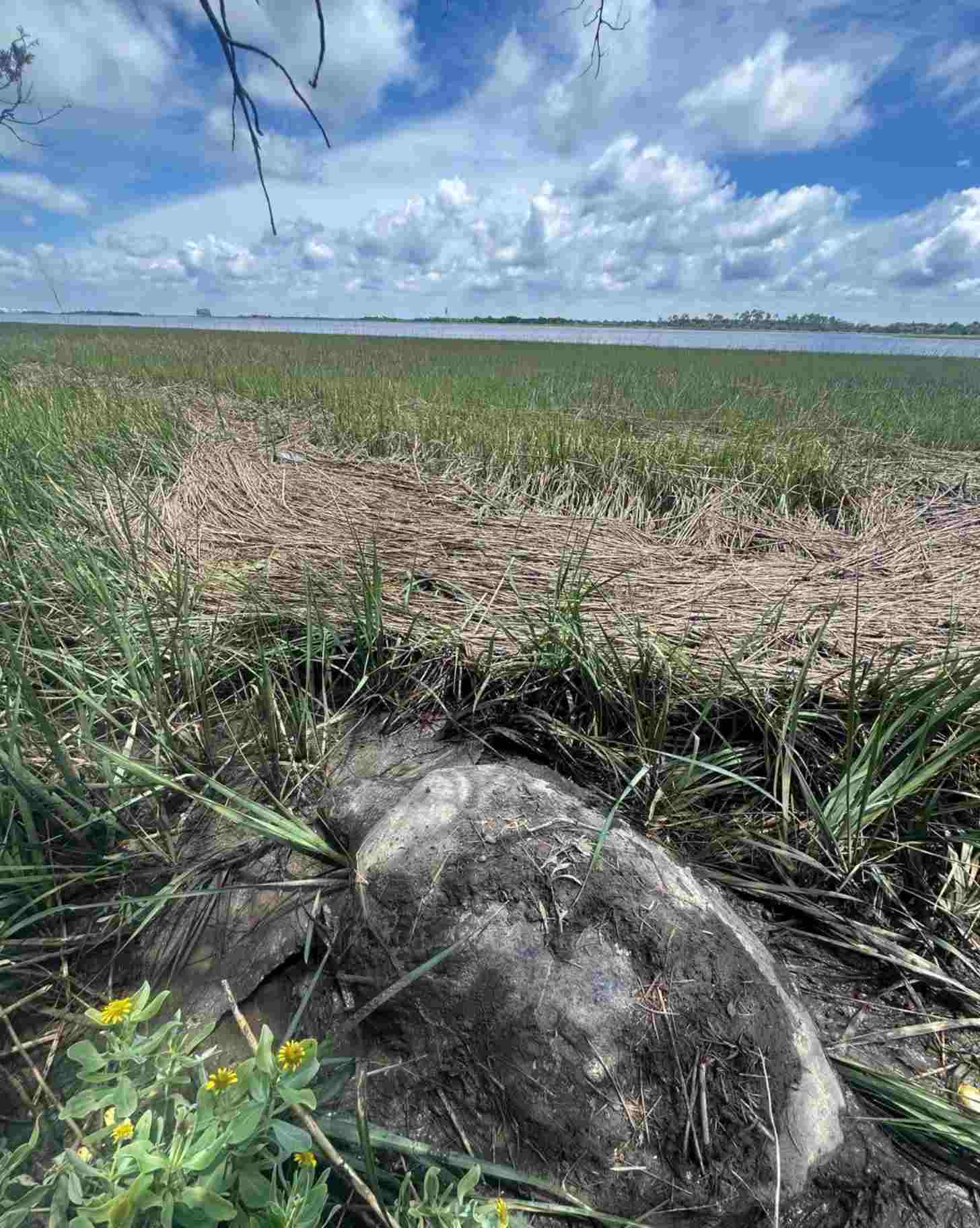
The marsh she ended up in was next to the South Channel of the Savannah River, in a trail right alongside the highway.
“She had a long crawl through the grass, parallel to the river, and had turned back around and ended up right by the trail,” Alley observed in a statement for TIMSC.
Alley contacted the Department of Natural Resources biologists, who had to fight traffic for about three hours before reaching the distressed turtle.
Fortunately, things weren’t too dire for the turtle, though she needed to be cooled off with water and wet towels to stay in fighting shape. Alley also got a beach umbrella out of her car to keep the turtle shaded.

“I decided to call her Wilbur because she was like a little marsh piggy, slapping her flippers in the mud when I got there,” Alley added.
“She showed no signs of external injury, was very strong, and very large.”
Wilbur was certainly distressed, however, and laid a single egg, likely out of stress, according to Alley.
While most sea turtles in the area encountered by TIMSC are tagged for tracking, experts decided not to tag Wilbur to not cause any additional stress. But they did measure her carapace, or shell, which came in at 3.2 feet. Her weight was estimated to be at least 250 pounds.

Finally, Mark Dodd and Blake Marin with the DNR arrived on the scene, along with some other TIMSC team members.
They all worked to maneuver Wilbur into a large velcro string and onto an ATV, where she was finally transported to a DNR truck and driven back home to the ocean.
After a short journey, she was released safely back to the water.
But the single egg she left? Researchers with the DNR took it for genetic testing for an ongoing study at the University of Georgia in Athens, “which will hopefully yield some more information about his strong sea turtle in the future,” TIMSC reported.

Loggerhead turtles like Wilbur are classified as an endangered species, facing threats like fishing bycatch, nesting habitat loss, ocean pollution, vessel strikes, and worsening impacts of climate change.
Right now, Tybee Island, Georgia is experiencing a historic sea turtle nesting season, with female loggerhead sea turtles currently laying a record number of nests. Conservationists are eager to see how this plays out for the future of the species, as nesting season lasts between May 1 to October 31.
“Swim safe out there, Wilbur,” TIMSC wrote on Facebook after the turtle had returned home. “We hope to have you nest safely on Tybee's beach!”
You may also like: Island conservationists celebrate 80X increase in nesting loggerhead turtles
Header image courtesy of Tybee Island Marine Science Center/Facebook
Phil Hardberger Park in San Antonio, Texas is a park and nature preserve named after a former San Antonio mayor who used his leadership to champion parks in the city’s urban core.
During his time as mayor, Hardberger created a nature preserve in Voelcker Ranch, one of the few remaining undeveloped parcels in the city. The city purchased 311 acres (which has since grown to 330 acres) to establish a park and conservation site amid a densely developed city. It officially opened in 2010.
“With Phil Hardberger Park, we are creating a park not just for ourselves and our children, but for the centuries,” Harberger, who is now the president of the Phil Hardberger Park Conservancy, said.

Ten years later, the conservancy debuted another ambitious project: A first-in-the-country land bridge designed for both human and wildlife passage. Named Robert L.B. Tobin Land Bridge, it acts as the centerpiece of the park, coming in at 150 feet wide and crossing a six-lane highway.
The bridge connects both sides of the park, which were originally bisected by the highway.

There is a 1,000-foot-long elevated “sky walk” that starts at the base of the park and winds upwards until pedestrians are walking among the tops of trees. Entry points are extended deeper into the park with increasingly elevated walkways to remain accessible to all visitors.
“You can have either a squirrel’s eye view or a bird's eye view as you come up through the trees,” Hardberger told Texas Public Radio.

And as for the animals? Designers created the bridge in layers, with a steep berm and native plantings to buffer wildlife onto a separate trail from humans.
Wildlife biologists helped designers execute a wildlife passage by installing 3,300 feet of barrier fencing, which directs animals upward, where they are covered by berms and plantings, separate from the human walkway.
According to Texas Public Radio, since its opening, the bridge has diversified park habitat with over 50 reintroduced species of wildlife, restoring a “major ecological sanctuary.”

“Before the first anniversary of the bridge, every mammal species known to reside within the park was captured on the land bridge’s trail cameras,” a statement from the conservancy explained, “including bobcat, white-tailed deer, and ringtail cat.”
In addition to being filled with native wildlife, a 1-acre wetland next to the bridge also collects rainwater and acts as a wildlife watering hole. A 250,000-gallon underground cistern harvests rainwater and irrigates the land during standard San Antonio droughts.
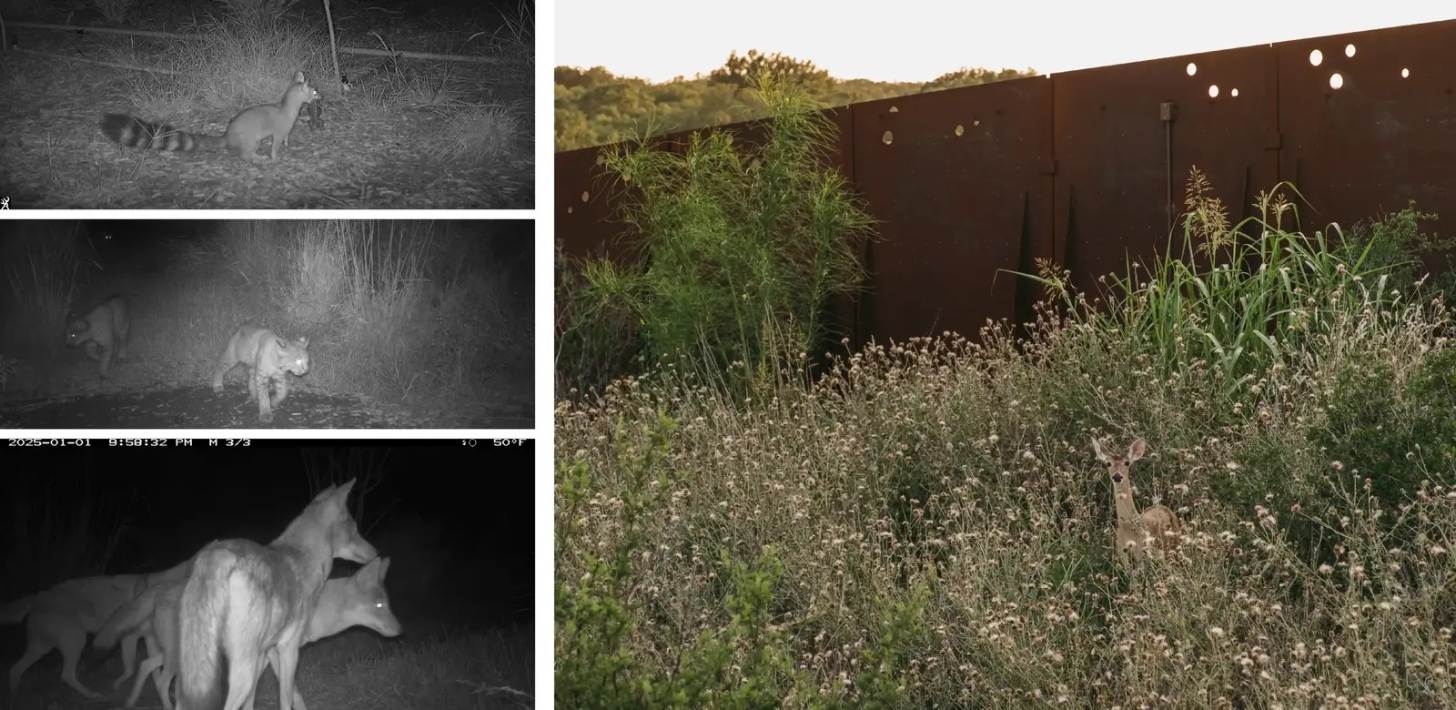
Last year, the land bridge won the Honor Award for General Design from the American Society of Landscape Architects.
“A great case study in possibilities,” the Awards Jury wrote of the design.
“This project makes an incredibly difficult task of building a functional landscape on structure; creating a welcoming space over a highway; balancing the needs of humans and non-humans alike; and connecting ecological fragments look easy.”
They also described the bridge as “more than infrastructure,” calling it a “continuation of the land itself,” to allow restored scrubland and savanna to “unfold over a cityscape.”

The bridge ultimately cost about $23 million to construct, using a 2017 voter-approved city bond of $13 million and $10 million in grants and donations. These days, it sustains about 750-1,000 visitors per day, according to the conservancy.
Wildlife crossings have grown in popularity as other states across the United States see conservation success and steep drops in wildlife-vehicle collisions.
The Robert L.B. Tobin Land Bridge expands on that, creating a space where people can connect to the natural world in a whole new way.

“Connectivity is an extremely important part of ecology,” Gregory Tuzzolo, an associate principal at Stimson Studio, the landscape architecture firm that worked on the bridge, told The Guardian.
“You can make a conservation area over here and a park over there, but if wildlife can’t pass from one area to another, we still have a degraded landscape. So, being able to really have this signature piece and this park means so much to this landscape.”
You may also like: Critics doubted a $1.46B wildlife crossing. Trail cameras tell a success story: '75 recorded uses each night'
Header image by Justin Moore for Phil Hardberger Park Conservancy
In the Indigenous Miskitu community of Mavita in eastern Honduras, locals have been losing their cassava fields in droves to hungry animals. For years, farmers have blamed the decimation of their crops on three species: Paca rodents, armadillos, and the Baird’s tapir.
Baird’s tapirs, known locally as “tilvas,” are the largest terrestrial mammal in Central America. Weighing up to 660 pounds — the size of a small donkey — tapirs have long, protruding noses, pig-like bodies, and hooved feet.
They are also incredibly endangered.
Today, the Baird’s tapir roams from northern Colombia through Panama, Costa Rica, Nicaragua, Honduras, Guatemala, Belize, and southeastern Mexico. They once thrived in El Salvador and Ecuador as well, but due to habitat degradation and overhunting, the species hasn’t been spotted in either country for decades.
In 1996, the Baird’s tapir was listed as vulnerable by the International Union for the Conservation of Nature, and upgraded to endangered in 2002 after research revealed that the mammal had experienced a 50% population decline in just 30 years.
When researchers from the Wildlife Conservation Society learned of the Miskitu farmers’ rising tensions with Baird’s tapirs, they stepped in to help.
“In Central America, human-wildlife conflicts are mainly expressed as crop damage, livestock predation, or, to a lesser extent, attacks on people,” the researchers explained in their study, which was published in the Neotropical Biology and Conservation on May 22. “In most cases, affected communities respond to these losses with retaliatory actions that threaten wildlife survival.”
To investigate the crop theft, WCS scientists set up camera traps equipped with solar-powered motion-activated LED lights in a 24-acre cassava field.
As expected, many animals emerged from the surrounding environment, which was a blend of Caribbean pine forest and tropical rainforest of the Honduran Mosquitia.
“What surprised me most was discovering that the species most frequently blamed by local people was not the one causing most of the crop interactions,” lead author Manfredo Turcios-Casco said in a press release.
Despite local rumors, the species most frequently recorded amongst the cassava crops was not the tapir, but the Honduran cottontail rabbit.
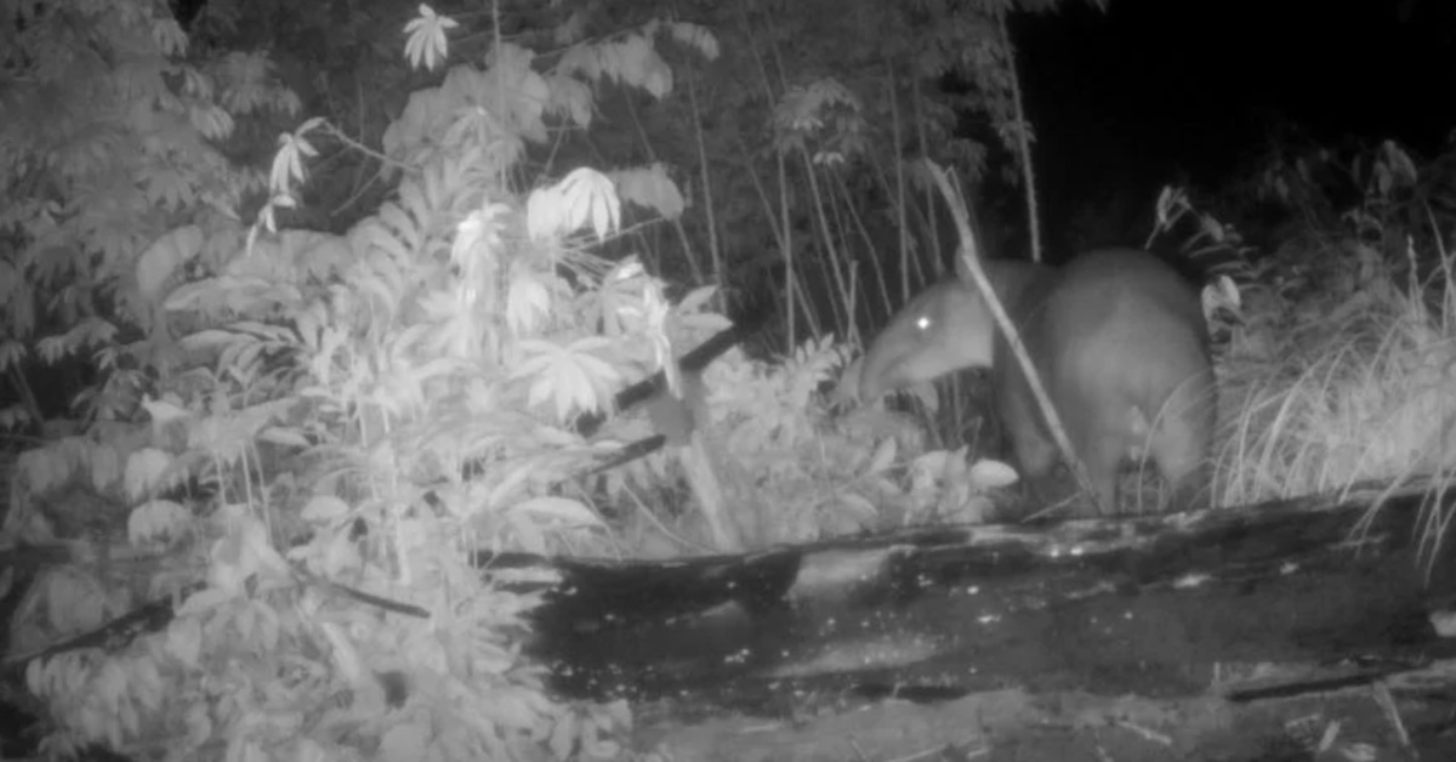
The rabbit — which is strikingly similar to the Eastern cottontail rabbit of North America — is widely distributed throughout Guatemala to Honduras.
“Contrary to local expectations, rabbits emerged as the primary crop raiders, while tapirs were present but not the sole culprits,” the researchers concluded.
In addition to the tapirs’ lower-than-expected presence, the researchers found no evidence that armadillos or pacas were feeding on the cassava.
“Many conservation conflicts begin with assumptions,” said Turcios-Casco. “Without evidence, it is easy to blame large and conspicuous animals.”
Because of the community’s assumptions, Baird’s tapirs had been facing retaliatory hunting in the area for years — but they play a vital role in the ecosystem.
The gentle herbivores are commonly known as “gardeners of the forest,” consuming and spreading 200 species of plants, fruits, and seeds as they move through the rainforests and Caribbean pines of Honduras.
“Camera traps allowed us to identify which species were truly interacting with the crops and helped us separate perception from reality,” Turcios-Casco said.
In their study, Turcios-Casco and his colleagues recommended further use of light traps and camera traps to garner accurate data on human-wildlife conflicts.
“These findings highlight the importance of accurately identifying the species involved to guide appropriate management actions and avoid negative impacts on species of conservation concern,” they said.
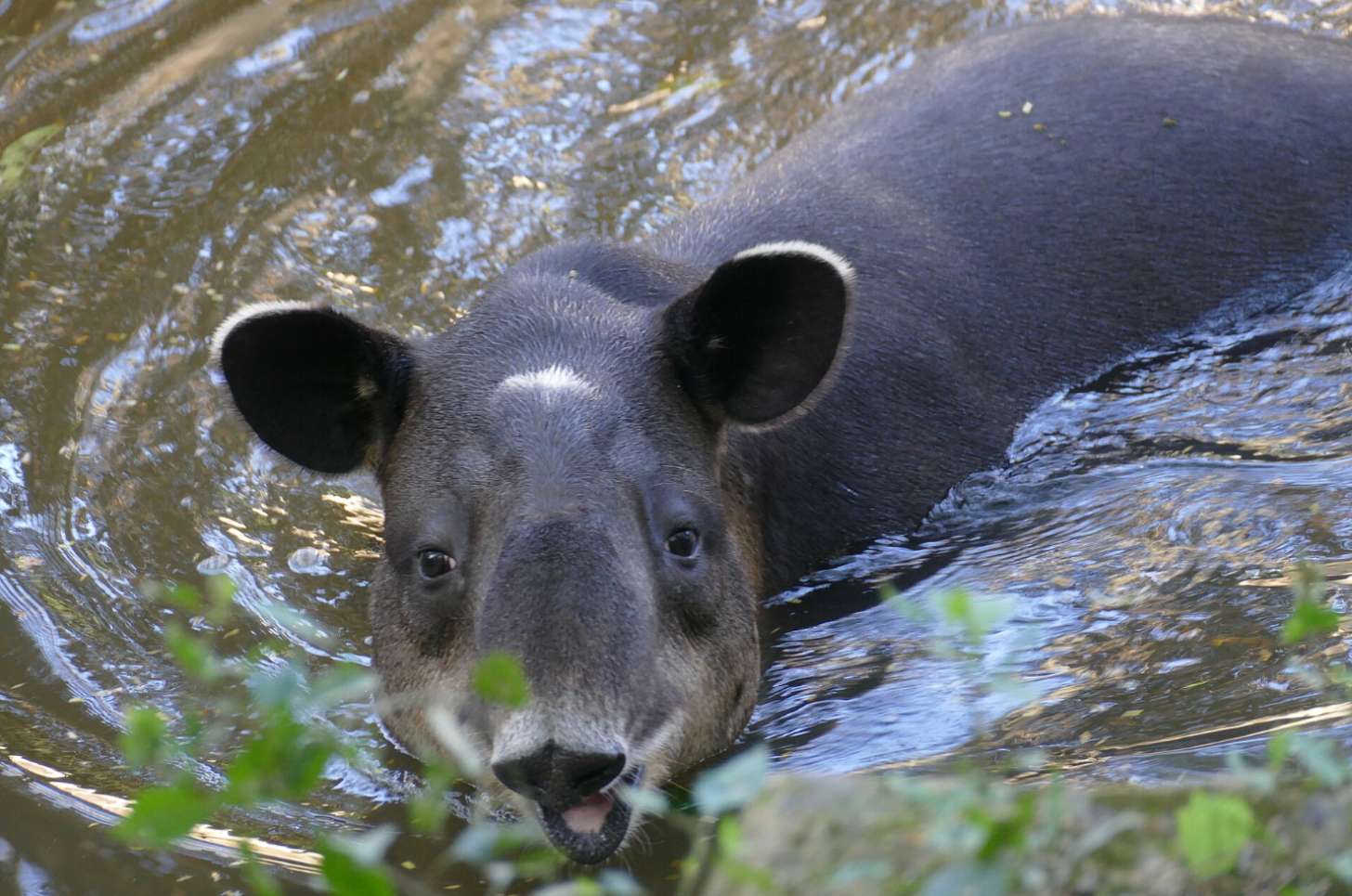
You may also like: Wisconsin has conserved 750,000 acres since 1989. These trail cam photos show why it matters
Header image via Turcios-Casco et al.
In mid-June, Virginia fisherman Brandon Watts was cruising on the waters of the Chesapeake Bay with his friends, hoping to reel in some cobias, a predatory fish that can grow up to 6 feet long.
Instead, they stumbled upon an animal in need: a 700-pound leatherback sea turtle that was wrapped in crab pot buoy lines.
“We think we were around Buck Row Beach, and we’d seen something struggling in the water,” Watts said in an interview with WAVY TV 10.
“It seemed like he was crying for help, and my dad mode kicked in, and I just went right to town.”

On that day, the three fishermen were grappling with 20 mph winds, which meant they had to be careful not to get too close to the sea turtle, lest the rocking waves drive them into the sea creature itself.
When Watts got close enough, he realized that the buoy lines were wrapped around the sea turtle’s neck and flippers at least 10 times. Using a razor knife, Watts sliced through each twisted rope until it was freed.
“I just couldn’t leave him, knowing that he could wash up dead somewhere down the line, so I just had to do what I could do to get him free,” Watts said.
As Watts worked to free the lines, his friend Travis Cullipher stood at the helm to make sure the boat was a careful distance from the sea turtle.
“I’ve been fishing since I was a little kid, but I’ve never seen a turtle in distress like that,” Cullipher said.
“They didn’t ask for all that stuff to be in that water,” Watts added. “So anything you can do helps.”
Abandoned fishing gear, like crab trap buoy lines, fishing hooks, nets, and more, poses a major threat to sea turtles.
In 2018, another leatherback sea turtle was caught in a crab pot buoy 50ft below the surface, before it was rescued by a boat full of fishermen.
In 2024, the New England Aquarium Anderson Cabot Center for Ocean Life responded to a 400-pound leatherback that was wrapped in fishing gear in Cape Cod Bay, Massachusetts.
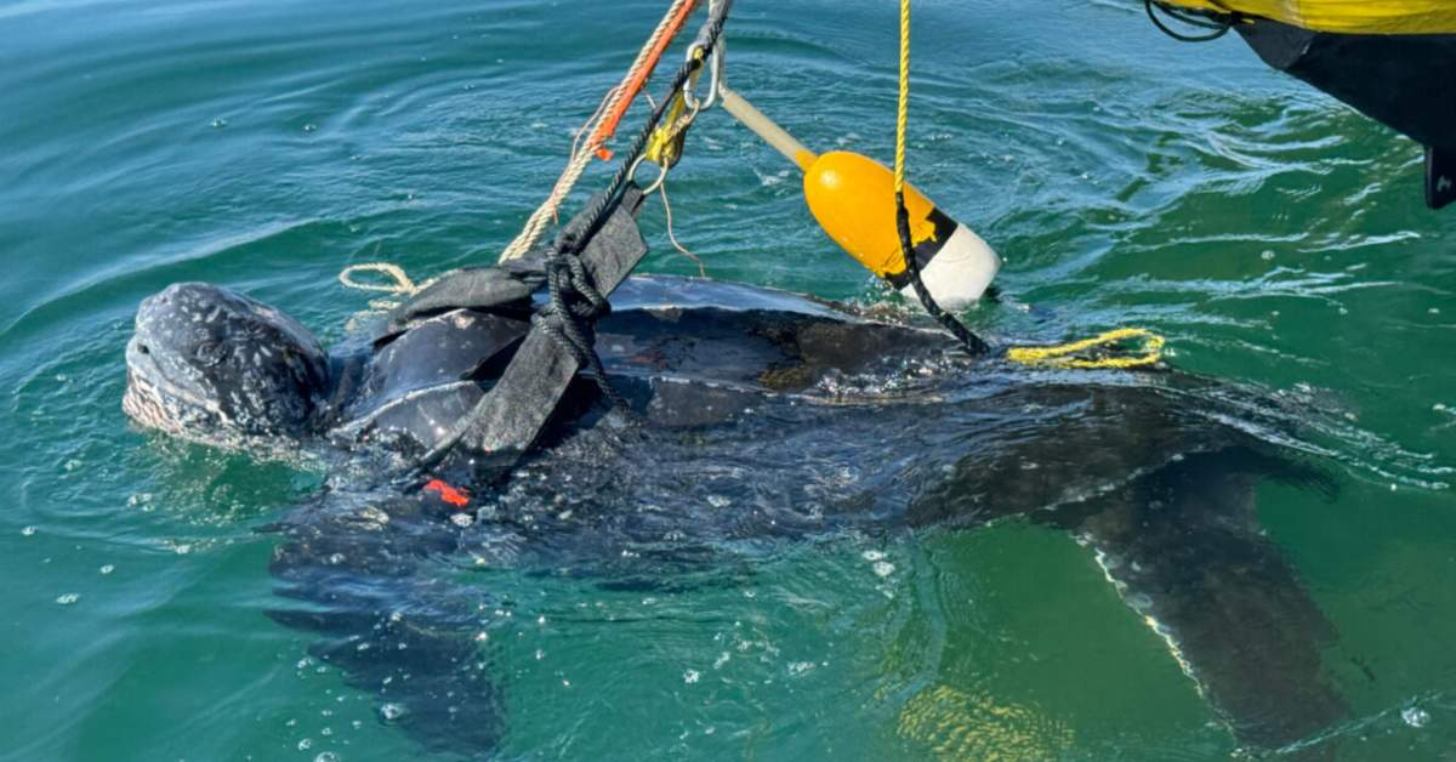
“The turtle had a rope entanglement around the shoulder region of its right front flipper, but fortunately it was detected quickly, and the gear was still loose with minimal damage to the flipper,” Dr. Melissa Joblon, the aquarium’s director of animal health, said in a press release.
“Overall, the turtle appeared healthy, active, and in great body condition, so we suspect it will do very well after release.”
Before the leatherback — nicknamed “Phinney” by local Cape Cod Bay responders — was released back into the bay, scientists affixed satellite and acoustic tags on the turtle’s shell.
The technology allows researchers to track released turtles for up to ten years by a vast array of underwater receivers that stretch from Canada to Florida.
“It’s critical that we understand the outcomes of leatherback sea turtles after they’re disentangled from fishing gear,” said Kara Dodge, an Anderson Cabot Research Scientist. “We’re using satellite and acoustic tags to monitor their post-release survival and behavior over time.”
Today, sea turtles like Phinney can be followed on the New England Aquarium’s Sea Turtle Tracker.
You may also like: An endangered sea turtle just laid the 300th nest of the season. She's been visiting Florida beaches since 2001
Header image is a representative photo of the story, via the New England Aquarium
Fireworks are notoriously bad for the environment, especially in drought-stricken areas prone to wildfires.
But they’re also especially unpleasant for survivors of gun violence, veterans — and pets that are sensitive to loud noises.
But for pets who aren’t safe at home, comforted by their families and pampered with all kinds of anxiety interventions, Fourth of July festivities can be extra challenging.
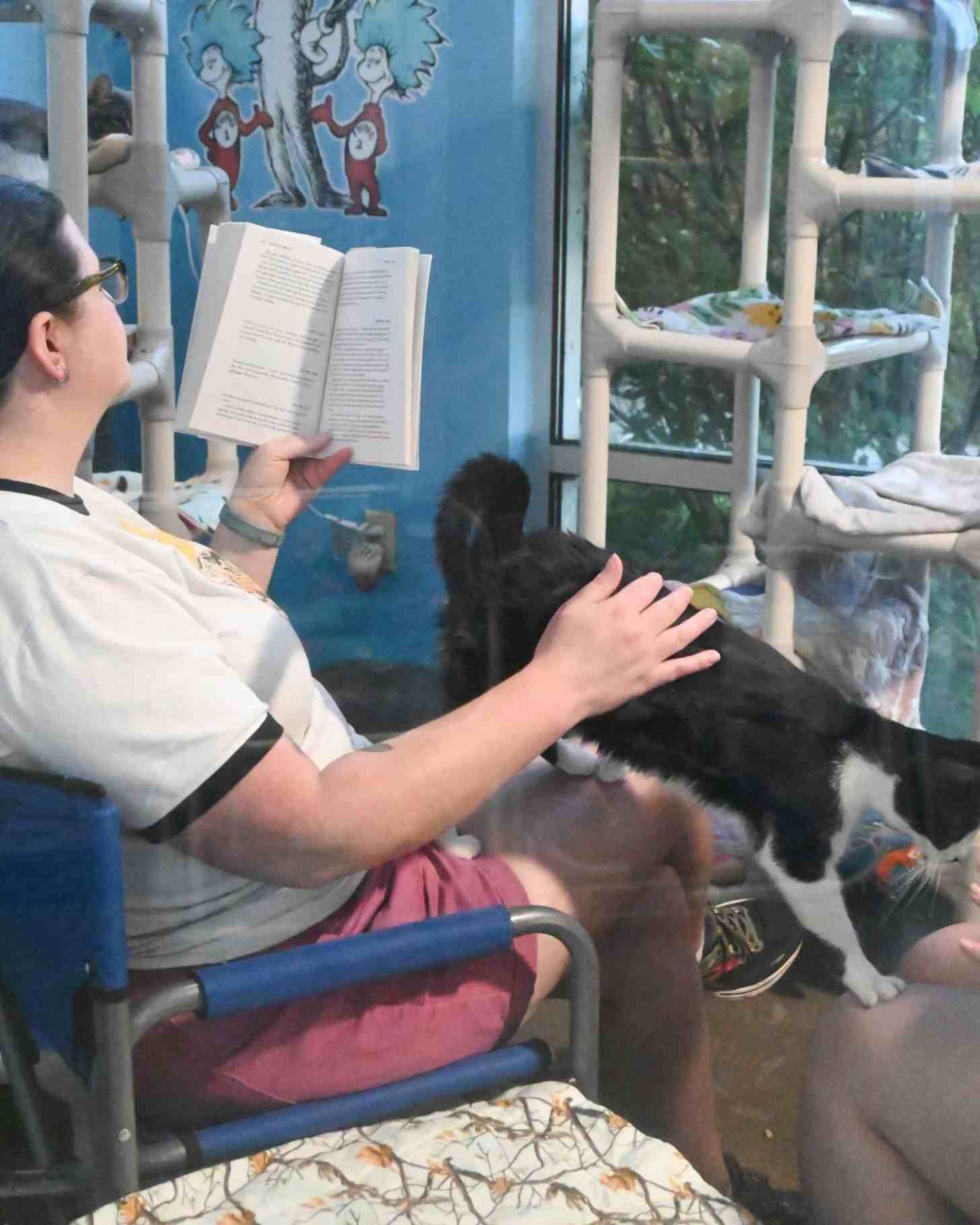
As one of Northern California’s largest open-admission shelters, Bradshaw Animal Shelter in Sacramento has found a way to help every animal in need as much as they can.
Six years ago, the shelter began hosting Comfort Sessions the evening of Independence Day.
“While the skies light up with color, our shelter pets will be facing the loudest night of the year,” the shelter wrote in a Facebook post ahead of this year’s event. “And that’s where you come in.”
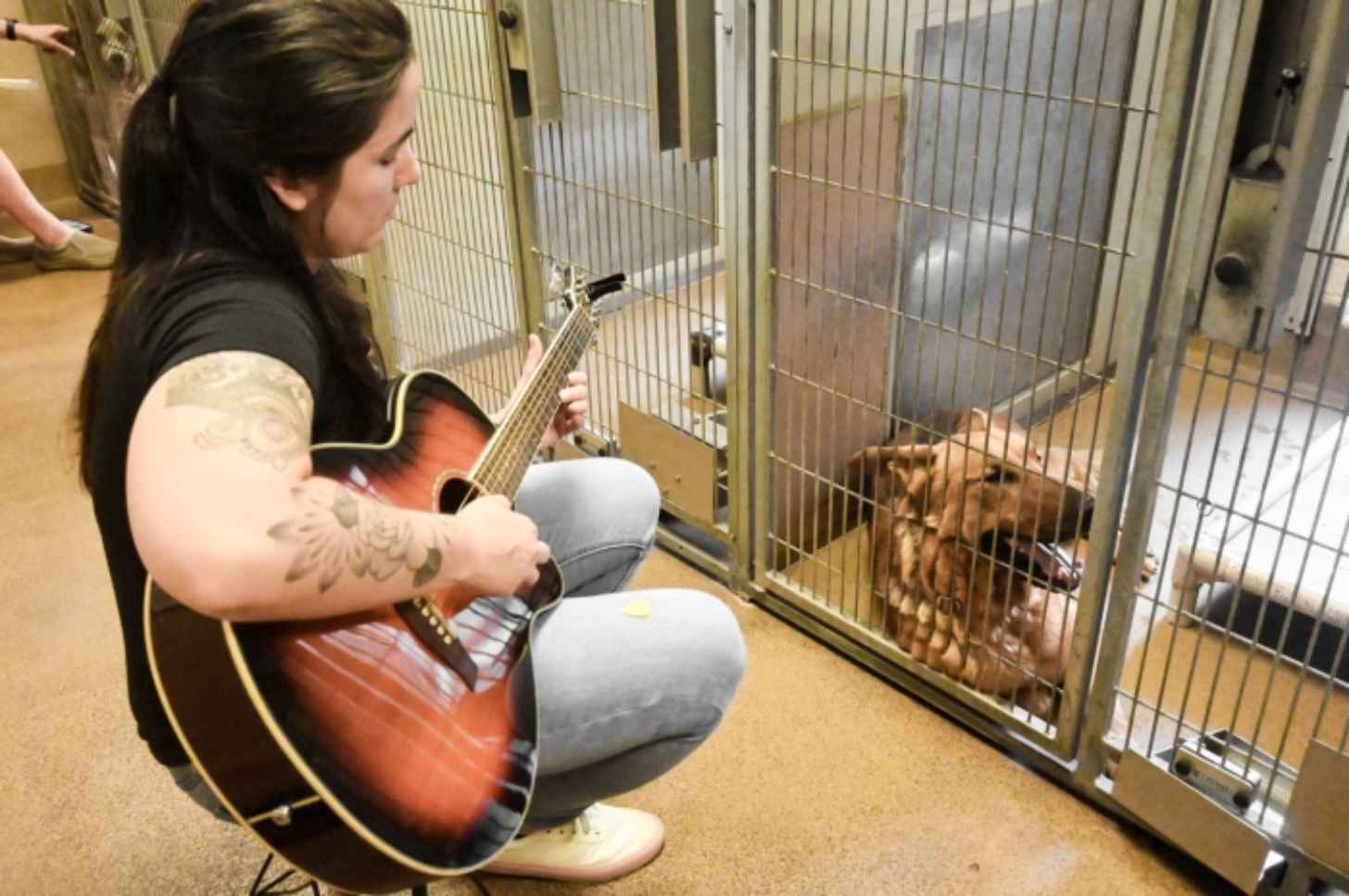
Volunteers are invited to provide a little comfort to the animals during two sessions on the evening of July 4th: 7 to 8:30 p.m. or 8:30 to 10 p.m.
“Come sit beside them,” the shelter urged. “Read a book. Strum a guitar. Sing a song. Your calm, soothing presence can ease their fear and help them feel safe through the pops, cracks, and booms.”
Individuals and groups up to five people are welcome to attend, including children with adult supervision. All volunteers have to do is sign up, bring a camp chair, cushion, or yoga mat, and a good book to read or a soothing instrument to play.

As of the writing of this article, all sessions are fully booked, with volunteers eager to do something good on the big day.
“While many of us spend the Fourth of July looking up at the fireworks,” the shelter wrote in a Facebook post, “our shelter pets are hoping someone will simply sit beside them.”
For those who weren’t able to sign up in time, one supporter commented on Bradshaw Animal Shelter’s Facebook post with another idea.
“I just made a monetary donation to Bradshaw Animal Shelter in lieu of buying fireworks. It has become my annual tradition,” the commenter wrote.
“The fireworks are torture for most animals, and it breaks my heart to see all the pets that end up in our already overwhelmed shelters.”

Why is this good news?
The unpredictable sounds of fireworks can overwhelm pets’ senses, triggering a fight-or-flight response. Dogs, especially, can experience pain from loud noises because they hear higher frequencies than humans do.
Animals that are calmer and less stressed are more likely to display their natural personalities, helping potential adopters see them at their best.
You may also like: This 277-dog pool party just broke a Guinness World Record. Now all of the pools are being donated to shelters
Header image courtesy of Bradshaw Animal Shelter/Facebook
Legislation to strengthen protections for reproductive and transgender healthcare providers and patients is poised for Gov. Mikie Sherrill’s approval following party-line votes by New Jersey lawmakers Tuesday.
The state Assembly approved the Democratic-sponsored measure to create a new crime of interfering with reproductive healthcare, which under the bill includes care for people who are transgender, by a vote of 55 to 23. The Senate also approved minor changes made by the Assembly by 25 to 15.
Jennifer Williams, a city council member in Trenton who is transgender, said she “could not be happier” with the outcome, given the years of advocacy by LGBTQ+ supporters.
“New Jersey is a great, liberty-loving state that will remain a safe haven for those who only want to live happy, productive lives while accessing medically necessary and proven medical care,” Williams told the New Jersey Monitor after the vote.
Supporters have said the protections are necessary as the Trump administration seeks to reduce access to abortion and care for gender dysphoria diagnoses, particularly among children. The administration has supported rollbacks to abortion access and has sought to withhold healthcare funding from hospitals that provide treatments to trans kids.
The measure first passed the Senate in late May — also along party lines — following multiple hearings that featured passionate testimony from parents whose transgender children have struggled to get care. Many said they have been told by doctors that treatment their kids were receiving would be terminated because of political pressure on their hospital systems.
“Healthcare decisions belong to patients and their providers,” bill sponsor Assemblywoman Shanique Speight (D-Essex) said in a statement.
Speight said every patient should have access to care without “fear, delay, or intimidation.”
Opponents of the bill said it could curb free speech and limit what anti-abortion advocates call “sidewalk counseling” of patients visiting reproductive healthcare facilities (a provision of the bill that some critics said could lead to criminal charges against journalists was removed in recent weeks). Republicans echoed those concerns and withheld their support.
Assemblyman Brian Rumpf (R-Ocean) claimed New Jersey was “turning the Constitution on its head” to address what he called the “highly inflammatory” issue of healthcare for people who are transgender.
Assemblywoman Dawn Fantasia (R-Sussex) said she supports access to healthcare for adults who are transgender, but worries the legislation does not do enough to protect children from getting treatments they may regret later in life.
“The bill does not differentiate between children and adults. That’s highly problematic. Adults can make adult decisions. Children — that’s different,” Fantasia said.

Lauren Albrecht, senior advocacy director at Garden State Equality, an LGBTQ+ organization that advocated for the bill, said the legislation protects access to evidence-based care.
Kaitlyn Wojtowicz, executive director of Planned Parenthood’s New Jersey political arm, said the measure will strengthen New Jersey’s existing protections around abortion, a critical step in the wake of the U.S. Supreme Court’s decision to end national protections for the procedure in 2022.
“This is a truly momentous day in New Jersey,” Wojtowicz said.
If signed into law, it would be a fourth-degree crime to harass or harm patients and healthcare providers, staff, or volunteers or block them from entering a facility that provides reproductive care, including services for trans people.
If someone is hurt during the interference, violators face ten years in prison and a fine of $150,000. It would also protect providers from extradition to other states that have chosen to criminalize their practice.
“This bill isn’t about trans individuals. This bill is about human rights,” said bill sponsor Assemblywoman Luanne Peterpaul (D-Monmouth), “and about women getting reproductive care.”
The votes in New Jersey came the same day the U.S. Supreme Court upheld bans Idaho and West Virginia created to prevent trans athletes from participating in women’s sports, a measure supporters say is needed to ensure fair competition for females. LGBTQ+ advocates said the ban is discriminatory.
This article was written by Lilo H. Stainton and originally published on New Jersey Monitor.
Header Image by Anne-Marie Caruso of New Jersey Monitor
Wildlife crossings, from highway overpasses to underpasses, tunnels, and fences, are proven to reduce wildlife-vehicle collisions by more than 90%.
In addition to preventing deaths, injuries, property damage, and medical costs for drivers, these structures reconnect important habitats and support the conservation of wildlife.
According to Pew, one wildlife crossing can prevent about 1,400 accidents over a 70-year lifespan, resulting in billions of dollars in savings.
But to see those results, the infrastructure needs to be built.
Some states, like Colorado and Arizona, have begun to devote larger amounts of funding to building wildlife crossings. And Montana just launched a new way to pay for these structures: specialty license plates.
Starting today, July 1, Montana motorists can now select a specialty license plate that funds wildlife connectivity programs statewide.
Back in 2025, the state legislature established a program to designate specific funding to wildlife crossings, and Montana Fish, Wildlife and Parks estimates that the license plate fundraiser will bring in about $100,000 annually to that program.

The license plate design features a snow-covered wildlife crossing, with cool-toned mountains in the background, and an elk stepping onto an overpass.
It was created by Kylie Bute, a recent graduate of Gallatin High School. She was selected as the winner of a contest organized by several conservation organizations and state agencies.
“My passion for art has always been about telling stories, and this design is a way to spread awareness of the importance of wildlife conservation and movement,” Bute said in a statement.
“I’m deeply appreciative and proud to know that my artwork will soon be on vehicles across our great state, helping Montanans connect with the incredible wildlife that surrounds us.”
The license plate costs an additional $20 to purchase and renew, with each sale going directly toward the state’s Wildlife Highway Crossings and Accommodations Account.
To learn more or purchase a license plate yourself, visit the Montana Motor Vehicle Division’s website.
You may also like: Maine's first 'turtle tunnels' help endangered reptiles cross a 'highway of death'
Header image by Jitze Couperus (CC BY 2.0)