Millions of Americans are facing heat advisories ahead of the July Fourth holiday as a major heat wave spreads across large parts of the central and eastern United States.
For many people, this is the time of year for cookouts, beach trips, and other outdoor activities. Soccer fans are packing into stadiums for World Cup matches. But summer also brings the risk of dangerously high temperatures and humidity in many parts of America, and the heat was rising in early July 2026.

In the U.S., hundreds of people succumb to heat-related illnesses each year. Older adults and people in areas that historically haven’t needed air conditioning tend to see the highest rates of illnesses during heat waves, as Chicago saw in 1995 when at least 700 people died in a heat wave.
I study health risks in a warming climate as a professor of public health, and I’ve seen heat become a growing concern.
Here are some of the key warning signs to watch for when temperatures rise — and ways to keep cool when the heat and humidity get too high.

Signs of heat-related illness to watch for
Heat-related illnesses occur across a spectrum, and mild heat stress can quickly progress to life-threatening heat stroke if a person is exposed to dangerous conditions for too long.
Mild forms of heat-related illness include heat cramps and heat rash, both of which can be caused by extensive sweating during hot conditions. Cooling the body and drinking cool fluids can help.
When heat-related illnesses progress into heat exhaustion, the situation is more serious. Heat exhaustion includes symptoms such as dizziness, nausea, excessive sweating, feeling weak, thirst, and getting a headache.
Heat exhaustion is a signal that the body is losing its ability to maintain a stable core temperature. Immediate action such as moving to a cool, ideally air-conditioned space, drinking liquids, loosening clothes, and applying wet cloths are some of the recommended steps that can help keep heat exhaustion from progressing to the most dangerous form of heat-related illness, heat stroke.
Heat stroke is a medical emergency. At this point, the body can no longer maintain a stable core temperature. A body with heat stroke can reach 106 degrees Fahrenheit or higher rapidly, and that heat can quickly damage the brain, heart, and kidneys.

Typically, someone suffering heat stroke has exhausted their reserves of sweat and salt to stay cool, so sweating eventually stops during heat stroke. Their cognitive ability fails, and they cannot remove themselves from danger.
Heat stroke can cause seizures or put someone into a coma as their core temperature rises. If the condition is not treated immediately, and the core temperature continues to rise, heat stroke becomes fatal.
Because heat exhaustion can lead to heat stroke, addressing heat-related illnesses before they progress is vital.
How to tell when the heat is too high
Heat risk isn’t just about temperature — humidity also increases the risk of heat-related illnesses because it affects how well sweating will cool the human body when it gets hot.
Instead of just looking at temperature when planning outdoor activities, check the heat index, which accounts for heat illness risk associated with temperature and relative humidity.
It doesn’t take very high temperatures or very high humidity for the heat index to enter dangerous territory.


However, the heat index is still a conservative measure of the impact of heat on humans, particularly for outdoor workers and athletes at summer practices.
This is because temperature measurements used in weather forecasting are taken in the shade and are not exposed to direct sunlight. If someone is outside and exposed to the direct sun, the actual heat index can be as much as 15 degrees higher than the heat index chart indicates.
A more sophisticated measurement of heat effects on human health is what’s known as the wet-bulb globe temperature, which takes into account other variables, such as wind speed and cloud cover. Neither takes into account a person’s physical exertion, which also raises their body temperature, whether working at a construction site or playing soccer.
Tips for staying safe in a heat wave
How can you stay cool when heat waves set in? The answer depends in part on where you are, but the main points are the same:
- Avoid strenuous outdoor activities in high temperatures if possible. If you start to feel symptoms of heat-related illnesses, drink fluids that will hydrate you. Find shade, rest, and use cool, damp cloths to lower your body temperature. If you see signs of heat stroke in someone else, call for medical help.
- Be careful with fans. Fans can be useful if the temperature isn’t too high because they wick sweat away from the body and induce evaporative cooling. But at very high temperatures, they can accelerate heat buildup in the body and lead to dangerous conditions. If indoor temperatures reaches 95 degrees or higher, using fans can actually be dangerous and raise the risk of heat-related illnesses.
- Find a cooling center, library, or community center where you can get inside and rest in an air-conditioned space in the hottest hours. In places such as Phoenix, where high temperatures are a regular hazard, cooling centers are typically opened in summer. Northern cities are also opening cooling centers as heat waves occur there more frequently than they did in the past. Urban areas with a lot of pavement and buildings — known as heat islands — can have temperatures well above the city’s average.
- Hydrate, hydrate, hydrate! Drink plenty of fluids, and don’t forget about the importance of electrolytes. Heat-related dehydration can occur when people sweat excessively, losing water and necessary salts from the body. Some sports drinks or rehydration fluids restore electrolytes and hydration levels.
Older adults and people with disabilities often face higher risks from heat waves, particularly if they can’t easily move to a cooler environment. Communities and neighbors can help protect vulnerable populations by providing cooling centers and bottled water and making regular wellness checks during high heat.
Summer can be a season of fun. Just remember the risks, keep an eye on your friends and neighbors when temperatures rise, and plan ahead so you can beat the heat.
This article was written by Brian Bossak from College of Charleston, and was originally published on The Conversation.
This article, originally published June 19, 2025, has been updated with new heat advisories.
Header Image by Gustavo Fring via Pexels

For decades, animals along the north-south migration corridor of the Cascade Mountains in Washington State faced a harrowing obstacle: a six-lane highway where tens of thousands of motor vehicles sped by every day.
In late 2018, the Washington State Department of Highways teamed up with the United States Forest Service and various nonprofits to build a wildlife overpass so that elk, deer, coyotes, and more could pass safely.
Before the bridge even officially opened in 2019, animals already began using it, picking their way along the native vegetation to continue their natural migration.
But although many animal visitors have used the I-90 Snoqualmie Pass wildlife crossing, one species remained deterred: black bears.
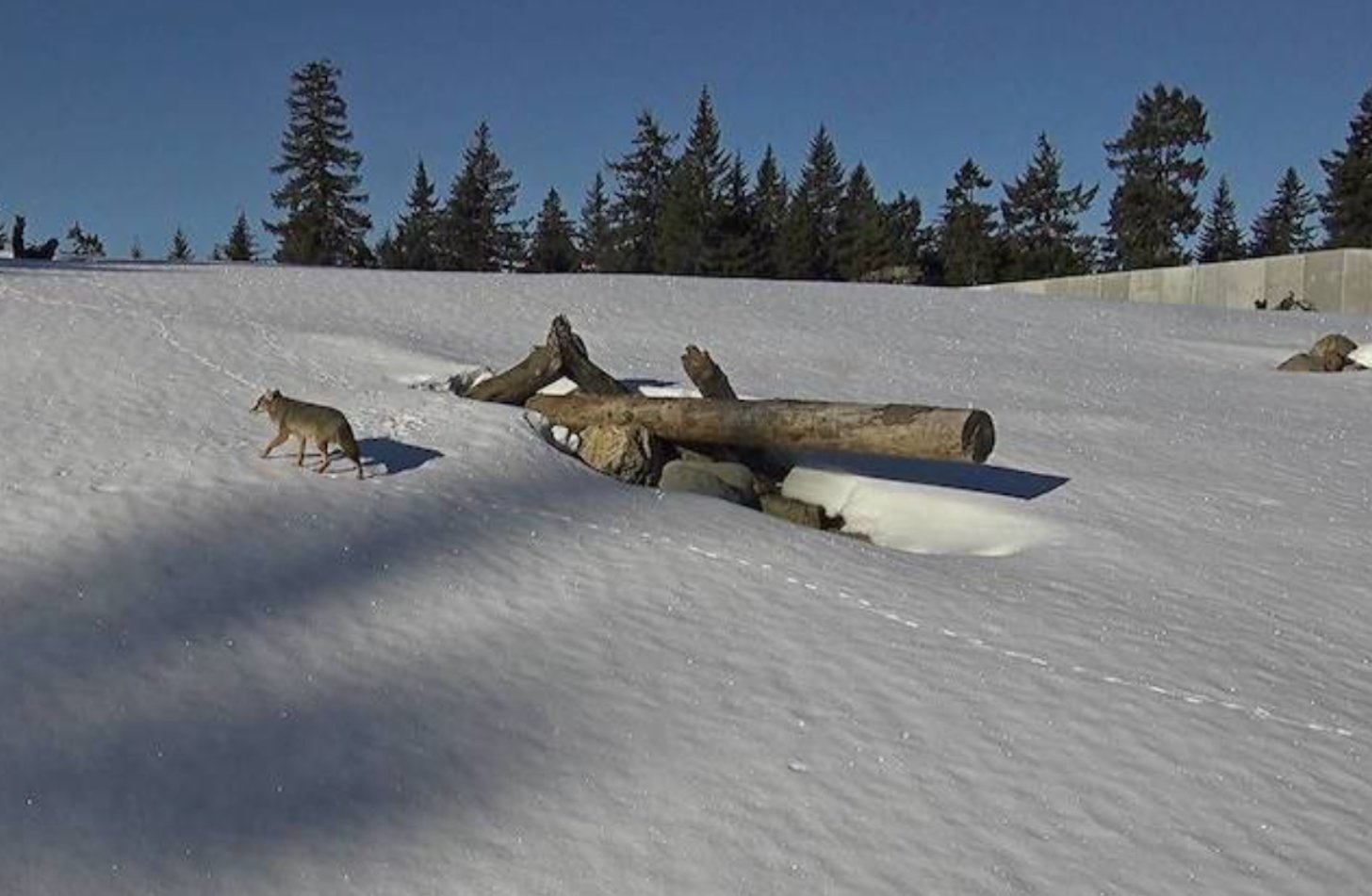
Compared to other animals, black bears reportedly have a higher risk assessment when it comes to busy roadways, crossing them largely at night to avoid traffic or avoiding them altogether. Research shows that they view unnatural crossing structures, like tunnels and bridges, with extreme caution.
But on June 28, eight years after the wildlife crossing was built, one brave black bear braved the bridge.
“Hey bear!” The Washington State Department of Highways said in an Instagram post. “We’ve seen 9,390 total wildlife visitors on the I-90 Snoqualmie Pass wildlife overcrossing since we started recording in late 2018. And on June 28 — our first bear!”
In the social media post, the WSDOT account shared trail camera footage of a black bear bounding along the crossing, with mountains rising in the background.
“Researchers at Banff National Park reported similar ‘bear-haviors’ on their wildlife crossings. That is: Bears take several years to warm up to these crossings, but they do eventually start using them,” the post continued. “We’re hoping this means more visits in the future!”
Annually, there are estimated to be more than 1 million instances of vehicles crashing into large mammals — and in California alone, one study found that more than 557 black bears were killed during one five-year period.
In addition to reducing traffic collisions, wildlife crossings also prevent animals from getting separated from critical food and water sources. Habitat degradation can also lead to inbreeding, which is especially troublesome for endangered and threatened populations already in decline.
Although black bears are not endangered, they are important links in the food web, acting as “forest gardeners” by eating and dispersing berry seeds and keeping deer populations in check through predation.
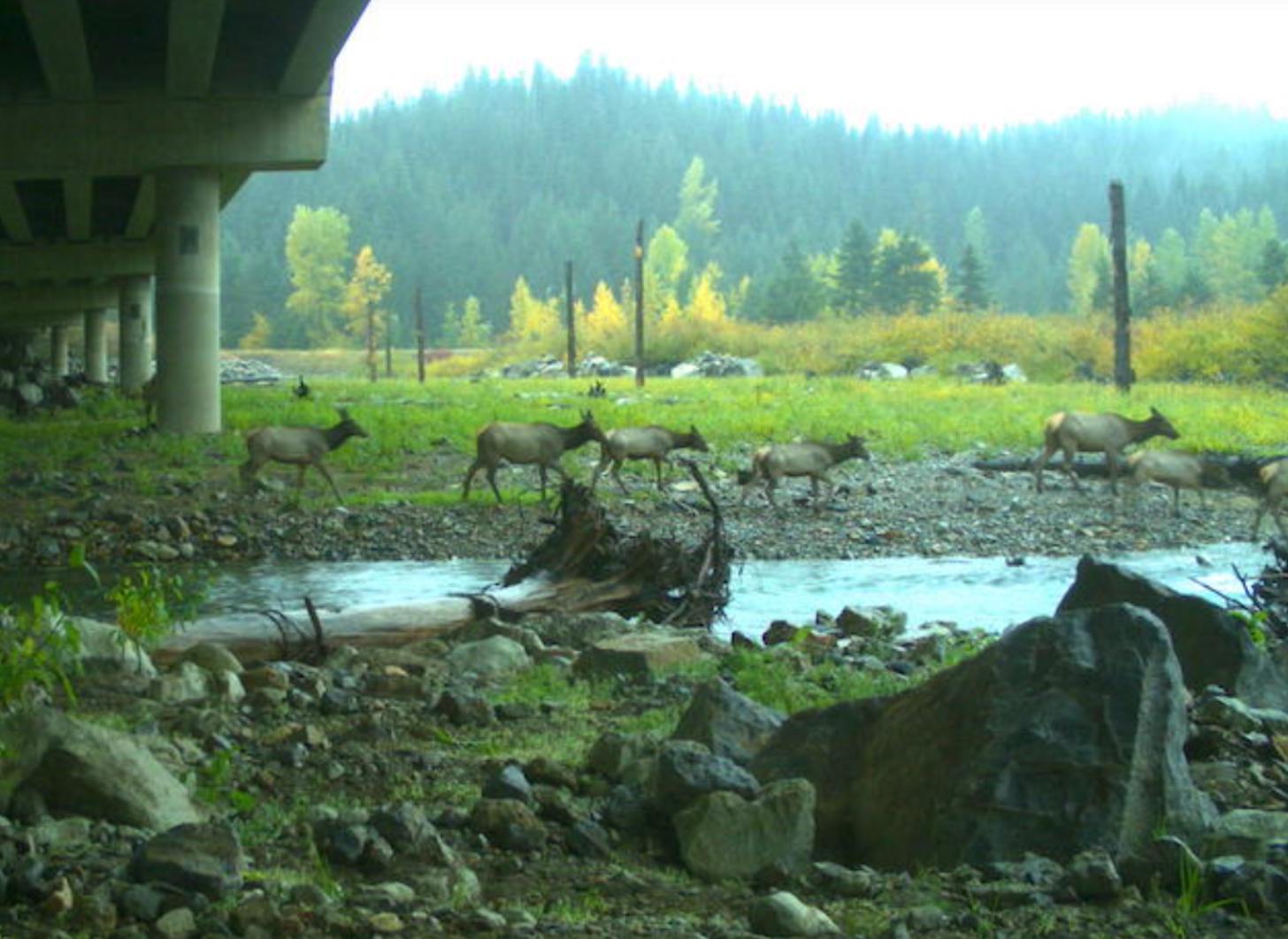
So far, WSDOT has recorded 38,321 wildlife crossings on our overpass and underpass structures along I-90.
“Which means we’re helping everyone get where they need to go,” they wrote, “whether they travel by wheel, foot, hoof, or paw.”
You may also like: Scientists just cleared an endangered species' name — with the help of camera traps
Header image via Alan D. Wilson (CC BY-SA 3.0)
For years, National Geographic’s Explorer Classroom has allowed students from all over the world to join Zoom calls with the globe’s leading scientists and adventurers.
In April, students aged 8-14 learned about snails and spiders with biologist Martina Panisi, joining her virtually as she stood in the middle of a tropical forest in Central Africa, surrounded by towering trees. In her hand, she held a giant, croissant-sized snail as though it were a precious gem.
“The Obô giant snail,” Panisi said, cradling it carefully with gloved hands. “It’s my favorite species in the world. So, every time I find it, I’m like, ‘Whoa, they are still here. They’re still among us!”
The snails can grow up to 6.16 inches in length, but the one in Panisi’s grasp is a teenager.
“We cannot know if it’s a male or a female because they are hermaphrodites. It means they are both male and female,” she explains. “So they can both produce eggs, and the eggs are as big as an olive, and they are yellow.”
“They are very special,” she emphasized. “They produce only three to six eggs per year, and that’s why they’re also endangered because their reproduction is very slow — and they grow very slow.”
“That’s why we are here,” she added. “We [have been] trying to protect them for many years now. And every time we find one of them is a big surprise, and we are very happy to have them.”

Panisi has dedicated over six years to the conservation of these snails, which are endemic only to the tropical forests of the islands of São Tomé and Príncipe in Central Africa.
At one point, the Obô giant snail was one of the most abundant species on the islands. But over the decades, the snail species has faced threats on all sides from habitat degradation, overharvesting, the spread of an unknown disease, and predation from non-native animals like wild pigs, rats, cats, dogs, genets, and monkeys.
As the population has declined, there’s been a marginal impact on the island forests’ health.
“These snails, together with other living beings in the forest, help by eating the litter,” Panisi said in the Explorer’s Classroom video. “They help decompose [them] and then the nutrients go back inside the ground, and the trees can use the nutrients again to grow healthy and strong.”
“So we need to thank these guys for keeping this forest healthy.”

Panisi has joined local conservationists in raising awareness of the species and safeguarding their future at the giant snail conservation center at Jardim Botânico do Bom Sucesso on São Tomé Island.
Mossy Earth, a social enterprise based in the United Kingdom, has been working in the region with local conservationists like Panisi to restore the snail’s population. In addition to the conservation center, they also facilitate forest surveys to curtail the threats of deforestation activities, snail harvesting, and the presence of invasive species.
Through Mossy Earth, Panisi has also gathered and processed genetic information.
“By processing this data, we hope to obtain a better understanding of the migration history of the Obô giant snail across the two islands,” Mossy Earth said on its website.
“As is often done with other species, these insights can then be used to establish conservation priorities,” the website continued. “This information may, for example, help us understand how best to preserve genetic diversity, which is important for ensuring the species can continue thriving as its environment changes.”
Flora & Fauna, a nonprofit backed by Sir David Attenborough, has also had an increased presence on the islands in recent years, leading additional efforts to save the Obô giant snail and the region at large.
“After 30 million years of isolation, life here has evolved into something truly extraordinary. Many of the species found in these forests exist nowhere else on the planet,” Flora & Fauna wrote on its website.
The organization describes São Tomé and Príncipe as the “Galapagos of Africa.”
“Stepping beneath the canopy is like stepping into another world,” Flora & Fauna continue. “Enchanting scops owls swoop silently through the canopy, while oceanic tree frogs cling to the intertwining branches with delicate limbs. On the forest floor, giant Obô snails leave their slimy trails, and timid Príncipe shrews dart between bushes, seeking shelter.”
“If we don’t act now to protect what’s left of these precious native forests, entire species will be wiped out.”
Watch Panisi's full Explorer Classroom lesson here:
You may also like: Watch an orangutan swing over a busy road via canopy bridge: 'We have watched and waited for this moment'
Featured image: Mossy Earth
Taylor Swift and Travis Kelce have just announced $26 million in donations to at least 20 charities ahead of their wedding, allegedly being held at Madison Square Garden this weekend.
While the duo has not officially announced their wedding, plenty of reports point to a massive celebration in New York City over Independence Day weekend, and the simple announcement from a representative makes it clear the couple is in the mood for a celebration.
The charities include food banks, animal welfare organizations, educational programs, and children’s hospitals.
According to Variety, the announcement from a representative of the couple said the following:
“This week, Travis Kelce and Taylor Swift donated $26 million to charities across the United States,” followed by a list of the respective nonprofits.
Beneficiaries of these donations include:
- City Harvest (New York City)
- Food Bank For NYC
- New York Cares
- Los Angeles Regional Food Bank
- Harvesters – The Community Food Network (Kansas City, MO)
- The Store (Nashville, TN)
- Helping Harvest (Reading, PA)
- Rhode Island Community Food Bank
- Feeding America (Nationwide)
- ASPCA (Nationwide)
- Dolly Parton’s Imagination Library (Nationwide)
- Grammy In The Schools (Nationwide)
- Education Through Music (New York, NY)
- Answer The Call (New York, NY)
- Musical Mentors (New York, NY)
- After-School All- Stars (New York, NY)
- After-School All-Stars (Cleveland, OH)
- MSK Kids, the pediatric cancer program at Memorial Sloan Kettering Cancer Center
- Hassenfeld Children’s Hospital at NYU Langone
- Children’s Mercy Hospital (Kansas City, MO)
Swift has a storied history making large donations during large, public moments in her life, specifically throughout The Eras Tour, and again when she released her “Elizabeth Taylor” music video earlier this year.
And although unaffiliated from the couple, the Monterrey Bay Aquarium has leveraged the couple’s star power to advocate for marine conservation, as well.
While neither Swift nor Kelce has publicly confirmed their nuptials this weekend, this is the closest the stars have gotten to revealing their big plans to the world.
You may also like: Taylor Swift made a secret donation to a Liverpool food bank during historic Eras Tour stop
Header image: @taylorswift/Instagram
Not everyone celebrates the Fourth of July with booming fireworks or hot-dog eating contests.
Across the country, people honor Independence Day with plenty of unique and specific traditions — from a key lime pie-eating contest in Key West, Florida, to the Lebeau Zydeco Festival in Lebeau, Louisiana, an annual Creole celebration filled with music.
But on Hawaii’s Big Island, there’s Turtle Independence Day, a celebration that is in its 37th year, dating back to 1989.

On Turtle Independence Day, locals and tourists alike gather at the Mauna Lani Auberge Resort to honor Native Hawaiians’ beloved green sea turtles, or honu.
During the event, attendees learn about marine conservation efforts, visit food stalls, and admire live hula performances, all culminating in a ceremonial procession to free sea turtles into their native habitat.
Most years, sea turtles from the Oahu-based Sea Life Park are released into the ocean. These turtles are part of the park’s green sea turtle breeding program, which has operated for over 40 years and has played a major role in the resurgence of the species in Hawaiian waters.

“Over 16,000 green sea turtle hatchlings have been released from the Park’s adult population,” Sea Life Park shares on its website, “and the breeding program has further impact through education programs with the help of these amazing little ‘honu ambassadors.’”
Each year, Sea Life Park releases anywhere from 200 to 800 baby turtles during hatchling season, with each microchipped before its release, so researchers can track their movements and monitor population growth over time.
Typically, Sea Life Park raises captive-reared hatchlings in saltwater ponds until they reach a safe, healthy size to be released into the wild. However, according to an event page from Mauna Lani Auberge Resort, “no turtles will be released this year, as none are ready to return to the ocean.”
While it may be a bummer to not see the actual turtles, the celebration will go on — and is free to attend.

A schedule from the resort lists a schedule of activities on both July 3 and 4, including “Honu talks” with turtle experts, live music, activity booths, kid’s activities, and still, a procession to the beach led by Hula Hālau.
“While there won’t be a turtle release this year, conservation is a lesson in patience,” the resort shared in a social media post ahead of this year’s event.
“Every turtle returns to the ocean only when it’s ready, making each release all the more meaningful.”
You may also like: Jet ski riders conduct rescue mission for sea turtle with 'bloody, peeling' infection on her shell
Featured Image: Mauna Lani Auberge Resort/Facebook
Every day the Good Good Good team collects the best good news in the world and shares it with our community. Here are the highlights for this week!
If you want to get good news in your inbox every day, join the Goodnewsletter — the free daily newsletter designed to leave you feeling hopeful.
The Best Positive News We’re Celebrating This Week —
French Polynesia just expanded ocean protections to cover 30% of its waters
The government of French Polynesia announced it is expanding the extent of ocean where extractive industries like seabed mining and industrial fishing will not be allowed — it means 30% of its waters will now be fully protected.
On June 7, 2026, the country’s president announced a 520,000-square-kilometer (200,000-square-mile) expansion of protected waters near some of its islands, bringing French Polynesian waters under full protection to 1.4 million square kilometers (540,500 square miles), reaching that 30% global benchmark.
The protected area was established by consensus of the communities within French Polynesia, and more than a decade of advocacy from local mayors.
Why is this good news? The new protected zone will help conserve 20 species of sharks including the critically endangered scalloped hammerhead and oceanic whitetip. The new zone is also one of the few known breeding sites for 22 bird species, and will protect 455 mollusk species, 60 open-ocean fish species, and other marine animals.
Imagine there were no state lines or borders in the US. Here’s how nature would draw the map
→ Read more
Sales of electric vehicles just overtook petrol cars for the first time ever in the UK
A new analysis found that, for the first time ever, more new electric vehicles have been sold over a 12-month period than petrol cars in the United Kingdom.
In the year leading up to May 2026, consumers in the UK purchased 516,490 new battery-electric vehicles, compared to 504,010 new petrol cars.
The milestone comes amid debate over the country’s “zero-emission vehicle” mandate, which sets a rising target for the share of new car sales that must be “zero-emission vehicles” each year.
A marathon-running nun has raised $2.6M to feed families in need
Sister Stephanie Baliga was the sixth-fastest freshman runner in the nation at the University of Illinois with dreams of Olympic gold. But when she fractured her foot in her sophomore year of college, her injury set her on a new path, one where she would become a nun at Chicago’s Mission of Our Lady of the Angels.
Baliga still runs, but now her running fuels her faith. For the last 15 years, she has run the Chicago Marathon to raise funds for the MOLA food pantry. Since 2011, she and her team have raised over $2.6 million.
Baliga estimates that their food pantry serves 800 people every week, with the marathon funds being especially critical during the pandemic. This fall, she plans to run her 16th Chicago Marathon with a $500,000 funding goal.
Why is this good news? Chicago’s Mission of Our Lady of the Angels makes a point to serve everyone in its community, regardless of religious affiliation. Father Bob Lombardo, who opened MOLA, said, “We do what we do because we’re Catholic, not because the people we serve are Catholic.”
→ Read more
Wisconsin has conserved 750,000 acres since 1989. These trail cam photos show why it matters
→ Read more
After 200 years, scientists are re-mapping Lewis and Clark’s historic route ahead of America’s 250th birthday
In 1804, Meriwether Lewis and William Clark set off on a two-year expedition to map the North American wilderness, with Sacagawea travelling with them for 16 months. Their historic route covered more than 4,900 miles of terrain — stretching from Pittsburgh, Pennsylvania, to the Pacific Ocean in Oregon — and this year Smithsonian scientists are revisiting it again.
The project, which involves more than 55 academic institutions across the United States, is part of a nationwide effort to understand how the country’s landscape has changed over 200-plus years of human development and environmental changes.
Participating scientist Christine C. Brodsky, a professor at the University of Missouri, said that looking to the past has helped them better understand the future, with the resurvey informing new strategies for “wildlife management and ecological resilience.”
→ Read more
Every Fourth of July, a California animal shelter invites volunteers to read to anxious pets
As one of Northern California’s largest open-admission shelters, Bradshaw Animal Shelter never turns away an animal in need. And every Fourth of July, as fireworks light up the skies, hundreds of dogs and cats in their care brace for one of the most stressful nights of the year.
That’s why, for the past six years, the shelter has invited the community to celebrate a little differently. Volunteers are asked to spend the evening reading stories, softly playing guitar, or simply sitting with shelter pets to help them stay calm.
“While many of us spend the Fourth of July looking up at the fireworks,” the shelter wrote in a social media post, “our shelter pets are hoping someone will simply sit beside them.”
Why is this good news? The unpredictable sounds of fireworks can overwhelm pets’ senses, triggering a fight-or-flight response. Dogs, especially, can experience pain from loud noises because they hear higher frequencies than humans do. Animals that are calmer and less stressed are more likely to display their natural personalities, helping potential adopters see them at their best.
Trail cameras show elephants, leopards, and more embracing India’s 7-mile wildlife crossing months ahead of schedule
An Australian man spent three decades replanting and restoring a subtropical rainforest in New South Wales
The Big Scrub in northern New South Wales was once 75,000 hectares of thriving subtropical rainforest filled with figs, vines, palms, and more, reduced to about 1% of its original expanse.
To restore it, Tony Parkes and his wife, Rowena, not only planted tens of thousands of trees on their own land, but they also co-founded the Big Scrub Rainforest Conservancy to unite critical stakeholders to restore the rest of the rainforest over the course of decades.
Parkes left his successful investment banking career to make it happen, and he’s helped protect what’s left of the forest, planted millions of trees, and made restoring Big Scrub a core part of civic life in the region.
For the first time since the Middle Ages, Italy’s forest cover is larger than its farmland
Italy’s forests now cover a larger area than agricultural land — a feat that has not been met since the Middle Ages. Today, woodlands span 60,000 square miles of the Italian peninsula, primarily in the country’s mountain regions.
Although Italy first achieved this milestone in 2020, the news was only just revealed in a report from the National Union of Mountain Municipalities and Entities.
In the report, researchers emphasized the importance of reforestation, hailing the municipality of Marcetelli in the Province of Rieti as a prime example of how forests are invaluable resources. In Marcetelli, where 94% of the land is covered in trees, the region has seen record rates of carbon storage, water and air filtration, and erosion prevention.
Even better: Beyond benefiting people and the environment, denser forests also provide safer habitats to vulnerable wildlife, including the critically endangered Marsican brown bear, which lives only in the central Apennine Mountains.
→ Read more
New Jersey makes it illegal to interfere with reproductive or gender-affirming healthcare
America is more racially and ethnically diverse than in previous decades — and most agree that’s a good thing
Recent Pew Research Center surveys show that three-quarters of U.S. adults think racial and ethnic diversity is a good thing for the country, with 62% saying it also has a positive impact on the country’s culture.
This is true across political parties, too, with 66% of Republicans saying America’s diversity is good, and 86% of Democrats. They differ slightly on how that impacts the country’s culture.
Additionally, majorities across racial and ethnic groups say a diverse U.S. population is a good thing for the country overall and has a positive impact on its culture.
On July 26, 1990, the Americans with Disabilities Act became the ‘world’s first comprehensive declaration of equality for people with disabilities’
The result of decades of activism, the ADA is one of the most sweeping pieces of civil rights legislation in U.S. history, providing broad protections against discrimination for an estimated 43 million Americans with disabilities. It set a new standard for the rest of the world.
The Civil Rights Movement brought America immeasurably closer to fulfilling its promise of equality, justice, and freedom for all
Though the Civil War brought an end to chattel slavery, without the Civil Rights Movement in the 1950s and 1960s, segregation and Jim Crow Laws, racist voting restrictions, and countless other injustices and human rights abuses might still be a reality today.
🇺🇸 You may also like: Major civil rights moments in every state
The President’s Emergency Plan for AIDS Relief is the largest commitment by any nation to combat a single disease in history, saving 25 million lives
Created in 2003, PEPFAR is widely credited with fundamentally altering the trajectory of the global HIV/AIDS epidemic, accounting for more than 90% of PrEP initiations globally and over $120 billion in cumulative funding from taxpayers. PEPFAR single-handedly replaced despair with hope in communities all over the world.
The national park system shows America’s commitment to preserving and protecting the immense, unique, breathtaking natural landscapes across the country for generations to come
Yellowstone National Park became the first national park in 1872, designating 2.2 million acres as solely “for the benefit and enjoyment of the people.” Without these protections, it’s reasonable to believe that they would not exist today. The foresight to protect them is truly incredible and worth celebrating.
🇺🇸 You may also like: These are the 25 oldest national parks in America
Thanks to immigration and immigrants, America’s culture and diversity are unlike anywhere else in the world
While the history of immigration in America is nuanced — from the forced displacement and brutal treatment of Indigenous people, to the transatlantic slave trade forcing emigration from African countries — America today is more racially and ethnically diverse than ever.
And contrary to what the popular narrative might be — it’s something most people think is a really good thing.
The Women’s Liberation Movement achieved transformational gains for gender parity, granting women more economic, social, and legal freedoms
Women now are free to open their own credit cards, get pregnant without fear of being fired, file for no-fault divorce, own property, go to college, play college sports, and so much more. And though it’s since been overturned, in 1973, the Supreme Court granted women the right to an abortion, a life-saving human right that people continue to fight to regain today.
🇺🇸 You may also like: Milestones from women’s history from the year you were born
The 19th Amendment and Voting Rights Act of 1965 gave women and Black people the right to have their voices fairly and equally represented in elections
While the 15th Amendment, which gave Black men the right to vote, was ratified in 1870, discriminatory practices kept them from voting until the Voting Rights Act of 1965 abolished those barriers.
The 19th Amendment was ratified on August 18, 1920, giving American women the right to vote, after a fight for suffrage that dated back to before the Civil War. Although the 19th Amendment enfranchised women on paper, many Black women and other women of color did not gain meaningful voting rights until the Voting Rights Act of 1965, further underscoring its enduring significance in American history.
The U.S. Labor Movement gave us a 40-hour, five-day work week and countless other workplace protections we still enjoy today
American labor organizing has been transformational for the rights of workers since the 1800s, often intersecting with civil rights, women’s rights, immigrant rights, and more. So many of the rights we enjoy today — like protections from discrimination, equal pay, overtime pay, and weekends — are thanks to the efforts and organizing of unions and labor organizers from decades ago.
American inventors, many of them immigrants, have changed the world and raised the global standard of living in countless ways
Thomas Edison’s light bulb brought safe, affordable, and reliable lighting to homes and streets. The Wright brothers gave us previously unimaginable global connectivity.
Albert Einstein invented the theory of relativity after fleeing Nazi Germany. Alexander Graham Bell, a Scottish immigrant, invented the telephone. Guglielmo Marconi, an Italian immigrant, pioneered wireless telegraphy, which eventually evolved into modern radio and communication systems.
American virologist Jonas Salk created the polio vaccine that has helped lead to the near-eradication of the disease globally
Building on decades of research from scientists before him, Jonas Salk developed the first effective vaccine against polio. Following a mass immunization campaign, the annual number of polio cases in the U.S. fell from 35,000 in 1953 to just 161 by 1961. Globally, cases have declined by 99.9% since 1988, from an estimated 242,000 to just over 3,700 in 2023.
The Stonewall Riots catalyzed the modern gay rights movement, achieving historic victories for LGBTQ+ rights
Because a group of people decided they’d had enough with constant police harassment and discrimination, we now have an entire month dedicated to celebrating and fighting for more progress for the LGBTQ+ community.
The riots didn’t kick off the movement, but are widely credited with the impacts and gains seen in the U.S. ever since, from workplace protections and marriage equality to larger cultural shifts.
🇺🇸 You may also like: 50+ years of modern LGBTQ+ history since Stonewall
The public school system has ensured education remains accessible to all children, regardless of economic status or location
In the early nineteenth century, states began to create public schools through legislation, initially serving children in lower-income areas. They gained momentum as a means to promote social equality, were integrated during the Civil Rights Movement, and despite efforts to dismantle the public education system, continue to help ensure all children in the country can access early education.
The Clean Air Act became one of America’s first and most influential modern environmental laws, leading to dramatic, life-saving reductions in air pollution nationwide
This landmark legislation didn’t happen overnight. A series of deadly smog disasters in the 1940s and 1950s revealed the life-threatening impacts of air pollution, decades of scientific research connected the dots, and a wave of environmental activism forced politicians to pass the law, and its subsequent revisions, that still protect Americans today.
More good news of the week —
After a civil rights complaint, Chicago built the nation’s largest air monitoring network. As extreme heat reshapes air quality, the network of 227 monitors is expected to help identify localized pollution hot spots.
Former NOAA scientists recreated a valuable climate information website that was shut down by the Trump administration. The new site, called Climate.us, was launched by scientists who had worked on Climate.gov until they were laid off last year as part of the Department of Government Efficiency cutbacks.
Jet ski riders in Australia cut their tour short to rescue an injured turtle with a “bloody, peeling” shell. She’s now in the care of a nearby sea turtle rehabilitation center, which started a fundraising campaign to help cover the costs of her food and care while she’s recovering and eventually released.
Billionaire MacKenzie Scott single-handedly donated one-third of all “megagift” donations in 2025. Scott made nearly $7 billion in megagifts, bringing her five-year giving total to $26.2 billion.
Cate Blanchett launched a free tool that allows people to protect their likeness from being used by AI. The acclaimed Australian actor presented her Human Consent Registry at the European Parliament.
Colombia passed the first national law requiring beef to be traced back to its origins. The landmark law is designed to stop deforestation connected to cattle ranching, which environmental groups say could provide a model for the wider Amazon region.
The number of loggerhead sea turtles increased 80 times over on Boa Vista, Cabo Verde’s third-largest island. The remarkable conservation recovery comes after a decade of steady decline.
New York City officials announced the first-ever Urban Forest Plan to achieve a 30% tree canopy across the city by 2040. It’s part of a larger effort to achieve the city’s broader goals of advancing environmental justice, mitigating the effects of heat, and improving quality of life.
Musician Dua Lipa is opening a library inside Livraria Lello, one of Portugal’s oldest bookstores. The “Manifesto Library” will prioritize collections of books that have been banned from schools and habitually “restricted from display.”
Ann Patchett will receive the 2026 Library of Congress prize for American fiction for “mastery of the art.” Patchett is also the owner of the independent Nashville bookstore Parnassus Books and founded the Parnassus Books Foundation, which gives books to students at Title I schools in Nashville.
Bloomberg Philanthropies is donating $260 million to help close the ocean protection gap. The investment will help close the gap between ocean protection commitments and action as countries work toward the global goal of protecting 30% of the ocean by 2030.
Princess Kate completed a hiking challenge to raise money for the hospital where she received cancer treatment. The Princess of Wales completed the “Three Peaks Challenge,” ascending the highest mountains in Scotland, England, and Wales within a 24-hour period.
Texas just opened a first-of-its-kind wildlife crossing over a 6-lane highway — and people can walk across it, too. In addition to a separate pathway for animals, a 1,000-foot-long elevated “sky walk” winds from the base of the bridge to the treetops.
The second-largest school district in the nation just banned screens for children in preschool through first grade. Under the Los Angeles Unified School District’s new policy, second and third-graders will also be limited to 20 minutes of daily screen time.
Hawaii is giving old fishing nets and recycled plastic a second life by mixing them into asphalt roads. Researchers at the Hawaii Pacific University believe the technology could help tackle both marine pollution and overflowing landfills.
A new Lego-inspired construction project in Colorado transformed a concrete slab into a four-story building in mere days. The project offered a glimpse at how Denver could build affordable housing faster and cheaper.
A critically endangered New Zealand parakeet has seen its numbers surge thanks to a pair of super breeders. Nacho and Trixie were paired up in 2024 at the Isaac Conservation and Wildlife Trust and have since produced 55 chicks, including 33 this year alone, and are responsible for more than 10 percent of the total population.
A 22-year-old engineer is 3D-printing dentures to give lower-income people their smiles back. Connor Gibson is the dental technology manager at a large nonprofit organization in Tennessee that provides free dental, vision, and medical care through volunteer-powered mobile clinics across the United States.
Montana debuted a new license plate design that is projected to raise $100K for state wildlife crossings. Wildlife crossings, from highway overpasses to underpasses, tunnels, and fences, are proven to reduce wildlife-vehicle collisions by more than 90%.
Canada prevented 4 out of 5 potentially fatal drug overdoses by providing free naloxone. After British Columbia began offering free, take-home naloxone services, hospitals saw a major drop in opioid poisonings.
Conservationists photographed a “lost” parrot for only the second time in more than 100 years. They spotted the small, elusive blue-fronted lorikeet in the highlands of eastern Indonesia’s Buru Island after a grueling 14-day trek.
A Bay Area apartment complex is providing affordable housing for local educators and city workers. The $88 million, 144-unit development features a fully equipped gym, game rooms, pools, a sauna, and an outdoor barbecue area.
Some of the U.K.’s biggest retailers are planning to start selling plug-in solar panels to help more homes generate their own electricity. “Balcony solar panels” allow households to run their electrical appliances without needing to buy as much power from the grid.
Scientists discovered a family of endangered sea star species thought to have been wiped out by a heat wave. As an infamous marine heat wave ramped up more than a decade ago, sunflower sea stars fell sick and all but disappeared from California waters.
Kelsey Pfendler began the more than 2,400-mile journey from Monterey, California, to Honolulu, Hawaii on May 21.
Pfendler was on a mission to become the first American woman to row solo from California to Hawaii — and the youngest and fastest woman ever to do it.
She succeeded in just 43 days, shattering the previous women’s record — but also broke the men’s record of 52 days by more than a week.

Pfendler rowed into Ala Wai Boat Harbor in Honolulu, greeted by hundreds who had gathered to watch her complete her journey.
As a veteran Grand Canyon river guide, Kelsey Pfendler also took on the challenge in part to raise funds and awareness for the Whale Foundation. The organization is dedicated to the mental, physical, and financial well-being of the Grand Canyon river guiding community.
As of the time of publication, more than $180,000 has already been donated to her Spotfund campaign since she began her journey.

"My mission goes beyond just rowing an ocean — it's about inspiring women everywhere to recognize and embrace their strength," she wrote on her fundraising page.
"Your support would mean the world to me as I pursue this dream. Thanks for believing in me!"
Pfendler previously skippered a women's team of four rowers across the mid-Pacific Ocean in 2024.
Featured Image: Courtesy of Kelsey Pfendler, @yourowkelsey/Instagram
With Oregon’s Department of Fish and Wildlife prickled by a noticeable decline in Central Oregon’s porcupine populations, officials are calling on locals to help.
While porcupines — native to Central Oregon’s high desert ecosystem — are not currently listed as endangered in Oregon, they are officially classified on the state’s Species of Greatest Conservation Need list.
Conservationists suspect the species is in decline due to traffic mortalities, predator resurgence, and climate change impacts — but all the records they have are currently anecdotal.
That’s why, in the summer of 2025, ODFW launched a study to track the distribution and mortality rates of these quilled rodents in the area.

Officials called on the help of citizens to join the monitoring program, using iNaturalist to report wildlife sightings, and then placing trail cameras based on the community’s data to confirm the presence of the animals.
Now, High Desert Museum and various Central Oregon public libraries are offering trail cameras to locals on loan for volunteers to deploy and record wildlife observations themselves.
“We maintain a bank of trail cameras and then we make those available to the public,” High Desert Museum Curator of Wildlife Jon Nelson told Central Oregon Daily.
“We teach the public how to use trail cameras to responsibly observe wildlife and then to take those observations and post them to community science platforms such as iNaturalist, so the managers have access to that data.”
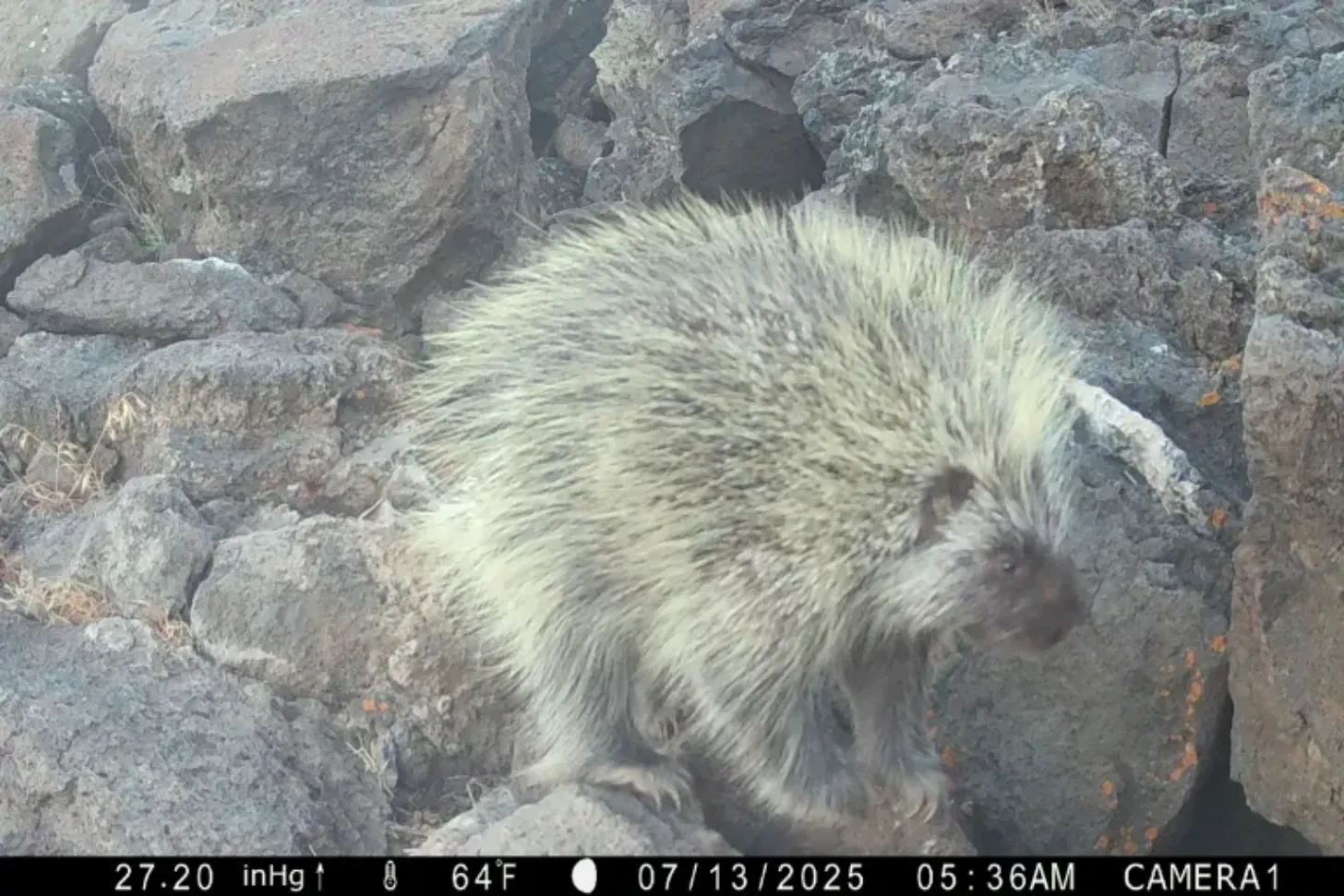
Along with the Wildlife Watch program at the museum, residents can access trail cameras at libraries in Deschutes, Crook, and Jefferson counties. Funding for these materials is being provided by the Wildlife Ecology Institute and the Oregon Wildlife Foundation, according to ODFW.
“I think it's important for people to understand their surroundings,” Jefferson County Library Director Jane Ellen Innes told Central Oregon Daily.
“The high desert is a very interesting place. I think we have a lot of wildlife that is available to us. So, I just think it’s part of nature and the balance [of] where we live.”
To check out a trail camera at the library, users must agree to post photos taken on iNaturalist and sign up as a volunteer for ODFW’s porcupine study. Once they have signed up, they can take a workshop at the High Desert Museum, and library users can check out the cameras for three months, with the option to renew the loan.

“It also inspires people to come into the library and learn more about them and the services we offer,” Ellen Innes added.
While the porcupine project in particular is fairly young, the museum has been deploying trail cameras and wildlife observation programming for about 15 years. Nelson told Central Oregon Daily that trail cameras are particularly helpful because they are able to be used 24/7, capturing nocturnal or elusive wildlife.
Porcupines are among those elusive evening critters, but with the trail camera loan program and eager citizen scientists, local officials are hopeful.
“Central Oregonians are eager to pitch in and learn more about their prickly neighbors and more than 140 reports have already been generated since the project was launched,” a web page from the ODFW stated.

Researchers are also capturing and fitting radio collars to 20 porcupines spotted in the study, in order to track their movements over time and collect data assessing seasonal home ranges, behavior patterns, dispersal of porcupines, survival rates, and more.
Ultimately, the goal is to develop a standardized monitoring protocol to support future conservation efforts for the species.
And so much of it is made possible by local volunteers.
“It is heartwarming how many people have reached out and called me to say ‘It was crossing the road,’” assistant wildlife biologist for ODFW, Mikayla Bivona, told Central Oregon Daily.
Bivona is leading the state’s porcupine study.
“Almost everybody explains they have a really cute waddle as [they] walked down the road. They are a pretty charismatic species I think a lot of people are getting excited about. Now they are taking a harder look at them.”
You may also like: Maine's first 'turtle tunnels' help endangered reptiles cross a 'highway of death'
Featured image courtesy of Oregon Department of Fish and Wildlife
Conservationists are celebrating four exciting milestones for wildlife corridors on the heels of the legislative seasons in four states across the United States.
Those four states — Utah, Virginia, Idaho, and Oregon — have just successfully passed legislation that will bolster state transportation budgets to build more wildlife crossings and make it easier to expand wildlife crossing infrastructure.
Wildlife crossings see strong bipartisan support across the country, with lawmakers from both parties championing their development. This is likely due to the fact that overpasses and underpasses designed for animals are highly effective in reducing wildlife-vehicle collisions — some studies estimate by over 90%.
Wildlife-vehicle collisions cause about 26,000 injuries and more than 200 deaths in the U.S. annually, leading to more than $10 billion in repairs, medical care, and more, per the U.S. Department of Transportation. Plus, highways often block migration paths and have negative impacts on wildlife, like population declines and reduced biodiversity.

According to Scioto Analysis, a single wildlife crossing can prevent about 1,400 accidents over a 70-year lifespan, meaning billions of dollars can be saved by investing in wildlife corridor infrastructure.
So, states are continuing to invest in these projects.
Following success stories from states like Colorado, California, and Arizona, these four new examples show the growing interest in wildlife corridor legislation nationwide.
4 states boosting wildlife corridor efforts
Utah
In Utah, for example, lawmakers from both sides of the political aisle enacted legislation this year that establishes a designated wildlife crossing fund for the state, putting $2 million toward wildlife crossing projects annually.
Utah residents can also contribute to this fund through vehicle registrations, hunting licenses, and other permits. An important carveout in the legislation also stipulates that new solar and wind projects will need to be consulted on by the Utah Division of Wildlife Resources before breaking ground.
While a major win, the state will still need to rely on federal dollars to fully scale its wildlife corridor efforts.
“I consider it a piece of the solution,” natural resource manager for the state’s Department of Transportation, Matt Howard, told Utah Public Radio. “We still will need to seek out things like federal grants for the big overpasses, or the big, wide underpasses.”
Virginia
Similarly, Virginia Governor Abigail Spanberger just signed legislation designating a permanent fund for wildlife corridors in April. Virginia ranks among the top 10 states in the nation for wildlife-vehicle collisions, costing residents an estimated $533 million every year.
Similarly to Utah’s new bill, the new Virginia fund will ideally attract private grants and federal matching funds, while also inviting Virginians to make contributions. This can be done through their local department of motor vehicles or from individual tax returns.

“I’m really proud of this bill,” Delegate Shelly Simonds, a sponsor of the legislation, said in a statement.
“We all worry about the possibility of hitting an animal while driving. This fund gives people a meaningful way to do something about it and support efforts to help prevent these accidents before they happen. If we come together, this bill can help us gather data on where these collisions happen, develop plans to prevent them, and strengthen coordination between agencies.”
Idaho
In Idaho, lawmakers did not designate a new fund for wildlife corridors, but they did pass a resolution that supports investment in wildlife corridor infrastructure.
While the resolution does not allocate new funds, it conveys strong support for advancing “public safety and conservation of Idaho’s big game migration corridors through the development and implementation of wildlife crossings where appropriate and supported by local communities,” according to Capital Press.
Advocates say the legislative momentum in Idaho comes on the heels of the Cervidae Peak Wildlife Overpass near Boise, a 150-foot-long bridge that aims to reduce collisions between animals like mule deer and elk, and the some 14,000 daily drivers on State Highway 21 by 80%.
“As long as we’ve got local community support, wildlife crossings can be a really great thing for the state,” the resolution’s sponsor, state Rep. James Petzke, said in a hearing, “and we want to encourage Fish and Game and others to continue to work on paths to getting more of those built in some of those key migration corridors.”
Oregon
And lastly, Oregon has a new approach to funding its wildlife corridors: An increase of the state’s lodging tax by 1.25% beginning in January 2027.
The tax increase will benefit nine conservation programs. These programs will fund and build new wildlife infrastructure, research into wildlife-vehicle collision reduction, and more. According to Pew Research Trust, a bipartisan coalition of hunters, anglers, landowners, conservationists, and community leaders spent over a decade trying to pass the landmark act.

Very few states currently provide recurring funding for wildlife conservation, and the “1.25% for Wildlife” effort will translate to small increases in cost (roughly $1.25 to $2.50) to overnight stays at hotels and other short-term rentals.
The increased tax revenue is projected to raise nearly $37 million per year to support these key conservation initiatives, with about $2 million designated to wildlife corridor projects each year.
“This is a decisive victory for wildlife and a landmark moment for conservation,” Karla Raettig, the chief advocacy officer for the National Wildlife Federation, said in a statement.
“Oregon Gov. Tina Kotek has demonstrated extraordinary leadership to preserve and protect the wildlife and habitat that define Oregon. This legislation is a model for other states to follow.”
You may also like: Critics doubted a $1.46B wildlife crossing. Trail cameras tell a success story: '75 recorded uses each night'
Featured Image: WikiPedant/Wikimedia Commons (CC BY-SA 4.0)
As the FIFA World Cup 2026 shifts into high gear, soccer in North America is riding an unprecedented high. In Burlington, Vermont, that energy is taking on a distinctly local and purpose-driven form.
Just a few years after its founding, Vermont Green Football Club has already made a name for itself in American soccer. Competing in USL League Two — a preprofessional summer league with 144 teams — the club captured national attention last year with an undefeated championship run.
The team aims to become a net-zero club, which means reducing its climate pollution to as close to zero as possible and offsetting any remaining emissions. Fans are encouraged to bike or take public transit to games, and each match highlights a local nonprofit organization.
Yale Climate Connections spoke with Vermont Green FC co-founder Patrick Infurna about the team’s mission and goals and how the community has stepped up to amplify the team’s impact.
An interview with Vermont Green FC co-founder
Yale Climate Connections: Could you introduce us to your environmental mission and what inspired it?
Patrick Infurna: We were founded by a group of friends with all different backgrounds, but with the idea that we wanted to build something that was more than just celebrating the game of soccer. We wanted this to be something that had a mission and an identity and a purpose that went beyond the game.
And when we did this in 2022, we always knew that to be successful and to be a club that actually mirrored and reflected the community in Vermont, it had to be something that had a purpose that went beyond the game.
For us, that was initially “How do we build a club that raises awareness of climate change?” And that evolved to something deeper with our environmental justice mission: If we’re going to address the climate crisis, we need to do it at the local level, at the human level, and we needed to build something that brought people together to discuss these issues.

YCC: Can you tell us a little bit about your work to become net zero?
Infurna: Net zero is our north star, and we’ve learned over time that it’s really a difficult task.
We started with an advantage — we’re playing at the University of Vermont in Burlington, partnering with organizations and businesses that were shooting for net zero or were B Corps themselves, and that has given us a leg up in prioritizing this.
We’ve had a lot of success in our mission to educate and bring fans together on this journey of thinking more critically about everything that we do. For example, our porta-potty partner is recycling and turning human waste into fertilizer.
The typical sports experience is going to the stadium, having a drink, having a hot dog, throwing it out, and leaving.
We wanted to transform that and encourage fans to be a bit more thoughtful with the food, the drinks, encouraging fans to recycle, using our staff to sort through the garbage at the end of every game to make sure things are recycled and sorted in the right way, and being an example, even if it’s a small one, to fans to say that we can be a bit better.
We’re still bound to traditional transportation when we take a bus for an away game. But when it comes to our home matches on the campus of the University of Vermont in Burlington, we encourage public transportation, and if you can bike to the game, walk to the game, use public transportation, that’s really important to us.
We encourage fans to bike to every game, and we’ve partnered with Local Motion, a local organization that sets up a free bike-parking valet at every match. And if you bike to the game and use the bike valet parking, you’re automatically entered into a raffle for small prizes — water bottles, Plink hydration tablets, whatever gear that we have in — and all of our gear is made from recycled materials.
But ultimately, we’ve tried to be clear that net zero is a target that we want to achieve, while understanding that it’s not the easiest task. So for us, this process of getting to net zero has really been about that journey and in educating our fans on what they can do at the stadium and outside of the stadium to make that little bit more of an impact.

YCC: Could you talk a little bit about how you’ve integrated an anti-racism piece into your work?
Infurna: We’re working with community organizations that are addressing the climate crisis through this human lens. More people being able to enjoy and play soccer is mission-critical to us, so we’ve really tried to boost the soccer community that existed here in Burlington before our club did.
We’ve had a partnership with a local Somali Bantu community association team called Juba Star FC. We’ve played games against them; we’ve supported their initiatives.
We’ve had a really excellent partnership with a group called Migrant Justice, which has been advocating for migrant farmworkers in Vermont for a long time now. And this [past] summer, our women’s team was coached by a U.S. women’s national team World Cup winner, Sam Mewis. We raffled off one of her game-worn jerseys to fans, and we raised over $6,000 for the Vermont Immigration Legal Defense Fund, a newly founded group that was making sure that we had trained and available lawyers to address immigration issues here in Vermont. And we were really proud of that partnership.
We were proud of bringing migrant justice into the mix, but the moment that brought even more pride was when the Green Mountain Bhoys, our organized independent fan base, saw that initiative and decided they were going to take it to another level. They built out their own fan campaign, and they raised [about $25,000] for the same organization.
Ultimately, whereas what a club can do may be limited in some ways, our fan base and our community have built their identity around this club, and they took it to another level. And that is success for a purpose-driven soccer team like ours.
YCC: Can you talk about some of the ways that you’re communicating these issues and getting information out to fans?
Infurna: We want to be a leader, and we want to be an example in addressing the climate crisis through the game of soccer. But we also don’t come to our fans saying that we — the Vermont Green Football Club — have all the answers.
So we give multiple ways for our fans to access local partners, whether that’s tables in the concourse where people can gather information, sign petitions, get gear, things like that. We also have match-day spotlights where we’ll welcome an organization to speak at halftime.
So you’re enjoying the game, understanding that this is entertainment and it’s a community event, but basically any other spot where the game is not going on, we hope that you’re going to find information about organizations locally working on these important issues.
And we’ve sold out every game, so it’s really an engaged fan base.
Some people say, “Oh, it’s halftime. Let me go get some food.” But a lot of people know that at halftime there’s the opportunity to continue engaging with the club’s mission via local partners, whether that’s Vermont Land Trust, Migrant Justice, or NOFA Vermont working in the agricultural area.
YCC: How have you seen the players engage with the mission?
Infurna: This league is for really top players who want to become professionals, and a lot of these players are focused athletes dialed in on building their careers. But we also bring in players we think will be open to the mission, and we ask all the players to engage with the mission. We’ve had a lot of success with players deciding that the community aspect of this is really important to them, and over the years we’ve had some really incredible advocates.
We don’t ask players to be experts; we don’t ask them to be perfect advocates for what we’re fighting for, but we do ask them to be open-minded. We ask them to engage as much as they possibly can.
And we do little things, like the players are engaging with the youth at the King Street Center — a youth center in Burlington. They’re out at the local clubs getting involved with the community. We’ve had a lot of players in college — some of them are environmental studies majors, some of them are social work majors — and we’ve had a range of players who wanted to make being a climate advocate a part of their identity as an athlete.
We say to these young men and women, “You have thousands of kids looking up to you, watching your every move. They’re watching how you carry yourself, what you say, how you speak. If you decide that you can add a little bit more to your path to be an advocate, it’s going to make an impact.”
So when an athlete decides, “I’m going to be a professional athlete, and I’m going to do it compassionately, I’m going to do it consciously,” that can go a long way.

YCC: Can you describe what it’s like at the stadium on a home game day?
Infurna: Game days at Virtue Field are really fantastic. You walk into the concourse, and you see the nonprofits tabling, you see the local food trucks, you see Ben and Jerry’s handing out free ice cream — every single Vermont Green FC game has mini-scoops of free Ben and Jerry’s for everybody.
It’s a joyous occasion, and it certainly helps that our team has been really good and we win a lot of games, but I don’t think it’s just that. I think people love to get together. I think they love to celebrate being Vermonters. I think they love to celebrate our community, the city of Burlington, and the state as a whole.
We’ve been sold out of our season tickets for the last couple of seasons, and we sold out every regular-season game last year.
We have such an engaged fan base that actively cheers on the team in this visceral, vocal way. But they also know that when they do all of this, and they build this identity for the club and for the fan base, it’s an expression of this community’s pride, this team’s pride, and pride that our football club — our community — is this incredible thing on and off the field. And I think that is ultimately what people are looking for at these Vermont Green games.
And I hope this is a glimpse at a different way to approach sport anywhere in the world. We’re not the first people to attach a mission to our team, but when you can gather at a local soccer game and you feel like everything is a reflection of who you and your neighbors and your city are, I think this is what people want from sports.
They don’t want to just be customers, they don’t want to just go consume athletics that they can watch on TV or on their phone or wait for the highlights. They want to have a fully engaging experience alongside their neighbors with a team that reflects and represents them. And I think that is why we’ve had sold-out games and people asking for more seats, because it’s just a good time.
And the way that people are deciding to support this team — to enjoy the game, to become obsessed with soccer, but to continue to recognize it as something that can bring people together to face larger issues — has been a testament to Vermont culture.
This article was originally published by Yale Climate Connections.
Featured Image: Patrick McCormack / Courtesy of Vermont Green FC
The space between railroad tracks doesn’t usually do much of anything. But in a tiny village in Switzerland, Swiss inventors have spent the last year proving it can be used to generate clean electricity.
In April 2025, Swiss startup Sun-Ways installed 48 solar panels along a 330-foot stretch of active railway in Buttes, Switzerland. It is the first removable solar power plant on a working rail line anywhere in the world.

The patented panels were designed to sit between the rails and can be easily removed whenever crews need to do track maintenance.
Now, just over a year into their three-year pilot project, the results are in: More than 11,000 trains have rolled directly over the panels at speeds up to 55 mph, and the installation has remained stable, safe, and productive.
“We have achieved our objectives, both in terms of railway safety and electricity production,” Joseph Scuderi, founder of Sun-Ways, told Swissinfo.

Since May 2025, the 330-foot-long installation has produced more than 16,000 kilowatt-hours of electricity — enough to cover the average annual consumption of three to four Swiss households — despite a month-long pause for snow and planned technical work.
What’s the good news?

- The pilot program has proven that unused land — even unconventionally small amounts of land — can be used to generate renewable energy. No need to purchase land, tear down trees, etc.
- The railway solar panels don’t interfere with moving trains or the maintenance crews who work on the tracks.
- Railway solar is expected to expand and spread to new locations.
The future of solar train tracks
The Buttes pilot is officially scheduled to run through 2028, but Scuderi hopes the strong early results will speed things up. “We have demonstrated that the solar plant between the rails is safe,” he said. “The sooner we obtain final approval, the sooner our partners abroad will also be able to move forwards.”
According to Sun-Ways, Switzerland’s roughly 3,300-mile rail network — excluding tunnels and poorly lit stretches — could generate up to 2% of the country’s electricity — enough to power some 300,000 households.

And, of course, railways are everywhere: the same unused space between the rails exists on train lines worldwide. The potential of generating energy in unused railway spaces hasn’t gone unnoticed.
“Last week there was a company from the Indonesian railway sector that came to see the pilot project to convince themselves it was real and not a fake video,” Scuderi told PV Magazine in July 2025.
Scuderi also told PV Magazine there has been some interest from Japan and South Korea, where trains travel at more than 186 miles per hour. In February, France’s national railway company SNCF signed a deal with Sun-Ways. And Scuderi said he’s currently in contact with an Italian railway infrastructure company about organizing a pilot in Italy by the end of the year.

If these pilot projects are successful, this new technology could enable hundreds of thousands of miles of train tracks around the world to generate clean, renewable energy for local communities.
Featured Image: Courtesy of Sun-Ways
- Indonesia is developing a roadmap to recognize and protect Indigenous peoples’ and local communities’ (IPLCs) traditional knowledge in biodiversity conservation, aligning with its commitments to international frameworks.
- Indigenous communities in Indonesia already safeguard vast biodiverse areas — an estimated 29 million hectares (71.6 million acres) — through customary practices, though only a small portion has been formally documented or recognized.
- The lack of legal recognition of Indigenous territories and rights leave many communities vulnerable to having their conservation efforts overlooked or criminalized despite their role in protecting ecosystems.
- Experts and advocates argue the roadmap must be backed by stronger policy recognition and broad collaboration among government, Indigenous groups, experts and civil society.
JAKARTA — The Indonesian government is developing a roadmap to protect local wisdom in biodiversity conservation, a move aimed at strengthening the recognition and protection of Indigenous peoples and local communities (IPLCs) whose traditional practices have long safeguarded some of the country’s richest ecosystems.
The roadmap, the drafting of which began in June 2026, comes as Indonesia seeks to implement its commitments under the multilateral treaty Convention on Biological Diversity (CBD) and the Kunming-Montreal Global Biodiversity Framework (KM-GBF).
The KM-GBF is a global agreement adopted in 2022 that recognizes the important role of Indigenous peoples and local communities in achieving biodiversity conservation.
One of the framework’s targets, known as target “30×30,” calls for conserving 30% of the world’s land and sea by 2030 while respecting the rights, territories and knowledge of Indigenous peoples.
Indonesia is one of the world’s most biodiverse countries, harboring some of the planet’s highest levels of species richness and endemism. It is also home to an estimated 50 million to 70 million Indigenous people, or around one-fifth of the country’s population. Many of these communities inhabit forests, coasts and other ecosystems with exceptional biodiversity.
According to the Working Group on Indigenous Peoples’ and Community Conserved Areas and Territories Indonesia (WGII), a coalition of NGOs documenting community conservation, its spatial analysis identified more than 29 million hectares (71.6 million acres) of Indigenous territories and community-managed areas with the potential to qualify as Indigenous Peoples’ and Community Conserved Areas and Territories (ICCAs).
Nearly 70% of these areas overlap ecologically important ecosystems, including mangroves, natural forests, karst landscapes, peatlands, coral reefs and seagrass beds, according to WGII.
The coalition says Indigenous peoples and local communities have protected these ecosystems for generations through customary governance systems that long predate modern conservation models.
“Most of the success in protecting Indonesia’s nature has actually come from the hands of those who live together with nature itself — namely IPLCs,” said Cindy Julianty, WGII’s executive coordinator.
She cited traditional conservation systems such as sasi in Maluku, which temporarily closes areas or resources to allow them to recover, and awig-awig in Bali, customary village laws that include rules governing forests, water and other natural resources.
“Conservation is not only about protecting species; it is also about safeguarding the relationship between people and nature,” Cindy said. “This is something we often overlook. Too often, our agendas and programs seem to view nature merely as an object to be used and exploited by humans. Indigenous peoples, on the other hand, see nature as a subject.”‘
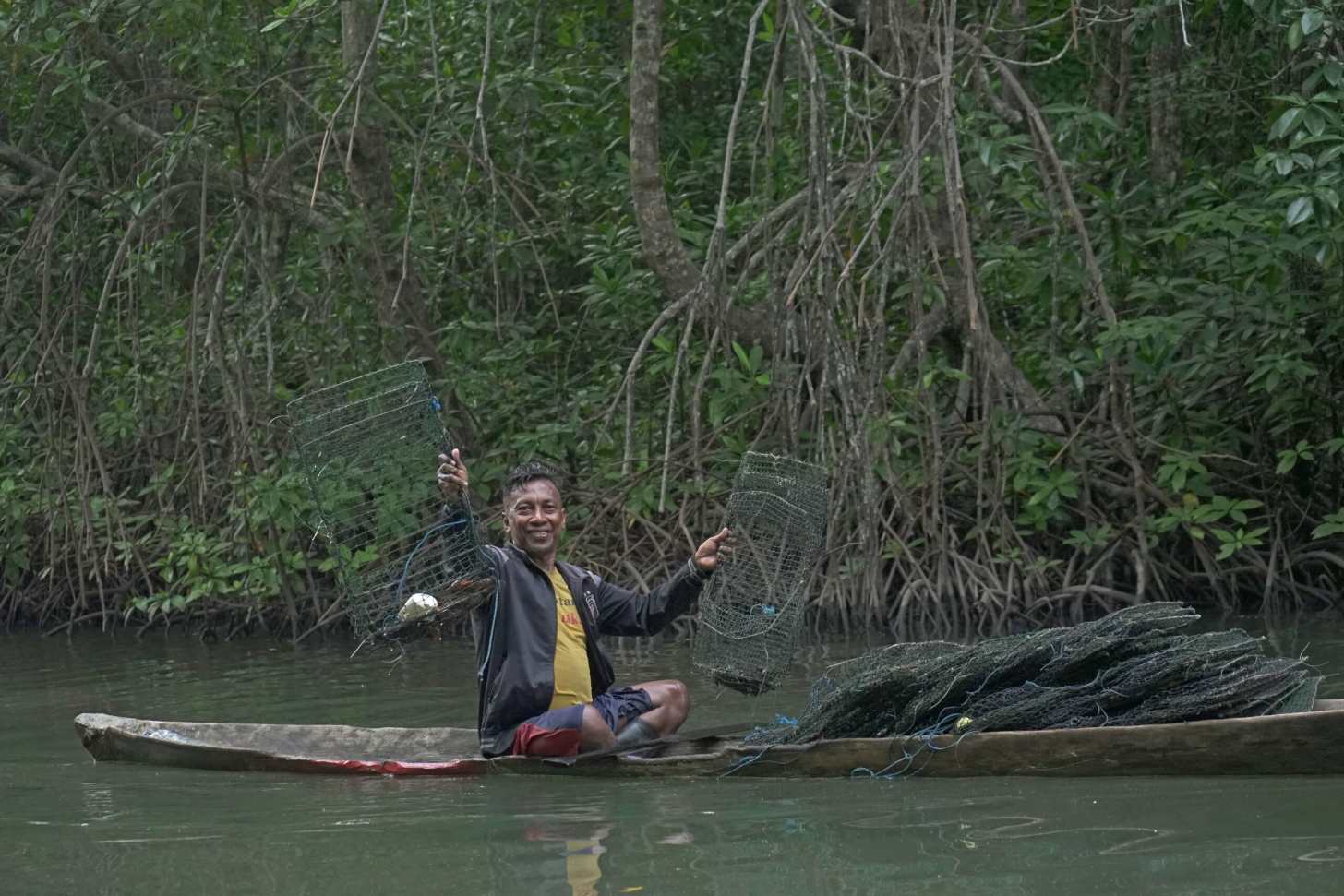
Muhammad Ihsan Maulana, WGII’s policy advocacy manager, said the findings demonstrate that Indigenous conservation deserves stronger policy recognition if Indonesia hopes to achieve its biodiversity targets in an equitable and inclusive way.
Yet Indigenous peoples have often been marginalized from formal conservation efforts because many of their territories remain legally unrecognized, even though they have managed them for generations.
So far, only about 1 million hectares (2.5 million acres) of ICCAs have been documented through WGII’s voluntary national registry, representing just a fraction of the group’s estimated 29 million hectares of potential ICCAs across Indonesia.
Without proper documentation and legal recognition, Indigenous communities risk having their conservation practices ignored or even criminalized, WGII say.
Against this backdrop, the Ministry of Environment and WGII began drafting the roadmap in June 2026.
As Indonesia’s CBD focal point, the ministry says biodiversity policy must move beyond science alone and better incorporate Indigenous knowledge.
“The CBD cannot address biodiversity solely from the perspective of science. It must also incorporate social dimensions,” said Inge Retnowati, the environment ministry’s director of biodiversity conservation.
She said the ministry is preparing a roadmap for the protection and promotion of local wisdom that goes beyond simply defining Indigenous peoples.
“The next question is what follows after that — how recognition should be provided, and what comes next,” Inge said. “The substance of this roadmap is something that we must develop together.”
According to the ministry, the roadmap is intended to guide policies on recognizing, protecting and promoting Indigenous peoples’ traditional knowledge and local wisdom in biodiversity conservation.
Rasio Ridho Sani, the ministry’s deputy for pollution and environmental damage control, acknowledged the vital role Indigenous peoples and local communities play in protecting ecosystems that face mounting pressure from deforestation, overexploitation of natural resources, pollution and climate change.
“Biodiversity is a vital natural asset for the sustainability of ecosystems and the well-being of society,” Rasio said. “Therefore, Indigenous peoples and local communities need to receive support, recognition, protection, and fair benefits for their contributions to conserving biodiversity.”
An integral part of incorporating Indigenous peoples and their traditional knowledge into biodiversity conservation is securing formal recognition of their rights.
However, only around 7.4 million hectares (18.3 million acres) of Indigenous territories have so far received formal government recognition through various legal mechanisms, leaving many communities without legal protection.
Legal scholars say the roadmap will only have lasting impact if it is accompanied by broader reforms to recognize Indigenous land rights.
“Documentation of local wisdom by regional governments together with communities can provide a strong foundation for accelerating the recognition and protection of local wisdom through more effective policies,” said Yance Arizona, a constitutional law lecturer at Indonesia’s Gadjah Mada University.
The roadmap also comes as Indonesia continues to lack a national Indigenous Peoples Law despite nearly 16 years of legislative debate. Indigenous organizations have long argued that the absence of such legislation leaves recognition of Indigenous rights fragmented across different sectors and government agencies.
Cindy said the roadmap should therefore be developed through broad participation rather than by the government alone.
“This roadmap must serve as a collaborative platform for the government, Indigenous peoples, academics, civil society organizations, and development partners,” she said. “We hope the document will not only serve as a policy guide but also encourage concrete action to strengthen the protection of rights, traditional knowledge, and local wisdom practices in Indonesia.”
Through the roadmap, WGII said it hopes Indonesia’s conservation model will gradually shift from focusing primarily on protecting species to recognizing the relationships Indigenous peoples have maintained with nature for generations.
“Conservation is not only about protecting species; it is also about safeguarding the relationship between people and nature,” Cindy said.
Header Photo: A villager in Buton guarding the sea using a customary system known as Kaombo, in which communities regulate access to marine areas, including coral reefs, seagrass beds and mangrove forests. Courtesy of SIEJ
Written by Hans Nicholas Jong. This article was originally published by Mongabay.
New York City resident dogs and cats, rejoice. It appears Mayor Mamdani’s affordability agenda has officially extended to the furry friends of the city.
On June 30, the Mamdani administration and the New York City Council announced their agreement on the 2027 fiscal budget.
Along with things like a $54 million increase to fund a Fair Fares expansion for public transit, $175 million allocated to expand housing vouchers, and an additional $79.1 million set aside to restore funding for parks, libraries, and cultural institutions, one line item stood out.

It reads: “Pet Food Pantry for Low-Income New Yorkers and Free or Low-Cost Spay and Neuter Services: $750,000.”
For a total investment of $1.5 million, the city will grow its existing spay and neuter program with a $750,000 infusion in 2027, up about $250,000 from the prior year. And a separate $750,000 will be allocated to launch the city’s first-ever pet food pantry pilot program, according to the council’s animal welfare caucus.
“This year’s budget demonstrates a commitment to equity, affordability, and community. I’m grateful to Speaker Menin and Mayor Mamdani for working together to secure historic victories,” Council Member Harvey Epstein said in a statement.
“Additionally, we secured funding for pet food pantries and spay and neuter services for pets across the five boroughs. This budget reflects what we can accomplish when we work together to protect essential services and invest in the well-being of all New Yorkers.”

These expanded pet services will be distributed through a network of community partners, local animal shelters, and nonprofit organizations across the city, Secret New York reported.
The pet food pantries, for instance, will operate out of existing community food networks and neighborhood hubs, with eligibility generally aligning with established low-income public assistance guidelines.
Expanded spay and neuter initiatives will utilize mobile clinics traveling through specific low-incoming neighborhoods, as well as voucher programs that are redeemable at participating local veterinarians.

The new allocations were praised in an Instagram post by advocacy group Voters for Animal Rights, shared by Council Member Epstein and the council’s animal welfare caucus.
“This budget recognizes that keeping families and pets together, preventing animals from ending up on the streets or in shelters, and supporting the rescuers who care for our city’s most vulnerable animals are all part of NYC’s affordability agenda,” the caption reads.
“The funding is $1 million more than last year, and it’s a starting point we’ll build from. Our long term goal is to have publicly funded pet food pantries plus low-cost spay/neuter and veterinary clinics accessible in every borough, for any rescuer or pet parent who needs them.”
The New York City 2027 budget — which was approved with a $125.8 billion total for the upcoming year — took effect on July 1, 2026, aligning with the start of the city’s new fiscal cycle.
Specific details surrounding the pet food pantry and spay and neuter program will be shared by the city’s official partners as the rollout begins. New Yorkers can check with their local Council Member’s office or the city’s Department of Health and Mental Hygiene for updates.
You may also like: Zohran Mamdani's favorite children's book represents what he wants for all NYC kids (Exclusive)
Featured Image: Michael Appleton / Courtesy of NYC Mayoral Photography Office
For thousands of years, the snow leopard was considered the king of the mountains, with its habitat range extending through 12 countries across Asia: Afghanistan, Bhutan, China, India, Kazakhstan, Kyrgyz Republic, Mongolia, Nepal, Pakistan, Russia, Tajikistan, and Uzbekistan.
But today, the snow leopard is on the decline. The top predator faces threats on all sides, from poaching, habitat loss, and the dropoff of its natural prey species.
And its most looming threat? Climate change.
According to the World Wildlife Fund, impacts from a warming planet could result in a loss of up to 30% of the snow leopard habitat in the Himalayas alone.
But the WWF is not letting them go without a fight. For years, the nonprofit has teamed up with communities and governments throughout Asia to raise awareness for the vulnerable species, reduce the impacts of development on fragile snow leopard habitats, and tackle the illegal wildlife trade.
They’ve also assisted India and Mongolia in conducting their first national snow leopard population assessments, which helps local conservationists monitor the ongoing impacts of climate change while providing critical baseline data about existing populations.
But snow leopards are notoriously hard to spot in the wild, thanks to their thick coats that help them blend into their snowy surroundings. Their camouflage has led to the nickname, “the ghost of the mountains.”
And the harder they are to find, the harder it is to save them.
Fortunately, a recent post on the WWF UK Instagram page showed how effective trail cameras can be in tracking the elusive species.
“POV: you’re a camera trap in the high altitudes of Wolong,” the nonprofit shared on social media.
“WWF China’s camera trap monitoring has documented a range of species during their ongoing survey in the area — from the iconic snow leopard to red foxes and takin, too!”
The photos shared on Instagram come from an ongoing survey launched in 2022 to document elusive mountain cats across 10 high-altitude regions in China, including the Wolong National Nature Reserve in Sichuan Province and Sanjiangyuan National Park in Qinghai Province.
So far, the trail cameras have captured more than 600 photos of snow leopards. Researchers estimate that only 22% of existing snow leopard populations have been recorded, which means that every shred of data is valuable.
On its website, WWF said that its conservationists have increasingly relied on modern technology like trail cameras to gather life-saving data.
“Together, we help manage human-leopard conflict, improve protection measures, increase awareness, and enhance community stewardship and benefit programs to ensure the long-term survival of the species,” WWF said.
You may also like: This giant snail is the size of a croissant. Conservationists are banding together to save it from extinction
Featured Image: @wwf_uk/Instagram
New York City churches are having a housing reckoning. As the housing market gets more expensive and difficult to navigate, many religious institutions have taken a page out of the YIGBY movement’s book — that’s “Yes In God’s Backyard.”
YIGBY aims to transform “underutilized faith community land” into affordable housing and homelessness solutions across the country.
And one iconic N.Y.C. church is getting in on the action.
Trinity Church is an Episcopal parish in Lower Manhattan’s Financial District founded in 1697. Situated close to the One World Trade Center, the church is a staple for religious and civic life in New York, hosting musical performances and leading large philanthropic projects alongside its standard worship services.

The site itself is also of historical significance, as the church provided memorial support in the wake of September 11, 2001, and is also where Alexander Hamilton is buried. Its towering 281-foot steeple is a staple of the area skyline.
And now, it represents a new beginning for many New Yorkers.
As of January 2026, Trinity Church has come to an agreement with Settlement Housing Fund, a leading nonprofit affordable housing developer in the city, announcing plans to develop a new 120-unit affordable housing community on land owned by Trinity Church.
The new apartments will be located at 50-58 Cliff Street in Lower Manhattan, adjacent to St. Margaret’s House, a 249-unit affordable senior housing residence that the church founded in 1981.
Approximately 120 permanently affordable apartments will be available to low-income households, with units set aside for formerly homeless individuals and families, a press release from Trinity Church stated.

While the new apartments won’t be located in the Trinity Church chapel, they’ll be less than a mile away and very much part of the church community. According to the press release from the church, Trinity will maintain ownership of the land through a 99-year lease.
“The building will feature high-quality, sustainable design and community-oriented amenities such as outdoor use spaces, a food-focused learning space, and flexible spaces for events, workshops, and community programming,” the release explained.
Offering community support isn’t new to Trinity. In addition to St. Margaret’s House, which provides housing for elderly and disabled New Yorkers, the church’s outreach includes food assistance seven days a week, support for asylum seekers, youth programs, free music and educational events, and support for ministries in countries all over the world.
Its commitment to serving neighbors is in the church’s DNA.
“Over forty years ago, Trinity Church demonstrated its commitment to housing stability by developing St. Margaret’s House, which continues to provide affordable homes for seniors in Lower Manhattan,” Thehbia Hiwot, managing director of housing and homelessness at Trinity Church, said in a statement.
“Today, we are building on that legacy through our Housing and Homelessness grant-making and our partnership with Settlement Housing Fund on this new development. Settlement Housing Fund is a trusted affordable housing developer and social service provider, and together we reflect our deep belief that every New Yorker deserves a safe, affordable place to call home.”

Settlement Housing Fund currently oversees 3,149 affordable units, with another 2,250 in development. The organization was selected by Trinity Church as the developer for the new site through “a competitive proposal process that prioritized 100% affordable housing.”
It’s unclear when the apartments will be move-in ready, or what the rent prices will be, but the January announcement said local, women-owned architecture firm Dattner would be taking on the project.
“Affordable housing opportunities in Lower Manhattan are rare, and we are proud to bring new, deeply affordable homes to this thriving neighborhood,” Judy Herbstman, president of Settlement Housing Fund, said in a statement.
“This project reflects our mission to create inclusive, sustainable communities where New Yorkers of all backgrounds can achieve housing stability and thrive.”
You may also like: At this Mennonite house in Manhattan, rent is less than $900 a month. It's surprisingly LGBTQ+ inclusive
Featured Image: Colin Winterbottom/Courtesy of Trinity Church
In early July, a group of fishermen was boating off the coast of New South Wales, Australia when they spotted a 220-pound loggerhead sea turtle bobbing in the water, wrapped several times over in thick ropes.
The ropes were connected to barnacle-covered buoys, and it was unclear how long the sea turtle had been struggling.
“Stay still, lady,” one fisherman can be heard saying on video as he cuts the tangle of ropes wrapped around the sea turtle.
As the sea turtle finally swims free, the same fisherman can be heard breathing a sigh of relief: “What a mission!”
Abandoned fishing gear, also known as “ghost gear,” can prove deadly to sea turtles without intervention.
And unfortunately, stories like this are all too common.
In June, while fishing in Virginia’s Chesapeake Bay, three fishermen spotted a 700-pound leatherback sea turtle struggling in the water.

Despite 20 mph winds, they carefully maneuvered their boat close enough for fisherman Brandon Watts to cut away crab pot buoy lines that were wrapped around the turtle's neck and flippers about ten times.
“It seemed like he was crying for help, and my dad mode kicked in, and I just went right to town,” Watts said in an interview with WAVY TV 10.
Once freed, the turtle swam away safely.
“I’ve been fishing since I was a little kid, but I’ve never seen a turtle in distress like that,” Watts’ friend, Travis Cullipher, said.
“They didn’t ask for all that stuff to be in that water,” Watts added. “So anything you can do helps.”
In April, an 8-year-old girl vacationing in South Carolina spotted a sea turtle hooked to Oak Island’s Ocean Crest Pier. It ended up being a Kemp’s ridley sea turtle, which is widely considered the most endangered sea turtle in the world.
The family soon called the Oak Island Sea Turtle Protection Program, an all-volunteer nonprofit organization, which came to unhook the sea turtle.
“A big thank you to Katie and her family from Spartanburg, SC, for calling us to make sure the turtle was ok,” the nonprofit posted on Facebook on April 17. “We assessed the turtle, checked him for tags, got some great data for the state, and released him immediately.”
If you see a sea turtle that appears injured, trapped, or struggling, immediately report it to local authorities or a marine conservation organization.
Call 1-800-SEATURTLE or use the NOAA Fisheries Stranding Contact Page to find 24-hour hotlines for your region.
You may also like: Nonprofit hosts 'ghost trap' rodeo: A fishing tournament for cleaning abandoned fishing gear out of the water
Featured Image: Ukanda/Wikimedia Commons (CC BY 2.0)
Firefighters of Rostraver Township, a small suburban area in Pennsylvania, were surprised earlier this week when they got a call about a raccoon stuck in the grates of a storm drain.
First responders came to the scene just before 10 a.m. after a resident had already helped try to free the raccoon by wetting it down and using a small amount of Dawn dish soap, hoping to help it slip through the opening.
“They tried a few of those things, but nothing ultimately worked,” Rostraver Township Police Chief Scott Sokol told the Mon Valley Independent.

But even the professionals struggled to get the critter free, ultimately using the “Jaws of Life,” or a powerful hydraulic tool that cuts through metal and is often used to rescue people trapped in mangled vehicles.
Police, fire department crews, and the township’s public works department all assisted in the rescue.
With the Jaws of Life equipment, and other hand tools, they worked to cut just enough metal out of the way for the mammal to run free.

“They were able to get the grate out with him inside, cut it away and eventually freed it,” Sokol said. “As soon as it was free, it took off running.”
While the raccoon appeared eager to return home to its natural habitat, Sokol said it was surprisingly calm amid the rescue, refraining from hissing or growling.

The cause of the incident, Sokol believed, was that the raccoon climbed into the storm drain but became stuck in an attempt to climb back out.
“It was an odd call,” Sokol said. “Poor little fella. Nobody wanted to hurt it. We wanted a happy ending, and thanks to everyone working together, that’s exactly what we got.”
You may also like: A team of firefighters worked together to save a dog trapped on a two-story cliff in Oregon
Featured Image: Rostraver Township Fire Department/Facebook
The Provo Canyon School, an infamous Utah teen treatment center, has lost its license for one of its campuses, the Utah Department of Health and Human Services announced Tuesday.
By Aug. 6, the license revocation letter says, all services at the Springville campus for girls must be terminated and any new enrollments are prohibited. The school’s owners are also barred from reapplying for a new license for five years.
“The Department is taking this action because of the Provider’s failure to provide applicable health and safety services for clients,” said the revocation letter from the Division of Licensing and Background Checks, citing “chronic, ongoing noncompliance with applicable rules, statutes, or requirements.”
The state did not revoke the license for the center’s Provo campus for boys but placed new conditions on it, arguing the school’s “failure to comply with state administrative rules and failure to provide applicable health and safety services for clients,” according to a letter.

That campus isn’t allowed to accept new admissions either, and it must undergo increased monitoring visits.
A state investigation found the center delayed treatment for a minor who was rendered unconscious after a physical assault, the letter placing conditions for the Provo campus says. The investigation also showed multiple incidents in which the school failed “to ensure that each client has the right to be free from potential harm or acts of violence.”
Both actions can be appealed. That’s an option Provo Canyon School leaders say they’re considering.
“We disagree with the state’s decision to revoke Provo Canyon School’s Springville Campus license and are evaluating all available legal and administrative options, including an appeal,” Tim Marshall, chief executive officer at the school said in a statement.
“As this is an ongoing matter, we are limited in what we can say at this time. Our priority remains providing safe, high-quality care and support for adolescents and their families, and we remain committed to serving those in need.”
For years the school had been the center of multiple reports of violence and poor medical care, including from reality TV star Paris Hilton, who said she was abused and isolated during her time as a teenager in the institution.
Hilton returned to Utah last month to show support for parents suing the residential teen treatment center after years of advocacy that resulted in new laws imposing stricter regulations on the industry.
Hilton applauded the state’s decision in a prepared statement issued Tuesday.
”Today, the state confirmed what survivors have known all along: Provo Canyon School failed the children in its care,” Hilton said.
“I was one of those children. I know what it feels like to cry for help and believe no one is coming. Today, children still inside that facility know someone is finally coming to protect them,” she said.
“The little girl in me who was told she would never be believed feels so validated today. We were telling the truth. We always were. No institution is too powerful to be held accountable. When survivors refuse to stay silent, change is possible.”
Multiple violations
Shannon Thoman-Black, director of Utah’s Division of Licensing and Background Checks, said in a news conference on Tuesday that her office had been following the process established by law since it started a previous investigation in January 2025, which resulted in the state setting conditions to the institution’s license.
“We don’t go in with a hammer when a scalpel will do. Now there comes a time when, in this case, we received additional complaints,” she said. “We investigated those complaints during the course of that investigation. We then discovered multiple substantiated (instances of) noncompliance.”
Division officials said they received a complaint from the Disability Law Center about the center in the middle of June. That prompted an investigation that uncovered incidents that either hadn’t been reported to the office or lacked substantial material, as required by the law.
State investigators interviewed staff and clients and reviewed medical records, camera footage and internal documentation from the school.
The list of violations included withholding information during the investigation process, failing to report critical incidents and to protect clients from harm, as well as failing to ensure all clients were free from neglect and discrimination, Thoman-Black said.
The school, according to the investigation, did not ensure that all staff members had clear background checks before having unsupervised access to the teens, and some engaged in “unnecessary restraint and aggressive physical contact with clients.”
Until Aug. 6, when the Springville campus is scheduled to shut down, the division will continue to monitor the institution.
The Department of Health and Human Services will work with the school and teen treatment systems in other states “to ensure a safe and timely transition, either to their home state or to another appropriate placement,” Thoman-Black said.
“Ultimately, a youth guardian determines what those next steps will be,” she said.
This article was written by Alixel Cabrera and was originally published by Utah News Dispatch.
Featured Image: @parishilton/Instagram
- Women’s conservation collectives in the communities surrounding Nigeria’s Afi Mountain Wildlife Sanctuary are working to defend the wildlife, forests, and rivers in a protected area that’s home to threatened gorillas and chimpanzees.
- Funded by membership dues, these groups carry out patrols, investigate wildlife crimes, and work collaboratively with traditional leadership structures to censure violators.
- One of the groups’ notable successes comes in ensuring that rules aimed at protecting the environment are upheld without bias or favoritism.
- The successes of the pioneering women’s collectives have inspired the formation of similar initiatives in other villages surrounding the sanctuary.
BOKI, Nigeria — The morning light fills Ulom with warmth and radiance. A dome of mountains, their green vegetation spread out like giant green walls, is visible at the edge of this serene village in Nigeria’s southeast. In the king’s palace, a women’s group kicks off its monthly meeting with prayers and choruses.
Today’s meeting centers on river pollution, a significant issue being addressed as part of a broader initiative to save Afi Mountain Wildlife Sanctuary (AMWS), a 39-square-mile wildlife hotspot situated near Ulom.
Gazetted in 2000, the sanctuary is inhabited by the critically endangered Cross River gorilla (Gorilla gorilla diehli), endangered Nigeria-Cameroon chimpanzees (Pan troglodytes ellioti), and drills (Mandrillus leucophaeus); porcupines; duikers; and dozens of bird, bat, and butterfly species.
Afi is the shared heritage of 16 villages, including Ulom, broadly known as the sanctuary’s landlords. Together, these communities have set up initiatives and bylaws aimed at protecting the hotspot, often in collaboration with nonprofits and other stakeholders.
The women’s collective meeting here today is one signal of a growing surge of women’s conservation leadership across the host communities.
Asu Margaret, the group secretary, reads aloud from a notebook. “In our previous meeting we discussed how to prevent wildfires in the Afi Mountains,” she says. “We rejected the felling of trees. We maintain the ban on timber dealers.”
Only about 300 Cross River gorillas are estimated to survive in the wild; roughly 100 of them live in a patchwork of interconnected protected areas that includes Afi, Mbe Mountains, and the Okwango division of Cross River National Park.
The gorilla’s presence has made Afi a home for diverse conservation initiatives, drawing global nonprofits, fascinated tourists, and world-class researchers who explore apes and primates. The women’s initiative, however, is rare, unique, and homegrown.
The meet ends with a resolution to raise the fine for river poisoning to 500,000 naira ($356). The group announces this new rule to a crowd of men, women, and youths gathered in the community hall, where it’s met with cheers and a few murmurs.

Rising to fame
The spark for the initiative, says 42-year-old Ofre Mary, originated from chatter during a burial ceremony in the nearby village of Bamba. During the gathering, she and her friends talked about women-led communal action to resist overfishing in their rivers.
Back from Bamba, with vigor and vision, Mary spoke to dozens of women, among whom she found committed supporters to officially launch the Ulom Women’s Conservation Collective in 2023.
“Our men have failed to stop the threats,” Mary says. “That’s why women decided to take a stand. That’s why we decided to take the risk.”
Across the villages Mongabay visited, people point to men as the chief culprits in hunting, trapping, logging, and river pollution; therefore, residents say, men lack the moral courage to oppose the crimes.
The women’s core exists to “firmly defend the Afi Mountains and prevent people from destroying it," Mary tells Mongabay.

At their maiden gathering at Mary’s home, members shared in their visions and their childhood memories of Afi’s lushness, which has now dwindled. They recalled the famous chimpanzee and monkey calls and the melodies of beautiful birds.
“My father told me Afi had special animals,” Mary says. “We must protect it.”
Now, the collective meets twice a month to brainstorm strategies to combat threats to Afi’s biodiversity and review existing wildlife regulations. Their patrols, targeted at uncovering early signs of hunting, logging, or wildfires, are designed to be both structured and spontaneous so the team is ready to confront threats at all times, including late at night and early dawn. The women average two standard monitoring patrols a month, excluding emergency responses.
They track and investigate every swirl of smoke, every gunshot, and every rattle of a chainsaw originating from Afi. Sometimes alone, sometimes in collaboration with communal leadership, state forestry officers, and nonprofits in the region, the women’s group investigates allegations of wildlife crimes.
Depending on the result of the investigations, suspects can be exonerated, fined, or even exiled. Their guns and chainsaws are confiscated, and traditional governance structures, such as communal task forces and councils of chiefs, ensure the pronouncements are enforced.

The women’s group can point to many successful interventions.
“In the past, we could barely sleep due to the sounds of chainsaws logging in our forests,” says Akan Grace, the public relations officer for the Ulom group. “Even by 12 a.m., midnight, the sounds of engines would be ringing from loggers inside the forest.”
Grace lost an entire family farm many years ago to a careless wildfire. That experience, together with her newfound conservation conviction, drew her to the collective.
Recently, the group traced a swirling column of smoke to the mountaintop, only to discover it came from cut timber that had caught fire. In 2024, Grace, Mary, and the other women pressured Ulom leaders to reject a timber deal that would expose Afi to deforestation. Youths were mobilized to lay roadblocks, effectively cutting off timber dealers from Ulom and nearby communities.
The signs of women’s power have always been there, says Francis Akie, who heads the Traditional Rulers Council of Ulom. The collective only gave it form and structure.
In 2021, Akie tells Mongabay, before the collective was formed, local leaders struck a secret deal with timber dealers to log margins of Afi in exchange for fees. The women threatened to embark on a nude protest unless the timber deal was instantly cancelled.
“They reminded us that a single baby chimpanzee or gorilla is more valuable than a hundred loads of timber trucks,” Akie says. “We saw merit in their ideas and stopped the timber deal completely. We refunded the timber dealers the money we already collected.”
Beyond physical actions, the women are using ideological campaigns to reshape the way locals perceive conservation. They teach that killing Afi’s apes and other iconic species will erase the objects of fascination that draw renowned wildlife researchers, global media, nonprofits, tourists, and scientists to the area.
Youths, who rely on hunting and timber trade in the absence of social services and gainful jobs, have questioned the monetary value of protecting gorillas and chimpanzees. The women’s response: fresh air, clean water, and a future for their children exceed cash, according to Agbo Helen, the leader of the collective operating at Katabang, another landlord village.

Yet the greatest impact of the collective may be in making the rules work. Prior to the women’s collective, multiple sources told Mongabay that nepotism, inequity, and partiality reduced several wildlife regulations to paper formalities without actual bite.
“In the past, the laws existed, but people didn’t care much about abiding by them. There was just a lot of talking without concrete action,” Grace says. “But now, if there is an offense like a wildfire, we fight until we uncover the culprit.”
They started by creating accountable leadership, where the rules are binding on all without bias. Erring members were punished. The rules are now applied equally, says Akie.
“Even if the king commits an illegal act that harms the environment.” This, he says, signals a powerful shift from the status quo riddled with bias, partiality, and nepotism.
“Even if my own sister breaks the law, we would arrest her. The warning has gone around to everyone,” says Osang Sarah, a key member of the Katabang collective. “If the community makes a law, everyone must abide by it. One person can never be greater than the community. There is nobody above the community law.”
In their homes, the women are also influencing what their families eat to eliminate threatened species from the local diet. This work helps in growing communal goodwill and the strong backing of traditional male-led authorities.
Given the success of their initiative, traditional rulers, who spoke to Mongabay at Ulom and Katabang, say they regret not entrusting the women with conservation leadership much earlier in the Afi sanctuary’s history.
“If we had involved these women a long time ago, we would have eradicated most of the threats to the sanctuary,” Akie told Mongabay.

Expanding stewardship
The news of Ulom’s success continues to spread. More than half of Afi’s 16 landlord communities, who share in the ownership and conservation responsibility for the area, are at various stages of launching similar initiatives.
In many ways, the villages of Buanchor and Katabang have replicated, if not exceeded, the success of Ulom. In 2024, before their launch, a delegation of women from Buanchor, led by Agbo Regina, visited Ulom to study the collective there.
“We advised them to master the way women wield power,” Grace tells Mongabay. “It is not always coercive.”
More than 100 women signed up in the early days of Buanchor’s initiative. Gradually, as expected, the membership shrank to just a dozen women, whose loyalty and shared vision are resolute.
“We wanted only people who are ready to work. People who are firm in their resolve,” Regina says. “The smaller the better. Large crowds destroyed stability.”
During one of their routine patrols last year, the Buanchor women spotted large clearings for farmland on the periphery of Afi. They raised the alarm, and the chiefs mobilized youths to halt the clearing and destroy all newly planted seedlings.

One dark night in January 2026 came the rattle of a chainsaw in the mountain adjacent to her home, according to Ojong Gift, the publicity lead for the Buanchor collective. She alerted her team, and a squad was dispatched with torches, machetes, rain boots, and raincoats to investigate the origin of the logging.
“We seized the chainsaw machine, and [the logger] was pleading for mercy. We gave him a final warning. He paid fine,” Gift says.
The standout moment for the Buanchor women came in 2024, Gift recalls. Privy to a male-endorsed timber deal, the entire Buanchor women issued a strong ultimatum to the communal authorities to reverse the decision.
“We threatened to protest naked all around the entire community if they permitted timber merchandise,” Gift says. As in Ulom, just the threat of this culturally powerful form of protest proved effective. “The men wanted to allow it because of the money involved; the women’s warning made them reverse the timber deal,” Gift says.
The Katabang group’s structure mirrors that of the Ulom and Buanchor groups, albeit with some unique features. Leaders emerge through elections and consensus. Dues are paid regularly to buy fuel and hire bikes for patrols. The initiatives have collaborated, not competed, with existing nonprofits, structures, networks, resources, and authorities.
Still, each community operates with the autonomy to shape its operations in relation to local realities. This decentralized leadership structure makes it more difficult for the groups to be hijacked by compromised persons whose motives are neither pure nor conservation-driven, local authorities tell Mongabay.
Since last year, at least half a dozen communities, including Kayang, Boje, Esikwe, and Kakubong, have sent women delegates to either Ulom, Buanchor, or Katabang to study their models in preparation for a launch of their own women’s conservation collectives.

Leaders in these three pioneer communities are invested in expansion, offering their own time, skills, and advice to advance new groups. A gap in protection in any of the communities that border Afi, they argue, could jeopardize the outcomes of systems in others.
“If we protect our axis of the forest and others ignore theirs, our work over here would be hindered,” Grace says. “Wildfires from their side of the forest can spill over to this side. Similarly, poisonous chemicals can flow into our rivers from their own axis since we share the same water source. That’s why every community should be involved.”
The guardians of the river
While timber and hunting operations take the limelight, collective members are equally proud of their efforts to protect Afi’s waterways. Several streams and rivers, including the Afi River from which the sanctuary derives its name, are patrolled by the female guards to deter and detect signs of pollution.
River patrols are scheduled on a roster. Their aims are to arrest offenders, galvanize community response, investigate crimes, and penalize pollution. While most conversations center on how river pollution deprives communities of water to wash, drink, bathe, and irrigate their farms with, Sarah tells Mongabay that apes and other animals are often the silent but worst-hit sufferers.
“Animals drink from the water,” Helen says. “Birds drink from the same water. Human beings drink from the same water, and if the water is poisoned, the animals might die or migrate.”
Until three years ago, when the women began river patrols and guardianship, river poisoning was widespread. To recover a contaminated river, communities often mobilize youths and women to use logs, mud, sandbags, and large rocks to dam off the affected areas.

Then, the women, armed with basins and buckets, scoop the contaminated water from these isolated pools until they’re dry. Once this is done, the makeshift dams can be dismantled, and a fresh flow of water can wash away any trace contaminants left in the mud.
“The women guard our rivers,” Akie says. “They arrest offenders. They are the ones who enforce the laws protecting the waters. Since it began, river poisoning has stopped.”
The impacts, now being celebrated across Afi and beyond, are a product of the sacrifices, bruises, and mockery endured by the women. A day before Mongabay visited Ulom, an outspoken member of the group was forced to withdraw after her husband threatened to divorce her, despite pleas from Mary and her team. Sensing his fierce refusal and prioritizing protecting her marriage, the collective bade her farewell.
“We didn’t want to remove anyone from her husband’s house. So, we had to obey the husband.”
As the focus turns fully toward expansion, the women also struggle to raise the money to rent motorcycles and buy fuel to patrol hotspots and connect with other women in nearby communities. They also lack proper equipment: rain boots, jungle fatigues, machetes to trim the tangle of jungle vegetation as they trace the crime scenes during patrols, and gear to fight wildfires.
“We have discussed expanding to other communities, but there is worry about how to finance this expansion,” Mary says.
In spite of these hurdles, their work is paying off, and the signs are unmistakable. River pollution has been nearly reduced to zero in some of the visited communities.
“The animals are returning. You can see their fecal droppings and play spots,” Sarah says. “The forest is gradually regenerating and thick. Recently, we started hearing the calls of chimpanzees once more.”
Featured image: Orji Sunday/Mongabay
This article was originally published on Mongabay.
- Researchers working in Benin’s Pendjari National Park reported some promising news for West African leopards: Density rose from 2017 to 2023.
- West Africa’ leopards are regionally endangered, with just 354 remaining across the region.
- Pendjari National Park sits within the W-Arly-Pendjari Complex, a large transboundary conservation landscape encompassing national parks, hunting reserves and buffer zones that in recent years has been infiltrated by non-state armed groups operating in the Sahel. While conservation efforts in the national park are working, the security crisis remains a major threat.
It’s been difficult to monitor West African leopards in Benin’s Pendjari National Park: It’s a large wilderness area, situated within a hotspot of armed conflict. The park is among the last strongholds for this geographically distinct leopard population — but a recent study shared hopeful news.
Leopard density in the park increased over a six-year period, according to a study published in the journal Global Ecology and Conservation. The park has been managed by the nonprofit African Parks since 2017 in partnership with the government — and this conservation effort seems to be working.
“It’s a win,” said study lead author Marine Drouilly, a biologist with Panthera, the global wild cat conservation nonprofit.
West African leopards are geographically separated from other African leopard (Panthera pardus pardus) populations. In 2025, they were listed as regionally endangered on the IUCN Red List, after suffering a 50% decline over the past two decades.
Numbers are estimated at just 354 across West Africa. In addition to Pendjari, important strongholds include the Niokolo-Koba–Badiar landscape in Senegal and the Guinea, Taï and Comoé National Parks in Côte d’Ivoire, and Mole National Park in Ghana.
A rapidly growing human population across West Africa means wildlife habitat is disappearing and becoming more fragmented, isolating already small leopard populations, Drouilly said, while widespread bushmeat hunting leaves leopards without enough prey.
There’s a growing threat from poachers continent-wide, as leopards are targeted for their spotted skins, canine teeth, bones, and other body parts, killed to supply the illegal wildlife trade in Africa and Southeast Asia. In West Africa, burgeoning use of talismans made with small pieces of leopard skin adds to demand, Drouilly said.

Pendjari NP lies within the W-Arly-Pendjari (WAP) Complex, a sprawling mosaic of five national parks, numerous hunting reserves and buffer zones across Benin, Burkina Faso, and Niger. It’s a World Heritage Site; At 10,425 square miles — an area about the size of Haiti — the complex is one of the largest conservation landscapes in West Africa and a vital refuge for numerous species that are in danger of extinction.
This includes three critically endangered species: West African lions (Panthera leo leo); up to 90% of the region’s remaining forest elephants (Loxodonta cyclotis); the last known population of Northwest African cheetahs (Acinonyx jubatus hecki); and it shelters a key population of West African leopards.
But over the past decade, non-state armed groups operating in the Sahel have infiltrated this remote wilderness area, threatening wildlife, exacerbating existing pressures, and interfering with conservation efforts.
In the face of security threats, African Parks maintains a strong field presence of rangers as well as an anti-poaching unit, with support from the Benin Armed Forces and aerial surveillance, study co-author Hugues Akpona, a regional manager with the organization, told Mongabay in an email.
The team, he said, is restoring habitat, bolstering prey populations and managing key water sources within the park. They’ve also had measurable success engaging with communities to build trust by involving them in decision making and by supporting economic development.
Their dedication and hard work are paying off, Drouilly said, noting that the study has lessons for conservation in other conflict zones.

Slight increase in leopard density is a sign of hope
To find out how leopards were faring within Pendjari NP, a team of ecologists, rangers and researchers began biennial camera trap surveys in 2017, the first long-term study of leopards in West Africa.
When the researchers analyzed data from 2017-2023, they expected to see a decline in leopard numbers, especially from 2022, when attacks by armed groups around the region intensified and parts of Pendjari became difficult to access.
Instead, leopard density showed a small but perceptible increase over the six-year period, going from 0.62 to 2.08 leopards per 38.6 square miles. This suggests the park’s leopard population is growing, though, researchers couldn’t estimate a total population size. With so few leopards left across the whole of West Africa, even a small rise in density is welcome news, Drouilly said.
“Even if it’s only a slight increase and the [leopard] density remains relatively low [compared with Southern Africa] … It’s significant,” Drouilly said. “We were very, very happy.”
The researchers also found that survival was moderately high, indicating a small but recovering population. However, the survey failed to detect any cubs, which was concerning to them.

Armed groups threaten wildlife and disrupt conservation
The security crisis in the border region between Benin, Burkina Faso, and Niger is the “principal challenge” facing the national park, study co-author Hugues Akpona told Mongabay in an email.
Armed groups, notably Jama’at Nusrat al-Islam wal-Muslimin, and, to a lesser extent, the Islamic State Sahel Province, have infiltrated the WAP Complex, moving down from Mali and Burkina Faso, according to a report by the Global Initiative Against Transnational Organized Crime.
Taking advantage of the wilderness area’s remoteness and dense forest cover, the extremist groups tap into established smuggling networks, using the protected areas as a base and as a place to hide hostages, the report noted. They also traffic people, goods, and guns across borders, according to the Africa-based Institute for Security Studies.
The dire security situation makes it hard to keep wildlife safe and implement conservation actions, and the presence of armed extremist groups makes working in the park dangerous. In July 2024, an armed group attacked and killed five African Parks rangers and seven members of the Benin Armed Forces in WNP.
Akpona, who serves as regional operations manager (West Africa) at African Parks, said: “Insecurity today represents not only a direct threat, but also a structural factor that weakens the overall conservation system and reduces the effectiveness of management strategies that are normally applied under stable conditions.”
He said conflict makes it difficult to carry out monitoring and other work.
For example, in the 2021 leopard survey, the team set up 81 camera traps, but in 2023, they could only set 50, in just a quarter of the 2021 survey area. That meant they couldn’t survey prime leopard habitat along the Pendjari River, Drouilly said.
Even within surveyed areas, the presence of armed groups makes it difficult to regularly check camera traps, change batteries, or replace any that are stolen or damaged by wildlife.

The team employs various strategies to get around security constraints, including camera traps that were designed by Panthera to withstand harsh field conditions for extended periods without maintenance.
More than 100 rangers have learned how to deploy camera traps, and their skill and commitment yields high-quality data, Akpona said. The team is also looking at monitoring methods to complement camera trap surveys, he added, such as eDNA: collecting fur and feces to identify leopard presence.
Still, the increase in leopard density shows that conservation efforts are working, Akpona said, and their efforts continue to yield positive results, for leopards, the wider ecosystem and communities living around the complex.
The level of community engagement, measured through the Community Conservation Index, rose to 81% in 2025, Akpona said.
Predators need prey to thrive. So in 2024, African Parks began rebuilding key antelope species including hartebeast (Alcelaphus buselaphus), waterbuck (Kobus ellipsiprymnus), korrigum (Damaliscus lunatus korrigum), and kob (Kobus kob).
“If you continue to stay on the ground and you continue to protect those species, you can have positive outcomes,” Panthera’s Drouilly said. “It’s not just supporting biodiversity conservation. It’s also providing livelihoods and stability in these regions for the people. So that’s really important.”

Concern for leopards across the range
Unfortunately, the outlook for leopards in other parts of the WAP Complex appears more fragile, Drouilly said, though, current information is scant. She noted that a 2021 survey in the Benin sector of the transborder WAP National Park — also managed by African Parks since 2020 — failed to detect leopards.
In the Niger and Burkina Faso sectors of WAP and Burkina Faso’s Arly National Park, there’s very little management; aerial observations and satellite data show the land is now heavily overgrazed by cattle, Drouilly said.
This makes the persistence of leopards in Pendjari — even at low density — all the more important.
“So if at some point we manage to secure the full area, then animals will be able to expand again and recolonize those areas,” Drouilly said.
Globally, leopards are listed as vulnerable on the IUCN Red List, with subspecies across much of their range in Africa and Asia declining. Supremely adaptable, yet rarely seen, they fly below the radar — and that’s part of the problem, said Andrew Stein, who’s served as lead author on the leopard’s IUCN Red List assessment since 2016.
“Because they’re so secretive, the assumption is that they’ll be fine. And what we’ve learned … is that they’re not,” said Stein, who founded and directs CLAWS Conservancy, a Botswana-based nonprofit, who was not involved in the study.
He called the hopeful findings “really exciting,” a rare piece of good news in a largely unknown but high-risk region for leopards.
“One of the things with leopards is that you give them a chance, you give them a little bit of space, and if there’s wild prey available, they can come back, just as this paper suggests,” Stein said.
Featured Image: Courtesy of ZSL-CCI/Panthera/APN-Pendjari National Park
This article was originally published on Mongabay.