- Birdwatching is becoming increasingly popular in Nepal, contributing to biodiversity conservation through public engagement and ecological data collection.
- Despite its popularity, a lack of public participation and data-sharing practices affect record-keeping.
- Researchers say documentation provided by birdwatchers helps fulfill data gaps related to bird population and habitat.
- Birdwatching helps promote local destinations and generate economic activity, though Nepal as a birdwatching destination remains largely untapped.
KATHMANDU — As a child, Shankar Tiwari and his friends killed birds for fun around Chitwan National Park in central Nepal, where they grew up. Years later, a foreign guest at the hotel where Tiwari worked took him birdwatching and turned the hunter into a bird lover.
The striking yellow and black plumage and red eyes of the black-hooded oriole (Oriolus xanthornus), which he saw magnified through binoculars for the first time, sparked Tiwari’s lifelong passion for birds, he said.

Today, the 57-year-old is one of Nepal’s leading birdwatching guides and a prominent member of the country’s growing birdwatching community that is contributing to bird conservation while promoting it as a tourism attraction.
“The birdwatching community has grown significantly today,” he said. “This has helped not just in raising awareness of the birds, but the community also helps in keeping tabs on the birds — how their habitat and population have changed over the years.”
A new study suggests that birdwatching is becoming increasingly popular in Nepal, particularly among the young, and that this trend “contributes to biodiversity conservation through public engagement and ecological data collection.”
In Nepal’s capital, Kathmandu, nonprofits like Bird Conservation Nepal (BCN) and Friends of Birds organize events on weekends, drawing a diverse group of birdwatchers.
Despite the increasing popularity of birdwatching, the study notes, public participation and data sharing remain limited.
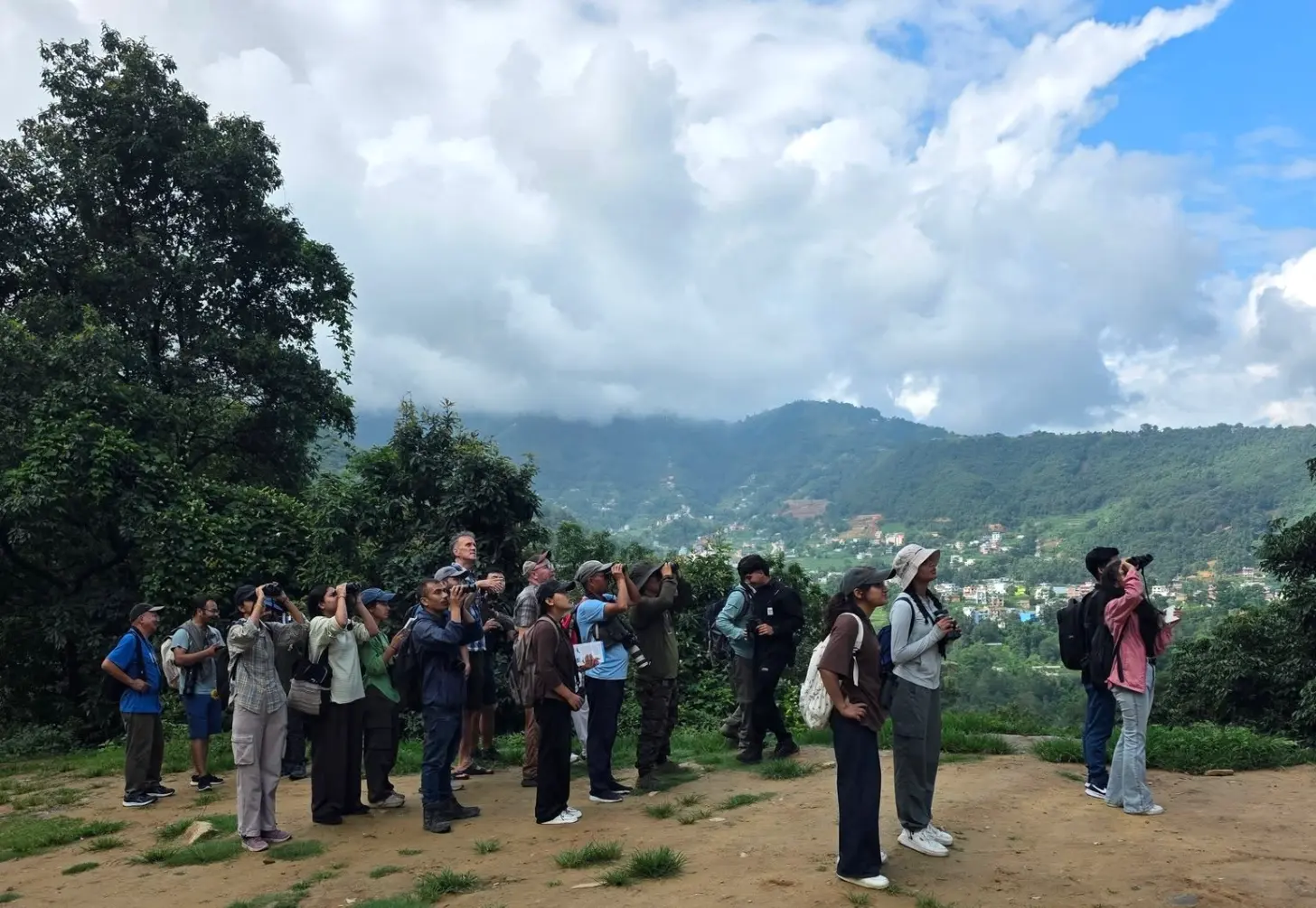
In a survey of 135 birdwatchers led by researcher Kamal Raj Gosai, only 37% shared their birdwatching records with platforms such as eBird, the online database of bird observations, or with bird conservation organizations, according to the study. A majority — around 46% — kept their data private.
Hem Bahadur Katuwal, co-author of the study and assistant professor at China’s Xishuangbanna Tropical Botanical Garden, said many birdwatchers, particularly young university students, may not be entirely aware of the importance of data sharing and its role in conservation.
He added that birdwatchers should record their observations, including the species they spot, the number of individuals seen, and the location of each sighting, among others.
“This helps in fulfilling the data gaps related to bird population and habitat,” he said. “The data also helps us establish trends and assess if the birds are in danger while compiling the national Red Data List of birds.”

Nepal is home to more than 900 bird species, of which 40 are globally threatened and 172 are nationally threatened. The country also has the enigmatic spiny babbler (Turdoides nipalensis), the only bird species endemic to Nepal.
However, conservationists like Ishana Thapa, CEO of BCN, say that growing urbanization and infrastructure development in Kathmandu and across Nepal, along with climate change, are disturbing bird habitats and populations.


A survey conducted between 2021 and 2022 along Kathmandu’s Bagmati River corridor by Central Department of Zoology, in Kathmandu’s Tribhuvan University, recorded only 67 bird species, compared to the more than 100 species historically seen in the area.
The large flock of birds that once cast a shadow on the ground while flying in Koshi Tappu Wildlife Reserve — one of Nepal’s prized birdwatching locations — is now seen in limited numbers, Tiwari said.
Duck species such as the northern pintail (Anas acuta), gadwall (Mareca strepera), Baer’s pochard (Aythya baeri) and common goldeneye (Bucephala clangula) have significantly decreased due to increased human activity.
“In such cases, the data collected from a birdwatching group can serve as a record of how the habitat is and what kind of disturbances there are specifically,” Thapa said. “This helps us in advocacy and also lobbying to protect bird habitats.”
As a birdwatcher, Tiwari said he has seen such examples of data-sharing firsthand and likewise shares data with relevant organizations.
While data from birdwatchers help assess the status of various bird species, they also contribute to documenting new species records, said Tiwari, who proactively shares such information on eBird and with organizations such as BCN. With 516 sightings, he tops the platform’s “species leader” ranking for Nepal for documenting the highest number of unique bird species in a specific location.
Most recently, in 2024, he said, he documented the white-cheeked starling (Spodiopsar cineraceus), Naumann’s thrush (Turdus naumanni) and spotted flycatcher (Muscicapa striata) through photographs for the first time in Nepal.
With an abundance of resident and migratory birds found from the forests around Kathmandu, to national parks and wildlife reserves such as Chitwan, Bardiya National Park, and Koshi Tappu Wildlife Reserve, conservationists and tourism entrepreneurs see Nepal as a haven for birdwatching, a potential that remains largely untapped.
Katuwal’s study shows that birdwatching could not only enhance local destinations but also generate economic benefits through tourism, with the survey indicating that birdwatchers in the tourism sector spent as much as $260 (40,000 rupees) per trip.

“We have so many bird species in Nepal, but we neither have data on the number of tourists who visit Nepal specifically for birdwatching nor are we promoting Nepal as a birdwatching destination,” Katuwal said.
Thapa from BCN agreed. She said government bodies should proactively promote Nepal as a birdwatching destination, just as they do for trekking and religious tourism, while urging the country to participate in international bird fairs to showcase its offerings.
For instance, while quasi-government bodies like the Nepal Tourism Board promote religious places like Lumbini, which is the Buddha’s birthplace, they could simultaneously promote it for birdwatchers, as the place is known for the threatened sarus crane (Antigone antigone).
“This is a low investment that can bring great benefits to our tourism sector,” Thapa said. “So far, the only promotion is either being done from an individual level or by those involved in tourism in the private sector.”
In many cases, birdwatching enthusiasts are making that effort, Tiwari said. To encourage birdwatching tourism, he founded the Travel Nepal ecotourism organization, catering to tourists who specifically visit Nepal for birdwatching.
Though the numbers are lower than those of visitors who travel for trekking and sightseeing, he said it was still encouraging to see Nepal on the list of global birdwatching destinations.
“I feel like I’m playing a small part in promoting bird tourism in Nepal,” he said. “It also feels like I am paying my debt in some ways. As kids, we didn’t know, so we killed birds. I’m very remorseful. So now I’m involved in bird conservation, raising awareness and getting more people to see and know about birds.”
Featured Image: Courtesy of Prasan Shrestha
This article was originally published on Mongabay.
This story was originally published by The 19th and was republished with permission.
Rebecca Lindsey is no stranger to challenging the status quo. From an early age, she built a reputation for being outspoken. Her mother, a teacher, encouraged an inquisitive spirit on Lindsey and her sister Mary, even to the chagrin of administrators at the schools they attended. Lindsey recalled a time when a high school principal confronted her mother: “Your daughters, they ask questions, they challenge me.”
“My mom said, ‘Well, are they rude about it?’ and he said, ‘Well, no.’” Asking questions, her mother said to the principal, is “what we raised them to do,’” Lindsey told The 19th.
A few years later, Lindsey was working at NASA as a technical writer for a satellite mission, her first job out of graduate school. In a room full of men, she spoke up during a meeting as the woman who had been training her watched in disbelief. Later, the woman told Lindsey that she had never spoken at any one of these meetings.
So last year, after the Trump administration shut down NOAA’s official climate information website, Climate.gov, and Lindsey became one of the roughly 280,000 federal workers to lose their jobs, she knew something had to be done.
Lindsey joined forces with former NOAA employees Anna Eshelman, and Mary Lindsey, her older sister, to become the core team behind the deactivated site’s successor, Climate.us, preserving over 15 years of key climate data and resources.
The trove features key maps, educational materials, and climate indicator reports, including the now-deleted Fifth National Climate Assessment, the government’s most comprehensive analysis of climate change that was at risk of being lost to the public.
Lindsey told The 19th that the venture came out of a need for more science-backed climate information.
For decades, Climate.gov was the go-to resource that translated complex climate science data into accessible public information, sharing critical tips on everything from how to survive heat waves, to explainers on El Niño’s impacts on hurricanes to over 15 million site visitors per year.
Funding for climate communications used to come straight from the federal government and for that to just be “yanked away” was jarring, Lindsey said.
"It’s not a pretty picture for climate communication and climate journalism right now,” Lindsey said. “We just felt like it was really important that there be a mature, robust, comprehensive online platform to serve as a hub. We felt that there needed to be a foundation, or cornerstone, that other people could build on and grow with.”
She said she firmly believes that the former Climate.gov, which is now rerouted to NOAA.gov, is unreliable because it is susceptible to political influence, and run by “cherry picked” climate denialists and contrarians.
“Trusted climate information should not disappear when politics change,” Lindsey said.
Lindsey is Climate.us’ managing editor. Eshelman is its lead designer. Mary Lindsey is its lead data visualizer.
The three women were laid off after the so-called Department of Government Efficiency, or DOGE, an initiative created by executive order in January 2025 to cut the size of the federal government, took aim at diversity, equity, and inclusion, or DEI, initiatives and scientific-focused fields.
Women, who made up 46% of the federal workforce, were hit particularly hard by the cuts. DOGE fizzled out several months before it was scheduled to sunset on July 4 of 2026.
Before the cuts hit NOAA, Rebecca Lindsey had been Climate.gov’s program manager since 2023, Eshelman worked as an artist with the Climate.gov team for over four years, and Mary Lindsey worked on the site for 13 years as a data visualization expert.
At the time, women made up about 29% of STEM federal workers and 26% of all STEM leaders in the federal government, according to the 2019 Equal Employment Opportunity Report.
“We are communicators. We are not climate scientists,” Lindsey said of the trio behind Climate.us, noting that some outlets have incorrectly described the team as scientists. “Climate.us will be a bridge between scientists and the public.”
Since its June 23 launch, Climate.us has raised more than $400,000 through a mix of crowd funding and individual donations. Lindsey said that while there’s uncertainty ahead for the long run, it is enough to keep the project running until early 2027, and the widespread support was “very touching,” to see.
Some eagle-eyed visitors of Climate.gov may recognize the same “climate dashboard” on the new site, tracking the Earth’s temperature, greenhouse gas levels, and rising sea levels. Lindsey said they aim to retain the most notable parts of the site, while growing and continuing to update.
“Who we are now and what we’re doing is not the full Climate.gov. But we feel like it’s worth it,” she said. “It’s something, and we’re going to do the best we can to keep the most important parts of the site updated.”
The project employs three people, though Lindsey estimates it will ultimately need 10 to 12 employees to be sustainable. More than 80 men and women scientists have also volunteered as subject-matter reviewers to help ensure scientific accuracy.
Lindsey said she grew up in a household that valued both the humanities and the sciences. She credits women teachers in physics, biology, chemistry, and math with showing her that science was a field where women belonged.
“I think that having representation of women in the sciences and including women in leadership positions in the sciences is important,” Lindsey said. “I don’t know if I would have chosen the path I chose if I hadn’t had those pivotal women teachers telling me that science is a path where women can go.”
Today, Lindsey sees that same willingness to speak up and educate as a central role in Climate.us.
In addition to the project’s climate work, Lindsey and Eshelman told The 19th that they hope Climate.us can provide similar inspiration to other women who want to pursue these careers.
“I would be thrilled if our example made other women feel empowered,” Lindsey said.
Eshelman added: “This core team of women came together organically, and just reflects the people and skillsets who stepped into these roles. That being said, I think it’s great to see women at the core for projects like this, and if seeing this team inspires other women to explore what’s possible, then I think that’s worth celebrating.”
Featured Image: NASA/Unsplash
The North Carolina General Assembly has just appropriated a historic $10.2 million for wildlife crossings and mitigation strategies in the state’s budget.
North Carolina first made a landmark $2 million appropriation in 2023, making the state’s first dedicated fund for wildlife crossings. Now, lawmakers have voted to establish a permanent funding source, which will funnel $10.2 million into wildlife crossing efforts every two years.
The state joins a handful of others in allocating state resources to build structures like wildlife overpasses and underpasses, including Colorado, Utah, Idaho, Oregon, and more.
A coalition of nearly 20 federal, state, tribal, and nonprofits called the Safe Passage Coalition has been working since 2017 to make North Carolina and Tennessee mountain highways safer for wildlife and humans.
The coalition originally formed to advocate for wildlife connectivity in the Pigeon River Gorge area, where I-40 intersects with one of North Carolina’s most important wildlife corridors.

The Gorge provides critical habitat for animals like black bears, elk, bobcats, white-tailed deer, and more, moving through the Great Smoky Mountains National Park, Pisgah and Cherokee National Forests, and along the Southern Appalachian Mountains, the Safe Passage Coalition explained.
This new funding mechanism is a major victory for every stakeholder involved.
“What began as a vision to reconnect one of North Carolina’s most important wildlife corridors has resulted in a historic, statewide effort to make roads safer for people while conserving the wildlife and natural heritage that define North Carolina,” Nikki Robinson of Wildlands Network said in a statement.
“Safe Passage thanks members of the General Assembly and all partners who supported this historic investment in conservation for future generations,” Jill Gottesman with The Wilderness Society, added.
“We look forward to helping implement projects that make North Carolina’s transportation system safer and more connected for both people and wildlife.”

North Carolina is one of the most biologically diverse states in the nation, especially in areas like Great Smoky Mountains National Park, which straddles the border between North Carolina and Tennessee.
However, as roads and development continue to separate habitats, wild animals often have no choice but to attempt to cross busy mountain highways, risking their lives.
“The Great Smoky Mountains National Park and connected landscapes are havens for iconic wildlife,” Jeff Hunter, National Parks Conservation Association’s Southern Appalachian Director, said in a statement. “But animals need room to roam, and when they roam onto roadways, the results can be catastrophic.”

In the U.S., there are up to 2 million wildlife-vehicle collisions every year, resulting in billions of dollars in property damage — and loss of life. North Carolina is ranked as the 12th highest state for these collisions, with over 62,000 reported between 2021 and 2023.
Wildlife crossings — like highway overpasses and underpasses — are a proven solution to prevent these collisions, reducing accidents by up to 90% and bridging fragmented habitats so wildlife can travel safely.
"North Carolina is leading by example through this historic $10.2 million investment to reduce the impacts of roads on iconic and imperiled wildlife alike — from the black bear to the endangered red wolf,” Ben Prater, southeast program director at Defenders of Wildlife, said.
“These recurring funds will provide resources to prevent wildlife-vehicle collisions, helping to protect motorists and enhance habitat connectivity for wildlife."
You may also like: California is building a new overpass to reduce crashes and protect wildlife. It's already working
Featured Image: Courtesy of Smokies Safe Passage Coalition
At their farm in Olmsted Falls, Ohio, Joe and Bridget Johnson have a hodgepodge of rescued animals and their young, including goats, sheep, a miniature donkey, and a miniature horse.
But a recent birth on the farm made the farming couple do a double-take.
“I thought I was crazy,” Joe Johnson told WJW News.
On Memorial Day, their 5-year-old adopted sheep named Ramona gave birth to her baby, Clara.
“He’s like, ‘Oh, Ramona had a baby,’ and I’m like, ‘Well, who is this?’” Bridget Johnson recalled. “‘That’s a goat, not a sheep.’”

Instead of mating with a ram named Russell, it appeared that Ramona had cosied up with Karev, a goat who shared the same black patch on its eye as Clara.
“Karev, he is a little bit of a player,” said Joe. “When you take into account all the factors, she looks more like a goat, she acts more like a goat, she sounds more like a goat. The sheep shearer came out and said, ‘she’s crossed with something,’ and then you look at a side-by-side and it’s hard to ignore.”
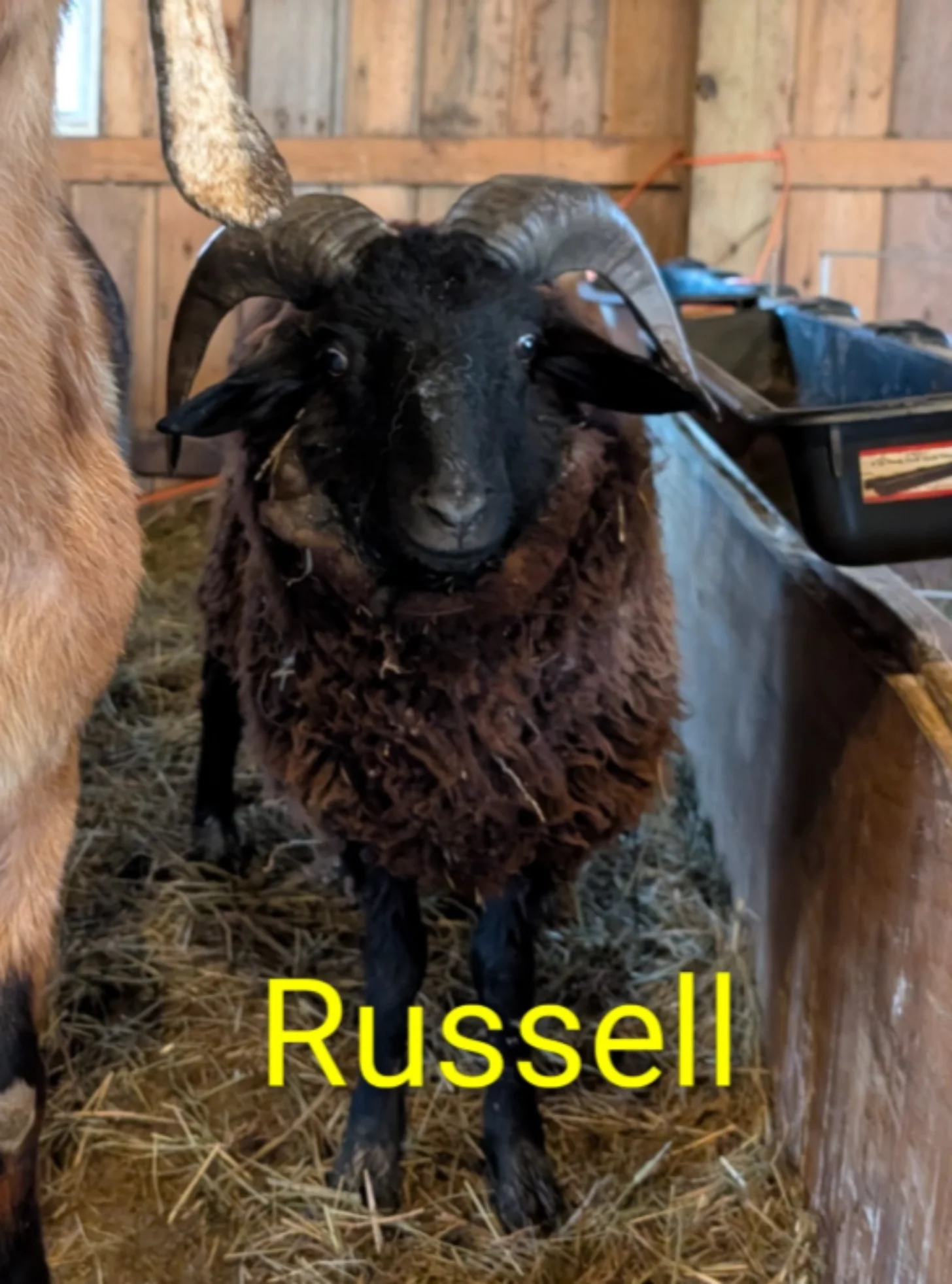
According to the Johnsons, Ramona had been hoping for a lamb for a while. She got a “kid” instead.
“She’s wanted to be a mom since the first couple months,” Bridget Johnson said. “We had goat babies the past seven years, and every year she tries to steal their babies.”

Goat-sheep hybrids, also known as “geeps,” are extraordinarily rare, and the possibility that Clara could be one sparked curiosity even beyond their town of Olmsted Falls.
“We want to solve this mystery not just for ourselves, but for all the friends, family, and neighbors who have followed Clara's journey,” Bridget Johnson wrote on her GoFundMe page.
“Texas A&M offers a specialized DNA test that checks chromosome levels to determine whether Clara is truly a geep or simply a sheep,” she explained. “The test is a significant expense for us, and while we love Clara regardless of her genetics and she will always have a happy home with us, the chance to uncover her true parentage would mean so much to everyone invested in her story.”
If Clara is a geep as suspected, it is remarkable that she made it past birth. Historically, most sheep-goat hybrids are almost always born stillborn, primarily due to a severe chromosomal mismatch between parents — as goats have 60 chromosomes and sheep have 54.
While geeps are extremely rare, they are not unheard of. In April 2022, a geep named Spring Rose was born on a Kentucky farm after a Nigerian Dwarf goat mated with a Babydoll sheep ram.

After DNA testing, Texas A&M confirmed that Spring Rose was a true goat-sheep hybrid — and a medical “miracle.”
“Even those that do make it to birth rarely live long. However, Spring Rose is thriving and growing well with 57 chromosomes. She shows all the signs of being able to live a long, healthy life,” Rebecca Sanderson, an expert in animal husbandry, reported in the Goat Journal
You may also like: This rescued sea turtle shocked scientists with its DNA results. After a 7-month recovery, he's returning to the ocean
Featured image: Bridget Johnson/GoFundMe
The Trump administration has rolled back teen pregnancy prevention grants and repurposed a program designed to reduce unintended pregnancies so that it promotes childbearing.
But several states, including Republican-led ones, have protected or expanded access to contraception in recent months.
Georgia Republican state Rep. Beth Camp sponsored a bill to expand contraceptive access in her state after her daughter faced a two-month delay renewing her birth control prescription.
The new law, passed in April and signed in May by Republican Gov. Brian Kemp, allows pharmacists to prescribe contraception methods such as birth control pills and shots directly to patients without a doctor’s signature.
Current Georgia law requires patients to receive a birth control prescription from a doctor, which they can then fill at a pharmacy. Camp has said the new policy could help increase access to contraception in areas with primary care provider shortages.
“In our state, we have such a challenge with access for medical professionals,” Camp told the House Health Committee earlier this year. “This is just really, to me, opening up a whole new stream of opportunities for women to be able to access contraception.”
In Maryland, Democratic Gov. Wes Moore in May signed a measure that requires public higher education institutions and community colleges to annually submit a report on contraception access to the Maryland Higher Education Commission.
It also requires the commission to submit a report on contraception access to the General Assembly and requires each community college to provide students with access to all methods of over-the-counter contraception.
Tennessee Republican Gov. Bill Lee in March signed into law a bipartisan bill that requires private health care plans to cover a yearlong supply of birth control. The state’s Medicaid program, TennCare, already provides a 12-month supply of birth control. The measure is set to take effect July 1, 2027.
And Democratic Virginia Gov. Abigail Spanberger in April signed a new law establishing the right to contraception and allowing people to sue if their rights are violated.
Spanberger also signed another law requiring health insurance companies to cover both prescription and over-the-counter contraceptives without cost-sharing. Both laws went into effect this month.
This article was written by Sofia Resnick and was originally published by Stateline.
Featured Image: Stock Catalog/Flickr (CC BY 2.0)
Madison Moore drove her car through the Tecumseh High School parking lot in New Carlisle, Ohio on Wednesday to get food boxes for her children.
“I love the variety that’s in there,” she said. “They like the apple crisps a lot. We don’t usually get those. We love the fresh fruit, and I love that we’re able to come here every week.”
The New Carlisle location is one of four weekly mobile routes Children’s Hunger Alliance has throughout Ohio this summer that distributes ready-to-eat meals for families to take home to their children. Each child can get a box.
The shelf stable meals include five days worth of breakfasts, dinners, milk, and snacks. The mobile routes also offer fruit bags with apples and oranges this summer.
“It is helpful because the girls like to snack a lot, and it is snacky food, but it’s also filling, and it’s healthy stuff for them, and they enjoy picking out what their meals are each day,” Moore said.
The New Carlisle mobile route goes from 10 a.m. to 11:30 a.m. on Wednesdays and about a dozen cars were lined up to receive their food boxes by 10 a.m. as the temperature was in the 80s, but the humidity was making it feel like it was in the 90s.
About 150 food boxes were distributed on Wednesday. Another 176 boxes were given out the week before, and 226 were passed out on June 17, said Diane Miller Ryan, Children’s Hunger Alliance director of community outreach.

The other mobile routes are in Coshocton on Tuesdays, Sabina on Wednesdays, and Troy on Thursdays.
The Troy site distributes at least 178 boxes a week, the Sabina site averages 75 boxes, and the Coschoton site gives out more than 100 boxes a week, Ryan said.
“During the summer — unless the kids are going to a summer camp or something like that, that actually serves the food — they don’t have any access to it, so this gives them access that they can get food and just help them, because everybody knows the price of food is outrageous now,” Ryan said.
More than 505,000, or 1 in 5, Ohio children struggle with hunger and summer is typically the hungriest time of the year for students who receive free or reduced school meals.
Nearly 29% of Ohio students participated in the school breakfast program and 57.3% of students participated in the school lunch program during the 2024-25 school year, according to the Ohio Department of Education and Workforce.
“During the school year, more than 900,000 children across Ohio count on the stability of a healthy meal at school each day, but when summer arrives, that dependable source of nutrition disappears,” Children’s Hunger Alliance President and CEO Michelle M. Brown said in a statement.
“For many families, that means stretching tight budgets even further, while often scrambling for affordable childcare or summer camps.”
Romy Wilson picks up food boxes at the New Carlisle site every week this summer.
“It’s a big help,” she said.
Beth Thomas picked up three boxes on Wednesday.
“The kids really enjoy them,” she said.
Samantha Kennedy said her kids, 11 and 8, like the snacks and the milk.
“I love that it gives my kids the ability to grab lunch on their own,” she said.
“It’s wonderful that I don’t have to answer the question, ‘what’s for lunch?’ It also gives them some self-confidence to be able to get their own food.”
Shawna Vanmeter said her kids like seeing what they get every week.
“Their favorite thing is probably the beef sticks and the juices,” she said.
One woman expressed her appreciation for the boxes and her kids said it’s like Christmas.
The New Carlisle boxes include Cinnamon Toast Crunch, Cocoa Puffs, waffles, chocolate milk, a turkey stick, fruit juice, Cheerios, a beef teriyaki stick, a pepperoni stick, and pepperoni pizza crackers.
“It looks like a lot of snacky things, but it’s whole grain crackers, or meat sticks,” Ryan said.
“It’s stuff that kids will eat. The big thing is you have to get kids to eat things, so we try to make it as healthy as possible.”
Children’s Hunger Alliance has about 145 summer meal sites statewide that provide food for children that are sponsored through the USDA’s Summer Food Service Program.
This article was written by Megan Henry and was originally published by Ohio Capital Journal.
Featured Image: Megan Henry/Ohio Capital Journal
Over the next few months, the San Gabriel Valley Mosquito and Vector Control District will release more than 480,000 mosquitoes in the San Gabriel Valley of Southern California.
In an era of spotted lanternfly invasions and “killer bees,” it’s understandable that news like that might spark fear in the public. But it’s actually a good thing that the public health department is releasing nearly half a million mosquitoes — because the plan will decimate the local mosquito population.
The pests in question are male mosquitoes, which are entirely harmless. Unlike their female counterparts, which draw blood, male mosquitoes subsist on plant nectar.
“Female mosquitoes are the only ones that bite us,” Anais Medina Diaz, San Gabriel Valley MVCD’s director of communications, told KNX News. “They need our blood to produce more eggs and more mosquitoes. Male mosquitoes do not bite, and they cannot transmit diseases.”
Every week, between now and October, the San Gabriel Valley MVCD will release 30,000 sterile male mosquitoes to stave off the Aedes aegypti, or yellow fever mosquito.

The invasive pest — which landed in Southern California more than a decade ago — carries and spreads dengue, Zika, and other mosquito-borne diseases.
Although their transmission rate historically trends low, the yellow fever mosquito is particularly hard to kill because they lay drought-resistant eggs that can survive on very little water.
Fortunately, by mating with the sterile male mosquitoes, their eggs won’t hatch at all.
The sterile insect technique, or SIT, is a globally adopted public health strategy that has successfully eliminated regional pest populations of fruit flies and screwworms over the last 70 years.
Tristan Hallum, director of scientific programs at the agency, told KCRW News that some invasive mosquito populations have dropped by as much as 90% thanks to SIT.
Hallum said the goal is for them to “find some of these wild-type Aedes aegypti females, mate with them, and then the ensuing progeny ends up becoming sterile.”
Although there may be a short-term uptick in mosquitoes in the San Gabriel Valley in the coming weeks, Hallum urged people not to panic.
“While residents may visually see more mosquitoes in the area, Aedes mosquito biting pressure will gradually reduce over time,” Hallum said in a press release. “This program is species-specific and will not affect humans, pets, wildlife, or other insects, like bees or butterflies.”
You may also like: Bull sharks are big, aggressive predators — but they can still make friends, according to new research
Featured image: Courtesy of the San Gabriel Valley Mosquito and Vector Control District
Now that Idaho’s transgender bathroom ban is the law, transgender Idahoans are navigating how to safely use the bathroom in public.
Preparing for the ban, Trans Affirm, a nonprofit that advocates for trans people in Idaho, crowd-sourced an online map of inclusive bathrooms across Idaho that it says are safe for people who are trans or gender diverse to use.
The list — developed through hundreds of community-submitted ideas — is made up of largely gender-neutral private bathrooms, said Scar Rulien, a board member for the nonprofit. He said creating that map was the first thing that came to mind after the bill passed the Idaho Legislature this spring.
“It is already a confusing law as it is. And it can be scary for transgender people, who identify as one gender, to use the bathroom that is of the gender that they don’t identify as,” Rulien said in an interview.
“Especially if they are actively transitioning and look like the gender that they identify as, it can pose a risk to their safety.”
For now, Rulien said he tells people to use gender-neutral restrooms for their safety “if they feel most comfortable with it.”
But the actual text of the criminal law isn’t the final say.
A federal judge temporarily blocked parts of the law, ruling it “invites arbitrary and discriminatory enforcement.” The block essentially allows transgender people to use single-user restrooms that align with their gender identity, or to use a multi-stall bathroom when a single-user facility isn’t available on the same floor.
More than a week into the law being in effect, it remains unclear how law enforcement officers will enforce the law.
How the judge’s partial block of the bathroom ban works
The law, passed this year through House Bill 752, creates criminal charges for people who “knowingly and willfully” enter a bathroom or changing room designated for the opposite sex, with some exceptions. The law applies in government-owned buildings and private businesses.
A first offense carries a misdemeanor, punishable by up to one year in prison. A second offense within five years is a felony, punishable by up to five years in prison.
The partial block of the law — issued last month by U.S. District Court Judge Amanda K. Brailsford — came in response to a lawsuit brought by the American Civil Liberties Union, or ACLU.
The judge’s partial block only affects the law’s application in bathrooms, not changing rooms. It applies in places affected by the law: places of public accommodations, a legal category that includes private businesses, and government-owned buildings.
The ACLU of Idaho’s website says the block means: “Trans people in Idaho will be able to use single-user restrooms consistent with their gender identity and multi-user restrooms when a single-user restroom is not available [including when it is occupied].”
But Rulien said the partial block falls short of fully addressing trans people’s needs in Idaho, hoping that the entire bill gets overturned.
“It’s sort of a Band-Aid on a bullet hole-type situation,” he said. “… This is great, and it’ll definitely help a lot of people. But it’s not exactly the help that will be life-saving, or exactly the help that we need in this current moment.”
To him, the partial block raises more questions about how the law will be enforced: How do you enforce the law if a trans person uses a multi-occupancy restroom without knowing there’s a single-user restroom on the same floor?
“How are you going to prove that they didn’t know? How are you going to prove that the bathrooms weren’t in use? Are we really going to get down to the nitty gritty already? And you’re looking at cameras to figure this out?” he said.
The ACLU says that Idaho’s bathroom ban is the only state ban that extends to private businesses — and that Idaho’s ban has the steepest penalties out of the three states that have criminal bathroom bans.
‘We’re a political scapegoat’
The bathroom ban is one of the latest in a series of anti-trans laws passed by the Idaho Legislature in recent years. Last month, the U.S. Supreme Court upheld Idaho’s 2020 law that bans trans women and girls from competing in sports that align with their gender identity.
The bathroom ban has also pushed some to plan to move out of Idaho, including a Boise family of medical professionals that raised their trans daughter in Idaho and one of the trans Idahoans suing over the law.
In the Legislature, some transgender people told lawmakers that the bill will force them to risk their safety by going into bathrooms with people that they don’t look like.
Preston Pace, who co-founded Trans Joy Boise, a separate trans advocacy group, said that five years ago, they didn’t think trans people would be “navigating anything like this.”
“It’s really scary. It’s discouraging how easily people just accepted the anti-trans rhetoric and anti-trans campaign,” Pace said in an interview. “… We’re a political scapegoat. And seeing people just accept it without any research, without knowing any trans or queer people, is really disheartening.”
The bathroom law expands on other bathroom bans Idaho has enacted. Idaho’s 2023 trans bathroom ban in public schools took full effect two months ago after a high school group challenging the law dropped its lawsuit — after a trans student who was part of the group died by suicide.
Pace said their group is focused on educating people on the law to figure out their safest options for public restrooms. They said now is not the right time to try to “take a stand.”
“It’s just too dangerous right now. Because on top of criminal charges, we’re already seeing nationwide instances of aggression and violence in public restrooms, with the public taking on the responsibility of policing these bans,” Pace said.
A 2025 study by the UCLA’s School of Law’s Williams Institute found there was no evidence that people face more harm if transgender people are allowed to use bathrooms that align with their gender identity.
But when trans people are refused access to facilities that align with their gender identity, the study found that trans people report verbal harassment and physical assault.
The growing influence of anti-trans sentiments has also changed Pace’s career goals.
On the same day that President Donald Trump was inaugurated on Jan. 20, 2025, he signed an executive order recognizing two sexes: male and female.
That same day, Pace said he went out and bought a guide to study for the LSAT, a test used for law school admissions.
He started law school earlier this year.
This article was written by Kyle Pfannenstiel and was originally published by Idaho Capital Sun.
Featured Image: Kyle Pfannenstiel/Idaho Capital Sun
In January, a loggerhead sea turtle was found “lifeless” on a beach in Jersey, a town about 85 miles south of England, by a local dog-walker.
While it’s unclear where the turtle originated, it’s believed to have landed on the beach following Storm Goretti, an extratropical cyclone that descended upon Western Europe.
Veterinarians jumped to action once they discovered the turtle was malnourished and cold-stunned, a hypothermia-like condition that causes the animal’s body to shut down. She was originally cared for by New Era Veterinary Hospital in Jersey, even spending two weeks in the family home of the clinic’s director, Peter Hawarth.
The care team named her Crush, after the beloved “Finding Nemo” character. They also aren’t completely sure she’s a female, but Crush has a longer tail like other female loggerheads, so that’s how she’s been referred to.
Soon, however, it became clear she needed more specialized care, so Hawarth flew the turtle to Southampton, carrying her in a box.
“[We are] so proud to be part of Crush’s journey to recovery,” Jersey Airport shared on social media on February 10. “This morning, she took to the skies with Loganair and is now safely at Weymouth Sea Life Centre — one step closer to returning home to the ocean.”
Once Crush made it to the Sea Life Weymouth center, an aquarium and conservation hub in Weymouth, United Kingdom, she was cared for alongside other rescued turtles.

“Since arriving at Sea Life Weymouth, Crush has undergone CT scans, regular blood tests, ongoing veterinary assessments, and a carefully managed diet to rebuild strength and regain a healthy weight,” Sea Life Weymouth recently shared on Facebook.
And now, nearly six months after being found washed ashore, Crush has been given the all-clear to be released back into the ocean.
“Our specialist animal care team and veterinary experts have finally signed off on getting Crush back to warmer waters and into the wild,” Sea Life manager Seb Webster told the BBC.
“Crush is in our quarantine facility at the moment because it's just a matter of weeks, we think. We are hoping … by the end of July.”
Crush will be released into warmer waters off the coast of the Azores, a group of islands near Portugal.

Sea Life Weymouth is now working with conservation partners to make the final preparations — including arranging Crush’s second time in an airplane — to ensure she has the “best possible chance of thriving back in the wild.”
According to Webster, Crush will spend some time in a specialized facility in the Azores after landing to make sure all is well. Then, another member of their team will be there to help release Crush when she gets another all-clear.
“We are incredibly proud of our team for their dedication and care to Crush's recovery,” Sea Life Weymouth concluded in a social media post.
“Thank you also to the hundreds of well-wishes from supporters around the world who have been following Crush's story.”
You may also like: Jet ski riders conduct rescue mission for sea turtle with 'bloody, peeling' infection on her shell
Featured Image: Sea Life Weymouth/Facebook
As the threat of artificial intelligence growing to replace human workers reaches a fever pitch, one robot-run cafe in Tokyo stands as a reminder of how technology can be used for good.
Dawn Avatar Robot Cafe is full of human diners enjoying tasty meals — and robots with green light-up eyes serving them. But the robots aren’t controlled by AI or some other computer programming. They are operated by disabled workers who are clocking in from home.

It all started when Ory Yoshifuji was a child, quarantined at home for three and a half years with an illness that kept him from attending school or hanging out with friends.
“I wondered,” Yoshifuji told the Australian Broadcasting Corporation, “‘Why couldn't I have a second body?’”
He went on to recover and study robotics in college, starting his company, Ory Laboratory, and creating the remote-control OriHime robot. After a few pop-up cafe experiments, he opened a permanent location.
“We’ve managed to create a situation where people, even if they can’t physically move around much, can still participate as members of society and as productive members of the workforce,” he told the ABC.
The workers — of which there are about 100 now — are called pilots. They work from their home computers, where they can move around the cafe through a remote control and speak to customers directly.

“Every word, every head tilt, every order taken — that’s a real human controlling them in real time,” Evie Parker, a tech enthusiast influencer, shared from the cafe in a recent vlog.
“The pilots of these robots are people with ALS, spinal cord injuries … conditions that keep them home. And this lets them work, earn paychecks, talk to strangers, have a normal everyday shift.”
Of course, a person’s value is not dependent on whether they can work or contribute to the economy. But OriHome robots allow people who do want to engage with the world in this way to do so safely and with autonomy.
One pilot, Naoki, has severe heart failure and is awaiting a heart transplant. He was told he had to stop working.
“I retreated into my shell,” he said in a video.
But then, he found his purpose again at Dawn Cafe.
“My first impression was that I am able to return to society,” Naoki said. “Now that I work like this, the joy of it is more prominent. I enjoy my days together with the customers. The way I feel … has changed completely. It’s like my feelings have been transplanted.”
Yoshifuji opened the Dawn Cafe in 2021, and has since expanded the OriHome offerings to include a mobile robot that guests can take with them to carry around Tokyo for a personalized tour of the area.

“What I loved about having our tour guide right on our shoulder is I feel like it was really flexible,” Canadian tourist Andrea Wheaton told the ABC.
“You can hear the warmth through their voice and some giggles on their end,” her husband, Dave Schultz, added.
Parker, the tech influencer, also shared that she had a great time with her OriHome pilot.
“I had a great meal, and I met a new friend, Maya, who was the pilot of my robot,” Parker said in her vlog. “We talked the whole time while I had lunch.”

While emerging technology certainly comes with valid concerns, Parker emphasized that it can also be used to help people and create solutions.
“The truth is, robots aren’t the scary part,” she concluded. “The real question is, what will we build them for?”
You may also like: This teen invented an autonomous 'sea turtle robot' to monitor coral reefs. He just won an award from the EU
Featured Image: Courtesy of Dawn Avatar Robot Cafe
In early June, a U.S. Coast Guard vessel spotted a loggerhead sea turtle struggling in Florida waters. After they hauled the 150-pound sea turtle aboard, they realized that she was tethered to an abandoned anchor, which had wrapped itself tightly around her right front flipper.
The endangered loggerhead, later named Hope, was immediately taken to The Turtle Hospital in Marathon, Florida — a veterinary hospital and rehabilitation center for sea turtles.
“Upon arrival at our turtle hospital, Hope received emergency medical care, including a full physical exam, bloodwork, weight and measurements, and treatment for her injured flipper,” The Turtle Hospital posted on Facebook on June 7.
“Our veterinary team carefully removed the entangling line, cleaned the wound, and bandaged the area to begin the healing process.”

“Despite everything she’s been through, Hope has shown us just how strong she is,” the post continued. “She’s been feisty, alert, and full of fight throughout her treatments — a promising sign as she begins her rehabilitation journey.”
On June 10, Hope’s health was still in dire straits. The Turtle Hospital veterinary staff realized that needed to remove her front right flipper to save her life.
“Due to the severity of the line entanglement injury to her front flipper, amputation is the best option to give her a chance at a healthy future,” the center explained in a Facebook update.
@turtlehospital Meet Hope ❤️🩹 Hope is a 150-pound loggerhead sea turtle who was rescued with the assistance of the U.S. Coast Guard after being found with a severe line entanglement injury to her front flipper. Upon arrival at our turtle hospital, Hope received emergency medical care, including a full physical exam, bloodwork, weight and measurements, and treatment for her injured flipper. Our veterinary team carefully removed the entangling line, cleaned the wound, and bandaged the area to begin the healing process. Despite everything she’s been through, Hope has shown us just how strong she is. She’s been feisty, alert, and full of fight throughout her treatments - a promising sign as she begins her rehabilitation journey. We’ll be monitoring her closely in the days ahead and providing the specialized care she needs to recover. Stay tuned this week for more updates on Hope’s progress as we learn more about her injury and continue her treatment 🐢💚 #SeaTurtleHospital #Loggerhead #SeaTurtleRescue #WildlifeRehabilitation #ProtectSeaTurtles @TurtleBette ♬ Inspiring Cinematic Piano - Veaceslav Draganov - Royalty Free Music Licensing
“Hope has shown incredible resilience since arriving at our hospital. Despite everything she’s endured, she continues to fight with the same feisty spirit that inspired her name.”
Throughout her healing process, Hope struggled to eat, with no signs of appetite — even when they dangled a meaty lobster tail over her tank.
Fortunately, after a steady intake of fluids and a “specialized diet,” Hope woke up hungry one day.
“Hope is eating again!” The Turtle Hospital said in a June 17 update. “After showing interest in food but refusing to take a bite, Hope finally decided it was time for lunch. Today’s menu: six squid [and] two mackerel.”
“This is a huge step forward in her recovery, and we’re feeling hopeful about her progress,” they added. “Keep cheering her on!”
After her amputation, the base of Hope’s flipper was also covered in a “medical honey wrap.”
“While it sounds like a sweet treat, honey is actually a scientific powerhouse for wound care,” The Turtle Hospital staff shared on Facebook on June 24. “Its high sugar content pulls water right out of bacteria cells (osmosis!), making it impossible for germs to survive.”
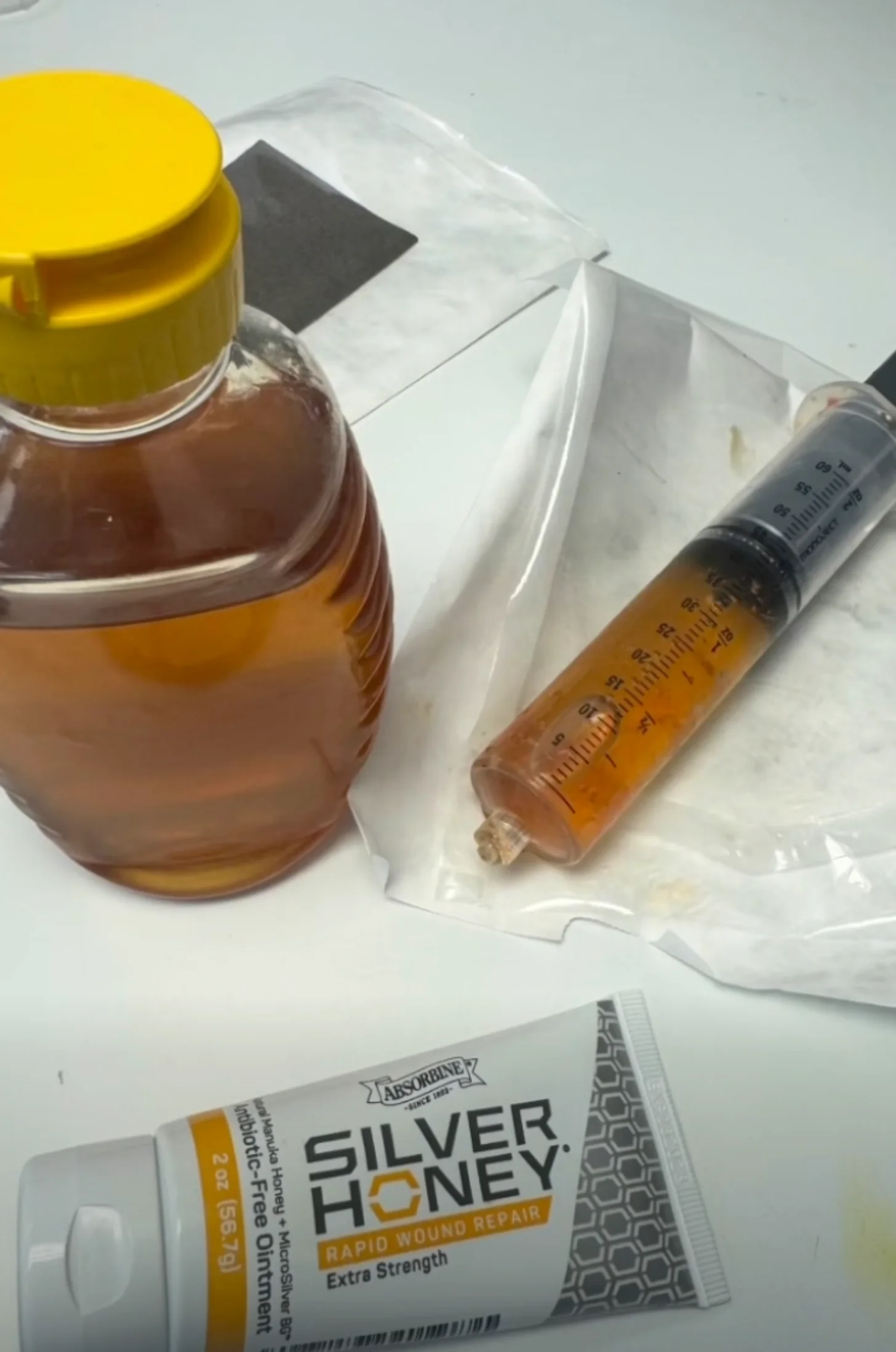
On July 3, The Turtle Hospital gave Hope a “spa day.”
“It was time for a wound bandage change, and let’s just say… Hope was feeling a little feisty!” The center shared, alongside a video of Hope wiggling her flippers as she was lifted out of a tank and scrubbed with small brushes. “That’s okay though — we’ll happily take a little turtle attitude.”

After a perilous month, The Turtle Hospital thanked everyone who had followed Hope’s journey online and purchased specialized “Hope” stickers on their store to support her medical care.
“She’s continuing to make progress, eating well, and healing with each passing day,” the center said.
“While we’re still monitoring her condition closely, we’re encouraged by how far she’s come and are so grateful to everyone following along and cheering her on.”

You may also like: Fishermen save 220-pound loggerhead sea turtle from strangling ropes
Featured Image: The Turtle Hospital/Facebook
Every day the Good Good Good team collects the best good news in the world and shares it with our community. Here are the highlights for this week!
If you want to get good news in your inbox every day, join the Goodnewsletter — the free daily newsletter designed to leave you feeling hopeful.
The Best Positive News We’re Celebrating This Week —
U.S. murder rate approaches a record low
As the nation celebrates its 250th anniversary, the United States is on track for its lowest recorded murder rate since the FBI began collecting comparable data in 1960.
According to early data from crime analyst Jeff Asher, who pooled data from about 600 police agencies, murders dropped 18.7% in the first four months of this year compared to the same period last year. Additionally, all violent crime has dropped 6.4%.
Even better: This drop comes after a brief spike during the COVID-19 pandemic, a trend that has since reversed dramatically. Officials point to a combination of factors for the decline, including community-based violence intervention programs and improved emergency medical care.
→ Read more
This giant snail is the size of a croissant. Conservationists are banding together to save it from extinction
→ Read more
Electric vehicle sales are growing much faster than expected worldwide
In six years, sales of electric vehicles have risen tenfold, with around 21 million EVs sold worldwide in 2025 alone, representing 25% of new car sales — that figure was just 1% in 2019.
By May of this year, 63% of new cars sold were EVs, and of the 1.4 billion cars currently on the road, 85 million are electric.
While China and Europe are leading the way for EV sales, it’s growing rapidly in other parts of the world, too, though has been relatively stagnant in the United States. These statistics do not factor in hybrid-electric vehicles.
Experts say tiny Antarctic sea creatures could be the key to treating melanoma
Researchers from the University of South Florida may have taken an important step toward a more targeted treatment for melanoma, the deadliest form of skin cancer.
By studying tiny Antarctic sea squirts, the team of scientists found that the bacteria living inside them produce toxins that can destroy melanoma cells in mice. Even more promising, the toxins did not appear to harm the animals, suggesting they may be selective rather than broadly toxic.
A recent six-week expedition led to a fresh crop of sea squirt specimens, giving researchers the material they need to better understand the bacteria and accelerate future stages of the research.
Why is this good news? Cancer research often advances through incremental discoveries. Even if the Antarctic sea squirts don’t lead to an approved medicine, they are still helping scientists better understand new ways to effectively fight cancer.
→ Read more
Switzerland has turned its train tracks into solar power plants
The ‘green’ economy just surpassed $10 trillion in market value
Companies that derive a significant portion of profits from environmental solutions make up what’s known as the “green economy,” and a new report found that they just topped $10 trillion in market value.
The milestone came after 5.3% growth last year. For the past decade, green companies have outperformed the overall market by around 12%.
It also comes despite the United States' retreat from investing in climate solutions and amid global volatility, demonstrating the resilience of the technology and industry overall.
Mayor Mamdani announces New York City’s first city-funded pet food pantry
On June 30, the Mamdani administration and the New York City Council announced their agreement on the 2027 fiscal budget.
Along with things like a $54 million increase to fund a Fair Fares expansion for public transit, $175 million allocated to expand housing vouchers, and an additional $79.1 million set aside to restore funding for parks, libraries, and cultural institutions, one line item stood out:
$750,000 will be allocated to launch New York City government’s first-ever pet food pantry pilot program.
Why is this good news? People who need assistance affording their own groceries may also need support getting food for their beloved pets, and this initiative recognizes the importance of caring for the city’s pets. This government program also supports existing food pantries and pet clinics.
“I spent 6 months reading hundreds of poems written by teens. I was shocked to discover that they are full of hope”
→ Read more
A report found that access to free naloxone has prevented 4 out of 5 potentially fatal overdoses in British Columbia
It’s been a decade since the Canadian province of British Columbia declared the opioid crisis a public health emergency, and thousands of people have since tragically died.
According to a new study, thousands more could have died if not for one harm reduction effort: providing free, take-home naloxone services, which it estimates prevented between 76% and 80% of potential deaths due to opioid poisoning.
The progress is thanks to the teams located across the province working to make the lifesaving “opioid antagonist” more accessible.
In a breakthrough for fighting MS, researchers found a way to identify previously undetectable brain lesions
Amid other symptoms, one hallmark of multiple sclerosis is lesions and scarring it leaves on a patient’s brain and spinal cord. Researchers have long known that damage specifically to the brain’s grey matter is a key driver of the disease’s progression.
But until now, MRI scans used to monitor patients with MS have only been able to detect lesions in the brain’s white matter, so treatment options have been solely focused on those lesions.
With the help of AI, scientists at the University of Buffalo have now found a way to reveal grey matter lesions, too, in a significant breakthrough for treating the disease.
Why is this good news? MS impacts around three million people globally, including one million people in the U.S. alone. While there is no cure for it, treatments can help slow progression of the disease — this breakthrough will help improve those treatments.
This champion soccer team teaches fans about climate change and DEI. They’ve sold out every game
→ Read more
A former Royal Marine rescued 194 animals from the front lines of the Ukraine war
Paul “Pen” Farthing, from Dovercourt, Essex is a former Royal Marine who toured Afghanistan as a commando between 2006 and 2007.
During his tour, Farthing established the Nowzad charity in Kabul to care for animals suffering the fallout of war, returning to Afghanistan in 2021 when he extracted 67 people and roughly 150 animals from the war-torn region.
This April, as Russian troops advanced upon the city of Kramatorsk, Farthing shifted his focus to Ukraine.
Across two daring rescue operations, he racked up more than 15,000 miles as he rescued dogs, cats, and farm animals from the front lines. Across the two missions, he rescued 194 animals. Of his many rescue missions, Farthing says animals in a cargo “never got in the way of people getting on a flight.”
California is returning a stretch of coastline that is sacred to Indigenous tribes
The state of California is transferring 136 acres of coastline in Mendocino County to Indigenous nations whose ancestors stewarded the area.
The land will be transferred to Kai Poma, a nonprofit founded by representatives of three Indigenous nations, the first time land managed by Caltrans has been returned to Indigenous tribes.
California first purchased the land in the 1960s to expand Highway 1 construction and create a scenic viewpoint for travelers. One Indigenous representative said the transfer was “beyond huge.”
Why is this good news? Public access to the area has been unregulated, with large groups coming to camp and party on the beach, driving through sensitive areas, and damaging cultural sites. The Indigenous groups will now have more control over protecting the sacred area.
→ Read more (May require login)
The NYC church where Alexander Hamilton is buried is building 120 affordable apartments
→ Read more
New data shows an increase in the population of West Africa’s most endangered predator
With only 354 individuals left in all of West Africa, the West African leopard is critically endangered. After decades of decline and threats on all sides — from poachers, retaliatory killings, and habitat loss — it appears that the tide is finally turning in the species’ favor.
In a new study, researchers working in Benin’s Pendjari National Park reported promising news for West African leopards, who live alongside 90% of the region’s remaining forest elephants and the last known population of Northwest African cheetahs.
After restoring the habitat, managing key water sources in the park, and bolstering natural prey populations, the researchers saw a clear uptick in the leopard population density.
→ Read more
More good news of the week —
Michigan lawmakers unanimously passed a bill to let children run lemonade stands without permits or fees. Under the new law, minors can make up to $5,000 a year with their temporary food stands.
Tens of thousands of free toothbrushes and tubes of toothpaste will be given out to children in Liverpool to tackle tooth decay. Tooth decay “is a disease of inequality” and this is part of a five-year government plan to tackle the problem nationally by donating kits to under-resourced areas in England.
Billionaire philanthropist Mackenzie Scott’s philanthropy on the African continent has now surpassed $1.5 billion. Scott’s funding in Africa increased in 2025, and now rivals the annual budgets of some of the world’s largest development banks for investment on the continent.
An ocean conference garnered 320 new commitments worth $6.4 billion to invest in ocean conservation, climate resilience, and more. More than 100 governments, businesses, and civil society organisations announced the commitments before an audience of more than 5,000 participants at the 11th Our Ocean Conference, hosted for the first time on the African continent.
Nine white rhino females were transported to Mozambique’s Zinave National Park, rounding out the first viable white rhino breeding population in decades. Conservationists say the growing population could help restore rhinos to other parks across Mozambique after a century of decline.
Church members are coming together to wipe out medical debt for their neighbors in Winston-Salem, North Carolina. Since the Trinity Moravian Church congregation began its Debt Jubilee Project in 2002, they have relieved more than $2.2 million in debt.
After the Oregon Department of Fish and Wildlife noticed that porcupines were disappearing, libraries stepped in to lend a hand. Central Oregon public libraries are loaning trail cameras out to locals so they can help record sightings across the state.
Utah, Virginia, Idaho, and Oregon just passed legislation that bolsters state transportation budgets to build more wildlife crossings. The crossings are seeing strong bipartisan support across the country, with lawmakers from both parties championing their development.
A new study of tens of thousands of patients found that eye retina photographs can help predict Alzheimer’s disease risk. Routine retinal photos are already common in eye exams and offer a low-cost, objective way to spot at-risk patients earlier, when lifestyle changes or treatments may still have an impact.
A universal basic food program in Colorado is taking a new approach to fighting food insecurity and hunger. A year-long pilot provided no-cost groceries to people in Denver and Del Norte, aiming to help people struggling to make ends meet — even if they aren’t eligible for SNAP.
A Native American boarding school founded in 1890 has gone from a symbol of forced assimilation to a place where Native traditions are celebrated and preserved. Today, New Mexico's Santa Fe Indian School offers classes in traditional art, craftsmanship, architecture, and 11 Indigenous languages.
Engineers developed a jacket that captures and stores drinking water from the air. In search of a solution that moves with the person, their fabric draws moisture from the air as the wearer moves, a kind of water harvesting that once needed a standalone machine.
Researchers created the world’s first global marine turtle DNA database to fight illegal sea turtle trade worldwide. Called “ShellBank,” the database enables scientists to extract DNA from turtle shells, eggs, meat, and other products, helping identify where trafficked turtles originated and which populations are most at risk.
A baobab-inspired floating waterfall power plant concept aims to provide clean energy to Madagascar. The island is rich in natural resources and unique biodiversity, yet severe energy shortages leave the vast majority of the population without electricity, leading to economic hardship and rising crime rates.
Chinese scientists have discovered over 50 green sea turtles, a national first-class protected species, in the seagrass beds of a nature reserve. While green sea turtles are no longer endangered globally, the finding highlights the positive impact of conservation efforts in protecting the marine ecosystem and its rare wildlife resources.
Tsunami, the rescue dog, has saved at least 13 people buried by the Venezuela earthquakes. One of the survivors rescued by the border collie included a 60-year-old man who had been trapped under rubble for six days.
A new U.K. policy marks the most significant investment in English agriculture since World War II. The 25-year plan doubles government investment in agricultural innovations like soil health monitoring, nutrient cycling, climate resilience, and robotics.
An international team of scientists discovered ancient human DNA on a cave wall in Portugal. The new study found that cave art can preserve the genetic traces of people who touched, painted, and interacted with the walls thousands of years ago.
Churches across New York City are turning their unused parking lots into places for affordable housing. Part of a larger, nationwide “Yes In God’s Backyard” movement, one proposal in the city would replace existing church buildings and open space with roughly 800 income-restricted homes.
Australian fishermen saved a 220-pound loggerhead sea turtle from strangling in ropes. The ropes were connected to barnacle-covered buoys, and it was unclear how long the sea turtle had been struggling in the abandoned fishing gear, also known as “ghost gear.”
Music streaming platform TIDAL prevents fully AI-generated music from making money on its platform. TIDAL says it is also using automated tools to remove AI-generated music that attempts to impersonate an artist or a group.
North Carolina just voted to protect animals in the Great Smoky Mountains with a historic $10.2 million investment in wildlife crossings. Advocates say it will “improve safety for both people and wildlife” across the area.
For the past 10 years, England national team players have donated their World Cup match appearance fees to charity. The effort has raised approximately £15 million since it first started, which has been distributed to charity partners like UNICEF, Help for Heroes, and the Bobby Moore Fund.
A mystery donation to a Santa Rosa thrift store turned out to be a quilt handmade in New Jersey in 1888. Realizing its historical significance, the shop sent it to the Hoboken Historical Museum in hopes that the maker’s descendants would see it.
A new solar power breakthrough in China could make desalinated seawater cheaper than bottled water. The technology decreases the energy consumption for solar thermal evaporation by nearly 50%.
A team of Los Angeles County first responders returned after helping with recovery efforts in Venezuela. Seventy-one members and six K-9 teams are back home after spending 11 days in Venezuela, sifting through debris and searching for survivors.
Against all odds, zookeepers in Cuba are celebrating the birth of endangered Bengal tiger babies. The Cuban National Zoo welcomed four tiger cubs, a small miracle on an island stifled by shortages of fuel, medicine, and days-long power outages.
A five-month-old bear cub was recently found severely injured and abandoned in the buffer zone of Bandhavgarh Tiger Reserve of Madhya Pradesh, an area in Bandhavgarh National Park in north east India.
The conservation reserve is home to many white tigers, leopards, and deer. An abandoned bear cub would quickly become prey.
The cub was identified to be a female sloth bear, also known as the Indian bear, a species native to India that feeds on fruits, ants, and termites.

Listed as vulnerable on the International Union for Conservation of Nature’s Red List, the species is at risk due to habitat loss and degradation.
But this cub was especially in trouble because she was separated from her mother.
Found in a weakened condition by members of the state Forest Department, the cub was quickly assessed as severely dehydrated, anemic, and underweight. She was also unable to walk properly due to an injury on her left hind leg.
Officials transported the bear to Wildlife SOS’s Van Vihar Bear Rescue Facility in Bhopal, the capital city of Madhya Pradesh.
Here, they called her Luna.

“When an injured cub is left alone in the wild, every passing hour is critical,” Kartick Satyanarayan, co-founder and CEO of Wildlife SOS, said in a statement.
Wildlife SOS is a nonprofit established in India in 1995, designed to rescue and rehabilitate wildlife in distress, while also working to combat illegal wildlife trade and human-wildlife conflict.
“Luna’s rescue demonstrates what is possible when prompt action, veterinary expertise, and close collaboration with the forest department come together,” Satyanarayan continued.
“Every successful rescue reinforces our commitment to protecting India's wildlife and ensuring that animals in distress receive the urgent care they need.”
Now under expert veterinary care, Luna is being treated for an old hairline fracture near her left hip, which indicates that she had suffered significant trauma before her rescue, believed to be from a fall in the wild.
The bear cub also had a wound on one of the toes on her left paw, a damaged claw, and an ulcer on the footpad, making it hard for her to walk. Now, the wound is cleaned and dressed regularly, and she is responding well to care.
“With age on her side, the cub has shown encouraging signs of healing,” an update about Luna on Wildlife SOS’s website reads. “Although naturally wary of people, she is beginning to form a trusting bond with her caregiver, who brings to her lots of honey-laden treats!”

A press release from Wildlife SOS shared that she is now eating well, gaining weight, and “gradually regaining her playful nature.”
These are all encouraging signs for her recovery.
“Young wild animals deserve the chance to heal in a safe and nurturing environment,” Geeta Seshamani, co-founder and secretary of Wildlife SOS, said in a statement.
“It is heartening to see Luna gradually regain her confidence and playful spirit, reminding us why every rescue matters.”

While it’s unclear if Luna will be released back into the wild, veterinarians are optimistic that she will make a full recovery.
“Ensuring the survival of this young cub was our foremost priority,” Shri Vijay Kumar, IFS director at Van Vihar National Park, said.
“The Van Vihar veterinarians are jointly working with Wildlife SOS expert veterinary team at Van Vihar Bear Rescue Facility [to provide] the specialized treatment and long-term rehabilitation for the bear cub. We look forward to seeing her make a full recovery.”
You may also like: Firefighters free raccoon trapped under sewer grate in 'jaws of life' rescue mission
Featured Image: Wildlife SOS/Facebook
Morgantown, West Virginia, has taken a step away from park benches and other equipment designed to discourage unhoused people and others from resting or lying down.
Morgantown City Council voted 5-2 on Tuesday to approve a resolution that prohibits the city from installing “hostile architecture” in public infrastructure, including new projects, repairs, and replacements.
The National Coalition for the Homeless defines hostile architecture as “urban-design strategy that utilizes elements of the built environment to intentionally guide or restrict behavior deemed undesirable by urban leaders.”
It can include slanted benches or uneven pavement that make it difficult for homeless people to sleep on, spikes in doorways or in windowsills that prevent people from sitting or lying down, locked benches and sprinklers.
Morgantown’s resolution defines the term as “physical design features installed on public infrastructure primarily intended to deter people from resting, sitting, lying down, or remaining in a particular area, when such features operate as a deterrent through discomfort, exclusion, or restriction rather than through legitimate safety, security, or operational necessity.”
Brian Butcher, one of three council members who sponsored the resolution, said it’s something that he’d been thinking about since he was elected. The issue was highlighted recently when the city installed a small bench with a divider in the middle in a city green space, he said.
“It’s a pretty small bench, but still has a divider,” Butcher told West Virginia Watch Wednesday. “I don’t think you could even lay down on it as a full-grown man, but it still has a divider at the center, right? And I was just like, ‘That is so silly.’”
Morgantown’s resolution doesn’t require the city to replace every piece of “hostile architecture,” but contemplates the city replacing equipment as needed with pieces that are not hostile, Butcher said.
A preliminary inventory found the city has around 15 park benches that are considered hostile, the Mountain Line Transit Authority has 18 to 20, and the Morgantown Board of Parks and Recreation has three. The preliminary audit focused on park benches because other types may be more difficult to identify, he said.
“We don’t have just straight up spikes on concrete surfaces… but there probably are places where we have planters and stuff like that that disallow you to sit down,” Butcher said. “But I’m not immediately aware of them. They don’t stick out as much, so it was kind of the low-hanging fruit that was put in for that inventory.”
Morgantown resident Paige Reiring spoke in support of the resolution during Tuesday’s meeting.
“As someone who lives downtown and who shops and visits our parks here and generally spends the majority of my life down here, I love seeing our city become more accessible to people,” Reiring said. “I have noticed that the lack of seating has been a major barrier not only for me to enjoy being in the city but also for my friends, as well. I have friends who are disabled and need frequent breaks to avoid hurting themselves when they’re traveling, especially with some of the hills that are throughout downtown.”
Another woman urged council members not to pass the resolution. She said some people need benches with armrests on both sides in order to push themselves up to a standing position from the structures.
“I, in fact, see your proposal to eliminate these benches as exclusionary, discriminatory, unwelcoming, and in fact hostile to those of us in the (age) 55-plus community, as well as those who are handicapped either temporarily or permanently,” she said.
Councilwoman Lousie “Weezy” Michael, one of two votes against the resolution, agreed that it may exclude seniors and people with disabilities and mobility issues.
Funding for some of the city’s benches came from AARP-West Virginia, the state’s largest non-partisan membership organization representing older residents. The organization provided a Community Challenge grant to the city in 2018 that the city used the grant to install benches in its business district.
A spokesman for AARP said the organization has no comment on the resolution.
Nick Ward, legal director for Disability Rights West Virginia, a nonprofit that advocates for disabled people in the state, told West Virginia Watch Thursday the organization supports Morgantown’s resolution.
“Disability Rights of West Virginia (DRWV) supports the Morgantown City Council’s effort to move away from hostile infrastructure,” the organization said in a statement Thursday.
“We are encouraged by the city’s proactive approach to making the community more accessible, welcoming, and accommodating for everyone. DRWV will always support efforts to create public spaces that remove barriers rather than create them, and that promote equal access for everyone in our community.”
Both Michael and Councilwoman Jennifer Seline, who also opposed the resolution, said they disliked the framing of some benches as hostile.
“I am unequivocally in favor of benches,” Seline said. “I wish that it wasn’t in the format of hostile architecture that we were talking about benches. I wish we were doing our inventory, having our model benches of what we wanted in the positive versus framing it in this way.
“I would like to see this wait until we had something in the positive that we could promote as Morgantown wanting to develop ways to get more benches, have people consider donation, have a model versus calling a bench potentially hostile that might be useful to some and not useful to others,” Seline said.
In response to comments about older and disabled people needing certain types of benches, Butcher said that hostile architecture can discriminate against a wide variety of people — including those with low or no vision, people with bigger bodies, and those that have difficulty walking.
He said guidance from the Americans with Disabilities Act centers around having one armrest on an end of the bench.
“The large research, the preponderance of research that I’ve done on the topic, finds that the sort of partitions that are meant for one person to sit in in between on a bench largely are only there to stop people from lying down and creates a bunch of other knock-on effects for the other affected groups that I mentioned earlier,” Butcher said.
The city of Morgantown is one of several in West Virginia that have banned homeless people from sleeping on public property in the wake of the 2025 Grants Pass decision by the U.S. Supreme Court of Appeals.
Other discussion about the resolution included comments that the city of Morgantown generally already does not use hostile architecture. Butcher said the resolution aims to make sure the city does not do so in the future.
“I don’t see a reason why our city would want to promote spikes on the ground or rollers that prevent people from sitting in a space or utilizing our public spaces,” Butcher said.
“I think our public spaces are for everybody, and that we should try to make sure that absolutely everybody who is in our city feels like they can be welcomed into our public spaces.”
This article was written by Lori Kersey and was originally published by West Virginia Watch.
Featured Image: Herzi Pinki/Wikimedia Commons (CC BY-SA 4.0)
With sea turtle nesting season in full swing, Good Good Good interviewed marine biologist Katherine Sayler to answer the internet’s burning questions about sea turtles.
In addition to Florida manatee and gopher tortoise preservation, Sayler specializes in sea turtle conservation in her native state of Florida, which is home to five of the world’s seven species of sea turtles: the loggerhead, green, leatherback, hawksbill, and Kemp’s ridley.
“We work to restore imperiled species throughout North America by transforming policies,” said Sayler, who serves as the southeast representative at Defenders of Wildlife. “We work kind of broadly with lots of different stakeholders to come up with solutions that are wildlife first and wildlife forward.”
Your top 5 questions about sea turtles, answered
Does the full moon impact when a sea turtle hatches?
It’s a common misconception that sea turtles rely on the full moon to hatch — or that they need it to be full to navigate to the ocean once they emerge from their eggs.
“This is a myth!” Sayler confirmed in an interview with Good Good Good.
Sea turtle nests have an average incubation period of 60 days, and hatchlings can hatch during any phase of the moon. However, the moon’s brightness can have an impact on a hatchling’s first journey to the water.
“When hatchlings use instinctive ‘sea finding’ behavior, they crawl toward the lowest and brightest horizon, typically the ocean, which is reflecting the moon and starlight,” Sayler explained.
Sayler said that this natural phenomenon is akin to plant leaves “naturally turning towards the sun.”
“Sea turtles do not need a full moon to sea-find, but artificial light sources from development on the beach or flashlights can interrupt this very important, instinctual, and ancient process.”
How many eggs does a female sea turtle lay in her lifetime?
The average lifespan of a sea turtle varies widely across the seven species, with Hawksbill and Kemp’s ridley sea turtles living 30 to 50 years and leatherbacks living up to 100.
Sayler boiled the generalized question down to a particular example to illustrate how many eggs a female green sea turtle might lay in her life.
“The species reproduces for roughly 35 years, every two years (high estimate) to five years (low estimate), laying 3.6 clutches per season with an average of 110 eggs per nest,” Sayler said. “That results in roughly 2,772 to 6,930 eggs.”
Sayler added that these estimates vary due to several factors, including “remigration intervals,” which is the number of years between a sea turtle’s nesting and breeding seasons.
Sea turtles need a lot of energy to migrate long distances and produce eggs, so they regularly return to foraging grounds to replenish their fat reserves, a process which typically takes two to four years.
“Emergence success — not just how many eggs hatch, but how many successfully make it out of the nest — is also important in sea turtle population dynamics,” Sayler said. “If we consider only 1 in 1,000, or fewer, sea turtle hatchlings survive to reproductive age, you can see these seemingly ‘large’ numbers aren’t large at all.”

Why do you rarely see small turtles, juvenile or just hatched, in the water?
“This is likely by design,” Sayler replied.
Upon reaching the water, hatchlings swim until they can find something to cling to, like sargassum or floating seaweed mats. If they beat the low survival odds of their first 48 hours, they spend the next few years in open-ocean currents.
“This period was termed the ‘lost years’ by famous sea turtle biologist Archie Carr, for the apparent disappearance of hatchlings and young sea turtles,” Sayler explained. “They disappear to remain out of sight and avoid shallower coastal waters where certain threats, like predators, are present.”
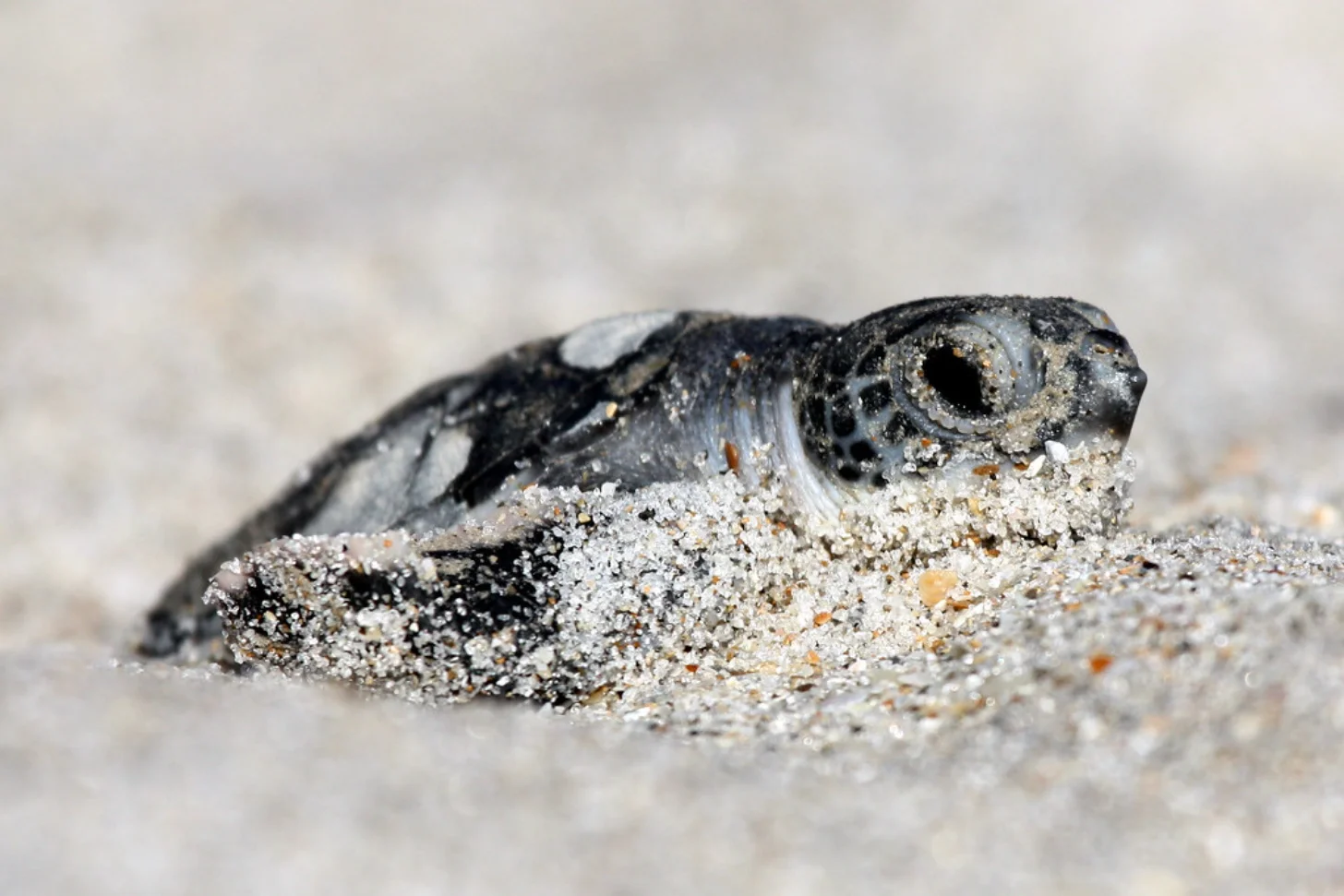
What do sea turtles eat? Are any of their prey threatened?
Sayler said that a sea turtle’s diet varies greatly from species to species, with some feeding primarily in the open sea and others preferring shallow waters near the coast.
“Generally speaking, green turtles tend to feed on seagrasses and macro-algae, and one of their primary threats is, therefore, the loss of seagrasses,” Sayler said. “This is a unique threat to them, as a result of this preference.”
“Hawksbill turtles often, but not always, prefer sponges or other invertebrates,” she added. “Leatherbacks feed almost exclusively on gelatinous zooplankton, including true jellyfish.”

What does it mean now that green sea turtles are no longer endangered?
In October 2026, after decades of conservation efforts, the International Union for Conservation of Nature announced that the green sea turtle was no longer endangered.
According to the Turtle Foundation, the milestone was achieved after global nesting numbers increased by 28% over the course of five decades.
Even so, Sayler said that they still need our help.
“The species is still listed under the endangered species list as threatened — so they’re still legally protected from harm, harassment, and trade — but they’re not endangered,” Sayler explained.
“This is actually very similar to the Florida manatee, where they were listed as endangered for a very long time, then there was a groundswell of incredible interest from the public and interagency cooperation,” she continued. “Different groups worked together to come up with really pragmatic solutions, and the population improved.”
“I like to think of endangered as meaning in danger of going extinct, and threatened meaning threatened to become endangered,” she added. “So they're still listed under the Endangered Species Act, but just no longer teetering right on that edge near extinction.”
You may also like: 7 things you absolutely need to know going into sea turtle nesting season
Featured Image: Hillebrand Steve/USFWS
On July 14, New York Governor Kathy Hochul signed an executive order to create a statewide moratorium on new hyperscale data centers.
The governor’s office says this moratorium is the nation’s first and will “establish the strongest standards for data center development.”
Hyperscale data centers are massive buildings that run large numbers of computers 24/7. Inside are servers, storage, networking gear, and heavy-duty cooling and backup power to keep the computers running non-stop. The campuses are typically run by a handful of major tech companies, and are designed to deliver cloud storage and artificial intelligence processing at massive scale. A single site can cover millions of square feet.
And they’re sweeping the country.

As of June 2026, the United States is home to 4,423 data centers, the most of any country worldwide. The runner-up is the United Kingdom, which has 555 data centers. It’s unclear how many of these locations are considered “hyperscale data centers,” but the scale of data center growth in the U.S. is significant by comparison.
Critics of these developments have recently gained momentum, calling on local governments to enact bans or moratoriums on new data centers, citing environmental, health, and energy cost concerns.
With Hochul’s new executive order, New York seems to be answering the call — even if only temporarily.
To impose the moratorium, Hochul will be temporarily pausing state environmental permits for up to one year. The goal in this time, her office reports, is to build a regulatory framework designed to “protect ratepayers, the environment, the energy grid, and communities across the state.”
“New York has always been at the forefront of innovation and change, but we’ve also always guaranteed that New Yorkers benefit,” Hochul said in a press release.
“As data center development threatens to hike up utility bills, deplete our natural resources, and create uncertainty for New Yorkers, it’s my responsibility to take action and lead.”
Earlier this year, Hochul worked with the state’s Department of Public Service to implement a proceeding called Energize NY, which requires data centers to either pay more for their energy or supply their own, thereby keeping energy rates affordable for New Yorkers.
“Unlike other sectors, data centers consume massive amounts of finite resources and place an unprecedented strain on the electric grid without creating many jobs in the process,” a press release from February 2026 explained.
“Governor Hochul is taking action to ensure every day New Yorkers do not subsidize this energy-intensive industry.”
As part of Energize NY, Hochul has directed DPS to develop a Generic Environmental Impact Statement for data centers to ensure any that emerge in New York in the future are held to consistent environmental standards. This standardization will take place during the one-year moratorium.
“The state will use the GEIS to assess the potential environmental impacts of the construction and operation of data centers in the state, including their effect on energy demand, water use and quality, and air quality,” a July 14 press release explained.
“Once the State finalizes these standards, the moratorium will be lifted, allowing new data center projects to proceed as long as they follow state, zoning code, and other local approvals.”
Another piece of this new executive order includes the development of a Community Investment Framework, which will provide guidance to local entities to help them negotiate community benefits as part of any data center development, including local infrastructure improvements, childcare investments, and direct financial support to communities.
The governor’s office said this framework will also establish wage and labor standards for data center workforce developments.
Additionally, Hochul urged the state to create a New York Grid Acceleration Fund, which will require data centers to invest in the state’s aging grid infrastructure and energy needs. The DPS will also consider approaches requiring data centers to fund new clean energy generation.
Lastly, the governor shared that she is pursuing legislation to repeal sales tax exemptions for massive data centers across the state.
Hochul has been an early advocate for artificial intelligence regulation, introducing an initiative to advance AI research for public good, advising on policy to protect jobs amid AI development, data protection safeguards for children, and protections against unauthorized uses and dissemination of deceptive AI images.
She has also created an Office of Digital Innovation, Governance, Integrity, and Trust to help improve digital safety and technological governance.
While other states have considered moratoriums on AI data centers — currently, 19 of 50 states restrict data centers or are considering restrictions — New York is the first in the nation to establish a statewide moratorium.
Maine came close to a statewide moratorium earlier this year when lawmakers passed a bill that would impose a temporary ban, but Governor Janet Mills later vetoed it, saying she would only support the legislation if it included an exemption for a data center that was already under contract.
Now, New York takes the lead.
“New York will lead the way in creating the strongest standards in the nation for data center development,” Hochul said in a press release, “ensuring that when companies succeed because of New York, New Yorkers succeed too.”
You may also like: A 69,220-square-foot data center could be built next to the Nashville Zoo. Brad Paisley wants to stop it
Featured Image: Tony Webster/Wikimedia Commons (CC BY 2.0)
- Across the globe, roads pose a deadly physical threat to wildlife and fragment the landscapes animals need to move through to survive. For some species, a road is a wall: They won’t even attempt to cross.
- Decades of research have proved that wildlife crossings (underpasses and overpasses), combined with roadside fences, prevent deadly collisions, protecting both animals and people.
- Crossings are part of larger efforts to reconnect shattered ecological corridors worldwide. Animals need to move to find food, water, a mate — and to escape more frequent, extreme wildfires and extreme weather events.
- Some of the motivation in building and retrofitting wildlife bridges and underpasses involves public safety and economics. Crashes with large animals cost the U.S. economy more than $10 billion each year.
One of the busiest highways in the western United States is Interstate 25, a concrete artery that runs north to south across the state of Colorado, funneling roughly 100,000 cars per day through the fast-growing exurbs south of the capital, Denver.
While I-25 facilitates human journeys, it disastrously truncates the movements of another set of commuters. For decades, mule deer, elk, black bears, and other species have wandered onto the highway — with fatal consequences.
Over a two-year period, from 2018 to 2020, the Colorado Department of Transportation tallied collisions with 76 deer, 15 bears, and 10 pumas along a 14-mile stretch of asphalt. Moreover, the interstate’s walls of traffic deter many animals from even attempting to cross, preventing them from roaming between alpine forests and Colorado’s eastern prairies.
Lately, however, this once-dangerous barrier has become far more accommodating to four-legged travelers. In 2021, Colorado completed the construction of five capacious, dirt-floored underpasses, flanked by more than 25 miles of roadside fencing, to allow wildlife to meander safely and freely beneath I-25.

And in December 2025, CDOT finished construction of an overpass, 200 feet wide by 209 long, that arcs over six lanes of traffic near the town of Greenland. That makes it one of the largest human-made wildlife crossings on Earth. All told, CDOT says it expects its network of a half-dozen passages to reduce roadkill by 90% and reunite 40,000 acres of habitat that the interstate severed.
“We’re connecting some huge wildlife populations,” says Andy Hough, environmental resources coordinator for Douglas County, who worked with CDOT to plan the crossings.
The Greenland overpass is the apotheosis of a fast-growing movement, one that aims to make the planet’s perilous road network safer for wildlife. Species from Florida panthers to tiger salamanders to Asiatic cheetahs are existentially endangered by vehicle strikes, while impenetrable walls of traffic fragment the ranges of grizzly bears, African elephants, and many other creatures.
Decades of research have proved that wildlife crossings, in combination with roadside fences, can both protect animals from deadly collisions and reconnect shattered ecological corridors. Now, conservationists and governments around the world are planning to install them to save biodiversity from the ravages of highways.
With sufficient investment, “we could solve this problem in a generation,” says Renee Callahan, executive director of ARC Solutions, a group that studies and advocates for wildlife crossings.
The question is whether we will.
The evolution of safe passage
The concept of wildlife crossings is three-quarters of a century old. The structures originated in France, which built green bridges for deer in the 1950s, and then spread to neighbors including Germany and Switzerland, which underlaid their roads with “toad tunnels” to escort migrating amphibians beneath traffic.
In densely developed countries such as the Netherlands, governments came to view crossings as vital to unifying patchworks of fragmented habitat for species such as badgers, hedgehogs, red deer, and wild boar.
“If we are going to have viable wildlife populations, we must provide for connectivity across transportation infrastructure,” says Marcel Huijser, a Dutch-born road ecologist with the Western Transportation Institute at Montana State University in the U.S., who describes the Netherlands as “one of the real leaders” in contemporary wildlife crossing construction.

Crossings found their way to the U.S. in the late 1960s, as immense interstate highways knifed through western forests and sagebrush steppe, severing natural pathways trod for centuries by migratory herds of mule deer, elk, and pronghorn.
In the state of Utah, engineers outfitted I-15 with a wildlife overpass, while underpasses helped deer traipse beneath I-70 in Colorado. Along I-80 in Wyoming, roadside fences guide hundreds of deer to underpasses each migration season. When the ungulates initially shied away from some especially long, dark tunnels, technicians baited the passages with vegetables and apple pulp.

That fitful progress notwithstanding, wildlife crossings languished in the U.S. during the late 20th century, as engineers questioned whether enough animals would use them to justify their multimillion-dollar price tags.
Passages found a warmer reception across the Canadian border where, beginning in the 1980s, Parks Canada would install roughly 40 in Banff National Park, a vast protected area pierced by the TransCanada Highway. Over decades, a rotating cast of researchers, led by a road ecologist named Tony Clevenger, studied the benefits of the Banff crossings, particularly for grizzly bears — wary, road-shy beasts who took longer to warm to the passages than deer, elk, and black bears.
Among the researchers was Mike Sawaya, a biologist who spent several years in the 2000s collecting grizzly hair and analyzing the DNA within it.
Sawaya stretched strands of barbed wire across the entrances to Banff’s underpasses and overpasses, so that any bear who squeezed past would leave a snagged tuft of fur. Combined with samples collected from surrounding areas within the park, this genetic evidence helped him and Clevenger figure out not only how many bears were using the passages, but precisely which ones.

Eight males and seven females crossed the highway during Sawaya’s three-year study, more than a quarter of whom produced cubs. The offspring of some crossers also crossed repeatedly themselves, a suggestion that mothers were teaching their cubs to use the passages.
Although scientists had previously expressed skepticism that crossings could heal the genetic wounds that highways inflicted upon wildlife, Sawaya’s research dispelled those doubts.
“At this point, there’s really no more question that these things can help populations,” Sawaya says.
Meanwhile, other researchers were demonstrating that crossings aided not only wildlife, but drivers, too. Collisions with white-tailed deer kill about 440 motorists each year across the U.S., and large animal crashes as a whole cost the national economy more than $10 billion annually in vehicle repairs, medical bills, and other expenses.
By averting dangerous, expensive crashes, wildlife crossings and roadside fences often recoup their own construction costs. In the state of Virginia, where deer collisions inflict $500 million in damages each year, the transportation department strung fences alongside a preexisting box culvert and a bridge beneath I-64, guiding wildlife toward passages originally built for the movement of livestock and water.
The project reduced collisions by more than 90%, quadrupled deer crossings through the passages, and paid for itself in less than two years.

“Now that we know that there are ways to make a huge impact, there’s more openness to looking into this type of mitigation,” says Bridget Donaldson, a research scientist at the Virginia Department of Transportation.
As crossings have proliferated, their designs have become more thoughtful, a trend that will reach its apogee atop California’s Wallis Annenberg Wildlife Crossing. The 200-ft bridge, opening to four-legged travelers on Dec. 2 this year, will allow mountain lions and other animals to traverse the 10-lane U.S. 101 Freeway and an adjacent city road.
The 101 ferries more than 300,000 cars per day, forcing the overpass’s architects, Rock Design Associates, to be unusually thoughtful about incorporating features like artful berms and vegetated sound walls to block traffic noise and headlights that might otherwise repel approaching animals.
The overpass and its surroundings are being surfaced with thousands of native plants, grown in a nearby nursery, to entice not only mountain lions, but also wrentits, monarch butterflies, western fence lizards, and a host of other, smaller species.
Those details have meant a more expensive crossing — the project will ultimately cost around $114 million, a third of it raised from private donors — but ideally a more effective and multi-species one.
“As we get into the next iteration of crossings, I do hope we can start thinking of these more as habitat to get everything across” — not just the large mammals, says Beth Pratt, president and CEO of the Wildlife Crossing Fund and the overpass’s primary advocate. “And that requires being thoughtful about what we’re planting on top.”

Croatia’s unheralded crossings
While North America is among the epicenters of global wildlife crossing construction, the movement is a global one — and many of the world’s most successful, if little-heralded, passages lie elsewhere.
Consider Croatia, where civil war and malaise long delayed the construction of new highways. Not until the late 1990s did the country begin planning a route from Zagreb, its capital, to the coastal city of Rijeka, through a crenellated mountain range that’s home to wolves, lynxes, and brown bears.
The proposed highway came to the attention of a wildlife biologist named Josip Kusak when, to his dismay, he discovered survey stakes in a remote valley where he was studying wolves. Although Kusak knew the highway was impossible to prevent, he nevertheless asked a government engineer in Zagreb whether he might contribute a few wildlife-friendly design recommendations, to which the official assented.
“Engineers like to build; it is in their nature,” Kusak says. “If you give them a reason to build more, they are happy.”
Kusak gave them plenty to build. He proposed overpasses between valley walls, underpasses near stream crossings, and viaducts where the highway spanned deep ravines. The planners adopted nearly all of his ideas.
When he inspected a half-built overpass and deemed it unnaturally featureless, the builders added truckloads of rocks. When he suggested sprucing it up with vegetation, they planted trees.
In a 2009 study, Kusak reported that deer, bears, wild boars, wolves, and other species used the overpass an average of 15 times per day. Altogether, roughly a quarter of the new road’s length was crossable for wildlife, making it among the most permeable highways on Earth — more than even the TransCanada Highway in Banff, if much less celebrated.
“We were lucky in Croatia that highway development was lagging behind compared to the rest of Europe,” Kusak says. When the road was built, he adds, “we had information, knowledge, and credibility to ask for crossing structures.”
A growing global movement
Croatia’s experience illustrates an important point. Major highways in Western Europe and North America were built decades ago, when biologists and engineers understood little about how severely traffic harmed wildlife. By contrast, countries constructing new highways today can draw upon years of road ecology research — and design better infrastructure from the get-go.
Laws in Nepal, for example, require the inclusion of wildlife crossings on any new road through a major forested area (though budget constraints have hampered passages on some projects).
In India, new “red roads” incorporate eye-catching patterns to slow drivers for wildlife, while the elevated National Highway 44 constructed through Pench Tiger Reserve allows the large carnivores to wander freely across the forest floor — a more radical intervention than any attempted in the U.S.
“We think we’re such leaders,” says Rob Ament, senior conservation adviser at the Center for Large Landscape Conservation, a Montana-based group that promotes habitat connectivity. “And then you go to India, and you’re like, wait, they’re just going to lift the highway?”

Granted, such dramatic — and expensive — measures aren’t always feasible. But many tropical countries have availed themselves of a far cheaper form of wildlife passage.
In 2022, Sri Lanka installed a rope bridge, in the form of steel cables connected by nylon netting, above the Sigiriya–Inamaluwa Road. It allows purple-faced langurs and other arboreal animals to safely clamber between fragmented habitats without descending to the forest floor.
“Canopy crossings” have likewise reconnected treetops for samango monkeys in South Africa, sloths in Costa Rica, and squirrel gliders in Australia. In April 2026, conservationists were thrilled to watch a young male Sumatran orangutan swinging his way across a rope bridge spanning Indonesia’s Lagan-Pagindar Road, the first orangutan ever to be spotted using a crossing.
And unlike many conventional wildlife crossings, rope bridges and ladders are portable and cheap: Some designs cost only several hundred dollars to construct and install.
“I always recommend canopy crossings,” says Fernanda Abra, founder of ViaFauna, a Brazilian company that designs ecologically sound roads.
Abra’s Reconecta Project, an initiative to outfit Amazonian roadways with canopy bridges, has already built 39 of these crossings, and plans to install 27 more in 2026.
“We are recording thousands of safe crossings by arboreal wildlife,” Abra says, including species such as black-capped capuchins, bearded saki monkeys, kinkajous, and silky anteaters.
Helping wildlife survive the infrastructure tsunami
For all their virtues, however, wildlife crossings alone can’t save ecosystems from the developmental wave that ecologist William Laurance calls the “infrastructure tsunami.”
The ecological crises that roads foment are legion: Among other impacts, they facilitate the dispersal of invasive species, create pernicious “edge effects,” befoul soundscapes and watersheds, increase poaching, and facilitate industrial logging, farming, and mining in the Amazon and elsewhere — a Pandora’s box of problems that crossings are powerless to prevent.
In a 2021 paper, a group of road ecologists even cautioned that crossings and other forms of mitigation could become a form of “malicious restoration,” a greenwashing tactic that development-happy governments apply to justify ill-conceived infrastructure.
Rather than rationalizing harmful new highways with crossings, then, road builders would be better off avoiding key habitats altogether.
“You can build roads that skirt the most sensitive areas, like migration corridors for large mammals, and still connect population centers to areas of production,” says Nirmal Bhagabati, an infrastructure expert formerly with WWF, who has consulted on highway design in countries such as Myanmar.

Can wildlife crossings be more than bridges to nowhere?
Roads are the most conspicuous impediment to animal movement, but not the only one. A wandering mammal may also be forced to limbo beneath barbed-wire fences, circumnavigate oil-and-gas operations, and traverse residential neighborhoods. An overpass whose adjoining habitats become condos or oil fields risks being a bridge to nowhere.
Near the city of Durango in Colorado, for example, a proposed residential development alongside Highway 550 threatens to render a deer underpass “non-functional,” according to Jon Holst, senior policy adviser at Western Resource Advocates.
Holst’s group, among others, has supported legislation to address that problem. This May, Colorado passed a law that adds an optional $5 fee to residents’ vehicle registrations, a measure expected to raise roughly $4 million per year for crossings statewide. Although most of that revenue will pay for infrastructure like underpasses and fences, some will also be eligible for other connectivity projects, such as conservation easements to ensure that crossings remain functional throughout their lifespans.
“We’ve seen Colorado be a leader and a champion on wildlife crossings, and hopefully that translates to leading on corridor conservation as well,” Holst says.
And Colorado isn’t the only state shelling out: In recent years, New Mexico has allotted $50 million for crossings; Utah $20 million; and Oregon $5 million. Those investments were motivated largely by the Wildlife Crossings Pilot Program (WCPP), a $350 million matching-grant initiative by the federal government, passed in 2021, that gives states a powerful incentive to dedicate their own funds for crossings.

Not only has the program provided federal grants to complete shovel-ready projects in experienced western states like Colorado and Wyoming, it’s also doled out small-scale planning grants to eastern and midwestern states such as Maryland, Missouri, and New York to figure out where their own passages should someday be built.
Yet the WCPP has one serious flaw: It isn’t nearly large enough.
“A lot of great projects got turned away,” says Callahan from ARC Solutions.
Now, legislators on both sides of the aisle, motivated by concern for both wildlife and public safety, are hastening to make the expiring program permanent and expand its reach. A bipartisan transportation bill before the U.S. House of Representatives would provide $80 million per year for crossings over the next five years, though conservationists hope to see that figure grow. (A bill in the U.S. Senate would allocate $1 billion to crossings over the next half-decade.)
“At the height of demand for these funds, the key is to ensure that the program continues so that we don’t lose the momentum,” Callahan says.
Among the crossings that have benefitted from the WCPP is Colorado’s I-25 overpass, which received $22 million in federal funding. Today, the overpass stands as a visual reminder of the importance of ecological connectivity, as well as a crucial truth: Assisting animals requires understanding of how they experience their worlds.
Whereas deer and black bears are content to meander through I-25’s underpasses, nearby pronghorn and bighorn sheep — fleet, far-sighted animals accustomed to scanning the horizon for predators — feel far more comfortable atop the open deck of a bridge.
For those creatures, and many others, the overpass should render I-25 — which has so long been an insuperable barrier — effectively transparent.
As Douglas County’s Andy Hough puts it: “It’s like the whole world is open to wildlife now.”
Featured Image: Ben Goldfarb
This article was originally published on Mongabay.
Sightings of blue whales and fin whales off Southern Africa’s Atlantic coast have increased in recent years, according to a newly published study.
This could signal recovery of the marine mammals after being virtually eliminated from the area by commercial whaling in the 20th century, the study authors say.
Scientists estimate around 350,000 Antarctic blue whales (Balaenoptera musculus intermedia) and some 725,000 fin whales (B. physalus quoyi) were killed in the Atlantic during the industrial whaling era from 1913-1978, driving both whales to near extinction.
A research team led by Bridget James of the University of Cape Town, South Africa, set out to assess if both subspecies are recovering in the Benguela ecosystem in the southeastern Atlantic. It’s a stretch of water between the west coasts of northern Angola, Namibia, and South Africa, where currents bring nutrients from lower ocean depths to the surface, producing rich blooms of krill, a marine crustacean that both whale subspecies eat.
The team found that between 1964 and March 2025, there were 17 reports of blue whale sightings and one report of stranding in the region.
They also recorded 76 fin whale sightings and six strandings. The blue whales were most often seen between late spring to summer (October-December) and autumn (March-April) in the Benguela ecosystem, while fin whales were seen year-round.
While the number of sightings is still relatively low, 95% of them were recorded since 2012.

James told Mongabay by email that the Benguela ecosystem is a migratory corridor between breeding and feeding grounds for the whales, and that increased whale sightings are an expected indicator of populations recovery.
Current Antarctic blue whale populations are estimated to be around 3% of pre-whaling numbers, while fin whale numbers have recovered to more than 30% of historical levels.
James said increases in their populations to at least 50% of pre-whaling abundance would suggest successful recovery for both subspecies. Whales have relatively few offspring and long intervals between births, which makes their recovery times very slow.
James added that as whale numbers increase, they’ll face further challenges since the ocean now is a very different place than during whaling times, with many more large ships and industrial and vessel noise. She noted one blue whale had died off Namibia possibly due to a ship strike.
Asha de Vos, a blue whale expert from Sri Lanka, not affiliated with the study, told Mongabay by email that “similar trends have been observed in other parts of the world following the end of commercial whaling.” She added these trends “are often consistent with gradual population recovery and the reoccupation of historical habitat.”
De Vos said an increase in sightings could also reflect more whales traversing the region rather than an absolute recovery of numbers, and that the findings provide promising evidence that warrants continued long-term monitoring.
Featured Image: Courtesy of Sara Golaski/Namibian Dolphin Project
This article was originally published on Mongabay.
When asked what she loves most about sea turtles, marine biologist Katherine Sayler told Good Good Good that she is constantly amazed by their sheer resilience.
“I think about how incredible their recovery has been in some parts of the world,” said Sayler, who serves as the southeast representative for Defenders of Wildlife, a nonprofit dedicated to protecting imperiled species.
According to Sayler, Kemp’s ridley sea turtles are the most globally endangered sea turtle in the world — and likely the rarest. Of the seven species of sea turtles, they are also the smallest.
Today, they primarily live in the warm, shallow waters of the Gulf of Mexico and the northwestern Atlantic Ocean, but at one point, they teetered on the brink of extinction.
Most of their nesting occurs on a singular Mexican beach: Rancho Nuevo in the state of Tamaulipas. There, they habitually engage in a phenomenon called arribada, or “arrival by sea,” where females emerge from the ocean by the thousands to nest en masse.
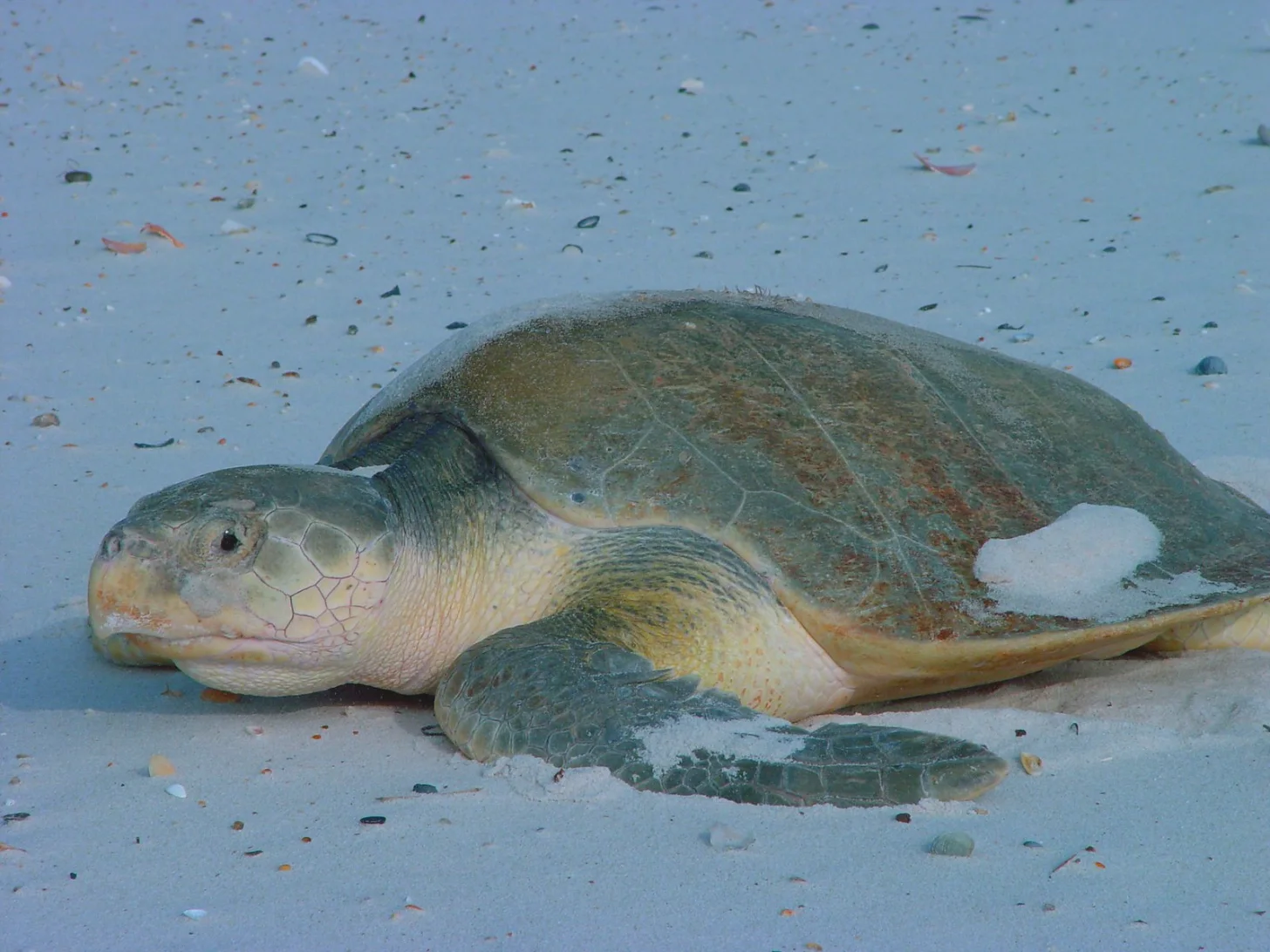
According to the National Oceanic and Atmospheric Administration, an amateur video from 1947 documented tens of thousands of Kemp’s ridleys nesting near Rancho Nuevo on a single day.
Decades ago, people collected eggs from the arribada to harvest them for food. That practice, coupled with coastal degradation and unintentional capture in fishing gear, caused their population to plummet in the mid-20th century.
Between the 1940s and 1985, Kemp’s ridley sea turtles declined by a staggering 99%.
“They went from over 121,000 nests to 702 nests,” Sayler emphasized. “Since the 1990s, they’ve been in recovery.”
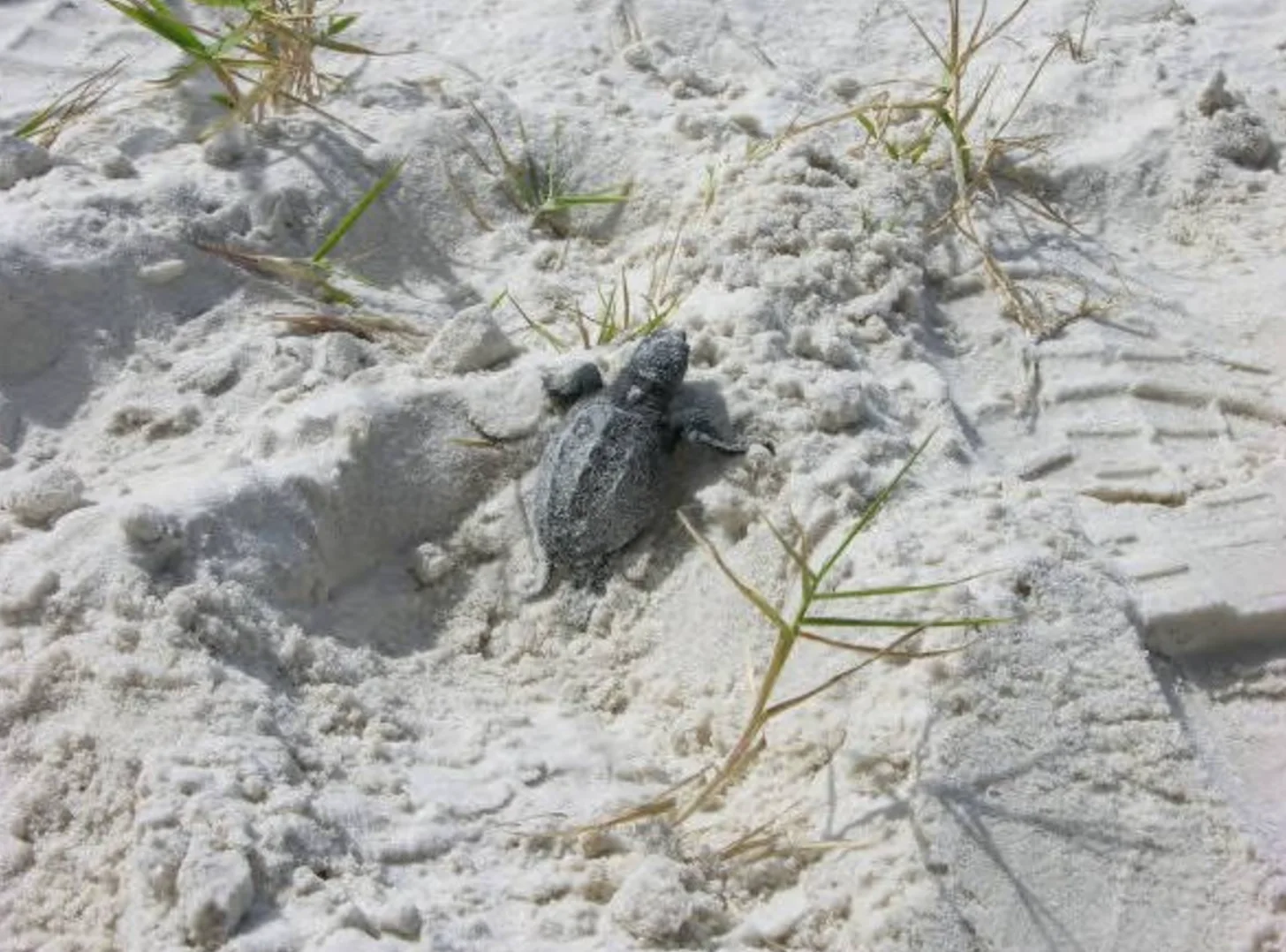
Today, there are an estimated 7,000 to 9,000 nesting female Kemp's ridleys, which amounts to roughly tens of thousands of nests globally per year.
“Because of thoughtful people taking action on their own beaches, conservation organizations, protection under the Endangered Species Act, and international conservation, many of them have rebounded,” Sayler said.
“I think it’s just so incredible, some of the bottlenecks that these sea turtles have experienced … it’s pretty significant in terms of the swing in population abundance,” she added.
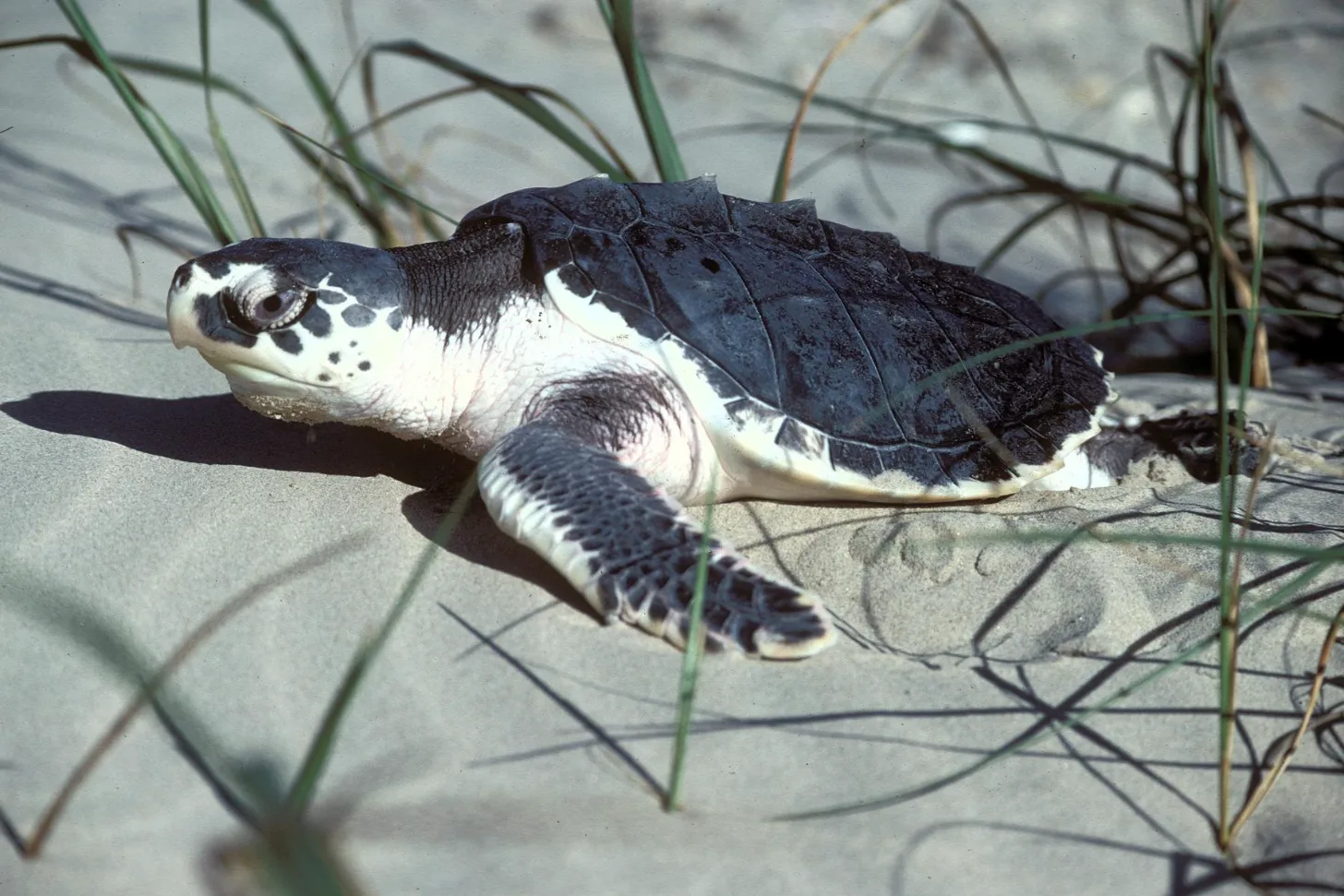
Although the world’s rarest sea turtle is currently rebounding, they — and other sea turtle species — face an uncertain future. Fortunately, there’s a lot that we can do to help, beyond swapping out plastic straws and giving wildlife a wide berth.
“Keep beaches dark, flat, and clean,” Sayler said. “That's really the action item that everyday people can do to really help sea turtles rebound and increase in abundance.”
You may also like: Do sea turtles only hatch during a full moon? Your top 5 questions about sea turtles, answered by an expert
Featured Image: USEPA Environmental-Protection-Agency
As 2025 came to a close, a new chapter was unfolding in Madhya Pradesh, India.
In December 2025, the Ministry of Road Transport and Highways and the National Highways Authority of India unveiled new updates to a highway that cut through the Veerangana Durgavati Tiger Reserve.
The massive wildlife park is home to a wide variety of animals, including Bengal tigers, leopards, wolves, panthers, and the four-horned antelope.
And like many roadways that cut through natural wildlife corridors, vehicle collisions posed a growing threat to animals and drivers alike.
NHAI has taken the threat of wildlife collisions seriously, adding 25 wildlife underpasses to points along the 7.5-mile stretch of highway that have been identified as critical animal movement locations.
Research estimates that one wildlife crossing can prevent about 1,400 accidents over a 70-year lifespan.
“These underpasses are integrated with natural ground levels and drainage paths to encourage regular animal use,” the NHAI and MoRTH said in a joint press release.
“Continuous chain-link fencing … has been installed on both sides of the highway to prevent animals from entering the carriageway and to guide them toward underpasses.”
India has been building wildlife crossings at an increasing rate in recent years. On April 14, the NHAI opened the Delhi-Dehradun Expressway, a six-lane highway underlined by a 6.8-mile corridor for animals.
Within a 40-day window, before construction was even completed, researchers recorded over 40,000 images of animals using the crossing. In addition to golden jackals, spotted deer, leopards, and peacocks, there were over 60 instances of elephants using the corridor.

But the NHAI hasn’t stopped there. In addition to giving animals alternate routes, the agency has employed an innovative technique to encourage drivers to slow down and keep an eye out for wildlife that may slip through the cracks.
And they did it with color psychology.
On a critical 1.2-mile stretch of highway through the Veerangana Durgavati Tiger Reserve, the NHAI applied red, 5-millimeter-thick thermoplastic surface layers to the roads.
“The bright red colour immediately alerts drivers that they are entering a speed-restricted, wildlife-sensitive corridor,” the NHAI and MoRTH stated.

There’s a scientific reason why red is typically chosen for stoplights, brake lights, and emergency signage.
Red has the longest wavelength of visible light, which makes it highly visible in rainy or foggy weather. Studies show that the human brain processes the color red up to 10% faster than any other color.
In addition to the red color, the slightly raised surface layer also has a subtle, but recognizable, impact on drivers.
“The slightly raised surface generates mild tactile and audible feedback, naturally encouraging drivers to slow down, without causing discomfort or sudden braking,” the NHAI and MoRTH said in the press release.
Overall, India’s first “red road” is meant to reduce accidents, protect wildlife, and make travel safer for all.
“As India continues to build critical infrastructure through diverse landscapes, this project sets a benchmark for environmentally responsible, people-centric, and wildlife-sensitive highway development, where red roads signal not danger, but thoughtful design and green intent,” the agencies emphasized.
You may also like: Since 2018, over 9,000 animals have crossed this wildlife bridge in Washington. Trail cameras just spotted its first bear
Featured Image: Ministry of Road Transport and Highways