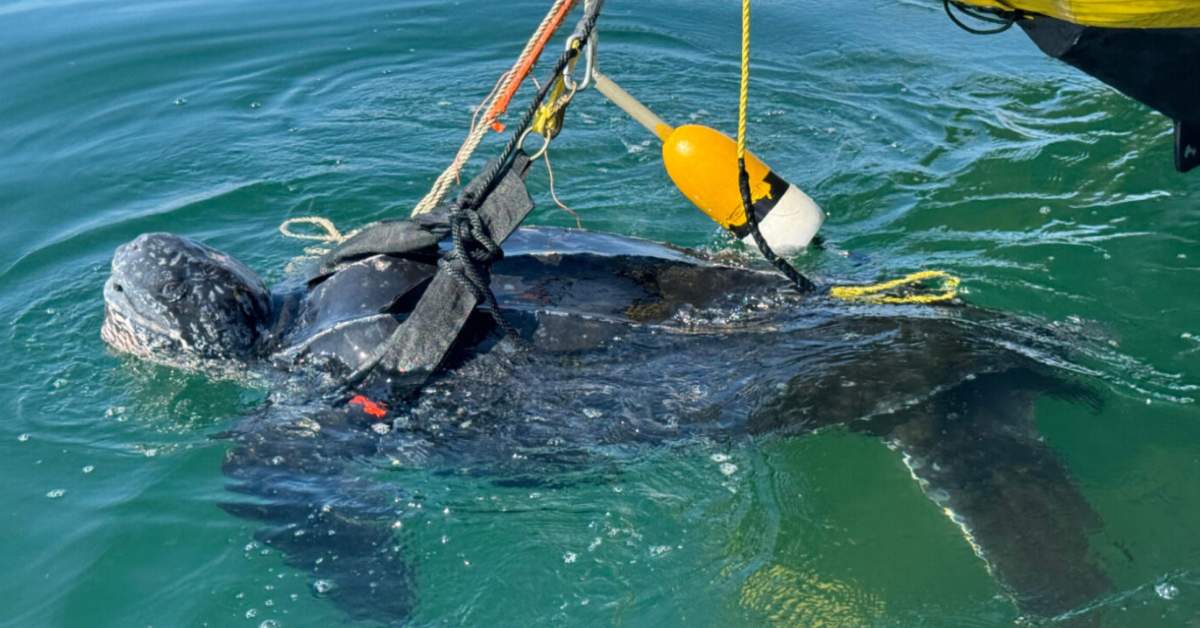
In mid-June, Virginia fisherman Brandon Watts was cruising on the waters of the Chesapeake Bay with his friends, hoping to reel in some cobias, a predatory fish that can grow up to 6 feet long.
Instead, they stumbled upon an animal in need: a 700-pound leatherback sea turtle that was wrapped in crab pot buoy lines.
“We think we were around Buck Row Beach, and we’d seen something struggling in the water,” Watts said in an interview with WAVY TV 10.
“It seemed like he was crying for help, and my dad mode kicked in, and I just went right to town.”

On that day, the three fishermen were grappling with 20 mph winds, which meant they had to be careful not to get too close to the sea turtle, lest the rocking waves drive them into the sea creature itself.
When Watts got close enough, he realized that the buoy lines were wrapped around the sea turtle’s neck and flippers at least 10 times. Using a razor knife, Watts sliced through each twisted rope until it was freed.
“I just couldn’t leave him, knowing that he could wash up dead somewhere down the line, so I just had to do what I could do to get him free,” Watts said.
As Watts worked to free the lines, his friend Travis Cullipher stood at the helm to make sure the boat was a careful distance from the sea turtle.
“I’ve been fishing since I was a little kid, but I’ve never seen a turtle in distress like that,” Cullipher said.
“They didn’t ask for all that stuff to be in that water,” Watts added. “So anything you can do helps.”
Abandoned fishing gear, like crab trap buoy lines, fishing hooks, nets, and more, poses a major threat to sea turtles.
In 2018, another leatherback sea turtle was caught in a crab pot buoy 50ft below the surface, before it was rescued by a boat full of fishermen.
In 2024, the New England Aquarium Anderson Cabot Center for Ocean Life responded to a 400-pound leatherback that was wrapped in fishing gear in Cape Cod Bay, Massachusetts.
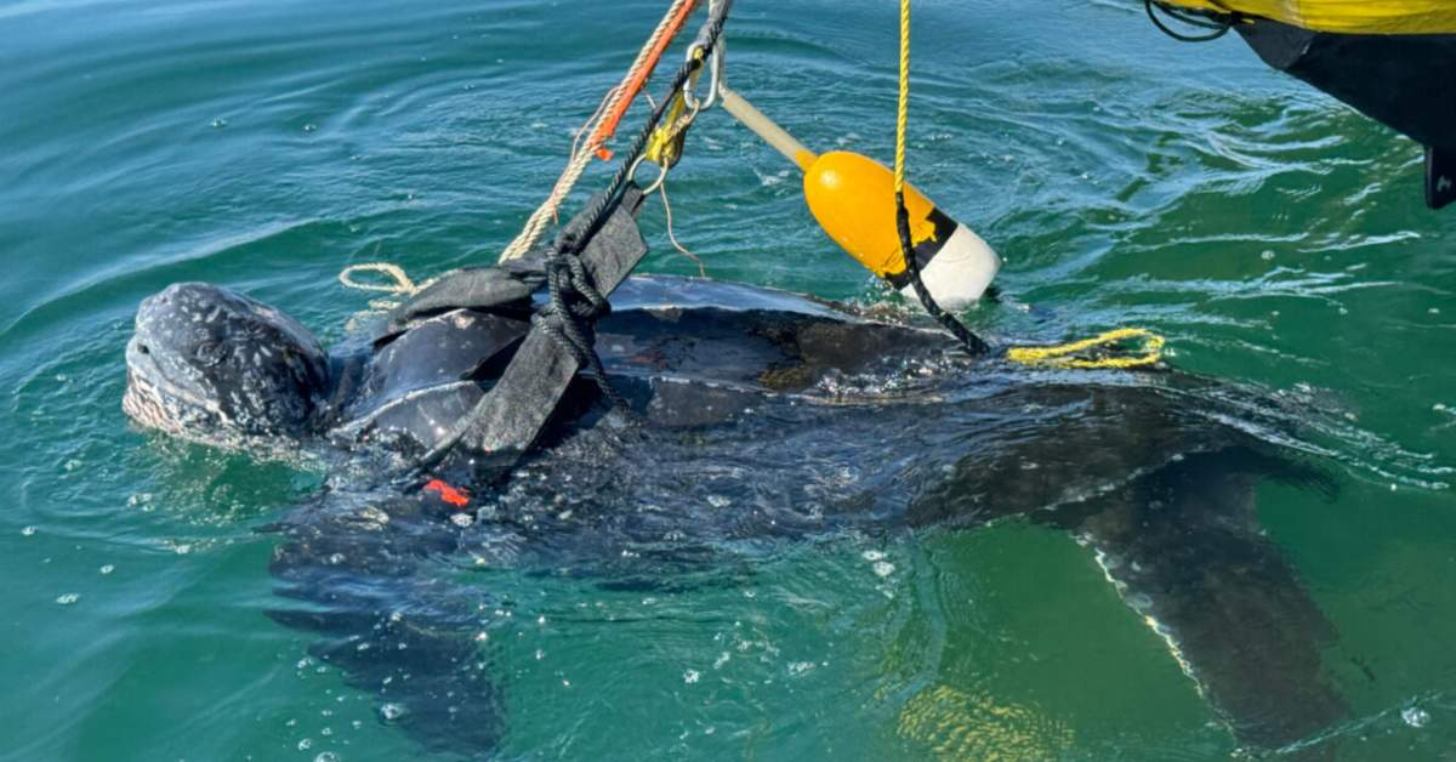
“The turtle had a rope entanglement around the shoulder region of its right front flipper, but fortunately it was detected quickly, and the gear was still loose with minimal damage to the flipper,” Dr. Melissa Joblon, the aquarium’s director of animal health, said in a press release.
“Overall, the turtle appeared healthy, active, and in great body condition, so we suspect it will do very well after release.”
Before the leatherback — nicknamed “Phinney” by local Cape Cod Bay responders — was released back into the bay, scientists affixed satellite and acoustic tags on the turtle’s shell.
The technology allows researchers to track released turtles for up to ten years by a vast array of underwater receivers that stretch from Canada to Florida.
“It’s critical that we understand the outcomes of leatherback sea turtles after they’re disentangled from fishing gear,” said Kara Dodge, an Anderson Cabot Research Scientist. “We’re using satellite and acoustic tags to monitor their post-release survival and behavior over time.”
Today, sea turtles like Phinney can be followed on the New England Aquarium’s Sea Turtle Tracker.
You may also like: An endangered sea turtle just laid the 300th nest of the season. She's been visiting Florida beaches since 2001
Header image is a representative photo of the story, via the New England Aquarium