The nonprofit is empowering children to make a positive difference in the world — and many of these kids are growing up to become activists
Even the smallest among us have it all figured out — or so goes the saying for charity: water's Tiny Heroes program.
Founded in 2006 by Scott Harrison, the nonprofit organization has dedicated its mission to bringing clean drinking water to folks in developing nations.
As of 2022, the organization has raised over $640 million towards the cause and has funded over 91,414 projects in 29 countries.
In addition to solving the worlds’ ongoing water crises at hand, charity: water is also helping the next generation of Helpers through their Tiny Heroes program.

The organization celebrates young people (who are as young as six years old!) who are finding innovative ways to help their community, whether it be raising awareness through homemade t-shirts that say "I like bugs, but not in my water" or hosting five-minute tea parties, Tiny Heroes is an ode to the kids who are doing heartwarming and innovative work for clean water.
And it's paying off too. According to the Tiny Heroes website, the combined power of these inspiring kids has brought clean water to 45,000 people and counting.
These kids have also raised over $1.8 million towards clean water, making them some of this generation's youngest entrepreneurs, innovators, and all-around top-notch helpers.
One of this year's Tiny Heroes alumni is an eight-year-old named Nanami, who spent her 8th birthday campaigning for clean water. The deal? Donate $8 or more and get a custom-designed tote bag.
Another hero is Neekta (based in Ontario, Canada) who spent her birthday in quarantine by doing a virtual recital; she played the piano and ukulele as a fundraiser for clean water. Through the power of music and empathy, she raised enough funding for clean water for 54 people.
Olive, who lives in the United Kingdom, hosted 5-minute tea parties after she learned there were kids who lived without clean water. Friends and family were invited to water and a snack, all the while conversing with Olive about the importance of clean water.
"I saw that other people don't have fresh water, and I felt sad. They must be thirsty. So I decided to raise some money to help them"
"I saw that other people don't have fresh water, and I felt sad. They must be thirsty. So I decided to raise some money to help them," said Olive.
The impactful work doesn't end at childhood
For these Tiny Heroes, the work doesn’t end at childhood. Many of these alumni have continued on to do amazing work in the field even after aging out of their adolescence.
Supriya, for example, has been fundraising for charity: water since 2017. Last year, she and her brother partnered to perform a Carnatic music concert (a traditional form of Indian classical music) and raised $3,212. Her total fundraising in the time she's been with charity: water is over $13,000.
"Clean drinking water is not a privilege; it is a basic human right."
"Clean drinking water is not a privilege; it is a basic human right,” Supriya said.
If the Tiny Heroes program was the start, it’s definitely not the end for many of these budding activists.
Many of the alumni have also gone on to do incredible work for other causes, such as climate change reform or anti-racism work. And many of them credit their current work to charity: water showing that it’s possible for anyone — regardless of size or age — to make a difference.
Just ask Riley Goodfellow, who was a Tiny Hero and now a student at George Washington University and still finding innovative ways to bring clean water to communities.
“Being a Tiny Hero alum and working on the Riley Project has shown me the strength of youth. When a young person speaks, others listen. There is also something very special about this new generation,” Riley told Good Good Good.
"Young people are underestimated, but charity: water has proven their strength through the Tiny Hero campaign."
“In my current campaign, most of my supporters have been from people my age (teenagers) who don't have a lot of money, but they dedicate services or small donations that add up to large sums due to the amount of people willing to help. Young people are underestimated, but charity: water has proven their strength through the Tiny Hero campaign.”
Their most-recent campaign is called “Not so little Tiny Hero” and aims to continue bringing awareness and funding to charity: water’s work.
“Many of us have no idea what it's like to be thirsty. We have plenty of water to drink — even the water in our toilets is clean! But many people around the world don’t have that luxury. Every day, about 1,400 children die from diseases caused by unsafe water and poor sanitation. But it doesn’t have to be that way. There are simple solutions like drilled wells, spring protections and BioSand filters that help provide clean water to communities around the world,” Riley wrote on the campaign page, which can be found on the charity: water website.
They added: “100% of the money will be used to build clean water projects, and when they’re complete, charity: water will send us photos and GPS coordinates so we can see the exact community we helped.”
Though the water crisis continues to be a dire issue for many communities around the world, there’s not a shortage of Helpers. And if the Tiny Heroes program has shown anything, it’s that young people can truly make a difference in ways beyond our (adult) greatest imagination.
When we invest in the youth, they invest back in the world.
Happy World Water Day!
This article was originally published in The Water Edition of the Goodnewspaper in October 2021.
Join thousands of subscribers who get the Goodnewspaper via snail mail each month.
I spent a lot of time on my living room floor in tears in the days following the 2016 election. If it wasn’t one thing, it was another: another headline about police killing, another hidden history of racial violence uncovered, and of course, grief over my mom.
I’d spent a lot of energy in public grief about racism that year—lugging a hundred-pound the boulder around town to show the mental burden racism can lay on the Black psyche, wearing a suit with the names of Black victims of police violence, writing new songs.
And the constant outrage and grief were catching up with me, becoming unmanageable. My drive to keep going was waning and my friends could tell.
One day a package arrived at my door from my friend Paul, an English professor in Central Florida. It was a book by activist Rebecca Solnit called Hope in the Dark.
I was skeptical about a book on hope. It seemed inappropriate and impossible. I thought hope was some feeling that tells you, no matter what, everything is going to work out fine.
But I had no reason to believe that.
It seemed America had flat-out ignored the Black Lives Matter movement and elected an outspoken racist to the presidency, all while the police’s Black body count continued to grow.
It seemed like the movement was failing. It seemed that the only people I knew who had hope weren’t paying close attention to what’s going on in the world.
But Hope in the Dark was the beginning of a journey that would permanently shift my perspective.
There's a difference between hope and certainty. To be hopeful doesn't mean we're sure about the future.
The idea that struck me most in Solnit’s book was that there’s a difference between hope and certainty. To be hopeful doesn’t mean we’re sure about the future.
“Hope is an embrace of the unknown and the unknowable, an alternative to the certainty of both optimists and pessimists,” she explains. “Optimists think it will all be fine without our involvement; pessimists adopt the opposite position; both excuse themselves from acting.”
My mouth dropped open when I first read those words. They gave me a concept of hope that looked ugly truths in the face and left room for human agency. It felt like good news.
From then on, I began to search for hope with the same resolve that I’d searched for information about racism.
I developed a routine of morning and weekend hope readings that did wonders for my mental health and convinced me that true, meaningful hope—the kind that is grounded in history, able to confront uncomfortable reality, and comfortable embracing ambiguity—can be cultivated.
Writings on hope from freedom fighters, past and present, became my holy texts. I would read them every morning or sneak away on my lunch break to pore over their words at my favorite burger spot.
Somewhere in the turmoil of those months, my perspective shifted from thinking hope is bullshit to seeing hope as the fuel of revolution—an important lesson for all freedom fighters.
Movements for social change are more likely to happen when people believe their efforts will be worthwhile. If people see their votes as useless or think the authorities will always squash uprisings, they’re less likely to take action to create change. People pick fights they believe they can win.
Related: Hope in the Heartbreak: How To Respond To Tragic News
Related: Read the Best Quotes About Hope, Optimism, & Cynicism
Related: Read the Best Desmond Tutu Quotes On Hope & Activism
Sociologist Doug McAdam reports that social movements are often triggered by what he calls “cognitive liberation,” a process by which people come to see their situation as both unjust and changeable.
In 1941, for example, A. Philip Randolph and other Black Civil Rights leaders planned a massive March on Washington to protest discrimination in the defense industry.
The march was called off when President Franklin D. Roosevelt issued Executive Order 8802, proclaiming, “it is the duty of employers and of labor organizations... to provide for the full and equitable participation of all workers in defense industries, without discrimination because of race, creed, color, or national origin.”
Later, the Committee Against Jim Crow in Military Service and Training pressured President Harry S. Truman to expand on Roosevelt’s order, calling for the complete end of segregation in the U.S. Armed Forces.
These orders signaled to many Black Americans that the Jim Crow establishment was vulnerable to collective action. By 1955, the year of the Montgomery Bus Boycott, Civil Rights activists didn’t have to wonder if change through collective action was possible. They’d seen it happen in recent memory.
Hope takes cues from current events and serves as the basis for action. It's not found by burying one's head in the sand. It comes to people who are paying attention to what's going on in the world.
Stories like this suggest that hope isn’t just some mysterious, innate quality or emotion. Hope takes cues from current events and serves as the basis for action. It’s not found by burying one’s head in the sand. It comes to people who are paying attention to what’s going on in the world.
There’s a snag here. The news media is notoriously negative. If we’re watching major news outlets for cues that the status quo is vulnerable, we may never get them.
Major news media outlets often report on social movements in the U.S. as though they’re unnecessary, fruitless, or criminal—and they underreport on social movements happening around the globe.
I’ve had to look for alternative media sources and curate the media I consume. I follow independent digital publications that report on social movements and freedom struggles around the world, like the Center for Applied Nonviolent Action and Strategies (CANVAS) and Waging Nonviolence.
Now at dinner parties, I’m the nerd who’s weirdly attuned to the fact that democracies have been backsliding around the globe for years—but also energized by the creative protests happening in some country you may not have heard of.
It may make me a little annoying, but looking for hope in this way—namely, by tracking freedom struggles—is a huge part of what keeps me going.
Knowledge of history is another essential ingredient in hope, because the past often illustrates what is possible for us in the present. The U.S. Civil Rights Movement was inspired in part by decolonization struggles happening around the world at the time.
The nonviolent movement that ousted Serbian dictator Slobodan Milošević looked back on the U.S. Civil Rights struggle for encouragement.
When we remember the stories of people power overcoming oppression in the past, it serves as the grounds for hope that it can happen again.
When we remember the stories of people power overcoming oppression in the past, it serves as the grounds for hope that it can happen again.
For this reason, I define hope not as a feeling but as a conviction, based on the knowledge of all the ordinary people who have won against injustice before.
History and data have convinced me that change, from the bottom up, is possible. I’m hopeful because I believe history is a story we’re writing together, not something happening to us—which means we all get a say in how the story ends.
This conviction that we can win isn’t static. It’s a flame that must be fed and tended. We tend our hope by setting boundaries about how we consume news content that makes us feel despair.
For instance, I made a decision in 2017 that I would no longer watch the video footage of a police killing—I know many others who did the same. Keeping that commitment has definitely made the way I pay attention to racial injustice more manageable.
There are many practical ways we can feed our hope. We surround ourselves with people who share our values, whose presence throws fuel on our fire. We honor our need to take breaks. We keep in mind that the completion of the struggle doesn’t rest on the power of one individual—me or you—but on the collective.
Here’s what my hope regimen looks like. When I’m really disciplined, my laptop stays in another room while I sleep, and my cellphone doesn’t rest next to my head during the night. I do this so that I’m not confronted with bad news first thing in the morning.
When I wake up, I put on some music because it brings me joy, have a glass of water with lime, eat a small breakfast, and do a little cleaning. Then I sit down to read from whatever book about hope I have at the time (and I make sure I always have a book about hope).
When I’m done reading, I add lines that resonated with me to a list of “Hope Notes” I keep. I meditate for a few minutes, do a little exercise, then shower.
Once I’ve dressed for the day, I’m now available to engage the news cycle and whatever is trending on social media—not a moment before.
My early days as a racial justice advocate were fueled almost entirely by anger, outrage, and obligation. I thought I was supposed to be serious and full of grief all the time, to match the seriousness of the problem we’re fighting. But engaging the work through grief alone left me paralyzed with despair.
The best freedom fighters understand that people need something to believe in. Yelling “Where is your outrage?” doesn’t work nearly as well as presenting a frustrated, persecuted people a compelling vision of what the world could be like if they’ll organize themselves for sustained resistance.
For these reasons, I can’t stress enough how important it is that the movement for Black freedom take hope seriously.
We must become masters at cultivating it, because without hope, there will be no revolution.
This piece was excerpted from Andre Henry's new book, All the White Friends I Couldn't Keep: Hope — And Hard Pills to Swallow —About Fighting for Black Lives.
You can purchase and read the book via Bookshop, Amazon, Libro.fm, or wherever you buy books.
Copyright © 2022 by Andre Henry. All rights reserved. No part of this excerpt may be reproduced or reprinted without permission in writing from the publisher.
Some of the links in this article may be affiliate links, which means that, for example, if you purchase a book via one of these links, Good Good Good may receive a commission at no extra cost to you. Thank you for supporting our ability to continue sharing good news!
Here at Good Good Good, we stand behind people who see a problem and address it with unabashed courage, empathy, and hope — Coretta Scott King is the ultimate example of that.
You might know King as the wife of civil rights leader Dr. Martin Luther King, Jr., however, her legacy extends far beyond the Civil Rights Movement of the 1950s and 60s.
Notably known as the chief architect of Dr. Martin Luther King’s legacy, King spent her life fighting against racism, war, homophobia, and any other form of violence and inequality — all done through peaceful advocacy.
King led with resolute strength, peace, and justice. Her work and legacy have since inspired future generations of activists to fight for social action.
In celebration of the life and legacy of Coretta Scott King, we put together some of her most inspiring quotes that we hope will propel you to continue on in the pursuit of justice and liberty for all:
Famous Quotes From Coretta Scott King on Community, Love, and Freedom
“When the heart is right, the mind and the body will follow.”
— Coretta Scott King
“Freedom and justice cannot be parceled out in pieces to suit political convenience. I don’t believe you can stand for freedom for one group of people and deny it to others.”
— Coretta Scott King
“It doesn’t matter how strong your opinions are. If you don’t use your power for positive change, you are, indeed, part of the problem.”
— Coretta Scott King
“My value system formed and was strengthened through pain and sacrifice.”
— Coretta Scott King, in her book My Life, My Love, My Legacy
“Struggle is a never-ending process. Freedom is never really won, you earn it and win it in every generation.”
— Coretta Scott King
“There comes a time when time itself is ready for a change.”
— Coretta Scott King
“Hate is too great a burden to bear. It injures the hater more than it injures the hated.”
— Coretta Scott King
“Revenge and retaliation always perpetuate the cycle of anger, fear, and violence.”
— Coretta Scott King
“The greatness of a community is most accurately measured by the compassionate actions of its members, a heart of grace, and a soul generated by love.”
— Coretta Scott King
“When you are willing to make sacrifices for a great cause, you will never be alone.”
— Coretta Scott King
“The greatest violence is seeing a child go to bed hungry.”
— Coretta Scott King, on eliminating world hunger
Related: Read quotes about hunger and feeding the poor
“Justice is never advanced in the taking of human life.”
— Coretta Scott King
“People who think nonviolence is easy don’t realize that it’s a spiritual discipline that requires a great deal of strength, growth, and purging of the self.”
— Coretta Scott King
On Women in the Civil Rights Movement
“Women, if the soul of the nation is to be saved, I believe that you must become its soul.”
— Coretta Scott King
“I am convinced that the women of the world, united without any regard for national or racial dimensions, can become a most powerful force for international peace and brotherhood.”
— Coretta Scott King
“Behind every good man, there’s a good woman reminding you I knew you when you didn’t have nothing.”
— Coretta Scott King
“If American women increase their voting turnout by ten percent, I think we would see an end to all of the budget cuts in programs benefiting women and children.”
— Coretta Scott King
Related: Meet these inspiring women making a difference
Related: Read quotes to empower women — by women
Related: Read quotes for Women’s History Month
On the LGBTQ+ Community & Gay Rights
“I appeal to everyone who believes in Martin Luther King Jr.'s dream to make room at the table of brother and sisterhood for lesbian and gay people.”
— Coretta Scott King
“I believe all Americans who believe in freedom, tolerance, and human rights have a responsibility to oppose bigotry and prejudice based on sexual orientation.”
— Coretta Scott King
“Homophobia is like racism and anti-Semitism and other forms of bigotry in that it seeks to dehumanize a large group of people, to deny their humanity, their dignity, and personhood.”
— Coretta Scott King
“I still hear people say that I should not be talking about the rights of lesbian and gay people and I should stick to the issue of racial justice. But I hasten to remind them that Martin Luther King Jr. said, ‘Injustice anywhere is a threat to justice everywhere.’”
— Coretta Scott King
On Her Husband: Martin Luther King Jr.
Related: Read the best quotes from Martin Luther King Jr.
“What most did not understand then was that I was not only married to the man I loved, but I was also married to the movement that I loved.”
— Coretta Scott King
“Accepting the prize, Martin said he saw the award as ‘profound recognition that nonviolence is the answer to the crucial political and moral questions of our time.’”
— Coretta Scott King, on her husband, Martin Luther King Jr., being awarded the Nobel Peace Prize, excerpted from her book, My Life, My Love, My Legacy
“As one whose husband and mother-in-law have died the victims of murder and assassination, I stand firmly and unequivocally opposed to the death penalty for those convicted of capital offenses… An evil deed is not redeemed by an evil deed of retaliation.”
— Coretta Scott King, on the abolition of the death penalty (Plus, read more of her death penalty quotes)
“When the ultimate question is asked about who the real sinners or saviors of this century were, the answer clearly shows that Martin Luther King Jr. helped transform America.”
— Coretta Scott King
Related: Read inspiring quotes about hope and activism from Coretta Scott King's daughter, Bernice King
Madeleine Albright was an American diplomat and politician who served as the first female Secretary of State in United States history.
She was appointed to the position by President Bill Clinton in 1997 and served until 2001. Prior to her appointment, she served as the U.S. Ambassador to the United Nations from 1993 to 1997.
Albright passed away on March 23rd in Washington D.C. She was 84.
Albright was born in 1937 in Prague, Czechoslovakia, to a Jewish family. When she was two years old, her family fled the country to escape the Nazi regime. They eventually settled in the United States, where Albright attended Wellesley College.
After graduating, she worked as a professor at Georgetown University and the University of Colorado before joining the U.S. State Department in 1977.
She received numerous awards and accolades for her work as a diplomat, including the Presidential Medal of Freedom, the nation's highest civilian honor.
Albright is widely considered to be one of the most influential women in American politics, and her tenure as Secretary of State is often cited as a model for future female leaders.
She has been outspoken on human rights issues, the importance of international diplomacy, and the value of women in politics — and remained a highly respected figure in the world of diplomacy.
Madeleine Albright was known for her frankness and her ability to get straight to the point, and she was never afraid to speak her mind.
Here are some of her most memorable quotes:
The Best Inspirational Madeleine Albright Quotes on Leadership, Refugees, and Making a Difference
Famous quotes
“It took me quite a long time to develop a voice, and now that I have it, I am not going to be silent.”
— Madeleine Albright

“You've got the guts to find your own purpose.”
— Madeleine Albright
“I think that we all know what evil is. We have a sense of what's evil, and certainly killing innocent people is evil. We're less sure about what is good. There's sort of good, good enough, could be better — but absolute good is a little harder to define.”
— Madeleine Albright
“Life is grim, and we don't have to be grim all the time.”
— Madeleine Albright
“Whatever the job you are asked to do at whatever level, do a good job because your reputation is your resume.”
— Madeleine Albright
“I love being a woman and I was not one of these women who rose through professional life by wearing men's clothes or looking masculine. I loved wearing bright colors and being who I am.”
— Madeleine Albright
→ Read more quotes about life
On feminism and women in leadership
“I have said this many times, that there seems to be enough room in the world for mediocre men, but not for mediocre women, and we really have to work very, very hard.”
— Madeleine Albright
“There is a special place in hell for women who don't help other women.”
— Madeleine Albright
“Women can't do everything at the same time, we need to understand milestones in our lives comes in segments.”
— Madeleine Albright
“Our collective experience has shown that when women have the power to make their own choices, good things happen.”
— Madeleine Albright
Related: Read the best quotes for Women’s History Month
On making a difference
“The real question is: who has the responsibility to uphold human rights? The answer to that is everyone.”
— Madeleine Albright
“I am not a fatalist. I have just been reading 'War And Peace' and Tolstoy is such a fatalist. I think people can make a difference... I am an optimist who worries a lot.”
— Madeleine Albright
“What people have the capacity to choose, they have the ability to change.”
— Madeleine Albright
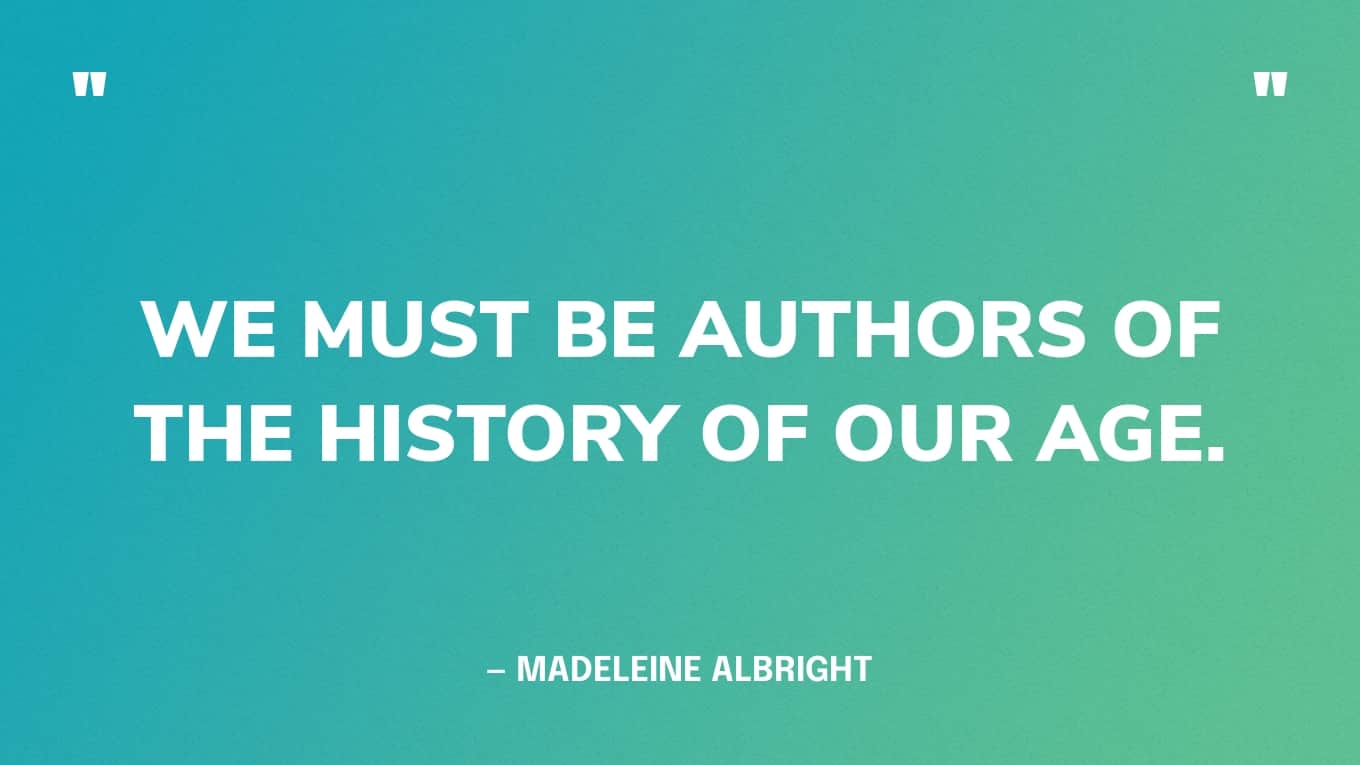
“We must be authors of the history of our age.”
— Madeleine Albright
“In a world where one-third of all edible food never makes it to the mouths of the hungry, we all have an individual moral responsibility to do our part.”
— Madeleine Albright, talking about world hunger
I have spent a lifetime looking for remedies to all manner of life's problems — personal, social, political, global. I am deeply suspicious of those who offer simple solutions and statements of absolute certainty or who claim full possession of the truth. Yet I have grown equally skeptical of those who suggest that all is too nuanced and complex for us to learn any lessons, that there are so many sides to every thing that we can pursue knowledge every day of our lives and still know nothing for sure. I believe we can recognize truth when we see it, just not a first and not without ever relenting in our efforts to learn more. This is because the goal we seek, and the good we hope for, comes not as some final reward but as the hidden companion to our quest. It is not what we find, but the reason we cannot stop looking and striving, that tells us why we are here.”
― Madeleine Albright, Prague Winter: A Personal Story of Remembrance and War, 1937-1948
Related: Read the best quotes about making a difference
Related: Read the best ideas on how to make a difference
On refugees and being a refugee
“When I came here as a child, I will never forget sailing into New York Harbor for the first time and beholding the Statute of Liberty. I did not have to face refugee camps or the kind of danger that many refugees endure. But like all refugees, I shared a hope to live a safe life with dignity and a chance to give back to my new country.”
— Madeleine Albright
“When countries with insufficient resources take in refugees, it creates more instability, not just at the frontlines of this crisis, but around the world. If we were to slam the door in the faces of refugees with certain religious backgrounds, we would defy our history and our principles of pluralism and diversity.”
— Madeleine Albright
“There is a significant moral difference between a person who commits a violent crime and a person who tries to cross a border illegally in order to put food on the family table. Such migrants may violate our laws against illicit entry, but if that's all they do they are trespassers, not criminals. They deserve to have their dignity respected.”
— Madeleine Albright
“Only in America could a refugee girl from Central Europe become Secretary of State.”
— Madeleine Albright
Related: Learn more about how to support refugees
Related: Find an organization that helps refugees near you
On being a diplomat and Secretary of State
“Well, the thing I learned as a diplomat is that human relations ultimately make a huge difference.”
— Madeleine Albright
“If you look at my life, generally, I've been put in situations that were difficult and which I conquered.”
— Madeleine Albright
“When we're trying to solve difficult national issues it's sometimes necessary to talk to adversaries as well as friends. Historians have a word for this: diplomacy.”
— Madeleine Albright
“A lot of people think international relations is like a game of chess. But it's not a game of chess, where people sit quietly, thinking out their strategy, taking their time between moves. It's more like a game of billiards, with a bunch of balls clustered together.”
— Madeleine Albright
“I loved being Secretary of the State, that's probably evident to everyone who watched me.”
— Madeleine Albright
More quotes
“Don't make me into this airy-fairy, moralist, idealist because I'm not.”
— Madeleine Albright
“I have very set and consistent principles, but I am flexible on tactics.”
— Madeleine Albright
“History is written backwards but lived forwards.”
— Madeleine Albright
“I was taught to strive not because there were any guarantees of success but because the act of striving is in itself the only way to keep faith with life.”
— Madeleine Albright
“The best book, like the best speech, will do it all — make us laugh, think, cry and cheer — preferably in that order.”
— Madeleine Albright
“We cannot, of course, expect every leader to possess the wisdom of Lincoln or Mandela’s largeness of soul. But when we think about what questions might be most useful to ask, perhaps we should begin by discerning what our prospective leaders believe it worthwhile for us to hear.
Do they cater to our prejudices by suggesting that we treat people outside our ethnicity, race, creed or party as unworthy of dignity and respect?
Do they want us to nurture our anger toward those who we believe have done us wrong, rub raw our grievances and set our sights on revenge?
Do they encourage us to have contempt for our governing institutions and the electoral process?
Do they seek to destroy our faith in essential contributors to democracy, such as an independent press, and a professional judiciary?
Do they exploit the symbols of patriotism, the flag, the pledge in a conscious effort to turn us against one another?
If defeated at the polls, will they accept the verdict, or insist without evidence they have won?
Do they go beyond asking about our votes to brag about their ability to solve all problems put to rest all anxieties and satisfy every desire?
Do they solicit our cheers by speaking casually and with pumped up machismo about using violence to blow enemies away?
Do they echo the attitude of Musolini: “The crowd doesn’t have to know, all they have to do is believe and submit to being shaped.”?
Or do they invite us to join with them in building and maintaining a healthy center for our society, a place where rights and duties are apportioned fairly, the social contract is honored, and all have room to dream and grow.
The answers to these questions will not tell us whether a prospective leader is left or right-wing, conservative or liberal, or, in the American context, a Democrat or a Republican. However, they will us much that we need to know about those wanting to lead us, and much also about ourselves.
For those who cherish freedom, the answers will provide grounds for reassurance, or, a warning we dare not ignore.”
― Madeleine Albright, Fascism: A Warning
Bryan Stevenson was in the second grade in 1955, when the school in his small, rural town in Delaware was desegregated.
But even though he was now technically allowed to go the same school as the white kids he grew up around, he still had to play separately from them and use a different entrance. He couldn’t even go to the same public pool as the white kids.
Growing up like this left a deep mark on Stevenson, one he carried with him to Harvard Law School, where he received a full-ride scholarship and found his life calling.
He wanted to bring justice to the people who needed it most and in Stevenson’s experience, the people who needed it most were on death row.
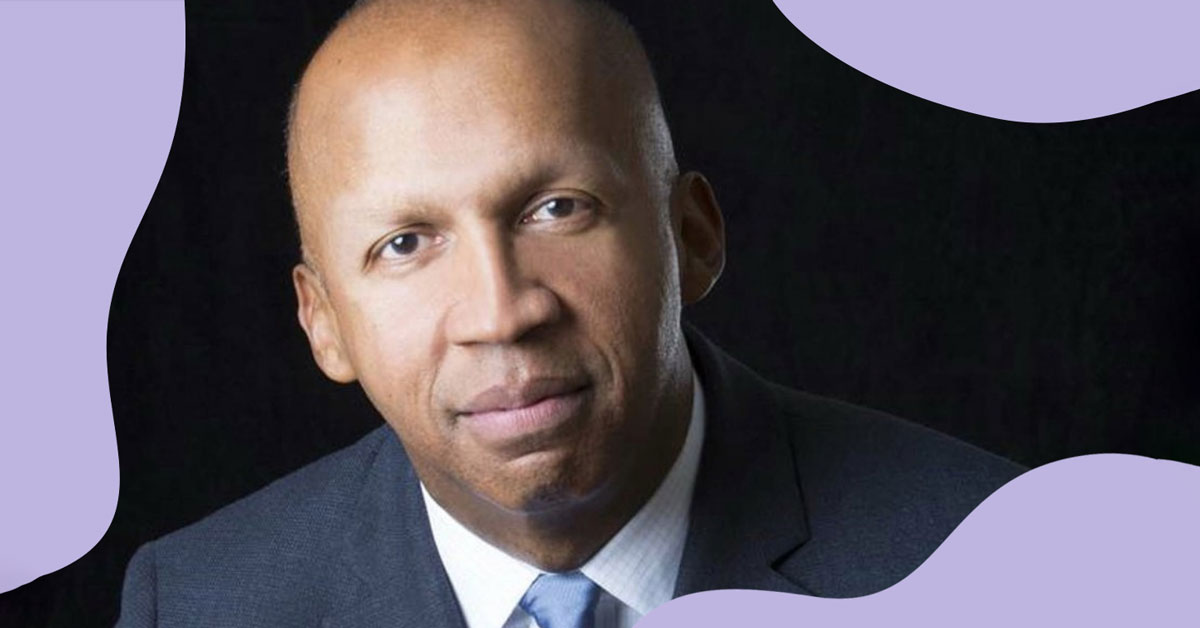
In 1995, he founded the Equal Justice Initiative, a nonprofit organization that seeks fair sentences for minorities, the poor, and, especially, children who find themselves in the justice system.
Stevenson was deeply concerned about people who were convicted for crimes they committed before they turned 18, and worked hard to convince the country that it was immoral and unconstitutional to pursue life sentences without parole for minors who were convicted of crimes.
As he wrote in his book Just Mercy, “Each of us is more than the worst thing we’ve ever done.”
Stevenson believes that we as a people have a duty to offer mercy to everyone, especially those who may not deserve it. That, after all, is what mercy is all about.
Stevenson’s hard work was rewarded in 2012, when the Supreme Court ruled that life sentences without parole for people 17 years old and under were unconstitutional, a landmark decision that affected 29 different states.
As of August of 2016, the Equal Justice Initiative had rescued 125 men from the death penalty.
Related: We collected Bryan Stevenson's best quotes about justice, mercy, and more to leave you inspired and ready to get involved
You might also like:
- The best quotes about justice
- The best quotes about activism
- The best quotes about hope
- The best quotes about death penalty abolition
A version of this article was originally published in Issue 01 of the Goodnewspaper in July 2017.
Europe's schools scramble to make space for more than 1.5 million children fleeing the war in Ukraine
— More than 1.5 million children have fled war in Ukraine
— Countries hire extra teachers, offer online classes
— Refugee groups urge more language support and therapy
Among the crowds of Irish revellers lining Dublin's streets for last week's St Patrick's Day parade stood a small girl in pigtails with Ukrainian flags painted on her cheeks and an oversized green hat - a gift from her new school.
Eight-year-old Varvara Koslovska is among more than 1.5 million children who have fled the war in Ukraine, which began one month ago, triggering Europe's fastest-growing refugee crisis since World War II.
From Ireland to Poland, countries are expanding classes, fast-tracking the registration of Ukrainian teachers, translating curriculums, and offering online lessons to ensure children uprooted by the war do not lose out on education.
Varvara, her brother Platon, 5, and cousins Ivan, 9, and Egor, 7, started at their new primary school just days after arriving in Ireland, at the end of a long journey from their home city Kyiv.
Bubbly and confident, Varvara has only a smattering of English but was all smiles as she described her new life.
"All the girls want to be friends with me. Everyone wants to help me - we've had loads of presents," she told the Thomson Reuters Foundation in a video call, holding up her new blue school bag patterned with stars, a gift from her head teacher.
The U.N. children's agency UNICEF said countries across Europe had promised to integrate Ukrainian refugee children into schools within three months of their arrival.
It is a vast operation for education systems that are often already struggling with tight budgets, large class sizes, and the impacts of the COVID-19 pandemic. Many refugee children will also need specialist language and psychological support.
UNICEF said getting children back into school quickly was crucial not only for their own development, but also for the future of Ukraine.
"In the short term, it provides them with the support, stability, and structure needed to cope with the trauma they've experienced," said UNICEF spokesman Joe English.
"In the long-term, school equips children with the knowledge and skills they need to rebuild their communities once the conflict is over."
"Huge Solidarity"
More than 3.6 million Ukrainians have fled the war, about half of them children, according to UNICEF, with the largest refugee inflows into Poland, Romania, Moldova, and Hungary.
Ireland, which waived visa requirements immediately after the Russian invasion on Feb. 24, was until recently home to about 5,000 Ukrainians. That number has since more than doubled.
Its government is prioritizing the registration of Ukrainian teachers arriving in the country to support refugee children.
Germany is also considering hiring Ukrainian teachers in its schools, which are already strained by teacher shortages and high levels of COVID-19 sick leave, according to national media.
Poland, which is hosting more than 2 million Ukrainians, has changed the law to increase class sizes, is boosting funding for education, and has set up a hotline for parents.
It has registered more than 100,000 students, with about half of Polish schools now containing Ukrainian children.
Those who speak some Polish are entering mainstream classes. Others are taught separately while they learn the language.
The government has also waived normal hiring rules to allow Ukrainians who speak Polish to work as teaching assistants.
"If necessary, we will change the law and change the organization of schools to help every child," said education ministry spokeswoman Anna Ostrowska.
"We've seen huge solidarity. It's very touching."
Trauma Fears
Some refugee experts have raised concerns about a shortage of language support teachers and psychological help for traumatized children.
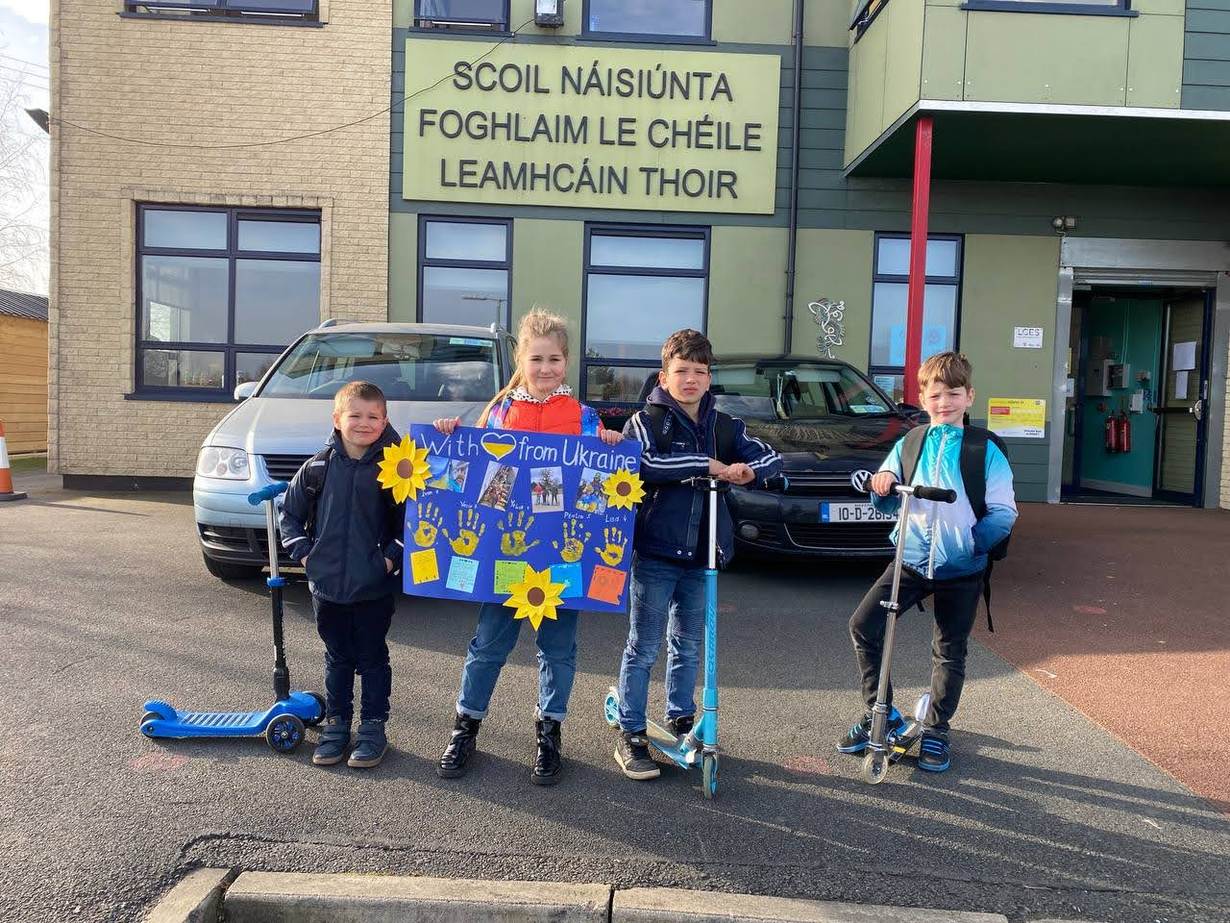
Many, like Varvara, have fathers fighting in the war, and relatives who have stayed behind. Others have witnessed shelling or lost loved ones.
"I'm worried because the children still hear the news, they know what's going on," said Varvara's mother Tatyana, adding her daughter missed her father very much and spoke to him every day by WhatsApp.
Varvara's grandfather, a pediatrician at a hospital in Zaporizhzhia, has been treating children injured during Russia's bombardment of the southern city of Mariupol.
"On the day we left, Varvara was crying constantly," Tatyana said. "We told her it wouldn't be for long. But the truth is no one knows when, or if, they will see their home again."
Education departments in Ireland, Poland and Britain said they would provide mental health support, but it was unclear whether any services would be available in Ukrainian.
Acute housing shortages in Ireland - like many European countries - mean many refugee children may be settled outside urban areas with less access to specialist support, refugee charities said.
Varvara's new school has tried to place the refugee children into classes with other pupils who speak their language.
But she says breaktime is hard despite the warm welcome.
"We get upset because no one understands us," she said, adding she was trying to learn more English on a language app.
New Language Tools
The introduction of online learning during the COVID-19 pandemic could help many children keep up with lessons while awaiting school places.
Despite the war, some schools in Ukraine are still running online lessons which pupils can access from outside the country.
Children in Poland who want to follow the Ukrainian curriculum are being offered support to get online, the education ministry said.
European Union education ministers are also exploring how to pool digital content to help refugee children.
In Britain, the Oak National Academy, a charity set up during the pandemic to offer online education, has already translated 10,000 lessons into Ukrainian - in theory allowing children to complete the English curriculum in Ukrainian.
In contrast to its EU neighbors, Britain has come under fire for its slow response to the crisis and cumbersome visa process.
The government has said it is ready to take 100,000 children, but had only issued 18,600 visas to Ukrainians as of Thursday.
The education department said schools are ready to absorb children when they arrive, adding that they had quickly found places for children evacuated from Afghanistan following the Taliban's takeover last August.
Back in Ireland, Varvara is keen on maths and picking up new words every day. Her mother says school has helped restore a sense of normality to her children's lives.
"I'm trying to keep things positive and hope they will remember this as an adventure," Tatyana said.
Related Stories
- Good Good Good Guide: How to Help Ukrainians
- Is there any good news in Ukraine?
- How to support refugees in your community
- How to help refugees around the world
- A conversation with a top official at the UNHCR
- The story of one Ukrainian Etsy seller making a difference
- Who is working to rebuild housing in Ukraine?
Header image: Ukrainian refugee Varvara, 8, attends the St Patrick's Day Parade with her uncle Andriy Koslovskyi in the Irish capital Dublin on March 17, 2022. Photo taken by Tatyana Koslovska. / Thomson Reuters Foundation.
Reporting by Emma Batha; Editing by Sonia Elks and Katy Migiro. This article was originally published by the Thomson Reuters Foundation, the charitable arm of Thomson Reuters, which covers the lives of people around the world who struggle to live freely or fairly.
Only 3% of active physicians are Black women. A wave of new digital platforms is trying to make it easier to find them.
The trip from Sacramento to Oakland, California, is an hour and a half on a good day. Maybe three when traffic jams the highway. But it’s a trip some of Dr. Joy Cooper’s patients were willing to take to see a provider who looked like them.
“Otherwise,” she said, “they would not see a Black physician.”
Finding a Black provider who is in a patient’s insurance network, works nearby, and is accepting new patients can be difficult, said Cooper, an OB-GYN practicing with the Alameda Health System.
Only 3% of active physicians are Black women, but their presence is crucial given the history of medical mistreatment and health disparities facing Black Americans.
The result: Patients drive dozens of miles for health care or, she said, “people end up settling for less.”
Inspired by the need to increase access to Black women physicians, Cooper partnered with another doctor, Monique Smith, in 2018 to found Culture Care. The digital health site links Black women with culturally similar doctors who can give them advice on navigating relationships with their in-person medical teams.
It was a move toward digital medicine before telehealth made its mark in health care amid the COVID-19 pandemic, using it as a potential solution to address racial health disparities.
Culture Care is among a wave of digital platforms and apps created to connect Black women with physicians and therapists who look like them in an effort to overcome some of the barriers that lead Black women to avoid getting needed physical and mental health care – and to receive substandard service when they do.
They include sites like Therapy for Black Girls, a service focused on destigmatizing mental health, and Health in Her Hue, which offers a database of culturally competent providers in dermatology, oncology, and other specialties.
The digital services were largely created by Black doctors and patients, women who are increasingly breaking into the tech space as entrepreneurs and using technology to address disparities in their communities.
“There’s a more robust understanding now of the importance of having culturally specific support and diversity on your care team as a Black person, as a part of a marginalized community,” said Maya Hardigan, who launched her own platform last year. “It actually can impact your health outcomes.”
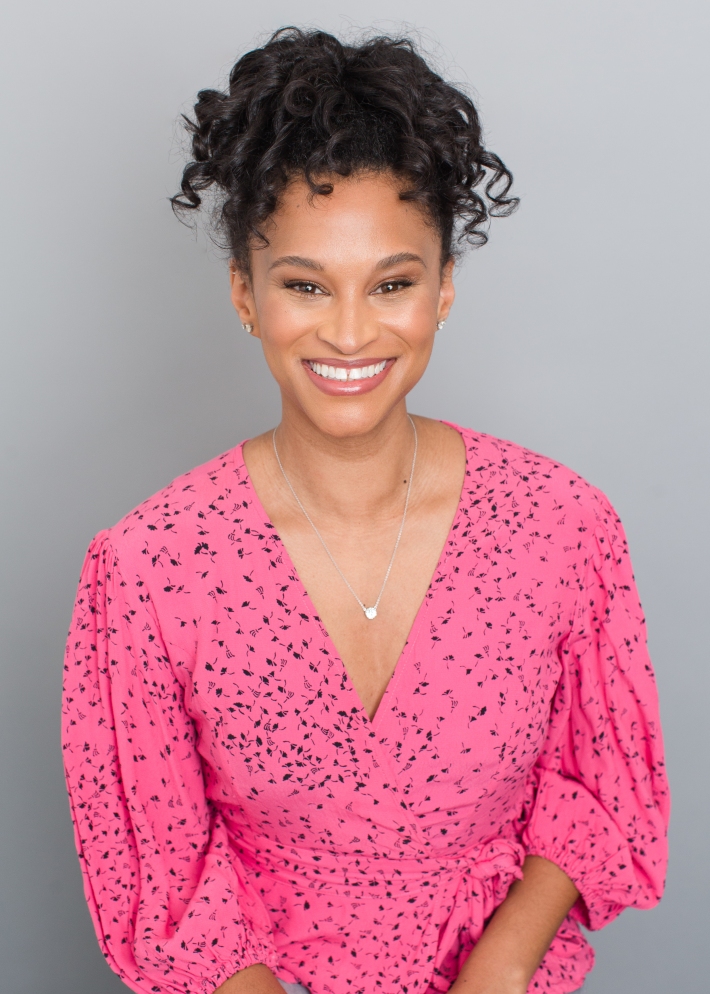
It was the height of the pandemic and racial justice protests in 2020 that inspired Hardigan to sit down with her husband and assess if the family of five living in New York City could take on the risk of Hardigan leaving her job and launching a startup.
Her vision was a digital maternal health platform aimed at increasing positive outcomes for Black moms. It launched last fall after she workshopped the product and built a small team.
It’s now called Meet Mae – a platform that offers health tracking, maternal health tips, and a database of culturally competent support for expectant moms, like doulas.
Across the country, Black patients outnumber Black physicians, especially Black women.
The proportion of Black physicians nationwide has increased by only 4 percentage points over the past 120 years, according to a study last year by UCLA.
In 1900, Black people made up 11% of the U.S. population and 1% of physicians. More than a century later, Black Americans were 13% of the population in 2018 and just 5% of physicians.
In Detroit, a city that is overwhelmingly Black, Dr. Ijeoma Nnodim Opara says, “Oftentimes, I’m still one of the very few Black doctors that they get to see.”
Research shows that for Black Americans, being cared for by a doctor who looks like them can protect patients against some disparate health outcomes.
In childbirth, Black babies are more likely to survive when cared for by a Black doctor, according to a 2020 study. The researchers found that Black newborns were nearly three times more likely to die than white babies when cared for by white doctors.
The mortality rate for white babies remained unchanged by the physician’s race.
Related: Midwives and Doulas Are Working To End Birth Disparities
Related: Innovative and Life-Saving Medical Advancements from the Last Century
Related: To Boost Black Men in Medicine, Advocates Are Turning To Sports
Another study by Penn Medicine researchers showed that patients who see doctors of their own race are more likely to rate their health care experience higher.
Hardigan’s model is based on the notion that small interventions, such as risk screenings at the beginning of pregnancy and increased awareness of the signs and symptoms that patients should seek immediate medical attention for, can save lives.
Culture Care was designed with a similar intention.
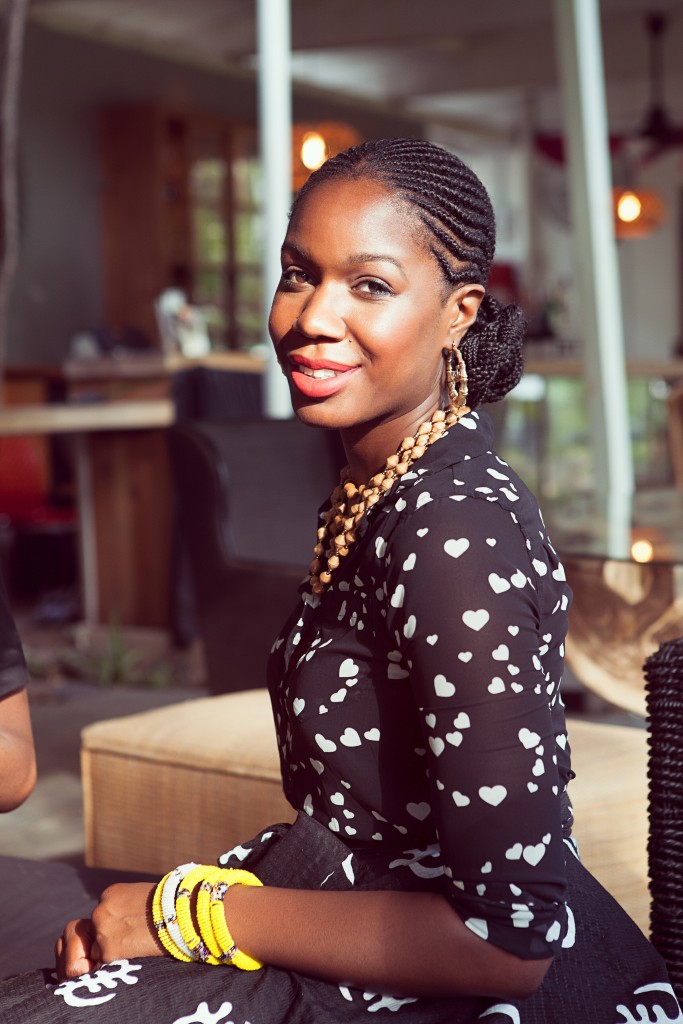
“I can have an impact without being in the same room,” said Culture Care’s Cooper. Its team includes a pediatrician, family medicine physician, lactation specialist, and mental health therapist.
The staff answers patients’ questions, advises on whether immediate medical intervention might be necessary, and serves as an additional support to Black patients.
It’s intended to recreate the sense of community historically present in Black neighborhoods when residents knew their local doctors and trusted them, Cooper said.
The motivation for Culture Care came from Smith’s personal experience as a patient in the maternity ward. She had been in labor 22 hours, and there were multiple complications.
During postpartum recovery after an emergency C-section, Smith reached out to Cooper, who answered every text and phone call. Smith was concerned about her blood pressure and about the healing of her incisions.
It was extra support that helped her navigate the health care system and access a doctor who looked like her – one that she knew and trusted.
“We’re a one-stop shop that you don’t have to leave your home to go to,” Cooper said.
A lot of times, patients will sit at home not feeling well or wondering about symptoms without heading to emergency care centers, in large part, she said, due to mistrust. “Even if we can’t do everything here, sometimes you need someone to tell you to go now.”
Opara, the Detroit physician, notes that the culture and norms within the medical system are built for white physicians. Opara knew as a teenager that she wanted to go into medicine, but as an undergrad, she majored in African studies and learned about the disparities pervasive in health, education, wealth, and criminal justice.
“That informed the way I engaged with medicine,” said Opara. Addressing the social factors that influence health, particularly structural racism, is critical for improving health outcomes for Black Americans, she said.
The outlook for Black women looking for Black OB-GYNs for pregnancy care is somewhat brighter.
In the speciality, Black women make up about 7% of active physicians, according to the Association of American Medical Colleges.
Still, maternal mortality rates are increasing. And Black women remain three to four times more likely to die due to pregnancy-related complications than white women.
“There’s not one silver bullet answer,” said Hardigan, Meet Mae’s founder.
Black women are working against racism and bias in maternal health care as well as elevated rates of chronic conditions impacted by often limited access to quality, culturally competent care, she said. Small interactions eroded the trust she’d had with her providers during her own pregnancy.
“What they tell us is that we’re not really being seen and treated for all of who we are,” Hardigan said.
She was a Black woman working within the health system with good insurance and solid financial resources, she said, “and yet I still felt a lot of marginalization.”
She’s not alone.
A lot of the writing on Meet Mae’s websites is by Black women reflecting on what worked throughout their pregnancies and what did not. “We can share in our experiences,” said Hardigan, “and let our users know we’ve been there.”
It’s a space for an open conversation on what it means to be Black and pregnant with maternal death rates increasing. It also provides real-time symptom tracking with weekly check-ins to assess physical and emotional risks and concerns.
It’s a pregnancy companion, Hardigan said, that lets moms know what they should be looking for at each stage of pregnancy and when to seek medical attention, if needed.
Meet Mae also connects families to doulas and lactation consultants, and offers culturally competent lifestyle tips.
“This feels deeply personal for me as a mom of three girls,” said Hardigan. “We’re really looking to see the tide shift in time for the next generation.
This story is part of the SoJo Exchange from the Solutions Journalism Network, a nonprofit organization dedicated to rigorous reporting about responses to social problems. It was originally published by Capital B.
Dr. Jane Goodall passed away at the age of 91. "Dr. Goodall's discoveries as an ethologist revolutionized science, and she was a tireless advocate for the protection and restoration of our natural world," said a statement from the Jane Goodall Institute. She was in California as a part of her speaking tour.
Goodall was one of the world's most celebrated primatologists and conservationists. Born in London, England, in 1934, Goodall was fascinated by animals from a young age.
She began her groundbreaking research on chimpanzees in Tanzania's Gombe Stream National Park in 1960. Over the course of her six-decade career, Goodall worked tirelessly to protect chimpanzees and their habitats.
In 2002, she founded the Jane Goodall Institute, which supports chimpanzee conservation efforts around the world. Goodall's work inspired people of all ages to appreciate and respect animals and our natural environment.
(We also recommend her site as one of the best places to find good news on the internet.)
At Good Good Good, we've always been drawn to Jane Goodall's relentless pursuit of hope — and her passion for inspiring young people to make a difference.
As we honor her life today — and every day — let's learn from her wisdom.
Here are our favorite Jane Goodall quotes to leave you inspired to make a difference for animals, earth, and people:
Famous Inspirational Quotes from Dr. Jane Goodall
“I do have reasons for hope: our clever brains, the resilience of nature, the indomitable human spirit, and above all, the commitment of young people when they’re empowered to take action.”
— Jane Goodall

“You cannot get through a single day without having an impact on the world around you.”
— Jane Goodall

“The greatest danger to our future is apathy.”
— Jane Goodall
“I think empathy is really important, and I think only when our clever brain and our human heart work together in harmony can we achieve our full potential.”
— Jane Goodall
“Let us try to replace violence and intolerance with understanding and compassion. And love.”
— Jane Goodall
“If only we can overcome cruelty, to human and animal, with love and compassion we shall stand at the threshold of a new era in human moral and spiritual evolution ― and realize, at last, our most unique quality: humanity.”
— Jane Goodall
“Let us not forget that human love and compassion are equally deeply rooted in our primate heritage.”
— Jane Goodall

“We have so far to go to realize our human potential for compassion, altruism, and love.”
— Jane Goodall
On Hope
“Hope is often misunderstood. People tend to think that it is simply passive wishful thinking: I hope something will happen but I’m not going to do anything about it. This is indeed the opposite of real hope, which requires action and engagement.”
— Jane Goodall, The Book of Hope: A Survival Guide for Trying Times
“There is still so much in the world worth fighting for. So much that is beautiful, so many wonderful people working to reverse the harm, to help alleviate the suffering. And so many young people dedicated to making this a better world. All conspiring to inspire us and to give us hope that it is not too late to turn things around, if we all do our part.”
— Jane Goodall, in her New Year’s message for 2018
“Hope does not deny the evil, but is a response to it.”
— Jane Goodall, The Book of Hope: A Survival Guide for Trying Times
“In all my lectures and books, I focus on reasons for hope. But today, it’s getting harder and harder to take that message of hope around the world. Todays’ young people—everywhere I go—they’re so excited and empowered. We’re listening to their voices. That gives us a reason to hope.”
— Jane Goodall, A New Era of Discovery in Gombe Thanks to Disney Family Trust

Related: Read this curated collection of quotes about hope and another on optimism (and the difference between them)
On Making a Difference
“What you do makes a difference, and you have to decide what kind of difference you want to make.”
— Jane Goodall
“There is a powerful force unleashed when young people resolve to make a change.”
— Jane Goodall
“Only if we understand, will we care. Only if we care, will we help. Only if we help shall all be saved.”
— Jane Goodall, as quoted in the Becoming Jane Challenge
“Change happens by listening and then starting a dialogue with the people who are doing something you don't believe is right.”
— Jane Goodall
“Lasting change is a series of compromises. And compromise is all right, as long your values don’t change.”
— Jane Goodall
“Each one of us must take responsibility for our own lives, and above all, show respect and love for living things around us, especially each other.”
— Jane Goodall
“Every individual matters. Every individual has a role to play. Every individual makes a difference.”
— Jane Goodall
“We have the choice to use the gift of our life to make the world a better place ― or not to bother.”
— Jane Goodall
“My job is to collect stories of hope — because there's so much going on that's awful. Animals becoming extinct, forests disappearing, people suffering tremendously. If this is the only aspect that gets out to the general public, they think there's not much we can do and they do nothing. And so these stories that show what can be done I think are tremendously important.”
— Jane Goodall, in an interview with Ecosia
“But consumers, at least if they’re not living in poverty, have an enormous role to play, too. If you don’t like the way the business does its business, don’t buy their products. This is beginning to create change. People should think about the consequences of the little choices they make each day.”
— Jane Goodall, in an interview in The New York Times
“Young people, when they understand the problems, are empowered to take action. When we listen to their voices (they) actually are changing the world and making it better for people, for animals, and for the environment because everything is interconnected.”
— Jane Goodall, after winning the BBVA Foundation Worldwide Award for Biodiversity
“My job now is to try and help people understand every one of us makes a difference. And cumulatively, wise choices in how we act each day can begin to change the world.”
— Jane Goodall, in an interview with The Washington Post
“We can work together to make the world a better place. Perhaps there can be peace one day if we learn from our past and commit to compassionate action for our futures.”
— Jane Goodall, reflecting on the 20th anniversary of 9/11
Related: Read these curated quotes from activists about activism
On Animals
“The least I can do is speak out for those who cannot speak for themselves.”
— Jane Goodall

“If we kill off the wild, then we are killing a part of our souls.”
— Jane Goodall
“Let us develop respect for all living things.”
— Jane Goodall
“If we do not do something to help these creatures, we make a mockery of the whole concept of justice.”
— Jane Goodall
“Farm animals are far more aware and intelligent than we ever imagined and, despite having been bred as domestic slaves, they are individual beings in their own right.”
— Jane Goodall
“Surely, we do not want to live in a world without the great apes, our closest living relatives in the animal kingdom? A world where we can no longer marvel at the magnificent flight of bald eagles or hear the howl of wolves under the moon? A world not enhanced by the sight of a grizzly bear and her cubs hunting for berries in the wilderness? What would our grandchildren think if these magical images were only to be found in books?”
— Jane Goodall, in a statement in defense of The Endangered Species Act
“I’ve spent my life speaking out on behalf of animals. And there is one issue that stands out uniquely as one of the worst threats to their survival. The illegal wildlife trade… without doing something today, we could face a world in which thousands and thousands of species go silent. Never to return. But there is something we can do today, and it will take all of us working together to make it possible.”
— Jane Goodall
On Chimpanzees
“Chimpanzees, more than any other living creature, have helped us to understand that there is no sharp line between humans and the rest of the animal kingdom.”
— Jane Goodall
“One thing I had learned from watching chimpanzees with their infants is that having a child should be fun.”
— Jane Goodall
“Chimps turned out to be, not only behaviorally so like us, but also biologically like us, sharing 98.6 percent of DNA, similarities in immune system, blood composition, anatomy of the brain. We’re not, after all, separate from the animal kingdom. We’re part of it.”
— Jane Goodall, in an interview in The New York Times
On the Environment
“In order to slow down climate change, we must solve four seemingly unsolvable problems. We must eliminate poverty. We must change the unsustainable lifestyles of so many of us. We must abolish corruption. And we must think about our growing human population… But I believe we have a window of time to have an impact.”
— Jane Goodall, in TIME
“Here we are, the most clever species ever to have lived. So how is it we can destroy the only planet we have?”
— Jane Goodall
“To reconnect with nature is key if we want to save the planet.”
— Jane Goodall
“You may not believe in evolution, and that’s alright. How we humans came to be the way we are is far less important than how we should act now to get out of the mess we have made for ourselves.”
— Jane Goodall
“Of course, a great deal of our onslaught on Mother Nature is not really lack of intelligence but a lack of compassion for future generations and the health of the planet: sheer selfish greed for short-term benefits to increase the wealth and power of individuals, corporations and governments. The rest is due to thoughtlessness, lack of education, and poverty. In other words, there seems to be a disconnect between our clever brain and our compassionate heart. True wisdom requires both thinking with our head and understanding with our heart.”
— Jane Goodall, The Book of Hope: A Survival Guide for Trying Times
“Fortunately, nature is amazingly resilient: places we have destroyed, given time and help, can once again support life, and endangered species can be given a second chance. And there is a growing number of people, especially young people, who are aware of these problems and are fighting for the survival of our only home, Planet Earth. We must all join that fight before it is too late.”
— Jane Goodall
On Women and Girls
“It actually doesn’t take much to be considered a difficult woman. That’s why there are so many of us.”
— Jane Goodall

“Women tend to be more intuitive, or to admit to being intuitive, and maybe the hard science approach isn't so attractive. The way that science is taught is very cold. I would never have become a scientist if I had been taught like that.”
— Jane Goodall
“When I was a little girl, I used to dream as a man, because I wanted to do things that women didn’t do back then such as traveling to Africa, living with wild animals and writing books.
I didn’t have any female explorers or scientists to look up to but I was inspired by Dr. Dolittle, Tarzan and Mowgli in The Jungle Book — all male characters.
It was only my mother who supported my dream: ‘You’ll have to work hard, take advantage of opportunities and never give up,’ she’d tell me.
I’ve shared that message with young people around the world, and so many have thanked me, and said, ‘You taught me that because you did it, I can do it too.’”
— Jane Goodall, in TIME
“Because I succeeded in a scientific world largely dominated by men, I’ve been described as a feminist role model, but I never think of myself in that way. Although the feminist movement today is different, many women who have succeeded have done so by emphasizing their masculine characteristics. But we need feminine qualities to be both accepted and respected and in many countries this is beginning to happen. I love that the new movement involves women joining their voices together on social media, thus giving a sense of solidarity.”
— Jane Goodall, in TIME
Related: Read Women’s History Month quotes
On Nature
“Nature can win if we give her a chance.”
— Jane Goodall

“Any little thing that brings us back into communion with the natural world and the spiritual power that permeates all life will help us to move a little further along the path of human moral and spiritual evolution.”
— Jane Goodall

“To reconnect with nature is key if we want to save the planet.”
— Jane Goodall

Related: Read the best Earth Day quotes
On Life
“Like our intellect, social media in itself is neither good nor bad — it is the use to which we put it that counts.”
— Jane Goodall, The Book of Hope: A Survival Guide for Trying Times
“Children — and adults — who have a growth mindset are much more successful than those who have a fixed mindset about themselves and the world.”
— Jane Goodall, The Book of Hope: A Survival Guide for Trying Times

“The advice I give to young people today is exactly what my mother gave to me when I was 10 and I said I’m going to grow up go to Africa, live with wild animals and write books about them. Everybody laughed. How could I do that? We didn’t have any money. World war ii was raging. I was just a girl. But my mother always said, ‘If you really want something, you’re going to have to work hard, you’ll have to take advantage of every opportunity but don’t give up.’ I’ve taken that message to young people…all around the world.
— Jane Goodall
→ Read more quotes about life
Short Jane Goodall Sayings
“Without patience, I could never have succeeded.”
— Jane Goodall
“Forgiveness is how we unchain ourselves from the past.”
— Jane Goodall, The Book of Hope: A Survival Guide for Trying Times
“There seems to be a disconnect between our clever brain and our compassionate heart.”
— Jane Goodall, The Book of Hope: A Survival Guide for Trying Times
“What you have to do is to get into the heart. And how do you get into the heart? With stories.”
— Jane Goodall, at the World Economic Forum
More Quotes from Jane Goodall
“We need to raise the standard of living for 80% of the world’s people while bringing it down considerably for the 20% who are destroying our natural resources.”
— Jane Goodall
“What makes us human, I think, is an ability to ask questions, a consequence of our sophisticated spoken language.”
— Jane Goodall
“Is world peace EVER going to be a reality? Sadly, likely not in our lifetimes. But that does not mean we should give in to despair. Mahatma Gandhi once said, ‘When I despair, I remember that all through history the way of truth and love have always won. There have been tyrants and murderers, and for a time, they can seem invincible, but in the end, they always fall. Think of it-always.’”
— Jane Goodall, reflecting on the 20th anniversary of 9/11
“I truly believe that the number of good and decent people in the world form by far the greatest percentage of the world population. And while there are those who are ruthless in their desire for ever more wealth and power, a great deal of harm is done simply through ignorance or the desperation of poverty or by those who have been misled.”
— Jane Goodall, reflecting on the 20th anniversary of 9/11
“One million species are in danger of extinction. So what I say to the business community is: Just think logically. This planet has finite natural resources. And in some places, we’ve used them up faster than Mother Nature can replenish them. How can it make sense if we carry on in the way we are now, with business as usual, to have unlimited economic development on a planet with finite natural resources, and a growing population?”
— Jane Goodall, in an interview in The New York Times
“People should think about the consequences of the little choices they make each day. What do you buy? Where did it come from? Where was it made? Did it harm the environment? Did it lead to cruelty to animals? Was it cheap because of child slave labor? And it may cost you a little bit more to buy organic food, but if you pay a little bit more, you waste less. We waste so much. And eat less meat. Or no meat. Because the impact on the environment of heavy meat eating is horrible, not to mention the cruelty.”
— Jane Goodall, in an interview in The New York Times
“To me, cruelty is the worst of human sins. Once we accept that a living creature has feelings and suffers pain, then by knowingly and deliberately inflicting suffering on that creature, we are guilty, whether it be human or animal.”
— Jane Goodall
“We can have a world of peace. We can move toward a world where we live in harmony with nature. Where we live in harmony with each other. No matter what nation we come from. No matter what our religion. No matter what our culture. This is where we’re moving towards.”
— Jane Goodall, in her Peace Day 2018 message
You might also like:
In early December last year, a 71-year-old man in Sweden received an early Christmas present: a new chance at life, delivered via drone.
While shoveling snow in front of his home in Trollhättan, about 75 kilometers north of Gothenburg, he suffered a cardiac arrest. A passerby, Mustafa Ali, saw him collapse and called emergency response.
After three minutes, before the first responders got to the scene, a drone arrived and hovered over the driveway, “First, I thought, there’s somebody filming here,” Ali told Euronews, “but someone from the alarm center said, ‘Here is your defibrillator, so just pick it up.’ Okay!”
The drone winched down an automated external defibrillator (AED), with clear instructions on where to attach its yellow pads to the patient’s body. The quick rescue saved the patient’s life.
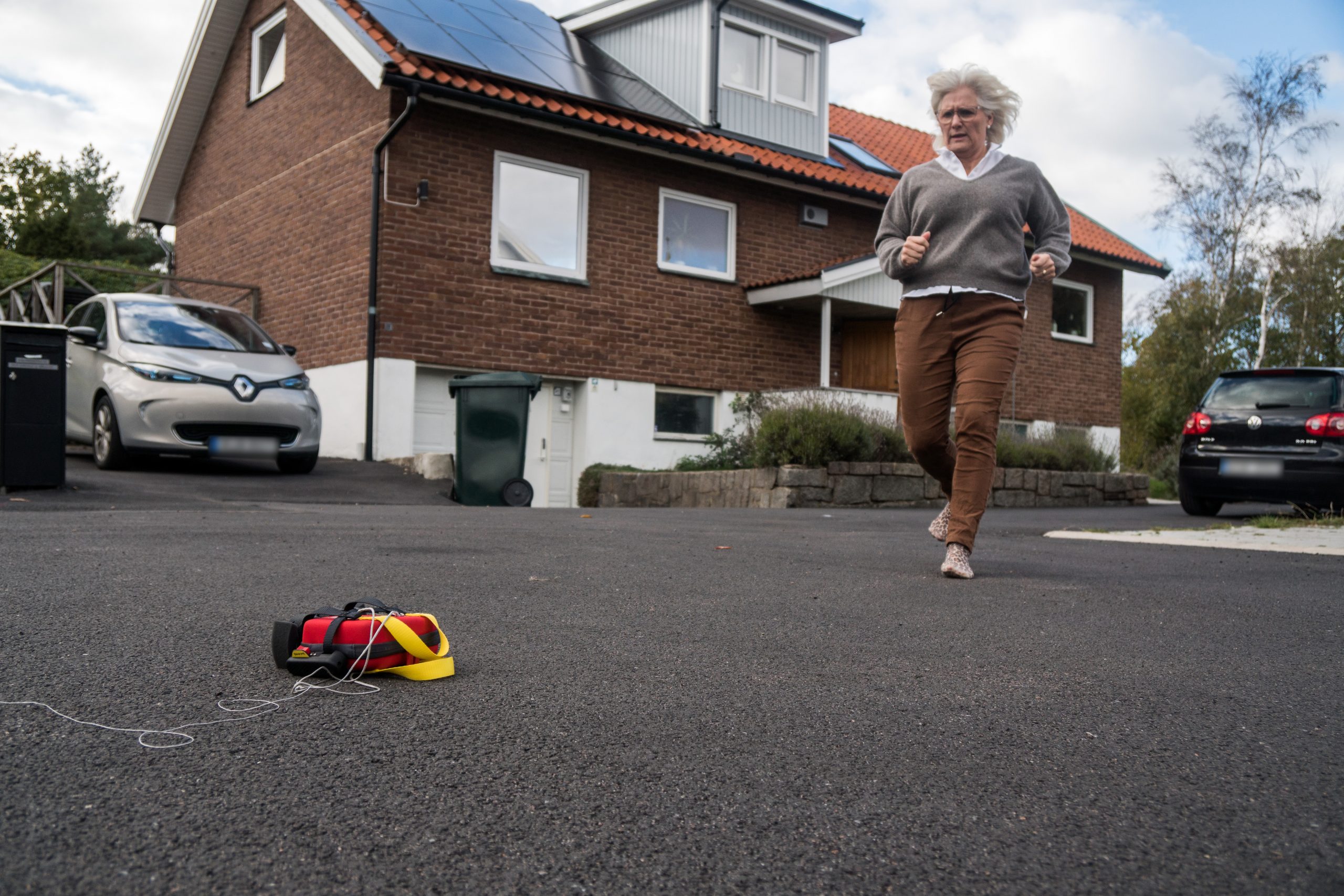
Sweden is the first country in the world that began to equip drones with AEDs in 2020. In the Trollhättan emergency, the first responders were there within five minutes, but the drone was there in three.
What sounds like only a slight difference can mark the frontier between life and death.
Some doctors use the popular adage, “Time is brain,” because with every minute that passes after a cardiac arrest, a patient’s survival rate decreases by 10 percent, and brain functions can be damaged irreversibly.
“275,000 Europeans and about 350,000 Americans suffer a cardiac arrest every year,” Magnus Hallberg, a developer at the drone company Everdrone, says. “Only ten percent survive.” Too often, bystanders don’t know how to perform first aid, and defibrillators are rarely at hand.
After two years, the Swedish pilot study shows that 95 percent of the drones arrive safely and quickly. Ambulances can get stuck in traffic jams that drones simply traverse as the crow flies.
It helped that Ali is a medical doctor who was on his way to the hospital and did not hesitate to immediately render first aid, but even people with no medical background can hardly make a mistake.
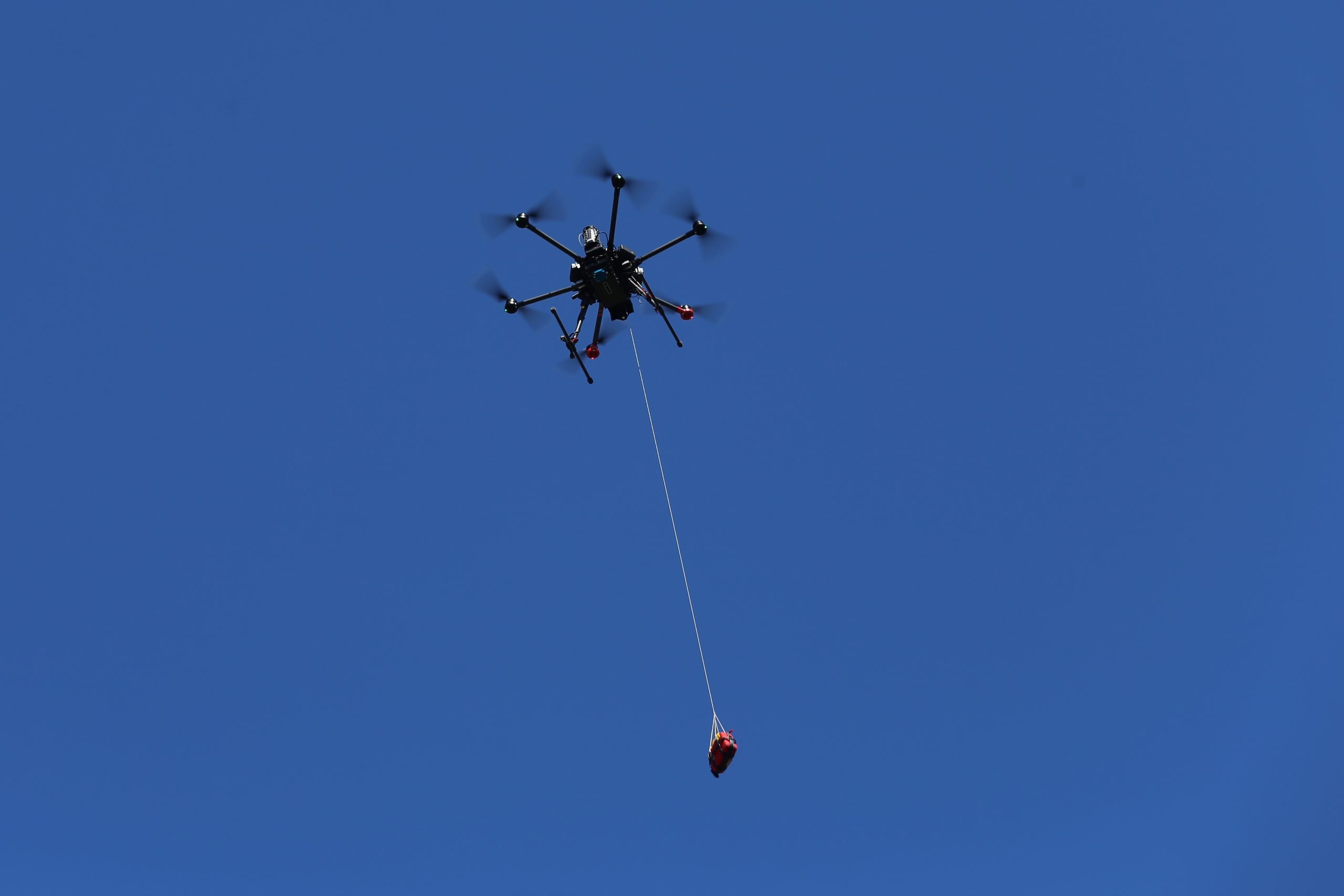
Once the AED is attached to the patient, it automatically detects the patient’s heart rhythm and will only deliver shocks when it ascertains a cardiac arrest.
“You don’t have to do anything as a bystander other than attach the AED,” Hallberg explains.
What makes the Swedish example noteworthy is that the drones get sent on their way immediately, as soon as an emergency is classified as a cardiac arrest.
“The drone is airborne within 60 seconds,” Hallberg knows. “On average, it takes ten to eleven minutes until the ambulance arrives.” Everdrone coordinates the project with the Center for Resuscitation Science at Karolinska Institutet (Sweden’s largest medical university) and the national Swedish emergency center, SOS Alarm.
When the center receives a call that fits the criteria for a cardiac arrest, the operator will instruct the caller on rendering first aid, while simultaneously sending an ambulance and a drone on their ways.
For the pilot project, the AED-drones covered a radius of six kilometers with 200,000 inhabitants, but Everdrone is about to expand to more regions and other countries. “The cost of a drone is a fraction of the cost of an ambulance,” Hallberg says.
The drone itself costs between $10,000 and $20,000. The drone hangar, called skybase, adds $40,000 to $60,000 to the cost but, once built, it can be used for many years.
Though the drones fly autonomously, there is still a pilot in command who oversees the operation for safety reasons and to get clearance from air traffic control.
“The actual operation comes down to $40 to $60 an hour,” Hallberg calculates. “That’s supportable.”
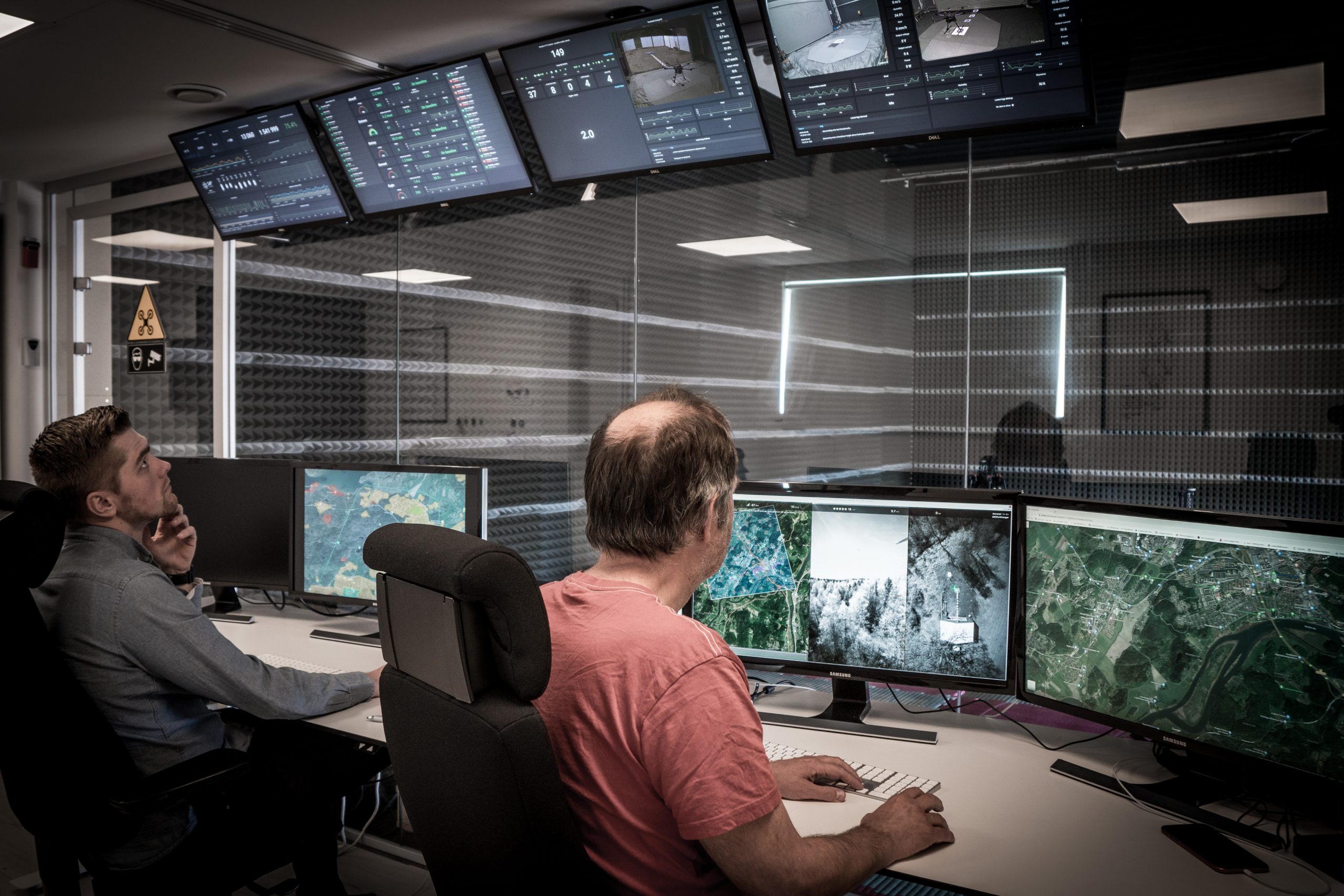
The drones are hard to beat when speed is of the essence, such as after a cardiac arrest or a snake bite, or in remote and medically underserved communities where patients face long transports to clinics and pharmacies.
As a result, many are getting on board. Google has patented a drone system for medical deliveries that includes AEDs. Backed by Google Ventures and Microsoft co-founder Paul Allen, the US company Zipline has tried out its medical deliveries on other continents, in Ghana and Rwanda for example, and is planning to extend to transport blood, antibiotics, prescription medication, and vaccines in rural areas in Maryland, Nevada, North Carolina, Utah, and Washington State. The Navajo Nation in Arizona just received its first medical delivery from a different drone developer, ZappCare, to secure medication delivery in hard-to-reach areas.
Mark Atlan, the founding CEO of ZappCare, is a member of the Apache Nation and put together a team of fellow Native Americans to secure medical care in hard-to-reach areas called Mission Healing Eagle Feather.
“Especially during the harsh winter months, we’ll deliver pharmaceuticals, medication such as insulin, hypertension medication to individuals who can’t get out of their driveways or are in super rural areas,” Atlan says. “Maybe emergency kits, maybe food, maybe some water.”
The movement is growing around the globe. The German company Wingcopter recently received a $16 million order to deliver drones for medical supplies in remote areas of the US.
While the Everdrone drones are specifically designed to deliver AEDs to areas that are served by participating hospitals, Wingcopter’s can travel up to 110 kilometers, at a speed of 100 kilometers per hour. They are already being used in Africa, for instance, to deliver medication and banked blood in Malawi.
Wingcopter drones have also been used to deliver coronavirus vaccines and masks for Covid-19 prevention in far-flung areas, like during a UNICEF initiative on the island state Vanuatu in the South Pacific.
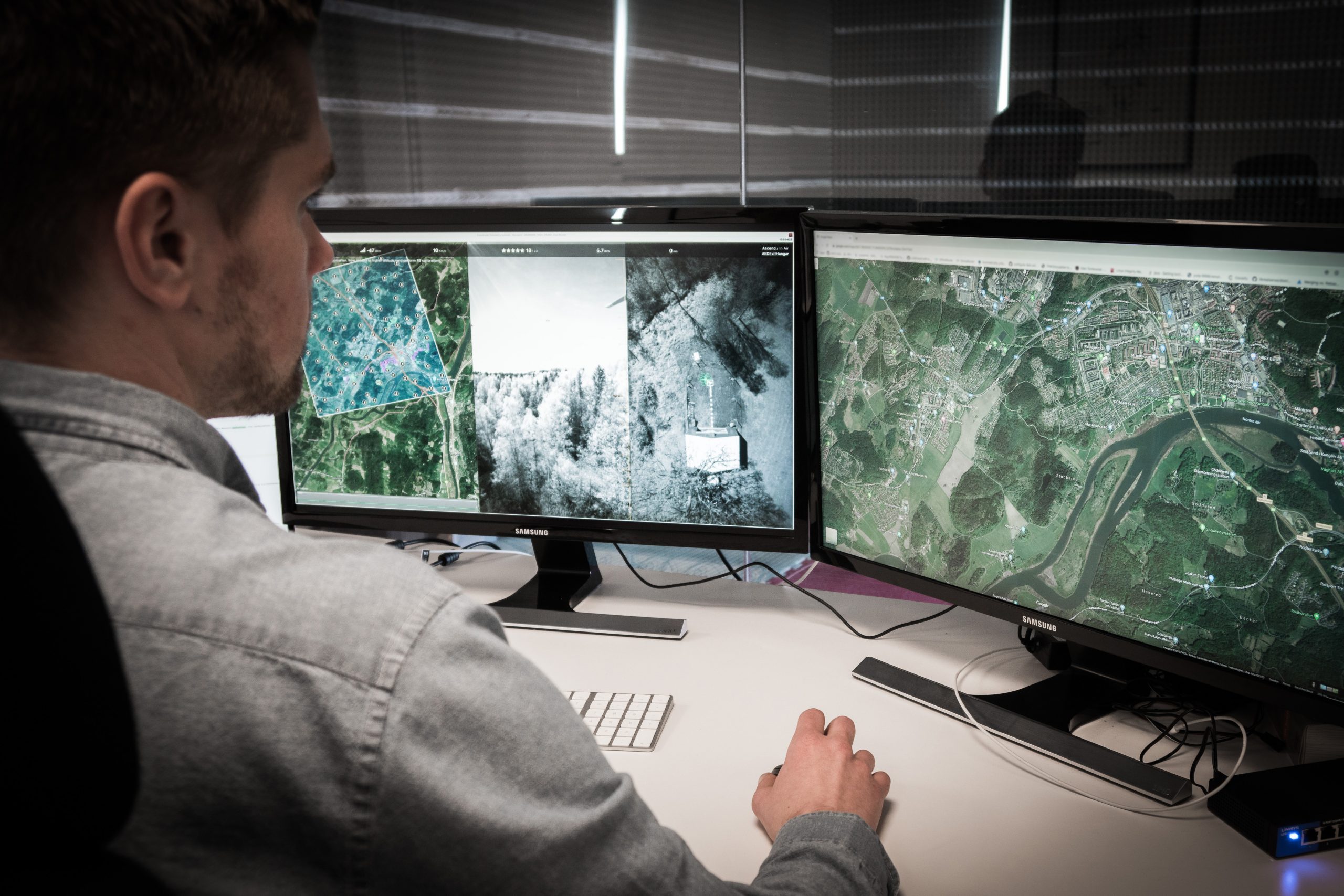
Drones are not new technology in public safety. Fire departments, police stations, and companies routinely use drones, for example to monitor at-risk areas in search-and-rescue or to check power lines.
Weighing against advantages of speed, cost, and decreased emissions, though, are some substantial disadvantages. Some areas are not suitable for drones.
For example, narrow alleys, crowds, or power lines can prohibit landings. (To minimize potential accidents, Everdrone’s unmanned aircraft does not land but winches down the AED.) Expensive medication or devices could get lost despite the GPS. And many drones can’t fly in strong wind or rain, though their design continues to improve.
“Speed is everything,” Timothy Amukele, a pathologist at Johns Hopkins Hospital in Baltimore, is quoted on the website Drones in Healthcare after finishing a proof-of-concept study to deliver blood samples via drone. “If it sits there for a long time, at some point the specimen starts deteriorating. It’s not so useful anymore.“
In addition, there is a reason many drones companies have been active outside the U.S. first: The U.S. has eased some regulations but bureaucratic hurdles remain.
For instance, drone pilots don’t need aviation pilot training anymore but, contrary to the Swedes, current drone projects in the US require visual oversight.
Already, unpermitted drones regularly obstruct fire crews and helicopters in emergencies.
Yet, most experts believe that it is only a matter of time until drones will become standard in medical care.
“People are starting to realize that drones can be used for good,” Amukele says.
“Already, in the United States, they are being used for agriculture and film making, but what they haven’t been used for is healthcare. Healthcare is the industry where we need this capacity.
This story is part of the SoJo Exchange from the Solutions Journalism Network, a nonprofit organization dedicated to rigorous reporting about responses to social problems. It was originally published by Reasons to be Cheerful.
Can free-market business ventures help contain the cost of prescription drugs?
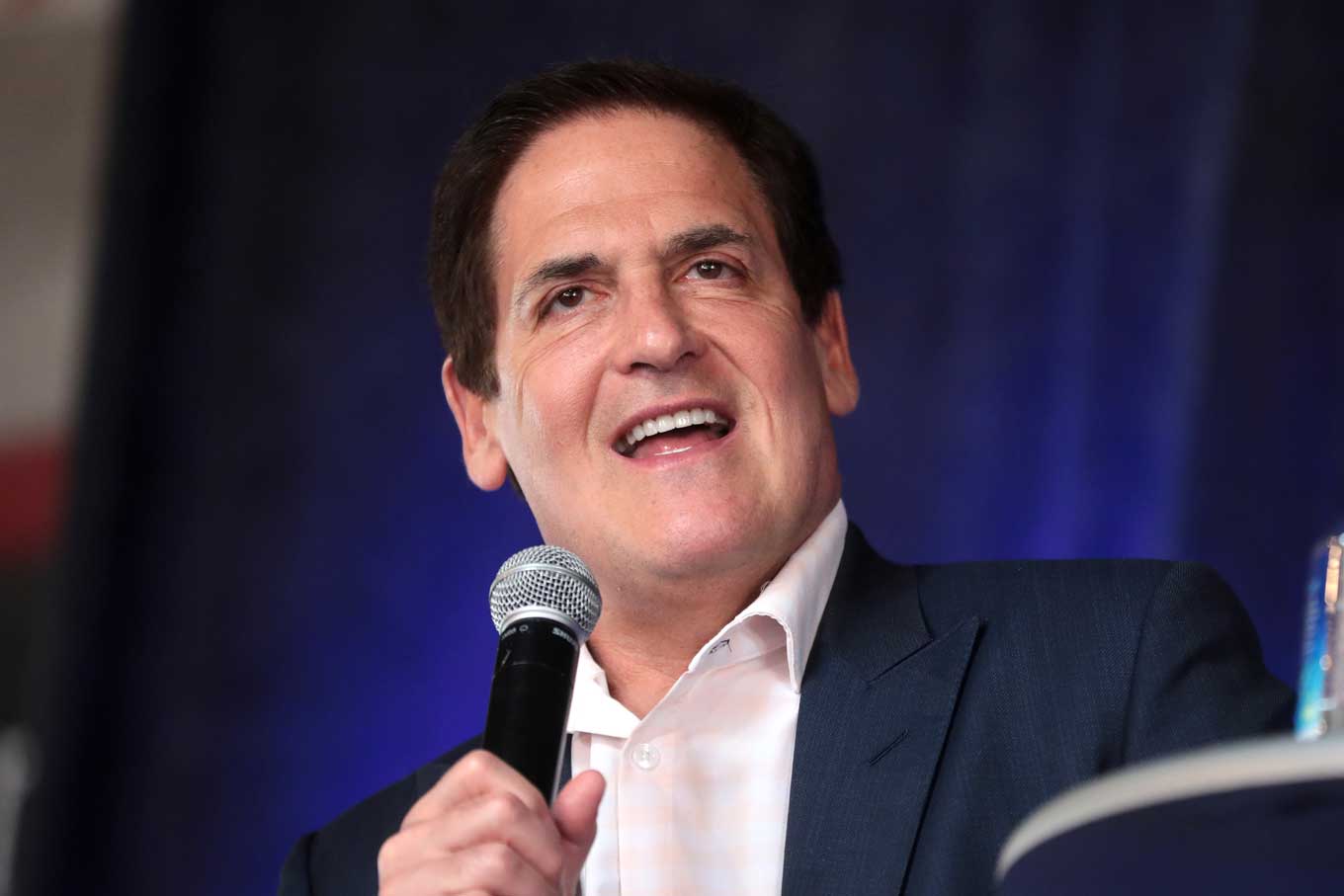
IN 2015, Martin Shkreli became the smirking face of drug company greed when, as founder and then-chief executive of Turing Pharmaceuticals, he bought rights to the anti-parasitic medication Daraprim and then jacked up the price from $17.60 to $750 per pill.
At the time, the drug was the only therapy approved by the U.S. Food and Drug Administration for toxoplasmosis, a disease that causes serious illness in people with weak immune systems, including babies born to mothers infected with the parasite and those with HIV.
For Alex Oshmyansky, an emergency radiologist, Shkreli’s move was what tipped him over the edge.
Fresh out of his radiology fellowship at Johns Hopkins University, the young doctor had already seen patients grow sicker and even die because they couldn’t afford their medications.
He vowed to become the anti-Shkreli by starting a company to sell vital drugs at or near cost.
Three years later, Osh’s Affordable Pharmaceuticals had secured $1 million in funding. Shortly thereafter, Oshmyansky grabbed the attention of billionaire Mark Cuban. The Dallas Mavericks owner and one of the stars of the television show Shark Tank wound up going all in.
In January, the Mark Cuban Cost Plus Drug Company opened shop online. The lofty aim, Cuban writes on the website, is “to disrupt the drug industry and to do our best to end ridiculous drug prices.”
The Mark Cuban Cost Plus Drug Company offers more than 100 generic drugs, which according the company, are priced at the costs of making them, plus a 15 percent markup and a $3 pharmacy fee.
For someone without health insurance (which the company does not accept in the first place), or whose plan has high deductibles or copays, the savings can be dramatic.
For example, the average wholesale price for a month’s worth of the cancer treatment imatinib (generic Gleevec) is $9,657, which you could cut to $120 with a coupon from the drug-tracking company GoodRx. Meanwhile, Cuban’s company offers a one-month supply for just $47.
Cuban and Oshmyanksy are not the first, nor the only ones taking on Big Pharma. In 2018, a group of health systems and philanthropists launched Civica Rx, a nonprofit that supplies hospitals with essential generic drugs.
Today, the company sells about 55 medications to 1,400 hospitals at savings of about 30 percent compared to what they paid previously. The model has been so successful that the company is expanding into the consumer market with a new initiative, CivicaScript, which has partnered with Anthem and some Blue Cross insurance companies and expects to start selling drugs by mail order and through retail pharmacies later this year.
But David isn’t about to slay Goliath — at least not yet. That’s because by and large, name brand medications, not generics, drive high drug costs.
While generics comprise 84 percent of the prescription medications sold in the U.S. by volume, they only account for 12 percent of spending, according to a recent report from the RAND corporation, a nonprofit policy think tank.
These new ventures, however innovative, only deal with a small set of generic drugs, said David Mitchell, president and founder of Patients for Affordable Drugs, a national nonprofit patient organization.
For this reason, Mitchell said, the new companies won’t help people like him. He has multiple myeloma, a sometimes deadly blood cancer, and the four drugs keeping him alive retail for about $935,000 per year.
Although Mitchell is covered by Medicare, he still winds up spending $25,000 annually on medications and specialty drug insurance to help pay for them.
“This model is not the comprehensive solution to our drug pricing issues in the country,” said Mitchell.
Poll after poll shows that the majority of Americans, regardless of political affiliation, support the government’s stepping in to contain drug prices, but so far, legislative efforts have stalled.
In this vacuum, a new breed of entrepreneurs are betting that free-market strategies that emphasize the public good over profit can make progress where politicians haven’t.
While it’s no small thing to make even a small percentage of drugs more affordable for the people who need them, the real disruptive power of the Mark Cuban Cost Plus Drug Company and Civica Rx is in demonstrating that it’s possible to challenge the health care industrial complex and live to tell the tale.
AMERICANS PAY MORE for brand-name drugs, said Mitchell, because unlike in other developed countries, the U.S. government doesn’t negotiate drug prices.
Thanks to patents and exclusivity rights granted by the FDA, drug companies get to sell new products for about 12 to 16 years without competition from generic versions.
In principle, this arrangement allows drugmakers to recoup R&D expenses, and sets an incentive for companies to develop new drugs. But during this monopoly period, drug makers are free to name their price, leading to rates that many advocates consider unacceptable.
“We are price takers. And the drug industry has the power to be the price setters,” said Mitchell. “That’s why drugs are so expensive.”
In general, once generics hit the market, the competition drives prices down. But it doesn’t always work that way. Drugs for rare conditions such as certain cancers may not have enough of a market to interest many generic makers, for example. And when prices dip too low, some competitors drop out, leading to drug shortages and price hikes by remaining manufacturers.
Drug pricing typically works by using intermediary companies known as pharmacy benefit managers, or PBMs, to negotiate rebates for insurers and, in turn, keep a sizeable bounty.
So, even though a PBM may negotiate 90 percent off the price of imatinib, employers and people with high-deductible plans still wind up paying about $3,200 monthly until their deductible is met — for a drug that costs about $35 to make, said Oshmyansky.
The Mark Cuban Cost Plus Drug Company’s strategy is to eliminate these middlemen.
“It seems like a great deal. You got 90 percent off, but the number you got the price off is completely made up. And it’s crazy,” he said of the current system. “So, that’s how we’re able to get the price down to $47 for a month’s supply.”
Like the Mark Cuban Cost Plus Drug Company, Civica Rx creates a direct route from the manufacturing facility to the customer. The company keeps the supply chain short, sourcing drugs from the U.S. where possible, and it negotiates directly with suppliers. (Both companies are also building their own drug manufacturing plants in the U.S.)
“The generic drug market traditionally functions like a commodity market, with prices fluctuating wildly and with a lot of middlemen entities negotiating prices,” said Allan Coukell, Senior Vice President of Public Policy at Civica Rx.
By contrast, he said, Civica Rx’s pricing is transparent and the same for everyone. “There’s no discounts or rebates or negotiation on that; it’s as low as we can sustainably make it.”
However, to work with insurers and sell drugs through pharmacies, the new CivicaScript initiative will have to work through traditional channels, including PBMs, said Coukell.
“We’re working with all of those entities, but in a way that will make sure that the drugs are not marked up unreasonably along the chain before they get to the patients.” To test the waters, they are starting small, with six to 10 high-priced generics.
Shannon Rotolo, a clinical pharmacy specialist at the University of Chicago Medicine, points out that neither of these ventures will help her patients who often require expensive specialty therapies for conditions such as cystic fibrosis, asthma, and lupus.
And even for generic drugs, there are downsides to having to shop around, she said. “The risk of that is splitting up people’s pharmacies.” You lose the interaction with a pharmacist who knows you, has a list of all your medications, and can, say, call your doctor when you need a refill.
Further, Rotolo pointed out that Cuban’s company doesn’t take insurance, so the cost of the drugs won’t count toward a deductible. That could delay or prevent patients from getting to the point where they have better coverage for all their medications.
ROTOLO HELPS PATIENTS find workarounds to try to make drugs more affordable such using a drug-company coupon, getting financial assistance through nonprofit organizations such as the Patient Access Network Foundation, or even bypassing insurance when the cash price is cheaper.
“But it’s just an incredible burden on the patient,” she said. Like Oshmyansky, she’s grown tired of watching patients fight insurance companies and do without other necessities to get their medications. In her case, though, her experience has turned her into an advocate for a single-payer system.
In 2020 Rotolo co-founded Pharmacists for Single Payer, and she also works with other advocacy groups at the state and national level.
“The appeal of a single-payer system from a pharmacy perspective, would be the idea of no copays, no deductibles, just knowing that the medication that patient needs is going to be covered without them having to worry about the cost,” she said.
Rotolo knows that a single-payer system is a longshot, but nonetheless with stories of people’s struggle to access health care during the pandemic rising up, she feels change coming.
Her friends that work for health insurers or PBMs talk about how the status quo is just not a sustainable model, she said. “And they kind of are starting to think of it as like a rush to make all the money before it all crashes.”
“A lot of observers are unhappy with the status quo,” said economist Murray Ross, director for the Institute for Health Policy at Kaiser Permanente. “You know, it would be nice if we could wave a magic wand, fix the patent process, create competitive markets, et cetera.”
But that’s just not possible in the short run, he said. Instead, reform may advance incrementally through both the free market and legislation like the Build Back Better Act, which passed the U.S. House of Representative, but is stalled in the U.S. Senate.
Rotolo pointed out that Cuban’s company doesn’t take insurance, so the cost of the drugs won’t count toward a deductible.
Kaiser hospitals have benefited from a cheaper, more consistent supply of generic insulin, blood pressure drugs, and other vital medications after contracting with Civica Rx, Ross said.
As for brand-name drugs, reforms such as those in the Build Back Better Act might help — for instance, allowing the federal government to negotiate prices for some high-cost drugs covered under Medicare and limit price increases on some drugs to the rate of inflation.
The reforms currently on the table don’t go as far as patient advocate David Mitchell would like, but he said just giving the government any power to negotiate pricing is an important step.
“And that’s frequently the way large reforms happen,” said Mitchell. “They don’t happen all in one fell swoop. You pass a law that makes a change, and then you build on it.”
It’s worth noting that even in the current no-holds-barred market, greed doesn’t always win.
In January, a federal court ruled in favor of the Federal Trade Commission and seven states, finding that as head of Vyera Pharmaceuticals (formerly Turing Pharmaceuticals), Martin Shkreli broke state and federal laws in stifling competition to maintain his monopoly on Daraprim.
The judge ordered Shkreli, who is currently serving out a seven-year sentence for securities fraud in an unrelated case, to pay the plaintiffs nearly $65 million and banned him from the pharmaceutical industry for life.
Meanwhile, Oshmyanksy is continuing to plunk stones at the pharmaceutical behemoth with his slingshot.
While he hasn’t yet caused any real pain, he has revealed the middlemen in the drug pricing scheme as a point of vulnerability. And he plans to take aim at the brand-name market where, as with ultra-high-cost generics, a disproportionate amount of the revenue goes to intermediaries rather than to the people making the drugs. If those stones land, they are likely to hurt.
“I don’t think we’ll have the same order-of-magnitude differences as we go over to those drugs,” he said. “But I think to some extent, we’ll be able to impact those prices as well.”
But can that strategy truly take down an entrenched and extraordinarily profitable market? “People ask me all the time, ‘Well, why are you trying to do all this? Isn’t it better to advocate for policy change?’” said Oshmyansky.
As a radiologist from central Montana, he said he has no power to sway Congress. “But I can make cheap medicine. I can just do that.”

As Russia’s invasion of Ukraine rages on, folks from all around the world have continued to generate meaningful support for Ukrainians in many ways — through humanitarian aid, warm meals, shelter, and even by funding individual Ukrainian small businesses via Etsy, a global marketplace for artisans of all kinds.
When a crisis of this magnitude rocks the global community, it can feel overwhelming and scary to know where the best place is to funnel your time, energy, and support as an outsider.
Direct support to individuals on platforms like Etsy can zoom in and help us see our contributions in real-time, helping people just like us.
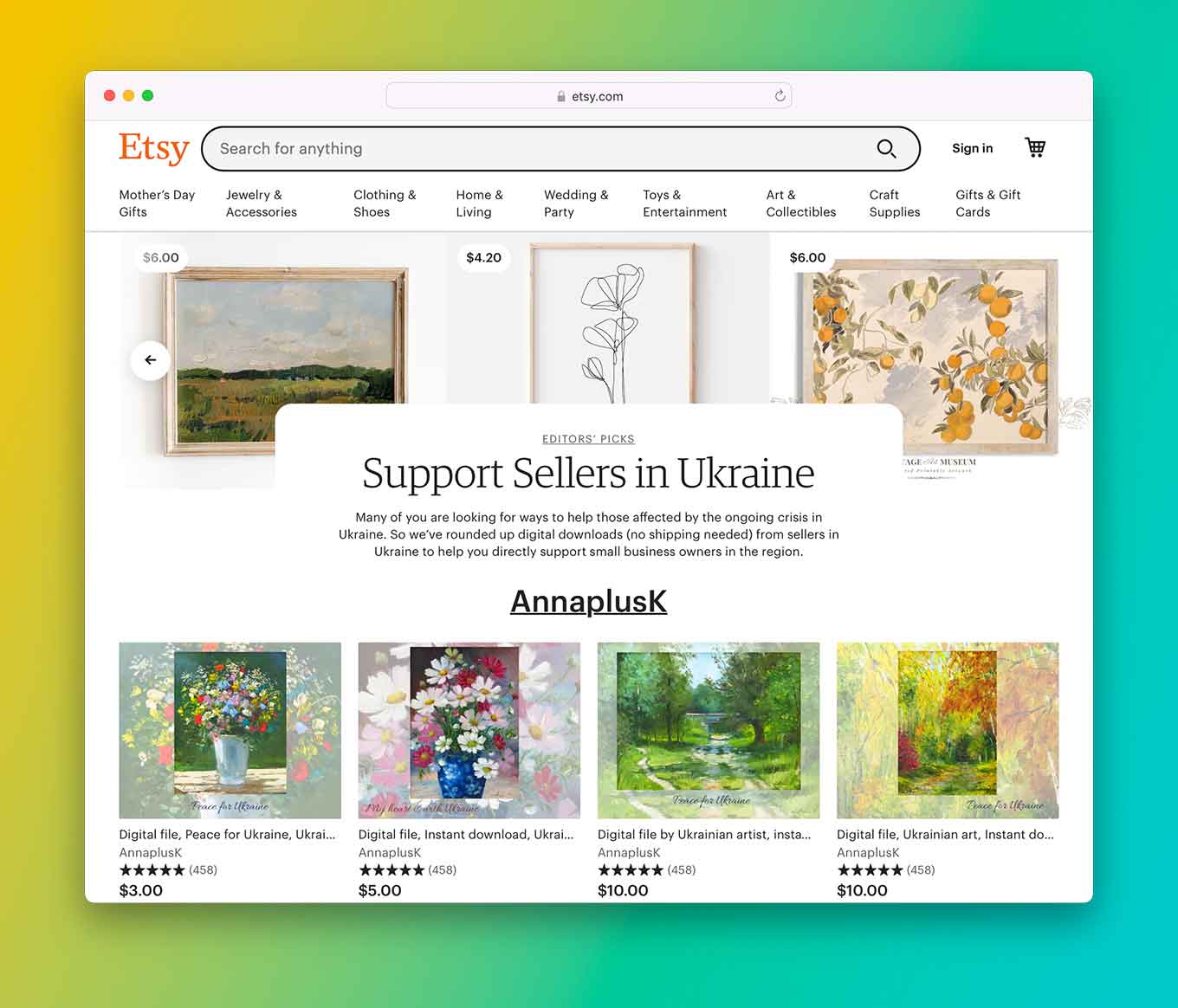
When I discovered that shopping on Etsy was a meaningful way to support individual Ukrainians, I hopped to it.
As an avid small business shopper, I use the website to find all kinds of gifts and goodies for loved ones, and I have even begun curating a collection of unique pet portraits of my dog by finding different artists on the platform.
When I discovered Yulia Kosareva’s listing for a custom pet portrait as an option to support a Ukrainian artist, I hit “add to cart” right away.
Although I loved her work, I had no expectations that Yulia would send me a digital portrait during this crisis — or at all. I simply found a piece of work I valued and wanted to play even a small role in supporting this artist.

After I made my purchase, I reached out to Yulia to assure her that the portrait would be a cherry on top and I simply wanted to help her in any way I could.
I was amazed that this woman was living in the middle of a major conflict, and here she was, messaging me within minutes, assuring me that she would work on my order. Again, I told her that her safety mattered most to me, and I had no expectations of her to complete my order.
Even still, she sent me a beautiful digital portrait in a matter of days and thanked me endlessly for my contribution.
For me, connecting one-on-one with an individual at the heart of this crisis put the entire situation into perspective. It gave me an anchor in a sea of information and heartbreak, to connect with someone on this level, to try to help a neighbor, as we both approached this unfathomable situation with the tools at our disposal.
Connecting with Yulia reminded me that below the headlines, statistics, and donations, there were individual people, like this gifted artist, entrepreneur, and mother, who had a story to tell.
Meet Yulia, a Ukrainian Etsy seller using her business to help others
While there are thousands of listings for digital files from Ukraine-based shops, it was Yulia who drew me in. We connected via email, and she graciously shared her story with me.

Yulia owns the Etsy shop YuliaPartyPrintables, and has been a full-time Etsy seller for three years. She creates printable digital files that include custom pet portraits, party supplies, and gifts. As I saw first-hand, the crisis has not stopped her.

“I try to fulfill orders whenever possible,” Yulia said. “Creativity helps [me] not to think about this horror. I am very grateful to all my customers for their support and willingness to wait, as the constant air danger sirens leave me little time for work, but I constantly work when I have the opportunity.”
While more than three million Ukrainians have fled to neighboring countries since the start of the crisis, Yulia has remained in Ukraine.
She said that she does not want to flee the country with her daughter unless it is absolutely necessary, since it would mean leaving her husband and many relatives who are liable for military service.
Yulia lives in a large regional city amidst many occupied towns and villages in Southern Ukraine. (We’ve opted to not include her specific location for her safety.) She said that since Russian forces have reached her region, she and her family must sleep on the floor of the hallway of their building where there are no windows because sirens sound often throughout the night.
When she is able, she creates custom dog portraits, and her daughter has even contributed a number of hand-drawn illustrations for supporters to purchase.

"Yulia said she received 510 orders at the beginning of March, which is 2.5 times more than usual."
Yulia said she received 510 orders at the beginning of March, which is 2.5 times more than usual. However, sales have decreased again, as she has had to remove some listings to better handle her workload amidst the crisis.
“Due to the war, I have deactivated more than half of my shop’s assortment because I am afraid that at any moment I can be left without communication and let the customers down,” Yulia said.
In addition, Yulia shared that while many essentials are available in the city, food and medical necessities are becoming scarce. She has had trouble treating her thyroid condition, as her medication is nowhere to be found.

Despite this, Yulia sends as much of her Etsy profits as she can to a family of volunteers organizing humanitarian aid in Kharkov. These volunteers do not work for an organization, but are “an ordinary family” risking their lives to support their neighbors by buying and distributing food, medicines, and essentials.
Shopping Yulia’s Etsy shop has become a direct way to fund their grassroots efforts.
"It is a very difficult time. My work saves me from these terrible thoughts and the terrible news we constantly watch. I am so grateful to my customers for this help, as it gives me the opportunity to help other people."
“I admire them and other volunteers, and I am glad that I can help at least financially,” Yulia said. “It is a very difficult time. My work saves me from these terrible thoughts and the terrible news we constantly watch. I am so grateful to my customers for this help, as it gives me the opportunity to help other people.”
How to support Ukraine by shopping on Etsy
Since Etsy has a global reach and makes it easy for creators to sell and distribute their work, this format has created a unique opportunity for shoppers around the world to intentionally choose to shop with Ukrainian sellers. This creative approach to direct financial relief has been referred to as a “hidden infrastructure” for global humanitarian aid.
Although Etsy typically takes a portion of fees from each digital storefront, the company recently announced its plans to credit Ukrainian sellers and cancel current balances of listing, transaction, and advertising fees.
Many sellers ship and distribute their products, making it difficult for those in crisis or those fleeing the country to get their work to customers. This has led to an influx of digital file purchases from the website.
Etsy has curated a selection of these listings from Ukrainian sellers.
However, if you would like to browse independent listings, here are some steps to find some work on your own:
- Search “digital files” on Etsy.
- Click the “all filters” button, and scroll down to “country.”
- Under “custom,” enter “Ukraine.”
These search results will display all digital files created and sold by Ukraine-based Etsy sellers.
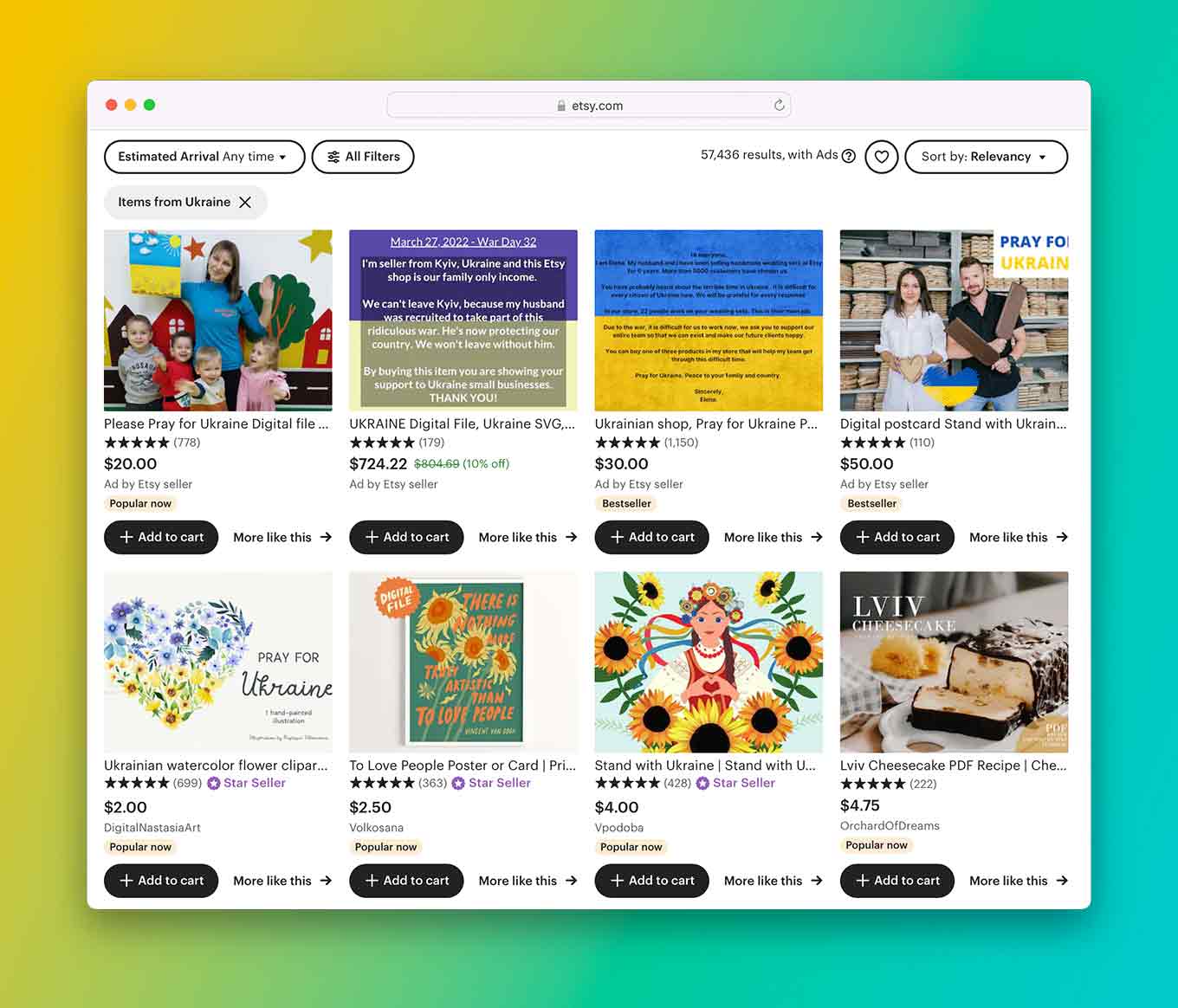
When you purchase a digital item, the file will immediately become available for download, meaning Ukrainian sellers can earn money without having to create new products or mail out orders.
These listings often include patterns for crafting, digital art customers can print from home, vector files, recipes, or even just act as direct donations to Ukrainians.
Things to keep in mind when supporting a Ukrainian Etsy seller
Be considerate
While a number of these digital Etsy listings from Ukrainians require little to no additional work for the seller, items like custom portraits or personalized downloads require artists to prepare and create an order. As Yulia shared, not all items will be available or may require a longer turnaround time.
Share their work
After you have purchased an item that supports a Ukrainian maker, share your finds with your community. Sharing helps to generate ongoing support and encourages your network to follow suit. My new print is hung proudly in my home, and I think of Yulia and her family every time I look at it. I hope to share their story any time someone new sees her work.
In addition, follow these artists on social media, and “favorite” their Etsy storefronts (to boost them in algorithms). While the crisis deeply impacts the financial situation of Ukrainians everywhere, so will the period of rebuilding and healing that will follow.
Ukrainians will need continuous economic support, and this outlet is one way to make your donations count on a personal level.
See if you can further support through charitable contributions
Just like Yulia, many Etsy sellers are pouring their funds back into relief efforts. Look into various Etsy listings to see how many individuals you can support with your purchases and donations.
While Yulia supports mutual aid efforts on the ground in her community, she also recommends two official donation sites for international supporters: UNICEF and the National Bank of Ukraine.
“I can’t imagine what kind of life awaits us,” Yulia said. “I try to be strong and not panic so my daughter does not feel my fear. We need to believe that this should end soon.”
Related: Verifiable Good News in Ukraine
Related: GGG's Guide on How To Help Ukraine
Related: Thousands Open Their Homes to Ukraine’s Refugees
Related: Schools Promise a Fresh Start for Ukraine's Refugee Kids
Related: Europe Is Working To Reduce Reliance on Russian Gas
Related: Meet the organizations rebuilding housing in Ukraine
An Invitation for Our Species:
Pınar Sinopoulos-Lloyd on Ecological Grief as Regenerative Medicine
You may remember when you first consciously experienced ecological grief: grief for our planet during climate change.
The initiatory memory sticks with me since it was when I began to blossom into being an embodied member of this planet. I was 16 when this emotional capacity was awakened within me.
It was 2004, so there wasn’t much consciousness around it just yet — especially in the younger generations. I felt isolated in my experience but found refuge with other radical environmental activists at the time.
This emotion is a gift. Each emotion has intelligence or it would not have evolved with us. The key is to discern the wisdom nested in it.
When I began to feel ecological grief, my capacity to love the world deepened — and so did my commitment to climate justice.
When I was gifted with ecological grief, I was simultaneously gifted with ecological awe and enchantment.
As an Indigenous person, we would not and may still not necessarily even distinguish it “ecological” since we would have had (and still may have) secure emotional attachment to place and our other-than-human relatives.
There is such possibility in ecological grief, which can transmute into regenerative action. Grief is only possible because we love what we are grieving.
This is why I call this realization initiatory; it initiates us into our belonging to this planet rooted in fierce love for ourselves and our human and ecological communities.
As many Indigenous leaders point to, defending our territories and relatives is an act of self-defense and community love. It is a prayer for our future generations — multi-species futures including but not limited to human relatives.
Ecological grief transformed me as much as ecological awe. I needed to deepen my understanding of how to care for Pachamama (Mother Earth in my Quechua language) and learn how Pachamama cares for me.
This is what brought me to survival skills a decade ago. I longed to tend to a secure attachment with place as well as learn how to tend to my nervous system through ecological co-regulation as a displaced Native, a trans young adult, an Autistic person, and also, a human being on the planet during this initiatory time for our own species.
Place-based skills are crafts and technologies rooted in one’s bioregion that builds relations to place.
It’s also important to acknowledge that although we all have ancestral skills that are place-based, a lot of these skills are Indigenous Lifeways that may have been disrupted or severed due to colonization.
As I was learning place-based skills, I began metabolizing my ecological grief. Learning wildlife tracking and bird language was immensely transformative.
These somatic multi-species languages expanded and reshaped my perspective and even my own cosmology. Wildlife tracking has been such a through-thread and is a humbling practice I continue to apprentice to this day.
Experiencing this healing and activation of multi-species solidarity fueled my drive to make this accessible to my LGBTQ2SIA+ community.
During my journey of learning survival skills — which I refer to as multi-species kinship practices — I realized the depths of our survival skills as queer and trans peoples and it felt integral to explicitly weave this wisdom in.
In 2013, I met my spouse, So Sinopoulos-Lloyd, another trans animist who would later become the co-founder of our organization, Queer Nature.
We fell in love in the dense forests of the Pacific Northwest surrounded by western red cedar, banana slugs, and sword fern.
This is what Queer Nature was born out of in 2015 — a multi-species love story.
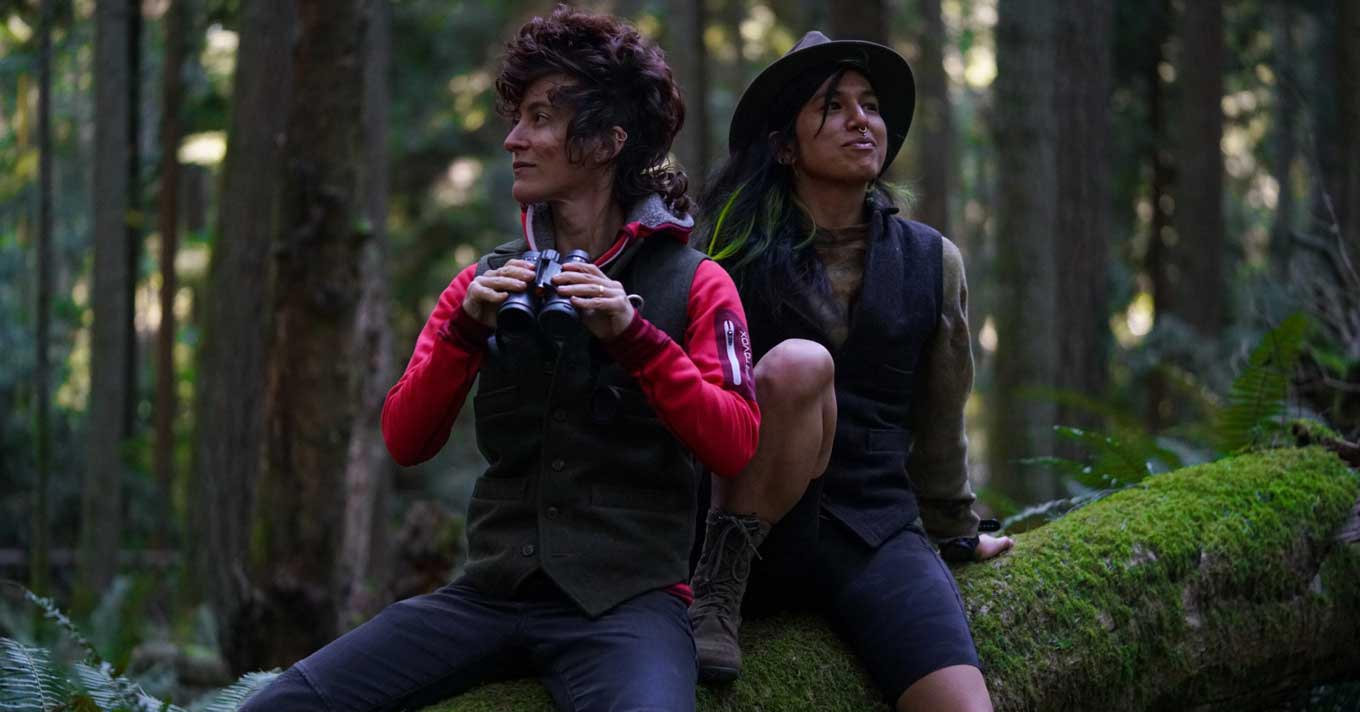
Historically, queer and trans communities have sought refuge within cities and specifically around bars and clubs. This is in part due to the trauma of homophobia and transphobia brought to this land by settler colonialism.
We wanted to offer an alternative refuge and co-create an earth-based queer community through place-based skills in a sober container.
After starting Queer Nature, we soon realized that the queer and trans communities not only needed one another to hold each other but also, to be held by the land.
The alchemizing of ecological grief initiated the space for community action to break through the spells of isolation. This includes isolation from our human community members as well as our ecological kin.
One of the emotion’s gifts is the alchemization to create restorative habitats for community connection and regenerative action.
In the dreaming of multi-species futures, may we relearn how to listen to our more-than-human kin. Our ecological grief and awe are portals to that re-enchantment.
You might also like: Meet the LGBTQ+ influencers making the world a better place
You might also like: What is “intersectional environmentalism”?
A version of this article was originally published in The Intersectional Environmentalist Edition of the Goodnewspaper.
Become a subscriber today to get your own monthly print newspaper filled with good news.
Featured image courtesy of Pınar Sinopoulos-Lloyd
Texas-Mexico Border Towns Are Working Together To Build A Binational Park
Only two years ago, the border town of Laredo, Texas, was bracing itself for the construction of the towering steel and concrete border wall that threatened to cut off the city, its people, and the environment from its main water source — the Rio Grande River.
Diligent grassroots efforts by No Border Wall Coalition (NBWC) — a coalition composed of veterans, clergy, teachers, students, Indigenous leaders, and landowners — paved the way for the cancellation of unconstructed border wall contracts.
According to environmental nonprofit Earthjustice, this saved 71 miles of sensitive riverfront land and more than $1 billion in taxpayer funds.

This victory allowed the City of Laredo to propose and unanimously green-light plans for a binational river park — which is set to be developed where the border wall was once proposed to stand.
Ambassadors to the U.S. and Mexico, along with city officials from Laredo, and Nuevo Laredo, Tamaulipas — affectionately called the “Sister Cities” — are working together to transform their shared river into an ecological restoration project.
This historic binational project will span approximately 6.3 miles and focus on strengthening the conservation of the Rio Grande River while creating a community recreation and education space that stands to represent the unique and interconnected relationship between these two border cities.
As of February 2022, Laredo City Council and members of the Binational Working Group — a public-private consortium — formally announced that San Antonio-based architecture and urban design firm Overland Partners will be working alongside local partner Able City to create conceptual design plans for the first phase of the ecological restoration project.
“We are inspired by the Binational River Park and excited by the unique challenges an aspirational project of this magnitude presents – environmentally, socially, and culturally,” Rick Archer, senior principal and CEO at Overland Partners told The Architect's Newspaper.
“Together with our partners and stakeholders, we want to create an international cultural destination and model for cooperation, conservation, and community.”
According to architecture, interiors, and design magazine Dezeen, the park will be made up of three areas: a 2.5-mile-long ecological restoration area northeast of the cities, a mile stretch in the urban cores along the river that will be framed by bridges and feature an amphitheater, and lastly, a recreation area that is proposed to stretch for three miles and lead pedestrians to the Nuevo Laredo Zoo.
Although this project is currently in its early stages, its envisioned to be comparable to San Antonio’s famed River Walk.
A version of this article was originally published in The Intersectional Environmentalist Edition of the Goodnewspaper.
Become a subscriber today to get your own monthly print newspaper filled with good news.
Happy Happy Transgender Day of Visibility!
Since 2009, March 31st has been a day to celebrate the trans and non-binary community — now celebrated worldwide — and you can thank activist Rachel Crandall for that. Thank you, Rachel!
It’s been a really tough few years, and the past year, in particular, has been — well, no one word really captures the feeling. Horrific? Depressing? Demoralizing?
That’s why I’m thrilled to share with y’all the following news released by the Biden Administration this morning.
The White House and federal agencies put out a number of wonderful announcements about trans rights, and I'm so excited to tell you about them because today should be about trans and non-binary joy.
This article was adapted, with consent, from Charlotte Clymer’s Twitter thread celebrating positive news about trans rights. Good Good Good has added titles and made edits for length, clarity, and context.
We highly recommend subscribing to her newsletter: Charlotte’s Web Thoughts
Describing her newsletter, she said: “What I will tell you is that I’m an optimist by nature with a very strong bias toward pragmatism. I think people are complicated, and the world doesn’t recognize that nuance enough. I think it’s okay to acknowledge the seriousness of this era while taking advantage of the moments of joy that come our way. If this appeals to you, then subscribe.”
13 Pieces of Positive News for Transgender Rights:
1. U.S. citizens will soon be able to select a non-binary gender marker on passports
The State Department announced that starting on April 11th, U.S. citizens will be able to select “X” as a non-binary gender marker on passports. They are the first federal agency to codify this inclusive policy. Applicants can already self-select without medical documentation.
While this is the first federal instance of this policy, a number of states do offer non-binary gender markers on driver’s licenses. Folks can find a map detailing identity document laws and policies across the country from the Movement Advancement Project.
2. TSA is updating their body scanners to reduce trans and non-binary discrimination
The Transportation Security Administration (commonly known as TSA) announced that they are updating their body scanners at airport security to move away from technology that has led to trans and non-binary travelers experiencing frequent discrimination, reducing unnecessary, invasive, and humiliating body searches.
3. In fact, TSA is making updates across the board
In addition to updating transitioning their airport security tech, TSA is:
- Working with airlines to implement non-binary markers during the flight booking process
- Removing gender considerations with validating traveler info at airport security
- Including non-binary markers during TSA Precheck enrollment and U.S. Customs and Border Protection’s Trusted Traveler program
4. HHS created a new website to support LGBTQ+ youth and families
The U.S. Department of Health and Human Services (HHS) released a new website that offers resources and guidance for LGBTQ+ youth and families, to counteract several GOP-led state governments removing such resources from their own websites in recent months.
5. The Department of Education is helping school leaders support trans and non-binary youth
The Department of Education's Office of Safe and Supportive Schools is expanding trainings with more resources to educate school leaders and communities about the challenges facing trans and non-binary youth and their families.
6. HHS affirmed the importance of affirming LGBTQ+ youth
HHS's Substance Abuse and Mental Health Services Administration released "LGBTQI+ Youth – Like All Americans, They Deserve Evidence-Based Care" to affirm the critical need for gender-affirming care for trans and non-binary youth.
This article aligns with President Biden’s statement regarding the health and safety of trans kids.
“Affirming a transgender child’s identity is one of the best things a parent, teacher, or doctor can do to keep children from harm,” he expressed in early March. “Parents who love and affirm their children should be applauded and supported, not threatened, investigated, or stigmatized.”
7. HHS confirmed that gender-affirming care is trauma-informed care
The National Child Traumatic Stress Network, which falls under HHS, has released “new information for providers confirming that providing gender-affirming care is neither child maltreatment nor malpractice.”
8. The Office of the Assistant Secretary For Health now has a resource for adults on gender-affirming care
The Office of the Assistant Secretary for Health has developed a resource to inform parents and guardians, educators, and other persons supporting children and adolescents with information on gender-affirming care
The resource is a downloadable document that includes information on topics like hormone therapy, puberty blockers, social affirmation, gender-affirming surgeries, and more.
For transgender and nonbinary children and adolescents, early gender-affirming care is crucial to overall health and well-being as it allows the child or adolescent to focus on social transitions and can increase their confidence while navigating the healthcare system,” the document reads.
9. It’s about to be a lot easier for transgender people to update their gender information on their social security card
The Social Security Administration announced that it is removing the requirement that transgender people show proof of identity such as doctor’s notes in order to update their gender information in their social security record by the fall of 2022.
The White House statement said: “This will significantly improve transgender individuals’ experience in accessing their retirement benefits, obtaining health care, and applying for jobs.”
10. Nonbinary individuals will now be able to use an “X” gender marker when filing employment discrimination charges
The U.S. Equal Employment Opportunity Commission announced it will give individuals the option to select an “X” gender marker during the voluntary self-identification questions that are part of the intake process for filing a charge of discrimination.
According to the Center for American Progress, “Studies show that anywhere from 15 percent to 43 percent of gay people have experienced some form of discrimination and harassment at the workplace. Moreover, a staggering 90 percent of transgender workers report some form of harassment or mistreatment on the job. These workplace abuses pose a real and immediate threat to the economic security of gay and transgender workers.”
While these statistics don’t include all members of the LGBTQ+ community, it’s reflective of the importance of being able to file discrimination charges in a way that reflects your gender.
11. The Department of Education is proposing a new process that will make it easier to identify discrimination and barriers in the student aid application process
The Department of Education will propose a new federal regulation: the 2023-24 Free Application for Federal Student Aid (FAFSA) will allow applicants to indicate their gender identity, race, and ethnicity to help inform the Department about application barriers.
12. Visiting the White House will now be easier for transgender, gender non-conforming, and non-binary visitors
The White House Office of Management and Administration announced they will begin implementing an "X" gender marker to the White House Worker and Visitor Entry System (WAVES) system that affirms trans and non-binary visitors and workers.
“This change will ensure that transgender, non-binary, and gender nonconforming people can visit the People’s House in a manner that respects and affirms their gender identity,” said a statement from the White House.
13. The President proposed a plan to better include the LGBTQ+ community in the next census
The White House also announced that the President’s proposed Fiscal Year 23 budget includes $10 million in funding for additional critical research on how to best add questions about sexual orientation and gender identity to the Census Bureau’s American Community Survey.
There are more announcements, but those are the top lines. Elections matter, folks. There's so much work left to be done, but I'm grateful to the Biden Administration for being intentional about addressing the discrimination experienced by trans and non-binary people.
Art has long been used as a tool for activism — from Picasso’s anti-war “Guernica” painting, to the iconic Guerilla Girls, who were known for their anonymous feminist and anti-racism work in the art world.
The Tate, a British museum collective, says the aim of activist art is to “create art that is a form of political or social currency, actively addressing cultural power structures, rather than representing them or simply describing them.”
There is one form of social currency — or specific art medium — that comes to mind when we think of activist art: zines.
What is a zine?
Zines are self-published, non-commercial print works that are often created in small batches and developed in DIY ways. They are also easily reproduced, with a “master flat,” which is then photocopied for folding into simple pamphlets to be distributed or sold within a community.
Writer Dorothy Hastings described them perfectly in a PBS article about LGBTQ+ zine creators. “Somewhere at the intersection of the academic essay, a diary entry, a self-portrait, and a notebook doodle, exists the zine,” she writes.
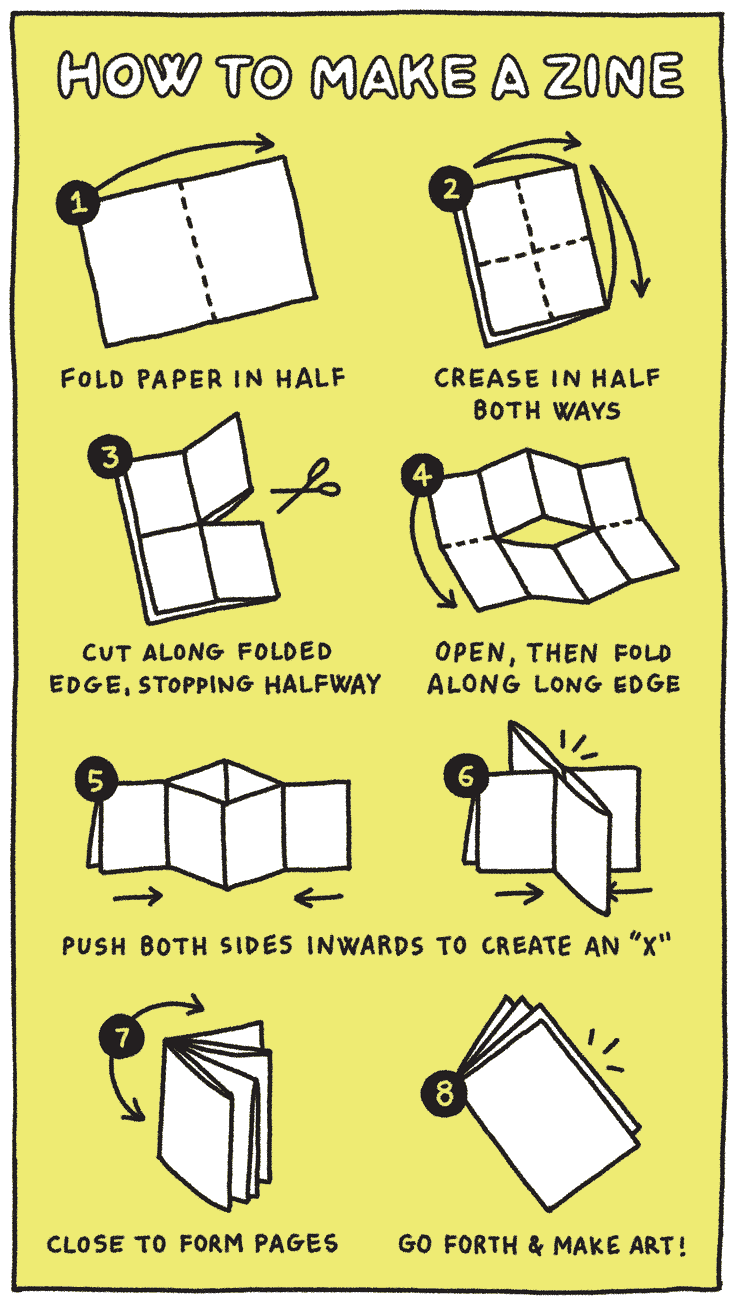
The zine community is a global one, and people use them in all kinds of ways. Whether it’s to disseminate information about social movements, share resources at protests, or simply create something from two human hands, zines put the power in the printer of the creator.
Sarah Mirk, a graphic journalist, editor, and teacher in Portland, Oregon, said she’s been making zines since she was a kid, before she even knew they had a name. Now, she rides a Zine Bike and teaches zine workshops all around Portland.
“What’s cool about zines is that everyone has the power to publish their own work,” Mirk said. “You don’t need permission to get your voice out there, or convince gatekeepers that something is worth writing about. I always tell people: if you don’t like what’s in the media, make your own media.”
Here are a few of our favorite zine artists, printers, and libraries creating and curating their own media for good.
14 Zine Artists Making a Difference
Jenn Woodall

Jenn Woodall is an illustrator, comics creator, and zine artist based in Toronto, Ontario. Her award-winning work often depicts queer and feminist themes, in conjunction with fantasy or adventure landscapes, often following women through time and space as they seek important truths. Her zines include titles like Magical Beatdown, Marie + Worrywart, and Seance.
Woodall’s first graphic novel “Space Trash” will be released in Summer 2022 and tells the story of three teenage girls who attend high school on the moon.
Woodall self-publishes her comics and zines and also distributes and publishes through Silver Sprocket, based in San Francisco.
Woodall is also on Patreon, sending supporters prints, zines, and comics.
Cyclista Zine
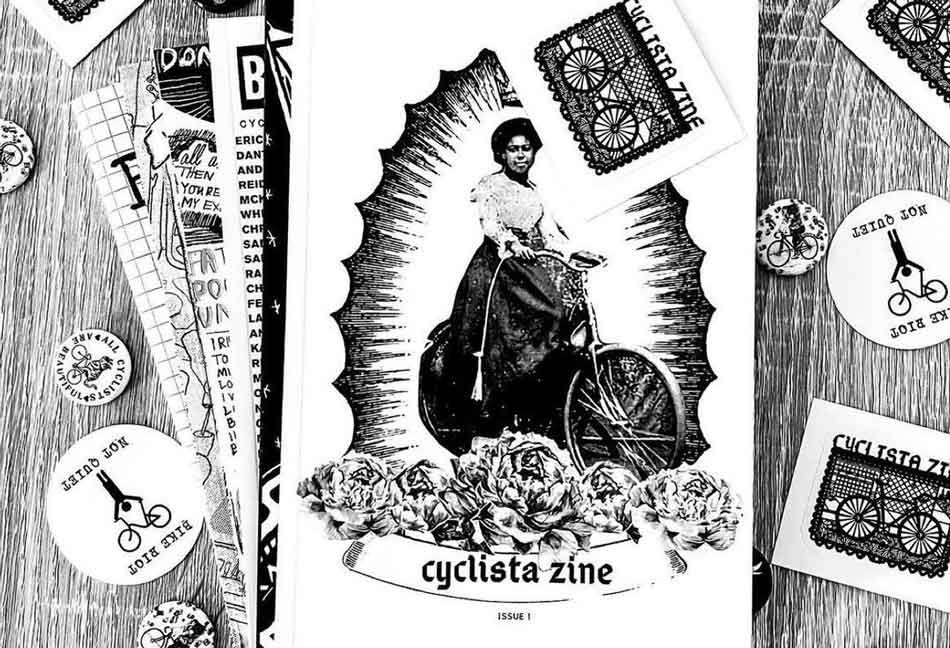
Cyclista Zine is an intersectional, radical feminist zine responding to the cycling industry. Printing quarterly, the zine is focused on sharing knowledge, art, and stories of BIPOC and women, trans, femme, and non-binary folks in cycling.
Though run by zinester Christina Torres, Cyclista Zine is a collaborative zine made up of submissions, acting as a printed guide from writers and artists who submit tutorials, stories, and advice for “feminists wanting to shred the patriarchy.” Aside from zine production, Cyclista Zine also hosts events, discussions, and a massive list of resources for activists.
Editions and events include topics like handling police interactions when biking and walking, colonialism and infrastructure, ableism in transportation, and bike liberation.
“The personal is political and cycling has a long history in creating great social change and oppression in our communities,” the Cyclista Zine manifesto reads. “Cyclista Zine is meant to function as a bridge between virtual safe spaces and in-person activism for the current and future generations to explore cycling their own way.”
Queer Zine Archive Project
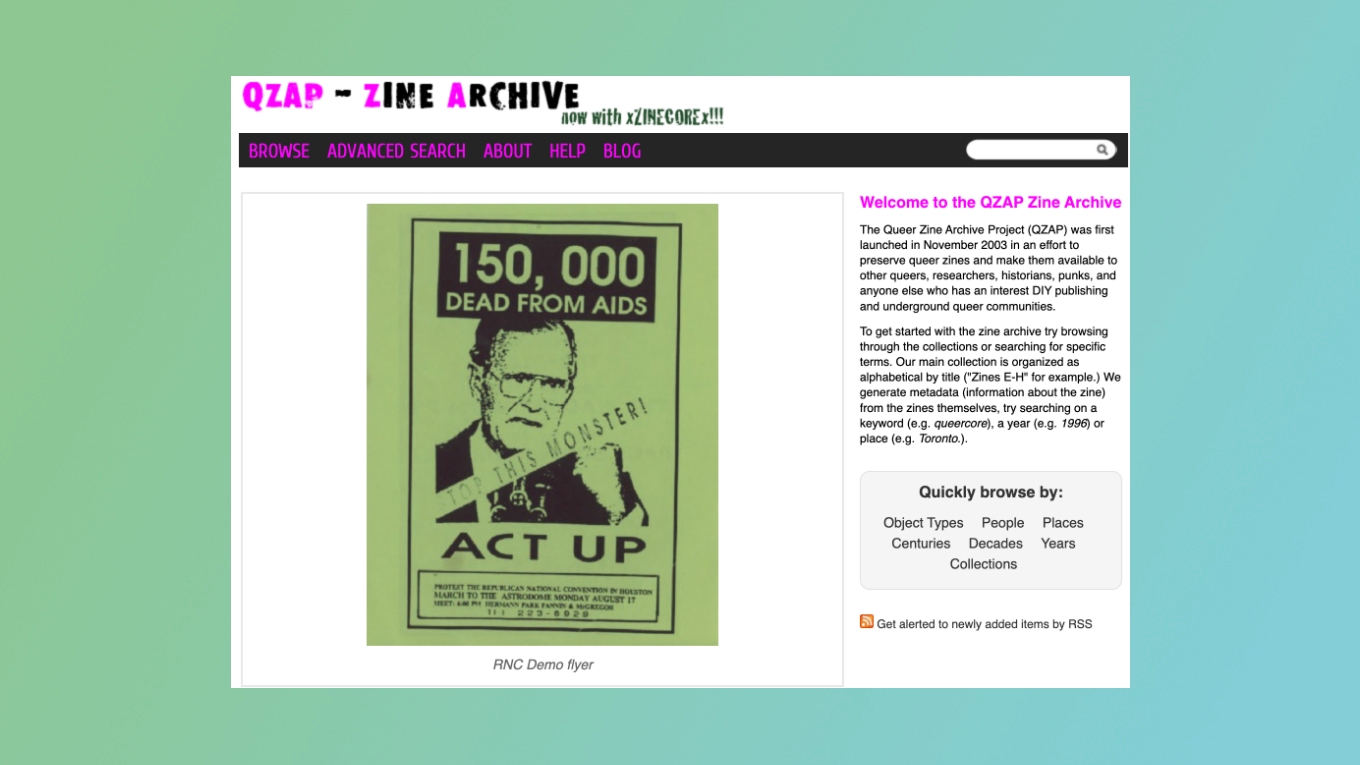
Launched in 2003 by zinesters Milo Miller and Christopher Wide, the Queer Zine Archive Project (QZAP) was developed to “establish a living history” of past and present queer zines and encourage current and emerging zine publishers to create.
QZAP has a free online searchable database that allows users to download electronic copies of zines, many highlighting topics such as queer love stories, sex education, queer media, and queer history. The project runs on donations from supporters and the love of about six contributors, who scan and archive thousands of zines.
Co-founder Miller spoke with PBS NewsHour in 2020 about their history with zines and how they impact the LGBTQ+ community.
“There’s a really certain type of story that gets told in [the] media, and it takes a lot to go around that if you don’t have access, prestige, if you’re not the ‘right’ skin color, if you don’t have the ‘right’ economic background,” Miller said. “And zines take all of that and say, ‘to hell with that.’”
Kate Bingaman-Burt (and Outlet)
Kate Bingaman-Burt is a zine creator and graphic designer in Portland, where she is the Associate Director of the School of Art & Design at Portland State University. She shares daily drawings and operates the KBB Mail Club, which sends subscribers zines and printed goods.
Bingaman-Burt also owns Outlet, a risograph press and art studio where folks can create zines.
Outlet is an accessible space for people to make prints at a high volume for a low cost. The space hosts a variety of workshops, from zine-making, to risograph and drawing basics, for makers of all kinds. Outlet is also home to a zine library with hundreds of contributions from community members.
Bingaman-Burt is deeply passionate about teaching folks about print media and using her space to welcome social movements and leaders to share their messaging.
“Print is a really powerful medium,” Bingaman-Burt said. “It can be accessed by so many people. It’s powerful for ourselves, but it’s also powerful to advocate for others, to make a publication I share, or a poster I put up in a window or take to a protest. It’s a medium that people can use in all the ways that make sense for them.”
Strongly Worded Letters
Strongly Worded Letters is an Omaha, Nebraska-based organization dedicated to civic and social education, providing scripts, knowledge, and action items to build grassroots power for local politics.
Their content revolves around providing organizers and activists with easy-to-understand tools, like scripts for communicating with elected officials, updates on local legislation, as well as mutual aid and protest information.
While Strongly Worded Letters is most known for its Instagram education tools, Patreon subscribers have access to a quarterly zine created by founders Gab Rima and Johnny Redd.
“I like how zines are easy to make and easy to digest. They make complex issues a lot easier to understand, they’re eye-catching, and you can distribute them at a low cost,” Redd said. “They’re also sort of like trading cards. People like having a physical object to read, and they’ve been a hit at events or high-energy rallies and help people stay involved once they get home.”
Hunter Ashlei Shackelford
Hunter Ashlei Shackelford — also known as Hunter The Lion — is a writer and artist based in Atlanta, Georgia. She has created a number of zines for herself and other organizations that confront racism, transphobia, fatphobia, and many other social justice topics.
Some of their work includes Black Trans Futures, Ugly AF: An Introduction to Desire Politics, and Before They Kill Me First.
Schackelford has founded two liberation organizations: Free Figure Revolution and Who’s Killing Us?. She most often writes and illustrates about the relationships between Blackness, fatness, desire, queerness, and pop culture.
“I’m so grateful to the Black trans folks who made it possible for me to find myself in a world that demands you lose yourself the moment you enter it,” Shackelford shared in an Instagram post. “I am grateful for the ability to name my experiences and give birth to language just by existing beyond the binary.”
Tiny Megaphone
Tiny Megaphone is a marketing consultancy run by Joanna Rutter. She is a thoughtful (and hilarious!) marketing pro who wants to “rig the system” and make marketing work for underdogs. In a world where capitalism and burnout make social media and marketing feel impossible, Rutter hopes to make things work “for the little guys.”
Her zine, How To Promote Your Business Without Feeling Shitty About It is a game-changing tool for creative people, small business owners, and people who are just generally grossed out by traditional marketing practices.
The zine provides an introduction to consent-based marketing and works as a pep talk, workbook, media critique, and marketing strategy skeleton, according to Rutter.
“If marketing is a megaphone, I’m handing it to the underdog to hear what they have to say,” Rutter said. “I made it [the zine] to encourage cool builders and dreamers in their quests to pay bills without compromising their values.”
Microcosm Publishing
Microcosm Publishing is a vertically integrated publishing house that “equips readers to make positive changes in their lives and in the world around them.”
Founded in 1996, Microcosm specializes in DIY books, zines, and decks about topics like self-care, feminism, social justice, bikes, and more. The publishing house also has a mission of access, using sliding scale pricing and sustainable operations prioritizing high staff wages.
Stand-out titles include “How to Resist Amazon and Why,” detailing the importance of shopping and distributing ethically; “Consensuality: Navigating Feminism, Gender, and Boundaries Towards Loving Relationships;”and “It’s OK To Be Sad.”
“Microcosm focuses on relating the experiences of what it is like to be a marginalized person and strives to be recognized for spirit, creativity, and value,” the Microcosm Publishing website reads. “Microcosm constantly poses the question: ‘how can we remove barriers to success for marginalized people in our industry?’”
This Is A Zine
This Is A Zine is a collective of artists and designers creating zines to discuss the world around us and create positive change. Led by Josh Eberhard, the collective created and distributed a weekly zine exploring a new topic about design and the world we live in between March 2020 and 2021. Now that the year-long project has concluded, zines are published when the artists see fit.
Some editions include Violence, TV, Politics, Instagram, Justice, and Anxiety. Copies are free to download and print at home, but digitally enhanced zines are shared via Instagram.
While some topics include more information, most of these topics are approached through a lens of creative design and artistic interpretation, acting as printed artifacts of a specific time in history.
ArtsEverywhere
ArtsEverywhere is a Canadian organization specializing in artistic journalism, highlighting artistic and creative practices as they relate to social justice and human rights.
The organization works in a series approach, as creative projects convene under themes or issues that affect marginalized groups most. A collection of refugee zines outlines the value of zine-making on refugee communities.
The collection highlights projects like “The Zines of Terezín,” made by Jewish children who shared “secret zines,” acting politically in the face of Nazi terror; and “Plaza Girls: A Diary,” which tells the stories of teenage Afghan and Arabic refugee girls.
ArtsEverywhere writer SiddJoag said: “Lacking other resources, refugees and others on the move often use writing and reading together to cite their politics.”
Zines & Things
Zines & Things is a Portland-based zine team by Rebekah Markillie and Jessica Wadleigh. Both are passionate storytellers who love the zine community, publishing works that encompass gender, mental health, and poetry.
The Zines & Things team works directly alongside writers and artists, partnering to provide an alternative to traditional publishing models.
Their program “Tell Me A Story” is a literary reading series that provides space for LGBTQ+, BIPOC, and women writers to connect and collaborate in a safe and creative environment. Zines & Things also publishes and sells works on their website, including a subscription program called The Zinester’s Digest.
“We make zines to pay homage to their rich history of anti-capitalism and anti-oppression,” The Zines & Things website reads. “We make zines as a liturgy to possibility, liberation, and resiliency.”
Sarah Mirk

Mentioned earlier, Sarah Mirk is a graphic journalist, educator, and zine-maker based in Oregon. Her comics have been published by outlets like NPR, The Nib, and Patagonia, and her graphic novel “Guantanamo Voices” won the 2021 Lynd Ward Graphic Novel Prize.
Mirk also offers a number of free zines on her website, covering a wide array of topics like abortion, white privilege, and voter suppression. In 2019, she made a zine every day for a year and published 100 of them in a book. An avid snail mail lover, she is also on Patreon, where supporters can subscribe to receive monthly zines and “whatever else I feel like mailing.”
“Making zines is a lot about embracing imperfection and just making something happen,” Mirk said. “It’s not mediated by a company or profit-driven entity, and you’re not feeding into this larger algorithm that’s giving us ads. It’s something you share with another person, about something you care about.”
One Of My Kind
One Of My Kind (OOMK) is a London-based art publishing collective run by three Muslim women: Sofia Niazi, Rose Nordin, and Heiba Lamara.
Together, they produce OOMK Zine, a biannual zine focused on women, art, activism, and faith. OOMK has become a collaborative effort that offers marginalized people a space to congregate around similar issues and concerns, sharing their art in an affordable and accessible way.
The OOMK team also runs Rabbits Road Press, a community printing press in East London, where they hold publishing events and discussions, in addition to hosting a local zine library.
“OOMK takes inspiration from decolonial, feminist, religious, and punk movements in creating methods of self-organization,” the OOMK Manifesto reads. “OOMK supports alternative and traditional sites of knowledge acquisition and believes that critical thinking should be nurtured and developed.”
The Sherwood Forest Zine Library

While many public libraries offer digital and print catalogs of zines, the Sherwood Forest Zine Library based in Austin, Texas is home to one of the most robust curated collections of Black Lives Matter, policing and protest guides, and zines.
The collection includes hundreds of works from various times in history, offering both academic and lived experience educational tools to help anti-racists on their social justice journeys.
Highlights include zines on mutual aid, tips for avoiding activist burnout, primers on white privilege, easy-to-read guides to staying safe while protesting, and much more.
This collection is a great resource for anyone looking to learn more about activist spaces through zine literature and provides a wide array of perspectives and tools for organizers, by organizers.
We are constantly inspired by creators who use their skills to tell important stories and make the world a better place. Although not a zine, our print Goodnewspaper is our rendition of creative storytelling for good. In fact, some of these artists were featured in the April 2022 issue of the Goodnewspaper: The Art Edition. Learn more about the Goodnewspaper and subscribe today for more good news.
One of the biggest humanitarian plights of our times is the refugee crisis, but we tend to have a vision in our heads of what constitutes a refugee.
For example, the Syrian refugee crisis is considered by many — including the United Nations — to be one of the largest displacement emergencies in modern times.
The recent situations in Afghanistan and Ukraine have also forced many Afghans and Ukrainians to abandon their homes in search of refuge.
While the concept of refugees, migrants, and displacement are not new, there has always been a largely unseen and unrecognized group of folks who fall within the same category by every definition but the legal one: climate refugees.

What is a climate refugee?
The legal definition of what defines a refugee, according to the United Nations, is “someone who is unable or unwilling to return to their country of origin owing to a well-founded fear of being persecuted for reasons of race, religion, nationality, membership of a particular social group, or political opinion.”
This legal definition, unfortunately, doesn’t include those who have to flee their homes because of the climate crisis. But it should.
A major cause of displacement is the climate crisis, which has caused some irreversible damage to some homelands, prompting its natives to relocate to a better climate.
Examples include islands being underwater, the destruction of ancestral Indigenous homelands, droughts, desertifications, and more.
As climate change worsens, so do natural disasters that deeply damage the world's natural landscapes and atmospheres.
According to Disaster Displacement, “natural disasters implore millions to leave home every year as a result of environmental degradation altering the landscape or as a result of related conflict, climate change, and displacement.”
Despite the growing population of climate refugees, there's a sustainable lack of resources for refugees seeking shelter from climate effects.
“Climate change [is] now found to be the key factor accelerating all other drivers of forced displacement. Most of the people affected will remain in their own countries. They will be internally displaced. But if they cross a border, they will not be considered refugees,” said António Guterres, UN Secretary-General, former UN High Commissioner for Refugees.
“These persons are not truly migrants, in the sense that they did not move voluntarily. As forcibly displaced not covered by the refugee protection regime, they find themselves in a legal void.”

How many climate refugees are there?
As reported in 2017, there were 18.8 million records of climate change disaster-related displacement.
In April 2021, the UNHCR released data that claimed the number of people who have been displaced by climate change-related disasters since 2010 has risen to 21.5 million, citing that “in addition to sudden disasters, climate change is a complex cause of food and water shortages, as well as difficulties in accessing natural resources.”
According to the World Economic Forum, there is a prediction that at least 1.2 billion people could be displaced by climate-related events by 2050.
“There's the heartache of leaving home, but also the distress of why that had to be,” Climate Refugees founder and executive director Amali Tower told Teen Vogue.
Climate Refugees is an immigrant, woman-of-color-led organization that advocates for the welfare of global citizens in response to the damages of climate change and those who are looking to escape from it.
They offer education and awareness of the situation, oftentimes with expert commentary and personal stories of those who have been personally affected by climate damage in their homeland.
They also advocate for new policies that will fully recognize the climate refugee crisis on the legislative level, which includes providing “expert inputs to policy, policy statements, writing joint NGO reports, and engaging in direct and public advocacy.”
According to Climate Refugees’ data, “recent trends indicate more internal displacement due to climate-related disasters than conflict, where in fact, of the 30.6 million people displaced across 135 countries in 2017, 60 percent were as a direct result of disasters.”
In addition to the trauma of climate change and resettlement, refugees who seek asylum for environmental reasons also have to navigate the generational trauma of escaping landscape ruin, reports Teen Vogue.
Given the hazardous atmospheric disasters of these situations, at least 90 percent of the burden of disease has been linked to the climate crisis.

What are some of the biggest threats to climate refugees?
A study by Front Psychiatry explored the heavy links between mental health and climate displacement.
For example, flooding in India and bushfires in Australia — which cause many to lose their homes and relocate — are huge factors in causing post-traumatic stress disorder, depression, and anxiety.
Unlike refugees who are recognized by international law, climate refugees have the burden of being an invisible group. Despite that, they still face challenges like being split from family, physical harm, exploitation, forced marriage, and sexual violence.
As writer Alli Maloney reports, because of their legal limbo, many of them live in camps or "spend periods in detention imposed by an unfriendly foreign government."
There's also a dire lack of opportunities for work and schooling, leaving many climate refugees in an economic freefall that could be life or death.
Defined as a threat multiplier by how it trickles down to other issues like water insecurity, climate change's impact has unsettled millions of people into what can only be described as an invisible crisis.
But unlike refugees who flee from recognized wartime conflicts (as with Syria, Afghanistan, and Ukraine), climate-displaced people are even more failed by systemic failures.
A prime example of climate refugees are the thousands of Bangladeshi teens who are made homeless every year as the result of river-bank erosion, reports Teen Vogue.
As do the one in 10 people who are forced to leave their homeland of Kiribati, Nauru, and Tuvalu as the Pacific Islands drown and sink further into the ocean. Another example is the young adults in Central America who travel in a "migrant caravan" to escape the extreme drought, but the path to safety is also riddled with difficulties imposed by many countries' anti-immigration laws.
“The system [is] trying to prevent them from really escaping the climate crisis and the economic crisis [it stems], finding safety in the U.S. and the direct necessity of migrating because of droughts and not having food or jobs to survive,” De Luna Navarro, an advocate and researcher of displaced young people seeking asylum in the United States, told Teen Vogue.

What are helpers doing for climate refugees?
To combat this rising crisis, advocates are pushing for lawmakers to recognize climate change-related displacement under human rights law, so refugees have access to the same protections.
Though it's a slow-moving process, there are a number of people who are working hard to make this a legal reality.
Thankfully, their efforts are paying off. In January of 2020, the United Nations Human Rights Committee determined that countries may not reject seeking asylum as a result of "climate change-induced conditions that violate the right to life.”
Following that, more than 160 nations joined in agreement with the United Nations Compact For Safe, Orderly, and Regular Migration to recognize climate change as a major cause of migration.
A silver lining amid the crisis is the young people who are working hard to combat the climate crisis, even when lawmakers are slow to do so.
Since younger generations are born into the crisis and have a greater awareness of the dangers (many of them living through global natural disasters like flooding, wildfires, and more at such a developmental age), they have become invaluable in the fight for the planet.
“It’s teens who really fill me with hope,'' Tower says.
“They’re so hungry for opportunity. A little younger—it’s way too much. But teens are at the right age, where this kind of change in their lives is integral.”
“This is the moment where they can make an impact.”
A version of this article was published in The Water Edition of the Goodnewspaper in October 2021.
You can get your own Goodnewspaper each month by becoming a subscriber today.
If you’re a TikTok lurker, like the other billion of us, you may have stumbled upon a video on your For You Page where someone encourages you to get off your phone and grab a drink of water.
“That’s enough scrolling time today,” they’ll cheer. “Why don’t you close the app and go for a walk?”
As good as their intentions are, many of us will roll our eyes and continue further down the rabbit hole. But Amelia Hutchison, the art psychotherapist behind @art_therapy_irl — and her private practice, Art Therapy In Real Life — provides a different brain break.
“What color is your heart today?” she’ll ask the camera, holding out a bushel of colored pencils, wide-eyed behind her rainbow assortment of glasses.
And the people in the comments answer. In poetic one-liners, questions about their own healing journeys, and stitched videos; more than 85,000 followers respond to Hutchison’s prompts.
Outside of TikTok, the Canadian care provider offers clinical care through one-on-one client relationships, as well as open studio and group sessions, all expanding access and experience around one thing: the power of art therapy.
What is art therapy?
Art therapy is an integrative approach to psychotherapy using art-making, creative process, and applied psychological theory for those seeking relief from mental health conditions. In addition to clinical care, art therapy practices can be used in non-clinical environments like workshops and classes.
As collective mental health needs shift and evolve to respond to modern social upheaval, more therapeutic and psychological resources will develop, too.
While tools like cognitive behavioral therapy — commonly referred to as “talk therapy” — are helpful to some, other approaches or modalities, like art or music therapy, can empower folks with different diagnoses, traumatic experiences, or mental health goals.
How does art therapy work?
Art therapy works by engaging the mind and body in ways that are different from verbal articulation alone, calling upon art materials and directives to activate sensory responses connected to emotions and experiences.
According to the American Art Therapy Association (AATA), when facilitated by professional therapists, art therapy can effectively support personal and relational treatment goals, as well as community concerns.
The AATA says that art therapy is used to:
- Improve cognitive and sensorimotor functions
- Foster self-esteem
- Foster self-awareness
- Cultivate emotional resilience
- Promote insight
- Enhance social skills
- Reduce and resolve conflicts and distress
- Advance societal and ecological change
Art therapy approaches can often be especially helpful for trauma survivors, as trauma activates the side of the brain used for emotional, visual, spatial, tactile, and artistic experiences.
Meet Amelia Hutchison, TikTok’s art therapist
As mentioned, Hutchison uses these tools, not only in her own work, but on a new, larger scale, inviting people from all backgrounds to get a taste of this creative approach to mental healthcare.
I sat down with Hutchison for an interview for our recently released Art Edition of the Goodnewspaper. While some of her story is shared in the print edition of the paper, I am excited to publish our full conversation.
Read our discussion below, and don’t forget to follow Hutchison to tap into your own inner Picasso.
This interview has been lightly edited for length and clarity.
Kamrin (Good Good Good): Tell me a little bit about how you got involved in art therapy. How did you know that this was your path of focus? What about it stood out to you?
Amelia Hutchison: Art therapy has always been my plan. I was really lucky as a kid to have lots of access to great creative spaces; specifically painting classes with an abstract painter, from the time I was six until I went off to college. They weren’t very structured classes because it was abstract, and I had these classes as a kid following some pretty intense trauma and some grief from a very young age, and I had this space, I think, to kind of explore without words.
Those classes weren’t therapy, but I think because I had a creative space to express things in color and shape and metaphor, even though I wasn’t actively doing healing work, having that space in my childhood, post-trauma, gave me this kind of extra mental health toolkit.
Words are wonderful. I write a lot of poetry myself, but I think words can be limiting, especially when we’re younger or might not have language when we’re dealing with things that are unspeakable. So, having this expanded toolkit for just, like, being in my brain and being in the world made post-traumatic growth possible for me as a young person. So when I heard about art therapy as a teenager, I was like: ‘Yeah, that thing.’ And there was no question after that.
Kamrin: What is your educational background like as an art therapist?
Amelia: I didn’t immediately go in that direction, actually. I did an undergraduate degree at the Maryland Institute College of Art that kind of focused on community arts and painting, which was great, but also that was just very fine-art specific.
In the kind of community organizing and facilitating I was doing, I always felt like I was kind of missing a clinical piece, and I wanted more of the kind of mental health training to accompany that. So I decided to pursue graduate studies in art therapy back in Canada, where I’m from.
Kamrin: You can approach this from a clinical perspective, or a personal perspective, but how would you say art benefits us psychologically? Like, how does creating make us better humans?
Amelia: I love that question. I think it's kind of similar to what I said before. Words are one part of how we experience the world, right? Language is incredibly valuable. And when we expand the ways we express to include things that are nonverbal — maybe it's movement, maybe it's sound, maybe it's something visual — I think it gives us range to explore all of the facets of being human.
I found for many of my clients, people are attracted to art therapy because whatever it is that they're working through, words aren't feeling like they're getting to it. Or, in some cases specifically, we’re working with trauma.
Trauma lives in the visual side of the brain. It’s hard to heal something like trauma when we're working with the cognitive analytical side of the brain. That’s why somatic therapy is really effective, and art therapy is really effective.
When we pull in visual tools, it gives us just another way of exploring and integrating things that are about memory or from the context of the brain that are really visual.
When we pull in visual tools, it gives us just another way of exploring and integrating things that are about memory or from the context of the brain that are really visual.
Talk therapy is amazing, but it's also just one way that we can approach caring for our mental health. And for some people, having a conversation is not the most comfortable way of making a connection or processing, thinking about folks who maybe have experienced trauma, or neurodivergent folks.
I fall into that category myself. Like, having a conversation, making eye contact? Not always going to work. But having this other element in the therapy space, I think it takes the pressure off of the conversation and gives another place to explore together with your therapist.
Kamrin: That really resonates with me. I am very much someone who tries to analyze all of my feelings and not actually feel them. I think this is exactly one of those tools, as opposed to just, like, talking it out or thinking it out, I realize this feeling needs to live somewhere else outside of me. So I think that's a really cool approach.
Amelia: You’re nailing it. Like, that idea of something living outside of me is one of the most important parts of art therapy.
Not only do we get to kind of express something in a context that is respectful and supportive and safe, but we're also taking something inside of our bodies, taking it outside and giving it form.
What would anxiety look like as a sculpture? What would fear look like as a symbol or a color? Actually having the experience of externalizing a feeling or memory we have can be really therapeutic for people.
And then, not only is it outside of us, we can manipulate it. We have the power to change it and transform it and tell a different story for it. And that in itself is incredibly validating in moments like this in our social history where we don't have a lot of control. To have one place in our lives where we do get to shape the narrative or practice asserting control over something is so important.
Kamrin: I love that. Tell me a little bit more about your practice and your offerings. I know you do clinical work and workshops. Can you dive into that for me?
Amelia: Yeah! So, in building my practice, it's been really important to make things as accessible as possible. And being in this kind of age of teletherapy or digital therapy has really made that possible in the last two years.
Right now, I offer one-on-one therapy, and that's the clinical mental health treatment side of art therapy, where I'll meet with a client, work on setting goals, working with whatever mental health diagnosis they have. We hold that through a psychotherapeutic lens and use the art as a tool to help them meet whatever mental health goals they have.
And those types of offerings are the ones that are kind of under the jurisdiction of the regulatory bodies. The great thing about that side of the work is that you get to go deep and you get to develop a relationship with a therapist that could potentially be long-term. That's really where someone would go for individual attention and if they're wanting clinical advice related to their specific issues or whatever, it is their brain therapy.
That’s about half my practice. I'm also trying really hard to make spaces that are more open and more accessible for people, ones that aren't kind of limited by where I live. I'm only able to work with people in certain states and provinces because of those kinds of regulations, which are important.
And I think some of these art therapy skills can translate to different kinds of therapeutic support groups or open studio spaces. Not everyone needs or wants one-on-one therapy, but maybe a group of six people that are meeting for a month to explore a certain topic with some guidance feels amazing.
Other therapeutic groups are kind of closed groups where there will be a certain number of people meeting and building relationships and exploring through art with the support of an art therapist.
And then I'm also running an open studio these days, and that's kind of even more loose. That's like a drop-in space where anyone can sign up and come, and there is maybe an idea or a prompt, but just an open room to create within.
I know for myself, as a person with ADHD, body-doubling is how I get things done. If I pay for something, even if it's like $5, or even if I've just signed up for something, if I know there's other people going to be there, those kinds of spaces for me, that's how I can land and be accountable to something, even if it's an art practice.
So, yeah, I run another thing called Anti-Hustle Art Studio, and that is a twice-weekly group where people can come and make art with the intention of making things that are not for their jobs, not for sale, not to be posted on the Internet, just to make things just for themselves, against the grain of productivity culture, whatever that means to them.
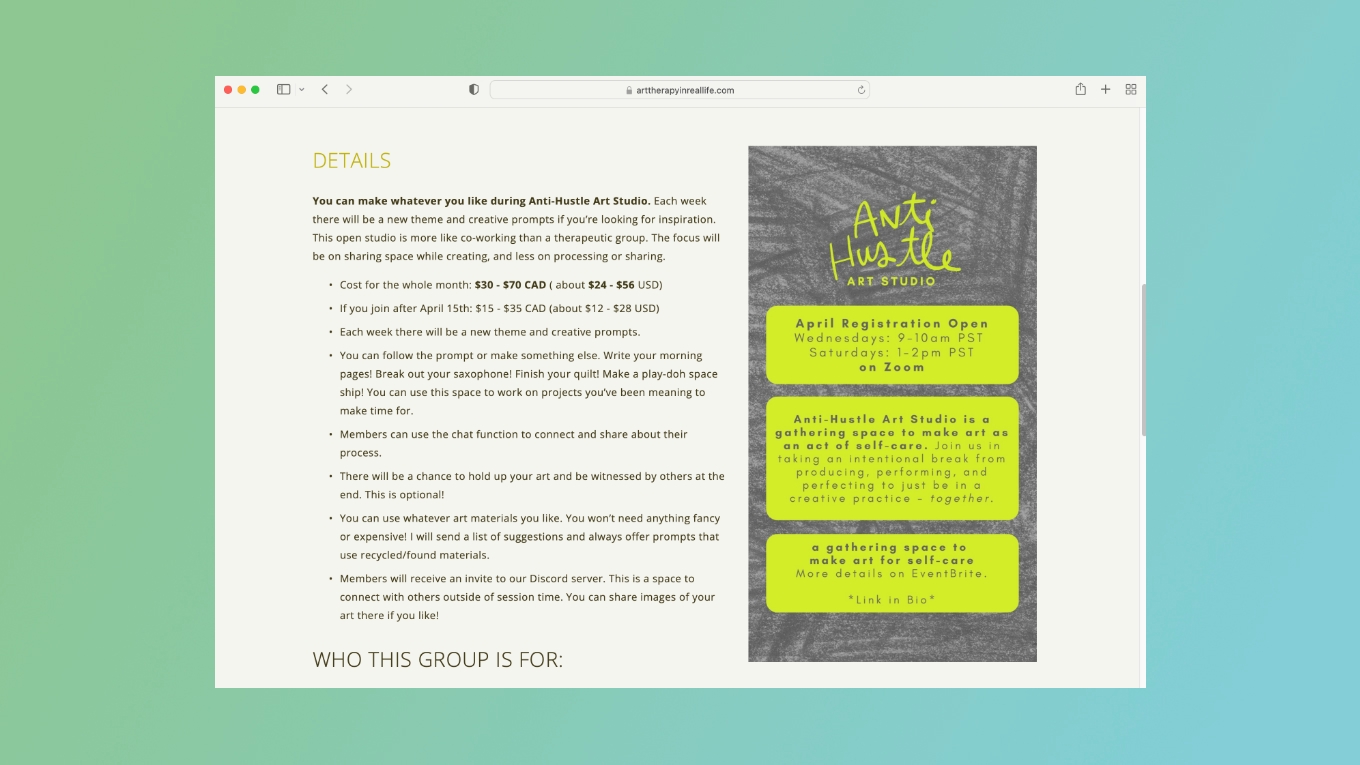
Kamrin: That’s so cool. I find that, a lot of times, people will believe that art is very exclusive or that it’s, like, reserved for people who are specifically trained as artists, or things like that. Obviously, your work is the antithesis of that: art is a healing tool for everyone. Tell me more about how we can normalize art in that way, as a way to take care of ourselves.
Amelia: I love that you're asking that question. The number one question people have is: “I'm not an artist. Can I do this?” Verbatim is like: “Oh, I couldn't even draw a stick figure.” That's the sentence people say that shows me their defense is coming up.
The whole point of art therapy is that we get to use art materials to have an experience that might give us some information. We're not working towards a final product that looks like any one thing, and that's uncomfortable for people.
We have all of this cultural conditioning that the only people who get to enjoy or benefit from art are the ones who have technical skills, who maybe were rewarded as children or college students for drawing in a certain way — likely a way that was kind of a Eurocentric aesthetic value or something that is deemed as profitable.
And if it wasn't those things, then maybe we received this messaging of: “I’m not talented, I'm not good, art is not for me. I can find other outlets for myself.” But I think one of the amazing things that can happen in art therapy is you have this space to just play and make things and learn from that experience without needing it to be something. In the end, I do a lot of work with clients where we set up a circumstance where they can't actually make a masterpiece.
We're using Playdoh, or we're drawing with our non-dominant hands. We're doing something like bilateral drawing — which is drawing with both hands at once. So there's so much information and value in just having the tactile experience of art material that we can miss if we think that the only reason to do something creative is to have a pretty final product.
Kamrin: How have you seen people benefit from that? Like, through TikTok? You have this platform where people are responding to your questions or prompts. How do you see this play out on a day-to-day scale?
Amelia: The first thing I think of is just that learning to think in metaphor can be so beneficial for folks because it gives us another way of interfacing with the world. There's kind of a binary there if someone asks how I’m doing. “I'm good” or “I'm bad,” right?
But if someone asks the question, like, “what's the weather in your heart like today?” think of what that would look like if I gave you a studio full of art materials and then you had a chance to explore what came up for you in the process. It’s so much more expansive.
I think the real benefits I see with the folks I work with is, first of all, a self-assurance of, like, I have this way of knowing myself and communicating with myself that feels really authentic and really personal. But then also this space of divesting from productivity, culture, and perfectionism.
I think the real benefits I see with the folks I work with is, first of all, a self-assurance of, like, I have this way of knowing myself and communicating with myself that feels really authentic and really personal. But then also this space of divesting from productivity, culture, and perfectionism.
Kamrin: How did you get started posting on TikTok? Was it kind of just like a tool to market your business, and then it became more of this space for people? What was that journey?
Amelia: I didn't know what to expect from that space. I've been on Instagram for years and years, but I like video. I like performing. I like public speaking. And I really like how stripped down a platform like Tik Tok is instead of the static pose, something that feels really polished. I like hopping into a conversation with someone.
And my thinking when it comes to using social media as a tool for marketing a business, my ultimate goal is to begin to create relationships, to start building a sense of trust, whether that's the people I'm going to work with or just giving people a sense of what the field is.
My real mission with my Tik Tok, and with my social media presence, is just to get the word out about art therapy being valid, real, and evidence-based, and not just this kind of floofy, crafty thing.
I was posting consistently with some simple informational videos, and then one thing just kind of caught wind, as they kind of can do on TikTok, and now I feel like there's been this community space created. There is this cool dialogue happening, and I've been able to kind of start and run new, different kinds of groups and step away from working only with client agencies. It's been really cool.
Because of TikTok, all of this information is being disseminated in this really exciting way. I feel like TikTok is kind of like the opposite of gatekeeping when it comes to kinds of information.
Kamrin: That being said, why is it important for us to make things that are not for the gaze of the Internet?
Amelia: Now you're touching on the ultimate irony of my work, that I've accidentally become a social media therapist who talks about the impact of social media on our mental health.
I'll speak from my own experience first. It’s been years, up until recently, that I made something and just kept it for myself. There was always this kind of perception of “what are people on the Internet going to see? How am I going to tell the story of this piece of art as it relates to the work I do?”
The gaze of the Internet started to kind of infiltrate my creative process, and I think it was harder and harder to make things just because it felt good or just for myself.
The gaze of the Internet started to kind of infiltrate my creative process, and I think it was harder and harder to make things just because it felt good or just for myself.
I think a lot of people experience this when it comes to sharing pictures of their lives, or if you set any precedent for yourself of being vulnerable on the Internet, there comes this time where you question: “What is just for me? Who am I when no one is watching?”
I think when it comes to a creative practice, it's a really important question. What do I make that's just for me? How is it different from the thing I make or the thing I sell or the thing I've known for? So, I mean, that's the rationale behind the Anti-Hustle Art Studio, to make things that no one gets to see except for you, if that's how you want to use the space.
I also think that having an analogue space in our lives to create and express fosters this incredible sense of connection to self authenticity, of just actually touching the physical world.
Social media collapses context. And I think what brings us back into a sense of context, into a sense of our humanness are these concepts of: “What can I feel with my body? What place am I existing in the world? What happens when I manipulate material?”
Having these really human and tactile experiences, I think, is a really important antidote to the fact that we live online now.
Kamrin: What are your favorite tips or exercises for someone just getting started with art or who wants to try out art therapy?
Amelia: There are so many things. As far as practices, I think bilateral drawing is an incredible tool for nervous system regulation. But really, start by getting yourself some materials that are not precious. Go to the dollar store, and just find something that your inner child wants to play with. Give yourself permission to play without the agenda of making something.
Amelia’s insights were originally published in the April 2022 issue of the Goodnewspaper: The Art Edition. Learn more about the Goodnewspaper and subscribe today for more good news.
Sometimes it feels like the world is filled with just doom and gloom. When you’re feeling burdened by bad news, it’s important to remember that there’s a lot of good in the world.
Fortunately, there are positive news sources here to help remind you of all the good happening behind the scenes.
We fancy ourselves as good news experts — and we compiled this list of some of the most common questions people have about good news.
Frequently Asked Questions About Where To Find Positive News —
Where can I find only positive news?
If you’re wondering where you can read only good news, there are actually a lot of options available.
Websites like Good Good Good, Reasons to be Cheerful, and Good News Network follow journalistic best practices in their coverage of the positive things happening in the world. They each publish daily content that’ll leave you feeling more hopeful.
If you’re looking for even more recommendations (because there’s no such thing as too much good news!) check out our list of the best positive news sources.
Is there a good news channel?
If you’re looking for a tv channel with just good news, unfortunately, this hasn’t been created yet.
Fortunately, a few online publishers have filled in the gap with fantastic video content that highlights people making a difference.
Check out A Plus and Lightbeam.tv — two online sources creating videos that will leave you inspired.
Is there a positive newspaper?
Yes! Good Good Good makes a Goodnewspaper that will leave you feeling hopeful and inspired to make a difference.
Every month, subscribers get a new happy newspaper mailed via snail mail.
You can subscribe to the Goodnewspaper today.
Is there a good news only app?
If you’re wondering if there’s an app that only shows good news, the answer is yes! Squirrel News created a curated constructive news app. According to their app description, their “team of independent journalists collect the most important solution-oriented articles from international media and bundle them into free daily editions.”
The Squirrel News app is available for iOS and Android — and also publishes articles and podcast episodes on its website.
Good News Network also has a free app, available in the App Store and Google Play.
Lastly, while it isn’t technically an app, you can make an “app” out of almost any mobile website by adding a bookmark to your home screen. Here’s a tutorial on how to do this on Android and iPhone. (Test it out with our good news website: goodgoodgood.co!)
Update: We've tested every good news app and have curated our best recommendations.
Are there any positive news podcasts?
Yes! The Good News Podcast produces several episodes each week that “make each day more bearable.” The show was created by the creative team at Cards Against Humanity and has been running since December 4th, 2017.
About Good News —
What are examples of good news?
- Conservation efforts are saving humpback whales
- The world has experienced a 59% decline in deaths of children under five since 1990
- The stigma around depression is decreasing in the United States
- Kids continue to find unique ways of making their communities — and the world — a better place
- We’re making significant progress in combatting the global education gap
- And much more…
Why do we need positive news?
Berkley’s Greater Good Magazine points to constructive journalism — or journalism that is more productive, forward-looking, and solution-focused — as a way to actually boost our news engagement and “widen our lens of attention and inquiry.”
Recent studies show that traditional news media, which often exposes us to fear-inducing information or imagery, can make us feel helpless or out of control, turning us away from engaging with current events as a whole.
However, more hopeful news allows us to feel more positive emotions, which improves our health and longevity, and can keep us from tuning out what’s happening in the world.
In addition, good news can even help mobilize us to be better people. A study led by Karen McIntyre of Virginia Commonwealth University found that people who read inspiring news stories were more willing to engage in a generous activity related to the story, like signing a petition or donating money to support a cause.
“This mirrors other studies that have found that people experiencing the uplifting feeling of moral elevation — which inspiring, solutions-oriented news stories could potentially engender — act more altruistically,” Greater Good Magazine shares.
About Popular Good News Sources —
What happened to Some Good News with John Krasinski?
John Krasinski decided to create Some Good News in the early days of the COVID-19 pandemic. Much of his acting and directorial work had been postponed along with the rest of Hollywood and he saw an opportunity to create a web series that could help bring some happiness to other people who were staying at home to reduce the spread of COVID.
His plan was always for the show to be a limited series while his other work was canceled. Over the course of nine episodes, Krasinski brought spontaneous and whimsical moments of happiness into the homes of millions of people.
Krasinski stepped back from the project to continue his acting pursuits after eight episodes (plus a bonus episode later that year).
Is Some Good News over?
Unfortunately, Some Good News with John Krasinski is over. In May of 2020, Krasinski sold the rights to the web series to ViacomCBS for an undisclosed amount of money.
“Writing, directing and producing — all those things — with a couple of my friends was so much, and I knew it wouldn’t be sustainable with my prior commitments,” Krasinski said about Some Good News in an Instagram Live.
“I knew the two options were always going to be, I leave it off at eight [episodes] in my office, which I would love to keep doing this show from my office forever, but it just wasn’t sustainable,” he continued.
“I knew I would need a partner coming on… One of the biggest news programs in America, CBS News, [said] they want to make it part of their permanent news cycle, which is insane.”
Unfortunately, in the two years since CBS acquired the series, they haven’t done anything with it. While the show may return at some point, it will likely return with a different host.
Is Good News Network religious?
Good News Network isn’t religiously affiliated, but there’s actually an unassociated radio network called GNN Radio. GNN is short for Good News Network radio and plays Christian programming and music in Alabama, Georgia, North Carolina, and South Carolina.
How does Good News Network make money?
Outside of the fact that Good News Network only publishes good news, they’re a traditional media company. Like many media companies, they mostly make money through advertising across their website, app, and other platforms.
Additionally, they sell “Good Gifts” which include holistic anxiety relief patches, jewelry, shoes, and books. Lastly, Good News Network also allows their readers to make donations.
Is GNN reliable?
According to the media bias rating tool, Ad Fontes, Good News Network’s bias rating is “Middle” and its reliability rating is “Reliable, Analysis/Fact Reporting.” Good News Network is a reliable source for positive news.
About Founders of Popular “Happy News” Outlets —
Who started the Good News Movement?
Good News Movement is a popular Instagram account with more than 4.1 million followers. They describe themselves as a bilingual, journalist-run good news page with current news and zero politics.
Good News Movement was founded by Michelle Figueroa, a long-time former CNN Espanol reporter.
In an interview with the Rachel Ray Show, she said that as a reporter, people would send her “good news stories from their own communities that maybe otherwise wouldn't make a headline or wouldn't make the newspaper or newscast."
So she set out to create a space online where people could find feel-good stories about — to quote Rachel Ray — “love, love of animals, love of each other, [and] respect for one another.”
Who is Geri Weis Corbley?
Geri Weis-Corbley is known as the 'Good News Guru'. She is the founder of the Good News Network, which is commonly heralded as the first website to focus on positive news.
Geri has more than 35 years of experience in television production and online news media. She has been featured on TV and radio, and has spoken publicly about the benefits of consuming good news.
She's also the author of the book, “... And Now, The Good News: 20 Years of Inspiring News Stories,” published in 2018.
Weis-Corbley's work paved the way for countless other positive media endeavors — including our work at Good Good Good.
Who is the owner of Good News Today?
India Today created Good News Today, which they describe as “India’s first and only good news channel that recognizes that the news doesn't just have to mean bad news.”
Who runs Tank’s Good News?
Tank’s Good News is run by George Resch. You may know Resch better as “Tank Sinatra,” the creator of extremely popular meme accounts like @tank.sinatra and @influencersinthewild.
Who is the editor of YES! magazine?
Sunnivie Brydum is the editorial director of YES! Magazine.
According to the magazine's about page, Sunnivie Brydum is an award-winning journalist and LGBTQ+ media expert. She has spent more than a decade leading editorial operations and coverage of LGBTQ+ issues for some of the most influential publications in the country.
In 2019, Sunnivie joined YES! as editorial director, overseeing daily editorial operations and online journalism.
YES! also has a number of other editors. You can learn more about them — and the founders of YES! — on their website.
Can I start my own positive news outlet?
You absolutely should! The world needs more good news — and more talented storytellers helping get the word out.
Whether you start a website, an Instagram account, a YouTube channel, or an actual print newspaper, the work you do can help people feel much more hopeful.
Our recommendation: Start with a niche you care about. If you care about the Philippines, share good news about what’s happening in your country. If you care about politics, write about policy that will genuinely solve problems. The options are limitless.
No matter where you find good news, we’re glad you’re seeking it out.
There’s good news about the environment, success stories of the ways the world is changing for the better, Reasons To Be Happy: Good Animal News From 2022, and so much more happy and hopeful news. And all of that is worth celebrating.
Our challenge to you is this: After you’ve celebrated positive news and you feel more hopeful about the world — find a way to get involved and make a difference. By taking action, you’re creating good news that might inspire others just like you.
Since Russia’s Feb. 24 invasion of Ukraine, millions of Ukrainians have fled their country and escaped to surrounding Eastern and Central European nations in droves.
As of March 31, over 4 million, or about 10% of all Ukrainians, had left.
The massive scale and rapidity of the exodus out of Ukraine is unprecedented in recent European history and was last seen during World War II.
The escalating refugee crisis highlights the welcoming attitudes of other European countries toward Ukrainian refugees, particularly among nations that have historically taken an antirefugee stance.
Understanding why Vladamir Putin invaded Ukraine is, in some ways, tied to where refugees are going.
In 2004, Ukraine’s Orange Revolution set the country on a new path, politically and culturally aligning with Western Europe rather than Russia.
After Kremlin-backed Ukrainian leader Viktor Yanukovych was overthrown in 2014, Putin seized Ukraine’s Crimea Peninsula, giving Russia control over the economically and militarily important Sevastopol naval base.
Ever since, Putin has sought other ways to regain control over Ukraine, stoking pro-Russian separatist movements in eastern Ukraine and circulating rumors that Ukrainian President Volodymyr Zelenskiy’s government is full of neo-Nazis.
Leading up to the invasion, Ukraine tied itself closer to European powers like the European Union and NATO.
Just before invading, Putin claimed his aims were to “demilitarize” Ukraine, while at the same time officially recognizing the pro-Russian separatist groups.
Now, Ukrainian refugees are fleeing to neighboring countries, many of which were also formerly part of the Soviet Union, and who have since joined NATO and the EU.
Some analysts believe this shared history, as well as shared defiance of Putin, has led many Europeans to embrace Ukrainian refugees.
However, there is a stark difference in Europe’s reception of refugees from Ukraine in contrast to refugees from the Middle East, Africa, and Asia.
According to a survey of 18,000 people across 15 European countries, factors like religion, language skills, and country of origin of potential refugees impact how many Europeans evaluate who is worthy of being granted safety and asylum.
Bulgarian Prime Minister Kiril Petkov put it explicitly when he said of Ukrainian refugees, “These people are Europeans. These people are intelligent, they are educated people. ... This is not the refugee wave we have been used to…"
Other countries have also pledged to aid Ukraine in its efforts to fight back Russian forces and accept refugees.
President Joe Biden has announced $1 billion in military aid and promised the U.S. would accept up to 100,000 refugees fleeing the crisis. Germany broke its long-standing policy of not sending weapons to conflict zones and has promised to aide Ukraine.
The EU granted Ukrainian refugees a temporary residence permit that removes the need for them to request asylum in any EU member country, allowing them to move freely throughout Europe.
To determine which countries have taken in the most people fleeing Ukraine since fighting broke out Feb. 24, Stacker compiled refugee data (last updated April 3) from the United Nations High Commissioner for Refugees.
The UNHCR compiles these statistics from several government sources from each country, primarily looking at border crossing data, but since the war between Russia and Ukraine is ongoing, these numbers are only estimates and does not consider refugees who have passed through one country to get to another.
The only exception is refugees who have crossed the border between Moldova and Romania.
You might also like:
- Meet One Ukrainian Etsy Seller Creating In The Midst of Conflict
- How To Help Ukraine: Donate To Orgs & Stop Misinformation
- Hope Within the Heartbreak: Finding Good News in Ukraine
- For Ukraine's Refugee Children, Schools Promise a Fresh Start
- Through Online Platforms, Thousands Open Their Homes to Ukraine’s Refugees
- Europe Sizes Up Renewables To Reduce Reliance on Russian Gas
- Sharon McMahon's 'Governerds' Raise Millions to Help Others
The 7 Countries Accepting the Most Ukrainian Refugees —
#7. Belarus
— Total recent Ukrainian refugee intake: 15,281
Although some Ukrainians have sought refuge in Belarus, it is the only country in the region to ally itself with Putin and the invasion.
Since Belarus shares a large stretch of border with Ukraine, it has been valuable to Russia in terms of military strategy. Tens of thousands of Russian troops gathered in Belarus near the Ukrainian border in the months leading up to the invasion and were able to invade the Ukrainian capital of Kyiv easily from Belarus.
Refugees have also reported abuse from Belarusian asylum camps. Asylum seekers from the Middle East, who were once promised passage to the EU, are now being forced from the camps.
Middle Eastern refugees can either go to Poland, where they were previously beaten back by Polish border police, or go into the active warzone of Ukraine.
#6. Slovakia
— Total recent Ukrainian refugee intake: 301,405
Sharing a short border with western Ukraine, Slovakia has seen a steady influx of mostly women and children refugees.
According to Igor Matovic, Slovakia’s finance minister, Slovak households that provide refugees with shelter will receive financial assistance from the government.
The country is also providing military assistance to Ukraine in the form of artillery ammunition and fuel.
Arriving refugees have been met by NGOs providing food and water, hygiene supplies, medical care, and legal advice. Veterinarians are even present to attend to people’s pets. The Slovak chapter of the Order of Malta, a Catholic human rights order, has been coordinating accommodations and rides for refugees who need to move to a different location.
#5. Russian Federation
— Total recent Ukrainian refugee intake: 350,632*
Russia has offered Ukrainian refugees a safe haven from the fighting it initiated in Ukraine and has also offered refuge in Putin-allied Belarus.
Ukraine’s deputy prime minister as well as other EU member nations’ leadership denounced this as a “trap,” meeting the announcement with disbelief.
Meanwhile, tens of thousands of Russian citizens have fled Russia in the wake of the invasion of Ukraine. Many fear a Soviet Union-era crackdown on dissidents or not being able to leave in the future.
Thousands of antiwar protestors in Russia have been arrested, and a group of Russian activists penned an open letter condemning the war and establishing an antiwar council.
Other activists, journalists, and outspoken critics of the war have been arrested or intimidated at their homes.
*Please note that the Russian refugee intake numbers are as of March 29, the last time data was updated for this country.
#4. Hungary
— Total recent Ukrainian refugee intake: 390,302
Although the Ukraine-Hungary border is small, there has been a large stream of Ukrainian refugees into the country, made up of mostly women, children, and international university students.
Hungarians have shown solidarity with the refugees, with many volunteers welcoming them at the border and supplying aid.
Even famously antirefugee Hungarian Prime Minister Viktor Orban—who campaigned on far-right, nationalistic, and xenophobic rhetoric—has expressed his support for incoming Ukrainian refugees.
This support contrasts heavily with Orban’s 2015 Syrian refugee policy, which earned the country the nickname “Fortress Hungary” due to its unwelcoming nature.
Part of the policy, which involved deporting refugees to nearby Serbia, was deemed by the European Court of Justice to violate EU law.
Border police also deployed attack dogs and water cannons to keep out refugees from the Middle East, raising questions about the notably disparate treatment Ukrainian refugees have received.
#3. Republic of Moldova
— Total recent Ukrainian refugee intake: 394,740
The Republic of Moldova’s location between Ukraine and Romania has led many Ukrainians to seek refuge in or pass through the roughly Maryland-sized country.
The sudden influx of hundreds of thousands of refugees has raised concerns about overwhelming Moldova, one of the poorest European countries, with limited resources to sustain aid.
Other nearby nations with more resources stepped up to help, with Romania arranging bus services to transport refugees out of Moldova and into Romania, supported by UN Refugee Agency and the International Organization for Migration.
Germany has also committed to taking in 2,500 Ukrainian refugees from Moldova in order to alleviate some of the strain.
#2. Romania
— Total recent Ukrainian refugee intake: 643,058
While many refugees who entered Romania since the Russian invasion have departed for other countries, upwards of 84,000 remain, mostly concentrated in Bucharest, the nation’s capital.
The country made shelters available, even converting part of the massive exposition center Romexpo to a refugee overflow shelter.
Dr. Raed Arafat, Romanian internal affairs minister, also said the country is attempting to make more permanent housing options available for refugees.
Many Ukrainians have expressed their desires to return to their country when it’s safe to do so in order to rebuild, but the Romanian government began taking initiatives for long-term solutions for those who do not plan to go back.
#1. Poland
— Total recent Ukrainian refugee intake: 2,451,342
The vast majority of Ukrainian refugees have gone to Poland—in numbers equalling the population of Poland’s largest city, Warsaw.
Movement into Poland is unsurprising, considering the country’s pre-war Ukrainian population was already the largest in the region at 1.5 million.
Poland’s government has already passed legislation to aid the massive influx of refugees, including allowing refugees to stay legally in Poland for 18 months without a visa, offering financial assistance to Polish households who help shelter refugees, and one-off subsistence payments to Ukrainian refugees.
Ukrainian children received permission to integrate into Polish schools, and adult refugees can work without a Polish working permit.
Refugees will have access to the Polish health care system, and since many refugees are lone mothers with children, Ukrainian families have access to financial assistance.
You might also like: Meet the people rebuilding housing for those still in Ukraine
This article was originally published by Stacker. (CC BY-NC 4.0)
Let’s be totally honest — you maybe shouldn’t trust us as the best source for bad news quotes.
Because we’re biased.
We hate bad news. With a passion.
Even though we’re not the leading experts on bad things in the world, we think it’s more fun — and a lot better for humanity — to be experts on all things good.
Every day we share good news stories from around the world, every weekday we share a roundup of the best positive news worth knowing about, and we even make a real-life print newspaper filled with good news. (Yes, you can subscribe today.)
But like all things, we’ve found that balance and nuance bring us a lot closer to sniffing out good solutions, creating meaningful dialogues, and embracing hope.
You can absolutely trust us on anything related to good news. Whether you trust us as the best source for quotes on bad news is up to you.
PS: Check out our favorite good news quotes.
Here are the best quotes about bad news (even though we prefer good news) —
“The brains of humans contain a mechanism that is designed to give priority to bad news.”
— Daniel Kahneman
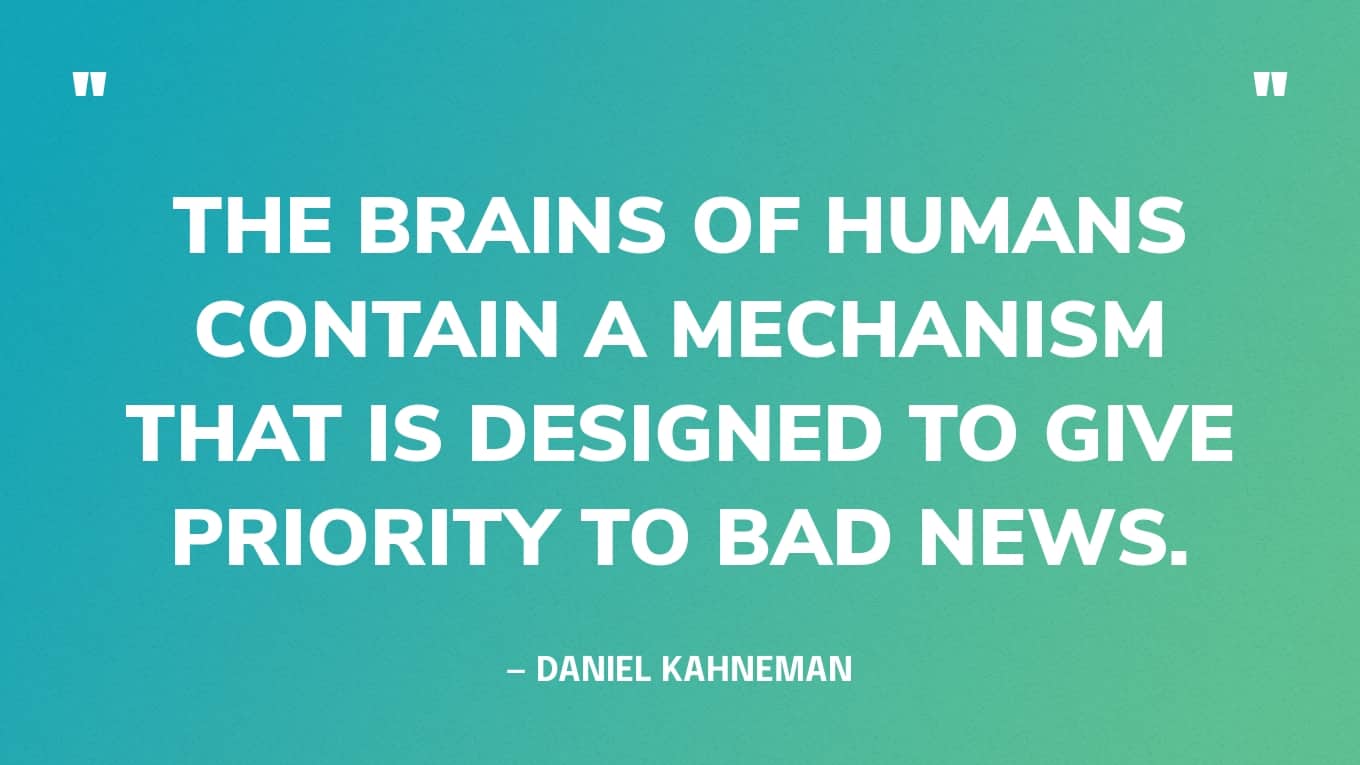
“The bad news is nothing lasts forever,
The good news is nothing lasts forever.”
— J. Cole
“Bad news travels at the speed of light; good news travels like molasses.”
— Tracy Morgan
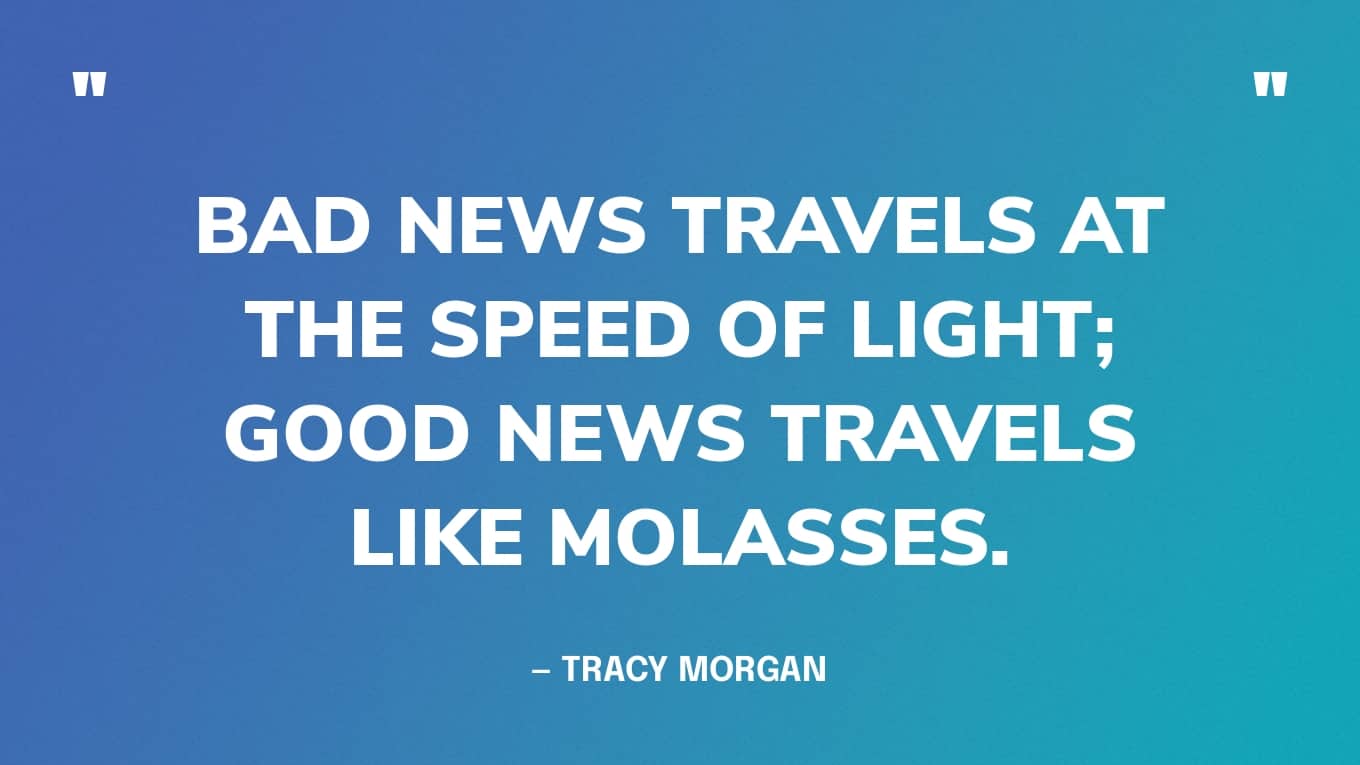
“A lot of times good news happens slowly and bad news happens all at once. And so we tend to focus on the bad news that’s crashing over us in waves, and not on the slow long-term work that people are doing together to try to make a better world for us to share.”
— John Green, in conversation with Steve Levitt on People I (Mostly) Admire
“The good news is hopeful doesn't mean dumb. The bad news is cynical doesn't mean smart.”
— Sarah Silverman
“Headlines, in a way, are what mislead you because bad news is a headline, and gradual improvement is not.”
— Bill Gates
You might also like: See how the world is gradually improving
“The news media are, for the most part, the bringers of bad news... and it's not entirely the media's fault, bad news gets higher ratings and sells more papers than good news.”
— Peter McWilliams
(The good news is, you can change that... by supporting Good Good Good and subscribing to the Goodnewspaper)
“I'd rather get bad news from an honest man than lies from a flatterer.”
— Ursula K. Le Guin
“Bad news travels faster than good.”
— Catherine the Great, via “Catherine the Great: Life and Legend” by John T. Alexander, 1989
“Sometimes, I think my most important job as a CEO is to listen for bad news. If you don't act on it, your people will eventually stop bringing bad news to your attention and that is the beginning of the end.”
— Bill Gates
“Bad news travels fast. Good news takes the scenic route.”
— Doug Larson
“More information is always better than less. When people know the reason things are happening, even if it's bad news, they can adjust their expectations and react accordingly. Keeping people in the dark only serves to stir negative emotions.”
— Simon Sinek
“Better to have bad news that's true than good news we made up.”
— Eric Ries
“This is what I say: I've got good news and bad news.
The good news is, you don't have to worry, you can't change the past.
The bad news is, you don't have to worry, no matter how hard you try, you can't change the past.
The universe just doesn't put up with that. We aren't important enough. No one is. Even in our own lives. We're not strong enough, willful enough, skilled enough in chronodiegetic manipulation to be able to just accidentally change the entire course of anything, even ourselves.”
— Charles Yu, How to Live Safely in a Science Fictional Universe
“Nothing travels faster than the speed of light with the possible exception of bad news, which obeys its own special laws.”
— Douglas Adams
“Bad news sells because the amygdala is always looking for something to fear.”
— Peter Diamandis
“When bad news is riding high and despair in fashion, when loud mouths and corruption seem to own center stage, when some keep crying that the country is going to the dogs, remember it’s always been going to the dogs in the eyes of some, and that 90 percent, or more, of the people are good people, generous-hearted, law-abiding, good citizens who get to work on time, do a good job, love their country, pay their taxes, care about their neighbors, care about their children’s education, and believe, rightly, as you do, in the ideals upon which our way of life is founded.”
— David McCullough, The American Spirit: Who We Are and What We Stand For
“Bad news is bad news because it drops your willingness to carry on.”
— Meir Ezra
You might also like: The best quotes about hope & the best quotes about activism
“A media diet of hostility, blame, confrontation and violence corrodes your civic outlook.”
— Mark Gerzon
“Don't let the bearers of bad news become the pallbearers of your happiness.”
— Stewart Stafford
“Never awake me when you have good news to announce, because with good news nothing presses; but when you have bad news, arouse me immediately, for then there is not an instant to be lost.”
— Napoleon Bonaparte
“If news is not really news unless it is bad news, it may be difficult to claim we are an informed nation.”
— Norman Cousins
“The bad news is that yesterday sucked. The good news is that yesterday is gone. Today's a new day. Own it! Shape it! Live it!”
— Steve Maraboli