As a stranding coordinator at Florida’s Gulfarium C.A.R.E. Center, Sarah Kamen is no stranger to rescuing and rehabilitating sea turtles.
But when a loggerhead sea turtle named “Chlorophyllis” came under her care in late March, she realized right away that this was going to be a particularly tough case.
“This morning, we got a call about a sea turtle that had been accidentally hooked at one of the local fishing piers,” Kamen shared in a TikTok video. “As you can see, [she’s] covered in lots of algae and barnacles.”
In addition to the growths on her shell, Chlorophyllis also had a hook in her mouth and an internal fragment seen on radiographs.
“Sea turtles that come into rehab looking like this really pull at our heart strings,” Kamen added.
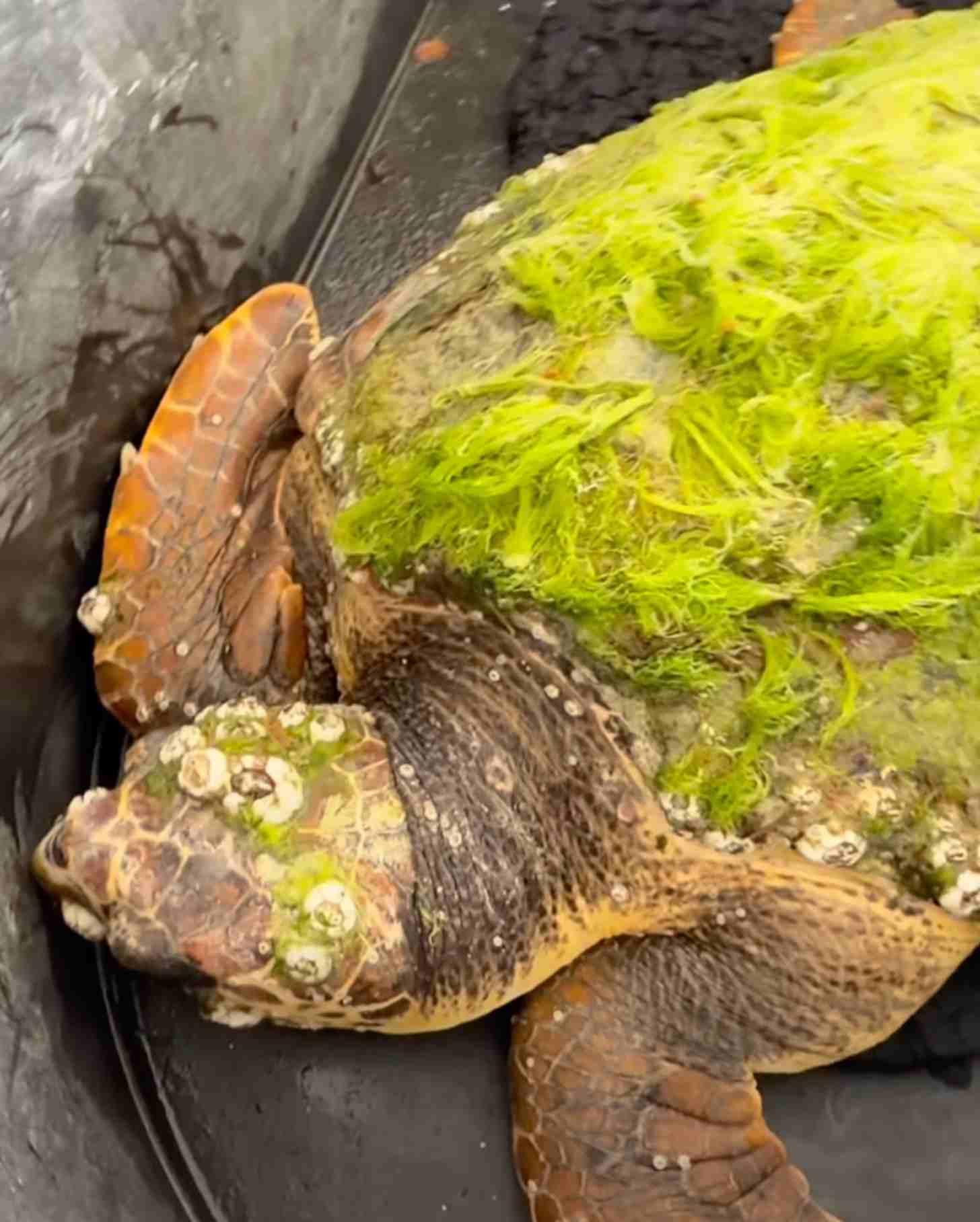
The stranding coordinator explained that thick algae grows on slow-moving sea turtles when they are sick and lethargic.
“This allows critters and algae to rapidly grow on its shell,” she said. “While removing the barnacles and algae is part of the rehab process, our first priority is the animal's health. Barnacle removal and scrubbing of the shell can cause additional injury and pain to the turtle if done too soon in the healing process.”
“So, for now,” she added, “we prioritize feeding, dedicating, lots of rest, and lots of love.”
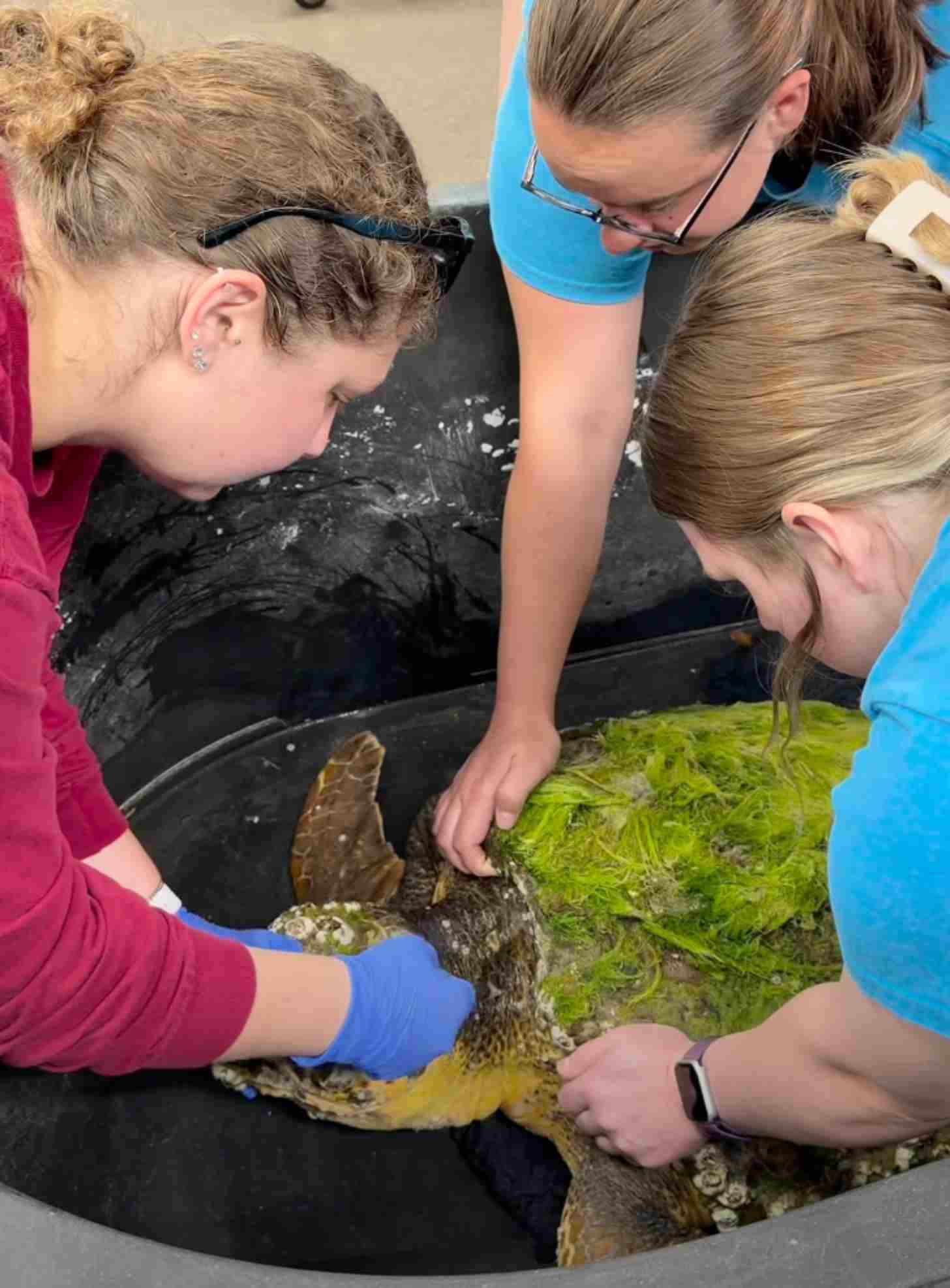
After immediate medical attention and a daily diet of fish, Chlorophyllis was ready for her “spa day” roughly a month into her recovery.
“The moment everyone has been waiting for is here!” Kamen shared in a TikTok video on April 23. “Chlorophyllis has gotten some of her spunk back and was ready for a much-needed spa day! After lots of close observation, we felt that she was strong enough to have those barnacles removed!”
In the video, Kamen showed the satisfying crunches and snaps of barnacle removal, as Chlorophyllis looked visibly relieved. After removing a barnacle on her chin, Kamen even gave her an affectionate “boop” on the nose.
@sarah_kamen The moment everyone has been waiting for is here! Chlorophyllis has gotten some of her spunk back and was ready for a much needed spa day! After lots of close observation, we felt that she was strong enough to have those barnacles removed! 🥰🐢 #barnacles #seaturtle #seaturtleconservation #marinelife #spaday ♬ original sound - Sarah
“While she still has a long way to go, small progress is a big win here at the center,” Kamen said in the video’s narration. “I hope this is as satisfying for you to watch as it was for me to do.”
After another month of rehabilitation, Chlorophyllis had regained her strength, energy, and appetite and was ready for re-release.
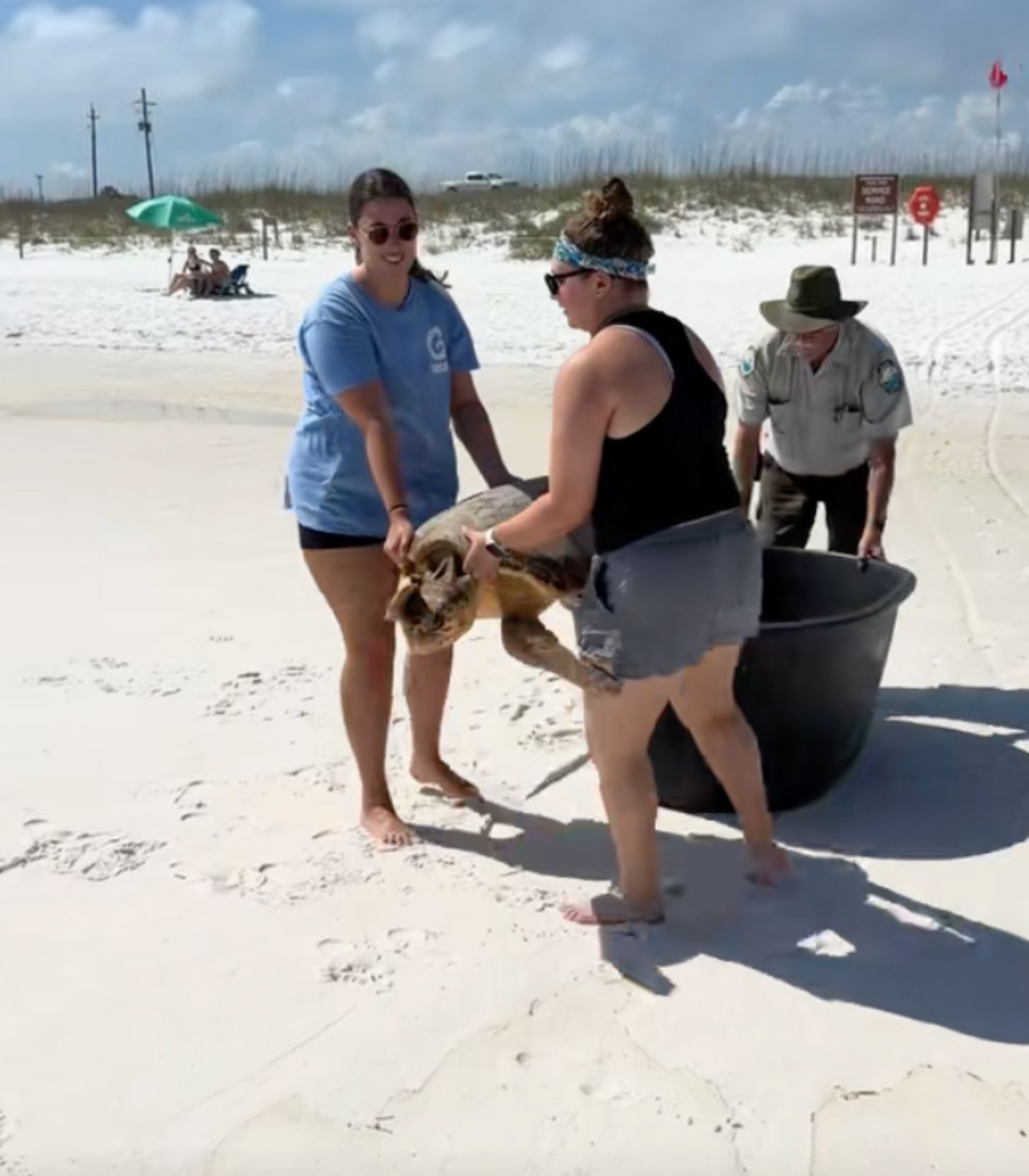
On May 22, Chlorophyllis was finally released back into the ocean, her flippers waving excitedly as she dove back into the warm waters, her shell gleaming in the sun.
“Two months in rehab and lots of fish snacks and medical care later, Phyllis was ready to make her new ocean debut,” Kamen shared in a TikTok video caption. “She’s practically unrecognizable now — in the best way.”
@sarah_kamen This is the update on Chlorophyllis that so many people have been waiting for!! 💚 2 months in rehab and lots of fish snacks and medical care later, Phyllis was ready to make her new ocean debut 🐢 She’s practically unrecognizable now in the best way 🥰 #seaturtle #seaturtlerelease #savetheturtles #conservation #marineeducation ♬ original sound - RWEeditz
You may also like: A sea turtle washed ashore with a stingray barb lodged in his tongue. After an incredible 8-month recovery, he's returning to the ocean
Header image via Rachael Partridge / TikTok
Every on-air journalist sits in a makeup chair before a broadcast, but reporter Guillermo Barraza’s routine is more transformative than most.
With a bright wig, fabulous outfit, and flawless makeup, Barraza slips away into Amanda Drag for “La Verdrag,” a news program “where minorities turn into a majority.”
The show, which is filmed in Mexico City, combines investigative reporting with interviews that highlight LGBTQ+ celebrities and residents. The Canal Once program gives visibility to a local queer community that faces daily harassment and prejudice.
“In this country, no one is safe,” Barraza told LGBTQ Nation. “The more visible you are, the more you want to fight for change, the more you put a target on your own chest. And if we have to put our lives on the line, that’s what we’ll do, because we won’t let fear win.”

Mexico has the second-highest death rates in the world for journalists, and Barraza sees a barrage of death threats flood their inbox every day. But the Amanda Drag persona allows Barraza to be brave in the face of violence.
“There are many things that Guillermo wouldn’t do or say that Amanda wouldn’t think twice about,” Barraza said. “Having an alter ego, you have fewer problems because they can’t harass a character. You have more freedom to speak out.”
A version of this article originally appeared in the 2024 Pride Edition of the Goodnewspaper
You may also like: This Florida drag queen doubles as a marine animal conservationist: 'Steve Irwin was my biggest inspiration growing up'
Header image via Guillermo Barraza
- A new wildlife overpass that spans a major highway south of Sydney is reconnecting habitat between Heathcote National Park and Royal National Park, helping animals safely cross one of Australia’s busiest road corridors.
- The retrofitted bridge includes features for a wide range of species, from rope crossings for gliding marsupials to vegetated pathways for ground-dwelling animals such as wombats, echidnas, and amphibians.
- Ecologists say reconnecting fragmented habitat is increasingly important as roads, urban expansion, extreme weather events, and climate-driven bushfires isolate wildlife populations and reduce genetic diversity.
- Research from Australia and elsewhere shows that wildlife crossings can significantly reduce animal deaths and help species move, forage, and breed, but only when these structures are carefully designed around animals’ behavior and habitat needs.
SYDNEY, Australia. At dusk on the edge of the bush in Australia’s Heathcote National Park, a spotted-tailed quoll lowers its tawny head to the ground, pink nose twitching. The dense forest, the scent of damp earth, and eucalyptus leaf litter gives way, abruptly, to heat and a chemical tang. Ahead: open space. Noise. Light.
A car zooms past, loud and fast. It doesn’t slow down. None of the vehicles do. It’s unlikely any driver going 110 kilometers per hour, or 68 miles per hour, would notice the brown, cat-sized quoll, camouflaged with white spots that beautifully blend into its native bush home.
Forty thousand vehicles a day move along this stretch of the M1 Princes Motorway — four lanes of fast-moving traffic that slice between Heathcote National Park on one side and Royal National Park on the other.
This is the primary route from Sydney to industrial centers in the southern part of the state of New South Wales, and there’s heavy truck traffic.
The quoll (Dasyurus maculatus) waits at the highway’s edge for a break that doesn’t come.
Headlights streak. Engines roar. The air pulses with pressure and speed. Crossing here isn’t just dangerous — it’s nearly impossible. The highway might as well be a canyon.
And yet, on the other side of the road lies something essential: new territory that includes more of the bird eggs and the rabbits that quolls eat, and mates with more varied DNA, both essential for long-term survival.
For decades, quolls, wallabies, deer, koalas, and other animals have died trying to cross this highway. More than 200 have perished in just five years, but this number only includes larger species because smaller animals are hard to count.
But now, just above the traffic, a new, safe path is taking shape.
A bridge across a river (of cars)
On a late summer afternoon in early March, I stand on the nearly completed Cawleys Bridge, a wildlife overpass-to-be that stretches above the roadway. It’s an ordinary structure that’s being transformed into something far more ambitious. Below, cars flash by and the sound is a constant, oceanic whoosh. Around me, the bridge smells of fresh soil — dark, mineral-rich earth recently spread across its surface.
Heavy machinery moves slowly back and forth, laying the final layers of habitat. State transport workers position massive tree trunks into place — logs arranged as architecture to form a new kind of ecosystem, one that’s designed to serve a wide variety of native species.
While the structure’s combination of features is new, its design is based on previously built wildlife bridges and the research proving that animals use them.
The science will continue. Motion-sensing cameras are already installed at entry points and along the crossing, ready to document which animals venture across the remodeled bridge, and how many.
Early monitoring, before the retrofit, showed just how inhospitable the bare bridge had been before modification.
“When we monitored it, in [Australian] winter, nothing was using it,” said Kylie Madden, an ebullient ecologist with the New South Wales Environment and Heritage agency. “In summer, we did get a few crossings of these goannas [lizards], and we had one ringtail possum. But it was such an unfriendly situation.”
Now, the previously animal-unfriendly, plain-concrete bridge — once used only for road-maintenance vehicles — has been transformed into habitat that feels more like home. And its design allows for a huge variety of species to cross.
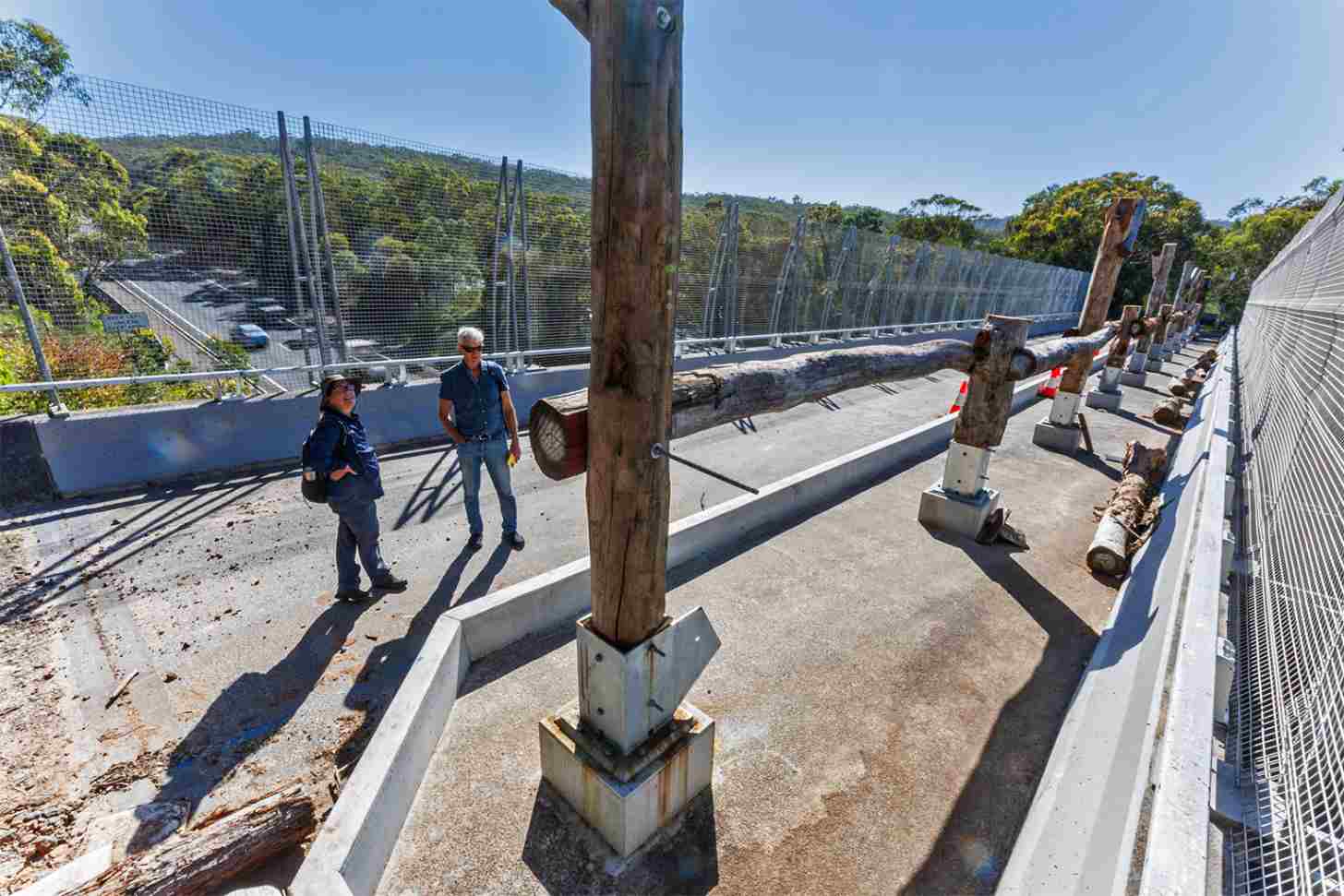
All animals considered: The scaly, the diminutive, and the arboreal
High above the ground, thick draped ropes stretch across open air, intended for arboreal marsupials like sugar gliders (Petaurus breviceps) and common ringtail possums (Pseudocheirus peregrinus) — species that prefer to move through the forest on tree branches well above the forest floor.
“There’s absolutely no way a sugar glider will make it across that road without connection,” Madden said.
Below the graceful ropes, there’s a wooden pathway for animals that typically like to travel just above the ground, including reptiles and koalas.
At the base, soil and native plantings will form a continuous vegetated corridor for ground dwellers: wombats (Vombatus ursinus), echidnas (Tachyglossus aculeatus), amphibians, and insects. They’ll be funneled toward the bridge and away from the road by two long “wings” of fencing that run perpendicular to the bridge.
“We’re trying to make this functional for everything,” Madden said, leading me over to soft mats of coral fern that are habitat for the many species living at the road’s edge.
“There are endangered species, like the red crowned toadlet [Pseudophryne australis] within just 10 meters [33 feet] of this bridge.” Madden crouched down to check for the tiny toads under the ferns next to a roped-off patch of ground marked with bright orange flags. “But they are never crossing without this structure.”
These tiny amphibians, no bigger than a thumb, live among the damp understory. Without cover, without continuity, the road is either a dead end or a death trap for them.
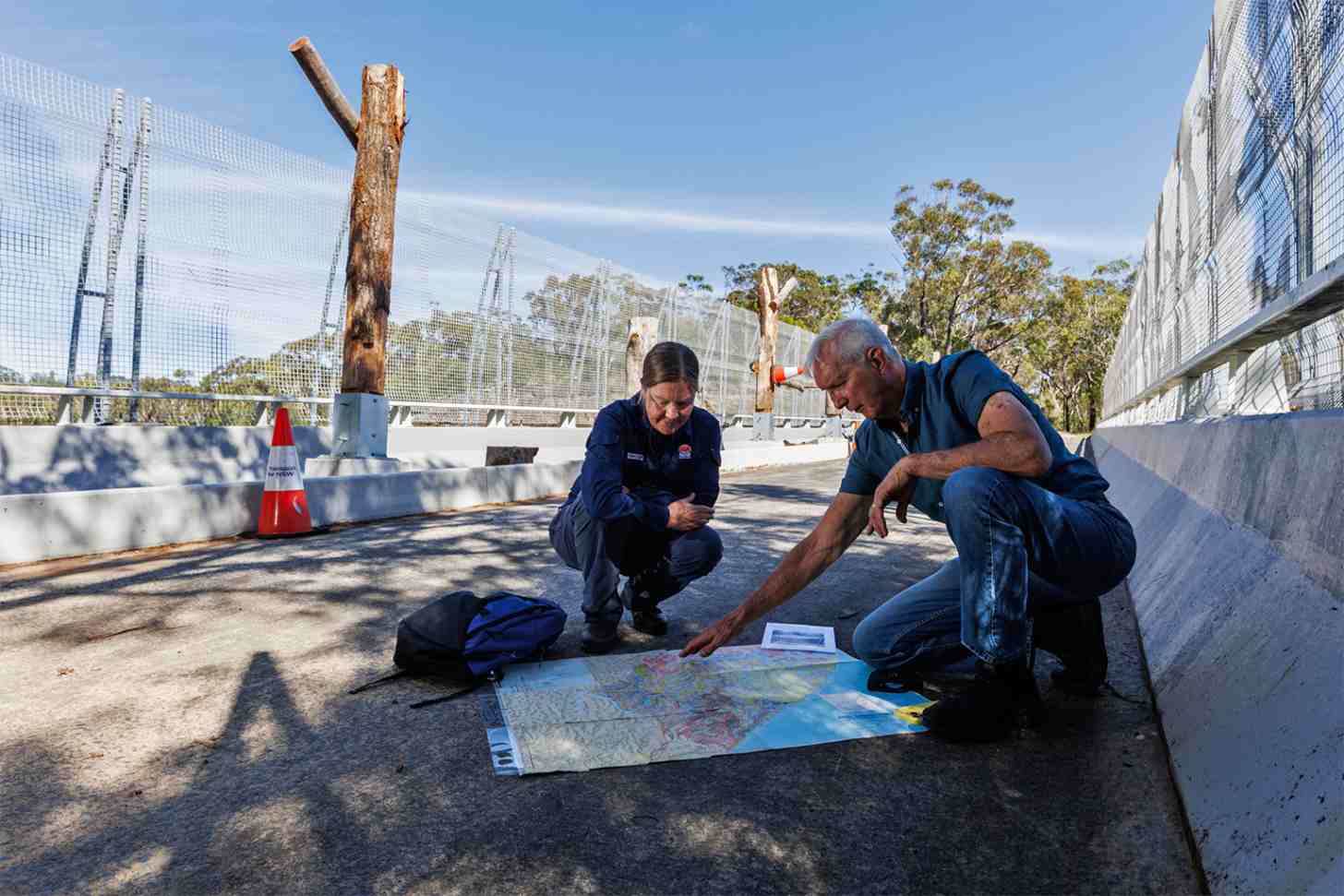
Uniting two iconic national parks
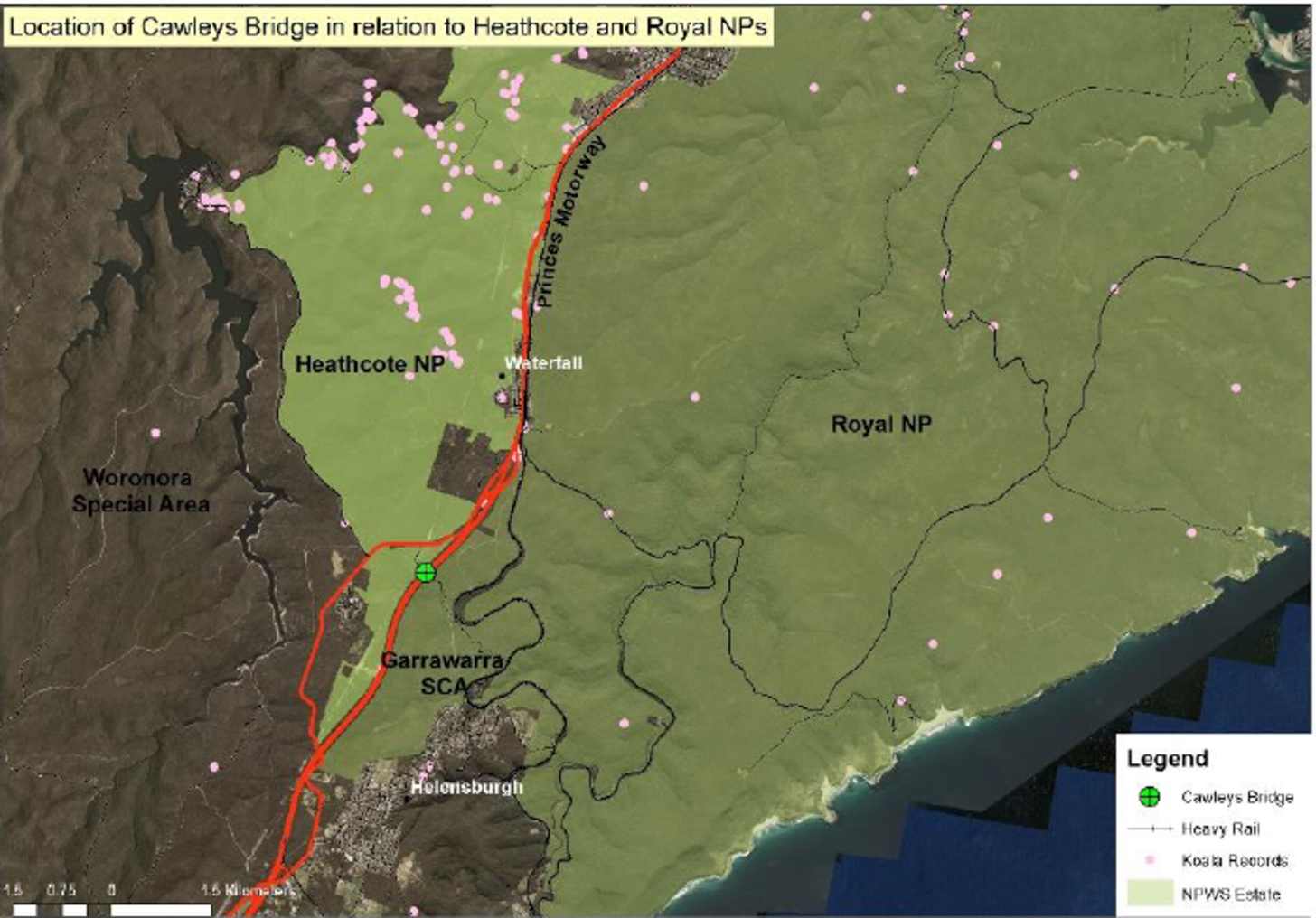
Experts say there’s an urgent need for these crossings. Royal National Park is the world’s second-oldest park, opened in 1879. But despite its size — 58 square miles — it’s increasingly isolated. To the east lies the Pacific Ocean; to the west, a vast and continuous expanse of bushland stretching across the Woronora Plateau, toward the Eastern Highlands that separate inland Australia from the coast.
Between them: the highway.
“It’s iconic,” Madden said of Royal. “But what it’s not connected to — because of the M1 — is this vast tract of wilderness.”
Even highly mobile animals struggle when habitat is fragmented by infrastructure. Madden said wombats are almost extinct within the national park, while still relatively common on the other side of the road.
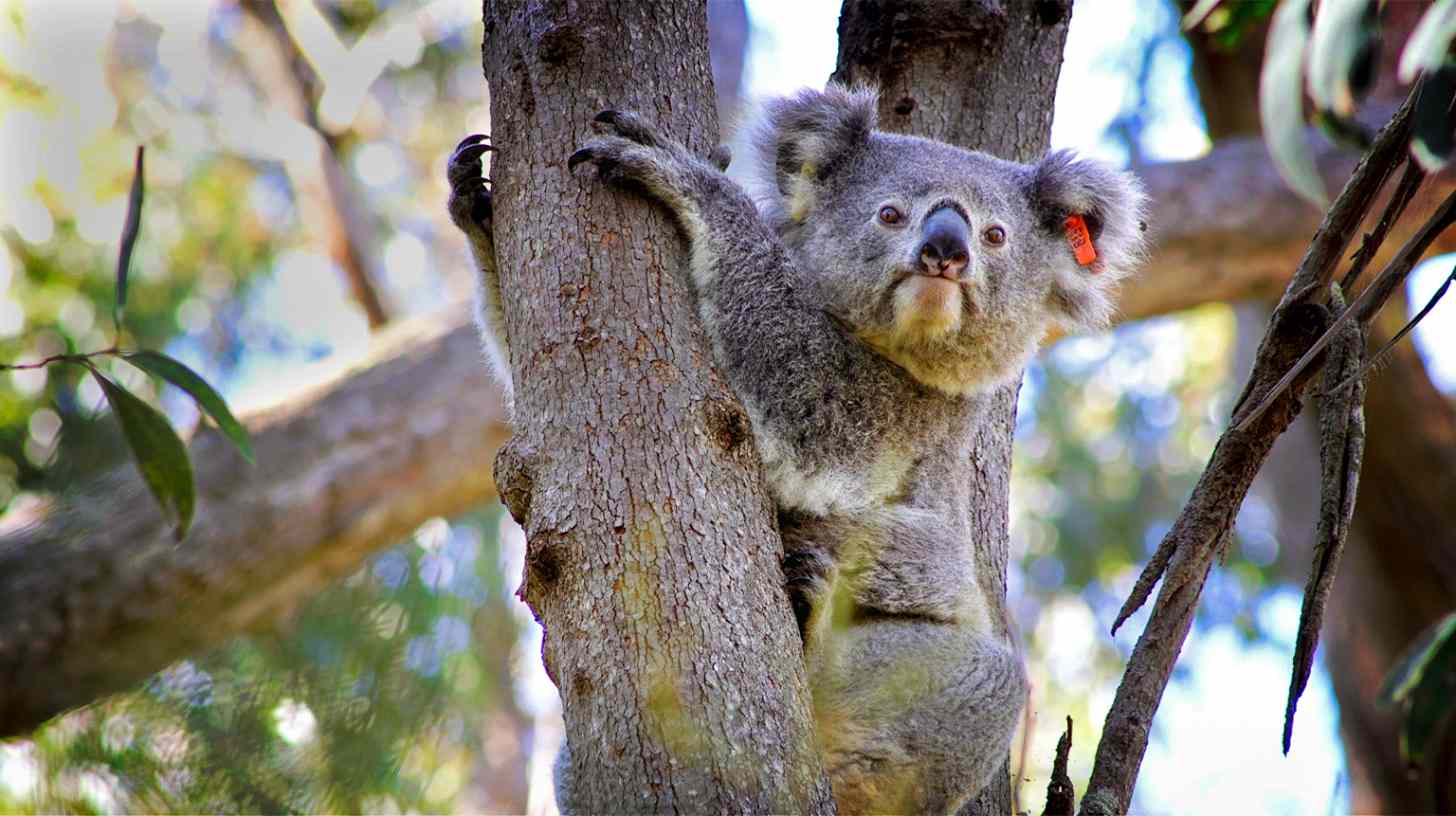
Koalas (Phascolarctos cinereus) were once present in the park, but they’ve all but disappeared.
“There’s habitat there,” Madden said, “but almost no koalas.”
Some populations remain on the eastern side. But without safe passage, they can’t recolonize the park — especially after a fire like the one that decimated Royal National Park in 1994.
That blaze was catastrophic, burning through more than 90% of the forest. In the decades since then, bushfires have increased in frequency, intensity, and size, driven by hotter and drier conditions induced by climate change, according to CSIRO, Australia’s federal science agency. Experts say the park is likely to burn again.
“We need to really make sure our reserves are connected,” Madden said, “for all species … to make them as resilient as possible for the future.”
Reconnecting fractured landscapes is key to the future health of wildlife. In a study outlining the need to reconnect nature, biologist Stuart Pimm and colleagues wrote that, “Even when natural habitats remain, they often come in fragments too small or isolated to sustain viable populations.”
When animals can move safely throughout their entire range, they avoid inbreeding: There’s a larger choice of mates, which increases genetic diversity. This bestows stronger defense to fight off disease and the ability to adapt to environmental changes, including climate change.
It also means that if there’s a bushfire in one area, animals can escape, either settling elsewhere or rebuilding populations in burned areas afterward.
But without connection, these animals might as well be living on islands.
Making it happen
The idea for Cawleys Bridge emerged from years of growing awareness, pressure, and collaboration. Bob Crombie, now a retired ranger at Royal National Park, originally raised the idea in 1974.
It was then taken up by a local branch of the Country Women’s Association and the National Parks Association. In 2021, the Sutherland Shire Environment Centre joined the coalition, and they began working with Transport NSW, the state’s transportation agency. Public concern over the plight of koalas helped push the project forward.
“In 2022, the idea of retrofitting Cawleys Bridge to reconnect Heathcote and Royal National Park came up in discussions,” Sally Webb, an official at Transport NSW, told Mongabay in an email
Now, she said, there are regular meetings between the transportation and environment agencies “to discuss how we can contribute to implementing the NSW Koala Strategy.” This government initiative, launched in 2021, centers on protecting koalas and their habitats.
By late 2023, the wildlife bridge had secured internal approval from four government agencies. The NSW Koala Strategy funded the bridge conversion, including nearly $600,00 for construction and maintenance and about $54,000 for monitoring.
The result is the hybrid structure that stands today, combining multiple crossing types into a single span: fencing to direct animals, ramps, ground cover, climbing structures, and aerial rope systems.
Across New South Wales, such crossings are still rare. Cawleys is just the second wildlife bridge in the Sydney area, which is a biodiversity hotspot. It’s the only one to link disconnected landscape between national parks.
There are 10 wildlife crossings along Australia’s heavily populated east coast, and Transport NSW has more than 25,000 records of animals using them. Most are underpasses, which are far less costly to build or retrofit than bridges.
Data from the agency’s Fauna Connectivity Database show that across 29 road projects nationwide, at least 67 species use crossings, including threatened animals like koalas and potted-tailed quolls, as well as more common ones, like emus (Dromaius novaehollandiae).
For ecologists, the lesson is clear: Animals will use these structures — but only if they feel safe.
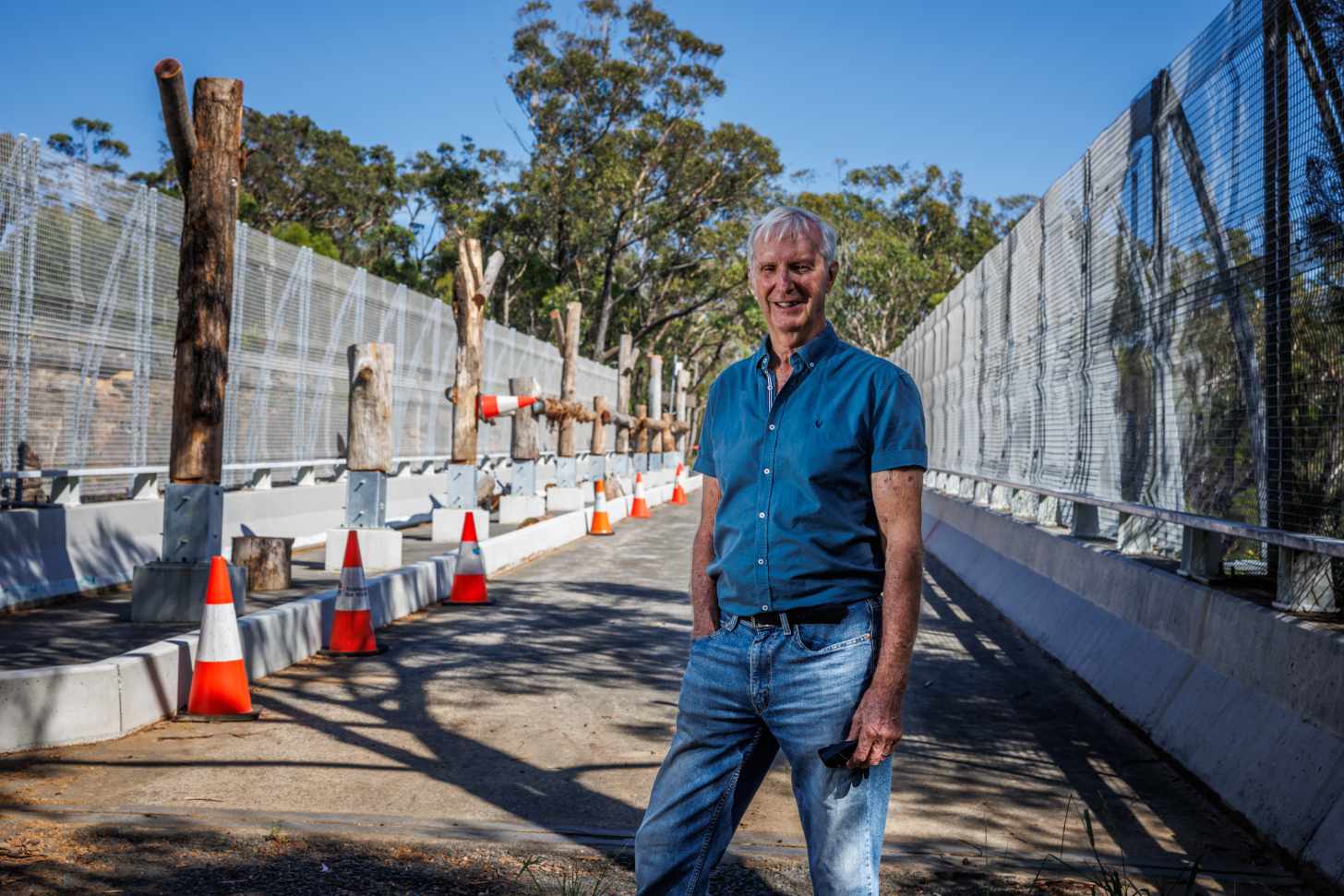
A proven connection
Animal-friendly crossings directly address the significant impact human development has on native species.
“One of the primary drivers of global landscape fragmentation is road construction,” said Brendan Taylor, a wildlife ecologist and author of the book The Evolution of Wildlife Crossings in Eastern Australia. He likened it to “casting a net over the landscape, with each road separating formerly connected habitats.”
That idea came from Road Ecology: Science and Solutions, a game-changing 2003 book by Richard T.T. Forman and other noted ecologists.
“That book was part of the growing movement to better understand and assess the impact of roads on wildlife populations,” Taylor said. Wildlife crossings, whether bridges or underpasses, are attempts to cut holes in that net, he added, in order to “perforate the roaded corridor,” allowing animals to move, forage, and breed.
When combined with fencing that keeps animals off the roadway and directs them toward a crossing, extensive research shows that these structures greatly reduce hazardous accidents and animal deaths.
Thousands have been built throughout Europe, with 600 in the Netherlands alone, and more than 1,000 in the U.S. and Canada. In the Brazilian Amazon, there’s now a primate canopy bridge. Kenya has constructed underpasses for elephants, and Singapore has built green bridges for various mammals. Crossings and culverts are being retrofitted into existing roads, and in many places, new roadways consider wildlife movement from the design stage, like the Delhi-Mumbai Expressway.
Connectivity is critical for the survival of many species. But crossings aren’t one-size-fits-all. The infrastructure needs to address the movements of different species and their preferences. That requires habitat-specific research.
Conservation biologist Ross Goldingay has spent years studying animals including Australia’s eastern pygmy possum (Cercartetus nanus), a small, tree-dwelling marsupial. Despite its diminutive size — about 5 inches from head to tail — pygmy possums can travel up to 1,640 feet in a single night.
Their movements benefit the landscape as they feed on pollen and nectar and pollinate plants and trees. Like many forest-dwelling and prey species, they’re reluctant to move through open spaces.
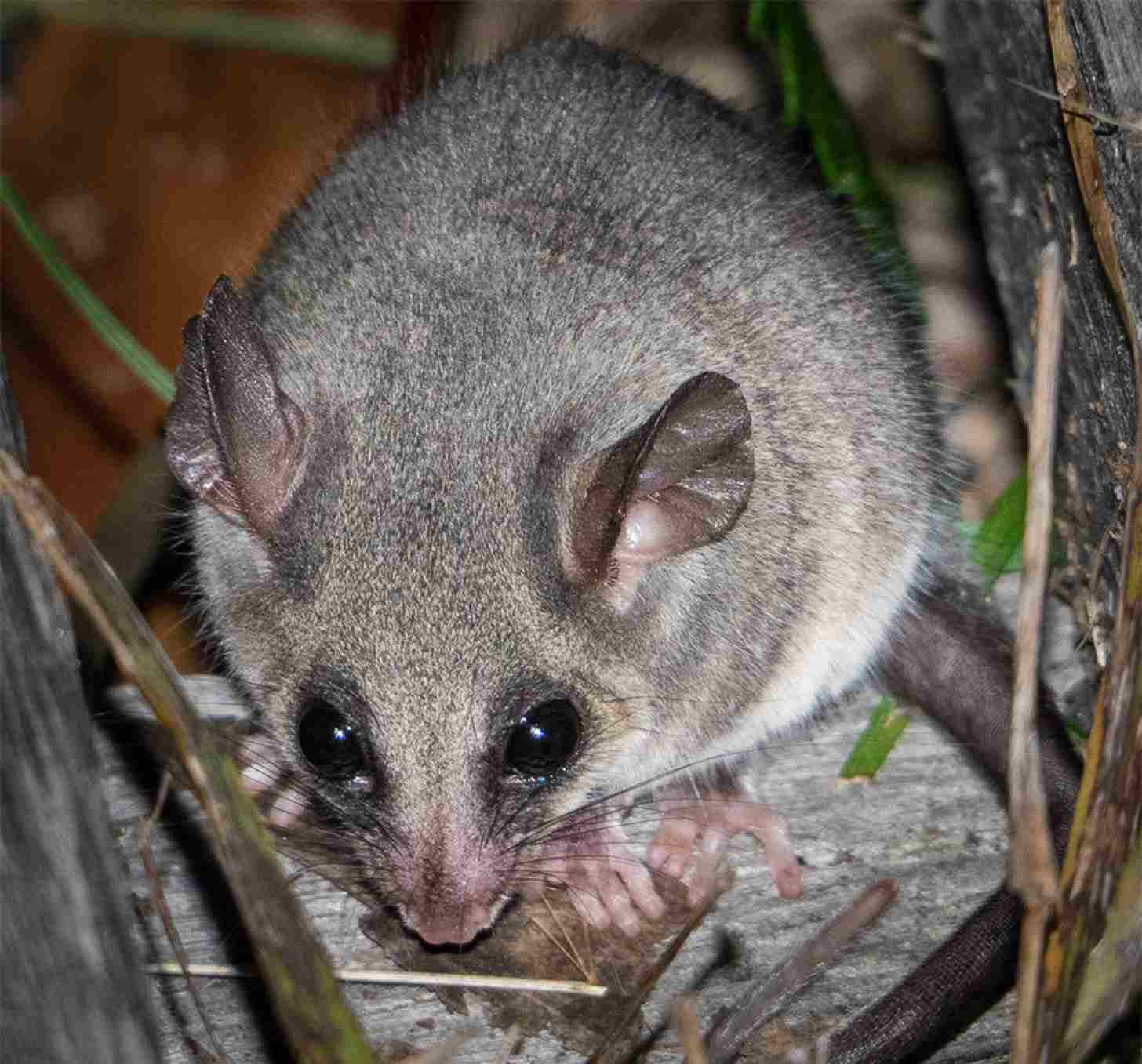
“If you want to try and maintain connectivity, you need to assist these animals. So how do you get them over a road?” Goldingay asked.
For the past three decades, his research has focused on exactly that. He’s conducted multiyear surveys to figure out what design elements are needed for animals to use crossings. He learned that installing tall wooden poles helps gliding possums cross gaps in the forest, including roads. In monitoring underpasses along the coast, he saw that a wide range of mammals regularly use them.
“Landscaping really matters,” Goldingay said. He’s found that pygmy possums, like other bush creatures, seek out plants for cover. His research has demonstrated that “where you’ve got the vegetation coming up … you’ll get more animals passing through.” Without it, crossings can fail.
His research also confirmed that rope bridges can ensure that arboreal animals such as squirrel gliders (Petaurus norfolcensis) have crossings that suit their habits: They can’t use underpasses. Animals that like to travel off the ground but not in the treetops — including koalas and the endangered broad-headed snake (Hoplocephalus bungaroides) — need another type of crossing.
Going over the road is just one solution. Some animals are going under, using existing culverts that were constructed when roads were built, usually to channel rainwater underneath.
In one study for Transport NSW, Taylor and his colleagues counted 36 species, from frogs to wallabies, that used even simple drainage pipes, just 3 feet wide, to cross beneath roadways.
Now, new “fauna sensitive” road construction guidelines in NSW include larger culverts, when appropriate, offering a cost-effective alternative to more expensive bridges.

Looking ahead
Back on the bridge in the long light of late April, which is early autumn here in New South Wales, the dump trucks and transport workers are gone. Aside from the steady thrum of cars below, all is quiet. Work on Cawleys Bridge is complete, and the final pieces of a living corridor have fallen into place.
While the traffic below remains unchanged — fast, loud, and relentless — above, there is a carefully constructed thread linking two vast landscapes.
It will take time, but studies show that animals find and use these bridges, adding them to their memory banks and teaching their young.
“Animals learn to use these pathways over time,” said Madden, the ecologist, “and that’s what a passage across a dangerous roadway is” — a pathway.
For spotted-tail quolls, koalas, tiny sugar-glider possums, and so many other animals, a bridge like this may be the difference between turning back from — or dying on — a “canyon of a road” or crossing into new territory.
This article was originally published on Mongabay.
Banner image: The Common wombat (Vombatus ursinus) frequents the western side of Cawleys Bridge, and it is hoped the bridge will reinforce the wombat population in Royal National Park. Image courtesy of Simone Cottrell / DCCEEW.
Every day the Good Good Good team collects the best good news in the world and shares it with our community. Here are the highlights for this week!
If you want to get good news in your inbox every day, join the Goodnewsletter — the free daily newsletter designed to leave you feeling hopeful.
The Best Positive News We’re Celebrating This Week —
The first gray wolf was detected in Sequoia National Park in more than 100 years
After traveling hundreds of miles across the state in recent months, a gray wolf was detected in Sequoia National Park for the first time in over 100 years.
Gray wolves were “extirpated” from the state in 1924, largely through government-backed programs driven by concerns among locals over livestock losses and perceptions of wolves as threats.
They are now listed as a protected, endangered species under state and federal law, and wolves like the female seen here are considered to be “pioneering individuals” for the species slow reestablishment in California.
What’s the nuance? Communities in Northern California have started raising concerns again about wolf activity, like livestock killings near homes, and some county officials have issued emergency resolutions.
New campaign challenges men to hold themselves accountable for childhood trauma: ‘She is not your rehab’
→ Read more
Teenage pregnancy rates have fallen across the world in the last few decades
Since 2000, teenage pregnancy rates have fallen across all regions for women aged 15 to 19.
Globally, rates have fallen by more than one-third, with even steeper declines in some regions, such as Central and South Asia, where they dropped by more than three-quarters.
According to the United Nations, birth rates have also decreased among adolescent girls aged 10 to 14, where pregnancy poses even greater health risks.
→ Read more
‘Off Campus’ star Belmont Cameli donated a kidney to a stranger, saving the lives of 7 people in a ‘transplant chain’
In the latest hockey romance to grace the silver screen, 28-year-old actor Belmont Cameli, who plays hockey star Garrett Graham, is seen shirtless on a myriad of occasions, and viewers were quick to notice that the actor has two scars on his abdomen.
They are the result of Cameli’s decision to donate a kidney in 2018. Cameli was tested as a donor after learning his childhood friend needed a transplant, and while he wasn’t a compatible match, he joined a paired kidney exchange program.
He ended up donating his kidney to a stranger and became part of a 14-person transplant chain that saved seven lives, an experience that Cameli said would never leave him.
Why is this good news? More than 90,000 people in the U.S. are currently waiting for a kidney transplant, often waiting years for a “deceased donor kidney,” or becoming too sick before one becomes available. Living donor kidneys also often last longer, work immediately, improve survival, and more.
NYC ‘queer garden’ is filled with non-binary and sex-changing plants
→ Read more
Stunted child growth — a consequence of malnutrition — has fallen dramatically in the last century
A child is considered stunted if they are too short for their age. Typically, the condition is an indication that a child’s development has been hindered by malnutrition or frequent exposure to disease.
Fortunately, childhood stunting has dramatically decreased in 122 countries since the 19th century.
Japan has shown the greatest improvement in child stunting. At the beginning of the 20th century, more than 70% of Japanese children were stunted. Today, that number is just 5%.
In addition to reducing food insecurity and increasing access to high-quality proteins after World War II, experts say that Japan achieved these dramatic results by expanding access to clean drinking water and effectively eliminating hookworm, ascariasis, and malaria.
A record number of dams were dismantled across Europe to restore nature and help wildlife thrive
Last year, a record-breaking 602 dams were removed across Europe, up 11% from the year prior and part of a larger, global trend to restore rivers and allow the surrounding ecosystem and wildlife to thrive.
With 2,324 total miles of rivers reconnected through the dam removals, the EU is a step closer to its goal of restoring 15,500 miles of river to their natural flow by 2030.
Since the first official count in 2020, removals have increased sixfold, with Sweden leading the way with 173, Finland with 143, and Spain with 109. Iceland and North Macedonia removed their first barriers in 2025.
Why is this good news? For centuries, communities around the world used rivers for economic growth, redirecting them to improve navigation or damming them to harness power, but that came at an enormous ecological cost. This massive effort is a critical corrective step in the right direction.
New study: Most people are not actually worried about trans women in women’s bathrooms
Violent crime rates continue to plunge in America’s biggest cities
New data from 67 of the nation’s largest police departments revealed a sharp nationwide decline in violent crime rates. The decline can be seen in every major region — from Portland to Baltimore — continuing a downward trajectory that began after crime rates spiked during the COVID-19 pandemic.
In addition to homicides dropping by 17.7%, robberies fell 20.4%, sexual assaults declined by 7.2%, and aggravated assaults decreased by 4.8%.
The cities that saw the most sizable percentage drops in homicide were Washington, D.C. (64.7%), Philadelphia (54%), and Memphis (34.4%), with New York City not far behind at 31.7%.
→ Read more
The largest wind energy project in the U.S. is coming online next month, despite Trump’s attempts to stop it
The SunZia wind project in New Mexico is considered the “largest clean energy installation” in the U.S., capable of powering around 1 million homes every year, is on track to come online next month.
The project includes a 550-mile transmission line that will help connect wind power to neighboring Arizona, too.
The Trump administration has cut off federal tax incentives and held back permits for renewable energy projects — around 5,000 turbines are on hold for federal approval. This milestone marks a major step in the clean energy transition in the U.S.
Why is this good news? Not only will the size and scale of this project add clean electricity supply, it will also help reduce strain during peak demand times, like when air conditioners run non-stop in the summer, reduce reliance on much dirtier, pricier fossil fuel sources, and help stabilize prices for customers and businesses.
Ever wanted to live above a library? In Oklahoma, that dream is becoming a reality
Solar is set to overtake coal on the Texas grid for the first time this year
Texas will have no new coal power plants built in the state this year, while developers are building more solar in the state than anywhere else in the U.S.
As a result, the federal government is projecting that the state’s power market will receive 78 billion kilowatt-hours from solar in 2026, and 60 billion from coal — the first time ever that solar has overtaken coal on the grid.
The milestone comes despite the Trump administration’s efforts to position coal and gas as the solution for “energy dominance” and “independence.”
More good news of the week —
Stephen Colbert’s “Late Show” charity auction raised nearly $2.5 million for World Central Kitchen. Colbert launched the auction to do some good ahead of the show’s finale on May 21, and presented a (tiny) check to the organization’s founder, Chef José Andrés, during the second-to-last episode of The Late Show last week.
Scientists used DNA from poop to save the world’s rarest marsupial. The technique is becoming increasingly popular in wildlife research because it allows scientists to study animals without disturbing them.
A new app helps Seattle residents find “little free food pantries” and communicate with one another about sharing food. The pantries supply residents with more than 4 million pounds of food per year.
Colorado lawmakers passed two bills aimed at reducing the state’s prison population. One changes how earned time is calculated; the other provides early release options to people who committed a felony offense before age 21.
Australia created a “living bank” of at-risk marine life forms to safeguard them against extinction. It’s one of many biobanks across the country that store everything from native plant seeds to the tissues of threatened mammals.
After winning its “encore contest,” the USPS is reissuing beloved “Mister Rogers Neighborhood” stamps. When they first printed in 2018, the USPS ordered about 12 million, and they sold out within a few weeks.
A single GoFundMe fundraiser inspired 28,000 people to donate $1 million and help veterans in all 50 states. Samuel Weidenhofer is a self-described “kindness influencer,” who helped December 88-year-old veteran Ed Bambas retire, and the act of kindness reached a scale he never imagined possible.
A new whale detection network launched in San Francisco to alert ships in real time and protect whales. The system, called WhaleSpotter, scans the bay around the clock for whale blows and heat signatures up to 2 nautical miles away.
A new drug has the potential to slow — and even reverse — the progression of a rare form of ALS. In clinical trials, the drug slowed muscle degeneration by targeting a rare mutation in 2% of ALS patients.
Scientists in Galway just found evidence of a “molecular goldmine” inside coral reefs. These newly discovered microbes produce an array of chemical compounds that could prove vital to future medicinal breakthroughs.
A new autonomous reef robot uses underwater microphones to detect marine life. Using visual and acoustic data, the robot can follow the sound of fish calls and “shrimp snaps” to map new marine zones.
The longest-running guaranteed income program gives Black mothers in Mississippi $1,000 a month. According to the organization’s report on the third cohort, 82% of participants felt more hopeful about their children’s futures, and 79% felt more hopeful about their own futures.
Conservationists are celebrating the birth of a rare wild horse, proof that the last “truly wild” horse in the world is no longer extinct. On April 21, the Bronx Zoo welcomed a new foal to its herd of endangered Przewalski’s horses.
An Oregon city created a first-of-its-kind $1 billion clean energy fund to help the city’s most vulnerable residents. The Portland Clean Energy Fund is also aimed at reducing carbon emissions and has distributed more than 20,000 free air conditioning units, funded energy efficiency retrofits for 3,100 homes, and more.
Scientists invented a new immunotherapy treatment that kills cancer cells — and it can be administered in under two minutes. The injection, which was just rolled out in England, is expected to help thousands of cancer patients.
The Oregon Symphony just performed lullabies written by parents who are incarcerated or experiencing homelessness. The Lullaby Project was designed to help parents who are physically separated from their children connect with them in a new way.
The level of “forever chemicals” in Canadian seabird eggs dropped dramatically in the last 55 years. Conservationists hailed the decline as a clear sign that environmental regulations can create real change.
A first-in-the-nation “dementia village” is a tiny town built just for residents with memory loss. The new model aims to maintain the best possible quality of life for its residents and help “normal” life last longer, even as their illness progresses.
After Hawaiians noticed “graffiti” on sea turtle shells, a 600-person project is helping improve protections. The NOAA’s Honu Count encourages locals to document any sightings of turtles with white alphanumeric etching on the right side of their shells to help biologists understand the foraging habitats, migration, distribution, and survival status of these turtles.
Papua New Guinea announced its largest-ever marine protected area. The country declared a UK-sized no-take marine protected area in the Bismarck Sea, forming part of a new regional conservation network and advancing its commitment to protecting 30% of its waters by 2030.
A nonprofit that connects dogs with temporary foster care while their owners are on deployment has served military members in all 50 states. (May require login) Operation Foster is the only nonprofit in the U.S. that provides free, long-term foster care for the pets of members of the military and hospital patients.
New radar technology could improve identification and tracking of key pollinators, closing a gap in conservation efforts. While pollinator declines have received widespread attention in recent years, most monitoring efforts focus on counting insect numbers rather than the diversity of species, and the distinction is important.
A study found that beavers are quietly turning rivers into natural, powerful carbon sinks. The researchers discovered that wetlands created by beavers stored carbon at rates up to ten times greater than nearby systems without beavers.
Captain Dan Salas has spent his whole life on the water.
At just 12 years old, he started working on the docks of San Pedro, California. Throughout his career, he went from tugboat captain to marine life guide, and eventually founded Harbor Breeze Cruises in 1990.
“Today, Harbor Breeze Cruises offers more whale watching tours than any other operator in the region,” reads a statement on the organization’s website.
“Whether it’s spotting a super pod of dolphins or witnessing the majesty of blue whales, our guests leave with memories that last a lifetime.”
Until now, guests haven’t just left with their memories. They’ve also left a hefty carbon footprint with every trip taken out into Pacific waters.
According to a study in the Journal of Sustainable Tourism, a sightseeing trip on a diesel boat can emit roughly the same carbon emissions as a single person driving 186 miles in a standard passenger vehicle.
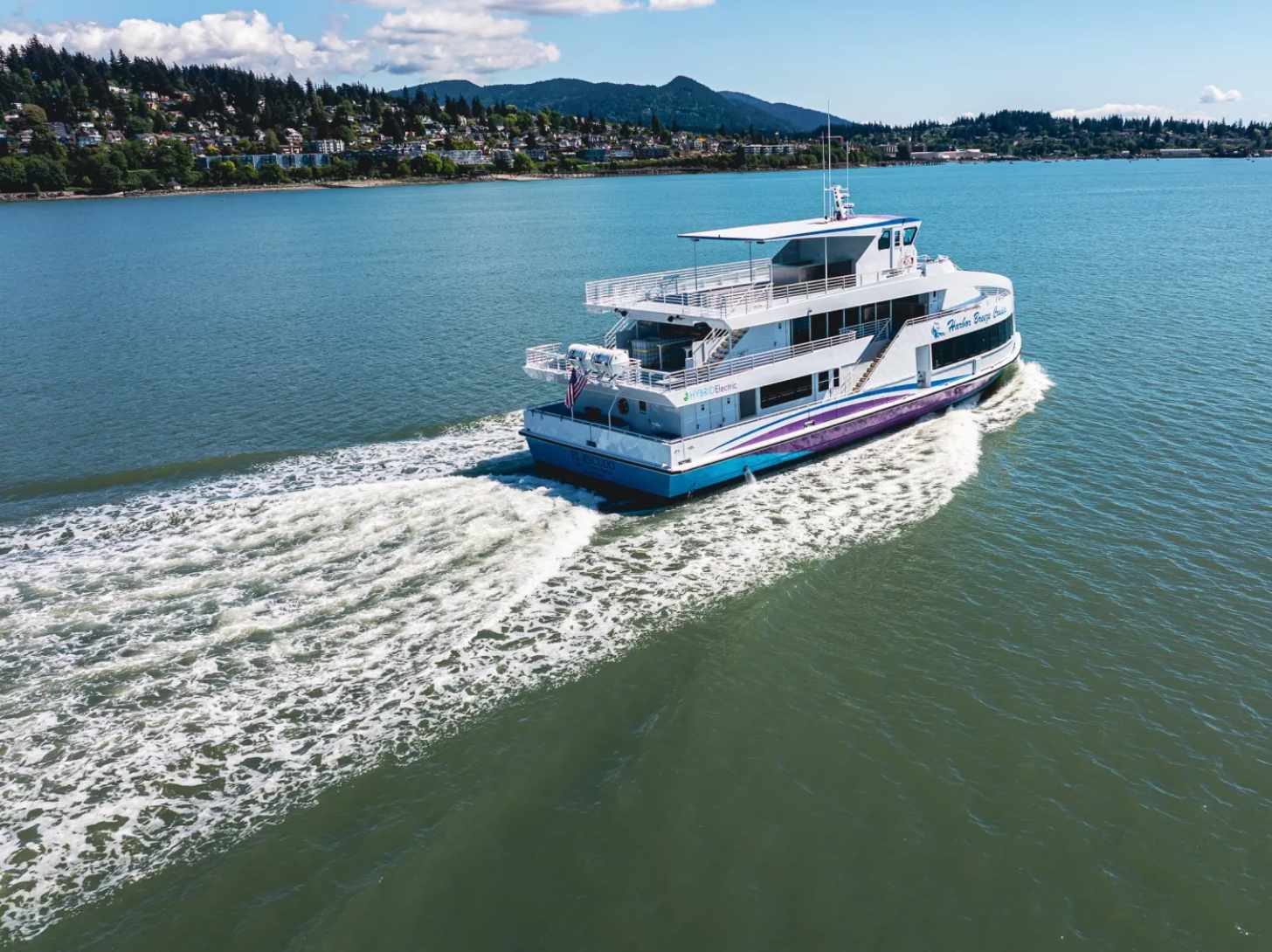
That’s why, for the past five years, Captain Salas has been working with the Port of Los Angeles, the Port of Long Beach, and the California Air Resources Board to fund a new kind of vessel.
“This is called the El Escudo,” he said in an interview with ABC 7, pointing proudly to his 180-foot boat. “It’s the world’s first parallel hybrid.”
“This has been a technological advancement that we never — in my lifetime — thought I would actually see. The air quality and what we’re doing is setting the tone for things to come in the future.”
According to Baird Maritime, the zero-emission boat can carry 350 passengers and reach greater speeds than a diesel-powered alternative.
“The vessel offers four distinct operational modes: conventional diesel propulsion, fully electric propulsion, underway battery charging, and stationary shoreside battery charging,” the maritime news outlet wrote in a press release.
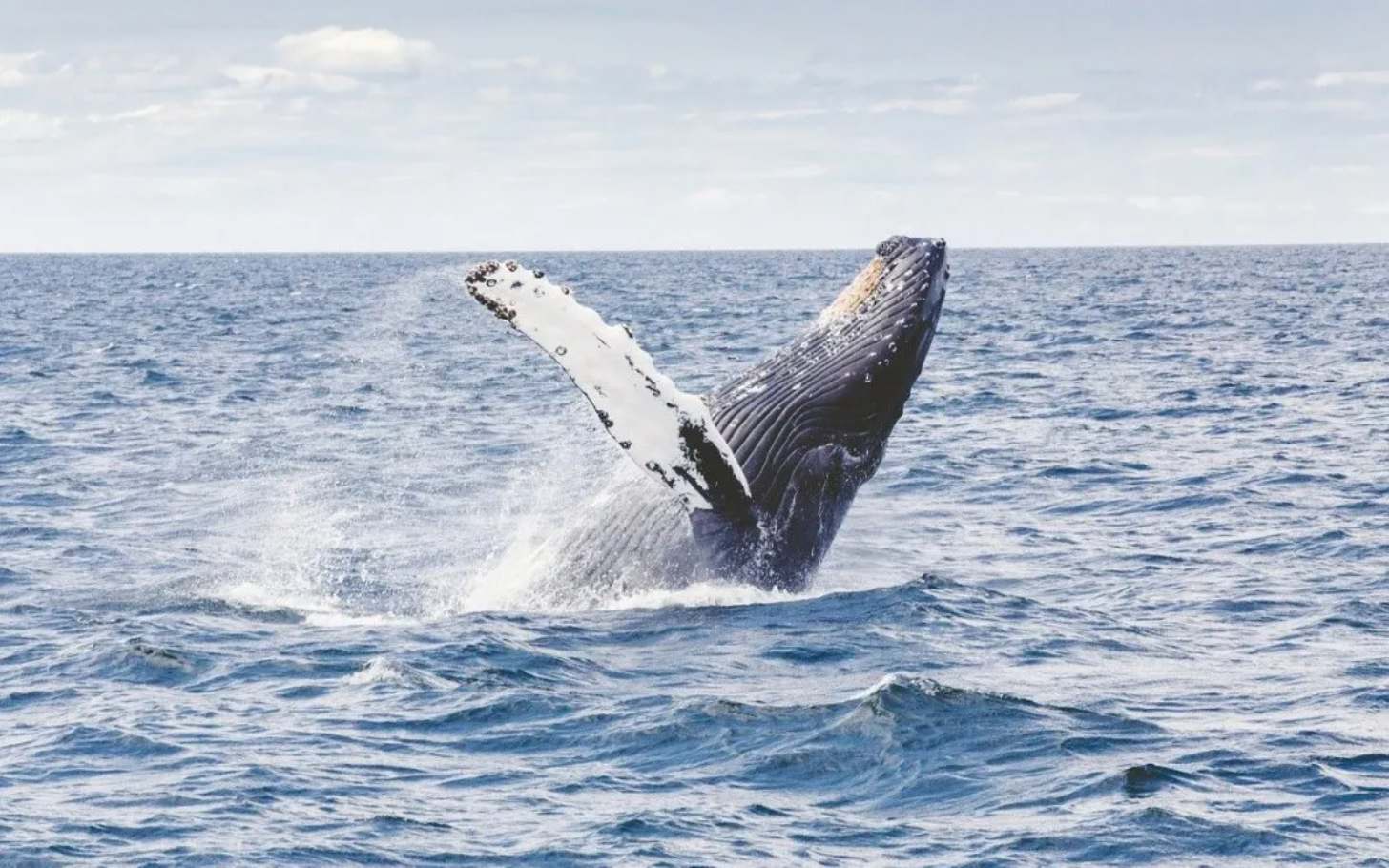
“The propulsion package allows the vessel to achieve significant emissions reductions while maintaining performance and efficiency for sailing on longer routes.”
For Captain Salas, the El Escudo is a way for him to continue building his business without harming his first love: The ocean.
“This is a gift back for my life here on the ocean, to give it back with clean air and a clean future,” he said.
You may also like: South Korea deploys new ferry that cleans up oil spills while people ride
Header image via All American Marine
As the manager at The Turtle Hospital in Marathon, Florida, Bette Zirkelbach has seen some tough cases. And in April, she shared a video of a green sea turtle who was recovering from a particularly difficult case of debilitated turtle syndrome.
For a rescued sea turtle, Sir Barksalot had certainly been through the wringer.
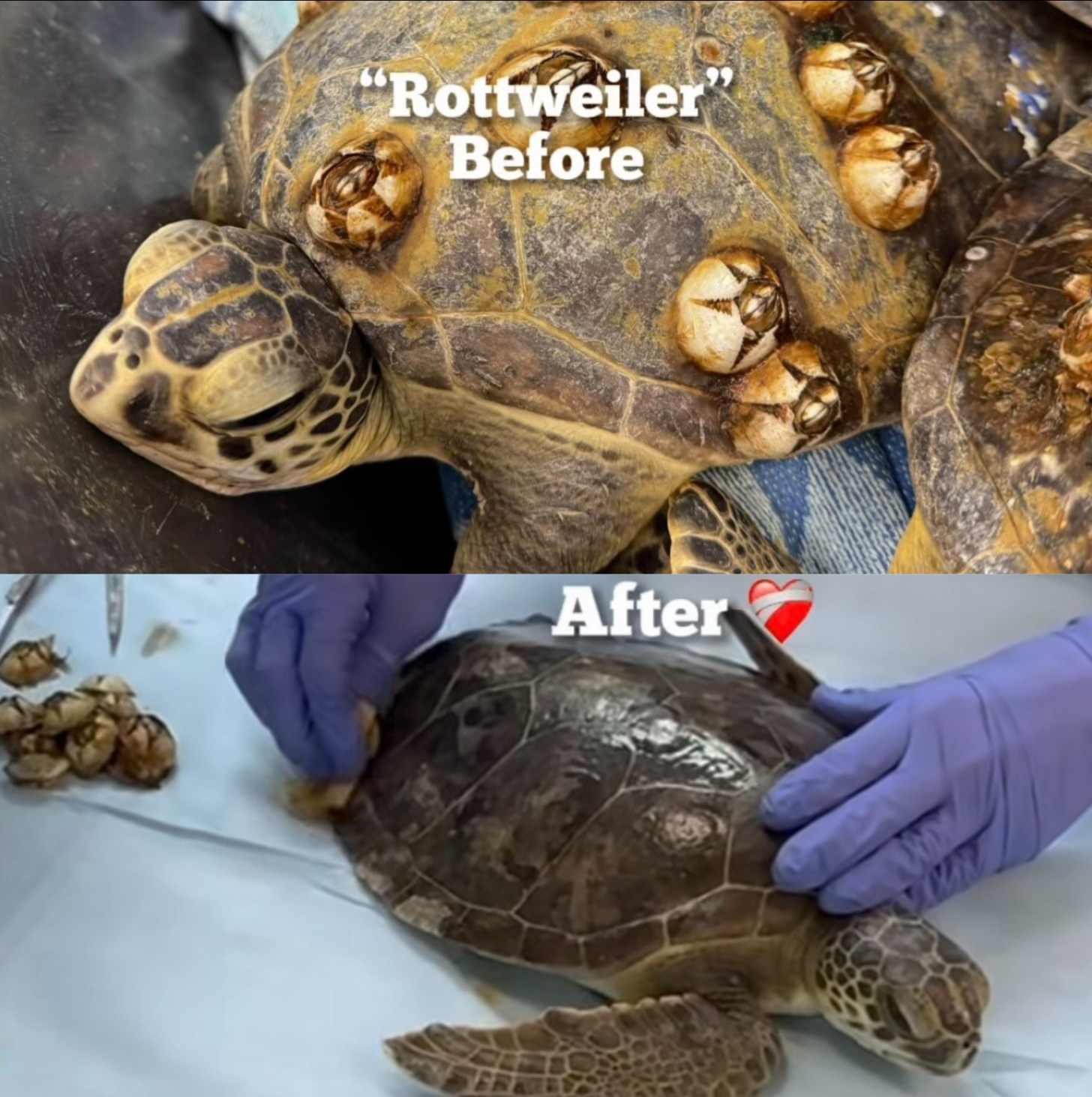
By the time he arrived at The Turtle Hospital, he was covered in barnacles, recovering from hypothermia, and suffering from fibropapillomatosis — a disease that causes cauliflower-like tumors on a sea turtle’s skin, eyes, mouth, and internal organs.
“‘Sir Barksalot,’ a juvenile green sea turtle rescued in northern Florida and transferred to The Turtle Hospital a week ago, is stable and ready for his barnacles to be removed,” Zirkelbach wrote in the social media post.
As one of five turtles with similar afflictions, Sir Barksalot was dubbed a member of the “Crusty Greens,” a group that included Shih Tzu, Cavalier, Boykin, and Rottweiler.
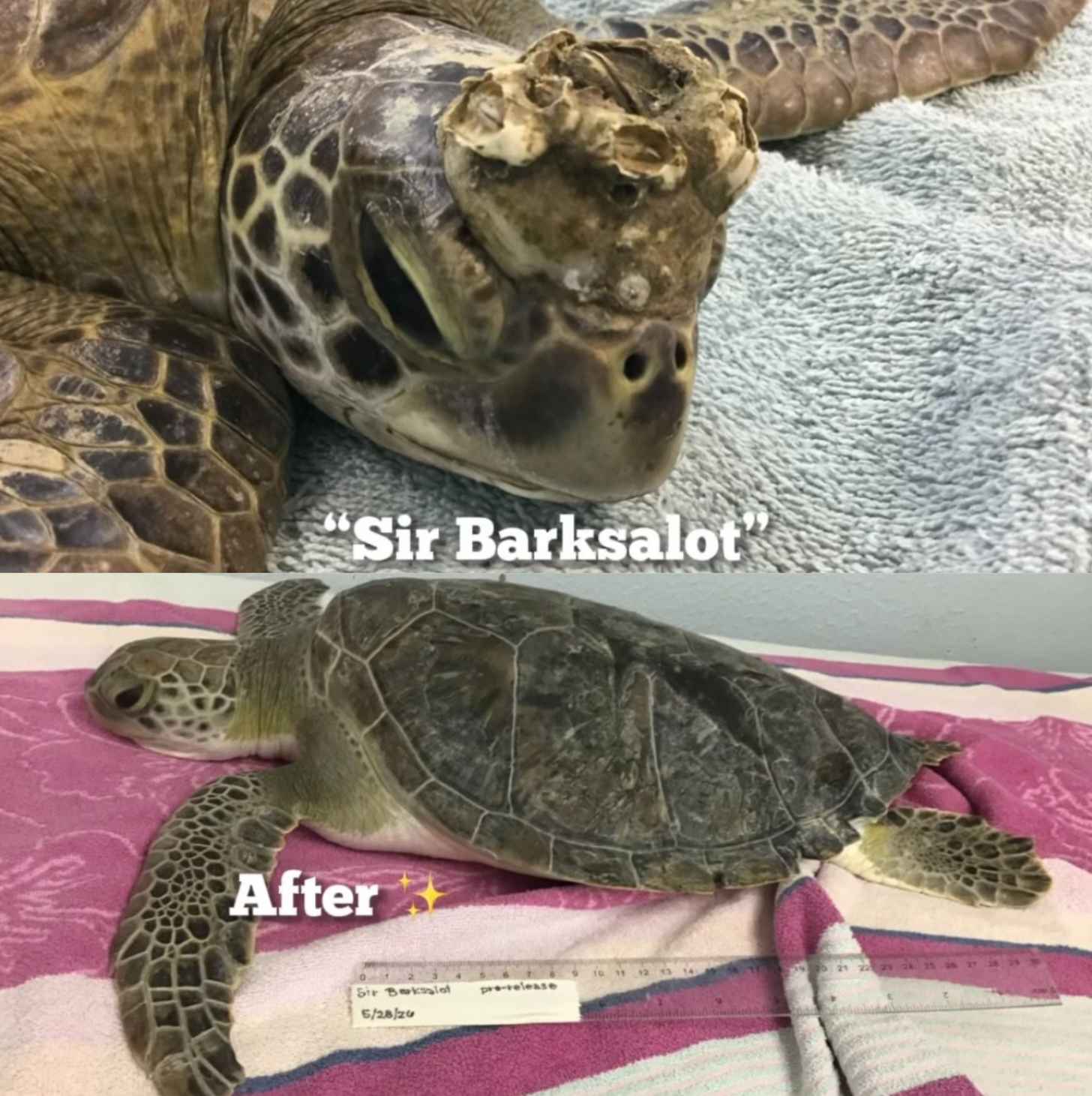
“When these juvenile green sea turtles first arrived at our hospital after being rescued in northern Florida, they were battling the effects of chronic cold stunning, fibropapillomatosis, and other serious health challenges,” Zirkelbach shared on Facebook on May 30.
“Many were weak, lethargic, and covered in barnacles, requiring months of dedicated medical care, rehabilitation, and monitoring.”
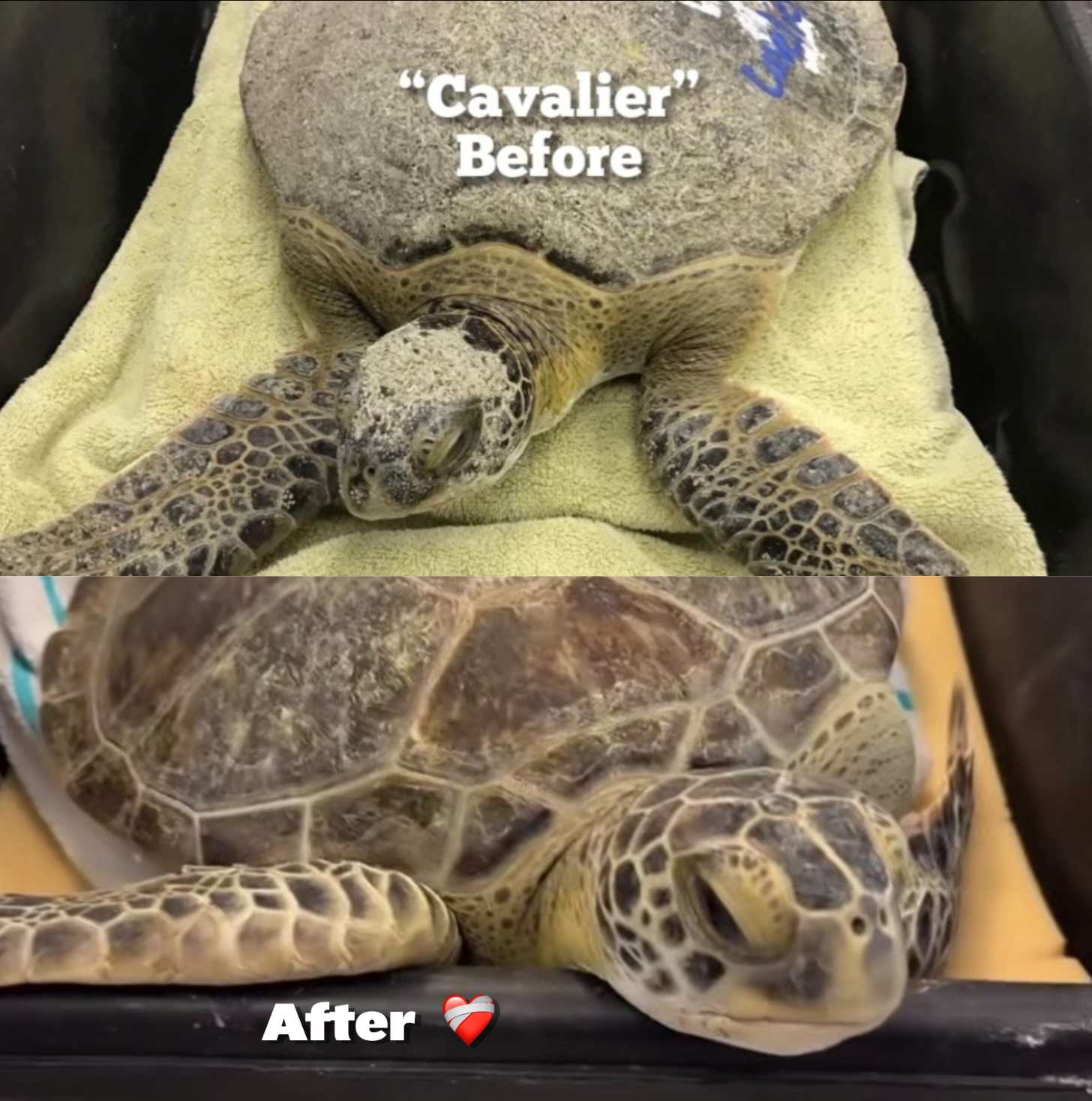
But after two months at The Turtle Hospital, Zirkelbach said the “difference is remarkable.”
“These turtles are healthier, stronger, and looking more like the wild sea turtles they were meant to be,” she said. “Their tumors have been treated, their strength has returned, and they’re spending their days swimming, diving, and thriving.”

The Turtle Hospital is constantly taking in new rescues. In December, a small green sea turtle named “Nutella” was rescued off the coast of Key Largo with a fishing line in her stomach and tumors on her body and eyes.
And last August, Zirkelbach and her staff saved a 170-pound loggerhead sea turtle named “Molly” from a debilitating tumor that weighed 10.1 pounds.

“Watching these transformations never gets old,” Zirkelbach said in her latest post. “Every turtle that regains its health is a testament to the power of rescue, rehabilitation, and the incredible teamwork that makes recovery possible.”
“The ‘Crusty Greens’ may have arrived in rough shape,” she said, “but they’re leaving us as confident, healthy turtles ready for their next chapter back in the ocean.”
See Sir Barkalot's barnacle removal video below:
You may also like: Endangered sea turtle makes full recovery after being covered in algae and barnacles: 'She’s unrecognizable now in the best way'
Header image via The Turtle Hospital
In 2017, political activist Alicia Roth Weigel was waging an exhaustive war against the Texas “bathroom bill” — which would force people to use the public bathrooms that aligned with their sex at birth. At the sixth-month point, Weigel knew it was time for bold action; she was going to come out as intersex.
“At this point I hadn’t told my brother and my best friends, that have known me my whole life, that I’m intersex,” Wiegel said in the 2023 documentary “Every Body.”
Although often overlooked in society, intersex people are as statistically common as redheads, making up 2% of the world’s population.
“We are present in society but hidden in plain sight,” Wiegel wrote in an essay for Politico. “We’re not exotic, but we are exhausted — constantly struggling for recognition or mere acknowledgment of our existence.”
Due to androgen insensitivity, Wiegel was born phenotypically female with internal testes, which were removed in an invasive surgery while she was still an infant.
Her parents never spoke about the circumstances of her birth and her surgeries, so Wiegel followed suit. But at 27, Wiegel was tired of living in shame. She felt that the bathroom bill was written with blatant disregard of people who don’t fit neatly into the gender binary.
“I am a woman. And regardless of my gender, a bathroom is a bathroom,” Wiegel told the senators. “I urge you to reconsider your feelings on what I feel is an extremely harmful piece of legislation.”
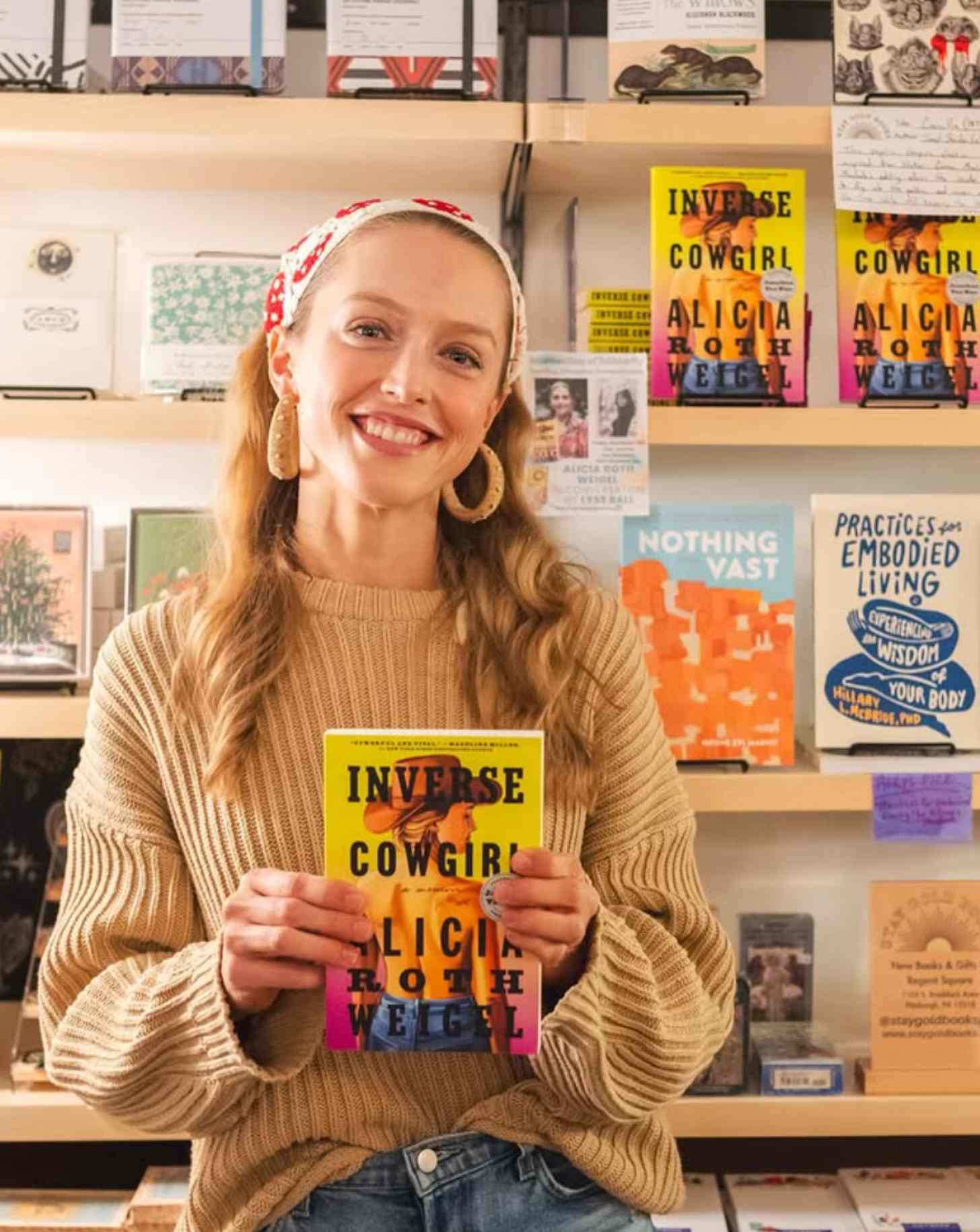
After deliberation, the bathroom bill failed to pass. In her 2023 memoir “Inverse Cowgirl,” Weigel continued to call for intersectionality, visibility, and empathy in human rights advocacy.
“Empathy is a choice, not a circumstance one is born into; we should recognize how powerful that is,” Weigel wrote.
A version of this article originally appeared in the 2024 Gender Edition of the Goodnewspaper
You may also like: No, everyone is not trans all of a sudden: Debunking 5 harmful myths about LGTBQ+ people
Header image via Tim Mossholder
The United States health care system is failing Black women. In 2021, the CDC reported 32.9 maternal deaths per 100,000 live births, a statistic that is 10 times higher than in countries of comparable income like Spain, Japan, and Australia. Sadly, a vast majority of those deaths were preventable — and 69.9% of the mothers lost were Black women.
The CDC cites several reasons for the disproportionately high rates of Black maternal mortality, including inequity in health care access, structural racism, and a disturbing history of medical abuse.
In her essay “Reproducing while Black,” celebrated anthropologist Dána-Ain Davis said these issues aren’t just constrained to birth. Her evidence reveals that Black women face hurdles even when seeking fertility treatment and starting their birth journey.
“Racism causes bedlam, and in certain situations – some more than others – requires the emotional and practical labor of avoiding it,” Davis observed. She added that racism multiplies “stress, uncertainty, and the need for profound vigilance in an already burdensome situation.”
For Wanda Irving, the issue of maternal care is deeply personal. Her daughter Shalon — a doctor with dual PhDs — died just three weeks after giving birth to Irving’s granddaughter. Post-birth, Shalon made repeated attempts to flag extreme pain, but her medical providers denied her care.
After the loss of her daughter, Irving recognized that the issue was bigger than her daughter’s care team and the hospital that failed her. It was systemic.
“The prevalence of the problem is deeply entrenched — embedded — in the very foundation of our health care system,” Irving explained in her 2020 TED Talk. “It is this broad-based failure that continues to allow disparities in maternal health and death, which result in Black women, like Shalon, dying at rates 300% higher than white women.”
While Irving acknowledged that improvements in data accuracy were rising, the first step to decades of trauma lies with accountability. Irving called on health care providers and hospitals across the country to acknowledge how they failed Black women, own responsibility, and actively take the steps to stop preventable deaths in the future.
“It is long past time that leaders in the medical community take steps to transform the health care system status quo,” Irving said.
As pressure mounts for the health care industry to change, the maternal care movement is primarily being led by grassroots campaigns, community organizations, and women with lived experiences.
Ashlei Spivey — the founder and executive director of I Be Black Girl — spoke to Good Good Good about her work leading the only Black-led birth justice organization in Nebraska.
“It's such an honor and a privilege to be able to lead this work and work alongside our community that we're from,” Spivey said. “Within our birth justice portfolio, our goal is to ensure that Black women and people with the capacity for pregnancy not just live through their birth journeys, but thrive.”
Spivey said that one of the biggest obstacles in maternal care reform is the catch-22 of trying to create a better system in the future while being held hostage by the system of the present.
“If the system is not serving us, how do we radically imagine and dismantle that system and think of something else rooted in community, rooted in what we need?” Spivey asked. “That is a tension that we hold as we're doing movement work.”
Spivey said that allies hoping to support reproductive justice can subscribe to newsletters, stay informed through social media, and donate directly to I Be Black Girl and other Black-led community-focused organizations like Reproductive Health Impact and Black Mammas Matter Alliance.
“We are doing a lot of system change to work around medical mistrust and how the medical system provides support, and really try to reimagine what care, abundance, and joy can look like through a community lens,” Spivey added.
Ultimately, Spivey said that the success of the movement relies on reframing it — not as a battle that Black women should face alone — but as a human rights issue that needs broader support.
“It doesn't just take the people that are impacted, it's going to take everyone,” Spivey said. “How people become part of this movement in a different way and really, truly show up is going to be integral to seeing some change.”
2026 UPDATE: The article above was originally written for the 2024 Gender Edition of the Goodnewspaper. Since then, the fight for Black maternal mortality has continued to be an uphill battle.
The word “Black” has been almost completely removed from a package of bills known as “The Momnibus Act,” which has long been viewed as Congress’ main legislation for addressing the Black maternal health crisis.
“There is a painful irony in a bill that originated as the Black Maternal Health Momnibus Act, that was named to address the Black maternal health crisis, no longer naming the population it was created to serve,” Angela D. Aina, co-founder and executive director of the Black Mamas Matter Alliance, said in a statement.
Democratic Rep. Lauren Underwood of Illinois, a lead sponsor of the Momnibus package, also expressed her disappointment.
“It suggests that there’s something wrong with it being about Black women,” Underwood said. “I think that is the piece that I am really concerned about: Is that there’s nothing wrong with having a bill that is trying to close the gap for Black women dying.”
Despite the language policing, Underwood and her peers remain undeterred. On May 18, she was joined by Representative Alma Adams and Senator Cory Booker in reintroducing the Momnibus Act.
“80% of maternal deaths in America are preventable, and the Momnibus is designed to stop them,” Underwood said in a statement. “This bill has the tools we need to make America a safer place to give birth, especially for the Black moms who are at the highest risk. The Momnibus will save moms’ lives, and Congress must act urgently to pass it.”
See Wanda Irving's full TED Talk below:
You may also like: This fund gives Black mothers $1,000 a month for one year. It’s the longest-running guaranteed income program in the US
Header image via Anna Shvets
On February 6, Florida local Clara Macciocchi was running along the beach when she came across a green sea turtle that had washed ashore.
Little did she know, her evening was about to turn into the “craziest night ever.”
“That is not normal, and I need to call someone,” Macciocchi said in a TikTok video, realizing that the sea turtle was struggling to keep its head above the lapping waves.
When she called the Clearwater Marine Aquarium animal helpline, they asked her to wait beside it until their sea turtle stranding coordinators could arrive.
“I’m just going to stay here to make sure no one messes with her,” Macciocchi said as the video continued.
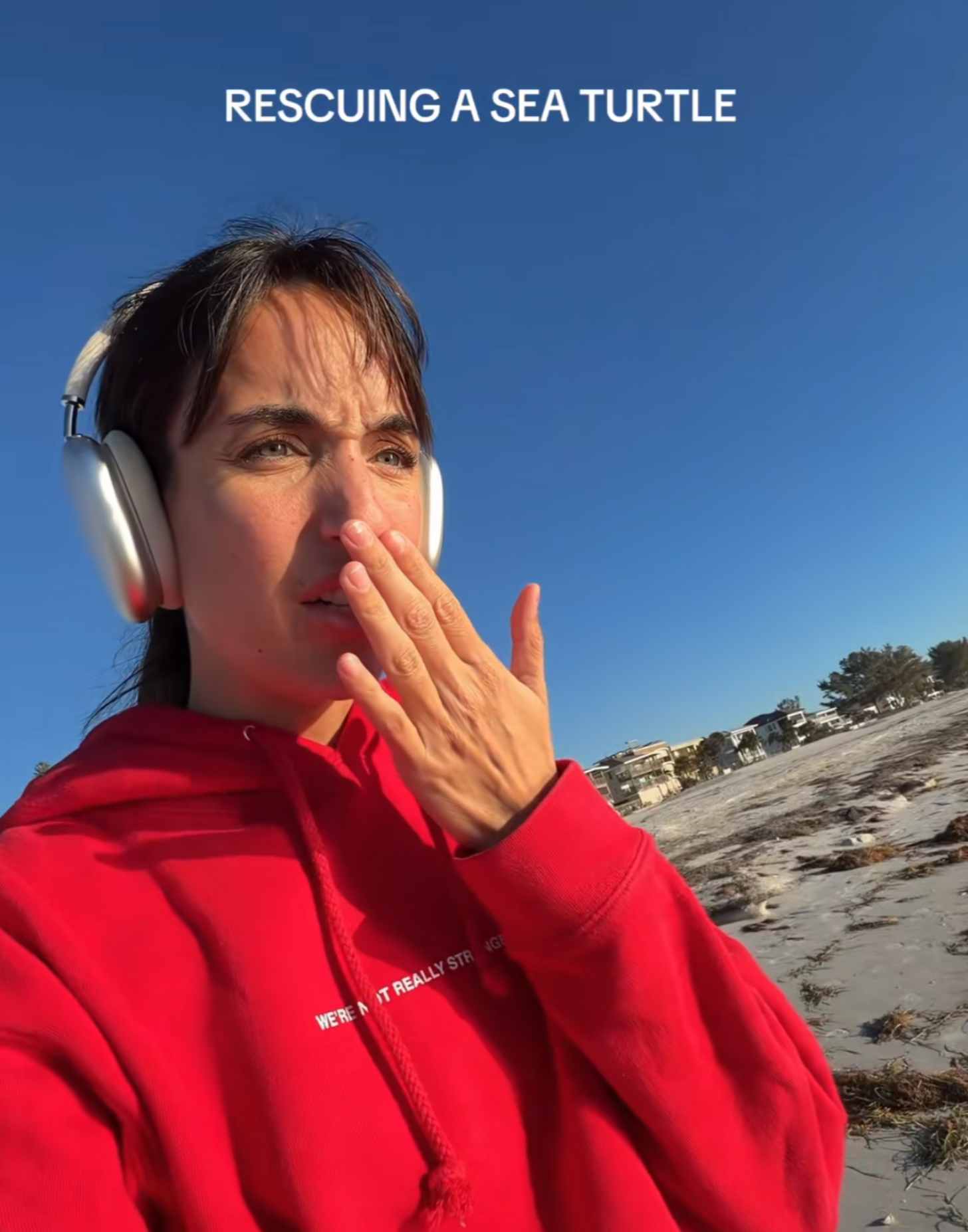
At one point, the sea turtle attempted to swim back into the ocean, but its flippers were weak, and it soon grew lethargic.
“She’s really having trouble; I don’t know what to do,” she said, her voice rising with concern.
Very quickly, it became clear that the sea turtle might drown if Macciocchi didn’t step in.
“I think this is illegal, but I think I have to grab her,” she said.
In the United States, it is illegal to touch sea turtles under the Endangered Species Act of 1973. However, wildlife experts agree that there are exceptions to the rule in extreme circumstances.
"Basically, if it's gonna be a life-or-death situation for that turtle, we can deputize people to pick it up and hold onto it for us. That is legal,” Andrew Orgill, a sea turtle specialist and staff supervisor at the Amos Rehabilitation Keep, has advised. “There's a Good Samaritan act as well.”
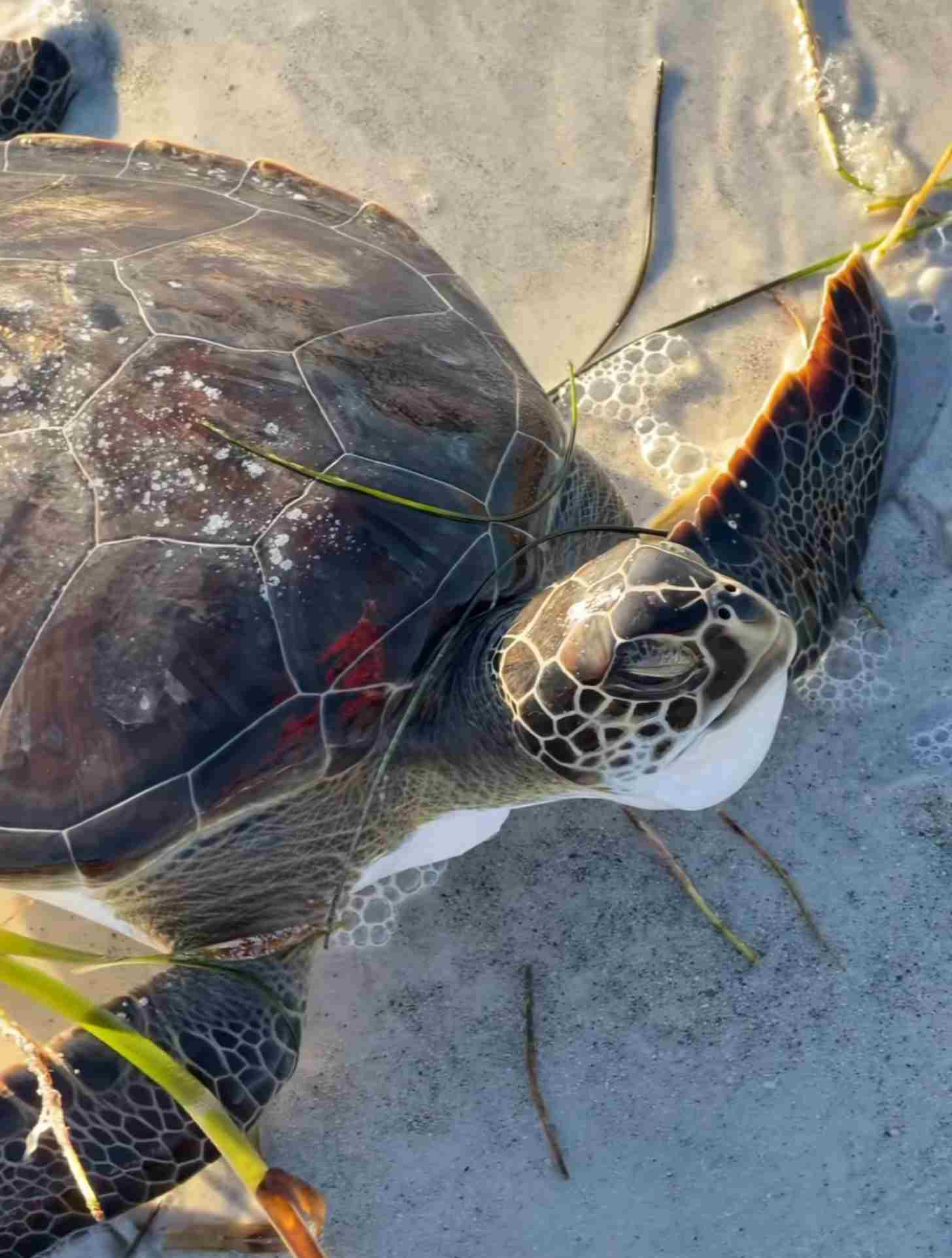
On that cold February day, when the sea turtle’s situation seemed dire, Macciocchi decided to intervene and gently move it a few feet from the waves.
“Had to go with my gut on this one,” she said. “I’m just going to wait it out with my little buddy here.”
When the rescue staff at the Clearwater Marine Aquarium spoke to her on the phone again, they told Macciocchi that she had done the right thing.
“They told me to keep her on shore,” she said, her worry growing as the sea turtle’s eyes closed.
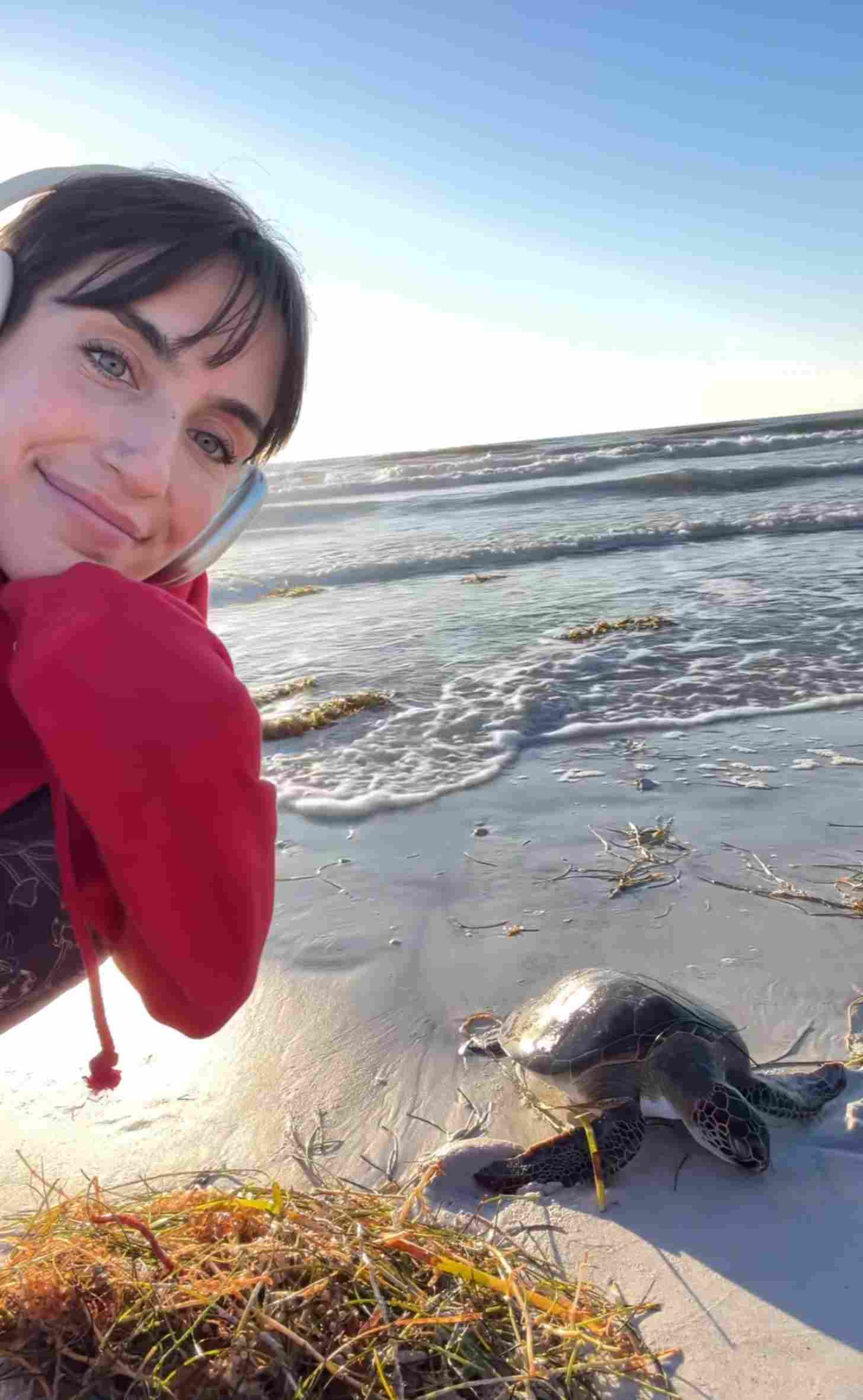
In total, Macciocchi stayed by the sea turtle’s side for more than three hours. Temperatures plunged as the sun began to set, but she still refused to leave.
“I’m literally shivering; it’s so cold,” she said.
Fortunately, at that point, a friend arrived. And she brought blankets, coats, and pizza in tow.
Then, finally, flashlights shone through the darkness as Clearwater Marine Aquarium staff arrived.
“Help is on the way!” she cheered. “I’m sad to say goodbye, but after three hours, I hope she feels better soon.”
While they wrapped the sea turtle in a blanket, the rescuers promised that it would be well taken care of.
“She’ll be in a warm tank tonight,” one staff member said.
@claraandherself Omg!!!! This was the craziest night ever! I always find animas hahaha. Thank you @Clearwater Marine AQ ♬ original sound - Clara
Macciocchi soon learned that the sea turtle she saved was just one of over 30 turtles impacted by a cold snap within a single week.
Fifteen of the turtles recovered quickly and were released on February 10. But the remaining sea turtles needed extra time for rehabilitation — including the one that Macciocchi rescued.
Even after Macciocchi left the beach that night, the sea turtle stayed on her mind. So, she visited the Clearwater Marine Aquarium to check on her old friend — who turned out to be a boy.
“The biologists say he’s doing well, but they still have to test his foraging skills in deep water to make sure he can be released,” the TikTok user said on February 12.
To track his recovery, the aquarium named him “Ladon” and grouped him with other recently cold-stunned turtles who were all named after Greek mythological figures — like Gaia, Eros, Hermes, Jupiter, and Cyclops.
On March 13, Macciocchi visited the aquarium again.
“He was a very sick little guy, unfortunately,” she explained in a video update. “They said he’s on antibiotics right now because he probably has a high white blood cell count.”
Despite a bout of infection, Ladon was still showing signs of improvement. It was just a matter of waiting for his bloodwork to come back with good results before he could be released.
@claraandherself Thank you @Clearwater Marine AQ ♬ original sound - Clara
Over two months later, on May 28, the day finally came for Ladon to return home. He was released alongside Hermes, a tank mate who had washed up in the same February cold snap and arrived with fibropapilloma tumors.
“Both green sea turtles were cleared for release by our veterinarian and the Florida Fish and Wildlife Conservation Commission (FWC),” the Clearwater Marine Aquarium said in a Facebook post. “We are thrilled to see these turtles healthy and back home in the wild!”
It was a happy ending for viewers who had been following Ladon’s story since the beginning.
“You saved his life,” one TikTok user wrote beneath the original video. “Thank you.”
“Most people would not have stayed that long or cared,” another commented. “Thank you, Clara.”
“This is probably the first time in history a documented case of a green sea turtle experienced a pizza party on the beach,” someone else joked. “So that’s pretty historic.”
You may also like: See these ‘crusty green’ sea turtles after two months of rehabilitation: ‘The difference is remarkable’
Header images via Clara Macciocchi
Chris Park lives on an organic farm in Oxfordshire, England, and he sees bees as a “blessing.”
“I’ve always had a fascination with bees and enjoyed them as a sacred creature,” Park said in an interview with Primal Gathering. “Bees have been here for 40 million years. Humans are toddlers in comparison.”
Park’s Instagram videos — which cover everything from beekeeping and basketmaking to his original music — typically average between 10,000 and 100,000 views.
But on May 31, he shared a post that quickly went viral, bringing in over 10 million views. In the video, Park calmly allowed a stinging honey bee to stay on his arm.
“This little honey bee is unwinding her sting,” the beekeeper said in the video. “It’s stuck in my wrist; she’s injected some venom. And that heat and that pain comes with it.”
“Our usual instinct is to lash out, isn’t it, and flick off the bee,” Park continued. “And she will then go into a frenzy, and try to fly away, and it will rupture her gut, and she’ll fly off with her stinger left behind, and often, the venom stays sort of there pumping away. And she dies.”
“But here,” Park said, “I’ve taken my arm to a more sheltered place, where she feels protected from potential predators, and I’ve tried to relax every single cell in my wrist, and calm my breath, and create this safe place for her, to calm down herself.”
Throughout the video, the bee can be seen moving its body clockwise and counterclockwise, as it frees each barb of its stinger.
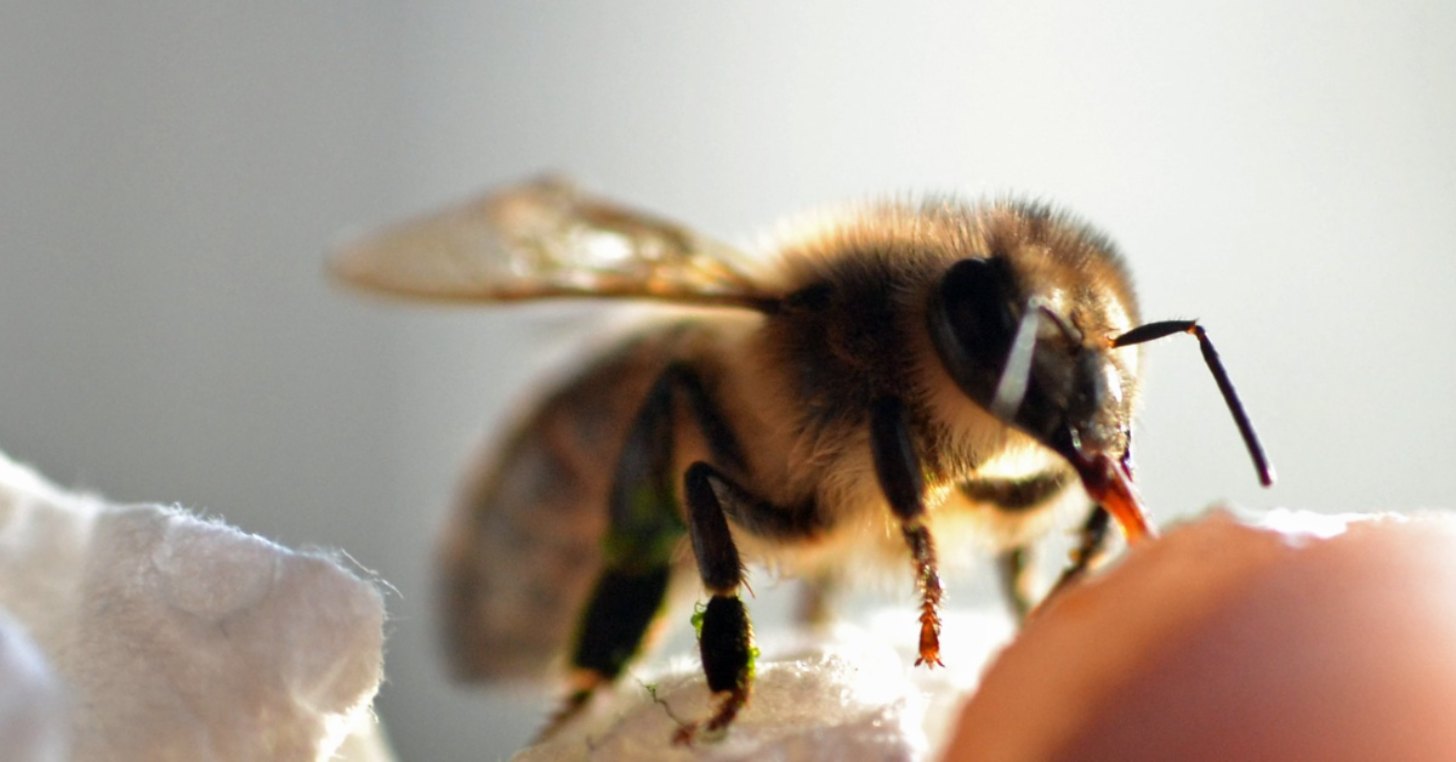
“They can sting other insects and retract those things, so they're used to doing it, but in our flesh, it often gets stuck,” Park added. “This is one of my first beekeeping lessons: that this can happen, but we can do this, and that it's a metaphor for life, you know, often we feel stung and in great pain, and we lash out and cause a worse situation.”
“But,” Park countered, “if we try and endure the pain and relax — and it's so much easier said than done — then a misadventure can be avoided, and in this situation, a life can be saved.”
At the end of the video, the honeybee finally flies off with its stinger seemingly intact. As soon as the moment went viral, Instagram users flooded the comments with praise and awe.
“You are officially the nicest human to ever exist on the planet,” one person said.
“This was magical to see,” one commenter wrote.
Another person exclaimed: “I didn’t know they could survive this!”
But the internet is rarely in agreement. On June 2, there were more than 3,600 comments on the Park’s video. And many of them were flippant or outright skeptical.
“Nope,” another commenter quipped.
“You should try snakes and sharks next,” one person egged on.
“Don’t try this at home,” warned another.
According to a study in the National Library of Medicine, a bee’s stinger is attached to its lower digestive tract by three sets of muscles— or, as Park put it, it’s “gut” — which is why it risks death every time it leaves its stinger behind.
“In order for a honeybee to extract its stinger without autotomy, it must rotate its body clockwise or anticlockwise around the sting site to pry the stinger loose; this behavior may successfully remove the stinger without autotomy but can be quite laborious,” observed co-authors Fiorella Ramirez-Esquivel and Sridhar Ravi.
The clockwise and anticlockwise behavior can be witnessed frequently in nature when a bee stings another animal with a thin exoskeleton and then attempts to retract its stinger.
However, is widely accepted that when a honey bee stings a human, it is incapable of pulling itself loose because the physical structure of the stinger is too deeply lodged in a human’s thick skin.
Even so, the belief that a bee can “unwind its stinger” is becoming more popular in the beekeeping community.
“Sometimes bees sting by accident,” fellow beekeeper Mirabai Nicholson-McKellar explained in a similar video that showed a honey bee moving in clockwise and counterclockwise motions. “If you stay calm and still, the bee might manage to pull her stinger out safely.”
Kate Hinkens, who runs Stinglab, a center for bee venom therapy and research, also backed the theory in her own video.
“If you let them try to unwind their stinger rather than swatting them away, sometimes the bee can unscrew her stinger by spinning around in circles,” she said. “Try it the next time you’re stung!”
Above all, Park’s demonstration of patience is kindness in action — and it shows that there is still a lot left to learn when it comes to bee behavior.
You may also like: New pollen-replacing 'power bars' give honey bees nutrients they need to survive
Header image via Conall (CC BY 2.0)
With sea turtle nesting season underway, conservationists are reminding visitors that small actions can make a big difference for these endangered animals.
Whether you’re spending a day at the shore or hoping to spot hatchlings making their journey to the sea, here’s how to enjoy the beach while helping protect sea turtles during one of the most important times of their life cycle.
When is sea turtle nesting season?
From late spring to early fall, beaches throughout the Americas become “a crucial nesting ground for sea turtles.”
“We must do everything possible to support their conservation by helping them nest and reproduce successfully,” Gulf State Park-Alabama shared in a Facebook post.
In the United States, sea turtles primarily nest along sandy coastal beaches in Florida, Georgia, South Carolina, North Carolina, Texas, Virginia, Alabama, and Hawaii.
Florida is home to the highest number of sea turtle nests and accounts for roughly 90% of nesting sites in the U.S.
Along the Atlantic coastline, the sea turtle nesting season generally runs from May 1 through October 31, with peak nesting occurring in June and July.
In Hawaii, the primary nesting season is much longer, running from mid-April through December, with a peak between August and November.
Sea turtle nesting season along the Gulf of Mexico (including the coasts of Texas and, in Mexico, Tamaulipas and Veracruz) spans from April through October, with peak nesting and hatching activity occurring from May through August.
Further south, in the broader Mexican Caribbean, sea turtle nesting season runs from May through early November.
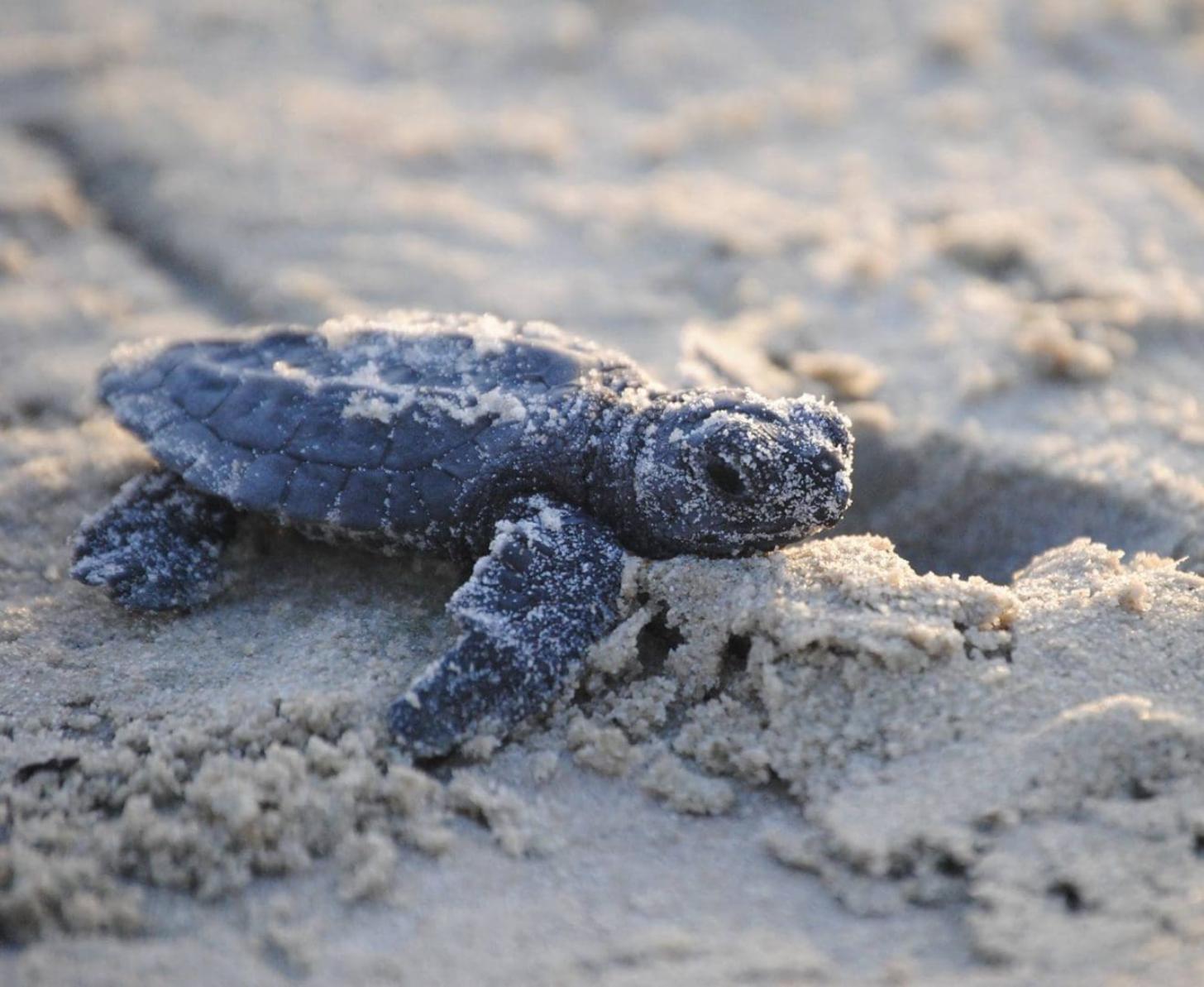
What is sea turtle nesting season?
Sea turtle nesting season includes the mating, nesting, and hatching behaviors of sea turtles.
After producing and carrying their eggs internally, female sea turtles come ashore to nest within a few weeks of mating.
Upon digging a depression in the ground, the female lays between 50 and 200 eggs (depending on the species) and camouflages her nest — first with damp sand, then with dry sand.
After the eggs have incubated in the sand for roughly 45-65 days, the sea turtle hatchlings use their beak to break through the shells. The hatchlings then slowly dig their way to the surface over several days and emerge together on the shore to race for the ocean.
For female sea turtles, this entire process — from mating to hatching — can happen up to 7 times in a single nesting season.
7 things to know during sea turtle nesting season
Leave the beach better than you found it
In the summer, the landscape of local beaches can change every day as people laze, play, and dig in the sand. Keep the National Park Service motto, “Leave No Trace,” in mind every time you visit a beach.
Dispose of trash, remove beach equipment, fill in holes, and yes, even knock down sandcastles. Obstacles or dramatic changes to the landscape can deter sea turtles from nesting or prevent hatchlings from reaching the water.
Know what to do if you come across a nest
Always stay at least 20 to 30 feet from nesting sea turtles and their marked nest areas. Stay quiet and eliminate any loud noises. When humans get too close, it can scare nesting mothers and cause them to abandon their eggs.
“If you see a nesting turtle or a nest, do not disturb them, and be sure to report it to local authorities so they can be properly protected and monitored,” North Carolina Aquariums advises.
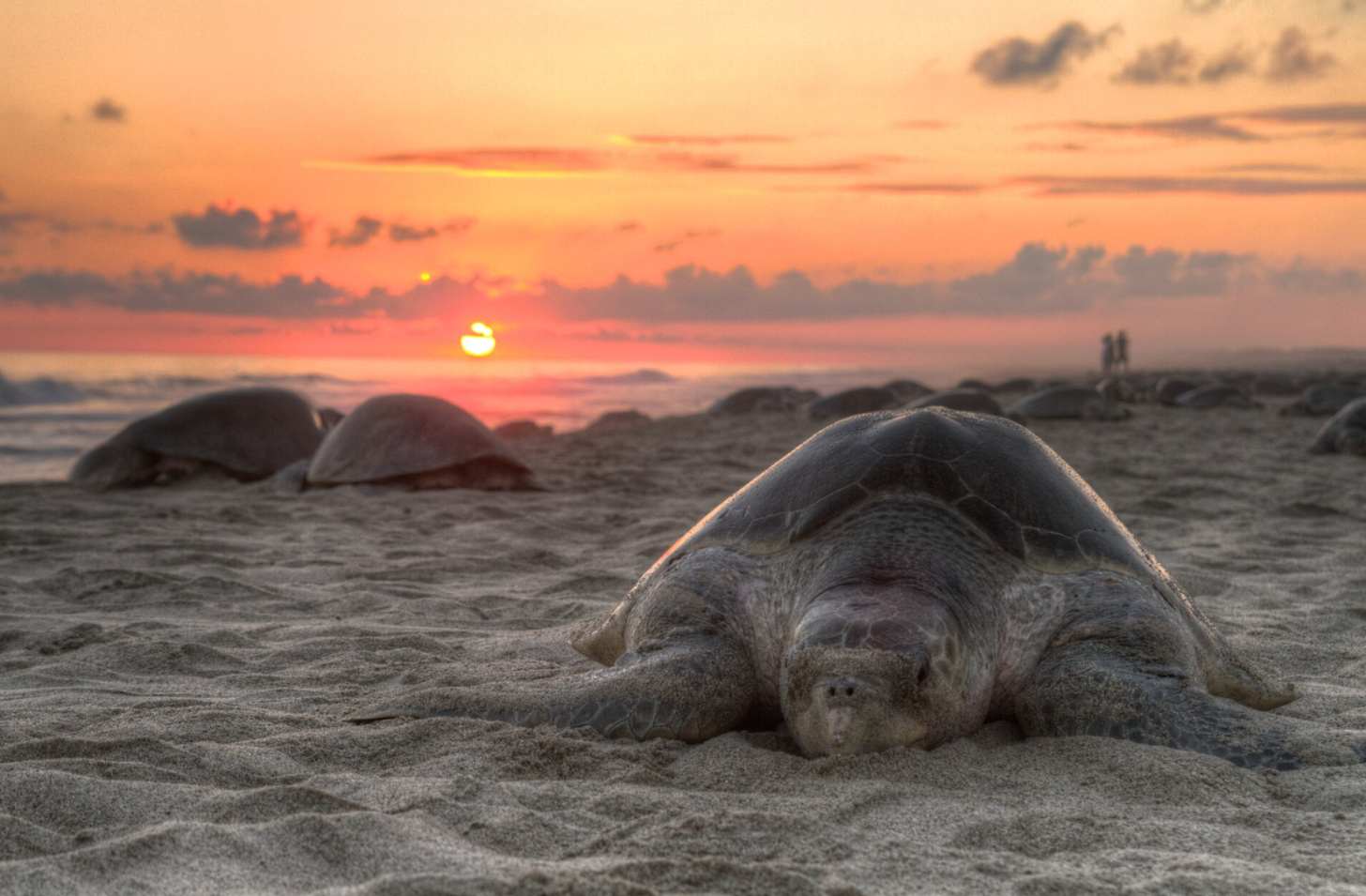
Learn how to help a sea turtle in an emergency
If you see a sea turtle that appears injured, trapped, or struggling, immediately report it to local authorities or a marine conservation organization. Call 1-800-SEATURTLE or use the NOAA Fisheries Stranding Contact Page to find 24-hour hotlines for your region.
If a turtle is accidentally hooked by a fishing line, gently reel in the slack and keep it at the surface. Do not lift the turtle by the fishing line, as it can cause severe internal damage.
Do not touch or move a sea turtle
Under the Endangered Species Act, it is illegal to touch a sea turtle.
“Handling sea turtles without proper training and permits is illegal and can cause further harm to the animal,” the Loggerhead Marinelife Center cautions. “Turtles, especially those entangled in fishing gear or showing signs of illness, require professional care. Untrained handling can exacerbate their injuries or introduce infections.”
However, in extreme life-and-death circumstances, wildlife authorities may ask you to intervene on the sea turtle’s behalf. Listen to the guidance of experts when reporting an injured or distressed sea turtle.
Do not ‘help’ a sea turtle hatchling by moving it closer to the water
Although it may be difficult to see a sea turtle hatchling struggling and not intervene, crawling to the ocean is a critical step in their development — and it must be done alone.
“They must crawl into the ocean to develop essential muscle strength and correctly orient themselves,” The Loggerhead Marinelife Center explains. “This crawl is crucial for their survival, as it imprints vital cues into their memory that will guide them back to their natal beaches when it’s their turn to nest. Picking them up interrupts this process, making it harder for them to find their way back as adults.”
Where to learn about local sea turtle releases
Find sea turtle rescues, conservancies, and research stations near you by using the Love Thy Turtle location-based map. Once you find a local rescue, follow them on social media for updates on future sea turtle releases. While some releases may be private, many are advertised as community-wide events that foster opportunities for sea turtle education and conservation.
How to support sea turtles near you
In addition to donating to — or volunteering with — your local sea turtle rescue, you can take care of sea turtles in your region by taking care of your local beaches. Do your part in reducing noise and light pollution, pick up trash when you see it, and don’t release balloons — an unsuspecting sea turtle may mistake it for a snack.
You may also like: This woman refused to leave a sea turtle’s side until rescuers arrived. Thanks to her, it got a second chance at life
Header image via Padre Island National Seashore, Texas
At the end of May, oyster farmers came across a seal pup that desperately needed help in Denman Island, British Columbia.
After the team at Baynes Sound Oyster Co. called for wildlife support, the Marine Animal Response Society organized a medevac for the pup through Harbour Air. By June 1, she arrived safely at the Vancouver Aquarium Marine Mammal Rescue Society.
The aquarium staff named the seal pup Bayne after the oyster farmers who rescued her. According to the Vancouver Aquarium Marine Mammal Rescue Society, Bayne is their first female seal pup of 2026.
Harbor seals are among the most common marine mammals along coastlines in the United States and Canada.
Despite changing ocean temperatures related to climate change, human-related disturbances, and entanglement in fishing gear, harbor seal populations have remained stable, thanks to protections under the Marine Mammal Protection Act.
The Vancouver Aquarium Marine Mammal Rescue Society explained that Bayne’s rescue was only possible “because of incredible community support like this.”
“It takes a village,” they emphasized.
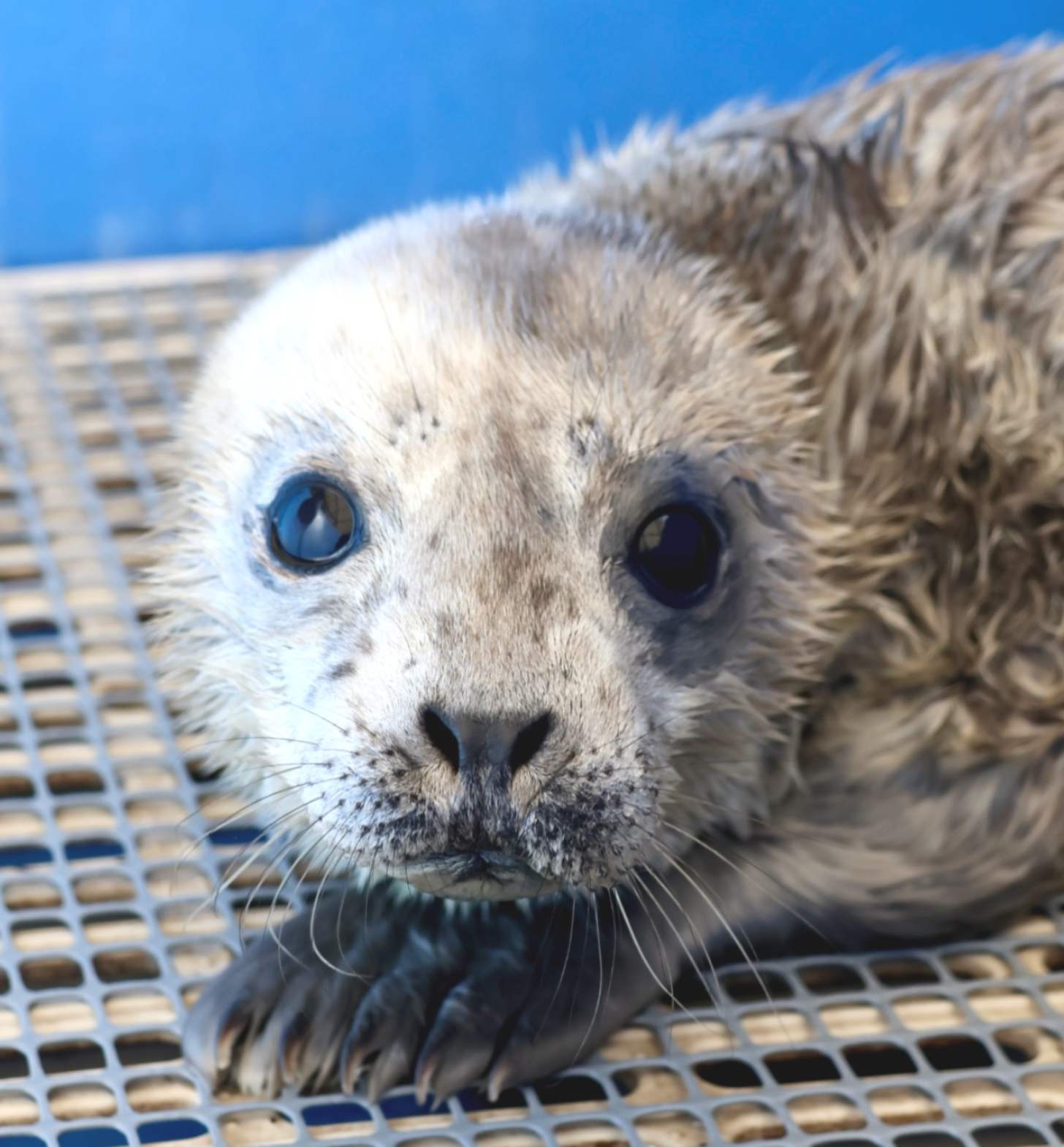
When the aquarium called the Baynes Sound Oyster Co. to thank them for their rescue, they had a follow-up request.
“During those conversations, we mentioned another challenge we were facing: finding foods that our newest sea otter patient would actually eat,” the aquarium posted to Instagram on June 2.
“Less than 12 hours later, they sent a cooler overflowing with fresh clams and crab.”
In the Instagram video, the sea otter in question — named Clamato — can be seen happily chomping down on a whole crab, slapping it on his stomach, and ripping it apart with his paws and teeth.
“Needless to say,” the aquarium wrote, “it was a huge hit.”
In a follow-up post on June 4, the aquarium provided more detail on the conditions of Bayne’s care.
“Bayne is what we call a lanugo pup, meaning she is still covered in the thick, blonde fur that is typically shed before birth,” the aquarium explained. “When harbor seal pups are born with their full lanugo coat, it often indicates that they were born prematurely.”
“Premature pups can have difficulty regulating their body temperature and maintaining healthy blood glucose levels, so Bayne is being closely monitored by our animal care team as she settles into rehabilitation.”
They wrapped up their post by saying: “Welcome to the rescue center, Bayne! We're rooting for you!”
Beneath the post, the comments section was filled with well wishes.
“Keep fighting, sweet girl — everyone has your back,” wrote one Instagram user.
“Does she know how much I love her?” another asked.
“Bayne, feel better soon!” one person cheered. “Grow big and strong!”
For those looking to support Bayne and Clamato — and the many other marine animals under their care — the Vancouver Aquarium Marine Mammal Rescue invited people to visit their website.
You may also like:
Header image via VA Marine Mammal Rescue Society
Comedy comes easily to Maria Bamford, even when the subject matter veers into the dark corners of the psyche. And in the upcoming documentary, “Paralyzed by Hope: The Maria Bamford Story,” that relationship with comedy and mental health takes center stage.
“At age 9 or 10, I started having sort of depressive feelings or episodes and suicidal ideation of sort of not wanting to be here,” the stand-up comedian told Good Good Good. “Along with that, I had obsessive-compulsive behaviors and developed a bit of an eating disorder. And once you start doing that, your brain just kind of struggles anyway.”
“That affected my depression, and then I had some intrusive thoughts that got, well…” Bamford pauses, thinking. “It wasn’t a thing they talked about back then. So my parents sent me to a therapist when I just wasn’t able to sleep at night. I just was too scared that I was gonna harm people, you know, my family.”
“So they sent me to a therapist, and I would just take a nap on her couch, basically,” she joked.
Directed by Judd Apatow and Neil Berkeley, “Paralyzed by Hope: The Maria Bamford Story” premiered at the Sundance Film Festival in January 2026 to rave reviews from critics.
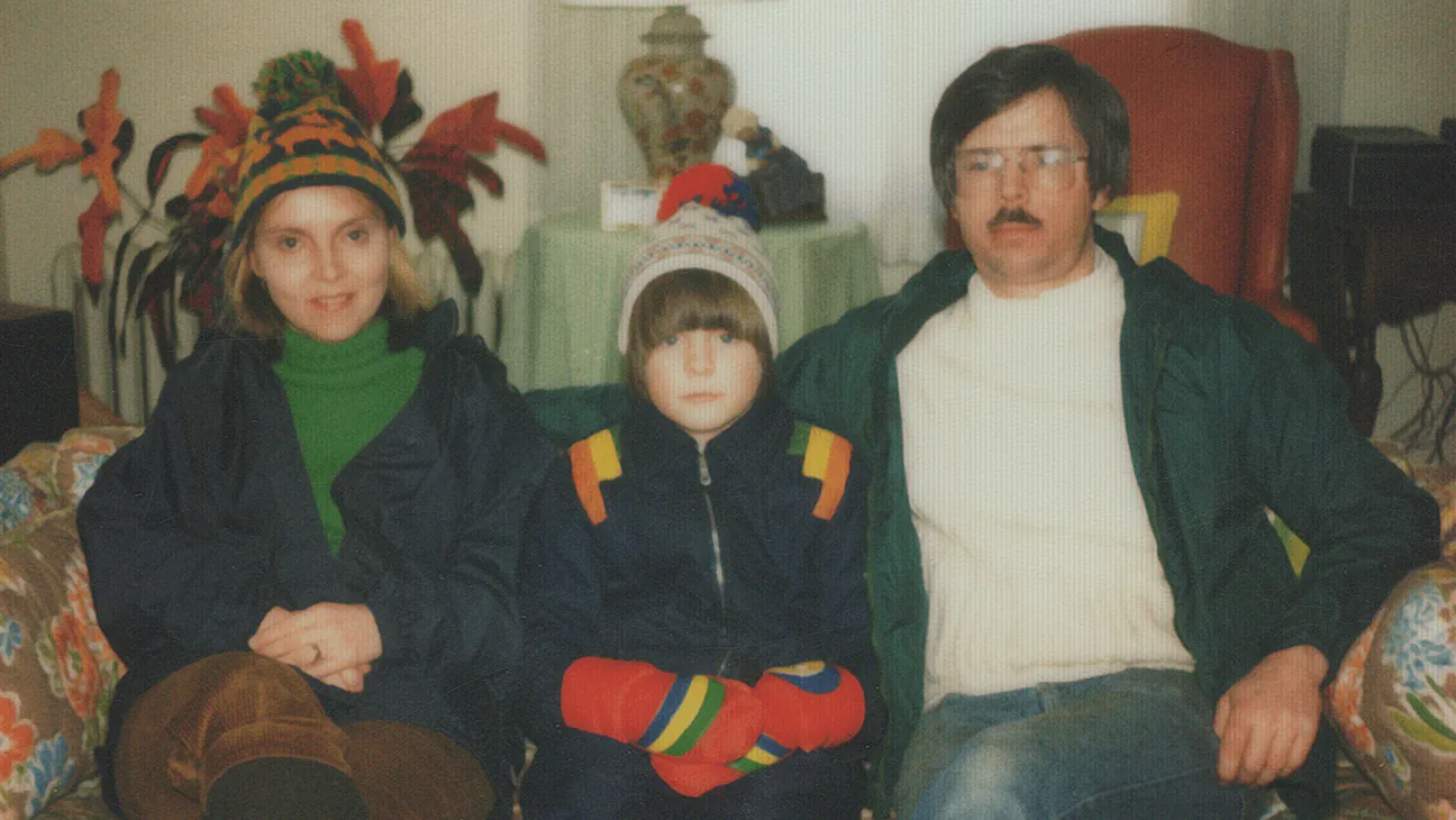
The documentary provides direct insight into Bamford’s long journey with mental health — a subject she was happy to revisit in an interview with Good Good Good.
“I had difficult times on and off,” she explained. “Everything kind of came to a head at one point in college when I called the suicide hotline.”
After college, her relationship with depression and OCD took a turn for the better, as she went on medication and sought treatment. At 35, Bamford began seeing a therapist for her OCD.
But at age 40, when a doctor encouraged her to go on antipsychotics, she balked.
“It felt scary. It felt like ‘Oooh, antipsychotics,’” she said, letting mock judgment leak into her internal dialogue. “Part of the deterioration of my mental health was in my refusal to try mood stabilizers. And then I was trying to work while trying these new meds, which was difficult.”
“I ended up being in hospitals like 3 times in a year,” she added.
When it comes to her OCD and depression, the former has always been the more “misunderstood” of the two. During one hospitalization, Bamford recalled how a gap in psychiatric care resulted in a longer stay.
“I tried to explain to this psychiatrist what intrusive thoughts were, and he thought it was that I was planning to harm people and that I was in danger to myself and others,” she said. “They kept me in the hospital 10 days longer because he didn’t want to let me out until I was for sure not gonna hurt anybody.”
“And I was like, no, no, it’s not that — I've never done anything. I’ve never done any of those things. I’m just worried about doing those things,” she emphasized. “I think the hard thing is finding the right place to go, and you might hit a few real rough spots in trying to find that.”
Following the hospitalizations, she was fortunately put on what she called a “cocktail” of prescription medication that finally felt like a good fit. For the next 15 years, the medicine helped her stay “fairly stable.”
When the depression returned more recently, Bamford turned to hormone replacement therapy through her local Planned Parenthood.
“So I have high hopes for that,” she said.

“Hope” is a recurring theme for Bamford. Apatow explained that the title of the documentary itself stems from an early joke she told on stage: “I never really thought of myself as depressed as much as paralyzed by hope.”
“She’s always been someone who’s been very inspirational because, you know, she is so open and honest and raw in her comedy, which makes it so hilarious and unique, but also very truthful,” Apatow told Good Good Good. “So in some ways it’s surreal, but also touches people.”
Apatow first met Bamford “many years ago” in the Los Angeles comedy club scene.
“I'm just a gigantic fan of hers mainly and have always admired what she's done and hoped that one day we could find a way to work together,” he said. “I was always trying to get her to make a movie, and she didn’t want to. And so one day I thought, ‘Oh, maybe I can get her to let me do a documentary about her.’”
When he called her and asked, he finally got his yes. The next day, Apatow was at her house.
“We wound up following her on and off for a few years,” he said.

In addition to footage of Bamford’s stand-up comedy sets and her personal life, the documentary is interspersed with interviews with comedians like Patton Oswalt, Tig Notaro, Ron Funches, Sarah Silverman, and Stephen Colbert, who pop up to sing her praises.
“In the movie, a lot of the people talked about how she is just completely unique, that there’s no precedent for what she’s doing on stage,” Apatow said. “You know, she’s embodying all these characters from her life. She’s doing impressions of real people and her family — not celebrities. It’s very imaginative, and wildly funny, and outrageous.”
When Apatow first approached Bamford about the documentary years ago, she was just as grateful as she was dumbfounded.
“I thought: It’s an honor that anyone cares, that anybody is interested,” she said. “But then there was also slight shame because I go, ‘Oh, there are a lot of more interesting stories out there, of people overcoming much more difficult circumstances.’”
“I was definitely born with a silver spoon in my mouth,” she stressed. “My dad was a physician, and we lived in a place where public schools were well-funded. I got care in whatever way it was available, as soon as I said I had problems.”
“Those are the kind of feelings that came up, just sort of a mixture of oh my gosh, well, okay, and I guess?” Bamford laughed. “But if it’s helpful to anybody, then I’m glad. I’m so grateful.”
In separate interviews, Good Good Good asked Bamford and Apatow who they look to for hope.
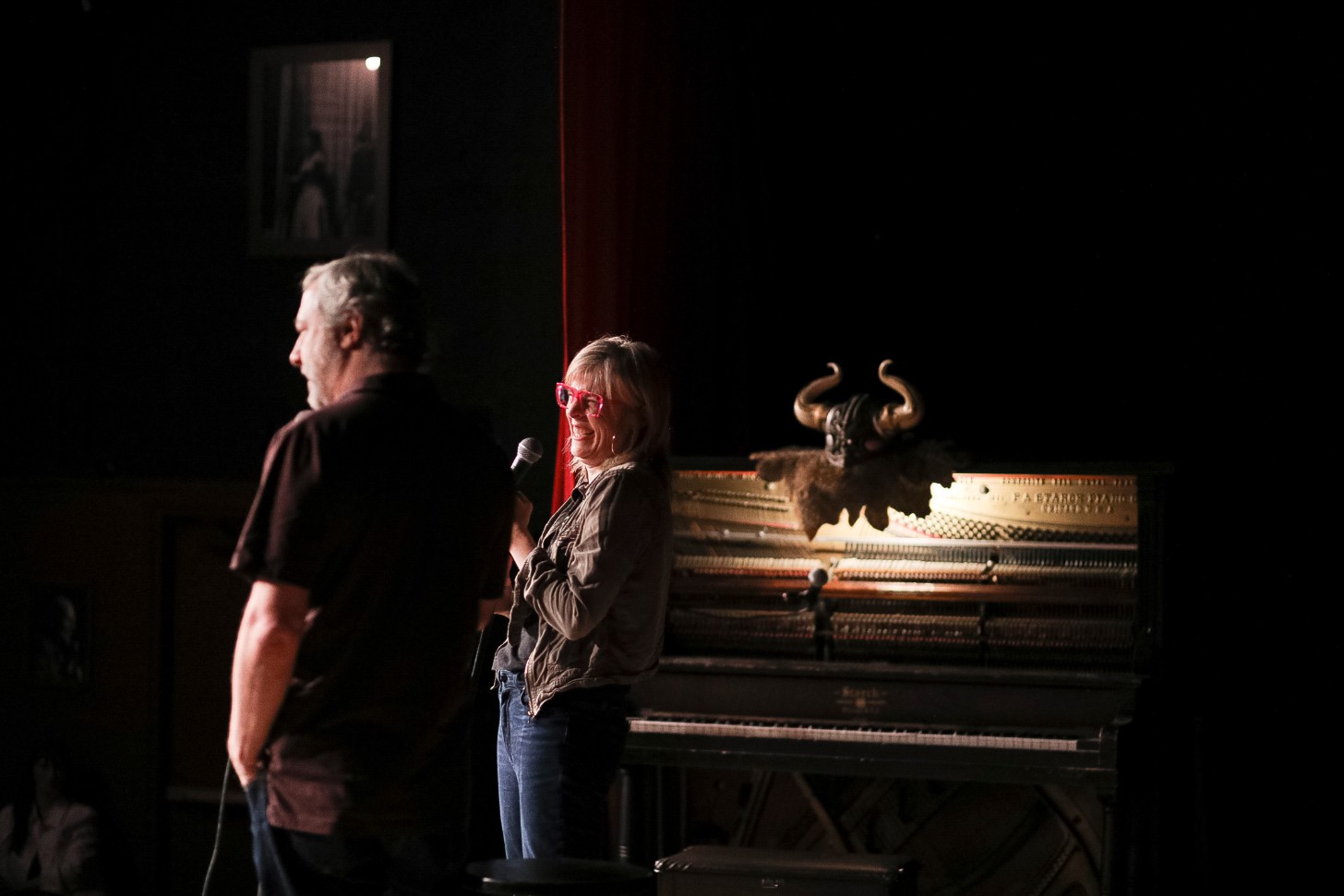
The question prompted a long list of answers, including their friends and family, groups like Mutual Aid LA Network, mental health podcasts like “ShxtsNGigs,” peers like Dave Eggers, who founded the youth writing center 826 Valencia, and Jackie Kashian, who raises money for immigrant defense funds.
Their lists also included each other.
“Judd has an absolutely insane amount of energy and enthusiasm to strongly support so many creatives — I am one of many that he has helped. He also gives so much back to progressive causes, follows his own passions, and is a delight to be around — chipper and cheerful and hilarious always,” Bamford said, adding that co-director Neil Berkeley is “a very hard-working and extremely pleasant person to spend time with.”
“He, like Judd, is the real deal,” she said.
Apatow echoed the same sentiments.
“Maria is one of those people because she’s very charitable,” Apatow said. “As soon as the fire happened in her community in Altadena, she started doing benefits for the theater that she worked at there, this clown theater, and she’s always reaching out and finding ways to help people.”
“She’s always been a comedian, but she's so much more than that, because what she does is so relatable to everybody,” he emphasized. “We are all struggling. We all have our depression. We all have our obstacles. And her comedy gets to the heart of that struggle.”
“Paralyzed by Hope: The Maria Bamford Story” is currently being shown at film festivals in limited screenings and is expected to receive a wider release in the coming year.
Header image via Largo Apatow / Courtesy of Judd Apatow
Since 2018, Uber and Lyft have committed to disclosing transparency reports regarding incidents of sexual harassment, physical altercation, and — most gravely — fatality. As rideshare apps began to rival taxi cabs and public transportation, passengers called for greater accountability and oversight.
Fortunately for Lyft, transparency reporting was simply a first step toward a larger commitment to passenger safety. In addition to making “911” a button click away, the app also sends a check-in message to the rider if their driver starts veering off the scheduled course.
In February 2024, the rideshare app also launched the optional Women+ Connect feature, which enables women — cisgender, transgender, and non-binary — to select a gender preference for a prospective driver. Over the last two years, the feature has continued to roll out at regions across the country.
“Lyft is rolling out an inclusive product at a time when so many companies are shying away from explicit inclusion of transgender and nonbinary people,” Jay Brown, chief of staff for the Human Rights Campaign, said in a press statement. “When rideshare is better for these folks, it's better for everyone, and we at HRC stand behind that.”
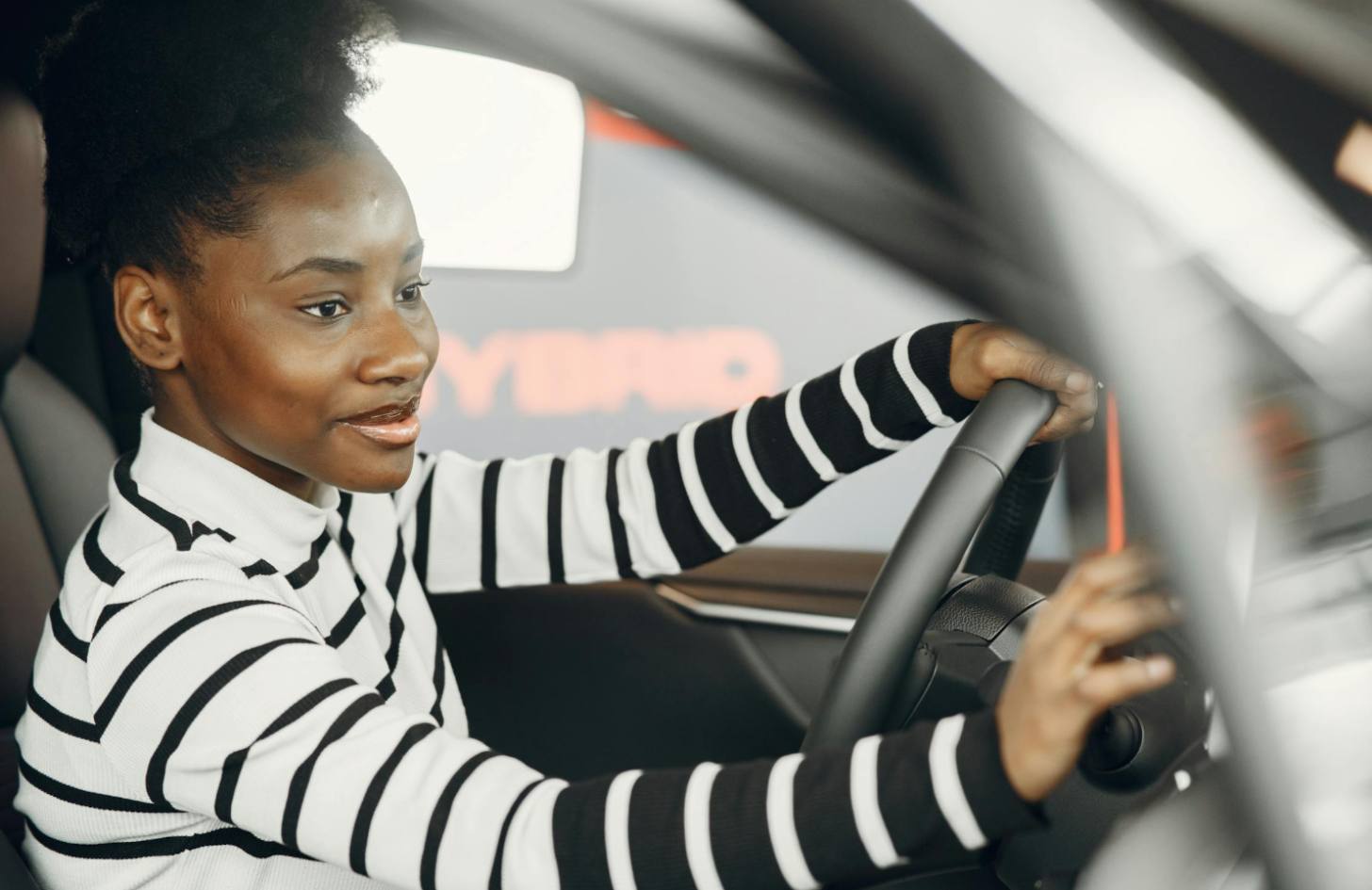
Since the rollout, over 7 million riders have used the feature. Gaddy Rodas, a Lyft driver based in Florida, has enjoyed the opportunity to make female passengers feel safer, especially when she does midnight pickups.
“I know there’s going to be women calling a Lyft, and they will feel more comfortable if a female driver is there,” Rodas told Lyft. “They’re like, ‘That makes me feel so much better.’”
A version of this article originally appeared in the 2024 Pride Edition of the Goodnewspaper
Header image via Gustavo Fring / Pexels
Last November, nine critically endangered sea turtles were found stranded in Brewster, Massachusetts, after freezing temperatures left them cold-stunned and sick.
After a brief visit to the New England Aquarium, the sea turtles took a 1,000-mile flight to the Georgia Sea Turtle Center in Jekyll Island, Georgia for extended care.
Jaynie L. Gaskin, the director of the Georgia Sea Turtle Center, was told that they would be receiving eight Kemp’s ridley sea turtles — the most endangered sea turtles in the world — and one loggerhead.
But when she loaded nine boxes into the Georgia Sea Turtle Center’s turtle van, director Jaynie L. Gaskin did a double-take.
“Where is the loggerhead?” she recalled asking in a post for the Jekyll Island Foundation. “These are all Kemp’s Ridleys.”
The pilots confirmed that all the turtles had been carried off the plane, so Gaskin and the team began opening boxes again. That’s when she spotted the missing turtle.
“Oh, here they are,” Gaskin said. “This little loggerhead looks so much like the others; I must have counted them as just another Kemp’s.”
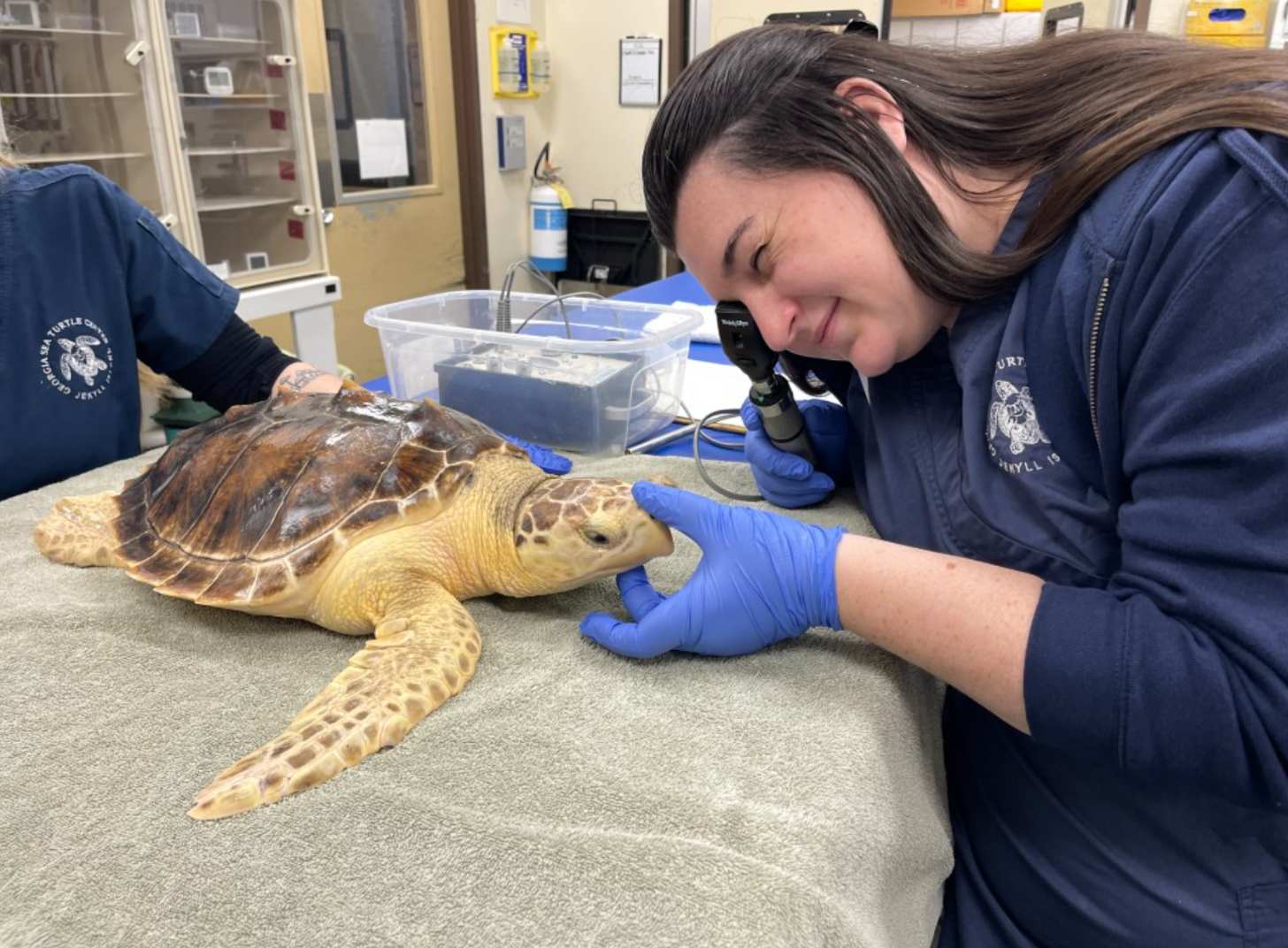
It had been a long time since the director had misidentified a sea turtle.
“That little guy really fooled me with their round shell and small head,” she told hospital manager Rachel Overmeyer.
At the center, the sea turtles received new names, each after a different tea: Chai, Boba, Darjeeling, Matcha, Jasmine, Peppermint, Chamomile, and Oolong.
The loggerhead, which boasted strange physical traits, was named Earl Grey after the “blended black tea.”
“As the veterinarian examined Earl Grey, he pointed out several unusual features,” Gaskin recalled. “A sharp hooked tip at the front of the beak is typically found on Kemp’s Ridley turtles, not loggerheads.”
“The shell raised even more questions,” she added. “Loggerheads usually have heart‑shaped carapaces, while Kemp’s Ridleys have round shells. Earl Grey’s carapace appeared unusually round, with ridges more characteristic of a Kemp’s.”
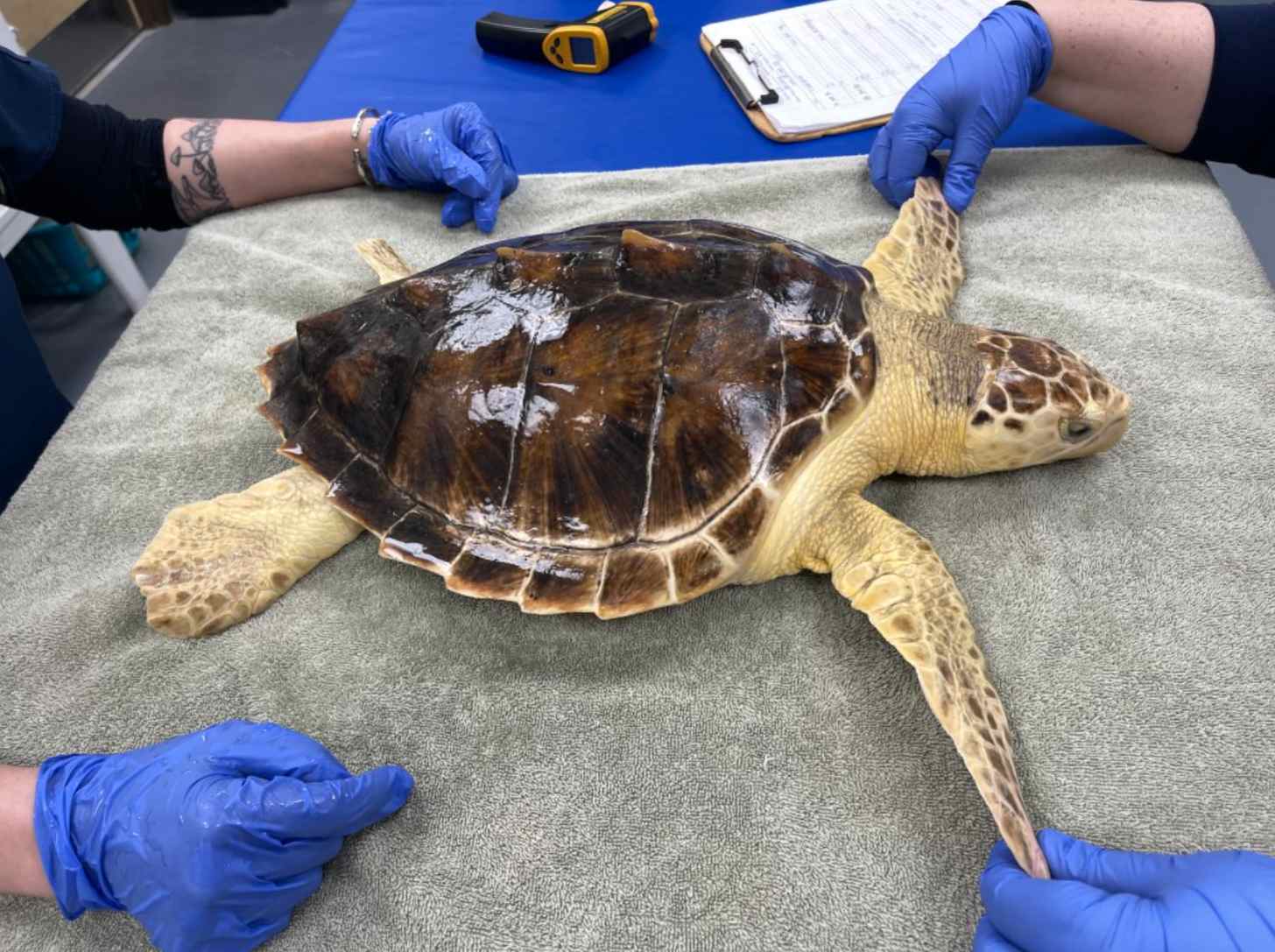
Soon, it was clear to everyone on staff that they had never seen a sea turtle like Earl Grey before. So they took a blood sample and sent it off to the University of Georgia for genetic testing.
“Just as rehabilitation was nearing completion, the genetic test results arrived,” Gaskin said. “Earl Grey was confirmed to be a first‑generation hybrid — with a loggerhead father and a Kemp’s Ridley mother — the first hybrid sea turtle ever treated at the Georgia Sea Turtle Center.”
After seven months of rehabilitation, care, and plenty of squid and leafy greens, Earl Grey was cleared for ocean release. On May 28, he returned to Georgia waters in a private release as the staff cheered him on.
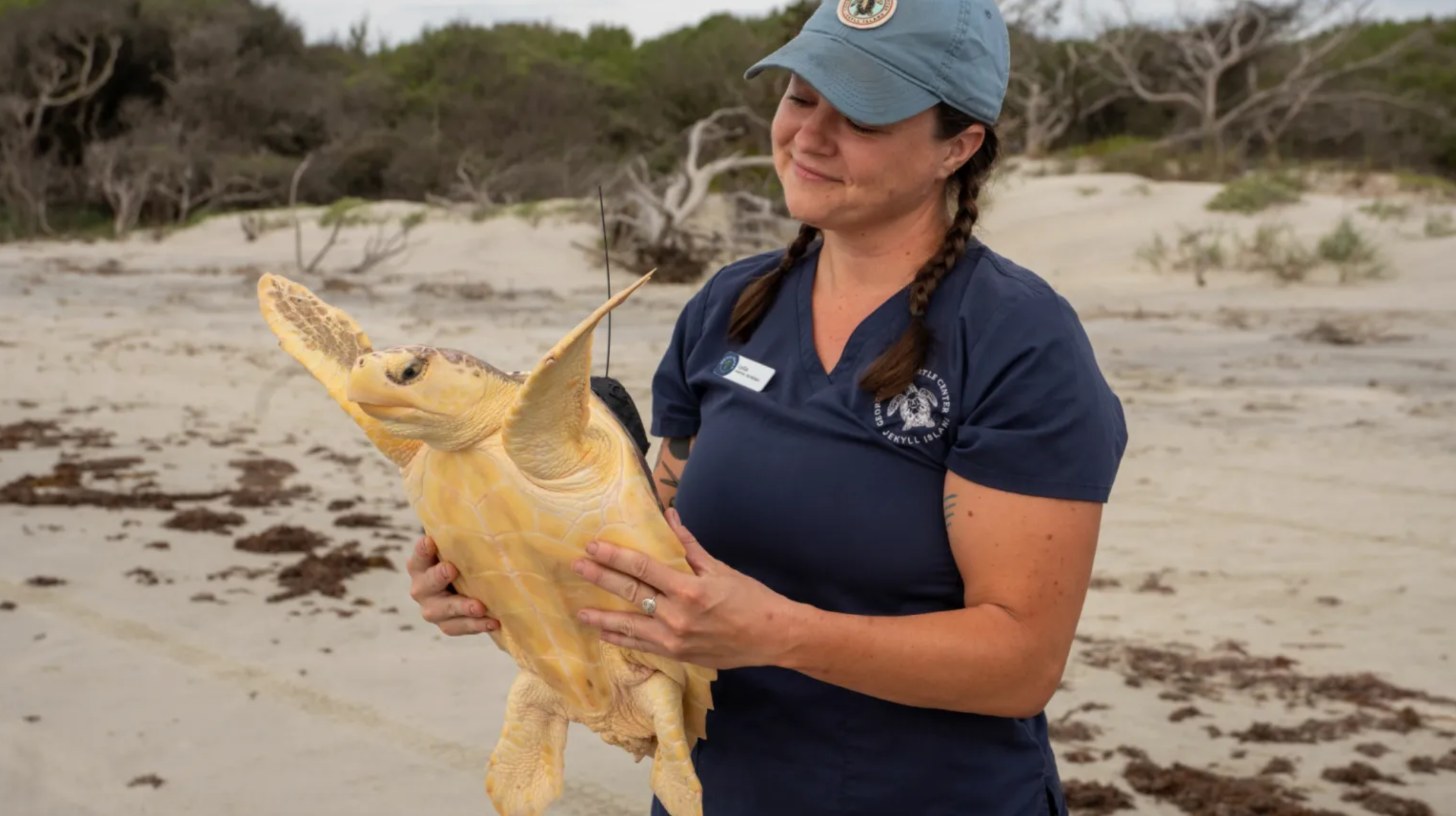
In an interview with Popular Science, Gaskin offered a theory about the curious hybrid discovery.
“From an evolutionary perspective, hybridization could be one of many ways genetic diversity is introduced into a population,” she explained.
“We encourage other rehabilitation facilities to consider genetic testing for any suspected hybrid sea turtles, as there may be more individuals than we currently realize!”
You may also like: After oyster farmers saved a seal pup in need, they followed up by sending her rescue a cooler full of clams and crab: 'It takes a village'
Header image via Jekyll Island Authority
On May 28, a massive traffic jam in Prince George, British Columbia had drivers craning their necks out of their car windows to see what the hold-up was.
A mother moose had tried to cross a four-lane highway with her two calves, and only one of them was able to clear the concrete barrier.
When the calf became distressed, three drivers stepped in to corral the baby moose away from traffic. Eventually, they were able to lift it over the barrier so that it could reunite with its mother.
When a video of the incident went viral across social media, many were quick to praise the drivers for stepping in to help.
One TikTok user wrote, “Good job to all the helpers,” before adding, “This is why all states need wildlife crossing bridges! A lot of them!”
According to the Pew Research Center, an estimated 1 million to 2 million wildlife crashes occur every year in the United States, causing approximately 200 human deaths, 26,000 injuries, and at least $8 billion in costs.
To reduce animal collisions, countries around the world have begun adding wildlife crossings across major roadways. In the U.S. alone, there are more than 1,000 dedicated wildlife crossings — including overpasses and underpasses.
In California, a new wildlife crossing over Route 97 in Siskiyou County is nearing completion after a decade of planning.
“The primary problem on the highway was the mortality,” Fraser Shilling, a director at the UC Davis Road Ecology Center, told SFGATE. “There’s truck traffic that goes through there, and they don’t slow down. They hit whatever’s on the road, so a lot of deer and elk were getting killed.”
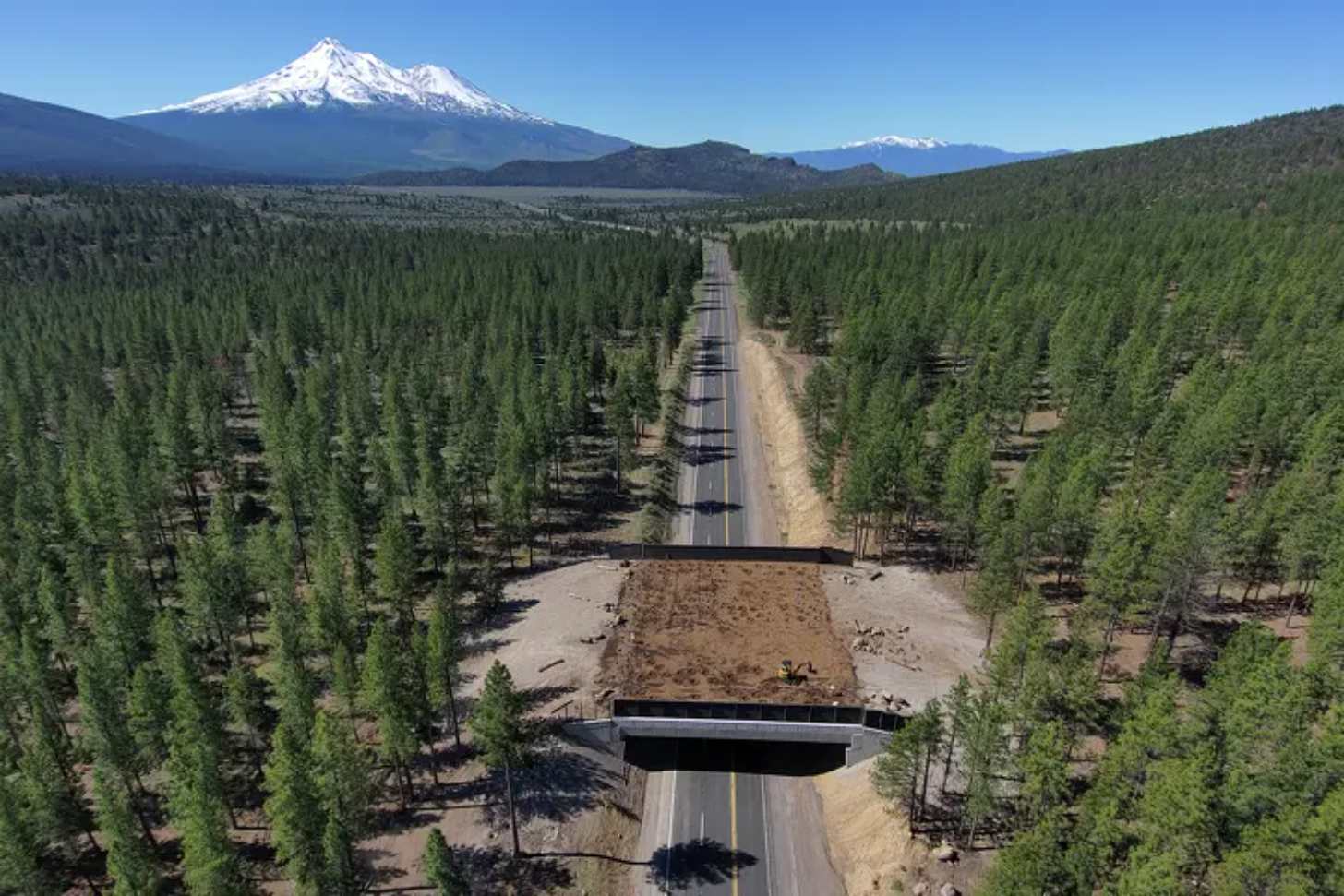
But before the crossing has even been completed, it’s already been graced by animal visitors. On June 2, the UC Davis Road Ecology Center shared footage of three mule deer crossing the bridge, navigating around lumber and soil on the active construction site.
“These deer are the first ever to successfully cross a roadway in the state of California using a newly constructed wildlife overcrossing, located on U.S. 97 in Siskiyou County, just 15 hours after crews wrapped up work for the day,” Caltrans District 2 shared in a Facebook post.
In addition to the three mule deer, there were signs of a bobcat crossing the wildlife bridge in January, but camera footage wasn’t definitive.
“While the contractor is still completing final touches, it’s incredible to see wildlife already embracing the new structure, even with workers still in the area,” the post continued. “This wildlife overcrossing was designed to provide animals with a safer way to cross the highway while helping reduce wildlife-vehicle collisions for motorists traveling through the corridor.”
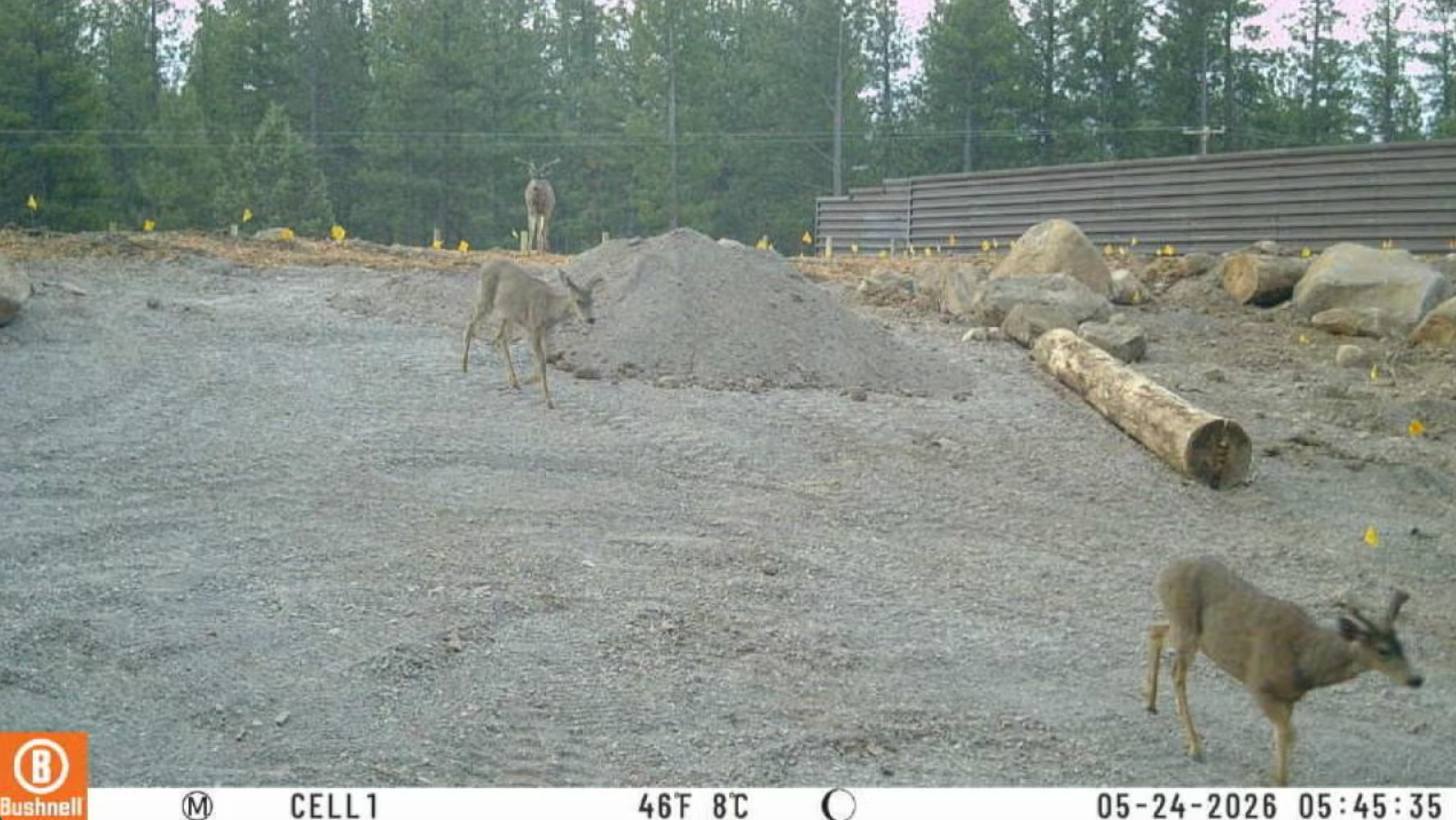
The wildlife overpass, which is approximately 100 feet long by 140 feet wide, is set to be completed this fall.
“Seeing animals use the structure this quickly is an exciting sign of the positive impact this project will have for both wildlife connectivity and public safety for years to come,” Caltrans District 2 said.
You may also like: A new wildlife overpass connects two of Australia's national parks, saving beloved endangered species
Header image via Caltrans, UC Davis Road Ecology Center, CDFW, Ore-Cal RCD
Every day the Good Good Good team collects the best good news in the world and shares it with our community. Here are the highlights for this week!
If you want to get good news in your inbox every day, join the Goodnewsletter — the free daily newsletter designed to leave you feeling hopeful.
The Best Positive News We’re Celebrating This Week —
Gay and bisexual men in England are donating blood in record numbers
Thanks to a change in eligibility criteria in England, Scotland, and Wales that was introduced in 2021, more gay and bisexual men are now donating blood than ever before.
In the 1980s, queer men were banned entirely from donating blood, and while the outright ban was lifted, strict rules around sexual activity were still in place. The updated, more inclusive rules allow many more people who’d previously been excluded “to take the opportunity to help save lives.”
A new survey of male blood donors found that 7.5% self-identified as as gay, bisexual, pansexual, queer, bicurious, or sexually fluid, a huge rise from 2014, which showed just 1.4% identified as such.
Why is this good news? Blood donation is life-saving, and nobody who can safely give blood should be restricted from doing so. The previous rules around gay men donating blood were outdated and unnecessarily restrictive — and this progress proves that changing those rules has led to a new pool of life-saving donors.
An overlooked aspect of gender-affirming care, voice lessons help empower trans people
→ Read more
Same-sex marriage support has grown across all religious affiliations in the last ten years
New data from the Public Religion Research Institute shows that support for same-sex marriage is higher today (65%) than it was in 2015 (53%).
Specifically, support for same-sex marriage is up among all major religious affiliations, including those who identify as White Christian, Christian of color, Non-Christian, and Unaffiliated. The most marked improvement is among White Christians, jumping from 45% to 59% in the last decade.
Additionally, most Americans support nondiscrimination protections for LGBTQ people (72%), with Democrats (90%) being the most supportive, followed by independents (76%) and Republicans (56%).
→ Read more
The LEGO Foundation pledged $97 million to fund childhood education in conflict zones
Amid rising global conflicts, from Gaza and Ukraine to Iran and South Sudan, an increasing number of children are not only suffering immensely, but they’re also missing out on their education.
The LEGO Foundation just announced a commitment of $97 million to fund the International Rescue Committee’s educational, play-based programs for children in conflict zones.
It’s part of a five-year partnership that will reach 5 million children in East Africa and the Middle East, and remain flexible to bring the IRC’s programming wherever it’s most needed, designed to evolve in real-time alongside conflicts.
Why is this good news? Every child, no matter where they live, deserves to play, learn, and grow in safety — conflicts steal that from children. This much-needed funding will help give them a piece of their childhood back.
No, everyone is not trans all of a sudden: Debunking 5 harmful myths about LGBTQ+ people in 2026
→ Read more
The majority of Americans regularly see kindness in their communities
A new Gallup poll surveyed more than 2,000 U.S. adults and found that most Americans believe kindness is common in everyday life.
Six in ten say they often or very often see people treating others with kindness or respect, while nearly two-thirds report personally experiencing multiple acts of kindness in the previous week.
The survey also found that most Americans are comfortable extending kindness to strangers, with 52% saying they would be very comfortable initiating a kind act, and 38% saying they would be somewhat comfortable. Overall, on a scale from “very kind” to “not kind at all,” three-quarters of Americans described their peers as kind.
Europe’s largest 3D-printed affordable apartment complex was completed in France in just 34 days
With 12 total affordable housing units, Europe’s — and potentially the world’s — largest 3D-printed apartment building is now complete in France. The building is three floors and was completed in just 34 days.
The developer behind the project printed it next to a similar building that used traditional building techniques, but took three months longer to complete.
The team behind it is already planning another, larger project that will include 40 apartments.
Why is this good news? Traditional construction is expensive and time-consuming. As the housing crisis reaches all corners of the world, 3D-printed solutions reduce the time required to construct more housing supply, and do so at a lower cost.
→ Read more
You may also like: Tour the eco house of the future: Affordable, 3D-printed, and fully recyclable
‘Bathroom bills’ ignore the existence of intersex people. This activist refuses to be erased
The majority of Americans trust vaccine scientists
In 2025, Harvard University researchers found that trust in vaccine scientists had declined significantly during the COVID-19 pandemic.
Today, new data shows that public trust in vaccine scientists has increased across the board. A national survey from the Annenberg Public Policy Center found that a majority of Americans value vaccine scientists as equally credible, self-correcting, unbiased, and beneficial as scientists overall.
Of 1,650 U.S. adults surveyed, 69% of people said they trusted vaccine scientists to act in their best interests, a similar statistic to the amount who trust medical scientists (72%) and scientists in general (70%).
A new report shows homelessness decreased in California and all across the U.S. last year
Despite the Trump administration’s claims that current policies to address and decrease homelessness aren’t working and need an overhaul, the number of people experiencing homelessness actually decreased nationwide in 2025.
It was the first decrease in homelessness since 2016, with an overall 3.3% drop in homelessness overall in the U.S., and states like California, Illinois, Florida, and New York also saw significant declines.
While the administration attributed the decline to immigration and housing policy shifts, experts quickly pointed out that this progress was due to policies still in place from the Biden administration.
What’s the nuance? The report is based on a single point-in-time count that can be flawed in depicting real-life data around homelessness. Experts acknowledged the progress, saying it reflected “targeted housing and service resources that were available in 2024 to rehouse people,” but a lot of those resources are now at risk.
This man went viral online after he calmly let a bee sting him and ‘unwind’ its stinger: ‘I had no idea they could survive this’
→ Read more
An Irish student won a prestigious award for her biodegradable plastic
Arya Satheesh, an 18-year-old student from Ireland, recently worked with researchers at University College Dublin and Atlantic Technological University Letterkenny to develop a new type of biodegradable plastic.
The invention, called “EcoPurge,” doesn’t just replace existing plastics — it also removes existing microplastics from the environment. And it just earned her a winning spot in The Earth Prize 2026.
By winning the global science competition, Satheesh was granted $12,500 of prize funding, which will go towards creating real-world products like packaging and compost bags. She hopes it becomes “a scalable solution that makes a real difference.”
A California city became the first in the US where voters passed a permanent ban on data centers
Residents of Monterey Park, California just made history, passing the country’s first permanent ban on data centers via a ballot initiative. While the official results won’t be certified until July 10, initial results have an overwhelming 86% of residents voting in favor of the ban.
While city councils have passed moratoriums, this ban is particularly significant since it's the first to be passed via ballot measure.
The vote comes after a fight to stop a massive data center near a residential neighborhood. The measure had support from all five city council members, but now officially puts future decision-making in the hands of residents.
Why is this good news? Across the country, there has been widespread public backlash to data centers over legitimate concerns around rising power rates, noise levels, water use and contamination, and more. This vote sets a new precedent that others could follow, ensuring the people impacted by data centers have the power.
7 things you absolutely need to know going into sea turtle nesting season
Homelessness in Denver decreased for the first time in 9 years
In January, the Department of Housing and Urban Development conducted its annual “Point-In-Time Count,” which tracks the number of people experiencing homelessness across the nation.
The results of that report were just released, with Denver officials finding that homelessness had significantly dropped in their city for the first time in nine years.
From 2025 to 2026, overall homelessness in Denver dropped by 12.5%. Of 6,411 people experiencing homelessness in the city this past January, 92% were in shelters, and 8% were unsheltered. The latter was a 64% decrease from 2023, showing that the number of people “rough sleeping” on the streets has dramatically decreased.
→ Read more
More good news of the week —
Boston turned a former school into an affordable housing complex for LGBTQ+ seniors. In addition to a rainbow-striped gymnasium floor, The Pryde shows its pride with exhibitions curated with the Boston LGBTQ Museum of Art, History, and Culture, and so much more.
A “queer garden” in New York City is filled with non-binary and sex-changing plants. The “Queer Ecologies Garden” also features historically significant species such as violets and pansies, which both have symbology in LGBTQ+ history and culture.
After a lesbian couple in Florida was ordered to remove a rainbow fence on their property, they sued the city. A lawsuit by the ACLU of Florida argues that the city “selectively enforced” its ordinances against an LGBTQ+ couple.
A district court judge in Kansas granted an injunction that will allow trans residents to access gender-affirming care. The judge acted on behalf of two transgender teenagers, halting a state law which seeks to ban health care for trans youth.
An annual festival in India allows transgender women to celebrate without fear. This year’s festival took place against the background of an amendment to the Transgender Persons (Protection of Rights) Act 2019, passed in March, which scrapped the right to self-identify gender and introduced medical scrutiny into the legal recognition process.
Despite pushback from churches, a couple in Botswana is leading the charge to legalize same-sex marriage. If they succeed, Botswana would become the second African country to legalise same-sex marriage, after South Africa, which did so in 2006.
For the first time in its 50-year history, Italy’s Catholic Scouts will allow LGBTQ+ scouts to take leadership positions. The Italian Association of Catholic Guides and Scouts was founded in 1974, and is Italy’s largest scouting and guiding association, as well as its largest general youth group.
Harry Styles is giving fans free “Together, Together” tour tickets in exchange for volunteering in the community. A service called Earnt trialed the offer for Styles’ coveted “One Night Only” show in Manchester this past March, too.
To protect the planet and marine life, a captain started using the world’s first emission-free whale watching boat. A sightseeing trip on a diesel boat can emit roughly the same carbon emissions as a single person driving 186 miles in a standard passenger vehicle.
Grammy winner Brandi Carlile raised money for the national parks during a three-day concert in Washington. $1 from every ticket sold at the “Echoes Through the Canyon” at The Gorge Amphitheatre went directly to the National Park Foundation.
A newscaster in Mexico is making LGBTQ+ history by delivering the news in drag. Despite facing death threats, Guillermo Barraza hosts “La Verdrag,” a news program “where minorities turn into a majority.”
Scientists believe they found a way to repair nerve damage in multiple sclerosis. Two experimental drug molecules promoted myelin repair in MS disease models, pointing toward a possible future route for treating nerve damage rather than only suppressing inflammation.
Prince William opened a new mental health center to help men in crisis. “We need to talk more about suicide, talk more about preventing it and talk about getting it [help] to young men and women earlier, so we don't have to have these centres in the very long run.”
Phoebe Bridgers announced a surprise show at Madison Square Garden, and tickets are just $1 and support immigration justice. Ticket sales support the Community Justice Exchange’s Immigration Bond Freedom Fund, which works to release people from detention centers while their cases are heard.
African countries are increasingly trading coal-powered projects for renewable energy alternatives. Of the 322 energy projects announced across Africa in 2025, 86% were renewable.
Florida scientists are saving frosted flatwoods salamanders, or “frosties,” by rescuing their eggs. One bog-trekking researcher called it a “scavenger hunt” like no other.
Oregon just saw its first California condor more than 120 years after they disappeared from the state. The condor flew into Oregon last month, becoming the first free-flying condor documented since 1904 and signaling progress for the endangered species.
A new method makes ocean water drinkable — and turns the leftover salts into a source for lithium batteries. Scientists at the University of Rochester developed the desalination process using solar-thermal technology.
For the first time, an endangered sea turtle was discovered nesting in Florida. According to researchers, olive ridley sea turtles are typically found in the southern Atlantic, in Brazil, Trinidad, Suriname, and Gabon.
An innovative backpack is protecting farmworkers from extreme heat, and it only costs $20. Created by a nurse and professor, the idea behind the backpack was borrowed from the military and is now being tested in North Carolina’s scorching fields.
Thanks to police reform, a New Jersey city experienced its first “homicide-free summer” in 50 years. Community and activist groups, as well as local media, played a major role in better policing by the Camden County Police Department.
In Australia, two Aboriginal divers faced jail time for harvesting sea urchins — now they’re leading a new coastal restoration project. The Walbunja divers are part of a $1.48 million initiative that supports Aboriginal practices.
The UK’s clean energy industry has led to more than a million jobs, higher wages, and nearly half a trillion pounds worth of investments. Analytics experts said the new data is further proof that clean energy leads to economic growth.
Northern Ireland launched a 100-year plan to save its ancient Celtic rainforest. The first batch of saplings was planted in February and March, with more to come.
A groundbreaking genomic test could spare breast cancer patients from going through chemotherapy. Scientists developed a genomic test that can spot who needs chemotherapy and who doesn’t, enabling doctors to determine which patients can safely skip it and paving the way for a new era of personalised medicine.
Canadian oyster farmers saved a harbor seal pup and transferred her safely to a local aquarium. When a sea otter at the same aquarium struggled to eat, the oyster farmers followed up their rescue with a cooler full of clams and crab.
A new wildlife overpass connects two of Australia’s national parks, helping save a beloved endangered species. The retrofitted bridge includes features for a wide range of species, from rope crossings for gliding marsupials to vegetated pathways for ground-dwelling animals.
Britain had a record year for solar in 2025, with 269,000 installations across homes and businesses. As more homeowners embrace renewable energy, solar installations climbed by 37%.
One of the world’s largest deep-sea coral reefs was just discovered off the coast of Argentina. The 1,000-meter-deep reef boasts a rich ecosystem and is home to dozens of new deep-sea species.
Scientists discovered a record 1,121 species across 13 expeditions in less-explored regions of the ocean. It’s part of a global initiative to accelerate the discovery of marine life and represents a 54% increase from the number discovered in the previous year.
An inventor created a built-in solution to make washing machines stop microplastics. Adam Root developed a filter to trap microfibers both at home and on an industrial scale.
On June 4, “Mister Rogers’ Neighborhood” officially joined YouTube with clips, compilations, and five full-length episodes from the beloved children’s show.
Mister Rogers devoted over three decades of his life to the preschool television series, which originally aired from 1968 until 2001.
“With its timeless messages of care and kindness, Mister Rogers’ Neighborhood is as relevant now as when it first aired,” Ellen Doherty, the chief creative officer and executive producer of Fred Rogers Productions, said in a press release.
“We’re excited to make the series more available for families and fans with this official YouTube destination,” she continued. “We think parents will connect with the authenticity of Fred Rogers’ messages. He was someone who really understood the big feelings and big questions of children — and of their grown-ups.”
The channel’s videos include the show’s very first episode, which aired on February 19, 1968, in black-and-white. The episode shows that even in its earliest iteration, beloved characters like Mr. McFeely and Lady Elaine Fairchilde were involved from the get-go.
Instead of releasing episodes in the order they aired, the channel prioritized releasing some of the most memorable moments from the show’s 33-year run, including “How People Make Crayons” from 1981, “A Science Experiment with Bill Nye” from 1997, and “Koko the Gorilla Meets Mister Rogers” from 1998.
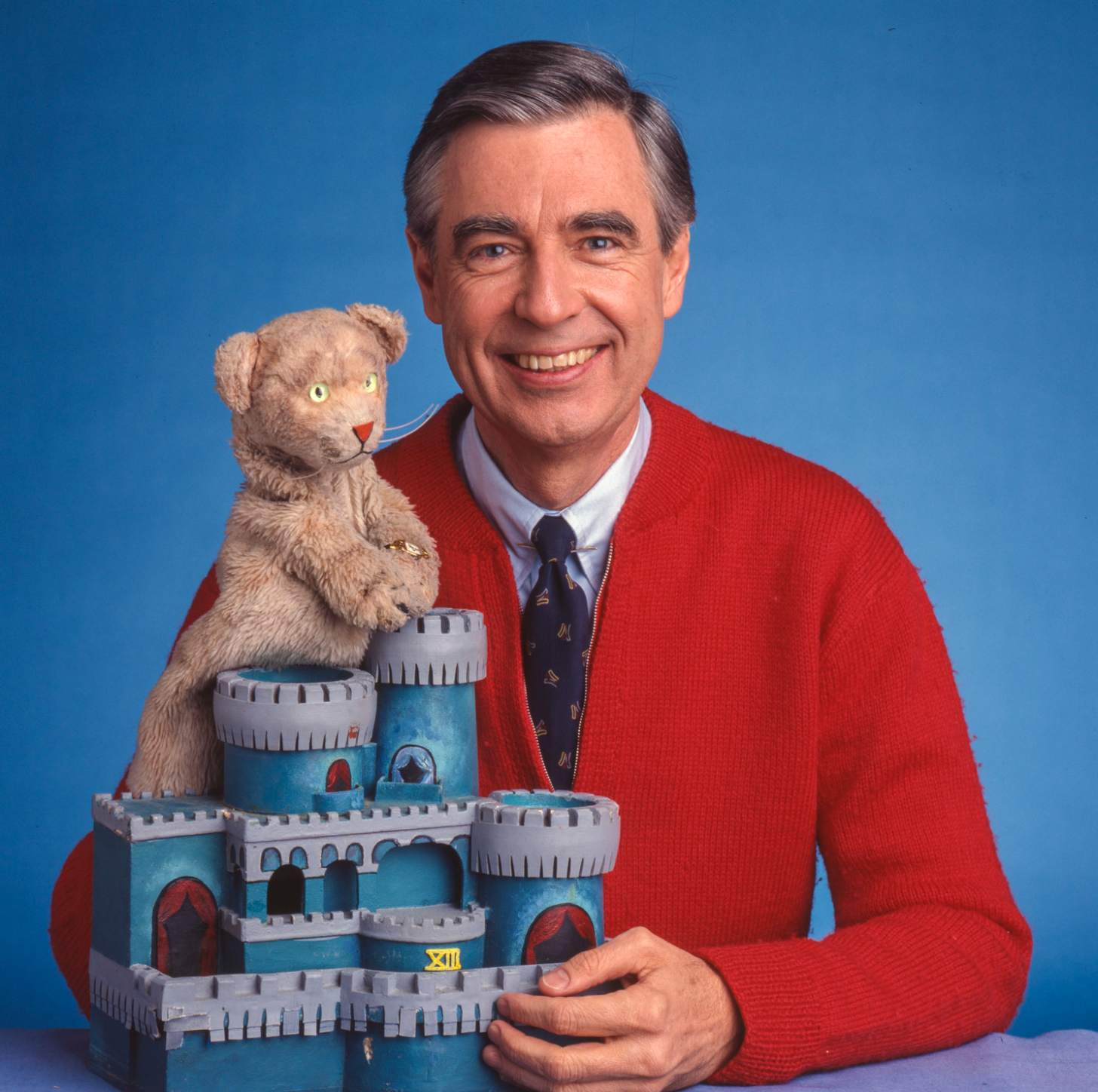
Perhaps most significantly, the “Mister Rogers’ Neighborhood” YouTube channel also uploaded the full episode of “A Visit With Officer Clemmons.”
The episode — which was written by Mister Rogers — featured a groundbreaking storyline in which he invited Officer Clemmons (played by François Clemmons) to join him in a small wading pool on a hot summer’s day.
The moment was designed to challenge racist stereotypes at a time when public swimming pools were still deeply segregated.
“He invited me to come over and to rest my feet in the water with him,” Clemmons recalled in an interview with StoryCorps. “The icon Fred Rogers not only was showing my brown skin in the tub with his white skin as two friends, but as I was getting out of that tub, he was helping me dry my feet.”
The episode aired on May 9, 1969, on the fifth anniversary of “wade-ins” held by civil rights protestors in Florida in 1964 at the Monson Motor Lodge in St. Augustine, Florida.
"” think he was making a very strong statement,” Clemmons stressed. “That was his way. I still was not convinced that Officer Clemmons could have a positive influence in the neighborhood — and in the real-world neighborhood — but I think I was proven wrong.”
Clemmons would go on to stay on the show for another 25 years until his final appearance in 1993, when he and Mister Rogers recreated their first poolside chat.
Kristin DiQuollo, the creative director of Mister Rogers’ Neighborhood YouTube Channel, said that they hope episodes like this help families “slow down together.”
“We’re thoughtfully curating playlists and compilations around classic segments like the Neighborhood of Make-Believe and factory visits,” she said. “We’ll also have rarely seen full episodes, livestreams of special theme weeks, visits with beloved neighbors, and lots of playful and musical moments.”
“Most of all,” DiQuollo said, “we hope the channel will help remind everyone how unique and special they each are.”
You can watch "The Very First Episode" of You can watch “The Very First Episode” of “Mister Rogers’ Neighborhood” below:
You may also like: 18 Best Books By (and About) Fred Rogers
Header image via Walt Seng, courtesy of Fred Rogers Productions
Across Long Island, New York, Eastern box turtles are declining rapidly in population.
While not officially labeled as threatened or endangered on the federal level, experts say the turtles are vulnerable due to habitat loss and fragmentation, along with other factors like the illegal pet trade, pesticides, and vehicle collisions.
To keep matters from getting worse, there’s April.
April is a 16-month-old Labrador retriever and is the newest recruit who has been trained as a conservation detection dog, able to sniff out the vulnerable turtles in the woodland brush.
April is occasionally joined by her partner in crime, Newt, another Labrador on the case, who has been tracking turtles for five years across six states.
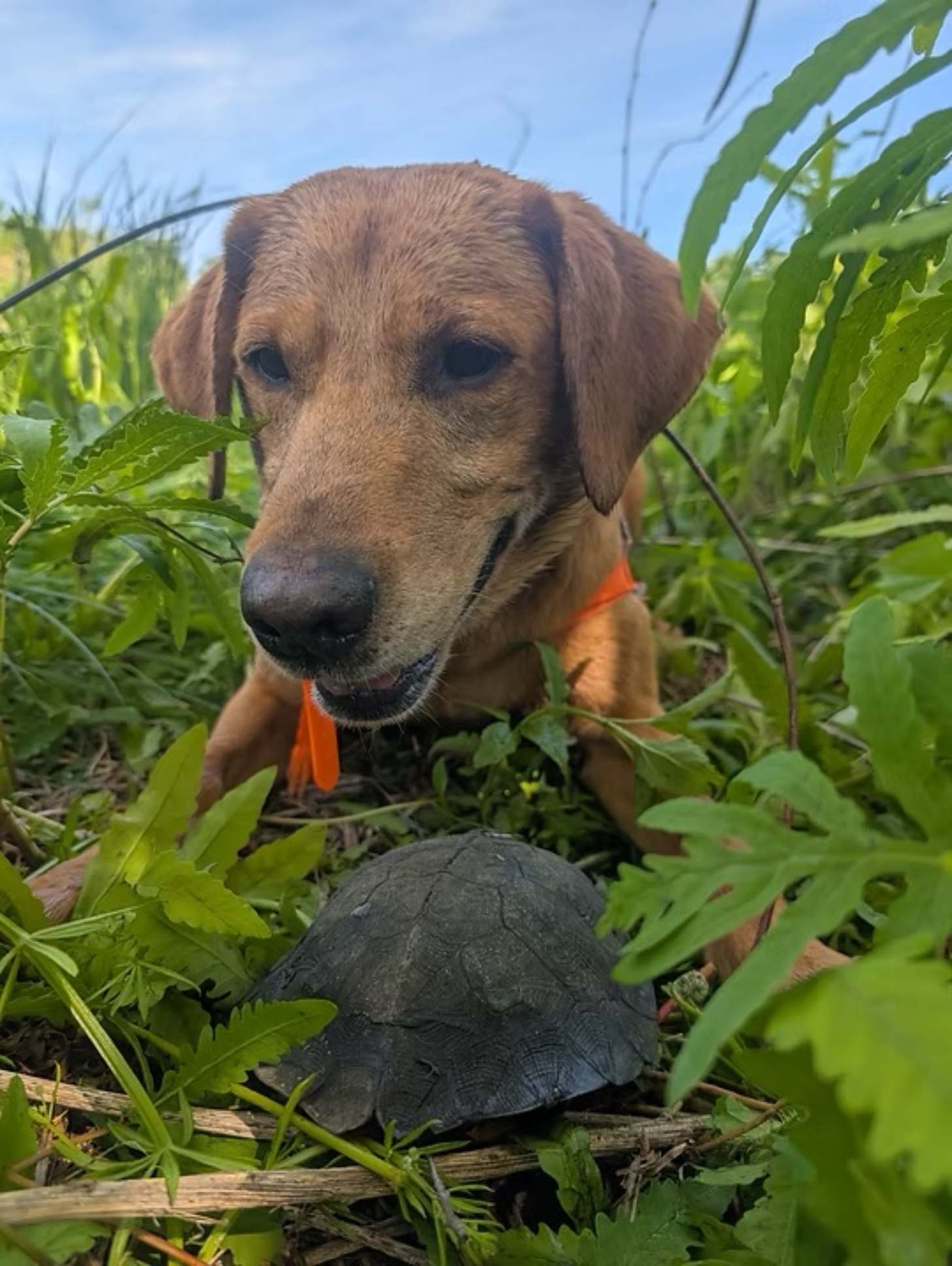
Together, under the handling of herpetologist Dr. Kris Hoffmann, the dogs have been trained to pick up the scent of the box turtles. They don GPS collars, a bright orange vest, and doggie bug spray as they traverse the woods of Long Island, in search of their prize.
Environmental organization Group for the East End has teamed up with Dr. Ana Thonis, a New York University biology professor, and Dr. Hoffmann, who owns the wildlife detection team Bark & Code, to survey the turtles across eight locations in Long Island.
“We don’t know right now exactly what's going on with these guys,” Thonis told Newsday of the turtles. “But we'll collect some data, and hopefully we can use that to inform legislation or more action for turtles.”
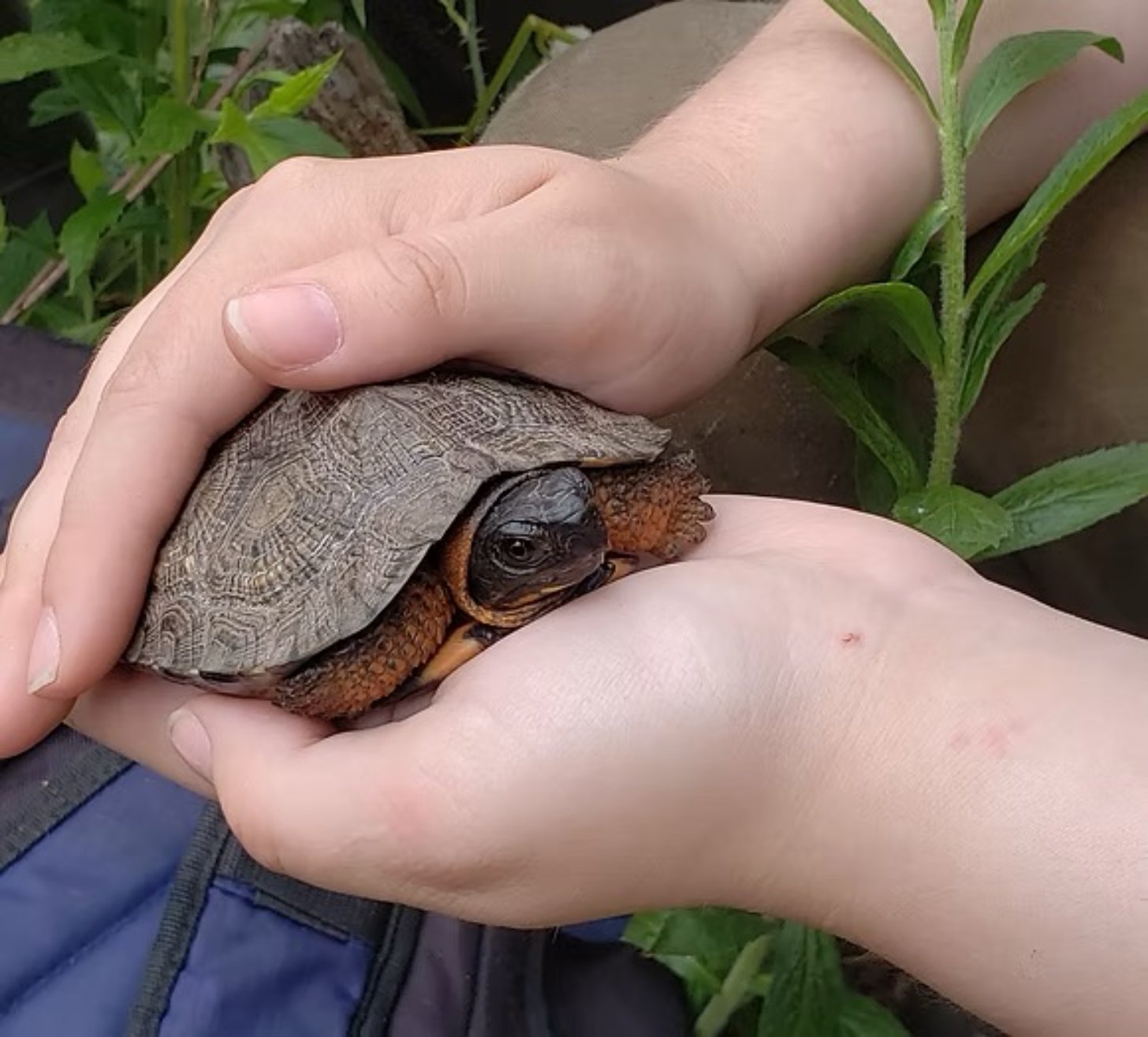
The dogs help find the turtles so conservationists can get an accurate count of the elusive reptiles, while also assessing their health and gathering data about the species and what they call their home habitat.
When April or Newt find a turtle in the wild, they signal to the handlers, and from there, each turtle is measured, weighed, and photographed for data collection. Researchers will also collect a small blood sample and mark the shell with a harmless notch before returning the turtle safely home.
April is able to pick up the scent of a turtle from 100 yards away in an open field, according to Hoffmann, and she has learned to distinguish between the target species and other more common scents. For instance, if she smells a snapping turtle, she will simply ignore it. But when she comes across an Eastern box turtle, she knows it’s time to signal.
During one day in the field, the team found seven turtles, which Thonis told Newsday was “a very encouraging sign.”
For the project as a whole, Newt’s record is sniffing out 14 turtles in one day. He’s found “thousands” of turtles over his years of service.
His signal is simple, Hoffmann told the Northfork Sun.

“He’ll lie down next to it and smell it,” she said.
He is then rewarded with his favorite thing: his ball.
April is still getting the hang of things but has already become a major asset to the survey team.
“We expect her to be unstoppable by next year,” Hoffmann told Newsday.
The good news is that the project will continue into the foreseeable future. Thonis said she plans to return to the same survey spots “for many more years.”
Box turtles can live past 80, so it takes time to really understand population sizes, and long-term studies are crucial, the researcher told Newsday.
“In conversations with many longtime Long Island residents, it has become clear that box turtles are far less common than they once were,” Thonis told Newsday.
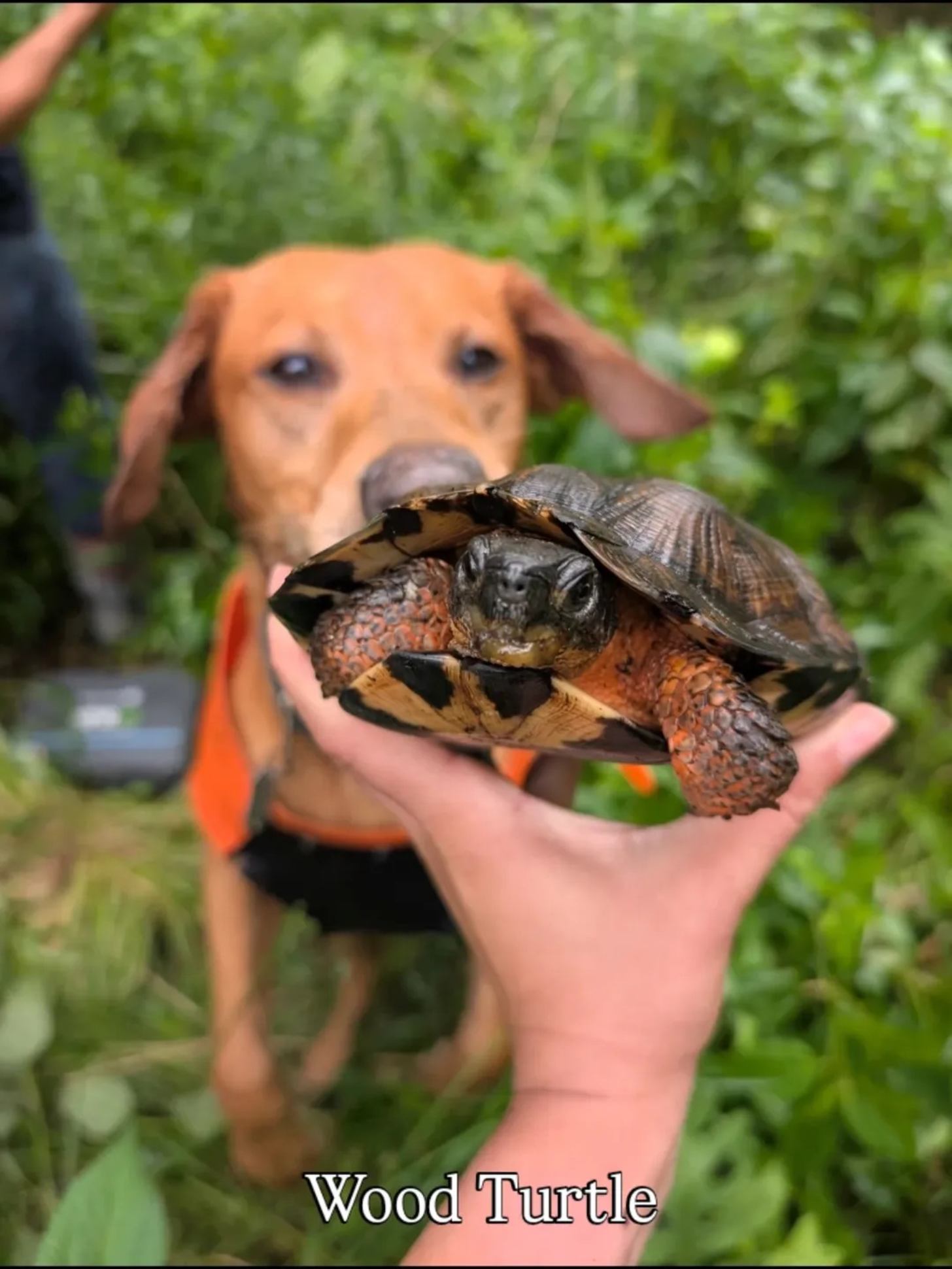
Without consistent monitoring, she added, “we will be much less prepared to understand the causes of any future declines or to develop strategies that could help stabilize and potentially reverse them.”
Some of those strategies could be small wildlife tunnels to help the species navigate their habitat safely, as urbanization has led to increased vehicle strikes and raccoon predators hunting the turtles’ eggs.
But in the meantime, data collection — aided by two furry friends — aims to build a safer future for the species one sniff at a time.
“We’re using animals to protect other animals,” Hoffmann told the Northfork Sun. “It’s very rewarding.”
“Everybody loves a turtle,” she added. “When you’re aware that they’re endangered in their own backyard, people want to save them.”
You may also like: Meet Splash, the country's first 'search and recovery' otter, who can find missing people underwater
Header image courtesy of April the Conservation Detection Dog / Instagram
Southern California is home to a diverse array of woodland, desert, and mountain creatures, including mule deer, foxes, coyotes, bobcats, mountain lions, black bears, desert bighorn sheep, and much more.
Unfortunately, their habitats are heavily fragmented due to the countless roads, highways, and freeways that cut across the landscape.
One of the largest freeways is U.S. Route 101 — a route that stretches approximately 808 miles from Oregon to downtown Los Angeles. Despite speed limits that cap drivers at 65 miles per hour, traffic usually races by at speeds as high as 75 to 80 miles per hour.
Speeding freeways, paired with the natural migration of California wildlife, have long been a recipe for disaster, putting animals and drivers at risk of collision.
The Pew Research Center estimates that 1 million to 2 million wildlife-vehicle collisions occur each year in the United States, leading to about 200 deaths, 26,000 injuries, and more than $8 billion in associated costs.
That’s why California began building the Wallis Annenberg Wildlife Crossing over Route 101’s 10-lane freeway in Agoura Hills in 2022.
And after four years of construction — and 30 years of planning — it is finally expected to be finished in early December 2026.
When it’s complete, it will be the largest wildlife crossing in the world.
“This is a vital crossing in one of the last undeveloped areas on the 101, and building a safe passage gives us a chance to ensure the future of the mountain lions in the Santa Monica Mountains and Los Angeles area,” Dr. Seth Riley — the wildlife branch chief of the National Park Service’s Santa Monica Mountains National Recreation Area — said in a press statement.
Rather than functioning as a simple bridge, it will be covered with native vegetation and designed to resemble a natural habitat, helping wildlife move across one of the busiest freeways in the country.
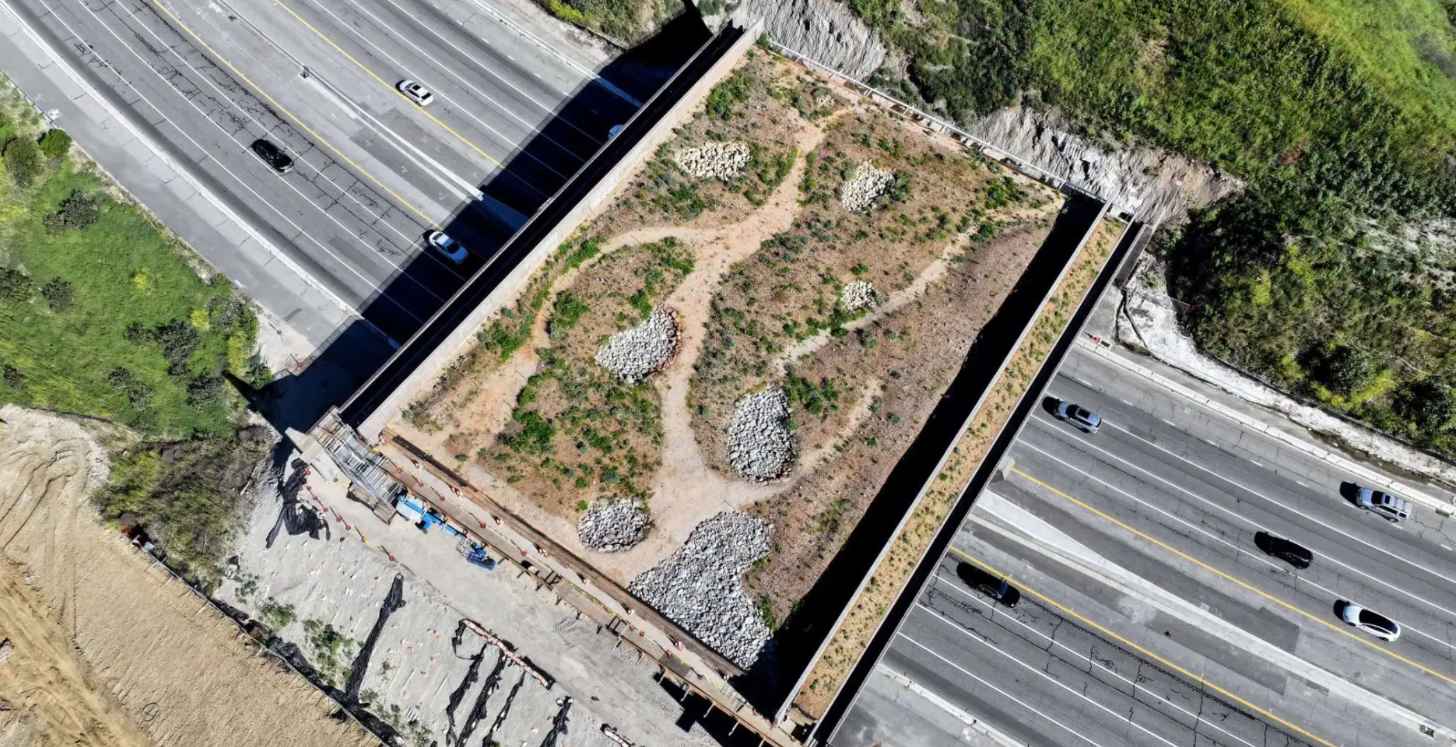
The project was inspired in part by the deaths of mountain lions, including the famous Los Angeles cougar P-22, whose story helped rally public support.
“You’re going to see this ecological transformation. And that part of it is going to be over one of the busiest freeways in the world — that, to me, is just such a hopeful statement for what’s possible,” said Beth Pratt, California’s regional executive director for the National Wildlife Federation. “We can redeem a freeway.”
On Earth Day, April 22, Pratt announced the updated deadline for the Wallis Annenberg Wildlife Crossing.
“The project will be officially ‘open for animal business’ on 2 December,” Pratt said.
On May 31, the Wallis Annenberg Wildlife Crossing Facebook page said that they received their first animal visitor as they neared completion of the “secondary structure” of the overpass.
“We saw our first hummingbird on the habitat in the 101 structure,” they shared.
Another wildlife overpass in California also received its first animal visitors recently, when three mule deer were seen crossing over Route 97 in Siskiyou County while the bridge was still under active construction.
“While the contractor is still completing final touches, it’s incredible to see wildlife already embracing the new structure, even with workers still in the area,” Caltrans District 2 shared in a Facebook post.
“This wildlife overcrossing was designed to provide animals with a safer way to cross the highway while helping reduce wildlife-vehicle collisions for motorists traveling through the corridor.”
You may also like: Endangered monkeys kept dying on a road compared to a 'meat grinder.' Locals built them a bridge made from recycled fire hoses
Header image via Wallis Annenberg Wildlife Crossing