As people with dementia and Alzheimer’s age, they often find themselves living in memory care facilities, places that work hard to focus on their safety and medical needs, but often feel institutionalized and sterile.
At the Hogeweyk Dementia Village in the Netherlands, however, a different kind of memory care has paved the way for an improved quality of life for older adults across the globe.
The idea of the Hogeweyk model is to create a normal neighborhood — not a nursing home. In a small town with independent living quarters, supermarkets, restaurants, and theaters, people living with severe dementia can find support from trained professionals while living normal lives.
The model has created a “paradigm shift” in memory care and is gaining popularity in Europe, Australia, China, and Canada. But now, the first dementia village in the United States has broken ground in Madison, Wisconsin.

It’s called The Ellen & Peter Johnson Dementia Village at Agrace, and it will support the nearly 11% of Wisconsinites above the age of 65 living with Alzheimer’s disease.
“Even with deeply committed caregivers, traditional memory care often limits how fully people can continue to live with purpose, personal choice and variety,” Agrace shared in a statement.
“The Hogeweyk-inspired model imagines something more: a community designed around living, not just care, where people with dementia can continue to feel the rhythms of real life.”
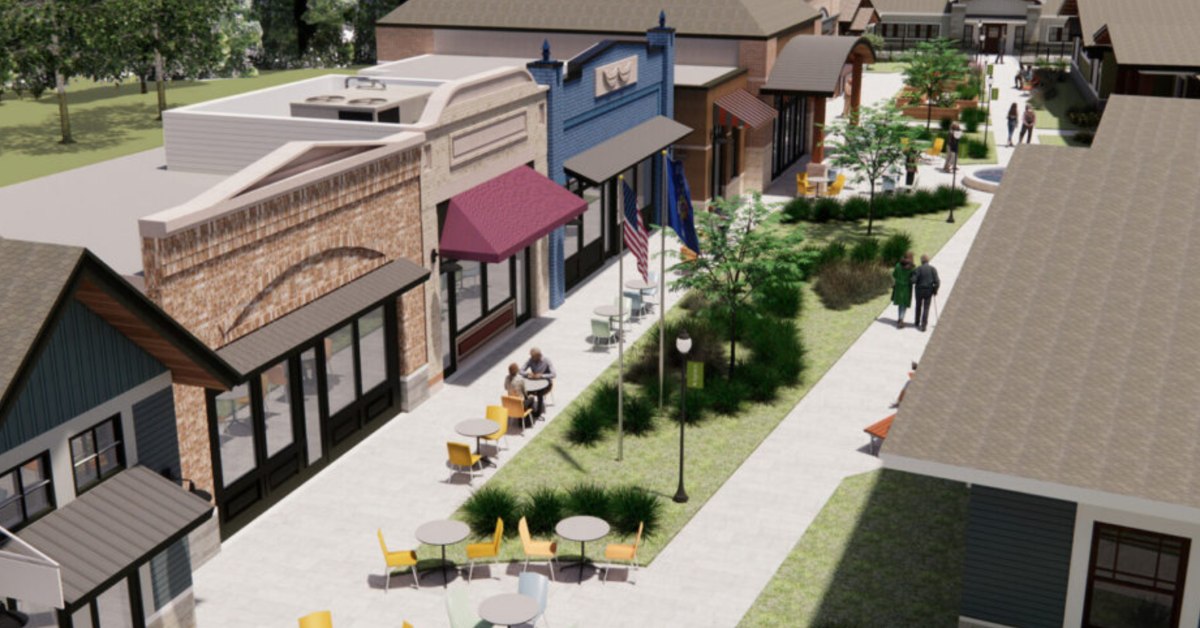
The Madison campus, which touts a “Main Street USA” look and feel, will provide communal housing to its residents, along with the amenities of a walkable town: A theater, parks, and a cozy, idyllic main street full of shops.

“Living at this campus will not feel like an institution — we are building individual households that look and feel just like a home,” Agrace president and CEO Lynne Sexten said in a statement.
“Residents will have eight housemates, a kitchen, their own bedroom and a living room. All the things that you have in a traditional home today will be replicated here within the village.”
The idea is to design the village to support those with dementia in a way that keeps them safe, while still providing them with access to a “robust social network,” Sexten said.
Each home will have a full-time caretaker for residents, and roommates will be assessed for interests and lifestyle, so they have a real chance at building meaningful relationships.

“It will look like any regular ranch house in any neighborhood in the U.S.,” Sexten told Realtor.com. “People will cook and clean and live normal lives like they usually do.”
The campus will also host 40 to 50 “day club” members who don’t live on-site but will spend the day at the village for dementia-friendly recreation and support.
On-site caregivers will also have their own housing inside the campus, and a Grief Support Center will also be available for families and caregivers navigating inpatient hospice care with Agrace.
The Agrace Dementia Village will be built on the hospital’s 6-acre campus and cost $40 million to build. Much of the investment stems from a $30 million community capital campaign called Revolutionizing Life with Dementia, and some of the biggest supporters were local philanthropists Ellen and Peter Johnson.

“The need is so incredible, and this project demonstrates that Agrace is a leader in memory care,” the Johnsons said in a statement. “To be able to say that Madison is going to have this extraordinary project is something that the whole community can be very, very proud of and we’re delighted to be a part of it.”
Agrace’s Dementia Village is planned to open in the fall of 2027, though Sexten anticipates a large wait-list, like many memory care facilities in the country.

But, she hopes that the neighborhood model will multiply, meeting the need for memory care across the country.
“This is an approach whose time has come,” Sexten told Realtor.com. “People with dementia are your neighbors — they are just regular people who need to live in an environment that is a bit different.”
You may also like: They turned an old convent into an all-women apartment complex: 'It's about taking control of our lives'
Header image courtesy of Agrace Hospice