


On April 21, the Bronx Zoo welcomed a new foal to its herd of endangered Przewalski’s horses.
“This foal is wildlife conservation in action — fewer than 2,000 Przewalski's horses exist globally,” a media contact said on behalf of The Wildlife Conservation Society.
The Przewalski’s horse (pronounced “shuh-VAL-skees”) is widely considered to be the world’s last “truly wild” horse, having diverged from the domestic horse over 5,000 years ago.
Compared to typical horses, Przewalski's horses are small and stocky, with a large head, thick neck, and short legs.
In addition to their dusky brown coat, they have yellowish-white bellies, dark legs, and stripes behind their knees. They also have no forelock — hair that falls between their ears — and sport a zebra-like mane instead.

The Przewalski’s horse once ranged throughout Europe and Asia, but human settlements drove them further east. Eventually, they could only be found in the Mongolian steppes of the Gobi Desert.
By 1969, the Przewalski's horse was officially declared extinct in the wild. At that point, conservation efforts turned to captive breeding efforts.
“Through breeding programs aimed at maintaining a genetically diverse population of the species and through reintroduction efforts, zoo-bred Przewalski’s horses were successfully returned to their native grasslands in China in 1989 and in Mongolia beginning in 1992,” The WCS said in a press release.
Today, all Przewalski's horses — including the one just born at the Bronx Zoo — are descended from just 14 individuals.
“The Bronx Zoo has played a pivotal role in the conservation of the Przewalski's horse, also known as the Mongolian wild horse,” the WCS said.
The Bronx Zoo has been raising Przewalski's horses for years.
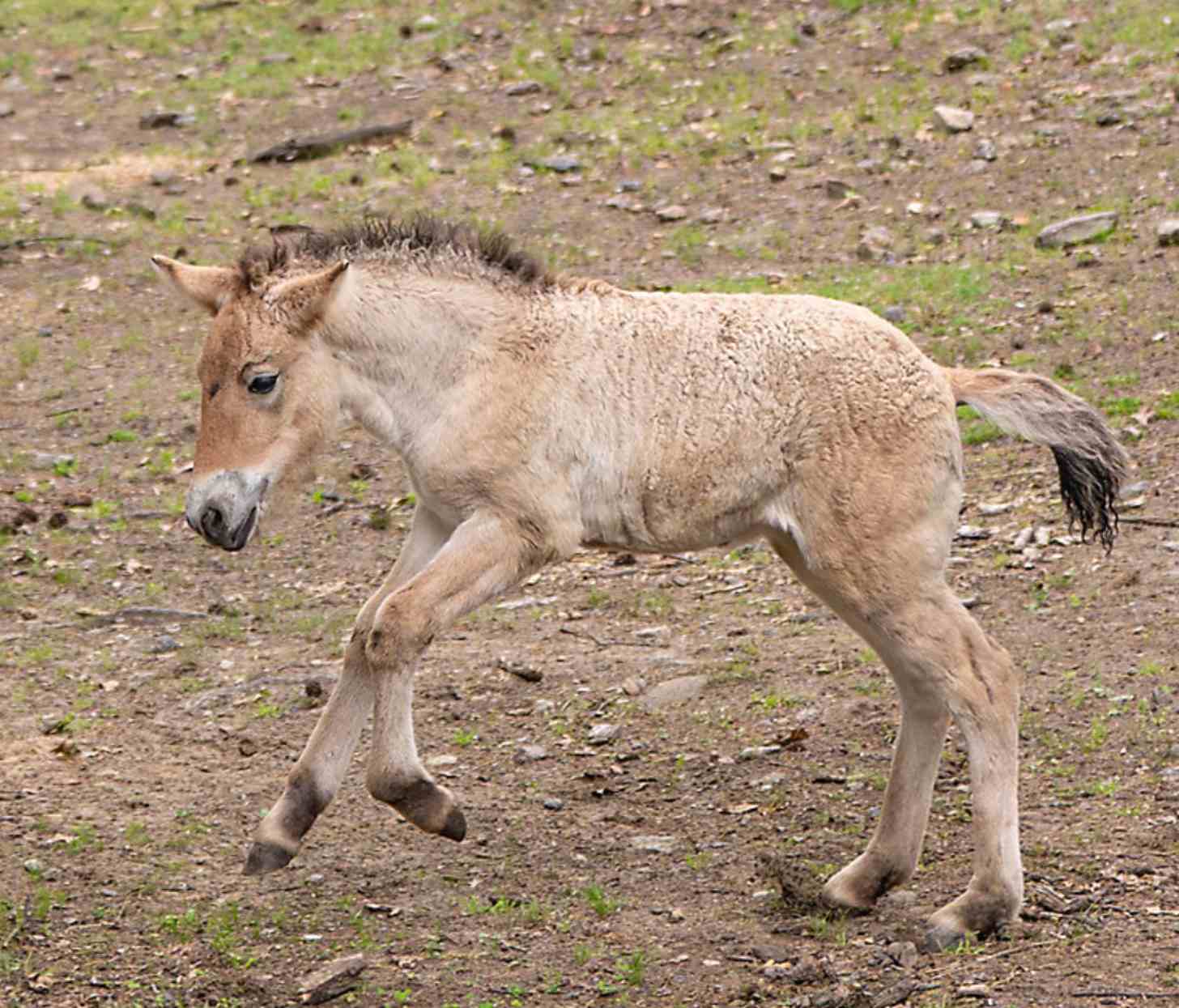
“The birth of an animal that was once extinct in the wild is a cause for celebration!” the Bronx Zoo shared on Facebook when an earlier foal was born in 2022.
But captive breeding is just one part of the species’ conservation plan — the other vital step is reintroduction.
In 2024, three Przewalski’s horses (named Zorro, Zeta II, and Ypsilon) traveled 3,000 miles, by truck and plane, from the Prague Zoo in Czechia to the Altyn Dala reserve in the Kazakh Steppe.
They were the first of 40 horses to join the reserve.
“We have been waiting for this moment for a very long time,” Albert Salemgareyev from the Association for the Conservation of Biodiversity in Kazakhstan told AFP in 2024. “A lot of work has been carried out in recent months in order for the Przewalski horses to come to Kazakhstan.”
In addition to strengthening the horse’s population, conservationists hoped that the reintroduction would also restore the steppe ecosystem. The horses spread seeds, graze vegetation, and play an important role in maintaining biodiversity across the grasslands.
For now, the horses are living in protected areas where veterinarians and researchers can continue monitoring their health and behavior. Once they're fully released, experts will continue keeping an eye on them to ensure that they’re thriving.
“I am very happy that we can return this beautiful animal to the land of its habitat,” Pavol Šepel’ák, an ambassador of the Czech Republic, said in a press statement. “The project itself … has already had great success.”
You may also like: Florida locals had one week to save a cow from slaughter: 'He managed to cross paths with all the right humans'
Header image via WCS / Terria Clay


