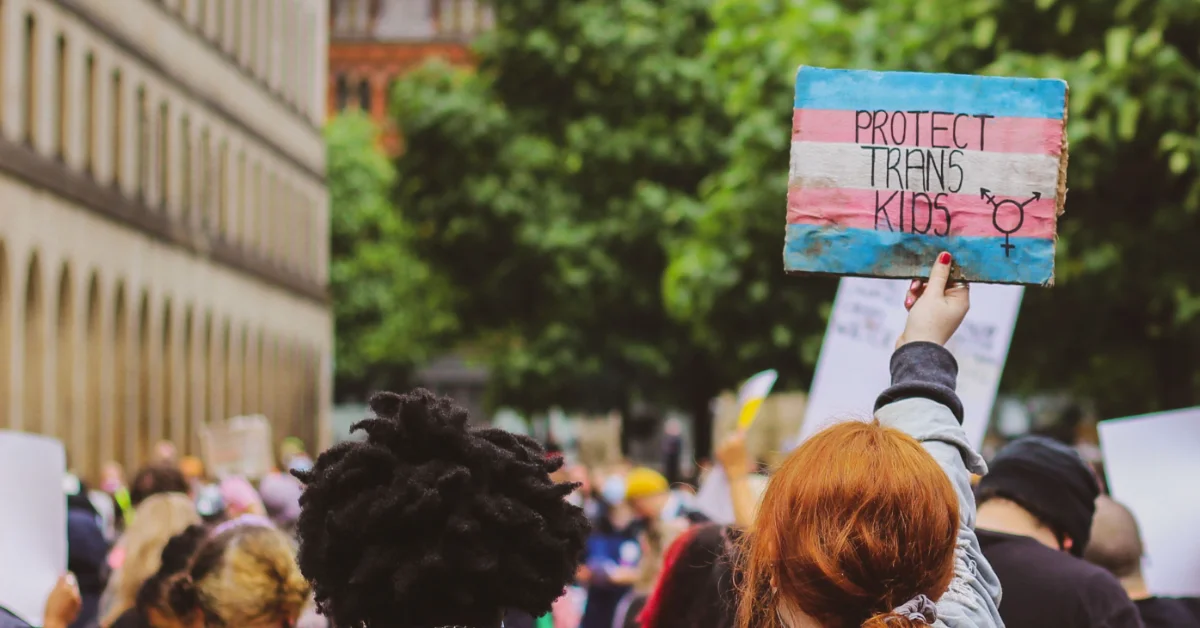
Amanda Timpkins is a self-proclaimed “accidental historian.” Since 2022, the television executive-turned-storyteller has spotlighted obscure and unsung LGBTQ+ figures on TikTok in her popular “YesterQueers” series.
It is not lost on her that recent measures to silence queer and trans voices, ban and burn books, and delete whole webpages of public history en masse speak to a new age of sweeping censorship.
“Aside from being inherently undemocratic, censorship is dangerous because it limits information and stifles discussion, which leads to idea entrenchment, polarization, stagnation,” Timpkins told Good Good Good.
“The free flow of information and exchange of ideas is crucial not only to having a vibrant society but also to human progress overall. And on the individual level, censorship makes people lonelier and more isolated. Seeing themselves in the stories we tell helps people feel connected, like they have a place in our shared community.”
Despite ongoing efforts to rewrite and erase those stories, new pages are still being written.
From Chappell Roan’s single “The Giver,” marking the first explicitly gay song to top the country charts, to Alex Consani becoming the first out trans woman to win Model of the Year, LGBTQ+ individuals are claiming space — and making more room for everyone.
Political victories echoed this momentum in the fall, as queer and trans candidates swept elections across the U.S.
Sarah McBride became the first openly transgender person elected to the U.S. Congress. RaShaun Kemp of Georgia and Amaad Rivera-Wagner of Wisconsin became the first openly gay Black men elected to their respective state legislatures. And Emily Randall made history as the first openly gay person to represent Washington at the federal level.
"We did more than win this election: we made history," Representative Emily Randall said in a post-election press conference. "Together, we shattered three glass ceilings. When I take office in January, I will become the first congresswoman and first person of color to hold this seat, the first openly LGBTQ person to represent Washington state in Congress, and the first ever queer Latina member of Congress."
Cultural milestones unfolded abroad, too: Madrid debuted its first queer and trans soccer team, Ukraine premiered its first LGBTQ+ film festival in Kyiv, and the 2024 Paris Olympics saw a record number of openly gay athletes competing.
And in a stunning show of recognition, Nemo Mettler became the first nonbinary musician to win Eurovision. Their victory sparked national conversations about nonbinary rights across Switzerland — a country where, on paper, people like Nemo “don’t exist.”

Together, these moments form a chorus of change, reminding the world that queer and trans voices aren’t just present — they demand to be heard.
And nowhere is that sentiment more prescient than with attorney Chase Strangio.
On December 4, 2024, Strangio made history as the first transgender person to make oral arguments before the U.S. Supreme Court in “United States v. Skrmetti.”
Strangio, who works with the American Civil Liberties Union (ACLU) and is the co-director of its LGBT & HIV Project, represented Tennessee families who challenged a state ban on gender-affirming medical treatments for transgender minors, including hormone therapy and puberty blockers.
Strangio's argument emphasized both the constitutional violations of the ban and the personal significance of the case, given that his own access to gender-affirming care was instrumental in his legal career.
“It is not lost on me that I will be standing there at the lectern at the Supreme Court in part because I was able to have access to the medical care that is the very subject of the case that we’re litigating,” Strangio told CNN in December.
Strangio also added that there’s inherent power that comes from waging verbal battles in the courthouse against people who live in denial of trans rights.
“I’m deposing ‘experts’ whose entire theory of transness is that it makes people miserable,” he said, "but they have to be confronted with me.”
Despite facing transphobic attacks right and left online, Strangio remains committed to advocating for equality, not just for himself, but for the families and larger communities he represents.
“I think about all of the arguments that have been held in the Supreme Court over just the basic dignity of people,” he said, holding civil rights attorneys like Ruth Bader Ginsburg and Thurgood Marshall in high regard. “That is part of our history — this is part of that history.”
“The resistance is partly just continuing to expand the opportunities for people to step inside these buildings, to have their voices be a part of the conversations and to have them be speakers and not just spoken about.”
Even as the LGBTQ+ community continues to make groundbreaking strides in visibility, politics, and culture, every inch of progress seems to have been undercut by deliberate efforts to erase events — and whole identities — from the past and present.
In early March, just weeks after the National Park Service removed any reference to transgender people from the Stonewall National Monument website, whole pages dedicated to iconic activists Marsha P. Johnson and Sylvia Rivera disappeared in quick succession.
It wasn’t an isolated event. At the behest of the Trump administration, huge swaths of LGBTQ+ history were scrubbed from government agency websites, with archival imagery like the “Enola Gay” — a World War II Superfortress bomber … yes, an airplane — catching stray bullets in the crossfire.
Even so, removing the letters “T” and “Q” from “LGBTQ” acronyms and carelessly using “Ctrl+F” to comb through historical documents cannot eradicate queer people and the history they forged.
“I really see this as a symbolic attack,” Michael Bronski, author of the book “A Queer History of the United States,” told NPR in March. “The impulse behind it is to symbolically eradicate all of this progress: all of the government recognitions, gay rights, the presence of gay pride, flags on government buildings.”
“Since you can't get rid of transpeople or gay people, or bisexual people, or queer people, you can try to get rid of documentation about us,” he said. “That means you're trying to rewrite history.”
Fortunately, queer history exists offline in a wealth of books, records, art exhibits, and monuments. And the people who painstakingly preserve those artifacts recognize that these spaces — museums, bookshops, and cinema halls — now serve as treasure troves in a time of sweeping censorship.
In September, the city of San Francisco purchased a permanent home for the GLBT Historical Society Museum and Archives, preserving a century of LGBTQ+ history.
After shuttling its collection between temporary locations for decades, the museum finally had a dedicated space for its priceless collection, which includes back issues of “OUT/LOOK: National Lesbian & Gay Quarterly,” portraits of Americans with HIV and AIDS, and remnants of the original rainbow Pride flag first flown in 1978.
“This is an incredibly proud moment for me as someone who was born and raised here to be able to support the stewardship of this incredible collection,” Roberto Ordeñana, the executive director of the GLBT Historical Society, told KQED.
“It’s vital for San Francisco to continue being that beacon of hope for the entire world to really understand both the struggles and the resilience of our community.”
Timpkins knows firsthand how “vital” these resources are. In her research, the “Yesterqueers” historian predominantly relies on JSTOR, which hosts over 12 million journal articles, books, images, and primary sources from a collection of libraries, institutions, independent scholars, and public testimonies.
“As an independent scholar who is not attached to an institution, I rely heavily on public libraries and archives, many of which are supported in whole or in part by federal programs,” Timpkins told Good Good Good. “The folks at the Internet Archive are doing extraordinary and important work in preserving what the administration is trying to destroy.”
Since 1996, the Internet Archive has used its digital library, the Wayback Machine, to archive nearly three decades of web history. Mark Graham, director of the Wayback Machine, told NPR that its servers have recovered nearly 73,000 expunged web pages since Trump's second inauguration began.
“We're just doing our job, trying to be the best library that we can be, trying to help preserve the cultural heritage of our time — to make this material accessible, useful to people now and into the future,” Graham said.
In addition to mentions of gender identity and sexual orientation, Graham said that the Wayback Machine has been working hard to preserve data on racial diversity, climate change, and reproductive health.
“On a personal level, this has been a bit of a sprint,” he said. “I've been working seven days a week for the last many weeks. I've been finding myself, quite literally since the inauguration, waking up earlier with a sense of purpose and energy.”
Whenever people question the importance of preserving history or begin to lose steam in the fight, Timpkins harkens back to a quote by trailblazing LGBTQ+ rights activist David Mixner.
“[He said: ‘I really believe if we come out of nothing, if we don’t know our history, then it’s impossible to build a future,’” Timpkins told Good Good Good.
“History is vital to humanity,” she emphasized. “Since we developed language, we have been sharing stories about our past and using them to inform our present and build our future.”
While the future may be uncertain, Timpkins — and others like her — offer a vision informed by the colorful, bold, and unapologetic stories of the past.
A version of this article originally appeared in the 2025 Pride Edition of the Goodnewspaper.
Header image via Ted Eytan / Wikimedia Commons (CC BY-SA 2.0)