- Birders in 2025 rediscovered five species of birds that scientists hadn’t documented in the wild for at least 10 years, according to the latest update of the Lost Birds List.
- All of the “found” birds are endemic to islands in Southeast Asia and Oceania.
- Two birds, one considered extinct and one reclassified as a subspecies, were taken off the list in 2025, and another bird, not seen in 94 years, was documented early this year.
- Six new species will be added to the list in 2026, those not documented in the wild for a decade. This puts the list at 120 birds — down from 163 when it started in 2022.
Five “missing” bird species — not seen, heard, or documented in the wild for a decade or more — were “found” in 2025, according to the 2026 annual update to the Lost Birds List.
It’s a tally of species that haven’t been photographed, recorded, or their genetic footprint detected for more than a decade. Another extraordinary rediscovery came earlier this year: A bird “missing” for 94 years was documented in Chad.
With the new changes, the overall number of “lost” birds, as defined in a 2022 study, dropped to 120 from the 163 listed when the list was first published in 2022. The list is maintained by the Search for Lost Birds project, a global partnership between the NGOs American Bird Conservancy, Re:wild, and BirdLife International.
Six species considered lost since 2016 will be added to the list in 2026.
Unlike the IUCN Red List, which tracks the extinction risk of species over time through extensive periodic assessments, the “lost species” list flags those that haven’t been documented in a long time — the first signs of trouble before they vanish forever.
John Mittermeier, director of the Search for Lost Birds project, called the list an “early warning system” for birds not seen in a while. He said it helps “fill conservation data gaps” before rigorous assessments catch up and spur action to protect species that might “potentially slip between the cracks.”
Every year, Mittermeier and his team scour through public birding platforms, such as eBird, iNaturalist, Xeno-Canto, and others, searching for observations of lost birds and adding them to the “found” list.
“The most fun part for me of this whole initiative and experience is seeing these discoveries that people around the world are making,” he said.
Scientists have created similar “lost species” lists for many other wildlife groups, including amphibians, sharks, and primates.

Lost birds found in 2025
In 2025, scientists and bird enthusiasts documented five “lost” birds, all from islands in Southeast Asia and Oceania.
Papua New Guinean ornithologist John Lamaris photographed the Bismarck kingfisher (Ceyx websteri), found only on the Bismarck Archipelago off the country’s northeast coast, in May. It had been 13 years since it was last recorded.
In neighboring Indonesian Papua, Ethan Skinner photographed the Biak myzomela (Myzomela rubrobrunnea), a honeyeater endemic to the islands of Biak and Supiori, documenting its presence for the first time in two decades.
Another “lost bird” from Indonesian Papua, the lyrically named broad-billed fairywren (Chenorhamphus grayi), was rediscovered when avid birder Daniel Hoops and his tour guide, Royke Mananta, photographed it and recorded its song — its first observation in 11 years.
Two birds were also found in the Philippines: Shareef Khaddafi clicked the first image of the Sulu cuckooshrike (Coracina guillemardi) in 18 years in the Sulu Archipelago, and birding guide Martin Kennewell snapped pictures of the rufous-breasted blue flycatcher (Cyornis camarinensis) in the tropical lowlands of Luzon Island, last seen in 2008.
In addition to these five observations, Harish Thangaraj made an extraordinary discovery: He recorded the sounds of Jerdon’s courser (Rhinoptilus bitorquatus), a critically endangered nocturnal bird endemic to South India’s shrublands that hasn’t been documented in 125 years.
However, scientists need photographs and additional recordings to confirm the bird’s identity before they can officially declare it “found.”
The latest addition to the “found” list came in February 2026, when two French birders photographed a rusty bush lark (Calendulauda rufa), a species native to the Sahel, in Chad. The last time scientists encountered the bird was 94 years ago.
Two bird species go off the list
Some “lost” birds are never “found”; a few vanish from the face of Earth. In 2025, scientists declared the slender-billed curlew (Numenius tenuirostris), a migratory shorebird, extinct.
Expanding farmlands, degraded wetlands, and persistent hunting of this slow-breeding species all led to its disappearance. It was last documented in 1995.
Advanced genetic analysis has also prompted changes to the list. For example, in 2025, the white-chested tinkerbird from Zambia, known from a single specimen collected in 1964 and given the name Pogoniulus makawai, is now reclassified as a subspecies, Pogoniulus bilineatus makawai, of the yellow-rumped tinkerbird, another lost bird from Zambia.
“People like the idea of finding the birds. That’s the most exciting,” Mittermeier said. But these other two categories — taxonomic reclassification and true disappearance — are important, he added.
While extinction is tragic, knowing a bird is gone focuses resources, ensuring “we’re not putting effort into looking for something that isn’t there and doesn’t exist,” Mittermeier said.
New ‘lost’ birds on the list for 2026
In 2026, six new species will join the list. Each is an island species, each not seen for at least 10 years.
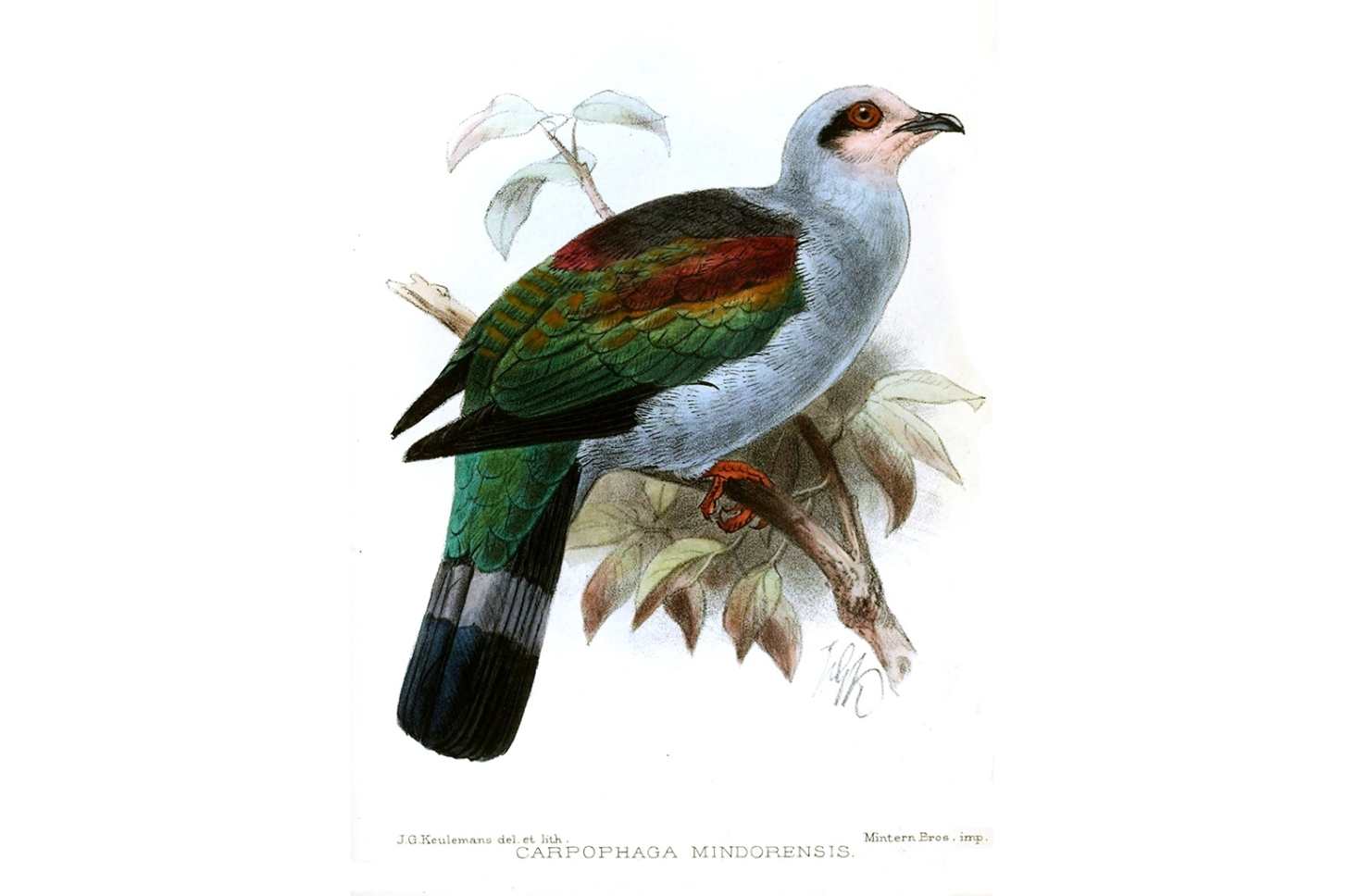
These include the critically endangered Mindoro bleeding-heart (Gallicolumba platenae), last photographed in 2005 by a trapper, and its call last recorded a decade ago; and the Mindoro imperial pigeon (Ducula mindorensis), last documented in 2016. Both birds are native to the island of Mindoro in the Philippines.
The other newly listed birds are the Guadalcanal honeyeater (Guadalcanaria inexpectata), endemic to the highlands of Guadalcanal in the Solomon Islands; the Minahasa shortwing (Heinrichia simplex) from the Minahasa Peninsula in Sulawesi, Indonesia, that’s also one of the world’s few never-photographed birds; the Samoan white-eye (Zosterops samoensis) from the highlands of Savai‘i, Samoa; and the closely related Vanikoro white-eye (Z. gibbsi), endemic to the remote island of Vanikoro in the southeastern Solomon Islands.
Birds are in peril, with steep declines worldwide. Habitat loss is the greatest factor, but hunting and poaching also take a serious toll alongside a litany of other threats, including farming and climate change; extreme heat that’s killing tropical birds; and the highly pathogenic H5N1 avian flu that is decimating populations across the globe, among others.
But those endemic to islands, whose habitats are already small and may be plagued by invasive species, rising seas, or increasingly dangerous storms, have nowhere else to go.
“We know islands are at the forefront of extinction, and so having lost birds on small islands [is] a little bit concerning to me,” Mittermeier said.
But he said he’s hoping the birding community can come to the rescue once again, having already helped shorten the lost bird list by about 25% — from 163 to 120 — in just five years.
“I’m really hopeful that we can get this list down to zero,” he said. “I think that’s feasible … given the power and the interest of this global community.”
This article was originally published on Mongabay.
Header Image by kenny_well via iNaturalist (CC BY-NC 4.0).