A new playground in Busan, South Korea is made from trash.
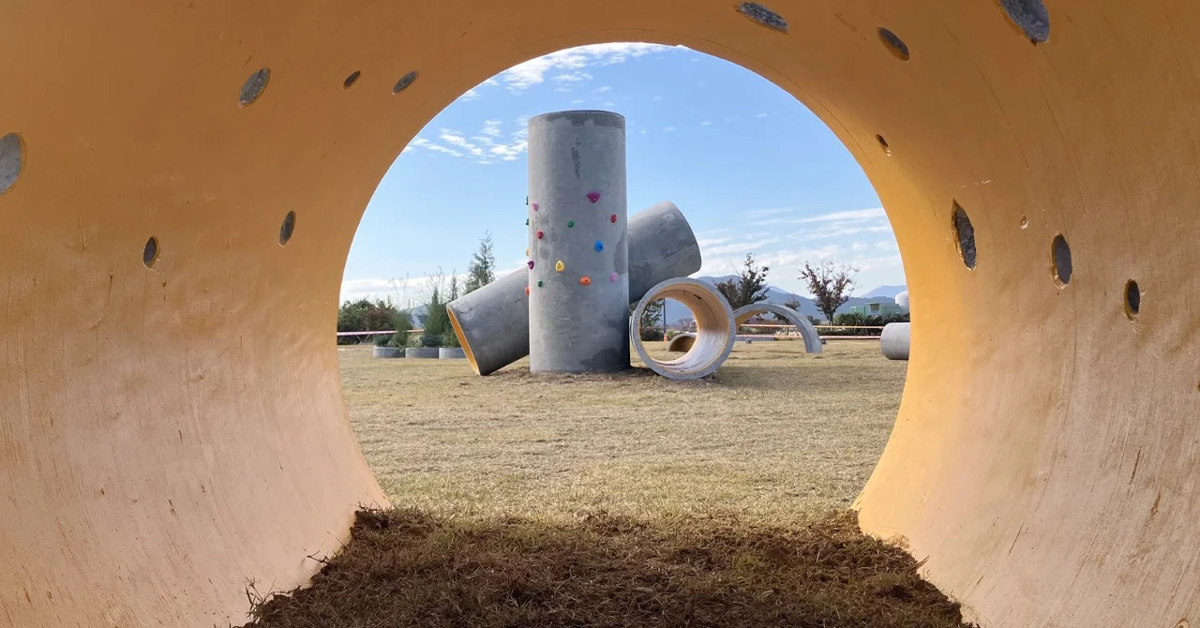
Seriously — Concrete Utopia, a play space and public art installation outside of the Museum of Contemporary Art Busan, was created by designer Hyuje Joo out of abandoned concrete tubes.

Joo’s project was designed to examine the environmental impact of concrete, a widely used construction material that is responsible for between 4-8% of global carbon dioxide emissions. The cement industry remains one of the most carbon-producing industries, producing more emissions than even the aviation industry.
So, using discarded concrete construction materials for a creative reuse project is a poetic way to depict this challenge.

“In response to the climate crisis and the material dominance of contemporary cities, the project addresses the condition of the ‘concrete city’ through the adaptive reuse of abandoned infrastructure,” designboom explains.
“Rather than introducing new materials, the installation reclaims discarded concrete pipes found in urban environments and reorganizes them into inhabitable play structures.”
Concrete Utopia contains rock-climbing walls, tunnels, slides, and other play structures that are stacked and positioned at varying angles, showing off an intentional spatial arrangement for the project.

The idea is that the play pavilion serves as a practical space for children — and adults — to enjoy, while also serving as a metaphor that invites visitors to imagine different ways to use construction waste to build cities and communities.
Joo’s work has long grappled with how to reimagine spaces and materials for a better future.

“The studio operates at the boundary of architecture, exploring new perspectives on everyday materials, objects, and spatial practices,” Joo’s website explains.
“Through installations, pavilions, and architectural projects, the work investigates material experimentation, sensory space, recycling, adaptive reuse, and architectural regeneration.”
Concrete Utopia achieves this mission well; inviting play and curiosity by way of materials that usually represent unyielding structure. By breathing new life into the cement pipes, Joo imagines something different.

“The studio treats architecture not only as building, but as a cultural and experiential medium, reinterpreting existing environments and revealing new meanings in ordinary elements of the built environment,” Joo’s website continues.
“By working across architecture, art, and research, the practice develops a distinct architectural language that merges concept, material, and spatial experience.”
You may also like: 'Smart building' inspired by endangered species cools and warms itself with 'flapping wings'
Header image courtesy of Hyuje Joo