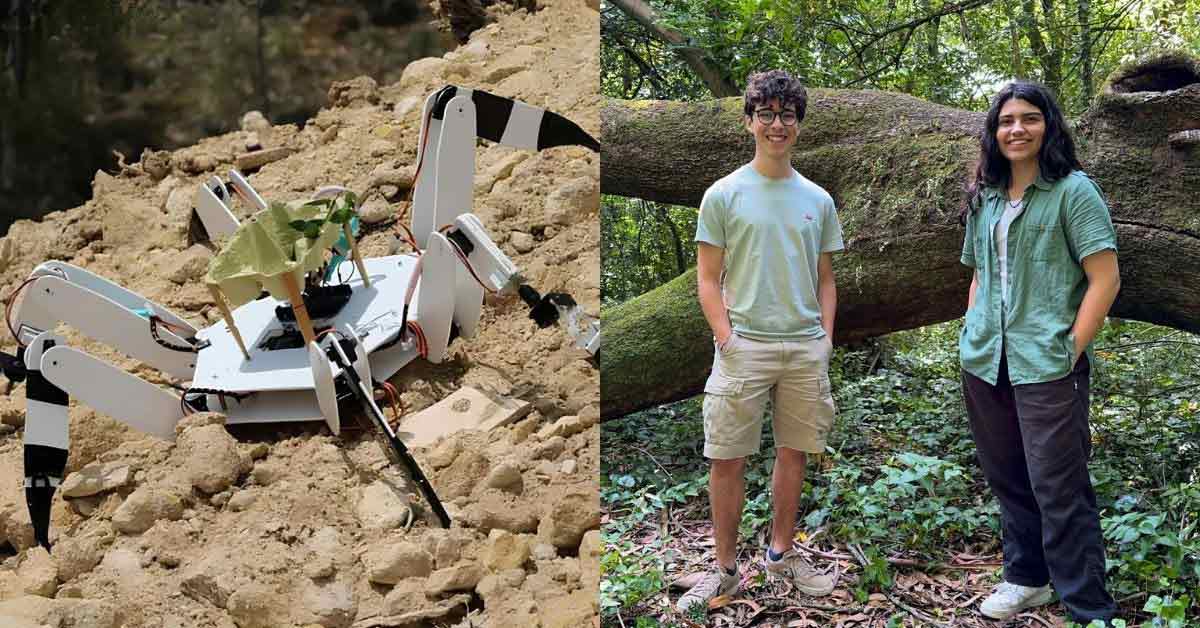
Engineering duo Marta Bernardino and Sebastião Mendonça are two 19-year-old college students who were inspired to create a solution after wildfires led to repeated deforestation near their homes in Lisbon, Portugal.
Wildfires have consistently affected Portugal, with the latest reports showing that 1.2 million acres of forest have been burned between 1980 and 2023 — about 54% of the country’s territory.
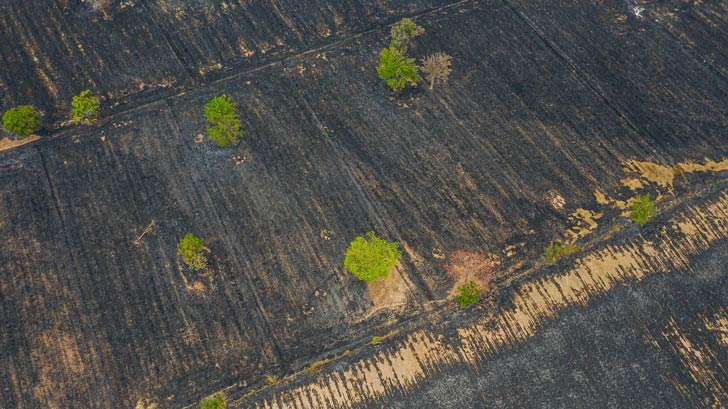
With these fires often taking place in rugged terrain difficult for forestry workers to access, replanting the trees seemed like a hopeless endeavor.
That is, until Trovador stepped in.
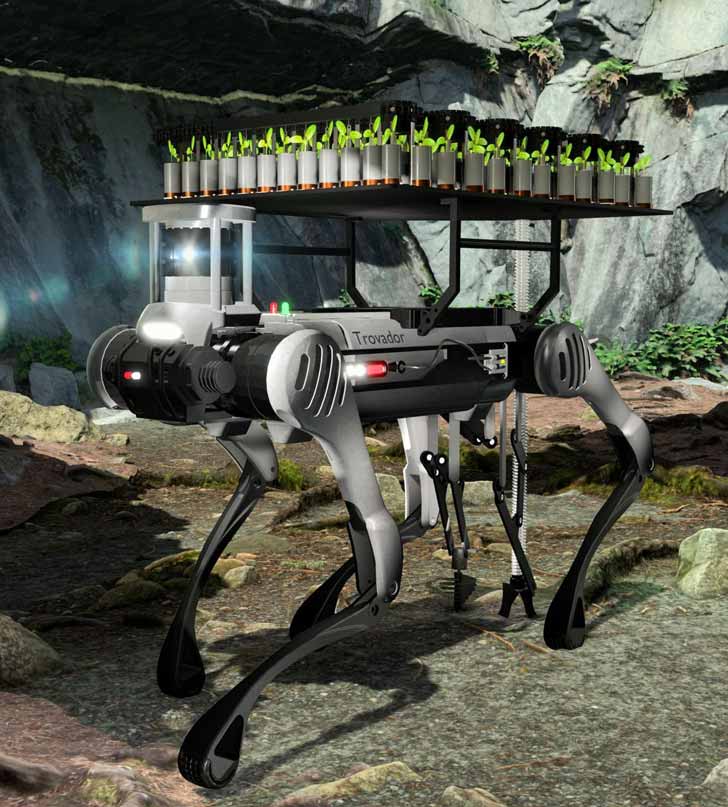
Trovador is the name of Bernardino and Mendonça’s robot, a six-legged creation enabled with artificial intelligence to navigate steep and dangerous terrain and plant trees across Portugal.
It’s named after D. Dinis, King of Portugal, also known as The Troubadour King, or “Trovador” in Portuguese. Dinis was instrumental in the planting of Leiria’s Forest, one of the greenest spaces in the country.
But those green spaces are now hard to reach.
“From my research, around 60% of the Portuguese green areas are in cliffs and mountains, making reforestation initiatives too risky to perform,” Bernardino said in a 2024 video. “So I decided to make a difference.”
“The inspiration was no longer a feeling of loss, but a clear-eyed recognition of a flawed system,” she told Smithsonian Magazine this year. “We saw that existing solutions — from volunteer planting to drone seed-dropping — were failing to meet the scale and complexity of the problem.”

In contrast to drone-based aerial seeding — which uses thousands of seeds with lower precision, which can waste natural resources — the targeted approach of the Trovador invention makes success more of a guarantee.
Bernardino and Mendonça began prototyping Trovador in 2023 using recycled parts and costing a total of €15. It was able to plant saplings 28% faster than humans, with a 90% survival rate and no post-planting care required.
It’s something Bernardino said is vital to not just the ecosystem but to Portugal’s people.
“Since the early 2000s, Portugal has lost over half of its forest cover, triggering erosion, water loss, and biodiversity collapse,” Bernardino told Smithsonian Magazine.
“This crisis hits rural communities hardest: places like Fundão and Alentejo, where forests provide food, water, income, and cultural identity. As ecosystems vanish, so do livelihoods.”
The duo has begun scaling up, becoming finalists of National Geographic’s Slingshot Challenge (with an accompanying $10,000 grant) in 2024, and now building out a more streamlined prototype.
They also received Europe’s top award for Robotics for Sustainability — the youngest to ever do so.
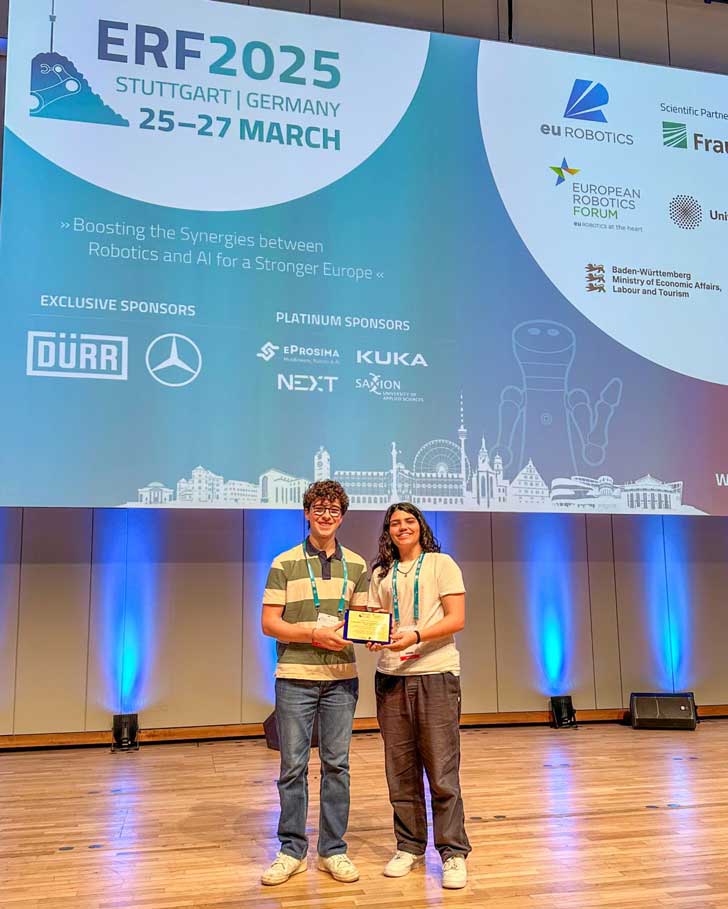
This recognition is leading them to refine their final product, one capable of climbing 45-degree slopes while detecting and avoiding boulders or other obstacles in its way.
Trovador can carry and plant up to 200 saplings per hour and has a light robotic movement, barely leaving an indent on the ground. The robot is also enabled with sensors that analyze soil health, ensuring healthy conditions before a sapling is even dropped in the ground.
It also uploads real-time GPS coordinates of each plant, as well as data like soil humidity and its own battery life, to a cloud, where the team can monitor conditions remotely.
“Trees are vital,” Bernardino wrote in a blog post announcing the original prototype. “They give us oxygen, store carbon, stabilize the soil and give home to the world’s wildlife. For the health of our planet and its inhabitants, their preservation and protection should be a priority for all of us.”
But to fully bring Trovador to market, cost concerns must be addressed.
To make implementation more feasible, Bernardino and Mendonça plan to market the robot as a service instead of an individual product for sale.
“Clients [like] municipalities, insurers, forestry firms, or NGOs can open our app, outline a polygon, choose native species, and receive a quote,” Bernardino told Smithsonian Magazine.
“Pricing is expected to be a big step up from the current methods, up to six times cheaper than manual crews and four times more cost‑effective than drones once seed wastage is factored in.”
As the inventors finalize field tests and make adjustments to the technology, their goal is to deploy it for large-scale restoration projects in 2026.
And it all started right in Bernardino’s backyard.
“I’m from Portugal, and I love my home,” she wrote in 2023.
“It is really concerning watching forests go from alive green to grey in seconds, and watching them go from grey to brown so slowly. I built this robot as an urge to replant my country and a dream to die seeing all Portuguese green landscapes again.”
You may also like: Student invents self-sanitizing door handle for hospitals, receives award from prime minister
Header images courtesy of Trovador