Walla Walla is making a push to become the first community in the nation to end youth and young adult homelessness.
Between 2021 and 2022, Walla Walla cut its count of homeless young people in half, from 81 to 39.
The rural county in Southeast Washington surrounded by golden wheat fields and rolling hills is perhaps best known for its wine industry.
It is now also the poster child of the statewide Anchor Community Initiative, a project started in 2018 by A Way Home Washington, a nonprofit co-chaired by Trudi Inslee, the first lady of Washington.
At inception, officials announced the initiative would end homelessness for anyone aged 12 to 24 in four Washington counties by the end of this year.
Leaders of the effort say better coordination, clearer data, and involvement from the people they are serving have helped Walla Walla’s success.
Now, the initiative is expanding to six other counties, bringing the state’s investment in the project to at least $12.5 million.
That’s despite the initiative failing to bring down youth homelessness in three other counties.

Before Walla Walla, the initiative touted Spokane as the first county in Washington to considerably reduce youth homelessness. But it didn’t last.
In the last year, Spokane’s numbers have risen 50%, suggesting that reductions are more difficult to sustain than to initially achieve.
And there are factors that initiative staff say made success easier in Walla Walla than in the other three counties.
Still, as numbers move up in some places and down in others, the initiative is helping to bring in more funding to communities that previously spent a fraction of what they do now on youth homelessness response, and young people say that is doing a better job serving them.
How it’s working
In Spokane, Finn Rankin, 21, has housing they feel good about for the first time. Their one-bedroom apartment pops with color, from the pink couch and orange dresser to the dozens of art pieces that decorate the walls, much of it created by Rankin.
It’s partly to make up for lost time, they say, for all the years they had no control over the spaces they lived in.
Homelessness often begins before adulthood. In King County, nearly half of all homeless people first experienced homelessness by the time they were 24. The Anchor Community Initiative strives to intervene early, said Inslee, a champion of the initiative.
Rankin and 40% of homeless youth in the country identify as LGBTQ, according to the Raikes Foundation.
Youth who are people of color are 83% more likely than their counterparts to become homeless, according to the National Network for Youth.

The Anchor Community Initiative works to address those disproportionalities, tracking homeless young people in those demographics.
Rankin’s family was always poor, they said. At 13, their family started living with friends and relatives. Two years later, Rankin was asked to move out because there wasn’t enough room.
In 2021, after six years of couch surfing, Rankin applied for and received a housing voucher, a coupon from the federal government that can be used to pay rent.
However, Rankin, who has an executive functioning disorder that makes focusing and organizing tasks difficult, was struggling to find an apartment that would take it in Spokane’s tight housing market.

That’s where the Anchor Community Initiative came in. The initiative works by revamping communities’ youth and young adult homelessness response system with a few key ingredients.
The first is better data. Initiative staff compile a “by-name list,” which includes the name of every homeless young person in the county, where they are, and details about what each person’s barriers to housing are.
Names appear on the list when young people check into shelters or seek homeless services.
When Rankin applied for the voucher, they likely showed up on that list.
The data shows how many young people are homeless, how many are unsheltered, and how many are being placed into housing, broken down by month. Initiative staff can use it to get near-immediate feedback on whether their efforts are working.
But data doesn’t get people housed. Usually, that takes money. And the initiative introduces a new pot of money that staff say is unique.
Money and lived experience
The Homelessness Prevention and Diversion Fund, public funds supplemented by private donations from foundations like Raikes, Campion and the Ballmer Group, has helped at least 724 youth and young adults across the four original Anchor Communities — Walla Walla, Spokane, Yakima and Pierce counties — find or maintain housing since 2020.
Walla Walla has served at least 139 young people this way. Raikes and Campion are financial contributors to The Seattle Times’ Project Homeless, while Ballmer supports the news organization’s Mental Health Project.
The diversion fund is uniquely flexible in what it can pay for and who can access it. A number of different community members and organizations can pull money out of it — not only youth homeless service providers but schools, tenant advocates, youth advisory board members and tribal centers.
The idea is that young people can approach whoever they are comfortable with or already have a relationship with for help.

Mike Woolson, a service navigator for the initiative in Walla Walla, says that much of the time, the fund provides direct rental assistance or housing deposits.
But he has also used it to pay for dorm rooms, beds and mattresses for young people to stay with friends, or transportation for youth who can’t sign their own lease to go stay with family in other parts of the country.
Although much of the funding goes toward short-term relief, Woolson and other initiative staff say, sometimes, that’s all a young person needs to avoid being on the street.
According to the initiative, 93% of young people who access the fund remain housed 12 months later.
Staff say that success is because they let young people choose their housing solution.
“They know what they need,” said Ashley Barnes-Cocke, Anchor Community Initiative project director. “The path to get to that doesn’t necessarily fit into the boxes that sometimes, as adults, that we create.”
After hearing stories like Rankin’s, initiative staff brought together case managers, housing specialists and landlord liaisons to create a weekly workshop to help young adults navigate the rental application process.
They helped Rankin keep track of all their applications and provided scripts to explain to landlords why they don’t have credit. They called it “House Busters.”
That culture of bringing together different groups to help young people is what many working with the initiative say is its most radical and effective ingredient, helping communities squeeze extra gains from existing resources.

Initiative staff lead regular meetings with service providers, outreach workers, representatives from schools, the juvenile detention facility and other organizations to come up with new approaches like House Busters.
After a few months of attending the workshop and submitting applications, Rankin found an apartment. But there were still moving costs, and first and last month’s rent.
The initiative paid for all of that on top of Rankin’s application fees through its Homelessness Prevention and Diversion Fund.
A few days before Christmas 2021, Rankin was handed the keys to their own apartment.
Rankin now sits on Spokane’s Youth Action Board, a group of formerly homeless youth and young adults who help steer the initiative’s efforts.
They say it feels good to share their experiences and traumas “and feel safe and also respected and heard.”
Why are Spokane’s numbers going up and Walla Walla’s going down?
Despite Rankin’s story of success, Spokane’s aggregate youth and young adult homelessness numbers have been on a roller coaster ride, trending upward in the last year.
When A Way Home Washington heralded Spokane’s early success, the county’s numbers had dropped from 270 homeless young people in December 2020 to 217 in June 2021, a 20% decrease within six months.
But from there, the count went up to 330 as of July 2022, a 50% increase in a little over a year.
In the other Anchor Communities, Yakima’s count of its homeless youth population has more than doubled — from 90 to 219 in the past three years. Pierce County went from 457 to 865 in the same time.
“I don’t see it as a failure necessarily,” said Julius Henrichsen, Spokane’s Anchor Community Initiative coordinator.
Staff said the increase is a result of better identification. Henrichsen said that paradoxically, Spokane’s numbers could be going up partly because the initiative is doing a good job serving young people.
For example, a number of homeless young adults emerged “out of the woodwork” in 2021, he said, when Spokane opened its first young adult shelter.
Inside the shelter, located across the street from the community college, bags, shoes and skateboards are stored underneath many of the 27 beds.
“They see this as home,” said LaKedia Davis, the shelter’s manager who grew up in Spokane.
Davis said the shelter residents “were just outside, under the bridge, sleeping in cars” before they moved in.
For many of them, coming to the young adult shelter was their first time being counted as homeless.
“The more data we provide to them, they think that the problem is growing or something. No, it’s just being elucidated,” said Julie Patiño, executive director of A Way Home Washington.
But nationally and in Spokane, the problem of homelessness is growing, accelerated by the pandemic, and that could also be extending the initiative’s goal posts.
According to the county’s annual Point-In-Time Count, homelessness in Spokane increased 41% over the past four years, from 1,245 in 2018 to 1,757 in 2022.
In the last year, a homeless encampment called Camp Hope in the city of Spokane swelled to become the largest in the state, with hundreds of people staying there.

Like much of the country, rents in Spokane skyrocketed during the past four years, increasing 42% since the initiative began, according to Apartment List.
Eviction moratoriums that have been expiring since last year have also likely resulted in more people becoming homeless.
On top of that, the pandemic exacerbated staffing shortages and turnover among social service providers that Henrichsen said made forward momentum on new efforts and projects difficult to maintain.
Initiative staff aren’t sure how to account for Walla Walla’s anomalous success during these challenging conditions.
They say the difference could be size. Walla Walla is smaller than the other three counties that have seen growth in their homeless youth and young adult populations.
From the start, staff there had a shorter list of homeless young people to manage.
Plus, it has a small town culture, which initiative staff describe as “the Walla Walla way,” making it easier to rally and coordinate people and organizations around a unified mission.
Walla Walla officials also say they have been lucky to see relatively little turnover among initiative staff and those leading service provider organizations.
Can you miss your target and still be succeeding?
Bringing the count of homeless young people down to zero is still the main goal, initiative staff said, but not the only metric by which they should be evaluated.
For one, Patiño said that having created the data infrastructure to even know that numbers are going up is, in and of itself, an asset.
Another number that’s going up is the number of people housed by the initiative’s flexible Homelessness Prevention and Diversion Fund.
Across all four original Anchor Communities, the fund has helped house or maintain housing for twice as many youth and young adults in the last year compared to the year before — 441 compared to 220, the vast majority of whom are staying housed a year after the intervention.

The initiative’s data also shows 55% of everyone housed through those funds in the last year were people of color, 47% had disabilities, and 25% identified as LGBTQ.
The initiative has also helped raise the overall homelessness funding available in its participating communities.
Spokane alone has received over $5 million in state and federal grants for youth and young adult homelessness in the last few years, funding that was either explicitly earmarked to support the initiative or obtained in grant awards that staff say the initiative played a crucial role in winning.
That’s a substantial amount when Spokane is on track to spend $16 million this year on homelessness as a whole, said Jenn Cerecedes, the city’s director of Community, Housing, and Human Services.
Those funds built Spokane’s first young adult shelter, and a number of new programs like House Busters.
New partners say they are still eager to participate. Thurston, Skagit, Whatcom, Jefferson, Clallam and Clark counties are joining the initiative this year.
Lisa Larson, 57, was left homeless after leaving an abusive relationship in Portland, Oregon, over a decade ago. She and her current partner, whom she met during this time, spent a year sleeping in abandoned houses, parks and public places, and were twice arrested for criminal trespassing.
On the streets, they heard about a different kind of space for unsheltered people like themselves: a community by and for the unhoused with its own plot of land, sanctioned by the city but not run by it, a 40-minute bus ride from Portland’s downtown.
They put their names on a waitlist and moved there in 2010.
They’ve been at Dignity Village ever since.
Larson now serves as the village’s outreach coordinator and was elected to serve as the council’s vice chairwoman. The village, which was birthed over 20 years ago in response to the demands of unhoused activists, is the first sanctioned, self-run village for unhoused residents in the country.
It remains one of very few communities of its kind in North America.
Residents in Dignity Village pay $75 a month to live there and put in 10 hours a week of work on village business, which includes cleaning, maintenance and paperwork.
Residents of the village, which holds about 65 people and grows to about 80 people in the winter, abide by a small set of rules ratified by members. Violating those rules can lead to a temporary or, in worst case scenarios, lifelong ban. Residents can stay for as long as they like; the average stay is currently about a year and a half.
On November 3, 2022, Portland’s city council approved an aggressive citywide camping ban as well as a plan to herd many of the city’s unsheltered residents into six sanctioned camps of 250 people each.
By forcing people off of the streets, the plan could mean the village, which currently has a modest waitlist of three people, could be overwhelmed with requests.
It could also lead many of the city’s unsheltered population to be jailed, forced into congregate shelter or driven away from the city.
It’s precisely the type of future Dignity Village was founded to avoid.
“I know a lot of people who don’t want to go to what they’re starting to already call internment camps,” Larson says. “To house that many people in a few small areas, it’s going to be insanity.”
A hostility toward encampments has ramped up since the beginning of the pandemic, as housing insecurity and social dislocation have led to an uptick in people sleeping outdoors.
It’s a familiar scenario for Dignity Village, whose founding hearkens to an era 20 years ago when unhoused activists, sick of being scapegoated and harassed, made a largely successful stand for their own autonomy.
After a previous citywide camping ban was ruled unconstitutional in September of 2000, a group of unhoused people founded the “Out of the Doorways” movement, militantly opposing sweeps and asking the city to permit a self-governed tent city for unhoused people.
The movement was supported by Street Roots, a Portland newspaper written by housed and unhoused journalists and sold by people experiencing homelessness.
An editor at Street Roots enlisted Mark Lakeman, an architect with an interest in community-run spaces and founder of the nonprofit The City Repair Project. Lakeman convinced the group that the term “village” would more clearly reflect the type of space they envisioned — and would be more well-received by the public.
In December of 2000, the residents of what was then called “Camp Dignity” placed themselves under the Fremont Bridge.
For the next 10 months, the group was dispersed by police but continued regrouping, often intentionally doing so in crowded public spaces and near affluent development where standoffs could get the most attention, Lakeman says.
Less than a year later, the city council permitted the group a fenced-in asphalt patch of land in its leaf-composting operation, a solution that was only approved for 60 days while the city council negotiated with residents on something more long-term, according to a New York Times report.
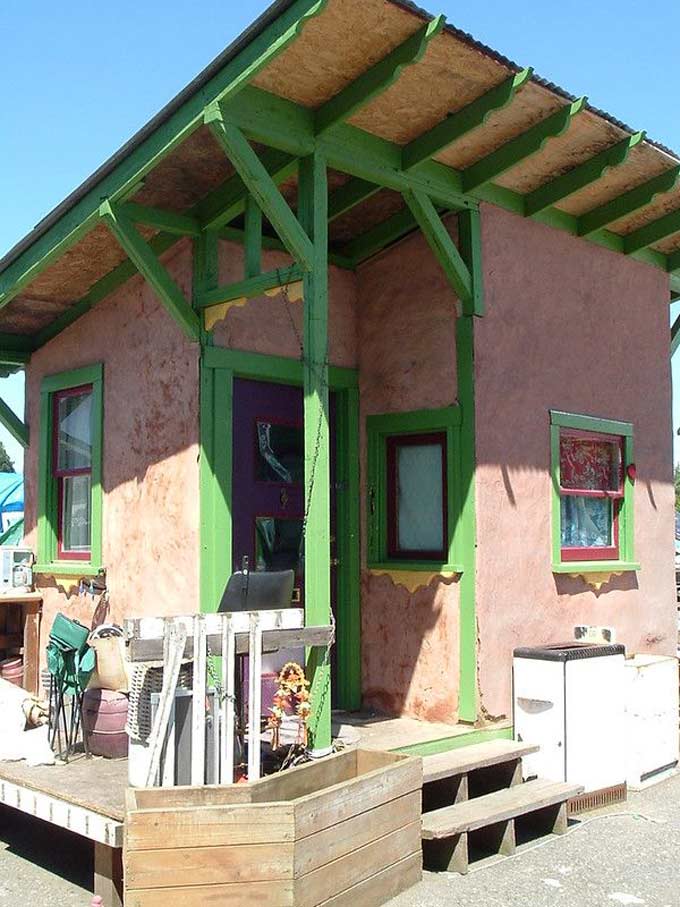
The site was continually reauthorized, eventually becoming permanent, its tarpaulin tents upgraded to tiny homes.
The early village was a combination of DIY architecture, built by residents and Americorps volunteers and designed by Lakeman to be ecologically sound. The city added sewage lines, power and provided sanitation. The space was initially rented from the city, though land is now inhabited at no cost. The $75 that residents pay each month goes to maintenance and operations.
Todd Ferry, a researcher with Portland State University’s Homelessness Research and Action Collaborative, has studied Dignity and other villages it inspired (such as Opportunity Village in Eugene, Oregon). He says the city realized that by giving the community autonomy and providing support when needed it would save itself money and bureaucratic burden.
“It needs to have some support and needs to be able to stay but, no, the city largely stays out,” he says.
The community strives to be economically self-sufficient. Dignity has set up several recycling-based businesses with the city’s help, including an agreement wherein residents chop and sell excess wood provided by loggers.
While the village had an advisory council, of which Lakeman was a member, it was dissolved years ago.
Residents have been reluctant to accept any direct funding from the city and have rejected any attempt at sharing leadership from either elected officials or outside nonprofits. The village incorporated as a 501(c)3 to sign legal agreements with the city.
The city does pay for a single employee: a program specialist who helps with bookkeeping and administrative needs.
“We do not endorse the idea of an advisory council and see that as a failed structure,” program specialist Victory LaFara tells Next City.
“We’ve been doing excellent with our own internally elected council and board officers. When the village is in need of consultants, I serve that role or I reach out for consultations when issues are outside of my expertise. Unlike an advisory council, I hold no power or purse strings over the Village. The Village is free from coercion to accept or reject my advice on its merits alone.”
This role is the only one occupied by someone who does not live in Dignity Village; all of the community’s other needs are handled by residents as part of their 10 hours of work. Lakeman says this role was accepted reluctantly by members after the village ran into financial problems.
More recently, Larson says, the village recently applied for and has received several grants. She’s optimistic about their finances. “We’re actually sitting financially pretty solid right now,” she says. “Many years ago when I was treasurer, I was basically having to rob from Peter to pay Paul on every monthly bill.”
The village occasionally ejects residents who break community rules, but Larson says they try to give people the benefit of the doubt. These rules remain more or less unchanged two decades after the community’s founding: no fighting, no disruptive behavior.
There was previously a stringent ban on alcohol and illicit drugs, but this prohibition has since been relaxed to accommodate the reality of people struggling with addiction, a change that required buy-in from the city. Now people are permitted to use drugs and alcohol in their own pods, so long as they don’t bring it out in the open.
“If you did not have a drug or alcohol problem before you hit the streets, by the time you find a place like Dignity Village, you probably do have a problem with it,” Larson says. She says residents help each other out with peer support and peer counseling for addiction.
The village has had its share of critics over the years, particularly in its early years. Some still criticize the site for not focusing on rapid rehousing or transitioning to permanent housing, although that is not the village’s stated goal.
Residents can stay as long as they like: Larson and her partner have been there for 12 years, and another resident has been there for 17, she says. Mobile service providers from the nonprofit JOIN provide housing assistance for those who want it.
A crucial aspect of the village model is that residents have agency, Ferry says. The spaces are voluntary; residents can leave and there are few barriers to entry. It is hard to imagine any of these approaches being replicated in the planned 6 mega encampments the city is looking to build.
“These solutions have been tried, they don’t work,” Ferry says of the new camping ban. He says he studied the role that size plays in a successful village of unhoused people. According to his research, the ideal number of people to maintain community cohesion is 25.
“I do think that a village model with a reasonable number of people would be much more desirable than massive camps that are often compared by the houseless community to internment camps,” he says.
Lakeman says he’s met with Mayor Wheeler many times and walked him through the village model but found him evasive. “It’s been so frustrating,” he says. “Before you even create these hugely expensive and politically volatile villages, why not just help people where they are?”
Larson is disturbed by the city’s plan. She believes it will put more strain on Dignity Village and exacerbate problems for the rest of Portland’s unhoused community.
She is even sympathetic to some of the complaints that have led to this moment: She sees RV campers proliferating and waste being left behind, but says there are better ways to handle it than to herd people into encampments.
She has friends still out on the streets, one of whom told her he’s prepared to go to jail rather than the city-run camp.
“Everyone deserves a safe place to put their head at night, and a safe place to be. And those encampments are not going to be that safe, not with the amount of people that they have in them,” Larson says.
She sees no way for the city’s camps to offer residents any real control. “You know, you let the people make their own rules,” she says.
“You let the people decide what direction their community is going to go in.”
Toledo City Council just approved a plan to turn $1.6 million in public dollars into as much as $240 million in economic stimulus, targeted at some of the Ohio metro’s most vulnerable residents.
“It’s really going to help people put food on the table, help them pay their rent, help them pay their utilities,” says Toledo City Council Member Michele Grim, who led the way for the measure. “Hopefully we can prevent some evictions.”
The strategy couldn’t be simpler: It works by canceling millions in medical debt.
Working with the New York City-based nonprofit RIP Medical Debt, the City of Toledo and the surrounding Lucas County are chipping in $800,000 each out of their federal COVID-19 recovery funds from the American Rescue Plan Act.
The combined $1.6 million in funding is enough for RIP Medical Debt to acquire and cancel up to $240 million in medical debt owed by Lucas County households that earn up to 400% of the federal poverty line.
“It could be more than a one-to-100 return on investment of government dollars,” Grim says. “I really can’t think of a more simple program for economic recovery or a better way of using American Rescue Plan dollars, because it’s supposed to rescue Americans.”
Under the RIP Medical Debt model, there is no application process to cancel medical debt. The nonprofit negotiates directly with local hospitals or hospital systems one-by-one, purchasing portfolios of debt owed by eligible households and canceling the entire portfolio en masse.
“One day someone will get a letter saying your debt’s been canceled,” Grim says. It’s a simple strategy for economic welfare and recovery.
RIP Medical Debt was founded in 2014 by a pair of former debt collection agents, and since inception it has acquired and canceled more than $7.3 billion in medical debt owed by 4.2 million households — an average of $1,737 per household.
CEO Allison Sesso says they switched from bright yellow envelopes to standard white envelopes a few years ago.
“We did some A-B testing and we realized that yellow envelopes just makes it feel more like a debt collection potentially,” Sesso says.
“We always have to work hard to make sure we don’t look like we’re a collection agency. We haven’t collected a single dollar of any debt we’ve ever purchased.”
The partnership with Toledo and Lucas County is the third instance of the public sector funding RIP Medical Debt to cancel debt portfolios.
Earlier this year, in the largest such example yet, the Cook County Board of Commissioners approved a plan to provide $12 million in ARPA funds for RIP Medical Debt to purchase and cancel an estimated $1 billion in medical debt held by hospitals across Cook County, which includes Chicago.
“Governments contract with nonprofits all the time for various social interventions,” Sesso says.
“This isn’t really that far-fetched or different from that. I would say between five and 10 other local governments have reached out just since the Toledo story came out.”
An estimated one in five households across the U.S. have some amount of medical debt, and they are disproportionately Black and Latino, according to the U.S. Census Bureau.
The average amount owed is $2,000. And the problem isn’t limited to the uninsured.
As Sesso points out, many households with health insurance still end up with unpaid medical bills because the only health insurance plans affordable to them are high-deductible plans.
“It’s like signing up for a subprime mortgage,” Sesso says. “It’s a big problem, because the premiums for the more Cadillac plans, if you will, are out of reach for people.”
Acquiring medical debt is relatively cheap: hospitals that sell medical debt portfolios do so for just pennies on the dollar, usually to investors on the secondary market.
The purchase price is so low because hospitals and debt buyers alike know that medical debt is the hardest form to collect.
Nearly 60% of all debt held by collection agencies is medical debt owed by some 43 million households, according to the Consumer Financial Protection Bureau.
Even more households owe medical debt that hospitals haven’t yet sold to anyone.
When it was first founded, RIP Medical Debt started out acquiring medical debt only on the secondary market, from debt collectors or other investors who had previously purchased portfolios from healthcare providers.
But two years ago, RIP Medical Debt started going directly to hospital systems and offering to buy the debt that they were holding on their balance sheets.
“I couldn’t tell you where it comes from, but generally the number that’s out there is that only somewhere between 20% and 30% of hospitals overall sell their debt,” Sesso says.
“That’s a lot of hospitals that don’t sell their debt on the secondary market, but those same hospitals will sell their debt to us because we’re doing it for a different purpose. So we’ve been able to open up part of the market to buy debt from hospitals that don’t otherwise sell their debt.”
A year ago, Sesso says, around a quarter of the debt RIP Medical Debt had ever purchased was direct from hospitals.
Today nearly 50% of the debt the nonprofit has canceled was acquired directly from hospitals, and that segment of its portfolio is growing much faster than medical debt purchased from the secondary market.
Sometimes it’s actually been the hospitals themselves that contact RIP Medical Debt before anyone else in their community.
The process is straightforward. After explaining RIP Medical Debt and its mission, they answer any questions including about reimbursement or regulatory issues, Sesso says.
“And then we take it from there. We sign a non-disclosure agreement, we get a file from them, we analyze it, we come back to them and tell them what the analysis has shown, how much of it qualifies, what we would pay, and then we sign another agreement that transfers the debt to us, we send them a wire, and we start sending out letters.”
Just like that, hundreds of lives are changed.
The big backend costs for RIP Medical Debt include costs to automate as much of the process as possible while also maintaining compliance with all the healthcare confidentiality laws and regulations around the secondary market for debt.
That includes paying for access to credit histories to verify that households are under the 400% of the federal poverty line threshold.
“We only want to buy the debt for people that qualify, which usually ends up being 80-90% of what hospitals give us to analyze in the first place,” Sesso says.
The amount of debt canceled for any given household has ranged from $25 all the way up to six-figure amounts. Under IRS regulations, debts canceled under RIP Medical Debt’s model do not count as taxable income for households.
One important limitation so far has been around using public dollars to acquire debt from public hospital systems; ARPA rules prohibit RIP Medical Debt from using those dollars to purchase debt from county-run or city-run hospital systems. But as it has already been doing in Chicago, the nonprofit will continue raising private funds to acquire and cancel debt portfolios from public hospitals.
After not one but two donations from philanthropist MacKenzie Scott, totaling $80 million, RIP Medical Debt is planning for expansion.
It’s using a portion of those dollars to create an internal revolving line of credit to expand to places where it can find willing sellers before it has found willing funders.
The internal line of credit means the nonprofit now has new, albeit still limited, flexibility to acquire debt portfolios from hospitals first, then begin raising private or public dollars locally to replenish the line of credit later and make those funds available for other locations.
“People often ask, do you only work with nonprofit hospitals, or do you work with for-profit hospitals? And I’m like, I just want to get the debt, regardless of who created the debt. If it’s out there, I want it,” Sesso says.
Fundamentally, they are not solving the issue of medical debt, but easing its pressure from as many lives as possible — while also upping the pressure on lawmakers and the healthcare industry.
“We’re intentionally taking the stories of the individuals whose debt we have resolved, and putting their stories out into the world with intention in a way that tries to push and create more of that pressure to fundamentally solve the problem,” she says.
After a groundbreaking treatment, researchers have announced that a 53-year-old man in Germany has officially been cured of HIV. That’s right, cured!
The man — whom doctors refer to as the “the Dusseldorf patient” to protect his privacy — is the fifth person to have a confirmed cured case of HIV. Researchers announced he has no detectable virus in his body, even after stopping his HIV medication four years ago.
The Dusseldorf patient joins four others globally who have undergone stem cell transplants for blood cancer treatment — which included rare genetic mutations that carry a resistance to HIV.
The Duesseldorf patient’s apparent success was shared last July at the International AIDS conference in Montreal, but researchers have officially confirmed the cure now.
“It’s really cure, and not just, you know, long term remission," Dr. Bjorn-Erik Ole Jensen, who presented details of the case in a new publication in Nature Medicine, said. “This obviously positive symbol makes hope, but there’s a lot of work to do.”
The stem cell transplant is a risky and complicated procedure — often too risky to offer as a cure for everyone with HIV. It’s also difficult to achieve, as the HIV-resistant gene mutation is only carried in 1% of the total population.
That being said, each time scientists cure a new case, they are given invaluable insights to lead them closer to a cure for everyone.
Marshall Glesby, infectious disease specialist and coauthor of a recent HIV cure study told PBS: “There is incremental progress being made in terms of our understanding of where the virus hides within the body and potential ways to purge it from those sites.”
What is HIV and who does it impact?
HIV, or human immunodeficiency virus, is a disease that enters and destroys the cells of the immune system, and without intervention, can lead to AIDS (acquired immunodeficiency syndrome), which makes it nearly impossible for someone to even fight a small infection.
About 38.4 million people around the globe live with HIV, and while modern medication can keep the virus at bay, inequities in healthcare and comorbidities can make it difficult to support everyone with the virus.
About half of HIV/AIDS cases are in eastern and southern Africa, but the impact of the virus is far-reaching. In other nations — like the United States — HIV/AIDS is closely associated with homosexuality, leading to higher instances of homophobia and violence. The stigma surrounding HIV results in people avoiding testing or treatment.
That being said, advocacy and fundraising have made an enormous impact on the decline of HIV/AIDS-related deaths worldwide.
Work is also being done to reduce HIV transmission through better access to testing, education campaigns for condom and needle use, and drug treatment and prevention therapies like antiretroviral therapy (ART) and pre-exposure prophylaxis (PrEP).
Beyond treatment and prevention, there is more work behind-the-scenes, even outside of these five isolated cured cases, to find a cure for HIV and beat both the stigma and the illness itself.
What progress has been made to cure HIV?
Outside of these stem cell therapies, a number of ongoing HIV research brings us closer and closer to a cure.
For example, with the success of mRNA COVID-19 vaccines, three new mRNA HIV vaccines are undergoing clinical trials and show a promising future for finding a functional cure for the virus.
Researchers at Tel Aviv University have also created an in vivo injection, which uses genetically engineered white blood cells that secrete neutralizing antibodies that destroy HIV. Though this research has only gone through animal trials, it has shown efficacy in disease models that could be replicated in humans.
Laundry, taxes, and raccoons — oh my! A24, the production company that created acclaimed film Everything Everywhere All At Once (EEAAO), is auctioning off 43 props and costume pieces from the Academy Award-nominated film this week.
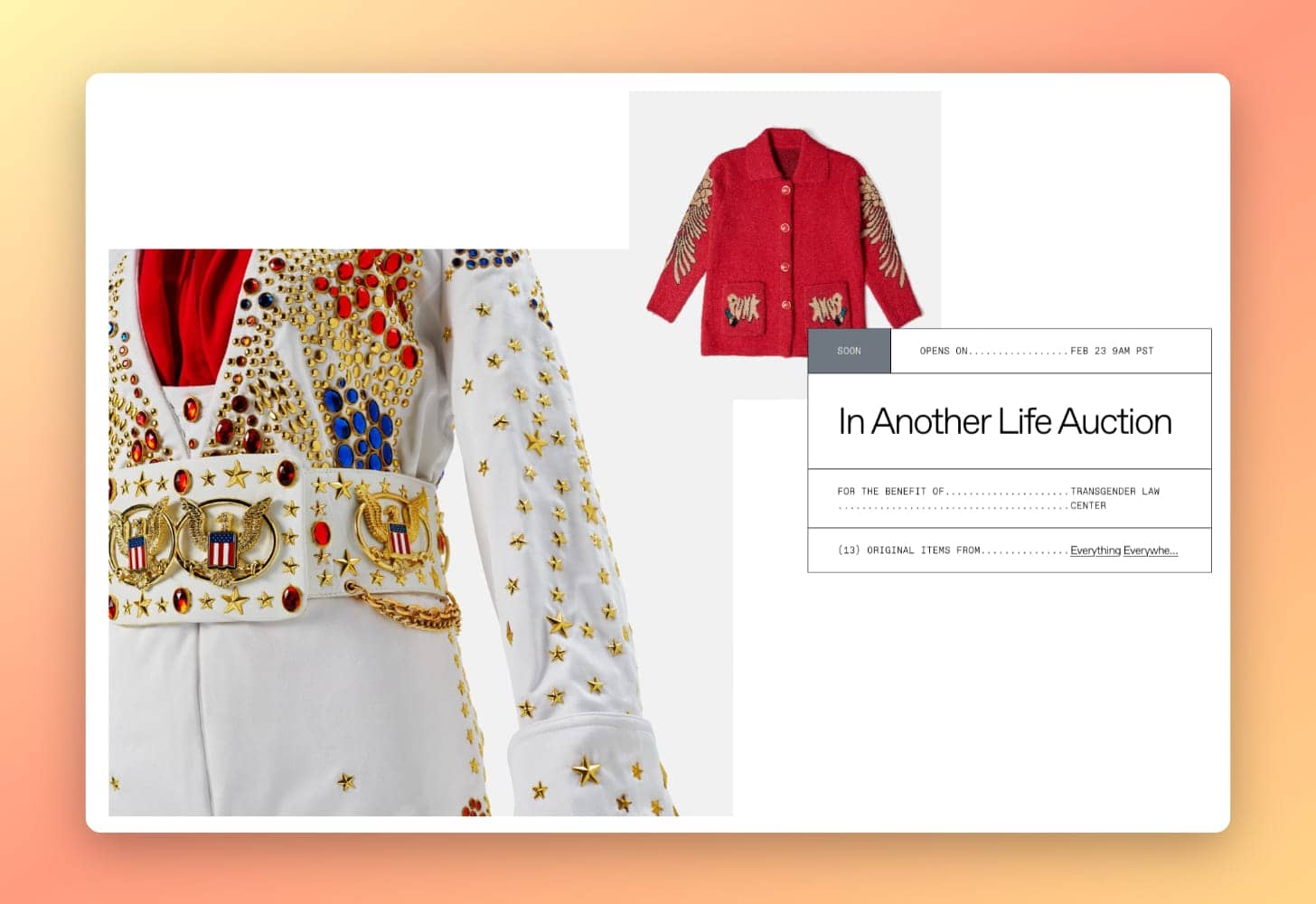
Each available item is split into three categories, each benefitting a different nonprofit organization. One auction, aptly titled the “In Another Life” auction, contains a number of costumes from the movie and will benefit the Transgender Law Center.
Transgender Law Center is the largest national trans-led organization in the U.S, advocating for trans immigrants, workers, and incarcerated people. The organization works to change law and policy so more people can live safely and authentically.
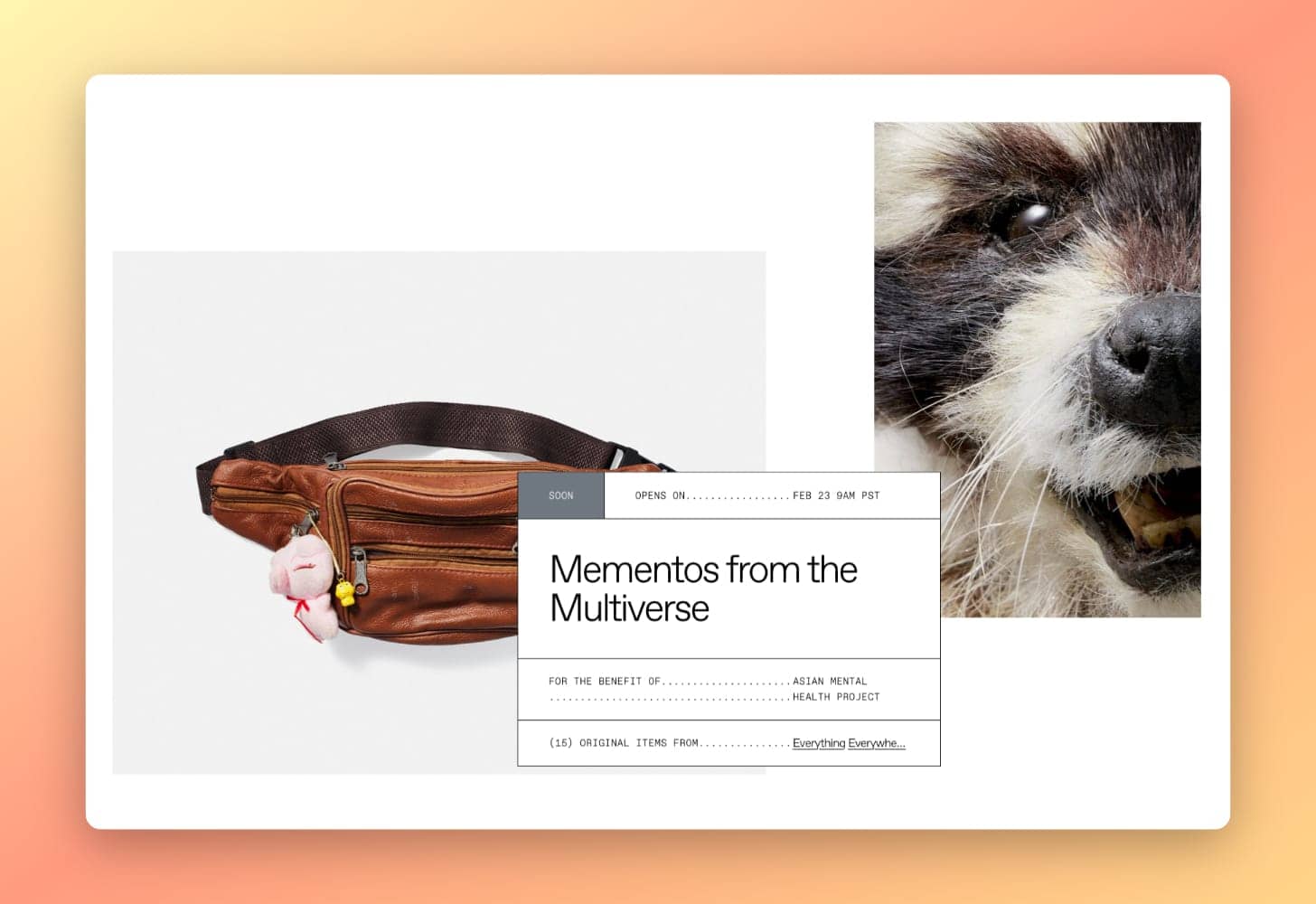
The other two auctions — “Mementos From The Universe” and “Laundry & Taxes” — will donate proceeds to the Asian Mental Health Project and the Laundry Workers Center, respectively.
The Asian Mental Health Project works to educate and empower AAPI communities in seeking mental healthcare, by offering resources, community care initiatives, and grant-based assistance.
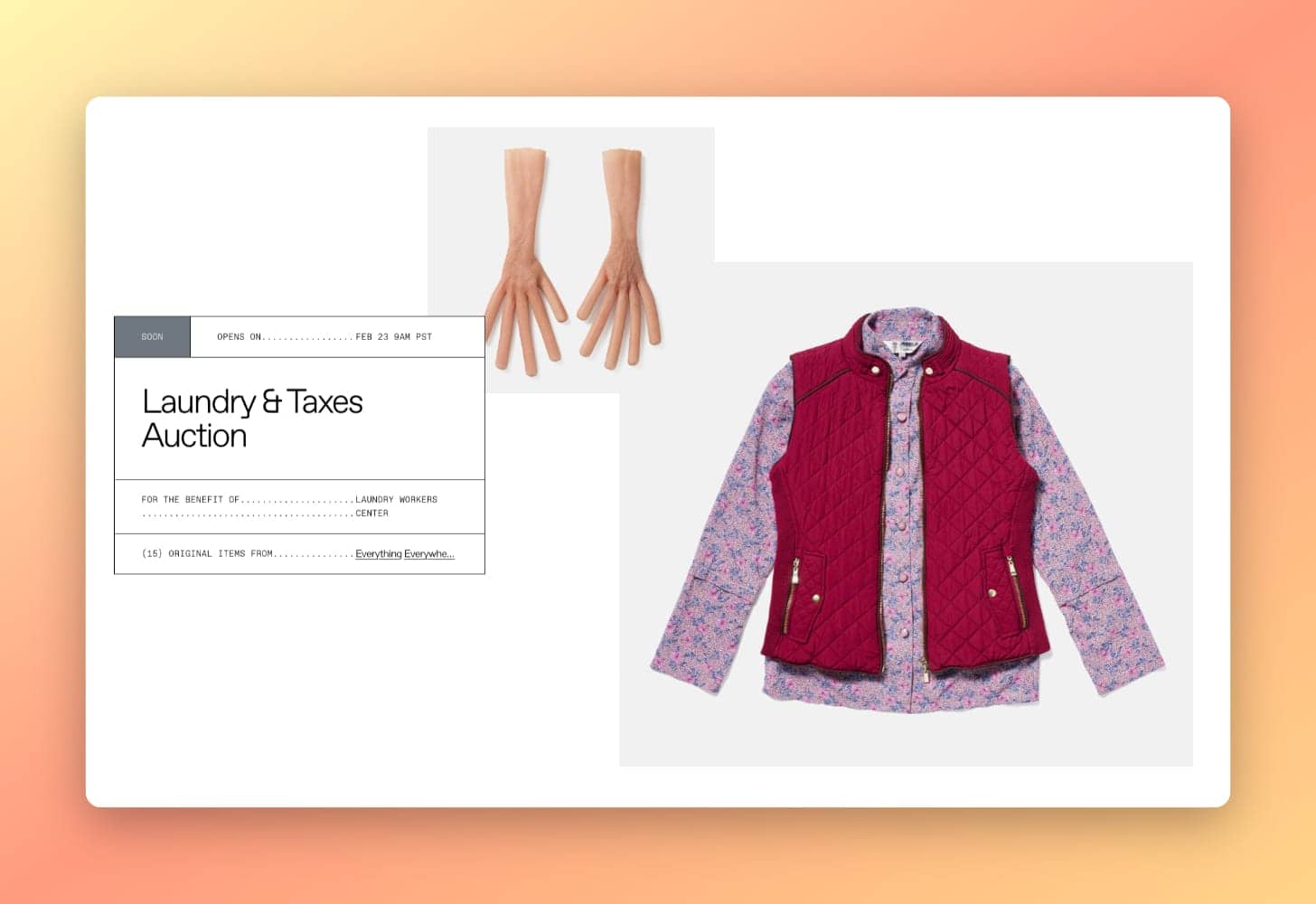
Lastly, the Laundry Workers Center is a worker’s rights group, led by immigrants in New York City and New Jersey. The grassroots organization addresses the need for improvements in living and working conditions in laundry, warehouse, and food service industries.
A24 has held auctions in the past for other movie props, but with the wild success of EEAAO, this auction is sure to roll in some funds for some groups who could really benefit from them.
Esteemed author and researcher Brené Brown once said, “Empathy fuels connection.”
In a world that feels deeply divided in many ways, those who are able to practice empathy have a unique ability to make a positive difference on large and small scales. Empathy gives us the power to compassionately understand the emotions and experiences of those different from us, to help others feel seen and known, and also to be mindful of how our actions and words affect others.
At Good Good Good we see empathy has the first step to feeling more hopeful about the world, allowing us to mourn bad news and problems before we join in creating solutions.
Practicing empathy isn't easy — especially when the stakes are high — but it's important.
Speaking on empathy again, Brown said, “Empathy has no script. There is no right way or wrong way to do it. It’s simply listening, holding space, withholding judgment, emotionally connecting, and communicating that incredibly healing message of ‘You’re not alone.’”
In this article, we’ve curated the best and most helpful empathy quotes from some of the world’s greatest empaths and world changers. These quotes will help us to understand empathy and the inspirational power it can have on us, as well as how we can use it to leave a positive difference in the world and those around us.
The Best Quotes for Empathy
Famous Quotes About Empathy
“If you talk to a man in a language he understands, that goes to his head. If you talk to him in his language, that goes to his heart.”
— Nelson Mandela
“The great gift of human beings is that we have the power of empathy, we can all sense a mysterious connection to each other.”
— Meryl Streep
“Learning to stand in somebody else’s shoes, to see through their eyes, that’s how peace begins. And it’s up to you to make that happen. Empathy is a quality of character that can change the world.”
— Barack Obama
“If there is any one secret of success, it lies in the ability to get the other person’s point of view and see things from his angle as well as your own.”
— Henry Ford
“This capacity for empathy leads to a genuine encounter — we have to progress toward this culture of encounter — in which heart speaks to heart.”
— Pope Francis
“If you look into someone’s face long enough, eventually you’re going to feel that you’re looking at yourself.”
— Paul Auster
“I do not ask the wounded person how he feels, I myself become the wounded person.”
— Walt Whitman
“Whenever you are about to find fault with someone, ask yourself the following question: What fault of mine most nearly resembles the one I am about to criticize?”
— Marcus Aurelius
“Each one of us has lived through some devastation, some loneliness, some weather superstorm or spiritual superstorm, when we look at each other we must say, I understand. I understand how you feel because I have been there myself. We must support each other and empathize with each other because each of us is more alike than we are unalike.”
— Maya Angelou
For Kids
“If you see someone without a smile, give them one of yours.”
— Dolly Parton
“If you can learn a simple trick, Scout, you’ll get along a lot better with all kinds of folks. You never really understand a person until you consider things from his point of view, until you climb inside of his skin and walk around in it.”
— Harper Lee, To Kill a Mockingbird
“We have two ears and one mouth so that we can listen twice as much as we speak.”
— Epictetus
“Empathy is a respectful understanding of what others are experiencing.”
— Marshall B. Rosenberg
“Sometimes it takes only one act of kindness and caring to change a person’s life.”
— Jackie Chan
“Whenever you feel like criticizing any one… just remember that all the people in this world haven’t had the advantages that you’ve had.”
— F. Scott Fitzgerald
“When you start to develop your powers of empathy and imagination, the whole world opens up to you.”
— Susan Sarandon
“You should not judge; you should understand.”
— Ernest Hemingway
On Compassion
“The purpose of human life is to serve, and to show compassion and the will to help others.”
— Albert Schweitzer
“When we focus on ourselves, our world contracts as our problems and preoccupations loom large. But when we focus on others, our world expands. Our own problems drift to the periphery of the mind and so seem smaller, and we increase our capacity for connection — or compassionate action.”
— Daniel Goleman
“Can I see anothers woe,
And not be in sorrow too.
Can I see anothers grief,
And not seek for kind relief.
Can I see a falling tear.
And not feel my sorrows share,
Can a father see his child,
Weep, nor be with sorrow fill’d.
Can a mother sit and hear,
An infant groan, an infant fear-
No no never can it be,
Never, never can it be.”
— William Blake, Songs of Innocence and of Experience
“Looking at various means of developing compassion, I think empathy is an important factor: the ability to appreciate others’ suffering.”
— Dalai Lama
“Learning to give empathy to myself and others as often as I can each day has rendered astounding benefits… Empathy leads to compassion and compassion to forgiveness and connection.”
— Judith Hanson Lasater
On Leadership
“Leadership is about empathy. It is about having the ability to relate to and connect with people for the purpose of inspiring and empowering their lives.”
— Oprah Winfrey
“One of the criticisms I’ve faced over the years is that I’m not agressive enough or assertive enough or maybe somehow because I’m empathetic, it means I’m weak. I totally rebel against that. I refuse to believe that you cannot be both compassionate and strong.”
— Jacinda Ardern, 40th Prime Minister of New Zealand
“As a leader, you should always start with where people are before you try to take them where you want them to go.”
— Jim Rohn
“Leadership is not so much about technique and methods as it is about opening the heart. Leadership is about inspiration — of oneself and of others. Great leadership is about human experiences, not processes. Leadership is not a formula or a program, it is a human activity that comes from the heart and considers the hearts of others. It is an attitude, not a routine.”
— Lance Secretan
“The main tenet of design thinking is empathy for the people you’re trying to design for. Leadership is exactly the same thing — building empathy for the people that you’re entrusted to help.”
— David M. Kelley, IDEO
“If you aren’t humble, whatever empathy you claim is false and probably results from some arrogance or the desire to control. But true empathy is rooted in humility and the understanding that there are many people with as much to contribute in life as you.”
— Anand Mahindra
“If your emotional abilities aren’t in hand, if you don’t have self-awareness, if you are not able to manage your distressing emotions, if you can’t have empathy and have effective relationships, then no matter how smart you are, you are not going to get very far.”
— Daniel Goleman
“Leading with integrity and empathy requires vision and a connection to your deepest self.”
— Karla McLaren, The Art of Empathy
“Empathy is the starting point for creating a community and taking action. It’s the impetus for creating change.”
— Max Carver
“Empathy has the power to bring together people who would otherwise never meet. It has the power to teach us and to reach us in moments of isolation when we think nobody understands.”
— Dr. Vivek Murthy, United States Surgeon General
“Empathy may be the single most important quality that must be nurtured to give peace a fighting chance.”
— Arundhati Roy
For Work
“Empathy depends not only on one’s ability to identify someone else’s emotions but also on one’s capacity to put oneself in the other person’s place and to experience an appropriate emotional response.”
— Charles G. Morris
“Empathy represents the foundation skill for all the social competencies important for work.”
— Daniel Goleman
“We must learn to regard people less in the light of what they do or omit to do, and more in the light of what they suffer.”
— Dietrich Bonhoeffer
“Some people think only intellect counts: knowing how to solve problems, knowing how to get by, knowing how to identify an advantage and seize it. But the functions of intellect are insufficient without courage, love, friendship, compassion, and empathy.”
— Dean Koontz
“When you show deep empathy toward others, their defensive energy goes down, and positive energy replaces it. That’s when you can get more creative in solving problems.”
— Stephen Covey
“No one reaches out to you for compassion or empathy so you can teach them how to behave better. They reach out to us because they believe in our capacity to know our darkness well enough to sit in the dark with them.”
— Brené Brown
“We need to understand the other side to impact the other side. We become much more effective as humans and leaders when we engage in hearty conversations with those who are different from us, not necessarily to change our opinions, but to build the empathy muscle.”
— Daniel Lubetzky, CEO of Kind
Short Quote & Captions
“Empathy is about finding echoes of another person in yourself.”
— Mohsin Hamid
“Men build too many walls and not enough bridges.”
— Joseph Fort Newton
“When people talk, listen completely. Most people never listen.”
— Ernest Hemingway
“I care. I care about it all. It takes too much energy not to care.”
— Lorraine Hansberry
“You cannot do a kindness too soon, for you never know when it will be too late.”
— Ralph Waldo Emerson
“Empathy is a connection; it’s a ladder out of the shame hole.”
— Brené Brown
“Empathy is a choice, and it’s a vulnerable one.”
— Brené Brown
“Proactive responding is the ability to listen to the other person’s feelings and empathize without taking responsibility for those feelings.”
— Clive Harman
Empathy vs. Sympathy Quotes
“Empathy fuels connection. Sympathy drives disconnection.”
— Brené Brown
“The Difference Between Sympathy, Empathy and Compassion:
If someone was stuck in a quagmire:
Sympathy would be: sitting on the side, feeling sorry for them.
Empathy would be: getting into the quagmire with them, and trying to find a way out for both of you.
Compassion would be: keeping your own feet on solid ground and staying in a state of love while you reach out a hand or branch to help them to get out.”
— Odille Remmert
More Quotes
“Empathy comes from the Greek empatheia — em (into) and pathos (feeling) — a penetration, a kind of travel. It suggests you enter another person’s pain as you’d enter another country, through immigration and customs, border crossing by way of query: What grows where you are? What are the laws? What animals graze there?”
— Leslie Jamison
“There is absolutely no single aspect of one’s personality that is more important to develop than empathy, which is not a skill at which men typically are asked to excel. I believe empathy is not only the core of art, literature and music, but should also be at the core of society, from ethics to economics.”
— Chris Ware
“Too often we underestimate the power of a touch, a smile, a kind word, a listening ear, an honest compliment, or the smallest act of caring, all of which have the potential to turn a life around.”
— Leo Buscaglia
“Empathy is really the opposite of spiritual meanness. It’s the capacity to understand that every war is both won and lost. And that someone else’s pain is as meaningful as your own.”
— Barbara Kingsolver
“The most beautiful people we have known are those who have known defeat, known suffering, known struggle, known loss, and have found their way out of the depths. These persons have an appreciation, a sensitivity, and an understanding of life that fills them with compassion, gentleness, and a deep loving concern. Beautiful people do not just happen.”
— Elisabeth Kübler-Ross
“Empathy has no script. There is no right way or wrong way to do it. It’s simply listening, holding space, withholding judgment, emotionally connecting, and communicating that incredibly healing message of ‘You’re not alone.’”
— Brené Brown
“The nature of humanity, its essence, is to feel another’s pain as one’s own, and to act to take that pain away. There is a nobility in compassion, a beauty in empathy, a grace in forgiveness.”
— John Connolly
“We use a term called ‘empowerment through empathy.’ And ‘Me Too’ is so powerful, because somebody had said it to me — right? — and it changed the trajectory of my healing process once I heard that.”
— Tarana Burke
“Empathy is a constant awareness of the fact that your concerns are not everyone’s concerns and that your needs are not everyone’s needs.”
— Roman Krznaric, Empathy: Why It Matters, and How to Get It
“Empathy begins with understanding life from another person’s perspective. Nobody has an objective experience of reality. It’s all through our own individual prisms.”
— Sterling K. Brown
“Empathy is choosing to see ourselves in another despite our differences. It’s recognizing that the same humanity — the same desire for meaning, fulfillment and security — exists in each of us, even if it’s expressed uniquely.”
— Dr. Vivek Murthy, United States Surgeon General
“If you share in a heart-felt sorrow, you can lighten the load of a friend. Sometimes facing the burden together can mend two broken hearts in the end.”
— Wes Fesler
“Could a greater miracle take place than for us to look through each other’s eye for an instant?”
— Henry David Thoreau
Every day the Good Good Good team collects the best good news in the world and shares it with our community. Here are the highlights for this week!
If you want to get good news in your inbox every day, join the Goodnewsletter — the free daily newsletter designed to leave you feeling hopeful.
The Best Positive News We're Celebrating This Week —
Hank and John Green’ annual livestream just raised $2.9 million for charity in 48 hours
Over the weekend, a celebration of community, fandom, and doing good for the world has raised $2.9 million for charity — the latest feat in the sixteen-year legacy of the Project for Awesome.
The Project for Awesome (or P4A, as its viewers know it) is an annual livestream project for charity hosted by Hank Green and John Green. And true to its reputation, the 2023 P4A provided no shortage of the goofy antics and heartwarming moments that have become its reputation — as countless people tune in, create inside jokes, and raise money for organizations making a meaningful difference in the world.
But at its core, the P4A is a livestream to raise money for charity. Viewers make donations and/or purchase perks, with donations going to the Foundation to Decrease World Suck, a nonprofit organization founded by Hank and John specifically for the P4A.
Why is this fundraiser especially good news? Rather than supporting a single cause, the Foundation distributes funds among various charities — money raised during the first 24 hours of the P4A is split between Partners In Health and Save the Children, and the second 24 hours to organizations voted on by viewers!
A community college’s guaranteed income program is supporting students who are also parents
Austin Community College (ACC) recently launched a new guaranteed income pilot program for student parents, helping support them and their children while they continue their education.
Participants in the program receive $500 a month for two years with a few conditions: They must enroll in nine credits each semester and attend monthly meetings with other student parents.
A growing body of research shows cash transfer programs can have a particularly big impact on young kids by providing family stability during children’s first few, formative years. This is likely due, in part, to a reduction of parental stress — which trickles down to their kids.
Why is this good news? While continuing education can hold the promise of a higher-paying job upon graduation, the financial burden can be one that especially students who are parents are simply not able to take on. And it’s not just a matter of “getting by” until graduation.
Constant stress or exposure to adverse childhood experiences like food and housing insecurity can lead to trauma and even cause changes to young children’s brains, making them less able to cope. But that harm can be mitigated if children’s basic needs are met and their parents have financial security — and guaranteed income programs can help.
The clean energy transition is full steam sun ahead: The U.S. is adding the most utility-scale solar in a single year in 2023
Researchers from the Energy Information Administration (EIA) are forecasting add up to 29.1 GW of solar and up to 9.4 GW of energy storage in 2023 — around 70% of the 54.5 GW of new planned generating capacity.
If all capacity is indeed added as planned, in December we’ll be celebrating the most utility-scale solar capacity added in a single year — more than double the current record of 13.4 GW added in 2021.
And aside from a dip in 2022 due to supply chain and other challenges, this good news follows a trend of rapidly rising utility-scale solar capacity since 2010. The EIA says the largest new solar developments are planned in Texas and California.
Cities from San Francisco to Dublin closed streets to cars during the pandemic — and are now making them a permanent fixture
When you close down a city street to cars, more people come out to do things like walking, biking, strolling, running, skating, and frolicking in the space normally reserved for motor vehicles. Car-free advocates even say that as greenhouse gas emissions and traffic violence go down, happiness and connection go up.
During the COVID-19 pandemic, cities around experimented with this idea, and over two years later, some of these experiments were so popular that they are here to stay.
In San Francisco, for example, JFK Drive (now known as JFK Promenade) has been historically closed to cars on Sundays since 1967 — during the pandemic, that changed to seven days a week. Visits to the park increased 36% since being closed to cars, and the city just passed a resolution to make it permanent along with some accessibility improvements for disabled people and seniors.
Are there any downsides to going car-free? Opponents of closing streets to cars argue that businesses will suffer (evidence shows the opposite!), congestion will increase (it doesn’t!), and disabled and elderly people will have less access to public space (fully solvable!). We already mentioned cleaner air, and more community connection… so in short, nope. No downsides.
Over the last 10 years of his retirement, an Australian man restored a plot of land with 150 types of native trees
Bob Newby knew he needed to have “something to keep myself occupied” during his retirement. An entomologist, he not only had been witnessing the declines in biodiversity and natural habitats, he knew how to bring them back.
With a bias “towards things that were unusual or rare or threatened,” Newby cleared the land across from his home and began introducing new species of native trees, which can host dozens of species of butterflies.
He’s now planted more than 150 types of native trees, and thanks to the “more favorable” habitat, butterflies, birds, and other wildlife have returned to the restored bushland. The area is also used to teach and train conservation students on restoring suburban bushland.
Community land trusts across the U.S. are building affordable, disaster-resilient homes
As climate change makes disasters like hurricanes, floods, and wildfires become more frequent, severe, and expensive, residents and policymakers are increasingly turning toward community land trusts (CLTs) — nonprofits that buy land to ensure community control, prevent displacement and ensure long-term affordability.
And now, they’re not only building affordable homes on the land— they’re building them with climate resiliency in mind, too.
The Houston CLT, for example, doesn’t buy homes or acquire land in environmentally hazardous areas — both for safety, and so new homeowners are not drowned in bills after a disaster. And in the Florida Keys, 27 cottages built by a CLT on 12-foot stilts with an airtight substance made from renewable materials that can withstand 200-mph winds were left largely unharmed by Hurricane Ian.
Why is this good news? Too often, developers build cheap homes in dangerous areas, which risks displacing vulnerable people who can’t afford to rebuild if their house is destroyed. Community-led initiatives put people over profit — prioritizing long-term community health and resiliency.
Countries are decoupling from fossil fuels to reduce reliance on Russian oil
One major response to the invasion of Ukraine was for countries in Europe and around the world to divest from fossil fuel projects in Russia (60% of the country’s exports are oil and gas) and turn to renewable energy projects. Even before the military invasion, in response to Russia’s buildup of troops around Ukraine, Germany stopped the approval of Nord Stream 2 gas pipeline that would bring natural gas from Russia to Europe.
Germany also announced it would be accelerating its clean energy transition plans to reach 100% renewable energy by 2035 — 15 years ahead of schedule. Australia, Britain, the United States, and Canada also imposed bans on Russian oil purchases in the spring of 2022.
And now, nearly a year following the invasion, the European Union announced that it is cutting off imports of Russian oil products.
More hopeful stories in Ukraine from the past year:
- Solar microgrids kept Ukrainian hospitals running, and the tech was celebrated as a “game-changer” in disaster relief settings.
- World Central Kitchen has served over 200 million meals across 9,000 distribution sites in the region through its #ChefsForUkraine program.
- A couple created a nonprofit to build homes for internally displaced Ukrainians. They’re building with literal rubble using plans from WWII.
More good news of the week —
A new analysis shows an overwhelming majority of Americans support tracking and reducing highway emissions. The Department of Transportation is exploring an ambitious effort to reduce emissions, and 99.9% of people support their proposed plan.
Lawmakers from both parties are speaking out in support of Senator John Fetterman’s decision to seek treatment for depression. Fetterman’s depression reportedly became more severe recently, so he voluntarily and admirably checked himself in to receive treatment.
Pennsylvania’s governor just blocked the death penalty — and called for it to be permanently repealed. Governor Josh Shapiro said he will refuse to sign any execution warrants, and called on lawmakers to repeal the death penalty entirely.
More than 33 million kids have now been vaccinated against polio in several south African countries. The vaccination effort has been part of ongoing efforts to eradicate the infectious paralytic disease that has been largely contained in much of the world.
The first in the EU to do so, Spain just passed a “period pain” law allowing people who menstruate to take medical leave. Menstruators will be able to stay home for a few hours during the working day or take medical leave if pain prevents them from working.
Tyler Perry just donated $2.5 million to help older homeowners in Atlanta stay in their homes. Perry wanted to help prevent residents on a fixed income from losing their homes due to rising real estate taxes.
Scientists invented a way to engineer wood to make it both stronger and capable of capturing carbon dioxide. This good news comes as the world works to develop more sustainable, less carbon-intensive building materials.
A fifth person was just confirmed to have been cured of HIV. Four years after stopping his HIV medication following a stem cell transplant, the 53-year-old patient has no detectable virus in his body.
More than 25 gigawatts of solar capacity are being constructed in the U.S. right now. Literally, as you’re reading these words, 366 utility-scale projects are being built across the U.S. — adding to the existing 107.5 GW that currently exist.
The world’s largest four-day workweek trial is being celebrated as a “major breakthrough.” The results of the trial showed a significant drop in the rates of stress and illness among staff, and most companies say they plan to keep the shorter week.
A court in South Korea recognized the rights of same-sex couples for the first time. The court said a couple were discriminated against when they were denied health insurance.
Drawing on their past experience, sea turtle poachers are now protecting the endangered species in the Philippines. The poachers didn’t know it was illegal — once they learned the turtles were endangered, they stopped, and now earn a living protecting them.
A Ukrainian wedding planner has adapted her events to blackouts and curfews. Kyiv registered a massive 9,120 marriages in the first five months after Russia’s invasion — each a hopeful, defiant act of celebration despite the war.
When the conflict arose, a queer metal fabricator from Denver decided to go to Ukraine to serve as a front-line aid worker. Agatha Williams is helping provide humanitarian aid in places that few international groups know exist.
Despite protesters being been jailed or drafted into the war, the anti-war movement in Russia is alive — just a bit stealthier. The movement is now manifesting through disseminating accurate information about the war, acts of sabotage, resistance art, and more.
Like many states who have responded to the Supreme Court’s decision to overturn the ruling of Roe v. Wade in June of 2022, Nebraska has put abortion on the chopping block in this year’s legislative session.
Namely, Republican Sen. Joni Albrecht introduced Legislative Bill 626 — dubbed the “Nebraska Heartbeat Act” — earlier this year. If passed, the bill would prohibit most abortions in Nebraska “once embryonic cardiac activity can be detected via ultrasound,” which happens around six weeks of pregnancy.
Global reproductive health organization ANSIRH reports that one in three people learn that they are pregnant after six weeks’ gestation.
Despite uproarious opposition from pro-abortion advocates in Nebraska, the bill has advanced and will soon reach the Unicameral floor for debate.
But abortion advocates are far from giving up the fight.
Nebraska’s faith leaders show support for reproductive freedom
Over 120 faith leaders across five religious faiths have come together to oppose the bill. The clergy members all endorsed a letter, which was printed as an ad in both the Omaha World-Herald and the Lincoln Journal Star on February 26.
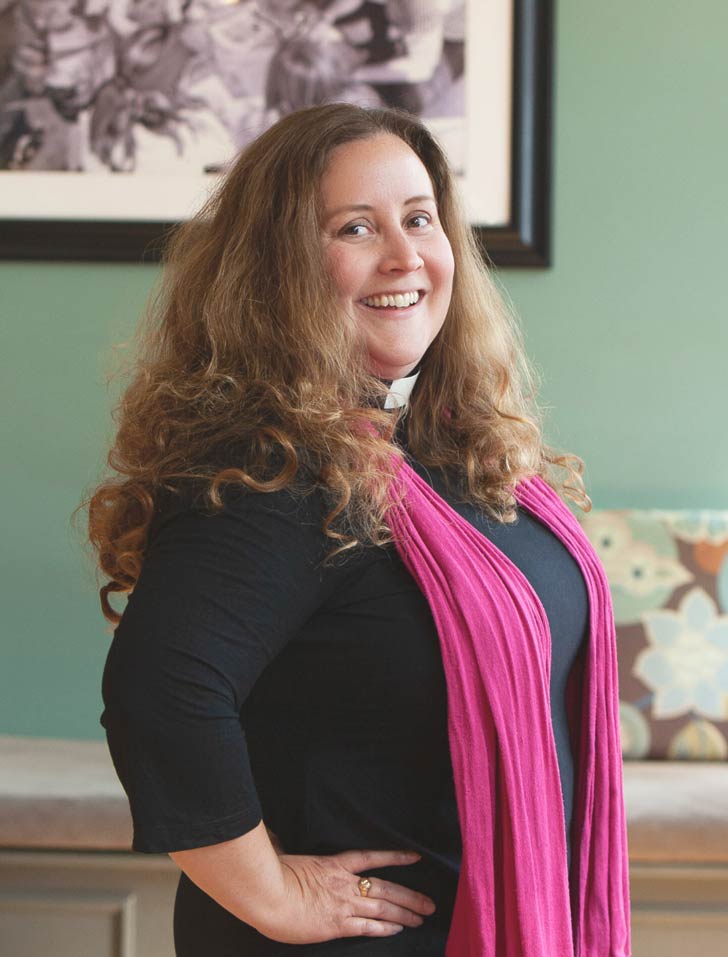
The initiative was led by Rev. Debra McKnight, the Founding Pastor of Urban Abbey, a nonprofit coffee shop, bookstore, and progressive, inclusive United Methodist Church in Omaha, Nebraska.
“When we all saw each other at the Capitol to testify [against the abortion ban bill] we decided we needed to get more organized,” McKnight said about her fellow clergy members in an email to Good Good Good.
“We gathered for coffee at the Abbey, sat down with organizers to ask what we needed to do, and we listened. We began reaching out to clergy networks, asking and asking and asking folks to sign on.”
After raising the funds to run the letter in the state’s two largest editions of the Sunday paper, McKnight was hopeful she’d get the support of at least 100 clergy members. She made it past 120.
“I am so grateful for all the clergy who signed on,” McKnight said. “I know for all of them, it is a risk.”

The ad — which was funded by Urban Abbey UMC, the Religious Council for Reproductive Freedom, and First Unitarian Church of Omaha — reads:
“As Nebraska religious leaders, we stand for reproductive rights and religious liberties. We support and trust our friends and neighbors to make choices about their health care with their physicians, families, and faith leaders. If you feel the same way, please contact your senators. Please oppose LB 626.”
Why is this good news?
While there is certainly room to discuss personal values about abortion and reproductive care, the fact of the matter is that removing access to abortion is life-threatening. Outlawing abortion in any way can lead to long-term health problems, increase the number of pregnancy-related deaths, and cause further harm to communities of color.
Besides, limiting or prohibiting abortion isn’t actually an effective — or safe — way to reduce abortions.
Medical providers fear that a law like this would make it more difficult — if not impossible — to provide essential care to patients, especially considering the complex and individual needs of folks experiencing pregnancy.
The Nebraska Medical Association, the Nebraska Nurses Association, and the American College of Obstetricians and Gynecologists all oppose the bill.
Despite the medical and socioeconomic implications, those in favor of bills like this often cite religious beliefs in their quest to remove access to abortion. McKnight hopes this letter will provide an alternative perspective and invite more nuance to the conversation surrounding both reproductive freedom and faith.
“Reproductive rights have been under attack, and the religious voice has been co-opted as a tool for this oppression,” she said. “We want to be clear that one can be a person of faith and value reproductive freedom. We want to be clear that a faith community can be a place of support and care, rather than judgment and condemnation.”
Part of this belief for McKnight comes back to her work cultivating inclusive faith communities, elevating the voices and experiences of all members of a community. (The Urban Abbey is Omaha’s go-to location for Drag Queen Story Hour.)
“The religious right’s objection to abortion is really born out of politics, not theology. The thing is, most of these churches don’t have religious leaders who have personal experience with reproductive healthcare,” McKnight said. “I know how vital this healthcare is, in part because I have needed it.”
Most of all, McKnight — and the 120 other faith leaders — just want people to have autonomy.
“At the very least, we should not disturb an individual’s healthcare decisions,” she said. “I believe we struggle to understand our bodies and health, and we need more access to health and sex education. If people understood their bodies better and could be in awe of the complexity, they would be less inclined to try to manage the bodies of others.”
Ultimately, McKnight said, if folks still feel like their faith moves them to not seek an abortion, that can be their own decision, or even a decision they make with their own faith leaders.
“However, pressing that belief onto others creates harm,” she said. “It really is an act of domination.”
By bringing together the leadership of over 120 clergy members in the state, she hopes people will think more deeply about the future of reproductive freedom.
“I hope it matters,” McKnight said. “I hope it gives folks pause when they assume that faith means pro-birth. I hope it will invite them to consider how complex our bodies are and how what is the most life-giving choice, or the choice that makes life abundant and wonderful, isn’t always in black and white.”
You might also like:
- How To Protect Abortion Access & Reproductive Freedom
- Best Pro-Choice Posters To Display
- How To Reduce Abortions (Without Banning Them)
Which faith leaders signed the letter?
Over 120 clergy members across five religious faiths in Nebraska endorsed this message about reproductive freedom. Additionally, 14 full faith communities endorsed the ad, which appeared in the Sunday, February 26 edition of both the Omaha World-Herald and the Lincoln Star Journal.
Faith Communities
- Urban Abbey United Methodist Church
- Saint Paul United Methodist Church Lincoln - Health and Justice Team
- First Unitarian Church of Omaha
- Temple Israel
- Nebraska Religious Council for Reproductive Freedom
- The Unitarian Church of Lincoln
- Queer Faith on Campus
- Prairie Vista Unitarian Universalist Community, Scottsbluff
- Mercy & Justice Team of the Great Plains Conference of the United Methodist Church First United Methodist Church, Omaha
- American Muslim Institute
- Tri-Faith Initiative
- Sacred Activism Community
- Kearney Unitarian Universalist Fellowship
- 2nd Unitarian Church of Omaha
Faith Leaders & Clergy
- Rev. Debra McKnight
- Rabbi Steven Abraham
- Rev. Katie Miller
- Rev. Dr. E. Scott Jones
- Rev. Kate West
- Rev. Rebecca Hjelle
- Rev. Penny Greer
- Rev. Brandon Proffitt
- Pastor D. Brown
- Rev. Joshua Sawyer
- Pastor Jessie Lent
- Rev. Fay Ann Blaylock
- Rev. Kenny Blaylock
- Rev. Steven Mitchell
- Rev. Stefanie Hayes
- Rev. Stephanie Ahlschwede
- Rev. Sarah Rentzel Jones, MDiv
- Rev. Charlene Wozny
- Rev. Dr. John Gathje
- Rev. Dr. Jane Florence
- Rev. Michelle M. Reed
- Rev. Stephen Griffith
- Rev. Hollie Schmidt
- Rev. Caitlin Bentzinger
- Rev. Lisa A. Hadler
- Rev. Benjamin Hanne
- Hazzan Michael Krausman
- The Rev. Elizabeth Easton
- Rev. Jim Corson
- Pastor Lowell Hennigs
- Rev. Chad Anglemeyer
- Rev. Shari Woodbury
- Rabbi Deana Sussman Berezin
- Rev. Mr. Lauren D. Ekdahl
- Rev. Dr. Don Bredthauer
- Rev. Nan Kaye-Skinner
- Rev. Kirstie J. Engel
- Pastor Kathy Rice
- Rabbi Batsheva Appel
- Rev. Dr. Lew Kaye-Skinner
- Rev. Dean Joy
- Pastor Tony Dawson
- Rev. Jim Wallasky
- Cantor Joanna M. Alexander
- Rev. Juniper E. Meadows
- The Rev. H. Ashley Hall, PhD
- Rev. Oscar Sinclair
- The Rev. Dr. Jim Keck
- Rev. Erica Nelson
- Rev. Nancy J. H. Phillips
- Rev. Day Hefner
- Deacon Kristin Johnson
- Rev. Dr. Mary Kay Totty
- Rev. Sharee Johnson
- Rev. Dr. Rebecca Z. McNeil
- Bishop J. Scott Barker
- Rev. Irene Prince
- Rev. Dr. Doug Griger
- Rev. Lyn Seiser
- Rev. Cara Jensen
- Rev. Doyle Burbank-Williams
- Rev. Dr. Ron Roemmich
- Rev. Sherry J. Sklenar
- Rev. Karen Jeffcoat
- Rabbi Aryeh Azriel
- Rev. Dr. Keith Herron
- Rev. Lyle K. Schoen
- Rev. Carol Windrum
- Rev. Bethann Black
- Rev. Cindy Beasley Karges
- Rev. Richard O. Randolph, PhD
- Pastor Samm Johnston
- Rev. Warren R. Schoming
- Rev. Cathy L. Cole
- Rev. Debra Tompsett-Welch
- Rev. Nancy K. Flader
- Rev. Beth Graverholt
- Rev. Randall Sailors
- The Rev. Scott Alan Johnson
- Rev. Susan P. Davies
- Rev. Dr. Jim Keyser
- Rev. Melissa Finlaw Draper
- Rev. Dr. Larry Adams
- Rev. Doodle Harris
- Rev. William M. Williams, Jr.
- Rev. Pat Norris
- Rabbi Alex Felch
- Rev. Dr. Sarah Voss
- Rev. Chad Boling
- Rev. Cath Gebers
- Rev. Marshall Johnson
- Rev. Dr. Marcee Binder
- Rev. Joy Simpson
- Rev. Morita Truman
- Rev. Portia Cavitt
- The Very Reverend, Bishop K. Jevon Chambers, ThD
- Rev. Ron Croom
- Rev. Dr. Chris Alexander
- The Rev. Juan Carlos Huertas
- Mr. Karim Khayati
- Rev. Ronald W. Knapp
- Rev. Grant Story
- Rev. Dr. Cynthia Lindenmeyer
- Rev. Dr. Don Sarton
- Rev. Lane Bailey
- Rev. Kelly Karges
- Rev. Kyoki Roberts
- Rev. Judy Waible
- The Rev. Benedict Varnum
- Rev. George Kilmer
- Rev. Reva B. Karstens
- Rev. Richard Mannel
- Rev. Kyle Knapp
- Rev. Gina Gile
- Wendy Goldberg, Tri-Faith Initiative Executive Director
- Rev. Jacob Cloud
- Rev. Abby Caseman
- Rev. David Lux
- Rev. Ken Rood
- Diaconal Minister Sue Rood
When it comes to making ethical and intentional purchases, it’s important to consider our carbon footprints, the labor practices of a company — and who owns and operates that company.
And women-owned and operated businesses are often at the forefront of ethical consumption. It’s a theory that has even threatened women’s success: Women have greater moral reservations about ethical compromises in business.
And you know what? We’re simply thrilled that many women business owners are strong in their convictions for a more ethical, just economy.
Of course, gender is a complex, personal socially constructed concept, but it has very real implications on how we live, work, and thrive in our society. The systems that keep women from succeeding are the same systems that raise boys and men to prioritize capital over compassion — and we’re here to celebrate the people who are paving the way to the end of the patriarchy.
According to the World Economic Forum, women started 49% of all new businesses in the U.S. in 2021, up 28% from just two years prior. More women are becoming entrepreneurs than ever before — and businesses owned by Black women represent the highest rate of growth in the number of total women-owned businesses.
However, in the U.S., men still outnumber women two to one when it comes to business ownership.
We’re here to remind you that you don’t need an excuse like Women’s History Month or International Women’s Day to support a woman-owned business. In fact, we’ve made it even easier to shop from diverse, women-run companies and social enterprises that make the world a better place year-round.
Here is the ultimate guide to women-owned businesses — in fashion, home goods, health and beauty, food, lifestyle, pets, and media — that give back and do good.
By the way, some of the links in this article are affiliate links, which means if you make a purchase after clicking a link, we may earn a commission at no extra cost to you. Thank you!
The best women-owned and women-led businesses that make a difference
Clothing & Accessories
wearwell
Co-founders: Erin Houston & Emily Kenney
What’s good: wearwell is an ethical and sustainable clothing and accessory brand, carrying products specifically aligned with values of secondhand shopping, size inclusivity, vegan values, and uplifting women- and Black-owned businesses.
1% of every wearwell purchase is donated to a nonprofit of the customer’s choice, like FABSCRAP, Black Girl Ventures, and Holler Health Justice.
Girlfriend Collective
Co-founder & creative director: Ellie Dinh
What’s good: Girlfriend Collective makes apparel and underwear made with 80% recycled plastic bottles (RPET). The brand also has a recycling program (the ReGirlfriend program) to help end the waste produced by clothing and contribute to a circular economy.
For Days
Co-founders: Kristy Caylor & Mary Saunders
What’s good: For Days accepts your pre-loved clothes and gives you $20 in Closet Cash toward your next purchase in the brand’s online shop, where you can buy new sustainable items and contribute to a new model of circular fashion.
Also, 1% of every For Days purchase is donated to a nonprofit of your choice, like The Loveland Foundation or Every Body Texas.
Subset
Co-founders: Cayla O’Connell & Lauren Sagadore
What’s good: Subset (formerly Knickey) is a sustainable underwear brand that prioritizes the use of low-impact materials for an eco-friendly and ethical production cycle. The brand also has a recycling program and has recycled over 750,000 items.
INK & ALLOY
Founder & CEO: Gretchen Hollingsworth
What’s good: INK+ALLOY is an accessory brand selling colorful, bold handmade products like jewelry, keychains, and purses. The company donates 5% of all proceeds to the education of girls in India.
Lisa Says Gah
Founder: Lisa Bühler
What’s good: Lisa Says Gah is a clothing and accessory brand dedicated to slow, sustainable, and ethical manufacturing. With a history of charitable giving, the brand has contributed thousands of funds to organizations like The Loveland Foundation, Black Mamas Matter Alliance, Transition Projects, and more.
Richer Poorer
Co-founder & CEO: Iva Pawling
What’s good: Richer Poorer makes sustainable essential clothing items, made with recycled or ethically sourced materials. The brand gives back through the Carbon Fund, as well as Dress For Success Worldwide West, and a number of voting rights organizations.
Birdy Grey
Co-founders: Grace Lee & Monica Ashauer
What’s good: Birdy Grey is a bridesmaid dress and wedding essentials company that partners with The Princess Project to provide pre-loved dresses and accessories to girls in need for prom and other special events.
TomboyX
Co-founders: Fran Dunaway & Naomi Gonzalez
What’s good: TomboyX makes underwear, bras, swimwear and other essentials that are made to be comfortable for everyone, regardless of where they fall on the size or gender spectrum. A certified B Corp, TomboyX is ethical and eco-friendly and has a long history of charitable contributions to LGBTQ+ and social justice organizations.
Mejuri
Co-founder & CEO: Noura Sakkijha
What’s good: Mejuri is a sustainable luxury jewelry company that focuses on traceability and transparency in its craftsmanship, with over 80% of its gold coming from recycled sources.
Mejuri also created the Empowerment Fund, which provides women and non-binary people with broader financial and educational resources to empower themselves.
Wildfang
Co-founders: Emma Mcilroy, Taralyn Thuot, & Julia Parsley
What’s good: Wildfang creates fun, gender-free clothing with inclusivity and sustainability in mind. The brand is Climate Neutral certified and gives back 1% of its annual revenue to causes that matter, sharing funds with organizations like Planned Parenthood, RAICES, ProjectQ, and more.
Home Goods
Parachute Home
Founder & CEO: Ariel Kaye
What’s good: Parachute is a Climate Neutral certified home goods company that prioritizes ethics and responsibility. Investing in both environmental and social justice, Parachute leads carbon offset projects around the globe and has created the Home for Dreams initiative, which supports Black-owned businesses with capital, advisory meetings, and brand amplification.
Pssst… Check out our sustainable bedding guide for more great options like Parachute!
TUSHY
Founder: Miki Agrawal
What’s good: TUSHY is a bidet company fighting for clean butts and a clean planet. By helping to remove our dependence on toilet paper and water, TUSHY aims to create a more hygienic and sustainable bathroom experience.
Plus, a portion of TUSHY profits goes to building community toilets in areas around the globe, fostering a revolution of “dignified defecation.”
Mustard Made
Co-founders: Jess & Becca Stern
What’s good: Mustard Made is a colorful and playful home organization brand made by and for moms. Based in the UK (but with offices and products in the U.S.), Mustard Made donates £5 from every order to Beam, which supports people experiencing homelessness to find secure housing, jobs, and training opportunities.
Jungalow
Founder: Justina Blakeney
What’s good: Jungalow carries all kinds of unique home goods, decor items, and wallpaper that all start as hand-painted designs by founder Justina Blakeney. Aside from prioritizing sustainable materials and thoughtful manufacturing, Jungalow also plants two trees for every one product purchased.
The brand also supports a number of charitable partners like Girls Who Code, The Rainforest Alliance, Southern Poverty Law Center, and more.
Our Place
Co-founder & co-CEO: Shiza Shahid
What’s good: Our Place sells kitchenware and home goods like pans, glassware, and more, all designed to bring people together around food and honor the traditions of immigrants and BIPOC communities.
Many of Our Place’s items are made with partially recycled materials and every order is packaged 100% plastic-free. Additionally, Our Place works with nonprofits like Feeding America to make good food more accessible to all.
Pssst… check out our shopping guide to recycled glassware, too!
Baloo Living
Founder & CEO: Elizabeth Grojean
What’s good: Baloo Living is a weighted blanket company that embraces the comforts of deep pressure stimulation without compromising its eco-friendly values. Baloo is a member of the NYC Fair Trade Coalition and Ethical Brand Directory and practices carbon neutrality through a partnership with Sea Trees by Sustainable Surf (which replants mangrove forests!).
Baloo also donates a portion of profits to Pajama Program, which supports children facing adversity by providing the means to a healthy bedtime.
Lorena Canals
Founder & designer: Lorena Canals
What’s good: Lorena Canals rugs, designed by none other than Lorena Canals, use no chemicals in its production process. The company also created a “RUGCYCLED” collection that uses cotton leftovers and scraps from their other products to maintain a zero-waste status.
The Lorena Canals factory is in India, where more than 170 artisans make each of the pieces by hand under fair trade practices. This is also home to the brand’s Sakûla Project, which provides food and education to low-income children in India.
Pssst… Check out our guide to sustainable rugs for more!
MINNIDIP
Founder: Emily Vaca
What’s good: MINNIDIP is a designer inflatable pool brand to help everyone have a pool party! MINNIDIP regularly donates to charitable partners in areas of environmental conservation, animal rights, childhood cancer and homelessness, and social justice.
Health & Beauty
BLK & GRN
Founder: Dr. Kristian Edwards
What’s good: BLK & GRN was created out of a desire to normalize access to non-toxic beauty products for Black women and to fund Black women entrepreneurs who care about the planet and the products they use every day. All products offered by BLK & GRN are ethically sourced and are made by over 136 Black artisans.
These personal care items are safe for people and the planet and cultivate the Black community with every dollar spent.
Pssst… Check out our guide to Amazon alternatives for more!
OUI The People
Founder: Karen Young
What’s good: Personal care brand OUI The People creates sustainable skincare products and stainless steel razors that “go against the grain.” By prioritizing transparency from product to packaging, OUI The People makes bodycare cool for the planet.
Hero Cosmetics
Co-founder & CEO: Ju Rhyu
What’s good: Hero Cosmetics is a skincare brand (and home of the Mighty Patch). Designed to create effective solutions for acne, rosacea, and dark spots, Hero aims to remove the stigma of skin conditions — and treat them with care.
The brand also works with Carbon Fund to reach full product carbon neutrality.
Megababe
Founder: Katie Sturino
What’s good: Megababe creates innovative products for normal body discomforts like boob sweat, chafing, and underarm bumps. Free of toxic chemicals and made with vegan ingredients, Megababe is good for you and the planet, all while embracing our beautiful bodies just as they are.
Supergoop!
Founder: Holly Thaggard, CEO: Amanda Baldwin
What’s good: Holly Thaggard started Supergoop by working to make sunscreen available in schools in Texas. In addition to protecting its customers from the sun, Supergoop continues to donate SPF pumps to schools across the country through their Ounce by Ounce program.
RÓEN Beauty
Founder & CEO: Tiffany Thurston Scott
What’s good: Founded by clean makeup enthusiast Tiffany Thurston Scott, RÓEN Beauty creates makeup and beauty products formulated with ingredients that are vegan, gluten, and cruelty-free. The brand is also part of the Responsible Mice Initiative, which ensures that any mica used in makeup products is carefully selected from raw material manufacturers and 100% ethically sourced.
The brand also partners with TerraCycle to help customers recycle their outer makeup packaging.
maude
Founder & CEO: Éva Goicochea
What’s good: maude makes body-safe sexual wellness essentials that are inclusive to all and made sustainably. The brand furthers its mission of accessible and inclusive sexual wellness by working closely with organizations like Advocates for Youth and SIECUS (Sexuality Information and Education Council of the United States)!
→ Explore our full reviews of all maude sex toys, maude lubes, and other maude products
Pink Moon
Founder & CEO: Lin Chen
What’s good: Pink Moon is a skincare and wellness brand founded on the owner’s long-held practices of Traditional Chinese Medicine, Reiki, and Astrology. By partnering with EcoCart to provide carbon-neutral shipping, Pink Moon has offset over 334,000 pounds of carbon while providing its signature eco-conscious products.
Pink Moon also donates 1% of every purchase to a nonprofit of your choice, like Animal Haven and Womankind.
SAALT
Co-founder & CEO: Cherie Hoeger
What’s good: SAALT is on a mission to “bring periods out of the dark ages” by creating reusable, safe menstrual products for all. With menstrual discs and cups, as well as period underwear, the brand aims to make having a period better for the planet — and in general!
A certified B Corp, SAALT also donates 2% of its revenue to provide period care to regions with the most need, and help fund initiatives in menstrual health, education, and sustainability.
The brand has donated over 52,000 period products, cleaned up over 78,000 pounds of trash, and funded over 373,000 days of school for girls around the globe.
Rael
Co-founders: Yanghee Paik, Aness An & Binna Won
CEO: Yanghee Paik
What’s good: Rael is a holistic wellness brand that promotes full-cycle care (so they have goods for periods and skincare!), using cruelty-free and eco-conscious ingredients. Embracing Korean beauty science, Rael aims to provide high-performing period care across the globe.
Rael is also on a mission to spread menstrual dignity to all, working with charitable partners like #HappyPeriod and I Support The Girls.
Ritual
Founder & CEO: Katerina Schneider
What’s good: Ritual was created when founder Katerina Schneider couldn’t find a prenatal vitamin she felt she could trust — so she set out to make her own. Ritual creates vitamins with completely traceable ingredients, from farms and suppliers that use regenerative agriculture practices.
A certified B Corp, Ritual is also committed to its sustainability goals, aiming to have 100% sustainable packaging by 2025 and reach net zero emissions this year.
Food
Seattle Chocolate Co.
Owner & CEO: Jean Thompson
What’s good: Eating sweets has never been so good. Seattle Chocolate Co, and its sister company jcoco, make up an ethical chocolate umbrella that gives back. The company’s origin chocolate is directly sourced from small Peruvian Farms and it uses Rainforest Alliance Certified cocoa in its large line of products. As of 2022, the brand is also certified carbon neutral!
Best of all, Seattle Chocolate Co. donates 10% of its net profits to Girls Inc, and jcoco donates fresh servings of food to those in need with every purchase. Partnering with food banks in Washington, California, and New York, the company has donated nearly 4 million servings of food.
Sips By
Founder & CEO: Staci Brinkman
What’s good: A top-rated tea club and subscription service, Sips By works with hundreds of tea brands across the globe to bring people together over a steamy mug of tea. Sips By partners include other women-owned brands, as well as BIPOC-owned, AAPI-owned, and LGBTQ+-owned small businesses that practice ethical and sustainable sourcing.
Fly By Jing
Founder & CEO: Jing Gao
What’s good: Fly By Jing creates spicy Schezwan sauces, spices, and dumplings inspired by the flavors of founder Jing Gao’s hometown of Chengdu. With bold, soulful tastes and bright design, Fly By Jing highlights the personal cultural histories of its founder — and the AAPI community.
Adding a little spice to the fundraising scene, Fly By Jing has also worked with charitable partners like St. Jude Children’s Hospital and BeChinatown.
Diaspora Co.
Founder & CEO: Sana Javeri Kadri
What’s good: Sana Javeri Kadri started Diaspora Co. when she was 23 in 2017, selling just one item: Pragati Turmeric. Her desire was to create a radically new, equitable spice trade.
Today, Diaspora Co. sources 30 single-origin spices from 150 farms across India and Sri Lanka, paying farm partners an average of over six times above the commodity price, investing in land stewardship, climate resistance, and delicious food systems.
Part of this work is through the company’s Farm Worker Fund, which invests in the social and economic well-being of over 850 farm workers in South Asia. Diaspora Co. has also provided healthcare access to 25 women in the farm community.
Women’s Bean Project
Founder: Jossy Eyre, CEO: Tamra Ryan
What’s good: The Women’s Bean Project is a nonprofit social enterprise that provides transitional employment and self-sufficiency to women experiencing poverty.
Making nourishing products while nourishing the community, Women’s Bean Project now sells products through over 1,000 retailers, and has helped to keep 95% of their program graduates employed a year after completing their program.
Omsom
Co-founders: Vanessa Pham & Kim Pham
What’s good: Sisters Vanessa and Kim Pham created Omsom to offer sauce packets and starters that celebrate the multitudes of Asian flavors, stories, and communities. While opening up diverse flavor profiles and having conversations about big topics like xenophobia and the “ethnic aisle” in the grocery store, Omsom doesn’t shy away from being loud and proud.
Through their brand, the duo has also worked to give back to the AAPI community, donating to Heart of Dinner, to feed AAPI elders in New York City.
Partake
Founder & CEO: Denise Woodard
What’s good: Partake was born out of a mom’s desire to make tasty snacks for her daughter, who has many food allergies. Selling cookies, breakfast and baking mixes, and snack packs, every offering at Partake is certified gluten-free, non-GMO, and vegan. They are also free of the top nine allergens: wheat, tree nuts, peanuts, milk, eggs, soy, fish, sesame, and shellfish.
While championing food inclusivity (did you know Black children are at a significantly higher risk for developing food allergies?) Partake also works with organizations like No Kid Hungry to fight food insecurity. Denise also founded Black Futures in Food & Beverage, an annual fellowship program that mentors HBCU students to help them secure internships and jobs in the food industry.
Buchi
Co-Founders: Jeannine Buscher & Sarah Schomber
What’s good: Buchi is a kombucha brand dedicated to community, collaboration, and culture (pun intended). Ingredients are sourced through closed-loop, carbon-neutral sugarcane processes, and for other ingredients, preference is given to independent, women-owned, and minority-owned suppliers.
Buchi also partners with One Tree Planted to work on reforestation projects around the world.
Lifestyle
Package Free Shop
Founder & CEO: Lauren Singer
What’s good: Package Free Shop is your one-stop shop for sustainable everyday items. With zero or minimal packaging, every item sold by Package Free Shop can either be composted, reused, refilled, or recycled.
The brand encourages shoppers to lean into a planet-forward lifestyle, and since its launch in 2017, has diverted 132 million plastic bags, 48 million plastic straws, and 3.8 billion plastic water bottles from oceans and landfills.
Thistle Farms
Founder & President: Becca Stevens
CEO: Tasha Kennard
What’s good: Thistle Farms is a nonprofit social enterprise that makes candles, lotions, essential oils, and more. Not only does every purchase support women survivors of trafficking, prostitution, and addiction — but the organization also houses residents in a therapeutic setting that offers them housing, healthcare, therapy, work, and community.
Stasher
Founder: Kat Nouri
CEO: Shannon Morgan Stearns
What’s good: Stasher creates alternatives to plastic bags, making it easy to reduce food and plastic waste. In fact, since its founding, the company has saved over 5.5 billion single-use plastic bags from entering waterways and oceans.
Stasher also donates 1% of its sales to environmental nonprofits, totaling over $1.3 million in donations to date.
The Little Market
Co-founders: Lauren Conrad and Hannah Skvarla
What’s good: The Little Market is a nonprofit fair trade shop that features ethically-sourced and artisan-made products. By celebrating individual artisans and their cultural techniques and traditions, the Little Market brings attention to social justice and human rights issues while extending opportunities for people around the world.
Marley’s Monsters
Owner & president: Sarah Dooley
What’s good: Marley’s Monsters creates handmade reusable products UNpaper towels, cloth napkins, dusters, and more. These sustainable alternatives help minimize your carbon footprint and save trees, all while making your home a bit more colorful.
Marley’s Monsters also diverts all of its fabric waste by donating scraps to St. Vincent de Paul Society of Lane County and ENVIA Fashion, where they are upcycled into other new products like jewelry, hair accessories, and more.
Blueland
Co-founder & CEO: Sarah Paiji Yoo
What’s good: Blueland is a Climate Neutral certified B Corp that designs reusable and refillable cleaning products like laundry essentials, hand soaps, cleaning sprays, and more. Since 2019, Blueland products have helped eliminate over a billion single-use plastic bottles from landfills and oceans.
Pets
Rowan
Co-founders: Michelle Arnau & Sally Clarke
What’s good: Rowan is reinventing coat care with naturally-derived formulas made with human-grade, vet-approved ingredients that keep your pup’s skin healthy, fur shiny, and smelling like coconuts (there’s even dry shampoo for dogs!). Plus, 1% of every purchase is donated to a nonprofit of your choice, like The Street Dog Coalition or Sage Compassion for Animals.
Springer
Co-founder & CEO: Shannon Ross
VP of Finance & COO: Diana Ross
What’s good: Springer creates innovative products for dogs and their parents, like travel bottles, walking gear, and more. As a member of 1% for the Planet, Springer also donates 1% of its sales to nonprofits that protect the environment — because there’s no better playground for pups than Mother Earth.
Dandylion
Founder & CEO: Carolyn Chen
What’s good: Dandylion is a dog skin and coat care company with natural products created in collaboration with vet dermatologists, chemists, groomers, and over 100 dog parents. Products — like this no-rinse paw cleanser — are pH-balanced and formulated with sustainably sourced ingredients that are vegan and cruelty-free.
All packaged with recycled, recyclable, compostable, or biodegradable options — often by Chen and her family themselves. Dandylion also gives back to animal rescue organizations like Hope For Paws.
Cat Cave Co.
Founder & CEO: Holly Hudson
What’s good: Cat Cave Co. makes cat beds and products from ethically-sourced, organic merino wool. The brand pays its workers 200% the average wage and gives back to local shelters and rescues.
Dog Threads
Co-founder & CEO: Gina Marie Davis
What’s good: Offering a large collection of matching dog and human apparel items, Dog Threads donates a portion of each purchase to an animal rescue nonprofit to help shelter animals in need. The brand also recycles its scrap fabric to create donated dog beds!
FOUND My Animal
Co-founders: Bethany Obrecht and Anna Conway
What’s good: FOUND My Animal sells rope leashes, collars, pet apparel, and accessories that promote animal adoption. Unique to each leash is a simple, numbered brass tag that reads “FOUND” and a portion of all sales go to support animal welfare and rescue organizations.
Pets available for adoption are also widely shared across the brand’s social media pages.
Media
Pantsuit Politics
Co-founders: Sarah Stewart Holland & Beth Silvers
What’s good: The hosts of the Pantsuit Politics podcast take a different approach to the news, looking at politics through lenses of nuance, compassion, and care.
The Newsworthy
Founder: Erica Mandy
Erica Mandy is an award-winning broadcast journalist and former CBS news reporter who started The Newsworthy, a daily news podcast to help people stay informed in a convenient, unbiased, and fun way. Her show empowers hundreds of thousands of listeners to engage more deeply with the world around them.
The GIST
Co-founders: Ellen Hyslop, Jacie deHoop & Roslyn McLarty
What’s good: We all love a great newsletter! The GIST is a fan-first sports media platform that is reinventing the dialogue around sports by providing equal coverage of women’s and men’s sports. Whether you’re checking out the newsletter or listening to the podcast, the GIST will be there with bit-sized and badass sports coverage.
The 19th News
Co-founder & CEO: Emily Ramshaw
Co-founder & publisher: Amanda Zamora
Editor-in-Chief: Julia B. Chan
What’s good: The 19th is a nonprofit newsroom beloved for its reporting at the intersection of gender, politics, and policy. Supported by members, philanthropy, and corporate underwriting, the 19th offers free-to-consume and free-to-publish journalism — especially produced for women, women of color, and the LGBTQ+ community.
Girlboss
Founder: Sophia Amoruso
CEO: Lulu Liang
What’s good: Girlboss is a modern media company providing women all over the world with the tools and mindset to succeed. Whether you’re reading the Girlboss Daily newsletter, shopping Girlboss goods created by women, or listening to Girlboss Radio, you’re uplifting ambitious women everywhere.
→ Subscribe to the Girlboss Daily newsletter
Whether it’s a scruffy rescue dog, a talkative parrot, a majestic bison, or a goofy-looking blobfish, we all have a favorite animal. The human-animal bond is something researchers have studied for years — and something Indigenous communities have honored for millennia.
So, it’s no surprise the United Nations decided to recognize March 3 as World Wildlife Day internationally.
While threats to biodiversity come as a tragic — although expected — consequence of climate change, rallying together with love for animals, their habitats, and their futures, is a great way to fight these threats head-on.
With that in mind, World Wildlife Day serves as a time to ensure the sustainability of endangered species, celebrate the ways wildlife make our planet so beautiful, and come together to take care of the Earth and all who inhabit it.
But first, a little history lesson:
5 Facts About World Wildlife Day
- On December 20, 2013 The United Nations General Assembly proclaimed World Wildlife Day to be March 3.
- Before it was recognized by the UN, World Wildlife Day was created by the Convention on International Trade in Endangered Species of Wild Fauna and Flora (CITES) in 1973.
- This year is the 50th anniversary of CITES, making 2023’s World Wildlife Day even more celebratory.
- CITES is an international agreement between governments that ensures international trade of wild animals and plants does not threaten the survival of that species, granting protection to over 37,000 species around the world.
- World Wildlife Day has become the most important global event dedicated to the world’s wild plants and animals.
While it’s important to learn more about wildlife and do our part to protect all living beings and environments every day, it’s helpful to have somewhere to start. We’ve created a guide on how to celebrate World Wildlife Day this year.
By the way, some of the links in this article (like books!) are affiliate links, which means if you make a purchase after clicking a link, we may earn a commission at no extra cost to you. Thank you!
How to celebrate World Wildlife Day
Learn
Learn more about animals — especially endangered species.
One of the best ways to get involved and impassioned about a topic is to simply learn more about it. Whether you expand your wildlife knowledge through a National Geographic subscription, by checking out books at your local library, or just being in nature and observing the plants and animals, you’ve already celebrated this special day.
Read books about wildlife.
Build your bookshelf with some helpful books about wildlife! Here are a few standout selections:
- “In The Shadow of Man” by Jane Goodall (Bookshop) (Amazon)
- “Love, Life, and Elephants: An African Love Story” by Daphne Sheldrick (Bookshop) (Amazon)
- “The Humane Gardener: Nurturing a Backyard Habitat for Wildlife” by Nancy Lawson (Bookshop) (Amazon)
- “Wilding: Returning Nature to Our Farm” by Isabella Tree (Bookshop) (Amazon)
- “Saving Us: A Climate Scientist’s Case for Hope and Healing in a Divided World” by Katharine Hayhoe (Bookshop) (Amazon)
Watch a documentary about wildlife.
As far as documentaries go, there is a wealth of wildlife films and documentary series to pique your interest and give you a whole new outlook on our world. Consider sitting down and enjoying one (or more!) of these classics:
- Wonders of The Ocean (National Geographic)
- Our Planet (Netflix)
- Wild Babies (Netflix)
- Our Great National Parks (Netflix)
- Life in Color with David Attenborough (Netflix)
- Great Migrations (National Geographic)
Read good news about animals.
Part of the fun of celebrating wildlife also means celebrating good news about wildlife. We’re all about good news at Good Good Good — and we create an Animals Edition of our Goodnewspaper every year.
Plus, we have a whole library of good animal news stories to inspire you, too.
- American Bison Are Making A Major Comeback
- Wildlife Crossings Built With Tribal Knowledge Drastically Reduce Collisions
- Conservation Efforts Are Saving Humpback Whales
- Nepal’s Conservation Efforts Have Nearly Doubled Their Tiger Population
- Turning ‘Ugly’ Animals Into Memes Could Be the Key to Their Conservation
- Meet These Famous Animal Conservationists You Might Not Know Yet
Take Action
Donate to a wildlife conservation organization.
Do your part to help fund animal conservation efforts. There are so many large and local wildlife organizations to choose from, and any amount you can give is meaningful.
If you can, setting up a recurring donation can make a huge impact, all while saving you time in the long run. Here are a few wildlife conservation nonprofits to keep in mind this World Wildlife Day:
- International Fund for Animal Welfare
- World Wildlife Fund
- Wildlife Conservation Society
- Jane Goodall Institute
- National Wildlife Federation
Take part in a World Wildlife Day event
On the official World Wildlife Day website, you can find a map of events around the globe that celebrate the awareness holiday.
You can also tune in online to the 2023 World Wildlife Day Global Event on March 3, broadcasting live on YouTube from Washington DC.
Volunteer with a local wildlife preserve, botanical garden, or national park
Put your wildlife skills and passions to the test by volunteering at a local wildlife preserve, botanical garden, or state or national park. Even if you just spend some time in a local park picking up trash, you’re doing your part!
If you have especially helpful expertise, you can do some on-the-ground work with plants and animals. Not sure where to start? Take World Wildlife Day as an opportunity to reach out to conservation projects, wildlife rehabilitation centers, or state park offices to see where your help is needed.
Do your part to protect wildlife every day
While World Wildlife Day is a fun and celebratory way to get involved with the care of plants and animals around the world, these passions should not only be limited to a single day each year.
Take this time to consider what ways you can make lifestyle changes that better take care of the planet and its diverse ecosystems. Consider putting a monthly park/ocean/beach/pond/lake clean-up date in your calendar. Figure out what native plants you can add to your yard. Take a train instead of a flight.
The possibilities are endless, and we need your brilliance to make this world a better place for wildlife.
Frequently Asked Questions
What is World Wildlife Day?
World Wildlife Day is an international celebration of wild plants and animals that takes place on March 3 every year. This day recognizes the beauty of life on planet Earth and encourages us to preserve biodiversity on a global scale.
What does World Wildlife Day do?
World Wildlife Day brings together wildlife conservation partners, animal lovers, and wildlife experts to celebrate the biodiversity of our planet and encourage us to take action in plant and animal conservation. This happens through events, speeches, marketing campaigns, and more.
What is the theme of World Wildlife Day 2023?
In 2023, the theme for World Wildlife Day is “Partnerships for Wildlife Conservation.” This theme celebrates all conservation efforts, from intergovernmental to local initiatives, and focuses on two sub-topics: marine life and oceans, and business and finance dedicated to wildlife conservation.
What was the theme of World Wildlife Day 2022?
In 2022, the theme for World Wildlife Day was “Recovering Key Species For Ecosystem Restoration.” This theme was designed and celebrated to raise awareness for both endangered and critically endangered wildlife, and to highlight the work of conservation efforts worldwide.
In the United States, motorcycles make up only 3% of all registered vehicles, though motorcyclists account for 14% of all traffic fatalities, according to the National Safety Council.
While the fresh breeze and exhilarating journey of a motorcycle expedition may be enticing to many riders, the safety concerns are real — especially when there are no standard safety features that a car or other vehicle would include.
This leaves folks to get creative — like Moses Shahrivar, an award-winning clothing designer and motorcyclist who has designed the innovative Mo’cycle Airbag Jeans.
Shahrivar has been designing motorcycle jeans for nearly two decades, and his first design was sold by Harley Davidson stores in Sweden. However, his most recent innovation is sure to transform the future of motorcycle riding.
What are airbag jeans?
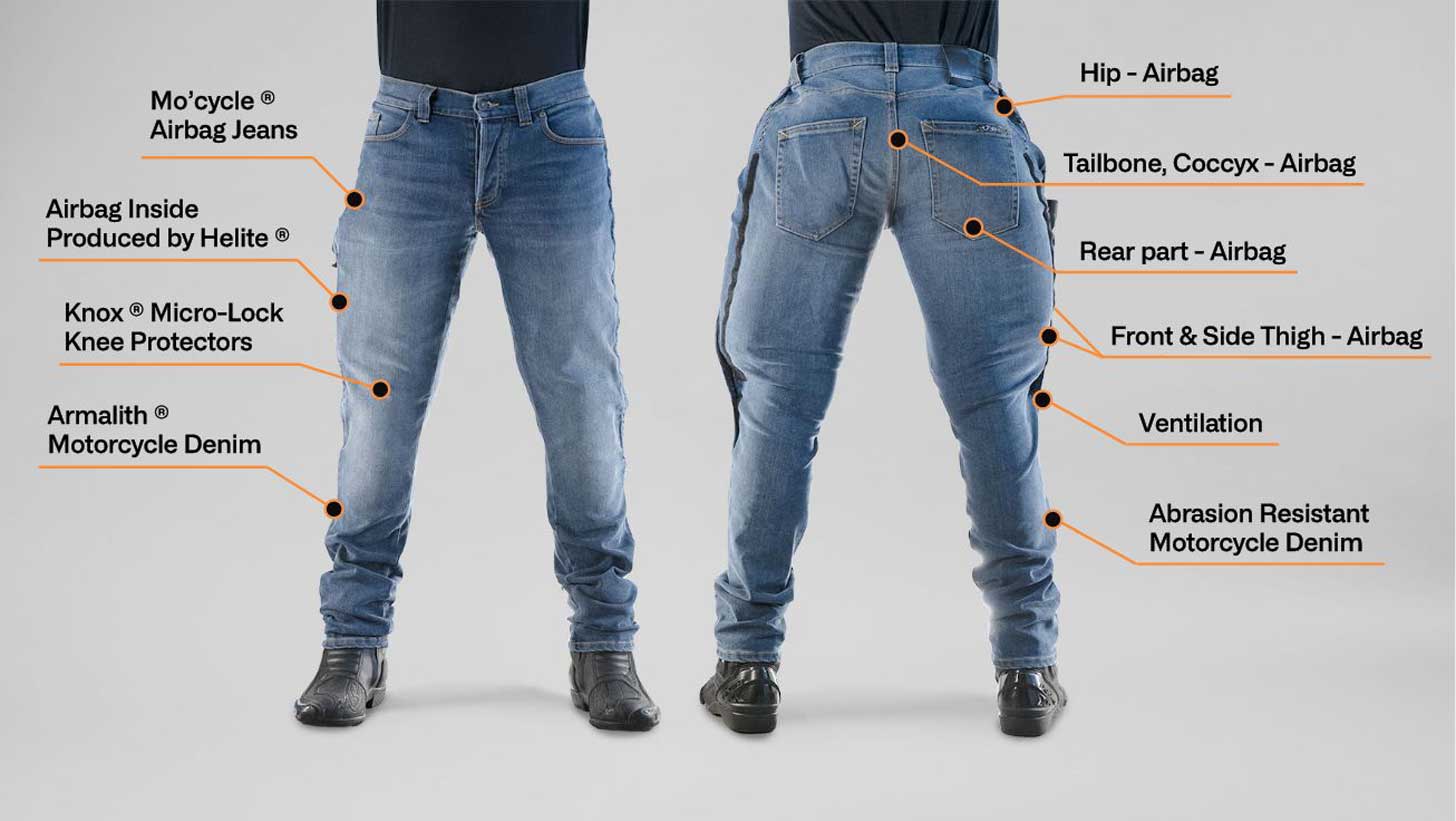
Shahrivar’s Airbag Collection was funded by the European Union, as well as investors from Dragons’ Den (the Swedish version of Shark Tank), in an effort to develop the safest riding clothes in history.
The jeans appear to be normal riding pants, but if an accident occurs, the airbags deploy and inflate to protect the hip, tailbone, and thighs. The gear is also water-repellent and made to be comfortable in any climate. Users can also take out the airbag and throw the pants in the wash and can replace airbag cartridges with ease.
The airbag cartridges are made with CO2 and inflate with gas when a rider falls from their motorcycle. Inflating before impact with a “dead-man’s switch” mechanism, the airbags deploy if a rider is physically and forcefully removed from their bike.
Shahrivar has also created an Airbag Vest, which utilizes the same tech and protects the heart and other vital organs and includes an inflatable helmet to go over the head for additional protection.

These items have been crash-tested and even helped protect Shahrivar in a recent accident.
“It took us 16 years to finally solve the long-lasting problem of protecting the lower body against impact hits,” the Mo’cycle Indiegogo page reads. “The Mo’cycle Airbag jeans is a revolutionary piece of riding gear as spinal column injuries tend to become permanent.”
Why is this good news?
The truth is: Riding a motorcycle is dangerous — but there are ways to make it safer. By creating practical safety gear that looks good enough that serious motorcyclists want to wear them, we can save lives.
It’s also always inspiring to see someone use their talents, skills, and experience (in this case, expertise in making jeans for motorcyclists) to make the world a better place. Hopefully this creative endeavor inspires even more life-saving fashion in the future.
Where can I buy Mo’cycle Airbag Jeans?
Riders can purchase their airbag gear through the brand’s Indiegogo page. The jeans and vest individually start at about $530 USD, though shoppers can buy the whole outfit for just under $1,000 USD.
Foo Fighters frontman Dave Grohl had Los Angelenos singing “there goes my hero” last week when he showed up to Hope the Mission’s Trebek Center in Northridge. The musician came ready to barbecue for 500 community members, as a storm rolled in.
On February 22, he came prepared with his own meat smoker, covering all expenses, and worked for nearly 24 hours, smoking meat for 450 guests and 50 staffers.

Hope the Mission supports Los Angeles community members who are facing poverty, hunger, and homelessness — and Grohl hoped to feed them all, especially as the area faced inclement weather.
When Grohl wasn’t preparing “ribs, brisket, pork butt, and all the fixin’s,” he took nap breaks in the parking lot. While he certainly puts his whole heart into performing, Grohl showed he also had a heart for helping.

Hope the Mission’s president and chief financial officer Rowan Vansleve was out of town for a charity event when Grohl came by, but based on text updates from the organization’s team, Vansleve was confident the rockstar was ready to handle the barbecue on his own.
“He turns up at 6 p.m., and then this meat truck gets delivered,” Vansleve told the Los Angeles Times.
“And it’s like an obscene amount of food. It’s unbelievable, the guy spent thousands of dollars. And he is in there by himself in our little food prep area, trimming the fat off, making sure every single one’s perfect. He’s got all of his mates together. They’re backing in these giant smokers.”
Dave Grohl’s love of barbecue
Grace Ancheta, director of development at the nonprofit, said Grohl took the task very seriously — and that his food was some of the best barbecue the shelter had ever seen. This makes sense; Grohl has a love for the barbecue pit and says cooking is a way to unwind after getting off stage.
He even created Backbeat BBQ, a one-man barbecue catering operation — a lower stakes (or should we say… steaks) touring endeavor he brings to events and benefits.
In fact, this isn’t the first time he’s used food for good. Grohl cooked for a crowd when fires hit Malibu in 2018, providing meals for displaced community members and firefighters.
Ancheta saw his passion first-hand.
“He actually served to our guests, he came out and was very gracious and took pictures with the people that recognized him,” Ancheta told the TODAY Show. “He wanted no glory for it, he was like, ‘I just want to do this for you guys and give back in that way.’”
It turns out, Grohl is a prodigious guitarist, grill master, and do-gooder all the same.
“The process of making music is a lot like cooking for a crowd,” he told Bon Appetit in 2019. “You create a recipe as you would a song. You prepare a meal as you would record in a studio. And you serve it as you would perform live. When people come back for seconds, well, that’s your encore.”
Why is this good news?
While it always brings a smile to our face when our favorite celebrities and artists use their platforms for good, Grohl touches on a deeply important issue facing folks in Los Angeles: Food insecurity.
Especially as climate change impacts both people and the planet through weather disasters, people need access to necessities like food and shelter.
In fact, nearly a quarter of all Los Angeles households face food insecurity, up 7% since 2021, according to research from the University of Southern California.
So, without telling anyone, Dave Grohl brought his giant smoker and cooked/fed barbecue and sides for 500 folks at Hope Mission in L.A. during the storms. Paid for it all. Worked 16 hours. So, when the aliens get here and ask “who’s in charge?”, I think we take them to Dave… https://t.co/CFIH4GOsfb pic.twitter.com/6BrUqjsgA6
— Liz Allman Seccuro (@LizSeccuro) February 28, 2023
Having access to good, meaningful meals is only part of fighting unjust food systems, and we’re glad Grohl is doing his part to make that happen.
Writer Liz Allman Seccuro tweeted it best: “When the aliens get here and ask ‘who’s in charge?’ I think we take them to Dave Grohl.”
Susan Corbett, the founder of Maine’s National Digital Equity Center (NDEC), lives in one of America’s most remote rural regions.
The population density is under 10 people per square mile.
Winters are brutal.
Health care can be hours away.
She knows first-hand how fast her community can tumble without a safety net.
When the pandemic’s shelter-in-place order went into effect in 2020, Corbett and her team witnessed the severe isolation and loneliness of many elderly people in her community.
The Digital Equity Center responded quickly. Working with a philanthropy, they sent out fully loaded tablets with cell connectivity and a Zoom link to people over 70.
“The instructors would use the phone to teach them how to turn on the computer saying, ‘Run your finger up the side of the tablet and press the button it on,’” Corbett said.
“The goal was to get the person to click on the Zoom link. When they did, you can imagine their pure joy when connecting for the first time and seeing the instructor.”
Elaine Abbott was one of Corbett’s instructors. Today she is a community and economic development planner for Sunrise County Economic Council.
“We are dinosaurs,” she said candidly in an interview. “Our infrastructure is so outdated that it is absolutely frightening. The communities throughout our county know that digital equity and infrastructure go hand in hand. We’ve been slow getting started but we are working fast to catch up.”
Since the pandemic, Corbett, Abbott, and others have been working with the region’s Passamaquoddy tribal leaders, broadband consultants, state agencies, and regional boards to assess the region’s needs and develop a broadband coalition strategy providing access to all citizens of Maine, regardless of their zip code.
Last month, National Digital Inclusion Alliance (NDIA) named Maine’s National Digital Equity Center as one of 18 grant recipients from across the country to become part of the nation’s first National Digital Navigator Corps.
In their press release, NDIA stated the grants will go toward hiring community-based digital navigators alongside programmatic and technical support to help thousands of residents gain much-needed access to the internet, devices, and digital skills training.
Corbett sees this as an opportunity to train “boots on the ground” navigators to help her own region while creating a navigator model for the state of Maine, and then raise funds for digital navigators statewide.
As the navigator’s training gets underway, Corbett is partnering with Abbott and others building coalitions across the state to make broadband accessible and affordable.
Chris Waite, a tribal broadband consultant for the Wabanaki Nations/Four Directions Development is part of that coalition.
“Without the pandemic, the financial investment from the government would never have happened,” Waite told me during a conversation about the challenges of getting broadband to remote regions.
“Maine, which is probably one of the most divided states with some of the biggest gaps, is coming together. They’re building fiber networks and going that extra step of creating digital inclusion and literacy from the ground up. Without that, it’s not going to work.”
While broadband is being installed, NDEC’s Washington County navigators will work within over 40 towns, some with populations under 25 people.
“Our plan,” Corbett said, “is to hire two navigators. One will work with older adults through the county. The other will hopefully be a tribal member working with communities on tribal lands.
“Navigators will guide people through the entire digital inclusion process, from assessing the full scope of their home connectivity needs, determining the right devices for their need, and directing them towards resources that are suitable both for their skill level and lifestyle.”
“It’s going to take a lot of listening,” Corbett said. “Mapping the needs of the communities they serve will be the first step. For this program to work, we need to take time and do a lot of listening before deciding the path forward. Both communities need to help us design and build this program so that they have ownership of it. The most important thing to do as we launch this program is to ensure we are understanding what the challenges might be for the community and help find a solution.”
Maine Secretary of State Shenna Bellows applauds this work. Raised in a household without electricity until 1985, she sees the lack of broadband access as an even starker disparity than her lack of electricity.
“In this day and age, where you have so much learning taking place online, where work opportunities for certain sectors require the ability to access the internet, where telehealth was mandated because of limitations and restrictions on people’s ability to reach in person services, whole populations are losing pace with change. Even worse, they’re becoming invisible.”
Digital equity is a fundamental part of social equity, Bellows said.
“We can’t have full social equity until every member of the community, including communities of color and indigenous communities, have digital equity,” she said.
“It’s critical and fundamental that we have broadband infrastructure across the country. The digital navigator corps goes hand-in-hand with infrastructure investment.”
In April of his senior year at Timberline High School, after years of conflict at home, Mikel Jake “MJ” Dizon became homeless.
He was a few months from graduation, but considered dropping out of school to focus on his job as a Starbucks barista to make money for rent. This decision could redirect the course of Dizon’s life.
Only 59% of homeless students in Washington state graduate in four years compared to 83% of all students. A similar disparity exists nationally as well.
This has a snowball effect. Not having a high school degree is the greatest single risk factor for experiencing homelessness after school, according to the Chapin Hall research institute at the University of Chicago.
The longer a person remains homeless, the more difficult obtaining stable housing becomes.
If a homeless student becomes a chronically homeless adult, they more often require not only housing but also services for mental health, physical health, and substance abuse treatment.
But at North Thurston Public Schools, the 661 students like Dizon, who are sleeping on friends’ couches, in vehicles, in shelters or in tents — with or without their families — are graduating at nearly the same rates as their peers.
The district has shown that this feat just requires dedicated and consistent support.
The Seattle Times’ Project Homeless is collaborating with the Center for Public Integrity to examine how homeless students are faring in Washington and across the U.S. This series will also include a look at school discipline rates for Washington’s 40,000 homeless students, as well as federal funding disparities among states.

Beginning six years ago, North Thurston hired staff, called “student navigators,” whose sole function is to attend to each homeless student’s needs, whether that’s housing or food, feeling like they belong at school, or planning for the future beyond graduation.
It has worked.
North Thurston’s graduation rates for homeless students rose from 65% in 2017 to 84% in 2020 and 81% in 2021 — within 7 percentage points of the district’s overall graduation rate.
State education officials say that North Thurston has provided a blueprint to limiting the impact that homelessness has on the rest of a student’s life. Now, they just need the money to scale it up.
Our mantra is “remove all barriers”
Since Dizon’s family immigrated to the United States from the Philippines in 2015, he said he’s been forced to leave his home three times due to conflicts with his parents, at times because he didn’t feel safe there.
“I came out of the closet to my parents, and my father wasn’t so accepting,” Dizon said. “They didn’t want to be my parents anymore. And I wasn’t their son.”
Forty percent of homeless youth identify as LGBTQ, 68% of whom cite family rejection as a major reason they become homeless, according to the Raikes Foundation.

Dizon wasn’t able to sleep at night his senior year when he realized he would become homeless. He had trouble waking up in time to attend drama, his favorite class. Soon, he was failing a class and drowning in all the tasks he needed to complete.
His boyfriend’s mom, a teacher at the district, told him a student navigator could help him.
Dizon connected with Gina Goddard, the student navigator at Timberline High School, who invited him into her office and spent hours on the phone with him to sign up for food stamps, and helped connect him with a foundation that provided him money for rent.
“If you are worried about whether or not you’re going to be able to eat or where you’re going to sleep, it is very, very hard to concentrate on your Spanish test,” said Leslie Van Leishout, who helped create North Thurston’s student navigator program in an effort to “remove all barriers” for homeless students.
That support pulled Dizon above water.
How North Thurston’s student navigator program began
The amount of time student navigators have to spend with their homeless students is what sets North Thurston apart from many other districts.
Before North Thurston had a student navigator in each high school, the district had a single homeless student liaison who was in charge of supporting about 900 homeless students and a similar number of foster care children.
Every school district in the nation is mandated to have a liaison under the McKinney-Vento Act, a federal law passed in 1987 to ensure that students experiencing homelessness “have access to the same free, appropriate public education” as other children.
But the law and the accompanying federal funding don’t provide the level of support homeless students need, education officials and advocates say.
Much of the North Thurston liaison’s time, Van Leishout said, was spent on paperwork and meetings rather than one-on-one support for homeless students.
Many have duties beyond even that. Sometimes, the McKinney-Vento liaison is also a principal or the district’s superintendent. Nearly 60% of McKinney-Vento liaisons statewide said they have less than four hours a week to serve homeless students, according to a 2022 report by the state’s Office of Superintendent of Public Instruction.

Washington state passed several laws in the last decade to strengthen the McKinney-Vento Act, one requiring every individual school in the state to designate a staff member as a point of contact for homeless students.
But that had the same problem of adding duties onto already burdened staff, usually counselors.
Van Leishout wanted to try something new in North Thurston. Formerly a teacher in the district for almost 20 years, and director of student support for seven years, she had the superintendent’s trust to try new ideas, and she could write the grant applications to support them.
She repurposed federal McKinney-Vento Act funding the district was using primarily for tutoring homeless students to pay for one student navigator.
It worked instantly. In the first full year of the program, the district’s graduation rates for homeless students rose 7 percentage points.
The next year, Van Leishout applied for a Washington-state specific grant to help homeless students, which paid for another student navigator.
Then, with the pandemic, came funding from the federal government that enabled Van Leishout to add two more student navigators.
For three straight years since the program began, the graduation rate rose.
Could any district do it?
North Thurston’s student navigator program is “what the McKinney-Vento Act at its heart was designed to do but with the resources to actually do it,” said Barbara Duffield, executive director of Schoolhouse Connection, a national advocacy nonprofit for homeless students.
But the funding is precarious and limited.
Two student navigator positions may expire soon as money from the American Rescue Plan runs out.
“That's a little bit challenging to know what's going to happen next,” Van Leishout said.
And not every district in the state could marshal as much ongoing funding as North Thurston.

Both federal and state funding for homeless student programs are competitive — not every district applies and not every district that applies wins.
Washington received in 2019 about $1.5 million of McKinney-Vento grant funding to distribute to districts, and the state’s Homeless Student Stability education Program provides $876,000 per year.
Less than 15% of school districts in the state receive federal McKinney-Vento grant funding and less than 6% of districts receive the state Homeless Student Stability education Program grant.
“That by no means is going to come even close to meeting the need that we have given the number of students that are experiencing homelessness,” said Vivian Rogers-Decker, the state’s Homeless Student Stability education Program supervisor.
Washington does better than most states at identifying and tracking its homeless students, but an analysis by the Center for Public Integrity shows that the lack of funding is likely causing many to fall through the cracks with more than 300,000 homeless students nationally, and at least 2,000 statewide, who are likely unidentified and not receiving support promised to them by law.
Rogers-Decker says North Thurston’s model of providing one-on-one support to homeless students is a best practice that should be emulated in districts around the state, but more funding is needed.
Seattle Public Schools, the largest district in the state, with more than twice the number of homeless students as North Thurston, gets the same amount of McKinney-Vento grant funding and none from the state’s Homeless Student Stability education Program.
Whereas each student navigator in North Thurston provides individualized support for about 65 high school students, in Seattle, each full-time staff member dedicated to supporting homeless students serves more than 200 across the district.
“Do I think there's enough resources? Absolutely not,” said Jeanea Proctor-Mills, Seattle Public Schools’ McKinney-Vento liaison.
Like most districts in the state and nation, Seattle’s 64% graduation rate for its homeless students lags behind its overall graduation rate of 87%.
Personalized attention leads to graduation
Lorin Griffitts, one of North Thurston’s student navigators and a former homelessness services provider, said she does what she hopes “a really good mom would do.”
She scrutinizes her students’ attendance and grades and notices when they start falling off. She meets with students regularly, some every day, in her office in the high school. She provides them whatever they need.
Sometimes that’s a sleeping bag, other times it’s just a listening ear.
Student navigators say they need to support students’ participation in sports and extracurriculars if they expect them to maintain an interest in school amid what is often turmoil outside of it.
For Dizon, that was theater. He looks the part with long black hair, wearing plaid pants, a pearl necklace and wire-rim glasses. He produced, wrote and directed his first play his senior year and knew he wanted to keep at it.
“I’m really passionate about writing,” Dizon said.
So when Dizon couldn’t afford a school trip to a Shakespeare festival after he became homeless, his navigator, Goddard found funds to pay for it.
Students also need to see a path for themselves after school, one worth graduating for, navigators say.
Dizon had little time to think about that last spring. His priority at the time was finding a place to live, so when Dizon received his acceptance letter to college, he was overwhelmed by the amount of paperwork he needed to complete.
Goddard spent hours with him filling out forms for financial aid and submitting enrollment papers, in addition to making sure he had a roof over his head until school started.
Oftentimes, Goddard is her students’ only support.
“A lot of the things that the kids deal with are super overwhelming. And so I think that knowing somebody cares about them is huge," Goddard said. "And I do really care about my students."
Dizon is now a freshman at Western Washington University, hoping to graduate with a degree in theater.
“I call her Miss. G. Like, you know, my aunt,” Dizon said. “I wouldn't have been so comfortable sitting here in my dorm room if it wasn't for her help.”
School district or homelessness system?
In many ways, North Thurston has created a homelessness response system within its school district where student navigators act like case managers.
The district even repurposed an unused building into a space where homeless and low-income students and families can do their laundry and pick up food, household items, clothes and school supplies.
Community organizations meet families there to offer housing, health services and help obtaining public benefits.
That’s possible largely due to the community’s generosity. All the food, clothes, and supplies are donated by individuals or local businesses.
The district also received more than $150,000 last year in cash donations for homeless students.

That generosity has also been cultivated by student navigators who have built relationships with the community.
For example, the North Thurston Education Foundation, which provided Dizon rent money when he became homeless, has increased its giving to the district more than threefold since the student navigator program began.
Last year, the district built on its success by adding a bilingual student navigator, Jessica Llamas, who is able to reach Spanish-speaking families by allowing them to “kind of put their guard down.”
North Thurston is hoping to add a student navigator in its middle schools, and eventually its elementary schools.
That is, if it can find the money.
Food loss and waste are major problems around the world. When food is tossed aside or allowed to spoil, it makes economies less productive and leaves people hungry.
It also harms Earth’s climate by generating methane, a potent greenhouse gas. Food loss and waste accounts for 4% of global greenhouse gas emissions. If food waste were a country, it would be the third-largest emitter in the world, ahead of India and behind only China and the U.S.
Worldwide, 1.3 billion tons of food are lost or wasted every year. Earth’s population is projected to increase from 8 billion today to roughly 10 billion by 2050.
Feeding that many people will require nations to increase agricultural production by more than 70% and reduce food loss and waste.
Expanding food cold chains to the world’s least-developed countries can have enormous impacts. But it also raises concerns if it’s not done in a way that avoids contributing to climate change.
Existing refrigeration systems release hydrochlorofluorocarbons, or HCFCs, and hydrofluorocarbons, or HFCs, which are extremely potent greenhouse gases.
Producing electricity with fossil fuels to power these systems also worsens climate change.
For these reasons, exporting traditional cold chains to developing countries is not environmentally and socially sustainable.
Instead, developing countries need cold chains that run on renewable energy and use alternative refrigerants with lower climate impacts.
As a scholar focusing on sustainable development, green growth, and climate change, I believe that expanding cold chains in the developing world — particularly sub-Saharan Africa — will not only benefit the environment but also provide important social benefits, such as empowering women.
Spoilage and contamination
To understand why cold chains are so important, think about how food travels from the farm to your table.
First, it is harvested and shipped to a wholesaler.
Then it might go straight to retail stores, or to a food processing company to be cooked, frozen, or canned.
At each stage, it may sit for periods lasting hours to days. If it is not held at a safe temperature, the food may spoil or become contaminated with bacteria that cause foodborne illnesses.
In 2021, over 700 million people were hungry around the world — 425 million in Asia, 278 million in Africa, and 57 million in the Caribbean and Latin America. Many countries in these regions have minimal cold storage capacity to keep food from spoiling before it can be eaten.
Seafood, meat, milk, and vegetables are highly reliant on cold food chains. Countries mainly in the developing world lose 23% of their perishable products before they reach markets.
Loss of cereal crops, which also benefit from cold storage, are equally staggering. For instance, Ethiopia loses about one-third of its stored corn after five weeks due to lack of proper storage.
In 2019, India’s Ministry of Food Processing Industries estimated that the country had lost or wasted 56 million tons of food, worth about US$10 billion, mainly due to lack of cold storage.
Inadequate postharvest management can lead to crop contamination and pest infestation.
In Uganda, where most corn is grown by small farmers who lack proper facilities to dry and store it, contamination with fungi that produce dangerous substances called aflatoxin has been a significant human and animal health concern.
Social benefits from cold storage
Nearly 150 countries have adopted the Kigali Amendment to the Montreal Protocol on Substances that Deplete the Ozone Layer.
This measure, negotiated in 2016, is driving changes in the cooling energy sector by requiring nations to phase down use of HFCs.
The global cold chain market is worth $160 billion today and is projected to reach $585 billion by 2026. Solar-powered cold storage is a niche market today, but is poised for growth.
In addition to minimizing food loss and waste, increasing incomes, curbing land degradation and reducing greenhouse emissions, sustainable cold storage offers great benefits for women, who produce 60% to 80% of crops and are responsible for postharvest activities in most developing countries.
Research in climate finance shows that women may be disproportionately burdened by poverty because they have less access than men to assets and financial resources in many countries.
However, since women play key roles in farming and managing food supplies, they are positioned to participate in the food cold chain business in remote and rural areas if the international community provides financial and technical support, thus improving their economic status and livelihoods.
Pilot projects show promise
I see sub-Saharan Africa as an ideal candidate for the introduction of food cold chains, for several reasons.
First, most of its food loss and waste occurs during harvest and postharvest stages. Installing sustainable cold chain systems at these stages can greatly reduce losses at an early point.
Second, much of the region lacks food cold chains. Investing here offers the opportunity to bypass conventional systems and leapfrog straight to sustainable designs.
In my view, a bottom-up approach starting at the farm level is the most viable strategy.
Notably, dairy farmers in Uganda are organized into cooperatives, which have invested in cold chain storage. This made them much more resilient to commercial disruptions during the COVID-19 pandemic than other sectors, such as fish and vegetables, which suffered heavy losses when producers could not get their products to markets.
Nigeria has the highest yearly food loss and waste rate in Africa — 415 pounds (190 kilograms) per capita. In northern Nigeria, a six-month pilot project that installed solar-powered cold storage for seven small fruit and vegetable markets preserved the quality of the goods and enabled the markets to charge higher prices.
These systems generated estimated net profits of roughly $8,000 per year per market. Even at a 7% annual interest rate, such a system could recoup its $40,000 capital cost within a decade.
Mexico exported $3 Billion worth of avocados to the US last year
— Sam Rosmarin (@SamRosmarin) February 18, 2022
Lessons for #Ethiopia:
1. Ethiopia has a great climate for valuable avocados
2. Improve domestic cold chain (most avocados don’t make it to Addis, even to fewer export markets)
3. Decrease time and cost to port
Access to electricity is as low as 55% in some parts of Nigeria, and most of its electricity comes from gas and oil. Renewable-powered cold storage offers a cleaner alternative.
Other experiments have produced similar results in northwest Kenya and in Indonesia’s Wakatobi islands, where 78% of the population relies on fish as a staple food. Solar-powered cold storage facilities helped these communities save money and reduce waste.
To promote efficient and climate-friendly cooling, including air conditioning and refrigeration, the United Nations Environmental Program has organized a Global Cool Coalition that includes cities, countries, businesses, and international organizations.
I see this partnership as a way to make progress on both sustainable development and climate change.
In my view, investing in renewable-powered cold chains in the world’s least-developed countries will help spur green growth, protect nature and feed the world’s hungry people.
You might also like: How To Empower Women & Girls | Quotes About Empowering Women
Self-love is essential for a fulfilling life.
It means treating yourself with kindness, compassion, and respect... creating a foundation of emotional well-being that supports all areas of your life.
Practicing self-love allows you to develop a more positive self-image, better appreciate your strengths, and accept your weaknesses. You approach challenges with confidence and optimism, and you become more resilient, compassionate, and confident.
Self-love also helps you create healthy relationships by setting boundaries, communicating effectively, and making choices that align with your values and needs. When you love yourself, you are open to receiving love from others and are less likely to settle for anything less.
Self-love is a powerful tool for personal growth and transformation — and we’ve collected the best quotes all about self-love. We hope that these allow you to prioritize self-love in your own life — and helps you to create a foundation of emotional well-being that supports you in achieving your goals and living the life you truly desire.
The Best Self Love Quotes To Celebrate & Love Yourself —
Famous Quotes
“To fall in love with yourself is the first secret to haceppiness.”
— Robert Morley
“My mission, should I choose to accept it, is to find peace with exactly who and what I am. To take pride in my thoughts, my appearance, my talents, my flaws and to stop this incessant worrying that I can’t be loved as I am.”
— Anaïs Nin
“I’m all about body positivity and self-love because I believe that we can save the world if we first save ourselves.”
— Lizzo
“Everyone of us needs to show how much we care for each other and, in the process, care for ourselves.”
— Princess Diana
“You yourself, as much as anybody in the entire universe, deserve your love and affection.”
— Buddha
“It’s all about falling in love with yourself and sharing that love with someone who appreciates you, rather than looking for love to compensate for a self love deficit.”
— Eartha Kitt
“The hardest challenge is to be yourself in a world where everyone is trying to make you be somebody else.”
— E.E Cummings
“I think no matter what you look like, the key first of all is to be happy with yourself. And then you know if you want to improve things you don’t like about yourself, then do it after you appreciate yourself.”
— Adele
Short Quotes
“Life isn’t about finding yourself. Life is about creating yourself.”
— George Bernard Shaw
“Wanting to be someone else is a waste of the person you are.”
— Marilyn Monroe
“I learned a long time ago the wisest thing I can do is be on my own side.”
— Maya Angelou
“A man cannot be comfortable without his own approval.”
— Mark Twain
“Self-love, my liege, is not so vile a sin, as self-neglecting.”
— William Shakespeare
“I took a deep breath and listened to the old brag of my heart. I am, I am, I am.”
— Sylvia Plath
“You are not a drop in the ocean. You are the entire ocean in a drop.”
— Rumi
“It is never too late to be what you might have been.”
— Mary Ann Evans
“Act as if what you do makes a difference. It does.”
— William James
“Find out who you are and do it on purpose.”
— Dolly Parton
“Who looks outside, dreams; who looks inside, awakes.”
— Carl Gustav Jung
“No one can make you feel inferior without your consent.”
— Eleanor Roosevelt
“Trust yourself. You know more than you think you do.”
— Benjamin Spock
“The real difficulty is to overcome how you think about yourself.”
— Maya Angelou
“Growth begins when we start to accept our own weakness.”
— Jean Vanier
“I am my own experiment. I am my own work of art.”
— Madonna
“It took me a long time not to judge myself through someone else’s eyes.”
— Sally Field
“By doing the work to love ourselves more, I believe we will love each other better.”
— Laverne Cox
“You are enough just as you are.”
— Meghan Markle
Quotes About Loving Yourself
“Love yourself first and everything else falls into line. You really have to love yourself to get anything done in this world.”
— Lucille Ball
“If you can learn to love yourself and all the flaws, you can love other people so much better. And that makes you so happy.”
— Kristin Chenoweth
“Love yourself enough to set boundaries. Your time and energy are precious. You get to choose how you use it. You teach people how to treat you by deciding what you will and won’t accept.”
— Anna Taylor
“When you recover or discover something that nourishes your soul and brings joy, care enough about yourself to make room for it in your life.”
— Jean Shinoda Bolen
Motivational Quotes
“Do not feel lonely, the entire universe is inside you. Stop acting so small. You are the universe in ecstatic motion. Set your life on fire.”
— Rumi
“Owning our story and loving ourselves through that process is the bravest thing that we’ll ever do.”
— Brené Brown
“Trust yourself. Create the kind of self that you will be happy to live with all your life. Make the most of yourself by fanning the tiny, inner sparks of possibility into flames of achievement.”
— Golda Meir
“As I began to love myself I stopped craving for a different life, and I could see that everything that surrounded me was inviting me to grow.”
— Charlie Chaplin
“When you take care of yourself, you’re a better person for others. When you feel good about yourself, you treat others better.”
— Solange Knowles
“Once you’ve accepted your flaws, no one can use them against you.”
— George R.R. Martin
“Always dream and shoot higher than you know you can do. Don’t bother just to be better than your contemporaries or predecessors. Try to be better than yourself.”
— William Faulkner
“What lies behind us and what lies before us are tiny matters compared to what lies within us.”
— Ralph Waldo Emerson
“It took me a long time to love myself, years actually. With that being said, you either like me or you don’t. I have no time to try and convince anyone to value all that I am.”
— Daniel Franzese
“I am thankful for all of those who said no to me. It’s because of them I’m doing it myself.”
— Albert Einstein
“Don’t ask yourself what the world needs, ask yourself what makes you come alive. And then go and do that. Because what the world needs is people who have come alive.”
— Howard Washington Thurman
“Caring for myself is not self-indulgence, it is self-preservation, and that is an act of political warfare.”
— Audre Lorde
On Self Worth
“Your self-worth is determined by you. You don’t have to depend on someone telling you who you are.”
— Beyoncé
“Stand up for who you are. Respect yourself and ignite the divine sparks in you.”
— Amit Ray
“Don’t fall into the trap of sacrificing your self-esteem for affection and acceptance.”
— Ashley Graham
“Because one believes in oneself, one doesn’t try to convince others. Because one is content with oneself, one doesn’t need others’ approval. Because one accepts oneself, the whole world accepts him or her.”
— Lao-Tzu
“You are responsible for your own emotional and mental well-being and if you have given someone else the power over your life for those two things you should immediately take back control.”
— Germany Kent
“Put yourself first. Self-love is not selfish at all. It means that you’re taking care of yourself, and like my mom reinforced to me, to make sure that I was safe and that I was healthy.”
— Laurie Hernandez
“Don’t rely on someone else for your happiness and self-worth. Only you can be responsible for that. If you can’t love and respect yourself — no one else will be able to make that happen. Accept who you are — completely; the good and the bad — and make changes as YOU see fit — not because you think someone else wants you to be different.”
— Stacey Charter
“The most common way people give up their power is by thinking they don’t have any.”
— Alice Walker
“We are stronger, talented, smarter, and more resilient than we were told.”
— CeCe McDonald
“I was always looking outside myself for strength and confidence but it comes from within. It is there all the time.”
— Anna Freud
More Quotes & Captions
“Self-care is never a selfish act — it is simply good stewardship of the only gift I have, the gift I was put on earth to offer to others.”
— Parker Palmer
“I remind myself to be kind to myself, and as slightly ridiculous as it may sound, to treat myself in the same gentle way I’d want to treat a daughter of mine. It really helps.”
— Emma Stone
“Did your mom ever tell you, ‘If you can’t say something nice, don’t say anything’? She was right— and talking nicely also applies when you’re talking to yourself, even inside your head.”
— Victoria Moran
“There came a time when the risk to remain tight in the bud was more painful than the risk it took to blossom.”
— Anaïs Nin
“It is revolutionary for any trans person to choose to be seen and visible in a world that tells us we should not exist.”
— Laverne Cox
“When I loved myself enough, I began leaving whatever wasn’t healthy. This meant people, jobs, my own beliefs and habits — anything that kept me small. My judgement called it disloyal. Now I see it as self-loving.”
— Kim McMillen, When I Loved Myself Enough
“Owning our story and loving ourselves through that process is the bravest thing that we’ll ever do.”
— Brené Brown
“You get the benefits of both giving and receiving compassion when you offer it to yourself.”
— Rick Hanson
“We just need to be kinder to ourselves. If we treated ourselves the way we treated our best friend, can you imagine how much better off we would be?”
— Meghan Markle
“But self-kindness involves more than merely stopping self-judgment. It involves actively comforting ourselves, responding just as we would to a dear friend in need.”
— Kristin Neff
“I can’t be there for other people unless I’m there for myself. I can’t really work to push our movement without really investing in myself. By investing in yourself you’re also investing in your community.”
— Dior Vargas
“Don’t chase people. Be yourself, do your own thing, and work hard. The right people — the ones who really belong in your life — will come to you. And stay.”
— Will Smith
“It’s surprising how many persons go through life without ever recognizing that their feelings toward other people are largely determined by their feelings toward themselves, and if you’re not comfortable within yourself, you can’t be comfortable with others.”
— Sidney J. Harris
“I had to grow to love my body. I did not have a good self-image at first. Finally it occurred to me, I’m either going to love me or hate me. And I chose to love myself. Then everything kind of sprung from there. Things that I thought weren’t attractive became sexy. Confidence makes you sexy.”
— Queen Latifah
Transgender activist Daniela Arroyo González has been selected as the first trans woman to compete in the Puerto Rico Miss Universe pageant this year.
After winning a federal lawsuit against the Puerto Rican government, González is best known for her fight — which she started at age 18 — to allow Puerto Ricans to change their gender markers on their birth certificates.
She is also a co-founder of the Puerto Rico Trans Youth Coalition, an advocacy group that provides a safe support group for trans youth in the U.S. territory.
González will compete among other women representing the island’s 78 municipalities for the Miss Universe Puerto Rico title. The winner will go on to compete in the global pageant.
The pageant’s Instagram account announced González’s participation in a post last week.
“She longs to live in a less polarized society,” the caption reads, in Spanish, “where differences can be appreciated and embraced as something positive that unites instead of something that separates.”
González also shared a joyful announcement on Instagram, smiling brightly in a pink blazer. “Grateful and excited to take you with me on this journey,” her caption reads, in Spanish. “Let’s make history together!”
Why is this good news?
The Miss Universe pageant has allowed transgender participation since 2012, and the first trans woman competed in the global event in 2018.
However, this is the first time a trans woman has been among Puerto Rico’s local competitors — and shows promising resistance, as basic human rights for trans folks are threatened by lawmakers around the country.
Another reason to celebrate trans representation in the pageant world is that Thai trans businesswoman Anne Jakkaphong Jakrajutatip bought the Miss Universe pageant last fall, a revolutionary change from the pageant’s former ownership (which once included former president and anti-trans billionaire Donald Trump).
“My life purpose here is to help other people to transform, to lead, to teach, and to inspire people,” Jakrajutatip told VOA News in February 2023.
“This is the new paradigm of the beauty competition, which I don’t see as the beauty competition alone. It’s actually a female platform to raise awareness. Therefore, the whole world can listen to them.”
Although beauty pageants have been scrutinized for decades, many contestants do find the pageants to be empowering and philanthropic.
Besides, after a federal court ruled just last November that the Miss United States of America pageant was able to ban trans women from competition, it’s certainly good news to see increased trans representation across the entertainment and beauty industry wherever we can.
Every day the Good Good Good team collects the best good news in the world and shares it with our community. Here are the highlights for this week!
If you want to get good news in your inbox every day, join the Goodnewsletter — the free daily newsletter designed to leave you feeling hopeful.
The Best Positive News We're Celebrating This Week —
To help reduce trash, some states are charging the companies that produce it
The number of active landfills in the United States has decreased steadily in recent decades, and the ones that are left are not being expanded. But as existing landfills begin to reach their capacity, communities will need a new place to put their trash.
An increasing number of states see an answer in an innovative regulation that tackles trash on the front end: incentivizing manufacturers to make their product packaging more easily recyclable or else pay to recycle it themselves. The Extended Producer Responsibility (EPR) laws could be a partial solution to the problem of diminishing landfill capacity.
And their main target is plastic pollution, since the U.S. recycled a mere 5-6% of its plastic waste in 2021, down from a “high” of 9.5% in 2014.
What’s the nuance? While many environmental groups praise the laws for putting the responsibility of paying for our trash problem where it should be — the corporations making all of it — others aren’t so sure. They argue that putting the responsibility squarely in the hands of the ones who created the problem won’t bring the solutions we desperately need.
For the first time in history, Australia blocked the creation of a coal mine under environmental protection laws
Earlier month, the Australian government rejected a proposal for the construction of a new coal mine in order to protect the Great Barrier Reef. The reef has already been weakened by four mass bleachings in the last six years — due to rising sea temperatures caused by climate change.
Federal authorities in Australia said the coal mine would put the reef at an “unacceptable risk.” While state authorities have rejected proposals like this before, it’s the first time the country’s Environmental Minister used their power to do so.
The proposal was also opened up for public consideration, and more than 9,000 submissions were sent in just 10 days, the majority of which called for the project to be stopped.
The Great Barrier Reef is a critically important part of the local ecosystem, overall ocean health, biodiversity, and so much more – and climate change is putting it at extreme risk. Taking the action necessary to stop and reverse climate change is going to take authorities and governments making critical decisions just like this — not bending to the will and desire of corporations.
Thanks to community activism, 44 acres of wild forest is now a nature preserve instead of a subdivision
When 44 acres of wild forest in Dunedin, Florida on the verge of being bulldozed and developed into a subdivision, citizens and local government came together to protect it — by raising $10 million to purchase the land and ensure it would stay wild forever.
The first phase of the Gladys E. Douglas Preserve opened recently, giving residents access to the very land they helped save. The 44 acres are filled with trails and 143 native plant species — 11 of which are endangered, threatened, or exploited.
The second phase is expected to open in 2025, expanding the preserve to 124 acres including a nearby lake, fishing pier, canoe and kayak launch, wildlife observation platform, and more. While a good bit of the preserve will be open to the public, half will stay closed for conservation purposes.
Why is this good news? While we fully understand the need to provide housing for folks who need it, that development needs to be sustainable and not come at the cost of excessive environmental harm. It’s also an inspiring example of both private citizens and government coming together to take action on a popular idea — and we love that it was to preserve the environment.
John Green and Partners in Health are now sponsoring the AFC Wimbledon Women’s soccer team
On top of the millions of dollars John Green and his brother, Hank Green raised recently for Partners in Health during the Project for Awesome — John and producing partner and British writer Rosianna Halse Rojas are also now supporting the organization’s incredible, important work in a whole new way.
The two announced that they would be sponsoring the AFC Wimbledon Women’s soccer (ahem, football) team and that the Partners in Health logo would now be displayed on the back of their shirts. (The team has since gone undefeated… coincidence? We think not.)
Working in 12 countries, Partners In Health operates within the belief that injustices lead to poverty and sickness, and that health is a human right — and no human is less deserving of that right than another. They do lifesaving work for women's and girls’ health around the world and are currently building a maternal health hospital in Sierra Leone.
Why is this good news? Historically and globally, women’s sports go underfunded — and so does women’s health. John and Rosianna investing in the women athletes of AFC Wimbledon and using the opportunity to highlight and support another incredible organization uplifting women is incredibly exciting news — and the very definition of using your power (and money) for good.
A clothing designer created airbag jeans to help protect motorcyclists
Driving a motorcycle is dangerous, and safety concerns among drivers themselves are real — especially when there are no standard safety features that a car or other vehicle would include.
To help make driving a little safer, people like Moses Shahrivar (who's an award-winning clothing designer and motorcyclist) are getting creative. Shahrivar has been designing motorcycle jeans for nearly two decades, and his most recent design could transform motorcycle riding.
The innovative Mo’cycle Airbag Jeans and Shahrivar’s entire airbag collection (including a vest that protects vital organs!) were funded by the European Union and investors in an effort to develop the safest riding clothes in history. They even protected Shahrivar in a recent accent.
Why is this good news? In the United States, motorcycles comprise only 3% of all registered vehicles, though motorcyclists account for 14% of all traffic fatalities. Any innovative safety enhancements that can reduce those fatalities are incredible and worth celebrating.
A self-governed village in Portland is giving unhoused people autonomy, agency — and dignity
Hostility toward encampments has ramped up since the beginning of the pandemic, as housing insecurity and social dislocation have led to an uptick in the number of people sleeping outdoors.
And it’s a familiar scenario for Portland’s Dignity Village, whose founding 20 years ago came about after unhoused activists, sick of being scapegoated and harassed, made a stand for their own autonomy.
Dignity Village is the first sanctioned, self-run village for unhoused residents in the country — and remains one of very few communities of its kind in North America. Residents in Dignity Village pay $75 a month to live there and put in 10 hours a week of work on village business, including cleaning, maintenance, and paperwork.
But most of all, the people who live there have agency.
Why does this matter? Recently, Portland’s city council approved a citywide camping ban as well as a plan to herd many of the city’s unsheltered residents into six city-run encampments of 250 people each.
A researcher that studied Dignity and other similar villages said they’re so successful because of their autonomy from the city (not run by the city) — and the ideal number of people for community cohesion is around 25 (not 250). While Portland’s current plan has been tried, and it hasn’t worked — but Dignity Village offers a viable alternative model to follow.
Baking helped a woman in New York recover from addiction — and now she’s using it to help others, too
A few years ago, Janie Deegan was experiencing homelessness and recovering from addiction. She found baking to be a “meditative, very controlled, artistic outlet” and a friend asked her to bake a cake for a large event she was hosting.
It gave her the courage to start selling her baked goods, and eventually open her first bakery, called Janie's Life-Changing Baked Goods (it’s now in two locations, with a third in the works). The bakery’s pie crust cookies aren’t the only unique, special thing about it though.
Drawing on the difficulties she faced in the past, Deegan has an “open door policy” when it comes to hiring, which means she’ll hire anyone “ready, willing, able and enthusiastic about coming to work,” no matter what their past — or even present situation looks like.
More good news of the week —
A24 is auctioning off props from “Everything Everywhere All At Once” to support trans, AAPI, and mental health charities. The proceeds will benefit the Transgender Law Center, the Asian Mental Health Project, and Laundry Workers Center (including the $90,000 Raccacoonie is going for right now).
Thanks to conservation efforts, Australia just removed 26 animal species from the “threatened” list. Additionally, three species that were already delisted were confirmed to have made continuing recoveries, including two frogs and the humpback whale.
Employers can no longer silence laid-off employees in exchange for severance pay. The National Labor Relations Board says two specific policies are unlawful and violate employees’ rights under the National Labor Relations Act.
Over 120 faith leaders across five religious faiths came together in support of reproductive freedom in Nebraska. Nebraska is one of many states trying to pass bills outlawing most abortions in the state, which would be life-threatening, increase the number of pregnancy-related deaths, and more.
REI announced they were going to stop selling clothes, cookware, and more that contain “forever chemicals.” Often found in waterproof clothing and camping cookware, PFAS are especially harmful chemicals because they don’t break down over time.
A high-speed rail project in California is creating a “miraculous” more than 10,000 jobs. The project is also creating significant economic benefits for residents living in poverty in the area, as well as a sustainable, car-free transportation alternative.
Dave Grohl barbecued for hundreds of people experiencing homelessness in Los Angeles during last week’s winter storm. Grohl didn’t tell anyone, brought his own smoker, stayed up all night to prepare it, and paid for all the food and supplies.
Rooftop solar is on track to become Australia's number one power source. More than 3.4 million Australians have a rooftop solar installation, and around 300,000 new ones are being installed annually.
An animated film based on humanity, empathy, and kindness just won a BAFTA. The Boy, the Mole, the Fox and the Horse won the BAFTA for best animated short and is also nominated for an Oscar.
Drugmaker Eli Lilly announced it's dropping the price of insulin products by 70% and capping out-of-pocket costs at $35/month. This incredibly good news comes thanks to years of public pressure — including a parody Twitter account's tweet that caused the drugmaker's stock to tumble.
Australia is holding a referendum to secure the permanent representation of Indigenous communities in parliament. Australians will vote on whether to enshrine an advisory group on issues related to Indigenous people into the constitution.
A first-of-its-kind cruelty-free circus replaced live animals with 3D holograms. The Circus-Theater Roncalli in Germany’s custom-built holographic figures uses 3D animations, photography, virtual rendering, and 11 digital laser projectors.
Wildlife advocates are helping farmers take advantage of birds as natural pest control. The groups have historically been at odds, but are working together to address the biodiversity crisis and help farms benefit from more wildlife.
A group of MMA fighters volunteered to provide security for a local drag brunch in West Virginia. They made the offer after the brunch was canceled “due to the amount of threats” the event organizers received.
To access federal funds, the Biden administration is requiring all electric vehicle chargers to work with all electric vehicles. Tesla, for example, installs chargers that only work with its own vehicles.
Alaina Wood — or as she’s better known on Instagram and TikTok, the Garbage Queen — is a climate communicator and sustainability scientist out to make the world a better and greener place.
Her social media videos and her newsletter, Pathfinder: Uplifting Climate Stories, help direct folks to the solutions to the climate crisis and empower them to take action to keep up the momentum.
I sat down with Alaina to chat about how climate optimism leads to action, and how we all have the ability to save the world.
This interview has been edited for length and clarity.
Q&A Interview with Alaina Wood
Kamrin Baker, Good Good Good: For the folks at home who aren’t familiar with your work, could you share a brief overview of your life as the Garbage Queen?
Alaina Wood: I am a climate communicator, which essentially means I talk about climate change online, but I’m not just any particular person talking about climate change online. I’m a sustainability scientist with a background in waste and water. So, I use that expertise to help explain climate concepts and science and policy and news, anything related to climate.
Like many people, I downloaded TikTok at the beginning of the pandemic. I was bored out of my mind in lockdown and had no intention of making any videos, let alone ones about climate. And then one day decided to make a video about why I don’t consider myself to be “zero waste” because it wasn’t accessible to me and it just honestly freaked me out and made me feel so guilty.
I quickly realized there was a whole community already talking about climate and the environment on TikTok. There was just a whole community on social media in general and was like, ‘Hey, I don’t have to bother my friends and family as much.’
I just started making videos more and more, enjoyed it, and started developing a network of friends. I was working for the government during this whole period, and they unfortunately cut my funding.
I tried out the new position they put me in and did not like it. So, I said, ‘hey, let’s give this TikTok thing a shot.’ And I’ve been a full-time climate communicator since the summer of 2021.
Kamrin: I think one of the discrepancies in information about environmental justice is the fact that people don’t necessarily know that there are jobs like this. Could you speak a little bit to why it’s important for this kind of role to exist and why it’s helpful for people to get an accurate picture of what’s going on?
Alaina: Good activism can only be good if you have proper information. When it comes to the climate crisis, it is such a ginormous issue. It’s very intersectional. It ties in with science, and policy, and health, and social justice, and all these things. So it’s important that when people want to fight the fight, which obviously I encourage everyone to do, to have the correct information.
To know who the good people are to learn from, the good media outlets, the good scientists, you name it. Information is knowledge and power.
Kamrin: A lot of your work touches on the effort to reduce climate doom and anxiety. We obviously share a very similar mission at Good Good Good, but I would love to hear what inspired you to start directing people towards hope and how that helps them take action.
Alaina: The whole reason I moved towards being more of a climate optimist — both in real life and in the content I make — was what I call the Summer of Climate Doom on TikTok. Bo Burnham had just released his Netflix special, and there was one song in particular that was like, ‘the oceans are rising, like, it’s too late.’
And people were just using that as a trending audio and overlay footage of, like, climate disasters or disasters that had nothing to do with the climate or just very doom-and-gloom messaging. I started seeing more of those videos and reading the comments and realizing people were giving up. They thought, ‘oh it’s too late.’
And, well, the oceans did catch on fire on two separate occasions that summer from oil rigs, but it’s still not too late!
The whole reason I made the switch to climate optimism was because I had a comment that was like: “Tell me why I never hear about progress. No one ever talks about solutions. All you seem to talk about is issues.” And I was like, ‘that’s true.’
Kamrin: You’re like “I mean, there are a lot of issues.”
Alaina: [Laughs] Yeah, but there are also a lot of solutions. So that reply to that comment was my first Good Climate News video. I was just starting to do some more research, like, ‘Okay, that’s a policy we passed,’ or ‘here’s some success in this.’ And that went mega-viral. I decided, ‘hey, why not make this a regular series?’
I also did a deep dive into what climate anxiety is, because I don’t really think I knew, until I got into this work in particular, that I’ve been experiencing climate anxiety my whole life. It’s not just my regular anxiety.
Kamrin: Oh yeah, there’s another layer to it.
Alaina: Exactly. But it was all because of Bo Burnham that I am the climate communicator I am today.
Kamrin: I know you say regularly that the systems and institutions that contribute most to climate change thrive when we all lose hope. I think that’s such an integral part of this conversation. I’d love it if you could speak to that concept a bit.
Alaina: Back in the day, the companies and institutions that put us into this mess realized: ‘Our stuff is causing climate change, but we don’t want to change. So let’s go on a denial campaign.’
There’s obviously lots of documentation on how that’s gone on for decades and decades, but you can no longer deny climate change exists. You’re seeing it almost every single day somewhere in the world, maybe in your backyard. So these same institutions realize, ‘well, hey, if we try to either delay change or just not have change happen at all by saying either the solutions won’t work or it’s too late, we get to continue to not change.’
So, climate doom is the new climate denial.
Kamrin: Whoa. That’s so real. The immediate way you fall into inaction is by denying that there’s anything you can even do.
Alaina: And that’s another part of the climate doom and the climate anxiety piece that ties into these institutions that are very happy about it. Like, you as one individual, may not be able to make enough change, but if a bunch of individuals make that same change, it can and has throughout history, made a positive impact. I think these institutions don’t want people to realize that there is power in collectivism.
Kamrin: What would you say are some small ways people can get started in their fight for environmental justice?
Alaina: The number one thing is just to educate yourself. Be educated, continue to learn. Once you kind of have a grasp of it, start to talk to your neighbors about it, talk to your friends or family. The more people talking about it, the more people who are learning, the better the chances we’re going to fix things.
Then, just take some steps in your life to live more sustainably. You don’t have to, again, you don’t have to go totally zero waste. You don’t have to give up your car, or necessarily be fully vegan, things like that. You can, if that’s accessible and affordable, but just make whatever changes you can in your life.
And then, demand that change with your government. It can seem a little overwhelming when you look at Congress. At least, my elected officials know me by name and face because I worked in government, and they just do not listen to me anymore. They’re like, ‘not her again.’
But trying to demand change at your local and state government is a lot more accessible for people and it’s a lot more realistic. When I worked in my local and state government, if a member of the public would come up and ask something, we would do it. We’re like, ‘yes, please engage, please interact with us.’
So, it’s: Educate yourself, talk to your community about it, make lifestyle changes, and then demand that change with your government.
Kamrin: What are some ways, besides reading the Goodnewspaper and following along with you, that people can move past that climate anxiety — or at least kind of manage it a little bit?
Alaina: My number one tip is to stop doom-scrolling. Which can be hard. Like, I get in those loops all the time. But what really helps me is that I straight up block accounts that freak me out. That’s okay to do. You can curate your algorithm in whatever way you want to.
And engage with accounts that share the positive news, but don’t go so far as to never hear about issues. You still need to be informed.
And then there’s learning how to manage your climate anxiety symptoms from a clinical perspective. So there are guides online from psychiatrists on how you can do that. One way, obviously, is to talk to people; someone you trust in your life. It can be a counselor, your friend, whatever. It can be your cat, I guess, too.
What’s helped me, in particular, and now there are a bunch of studies backing this up, is just going out in nature. Even if it’s a five minute walk or laying in the grass. Getting out and reconnecting with nature can help just anxiety in general. Studies have shown that having that connection makes you a better climate activist, too, because you’re like, ‘Oh, sweet, nature! Let’s protect that.’
Kamrin: Yes, it completely reframes it back to why this is important. I know you’ve talked before about how we need to center people who don’t get to be in nature a lot, or who have been historically excluded from nature.
Alaina: Oh absolutely. I had always felt a little uncomfortable in some spaces because I was like a young woman, but then I got to be a part of a board for a few months, looking at making our outdoor spaces in Tennessee more accessible and inclusive for people.
I heard all of these people’s stories of people who are being like, ‘I’m not going to tell you where that trail is because you don’t look like you’re a hiker,’ or the signage wasn’t in Spanish, so people couldn’t read or understand, or there were no paper maps or digital maps or anything like that.
That completely changed my mindset. And again, that ties back to climate activism because, one, we are part of nature and everyone deserves access to it. And, two, the more you’re in it, the more likely you are to fight for it.
Kamrin: Okay, I have a fun question for you. So, you are the Garbage Queen. If you had a crown, what garbage would it be made out of?
Alaina: Oh, now that is a fantastic question. I’m trying to think of what my least favorite thing to find in landfills was when I was working in food waste. I’ve also had to help put out landfill fires caused by laptop batteries.
It’s got to be all the things that could be diverted from landfills that people throw into landfills. So, it’s going to be a stinky crown.
Kamrin: Yeah, that’s okay. That doesn’t matter right now.
Alaina: So, some aluminum and steel cans. Probably some banana peels. That could be fun. And then some cardboard and paper. That’s going to be the structural integrity. I used to see loads of perfectly good cardboard in landfills.
Kamrin: Good, so now you’ve got on your crown, and I can ask you my last question. What is giving you hope these days?
Alaina: Quite a few things, actually! Climate jobs, like the sheer number of people applying for climate jobs right now, are huge. I think that’s probably the number one question I get asked, like: ‘How did you get into this? How do I get into this? Even if I’m not a scientist, I want to help. How do I make my job a climate job?’
Another thing is all of the solutions that are getting scaled up. There are things, like recycling technology, or regenerative agriculture, or an energy storage project, that I researched before I was a climate communicator, and now I’m watching them, in real time, get scaled up and find funding.
We’re seeing the change right now.
And, it’s fascinating, since I got started in this, watching organizations I’ve been following for years make that transition to optimism and solutions journalism and things like that.
We’re making changes, structurally and systematically, but also how we communicate about it.
When I started doing climate optimism stuff just a couple of years ago, it was so difficult to find information. And now, it’s everywhere.
I just hope we continue this trend.
A version of this article was originally published in The 2023 Environment Edition of the Goodnewspaper.
Get your own Goodnewspaper by becoming a good news subscriber today.
“When I was looking at ways to help those experiencing homelessness, I wanted to do more than give somebody a meal for one day,” Jason Christensen says in his now-viral TikTok video that has over 2.3 million views.
“I wanted to give them a space that could be a real foundation and be a launch pad to help them break the cycle of homelessness.”
Christensen is the founder of Sleep Trailer, a company that aims to provide safety, security, and dignity to those in need. The Albany, Oregon resident is the son of a cabinet maker and home builder and says he loves to create innovative ways to solve complex problems.

The trailers were inspired by capsule hotels in Japan — but on wheels — and each unit is filled with eight individual lockable pods to provide emergency shelter to those in need. Christen’s ultimate goal is to provide “a bed for every head.”
What is a sleep trailer?
A Sleep Trailer is a compact, portable option for transitional housing that allows folks to have a safe, dignified space to sleep and house their belongings.
The company’s signature bright blue trailers were designed with the help of 20 TWENTY Sustainable Manufacturing, a design firm in Salem, Oregon.
Each 7.8-foot long pod within the trailer comes equipped with the following amenities:
- Air conditioning, heating, and dehumidifying
- Carbon monoxide and smoke detectors
- Large window and emergency exit
- Four vents for airflow
- Waterproof with a drain
- Pet-friendly accommodations
- Accessibility options and customizations

The trailers are available in single-level and double-decker options, and all pods are about four feet high, and four feet and eight inches wide.
The space can be used to sleep, store belongings, and simply have a space to call one’s own during a time of transition.
“The goal is not to stay here forever. It’s nice, and it’s safe, but we can do better than this,” Christensen shares in a promotional video on the Sleep Trailer website.
“We’re looking towards building more affordable housing, because that’s obviously the real answer to ending homelessness, but that takes a lot of resources and a lot of funding.”
The Sleep Trailers are in their pilot program at this time, but Christensen hopes to use them even beyond a transitional housing model; creating options for emergency and disaster relief, rehabilitation programs, safety for first responders like firefighters, and more.
“This is designed to be a place to come in, to stabilize, to get your mind right, and to understand and know that you’re worth it,” he says.
Viral on TikTok
Christensen posted his concept for his Sleep Trailer solution on TikTok on October 19, 2021 in a post that almost immediately grew to 400,000 views.
His comment sections were flooded with people praising the solution, requesting that he bring Sleep Trailers to their communities, and asking questions about the logistics of how these trailers function.
@sleeptrailerllc Part 1 of most frequently asked questions. Part 2 coming soon hope this helps people see how it could be used and an asset to an area keep the questions and comments coming we love to see it!!!
♬ We Built This City - Starship
Since then, Christensen has created over 170 TikToks explaining (and refining and improving) the concept in more detail. He’s created videos explaining everything from cooling and heating in pods, the size of each pod, how to manage a Sleep Trailer, to how to reach the top pods, sponsorship opportunities, and even the problems with sobriety requirements for housing.
@sleeptrailerllc has reached more than 150,000 followers and 1.4 million likes on TikTok as Christensen continues to share about his initiative.
Why is this good news?
A 2020 report found that nearly 15,000 people were experiencing homelessness across the state of Oregon.
While large, systemic shifts in housing affordability, accessibility, and equality are necessary to truly solve this crisis, innovations like Christensen’s Sleep Trailers are vital to providing transitional support.
The portable nature of the Sleep Trailers allows them to meet people where they need support, providing a space for folks to truly rest while they access other necessary resources on their path to long-term stability.

“I thought, ‘if I was in that situation, for me it would come down to safety, security, and having my own space where I could stabilize and be able to lock my stuff up during the day and not worry about it getting stolen,’” Christensen shares on TikTok. “So I could take advantage of those next resources.”
Those “next resources,” Christen outlines, are services like healthcare, substance abuse services and rehabilitation, mental health services, employment, housing programs, and more.
By providing a home base for people in transitional times, the Sleep Trailer allows folks to get the support they need in every aspect of their lives.