Since 2008, the Global Peace Index has consistently named Iceland the safest place to live on the planet.
“Iceland is the most peaceful country in the world by a considerable margin, with the gap in peacefulness between the first two countries on the 2025 GPI being the same size as the gap between the second and 10th ranked countries,” the report states.
The index defines peace by three domains: safety and security, ongoing conflict, and militarisation. In fact, the Global Peace Index recorded a 2% improvement in Iceland’s “overall peacefulness” compared to 2024, due to its recent drop in military expenditure.
Iceland was joined at the top of the index by Ireland, Austria, New Zealand, and Switzerland.
But the United States was far behind, ranking 128th under Kenya and above Ecuador.
Why the U.S. is ranked so low
Experts said that there are a number of reasons why the U.S. ranks so poorly in peacefulness.
In 2024, the U.S. allocated substantial funds towards nuclear modernization and missile defense. And although North Korea has the highest military spending per capita, the United States is the country that spends the most annually on its military, followed by China, which spends less than half as much.
The country’s score is also impacted by its involvement in external conflicts, with the U.S., Russia, Iran, and France among the countries with the highest scores.
It’s also due in part to its role as a major nuclear power.
“[Overall] efforts towards nuclear disarmament have stagnated,” the report stated.
“The major nuclear powers, primarily the United States and Russia, who possess the vast majority of warheads, have seen little progress in stockpile reduction. Indeed, in the past three years, every state with nuclear capabilities has either maintained or increased its arsenal.”
Even the U.S.’s relationships with neighboring countries have become strained in the last year, largely due to its ongoing trade war with Canada and Mexico.
Lastly, the U.S. had an unimpressive score in “societal safety and security,” with the country ranked 80th, between Sri Lanka and Zambia.
“The assertion is that low crime rates, minimal terrorist activity and violent demonstrations, harmonious relations with neighboring countries, a stable political scene and a small proportion of the population being internally displaced or made refugees can be equated with peacefulness,” the report argued.
What the U.S. can learn from Iceland
When comparing the U.S. and Iceland, it should be noted that they differ widely in size and population. The U.S. population is 342 million, while Iceland's population is just under 400,000.
But even though Iceland is roughly the size of the state of Ohio, it appears that leading U.S. agencies could stand to learn from the Nordic island country.
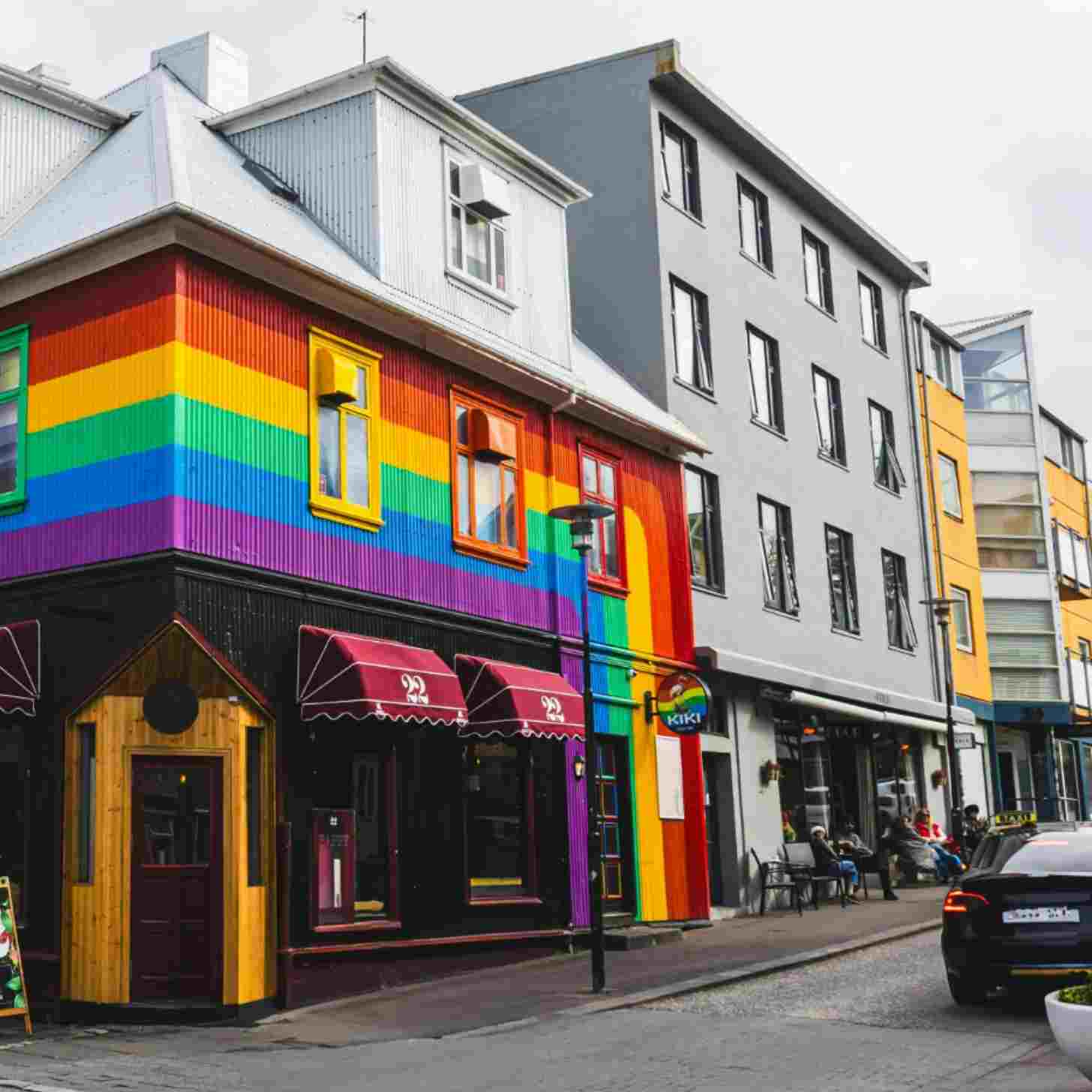
"While harsh weather conditions, especially in winter, may not always create a sense of safety, community does," Inga Rós Antoníusdóttir, an Icelandic native, told the BBC.
"You can walk alone at night mostly without worry; you will see babies sleeping peacefully in prams outside cafes and shops while their parents enjoy a meal or [are] running errands; and the local police don't carry guns."
Tensions between civilians and police officers have been on the rise in the U.S. in the past decade, with Mapping Police Violence estimating that 1,159 people have been killed by police violence in 2025, so far.
But in Iceland, no one has been killed in a police shooting since 2013, and homicide rates are low, despite a high rate of gun ownership.
“The system here works,” Gunnar Rúnar Sveinbjörnsson, a spokesman for Reykjavik's police department, told NBC News.
"It's just madness," he added, in reference to gun violence in the U.S. "We just cannot understand why this isn't stopped and why something isn't being done."
In addition to its extremely low crime rates, Iceland is unique among NATO members for having no standing army.
But that’s not to say it hasn’t been a hot-button topic, especially over the past year.
Bjarni Mar Magnusson — a professor of international law at Iceland’s Bifrost University — recently cited a bevy of reasons for investing in the country’s military power, including “Russia’s invasion of Ukraine, pressure within NATO to increase defence spending and its consequent impact on Europe, as well as President Trump’s [threats to annex] Greenland.”
However, Kristrun Frostadottir, the Icelandic prime minister, begged to differ.
“I don’t think we will see an Icelandic army in my lifetime,” Frostadottir said in early November.
The 2025 Global Peace Index was led by:
- Professor Kevin P. Clements, the director for the National Centre for Peace and Conflict Studies
- Dr. Sabina Alkire, the director of Oxford Poverty & Human Development Initiative
- Dr. Ian Anthony, a research analyst for the Swedish Defence Research Agency
- Dr. Manuela Mesa, the director for the Centre for Education and Peace Research
- Dr. Ekaterina Stepanova, the head of the peace and conflict studies unit at the Institute of the World Economy and International Relations
You may also like: Helsinki just went a full year without traffic fatalities — here's their secret
Header image via Pavel Danilyuk / Pexels