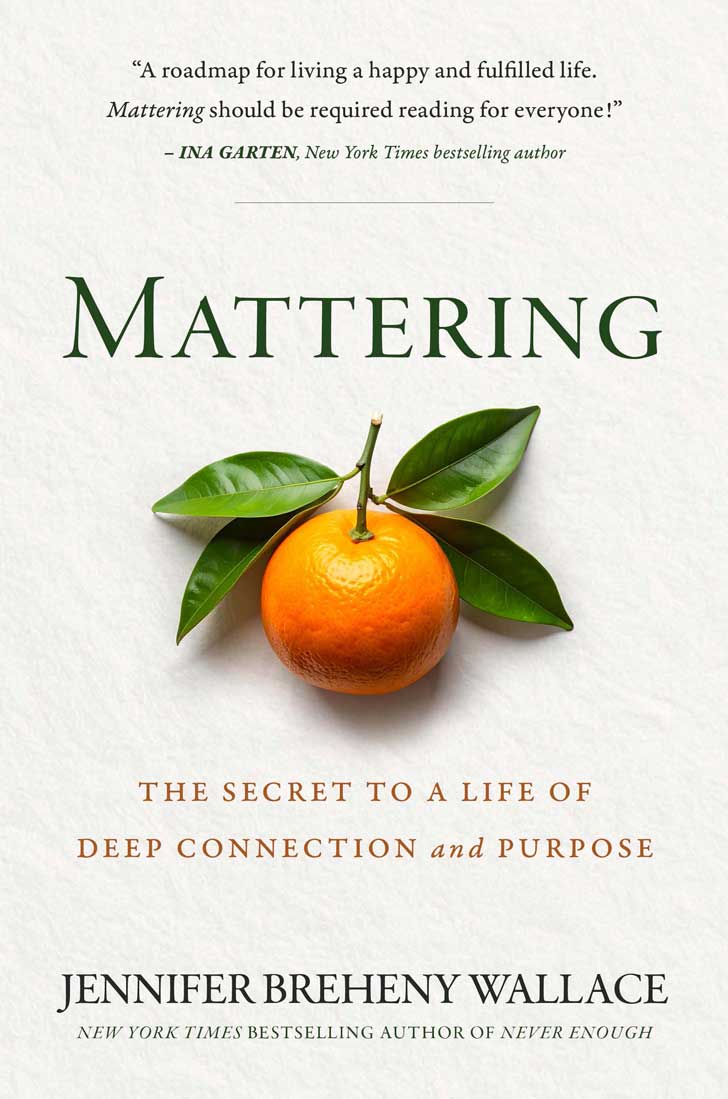
Jennifer Breheny Wallace is an award-winning journalist and author of the forthcoming book “Mattering: The Secret to a Life of Deep Connection and Purpose.”
She has spent her professional career researching the argument that having a sense of value, purpose, and community is nearly as innate as our need for food, water, and shelter.
“Mattering is the deep human need we all have to feel valued by the people around us and to know that we have value to give back. It’s about believing that who we are and what we do makes a difference in the lives of others,” she told Good Good Good in a recent interview.

She went on to add that after our basic survival needs are met, the need to matter is the next motivator for human behavior.
“Our earliest ancestors survived by being essential to their group,” Wallace explained. “In other words, to be valued and needed was to be protected, while being ignored or excluded meant certain death and an inability to pass our genes on.”
Those instincts still shape our actions today, she said.
“When we feel we matter, we are more generous, resilient, and connected. We engage in positive ways in our families, our workplaces, and our communities,” Wallace said. “But when that sense of mattering erodes, we suffer.”
“We often withdraw and become anxious and depressed. Some of us might turn to substances to numb the pain. Others might look for extreme ways to be seen in desperate attempts to prove they still matter. We can see the fallout everywhere today in the loneliness epidemic, in rising rates of burnout and anxiety, and even political polarization.”
Wallace sees humanity at a “mattering” juncture, as we compete with artificial intelligence, sociopolitical upheaval, climate change, and all manner of uncertainties in our day-to-day lives and relationships.
But, she posits, that feeling of personal and communal value — “mattering” — can be cultivated intentionally, and can truly make a difference.
“We know from research that mattering reduces anxiety and depression, and it increases empathy and civic engagement. When we feel valued, we naturally want to add value. It’s the emotional fuel that keeps humanity going and the invisible thread that ties our well-being to one another’s,” she said.
“And we need that now more than ever.”
In her book, which will hit shelves in January 2026, Wallace offers readers a blueprint for how to prioritize a sense of mattering in ourselves and our relationships.
It starts with recognizing each other, and later, learning to comfortably rely on each other.
In other words, we need to become helpers — and be open to receiving help, too.
“For so long, we’ve been taught that to be independent and self-reliant is to be strong and that asking for help is a sign of weakness or neediness,” Wallace said.
“But the truth is, asking for help is one of the most generous things we can do for another person. It gives someone else the gift of the chance to feel useful, trusted, and needed. When we reach out, we’re extending an invitation and saying, ‘You matter to me.’”
Even starting small by asking a colleague for their perspective, turning to a friend for advice, or asking a neighbor to borrow a ladder, she said, goes against the grain of “a culture that prizes hyper-independence.”
Plus, knowing how to be the most effective helper in itself gives us purpose and meaning.
Offering “the three Ts,” or time, talent, and treasure, to meet a genuine need, helps us build healthy reliance within our communities.
Once people engage in reliance, Wallace added, they begin to experience importance, or the feeling that they matter because they are prioritized. Here, they can create space for themselves and others, instead of just “squeezing them in.”
From there, she said, people reach “ego extension,” or an understanding that when one person matters, we all matter.
“Their wins feel like our wins, their pain like our pain. This kind of emotional investment creates healthy interdependence that makes life meaningful,” Wallace described.
And lastly, in “the journey of mattering,” Wallace said, is attunement, or the feeling of being deeply understood and meaningfully responded to. Essentially, it means that we give others the same attention we long for.
In a 2025 TED Talk, Wallace outlined some examples of where “mattering” was implemented on a systemic level.
There’s the fire chief, who, dissatisfied after never receiving closure from the people he helped, implemented a system to track the outcomes of rescues so his team knew their efforts had saved someone’s life or eased someone’s suffering.
Then there’s the Dutch supermarket chain Jumbo, which set aside slow checkout lanes for cashiers to take extra time to chat, especially with elderly customers. It’s now in place at 200 locations.
“The lesson for us? We don't need to build new spaces to unlock each other's mattering,” Wallace concluded. “We just need to be more intentional about the spaces we already have.”
A world where mattering matters is well within reach, Wallace believes.
“[My vision is] a world where people feel seen and significant not because of their résumés or social status, but because of who they are deep inside and their unique gifts to share,” she said.
Ultimately, as evidenced by Wallace’s examples, it’s up to us to take small, intentional steps wherever we already find ourselves.

“At home, you can remind the people closest to you why they matter so much to you. At work, connect people to the human impact of what they do by showing them how their effort ripples outward to a colleague, a customer, a community,” Wallace said.
“And in our neighborhoods, it’s slowing down enough to appreciate the neighbor who is always the first to come over with a pot of warm soup when there is a family emergency or the bus driver whose positive energy spills over to passengers.”
“Mattering is a daily practice of helping others feel both valued and valuable. If each of us took that responsibility seriously, even just within our own circles, we could shift our culture,” she added.
In her own life, Wallace has been practicing an exercise where she imagines everyone she meets wearing an invisible sign that reads: “Tell me, do I matter?”
“We can answer that silent question with care through generous listening, recognizing someone’s contributions, or responding to rudeness — often veiled anti-mattering — with compassion instead of judgment,” she said.
And it all boomerangs back to us.
“Every time we reinforce someone else’s value, we reinforce our own. We are reminded that we, too, are needed, valued, and capable of making a difference,” Wallace reaffirms.
“In reminding others that they matter, we confirm just how much we matter, too.”
You may also like: From crying clubs to cuddle therapy, here's how people are combatting loneliness across the U.S.
A version of this article was originally published in The 2025 Helpers Edition of the Goodnewspaper.
Header image by Carra Sykes for Good Good Good