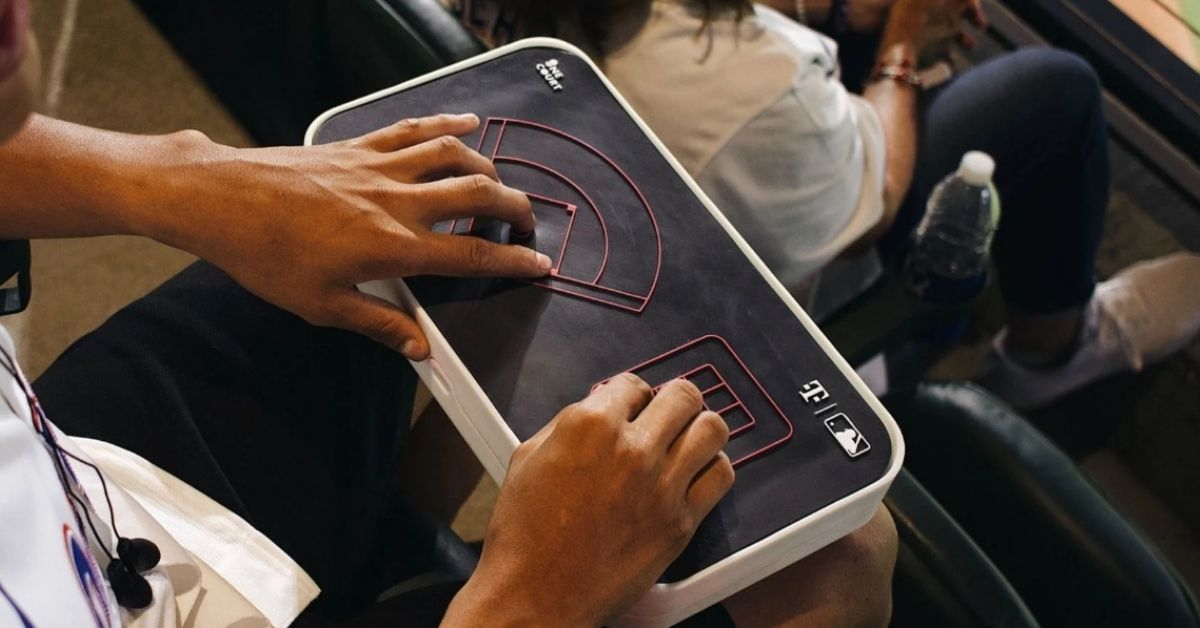
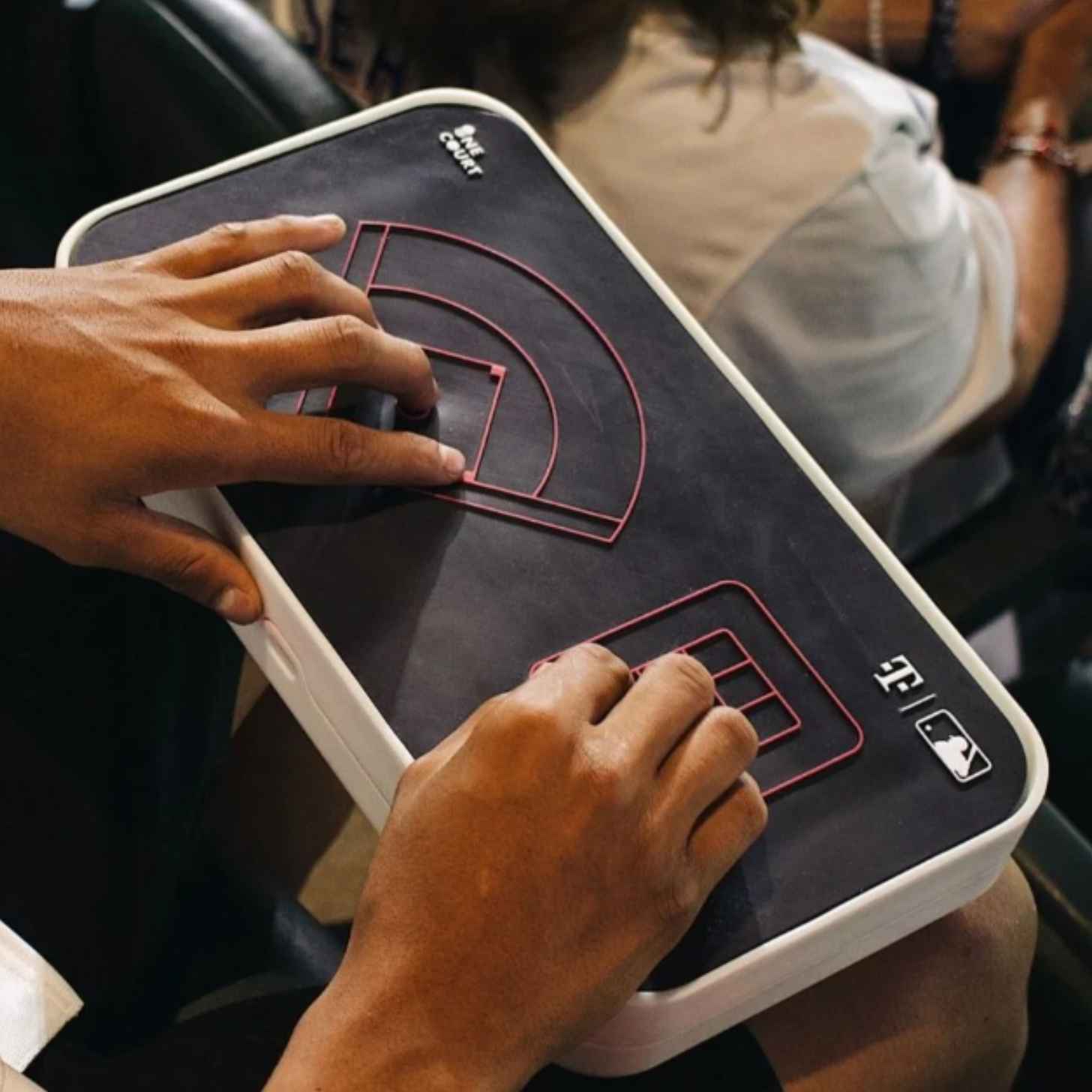
This year, startup OneCourt ushered blind and low-vision basketball fans into a new era of sports viewing by introducing new, free-to-rent haptic feedback devices at Sacramento Kings and Portland Trail Blazers games.
OneCourt allows users to watch the game “through their fingers” by relaying real-time data to tablet-sized devices. Through unique, buzzing patterns, fans can track team possession and follow the ball’s movement across the court.
“We believe that sports are for everyone and at OneCourt, we have created an intuitive tactile broadcast that makes sports more enjoyable for fans of any age, background, or visual ability,” Jerred Mace, founder and CEO of OneCourt, told the NBA.
“Every team in every league should adapt this device,” blind TikTok creator Ferraro said, grinning ear to ear as he tried the device at a Trail Blazers game. “I can’t explain how life-changing this is as a blind spectator.”
Major stadium builds sensory-friendly space for football fans
Kylie Kelce, weekly podcaster and wife of retired Philadelphia Eagles star Jason, is well acquainted with the roar of a packed stadium. She also knows it's not an ideal environment for every football fan.
"When you are in a stadium and the noise is so loud and so many things are happening, you really don't have any control over the way the sound or the stimulation is coming in,” Kelce told Good Morning America.
With a solution in mind, Kelce collaborated with the Eagles Autism Foundation and the Children’s Hospital of Philadelphia to debut a mobile sensory-friendly unit at Lincoln Financial Field filled with plush bean bags, soft lighting, and wall art that begs to be touched.
Consulting health professionals said individuals with dementia, PTSD, and extreme anxiety all stand to benefit from the space, too.
"To be able to come into this space — it's quiet, it's calm,” Kelce said. “You have all of these distractions [and] you can just sort of send your brain somewhere else for a little bit.”
The NHL is all hands-in on ASL
On June 5, 2024, the Stanley Cup Final aired on television in American Sign Language, marking the first time that a major sports league aired its broadcast with ASL commentary.
As the game played on the screen, deaf ESPN broadcasters Jason Altmann and Noah Blankenship delivered live color commentary and play-by-play analysis — all in ASL. Beneath game footage, the “NHL in ASL” broadcast also had a “crowd intensity meter” that measured the arena’s noise level for viewers at home.
“I watched it and I will tell you — fascinating, so fascinating, having it in ASL,” signed die-hard hockey fan Jerry Trayner, in an interview with ABC News Detroit. “I am so happy the NHL did this.”
Since the Stanley Cup Final, Altmann and Blankenship have continued their ASL coverage throughout hockey season.
"This is about the Deaf community being validated, being seen, and what can we do to create a positive impact and change the Deaf community moving forward," Altmann said.
Adaptive baseball league knocks inclusion out of the park
When players step out on the Miracle League baseball diamond in Auburn Hills, Michigan, they’re not stepping on grass. They’re stepping on synthetic rubber turf, which makes it easier for disabled athletes to find their footing and for wheelchair users, like Coach Mason Kaiser, to mentor on the field.
“I get to help other kids or other young adults that are just like me,” said Kaiser. “I know that I can help these kids and these parents through some of their toughest times.”
Kaiser started playing in the Miracle League of Michigan over 20 years ago. According to the Detroit Free Press, when the league’s first season debuted in 2004, it started with just four teams and 40 players.
Today, it serves 400 players across four leagues.
Through cushioned turf, wheelchair-accessible dugouts, brightly painted bases, and “buddy” systems, Miracle League makes its programs adaptive so players with various physical and intellectual disabilities — like Down syndrome, cerebral palsy, and vision impairment — can play.
Their biggest adaptive policy? Slowing down the clock. In Miracle League, every player takes a turn at bat and runs the bases, no matter their pace.
A version of this article originally appeared in the 2025 Sports Edition of the Goodnewspaper.
Header image via OneCourt