When London-based photographer Alexander Meininger had children, he found himself spending more and more time observing playgrounds.
A tinkerer by nature, he built his sons an indoor treehouse, but didn’t realize the importance of play until the war in Ukraine, when he saw footage of children being displaced from their homes, schools, and all stability from the place they called home.
Now, he has just launched his nonprofit, Playrise, an organization that makes modular, packable play equipment and furniture for children living in disaster zones and refugee camps.
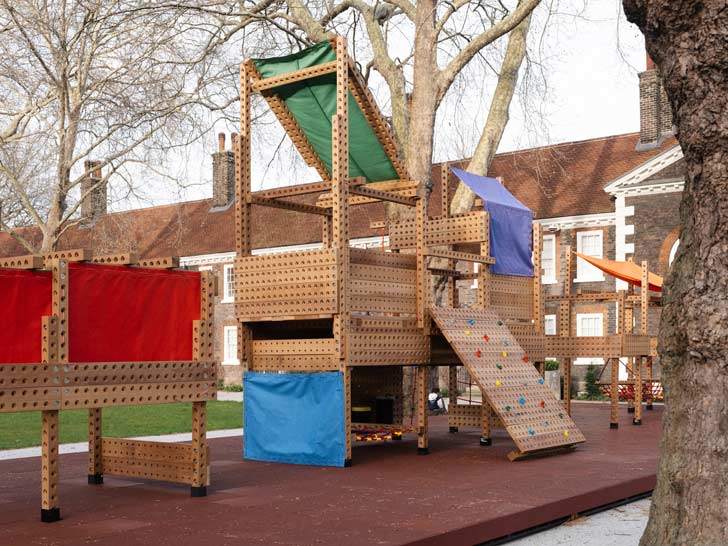
Meininger worked with architecture studio OMMX to design the play structures, which are built from simple wood components that can be assembled easily and customized with colorful accessories like monkey bars, hammocks, basketball hoops, and climbing ropes.
It’s fully customizable, with the structures easy to reconfigure based on each location’s needs and limits. Parts can be easily replaced, and all of the bolts that keep structures together are fitted with playground-specific hardware.
Meininger and team also spoke with Sudanese, Palestinian, and Eritrean child refugees to learn what children living in displacement actually wanted.
Their feedback confirmed what the inventors already knew to be true: Play is vital for child development.

“In communities such as refugee camps, many children are displaced from home, living with trauma, cut off from education and essential healthcare, and suffering from high degrees of physical and psychological stress as a result,” Playrise writes on its website.
“In such circumstances, play is a lifeline, helping children relieve stress, foster nurturing relationships, and re-establish conditions in which learning can occur.”
Initially, Meininger wanted to build the structures out of rubble found in war and disaster zones, but then he realized these communities needed something “affordable, quick, and easy to assemble,” he told The Guardian.

“Just like when you’re renting, you don’t want bespoke furniture, you need something from Ikea, in refugee camps, there is no appetite for anything permanent,” Meininger added. “The problem is that a lot of people end up in this temporary accommodation for a depressingly long time.”
So, he set out to develop something that could be scalable and easily replicated but still personal and joyful for each refugee community.
Meininger and OMMX engineers, along with other developers, travelled to Aysaita, Ethiopia, a community that will be the first refugee camp to receive a Playrise prototype. Here, 10,000 children under the age of 10 are housed — and there is not a single playground.
The designers spoke with these children, along with others in two locations in Egypt, which are hubs for displaced Palestinian and Sudanese refugees. They created co-design workshops with the children and interviewed their parents.

In the Aysaita refugee camp, which has been operational since 2007, families reported that their kids even helped construct the sample play structures that were sent to try out.
“We’re equipping them with the practical skills they will one day need in order to build and maintain their own homes,” Hikaru Nissanke, director of OMMX, told The Guardian. “This struck us as poignant, given the precarity with which they’re living.”
The playgrounds are meant to be that easy to assemble, while still prioritizing safety. For instance, the designers chose to use timber instead of metal, so that materials wouldn’t be too hot in these desert climates. They also designed the structures to keep fingers from getting stuck, and options that lay soundly on various terrains, from desert sands to concrete.
“The simple modular kit comprises elements which allow for play for different ages, abilities, personalities, and settings. Some configurations focus on dynamic movement and popular games, others on more intangible forms of sensory play,” the Playrise website describes.
“With our system, children can create a playground, a theatre, a tunnel, or simply a safe space to call their own.”

All of the framework and add-ons can be assembled with standard tools, and the hope is to offer international aid organizations a “menu” of various playground parts and structures that they can deploy to their areas of focus.
“We didn’t want to go into this with a western perspective of what kids should do, or be patronizing,” Nissanke said. “But from the countries I’ve visited, I’ve seen that, on a basic level, humans are humans, and they wish for the same things. One of those things is that they want to see their kids thrive and play.”
While the Ethiopian refugee community will be the first to fully integrate Playrise into its space, Playrise representatives told Dezeen that refugee camps in Cairo and Wadi Karkar will be next.
“Play is not a luxury, or a nice-to-have … It is often in the playground that we forge the connections and peer relationships on which society is founded. The bonds that keep communities together are established on the swing and the slide,” Playrise concludes on its website.
“Where we are born is arbitrary, but our right to play safely should be fundamental.”
You may also like: Olivia Rodrigo's new music video was filmed by children in Gaza and Ukraine. It funds aid for kids affected by war
Header image by Lewis Ronald for Playrise