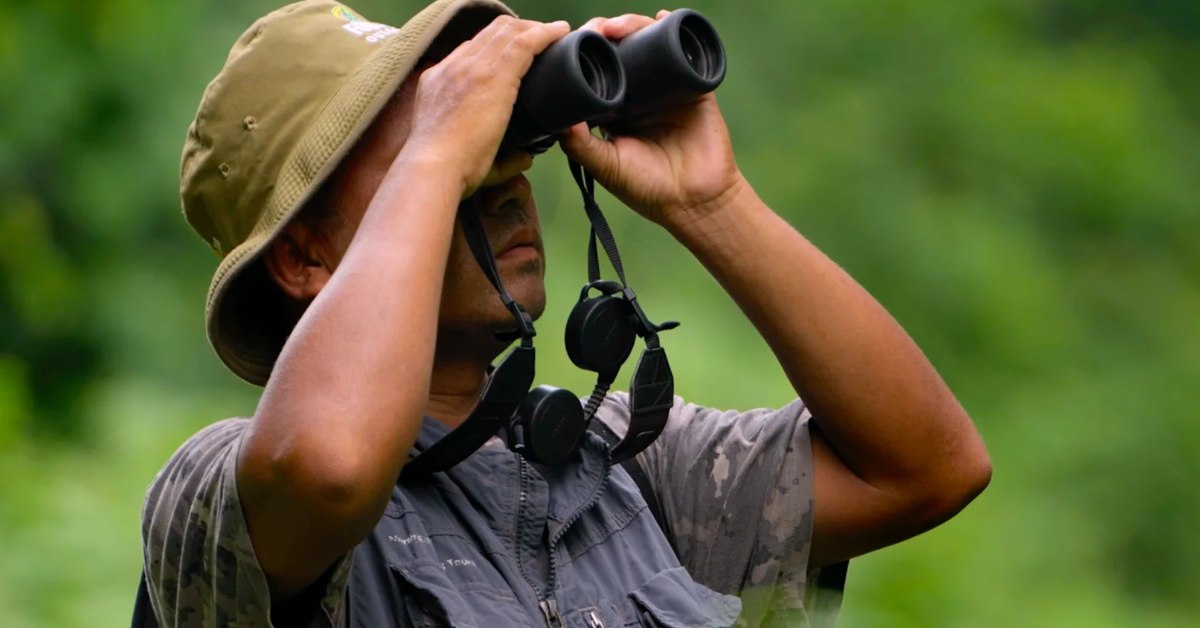
Rustom Basumatary is a naturalist and an avid birder from the remote Indian village of Bodoland Territorial Council. As an Indigenous Bodo boy, he grew up hunting small game inside Manas National Park, a UNESCO World Heritage site.
By his account, a large part of the Bodo upbringing involved poaching and deforestation. But today, he works with fellow conservationists to make sure that all wildlife inside the park is protected.
“We used to earn our living by hunting animals and cutting trees,” Basumatary said. “Now we have changed. Today, we earn our livelihood by guiding people to observe birds and animals.”
But Basumatary is more than a tour guide. He has also been a vital champion for endangered animals and even rediscovered the critically endangered white-bellied heron, which had long vanished from the park.
He has also made it his mission to pass his love for the park’s creatures, big and small, down to younger generations as a founding member of Manas Ever Welfare Society, a youth-led community initiative.
In 2023, Basumatary received the Assam Guarav Award, one of the top civilian honors in Northeast India, for his wildlife conservation efforts.
“The jungle offered him something the outside world could not: peace, wonder, and a sense of belonging,” said filmmaker Salma Sultana Barbhuiya.
Sultana Barbhuiya captured Basumatary’s story in the short documentary “Chasing Birds,” which won second place in the 2025 Yale Environment 360 Film Contest. In it, Basumatary acknowledged that his conservation efforts are ongoing.
“For every tree I plant, there are many people ready to cut it down,” he said. “It has many enemies with almost a 50-50 chance of survival. Conservation is not easy; it’s a tough task. Still, we are doing it, and we will continue our efforts.”
A version of this article originally appeared in the 2026 Environment Edition of the Goodnewspaper
You may also like: She was the first female CEO of an Afghan tech company. Now she teaches girls under Taliban rule in secret classrooms
Header image via Chasing Birds / Yale 360