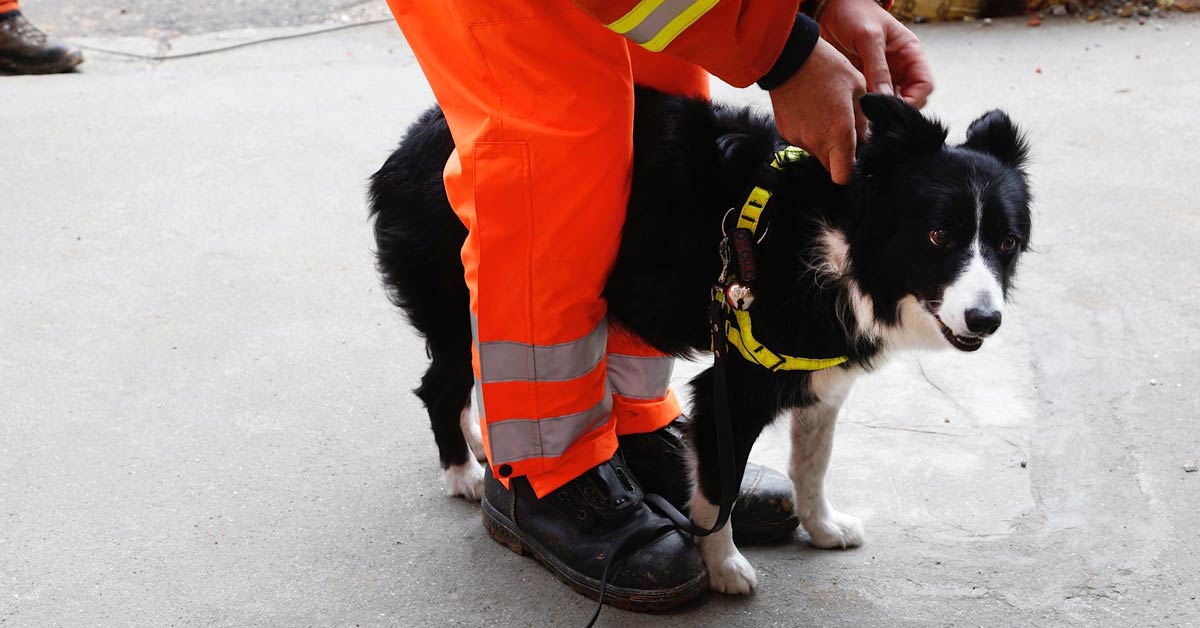
Search-and-rescue dogs have long been vital partners to emergency responders, able to find a scent trail, locate their subject at the end of that trail, and alert their handler, guiding assistance to someone who might be lost, trapped, injured, or, tragically, dead.
But artificial intelligence company Scientific Systems is working on a tool that combines the brilliance of canines with digital information gathered by AI systems, relying on humans as a bridge to analyze them both, helping save people faster than any of the three ever could alone.
It’s called Collaborative Intelligence for Olfactory Search Missions Integrating Canines and Technology, or COSMIC-T.
As dogs do their sniffing, a drone gathers information about the dog’s movements along with environmental factors, like weather conditions, wind patterns, and geography.

From there, AI software makes predictions about where someone might be. Handlers watch as a tablet displays color-coded maps, using infrared sensors to refine predictions that help them to direct their dog colleagues in the right direction.
Or, if faster than on four legs, an autonomous drone moves in the direction of the person in need.
After three years of testing, Scientific Systems found that mock victims were located five to 10 times faster than they would have been without the help of AI.
The system can also monitor a dog’s physiological and behavioral state in real time, ensuring that a mission is not too physically or emotionally draining on the pup.
COSMIC-T’s canine training data was captured during training missions conducted by the Boone County Missouri Fire District.
“It’s been a privilege to assist Scientific Systems in its COSMIC-T program,” Scott Olsen, Fire Chief of Boone County Fire Protection District, said in a statement.
“Canine Search Teams are one of the most important components of our disaster response capabilities, and we’re proud to have contributed data and expertise towards technologies that can help advance the Search and Rescue mission.”
But never fear: These dogs, and their human counterparts, won’t be out of their jobs due to the emergence of AI.
“We’ve spent hundreds of millions of dollars trying to make a sensor that is as good as a dog’s nose, and we’ve never gotten close,” Mitchell Colby, the group lead for AI and machine learning at Scientific Systems, told Nautilus.
“AI is making great strides, but I have not seen any AI that can compete with the intuition of an operator with a lot of experience.”
You may also like: Shelter dog makes history as first-ever 'morale dog' stationed on a US Navy ship
A version of this article was originally published in The 2025 Dogs Edition of the Goodnewspaper.
Header image courtesy of DFID - UK Department for International Development (CC BY 2.0)