In 2021, Igor Efimov, a professor of biomedical engineering and cardiology at Chicago’s Northwestern University, developed the first dissolvable pacemaker with his colleagues.
“We were motivated by an unmet need: children born with congenital heart defects,” Efimov told IEEE Spectrum.
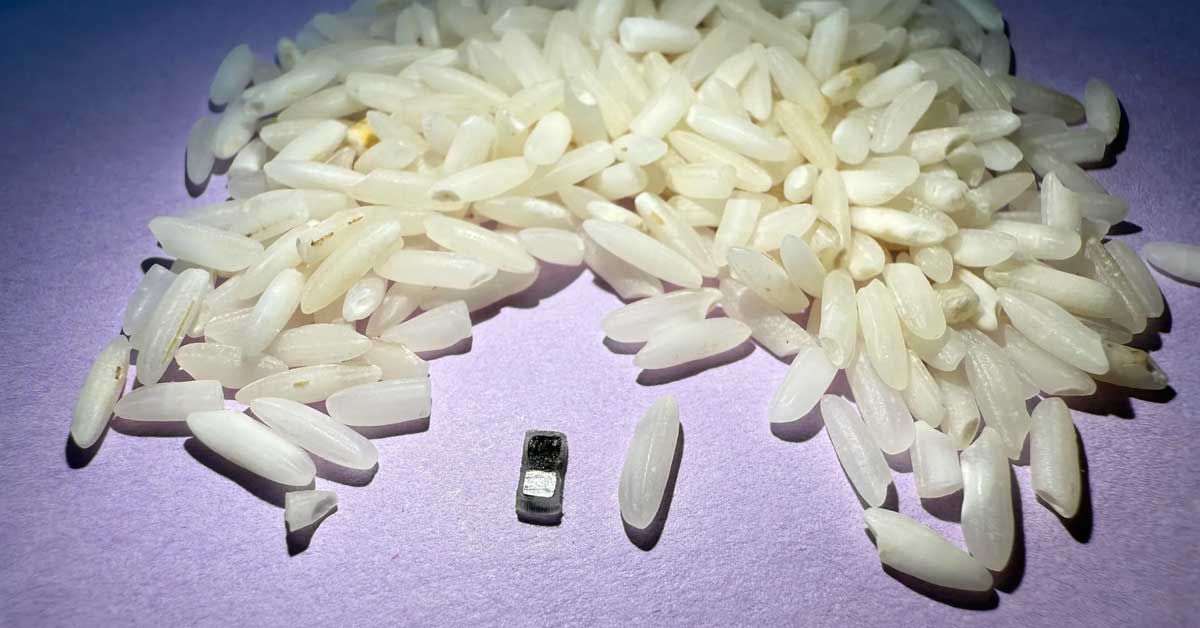
So, he and his team further miniaturized their original design and created the world’s tiniest known pacemaker.
It’s smaller than a grain of rice, can be implanted with a minimally invasive injection, and dissolves when it is no longer needed.
Pacemakers electrically stimulate cardiac muscles to control heart rates, with many patients only requiring them for short-term heart problems following surgery.
For babies born with congenital heart defects, Efimov’s goal was to make a temporary pacemaker that was as small and fragile as its patient.
“About 1% of children are born with congenital heart defects,” Efimov said in a statement for Northwestern University. “The good news is that these children only need temporary pacing after a surgery. In about seven days or so, most patients’ hearts will self-repair. But those seven days are absolutely critical.”
“Now, we can place this tiny pacemaker on a child’s heart and stimulate it with a soft, gentle, wearable device. And no additional surgery is necessary to remove it.”
That additional surgery can be fatal to any patient with a pacemaker — not just infants.
“Wires literally protrude from the body, attached to a pacemaker outside the body. When the pacemaker is no longer needed, a physician pulls it out. The wires can become enveloped in scar tissue. So, when the wires are pulled out, that can potentially damage the heart muscle,” Efimov said.
“That’s actually how Neil Armstrong died. He had a temporary pacemaker after a bypass surgery. When the wires were removed, he experienced internal bleeding.”
Those wires are also no longer an issue.
Efimov’s team also paired the tiny pacemaker with a small, flexible patch that sits on the patient’s chest and detects an irregular heartbeat.
When this happens, it automatically emits pulses of near-infrared light to wirelessly control the pacemaker and get the patient back to their ideal heart rate.
The researchers found that the design was effective in small and large animals, as well as hearts from organ donors. And despite its miniscule size, it delivered as much stimulation as a full-size pacemaker.
Efimov and team also hope that their research will enhance other traditional implants in future studies.
You may also like: This minnow can regenerate its spinal cord after injury. Scientists want to replicate its abilities in humans
A version of this article was originally published in The 2025 Technology Edition of the Goodnewspaper.
Header image courtesy of Northwestern University