On February 2, the Smithsonian’s National Zoo and Conservation Biology Institute welcomed their newest addition: the first elephant calf born at the zoo in nearly 25 years.
With fewer than 50,000 Asian elephants remaining in the wild, it was a huge milestone for the zoo’s breeding program — and the species at large.
The calf was born to 12-year-old mother Nhi Linh and 44-year-old father Spike, a match recommended by the Association of Zoos and Aquariums’ Species Survival Plan.
Asian elephant pregnancies last 18 to 22 months on average, and Nhi Linh’s pregnancy landed at the longer end of that range, at 21 months.
The calf was later named Linh Mai in a public poll, a name which means “spirit blossom” in Vietnamese.
Soon after Linh Mai was born, the elephant care team watched with concern as Nhi Linh appeared to reject her daughter by swinging her trunk, kicking her feet out, and throwing hay in her direction.
The elephant care team separated the two immediately, keeping them in adjacent enclosures where they could see, smell, and hear each other with a safety barrier in between.
“Keepers hoped Nhi Linh would accept her daughter with time,” the National Zoo stated in a press release. “When it became clear she was not receptive to nursing, the team stepped in to bottle-feed the calf every two hours, around the clock.”

According to wildlife experts, it’s rare, but not unheard of, for elephants to reject their calves out of stress — especially if they are first-time mothers.
Fortunately, Linh Mai’s “aunties” stepped in to help. She formed a fast bond with Swarna, an experienced elephant mother. After Swarna gently explored the baby’s body with her trunk, she accepted her as her own. The other elephants, including Linh Mai’s father, Spike, took notice and embraced her in turn.
“From that day on, Linh Mai’s relationship with Swarna blossomed into something special. Positive interactions — like Linh Mai scratching her back on her auntie’s belly — went a long way toward building bonds between the pair,” the National Zoo stated. “At 52 years old, Swarna does her best to keep up with Linh Mai — who is a bundle of energy!”

By the time she was two months old, Linh Mai was already proving herself to be a fast learner.
“She even recognized her name when keepers called to her,” the National Zoo shared on its website. “This was an important first step in training Linh Mai to voluntarily participate in her own care.”
Since the mid-1990s, zookeepers have used positive reinforcement training to teach elephants to voluntarily take part in their own routine healthcare, which helps elephant care team members avoid using high-risk anesthesia altogether.
At an early age, accredited zoos and sanctuaries teach calves how to present their feet so their pads can be inspected and their toenails can be trimmed. They also learn how to open their mouths on cue while holding their trunks on their heads to check their teeth and gums.
“A solid training foundation is one of the cornerstones to optimal welfare,” Daryl Hoffman, curator of large mammals at the Houston Zoo, said in a statement.
“We all know [about] food, medical care, and shelter, or exhibit design, but training is just as equal in importance,” he added. “Solid training allows our elephants to participate in their own medical care with husbandry behaviors.”
As they get older, they can be trained to stand still for routine X-rays, ultrasounds, and trunk washes, and even control the movement of their ears and legs for blood draws.
The first behavior that Linh Mai learned was how to target, or move in a certain direction by following a buoy on the end of a dowel.
“When she did so, keepers pressed a clicker to let her know she did a good job,” the National Zoo said on its website. “With some practice, she learned to follow the target and shift from one area to another.”
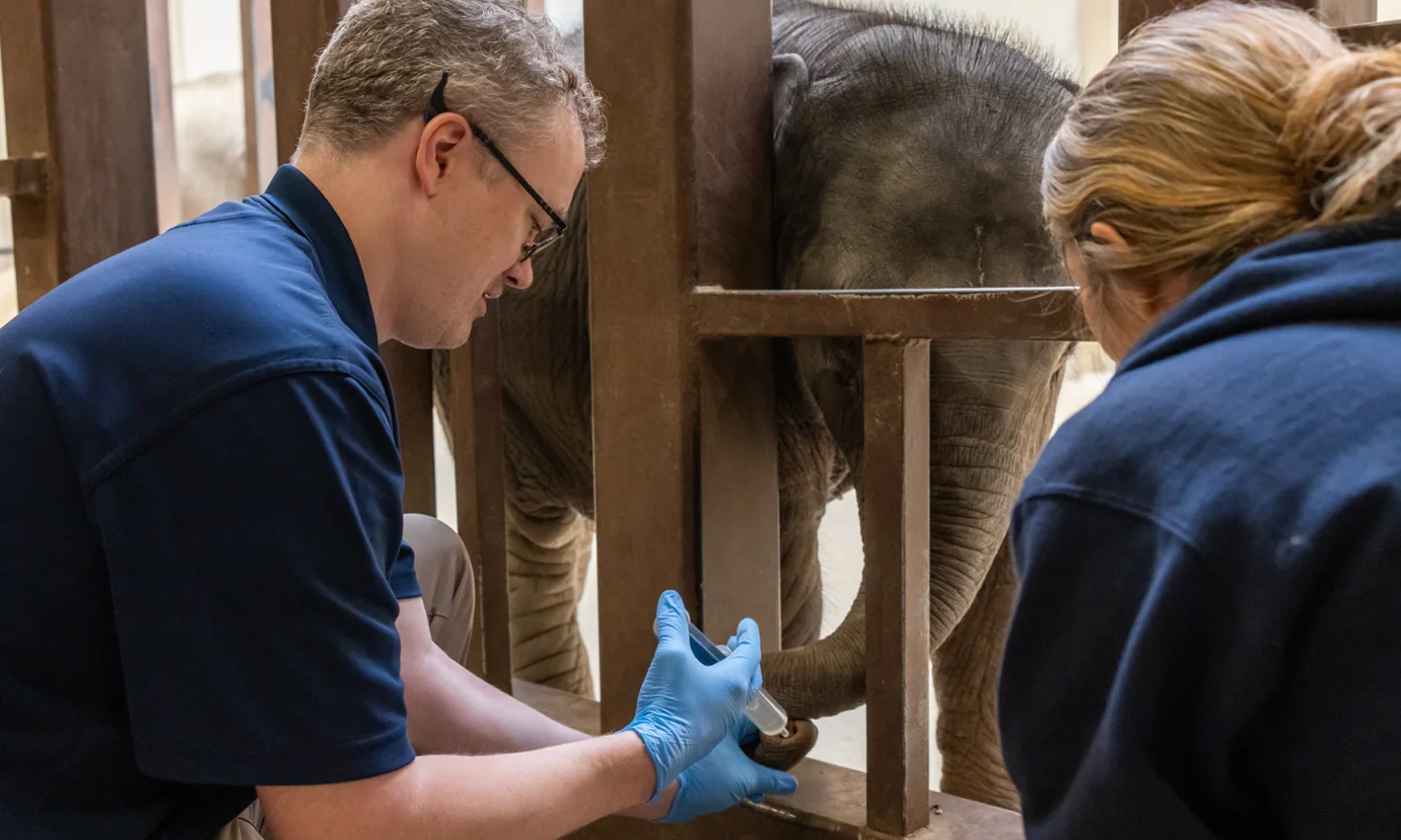
As she gets older and her attention span increases, the elephant care team will teach her more complex behaviors so that they can monitor her behavior, weight, and health.
“Already, she stands on a scale for weekly weigh-ins — and, as of August 24, weighs 930 pounds,” the National Zoo shared.
“Eventually, she will learn how to present different body parts so keepers and veterinarians can examine her up close and participate in diagnostic procedures, like blood draws.”
At 5 months old, Linh Mai reached a major milestone: “baby’s first swim.”
“Our brave ‘spirit blossom’ entered the 5.5-foot-deep end of the outdoor pool for the very first time on July 15,” the National Zoo wrote. “In true herd mentality, Linh Mai waited until all elephant care team ‘lifeguards’ … were in the pool before taking the pachyderm plunge. The team cheered her on, held her trunk above water, like a snorkel, and gently guided her to the shallow side of the pool — before she dove in again!”
Watch Linh Mai and her auntie Swarna take a dip together in August:
You may also like: Experts race to save baby elephant after it was found injured and abandoned on a Thai riverbank
Featured Image: Roshan Patel/Smithsonian