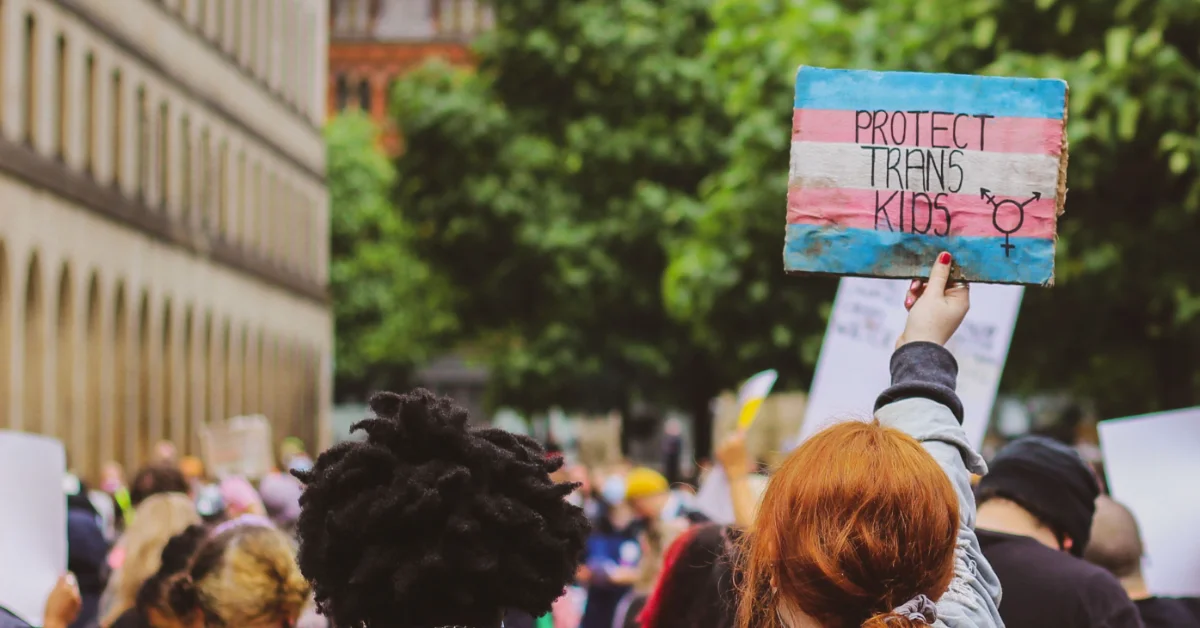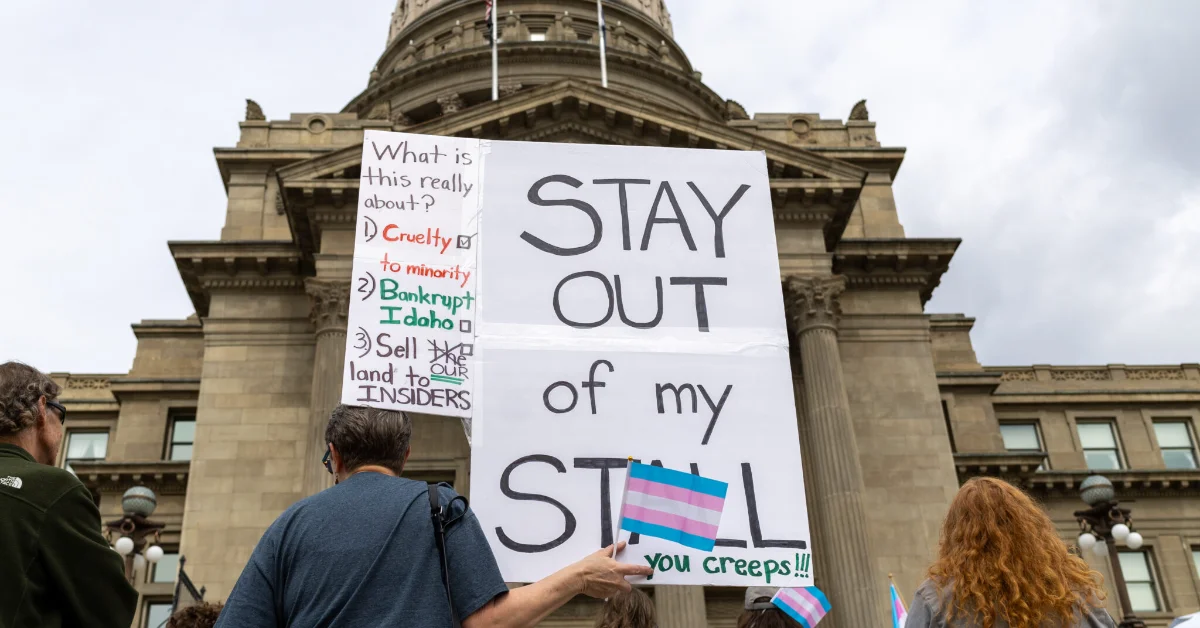
Now that Idaho’s transgender bathroom ban is the law, transgender Idahoans are navigating how to safely use the bathroom in public.
Preparing for the ban, Trans Affirm, a nonprofit that advocates for trans people in Idaho, crowd-sourced an online map of inclusive bathrooms across Idaho that it says are safe for people who are trans or gender diverse to use.
The list — developed through hundreds of community-submitted ideas — is made up of largely gender-neutral private bathrooms, said Scar Rulien, a board member for the nonprofit. He said creating that map was the first thing that came to mind after the bill passed the Idaho Legislature this spring.
“It is already a confusing law as it is. And it can be scary for transgender people, who identify as one gender, to use the bathroom that is of the gender that they don’t identify as,” Rulien said in an interview.
“Especially if they are actively transitioning and look like the gender that they identify as, it can pose a risk to their safety.”
For now, Rulien said he tells people to use gender-neutral restrooms for their safety “if they feel most comfortable with it.”
But the actual text of the criminal law isn’t the final say.
A federal judge temporarily blocked parts of the law, ruling it “invites arbitrary and discriminatory enforcement.” The block essentially allows transgender people to use single-user restrooms that align with their gender identity, or to use a multi-stall bathroom when a single-user facility isn’t available on the same floor.
More than a week into the law being in effect, it remains unclear how law enforcement officers will enforce the law.
How the judge’s partial block of the bathroom ban works
The law, passed this year through House Bill 752, creates criminal charges for people who “knowingly and willfully” enter a bathroom or changing room designated for the opposite sex, with some exceptions. The law applies in government-owned buildings and private businesses.
A first offense carries a misdemeanor, punishable by up to one year in prison. A second offense within five years is a felony, punishable by up to five years in prison.
The partial block of the law — issued last month by U.S. District Court Judge Amanda K. Brailsford — came in response to a lawsuit brought by the American Civil Liberties Union, or ACLU.
The judge’s partial block only affects the law’s application in bathrooms, not changing rooms. It applies in places affected by the law: places of public accommodations, a legal category that includes private businesses, and government-owned buildings.
The ACLU of Idaho’s website says the block means: “Trans people in Idaho will be able to use single-user restrooms consistent with their gender identity and multi-user restrooms when a single-user restroom is not available [including when it is occupied].”
But Rulien said the partial block falls short of fully addressing trans people’s needs in Idaho, hoping that the entire bill gets overturned.
“It’s sort of a Band-Aid on a bullet hole-type situation,” he said. “… This is great, and it’ll definitely help a lot of people. But it’s not exactly the help that will be life-saving, or exactly the help that we need in this current moment.”
To him, the partial block raises more questions about how the law will be enforced: How do you enforce the law if a trans person uses a multi-occupancy restroom without knowing there’s a single-user restroom on the same floor?
“How are you going to prove that they didn’t know? How are you going to prove that the bathrooms weren’t in use? Are we really going to get down to the nitty gritty already? And you’re looking at cameras to figure this out?” he said.
The ACLU says that Idaho’s bathroom ban is the only state ban that extends to private businesses — and that Idaho’s ban has the steepest penalties out of the three states that have criminal bathroom bans.
‘We’re a political scapegoat’
The bathroom ban is one of the latest in a series of anti-trans laws passed by the Idaho Legislature in recent years. Last month, the U.S. Supreme Court upheld Idaho’s 2020 law that bans trans women and girls from competing in sports that align with their gender identity.
The bathroom ban has also pushed some to plan to move out of Idaho, including a Boise family of medical professionals that raised their trans daughter in Idaho and one of the trans Idahoans suing over the law.
In the Legislature, some transgender people told lawmakers that the bill will force them to risk their safety by going into bathrooms with people that they don’t look like.
Preston Pace, who co-founded Trans Joy Boise, a separate trans advocacy group, said that five years ago, they didn’t think trans people would be “navigating anything like this.”
“It’s really scary. It’s discouraging how easily people just accepted the anti-trans rhetoric and anti-trans campaign,” Pace said in an interview. “… We’re a political scapegoat. And seeing people just accept it without any research, without knowing any trans or queer people, is really disheartening.”
The bathroom law expands on other bathroom bans Idaho has enacted. Idaho’s 2023 trans bathroom ban in public schools took full effect two months ago after a high school group challenging the law dropped its lawsuit — after a trans student who was part of the group died by suicide.
Pace said their group is focused on educating people on the law to figure out their safest options for public restrooms. They said now is not the right time to try to “take a stand.”
“It’s just too dangerous right now. Because on top of criminal charges, we’re already seeing nationwide instances of aggression and violence in public restrooms, with the public taking on the responsibility of policing these bans,” Pace said.
A 2025 study by the UCLA’s School of Law’s Williams Institute found there was no evidence that people face more harm if transgender people are allowed to use bathrooms that align with their gender identity.
But when trans people are refused access to facilities that align with their gender identity, the study found that trans people report verbal harassment and physical assault.
The growing influence of anti-trans sentiments has also changed Pace’s career goals.
On the same day that President Donald Trump was inaugurated on Jan. 20, 2025, he signed an executive order recognizing two sexes: male and female.
That same day, Pace said he went out and bought a guide to study for the LSAT, a test used for law school admissions.
He started law school earlier this year.
This article was written by Kyle Pfannenstiel and was originally published by Idaho Capital Sun.
Featured Image: Kyle Pfannenstiel/Idaho Capital Sun