
In the Amazon’s Putumayo basin of Colombia, a new species of fish was discovered swimming among submerged roots in a shallow forest stream.
That fish, which is roughly the size of the average pinky nail at just 0.8 inches long, is the Priocharax rex. And it’s now one of ten known species of Priocharax.
Despite its small size, it’s actually the largest known species of the genus (just like the etymology of the Tyrannosaurus rex, the “rex” here means “king.”)
Similar to other Procharax fish, the P. rex retains larval features, even after it matures. This results in a reduced number of fin rays and an internal skeleton that is less fully developed.
But this fish was remarkable to scientists for several reasons.
Firstly, seven species of Priocharax (except for the Priocharax pygmaeus and Priocharax ariel) are limited only to Brazil. This discovery extends the genus’s known range northwest into Colombia and enriches knowledge of the country’s marine biodiversity.
Secondly, the P. rex boasted a strange new feature, in the form of a seemingly innocuous flap of skin.
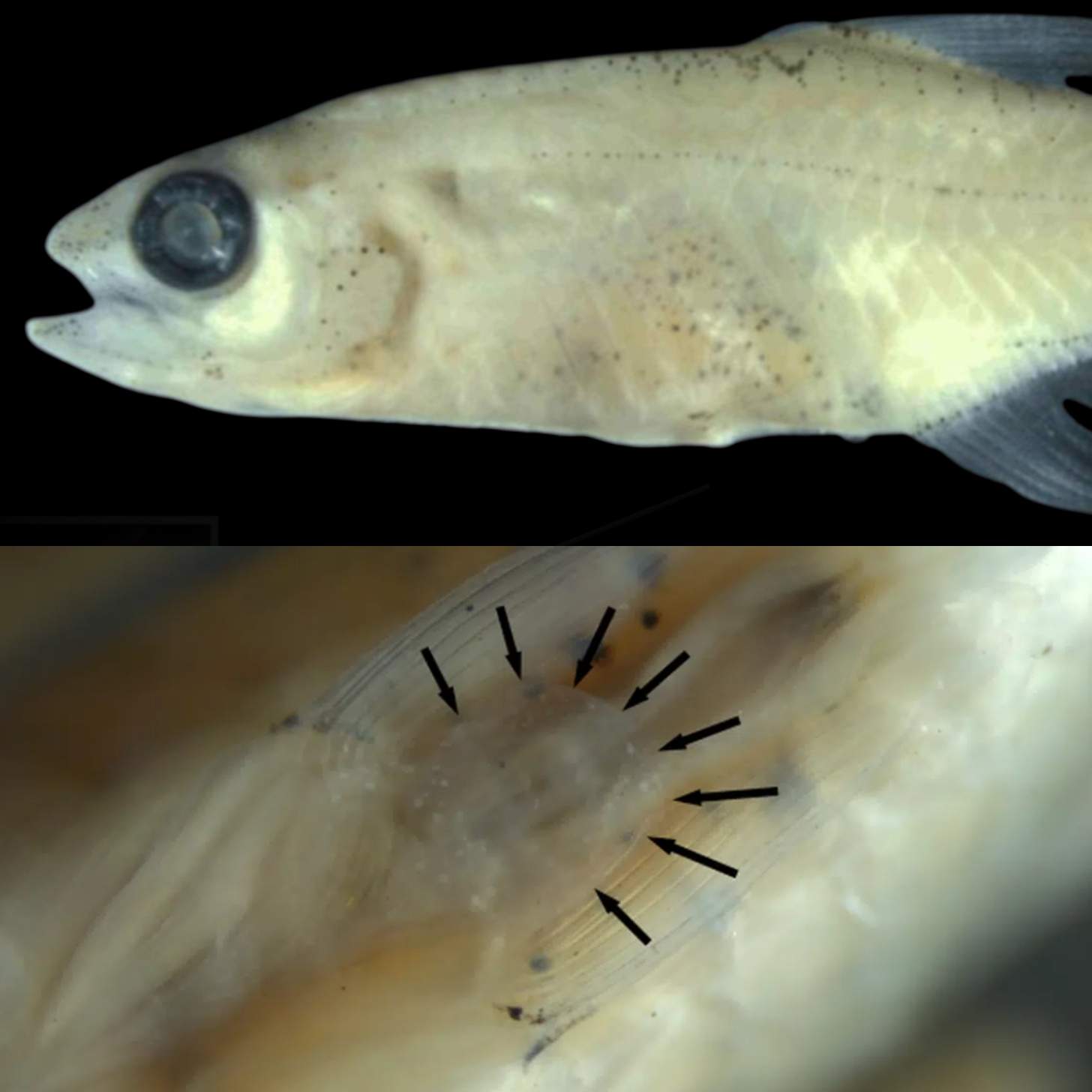
The curtain-like skin wing hangs loosely between its pelvic fins — and it's an organ never seen before in any other species of Priocharax, or any similar fish.
“I had never seen such [a] structure in any other fish!” said George Mendes Taliaferro-Mattox, a fish biologist at the Federal University of São Carlos in Brazil and lead author of the study — which was published in Zootaxa. “It is almost like a chastity belt, which is present in both males and females.”
When it comes to its function, Taliaferro-Mattox said it’s “too soon to speculate on its function.”
“The main importance of this structure so far is the fact that it is unique to this species, as far as I know,” he said.
Although it requires further study, Taliaferro-Mattox and his colleagues do have a few ideas regarding the organ’s potential use. They suggested that it may be able to help it remain stable in a strong current, house extra nerve endings, or be used in a courtship display for potential mates.
Overall, the new research shows that even tiny, miniaturized fish, which often have simplified or reduced anatomy, can evolve brand-new structures — like the strange skin flap.
You may also like: New creature with 'visible internal organs' discovered by scientists. It looks straight out of a Studio Ghibli movie
Header image via Flickr / Dallas Krentzel (CC BY 2.0)