This story was originally published by The 19th and was republished with permission.
BLUE ASH, OHIO — The first Haitian immigrant reported to the Immigration and Customs Enforcement field office at 7:42 a.m. on Sunday. From the corner, the Catholic sisters watched, their positions on immigration stamped on banners and signs.
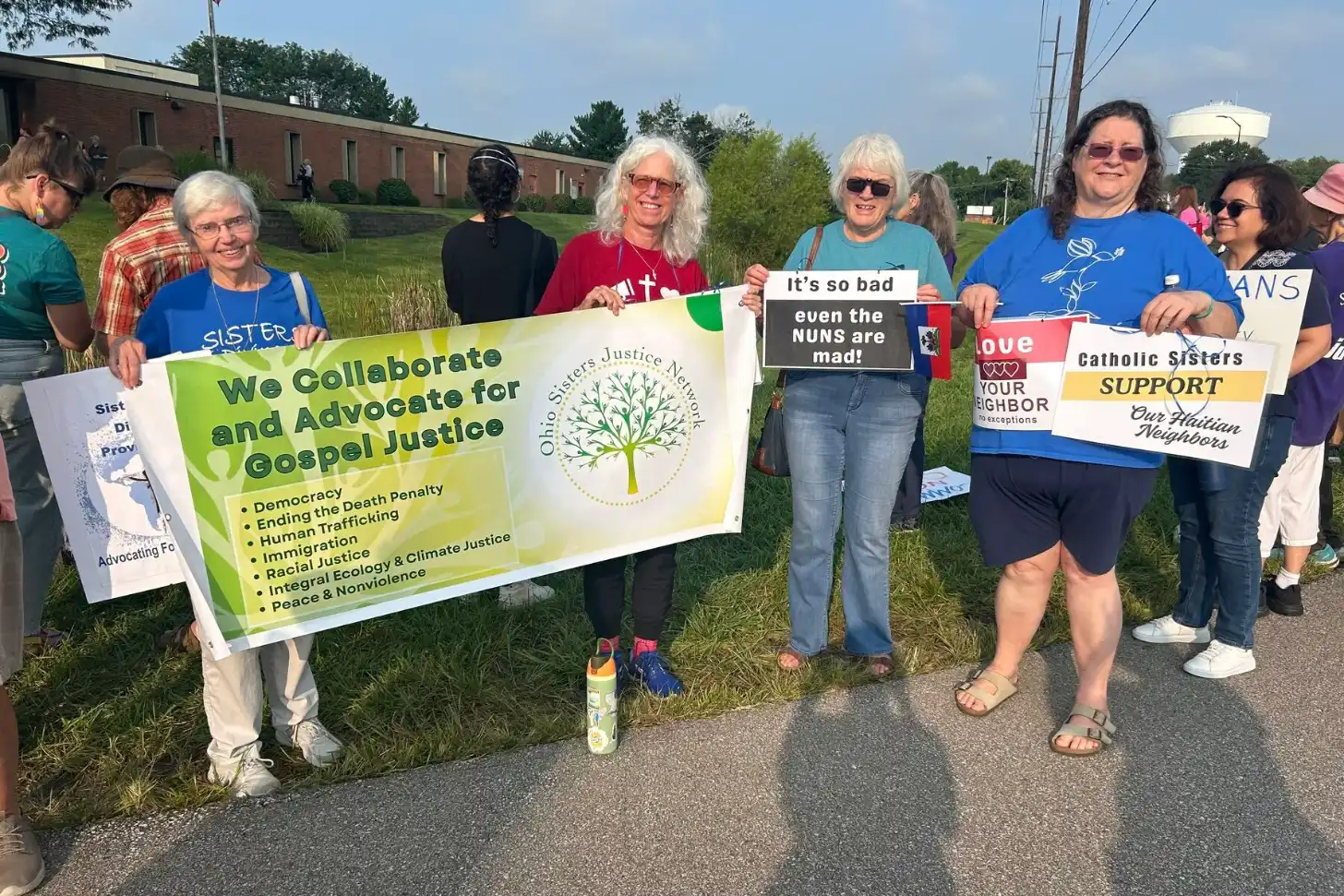
Sister Alice Gerdeman’s sign noted that her order, the Sisters of Divine Providence, supports “challenging systems that exclude.” Sister Sandy Howe’s sign read, “Love Your Neighbor, no exceptions.” Sister Patricia Wittberg’s took a more direct approach: “It’s so bad even the NUNS are mad!”
“Where has our conscience gone as a society?” Sister Carren Herring asked as the Haitian man walked toward the field office, where he would reemerge from hours later with a GPS tracker clamped around an ankle.
There would be a dozen or so more like him that day, mostly Springfield-area Haitian residents summoned to report to ICE after the Trump administration ended Temporary Protected Status, or TPS, for the country.
The program has allowed hundreds of thousands of Haitians to live and work legally in the United States due to violence and political instability back home.
The man paused before entering the ICE Enforcement and Removal Operations office. At the door, Springfield pastors were offering communion and prayer. He waved to the crowd of nearly 700 lining the street in support.
“ICE does not speak for the people! No neighbor of ours is illegal!” they chanted in early-morning humidity that portended an oppressively hot August day.
The group of sisters positioned on the corner in front of the office were from different orders: Sisters of Mercy, Sisters of the Precious Blood, Sisters of Charity, and Sisters of Divine Providence. They are united by their faith and shared ministry, the Ohio Sisters Justice Network, whose banner described the network’s use of “gospel justice” to protect democracy, end human trafficking, and support immigrants.
That included advocating that the Trump administration extend TPS for Haitians. Now, it means showing up to support them as immigration enforcement tightens its grip.
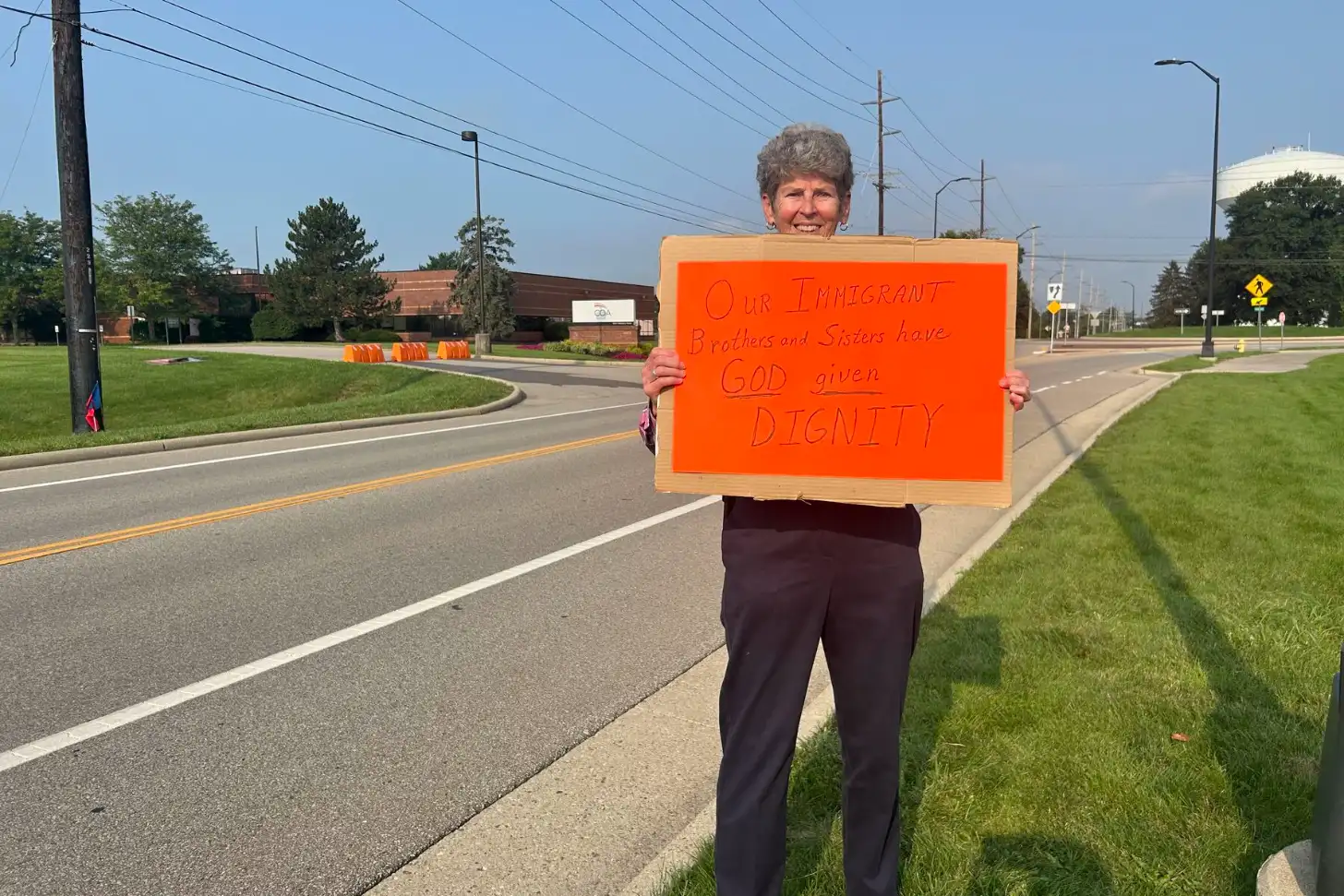
“I’ve had people say to me, ‘Sister, they need to come here legally.’ Well, they came here legally,” said Sister Sally Duffy, a Sister of Charity and active participant in the network. She held a handwritten orange sign that read: “Our Immigrant Brothers and Sisters have God given DIGNITY.”
“We are changing the rules,” she continued. “If it was a Bengals football game, and it was the last second on the clock, and the field goal kicker was going to make a 30-yard field goal, and all of a sudden, no, we moved him back, so now it became a 70-yard field goal, there’d be an uproar, an outrage over changing the rules.”
Late last month, ICE started sending letters to Haitians in Springfield, informing them that the Trump administration would begin to enforce the end of TPS for Haiti, a plan greenlit by the Supreme Court. Haitian immigrants have been reporting to the ICE office in this Cincinnati suburb since.
In Springfield, a city of 60,000 about an hour’s drive north of the ICE office, roughly one in four residents are Haitian — and many of them were on TPS. For months, faith-based and secular groups there have marshaled thousands of volunteers to prepare for a potential mass deportation event they fear could result in a humanitarian crisis.
Many have wondered what will happen when families are separated: Who will care for the U.S.-born, citizen children who may be left behind?
Now, these volunteers have expanded their efforts to Blue Ash, which has one of the closest ICE offices.
President Donald Trump pledged during his 2024 campaign to undertake the “largest deportation of criminals in the history of America.” He and Vice President JD Vance, who was then a U.S. senator representing Ohio, specifically targeted Haitians living in Springfield, spreading the lie that the legal immigrants were eating their neighbors’ pets. White nationalist groups descended on the city; bomb threats closed area public schools.
The Springfield community watched with trepidation as Trump’s “Operation Metro Surge” wrought havoc on much-larger Minneapolis earlier this year, leading to the deaths of two U.S. citizens, Alex Pretti and Renee Nicole Good.
Organizations working with Haitians in Springfield started stockpiling supplies and forming ICE patrols to prepare for a similar enforcement surge as in Minneapolis — but the surge never arrived.
Gregory Bovino, the commander-at-large of Trump’s Customs and Border Protection, was removed from his position in January after the deaths. Two months later, Markwayne Mullin replaced Kristi Noem as secretary of the Department of Homeland Security. Federal immigration agents dialed down their street presence in Minneapolis amid intense public backlash against the administration’s tactics, prompting a shift in enforcement strategy.
The sisters paid attention.
“They don’t want another Minneapolis … but they’d love for all the Haitians to be deported in secret,” Sister Wittberg said. “I don’t know that we can do anything but witness that this is not a Christian thing to do.”
A Department of Homeland Security spokesperson reiterated in an email that TPS was supposed to be temporary, writing: “Every day, DHS is conducting law enforcement activities across the country to keep Americans safe. DHS does not discuss ongoing or future operations.”
Catholic sisters are playing a key role among clergy and other religious leaders who have been organizing demonstrations and vigils at ICE field offices and processing centers in places like Chicago, Pittsburgh, and Philadelphia. Religious leaders present in Blue Ash on Sunday also included women serving as a Jewish rabbi, a Baptist minister, and a Muslim chaplain.
When Cincinnati-based Ignite Peace, a group founded by Catholic sisters that has since become an interfaith organization, planned the “ICE: We See You” response for Sunday, they encouraged participants to wear “religious garments.”
After all, the action would happen on a day and time when many would otherwise be attending religious services.
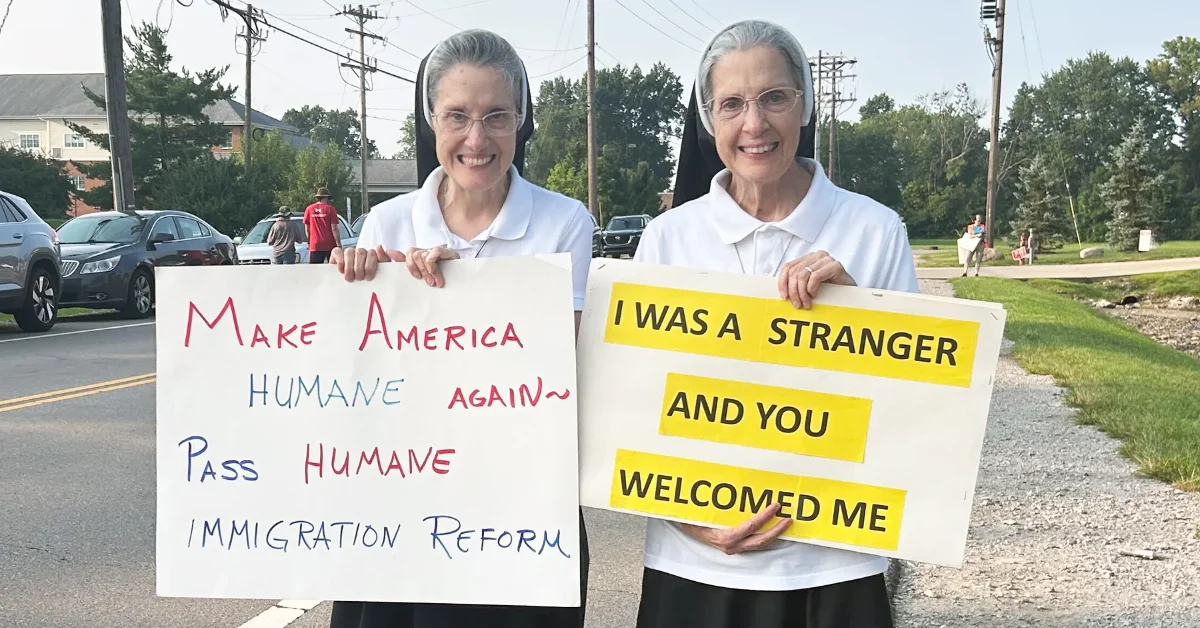
Sisters Anita Marie and Maria Francine, biological twins with the Sisters of Notre Dame, stood at the door to the ICE office wearing their traditional habits. Pastor Carl Ruby of Springfield’s Central Christian Church and Viles Dorsainvil, a Moravian pastor and founder of Springfield’s Haitian Support Center, offered Haitian immigrants the sacrament before their appointments.
The sisters both said they would typically be praying quietly in their rooms early on a Sunday, ahead of attending Mass.
“And this,” Sister Anita Marie said, “is a type of prayer.”
Featured Image: Amanda Becker/The 19th