When Jackson Farmer was in kindergarten at Red Cross Elementary School in Glasgow, Kentucky, one of his teachers noticed that he would often come to school wearing a rubber hand.
Farmer was born without a right hand, and the rubber device didn’t give him any functionality, but it did provide the appearance of having a hand.
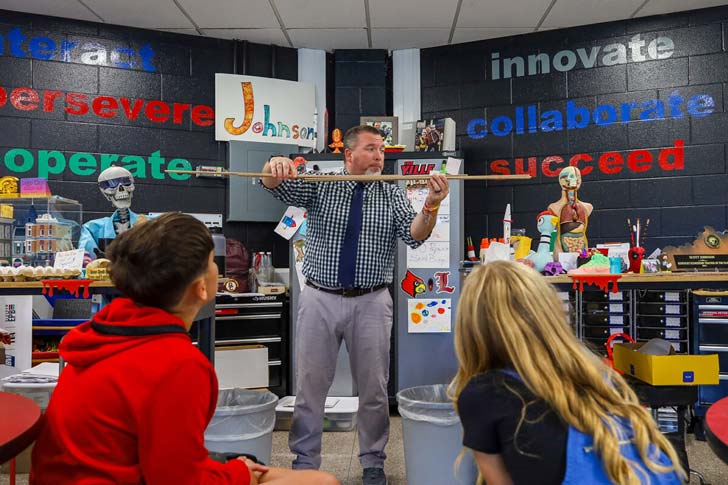
That teacher, Scott Johnson, is a science, technology, engineering, art, and mathematics educator at the school, working in a lab environment for every student, whether they’re in kindergarten, all the way up to sixth grade.
As he followed Farmer’s educational journey over the years, they grew a special bond.
“The first year we met, he was a kindergartener and he cracked a joke at me, ‘Hey, do you need a you need an extra hand?’” Johnson told WDRB News.
“And all of a sudden, he pulled off his silicone hand and started to hand it to me and I was like, ‘Oh, buddy.’ Like, he got me hooked, line, and sinker.”
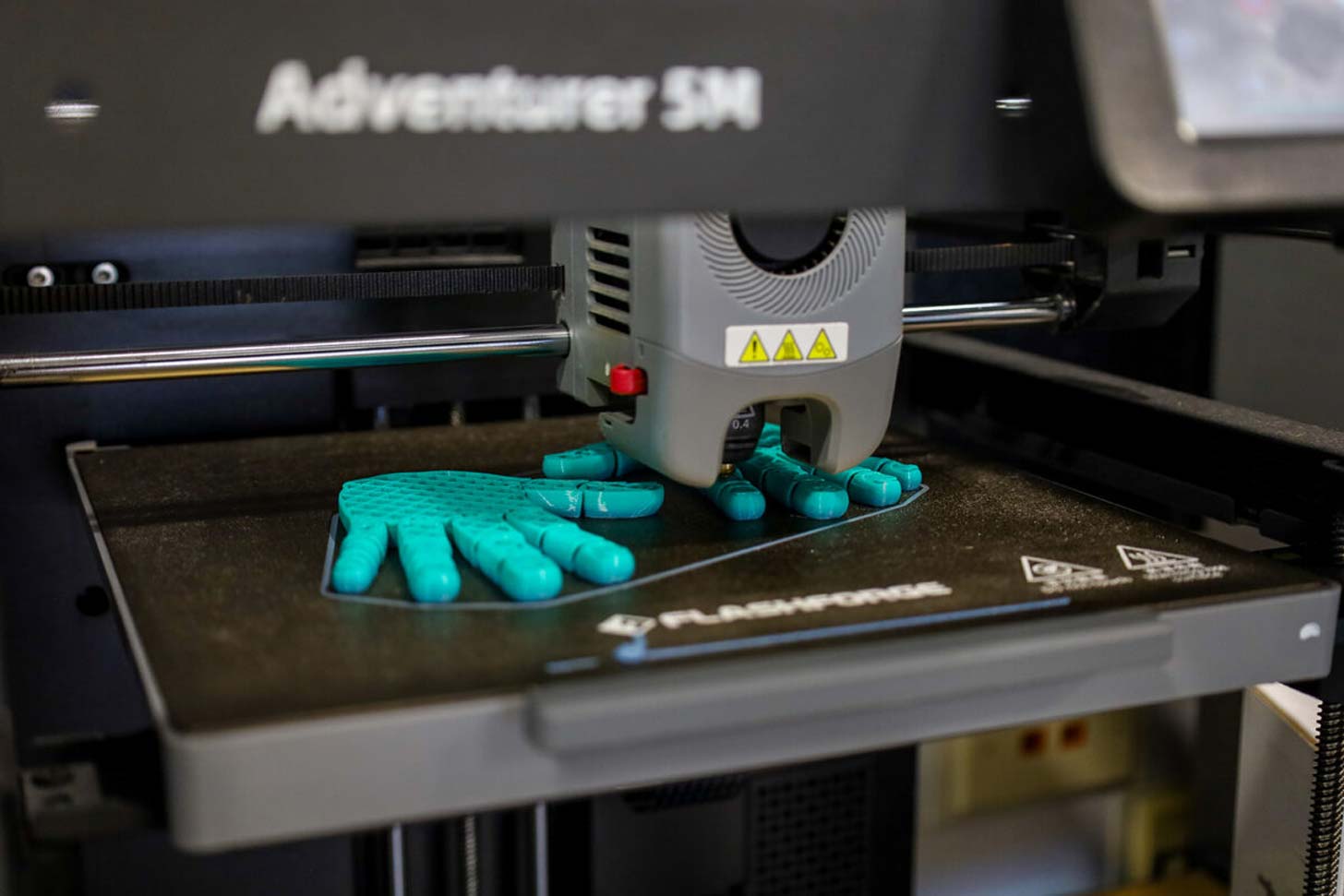
Part of Johnson’s STEAM curriculum includes 3D printing with students, and last year, he had the idea to start figuring out how to create a working prosthetic hand for Farmer in the school’s lab.
“I just started getting more curious and wondering if there was something that we could make here in the lab that he could actually use in his real life,” Johnson told WDRB News.
Whenever he had a free moment, he would work on developing the design, especially with the help of E-Nable, an online community of volunteers who use 3D printers to make free or low-cost prosthetics for children and adults with limb differences.
For about a year, he went through trial-and-error to create the right thing, even consulting with an engineer from Denmark to perfect the design files.
And he managed to keep it a secret the whole time.
“For the longest time, I didn’t tell anyone other than my wife what I was working on,” Johnson told Kentucky Teacher, a blog from the state’s education department.
“What if I found out I was trying to do something far beyond my skill set? I didn’t want to falsely get anyone’s hopes up.”
Eventually, he created a prototype and showed it to the Farmers, who — very excitedly — gave him permission to proceed with the final product.
That final iteration took 25 hours to print, with all of the parts needed for a full hand made right in the school’s STEAM lab. Once everything was accounted for, it took about four hours to assemble the hand. Instead of using batteries or electronic power, the 3D-printed prosthetic is a simple machine that moves by the power of Jackson’s wrist.
“I never wanted him to feel like he had something heavy on his wrist; I want him to be able to play, so it’s pretty lightweight,” Johnson told Kentucky Teacher.
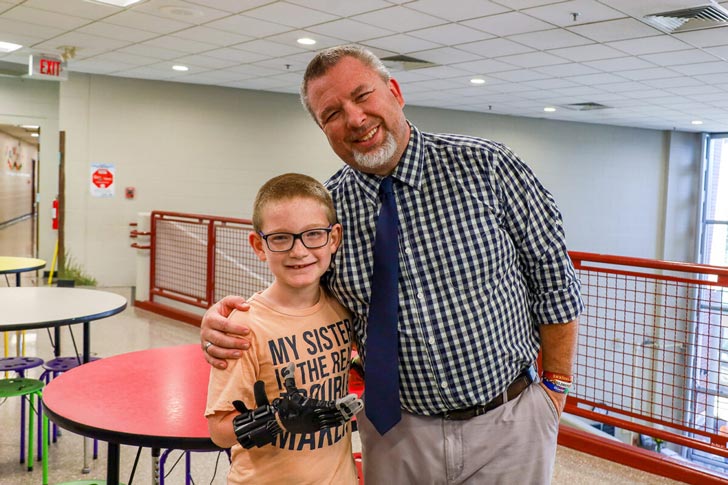
The fingers are attached to the hand with fishing lines, and a fulcrum lever helps them move. When Farmer flexes his wrist down, the fingers close. When he relaxes his arm, the hand opens up.
“It felt great. It felt like it was just right,” Farmer, who is now in fourth grade, said. “[My favorite thing is] trying to write [with the hand] … I’m not that good, but I try.”
The prosthetic was also printed out of a biomaterial — corn plastic — and features rubber fingertips on the outside and foam on the inside, so the device would be more comfortable on Farmer’s skin.
The total cost of the materials was between $20 and $30.
“It just makes me feel like, ‘yay, I get to do stuff on my own,’” Farmer told WDRB News.
It’s a newfound freedom that will help him continue through school with ease. And it’s been a game-changer for Johnson, too, who was named the 2025 Kentucky Teacher of the Year.
Although he was the brains behind Farmer’s new hand, it still provides a unique learning experience for the student.
If the prosthetic needs a repair, or if Farmer grows out of it, new pieces can be printed right in the school lab. (Farmer has reportedly already gone through three palms while playing rough at recess, and he also helped Johnson reprint a thumb for his prosthetic.)
“In the end, Jackson will be able to do all this work without me,” Johnson told WDRB News.
Farmer will have the printing files to reprint the hand on his own as he grows up and out of Red Cross Elementary School.
And Johnson will continue doing what he does best.
“All of my students, all of their backgrounds and their different ability levels, can create in our space,” the teacher said when he was named Teacher of the Year.
“We don’t treat our content as a subject or a means to a grade, but rather as information for life. This is especially crucial as we try to dissolve the barriers between our school and the real world.”
You may also like: Meal time was extra challenging for this disabled first grader, so a lunch lady made him a custom 'cafeteria cart'
Header image by Fiona Morgan/Kentucky Department of Education