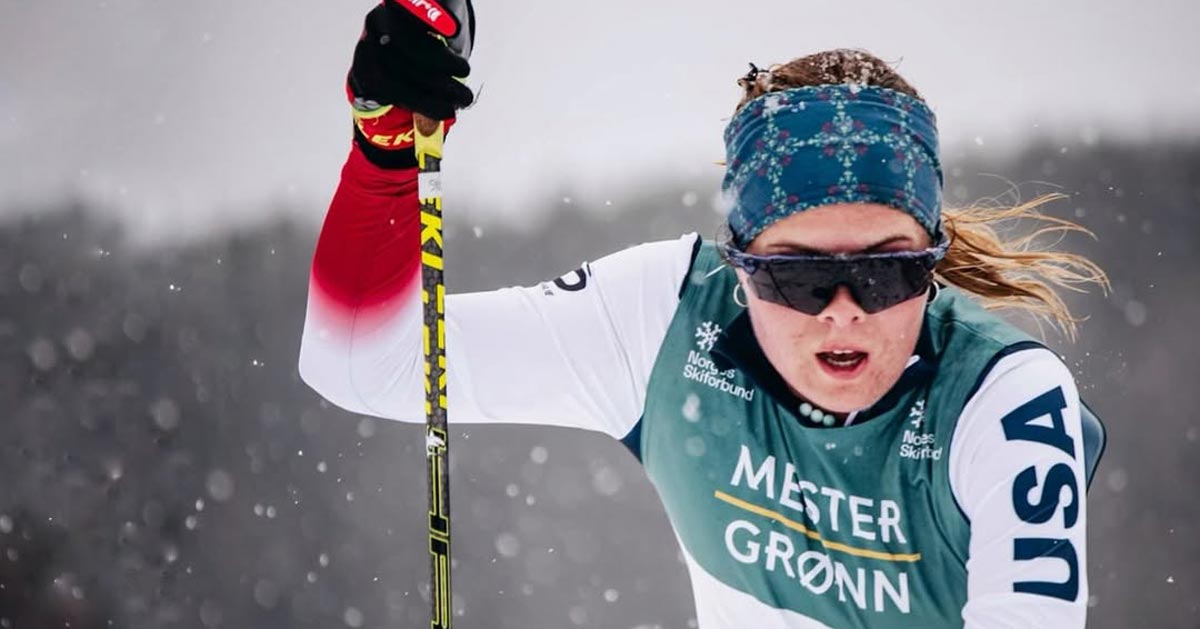
Sydney Peterson has felt at home on the slopes since she was five years old, cross-country skiing since her early childhood.
But when she was 13, she started experiencing symptoms of what would eventually be diagnosed as dystonia, a condition that caused involuntary muscle contractions in Peterson’s left arm and leg due to faulty signals sent from the brain.
But that didn’t stop her from skiing.
She competed on her high school team, training intensively and participating in national competitions. But when she was formally diagnosed with dystonia at 19, she turned to Paralympic competition instead.
“I never started skiing because I wanted to become an Olympian,” she told the NCAA. “I just started skiing because I loved to ski. … Each thing gradually led me there, which is really cool.”

Now, she skis with one pole and a custom left ankle brace to help her glide across the snow. Her left arm and leg are partially paralyzed, though a brain surgery in her undergraduate years has helped slow down the progression of her condition.
In 2022, Peterson won three medals at the World Para Snow Sports Championships and made her Paralympic debut just two months later, bringing home three medals from Beijing, including silver, bronze, and a gold as a member of the United States mixed relay team.
She’s back to compete again in Milan Cortina, but winning another medal isn’t the only thing on her mind.
Aside from being a Nordic skier on the U.S. Paralympic team, Peterson is working towards her PhD at the University of Utah, where she studies neuroscience — specifically movement disorders similar to her own condition.
Working in a rare disease lab, Peterson and her fellow researchers are testing the effectiveness of different drugs on certain genetic movement disorders. The medications the lab is testing are already approved by the Food and Drug Administration, and they are testing them on fruit flies to see which drugs might apply to certain movement disorders.
They aren’t specifically investigating Peterson’s condition, but there is overlap in the research.
“A lot of the drugs we test here, I've taken them before,” Peterson told NPR.
The 24-year-old found that learning more about her own condition made her interested in diving deeper into neuroscience.
“Once you start learning more about the brain, it's really hard to not want to go deeper. I don't study my exact disease. I wouldn't want to do that. That would be too deep,” she told NCAA. “But I think I’ve seen how beneficial research can be.”
According to NPR, Peterson’s disorder can’t be cured, though treatments and interventions like brain surgery have helped her manage her condition. Her goal now is to help others, too.
“It definitely all fueled my interest in science,” she told Team USA, of her condition. “I wanted to learn about what was happening to myself, and I wanted to try and see if I could help other people.”
And while she’s at the top of her game as a para athlete, her academic career provides another path — one she can pursue alongside her elite athletic dreams, and one that will give her a future outside of sports, too.
“I entered college with four functioning limbs. And then throughout my sophomore year, now my arm and leg are slowly losing function,” Peterson recalled to the NCAA.
“[Living with dystonia] can feel like your body’s just constantly betraying you, and it feels like you can never put a plan in place because then you have to constantly change that plan, which is tough.”
But for now, she has her eyes on the next race.
“If you’re passionate about something, don’t avoid it just because it seems challenging,” she told Team USA.
“Anything you want to pursue — whether you have a disability or not — is going to be challenging. You might as well go for it. If you do what you think will be worthwhile and surround yourself with people you enjoy being around, it will pay off.”
You may also like: A Paralympic snowboarder made his own prosthetic leg. Now, 25 of his competitors will wear his designs in Italy
Header image courtesy of Sydney Peterson/Instagram