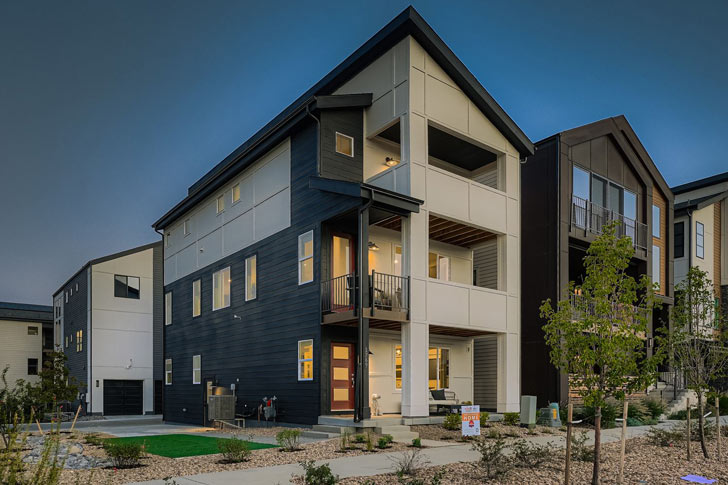
In Broomfield, Colorado, a new mixed-use community called Baseline is challenging the traditional suburban setup.
It all started in 2019, when nonprofit Butterfly Pavilion wanted to create a movement that confronted the habitat destruction of the nation’s pollinators like bees, butterflies, moths, and beetles.
These critical species are vital in producing the food we eat every day, but they’re also a key part of the whole ecosystem.

“They keep wetlands going. They keep our grasslands going. They make sure forests are diverse,” Amy Yarger, director of horticulture at the Butterfly Pavilion, told the Colorado Sun.
“And if they can keep those plant communities healthy and reproducing by assisting plants in their reproduction, that means our water is filtered, and we can hold on to our soil and not just have a big old dust bowl.”
So, the conservation organization came up with the idea of “pollinator districts,” or communities that are strategically designed and maintained to support pollinator habitat growth.
“At Butterfly Pavilion, we believe conservation is strongest when people work together,” the organization writes in a blog post. “When science, planning, and community commitment align, pollinators respond.”

Baseline became the blueprint.
While other Colorado cities, like the city of Manitou Springs, and Lafayette, are dedicated to the municipal pollinator district charge, Baseline was the first in the world to embrace the concept.
The neighborhood was once agricultural land that was used for growing wheat and later became uncultivated. Now, it’s home to 1,200 move-in-ready multifamily units that start in the low $500,000s, slightly cheaper than the median sale price for a standard home in Broomfield — between $600,000 and $625,000 in early 2026.
But the price isn’t the only attractive factor. The community is full of bike paths and trails, with a “pocket park” no more than 1,600 feet (or about 0.3 miles) away from any home. Every unit also meets Home Energy Rating System requirements, and all of the plants in the area are drought-tolerant, native plants that attract pollinators. In total, 170 acres of the community are dedicated to natural spaces and gardens.
And it’s working.
Before construction began at the development, scientists documented only 11 families of pollinators. By late summer 2025, scientists documented pollinators in 27 different families.
“This marked a significant increase in diversity compared to earlier years and reflected steady growth in both native pollinators and honey bees,” Butterfly Pavilion reported.
“Researchers consistently observed pollinators visiting native plants selected for habitat value and recorded broadtail hummingbirds, one of the region’s few vertebrate pollinators, for the first time. Several insect families, including longhorn beetles, plasterer bees, and digger wasps, were also documented at Baseline for the first time.”
In fact, scientists saw a 272% increase in Western honeybees in 2025 compared to the year prior. And in addition to the growth in pollinator families, individual pollinator counts jumped from 587 in 2023 to 3,805 in 2025.

Yarger told the Colorado Sun that residents seem to be invested in the success of their neighboring pollinators.
When she is out doing surveys in the community, she said, “homeowners will come outside and want to tell me what they’ve been seeing. They just feel like I’m somebody that has things they want to talk about. They know I’m there for the pollinator district and they have ownership in that.”
To become a certified pollinator district, these surveys are required, and Butterfly Pavilion experts are bringing the approach to more transportation corridors and communities in Colorado’s Front Range.
It starts by documenting how these areas look now, and what recommendations scientists can provide to manage the landscape for prime pollinating.

For Yarger, this approach makes her feel “like … we have a way forward,” she told the Colorado Sun.
And science backs it up.
“This long-term, evidence-based approach mirrors the Pollinator District model developed at Baseline: assess first, design intentionally, monitor consistently, and adapt based on results,” Butterfly Pavilion concluded.
“Infrastructure can support biodiversity when guided by science and long-term stewardship.”
You may also like: Cities across Europe install 'moss banks' to reduce pollution from busy roadways
Header image courtesy of Baseline Community