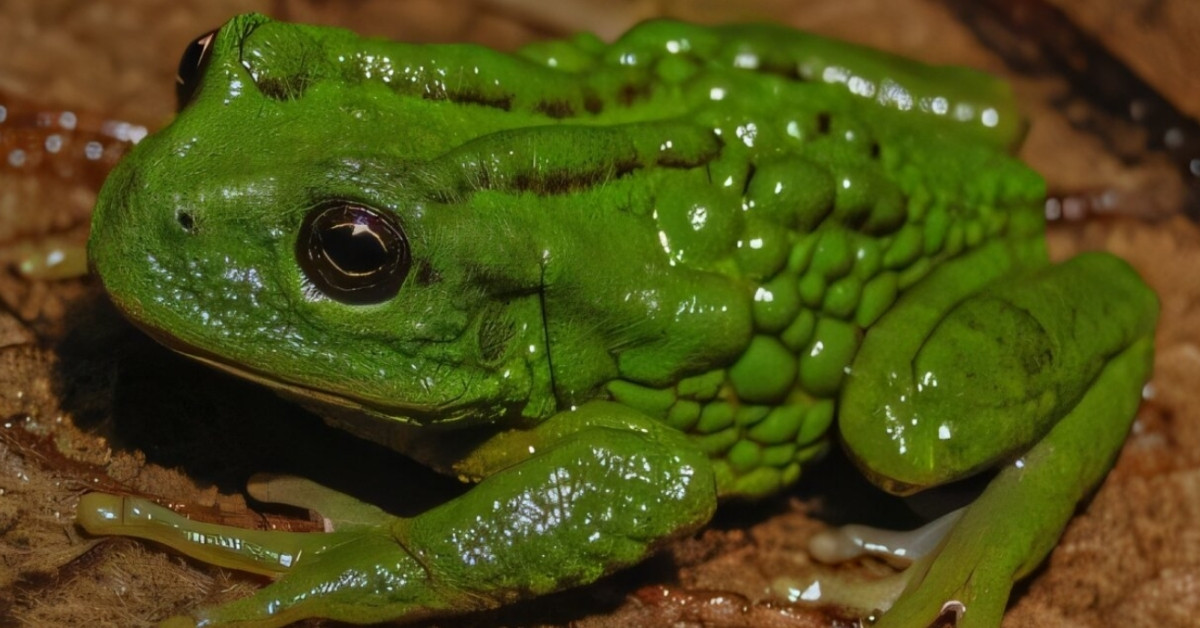
While surveying the cloud forests of Peru, a group of herpetologists recently stumbled upon a new species of amphibian — a rare “marsupial” frog that carries its eggs in a pouch on its back.
In a study published in the New Zealand scientific journal Zootaxa, the researchers said the new frog — Gastrotheca mittaliiti — measured in at just 2.7 to 3.3 centimeters (1 to 1.3 inches) and was discovered in a mountainous Amazonas region bordering Ecuador.
“Our results highlight the Huancabamba region as the hotspot of Gastrotheca species richness,” the researchers said.
The new species was distinguishable from other frogs in its genus by several physical traits, such as its small size, rough and bumpy skin, raised ridges along its back, and “narrow discs on fingers and toes.”
Among over 7,700 known species of frogs, marsupial frogs are some of the most fascinating.
The females have a special pouch on their back — a rare trait among amphibians — and after the eggs are fertilized, the male helps place the eggs into this pouch using his toes.
The eggs then stay inside the pouch while they develop. Inside, they stay connected to the mother’s body, which gives them oxygen to help them grow.

In 2016, ecologists Robin W. Warne and Alessandro Catenazzi made a groundbreaking discovery while studying marsupial frogs.
By using a special method to track nutrients — like fats and proteins — from the mother to the embryos, they found that nutrients from the mother actually move into the developing babies.
Until then, it was thought that the frog pouches were built largely for protection.
However, Warne and Catenazzi proved that marsupial frog mothers don’t just carry their babies; they actually feed them nutrients while they grow inside the pouch, similar to how some mammals support their young.
“This finding revealed a suspected but untested trait in the evolution of parental care in marsupial frogs, in contrast to previous work on Gastrotheca species that release tadpoles, and suggests greater complexity in reproductive and provisioning modes than previously thought,” Catenazzi and Warne observed in their study, which was published in the scientific journal Biology Letters.
To date, scientists have found 74 frogs in the genus Gastrotheca.

This includes the Guenther's marsupial frog (Gastrotheca guentheri), which is the only known frog with true teeth in its lower jaw, and the horned marsupial frog (Gastrotheca cornuta), which makes a mating call that sounds like a champagne cork being popped.
Manuel Oliva, director of Toribio Rodriguez de Mendoza National University’s Ceja de Selva Research Institute for Sustainable Development, told AFP that with the discovery of the Gastrotheca mittaliiti, herpetologists have been able to paint a better picture of the frog genus — and how to protect them.
“This is further evidence of the enormous natural wealth we possess ... If we continue our research, there are many species still waiting to be discovered,” Oliva told AFP.
You may also like: Scientists discover three new species of toad that give birth to tiny 'toadlets,' skipping the tadpole phase altogether