If there is one thing most people wouldn’t want to stumble across in the forests of the Philippines, a giant spider would probably be one of them.
But a pile of bird droppings probably wouldn’t be far behind.
And one scientist appeared to come across both during a research expedition assigned by the Russian Federation’s Ministry of Science and Higher Education.
Well, one posing as the other.
In 2025, arachnologist Mikhail M. Omelko came across a rare bird-dropping crab spider, a spider that can mimic the likeness of a pile of bird poop.
“These spiders are often referred to as bird-dropping crab spiders due to their remarkable mimicry as their body shape and coloration closely resemble bird droppings on leaf surfaces,” Omelko wrote in a new study, which was published in the scientific journal ZooKeys on October 24.
“To enhance this deceptive appearance, these spiders construct a thin white silk patch on a leaf and place insect remains within it; the spider itself rests in the center of this structure.”
Omelko works at the Federal Scientific Center of East Asia Terrestrial Biodiversity at the Russian Academy of Sciences in Vladivostok, Russia. His expeditions have led to numerous new species identifications since 2020.

According to his latest study, this is the first spider in the Phrynarachne genus found in the Philippines.
Remarkably, the new species of Phrynarachne gorochovi, or bird dropping crab spider, doesn’t just mask itself to resemble a harmless pile of bird poop — it also pulls off the magic trick of smelling like one too.
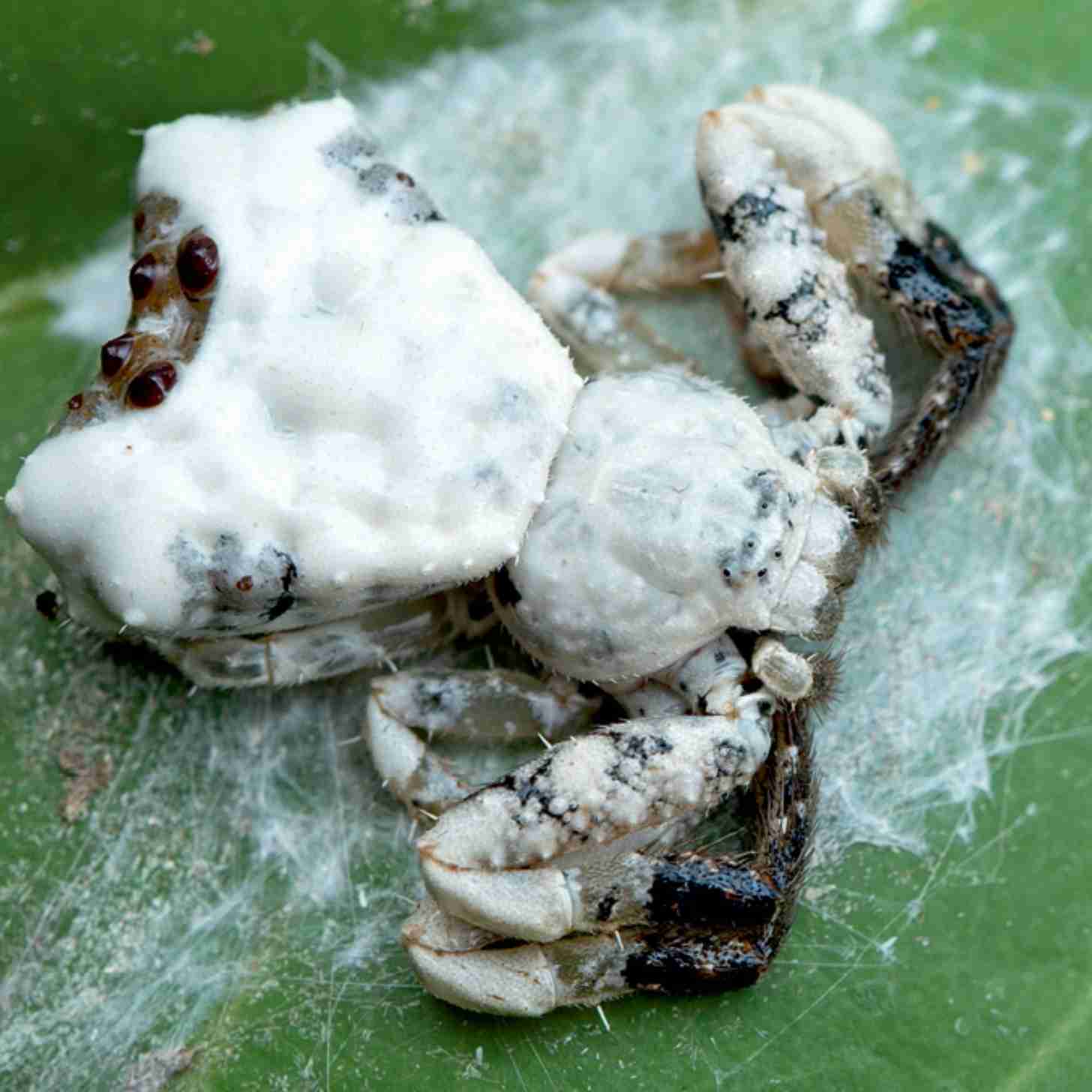
“In addition to this striking morphology and behavior, Phrynarachne spiders emit a distinct foul odor that attracts insects such as flies,” Omelko observed.
Crab spiders are named after “crabs” for a number of reasons: the flatness of their back, the length of their two front legs, and their sideways movement.
Like most spiders, crab spiders benefit their surroundings by eliminating pests — in this case, flies — and helping natural flowers around them grow.
This new species of crab spider, in particular, is yellow with several dark brown spots and bumps across its body and carapace.
This spider is just the latest in a string of exciting discoveries in the last year, including a red “oddball” velvet ladybird spider with never-before-seen features and a methane-eating deep-sea spider found 3,000 feet below the ocean’s surface.
You may also like: A new species of spider with 'never-before-seen features' was discovered in Southern Morocco. It looks like a Pokémon
Header image via Asenka79 CC BY-NC 4.0