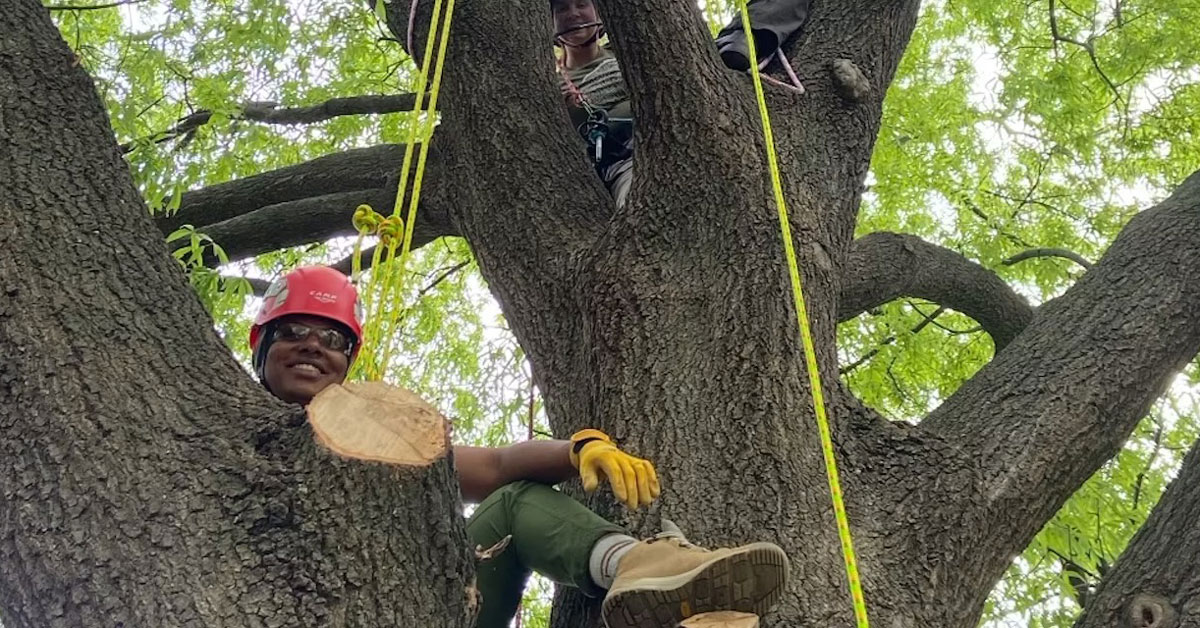
Students who study forestry will read about trees, but they do not often get the chance to climb up into a tree, feel its branches, and see its leaves up close.
After observing how many forestry courses gave students limited chances to learn through hands-on experiences, I attended a workshop to gain tree-climbing skills and brought some of these lessons back to my own university’s new urban forestry program.
Forestry students at the University of Tennessee, Knoxville, now learn about trees in the classroom and on laptops, but also from 50 feet above the ground. In the process, they gain practical tree-climbing skills, including knot-tying, how to set a climbing line, and basic techniques that help them go up, down, and across trees.
Cities and trees
I designed the course Principles of Urban Forestry to teach students about the history, benefits, and costs of growing and maintaining trees in cities.
Many trees grow near homes, sidewalks, roads, buildings, and utility lines in cities. Climbing is one way tree-care professionals can safely reach these trees to prune branches, look for signs of disease, and assess possible risks.
During the first 10 weeks of the course, students learn how people, trees and cities changed as communities across the country urbanized. They also begin building basic tree-climbing skills by using 6-foot ropes to learn safety techniques, such as tying climbing knots.
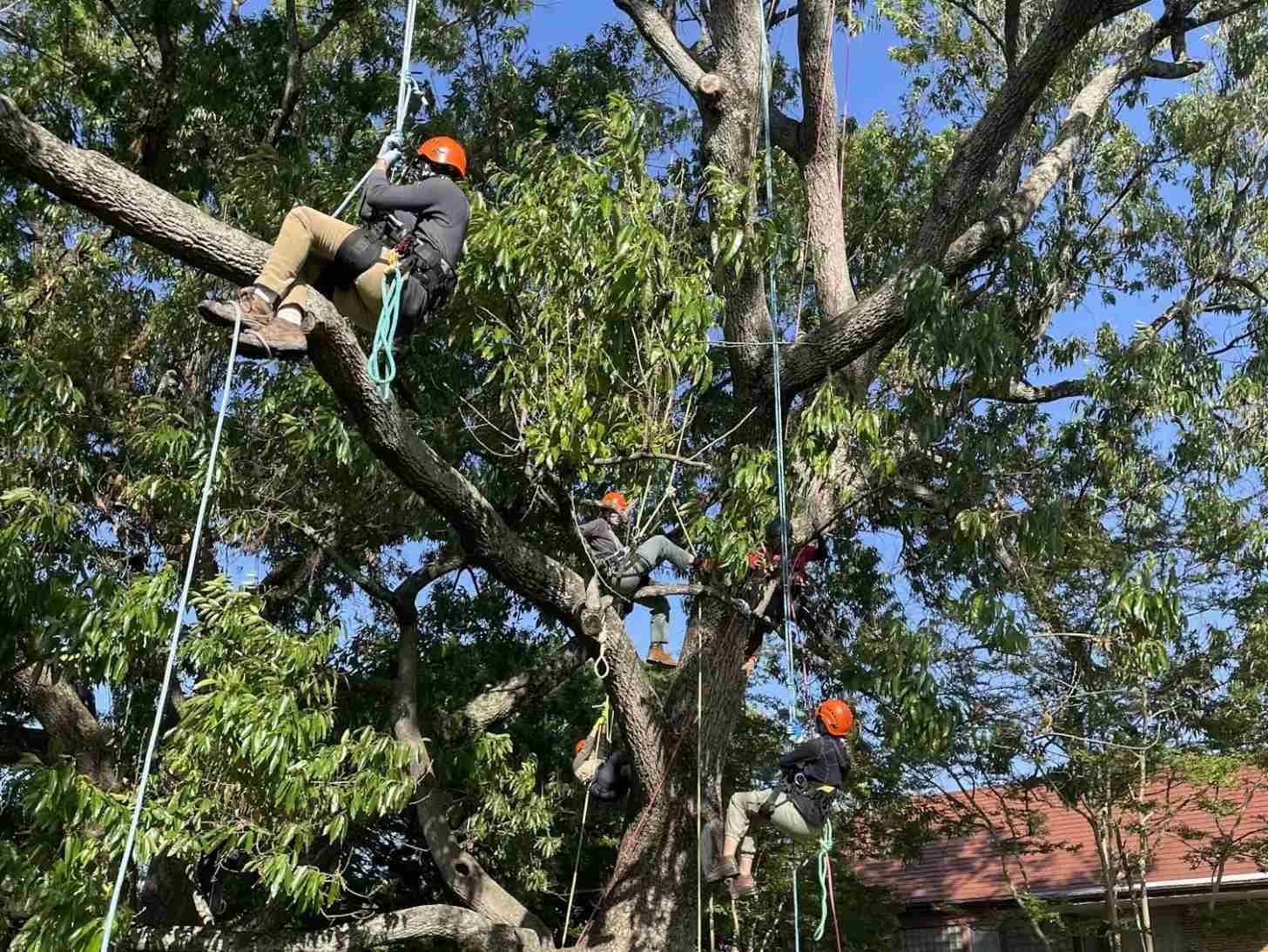
For the last five weeks of the course, students climb trees on the University of Tennessee’s Institute of Agriculture campus in Knoxville. Most students climb to heights of about 50 feet. But some students ascend sawtooth oaks, which can stretch up to 69 feet tall.
These trees have strong branching structures and enough space for students to safely learn different climbing techniques. Students first learn how to move up and down the tree, using a technique called body or hip thrusting. They then practice moving through the tree canopy and learn to limb walk, an advanced practice of traversing thinner branches.
The exercise helps them understand tree structure, movement, and care from inside the tree’s canopy.
A focus on trees
Over the past 30 years, the U.S. Forest Service and other organizations have encouraged city dwellers to think differently about trees and greenery, and to promote planting and protecting trees along streets and in parks and other public spaces.
This work has involved planting the right trees in the right places, regularly pruning branches, and monitoring tree health.
The care and management of city trees directly affects most Americans. Approximately 80% of the U.S. population lived in urban areas in 2020.
The shade from trees can cool neighborhoods that would otherwise bake in the sun. Trees also improve air quality by absorbing carbon dioxide and pollutants through their leaves and releasing oxygen.
Even though many students in this course may not choose careers in tree care, the course helps them understand why trees are important to communities.
Climbing isn’t just a physical skill
Through tree climbing, students begin to understand the unique challenges of caring for trees in cities in a practical way.
Students learn that they, too, can help communities care for trees safely and responsibly. City residents, politicians, planners, scientists, and tree-care professionals ideally need to all work together to decide specifics, such as where trees should be planted and how all neighborhoods can benefit from healthy trees.
Ultimately, this course encourages students to look up, be more observant, and better understand the places where they study, work, and live. By paying closer attention to trees in their neighborhoods, students begin to see how trees affect shade, safety, comfort, beauty, and the overall quality of daily life.
This article was written by Sharon Jean-Philippe from University of Tennessee and was originally published on The Conversation.
Header Image by Sharon Jean-Philippe